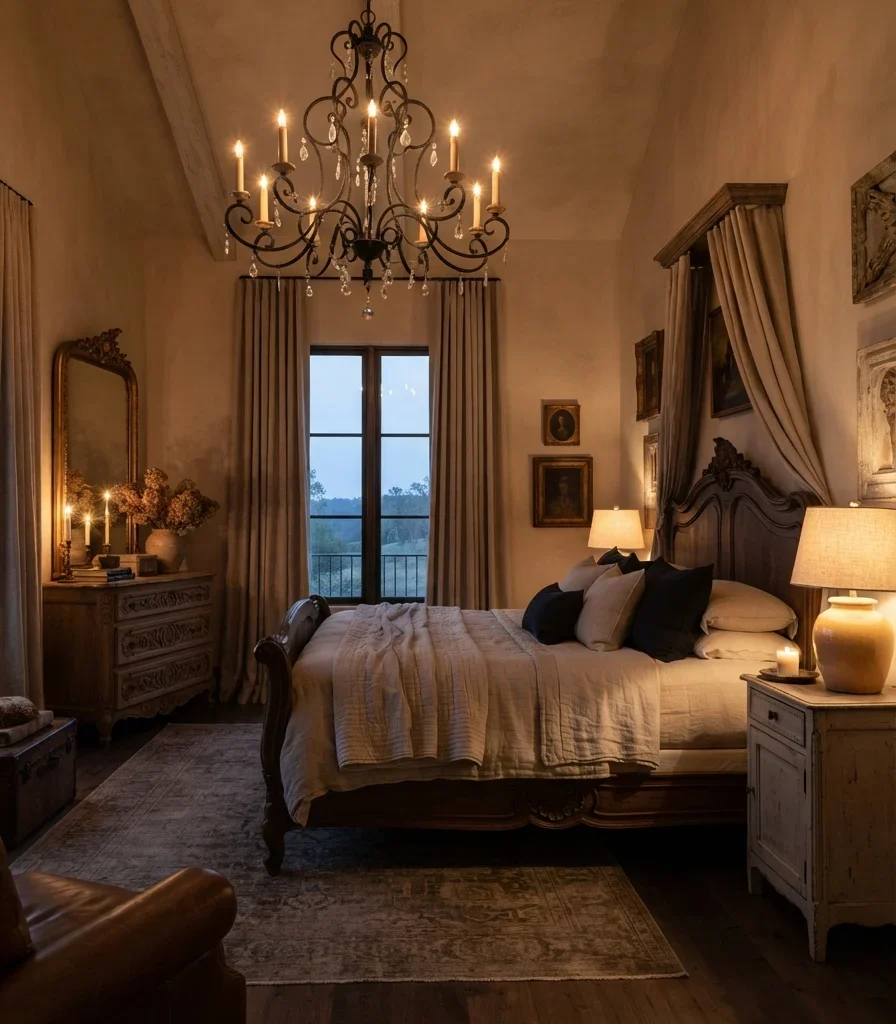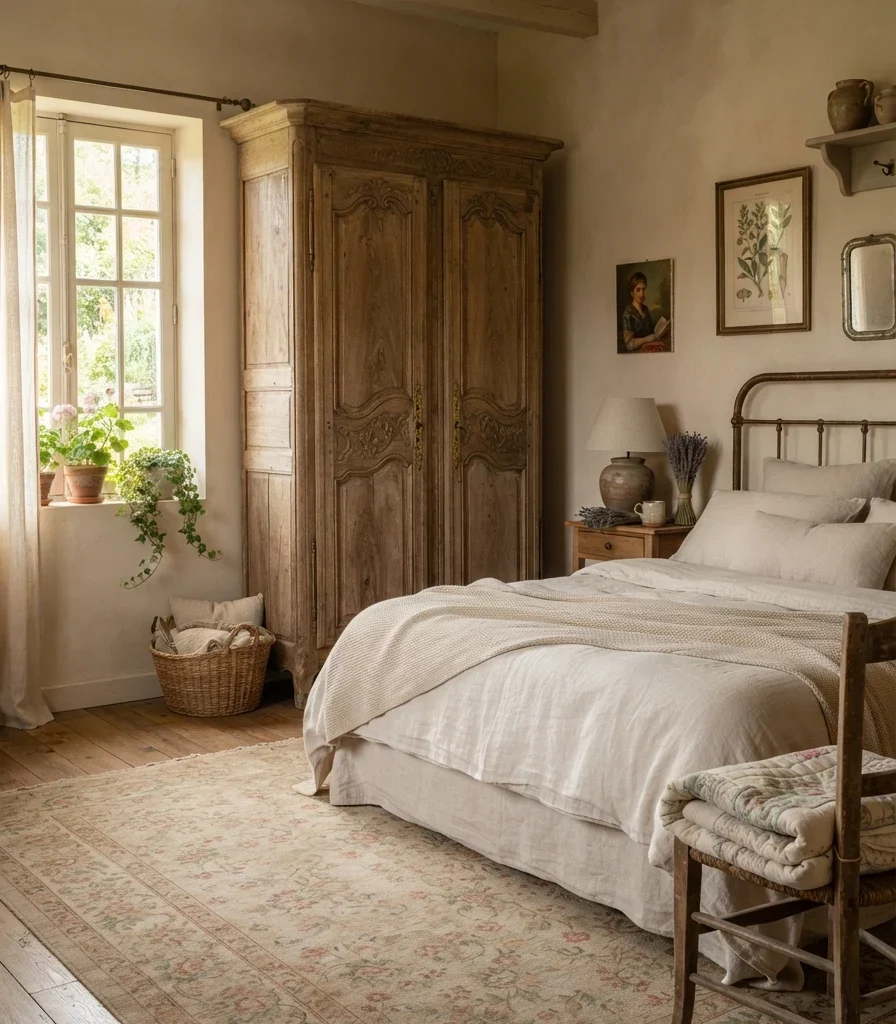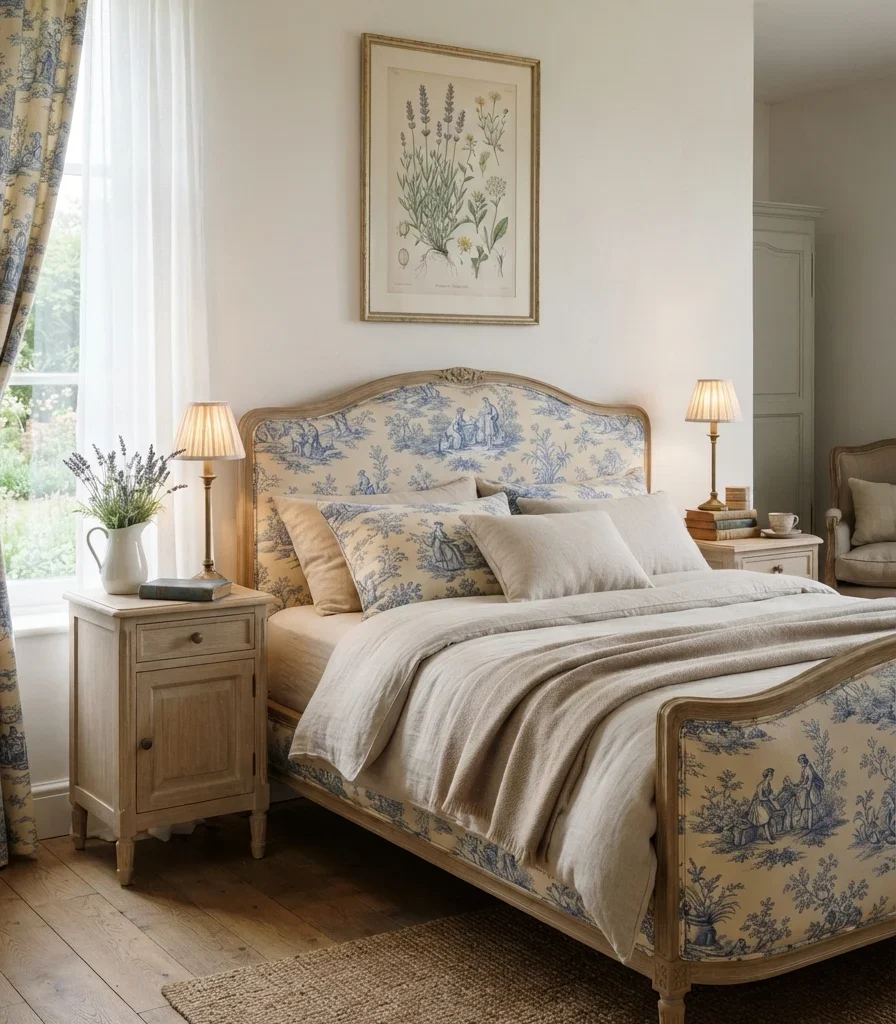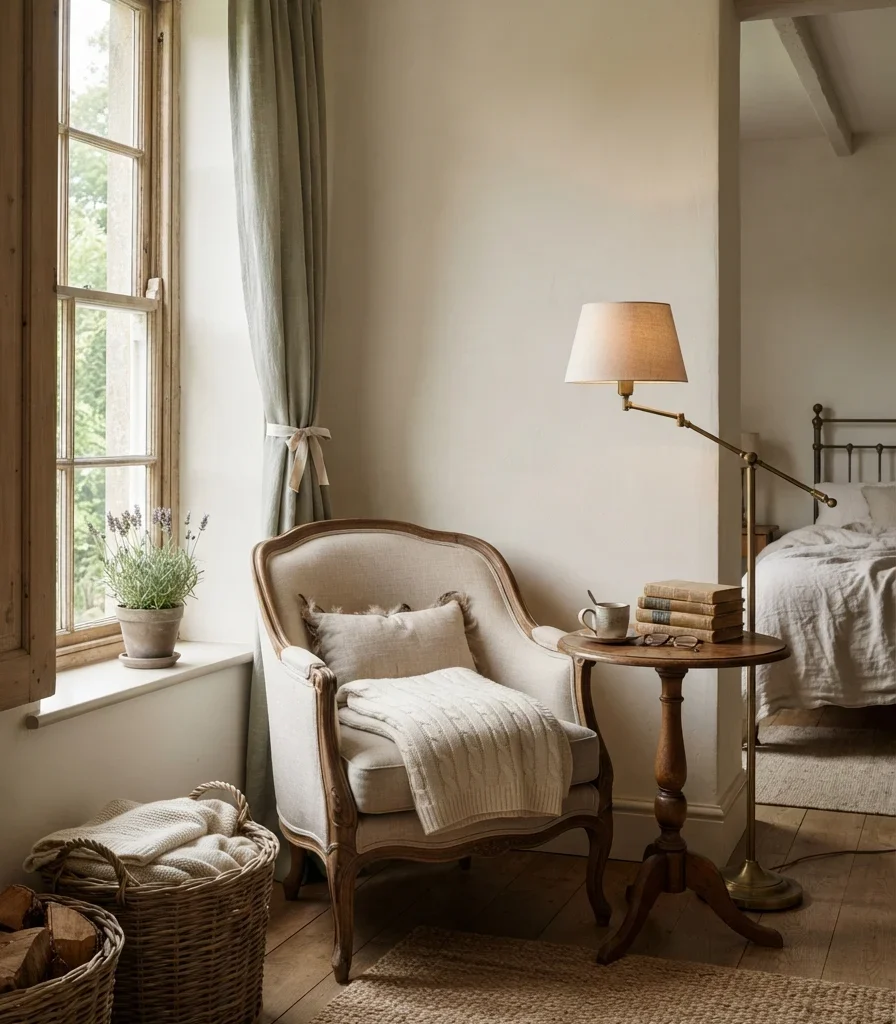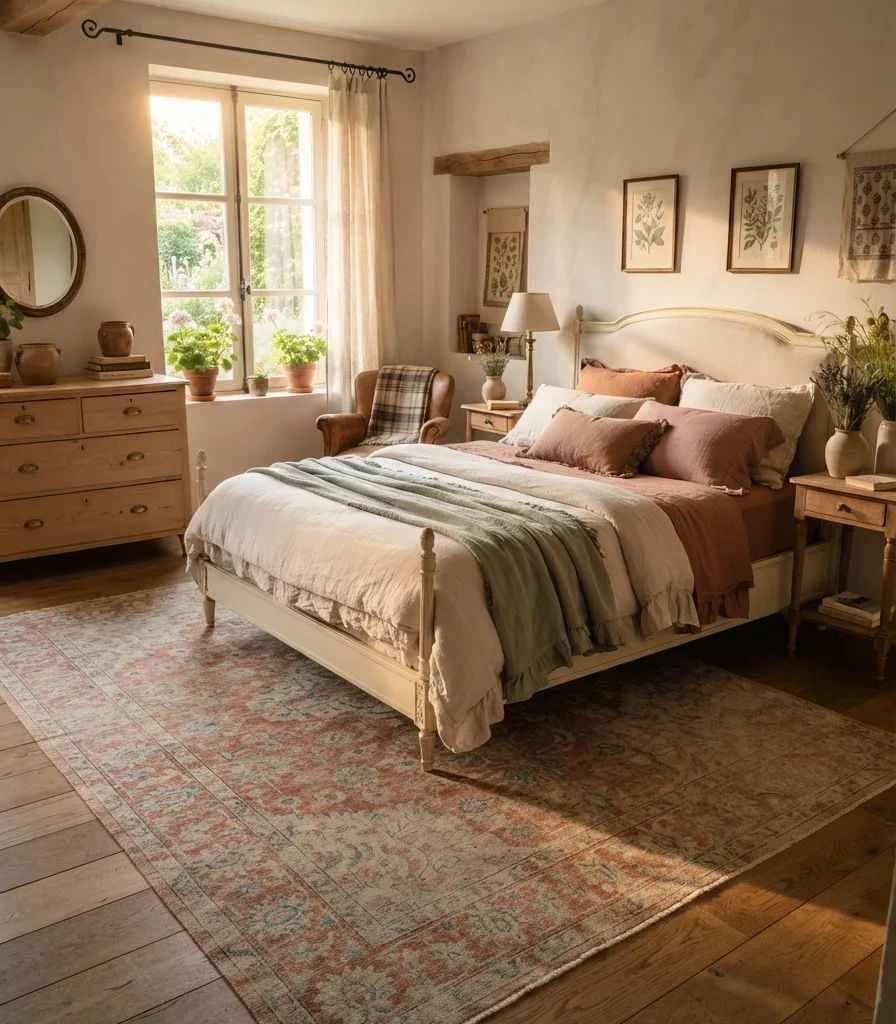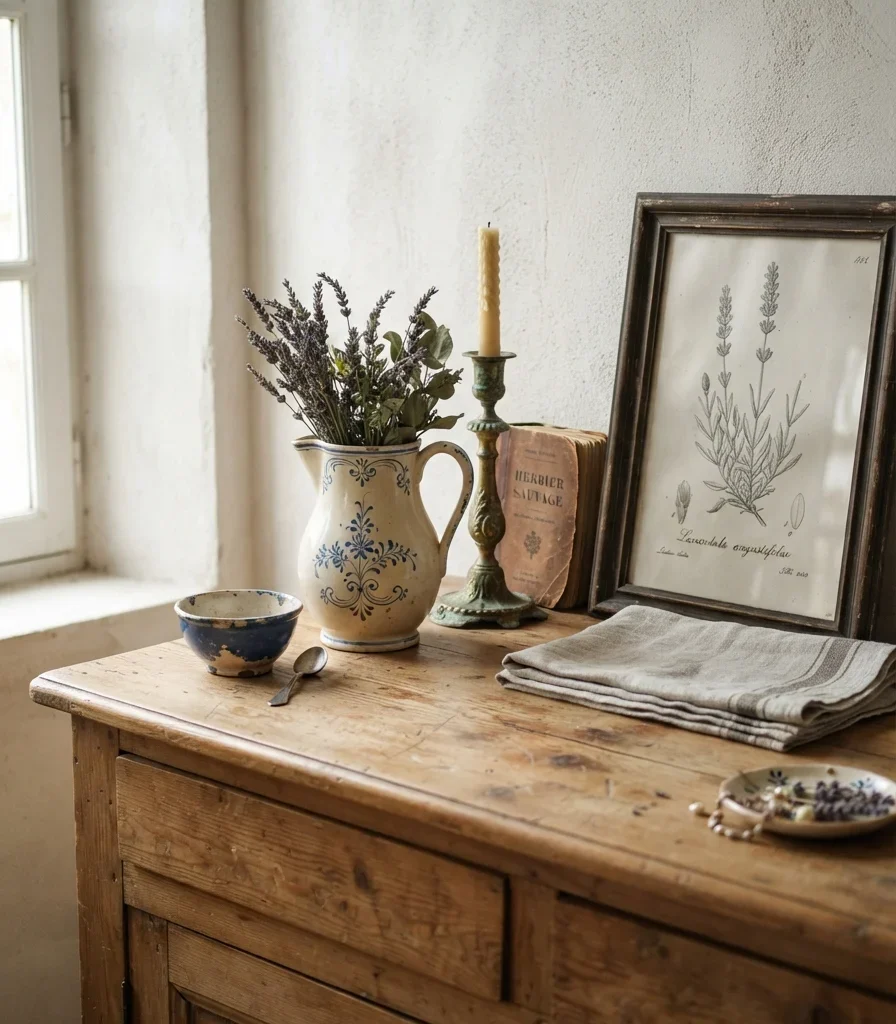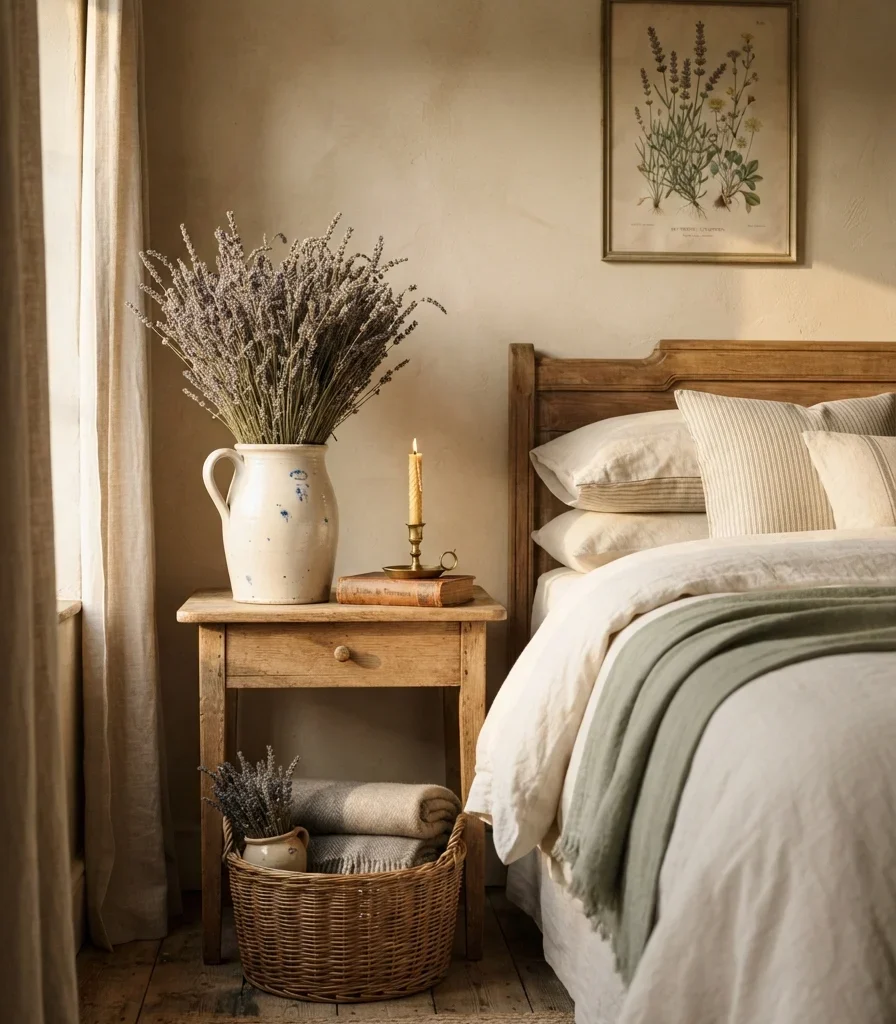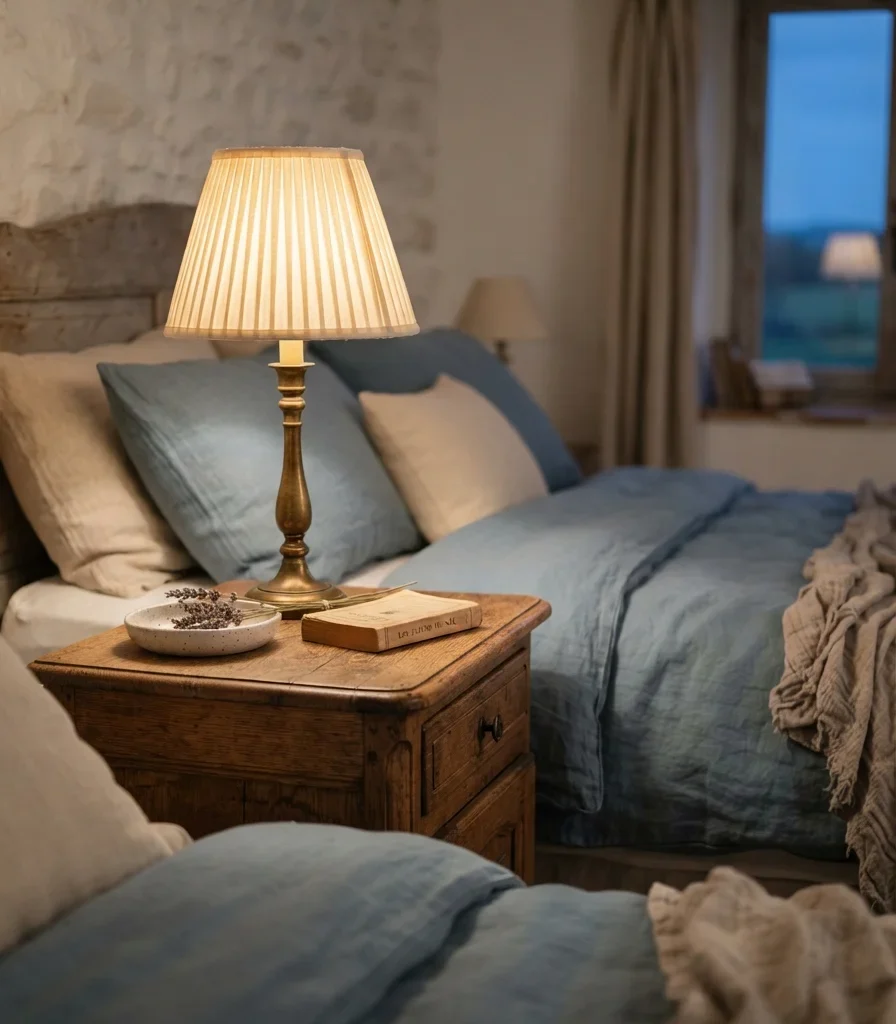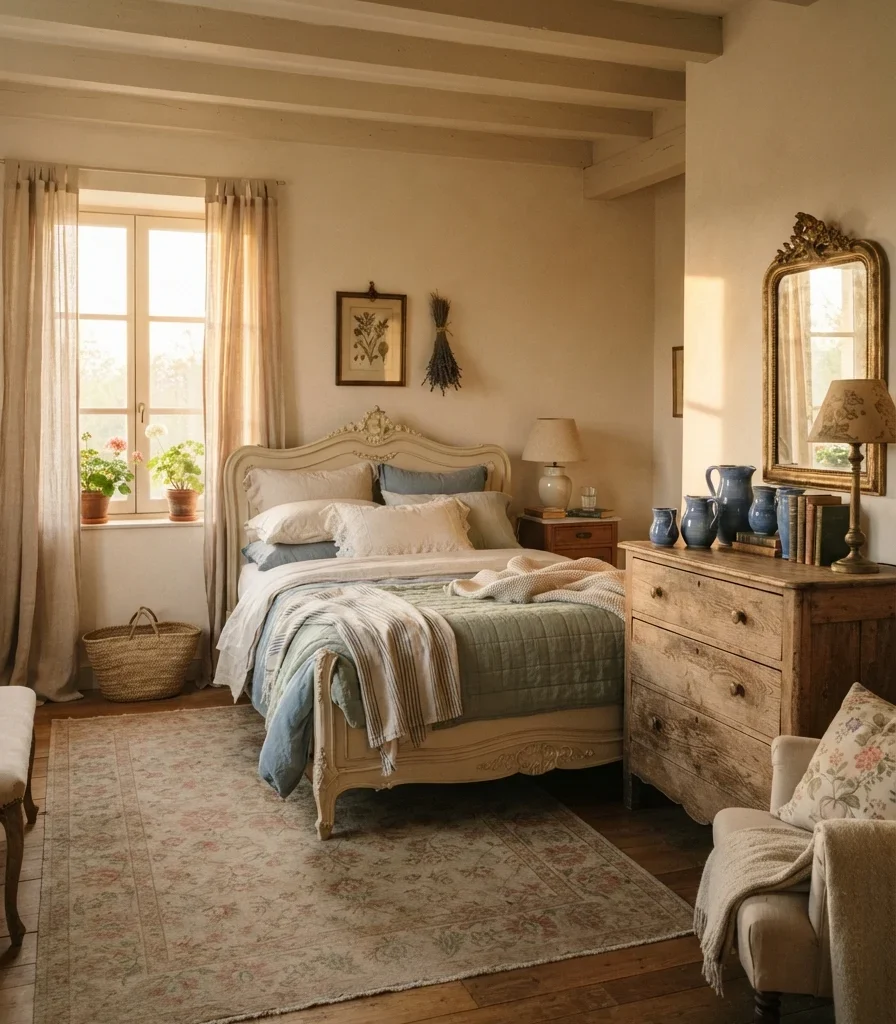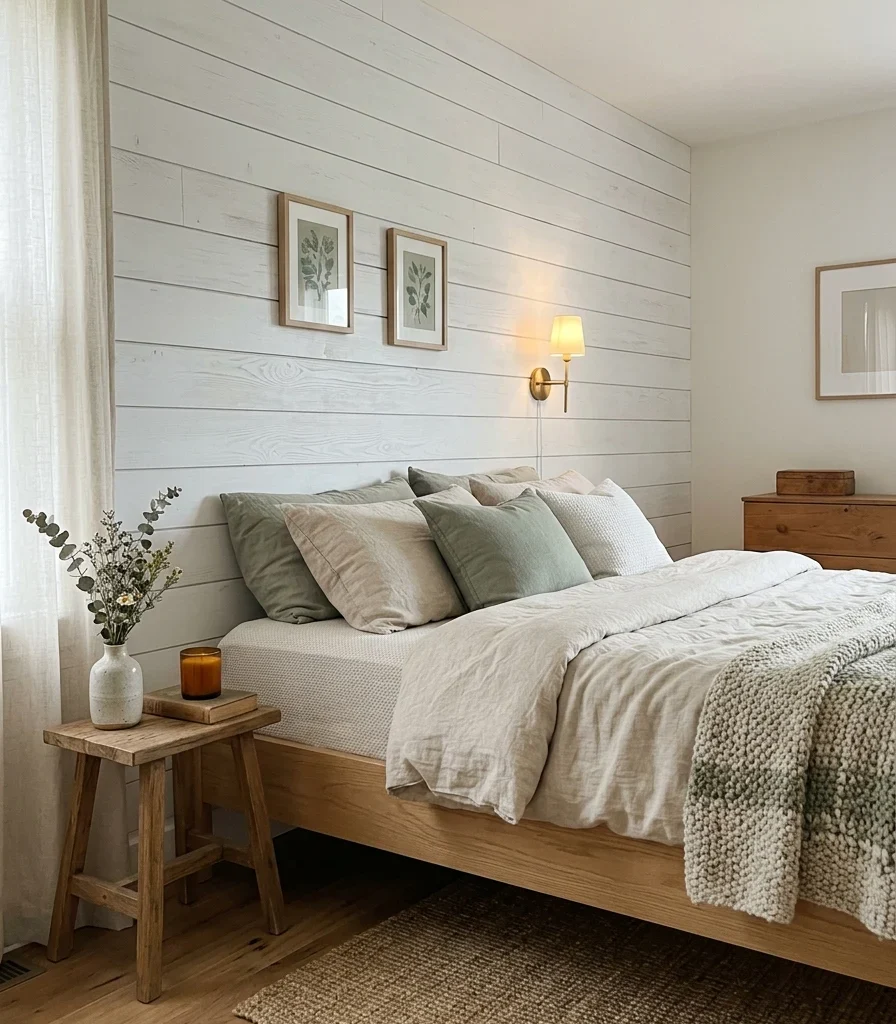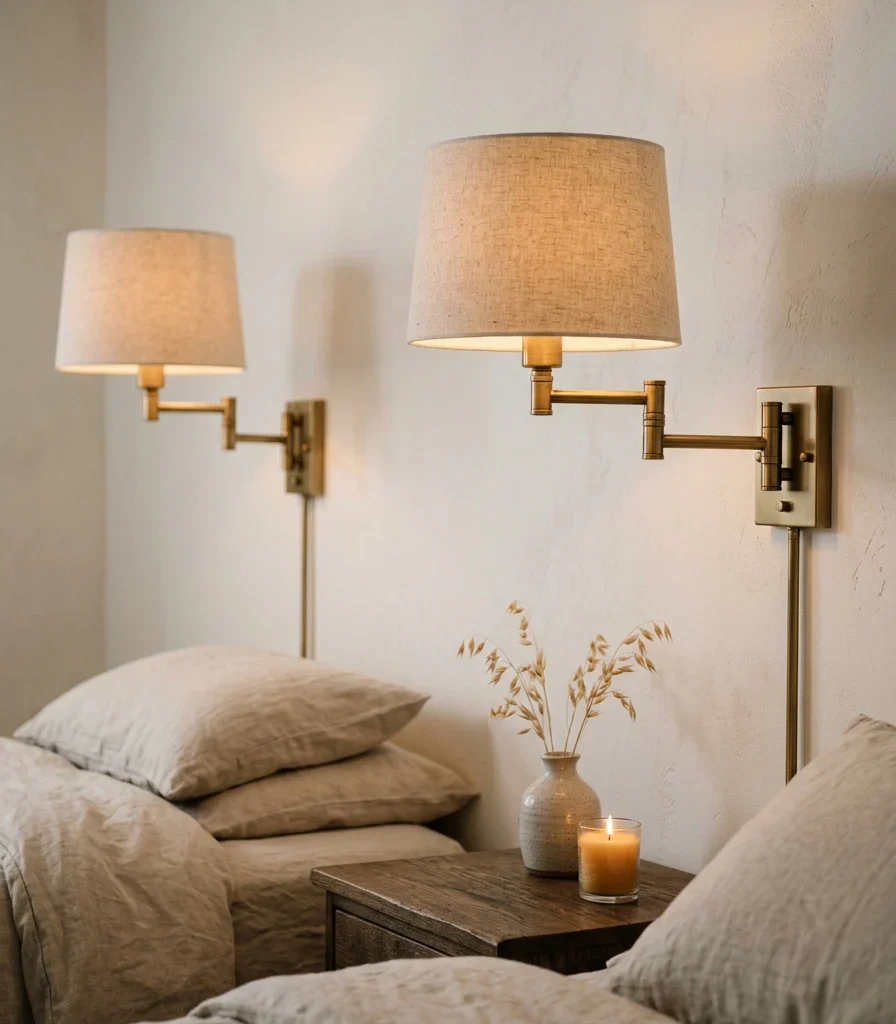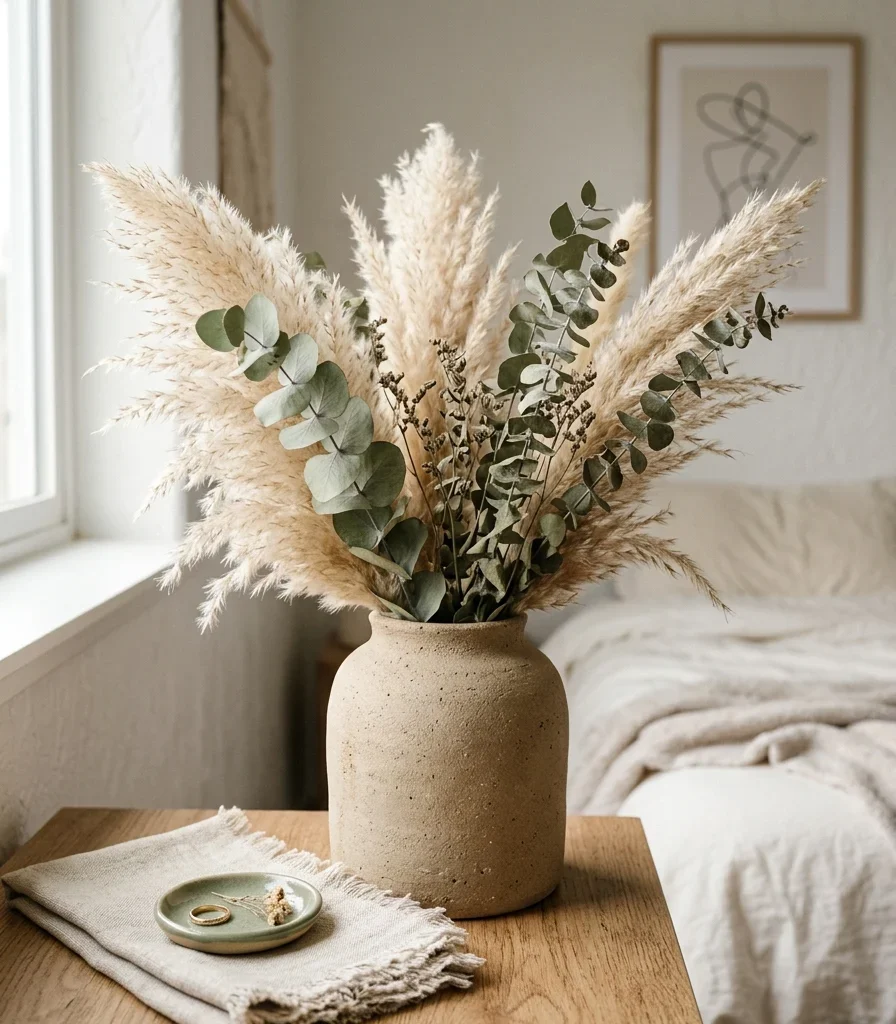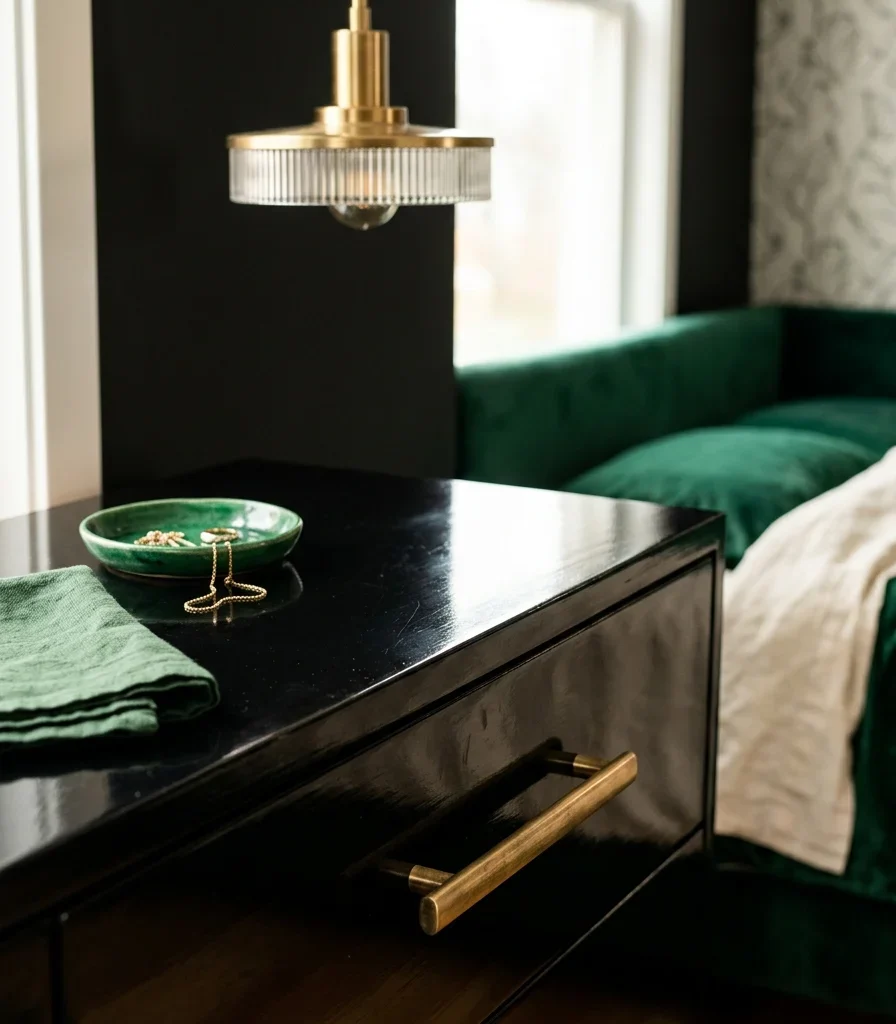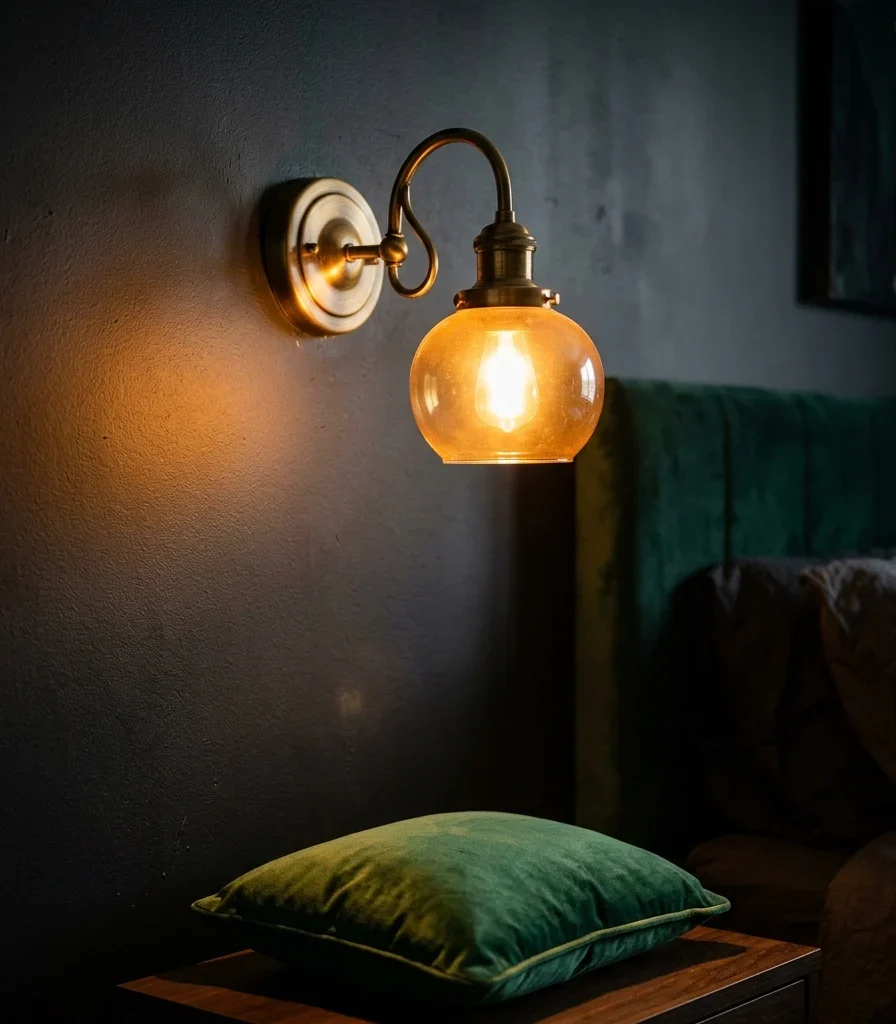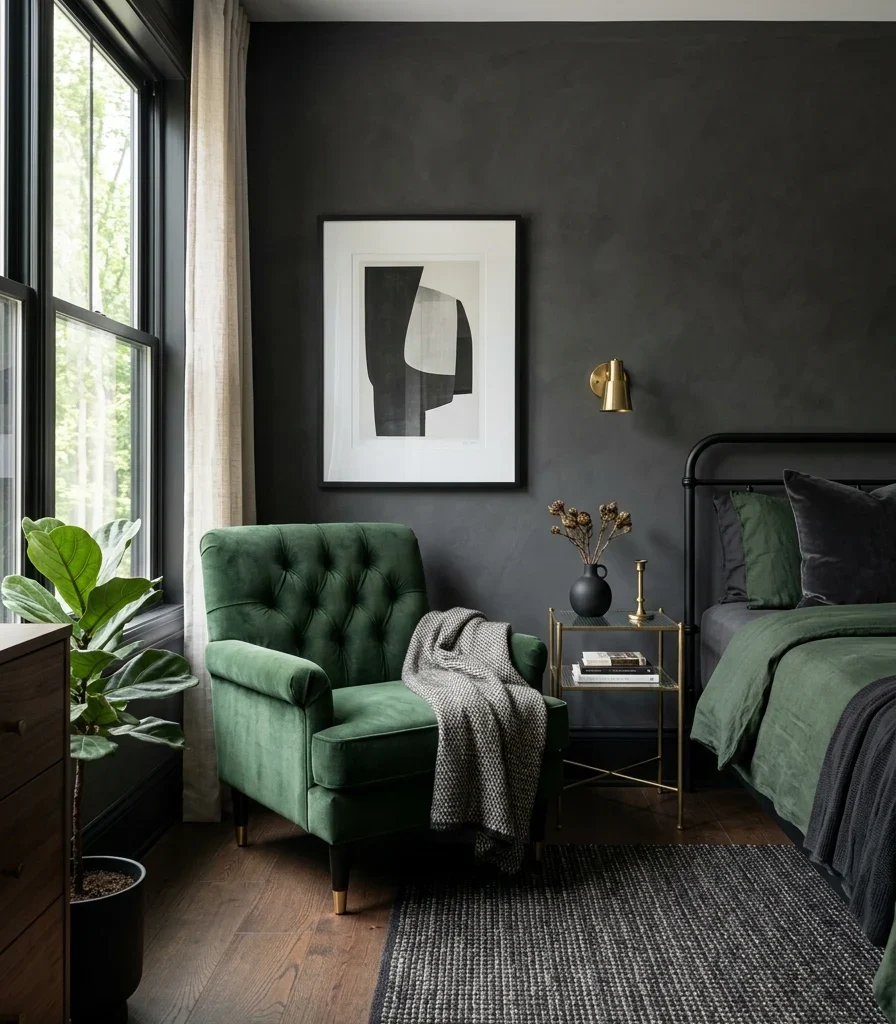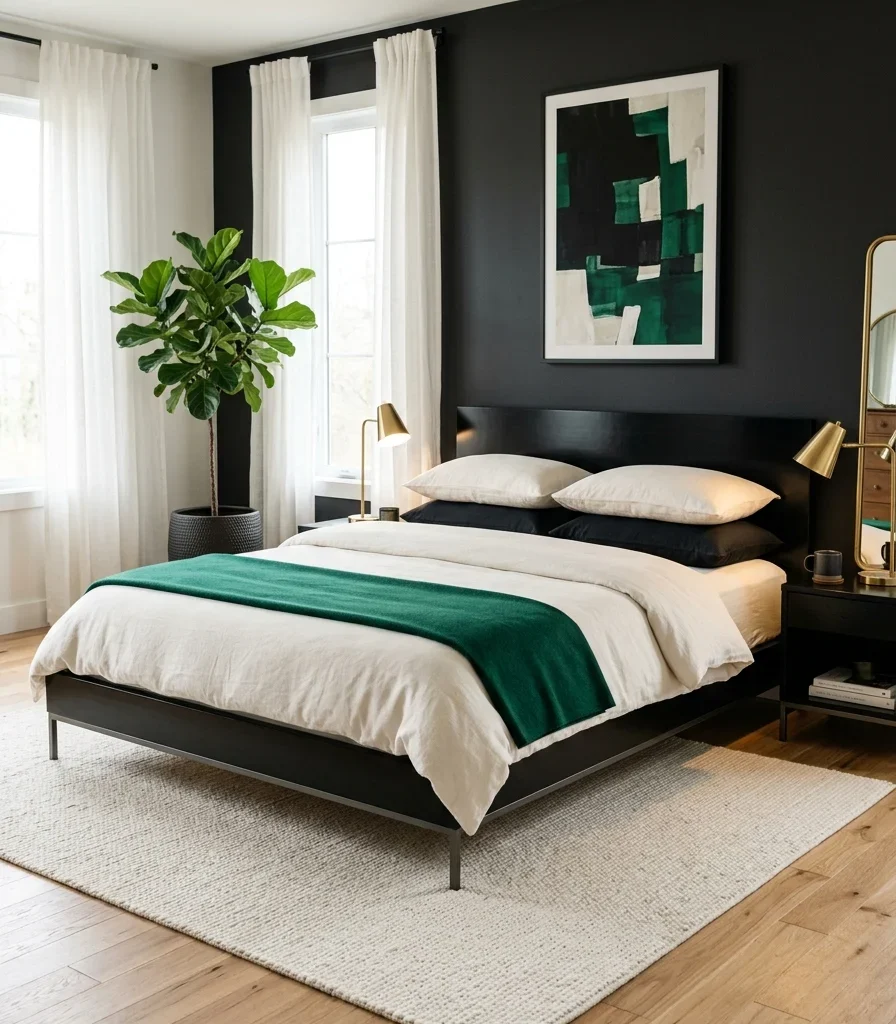
13 English Countryside Bedroom Ideas for a Room That Feels Like a Warm Embrace

13 English Countryside Bedroom Ideas for a Room

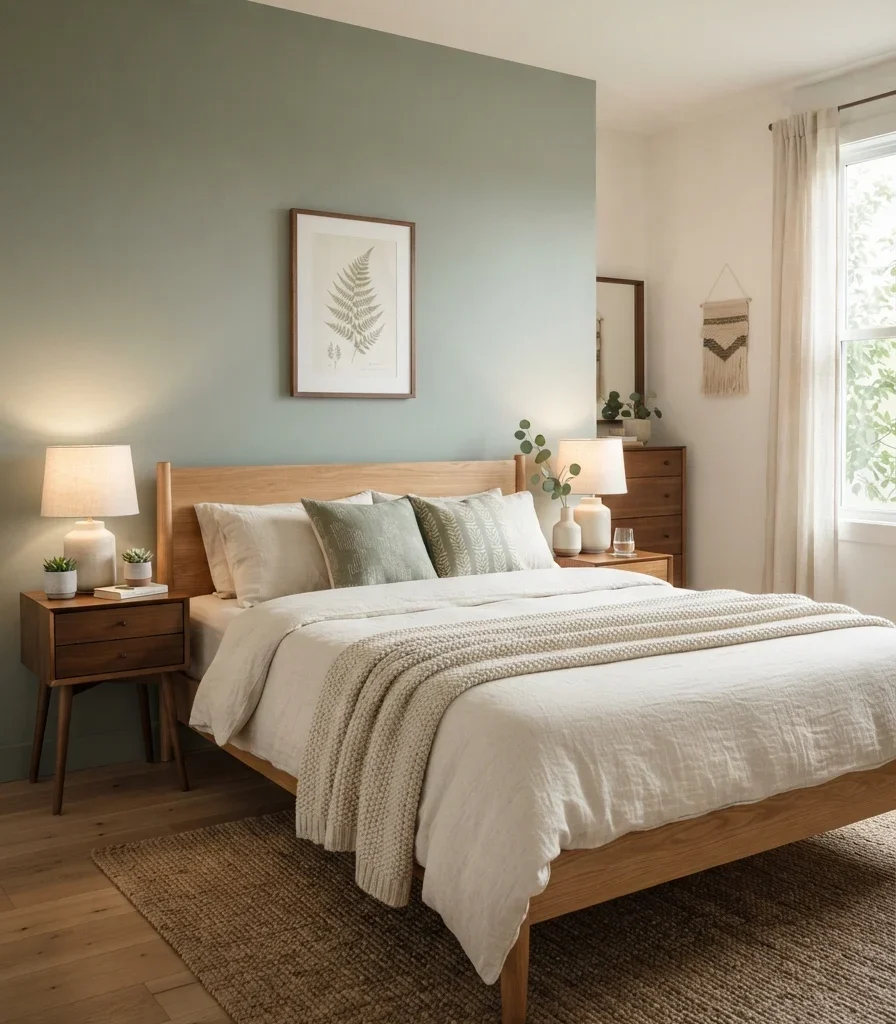
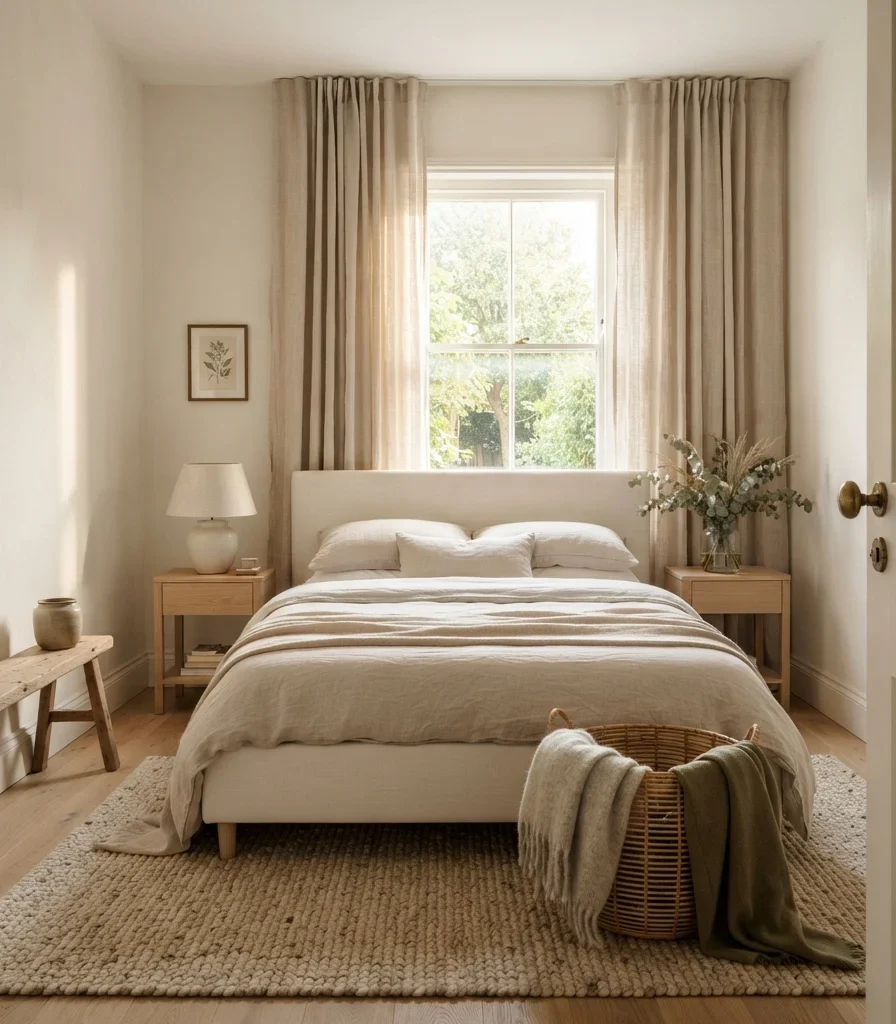
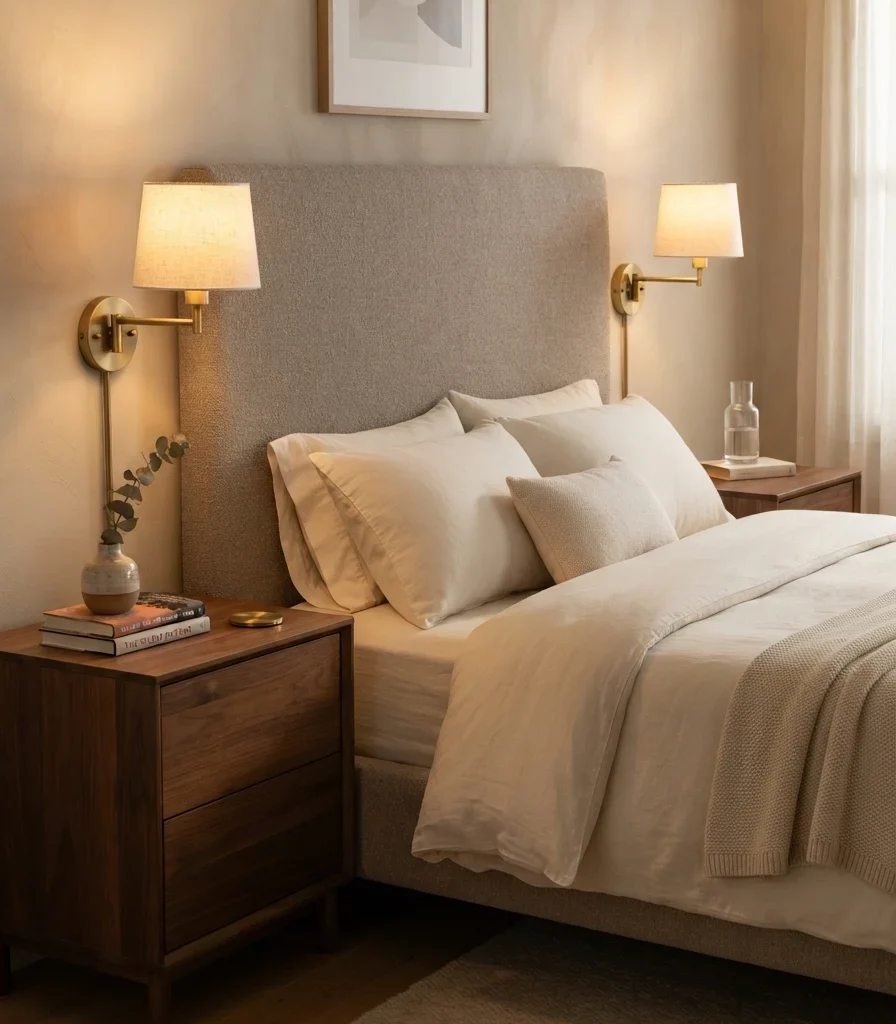
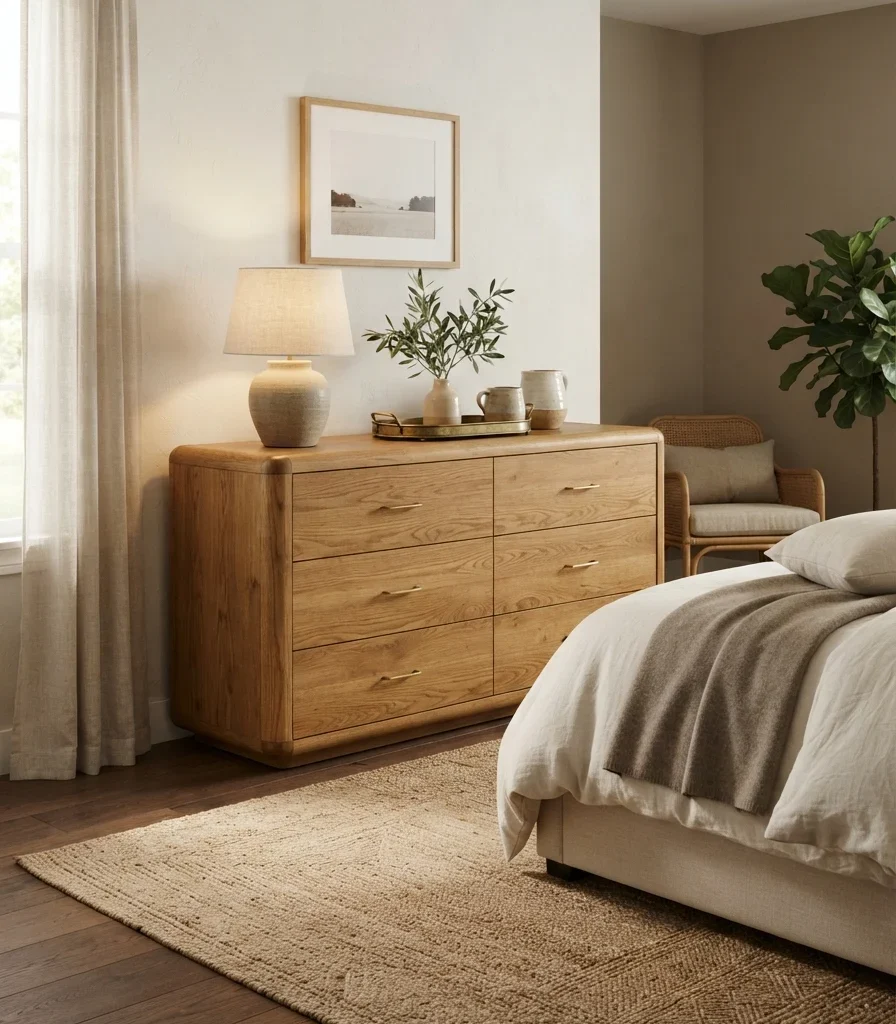
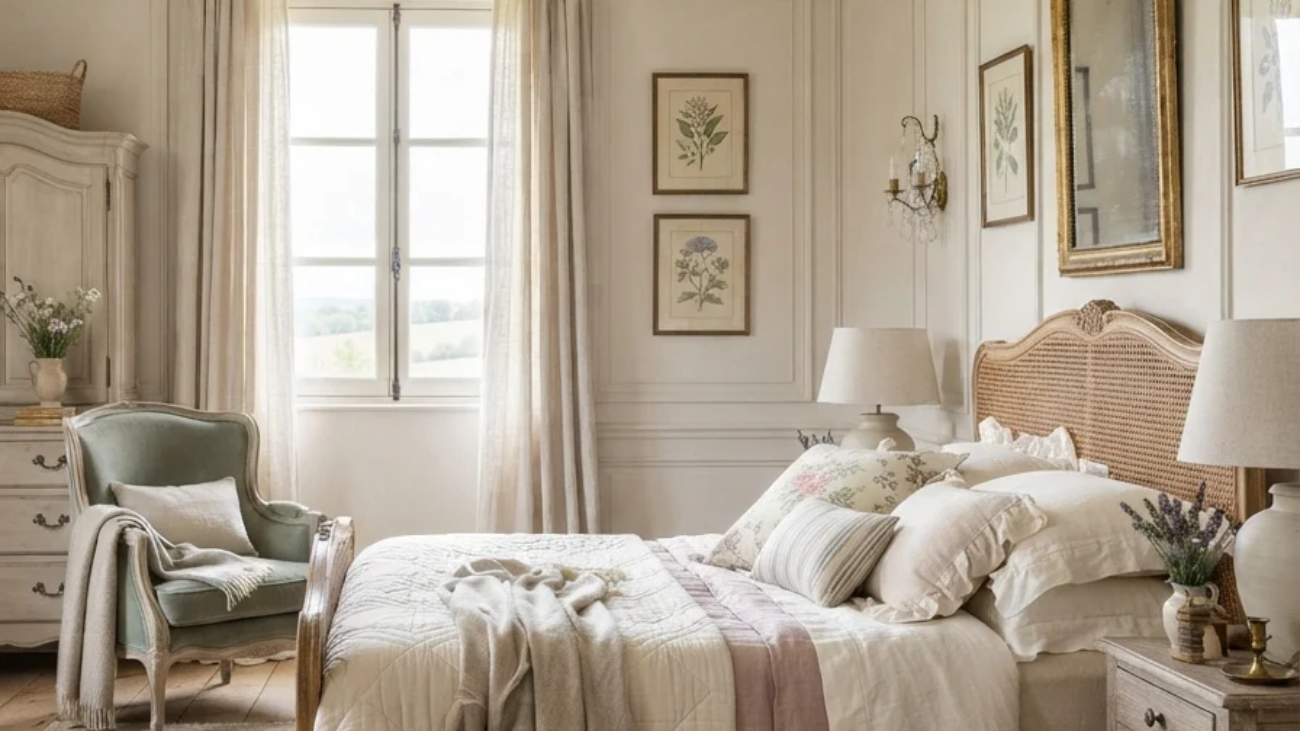
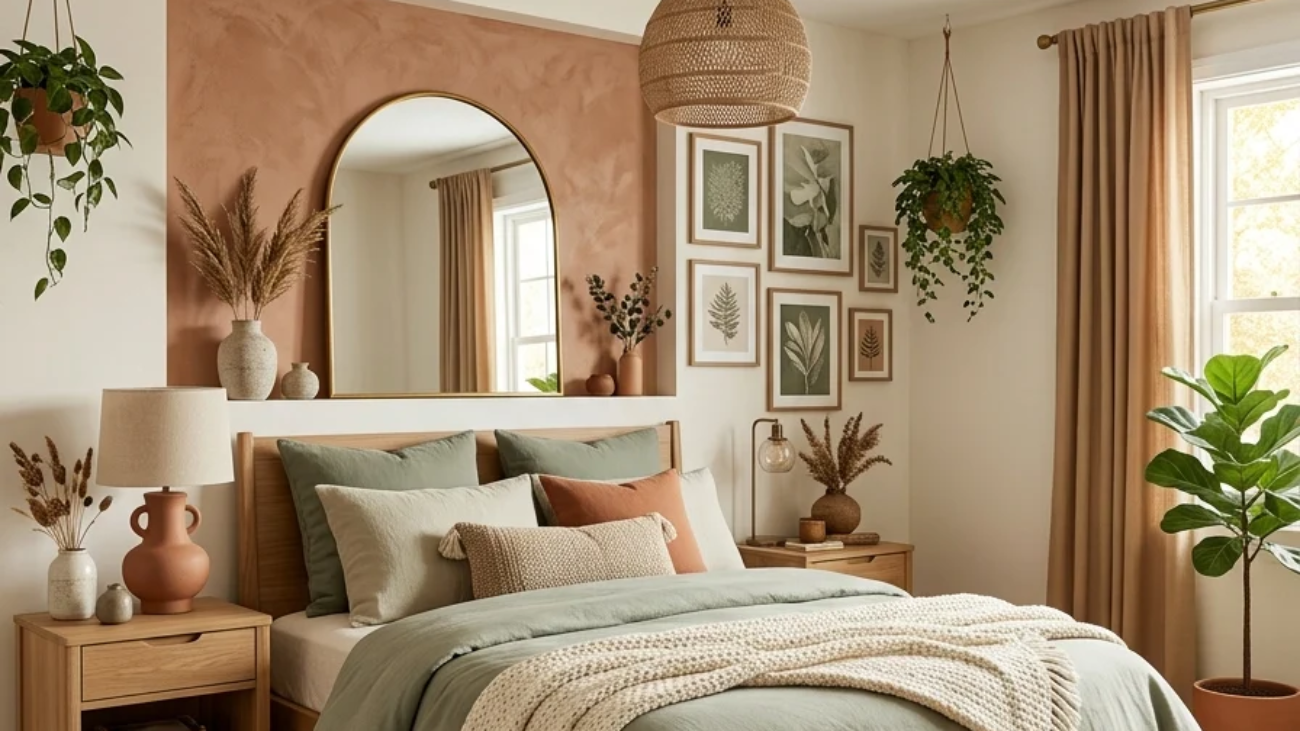
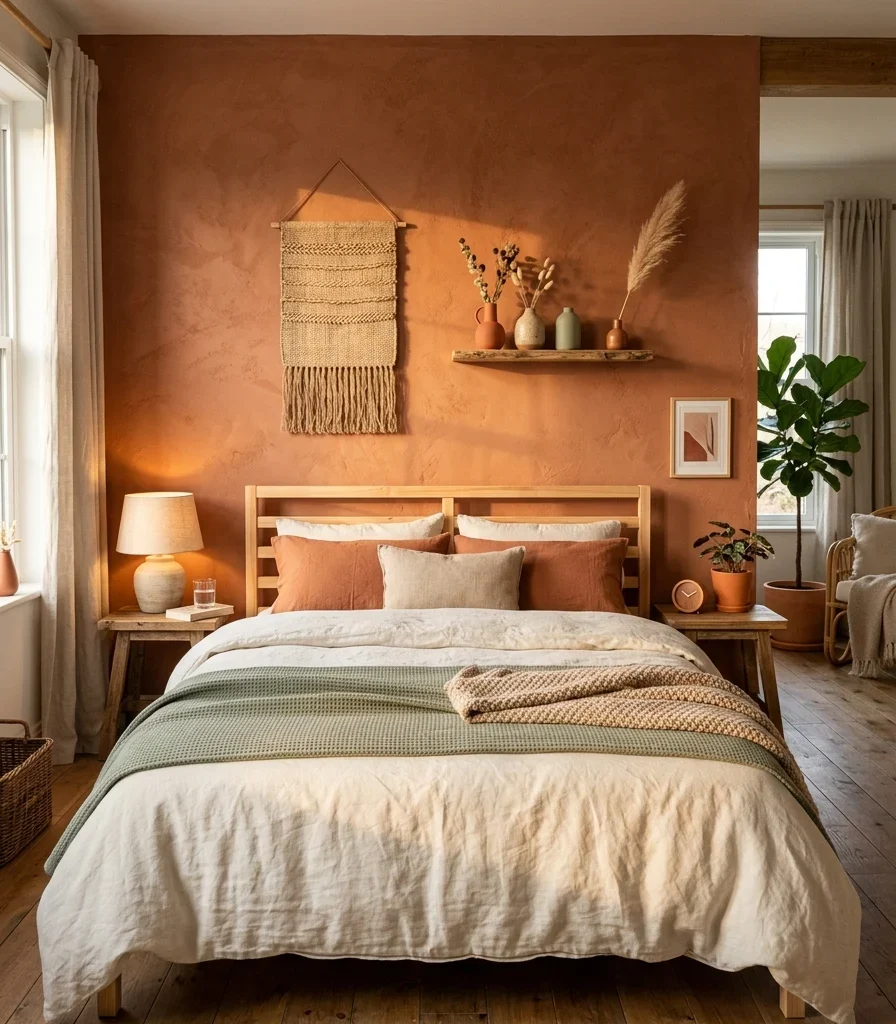
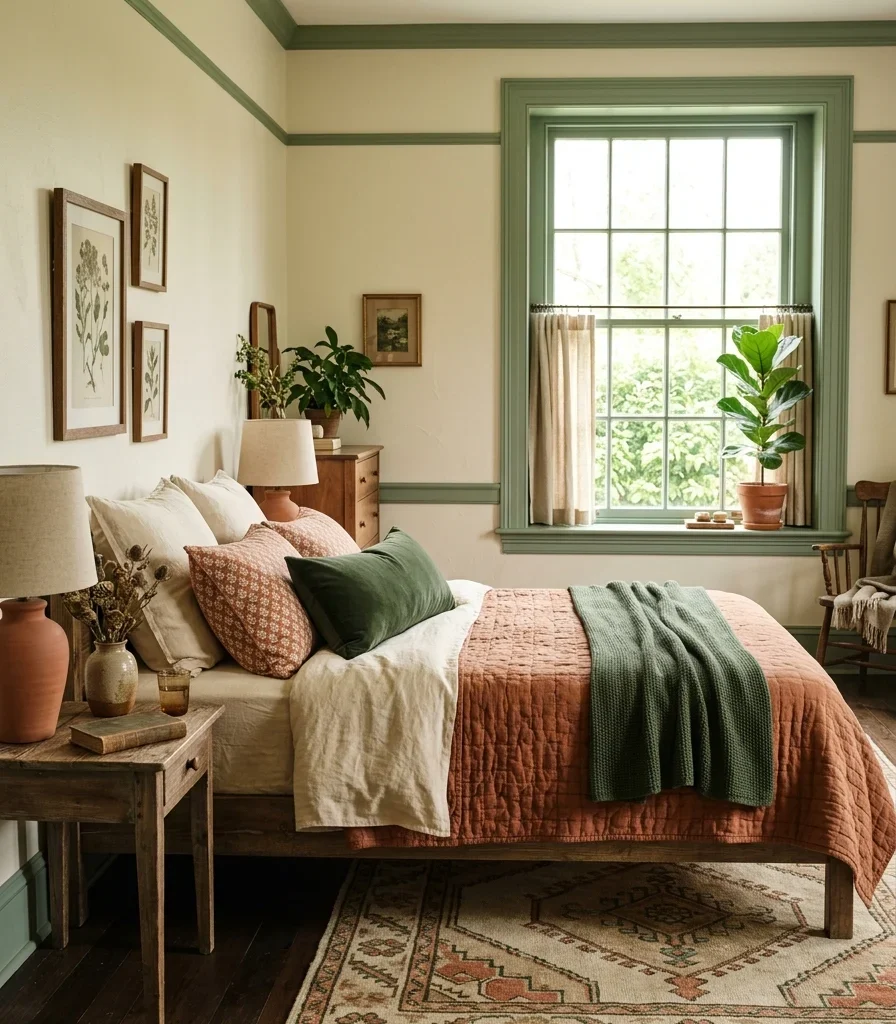
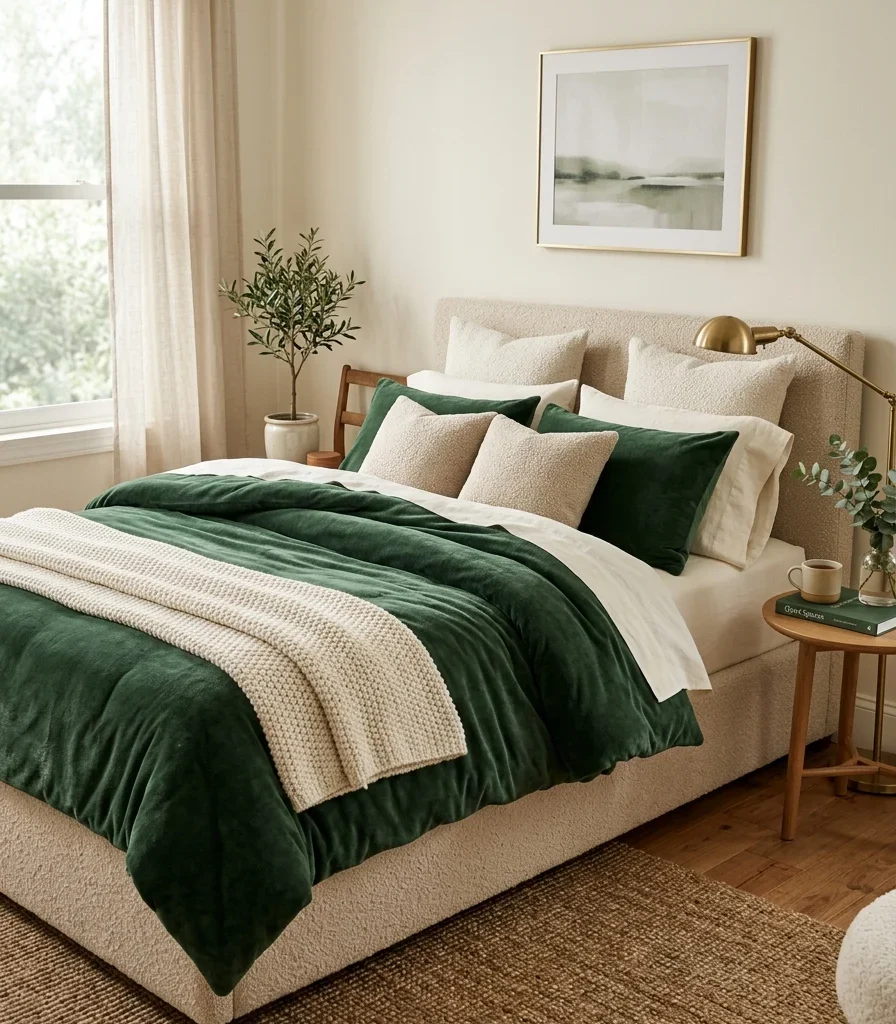
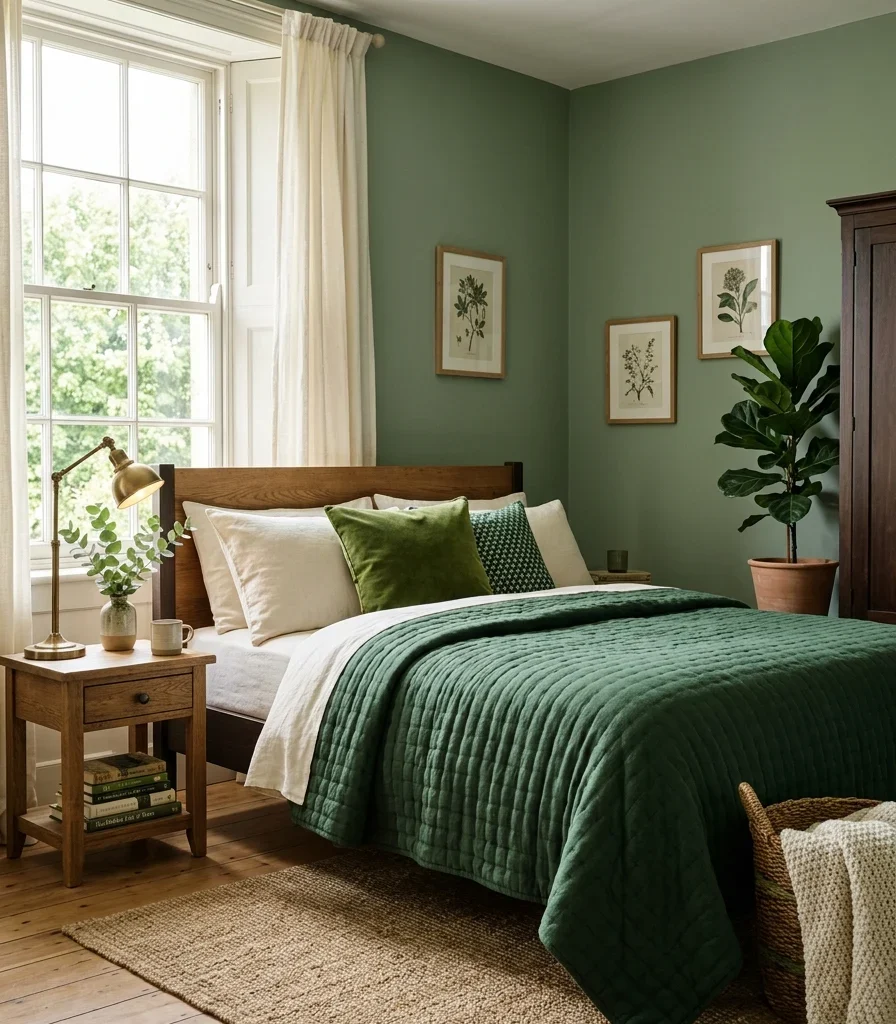
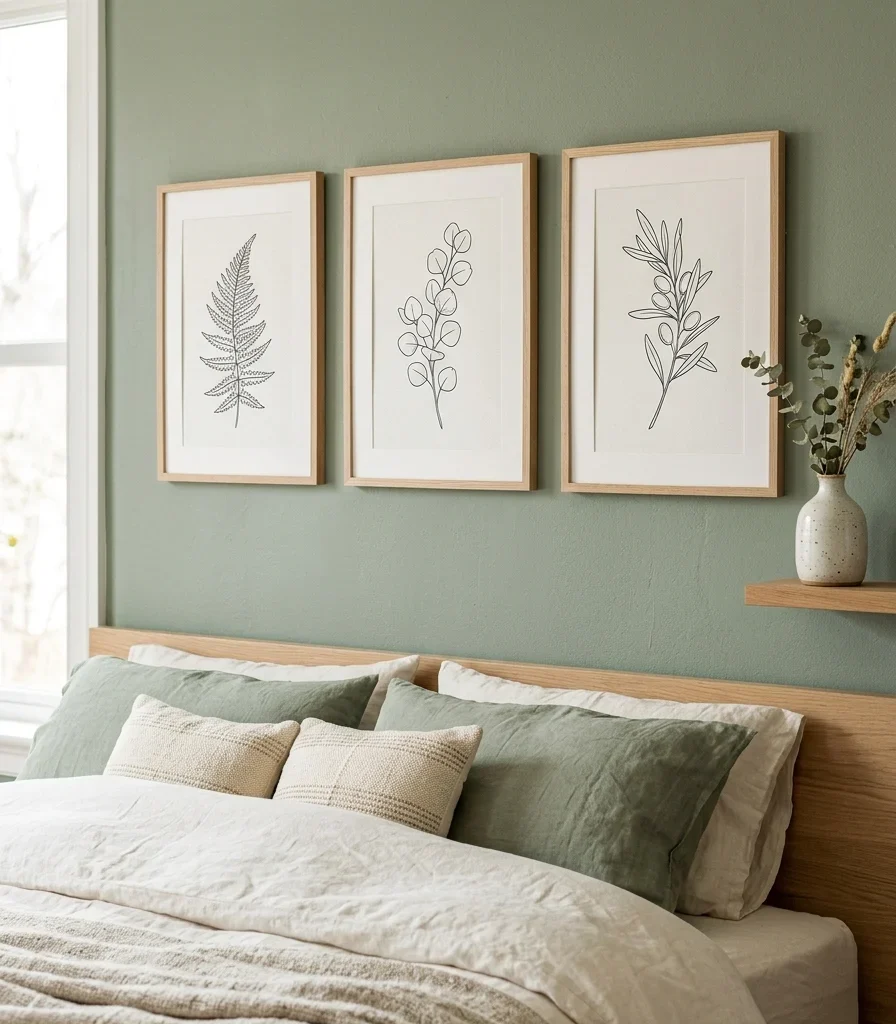
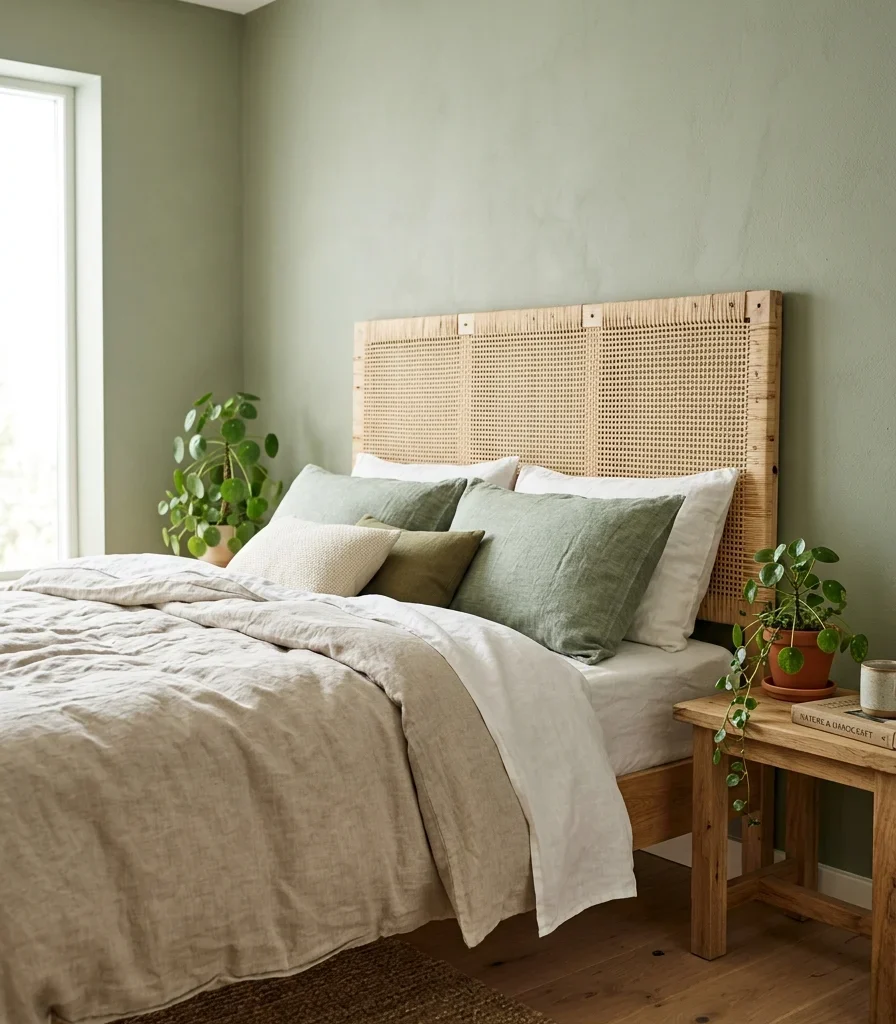
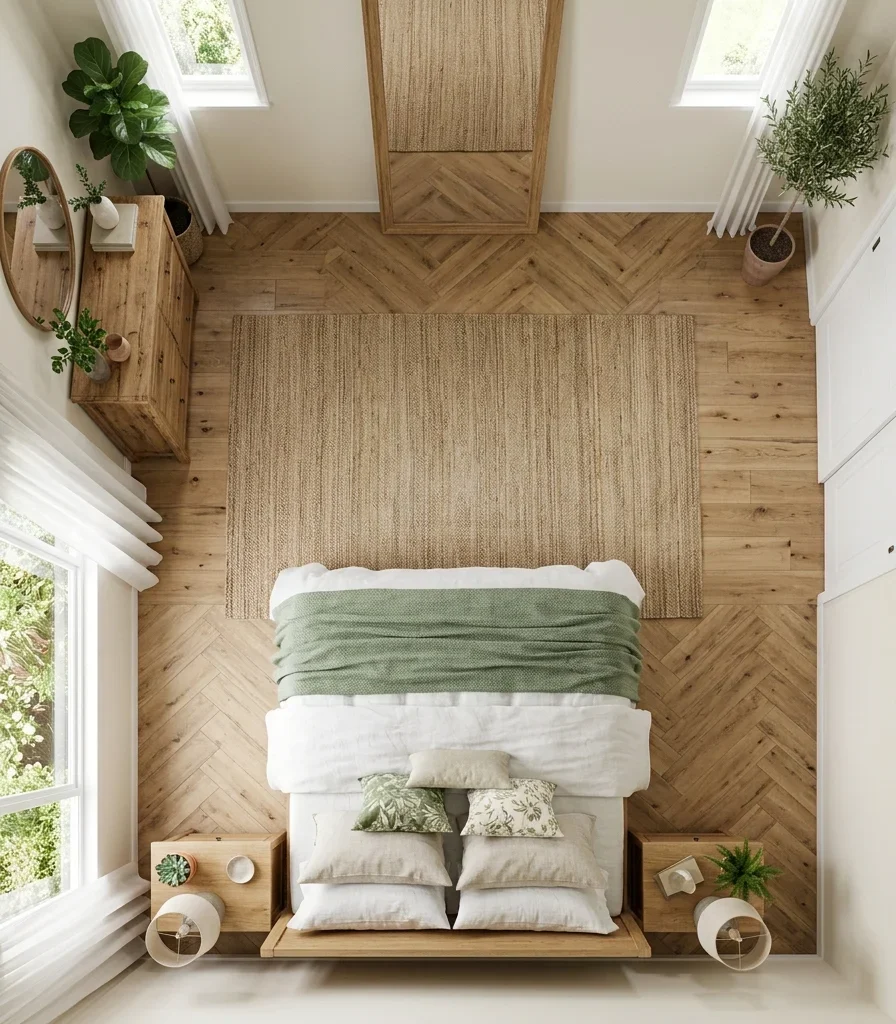
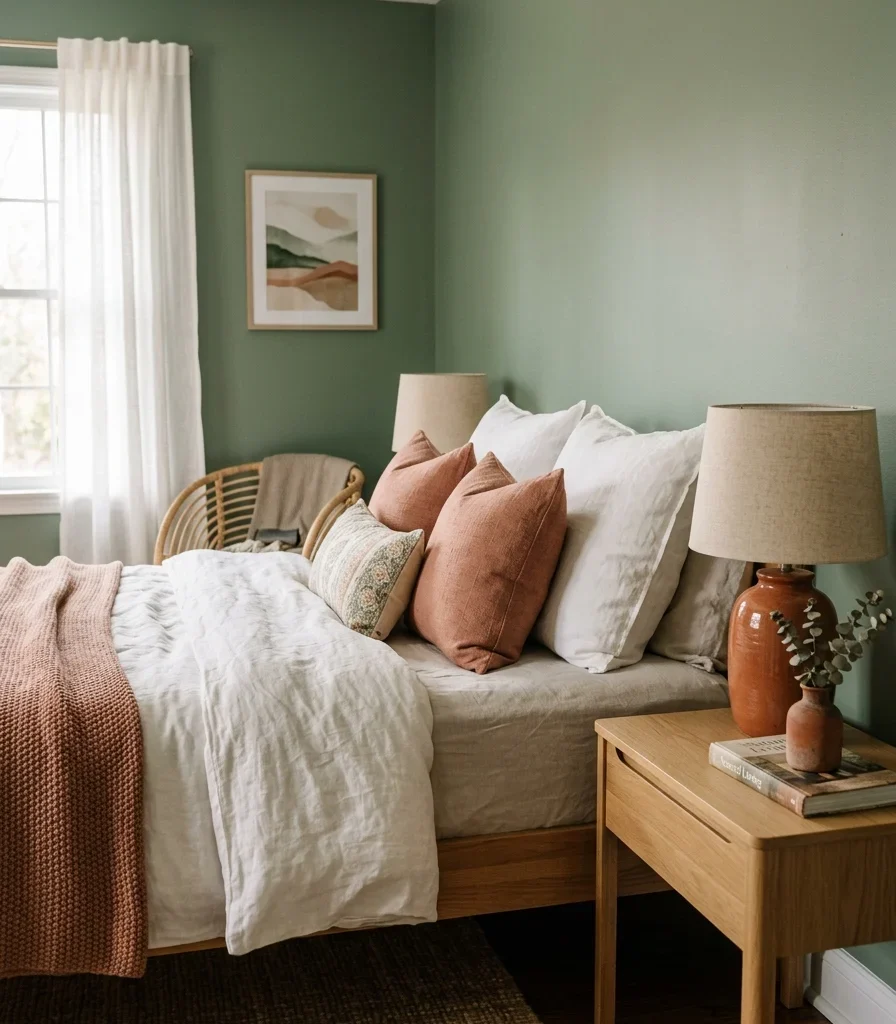
English countryside bedroom design is a relaxed British country-house aesthetic built around aged timber, natural linen, muted botanical colors, traditional furniture, and the quiet comfort of rooms that look lived in rather than staged. These 13 English Countryside Bedroom Ideas for a Room That Feels Like a Warm Embrace show how to use color, texture, lighting, furniture, pattern, and thoughtful layouts to create a bedroom that feels deeply settled.

The atmosphere is soft without being bland, layered without feeling cluttered, and old-fashioned without becoming theatrical. Morning light falls gently across linen bedding, worn wood develops a warmer glow beside the bed, and small imperfections make the room feel personal. There is a sense of stillness here, the feeling of closing a bedroom door at the end of a long day and leaving the outside world behind. English countryside style works because comfort is treated as part of the architecture, not something added at the end. Here are 13 ideas worth saving and stealing.

Why 13 English Countryside Bedroom Ideas for a Room That Feels Like a Warm Embrace Work So Well

English countryside interiors grew from the domestic traditions of rural cottages, rectories, manor houses, and country estates across England rather than from one single decorating movement. The aesthetic overlaps with Georgian, Victorian, Arts and Crafts, and traditional cottage interiors, but its defining quality is the relaxed way these influences are layered. Unlike modern farmhouse, which often simplifies country references into cleaner silhouettes, English country rooms embrace antiques, botanical patterns, painted furniture, irregular surfaces, and furniture that looks as though it has stayed in the family.

The material palette is tactile and naturally subdued: honey oak, dark walnut, painted pine, rush, wool, cotton, washed linen, aged brass, ceramic, and occasional wrought iron. Useful colors include warm ivory, mushroom, oatmeal, muted sage, olive, faded cornflower blue, dusty rose, and soft brown. Rather than using several unrelated accent colors, repeat two or three tones throughout the bedding, curtains, artwork, and accessories so the room feels collected rather than coordinated.

The renewed interest in English countryside interiors also fits a wider decorating shift toward slower, more personal homes. Secondhand furniture, natural fibers, repairable pieces, vintage finds, and rooms designed for comfort all sit comfortably within the sustainability-minded approach many homeowners now prefer. Pinterest-friendly spaces are moving away from disposable matching sets toward rooms with visible character, and English country style naturally rewards that approach because patina is an asset rather than a problem.

Small bedrooms can achieve the look surprisingly well, but restraint becomes more important. Prioritize one substantial hero piece, usually the bed, then use full-height curtains, compact bedside tables, vertical storage, and layered textiles rather than filling every corner. A 10-by-12-foot bedroom does not need an antique wardrobe, bench, desk, and chest simultaneously; one well-scaled vintage piece and strong textiles can communicate the style more effectively.

Style at a Glance

ElementEnglish Countryside Bedroom
PhilosophyComfortable, collected, practical, and gently timeworn
Key MaterialsOak, pine, linen, wool, rush, aged brass, ceramic
Color PaletteWarm ivory, sage, olive, faded blue, dusty rose, mushroom

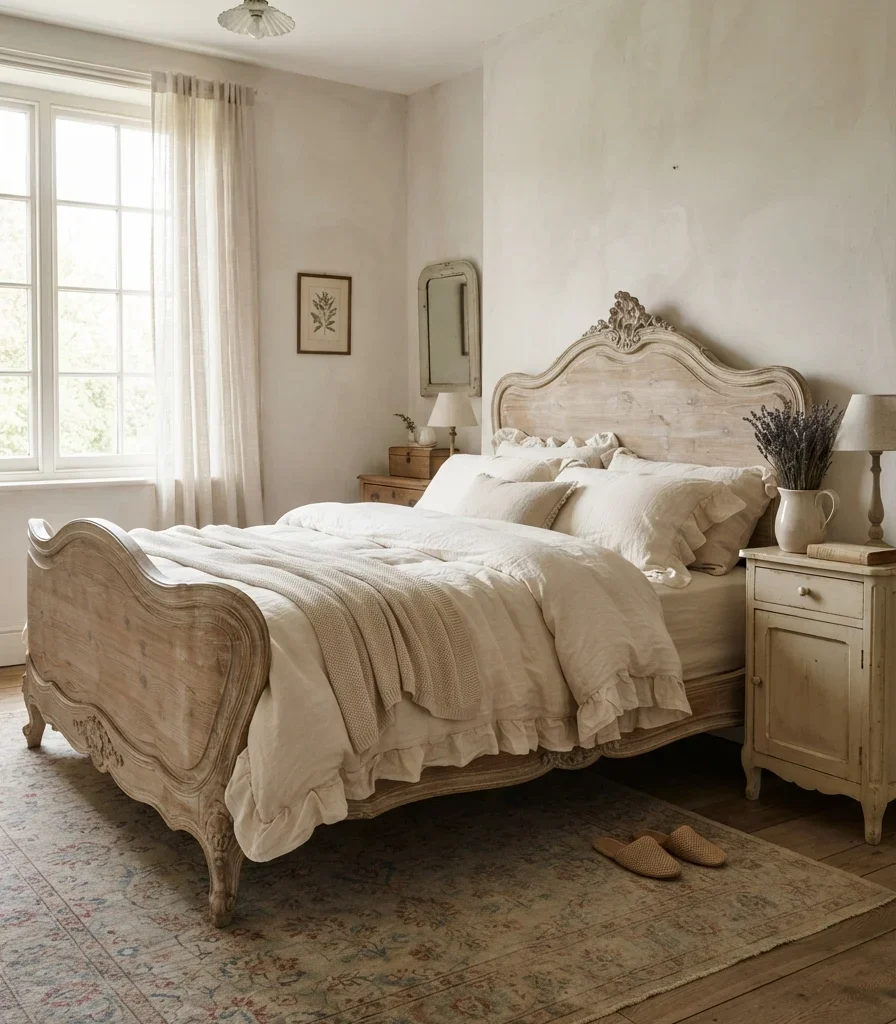
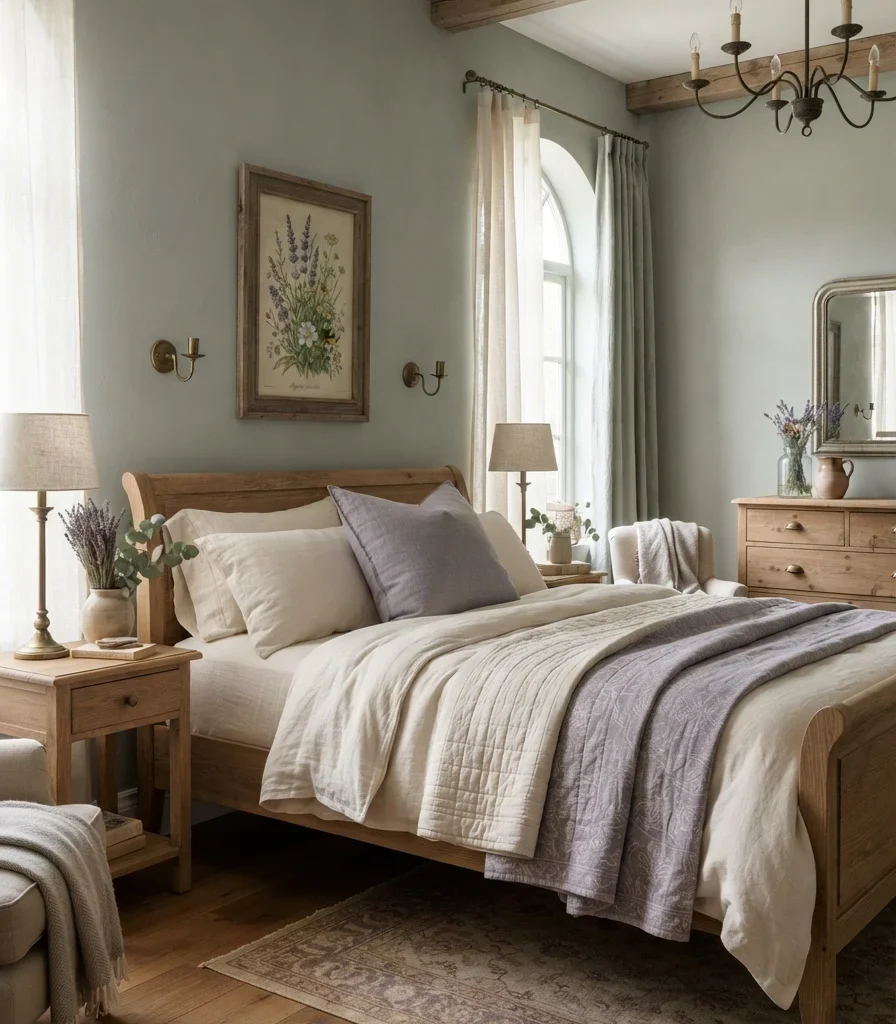
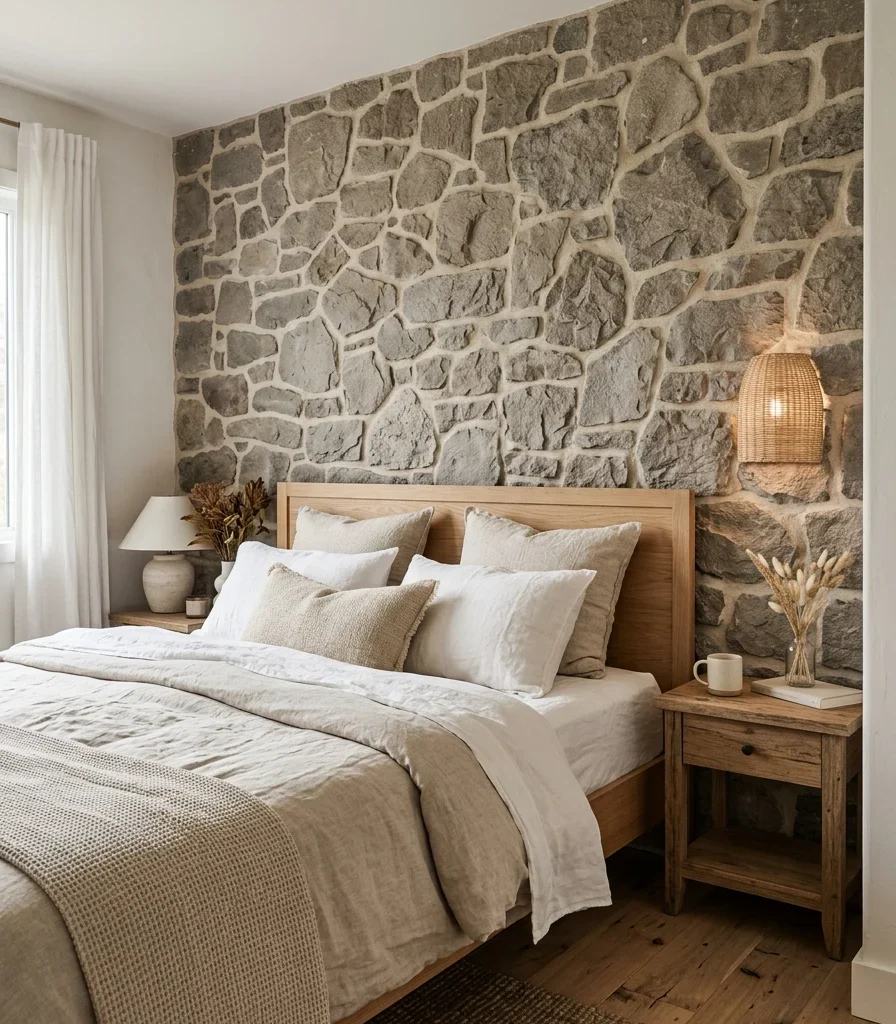
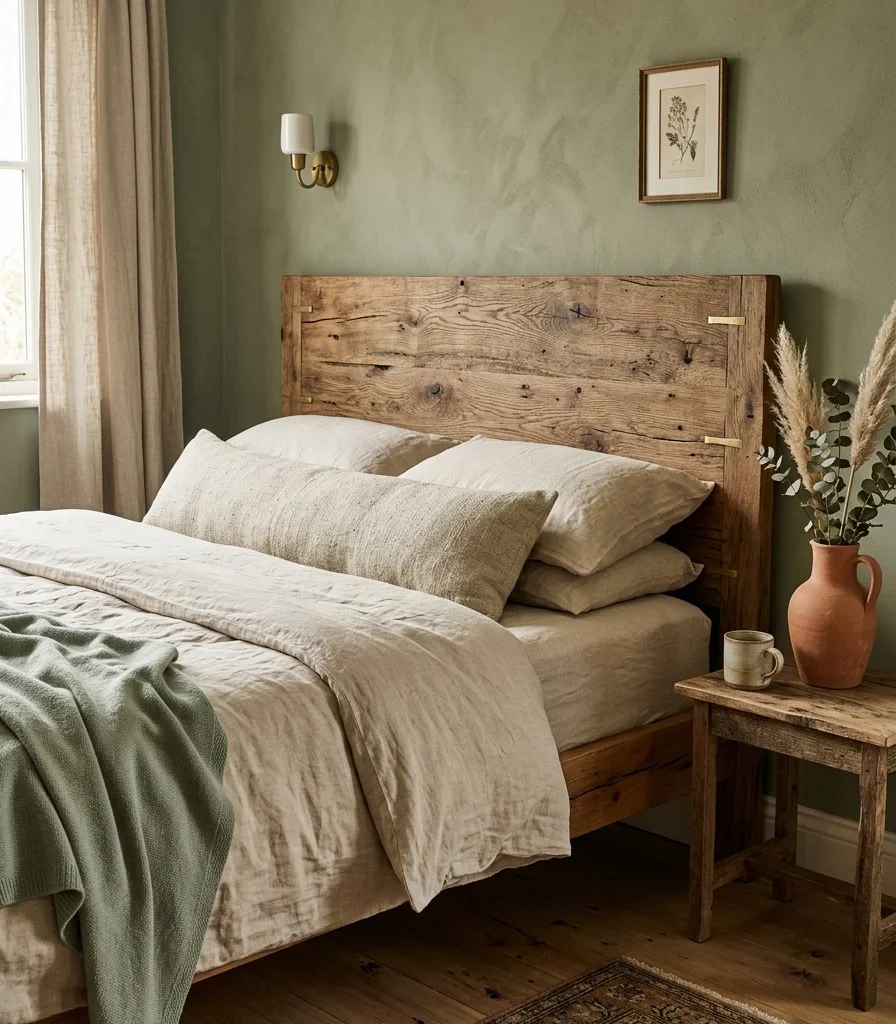
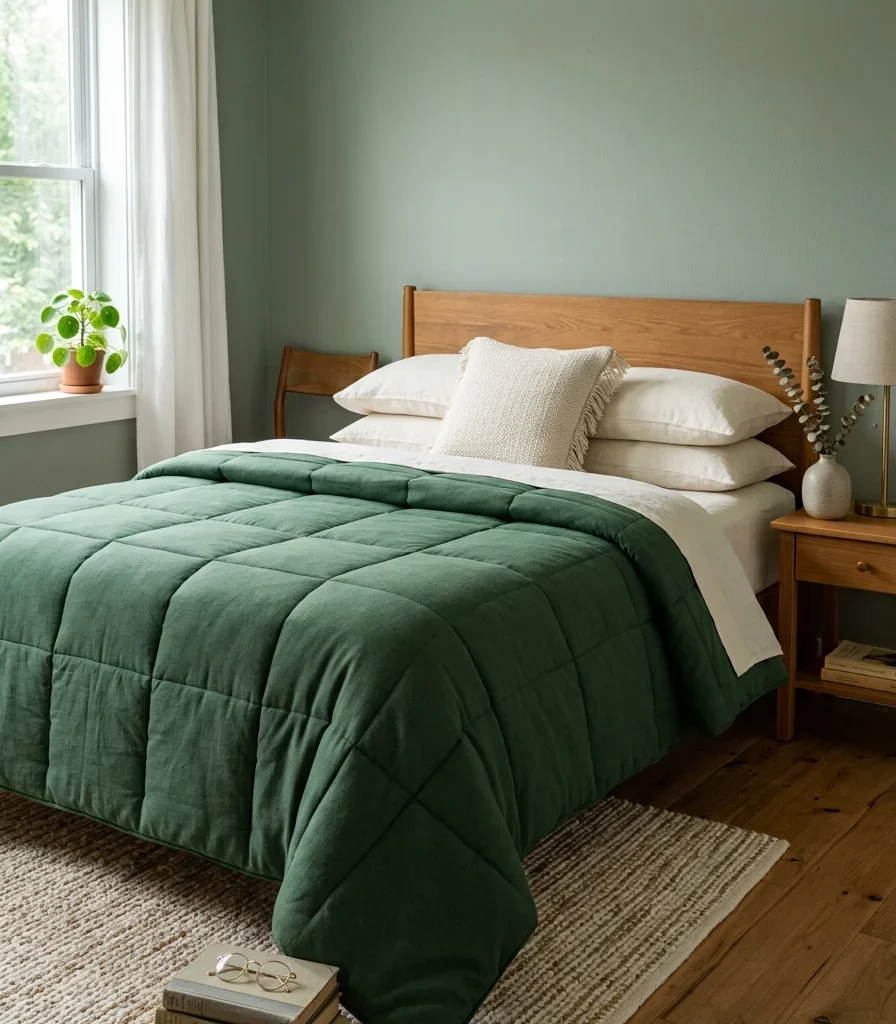
1. English Countryside Bedroom Ideas Start With a Weathered Oak Bed
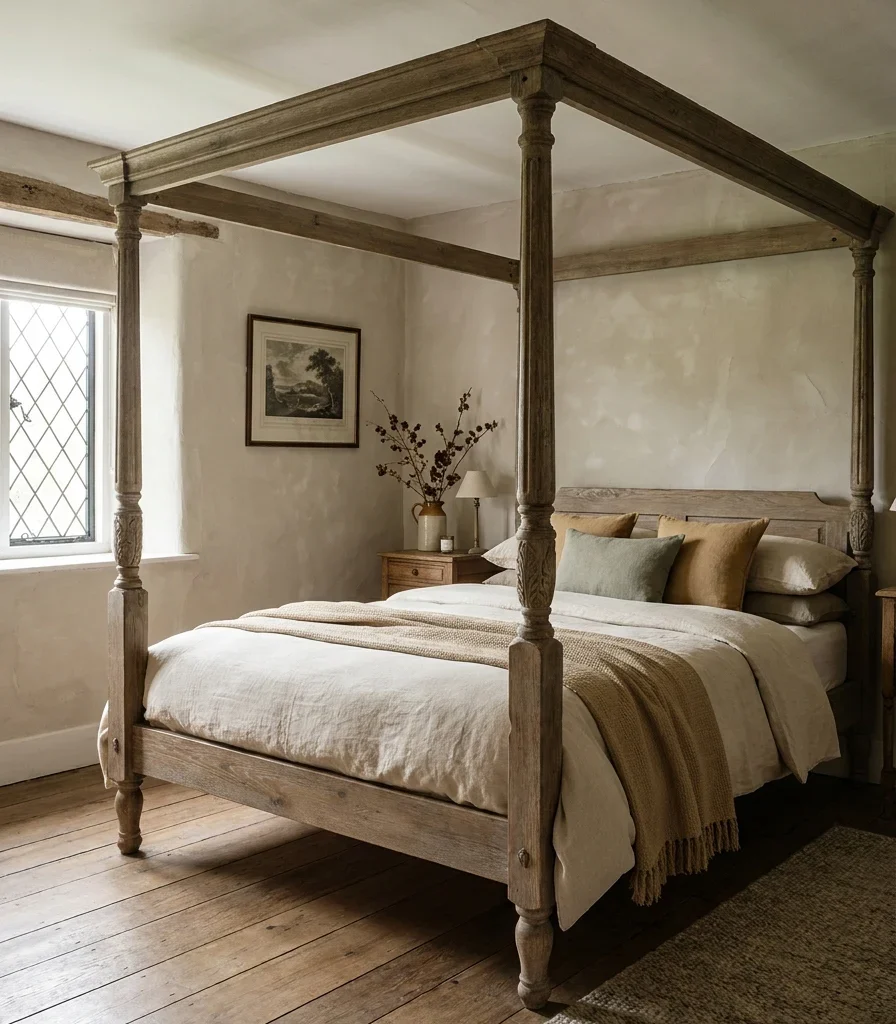
1. English Countryside Bedroom Ideas Start With a Weathered Oak Bed

Vibe: Grounded. The bed gives the bedroom the reassuring weight of furniture made to stay.

Why it works: A substantial oak bed creates visual hierarchy and establishes the material language immediately. The contrast between solid timber and loosely rumpled linen prevents the room from becoming too formal, while visible grain introduces the irregularity that makes English country furniture feel authentic.

How to get it: Choose medium-to-dark oak with a matte waxed finish rather than high-gloss varnish. Keep the headboard visually substantial, but allow at least 75 cm of clear circulation at the sides if the room permits.

💡 Quick Win: If replacing the bed is outside the budget, add a 100% linen headboard cushion in oatmeal to a simple wooden frame for an immediate country-house shift.

Shop The Look

Product
Weathered solid oak four-poster bed
Oatmeal European linen duvet cover
Antique oak three-drawer bedside table
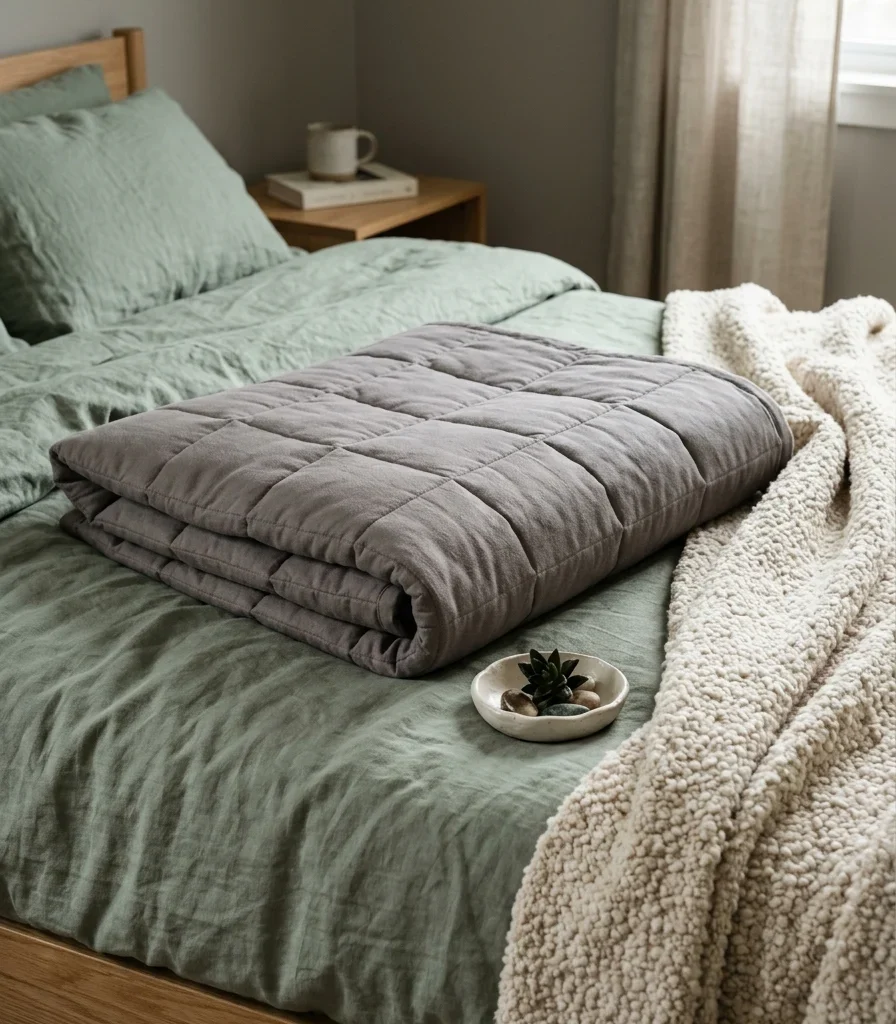
Handwoven wool throw blanket
Ceramic bedside water pitcher

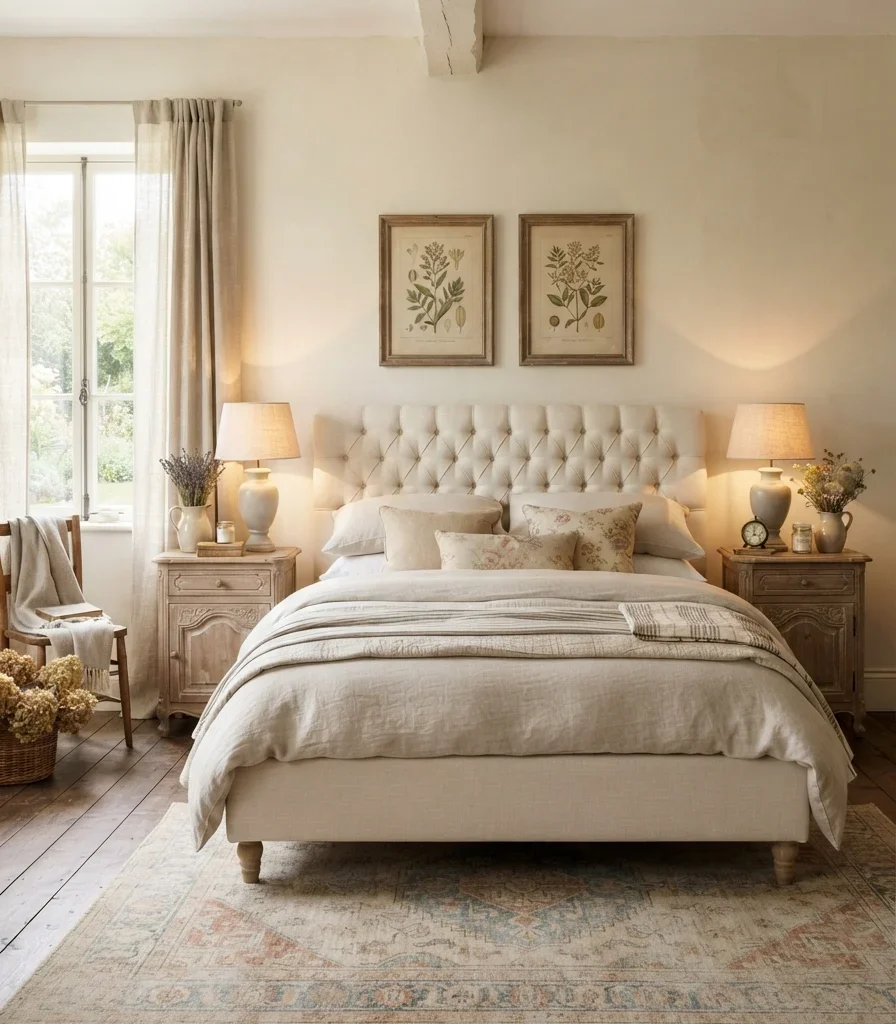
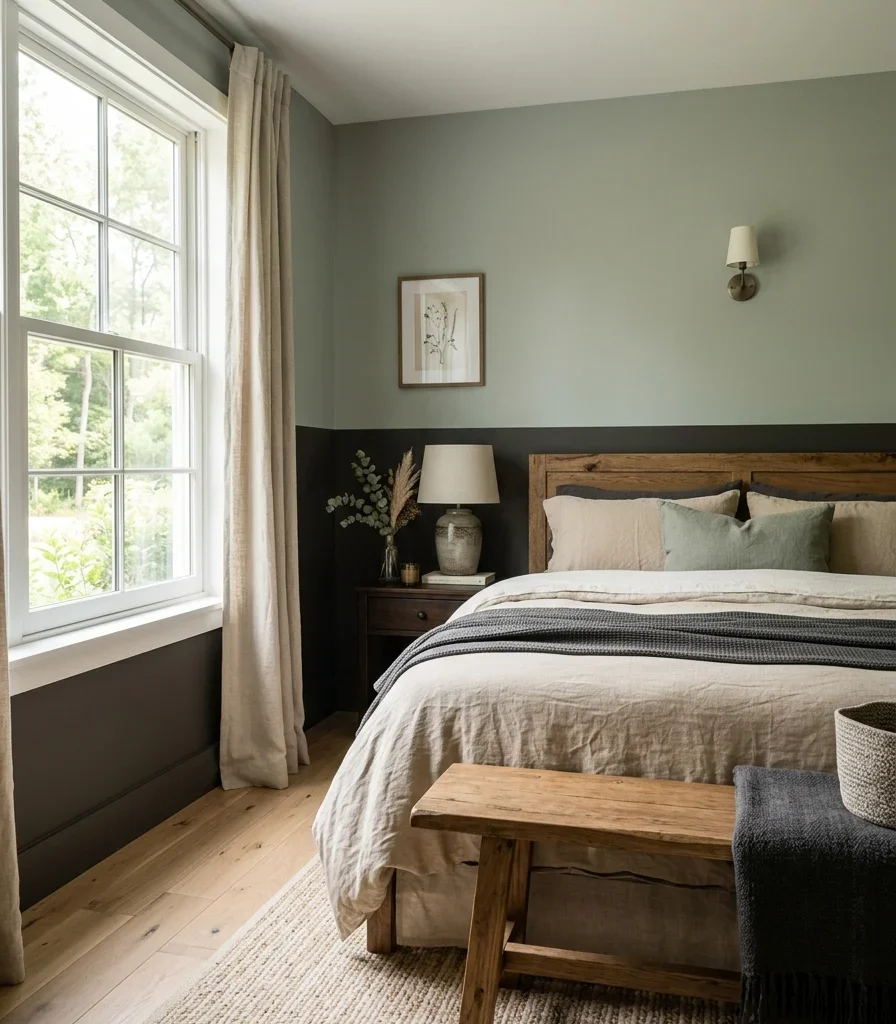
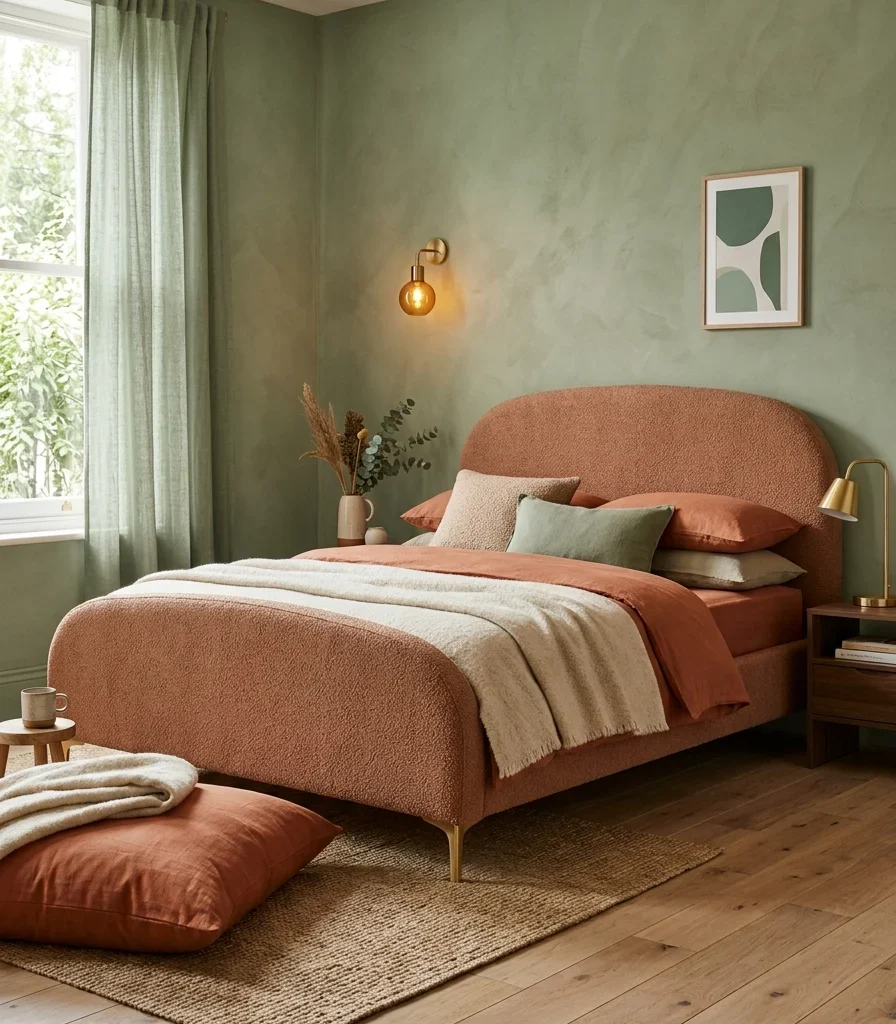
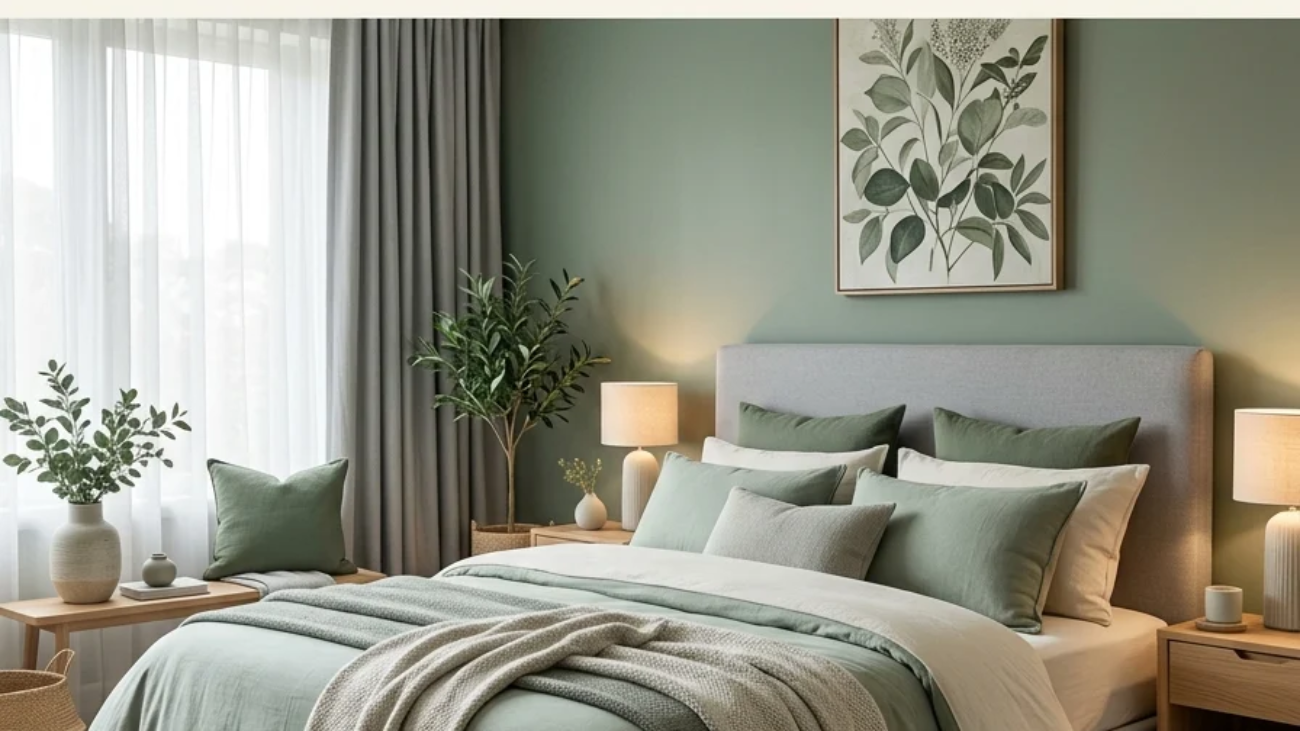
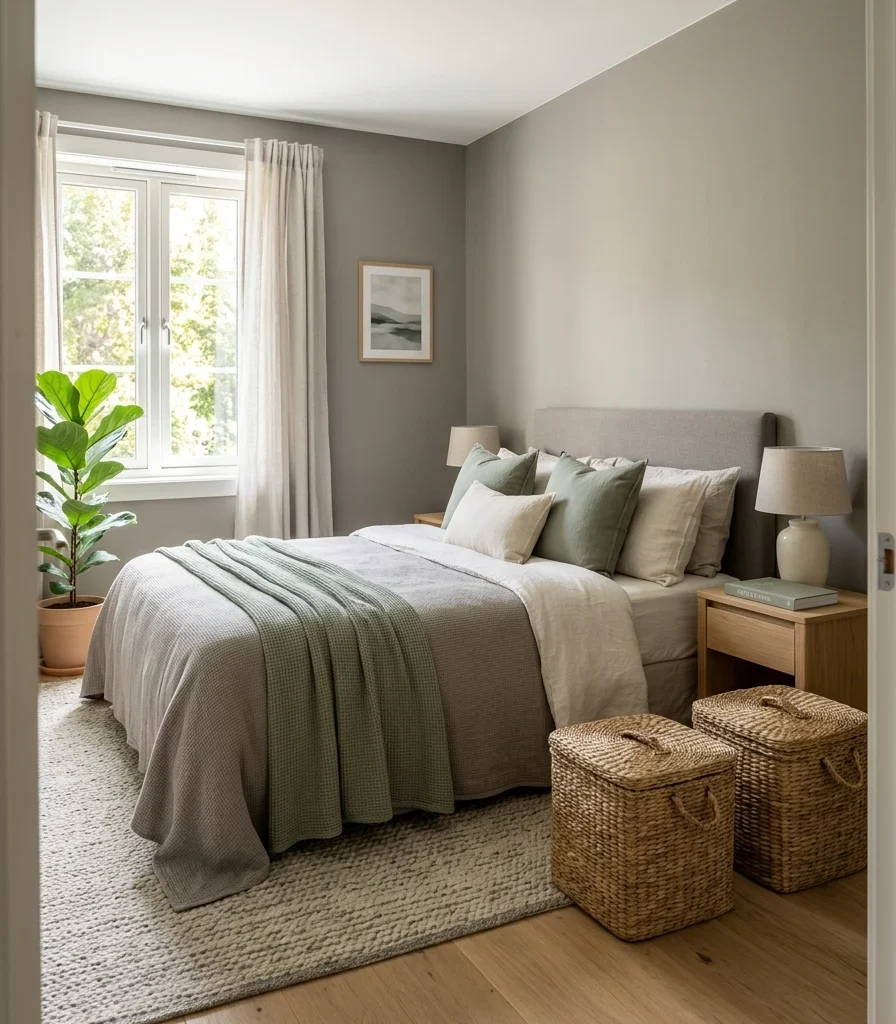
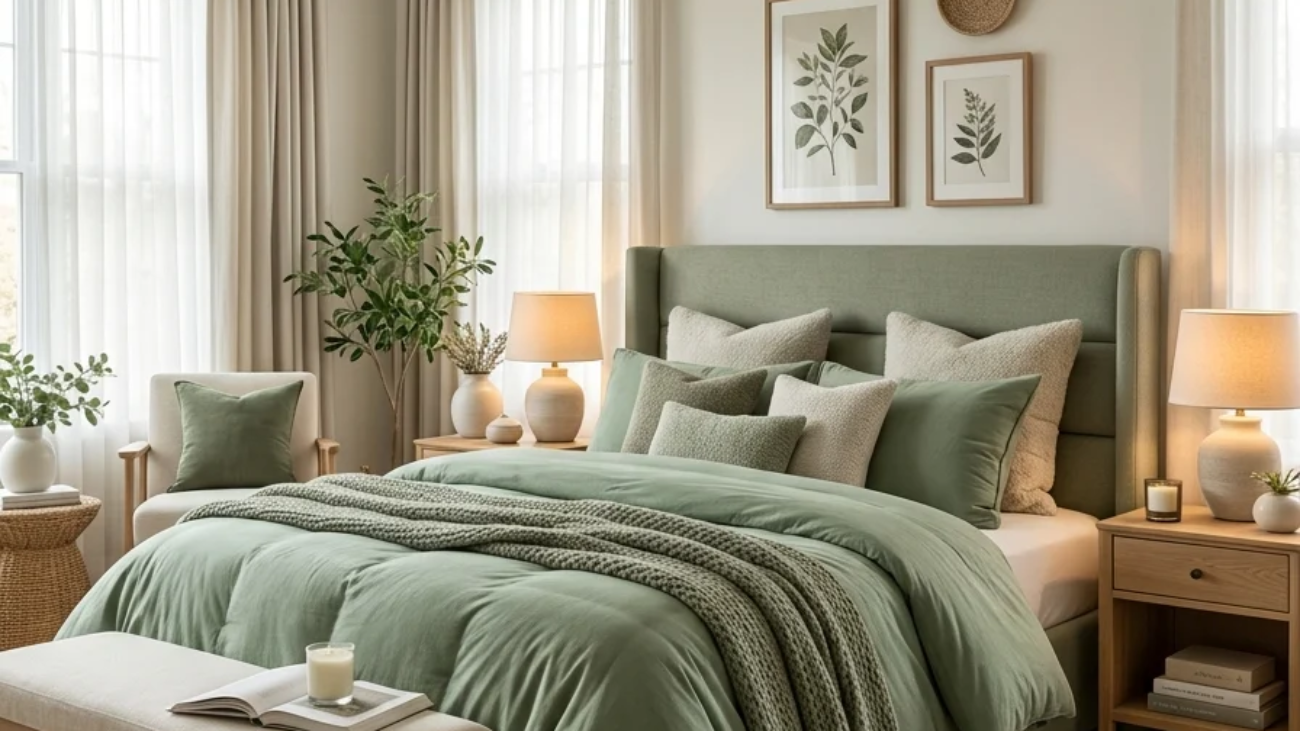
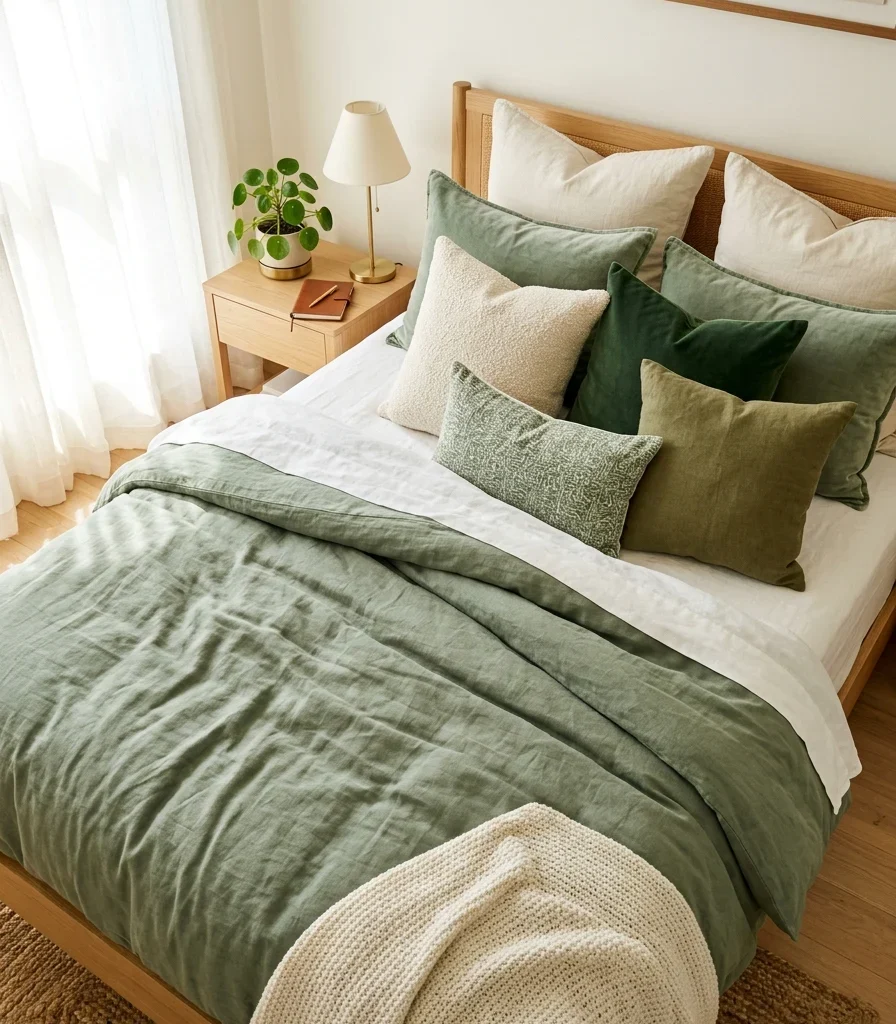
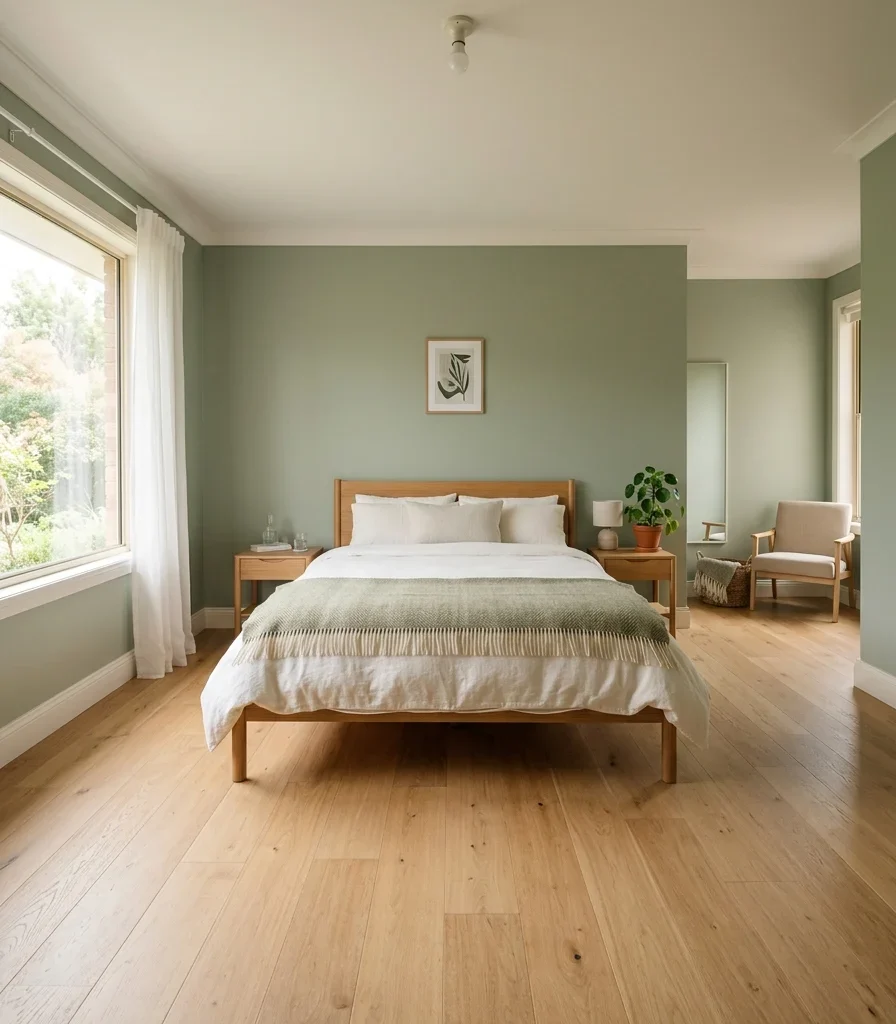
2. Use Sage Green With Warm Ivory for a Soft English Palette
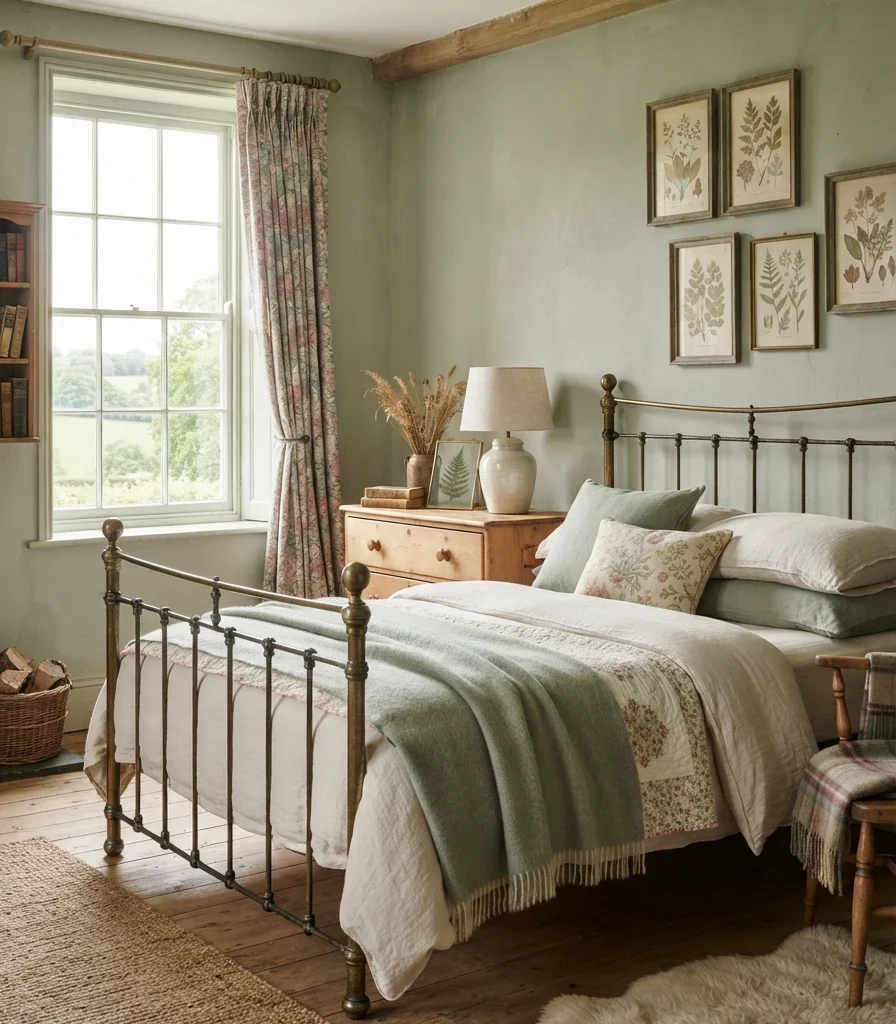
2. Use Sage Green With Warm Ivory for a Soft English Palette

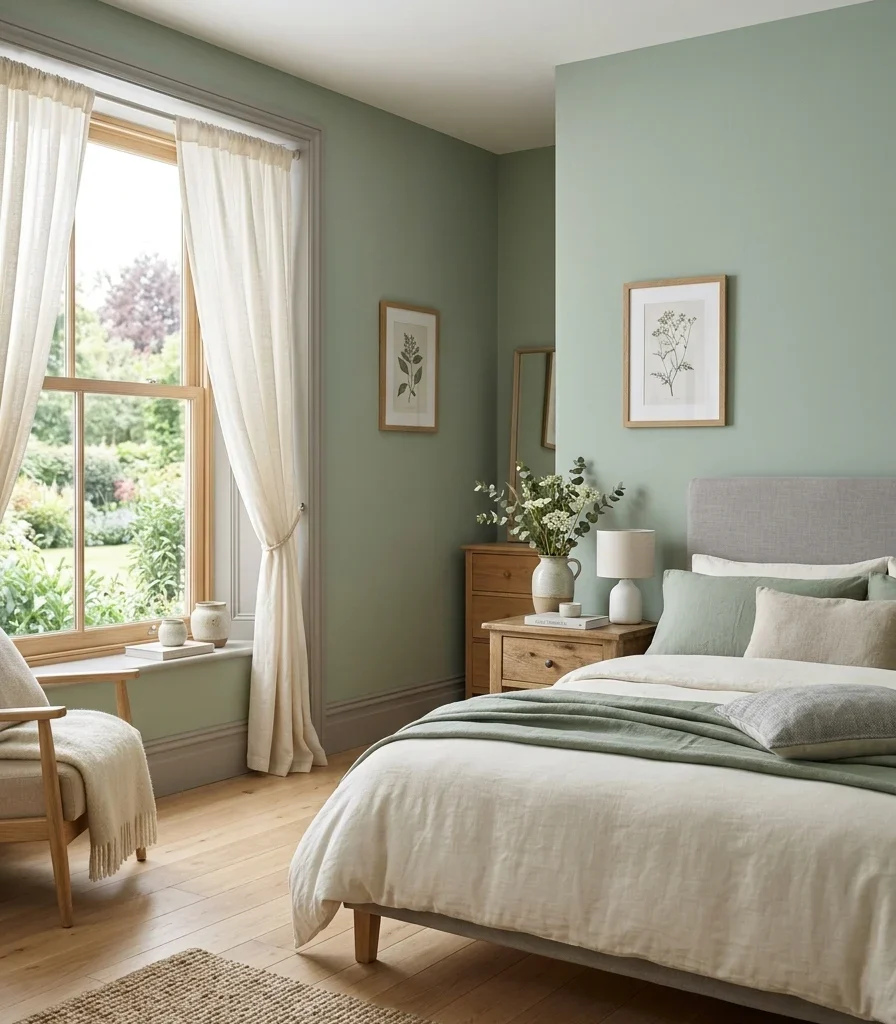
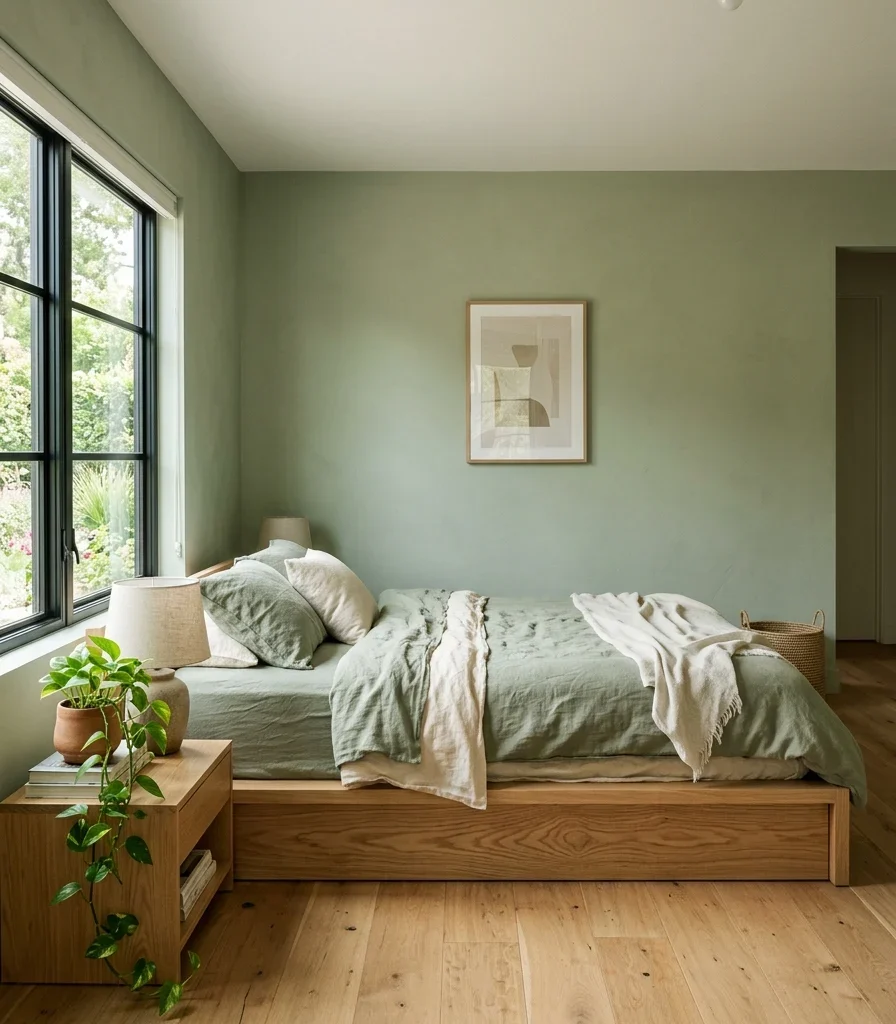
Vibe: Sun-warmed; the muted green feels connected to hedgerows and garden foliage outside the window.

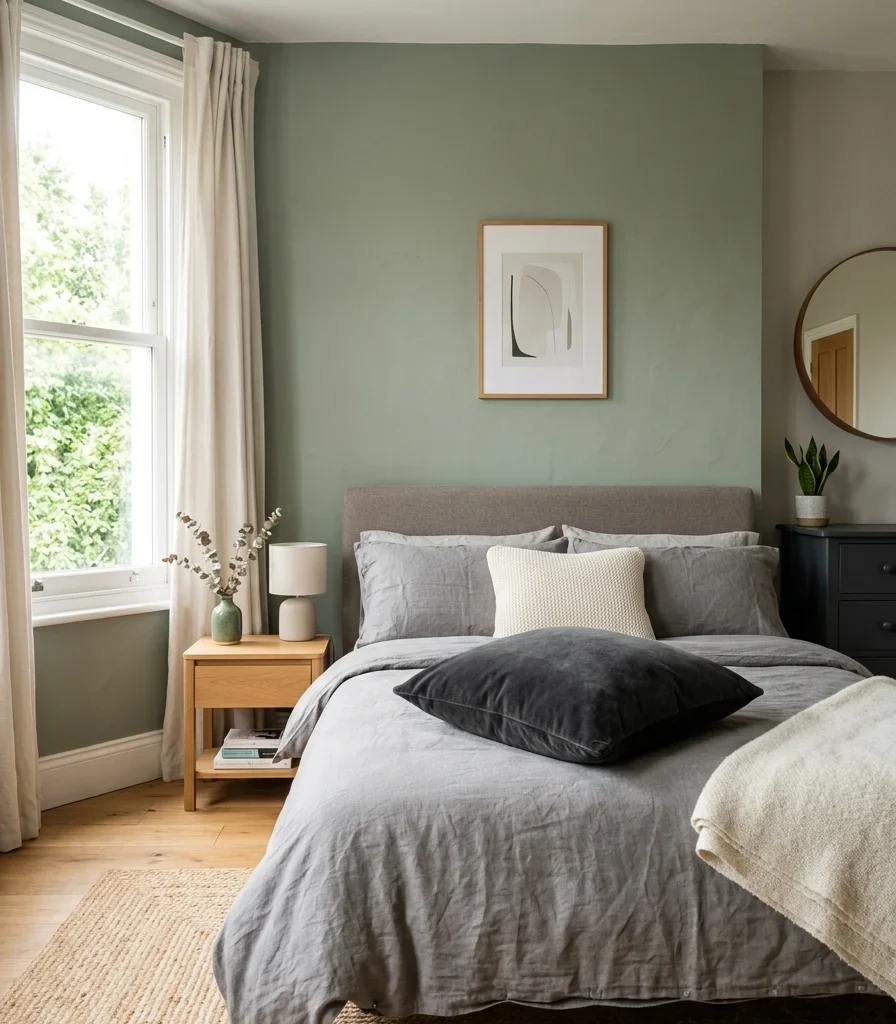
Why it works: Sage and warm ivory create low-contrast color continuity, which makes a bedroom feel calmer than a palette built around sharp black-and-white contrast. The warmer white also prevents sage from becoming cold, especially in north-facing rooms.

How to get it: Use a chalky sage around the walls and trim only if the room receives enough daylight; otherwise choose a warmer greige-sage. Repeat the green in one curtain or cushion rather than introducing it through every accessory.

Shop The Look

Product
Muted sage green interior wall paint
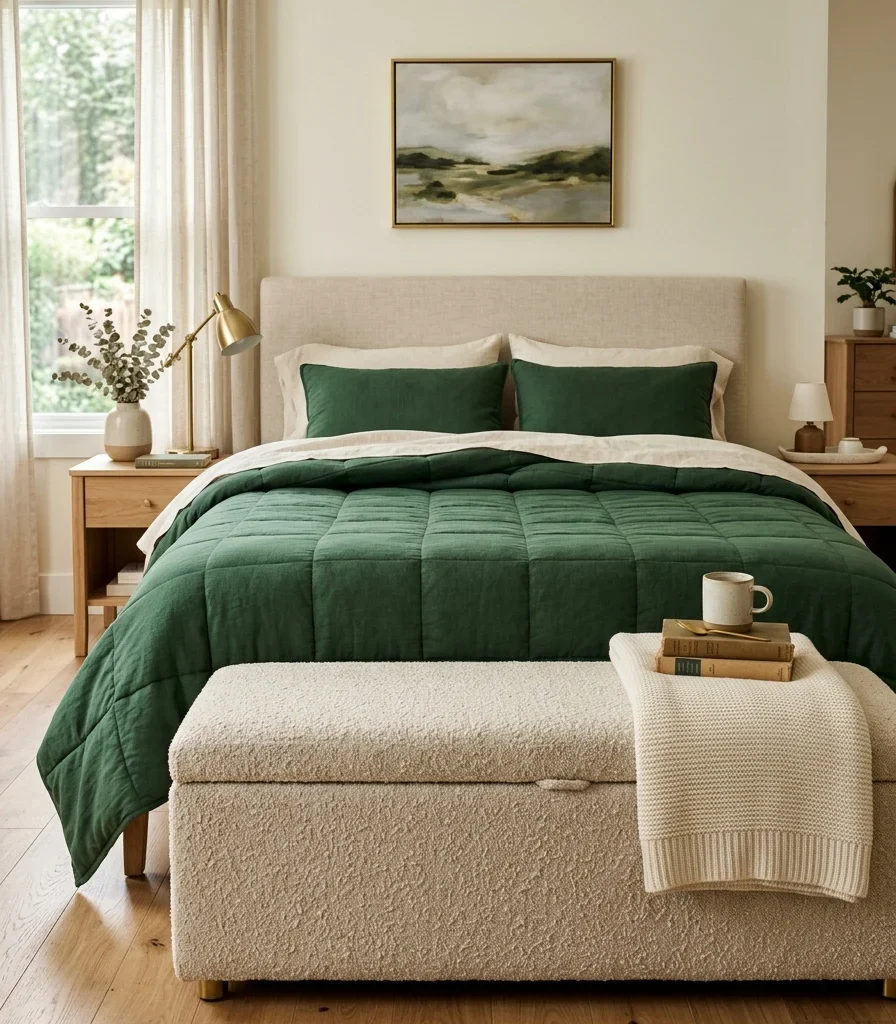
Warm ivory linen duvet cover
Faded sage floral curtain panels
Antique pine bedside chest
Sage ceramic table lamp

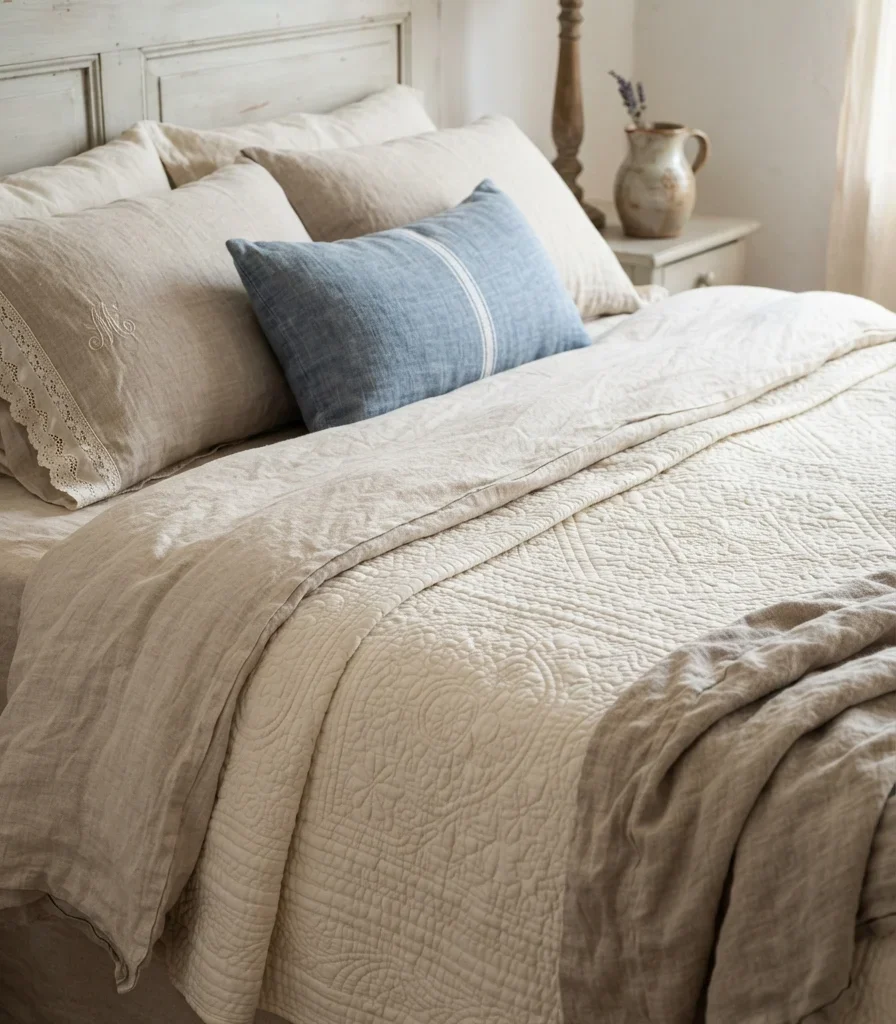
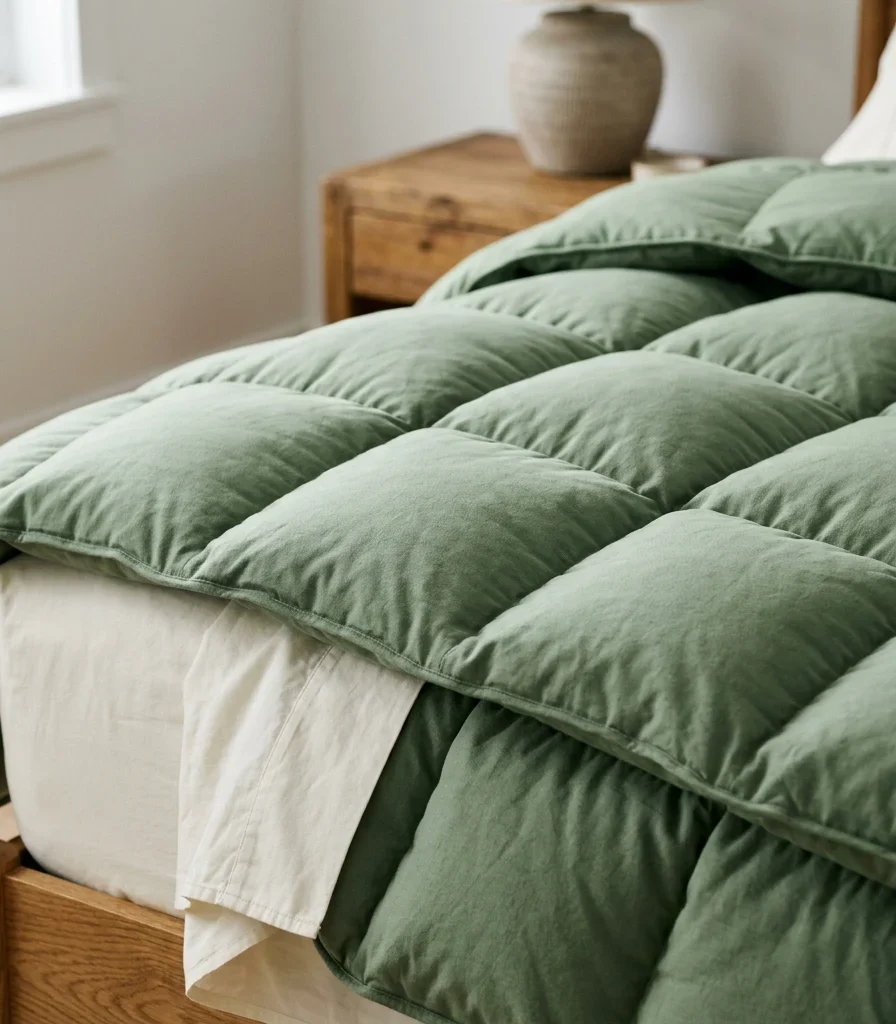
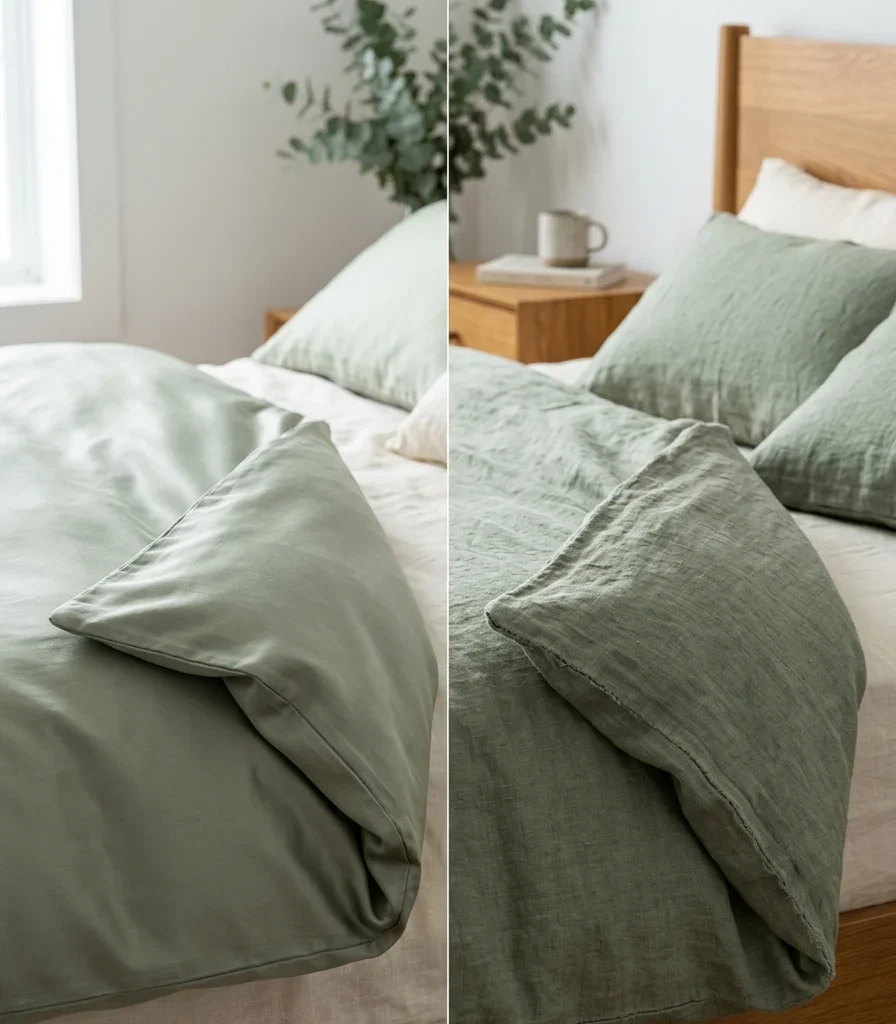
3. Layer Washed Linen, Wool, and Cotton on the Bed
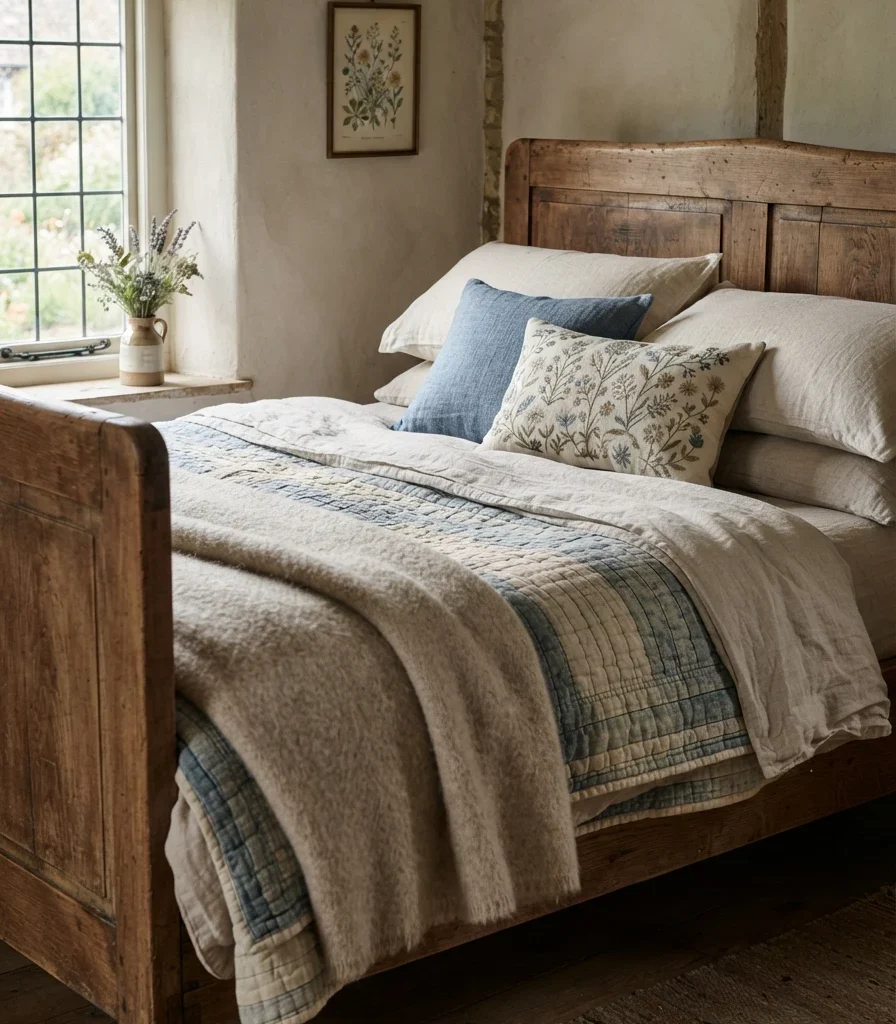
3. Layer Washed Linen, Wool, and Cotton on the Bed

Vibe: Layered every textile invites touch and makes the bed feel assembled over years.

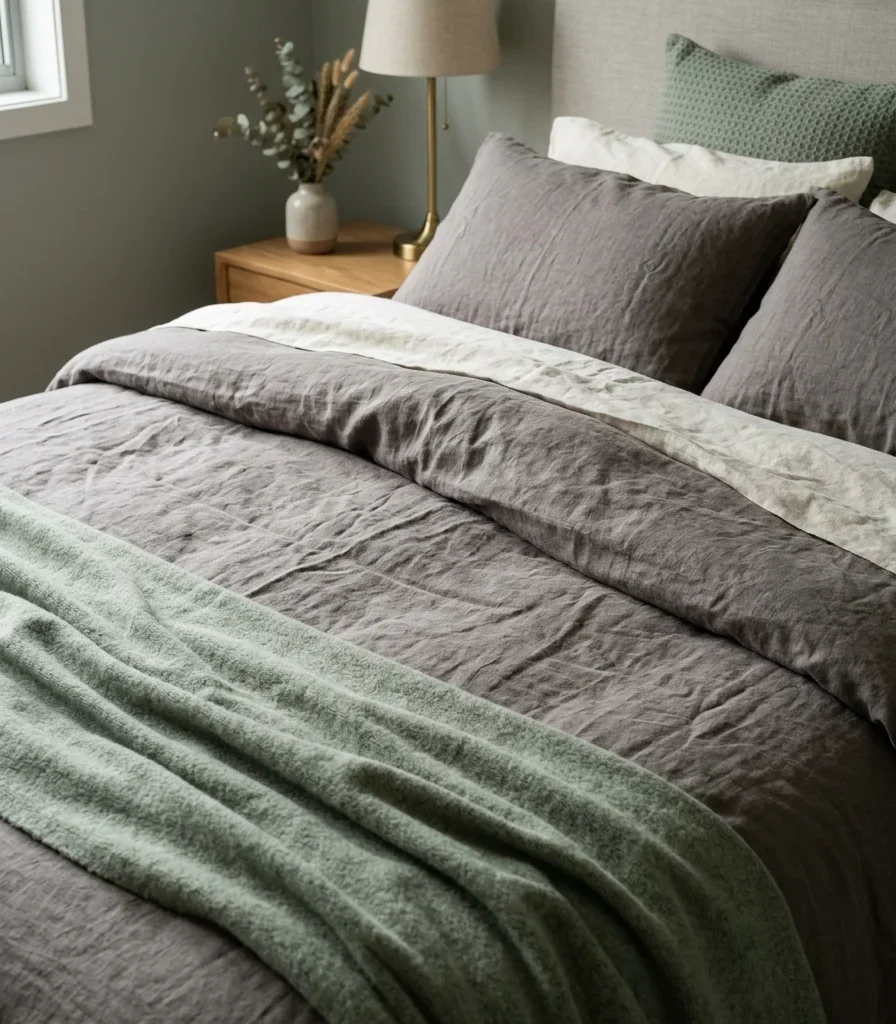
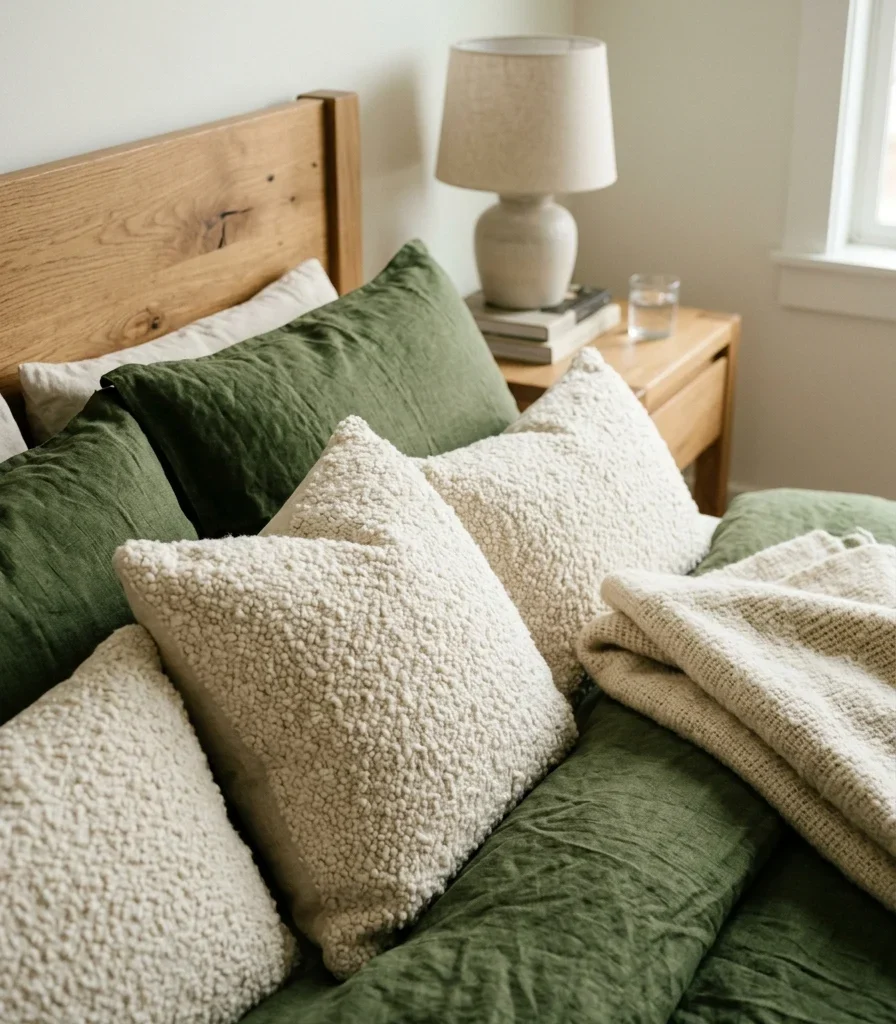
Why it works: Texture layering creates depth without relying on strong pattern. Linen has a slightly irregular surface, cotton provides a smoother middle layer, and wool introduces loft and visual weight, allowing a restrained color palette to remain interesting.

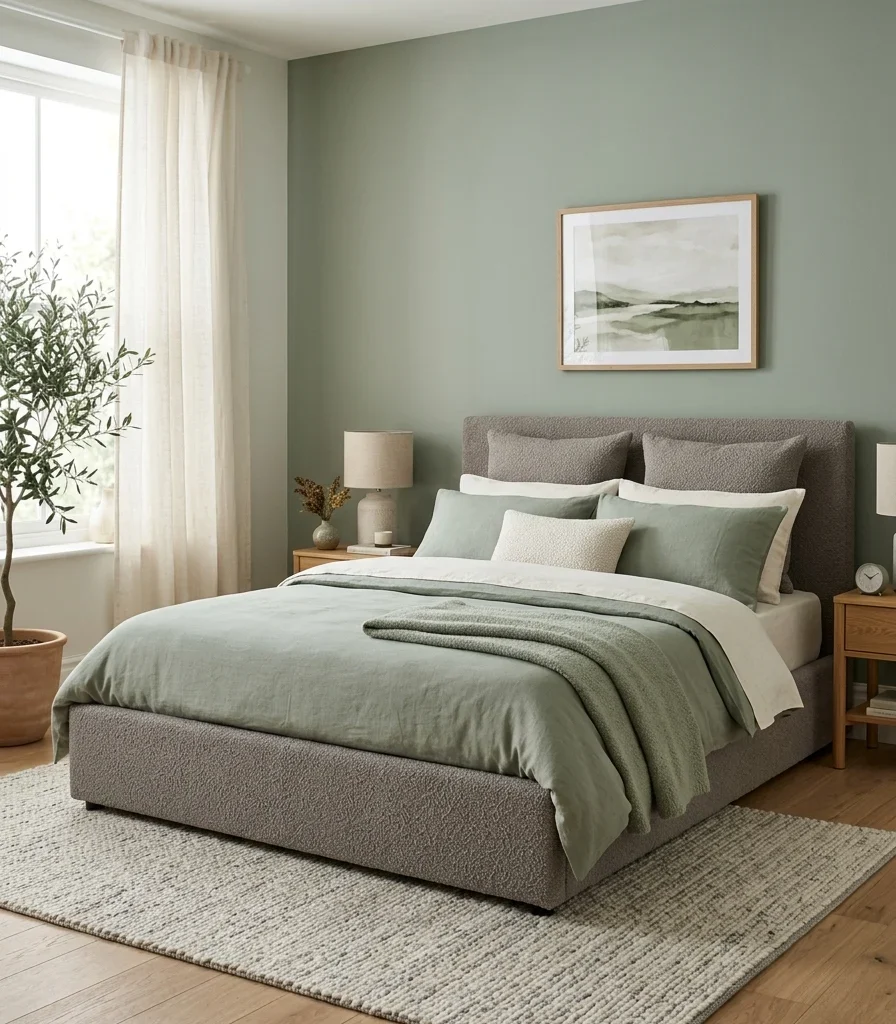
How to get it: Build the bed in three tactile levels: crisp or washed linen sheets, a lightweight cotton quilt, then one wool blanket folded across the lower third. Avoid piling more than three major patterns into the arrangement.

Shop The Look

Product
Stonewashed oatmeal linen sheet set
Quilted cotton bedcover ivory
Chunky natural wool blanket
Faded blue linen pillowcase pair
Embroidered floral lumbar cushion

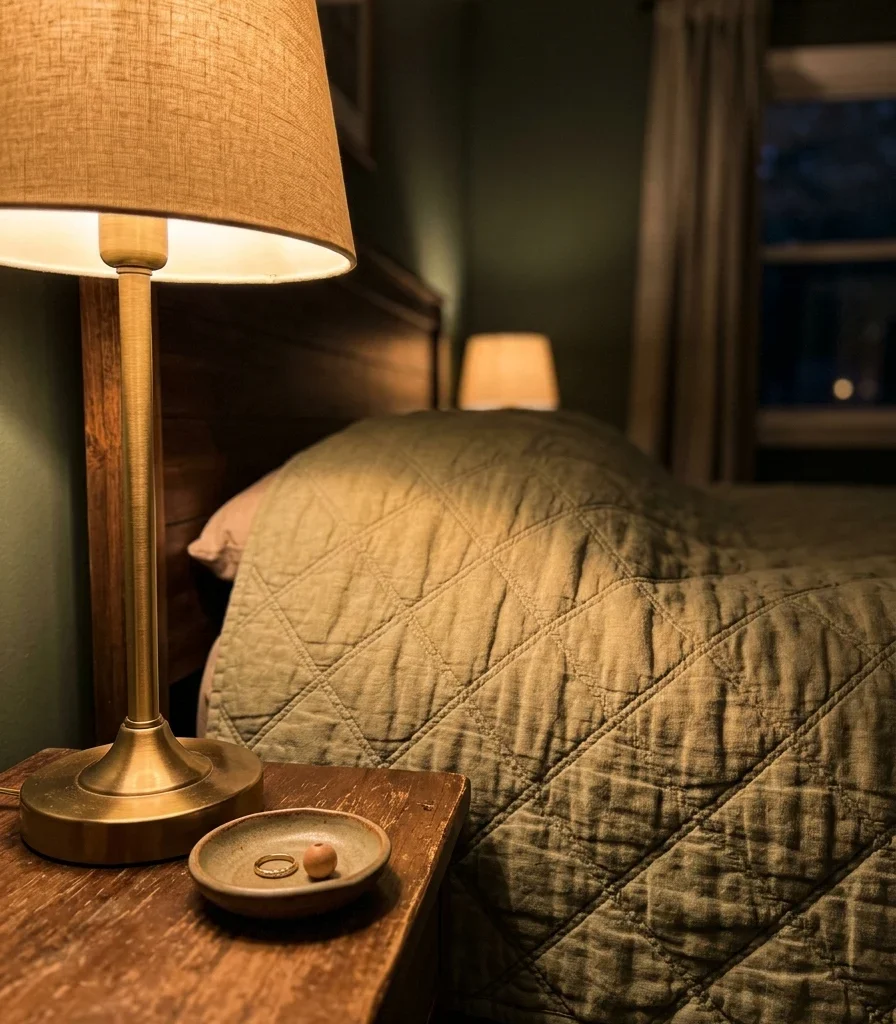
4. Hang a Traditional Brass Pendant Beside the Bed
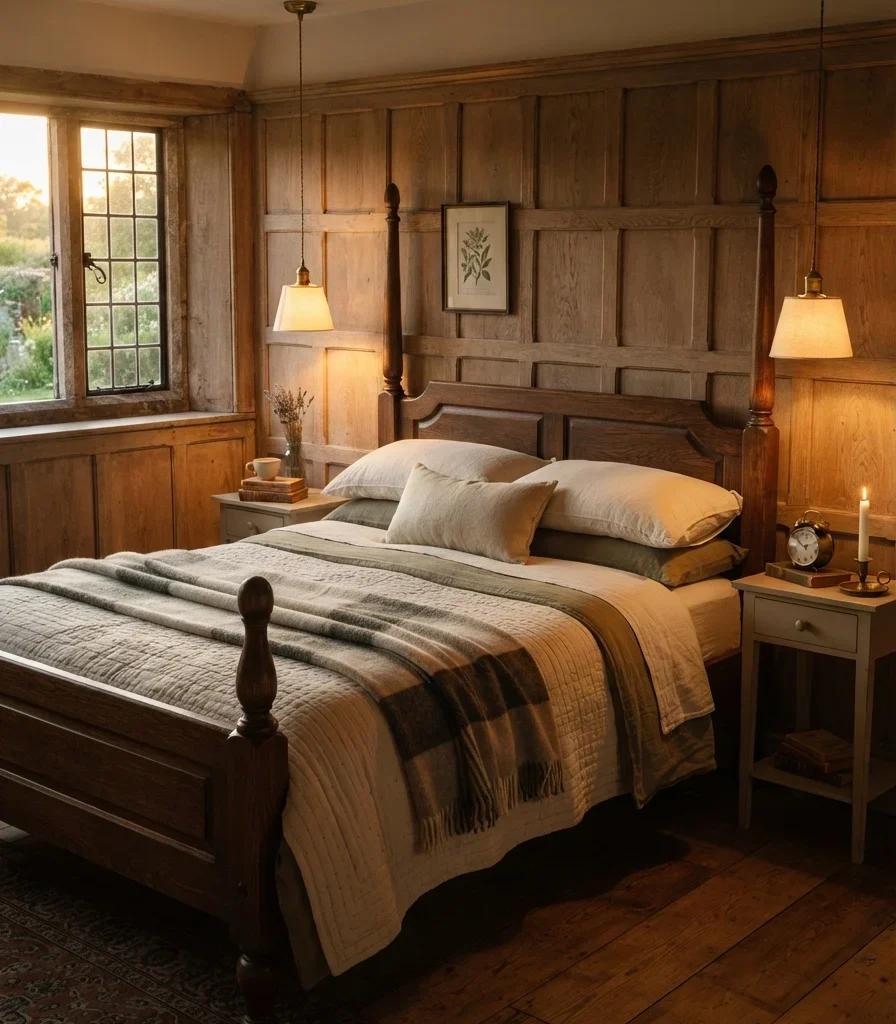
4. Hang a Traditional Brass Pendant Beside the Bed

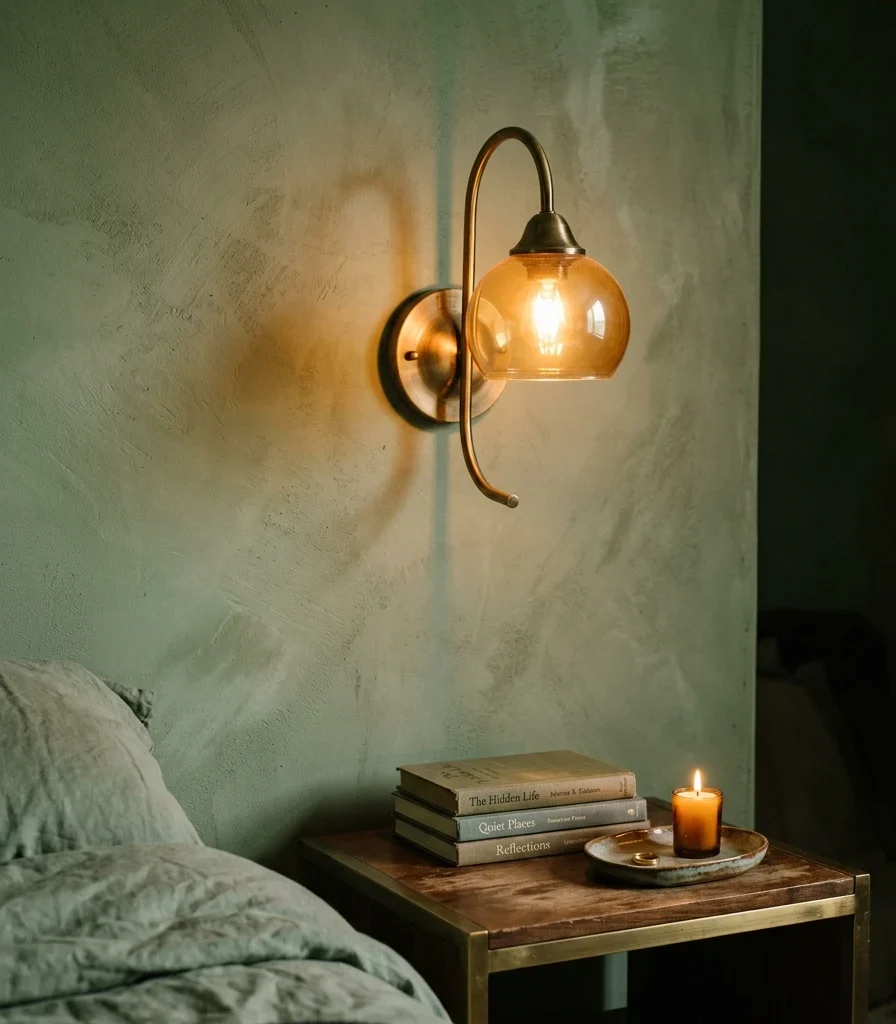
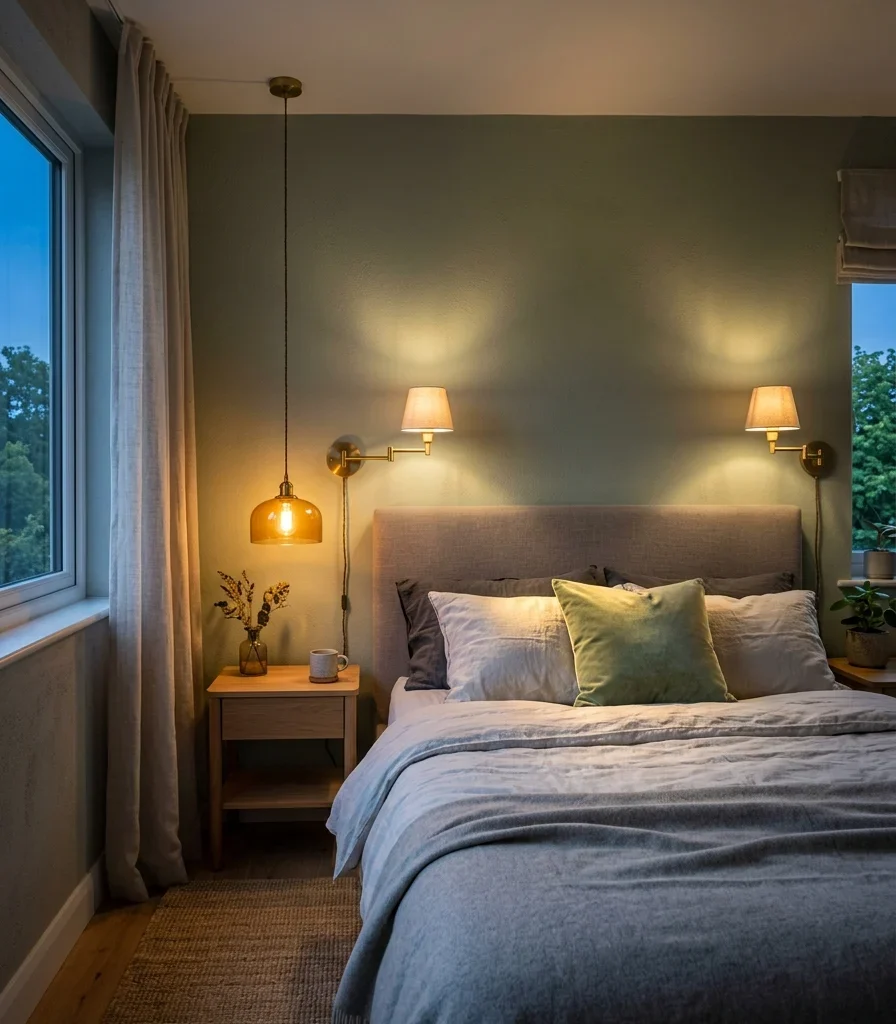
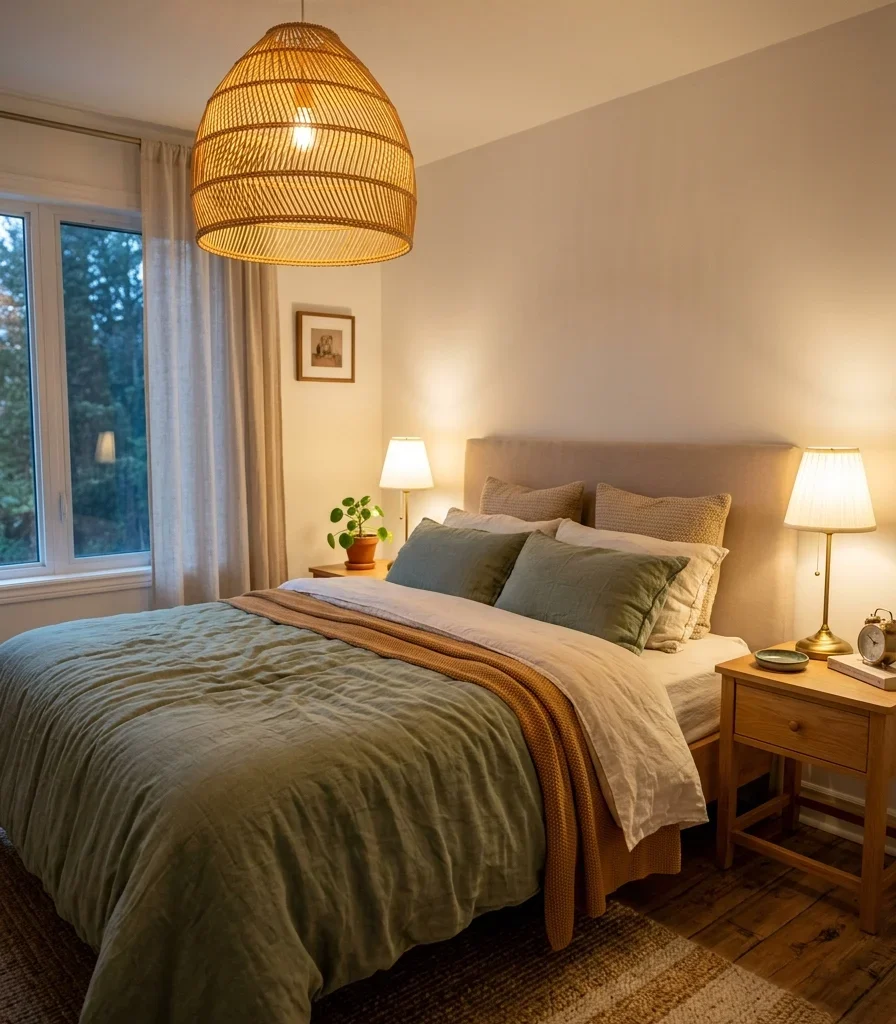
Vibe: A luminous arm bedside light makes timber and linen appear softer after sunset.

Why it works: Pendant lighting frees the bedside surface while creating vertical rhythm around the bed. Aged brass reflects warm light gently, unlike polished chrome, which tends to introduce a sharper contemporary note.

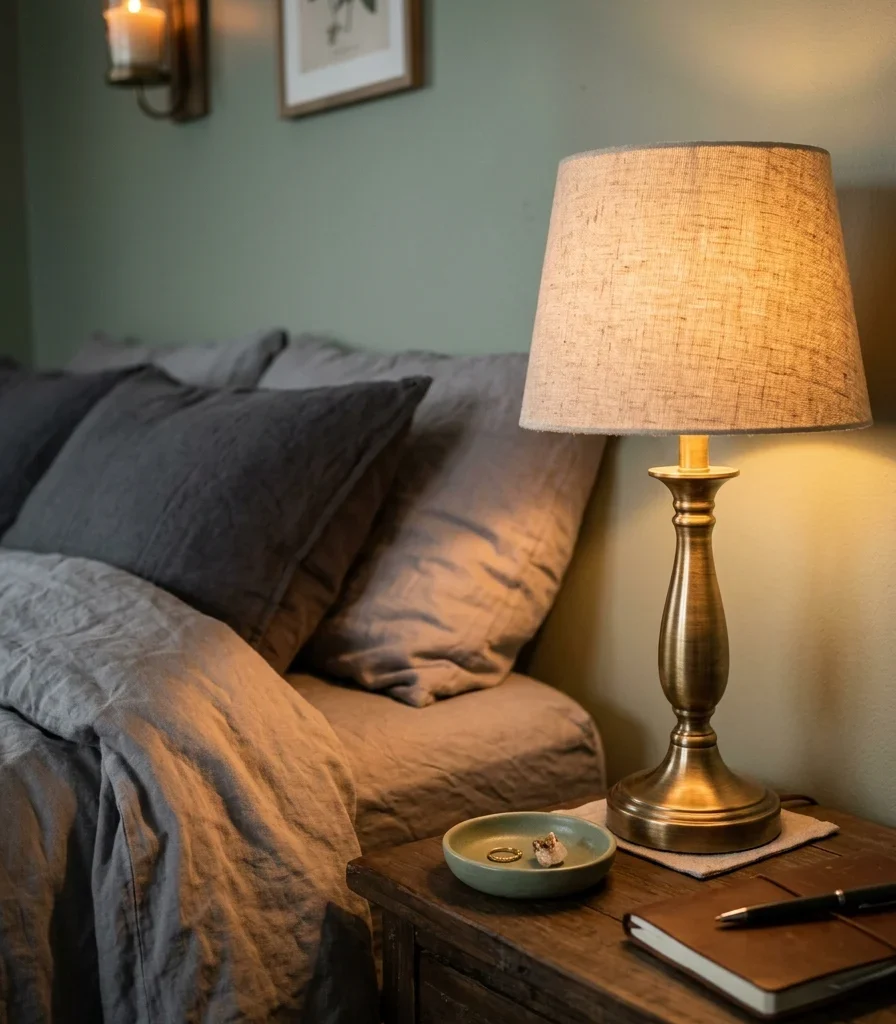
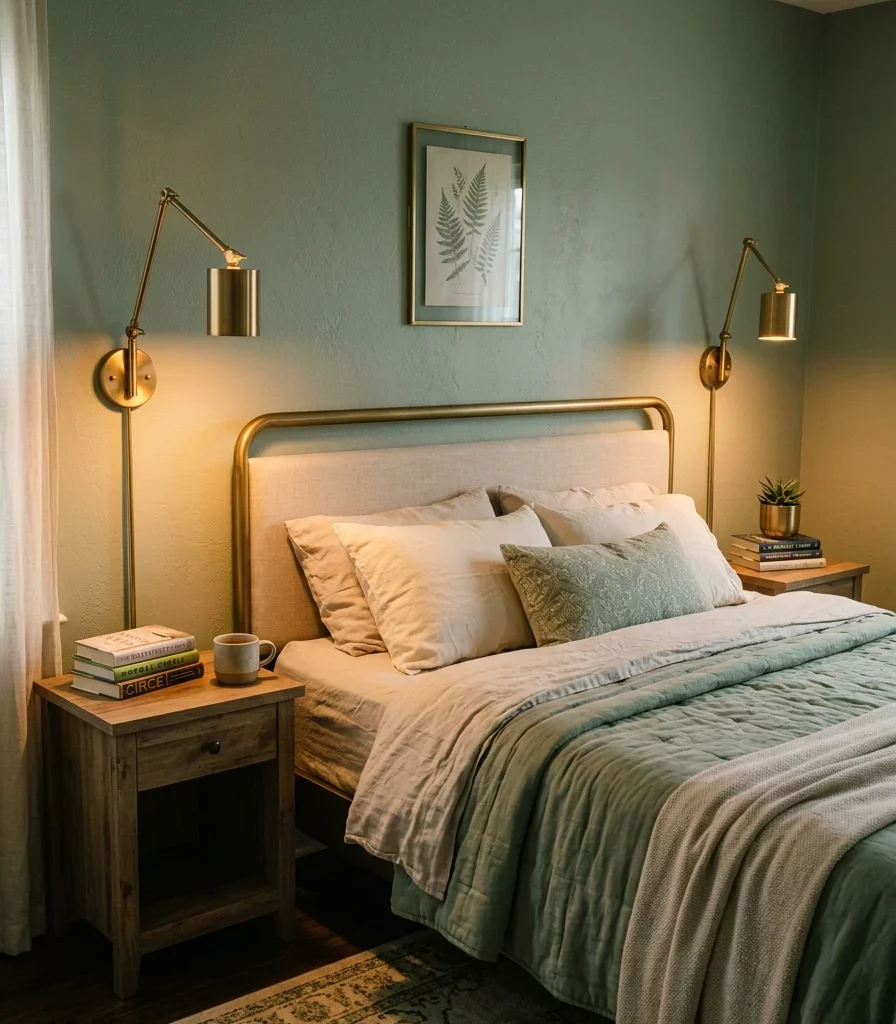
How to get it: Hang each pendant approximately 45–60 cm above the bedside surface and use 2200–2700K dimmable bulbs. Keep the pendants visually small enough that they frame the bed rather than compete with the headboard.

💡 Quick Win: Swap existing cool-white bedside bulbs for warm 2700K bulbs before buying new fixtures; the color temperature alone can noticeably change the room’s atmosphere.

Shop The Look

Product
Aged brass bedside pendant light
Cream fabric shade pendant
2700K dimmable vintage LED bulb
Brass ceiling hook canopy
Antique brass cord adjuster

5. Bring in an Antique Pine Chest for Honest Country Character
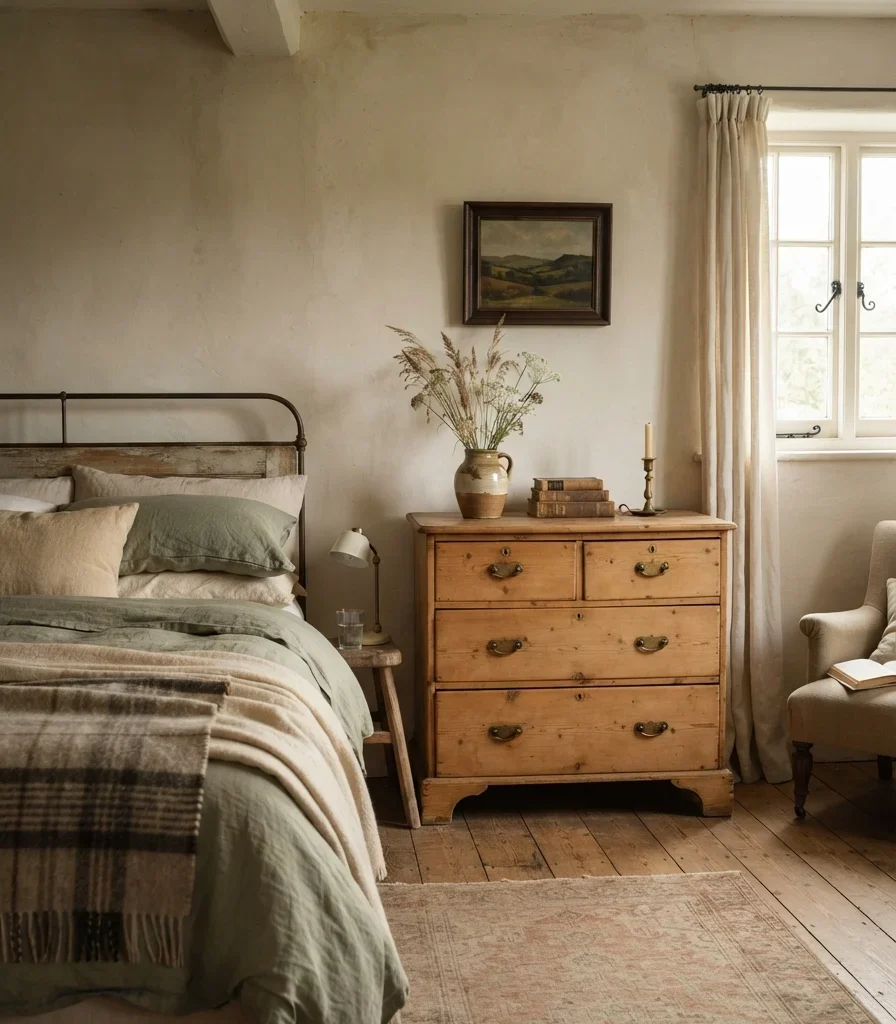
5. Bring in an Antique Pine Chest for Honest Country Character

Vibe: Ancestral worn pine makes the room feel connected to another generation.

Why it works: Pine has a lighter visual weight than dark oak and brings an informal cottage quality into the bedroom. Its knots, dents, and uneven color also provide authentic surface variation that manufactured distressed furniture often struggles to reproduce.

How to get it: Search for secondhand pine chests with simple drawer fronts and original brass or iron pulls. Avoid pieces with artificially exaggerated distressing; genuine small scratches and uneven color are enough.

Shop The Look

Product
Vintage pine six-drawer chest
Antique brass cup drawer pulls
Small framed English landscape print
Stoneware bud vase
Traditional brass candlestick

6. Frame the Bed With Full-Length Floral Curtains
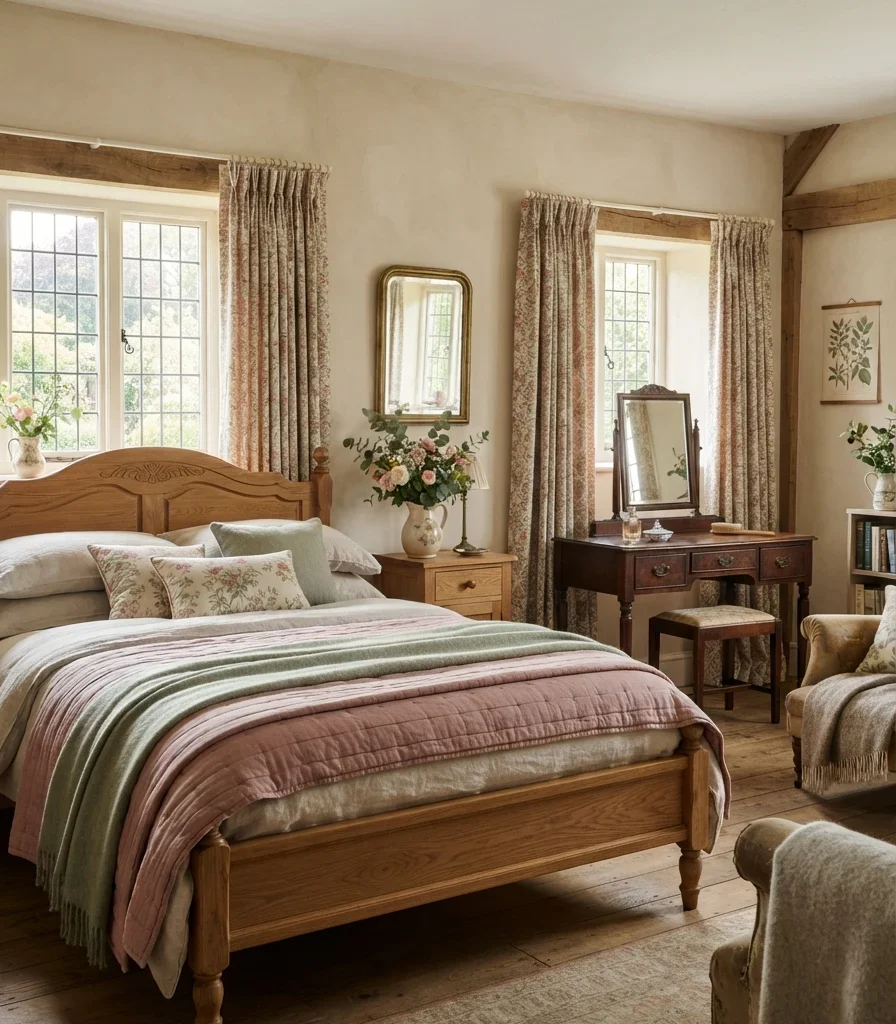
6. Frame the Bed With Full-Length Floral Curtains

Vibe: Airy. The curtains soften the bed’s silhouette and make the wall feel taller.

Why it works: Full-length fabric adds vertical emphasis, while a small floral pattern reinforces the botanical vocabulary of English country interiors. Framing the bed with fabric also creates a subtle architectural effect in rooms without a traditional alcove.

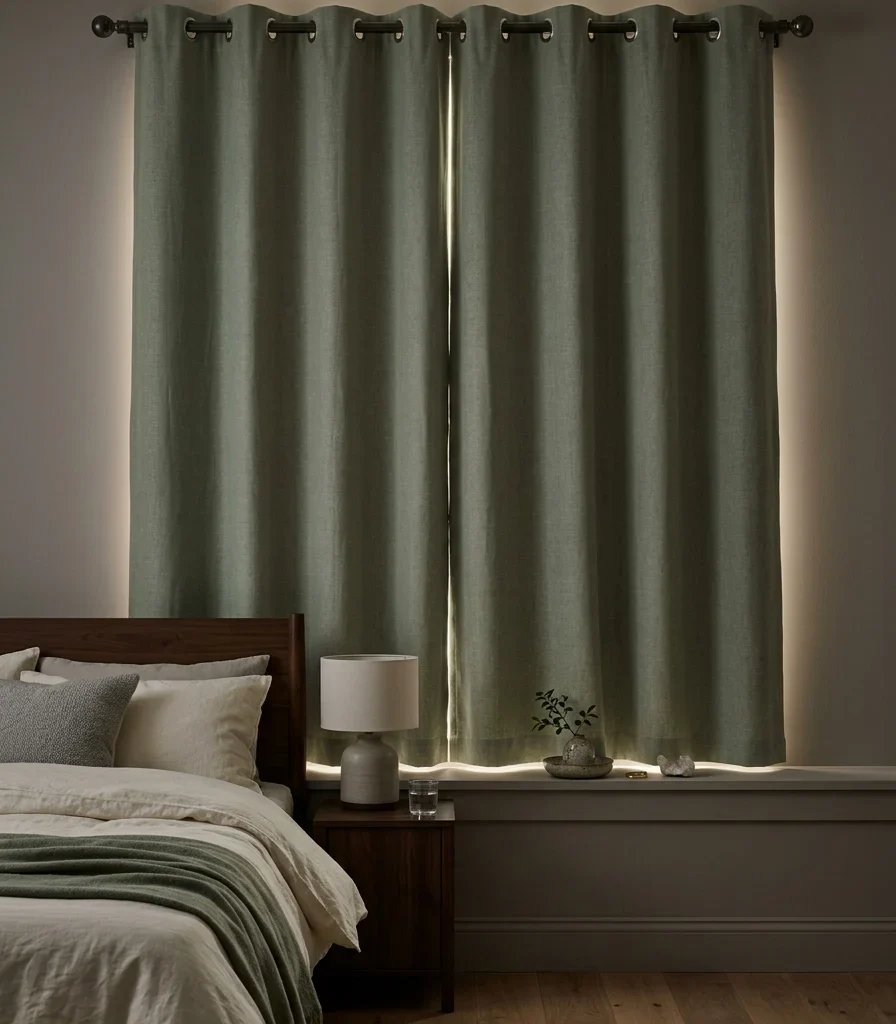
How to get it: Mount the curtain rod close to the ceiling and extend it 15–20 cm beyond each side of the bed. Choose a small botanical print with a warm ivory background so the pattern remains secondary to the bed.

Shop The Look

Product
Small-scale English floral curtain panels
Aged brass curtain rod
Brass curtain rings with clips
Floral linen tieback set
Natural cotton curtain liner

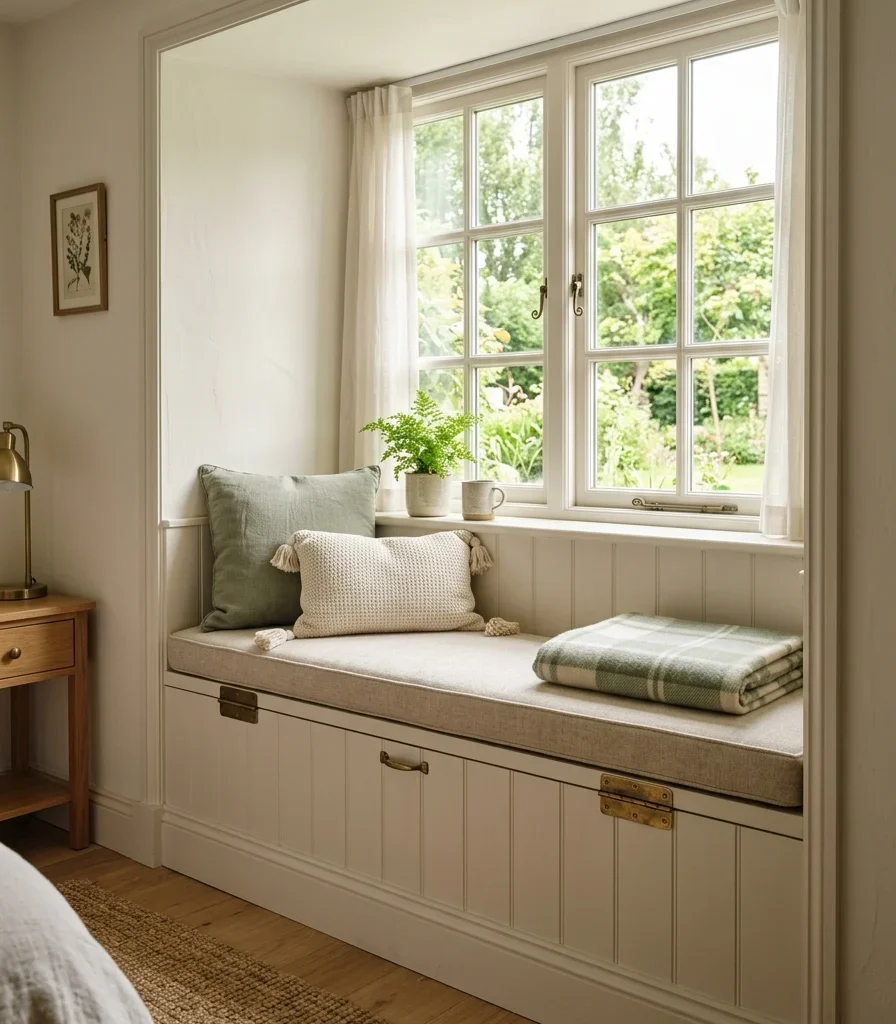
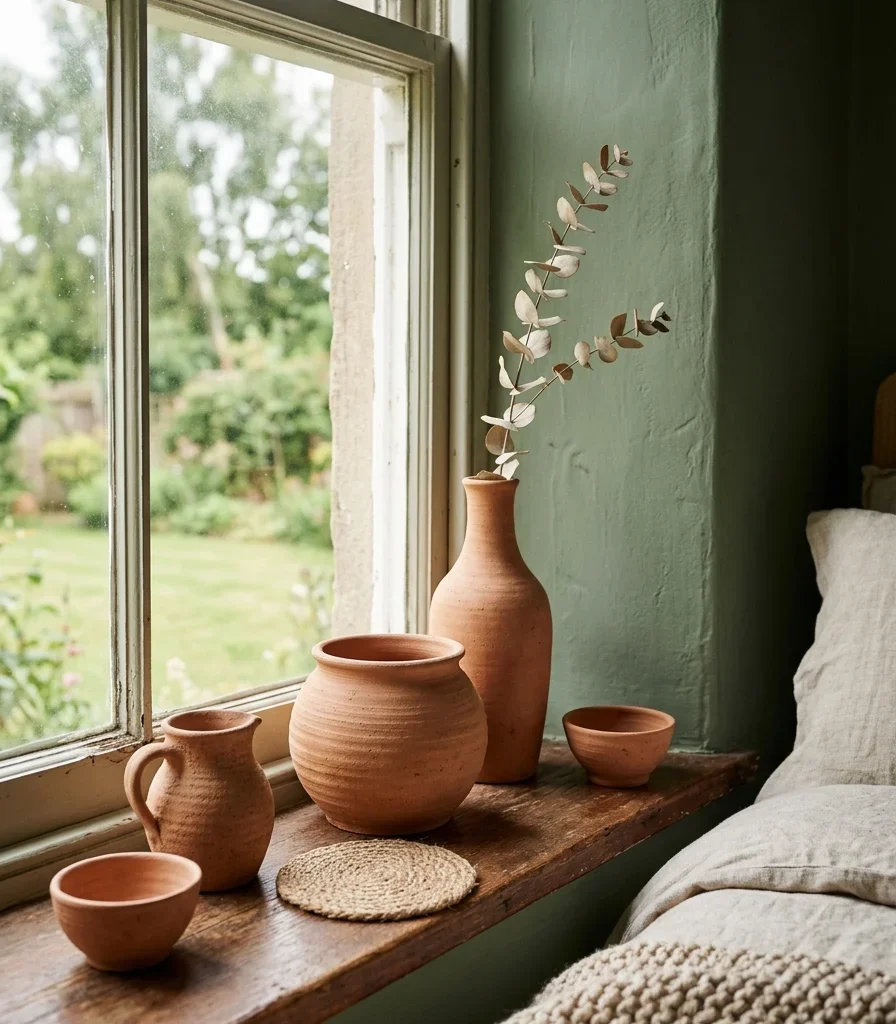
7. Add a Window Seat for a True Country-House Retreat
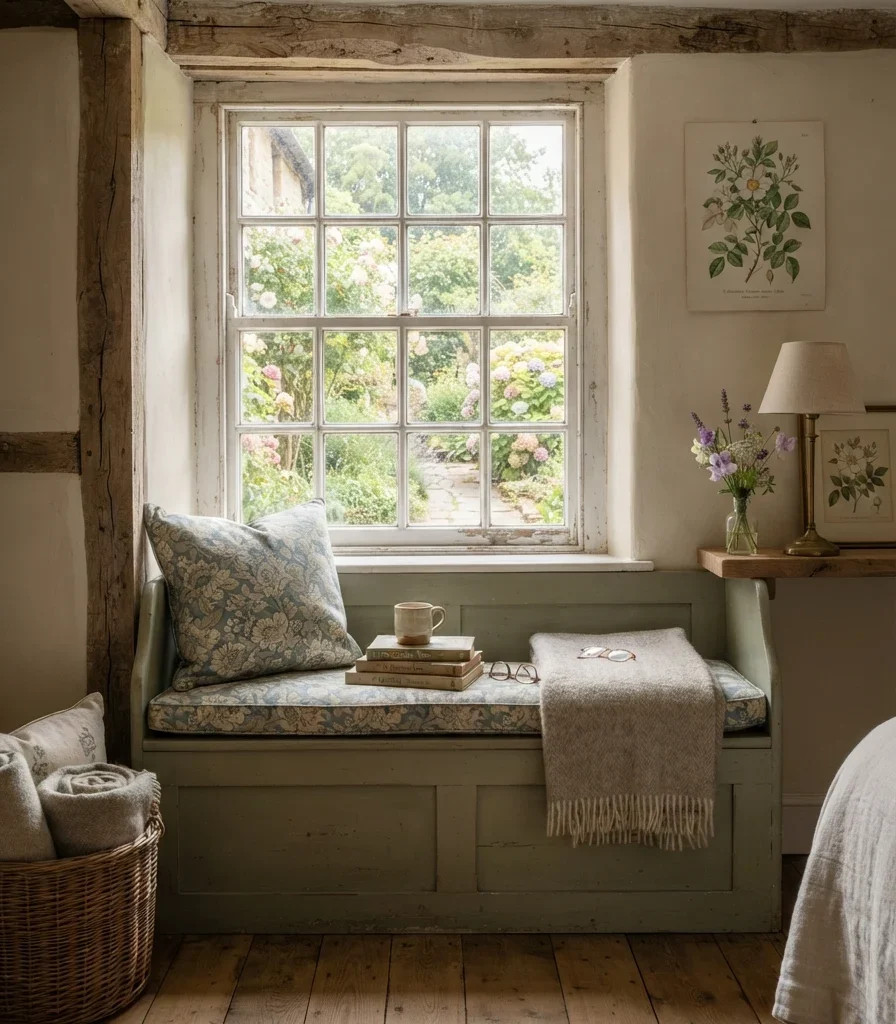
7. Add a Window Seat for a True Country-House Retreat

Vibe: Still, the window seat creates a sheltered pause within the bedroom.

Why it works: A window seat turns otherwise unused wall depth into functional seating and makes natural light part of the room’s experience. Linen upholstery and a wool throw provide softness while the window frames the landscape as living artwork.

How to get it: Aim for a seat height around 45 cm and a depth of approximately 50–60 cm. Add a tailored 7–10 cm cushion rather than an oversized loose cushion that consumes useful seating depth.

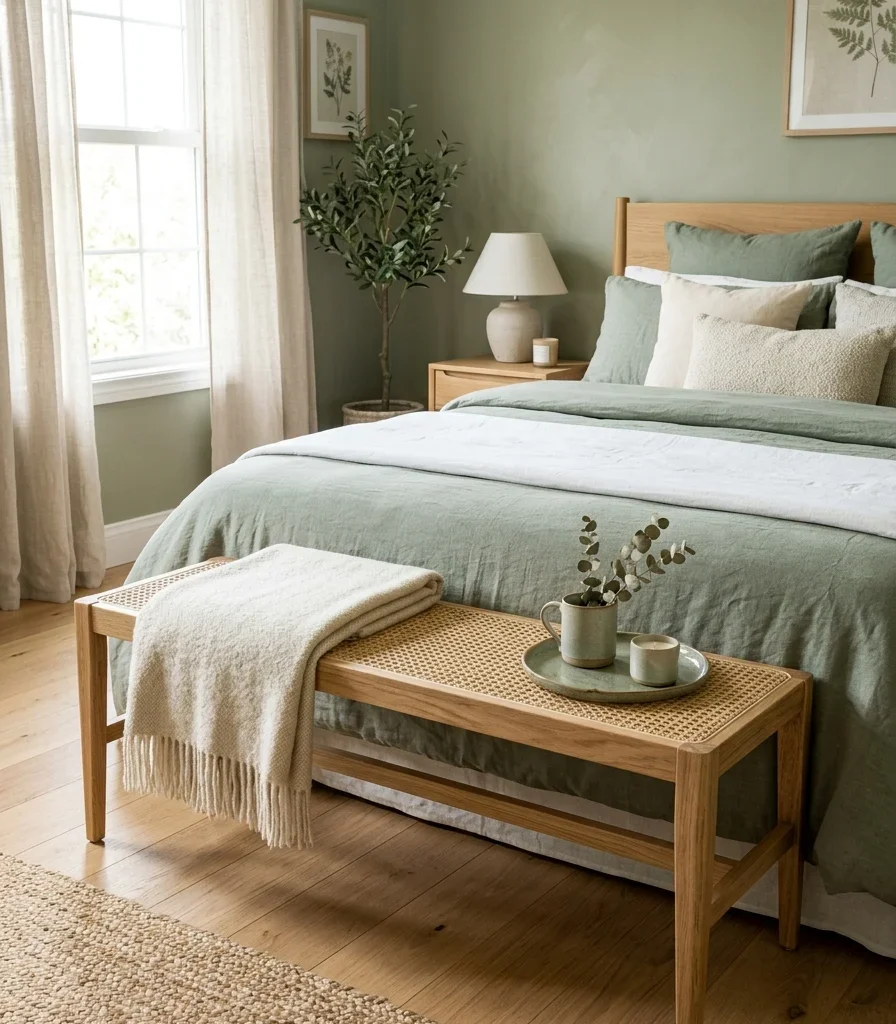
💡 Quick Win: A freestanding wooden bench placed beneath a suitable window can create the same visual effect without building cabinetry.

Shop The Look

Product
English floral window seat cushion
Natural wool throw blanket
Wicker storage basket with handles
Traditional ceramic reading mug
Small brass reading lamp

8. Make a Four-Poster Bed Feel Relaxed, Not Formal
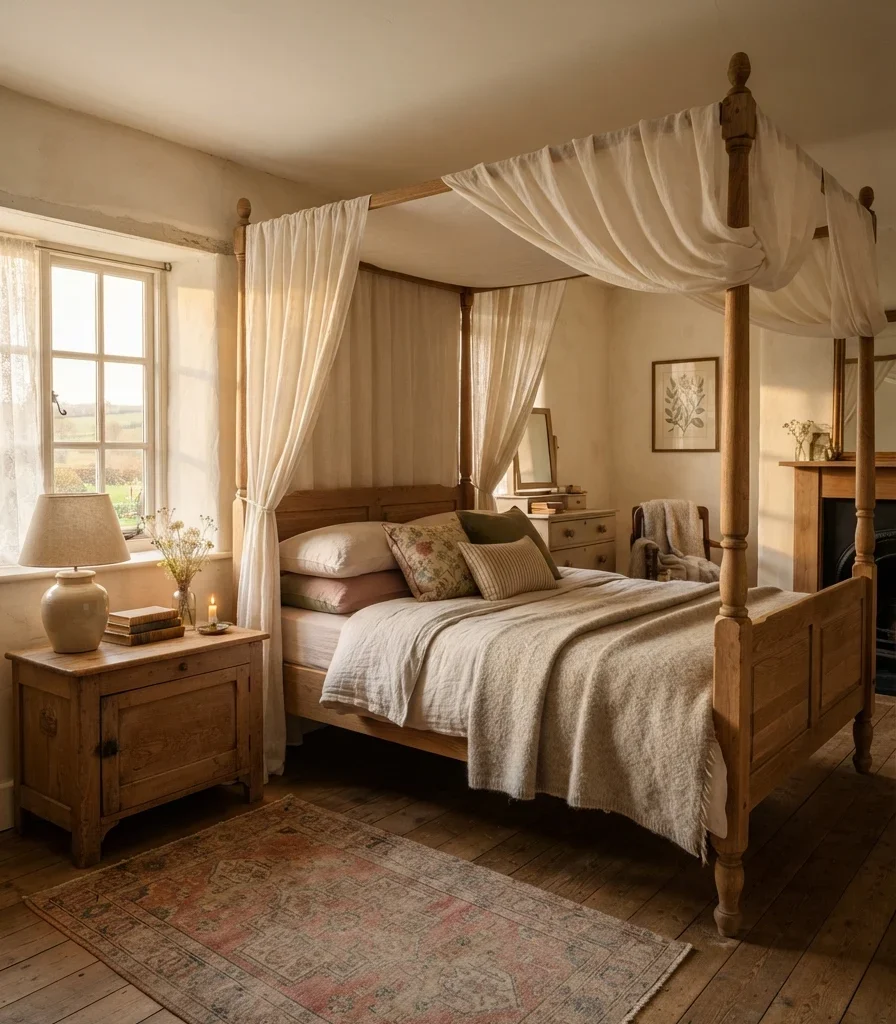
8. Make a Four-Poster Bed Feel Relaxed, Not Formal

Vibe: Hushed. Fabric around the bed creates a gentle sense of enclosure.

Why it works: The four-poster supplies strong vertical geometry, so the rest of the room can remain visually quiet. Loose linen softens the architectural frame and prevents the bed from reading like a formal hotel suite.

How to get it: Use lightweight washed linen rather than heavy velvet or gathered drapery. Let the fabric fall naturally from the upper rails instead of creating symmetrical theatrical swags.

Shop The Look

Product
Natural oak four-poster bed
Ivory washed linen canopy panels
Faded floral bolster cushion
Antique wool Persian-style rug
Ceramic bedside table lamp

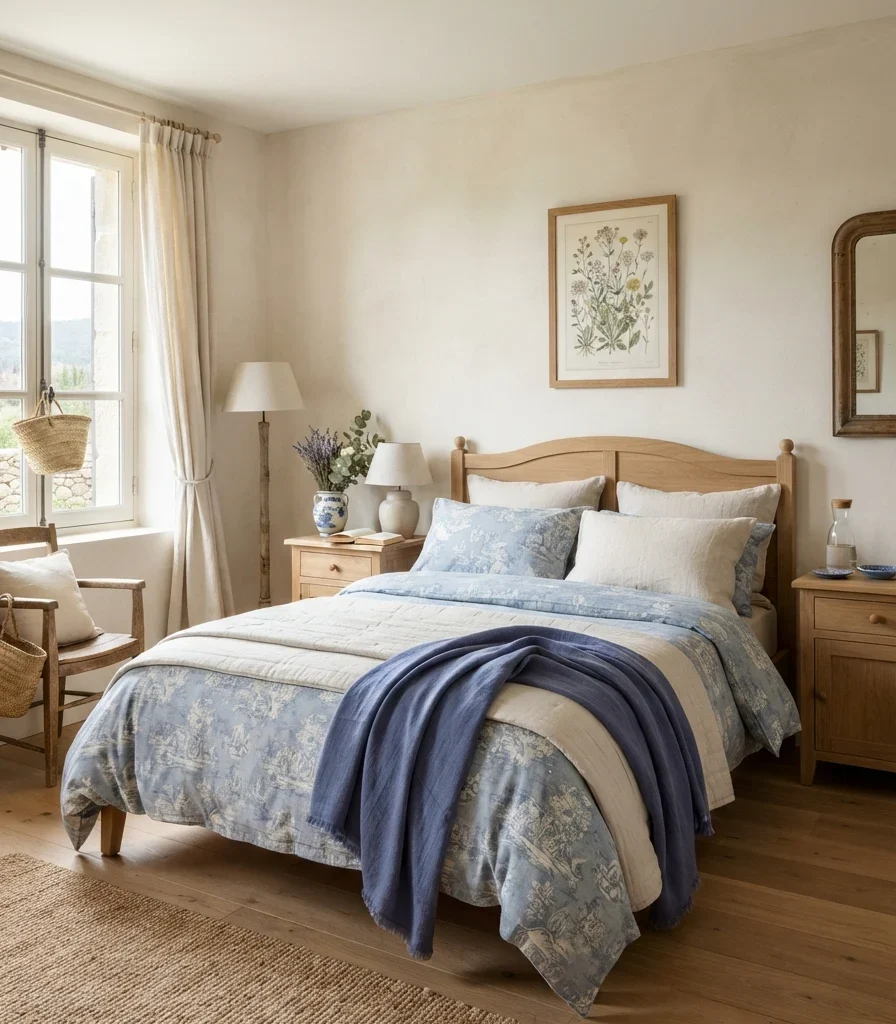
9. Use Faded Blue-and-White Pattern for English Cottage Character
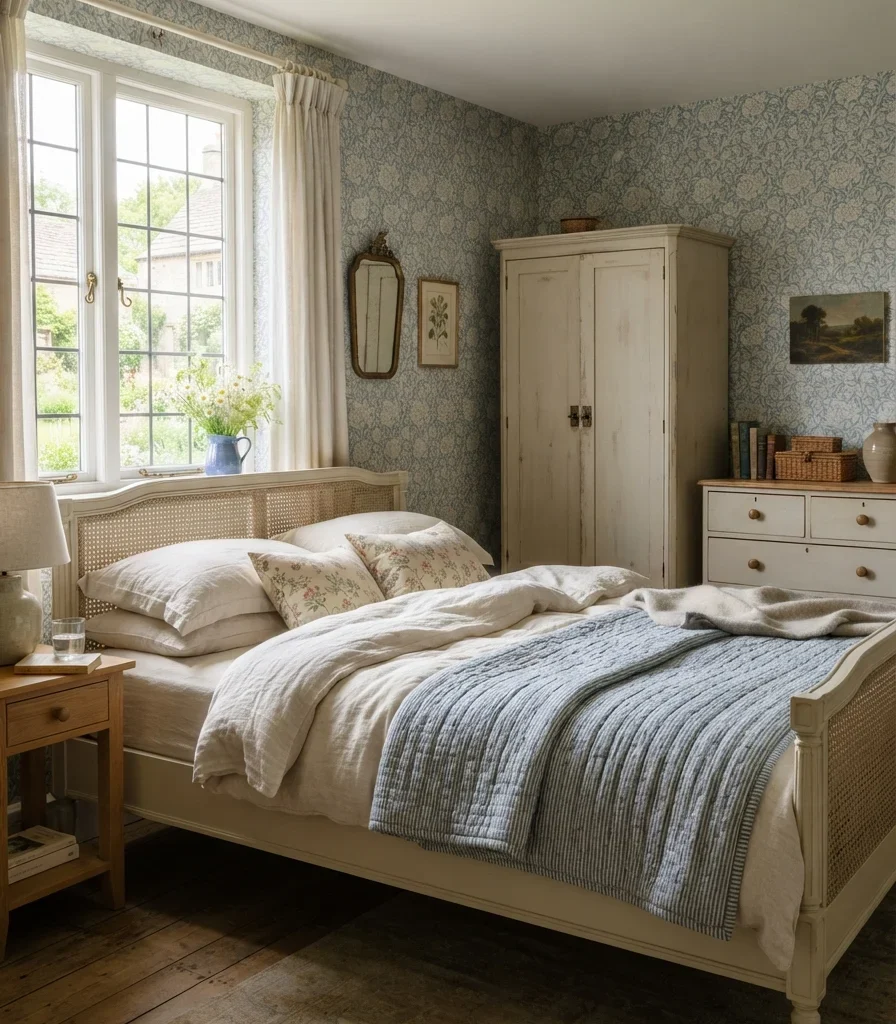
9. Use Faded Blue-and-White Pattern for English Cottage Character

Vibe: Nostalgic. The faded blue pattern recalls old cottage textiles without becoming overly sweet.

Why it works: Blue and warm ivory provide gentle contrast while painted furniture keeps the room visually light. The small floral scale is important because a large high-contrast print would dominate a bedroom that depends on softness.

How to get it: Select wallpaper where the blue is greyed rather than saturated and pair it with plain ivory bedding. Repeat the blue in only two or three accessories so the pattern remains the main statement.

Shop The Look

Product
Faded blue floral wallpaper
Blue-and-white ceramic pitcher
Ivory linen duvet cover
Painted cream bedside table
Blue floral quilted throw

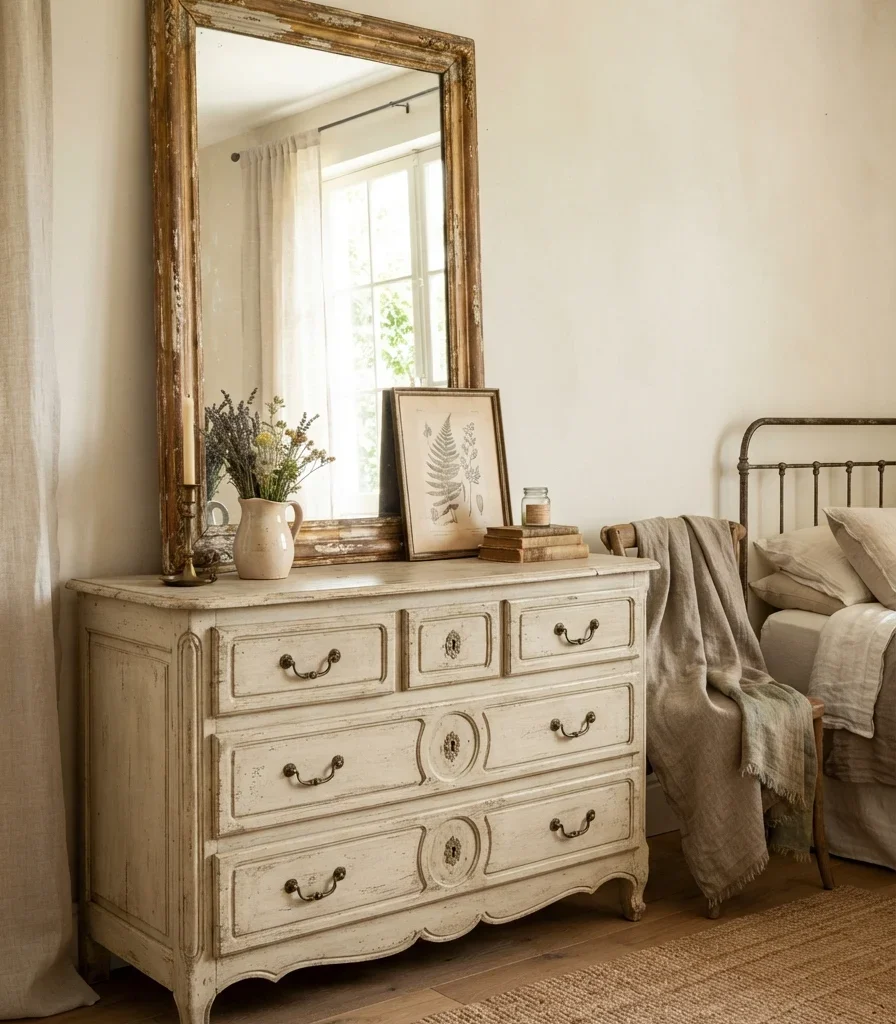
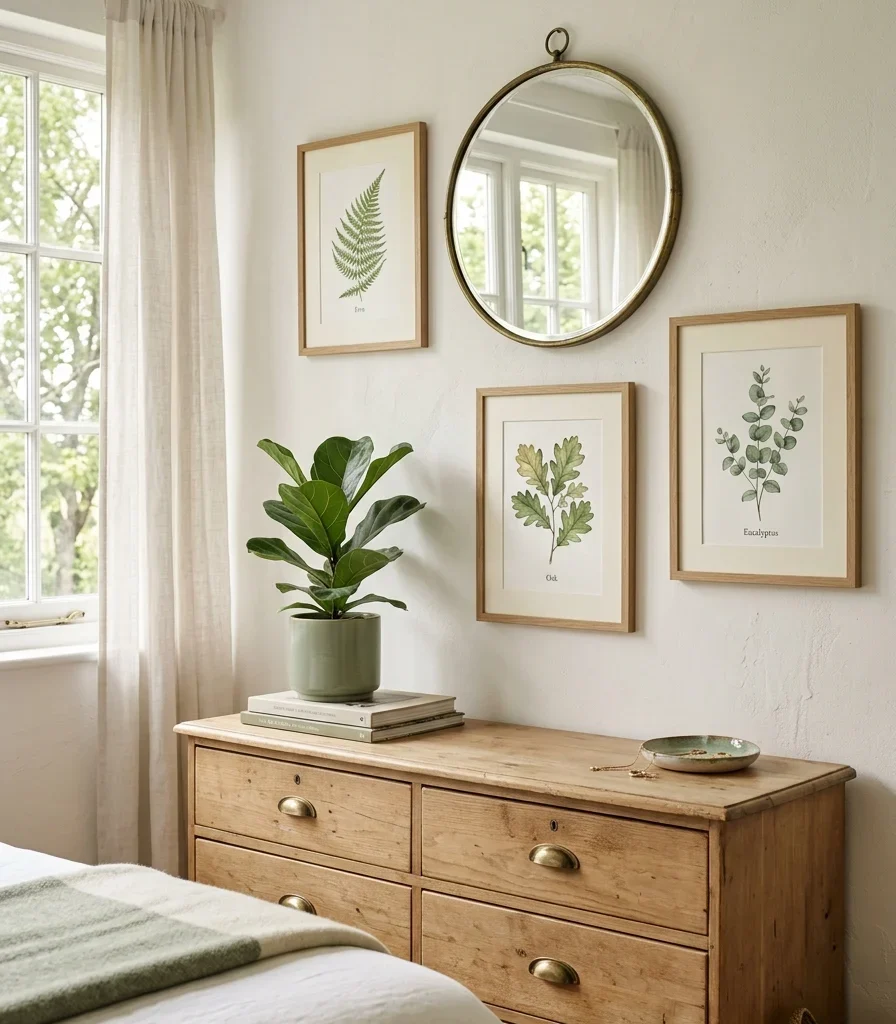
10. Add an Antique Mirror Above a Painted Dresser
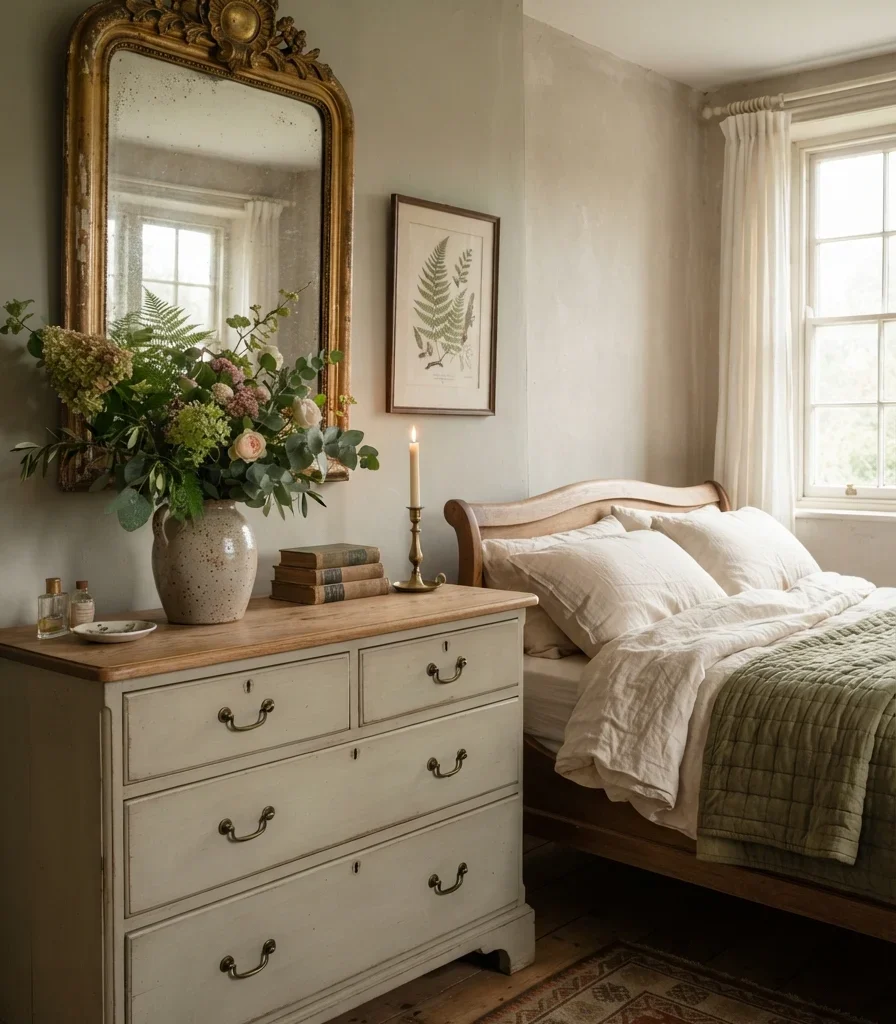
10. Add an Antique Mirror Above a Painted Dresser

Vibe: Reflective. The old mirror gives the room the feeling of a piece collected over time.

Why it works: Aged reflective surfaces bounce daylight without creating the hard contemporary effect of a frameless mirror. The contrast between muted painted furniture and an imperfect gilt frame adds a small amount of visual sparkle while retaining country character.

How to get it: Choose a mirror with visible patina and an irregular or softly aged frame. Hang it so its center sits around eye level rather than automatically centering it high above the dresser.

💡 Quick Win: An inexpensive vintage-style mirror can be made more convincing by replacing a bright modern frame with one finished in muted antique gold or aged wood.

Shop The Look

Product
Antique-style aged gilt mirror
Sage green painted dresser
Small brass candlestick pair
Handmade ceramic vase
Vintage-style botanical print

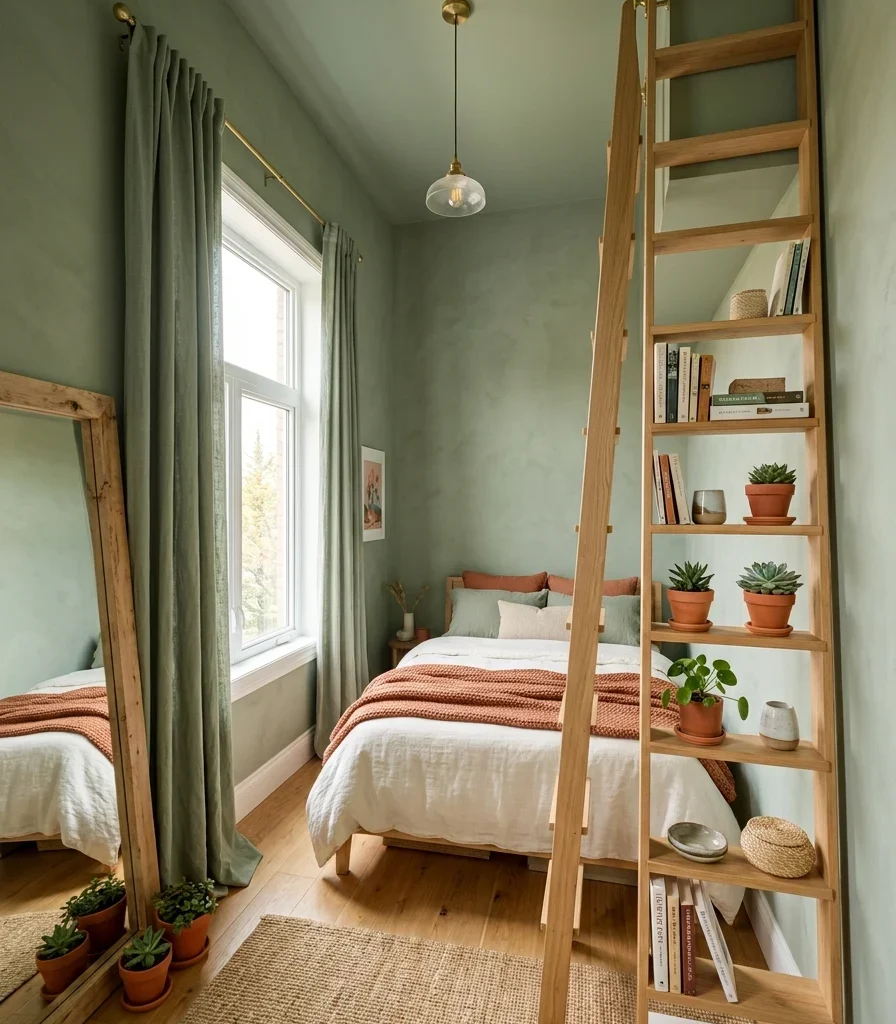
11. Design a Small Bedroom Around Vertical Storage
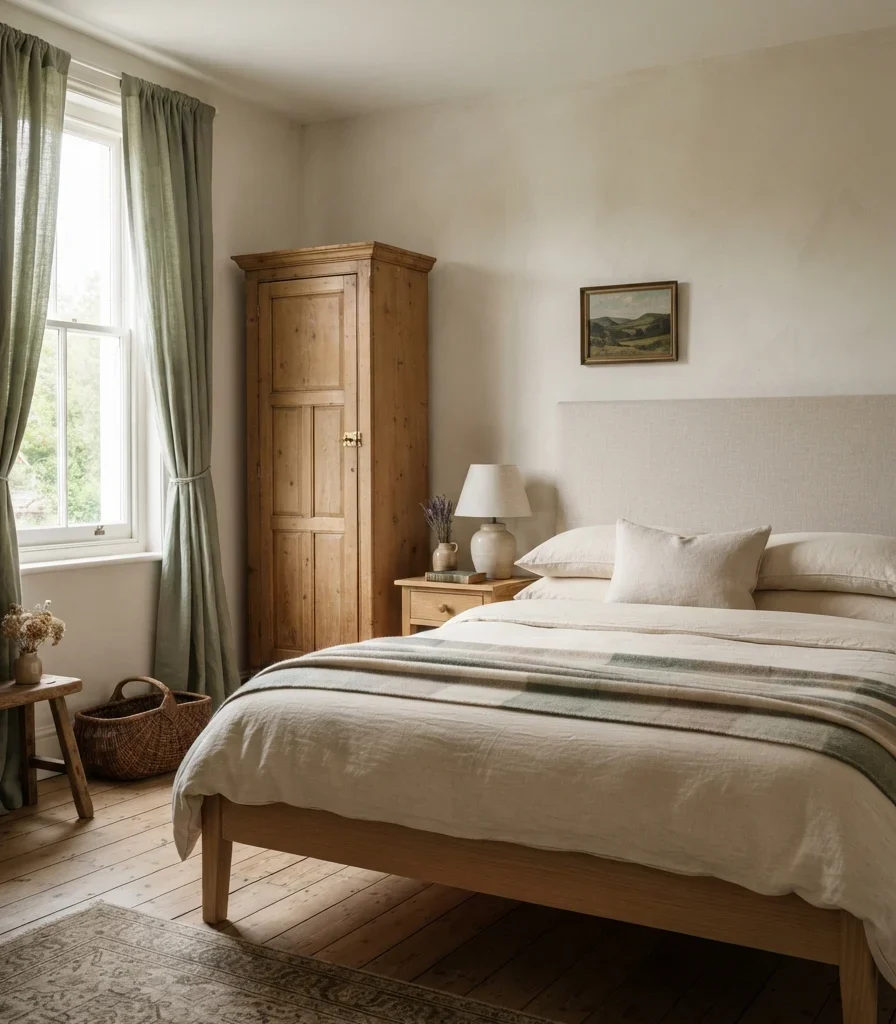
11. Design a Small Bedroom Around Vertical Storage

Vibe: Cozy; the compact room feels enveloping rather than cramped.

Why it works: Vertical storage uses height instead of valuable floor area, while a narrow furniture footprint keeps circulation open. Full-length curtains further draw the eye upward, creating the perception of a taller room.

How to get it: Choose storage no deeper than approximately 45–55 cm where possible, and take it close to the ceiling. Keep bedside furniture narrow enough that the bed remains the dominant horizontal element.

Shop The Look

Product
Narrow antique-style wardrobe
Slim oak bedside cabinet
Full-length ivory linen curtains
Woven under-bed storage basket
Small framed countryside landscape

12. Style the Bed With a Traditional Quilted Coverlet
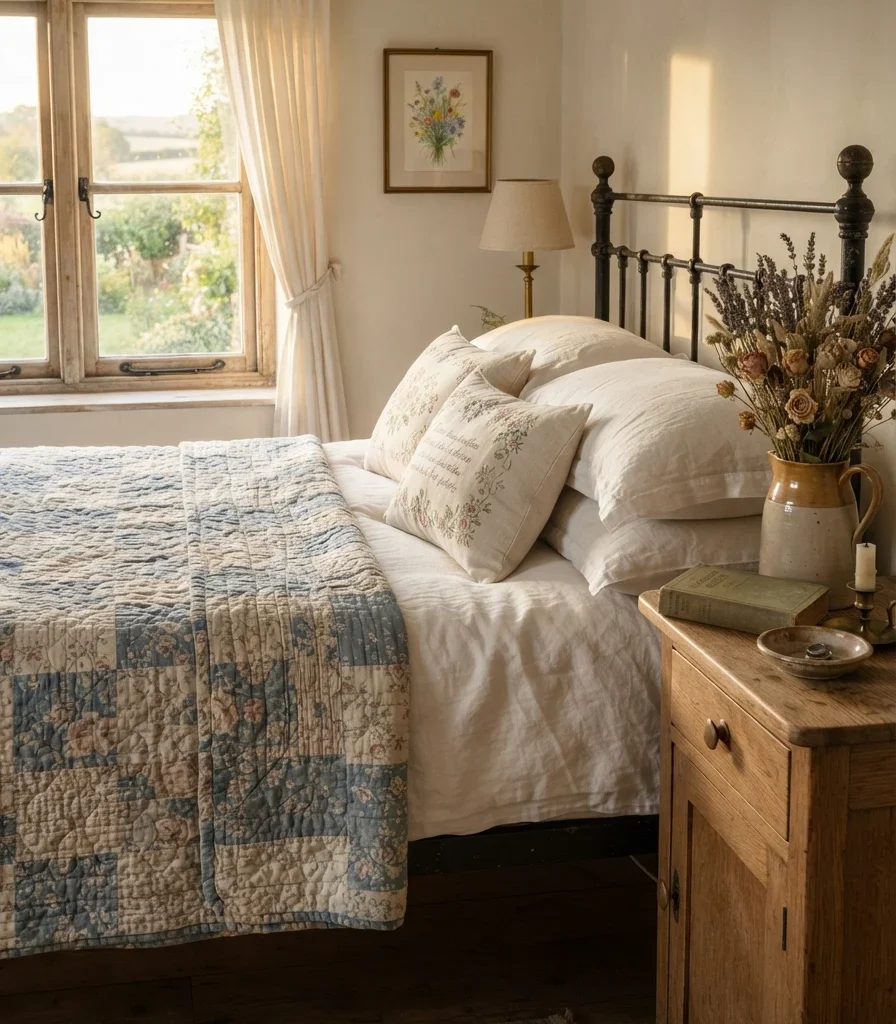
12. Style the Bed With a Traditional Quilted Coverlet

Vibe: Cocooned. The quilt gives the bed a tactile sense of protection and warmth.

Why it works: Traditional quilting introduces pattern and texture without requiring wallpaper or upholstered furniture. A faded cotton quilt also contrasts naturally with the smoother surface of linen, creating depth through textile construction rather than excessive color.

How to get it: Fold the quilt across the lower third of the bed rather than covering everything completely. Choose a washed pattern in faded blue, cream, or dusty rose so it looks softened by time.

Shop The Look

Product
Traditional English quilted bedspread
Cream linen sheet set
Embroidered cotton pillowcases
Antique iron bed frame
Faded floral cotton cushion

13. Finish With a Quiet English Country Reading Corner
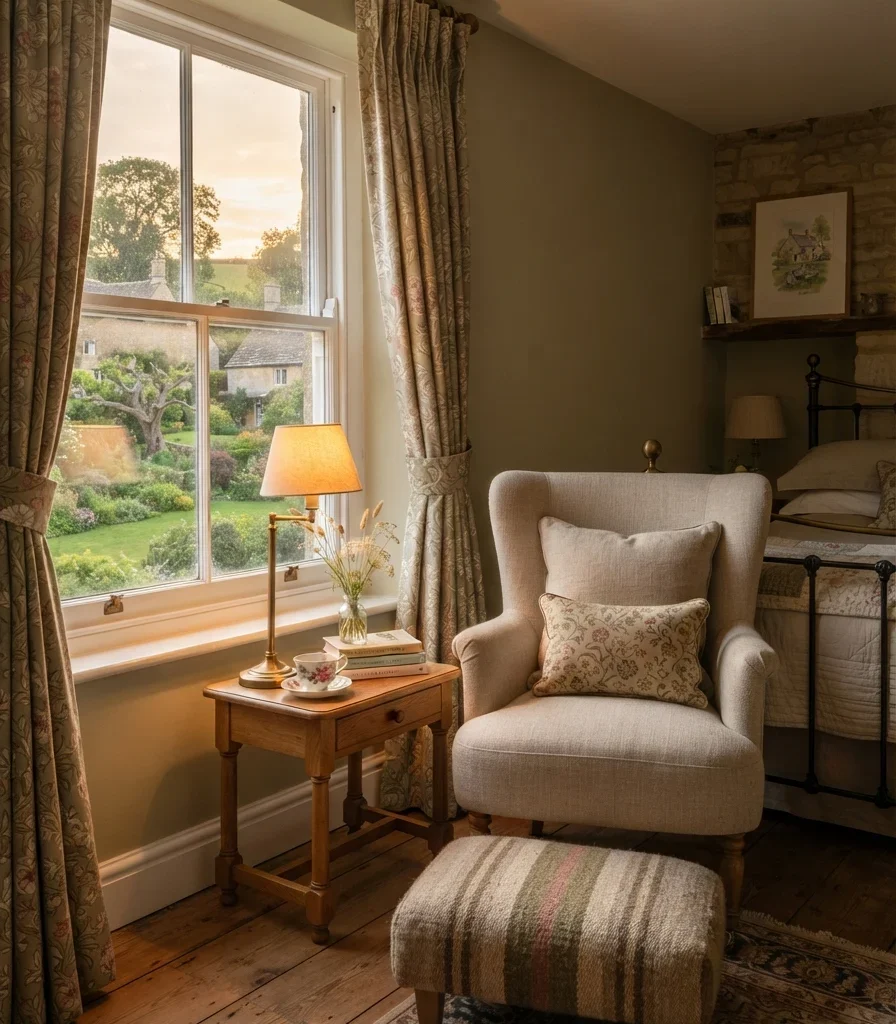
13. Finish With a Quiet English Country Reading Corner

Vibe: Restorative. The corner creates a small ritual space for slowing down before sleep.

Why it works: A bedroom does not have to be organized exclusively around the bed. A compact reading chair introduces a secondary zone and gives unused corner space a purpose, while warm task lighting creates a lower layer of illumination.

How to get it: Choose a chair no wider than approximately 75 cm for a compact bedroom and position it near a window without blocking curtain movement. Add a small round table rather than a bulky rectangular nightstand.

💡 Quick Win: If a full chair is too large, use a compact upholstered slipper chair with a wool throw and a small wooden stool beside it.

Shop The Look

Product
Oatmeal linen wingback reading chair
Antique oak round side table
Aged brass adjustable reading lamp
Wool footstool neutral pattern
Floral lumbar cushion

How to Start Your English Countryside Bedroom Transformation

Start with warm ivory linen bedding. This single change anchors the bedroom because linen immediately introduces the relaxed texture associated with traditional English country interiors, while warm ivory gives you a flexible base for sage, faded blue, dusty rose, oak, pine, and antique brass.

The most common mistake is using too many obviously distressed reproduction pieces. Furniture with exaggerated chipped paint, fake wormholes, and identical “antique” finishes makes the room look themed rather than inherited. Keep one genuinely aged piece, such as an antique pine chest, and let newer furniture remain simple.

Three budget pieces can make an immediate difference for under $50 each: a small blue-and-white ceramic pitcher, a pair of aged-brass candlesticks, and a natural linen cushion cover in oatmeal or flax. Place the pitcher on the bedside table, the candlesticks on a dresser, and the cushion at the front of the bed.

A simple textile refresh can happen over one weekend for roughly $150–$500. A fuller bedroom transformation with quality bedding, curtains, lighting, furniture, rug, and artwork can reach $1,500–$5,000+, while custom wardrobes, flooring, architectural work, and genuine antiques may take several months. The look becomes more convincing gradually as authentic pieces replace generic ones.

Frequently Asked Questions About 13 English Countryside Bedroom Ideas for a Room That Feels Like a Warm Embrace

What is the difference between an English country bedroom and a cottage bedroom?

An English country bedroom is broader and can range from a modest rural cottage to a Georgian country house, so it often combines antiques, traditional upholstery, botanical textiles, and more formal furniture proportions. Cottage bedrooms tend to be smaller, simpler, and more rustic. Both can use linen, painted wood, florals, and natural materials, but English country style usually allows greater variation in furniture age and scale.

Which colors work best in an English countryside bedroom?

Warm ivory, muted sage, olive green, mushroom, faded cornflower blue, dusty rose, and soft brown are especially effective. For darker bedrooms, warm ivory and muted sage usually perform better than icy white or blue-grey. A useful starting combination is warm ivory walls with sage textiles, honey oak furniture, and small touches of faded blue.

How much does an English countryside bedroom cost to create?

A small styling update can cost around $150–$500, particularly if you already own a suitable bed. A mid-range transformation with linen bedding, curtains, lighting, rug, artwork, and secondhand furniture can fall around $1,500–$5,000. Genuine antique furniture, custom cabinetry, architectural changes, and high-quality natural fabrics can push a full renovation considerably higher.

Can English countryside style work in a modern bedroom?

Yes, but balance is important. Keep the modern architecture simple and introduce character through an antique pine chest, washed linen bedding, aged brass lighting, botanical artwork, or a traditional wool rug. Avoid adding every country-house reference at once; two or three authentic-looking pieces can create a stronger contrast than an entire room of reproduction furniture.

What type of bedding is best for an English countryside bedroom?

Washed linen, cotton quilts, wool blankets, and embroidered cotton are excellent choices because they create texture without excessive visual polish. Start with warm ivory or oatmeal linen sheets, then add a faded floral or blue-and-white quilt across the lower third of the bed. A lightweight wool throw folded over the quilt adds warmth and gives the bedding a naturally layered appearance.

Ready to Create Your Dream English Countryside Bedroom?

These 13 English Countryside Bedroom Ideas for a Room That Feels Like a Warm Embrace cover the details that give the style its depth, from sage and faded blue color schemes to weathered oak, washed linen, traditional lighting, antique storage, botanical patterns, and practical small-bedroom layouts. You do not need to transform everything at once; starting with one meaningful textile or genuinely aged piece is often the better way to build a room with character. Today, replace one synthetic bedding layer with a warm ivory linen duvet cover and add a small ceramic pitcher beside the bed. Over time, the room should begin to feel quieter, softer, and more personal- the emotional quality that makes an English countryside bedroom so comforting. Save and pin the ideas that speak to you most, especially the linen bed, painted dresser, floral curtains, and window-seat details, so your future room develops like a country house rather than a showroom.

You Might Also Like

11 Home Bedroom Refresh Ideas That Make Your Space Feel New Again

11 Home Bedroom Refresh Ideas That Make Your Space Feel New Again

A home bedroom refresh is a focused update that improves a bedroom’s color, lighting, textiles, furniture arrangement, and decorative details without requiring a complete renovation. These 11 home bedroom refresh ideas show you how to make a tired bedroom feel more comfortable, cohesive, functional, and visually finished through manageable changes.

A refreshed bedroom should feel easier to enter at the end of the day: softer light across the walls, clean bedding beneath your hands, a calmer bedside surface, and enough visual breathing room to let your mind slow down. You do not need to replace every piece of furniture to create that feeling. Small changes in proportion, texture, color, and lighting can alter how the entire room is experienced. The best bedroom updates also improve everyday routines, from reaching for a book at night to finding clothes in the morning without fighting through clutter. Think of the process as editing rather than rebuilding. Here are 11 ideas worth saving and stealing.

Why Home Bedroom Refresh Works So Well

A bedroom refresh works because it sits between ordinary decorating and a full renovation. Instead of changing the architecture, you improve the visual hierarchy of the existing room: the bed becomes the anchor, lighting establishes atmosphere, textiles add softness, and secondary furniture supports how the space is actually used. Contemporary bedroom design also borrows from hospitality, Scandinavian interiors, quiet luxury, and residential minimalism, where comfort and restraint matter as much as appearance.

The most effective materials are tactile rather than merely decorative. Washed linen, cotton percale, unfinished or medium-toned oak, walnut veneer, wool, jute, ceramic, aged brass, and matte black metal all introduce useful variation. A practical palette might combine warm ivory with mushroom taupe, dusty sage, muted clay, soft charcoal, or walnut brown. These tones are easier to layer than a collection of unrelated accent colors.

Bedroom refreshes remain especially relevant because people increasingly expect their homes to support rest, work, storage, and personal rituals. The bedroom has become more than a place to sleep, which makes lighting, organization, comfortable seating, charging access, and flexible furniture important design considerations. A good refresh therefore improves both the photograph and the lived experience of the room.

Small bedrooms can absolutely benefit from the same approach, but scale becomes critical. Prioritize one strong focal point, furniture with useful storage, wall-mounted lighting, and textiles that create softness without consuming floor area. Avoid filling every empty corner simply because it is available; negative space is one of the cheapest ways to make a compact bedroom feel more generous.

Style at a Glance

ElementHome Bedroom Refresh
PhilosophyEdit, layer, and improve function
Key MaterialsLinen, cotton, oak, walnut, wool, ceramic, brass
Key ColorsWarm ivory, mushroom taupe, dusty sage, muted clay

1. Start With a Layered Neutral Bedding Reset

1. Start With a Layered Neutral Bedding Reset

Vibe: Hushed. The bed immediately becomes softer, calmer, and more inviting.

Why it works: Textile hierarchy gives the eye a clear visual order instead of making the bed look like a pile of unrelated cushions and blankets. Combining washed linen, cotton percale, and a lightweight quilt creates contrast through texture while keeping the colors within one tonal family. The neutral layering also makes existing furniture easier to keep, because the bed becomes the refreshed focal point without demanding a new frame or headboard.

How to get it: Begin with one warm ivory duvet cover, add a mushroom or oatmeal quilt folded across the lower third, and finish with two larger pillows behind your regular sleeping pillows. Keep decorative cushions to one or two so the bed remains practical rather than staged.

💡 Quick Win: Replace only the duvet cover and add one textured throw before buying anything else; this can change the room within an afternoon.

Shop The Look

ProductSearch on Amazon
Linen duvet coverWarm ivory washed linen duvet cover queen
QuiltOatmeal lightweight cotton quilt queen
Euro shamsMushroom taupe euro pillow covers set
ThrowChunky neutral knit throw blanket
Pillow coversTextured boucle lumbar pillow cover

2. Paint the Headboard Wall a Softer Accent Color

2. Paint the Headboard Wall a Softer Accent Color

Vibe: Grounded; the room feels visually anchored without becoming dark.

Why it works: A single accent wall creates contrast and establishes a focal plane behind the bed, which is especially useful when the existing headboard is visually plain. Dusty sage, muted clay, mushroom taupe, and soft blue-gray are safer choices than highly saturated colors because they introduce depth without competing with bedding. A matte finish also reduces glare and gives the wall a more substantial appearance.

How to get it: Choose the wall behind the bed and paint it in a muted, low-saturation shade such as dusty sage. Keep the remaining walls warm white or very pale greige so the accent wall reads as intentional rather than making the whole room feel smaller.

Shop The Look

ProductSearch on Amazon
Wall paintDusty sage green interior matte wall paint
Paint roller9-inch microfiber smooth wall paint roller
Cutting brush2 inch angled paint brush
Drop clothReusable cotton canvas painting drop cloth
Painter’s tapeLow-tack clean-edge painter’s tape

3. Replace Hard-Edged Curtains With Soft Linen Panels

3. Replace Hard-Edged Curtains With Soft Linen Panels

Vibe: Airy daylight becomes softer, and the room feels less visually rigid.

Why it works: Full-height curtains create vertical emphasis, making the window wall feel taller while softening hard architectural edges. Linen is particularly effective because its irregular weave catches daylight without looking glossy or overly formal. The key principle is fullness: skimpy curtain panels expose too much glass and produce a temporary-looking finish, while generous fabric creates controlled folds.

How to get it: Mount the curtain rod or track close to the ceiling and extend it beyond both sides of the window frame. Choose panels with approximately 1.5–2 times the window width in total fabric so they retain fullness even when closed.

💡 Quick Win: If your existing curtains are usable, simply raise the rod closer to the ceiling and add wider panels rather than replacing the entire window treatment.

Shop The Look

ProductSearch on Amazon
CurtainsNatural flax linen curtain panels 96 inch
Curtain rodMatte black or antique brass extra long curtain rod
RingsWooden curtain rings with clips
SheersWarm white sheer linen-look curtain panels
TiebacksNatural cotton rope curtain tiebacks

4. Add Warm Bedside Lighting at the Correct Height

4. Add Warm Bedside Lighting at the Correct Height

Vibe: Luminous; the room shifts from functional brightness to deliberate evening atmosphere.

Why it works: Layered bedroom lighting works because different sources illuminate different visual planes. A bedside sconce supplies task light for reading while eliminating the footprint of a table lamp, which is valuable when nightstands are narrow. Warm 2700K bulbs create a softer evening environment than cool daylight bulbs, while adjustable arms direct light toward the book rather than directly into the sleeper’s eyes.

How to get it: Mount each sconce so its switch is reachable from bed and position the reading head approximately 45–60 cm above the top of the mattress, adjusting for your seated reading position. Choose dimmable fixtures whenever the wiring and switch arrangement allow it.

Shop The Look

ProductSearch on Amazon
Wall sconcesAdjustable arm bedroom wall sconces brushed brass
Bulbs2700K dimmable warm white LED bulbs
Plug-in kitPlug-in wall sconce cord cover kit
Cord coverPaintable adhesive cable raceway
DimmerPlug-in lamp dimmer compatible with LED

5. Introduce One Substantial Wood Piece

5. Introduce One Substantial Wood Piece

Vibe: Anchored. One substantial natural material gives the room visual weight.

Why it works: Bedrooms can look unfinished when every major surface is lightweight, glossy, or visually similar. A solid-looking oak dresser introduces visual weight and natural grain, creating contrast against softer bedding and painted walls. Proportion matters more than quantity: one substantial timber piece usually contributes more character than several small decorative wooden accessories.

How to get it: Select one dresser, chest, or substantial bedside cabinet in oak or walnut and make it the room’s primary furniture investment. Keep its styling deliberately sparse, leaving roughly one-third of the top surface visually empty so the wood remains part of the composition.

💡 Quick Win: If replacing furniture is not practical, add a solid oak tray or wooden bedside stool to introduce natural grain at a much smaller cost.

Shop The Look

ProductSearch on Amazon
DresserNatural oak 6 drawer bedroom dresser
Bedside chestOak wood two drawer nightstand
TraySolid oak rectangular decorative tray
StoolNatural wood bedroom accent stool
Drawer organizersBamboo adjustable drawer organizer set

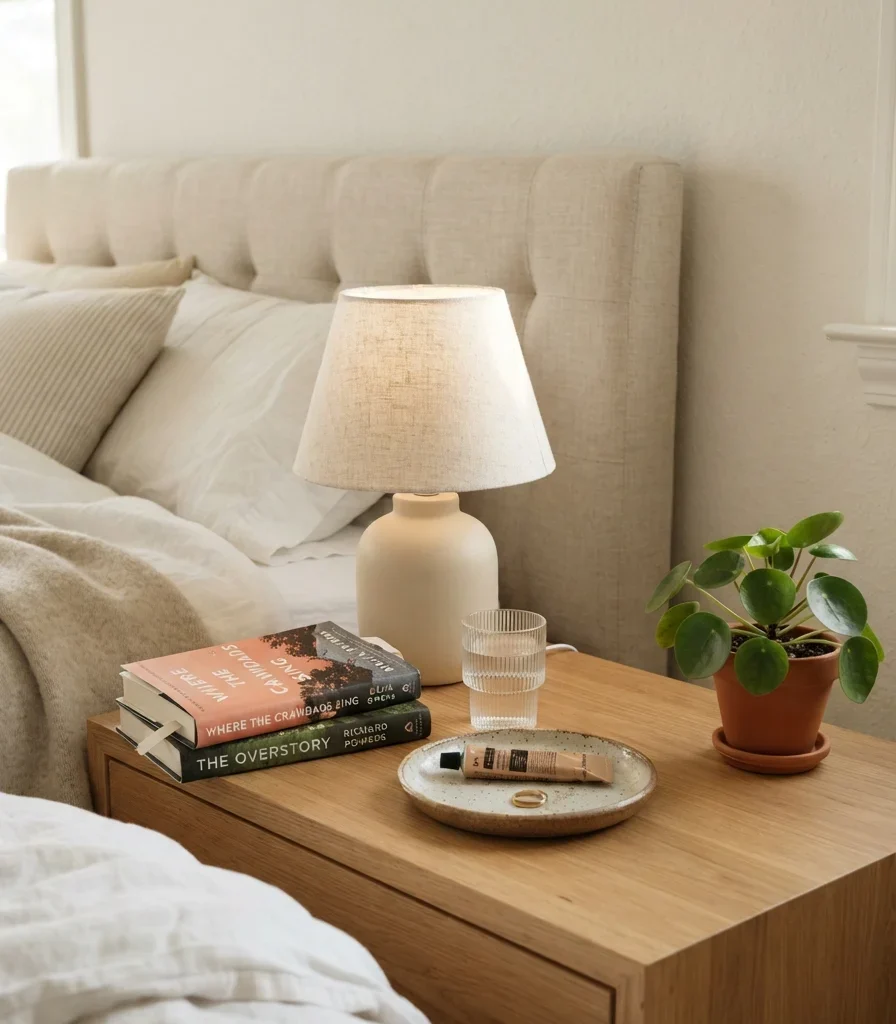
6. Build a Bedside Surface That Actually Works

6. Build a Bedside Surface That Actually Works

Vibe: Personal. The bedside becomes a small ritual station rather than a dumping ground.

Why it works: A functional bedside arrangement improves visual order because every object has a defined role. The combination of a lamp, tray, book, and one organic element creates asymmetrical balance without filling the entire surface. The shallow tray is particularly useful because it visually groups small objects and prevents chargers, jewelry, and everyday items from spreading across the nightstand.

How to get it: Clear the entire nightstand first, then return only four functional categories: light, reading, personal item, and catchall storage. Use a tray no wider than about two-thirds of the nightstand so there is still deliberate negative space around it.

Shop The Look

ProductSearch on Amazon
Table lampSmall ceramic bedside lamp linen shade
Catchall trayStoneware oval bedside catchall tray
Book standMinimal wooden adjustable book stand
Plant potSmall matte ceramic planter sage green
Charging stationCompact wooden bedside charging station

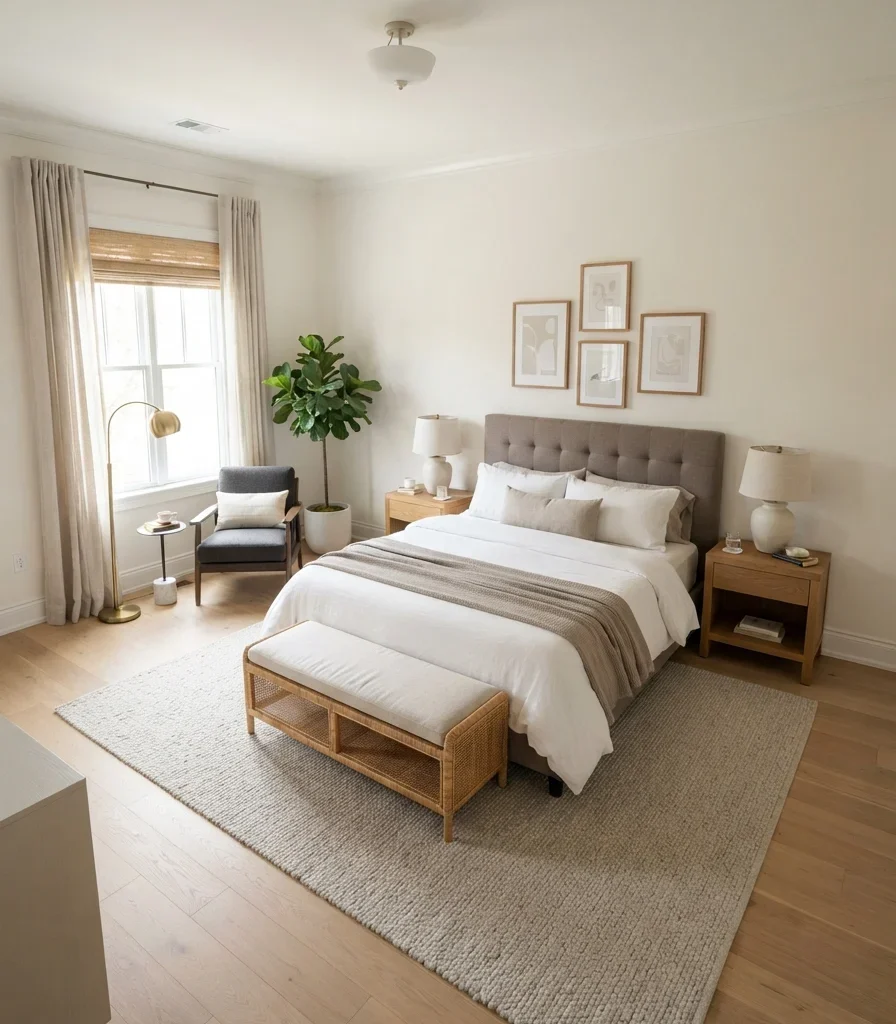
7. Rework the Furniture Layout Around the Bed

7. Rework the Furniture Layout Around the Bed

Vibe: Balanced; the bedroom feels calmer because movement through it becomes obvious.

Why it works: Furniture arrangement determines how spacious a bedroom feels even when the square footage does not change. Centering the bed where possible establishes symmetry and gives the sleeping zone visual authority, while clear circulation reduces the feeling of congestion. Ideally, maintain roughly 60–75 cm of comfortable walking space beside the bed where the room allows it.

How to get it: Remove small movable furniture and temporarily center the bed on the strongest wall before returning anything else. Walk through the room from the door to the bed and from the bed to the closet; anything that interrupts those primary paths should be moved or removed.

💡 Quick Win: Before buying furniture, use painter’s tape on the floor to mark the footprint of a proposed bed, dresser, or chair and test the circulation for a full day.

Shop The Look

ProductSearch on Amazon
Bed benchUpholstered bedroom bench 48 inch neutral
Area rug8×10 low pile neutral bedroom rug
Floor lampSlim arc floor lamp warm white shade
Furniture slidersHeavy-duty reusable furniture moving sliders
Measuring tape25-foot retractable measuring tape

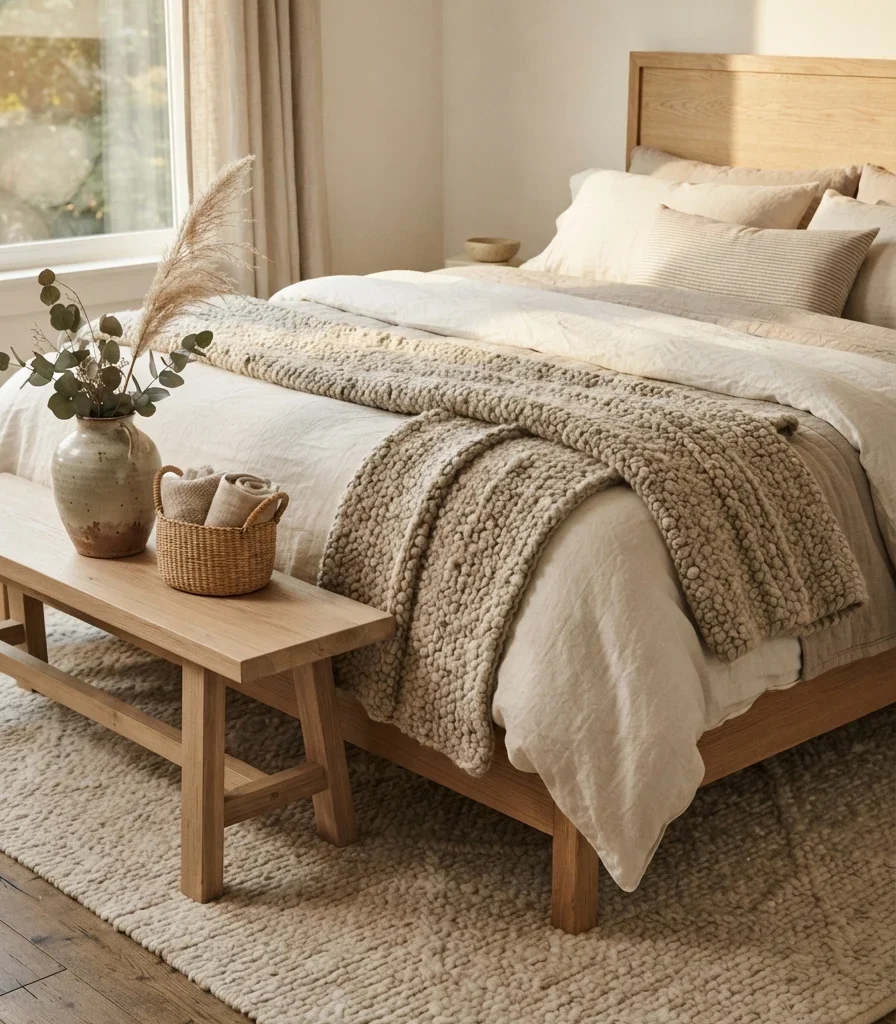
8. Add a Textured Throw at the Foot of the Bed

8. Add a Textured Throw at the Foot of the Bed

Vibe: Tactile; the room becomes inviting through visible and implied softness.

Why it works: Texture layering adds depth without requiring additional color. A chunky cotton, wool, or boucle throw contrasts with the flatter surface of a duvet and the fine weave of linen, creating a material hierarchy that the eye can read immediately. Placing the throw across the lower third also creates horizontal balance and visually finishes the bed without covering its entire surface.

How to get it: Choose a throw that differs from the duvet in both texture and scale, then place it loosely across the lower quarter to third of the bed rather than folding it into a rigid rectangle. Keep the color within two shades of the bedding for a restrained result.

Shop The Look

ProductSearch on Amazon
Throw blanketOatmeal chunky cotton knit throw
Boucle throwCream boucle textured throw blanket
Bed scarfTaupe woven bed runner
Bench cushionNeutral boucle bench cushion
Wool rugSmall natural wool bedside rug

9. Use a Large Mirror to Multiply Daylight

9. Use a Large Mirror to Multiply Daylight

Vibe: Open reflected daylight gives the room more visual breathing room.

Why it works: A mirror can visually extend a bedroom by reflecting existing light and creating another apparent plane. The placement matters more than the mirror itself: positioning it where it catches a window or bright wall is considerably more effective than placing it against a dark corner. A tall vertical shape also emphasizes ceiling height and can make compact rooms feel less compressed.

How to get it: Position a large mirror perpendicular or diagonally opposite the brightest window rather than directly facing the bed. Choose a frame that echoes an existing material, such as pale oak, walnut, or matte black, so the mirror feels integrated rather than randomly introduced.

💡 Quick Win: Move an existing full-length mirror before purchasing a new one and test three positions during daylight; the brightest reflection is usually the strongest placement.

Shop The Look

ProductSearch on Amazon
Floor mirrorFull length arched wood frame bedroom mirror
Wall mirrorLarge rounded rectangle bedroom wall mirror
Mirror hooksHeavy duty D-ring mirror hanging hardware
Anti-tip kitFurniture and mirror anti-tip wall anchor
Felt padsSelf-adhesive felt furniture floor protectors

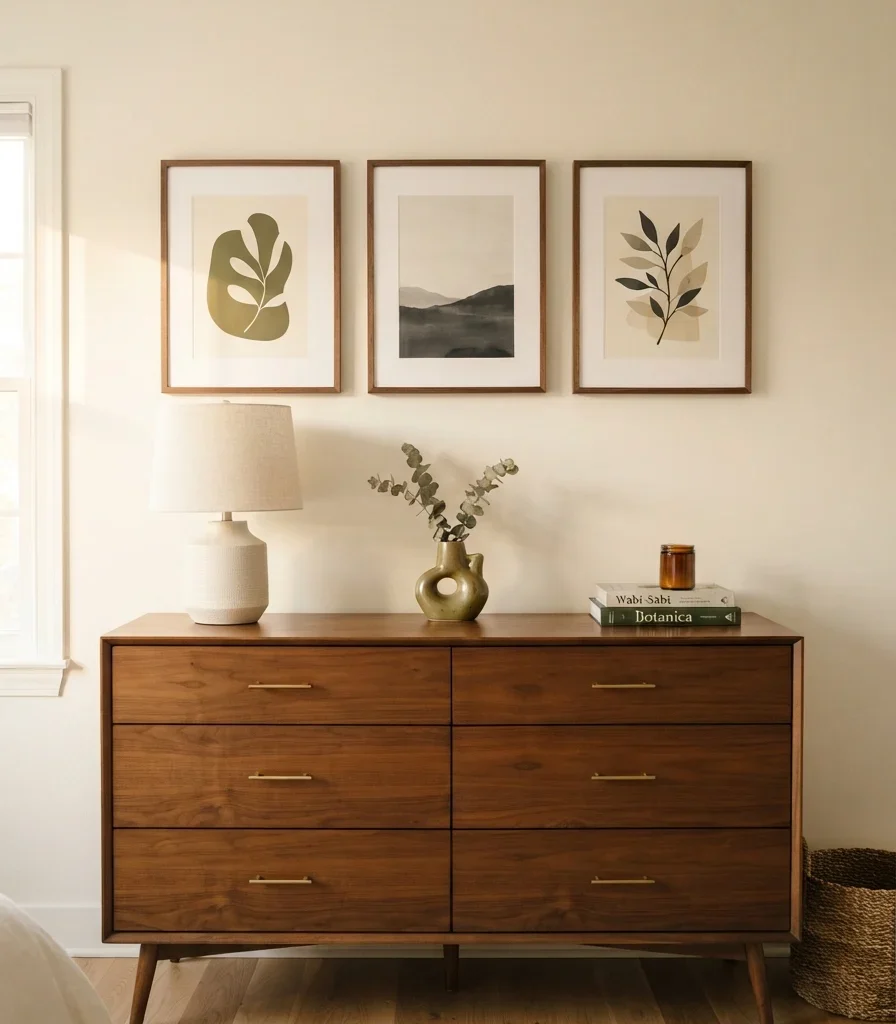
10. Create a Calm Gallery Above the Dresser

10. Create a Calm Gallery Above the Dresser

Vibe: Considered; the wall feels intentionally composed rather than merely decorated.

Why it works: A small coordinated gallery gives a bedroom personality while maintaining visual control. Repetition creates cohesion: using the same frame finish or a consistent color family makes three different artworks read as one collection. The arrangement should also relate to the furniture below; a grouping that is too narrow can make a dresser look oversized, while a grouping around two-thirds of the furniture width usually feels more proportionate.

How to get it: Choose three prints that share one visual thread, such as botanical forms or muted landscapes, and arrange them with consistent 5–8 cm spacing. Center the entire grouping over the dresser rather than centering each artwork individually.

Shop The Look

ProductSearch on Amazon
Botanical printsNeutral botanical wall art set of 3
FramesWalnut wood picture frames 8×10 set
Mat boardsOff-white archival picture mat 8×10
Hanging levelMagnetic picture hanging alignment tool
Dresser trayDark walnut decorative dresser tray

11. Turn an Awkward Corner Into a Mini Reading Zone

11. Turn an Awkward Corner Into a Mini Reading Zone

Vibe: Hushed; an unused corner becomes a reason to slow down.

Why it works: Giving an awkward corner a defined purpose makes the whole bedroom feel more intentional. The important principle is scale: a slim chair and small round table provide function without creating a second heavy furniture cluster. A dedicated reading light also prevents the corner from becoming purely decorative; the space earns its footprint through actual use.

How to get it: Choose the smallest chair that still supports your back comfortably, then pair it with a table no wider than about 40–45 cm. Place the lamp slightly behind and to the reading side of the chair so the light falls onto the pages rather than directly into your eyes.

💡 Quick Win: You can create the zone for under $50 initially with a small side table, secondhand chair cushion, warm LED bulb, and one basket for books or blankets.

Shop The Look

ProductSearch on Amazon
Accent chairCompact oatmeal boucle bedroom reading chair
Side tableSmall round natural oak side table
Reading lampAdjustable warm light floor reading lamp
Book basketWoven seagrass floor basket for books
ThrowSage green wool blend reading chair throw

How to Start Your Home Bedroom Refresh

The single best first move is to reset the bed, because it is normally the largest visual object in the room and determines the color and texture direction for everything around it. Start with a warm ivory duvet cover and one muted secondary tone such as mushroom taupe or dusty sage; that foundation makes later decisions about curtains, rugs, art, and accessories much easier.

The most common mistake is changing too many small accessories before fixing scale and visual hierarchy. Ten new decorative objects cannot compensate for a bed that is badly positioned, curtains mounted too low, or lighting that is harsh and overhead-only. Fix the largest visual problems first, then add smaller details.

For an inexpensive entry point, buy three specific pieces: a warm ivory textured pillow cover, a small ceramic bedside lamp, and a woven cotton throw in oatmeal or muted sage, ideally keeping each under $50. Those three changes can introduce softness, warmth, and layered light without committing to new furniture.

A focused weekend can handle bedding, styling, curtains, artwork, and furniture rearrangement, while painting may take one to two days, i ncluding drying time. A starter refresh can realistically fall around $150–$500, while a fuller room update with new lighting, rug, curtains, storage, and one substantial furniture piece may reach $800–$2,500+, depending on room size and product quality.

Frequently Asked Questions About Home Bedroom Refresh

What is a home bedroom refresh and how is it different from redecorating?

A home bedroom refresh is a lighter intervention that improves an existing room without requiring a complete furniture replacement or renovation. It might involve new bedding, lighting, curtains, paint, artwork, and furniture placement while keeping the main bed and storage. Redecorating can be broader and may involve replacing multiple major pieces. A refresh is particularly useful when the room’s structure already works, but its atmosphere feels dated or unfinished.

What colors work best for a bedroom refresh?

Warm ivory, mushroom taupe, dusty sage, muted clay, soft blue-gray, and oatmeal are versatile choices because they create depth without overwhelming a sleeping space. If the room receives limited natural light, avoid using several dark colors simultaneously. A warm ivory base with one accent such as dusty sage is usually easier to balance than introducing three or four competing colors.

How much does a bedroom refresh usually cost?

A small DIY refresh can cost approximately $150–$500 if you concentrate on bedding, lighting, textiles, and artwork. A more comprehensive update with a rug, curtains, new lighting, paint, storage, and one substantial furniture piece can reach $800–$2,500 or more. The largest savings usually come from keeping the existing bed and major storage pieces while changing the surfaces around them.

Can I refresh a small bedroom without making it feel more crowded?

Yes, but every new item should justify its footprint. Use wall-mounted sconces, under-bed storage, tall curtains, a large mirror, and furniture with drawers instead of adding multiple freestanding decorative pieces. Keep at least one visible area of negative space around the bed so the room does not become visually compressed.

What is the most important element to update during a home bedroom refresh?

The bed is usually the strongest starting point because it occupies the most visual area and is the room’s primary functional feature. Start with layered bedding, then evaluate the headboard, bedside lighting, rug, and surrounding furniture. A correctly proportioned bed zone can make the rest of the room look more intentional even before additional accessories are added.

Ready to Create Your Refreshed Bedroom?

These 11 home bedroom refresh ideas cover the pieces that make the biggest difference: bedding, color, natural materials, lighting, layout, mirrors, artwork, and functional corners. A transformation does not need to happen all at once; starting with one high-impact change is often the smartest way to avoid buying pieces that later compete with each other. Today, strip the bed, clear both nightstands, and rebuild the bed with one warm ivory layer and one contrasting textured layer. As the room becomes calmer and more functional, it should feel less like a collection of furniture and more like a place designed specifically for rest and everyday comfort. Save or pin your favorite ideas now, especially the layered bedding, warm lighting, and small reading-corner concepts you can return to when your next bedroom update begins.

You Might Also Like

16 Ways to Master the Art of a French Country Bedroom

16 Ways to Master the Art of a French Country Bedroom

French country bedroom style blends the relaxed character of rural French homes with aged materials, graceful furniture, soft textiles, and an effortless sense of comfort. These 16 Master the Art of French Country Bedroom ideas show you how to create that atmosphere through color, linen, antique-inspired furniture, lighting, pattern, layout, and carefully chosen details.

Morning light should feel softened rather than harsh, filtering through linen curtains onto rumpled bedding and warm plaster-toned walls. At night, aged brass lamps and candlelike illumination replace bright overhead light, making the room feel slower and more intimate. The beauty of French country design comes from things that look collected rather than coordinated on a single shopping trip. Natural linen, weathered timber, faded florals, antique mirrors, and imperfect ceramics give the bedroom a sense of history without making it feel like a museum. Here are 16 ideas worth saving and stealing.

Why Master the Art of French Country Bedroom Works So Well

French country bedroom design comes from the domestic traditions of rural and provincial France, particularly regions such as Provence, Burgundy, Normandy, and the Dordogne. It sits between rustic farmhouse practicality and traditional French elegance, using the architectural vocabulary of old farmhouses, village homes, and country estates without requiring excessive ornament. Unlike contemporary farmhouse rooms, it relies less on manufactured rustic effects and more on genuine-looking patina, natural textiles, curved furniture, and relaxed symmetry.

Its core materials are linen, cotton, oak, walnut, painted timber, wrought iron, aged brass, terracotta, ceramic, and occasionally limestone. The most useful colors include warm ivory, aged plaster, flax, mushroom taupe, faded Provençal blue, dusty sage, lavender gray, muted terracotta, and soft butter yellow. Toile, ticking stripe, faded florals, quilted boutis, and embroidered linen provide pattern while keeping the palette restrained.

French country remains relevant because it answers the desire for homes that feel personal, comfortable, and less disposable. Its emphasis on natural fibers, antique furniture, repaired objects, handmade ceramics, and long-lasting materials also fits naturally with the move away from highly coordinated, short-lived interiors. The result feels collected over time rather than purchased as a matching bedroom set.

Small bedrooms can absolutely achieve the look, but scale matters. Choose one substantial vintage-inspired piece, use pale warm colors to reflect available daylight, hang curtains high, and keep bulky storage concentrated against one wall. A small room cannot comfortably imitate a large French farmhouse bedroom, so prioritize material authenticity and atmosphere rather than quantity.

Style at a Glance

ElementFrench Country Bedroom
PhilosophyRelaxed elegance, useful beauty, authentic patina
MaterialsLinen, oak, walnut, wrought iron, aged brass, ceramics
Color paletteWarm ivory, flax, faded blue, sage, lavender gray, terracotta

1. Anchor the Room With a Carved French-Style Bed

1. Anchor the Room With a Carved French-Style Bed

Vibe: Ancestral. The bed gives the room an immediate sense of history and permanence.

Why it works: The bed is the largest visual object, so its silhouette establishes the entire bedroom’s character. A gently curved headboard and carved timber introduce traditional French proportion without requiring heavy ornament, while distressed cream paint contrasts naturally with relaxed linen. The combination creates visual weight without making the room feel formal.

How to get it: Choose a bed with curved rails, turned details, or restrained carved panels rather than ornate baroque decoration. If the frame is too glossy, use a matte chalk-style finish in warm ivory and lightly expose the timber only at natural wear points.

💡 Quick Win: If replacing the bed is unrealistic, attach a vintage-style carved wood headboard to your existing frame and repaint it in aged ivory.

Shop The Look

ProductSearch on Amazon
French bedCarved French country wooden bed frame cream
Linen beddingNatural ivory washed linen duvet cover
Bedside tableFrench provincial two drawer nightstand
RugFaded floral vintage bedroom area rug
HeadboardAntique white carved wood headboard

2. Build a Warm Ivory and Faded Blue Palette

2. Build a Warm Ivory and Faded Blue Palette

Vibe: Airy muted blue and warm white make the room feel sun-washed rather than stark.

Why it works: French country palettes depend on desaturation, not bright color contrast. Faded blue works particularly well because its gray undertone prevents the room from becoming nautical or overly crisp, while warm ivory prevents the blue from feeling cold. Repeating the blue in only three or four locations creates cohesion without turning the bedroom into a themed space.

How to get it: Use warm ivory for the largest surfaces, faded blue for bedding or one upholstered piece, and natural flax for curtains. Keep decorative blue objects within the same muted value rather than mixing turquoise, navy, and cobalt.

Shop The Look

ProductSearch on Amazon
Blue duvetFaded French blue linen duvet cover
Pillow shamsBlue ticking stripe euro pillow covers
Ceramic vaseBlue and white French faience style vase
CurtainsNatural flax linen curtain panels
ThrowMuted indigo blue cotton woven throw

3. Layer Washed Linen With a Quilted Boutis

3. Layer Washed Linen With a Quilted Boutis

Vibe: Tactile; every layer invites touch and signals relaxed comfort.

Why it works: Texture layering is more authentic to French country bedrooms than piling on decorative cushions. A quilted boutis provides fine stitched texture against the irregular surface of washed linen, creating depth without requiring strong colors. The slight wrinkles are valuable because perfectly pressed textiles can make the room feel more contemporary and staged.

How to get it: Use three textile weights: lightweight linen sheets, medium-weight linen bedding, and a quilted cotton coverlet. Fold the boutis across the lower half of the bed rather than covering everything completely.

💡 Quick Win: Add one ivory quilted coverlet to existing neutral bedding before changing anything else; it delivers the strongest French-country textile cue for relatively little effort.

Shop The Look

ProductSearch on Amazon
Boutis quiltFrench country quilted boutis bedspread ivory
Linen sheetsNatural flax linen sheet set
PillowcaseWhite embroidered linen pillowcase
Lumbar pillowFaded blue floral lumbar pillow
Bed throwOatmeal linen cotton throw blanket

4. Hang a Wrought-Iron Chandelier

4. Hang a Wrought-Iron Chandelier

Vibe: Luminous, layered warm light gives the ceiling and furniture a softer evening character.

Why it works: Wrought iron introduces a dark structural note against pale plaster and textiles, creating contrast without the hardness of glossy black metal. A chandelier also brings decorative lighting to the center of the room, establishing a visual axis above the bed. Warm bulbs around 2200–2700K are preferable to cool white LEDs for an evening bedroom.

How to get it: Choose an open, lightweight iron fixture rather than an oversized ornate chandelier. Center it over the bed and hang it high enough to preserve comfortable head clearance, using a dimmable warm-white bulb.

Shop The Look

ProductSearch on Amazon
ChandelierFrench country wrought iron bedroom chandelier
Bulbs2200K dimmable warm white vintage LED bulbs
Ceiling medallionSmall antique white ceiling medallion
Wall switchVintage brass dimmer wall switch
Chain coverDecorative black chandelier chain sleeve

5. Give an Antique Armoire the Main Storage Role

5. Give an Antique Armoire the Main Storage Role

Vibe: Storied; the storage piece feels inherited rather than newly installed.

Why it works: A tall armoire creates vertical emphasis and gives the bedroom one dominant furniture statement. Traditional French wardrobes historically served as freestanding storage before modern built-in closets became standard, making the form both decorative and functional. Its substantial height also balances a low bed and prevents the room’s furniture from clustering entirely at mattress level.

How to get it: Look for solid oak or walnut, raised panels, curved cornice details, and aged brass or bronze hardware. In a smaller room, choose a narrow armoire around 90–120 cm wide rather than sacrificing circulation for a larger statement.

💡 Quick Win: Replace plain wardrobe knobs with aged bronze drop pulls; changing hardware can give ordinary storage a more provincial character in under an hour.

Shop The Look

ProductSearch on Amazon
ArmoireFrench provincial antique white wardrobe armoire
HardwareAged bronze drop pull cabinet handles
Storage basketNatural seagrass wardrobe storage basket
Drawer boxLinen fabric wardrobe organizer boxes
Door hookAntique brass over-door coat hook

6. Frame the Bed With Toile de Jouy

6. Frame the Bed With Toile de Jouy

Vibe: Pastoral. The room carries the quiet narrative quality of an old French countryside textile.

Why it works: Toile de Jouy provides pattern without requiring multiple colors because its traditional compositions use detailed pastoral imagery against a restrained ground. Its historical association with French textile production makes it more specific to French country design than generic floral fabric. The pattern is strongest when surrounding surfaces remain relatively quiet.

How to get it: Use toile on one dominant element- an upholstered headboard, bench, or pair of cushions- and keep nearby bedding mostly plain. Blue-on-cream is the easiest version to combine with warm ivory, oak, and faded blue accessories.

Shop The Look

ProductSearch on Amazon
Toile fabricBlue toile de Jouy cotton fabric by yard
BenchToile upholstered bedroom bench
Pillow coversBlue cream toile de Jouy pillow covers
Wall artFrench pastoral toile framed print
BolsterToile de Jouy bolster pillow

7. Create a Window-Side Reading Retreat

7. Create a Window-Side Reading Retreat

Vibe: Hushed; the corner creates a private place to pause without adding visual noise.

Why it works: Zoning turns unused bedroom floor area into purposeful space. A curved chair introduces the rounded furniture language associated with traditional French interiors, while a small table and task light prevent the corner from becoming decorative dead weight. Keeping the footprint compact protects the circulation around the bed.

How to get it: Leave at least 75 cm of clear walking space between the reading chair and the main furniture route. Pair a 40–50 cm side table with a slim floor lamp rather than adding a bulky cabinet.

Shop The Look

ProductSearch on Amazon
Accent chairFrench bergere style upholstered bedroom chair
Side tableSmall round walnut pedestal side table
Floor lampAntique brass adjustable reading floor lamp
BasketFrench market style woven storage basket
ThrowCream wool fringe throw blanket

8. Add a Faded Floral Rug Beneath the Bed

8. Add a Faded Floral Rug Beneath the Bed

Vibe: Sun-warmed; the floor gains the faded color variation of something collected over years.

Why it works: A large rug visually joins the bed, nightstands, and surrounding floor into one sleeping zone. Faded floral patterns work particularly well because they introduce color without the sharp contrast of new geometric designs. The worn appearance also reinforces French country’s preference for patina over showroom polish.

How to get it: For a queen bed, begin around 8×10 feet if the room permits, positioning the rug so it extends beyond the sides and lower portion of the bed. Choose low-pile construction for easier furniture placement and door clearance.

💡 Quick Win: If a large rug is outside your budget, use a smaller vintage-style runner on each side of the bed to introduce the same faded floral language.

Shop The Look

ProductSearch on Amazon
Area rug8×10 faded French floral vintage rug
Bedside runnerFaded floral washable bedside runner
Rug padNon-slip low-profile rug pad 8×10
Rug tapeDouble-sided rug corner grip tape
FootstoolVintage floral upholstered bedroom footstool

9. Style a Weathered Dresser With Ceramic Pieces

9. Style a Weathered Dresser With Ceramic Pieces

Vibe: Collected small objects feel inherited and useful rather than decorative filler.

Why it works: Styling a dresser with ceramics creates a layered still life while preserving useful surface space. Repeating ceramic forms in slightly different heights gives the eye a visual rhythm, and aged brass provides a warm metallic counterpoint to cool blue-and-white pottery. The weathered timber becomes part of the display rather than merely supporting it.

How to get it: Use one tall ceramic pitcher, one low bowl, and one small brass object arranged in a loose triangular composition. Leave at least one-third of the dresser top empty to preserve negative space.

Shop The Look

ProductSearch on Amazon
Ceramic pitcherCream French farmhouse ceramic pitcher
BowlBlue and white hand-painted ceramic bowl
CandlestickAntique brass taper candlestick pair
Botanical artVintage French botanical print
Linen runnerNatural flax linen dresser runner

10. Use Lavender and Dried Botanicals as Living Color

10. Use Lavender and Dried Botanicals as Living Color

Vibe: Fragrant; the room feels connected to a garden even when the windows are closed.

Why it works: Botanical accessories connect French country interiors to the agricultural landscape that inspired them. Lavender provides a muted purple-gray accent rather than a saturated floral color, while its vertical stems add height to low furniture. Dried botanicals also last considerably longer than fresh bouquets and do not introduce water near delicate wood surfaces.

How to get it: Place one substantial lavender bundle in a ceramic or stoneware pitcher rather than scattering small artificial flowers throughout the room. Add one olive branch or dried rosemary bundle only if the palette needs another organic shape.

💡 Quick Win: A $10–$20 dried lavender bundle in a secondhand ceramic jug can create an immediate French-country focal point.

Shop The Look

ProductSearch on Amazon
LavenderDried natural lavender bundle
PitcherLarge cream stoneware farmhouse pitcher
Botanical stemsDried olive branch artificial natural style
VaseFrench ceramic floor vase aged cream
BasketSmall woven French market basket

11. Choose an Aged Brass Bedside Lamp

11. Choose an Aged Brass Bedside Lamp

Vibe: Candlelit; the bedside becomes warmer and more intimate after sunset.

Why it works: The combination of aged brass and fabric shade introduces both reflective and absorbent surfaces, which softens the behavior of artificial light. A traditional lamp profile also supports the historical character of French provincial furniture without requiring an expensive antique. The key is patina: bright polished gold usually reads more contemporary than aged brass.

How to get it: Choose a lamp with an aged or unlacquered brass base and an ivory linen or pleated fabric shade. Use a 2700K bulb and a dimmer-compatible lamp if possible.

Shop The Look

ProductSearch on Amazon
LampAged brass French provincial bedside lamp
ShadeIvory pleated linen lamp shade
Bulb2700K warm white dimmable LED bulb
TrayAntique brass oval bedside tray
CandleUnscented beeswax taper candle set

12. Introduce a Soft Sage and Lavender Bedroom Palette

12. Introduce a Soft Sage and Lavender Bedroom Palette

Vibe: Serene. The softened greens and lavender create quiet color without becoming sugary.

Why it works: Analogous muted colors create harmony because they share a similarly low saturation and gentle visual intensity. Dusty sage works as the dominant secondary color while lavender gray contributes a small cooler note, and warm ivory prevents both from making the room feel chilly. Natural oak then supplies the warmer value needed to balance the palette.

How to get it: Keep sage on one major surface such as the walls or upholstered headboard, use lavender only for small textiles, and reserve ivory for most bedding. Avoid pairing these tones with bright white, which can make the palette appear more contemporary.

Shop The Look

ProductSearch on Amazon
PaintDusty sage green matte interior wall paint
Pillow coversLavender gray linen pillow cover set
QuiltWarm ivory cotton quilt
Wall artSage lavender botanical bedroom print
Ceramic lampSage green ceramic bedside lamp

13. Create Symmetry Without Making the Room Formal

13. Create Symmetry Without Making the Room Formal

Vibe: Balanced symmetry creates calm while imperfect materials keep the room relaxed.

Why it works: Symmetry gives the sleeping area visual stability, but French country rooms rarely need perfectly matching furniture. Repeating the position and height of lamps creates order while allowing nightstands, ceramics, or artwork to vary slightly. This is a useful example of controlled asymmetry: the architecture is balanced, while the objects retain individuality.

How to get it: Match the two lighting fixtures first, then allow the bedside objects to differ. Keep the lamp shades approximately equal in height and place the bed on the strongest central axis available.

💡 Quick Win: If your nightstands do not match, use identical lamps and linen shades to visually connect them.

Shop The Look

ProductSearch on Amazon
LampsMatching ceramic bedside lamps with linen shades
NightstandsFrench provincial bedside table pair
Picture framesAntique brass picture frame set
CurtainsWarm ivory linen-look curtain pair
BeddingCream stonewashed linen bedding set

14. Turn a Small Bedroom Into a French Country Retreat

14. Turn a Small Bedroom Into a French Country Retreat

Vibe: Weightless; the room feels larger because the floor remains visually open.

Why it works: Small bedrooms need visual subtraction more than decoration. A narrow iron bed occupies less visual mass than a deep upholstered frame, while wall-mounted lamps eliminate bedside-table clutter. Tall curtains and a vertical mirror draw the eye upward, creating the perception of height rather than width.

How to get it: Keep the largest furniture piece against one wall and choose a bed frame with visible space beneath it. Use one slim floating shelf on each side instead of full nightstands when circulation is tight.

Shop The Look

ProductSearch on Amazon
Iron bedNarrow French farmhouse black iron bed frame
Floating shelfRustic oak floating bedside shelf
SconcesPlug-in aged brass swing arm wall sconces
MirrorSmall antique-style oval wall mirror
StorageUnder bed woven storage baskets

15. Add an Antique-Style Mirror Above the Dresser

15. Add an Antique-Style Mirror Above the Dresser

Vibe: Luminous reflected daylight gives old surfaces a softer, richer appearance.

Why it works: Mirrors are particularly useful in French country bedrooms because antique frames add decorative history while the reflective surface increases available light. Aged gold or distressed wood creates warmth without the sharpness of polished metallic finishes. The composition also adds vertical emphasis above a low dresser, balancing the room’s furniture heights.

How to get it: Select a mirror approximately two-thirds the width of the dresser and hang it so its center aligns comfortably with eye level. Place it where it reflects a window, pale wall, or lamp rather than a cluttered storage area.

Shop The Look

ProductSearch on Amazon
MirrorDistressed French antique gold wall mirror
DresserFrench provincial painted wood dresser
CandlesticksVintage brass taper candlestick set
VaseDistressed ceramic French pitcher vase
ArtFrench countryside landscape print

16. Finish With an Imperfect, Collected Layer

16. Finish With an Imperfect, Collected Layer

Vibe: Lived-in; the bedroom feels accumulated through life rather than completed in one shopping trip.

Why it works: The defining principle here is material variation: polished and weathered, smooth and woven, pale and dark, old and new. French country bedrooms become convincing when every object does not look as though it came from the same collection. One genuine antique beside newer linen bedding is often more effective than filling the room with artificial distressing.

How to get it: Finish the room by removing approximately 10–15% of the decorative objects you initially planned to display. Keep pieces with useful history, natural material, or personal meaning and let the remaining negative space become part of the design.

💡 Quick Win: Replace three mass-produced decorative objects with one secondhand ceramic pitcher, one old wooden frame, and one bunch of dried lavender; the variation will immediately make the room feel more collected.

Shop The Look

ProductSearch on Amazon
Ceramic pitcherVintage French farmhouse ceramic pitcher
Picture frameDistressed antique wood picture frame
Linen throwNatural flax fringed linen throw
Woven basketFrench market woven storage basket
CandleholderAged iron French taper candleholder

How to Start Your French Country Bedroom Transformation

Make the bed textiles your first move. Choose a warm ivory washed-linen duvet cover and layer it with a lightweight quilted coverlet in oatmeal or faded blue, because the bed occupies the largest visual area and immediately establishes the room’s material language. Once those textiles are in place, you can judge whether your existing furniture, curtains, rug, and wall color support the same warm, relaxed direction.

The most common mistake is using too many distressed finishes at once. A chipped dresser, heavily distressed bed, faux-aged mirror, rustic rug, and artificially weathered accessories can make a bedroom look themed rather than genuinely French. Keep one or two pieces visibly aged and let the rest use honest natural materials such as linen, oak, cotton, ceramic, and aged brass.

For an entry point under $50, start with a dried lavender bundle, a small blue-and-white ceramic pitcher, and a faded floral or ticking-stripe pillow cover. These three pieces introduce the style’s botanical, ceramic, and textile vocabulary without requiring furniture replacement.

A simple bedroom refresh can take one weekend and cost $150–$500, while a more complete transformation with paint, curtains, lighting, rug, and furniture can take two to six weeks and cost approximately $800–$3,000. Structural additions such as plaster treatment, built-in storage, or flooring take longer and can push costs substantially higher.

Frequently Asked Questions About Master the Art of French Country Bedroom

What is a French country bedroom and how is it different from a farmhouse bedroom?

A French country bedroom combines rural practicality with traditional French elegance, whereas many farmhouse bedrooms emphasize simpler American or English agricultural forms. French country interiors commonly use linen, carved timber, toile, faded florals, aged brass, wrought iron, and antique-style furniture. The palette is usually softer and more nuanced, with warm ivory, faded blue, sage, lavender gray, and muted terracotta rather than stark black-and-white contrasts.

Which colors work best for a French country bedroom?

Warm ivory is the safest foundation because it resembles aged plaster rather than modern bright white. Pair it with faded Provençal blue, dusty sage, lavender gray, flax, or muted terracotta depending on the amount of natural light. North-facing bedrooms generally benefit from warmer ivory and flax, while bright south-facing rooms can handle cooler faded blues without feeling chilly.

How much does it cost to create a French country bedroom?

A starter transformation can cost around $150–$500 when you focus on bedding, secondhand ceramics, curtains, and lighting. A more complete room with a new rug, painted furniture, linen window treatments, and decorative lighting commonly falls around $800–$3,000. Antique armoires, carved beds, custom upholstery, and structural changes can increase the budget considerably.

Can French country style work with modern bedroom furniture?

Yes, provided the modern pieces have simple silhouettes and are surrounded by authentic-looking natural materials. For example, a contemporary oak bed can work with washed linen bedding, a vintage rug, an antique-style mirror, and aged brass lighting. Avoid combining several ultra-glossy surfaces or highly geometric pieces, because they can overpower the softer provincial character.

What bedding is best for a French country bedroom?

Washed linen is one of the strongest choices because its natural wrinkles and irregular texture reinforce the relaxed character of the style. Build the bed with warm ivory or flax linen sheets, a quilted cotton or bouclé-style coverlet, and one faded floral or ticking-stripe accent. A layered combination of three related textures usually looks more convincing than a large collection of decorative pillows.

Ready to Create Your Dream French Country Bedroom?

These 16 Master the Art of French Country Bedroom ideas cover the full design vocabulary, from faded color and linen layering to antique furniture, wrought iron lighting, botanical accents, spatial planning, and collected accessories. The transformation is intentionally incremental, and beginning with bedding or one authentic secondhand piece is often smarter than replacing an entire bedroom at once. Today, make the bed your starting point by adding one warm ivory linen layer and one quilted coverlet in oatmeal or faded blue. As natural textures, aged finishes, and softened light accumulate, the bedroom should begin to feel calmer, more personal, and quietly connected to the relaxed elegance of rural France. Save or pin the combinations that speak to you most, especially the linen, toile, lavender, antique mirror, and faded-blue details you can build around over time.

You Might Also Like

16 Modern Cottage Bedroom Ideas That Feel Warm, Clean, and Effortless

16 Modern Cottage Bedroom Ideas That Feel Warm, Clean, and Effortless

Modern cottage bedroom design blends the soft, lived-in charm of traditional cottage style with the clean lines and pared-back palette of contemporary interiors. This guide walks through 16 modern cottage bedroom ideas covering color, materials, lighting, furniture, and layout so you can build the look one decision at a time.

Picture a room where whitewashed wood meets crisp linen, where morning light pools across a wool rug, and where nothing shouts but everything feels considered. It’s a style built on stillness, sage and oat tones, worn textures, and a slower pace to the whole room. Modern cottage bedrooms feel like a countryside retreat that never fully left the modern world behind. Here are 16 ideas worth saving and stealing.

Why Modern Cottage Bedroom Ideas Work So Well

What is it? Modern cottage design pairs the informal, hand-me-down warmth of English and American cottage interiors wood beams, gingham, florals, worn textiles with the restraint of contemporary minimalism: streamlined furniture, quiet palettes, and almost no ornamentation. It differs from farmhouse (heavier, more industrial hardware) and from Japandi (more austere, less pattern) by keeping one foot firmly in cozy, collected charm.

Materials and colors. Expect warm white, oat, dusty sage, terracotta blush, and warm charcoal. Core materials: whitewashed shiplap, reclaimed oak, rattan, boucle, wrought iron, and stoneware ceramics. Every surface should feel touchable, not polished.

Why it’s trending now. Post-pandemic slow living, the sustained Pinterest search rise around “cottagecore,” and a broader shift toward homes that feel restorative rather than performative have pushed this hybrid style into its own category: warmth without clutter.

Can small spaces pull it off? Yes, with limits. Prioritize a whitewashed wall, one statement material (a beam, a stone panel), and a platform bed that keeps the floor visible; skip the four-poster canopy and heavy casegoods, which overwhelm compact rooms fast.

Style at a Glance

ElementCottageModern
PhilosophyWarmth, nostalgia, hand-me-down charmRestraint, clean lines, functional simplicity
MaterialsReclaimed wood, rattan, linen, wrought ironMatte black hardware, streamlined silhouettes, boucle
Color paletteWarm white, oat, terracotta blushDusty sage, warm charcoal, soft dusty blue

16 Modern Cottage Bedroom Ideas

1. Whitewashed Shiplap Headboard Wall

1. Whitewashed Shiplap Headboard Wall

Vibe: Hushed; the wall reads as calm texture rather than pattern.

Why it works: The rough grain of whitewashed shiplap against smooth linen bedding creates the texture-layering contrast this style depends on. Because the whitewash is a thin wash rather than solid paint, light behaves unevenly across the boards, catching grain and shadow instead of bouncing flat.

How to get it: Install tongue-and-groove pine boards horizontally, then apply a 1:1 white paint-to-water wash with a dry brush so grain stays visible underneath.

💡 Quick Win: Peel-and-stick whitewashed shiplap wallpaper panels achieve 80% of the texture in an afternoon, no carpentry required.

Shop the Look

Product
Whitewashed shiplap wall panel kit
Ivory linen fitted sheet set
Matte stoneware bud vase
Chunky knit throw oatmeal
Low platform bed frame natural oak

2. Warm White Walls with Dusty Sage Trim

2. Warm White Walls with Dusty Sage Trim

Vibe: Still, the room feels paused rather than empty.

Why it works: Color-blocking the trim against the wall introduces the architectural definition modern interiors need, using the contrast principle at the smallest possible scale: a few inches of paint rather than a full accent wall.

How to get it: Paint walls in a warm white like Benjamin Moore White Dove, then paint baseboards, door casing, and window trim in a dusty sage such as Farrow & Ball Pigeon.

Shop the Look

Product
Warm white matte wall paint
Dusty sage trim paint satin finish
Rattan wall mirror round
Linen curtain panels natural
Ceramic table lamp oatmeal shade

3. Woven Rattan Pendants Over the Nightstands

3. Woven Rattan Pendants Over the Nightstands

Vibe: Warm light falls in soft, broken patterns across the ceiling.

Why it works: Swapping table lamps for pendants clears nightstand surface area (a negative-space win) while the rattan’s open weave diffuses light unevenly, casting the dappled shadow pattern that flat shades can’t produce.

How to get it: Hang two matching rattan pendants at identical height, roughly 12 inches above where a lampshade would sit, wired into a plug-in cord kit if no ceiling junction exists.

💡 Quick Win: A plug-in pendant conversion kit lets you hang rattan fixtures without any electrical work; it has an outlet and a cup hook.

Shop the Look

Product
Woven rattan pendant light small
Plug-in pendant light conversion cord
Ceramic bedside carafe with glass
Slim oak nightstand two-drawer
Small dried botanical stem bundle

4. Wrought Iron Canopy Bed Frame

4. Wrought Iron Canopy Bed Frame

Vibe: Romantic without feeling heavy or dated.

Why it works: The iron frame’s thin profile creates visual weight without visual mass; the negative space between rails keeps the eye moving through rather than stopping at a solid headboard, a proportion principle key to modern-cottage restraint.

How to get it: Choose a slim matte black iron frame and drape sheer natural linen over only two corner posts, not all four, so the canopy reads as gesture rather than full enclosure.

Shop the Look

Product
Matte black wrought iron canopy bed frame
Sheer natural linen canopy panel
Wool area rug undyed cream
Ceramic floor vase tall
Ivory linen duvet cover

5. Layered Linen and Boucle Textiles

5. Layered Linen and Boucle Textiles

Vibe: Layered; the bed looks touched, not staged.

Why it works: Three distinct textures smooth linen, ribbed waffle weave, looped boucle create tactile variety without introducing pattern, which is how this style adds richness while staying visually quiet.

How to get it: Build the bed in this order: fitted linen sheet, a waffle-weave cotton blanket folded at the foot, then a boucle throw draped diagonally across one corner.

💡 Quick Win: Adding just the boucle throw to an existing bed setup instantly signals the style without buying new bedding.

Shop the Look

Product
Oatmeal linen sheet set
Waffle-weave cotton blanket cream
Boucle throw blanket taupe
Linen pillow sham set of two
Small lumbar pillow natural cotton

6. Reclaimed Oak Ceiling Beams

6. Reclaimed Oak Ceiling Beams

Vibe: Grounded; the eye is pulled up and held there.

Why it works: Exposed beams add architectural weight overhead, anchoring an otherwise light, neutral room. This is a proportion trick: a mostly white space needs one dense, dark element to keep it from feeling flat or unfinished.

How to get it: Install a faux beam kit in raw or lightly stained oak across the ceiling’s shorter span, spacing beams evenly at 24–36 inch intervals.

Shop the Look

Product
Faux wood ceiling beam kit oak
Raw oak stain finish natural
Woven pendant light fixture
Linen duvet cover warm white
Wool throw pillow charcoal

7. Terracotta Blush Accent Wall

7. Terracotta Blush Accent Wall

Vibe: Warm; the wall glows rather than dominates.

Why it works: Confining a saturated color to a single wall keeps the accent as a focal point rather than an atmosphere, letting terracotta’s warmth read as intentional against an otherwise neutral, sage-accented room.

How to get it: Paint only the headboard wall in a matte terracotta blush; leave the remaining three walls in warm white to keep the color contained and deliberate.

💡 Quick Win: Skip the paint and use terracotta ceramic accessories a planter, a lamp base to test the tone before committing to a wall.

Shop the Look

Product
Terracotta blush matte wall paint
Terracotta ceramic planter small
Woven wall hanging natural fiber
Sage green linen throw pillow
Ceramic table lamp terracotta base

8. Window-Side Reading Nook Zone

8. Window-Side Reading Nook Zone

Vibe: Still a room within the room.

Why it works: A jute rug placed at an angle to the window visually separates the nook from the sleeping zone without any wall or partition pure zone definition through flooring and furniture placement rather than structure.

How to get it: Set a single chair perpendicular to the window, add a small round side table, and let the jute rug’s edge ot a wall mark where the nook begins.

Shop the Look

Product
Jute area rug natural
Upholstered accent chair boucle
Round rattan side table small
Potted olive tree faux
Linen throw blanket folded

9. Vintage Cane Accent Chair Pairing

9. Vintage Cane Accent Chair Pairing

Vibe: Layered old and new sit side by side comfortably.

Why it works: The chair’s curved cane silhouette contrasts directly against the platform bed’s straight, boxy lines deliberate shape contrast that keeps a minimal room from feeling sterile.

How to get it: Pair exactly one vintage or vintage-style cane chair per room; more than one dilutes the contrast and starts to read as a matched set rather than a found object.

💡 Quick Win: Secondhand marketplaces and estate sales consistently have cane chairs under $60 in solid, refinishable condition.

Shop the Look

Product
Vintage-style cane back accent chair
Handwoven cotton quilt throw
Small ceramic catchall dish
Low platform bed frame walnut
Woven storage basket small

10. Brass Wall Sconces Flanking the Bed

10. Brass Wall Sconces Flanking the Bed

Vibe: Intimate; the light pools low and warm.

Why it works: Symmetrical sconces frame the sleeping zone the way a fireplace mantel frames a living room, using bilateral balance to make the headboard wall feel composed rather than accidental.

How to get it: Mount articulated brass sconces at 60 inches from the floor on either side of the headboard, with linen drum shades and a 2200K warm bulb.

Shop the Look

Product
Brushed brass articulated wall sconce pair
Linen drum lampshade small
Warm LED bulb 2200K dimmable
Cord cover paintable wall channel
Ceramic bud vase brass rim

11. Dried Botanicals in Stoneware Vessels

11. Dried Botanicals in Stoneware Vessels

Vibe: Quiet, a single organic gesture, nothing more.

Why it works: The irregular, slightly imperfect shape of dried botanicals contrasts against the clean lines of modern furniture, adding organic texture without introducing color or pattern.

How to get it: Limit each surface to one stoneware vessel with a single botanical variety; mixing three types of dried stems in one vase reads as clutter, not curation.

💡 Quick Win: A single stem of dried eucalyptus from a grocery store florist section costs under $10 and lasts for months.

Shop the Look

Product
Matte stoneware vessel unglazed
Dried pampas grass stem bundle
Dried eucalyptus stem natural
Linen table runner oat
Small ceramic ring dish

12. Natural Stone or Brick Accent Detail

12. Natural Stone or Brick Accent Detail

Vibe: Raw; the room gains real material weight.

Why it works: A stone or brick panel introduces genuine material contrast against soft linens and painted walls, grounding the room the way a fireplace grounds a living space texture the eye can’t get from paint alone.

How to get it: Install thin stone veneer panels on the headboard wall only, keeping the remaining walls smooth and painted so the stone reads as a deliberate feature.

Shop the Look

Product
Thin natural stone veneer panel
Stone panel adhesive mortar
Linen bedding set warm white
Woven wall sconce shade
Small wood stool bedside

13. Dusty Sage and Warm Charcoal Contrast

13. Dusty Sage and Warm Charcoal Contrast

Vibe: Grounded, heavy at the base, light above.

Why it works: This is a value-contrast technique: dark charcoal at wainscoting height visually anchors the room, while sage above lightens the overall weight, so the color story reads as architectural rather than decorative.

How to get it: Paint the lower third of the walls (roughly 32 inches up) in warm charcoal, add a thin trim strip, and paint everything above it in dusty sage.

💡 Quick Win: Try the contrast first in bedding only: a charcoal duvet with sage throw pillows before committing to paint.

Shop the Look

Product
Warm charcoal matte wall paint
Dusty sage matte wall paint
Wood chair rail trim strip
Charcoal linen duvet cover
Sage green throw pillow cover

14. Built-In Window Seat with Storage

14. Built-In Window Seat with Storage

Vibe: Cozy. The smallest room feels intentional, not cramped.

Why it works: A built-in reads as architecture rather than furniture, which is the illusion technique that makes small cottage bedrooms feel large . Nothing sits on legs taking up visible floor space, and storage disappears beneath the cushion.

How to get it: Build a bench seat under the window with a hinged lid for blanket storage, upholstering the top in a durable linen-blend cushion.

Shop the Look

Product
Window seat cushion custom linen
Hinged storage bench hardware kit
Small lumbar pillow pair
Folded wool throw blanket
Slim curtain rod natural wood

15. Reclaimed Wood Nightstands with Open Shelving

15. Reclaimed Wood Nightstands with Open Shelving

Vibe: Airy; even the storage feels weightless.

Why it works: An open shelf beneath the tabletop, raised on slim legs, keeps the floor visible underneath the nightstand, the same negative-space principle as the platform bed, applied to a smaller piece.

How to get it: Choose nightstands with a single open shelf rather than closed drawers, in a reclaimed or lightly distressed oak finish that shows visible grain.

💡 Quick Win: A vintage wooden stool repurposed as a nightstand costs less than most new options and adds the same open, leggy silhouette.

Shop the Look

Product
Reclaimed oak open-shelf nightstand
Small ceramic reading cup
Stack of linen-bound books
Dried botanical stem single
Slim brass reading lamp

16. Botanical Print Gallery with a Vintage Mirror

16. Botanical Print Gallery with a Vintage Mirror

Vibe: Serene; the wall feels finished, not filled.

Why it works: Including one vintage mirror in a print gallery does double duty; it bounces natural light back into the room while breaking up the flatness of framed prints with a reflective, three-dimensional object.

How to get it: Arrange three botanical prints in matching slim oak frames with one round vintage mirror as the anchor, laying the composition on the floor first to confirm spacing before hanging.

Shop the Look

Product
Botanical print set slim oak frame
Vintage round mirror brass edge
Small ceramic trinket dish
Potted trailing plant small
Picture hanging level tool kit

How to Start Your Modern Cottage Bedroom Transformation

Your first move should be the walls, and specifically one color: a warm white like Benjamin Moore White Dove. Everything else in this style the sage trim, the terracotta accent, the reclaimed wood  s calibrated against a warm, not stark, white base, so getting that undertone right first keeps every later choice from clashing.

The most common mistake is mixing wood tones, an orange-toned oak nightstand next to a gray-washed bed frame, for example. It breaks the room’s material coherence instantly, because modern cottage design depends on one consistent wood family throughout. Fix it by choosing either a warm honey oak or a whitewashed finish and sticking to it across furniture, beams, and frames.

Three items under $50 that create real impact fast: a single stem of dried pampas grass in a matte black ceramic bud vase (around $18), a waffle-weave cotton throw blanket in oatmeal (around $35), and a small round rattan wall mirror (around $42).

A weekend refresh paint, textiles, one lighting swap  uns $150–$300 and is achievable in two days. A full transformation with new furniture, beams, and wall treatments realistically takes four to eight weeks and $1,500–$4,000, depending on how much is built-in versus purchased ready-made.

Frequently Asked Questions About Modern Cottage Bedroom Ideas

What is the difference between modern cottage and farmhouse bedroom style?

Modern cottage leans softer and more collected, using rattan, linen, and slim iron frames, while farmhouse leans heavier and more industrial, favoring shiplap, black metal hardware, and chunkier reclaimed wood. Farmhouse often includes barn-door details and galvanized metal accents that modern cottage generally skips in favor of brass and cane. Both share a neutral base palette, but modern cottage adds terracotta and dusty sage where farmhouse tends to stay in gray and white.

What colors are best for a modern cottage bedroom?

Warm white (like Benjamin Moore White Dove) as the base, with dusty sage, terracotta blush, and warm charcoal as accents, is the most reliable modern cottage palette. Avoid stark, cool-toned whites  ; ey read as clinical rather than cottage-warm. A charcoal accent applied at wainscoting height or on bedding adds contrast without overwhelming the room’s overall lightness.

How much does it cost to decorate a modern cottage bedroom?

A budget refresh using paint, textiles, and accessories runs $150–$400 and can be done in a weekend. A mid-range room with new bedding, one statement lighting piece, and a nightstand swap lands between $600–$1,500. A full room transformation including built-ins, ceiling beams, and custom furniture typically costs $1,500–$4,000 depending on region and contractor rates.

Does modern cottage style work in a small bedroom?

Yes, with adjustments. Prioritize a single whitewashed or stone accent wall rather than treating all four walls, choose a low platform bed to keep the floor visible, and add a built-in window seat instead of a bulky armchair. Skip four-poster canopy beds and oversized casegoods, which read as cramped rather than cozy in a compact footprint.

What kind of bedding fits a modern cottage bedroom?

Layered natural linen in warm white or oat, topped with a waffle-weave cotton blanket and a boucle throw, is the signature modern cottage bedding formula. Stick to solid colors and varied textures rather than florals or busy prints; the texture layering does the visual work that pattern would otherwise handle. A charcoal or sage linen duvet works well as a single color accent within an otherwise neutral bed.

Ready to Create Your Dream Modern Cottage Bedroom?

These 16 ideas cover color, material, lighting, furniture, and even how to zone a small room so there’s a genuine entry point no matter where your bedroom currently stands. Starting small is not a compromise here; a single whitewashed wall or one boucle throw is a legitimate first step, not a placeholder for “real” decorating later. Today, pick up a paint sample of a warm white and hold it against your bedroom wall in both morning and evening light before deciding. Once the room comes together, it should feel less like a styled space and more like a slower, steadier version of your own home. Save the ideas that matched your light, your wood tone, and your particular sense of calm , nd start with the one you can’t stop picturing.

You Might Also Like

12 Cozy Green Terracotta Bedroom Ideas Worth Saving

12 Cozy Green Terracotta Bedroom Ideas Worth Saving

A cozy green terracotta bedroom pairs sage-to-forest green tones with sunbaked clay and rust hues to create a sleep space that feels grounded and alive. This article gives you 12 cozy green terracotta bedroom ideas: color, materials, lighting, furniture, layout, and small-space fixes, each with a shoppable “Steal the Look” list.

Picture a room where light lands on a clay-colored wall the way afternoon sun hits a terracotta courtyard warm, a little dusty, unhurried. Sage and moss greens soften the terracotta’s heat so the palette never tips into “spicy.” Linen wrinkles gently on the bed, unglazed pottery sits on a windowsill, and the whole room feels built around slowing down. Here are 12 ideas worth saving and stealing.

Why a Cozy Green Terracotta Bedroom Works So Well

A green terracotta bedroom is a color-palette-driven style rather than a single design movement; it borrows the sunbaked clay tones of Spanish, Mexican, and Southwestern architecture and pairs them with the botanical sage and moss greens of Mediterranean and Japandi interiors. What separates it from a generic “earth tone bedroom” is the deliberate two-color anchor: terracotta carries warmth, green carries calm, and neither dominates.

The materials that make this read as intentional: unglazed terracotta pottery, raw clay plaster or limewash, reclaimed oak, jute and rattan, and bouclé in a warm oatmeal base. Colors worth naming: terracotta (a muted brick-orange, not fire-engine orange), sage, moss, eucalyptus, and clay-white for walls not doing accent duty.

This palette is trending because it sits between two 2020s movements: the sustainability-driven return to unglazed natural materials, and the post-pandemic desire for bedrooms that feel like a retreat rather than a showroom. Pinterest search data shows steady growth for “terracotta bedroom” and “sage green bedroom” independently; combining them fills a search gap neither term covers alone.

ElementGreen InfluenceTerracotta Influence
PhilosophyBotanical calm, Mediterranean restraintSunbaked warmth, Southwestern clay tradition
MaterialsBouclé, linen, rattan, unglazed stonewareTerracotta pottery, clay plaster, reclaimed wood, jute
Color PaletteSage, moss, forest, eucalyptusTerracotta, clay, rust, sunbaked brick

1. Terracotta Accent Wall Behind the Bed

1. Terracotta Accent Wall Behind the Bed

Vibe: Grounded wall color that makes the bed feel like the room’s warm center.

Why it works: Terracotta is a warm hue that visually advances, so painting only the headboard wall creates depth without shrinking the room. Value contrast between matte clay and crisp ivory linen keeps the wall from reading as heavy.

How to get it: Paint one wall in a muted clay shade such as Sherwin-Williams Cavern Clay SW 7701, in matte, eggshell, satin, or gloss on warm colors under lamp light. Keep the remaining walls warm white.

💡 Quick Win: Can’t commit to paint? A terracotta-dyed linen wall hanging behind the headboard gives most of the same warmth for under $60 and comes down in minutes.

Shop The Look

Product
Terracotta clay wall paint sample kit
Ivory linen duvet cover set queen
Woven jute wall hanging round
Rattan pendant light shade small
Ceramic table lamp warm terracotta glaze

2. Linen and Reclaimed Wood Headboard

2. Linen and Reclaimed Wood Headboard

Vibe: A raw headboard that looks decades-old even if bought last month.

Why it works: Texture layering pairs rough and smooth surfaces so the eye registers more than one thing. Reclaimed oak grain against slightly wrinkled linen creates contrast without adding a new color.

How to get it: Source a reclaimed or distressed oak headboard rather than new stained wood; the grain depth is visible up close. Add a linen bolster in warm oatmeal, not stark white, which reads too clinical against raw wood.

Shop The Look

Product
Reclaimed wood headboard bed frame
Natural linen bolster pillow cover
Oak floating nightstand shelf
Woven rattan storage basket round
Wool throw blanket sage green

3. Warm Amber Bedside Sconces

3. Warm Amber Bedside Sconces

Vibe: Hushed lighting that turns the last twenty minutes before sleep into a ritual.

Why it works: Wall sconces free nightstand surface area (negative space) while their fixed height keeps output consistent. Warm 2700K bulbs avoid the blue-light spectrum that interferes with melatonin, which matters more here than anywhere else in the house.

How to get it: Mount sconces so the shade center sits roughly 60–65cm above the nightstand, at eye level when seated up in bed. Specify 2700K bulbs only and add an in-line dimmer cord.

💡 Quick Win: Swapping bulbs to 2700K “warm white” in existing lamps costs under $12 and shifts the room’s mood instantly.

Shop The Look

Product
Brushed brass wall sconce bedside pair
Amber glass sconce shade replacement
In-line dimmer switch cord bedside
Rattan accent lamp base small
Warm white 2700K LED bulb set

4. Sage-to-Forest Green Layering

4. Sage-to-Forest Green Layering

Vibe: Layered green shows up at three depths instead of one flat accent.

Why it works: Tonal layering several shades within one color family creates depth a single flat green can’t. A lighter sage trim, warm white walls, and one deep forest-green cushion give the eye a gradient to travel across.

How to get it: Paint trim in a soft sage like Benjamin Moore’s “Saybrook Sage,” keep walls warm white, and add one forest-green velvet cushion as the deepest note.

Shop The Look

Product
Sage green trim paint sample pot
Forest green velvet throw pillow cover
Terracotta quilted linen coverlet
Small green ceramic bud vase
Moss green wool area rug

5. Curved Upholstered Bed in Clay-Toned Bouclé

5. Curved Upholstered Bed in Clay-Toned Bouclé

Vibe: Cocooning, curved shape that wraps the whole room around you.

Why it works: A curved headboard softens hard angles, distributing visual weight; rounded forms read as lighter than boxy ones at the same size. Clay-toned bouclé carries both the color story and a texture that reads soft from across the room.

How to get it: Choose a curved bed frame upholstered in terracotta or rust bouclé rather than cream, so the bed doesn’t split off from the palette. Pair with slim brass legs to keep the silhouette light.

💡 Quick Win: No budget for a new frame? A terracotta bouclé headboard slipcover over an existing frame gives the same curved, textural look for far less.

Shop The Look

Product
Curved bouclé upholstered bed frame terracotta
Clay-toned bouclé headboard slipcover
Brushed brass bed frame leg caps
Oversized terracotta floor cushion
Wool blend area rug,warm cream

6. Terracotta Ceramics and Unglazed Pottery Vignette

6. Terracotta Ceramics and Unglazed Pottery Vignette

Vibe: Tactil a vignette that makes you want to touch every surface.

Why it works: Unglazed pottery’s matte, porous surface absorbs rather than bounces light, reading warmer and more grounded than glossy ceramics. Grouping in odd numbers at varying heights avoids the flat look of matched pairs.

How to get it: Group three unglazed terracotta vessels tall vase, squat bowl, small bud vase on one windowsill rather than spreading pieces around the room. Skip anything glazed or painted.

Shop The Look

Product
Unglazed terracotta vase set of three
Handmade ceramic bud vase small
Woven seagrass catch-all tray
Dried pampas grass stem bundle
Small ceramic trinket dish clay finish

7. Botanical Textiles and Leaf-Print Linens

7. Botanical Textiles and Leaf-Print Linens

Vibe: Lush, brings the outside in without a single fake leaf on the walls.

Why it works: A botanical print introduces green through pattern instead of paint, letting renters access the palette without touching a wall. The print’s green tones bridge the terracotta bedding beneath it to any green textiles elsewhere.

How to get it: Choose a muted, tonal leaf-print linen duvet; avoid bright, high-contrast florals, which push toward “garden print.” Layer one solid terracotta pillow beneath it so the print isn’t the only color statement.

💡 Quick Win: A single dried eucalyptus bundle in a terracotta vase adds the same green-and-clay pairing for under $15 with zero maintenance.

Shop The Look

Product
Botanical leaf-print linen duvet cover
Green leaf throw pillow cover set
Dried eucalyptus stem bundle
Rattan plant stand round
Faux trailing pothos plant

8. Zoning a Reading Corner in Green and Clay

8. Zoning a Reading Corner in Green and Clay

Vibe: Considered turns a one-function bedroom into a room with two reasons to be in it.

Why it works: Zone definition creates a distinct seating area; even small breaks up traffic flow and signals the space serves more than sleep. A green chair against a terracotta bed reads as visually distinct without adding a third color.

How to get it: Position one accent chair and a side table in the corner with the most natural light, angled to face into the room. Keep the chair in the green half of the palette so it separates visually from the bed.

Shop The Look

Product
Bouclé accent chair sage green
Round rattan side table small
Woven floor storage basket
Brass adjustable reading lamp
Terracotta wool floor pouf

9. Layered Ceiling and Task Lighting in Warm Tones

9. Layered Ceiling and Task Lighting in Warm Tones

Vibe: Glowing light makes the whole room look sunset-lit at 9 pm.

Why it works: Natural fiber shades diffuse light into a soft, dappled glow instead of a hard beam. Pairing this with a separate brass task light means you’re never choosing between mood lighting and reading light.

How to get it: Install a rattan dome pendant with a 2700K bulb, plus one adjustable brass reading light beside the bed. Never rely on a single overhead fixture alone; it flattens shadows and kills the cozy effect.

💡 Quick Win: A plug-in swag pendant kit hangs a rattan shade with no electrical work just a hook and a tucked-away cord.

Shop The Look

Product
Rattan dome pendant ceiling light
Warm white 2700K LED bulb set
Brass adjustable reading wall light
Plug-in swag pendant light kit
Smart dimmer plug warm setting

10. Matching Terracotta Nightstands with Woven Fronts

10. Matching Terracotta Nightstands with Woven Fronts

Vibe: Balanced symmetry that makes a bedroom feel finished, not assembled piece by piece.

Why it works: Matching nightstands apply a proportion and symmetry principle; the eye reads identical paired objects as intentional, while mismatched ones read as unresolved. Woven cane fronts add texture without a new color.

How to get it: Choose a nightstand pair with woven cane fronts in a terracotta-washed finish, topped with identical lamps; even matching lamp shades reinforce the symmetry.

Shop The Look

Product
Rattan-front nightstand pair terracotta wash
Ceramic table lamp pair sage green
Small woven storage basket pair
Brushed brass drawer pull knob set
Linen table runner for dresser top

11. Gallery Wall in Earth-Tone Ceramics and Art

11. Gallery Wall in Earth-Tone Ceramics and Art

Vibe: Curated a wall that tells visitors this palette was chosen on purpose.

Why it works: Mixing framed art with mounted ceramic plates adds dimensionality that flat art alone can’t achieve; the plates cast small shadows and catch light differently. Sticking to only terracotta and sage tones keeps a busy wall from feeling chaotic.

How to get it: Lay out the arrangement on the floor first with painter’s tape, mixing two or three abstract canvases with two or three ceramic plates, spaced roughly 5–8cm apart.

💡 Quick Win: Three mismatched terracotta ceramic plates alone, mounted with adhesive hangers, create an instant gallery moment for under $40.

Shop The Look

Product
Abstract earth-tone canvas art set
Ceramic decorative wall plate set
Woven wall hanging fiber art
Small floating wood shelf
Terracotta-toned picture frame set

12. Vertical Green and Clay Layering for Compact Bedrooms

12. Vertical Green and Clay Layering for Compact Bedrooms

Vibe: Airy proof this palette can work in a small room without feeling cramped.

Why it works: Vertical layering of all furniture and ceiling-height curtains draws the eye upward, making low ceilings feel taller. Keeping terracotta small and low while letting green live higher on curtains avoids the visual weight a full terracotta wall would add.

How to get it: Mount curtain rods at ceiling height in sage linen, add one tall narrow ladder shelf in natural wood, and reserve terracotta for small, low objects only: a floor planter, a bud vase.

Shop The Look

Product
Ceiling-height curtain rod extendable
Sage green linen curtain panel pair
Tall narrow ladder shelf natural wood
Small terracotta wall planter set
Leaning full-length mirror slim frame

How to Start Your Green Terracotta Bedroom Transformation

Start with the wall color. Before buying bedding, furniture, or décor, choose and commit to one terracotta shade for a single accent wall; this anchors every choice that follows, from the green tone you pair with it to the wood finishes sitting against it.

The most common mistake beginners make is choosing a terracotta that’s too orange and a green that’s too bright construction-cone orange next to Kelly green which reads as a Halloween palette rather than an earthy retreat. Both colors need to be muted and dusty. If you’re unsure in the paint aisle, hold the swatches together: if they look like trail mix rather than a traffic sign, you’ve got it right.

Three items under $50 that make an immediate impact: an unglazed terracotta bud vase ($18–$25) on the nightstand; a sage green linen throw pillow cover ($15–$22) added to existing bedding; and a warm white 2700K bulb set ($10–$14) replacing any cool-white bulbs.

Realistic expectations: A starter version an accent wall, new bedding, a few ceramic pieces takes a single weekend and costs $150–$400. A full transformation with furniture, lighting, and a gallery wall runs $1,500–$4,000 over four to eight weeks as pieces are sourced.

Frequently Asked Questions About Cozy Green Terracotta Bedroom Ideas

What is a green terracotta bedroom, and how is it different from a regular earth-tone bedroom?

A cozy green terracotta bedroom pairs two anchor colors, sage-to-forest green and clay-toned terracotta, rather than pulling from the full earth-tone spectrum of browns, tans, and rust at once. A general earth-tone bedroom might mix camel, chocolate, and mustard, while this approach deliberately limits itself to two complementary families so the palette stays calm rather than busy.

What green pairs best with terracotta in a bedroom?

Sage and moss green are the most reliable pairings because their grey undertone softens terracotta’s warmth without competing with it; forest green also works well as a broader accent in small doses, like a single velvet cushion. Avoid mint or emerald green, which read cool and clash with terracotta’s warm orange base.

How much does it cost to decorate a bedroom in this style?

A budget-conscious version using paint, new bedding, and a few ceramic accents costs roughly $150–$400 and can be done in a weekend. A fuller transformation with upholstered furniture, layered lighting, and a gallery wall generally falls between $1,500 and $4,000, depending on whether furniture is new or secondhand.

Does a green terracotta bedroom work with existing furniture, like a dark wood dresser or black bed frame? Ye s

Yess, dark wood tones like walnut pair naturally with terracotta’s warmth, and black metal bed frames contrast nicely against sage walls without clashing. The palette is flexible enough to build around existing furniture as long as new textiles lean into the terracotta-and-sage story rather than introducing a third unrelated hue.

What’s the single most important element for making this style feel cozy rather than just colorful?

Lighting makes or breaks the cozy feeling. Warm 2700K bulbs and layered light sources (a ceiling fixture plus at least one bedside lamp) turn a well-colored room into a genuinely cozy one. Cool white or single-overhead lighting flattens the terracotta and green tones and makes even a well-decorated room feel clinical.

Ready to Create Your Dream Cozy Green Terracotta Bedroom?

These 12 ideas cover the full range of what this palette can do, from the color-anchoring power of a terracotta wall, to the material warmth of unglazed pottery and reclaimed oak, to small-space tricks that make a compact room feel just as layered as a large one. Building a room like this happens one weekend, one wall, one throw pillow at a time; no rule says you need to do it all at once. If you’re starting today, pick your terracotta paint swatch and hold it against a sage fabric sample before buying anything else. Once the walls are warm and the light is soft, this is the kind of bedroom that makes climbing into bed feel like stepping into a sunbaked, sheltered little world of your own. Save the ideas that match your room’s light and size and start pinning your terracotta-and-sage moodboard tonight.

You Might Also Like

10 Black and Green Bedroom Design Ideas Worth Saving

10 Black and Green Bedroom Design Ideas Worth Saving

A black and green bedroom design pairs deep matte black surfaces with rich emerald or forest green accents to build a moody, jewel-toned sleep space that feels dramatic instead of dark. This article gives you 10 black and green bedroom design ideas: color, materials, lighting, furniture, layout, and small-space fixes, each with a shoppable “Steal the Look” list.

Picture a room where black doesn’t read as heavy but as a backdrop that makes everything else glow: brass catching lamplight, velvet holding shadow in its folds, a single emerald cushion looking almost lit from within. The mood is intimate rather than cold, closer to a boutique hotel suite at night than a stark modern box. Green keeps black from feeling flat, and black keeps green from feeling too soft. Here are 10 ideas worth saving and stealing.

Why a Black Green Bedroom Design Works So Well

A black and green bedroom design draws from Art Deco’s love of deep, saturated color paired with metallics, filtered through the current dark academia and modern maximalist movements that reject the all-white bedroom in favor of rooms with genuine atmosphere. What separates it from a generic “moody bedroom” is the specific two-color discipline: black carries the drama, emerald or forest green carries the life, and the combination avoids the murkiness that black-only rooms can fall into.

Its materials are precise: matte black lacquer or powder-coated metal, brushed brass or unlacquered gold hardware, deep emerald or hunter green velvet, black marble or soapstone, and dark walnut or ebonized oak. The palette itself stays narrow: rue black, deep forest green, emerald, and warm brass, so the room reads curated rather than chaotic.

This look is trending because Pinterest and Google search data both show rising interest in “moody bedroom” and “jewel tone bedroom” queries as the all-neutral decade fades, alongside a broader design shift toward bedrooms built for atmosphere and rest rather than resale-neutral appeal. People are decorating for how a room makes them feel at 10 pmm, not for how it photographs empty.

Small bedrooms can do this style, but they need to be strategic;   an all-black room under 100 square feet can feel like a cave without enough reflective surface. Small-space decorators should prioritize one glossy or metallic surface (a lacquered nightstand, a brass mirror) per wall to bounce light around the room.

ElementBlack InfluenceGreen Influence
PhilosophyArt Deco drama, dark academia moodBotanical richness, jewel-tone depth
MaterialsMatte black lacquer, black marble, brassEmerald velvet, forest green linen, ebonized oak
Color PaletteTrue black, charcoal, warm brassEmerald, hunter green, deep forest

1. Matte Black Accent Wall With Emerald Bedding

1. Matte Black Accent Wall With Emerald Bedding

Vibe: Moody a wall dark enough to make everything in front of it look intentional.

Why it works: True black absorbs light rather than reflecting it, which makes any saturated color placed against it, like emerald velvet, appear richer by contrast, a basic value-relationship principle. Painting only the headboard wall in black contains the drama to one plane instead of letting it swallow the whole room.

How to get it: Paint the headboard wall in a true matte black such as Benjamin Moore “Black Beauty” or Farrow & Ball “Pitch Black,” and dress the bed in emerald velvet rather than a paler sage or olive, which reads muddy against true black.

💡 Quick Win: Not ready to paint? A large emerald velvet headboard cushion propped against a plain wall delivers the same jewel-tone contrast without touching the paint can.

Shop The Look

Product
Matte black wall paint sample
Emerald velvet duvet cover set
Brass table lamp warm shade
Small ceramic vase black glaze
Velvet euro pillow sham emerald

2. Brushed Brass Hardware and Fixtures Throughout

2. Brushed Brass Hardware and Fixtures Throughout

Vibe: Refined metal finish that keeps an all-dark room from feeling flat.

Why it works: Brushed brass introduces warmth and reflectivity that black alone can’t provide, applying a contrast principle. A warm metallic against a cool, matte black surface creates visual movement that the eye is drawn to follow around the room. Consistency matters here: mixing brass with chrome or black hardware in the same room breaks the cohesion this style depends on.

How to get it: Replace all drawer pulls, doorknobs, and light fixture finishes with brushed brass or unlacquered brass throughout the bedroom, rather than mixing metal tones piece to piece.

Shop The Look

Product
Brushed brass drawer pull set
Brass pendant light dome shade
Black lacquer dresser with brass legs
Brass picture frame set small
Green ceramic trinket dish

3. Warm-Toned Wall Sconces for Layered Drama

3. Warm-Toned Wall Sconces for Layered Drama

Vibe: Hushed light that makes a dark room feel intimate rather than dim.

Why it works: Black walls absorb ambient light, so relying on a single overhead fixture leaves the room feeling cave-like. Wall sconces at bedside height create pools of warm light that punctuate the darkness deliberately, which is a light-behavior principle: controlled contrast reads as intentional mood, while flat under-lighting just reads as underlit.

How to get it: Mount brass wall sconces at roughly 60cm above the mattress on either side of the bed, fitted with warm 2700K bulbs, and skip the overhead fixture entirely in favor of layered lamp and sconce light.

💡 Quick Win: Amber-tinted bulbs in existing lamps mimic candlelight instantly for under $15 without any new fixtures.

Shop The Look

Product
Brass wall sconce pair bedside
Amber glass sconce shade
Warm white 2700K bulb set
In-line dimmer switch cord
Black wall-mounted reading light

4. Deep Forest Green Layered Over Charcoal Undertones

4. Deep Forest Green Layered Over Charcoal Undertones

Vibe: Layered green and black meeting at three different depths in one room.

Why it works: Tonal layering between charcoal walls, black trim, and forest green furniture creates a gradient the eye can travel across, rather than a hard jump from full black to full green. This softens the drama of a true-black room while still keeping the palette dark and rich.

How to get it: Paint walls in a deep charcoal like Sherwin-Williams “Iron Ore” rather than true black, keep trim and baseboards in black, and add one forest green velvet chair as the room’s richest note.

Shop The Look

Product
Charcoal wall paint sample
Forest green velvet accent chair
Black baseboard trim paint
Brass side table round
Wool throw blanket charcoal

5. Low-Profile Black Bed Frame as the Room’s Anchor

5. Low-Profile Black Bed Frame as the Room's Anchor

Vibe: Grounded bed low enough to make the ceiling feel higher by comparison.

Why it works: A low-profile platform frame reduces the visual weight a tall, ornate bed carries in an already dark room t. This is a proportion principle, where a lower horizontal line leaves more visible wall and ceiling space to breathe. Black lacquer keeps the frame from disappearing into the room; its sheen catches light even in low ambient conditions.

How to get it: Choose a platform bed frame no taller than 35cm at the mattress line, finished in matte or satin black lacquer rather than a textured or upholstered black, which absorbs too much light in an already dark room.

Shop The Look

Product
Low-profile black platform bed frame
Emerald green throw blanket
Brass adjustable reading lamp
Black lacquer nightstand pair
Ivory linen fitted sheet set

6. Black Marble or Soapstone Nightstand Surfaces

6. Black Marble or Soapstone Nightstand Surfaces

Vibe: Tactile surface with more depth than a flat black paint or laminate could ever hold.

Why it works: Honed black marble or soapstone carries natural veining and subtle variation that flat black surfaces lack, giving the material authenticity this style needs to avoid feeling like a stage set. Honed rather than polished stone keeps the light response soft, matching the room’s overall low-glare mood.

How to get it: Source a nightstand with a honed black marble or soapstone top rather than painted MDF, or have a stone remnant cut to size for an existing nightstand base.

Shop The Look

Product
Black marble top nightstand
Soapstone remnant slab for tabletop
Brass table lamp small
Emerald ceramic ring dish
Marble sealer for stone maintenance

7. Layered Ceiling, Task, and Accent Lighting

7. Layered Ceiling, Task, and Accent Lighting

Vibe: Glowing a room with enough light sources that no corner falls into true darkness.

Why it works: A black room needs more light sources than a light-colored one, since dark walls and furniture absorb rather than bounce light around the space; a single source leaves the far corners genuinely dim. Layering a ceiling pendant, a floor lamp, and bedside sconces at three different heights fills the room with light without needing any single fixture to be overly bright.

How to get it: Install a matte black dome pendant as the primary fixture, add a brass floor lamp in the room’s reading corner, and keep bedside sconces as a third, lower layer, all on warm 2700K bulbs.

💡 Quick Win: A plug-in floor lamp with a dimmer switch adds a full light layer in an afternoon with no electrical work required.

Shop The Look

Product
Matte black dome pendant light
Brass floor lamp with dimmer
Warm white 2700K bulb set
Plug-in dimmer switch cord
Brass wall sconce pair

8. Botanical Textiles and Deep Green Accents

8. Botanical Textiles and Deep Green Accents

Vibe: Lush the layer that keeps a dark, dramatic room from feeling austere.

Why it works: Botanical prints and a real trailing plant introduce organic, irregular shapes into a room otherwise built from hard-edged, glossy materials, which is a contrast principle. Soft living forms balance the sharpness of lacquer and marble elsewhere in the space.

How to get it: Add two or three botanical-print emerald pillow covers to the bed and place one trailing pothos or philodendron in a matte black ceramic planter on a nightstand or dresser.

Shop The Look

Product
Botanical print pillow cover emerald
Matte black ceramic planter
Trailing pothos plant faux or live
Dried eucalyptus stem bundle
Velvet throw blanket deep green

9. Zoning a Dressing Corner in Black and Brass

9. Zoning a Dressing Corner in Black and Brass

Vibe: Considered a bedroom with a second reason to linger besides sleep.

Why it works: Defining a dressing zone with its own furniture – a vanity, a mirror, and a stool applies the layout principle of zone definition, giving the room a second function and breaking up what would otherwise be one long stretch of floor around the bed.

How to get it: Position a black lacquered vanity with a brass-framed mirror against the wall perpendicular to the bed, and add one emerald velvet stool tucked beneath it to keep the corner visually anchored in both room colors.

Shop The Look

Product
Black lacquer vanity table
Brass-framed wall mirror round
Emerald velvet vanity stool
Brass vanity tray for jewelry
Small ceramic dish set black

10. Vertical Drama for Small Black Green Bedrooms

10. Vertical Drama for Small Black Green Bedrooms

Vibe: Airy roof that a dark palette doesn’t have to shrink a small room.

Why it works: A large brass-framed mirror bounces available light back into a small, dark-walled room, offsetting black’s tendency to absorb it, while floor-to-ceiling curtains draw the eye upward, a proportion technique that makes low ceilings feel taller. Together they counteract the two biggest risks of a small black bedroom: dimness and visual heaviness.

How to get it: Hang curtains from a rod mounted at ceiling height in black or emerald linen, and lean or mount one large brass-framed mirror across from the window to maximize reflected daylight.

Shop The Look

Product
Ceiling-height curtain rod black
Emerald linen curtain panel pair
Large brass-framed wall mirror
Small black ceramic vase
Emerald velvet cushion cover small

How to Start Your Black Green Bedroom Design Transformation

Start with the black wall. Before buying bedding, furniture, or brass fixtures, paint one wall, ideally the headboard wall, in a true matte black. This single decision determines how dramatic the rest of the room will feel and gives you a fixed backdrop to test every green fabric and brass finish against before committing further.

The most common mistake beginners make is choosing a green that’s too bright or too yellow-based, like a kelly or olive green, which clashes against true black instead of deepening it. The fix is sticking to blue-based greens emerald or hunter green which I read as jewel tones against black rather than fighting it.

Three items under $50 that make an immediate impact: a brass table lamp with a warm 2700K bulb ($25–$40); an emerald velvet pillow cover ($15–$25) added to existing bedding; and a small black ceramic vase ($12–$20) styled with one dried botanical stem.

Realistic expectations: A starter version one black wall, new bedding, and a brass lamp takes a weekend and costs $150–$350. A full room transformation with furniture, lighting, and marble surfaces runs $2,500–$7,000 over six to ten weeks.

Frequently Asked Questions About Black Green Bedroom Design

What is a black green bedroom design, and how is it different from a moody gray bedroom?

A black green bedroom design pairs true black or charcoal with a saturated jewel-tone green like emerald or forest green, while a moody gray bedroom typically stays within a single neutral family without a bold color accent. The green is what keeps this style from reading as simply dark; it adds richness and life that gray-only moody rooms don’t have.

What shade of green pairs best with black in a bedroom?

Blue-based greens like emerald and hunter green pair best with black because their cool undertone reads as a jewel tone rather than clashing, while yellow-based greens like olive or chartreuse can look muddy against true black. Sherwin-Williams “Rookwood Dark Green” or a true emerald velvet fabric are reliable starting points.

How much does it cost to decorate a bedroom in this style?

A budget-conscious version using paint, new bedding, and a brass lamp costs roughly $150–$350 and can be done in a weekend. A fuller transformation with a new bed frame, marble surfaces, and layered lighting typically runs $2,500–$7,000, depending on whether pieces are new or sourced secondhand.

Does this style work in a bedroom with limited natural light?

Yes, but it requires more intentional lighting than a lighter room. Black walls absorb ambient daylight, so layered warm lighting (a ceiling fixture, a floor lamp, bedside sconces) becomes essential rather than optional. A large brass-framed mirror placed across from the window also helps bounce whatever natural light is available back into the space.

What’s the most important material for making this style feel elevated rather than heavy?

Brass is the material most responsible for keeping a black-green bedroom from feeling oppressive; its warm, reflective surface breaks up the matte black and catches light in a way that flat black or dark green alone cannot. Unlacquered or brushed brass specifically ages with a soft patina that suits this jewel-toned, slightly vintage mood better than a shiny chrome or polished gold finish would.

Ready to Create Your Dream Black Green Bedroom Design?

These 10 ideas cover the full range of what this palette can do, from the drama of a matte black accent wall, to the richness of emerald velvet and black marble, to the small-space fixes that keep a dark room from feeling cramped. Building a room this bold happens one wall, one lamp, one velvet cushion at a time; there’s no need to commit to the full transformation before you know it’s right for you. If you’re starting today, paint a single sample swatch of true black on your headboard wall and hold an emerald fabric swatch against it in your own light. Once the brass is glowing and the green is catching the lamplight, this is the kind of bedroom that makes the end of the day feel like stepping into somewhere genuinely yours. Save the ideas that match your room’s light and your appetite for drama, and start pulling your black-and-emerald moodboard tonight.

You Might Also Like

10 Ways to Create a Relaxing Green Grey Bedroom
10 Ways to Create a Relaxing Green Grey Bedroom
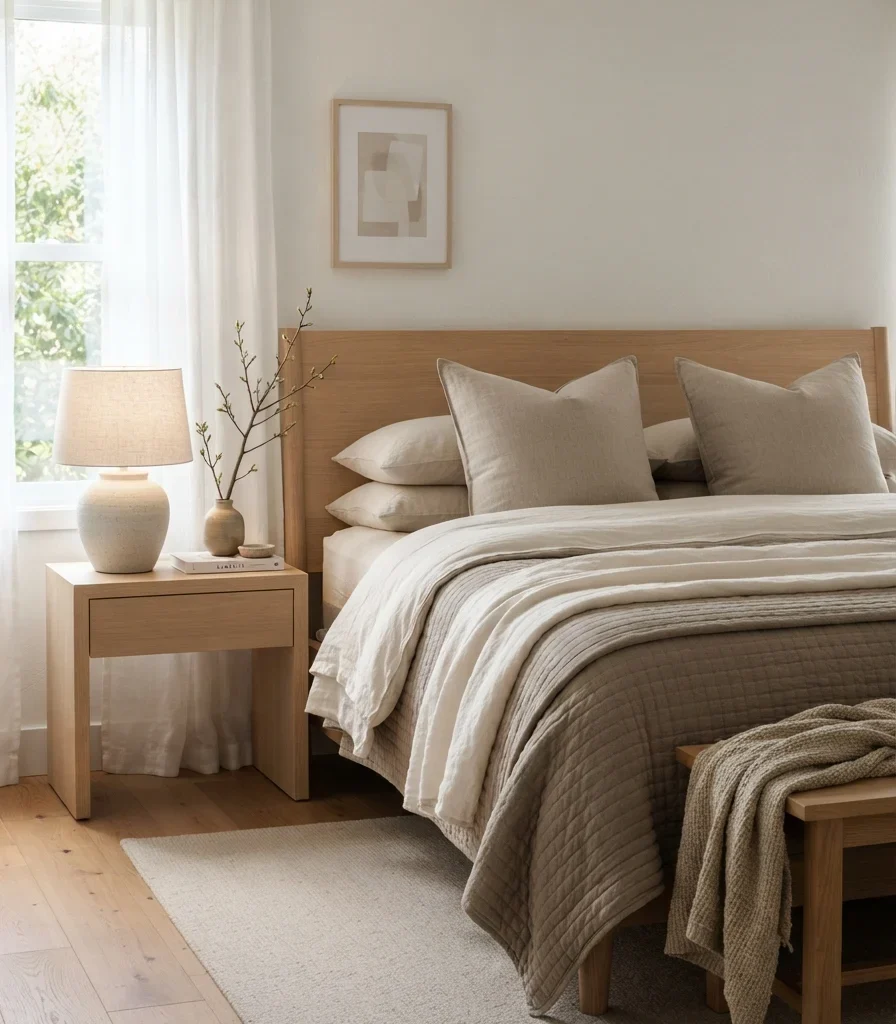
A relaxing green grey bedroom pairs muted botanical sage with warm, soft gray tones to build a sleep space engineered for calm rather than just good looks. This article gives you 10 ways to create a relaxing green grey bedroom: color, materials, lighting, furniture, layout, and small-space fixes, each with a shoppable “Steal the Look” list.

Picture a room where nothing competes for your attention: the walls settle into a soft, grayed sage, the light dims low enough to feel like evening even before the sun sets, and the textures underhand are all soft, natural, and quiet. Nothing here is trying to impress anyone; it’s trying to help you fall asleep faster and stay there. Here are 10 ideas worth saving and stealing.

Why a Relaxing Green Grey Bedroom Works So Well
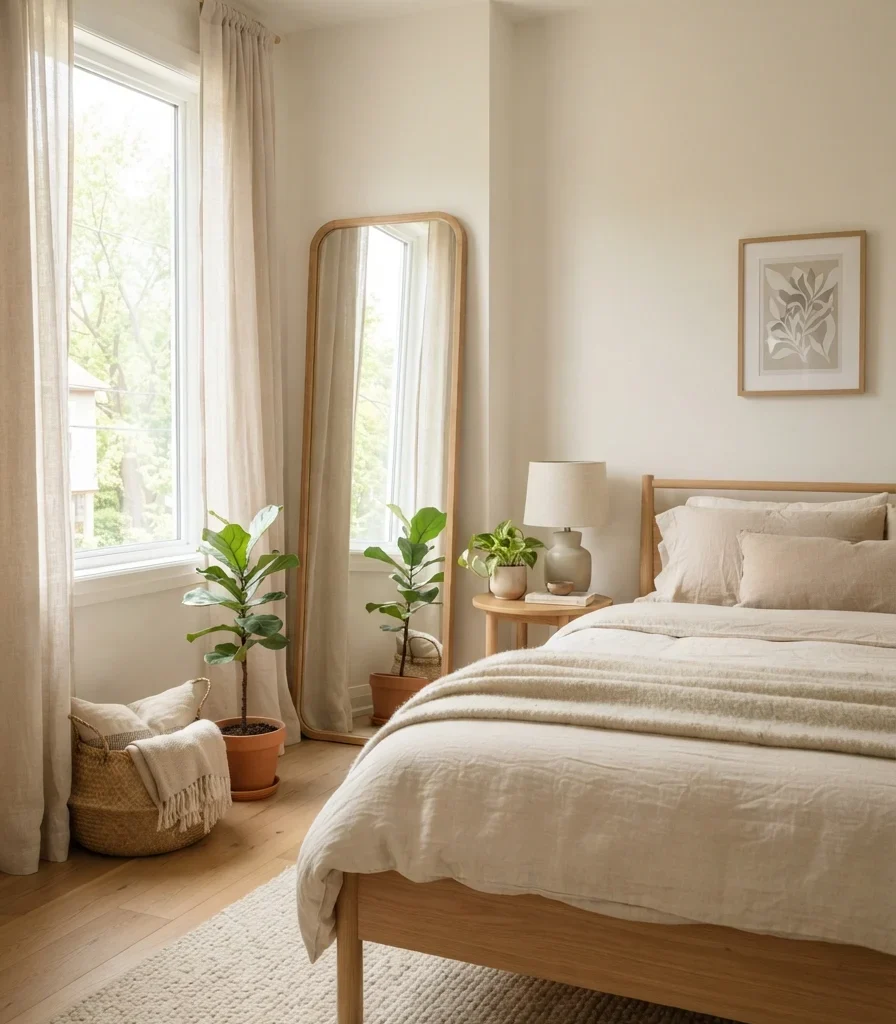
A relaxing green grey bedroom pairs the biophilic calm of muted sage green the color psychology research most consistently links to lowered heart rate and reduced anxiety with the grounded, distraction-free minimalism of warm gray, an approach rooted in both Scandinavian sleep-focused design and clinical sleep-hygiene guidance. What makes it distinct from a purely decorative “sage bedroom” is that every choice gets filtered through one question: does this help or hurt actual rest?

Its materials are specific: pure linen or brushed cotton sheeting, boucle upholstery, unglazed ceramic, wool rugs, and matte-finish hardware in brushed nickel rather than reflective chrome. Colors worth naming: sage, moss, and eucalyptus green against warm gray, greige, and soft charcoal always warm-toned grays, since cool blue-based gray can read clinical rather than calming under evening light.

This approach is trending because sleep science has entered mainstream home decor conversation. Pinterest and wellness-app data both show rising searches for “sleep sanctuary bedroom” and “calming bedroom colors,” reflecting a broader post-pandemic shift toward bedrooms designed around rest quality, not just Instagram appeal. Blue-light awareness and circadian-lighting research have pushed warm, dimmable lighting from a nice-to-have into a genuine design requirement.

Small bedrooms can absolutely achieve this, but need to prioritize differently; visual clutter undermines calm faster in a small room than color choice ever will. Small-space decorators should tackle decluttering and closed storage before adding any new sage or gray textiles, since an overstuffed small room fights the relaxation goal no matter how good the palette is.

ElementGreen InfluenceGray Influence
PhilosophyBiophilic calm, botanical restfulnessGrounded minimalism for sleep focus
MaterialsLinen, boucle, rattan, unglazed ceramicWool, brushed nickel, matte finishes
Color PaletteSage, moss, eucalyptusWarm gray, greige, soft charcoal

1. Soft Sage Walls With Warm Dove Gray Trim

1. Soft Sage Walls With Warm Dove Gray Trim

Vibe: Serene a wall color chosen for how it feels at 9 pm, not just how it photographs at noon.

Why it works: Muted sage has a grayed-down undertone that keeps it from reading as an energetic, saturated color, which matters for a room meant to lower stimulation rather than raise it. This is a saturation principle, where lower-chroma colors read as calmer regardless of hue.

How to get it: Paint walls in a chalky matte sage such as Sherwin-Williams “Clary Sage” and trim in a warm dove gray like Benjamin Moore “Gray Owl,” avoiding a glossy sheen that reflects light and disrupts the calm the color is meant to create.

💡 Quick Win: Not ready to paint? A sage green linen curtain panel introduces the same calming tone at the window without touching a wall.

Shop The Look

Product
Sage green matte wall paint sample
Warm dove gray trim paint
Ceramic vase sage glaze
Linen curtain panel sage green
Wool throw blanket ivory

2. Natural Linen Bedding for Relaxing Texture

2. Natural Linen Bedding for Relaxing Texture

Vibe: Still bedding that feels like it’s already settled in for the night.

Why it works: Linen’s breathable, temperature-regulating weave supports actual sleep comfort, unlike synthetic sheeting that traps heat, and its naturally relaxed, slightly wrinkled texture reads as effortless rather than stiff a material-authenticity principle that pure cotton sateen can’t replicate.

How to get it: Choose stonewashed linen sheets in warm gray rather than pure white, which shows every wrinkle starkly, and add one sage green linen throw at the foot of the bed as the room’s single green textile note.

Shop The Look

Product
Stonewashed linen sheet set warm gray
Linen duvet cover warm gray
Sage green linen throw blanket
Linen pillowcase set ivory
Fabric refresher spray natural scent

3. Warm Dimmable Lighting for a Wind-Down Routine

3. Warm Dimmable Lighting for a Wind-Down Routine

Vibe: Hushed light, dim and warm enough to signal the body that it’s time to slow down.

Why it works: Circadian lighting research shows that bright, cool-toned light in the evening suppresses melatonin production, while warm 2700K light dimmed low in the hour before bed supports the body’s natural wind-down process. This is a light-behavior principle with a direct physiological effect, not just a mood one.

How to get it: Install a dimmer switch on the bedside lamp and set it to 2700K bulbs only, dimming the light to roughly 20–30% brightness starting an hour before your intended bedtime.

Shop The Look

Product
Brass table lamp linen shade
Warm white 2700K dimmable bulb set
In-line dimmer switch cord
Small ceramic catch-all dish
Smart plug with scheduled dimming

4. Tonal Green-to-Gray Gradient Layering

4. Tonal Green-to-Gray Gradient Layering

Vibe: Layered, a room where the eye settles instead of jumping between colors.

Why it works: A gradual color gradient from sage walls to gray bedding to one charcoal accent gives the eye a smooth path to travel across the room, rather than the visual friction of two unrelated colors placed side by side tonal-layering principle that supports the room’s overall calming intent.

How to get it: Keep walls sage, bedding in warm gray linen, and add exactly one charcoal velvet cushion as the deepest note; adding a second bold accent color breaks the calm the gradient is built to create.

Shop The Look

Product
Gray linen duvet cover set
Charcoal velvet throw pillow cover
Small sage green ceramic bud vase
Wool area rug warm gray
Sage green wall paint sample

5. Low-Profile Upholstered Bed for a Grounded Feel

5. Low-Profile Upholstered Bed for a Grounded Feel

Vibe: Grounded furniture low enough to make the whole room feel less demanding on the eye.

Why it works: A low-profile frame reduces the visual weight and height a tall, ornate headboard carries, applying a proportion principle where lower horizontal lines leave more visible open space, which reads as calmer than a room with a tall, imposing furniture silhouette.

How to get it: Choose a platform or low-profile upholstered bed frame no taller than 90cm at the headboard, in warm gray boucle rather than a patterned or dark fabric that adds visual weight.

💡 Quick Win: Removing the bed skirt and box spring in favor of a simple platform frame instantly lowers the bed’s visual height without buying anything new.

Shop The Look

Product
Low-profile upholstered bed frame gray boucle
Sage green throw blanket
Warm oak nightstand pair
Wool area rug ivory
Brass bed frame leg caps

6. Blackout Curtains in Sage Linen for Deeper Sleep

6. Blackout Curtains in Sage Linen for Deeper Sleep

Vibe: Dim a room that can go fully dark whenever the body needs it to.

Why it works: Blackout fabric blocks the streetlight and early-morning light that disrupts deep sleep cycles, and a linen-textured sage fabric delivers that function without looking like a hotel-grade blackout panel a material choice that serves both the relaxation function and the room’s color story at once.

How to get it: Hang sage green blackout curtains with a linen-look texture from a rod mounted just below ceiling height, extending at least 15cm past the window frame on each side to block light gaps.

Shop The Look

Product
Sage green blackout curtain panel set
Ceiling-height curtain rod extendable
Curtain rod finial set brass
Small ceramic dish for windowsill
Blackout curtain liner add-on

7. Weighted Blanket and Textured Throws for Calm

7. Weighted Blanket and Textured Throws for Calm

Vibe: Grounded the layer that turns a nice-looking bed into a genuinely calming one to lie in.

Why it works: Weighted blankets provide deep pressure stimulation that some people find measurably calming, and layering one over the existing sage-and-gray bedding adds a functional relaxation tool without disrupting the palette, since most weighted blankets come in matching neutral covers.

How to get it: Choose a weighted blanket at roughly 10% of body weight in a warm gray cotton cover, folded in thirds at the foot of the bed over the sage top layer.

💡 Quick Win: A boucle throw draped over one corner of the bed adds textural softness for under $40 if a full weighted blanket isn’t in the budget yet.

Shop The Look

Product
Weighted blanket cotton cover warm gray
Boucle throw blanket ivory
Sage green quilted coverlet
Removable duvet-style blanket cover
Small ceramic dish nearby styling

8. Decluttering and Zoning for a Distraction-Free Sleep Space

8. Decluttering and Zoning for a Distraction-Free Sleep Space

Vibe: Consider a room with nothing left out to catch the eye or the mind before sleep.

Why it works: Visual clutter increases cognitive load even when it’s not consciously noticed, which works directly against a bedroom’s relaxation goal. This is a negative-space principle, where empty, uncluttered surfaces genuinely read as calmer to the brain than busy ones, regardless of color palette.

How to get it: Limit each nightstand to no more than three items: a lamp, a book, a small dish, and move everything else into closed woven baskets or a dresser drawer rather than open shelving.

Shop The Look

Product
Woven storage basket lidded set
Closed dresser with drawer organizers
Nightstand with drawer storage
Small ceramic dish for essentials
Drawer organizer tray set

9. Layered Nightstand and Reading Lights for Evening Calm

9. Layered Nightstand and Reading Lights for Evening Calm

Vibe: Glowing enough layered light that no single source has to work too hard or shine too bright.

Why it works: Wall-mounted reading lights free up nightstand space (supporting the decluttering goal) while giving each side of the bed independent light control, so one partner can read while the other sleeps a practical layout benefit layered on top of the room’s overall warm-light strategy.

How to get it: Mount adjustable brass reading lights at roughly 60cm above the mattress on each side, each on its own switch, paired with a dimmed ceiling pendant for ambient fill light.

Shop The Look

Product
Brass adjustable wall reading light pair
Individual switch cord for each light
Low-hanging pendant light warm brass
Warm white 2700K bulb set
Wall-mount bracket hardware kit

10. Green-Gray Layering Tricks for Small Relaxing Bedrooms

10. Green-Gray Layering Tricks for Small Relaxing Bedrooms

Vibe: Airy proof that a small bedroom can feel just as restful as a large one.

Why it works: Light warm gray as the dominant wall tone reflects more available light than a saturated sage would in a small room, while confining green to one or two small textiles keeps the calming color story intact without adding visual weight a compact space can’t spare.

How to get it: Paint walls in a light warm gray, add one sage green cushion or throw as the only green element, and lean a full-length mirror across from the window to bounce daylight back into the room.

Shop The Look

Product
Light warm gray wall paint sample
Sage green cushion cover single
Leaning full-length mirror slim frame
Small potted plant faux
Compact nightstand with storage

How to Start Your Relaxing Green Grey Bedroom Transformation
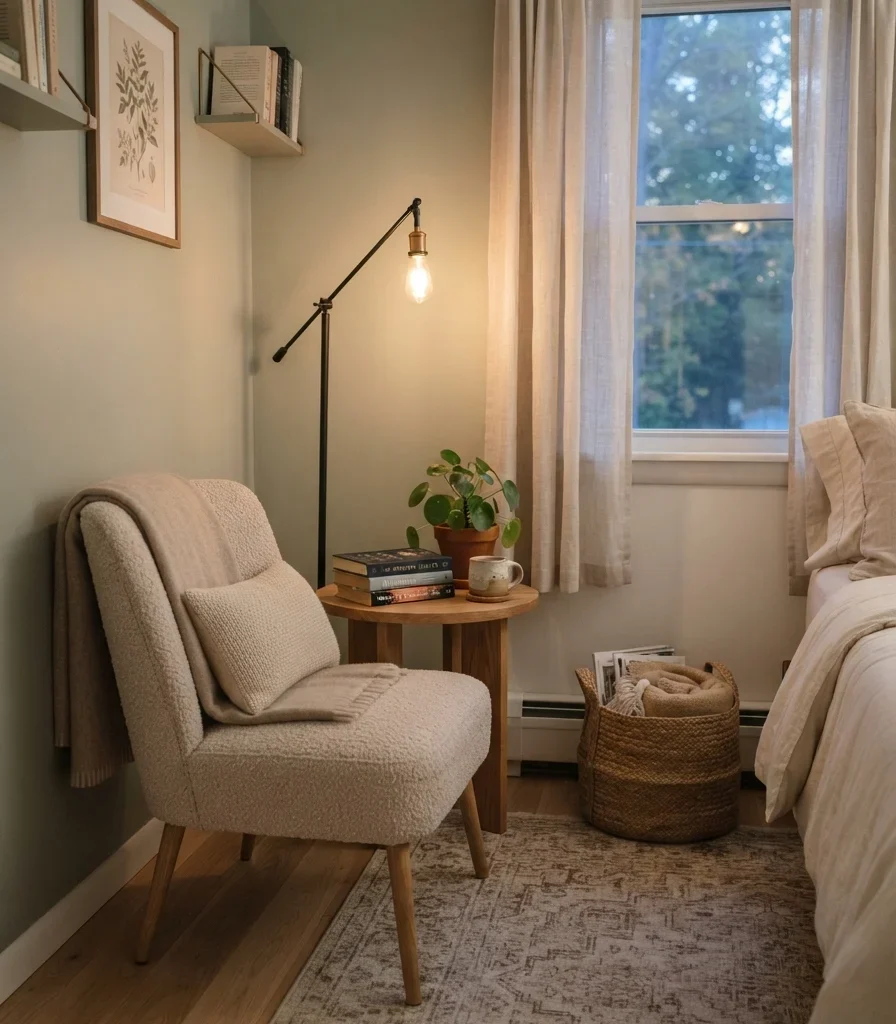
Start with the lighting, not the paint. Before choosing a wall color, install a dimmer switch and swap every bulb in the room to warm 2700K. This single change affects how every future color choice actually reads at night, since even the perfect sage-and-gray palette looks flat and cold under cool-white light.

The most common mistake beginners make is choosing a cool, blue-based gray instead of a warm gray, which fights sage green’s warmth and reads clinical rather than calming, especially under evening lighting. The fix is checking the paint’s undertone in your own lamp light before buying, since warm grays like “Gray Owl” or “Agreeable Gray” look noticeably different under warm bulbs than they do on a lit showroom wall.

Three items under $50 that make an immediate impact: a warm white 2700K dimmable bulb set ($10–$16) for existing lamps; a sage green linen throw ($20–$35) for the foot of the bed; and a lidded woven storage basket ($18–$28) to clear nightstand clutter.

Realistic expectations: A starter version lighting, bedding, decluttering takes a weekend and costs $100–$300. A full transformation with paint, furniture, and blackout curtains runs $1,200–$3,500 over three to six weeks.

Frequently Asked Questions About Relaxing Green Grey Bedrooms

What is a relaxing green grey bedroom, and how is it different from a regular sage green bedroom?

A relaxing green grey bedroom filters every design choice through sleep-quality impact: lighting temperature, fabric breathability, and clutter levels, while a regular sage green bedroom focuses primarily on the visual palette. The relaxation-focused version treats warm lighting and decluttering as equally important as the wall color itself.

What shade of gray works best paired with sage green for a calming bedroom?

Warm grays with a beige or greige undertone, like Benjamin Moore “Gray Owl” or “Agreeable Gray,” pair best because they complement sage’s warmth rather than fighting it the way a cool, blue-based gray does. A cool gray under warm evening lighting can look muddy or clinical, which works against the room’s calming goal.

How much does it cost to create this kind of relaxing bedroom?

A budget-conscious version focused on lighting, bedding, and decluttering costs roughly $100–$300 and can be done in a weekend. A fuller transformation including paint, a new low-profile bed frame, and blackout curtains typically runs $1,200–$3,500, depending on whether furniture is new or sourced secondhand.

Does this style work with existing furniture, like a dark walnut dresser or a taller bed frame?

Yes, a dark walnut dresser grounds the palette nicely and doesn’t need to change, though a taller bed frame works against the low, grounded feel this style aims for. If replacing the bed isn’t an option, removing a bed skirt or box spring can lower the visual height without buying new furniture.

What’s the single most important factor for actually improving sleep, not just the room’s appearance?

Light temperature and dimming matter more for actual sleep quality than any color choice. Warm 2700K bulbs dimmed low in the hour before bed support the body’s natural wind-down process, while bright, cool-white light in the evening can suppress melatonin regardless of how calming the wall color looks. Blackout curtains are the second most impactful factor, since uncontrolled morning light disrupts sleep cycles more than most people realize.

Ready to Create Your Dream Relaxing Green Grey Bedroom?

These 10 ideas cover the full range of what this palette and approach can do, from the calming power of warm sage and gray tones, to functional relaxation tools like blackout curtains and dimmable lighting, to small-space layouts that keep a compact bedroom feeling just as restful as a large one. Building a room like this happens gradually: swap the bulbs first, then the bedding, then the paint, and there’s no need to overhaul everything before you start sleeping better. If you’re starting today, install a dimmer switch and switch every bulb in the room to warm 2700K before you buy a single new textile. Once the light is warm and the clutter is gone, this is the kind of bedroom that makes falling asleep feel like less of an effort every single night. Save the ideas that match your room’s light and your own sleep habits, and start building your calm, sage-and-gray retreat tonight.

You Might Also Like

12 Green Comforter Bedroom Ideas for Max Comfort
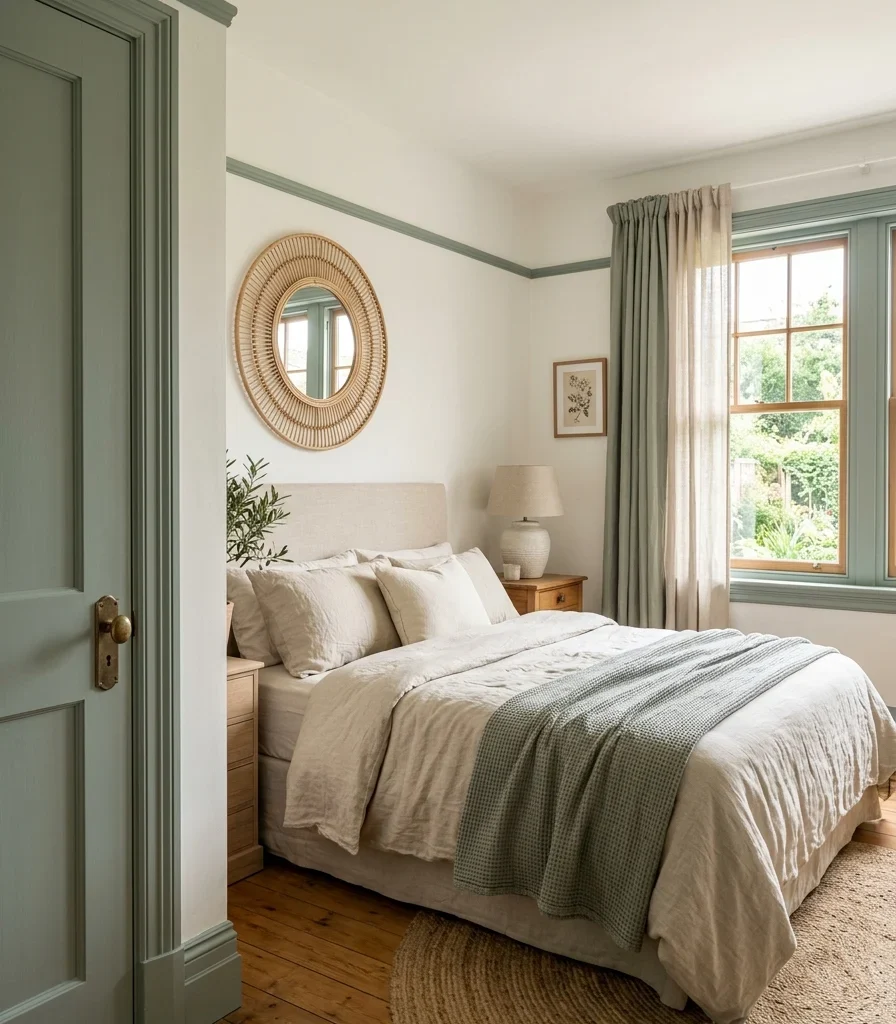
12 Green Comforter Bedroom Ideas for Max Comfort
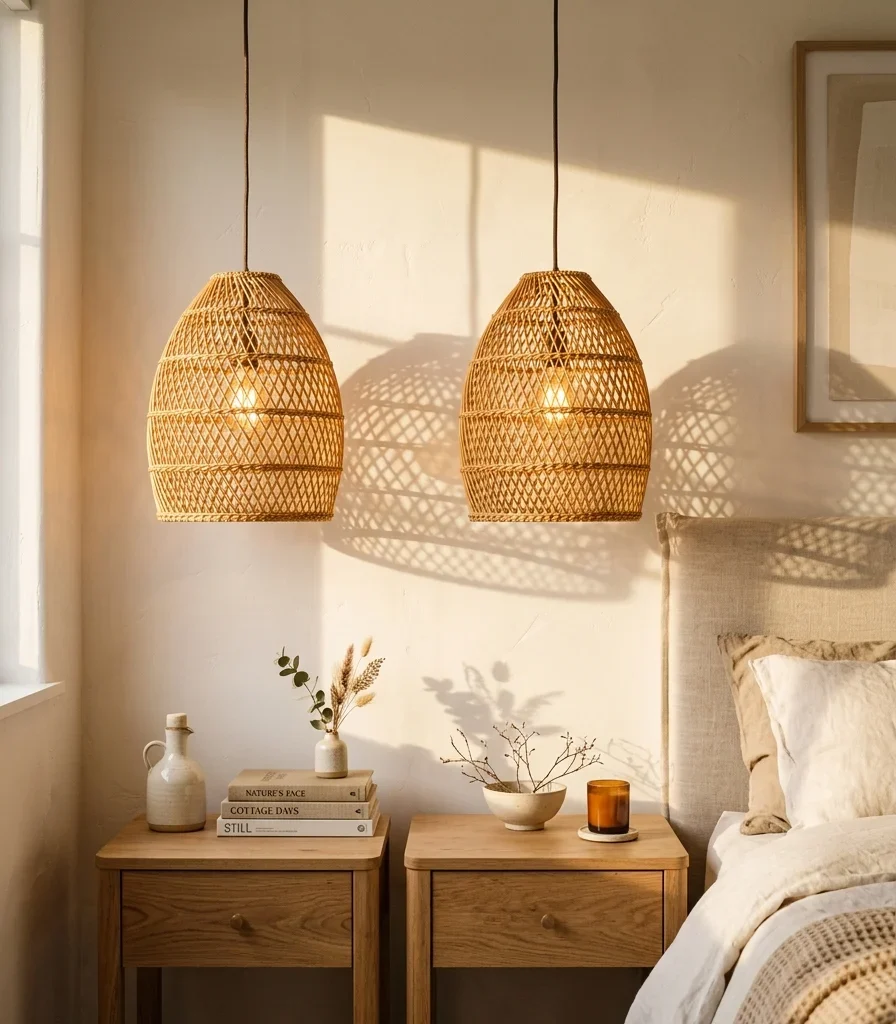
A green comforter bedroom for max comfort builds the whole room around one plush, richly-colored comforter  sage, forest, or emerald  layered with soft, breathable materials so the bed becomes the most comfortable spot in the house, not just the prettiest. This article gives you 12 green comforter bedroom ideas: color, materials, lighting, furniture, layout, and small-space fixes, each with a shoppable “Steal the Look” list.
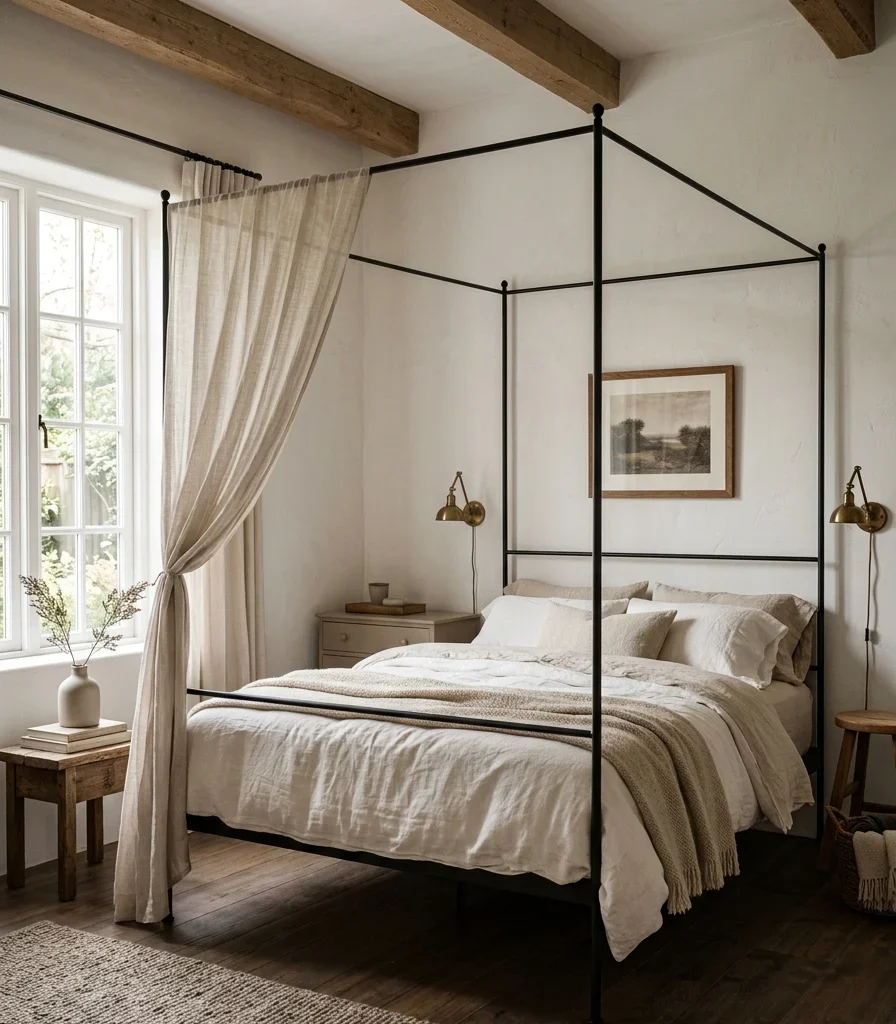
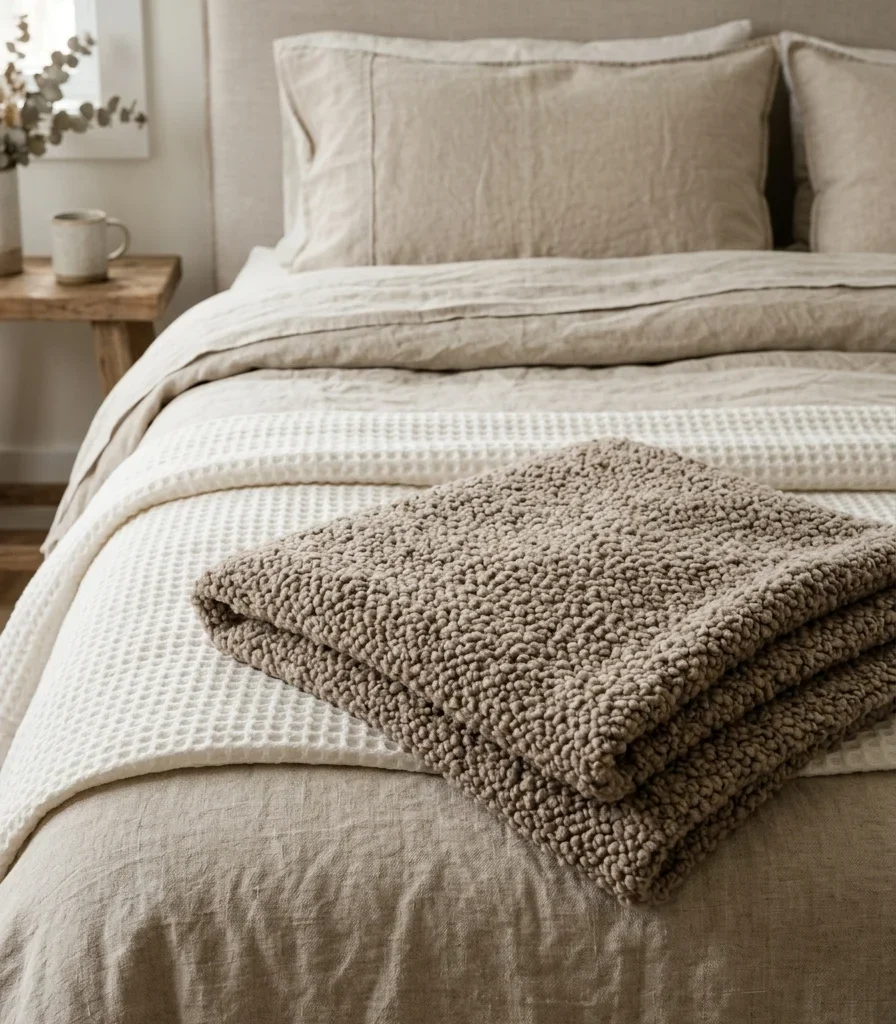
Picture sinking into a bed so deep and soft it feels like the room exhales around you, the comforter’s weight settling in exactly the way a good hug does. Green makes the whole space feel like a forest clearing at dusk still, private, a little removed from the noise of the day. Warm light catches the comforter’s texture instead of flattening it. Here are 12 ideas worth saving nd stealing.
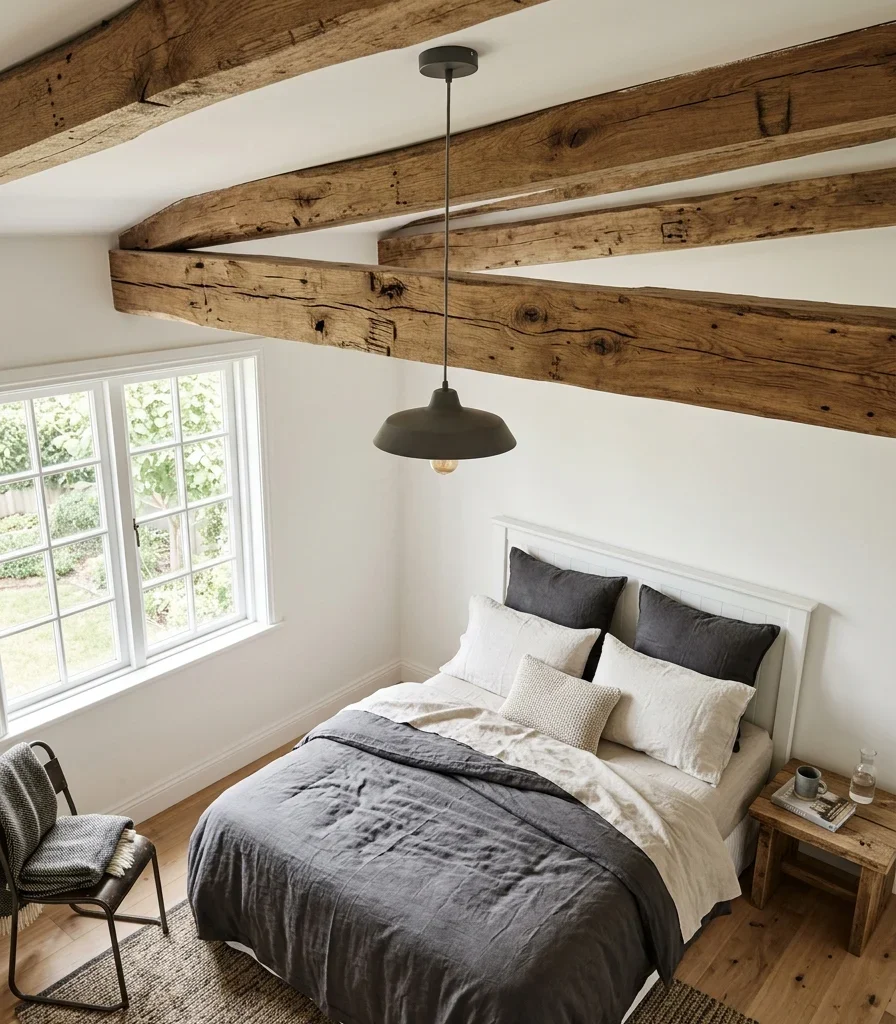
Why a Green Comforter Bedroom for Max Comfort Works So Well
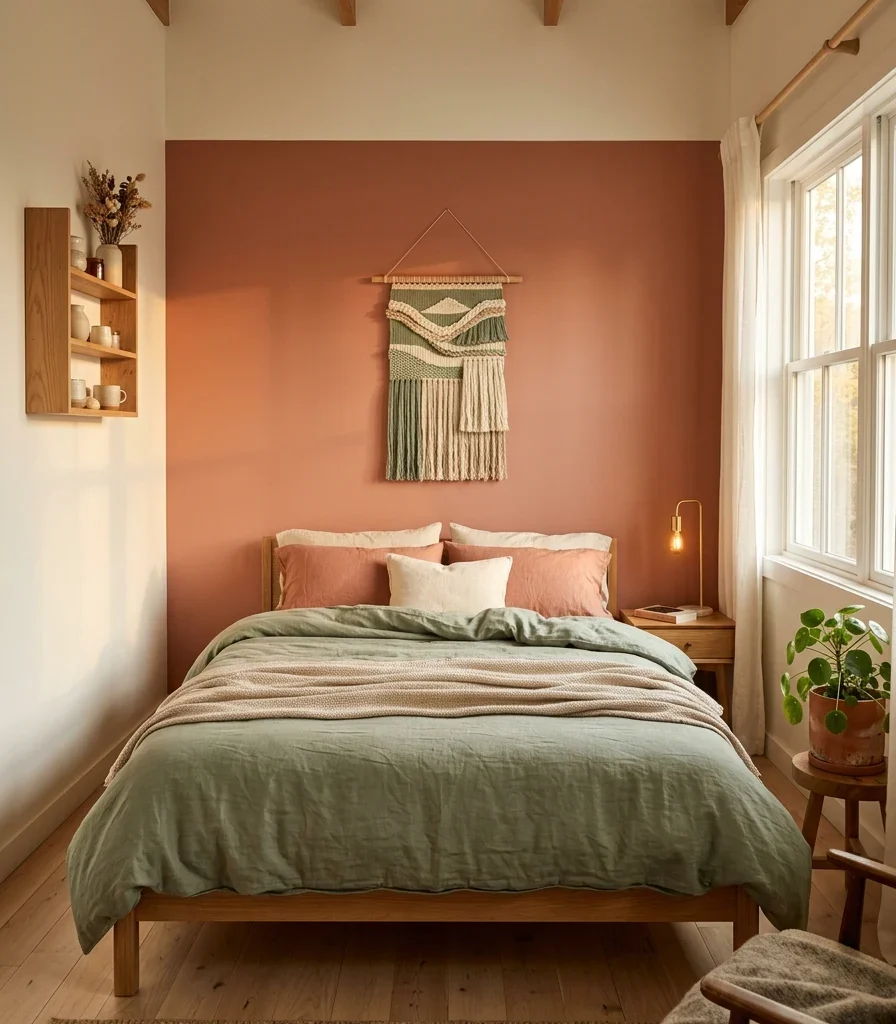
A green comforter bedroom for max comfort blends two ideas rarely paired deliberately: sleep-science comfort (fill weight, breathability, layering) and the botanical calm of a sage-to-forest green story drawn from biophilic design. What separates it from a plain “green bedroom” is that comfort specs come first: fill type and weave matter as much as the shade on the label.
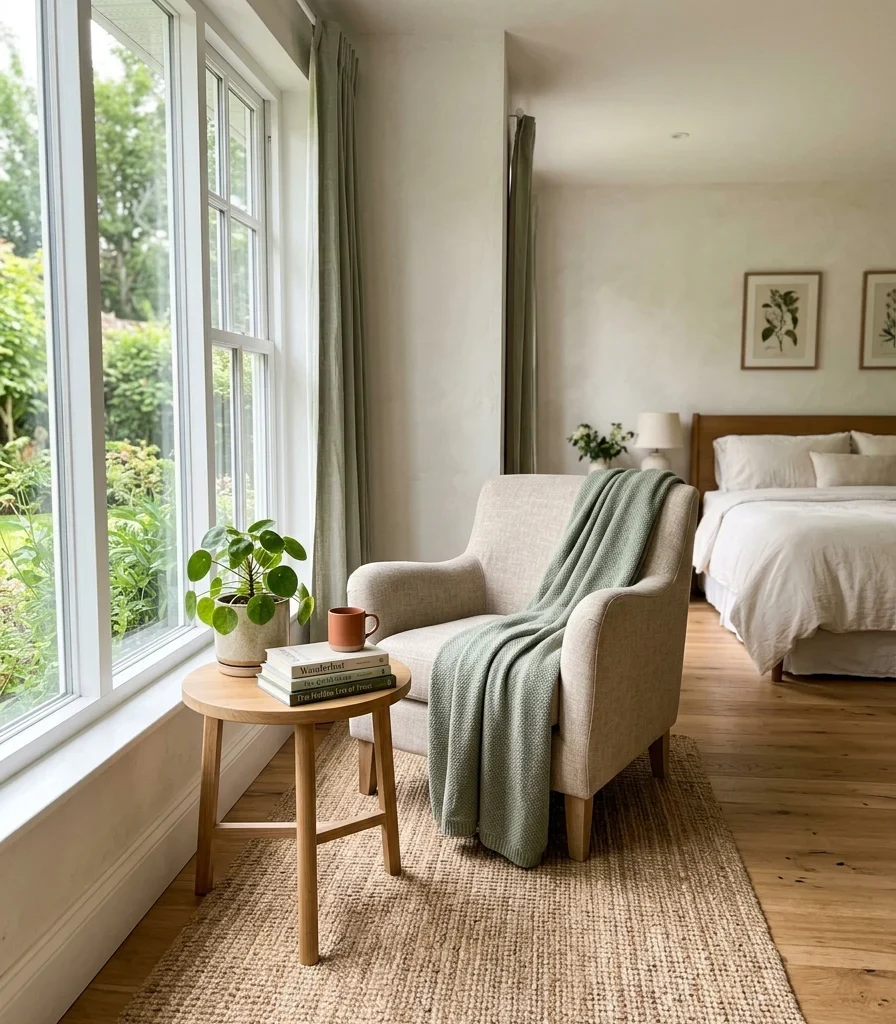
Its materials are specific: down alternative or responsibly-sourced down fill in the 300–500 GSM range, brushed cotton sateen or linen duvet covers, velvet throw pillows, and a warm oak or upholstered bed frame. Colors worth naming: sage, moss, hunter green, and deep forest for the comforter itself, balanced against warm white, oatmeal, or dove gray walls and linens.

This approach is trending because post-pandemic habits pushed people to spend more waking hours in bed  working, reading, resting  shifting priorities from purely visual bedrooms toward ones built for extended comfort. Pinterest shows rising interest in “cozy bedroom” and “hotel bed at home” queries.

Small bedrooms can do this, but oversized comforters overwhelm a compact room. Choose a comforter sized to the mattress rather than a large overhang, and prioritize one plush texture rather than layering three or four thick textiles.

ElementComfort FunctionGreen Aesthetic
PhilosophySleep-first, tactile layeringSage-to-forest botanical calm
MaterialsDown-alternative fill, cotton sateen, brushed microfiberVelvet, linen, ceramic accents
Color PaletteWarm white, oatmeal, dove graySage, moss, emerald, forest green

1. Choosing Your Green Comforter Shade for the Room’s Light

1. Choosing Your Green Comforter Shade for the Room's Light

Vibe: Still a comforter shade chosen to work with the light already in the room, not against it.

Why it works: Cool, north-facing light makes pale sage look washed-out and gray, while warm, south-facing light can handle a deeper forest green. The same pigment shifts noticeably depending on the color temperature of light hitting it.

How to get it: In a cool-lit room, choose a deeper forest or hunter green comforter, which holds its color better under blue-toned daylight; in a warm-lit room, a lighter sage reads richer without looking flat.

💡 Quick Win: Hold a fabric swatch or comforter corner up against your window at midday before buying; the true color only shows in your own light, not a product photo.

Shop The Look

Product
Forest green quilted comforter queen
Sage green comforter king size
Ivory linen throw pillow cover
Ceramic vase warm white glaze
Warm oak picture frame small

2. Down Alternative vs. Down Fill for True Comfort

2. Down Alternative vs. Down Fill for True Comfort

Vibe: Ground a comforter with enough loft to actually feel like it’s doing something.

Why it works: Fill weight, measured in GSM, directly determines warmth  300–350 GSM suits warm climates or hot sleepers, while 400–500 GSM suits colder rooms or a heavier, more cocooning feel. Down alternative mimics down’s loft without allergy risk; genuine down offers a slightly better warmth-to-weight ratio at a higher price.

How to get it: Match your comforter’s GSM to your room’s typical nighttime temperature and your own preference for weight; check the product listing’s fill weight specifically, not just the marketing language.

Shop The Look

Product
Down alternative comforter 400 GSM
Genuine down comforter box-stitch
Duvet cover with interior ties
Cotton sateen sheet set ivory
Comforter storage bag, breathable

3. Warm Bedside Glow That Flatters a Green Comforter

3. Warm Bedside Glow That Flatters a Green Comforter

Vibe: Hushed light that makes the comforter’s texture visible instead of flattening it.

Why it works: Cool-white bulbs flatten fabric texture and mute green tones, while warm 2700K light brings out the quilted texture and richness of the color. The same bedding photographs differently under a flashlight versus a proper bedside lamp.

How to get it: Use brass table lamps with linen shades on 2700K bulbs at bedside height, positioned so the light falls across the comforter rather than only up toward the ceiling.

Shop The Look

Product
Brass table lamp linen shade pair
Warm white 2700K bulb set
Small ceramic catch-all dish
In-line dimmer switch cord
Linen lamp shade replacement ivory

4. A Low Upholstered Bed Frame That Lets the Comforter Lead

4. A Low Upholstered Bed Frame That Lets the Comforter Lead

Vibe: Layered, a frame quiet enough that the comforter is clearly the star.

Why it works: A low-profile, neutral-toned frame keeps visual weight low so the eye goes straight to the comforter’s color and texture ;the frame becomes a supporting element rather than competing for attention.

How to get it: Choose an upholstered frame in oatmeal, ivory, or warm white boucle rather than a patterned or colored fabric, keeping the comforter as the room’s single boldest textile.

💡 Quick Win: Can’t replace the frame? A neutral fitted bed skirt hides a mismatched frame instantly and lets the comforter take over visually.

Shop The Look

Product
Low-profile upholstered bed frame oatmeal
Bed skirt fitted neutral tone
Brass adjustable reading lamp
Wool throw blanket ivory
Brass bed frame leg caps

5. Layered Throw Pillows Around the Comforter

5. Layered Throw Pillows Around the Comforter

Vibe: Inviting a bed you actually want to flop onto at the end of the day.

Why it works: Mixing pillow textures within the comforter’s own color range adds richness through texture layering rather than introducing colors that compete with it, keeping the palette cohesive while adding depth.

How to get it: Stack five pillows total  two standard shams, two decorative squares, one lumbar  in three different textures, all within the sage-to-forest green range plus one ivory neutral.

Shop The Look

Product
Velvet throw pillow cover forest green
Linen throw pillow cover sage
Boucle lumbar pillow cover ivory
Standard pillow sham set
Small potted plant faux nightstand

6. Tonal Green Layering From Walls to Bedding

6. Tonal Green Layering From Walls to Bedding

Vibe: Serene  green showing up at three depths instead of one flat note.

Why it works: Tonal layering within one family sage walls, forest green comforter, moss cushion creates a gradient the eye can travel through, reading as intentional rather than one flat block of color.

How to get it: Paint walls in a soft sage such as Sherwin-Williams “Clary Sage,” choose a deeper forest green comforter, and add one moss green velvet cushion as the mid-tone bridge between the two.

Shop The Look

Product
Sage green wall paint sample
Forest green quilted comforter
Moss green velvet cushion cover
Brass adjustable reading lamp
Ivory linen sheet set

7. Cotton Sateen vs Linen Duvet Cover for Breathable Comfort

7. Cotton Sateen vs Linen Duvet Cover for Breathable Comfort

Vibe: Calm fabric choice that changes how the whole bed feels to climb into.

Why it works: Cotton sateen’s tighter weave creates a subtle sheen and cooler hand-feel, ideal for hot sleepers, while linen’s looser weave breathes more and softens with every wash  the two fabrics suit different comfort needs even in the same green shade.

How to get it: Choose a 300-thread-count cotton sateen duvet cover if you sleep warm, or a stonewashed linen cover if you prioritize breathability and a relaxed, lived-in texture.

💡 Quick Win: A duvet cover in either fabric can slip over an existing comforter insert, letting you change the whole look without buying a new comforter.

Shop The Look

Product
Cotton sateen duvet cover sage
Stonewashed linen duvet cover sage
Duvet insert clip set
Cotton sateen pillowcase pair
Linen pillowcase set ivory

8. Layered Ceiling and Lamp Light for a Cocooning Glow

8. Layered Ceiling and Lamp Light for a Cocooning Glow

Vibe: Cocooning, e ugh layered light that the whole room feels like it’s wrapping around the bed.

Why it works: A single overhead fixture creates flat light that doesn’t flatter texture, while a pendant layered with two bedside lamps creates pools of light at different heights, making a plush comforter look genuinely inviting rather than just present.

How to get it: Install a rattan or woven pendant as the primary ceiling fixture and add matching brass lamps at both bedsides, all on warm 2700K bulbs with a shared dimmer if possible.

Shop The Look

Product
Rattan dome pendant ceiling light
Brass table lamp pair warm shade
Warm white 2700K bulb set
Shared dimmer switch kit
Small ceramic catch-all dish pair

9. A Storage Bench at the Foot of the Bed

9. A Storage Bench at the Foot of the Bed

Vibe: A functional bench that holds the extra blanket you’ll actually reach for.

Why it works: A storage bench applies negative space and proportion; it fills what’s often empty floor while giving the extra layers this style depends on (a second throw, a spare comforter) somewhere to live besides a closet shelf.

How to get it: Choose a bench roughly two-thirds the width of the bed, upholstered in a neutral boucle or linen, with a hinged lid for blanket storage rather than an open shelf that shows clutter.

Shop The Look

Product
Upholstered storage bench oatmeal boucle
Folded throw blanket forest green
Brass bench leg caps
Small woven basket for bench top
Linen bench cushion cover ivory

10. A Weighted Blanket Layered Over the Comforter

10. A Weighted Blanket Layered Over the Comforter

Vibe: Grounded; the layer that turns “cozy-looking” into actually calming to sleep under.

Why it works: A weighted blanket adds deep pressure stimulation some sleepers find calming, layered as a second textile rather than a replacement  a practical comfort addition that also adds a second green tone deepening the tonal layering already at work.

How to get it: Choose a weighted blanket at roughly 10% of your body weight in a moss or hunter green cotton cover, folded at the foot of the bed over a lighter sage comforter so both greens stay visible.

💡 Quick Win: Fold the weighted blanket in thirds at the foot of the bed rather than draping it loosely; it reads intentional instead of like an afterthought.

Shop The Look

Product
Weighted blanket cotton cover moss green
Removable duvet-style blanket cover
Sage green quilted comforter
Small ceramic dish nearby styling
Bed runner scarf forest green

11. Arranging the Room Around a Cocooning Bed Zone

11. Arranging the Room Around a Cocooning Bed Zone

Vibe: Considered a layout where every other piece of furniture clearly supports the bed.

Why it works: Centering the bed on the longest wall and framing it symmetrically with matching nightstands applies zone definition; the room visually organizes around the bed, reinforcing the comfort-first philosophy at the furniture level, not just bedding.

How to get it: Position the bed so there’s at least 60cm of clearance on both sides for nightstands and walking space, and keep any additional furniture (a bench, a chair) aligned to the bed’s centerline rather than pushed into a random corner.

Shop The Look

Product
Matching nightstand pair warm oak
Brass table lamp pair
Area rug soft pile ivory
Symmetrical wall art pair
Brass drawer pull hardware set

12. Choosing Comforter Size and Placement for Small Bedrooms

12. Choosing Comforter Size and Placement for Small Bedrooms

Vibe: Airy proof that a plush comforter doesn’t have to overwhelm a small room.

Why it works: An oversized comforter with a deep overhang expands the bed’s footprint in a small room, while one sized precisely to the mattress plus a modest 8–10 inch drop keeps visual weight in proportion  a scale principle that matters more here than in a large bedroom.

How to get it: Measure your mattress before buying and choose a comforter labeled for that exact size rather than sizing up “for extra coziness,” which is the most common way a small bedroom ends up feeling bed-dominated.

Shop The Look

Product
Sage green comforter sized to mattress
Slim floating nightstand shelf
Small area rug bedside
Wall-mounted reading light, space-saving
Under-bed storage bin woven

How to Start Your Green Comforter Bedroom Transformation
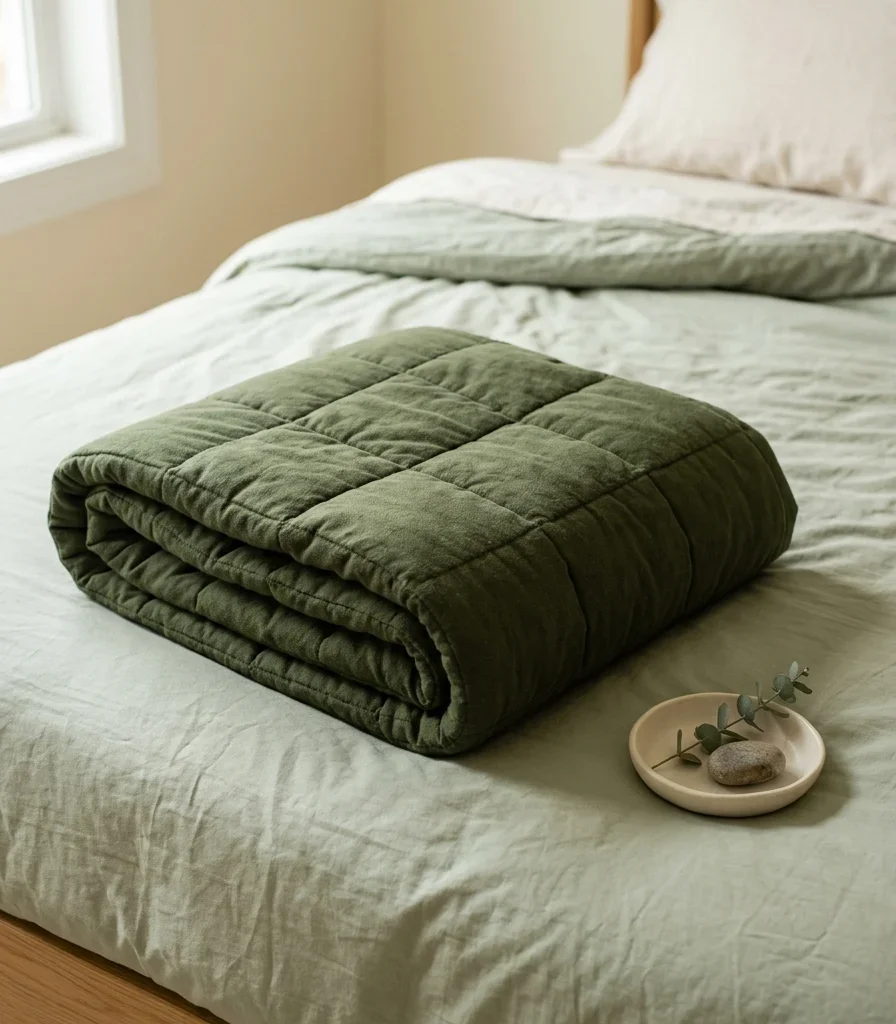
Start with the comforter itself. Before choosing wall color, furniture, or lighting, select the exact green comforter shade, fill weight, and fabric since every other decision in the room gets made to support this one anchor piece, from the wall color that flatters it to the lamp warmth that lights it well.

The most common mistake beginners make is buying a comforter sized larger than the mattress “for a fuller look,” which creates excess bunching and a sloppy silhouette instead of the intentional, hotel-bed effect this style is going for. The fix is measuring your mattress and choosing the comforter size listed specifically for it, checking the product’s drop measurement rather than assuming.

Three items under $50 that make an immediate impact: a sage green velvet throw pillow cover ($18–$28) added to the bed; a warm white 2700K bulb set ($10–$14) for existing lamps; and a small ceramic vase ($15–$22) styled on the nightstand with one dried stem.

Realistic expectations: Astarter version the comforter itself plus a couple of pillows takes an afternoon and costs $80–$200. A full room transformation with new furniture, lighting, and a weighted blanket runs $600–$1,800 and typically takes two to four weeks.

Frequently Asked Questions About Green Comforter Bedrooms for Max Comfort

What is a green comforter bedroom, and how is it different from a plain sage green bedroom?

A green comforter bedroom for max comfort centers the entire design around the comforter’s fill weight, fabric, and fit  not just its color  while a plain sage green bedroom typically focuses on wall paint and decor first. The comfort-focused version treats the bedding as functional gear as much as decor, prioritizing GSM fi, fill weight a, nd breathable fabric alongside the shade of green.

What shade of green works best for a comforter?

Sage and moss green suit warm-lit, south-facing rooms, while deeper forest or hunter green holds its richness better in cooler, north-facing light that can wash out paler greens. Whichever shade you choose, check it against your own room’s natural light before buying, since product photos rarely reflect true color under different light temperatures.

How much does a good green comforter setup cost?

A quality down-alternative comforter with a 300–400 GSM fill typically runs $60–$150, and a full comfort-focused refresh including pillows and a duvet cover falls in the $80–$200 range. A more complete room transformation with new furniture and layered lighting generally runs $600–$1,800 depending on what’s already in the room.

Does a green comforter work with existing furniture, like a dark walnut bed frame or beige walls?

Yes  dark walnut frames pair well with both sage and forest green comforters, since the warm wood tone grounds the cooler green, and beige or oatmeal walls provide a neutral backdrop that lets the comforter’s color and texture stand out rather than competing with a bold wall color.

What’s the most important factor for actual sleep comfort, not just looks?

Fill weight, measured in GSM, matters more for actual comfort than color or fabric choice  a 300–350 GSM comforter suits warm sleepers or hot climates, while 400–500 GSM suits colder rooms or people who want a heavier, more cocooning feel. Choosing GSM based on your typical room temperature and sleep style will affect comfort more than any styling decision in this list.

Ready to Create Your Dream Green Comforter Bedroom?

These 12 ideas cover the full range of what this style can do, from choosing the right green shade and fill weight, to layering lighting and textiles, to small-space sizing that keeps a plush comforter from overwhelming the room. Building this kind of bedroom happens one layer at a time: the comforter first, then lighting, then furniture, and there’s no need to buy everything on the same weekend. If you’re starting today, measure your mattress and pick the exact comforter size and GSM fill that match how warm you actually sleep. Once the layers are right, this is the kind of bed that makes the whole day feel worth it just for the moment you finally climb in. Save the ideas that match your room’s light and your own comfort needs, and start building your green-comforter moodboard tonight.

You Might Also Like

15 Serene Atmosphere Green Bedroom Ideas
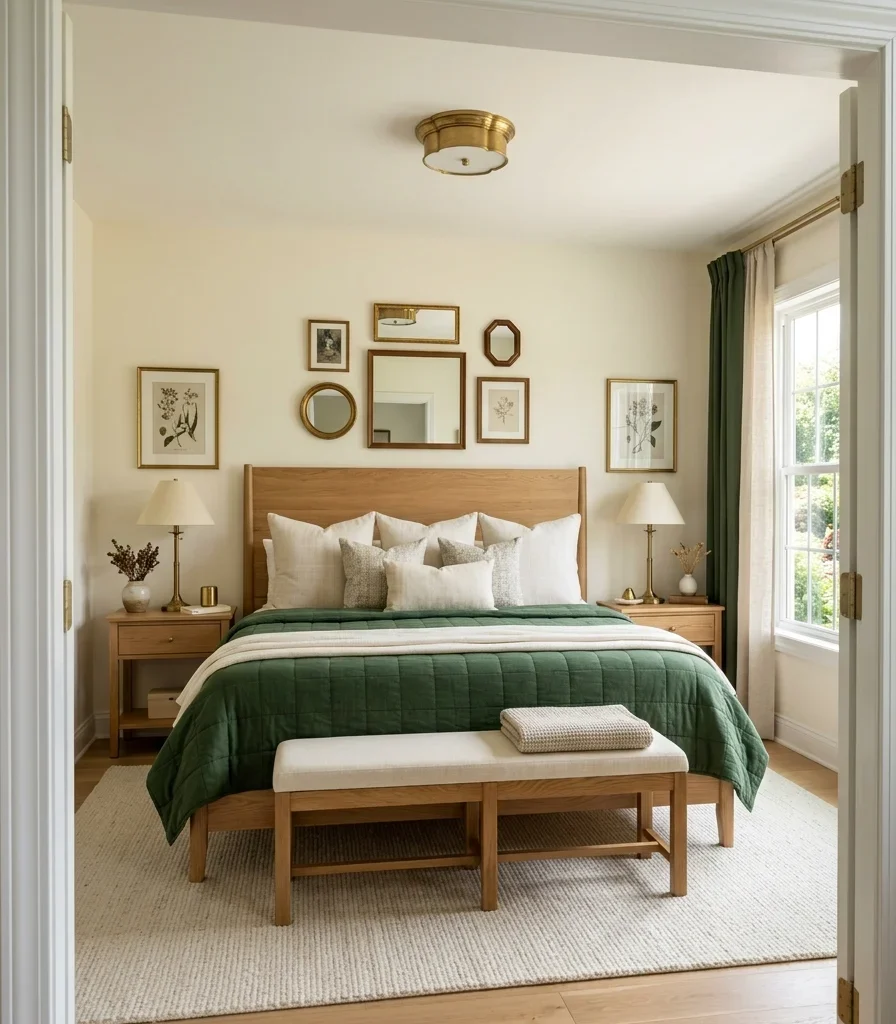
15 Serene Atmosphere Green Bedroom Ideas
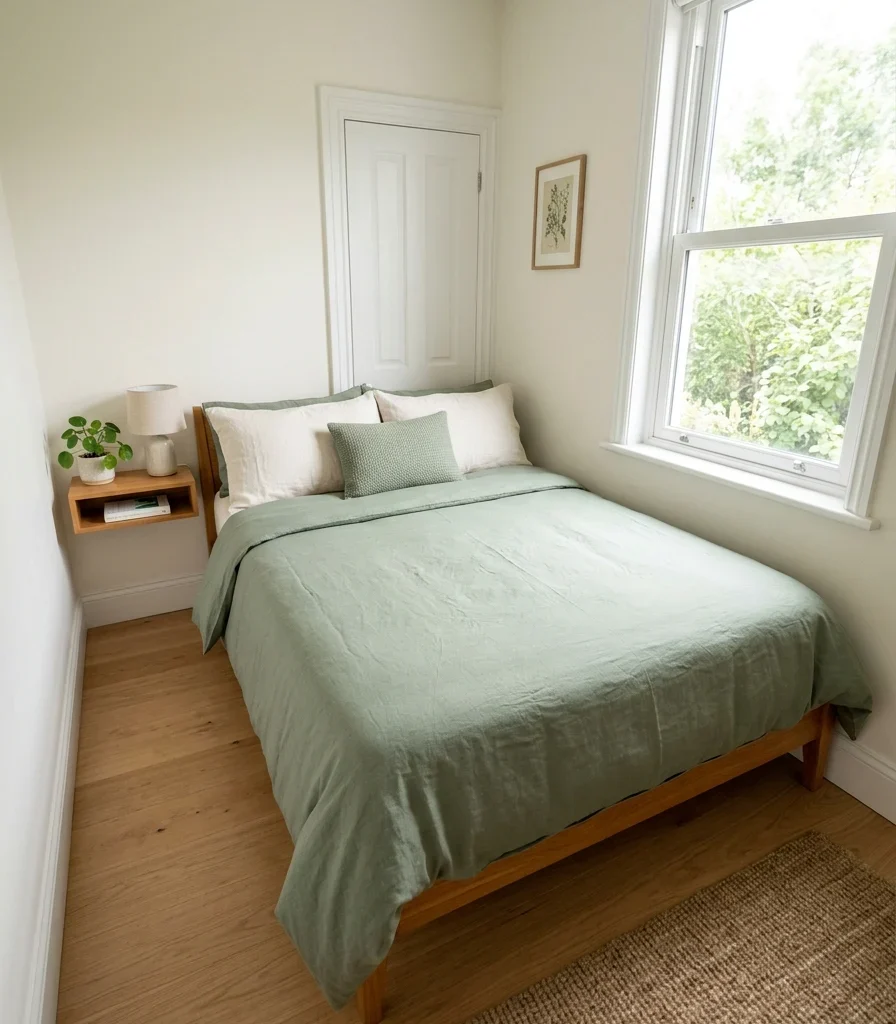
A serene atmosphere green bedroom uses layered, muted greens sage, moss, forest to bring the calming effect of nature indoors without turning the room into a jungle theme. This guide walks through 15 serene atmosphere green bedroom ideas, covering color, materials, lighting, and layout so the space reads as restful the moment you walk in.
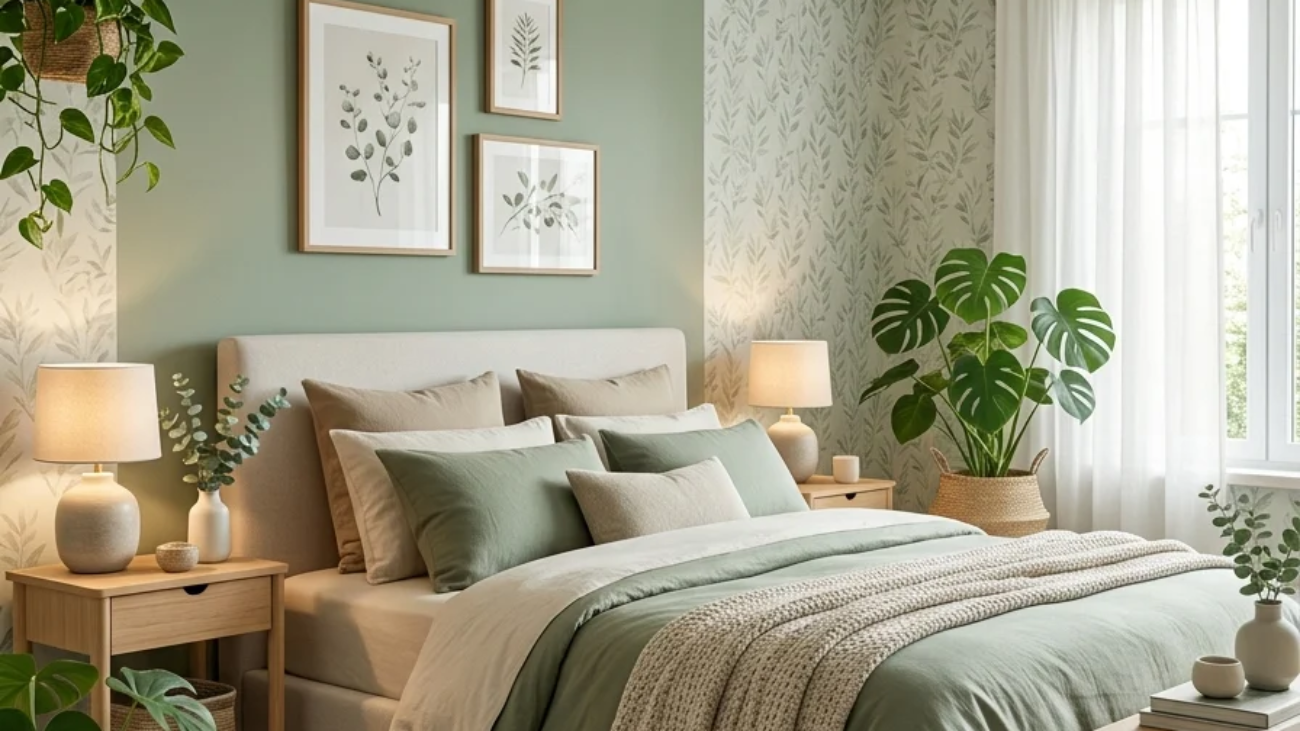
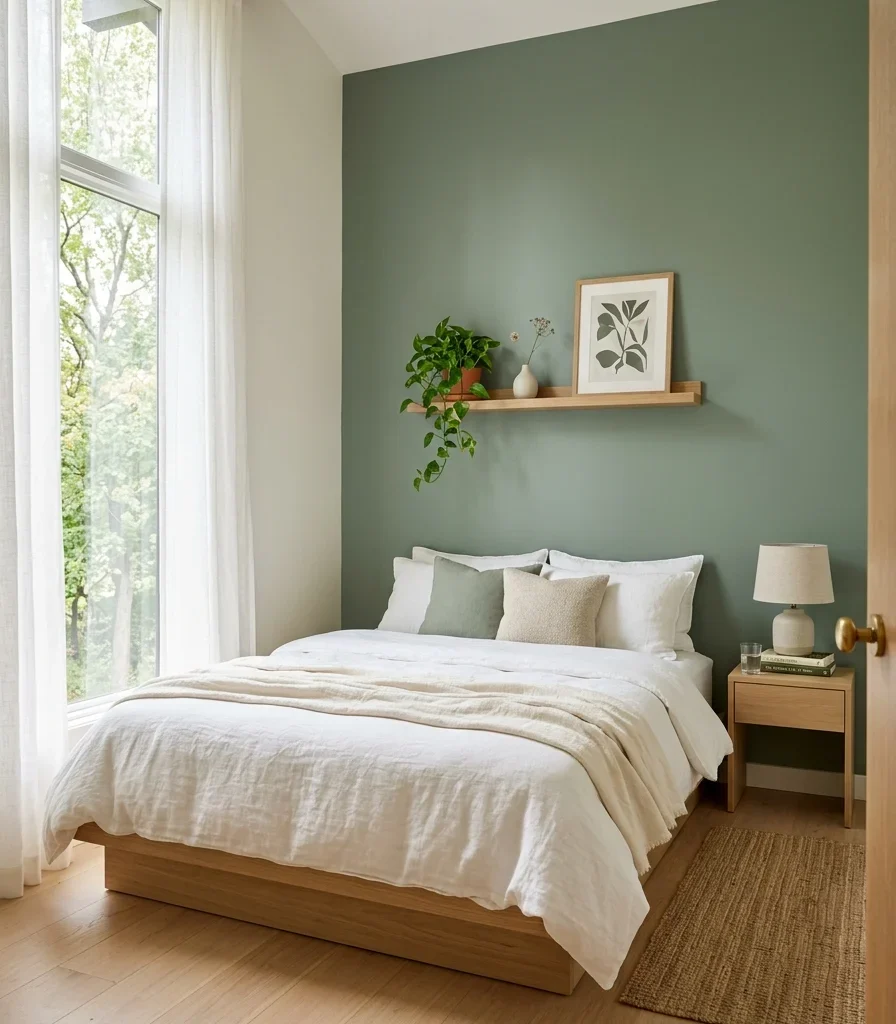
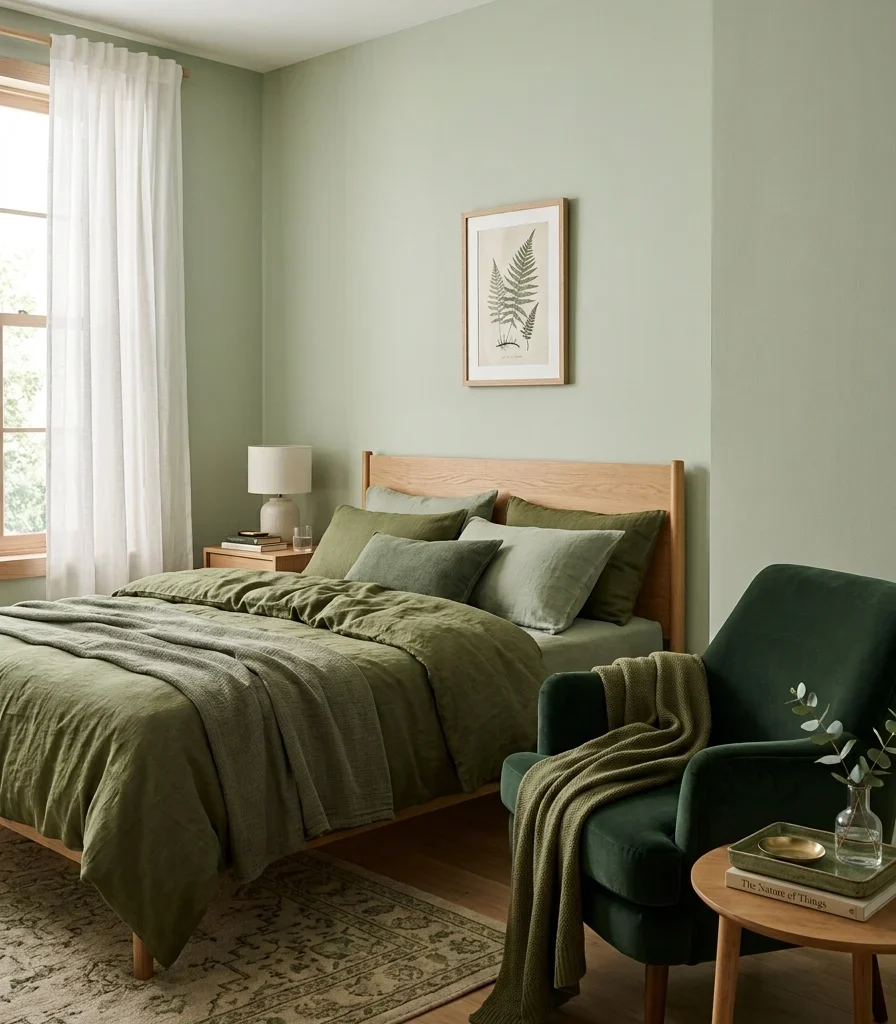
Picture walls the color of sage leaves catching late-afternoon light, linen bedding in a muted moss tone that softens every corner, and a single trailing plant on a floating shelf tying the palette back to something living. The room feels hushed rather than heavy, grounded without closing in. It draws on the same biophilic instinct that makes a walk through a quiet forest feel like an exhale, translated into paint, linen, and unfinished wood.
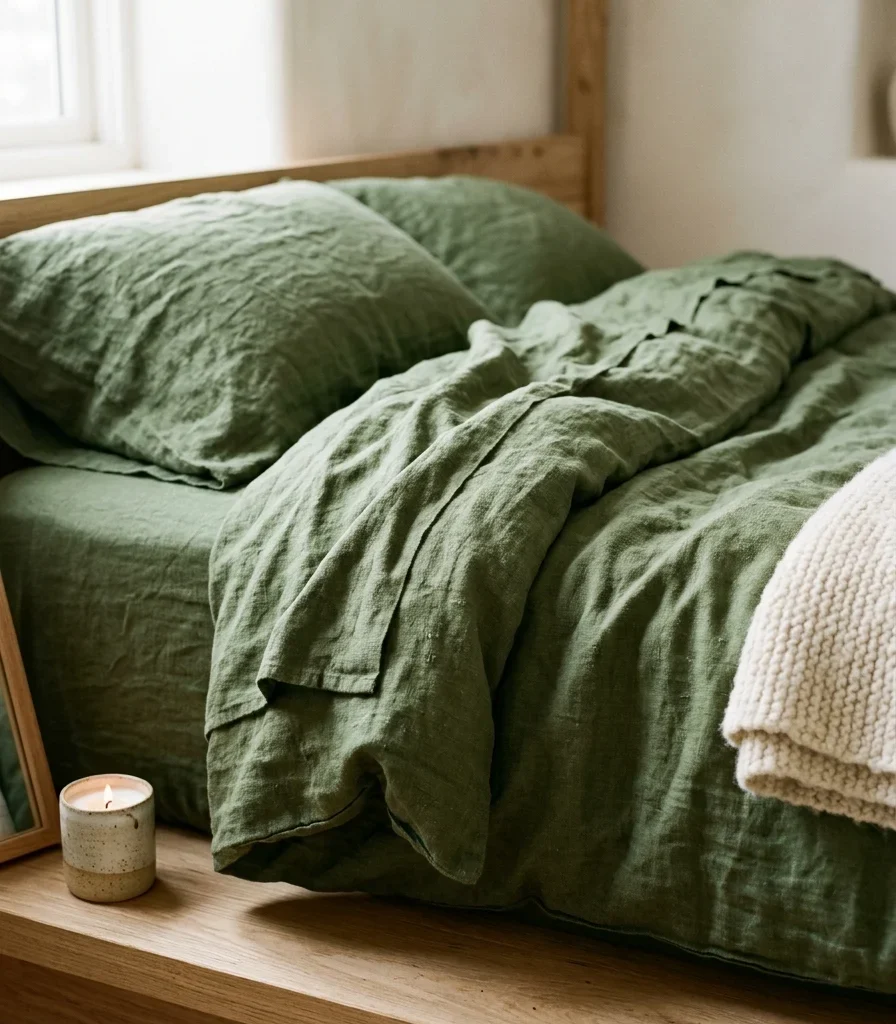
Here are 15 ideas worth saving and stealing.

Why a Serene Green Bedroom Works So Well
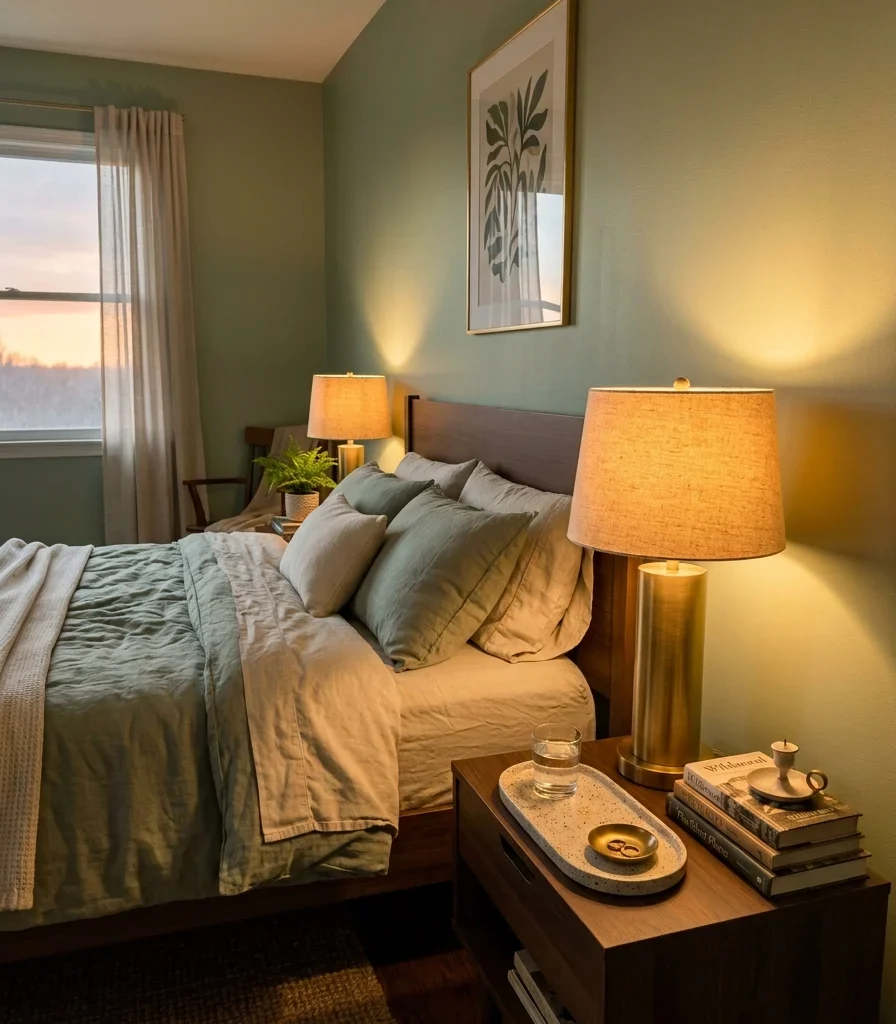
A serene green bedroom isn’t a single decor movement; it’s a color-led approach rooted in biophilic design, the practice of bringing nature’s visual cues indoors, layered with the quiet restraint of Japandi and English countryside interiors that have used sage and moss tones for centuries. What sets it apart from a bold, saturated “green room” trend is restraint: every green here is muted, never neon or primary.

The palette moves from soft sage through moss to a deeper forest green, anchored by warm white trim and touches of terracotta blush for warmth. Materials lean natural and tactile: linen bedding, unfinished white oak furniture, woven rattan or cane headboards, and boucle throw pillows that add softness without pattern.

This look is trending because biophilic design has moved from office lobbies into bedrooms as more people prioritize sleep quality and nervous-system calm at home, and Pinterest searches for “sage green bedroom” and “moody green bedroom” have both climbed steadily as green overtook neutral gray as a top bedroom color choice.

Style at a Glance

ElementDetail
PhilosophyNature’s calm, translated indoors
Key Materialslinen, white oak, rattan, boucle
Key Colorssage, moss, forest green, terracotta blush

15 Serene Atmosphere Green Bedroom Ideas

1. Sage Green Paint on Just the Headboard Wall

1. Sage Green Paint on Just the Headboard Wall

Vibe: Airy. One green wall delivers the calming effect without the room ever feeling boxed in.

Why it works: This uses color contrast and proportion together. Painting only the headboard wall in sage while keeping the remaining three in warm white preserves the sense of openness a small room needs, while still giving the eye one clear, restful focal point behind the bed.

How to get it: Paint just the headboard wall in a muted sage such as Farrow & Ball’s Vert de Terre, stopping the color precisely at the room’s corners so it reads as a defined plane, not a mistake.

Shop the Look

  • Farrow & Ball Vert de Terre paint sample
  • White oak platform bed frame, low profile
  • Linen duvet cover, warm white
  • Ceramic bud vase, single-stem

2. Layered Tonal Greens From Sage to Forest

2. Layered Tonal Greens From Sage to Forest

Vibe: Layered three shades of the same color read as depth rather than repetition, the way a forest canopy holds a dozen greens at once.

Why it works: Tonal layering is a color principle that avoids the flatness of a single-shade room. Using sage on walls, moss on bedding, and forest green on one accent chair creates gradation the eye reads as rich rather than monotonous, without introducing a second color family to manage.

How to get it: Choose three greens from the same undertone family one pale, one mid, one deep and assign each to a different surface: walls, textiles, and a single furniture piece, never mixing them within the same object.

💡 Quick Win: A single moss green throw pillow on white bedding is the fastest way to test this layering before committing to paint.

Shop the Look

  • Moss green linen duvet cover
  • Forest green velvet accent chair
  • Botanical line-art print, framed
  • Small ceramic catch-all tray

3. Linen Bedding in Muted Moss Tones

3. Linen Bedding in Muted Moss Tones

Vibe: Hushed linen’s natural wrinkle keeps a green bedroom from feeling too polished or showroom-perfect.

Why it works: Material choice changes how color reads under light. Linen’suneven weave scatters light rather than reflecting it evenly, which softens a saturated moss tone into something calmer than the same color would look on smooth cotton sateen.

How to get it: Choose stonewashed linen bedding in a muted moss tone, leaving the duvet loosely tucked rather than hospital-cornered so the natural texture and slight color variation stay visible.

Shop the Look

  • Stonewashed linen duvet cover, moss green
  • Linen fitted sheet, warm white
  • Wool throw blanket, natural
  • Ceramic pillar candle, matte white

4. Warm Amber Bedside Lighting

4. Warm Amber Bedside Lighting

Vibe: Romantic warm light keeps green walls glowing rather than going flat and gray after sunset.

Why it works: Light temperature directly affects how green reads. Cool white bulbs pull the blue undertone out of sage and moss, making them feel colder and grayer, while warm 2700K bulbs enhance the yellow undertone in most muted greens, keeping the room feeling warm through the evening.

How to get it: Use matching brass table lamps with linen shades on both nightstands, fitted with warm white 2700K bulbs, and avoid any daylight-temperature bulb anywhere in the room.

Shop the Look

  • Brass table lamp, linen shade, set of 2
  • Warm white LED bulb, 2700K, set of 2
  • White oak nightstand, set of 2
  • Small ceramic bedside tray

5. Low-Profile Platform Bed to Keep the Room Grounded

5. Low-Profile Platform Bed to Keep the Room Grounded

Vibe: Grounded. A low bed frame keeps the room’s visual weight close to the floor, echoing the stillness of forest-floor light.

Why it works: Visual weight and proportion matter directly here. A tall upholstered headboard competes with a saturated wall color for attention, while a low, simple platform frame lets the green wall remain the room’s clear focal point instead of splitting it.

How to get it: Choose a white oak platform bed frame no taller than 14 inches at the headboard, positioning it centered against the green wall with equal clearance on both sides.

Shop the Look

  • White oak platform bed frame, low profile
  • Linen duvet cover, warm white
  • Small trailing pothos, ceramic pot
  • Wool area rug, natural, 8×10

6. Warm White Trim Against Deep Forest Green Walls

6. Warm White Trim Against Deep Forest Green Walls

Vibe: Moody deep forest walls with crisp white trim feel enveloping rather than dark, like standing under a full canopy.

Why it works: Contrast theory keeps a deep saturated color from reading as heavy; glossy warm white trim around every window and doorway gives the eye a bright edge to rest on, which prevents forest green walls from visually shrinking the room the way an all-dark palette would.

How to get it: Paint walls in a deep forest green such as Farrow & Ball’s Studio Green, finishing all trim, baseboards, and window casings in a glossy warm white for maximum contrast at the edges.

Shop the Look

  • Farrow & Ball Studio Green paint sample
  • Glossy warm white trim paint
  • Brass wall sconce, swing-arm
  • Framed botanical print, small

7. Botanical Art in Slim Oak Frames

7. Botanical Art in Slim Oak Frames

Vibe: Calm botanical prints echo the room’s palette without adding a competing color or busy pattern.

Why it works: Repetition of subject matter reinforces a room’s theme more subtly than repeating color alone. Three related botanical prints in identical thin oak frames create a cohesive gallery moment while keeping the visual weight light against a saturated wall.

How to get it: Hang three botanical line-art prints in matching slim white oak frames in a horizontal row above the headboard, spacing each frame two inches apart for a clean, gallery-style line.

💡 Quick Win: Printable botanical art from a design shop’s digital download can be framed at home for under $30 total.

Shop the Look

  • Botanical line-art print, framed, set of 3
  • Slim white oak picture frame, set of 3
  • Small ceramic bud vase
  • Picture hanging strip kit

8. Unfinished Rattan Headboard

8. Unfinished Rattan Headboard

Vibe: Raw. A woven rattan headboard against green walls doubles down on the room’s natural, unpolished feel.

Why it works: Texture layering between two natural materials rattan’s open weave and a matte painted wall creates depth without adding another color, since both surfaces share warm, earthy undertones that reinforce rather than compete with each other.

How to get it: Choose an arched or fan-shaped unfinished rattan headboard sized to the bed frame, positioning it directly against the sage or moss wall so the weave’s shadow pattern is visible in daylight.

Shop the Look

  • Unfinished rattan headboard, arched, queen size
  • Linen duvet cover, moss green
  • Wool throw blanket, natural
  • Small potted fern, terracotta pot

9. Positioning the Bed to Face the Room’s Greenest Wall

9. Positioning the Bed to Face the Room's Greenest Wall

Vibe: Serene. Waking up facing the room’s calmest surface sets the emotional tone before the day even starts.

Why it works: This is a layout decision most bedroom guides skip. Positioning the bed so the sleeper’s eyeline lands on the green wall rather than a closet door or hallway view means the room’s most calming element is also its first visual impression each morning.

How to get it: Map your bedroom’s sightlines from a lying position before finalizing furniture placement, positioning the bed frame so the headboard sits opposite, not beside, the deepest green wall in the room.

Shop the Look

  • White oak nightstand, set of 2
  • Framed botanical print for green wall
  • Small potted plant, ceramic pot, set of 2
  • Wool area rug, natural

10. Terracotta Accents to Warm Up a Cool Sage Palette

10. Terracotta Accents to Warm Up a Cool Sage Palette

Vibe: Warm terracotta against sage keeps a cool-leaning green from ever feeling sterile or clinical.

Why it works: Color temperature balance matters in an all-green room. Sage and moss both lean slightly cool, and a warm terracotta accent color acts as a counterbalance, the same way a single warm object in a cool-toned photograph draws the eye and adds life.

How to get it: Introduce terracotta only through two or three small accents: a ceramic lamp base, one throw pillow cover, and a bud vase, rather than a full terracotta wall or large furniture piece that would compete with the green.

Shop the Look

  • Terracotta ceramic table lamp base
  • Terracotta blush linen pillow cover
  • Small terracotta bud vase
  • Folded cotton throw, warm white

11. Dimmable Wall Sconces Flanking the Bed

11. Dimmable Wall Sconces Flanking the Bed

Vibe: Romantic. Sconces on either side of the bed create two soft pools of light rather than one flat overhead wash.

Why it works: Layered lighting placed symmetrically supports both function and calm. Wall-mounted sconces free up nightstand surface space, while their dimmable warm glow lets the room shift from reading-bright to sleep-ready without ever switching to a harsh overhead fixture.

How to get it: Mount two brushed brass swing-arm sconces at 24 inches above each nightstand, wiring both to a shared dimmer switch so they lower together to a warm, even glow at bedtime.

💡 Quick Win: Plug-in sconces with a built-in inline dimmer switch skip electrical work entirely.

Shop the Look

  • Brushed brass swing-arm wall sconce, set of 2
  • Shared dimmer switch, in-wall
  • Warm white LED bulb, 2700K, set of 2
  • Small stack of linen-bound books

12. A Cane Bench at the Foot of the Bed

12. A Cane Bench at the Foot of the Bed

Vibe: Airy. A woven cane bench reads as furniture that lets light and sightlines pass through it, unlike a solid upholstered piece.

Why it works: Furniture arrangement in a saturated-color room benefits from visual lightness; an open-weave cane bench occupies the same footprint as a solid bench but reads as far less heavy, keeping the green wall behind it as the room’s dominant visual element.

How to get it: Place a slim woven cane bench with white oak legs at the foot of the bed, sized no wider than the bed frame itself so it doesn’t visually crowd the walking path.

Shop the Look

  • Woven cane bench, white oak legs
  • Wool throw blanket, moss green
  • Small ceramic catch-all tray
  • Linen lumbar pillow, warm white

13. Boucle Throw Pillows for Tactile Softness

13. Boucle Throw Pillows for Tactile Softness

Vibe: Layered boucle’s nubby texture against smooth linen gives the bed visual and tactile depth without adding another color.

Why it works: Texture layering does the work color repetition can’t. Boucle’s loop texture creates shadow and highlight variation across its surface, adding visual interest to a monochromatic green-and-white bed without introducing a third color into the palette.

How to get it: Layer two ivory boucle lumbar pillows against the moss green duvet, keeping both in the same warm-white undertone so the texture contrast reads clearly rather than clashing.

Shop the Look

  • Ivory boucle lumbar pillow cover, set of 2
  • Moss green linen duvet cover
  • Wool throw blanket, natural
  • Linen euro pillow sham, warm white

14. Trailing Plants on a Floating Shelf

14. Trailing Plants on a Floating Shelf

Vibe: Layered cascading vines against a painted green wall blur the line between decor and the living plant it echoes.

Why it works: This reinforces the room’s biophilic theme literally rather than symbolically. Trailing plants against a sage or moss wall create genuine texture, layering, and movement as vines grow and shift over time, something a static print or textile can’t replicate.

How to get it: Mount a single white oak floating shelf above the headboard, positioning two trailing pothos plants in matching ceramic pots so their vines cascade down toward the pillows over several months.

Shop the Look

  • White oak floating shelf, 24-inch
  • Trailing pothos plant, live, set of 2
  • Matte ceramic plant pot, small, set of 2
  • Ceramic pillar candle, sage green

15. Negative Space Around the Bed to Let the Green Breathe

15. Negative Space Around the Bed to Let the Green Breathe

Vibe: Still, empty floor space around the bed lets a saturated green wall remain the room’s single quiet statement.

Why it works: Negative space is the layout principle most often skipped in favor of adding more furniture, but in a color-led room, empty floor area gives the eye room to rest between the bed and the wall, preventing the space from feeling visually competitive between color and clutter.

How to get it: Limit bedroom furniture to the bed, two nightstands, and one accent piece maximum, keeping at least three feet of clear floor space visible on at least two sides of the bed.

Shop the Look

  • White oak nightstand, set of 2
  • Wool area rug, natural, 8×10
  • Single accent chair, boucle upholstery
  • Small potted plant, ceramic pot

How to Start Your Serene Green Bedroom Transformation

Start with one wall of sage green paint behind the headboard, specifically a color like Farrow & Ball’s Vert de Terre. This single move anchors the entire room’s undertone before you buy a single piece of bedding or furniture, since every green, wood, and metal choice that follows needs to sit correctly against it.

The most common mistake is pairing a muted sage or moss wall with cool white daylight-temperature bulbs. This pulls the blue undertone out of the green and makes it read gray and lifeless by evening. The fix is simple: use only warm white 2700K bulbs throughout the room, no exceptions.

Three items under $50 create real impact fast: a moss green linen throw pillow cover (around $28), a small ceramic bud vase in matte white (around $16), and a single trailing pothos plant in a terracotta pot (around $22).

A weekend covers paint and styling swaps; a full room with new bedding, a headboard, and lighting takes two to three weeks to source and install. Budget $300–$700 for a starter version, or $2,000–$5,000 for a full room refresh with custom furniture.

Frequently Asked Questions About Serene Green Bedrooms

What’s the difference between a sage green bedroom and a forest green bedroom?

Sage green is a pale, gray-leaning tone best suited for full walls in smaller rooms since it stays light and airy even across four surfaces. Forest green is far more saturated and works best as an accent wall or in larger rooms with strong natural light, since covering an entire small room in it can feel closing without enough contrast from trim or furniture.

What color goes best with a green bedroom?

Warm white and terracotta blush are the two most reliable pairings. Warm white keeps trim, bedding, and ceilings bright enough to balance a saturated wall, while terracotta accents in a lamp base or pillow cover add warmth to counter green’s naturally cool undertone. Brushed brass hardware also complements both without competing for attention.

How much does it cost to create a serene green bedroom?

A starter version using paint, new bedding, and a few accessories runs $300 to $700. A mid-range update with a rattan headboard and new lighting typically lands between $1,000 and $2,000. A full room transformation with custom furniture and a professional paint job can reach $2,000 to $5,000 depending on the scope.

Can a serene green bedroom work in a room with little natural light?

Yes, with one adjustment: choose a lighter sage rather than a deep forest tone, since darker greens need strong daylight to avoid reading as murky in a dim room. Compensate with warm 2700K lighting layered at multiple heights, including bedside sconces and a floor lamp, rather than relying on a single overhead fixture.

What is the best material for a green bedroom headboard?

Unfinished rattan is the most searched and most versatile choice, since its natural texture and warm undertone complement both pale sage and deep forest walls without introducing a competing color. Linen-upholstered headboards in a matching or slightly lighter green tone are the second most common choice for a softer, less textured look.

Ready to Create Your Dream Serene Green Bedroom?

From tonal sage layering to rattan headboards and negative space around the bed, these 15 serene atmosphere green bedroom ideas cover color, materials, lighting, and layout so the room feels fully considered, not just repainted. You don’t need to commit to four green walls this weekend; starting with one accent wall or one linen duvet is genuinely the right way to begin, not a smaller version of the goal. Pick up a moss green throw pillow today and set it against your current bedding to see how the undertone reads in your own light. Once the room comes together, climbing into bed each night will feel like the quiet exhale this palette was always meant to give you. Pin your favorites now, especially any tonal-layering idea that shows you how far sage, moss, and forest green can stretch in one room.

You Might Also Like

16 Ways to Optimize a Home Office Setup in a Small Bedroom

16 Ways to Optimize a Home Office Setup in a Small Bedroom

A small-bedroom home office is a compact work zone built directly into a bedroom’s existing footprint: a desk, storage system, and lighting plan scaled down and positioned so the work area shares space with the bed without visually competing with it. This article gives you 16 practical, genuinely space-smart ideas for building a home office setup that fits a small bedroom, covering furniture, layout, color, lighting, and storage decisions that make an 8×10 or 10×12 room function as both a bedroom and a workday-ready office.

It feels like exhaling a room where the desk doesn’t announce itself the moment you open the door, where the bed still reads as a bed at 9 pm, and where every surface has been asked to do more than one job without looking like it’s straining to do it. Light falls across a slim desk instead of a sprawling one. Texture woven rattan, warm oak, soft linen does the visual work that square footage can’t. This is small-bedroom home office design at its most resolved: quiet, considered, dual-purpose.

Here are 16 ideas worth saving and stealing.

Why Small Bedroom Home Office Design Works So Well

Small-bedroom home office design is the practical discipline of merging two competing room functions rest and focused work inside a footprint that was architecturally intended for only one. It draws from two design traditions simultaneously: Japanese multifunctional furniture design (which has solved for compact living for centuries through fold-away, stackable, and convertible pieces) and Scandinavian minimalism (which prioritizes light, negative space, and a restrained material palette over volume of furniture). What makes it distinct from a standalone home office is that every decision has to satisfy two rooms at once  a desk lamp has to look right at 2 pm and 11 pm, and a chair has to disappear visually when the laptop closes.

The core materials read light and unobtrusive: warm white and soft greige walls, pale ash or white oak for desks and shelving, woven rattan and cane for baskets and headboards, matte black or brushed brass for hardware and lighting, and linen or cotton canvas for any soft textiles. Color stays largely neutral with one accent dusty sage, warm terracotta, or soft blush used sparingly on a chair, a lamp shade, or a stack of folders, never across a full wall.

This approach is trending because remote and hybrid work became permanent for millions of people who live in studio apartments, one-bedroom flats, and starter homes where a dedicated office was never in the floor plan. Pinterest search volume for “small bedroom office ideas” and “work from home small space” has climbed steadily as people stopped treating remote work as temporary and started asking their bedrooms to perform like real offices.

Yes, small spaces can absolutely achieve this, but priorities matter. Vertical storage, a desk under 42 inches wide, and visual zoning (rug, curtain, or color block) should come before any decorative purchase. Skipping the zoning step is the single biggest reason small-bedroom offices feel chaotic instead of calm.

Style at a Glance

ElementDetail
PhilosophyEvery piece must serve both the sleep zone and the work zone; dual function outranks decoration in every decision
Key MaterialsPale ash and white oak, woven rattan and cane, linen, matte black metal, brushed brass, cotton canvas
Key ColorsWarm white, soft greige, dusty sage, warm terracotta, soft blush, warm charcoal accent

16 Small Bedroom Home Office Ideas

1. Tuck the Desk Into an Unused Corner Nook

1. Tuck the Desk Into an Unused Corner Nook

Vibe: Grounded. The corner that was dead space becomes the room’s quietest, most functional square footage.

Why it works: Corners are the most underused square footage in any bedroom because furniture is instinctively placed against flat walls, leaving the diagonal corner empty. Angling a desk into that corner uses negative space that isn’t competing with the bed, dresser, or door swing, which is a principle of spatial efficiency rather than decoration. A 30-inch-wide desk fits into most corners without blocking a window or closet.

How to get it: Choose a desk no wider than 30 inches with a shallow 18-inch depth, and angle it at 45 degrees into the corner rather than pushing it flush against both walls, which leaves a usable triangle of floor space in front of the chair instead of a cramped dead zone.

💡 Quick Win: A corner desk under $150 with hairpin legs instantly claims unused square footage without requiring any wall-mounted installation.

Shop the Look

Product
White oak corner desk 30 inch
Brushed brass drawer pull set
Small ceramic pen holder matte
Woven paper document tray
Potted pothos in terracotta pot

2. Mount a Floating Wall Desk to Reclaim Floor Space

2. Mount a Floating Wall Desk to Reclaim Floor Space

Vibe: A weightless desk that appears to hover, leaving the floor beneath it entirely visible and open.

Why it works: Floating furniture reduces visual mass at floor level, a principle interior designers use specifically in small rooms because the eye reads open floor as more square footage than furniture legs interrupting the sightline. A wall-mounted desk with no legs eliminates the “furniture forest” effect four-legged pieces create when packed into a tight room.

How to get it: Install a 24-inch-deep floating desk on concealed steel brackets rated for at least 100 lbs, mounted at standard desk height of 29 inches, and keep the wall behind it clear of shelving directly above knee height so the open-floor effect isn’t undercut by visual clutter beneath.

Shop the Look

Product
Floating wall desk pale ash
Concealed steel desk bracket set
Slim adjustable task lamp black
Linen-covered notebook stack
Cable management tray under-desk

3. Paint the Work Zone Wall in Warm Greige

3. Paint the Work Zone Wall in Warm Greige

Vibe: Settled. The work corner feels intentionally separate from the sleep zone the instant you look at it.

Why it works: Color blocking is a zoning technique that divides one room into two functional areas without a physical partition. A warm greige applied only to the work-zone wall while the sleep zone stays warm white creates a visual boundary the brain registers instantly, which is the same psychological cue used in studio apartments to separate kitchen from living space.

How to get it: Paint only the wall directly behind or beside the desk in a warm greige with a pink-yellow undertone (avoid cool blue-grey undertones, which read cold against warm oak furniture), in an eggshell finish so the color shifts subtly with the room’s natural light throughout the day.

💡 Quick Win: Removable peel-and-stick greige wallpaper achieves the same zoning effect in an afternoon for renters who can’t paint.

Shop the Look

Product
Warm greige eggshell interior paint
Peel and stick greige wallpaper
Framed botanical line-art print
Small woven seagrass basket
Painter’s tape precision edge

4. Add an Adjustable LED Task Lamp for Focused Light

4. Add an Adjustable LED Task Lamp for Focused Light

Vibe: Focused, a pool of warm, directed light that separates “working” from “winding down” without touching the overhead fixture.

Why it works: Task lighting operates on the design principle of light layering; a single overhead bedroom fixture creates flat, shadowless light appropriate for sleep prep but inadequate for close work. A dedicated task lamp with an articulated arm delivers direct light exactly where reading or typing happens, reducing eye strain without flooding the whole bedroom in bright light at 9 pm.

How to get it: Choose a lamp with an adjustable arm and a 3000K warm-white LED bulb (avoid 5000K daylight bulbs in a bedroom setting, which disrupt the room’s evening atmosphere), and position it so the light falls across the desk from the non-dominant-hand side to avoid shadow interference while writing.

Shop the Look

Product
Adjustable articulating LED desk lamp
Warm white 3000K LED bulb
Small ceramic coffee mug matte
Mini succulent in ceramic pot
Leather-bound notebook slim

5. Install a Pegboard for Vertical Wall Organization

5. Install a Pegboard for Vertical Wall Organization

Vibe: Ordered; every loose object has a fixed vertical address instead of colonizing the desk surface.

Why it works: A pegboard exploits vertical space, the single most underused dimension in a small bedroom where floor and desk surface area are fixed but wall height above the desk is typically empty. This is a direct application of the storage principle that vertical square footage is free square footage; nothing on the pegboard touches the working desk surface below it.

How to get it: Mount a 24×18-inch natural birch pegboard 6 inches above the back edge of the desk, and use a mix of hook lengths and small shelf pegs so items hang at varied depths rather than crowding into a single flat plane, which keeps the wall from reading as cluttered even when it’s holding a dozen items.

💡 Quick Win: A pack of matte black pegboard hooks under $15 instantly converts blank wall space into functional storage.

Shop the Look

Product
Birch wood pegboard 24×18 inch
Matte black pegboard hook set
Small round wall clock minimal
Canvas hanging tool pouch
Wall-mount pegboard shelf small

6. Layer in Woven Rattan Storage Baskets

6. Layer in Woven Rattan Storage Baskets

Vibe: Textural baskets that hide the visual noise of a functioning office without introducing a single hard plastic edge.

Why it works: Woven rattan solves the material-honesty problem that most office storage creates: plastic bins and metal file boxes read as “office equipment” and clash visually with bedroom textiles like linen bedding and wood furniture. Rattan shares the same natural-fiber language as the rest of the room, so storage disappears into the decor instead of announcing itself.

How to get it: Use one basket sized for hanging file folders (roughly 13×10×10 inches) tucked beside or under the desk, and a second smaller basket on the desk’s corner for loose cables and chargers, lining both with a plain linen fabric to prevent small items from slipping through the open weave.

Shop the Look

Product
Woven rattan file storage basket
Small rattan desk organizer basket
Natural linen basket liner fabric
Wood engraved label tag set
Rattan magazine holder slim

7. Divide Sleep and Work Zones With a Sheer Curtain

7. Divide Sleep and Work Zones With a Sheer Curtain

Vibe: Layered, a soft boundary that separates without ever fully closing off light or airflow.

Why it works: Traffic flow and zone definition in a shared-function room depend on a visual cue that signals “this is a different area” without requiring a wall. A sheer curtain on a ceiling track achieves spatial separation through translucency rather than opacity, which keeps the small room from feeling chopped up or darker than it already is a real risk with solid partitions in rooms under 120 square feet.

How to get it: Install an L-shaped or straight ceiling-mounted curtain track positioned to run between the desk and the bed, and hang an unlined natural linen curtain that can be pulled fully open during work hours and closed at night, keeping the zoning flexible rather than permanent.

💡 Quick Win: A tension rod and single sheer panel under $40 create the same zoning effect without any ceiling installation.

Shop the Look

Product
Ceiling mount curtain track L-shape
Sheer natural linen curtain panel
Tension rod adjustable curtain
Curtain ring clips brass
Folded cotton throw neutral

8. Choose a Slim-Profile Ergonomic Chair

8. Choose a Slim-Profile Ergonomic Chair

Vibe: Streamlined, a chair sized to disappear visually the moment it’s tucked under the desk.

Why it works: Furniture scale is the design principle most frequently ignored in small-room seating; a bulky executive chair with wide armrests reads as oversized against a compact desk and eats floor space that a slim frame wouldn’t. A chair with a narrow 18-inch seat width and a low-profile mesh back provides ergonomic support without the visual bulk of a traditional office chair.

How to get it: Select a chair with a seat width under 19 inches and armrests that either fold or sit flush enough to tuck fully under the desk, in a warm taupe or oatmeal upholstery that coordinates with linen bedding rather than the harsh black mesh typical of corporate office chairs.

Shop the Look

Product
Slim mesh ergonomic desk chair
Warm taupe seat cushion pad
Small round floor plant pot
Chair caster floor protector set
Lumbar support cushion linen

9. Roll Office Supplies Into Under-Bed Storage

9. Roll Office Supplies Into Under-Bed Storage

Vibe: Hidden supplies that vanish completely from view the second the workday ends.

Why it works: Under-bed space is the largest unused storage volume in most small bedrooms, typically 6 to 10 inches of clearance running the full footprint of the bed. Routing paper, extra cables, and reference binders into low rolling bins here removes them from the desk and closet entirely, which is the single highest-capacity small-space storage move available in a bedroom.

How to get it: Measure clearance under the bed frame before buying (most platform beds clear 7 inches), and choose a canvas or woven bin no taller than that clearance with wheels for easy access, reserving it specifically for supplies used weekly rather than daily items that need to stay on the desk.

💡 Quick Win: A flat under-bed canvas bin under $25 instantly adds hidden storage without any furniture purchase.

Shop the Look

Product
Low-profile rolling under-bed bin
Canvas storage bin with wheels
Labeled hanging file folder set
Ceramic paperclip organizer dish
Flat document storage box

10. Introduce Dusty Sage as the Single Accent Color

10. Introduce Dusty Sage as the Single Accent Color

Vibe: Fresh one considered color that keeps the neutral palette from tipping into flat or sterile.

Why it works: Restricting an accent to a single color across two or three objects rather than scattering multiple accent colors is a discipline of color layering that prevents visual competition in a small room where every object is seen at close range. Dusty sage specifically reads calm rather than energetic, which suits a room that has to support sleep in the evening.

How to get it: Apply sage to exactly two or three objects maximum a chair cushion, a ceramic vase, and a desk tray and keep every other surface in warm white, oak, or brass so the sage reads as a deliberate accent rather than a second competing palette.

Shop the Look

Product
Dusty sage desk chair cushion
Sage green ceramic bud vase
Oak wood desk catch-all tray
Sage linen coaster set
Brass single-stem bud vase

11. Hang a Linen-Covered Cork Board for Daily Notes

11. Hang a Linen-Covered Cork Board for Daily Notes

Vibe: Hushed, a soft, fabric-covered surface that holds the week’s to-do list without a single loud color.

Why it works: A linen-covered board applies the same material-coherence principle as the rest of the room to a category of bulletin boards that’s normally sold in bright primary colors or black cork. Wrapping the cork base in natural linen before framing it lets the note-taking surface match the room’s textile language instead of introducing an office-supply-store aesthetic.

How to get it: Stretch a plain natural linen fabric over a standard cork board and staple it to the back before framing in a thin oak border, then use brushed brass push pins exclusively; mixed-color pins are the detail that most quickly makes a styled board look untidy.

💡 Quick Win: Wrapping an existing black cork board in linen fabric with a staple gun is a 20-minute fix that costs under $10.

Shop the Look

Product
Natural linen cork board oak frame
Brushed brass push pin set
Dried pampas grass stem single
Small printed weekly planner card
Oak wood board mounting hardware

12. Add a Narrow Cane Vertical Shelving Unit

12. Add a Narrow Cane Vertical Shelving Unit

Vibe: Layered, a tall, narrow footprint that stores far more than its floor space suggests it should.

Why it works: Vertical shelving addresses the same principle as the pegboard idea but at a larger storage capacity. A unit 16 inches wide and 60 inches tall occupies less than 2 square feet of floor while holding the storage volume of a much wider low dresser. The cane-front lower doors add texture and conceal less attractive supplies, while open upper shelves display the objects worth seeing.

How to get it: Choose a shelving unit no wider than 18 inches so it fits beside a desk without crowding the walking path, and reserve the lowest cane-fronted section for items you don’t want visible daily spare paper, chargers, old files while styling only the top two open shelves.

Shop the Look

Product
Narrow cane front shelving unit
Pale oak tall bookshelf 18 inch
Small ceramic catchall bowl
Stacked linen-bound book set
Small trailing plant in pot

13. Layer Ambient String Lighting Behind the Desk Lamp

13. Layer Ambient String Lighting Behind the Desk Lamp

Vibe: Warm, a soft secondary glow that carries the desk area from workday brightness into evening softness.

Why it works: Light layering means combining at least two light sources at different heights and intensities rather than relying on one overhead fixture. Ambient string lights positioned along a shelf edge behind the task lamp add a low, diffused glow that makes the work corner feel inviting after 6 pm instead of clinically lit, extending the desk’s usefulness into a relaxed evening reading nook.

How to get it: Choose warm 2200K micro LED string lights (avoid cool white, which clashes with the task lamp’s 3000K bulb) and drape them along the underside of a shelf or the top edge of a headboard adjacent to the desk, plugged into a separate switch from the task lamp so each light source can be controlled independently.

Shop the Look

Product
Warm 2200K micro LED string lights
Copper wire fairy light set
Small glass jar light diffuser
Dual outlet plug timer switch
Folded linen napkin accent

14. Install a Fold-Away Secretary Desk

14. Install a Fold-Away Secretary Desk

Vibe: Resolved: a desk that exists only when you need it and disappears completely into the wall when you don’t.

Why it works: A fold-away secretary desk is the most direct application of dual-function furniture design available for a genuinely tiny bedroom; when folded shut, it presents as a slim 6-inch-deep cabinet rather than a 24-inch-deep desk, reclaiming nearly two feet of floor space during non-work hours. This matters most in bedrooms under 100 square feet where a permanent desk footprint competes directly with walking space around the bed.

How to get it: Mount the unit so the fold-down surface, when open, sits at standard 29-inch desk height, and choose a model with at least two interior cubbies so pens, chargers, and notepads stay contained inside the cabinet rather than needing separate desk storage once it’s folded shut.

💡 Quick Win: A compact fold-down laptop shelf under $60 delivers the same space-reclaiming effect at a fraction of the cost of a full secretary desk.

Shop the Look

Product
Wall mount fold-down secretary desk
Brass fold-out hinge hardware
Compact fold-down laptop shelf
Interior cubby organizer insert
Small ceramic mug matte glaze

15. Lean a Full-Length Mirror Beside the Desk

15. Lean a Full-Length Mirror Beside the Desk

Vibe: A luminous room that visually doubles in depth the moment a mirror bounces the window light back across it.

Why it works: A leaning mirror is a classic small-space illusion technique that works on the principle of reflected light and perceived depth. Positioning it to face the room’s main window doubles the apparent light source and reflects the far wall, which reads to the eye as additional square footage even though the physical dimensions haven’t changed at all.

How to get it: Lean a mirror at least 60 inches tall against the wall directly across from the window, angled very slightly outward rather than flush against the wall, so it catches and redirects daylight across the desk area rather than reflecting only the ceiling.

Shop the Look

Product
Full-length arched leaning mirror
Thin oak wood mirror frame
Small woven basket mirror base
Folded knit throw neutral tone
Anti-tip mirror wall strap

16. Finish With Warm Terracotta Desk Accessories

16. Finish With Warm Terracotta Desk Accessories

Vibe: Grounded a warm final layer of color that gives the whole desk setup a lived-in, considered finish.

Why it works: Closing a design scheme with one final, cohesive accessory grouping is a principle of visual weight distribution. After fifteen decisions about furniture, storage, and zoning, a small cluster of terracotta objects on the desk gives the eye a single warm focal point without introducing any new material into the room’s established palette of oak, linen, rattan, and neutral paint.

How to get it: Group three unglazed terracotta pieces a pen cup, a shallow catch-all tray, and a small planter on one corner of the desk only, keeping the rest of the surface clear so the terracotta cluster reads as a styled moment rather than scattered clutter.

💡 Quick Win: A single terracotta planter under $15 anchors the whole desk palette without committing to a full accessory set.

Shop the Look

Product
Unglazed terracotta pen cup
Terracotta shallow catchall tray
Small terracotta planter pot
Trailing pothos plant small
Woven linen desk coaster set

How to Start Your Small Bedroom Home Office Transformation

Your first move is choosing the desk before anything else, specifically, a desk no wider than 30 inches and no deeper than 24 inches. Every other decision in this list, from chair scale to lighting placement to storage volume, is sized in relation to the desk’s footprint, so committing to an undersized desk first prevents the far more common mistake of choosing furniture room-by-room and discovering too late that nothing fits together.

The most common mistake in small-bedroom office setups is buying a full-size or oversized desk chair meant for a dedicated home office, then finding it visually and physically dominates a room that also has to function as a bedroom. The fix is scale-matching: every piece, from chair to shelving to lamp, should be selected against the desk’s dimensions, not against a standard office furniture catalog sized for larger rooms.

Three items under $50 that create immediate impact: a warm 3000K LED desk lamp bulb pack, a woven rattan desk-corner basket for cables, and a single terracotta planter to anchor the desk’s color story.

A focused weekend can accomplish desk placement, lighting, and one storage piece for $150–400. A full 16-idea transformation new desk, chair, shelving, curtain divider, and styled accessories typically runs $600–1,800 and takes two to four weekends spread across paint drying time, furniture delivery, and styling.

Frequently Asked Questions About Small Bedroom Home Office Setup

What is the difference between a small bedroom home office and a regular home office?

A regular home office is designed around a single function and typically occupies a dedicated room, allowing full-size furniture and permanent storage. A small bedroom home office has to satisfy two functions in one footprint, which means every piece desk, chair, lighting, storage is chosen at a reduced scale and often selected for dual use, such as under-bed storage bins or fold-away desks that a standalone office would never need.

What color works best for a small bedroom home office?

Warm white or soft greige on the main walls, paired with one accent color such as dusty sage or warm terracotta used on no more than two or three objects, works best. Cool grey or stark white can make a small room feel clinical and less restful at night, while a warm greige with a pink-yellow undertone keeps the room feeling calm during work hours and cozy after dark.

How much does it cost to set up a small bedroom home office?

A basic functional setup desk, chair, and task lamp typically costs $150–400 using budget-friendly pieces. A fully styled version with shelving, a curtain divider, woven storage, and coordinated accessories generally runs $600–1,800, depending on whether the desk is a simple flat-pack option or a built-quality piece in solid oak.

Can a small bedroom home office work if I share the room with a partner?

Yes, but zoning becomes more important  a sheer curtain divider or a corner desk placed away from the direct sightline of the bed helps the work area feel separate even in a shared room. Noise-dampening elements like a woven rug under the desk and a closing storage cabinet for work materials also help the space transition back into a shared bedroom at the end of the workday.

What is the single most important element in a small bedroom home office?

Desk size is the single most important decision, because every other furniture and storage choice in the room is scaled against it. A desk under 30 inches wide with a shallow 18–24-inch depth leaves enough walking clearance around the bed to keep the room from feeling like an office that happens to have a bed in it, which is the most common failure point in small-bedroom office design.

Ready to Create Your Dream Small Bedroom Home Office?

These 16 ideas move across color, material, lighting, layout, and true small-space tricks from a warm greige zoning wall and layered task-and-string lighting to a fold-away secretary desk and a mirror that doubles the room’s daylight. None of this has to happen at once, and starting with just the desk and one storage piece is genuinely the right way to begin rather than a compromise. Today’s specific action: measure your desk corner and order a desk no wider than 30 inches; that single measurement decides the scale of everything that follows. Once it’s in place, you’ll notice the room finally feels like it belongs to you at both 2 pm and 10 pm, calm enough to close a laptop and exhale into. Save the ideas that fit your room’s actual corners and your budget’s actual limits; those are the ones, sage accents and woven baskets included, that you’ll still be glad you pinned a year from now.

You Might Also Like