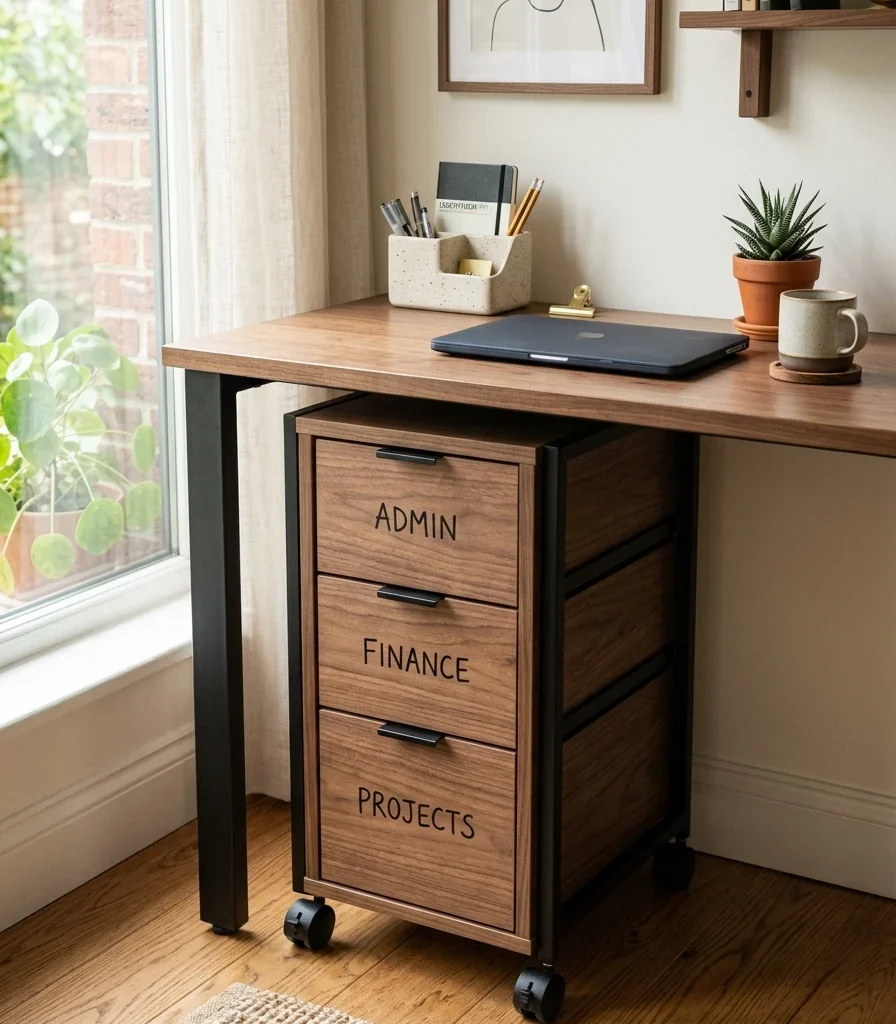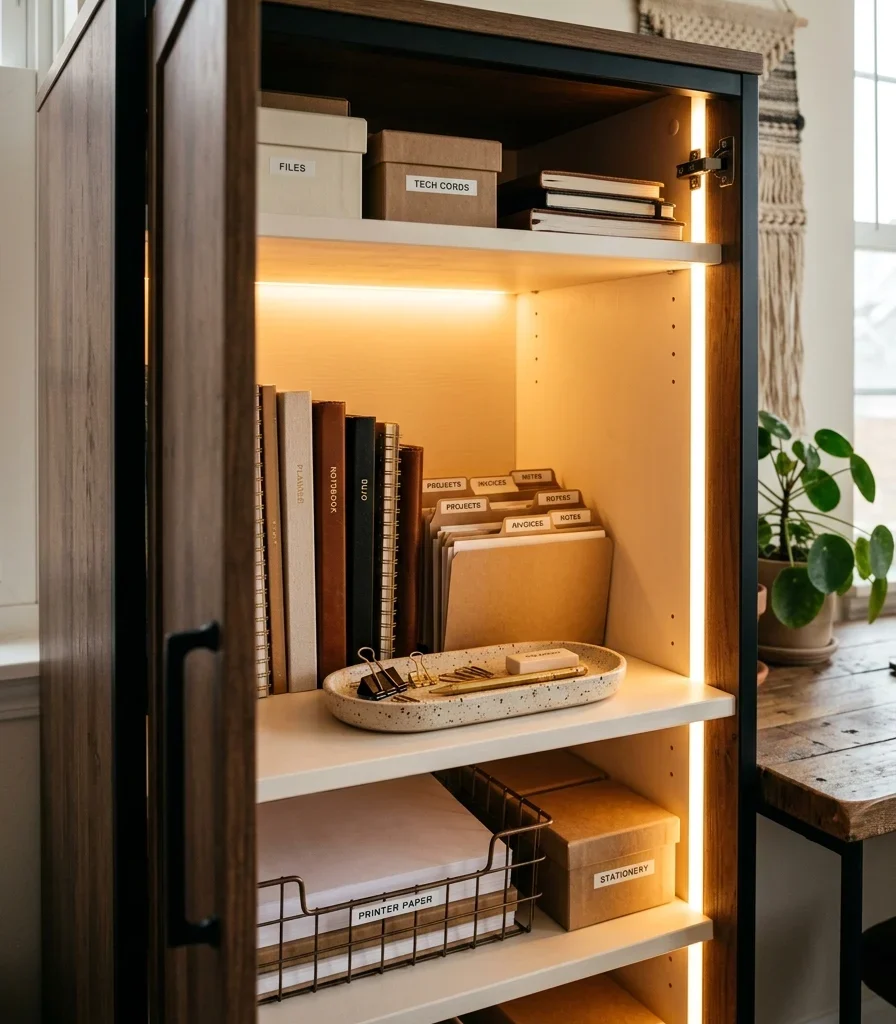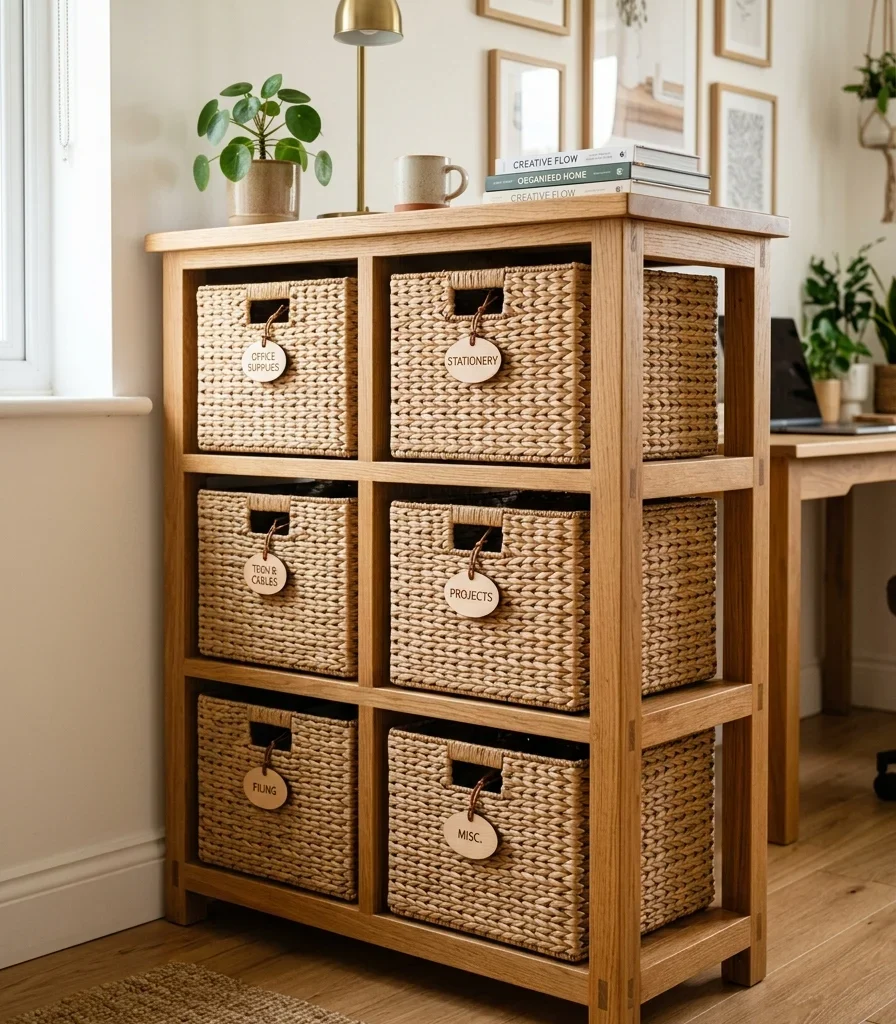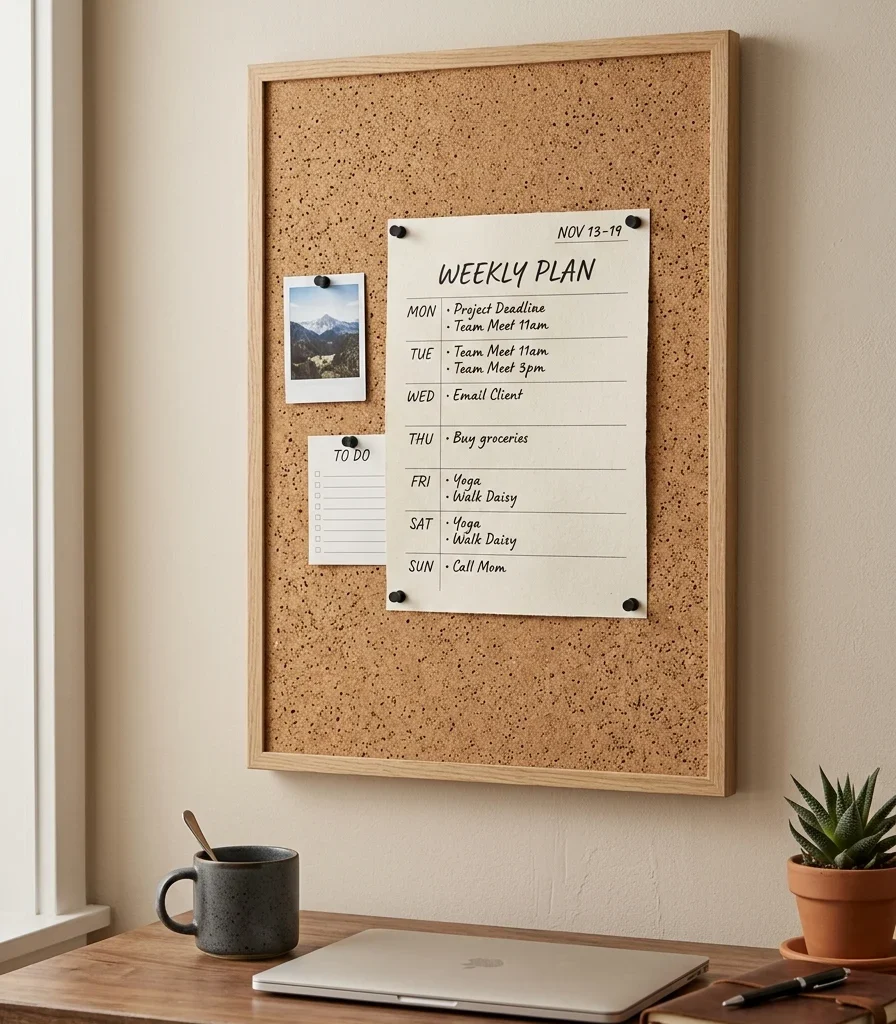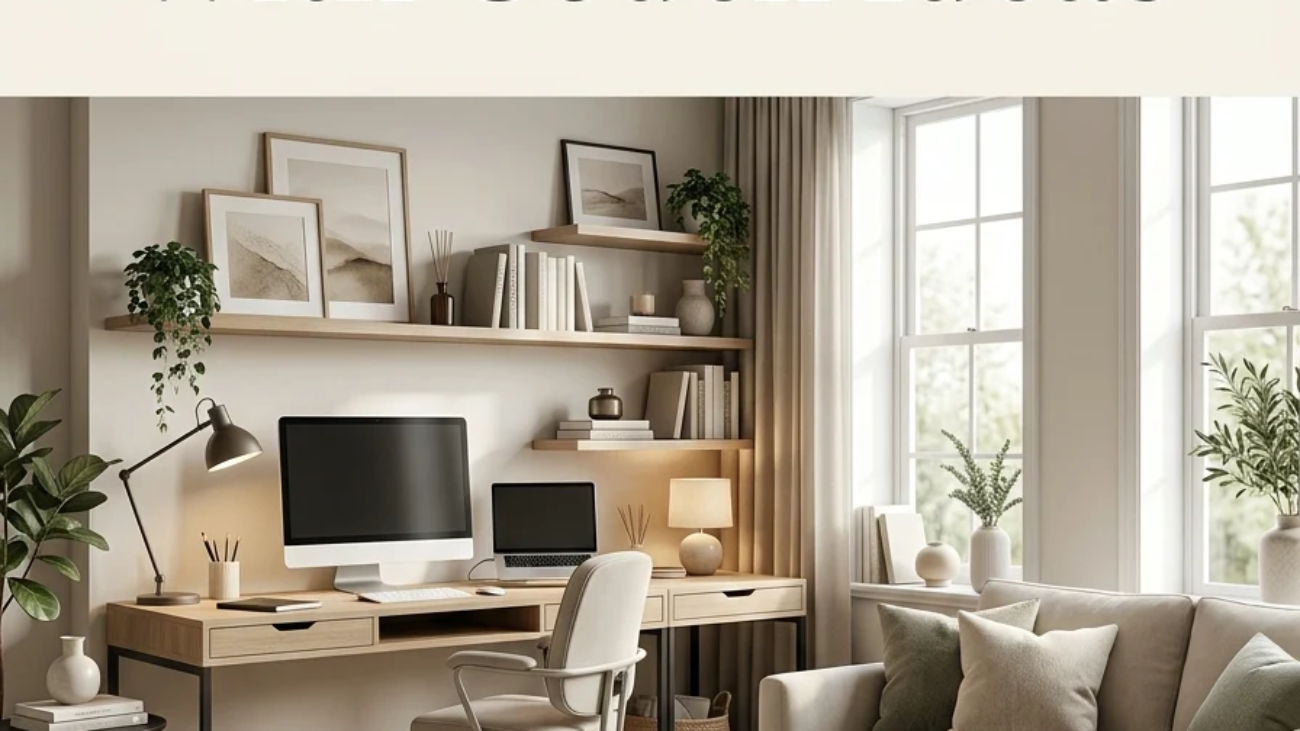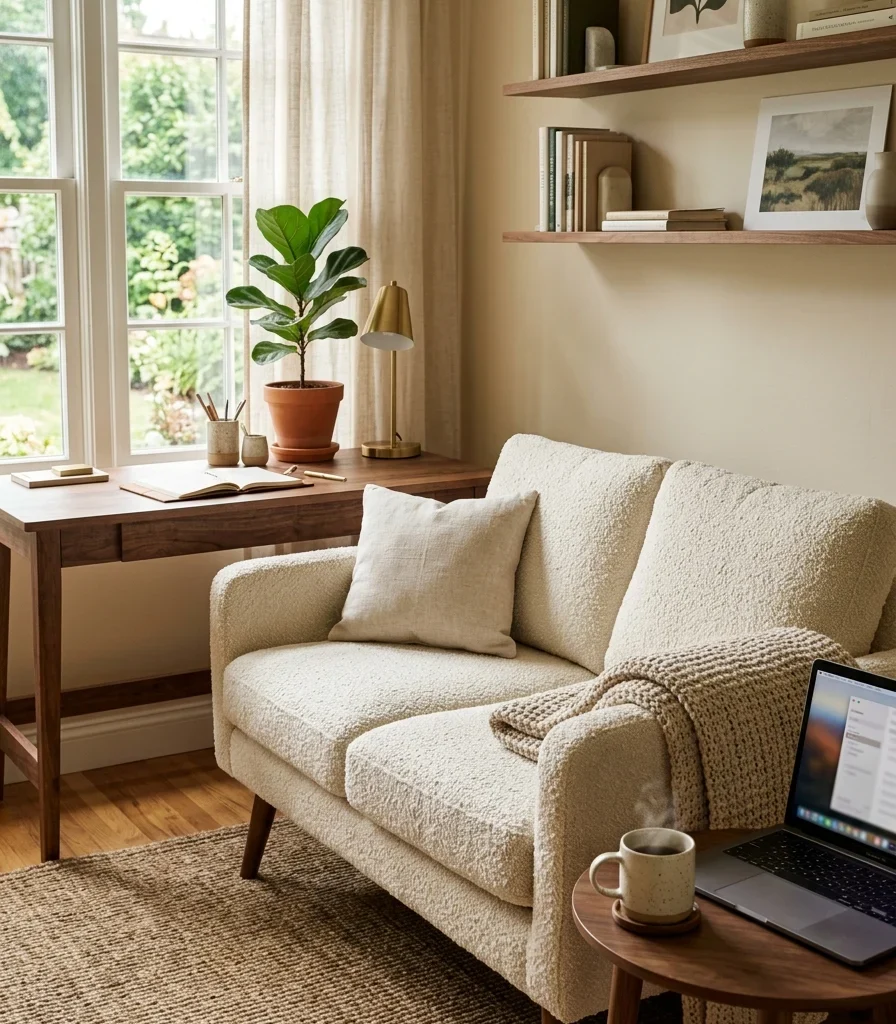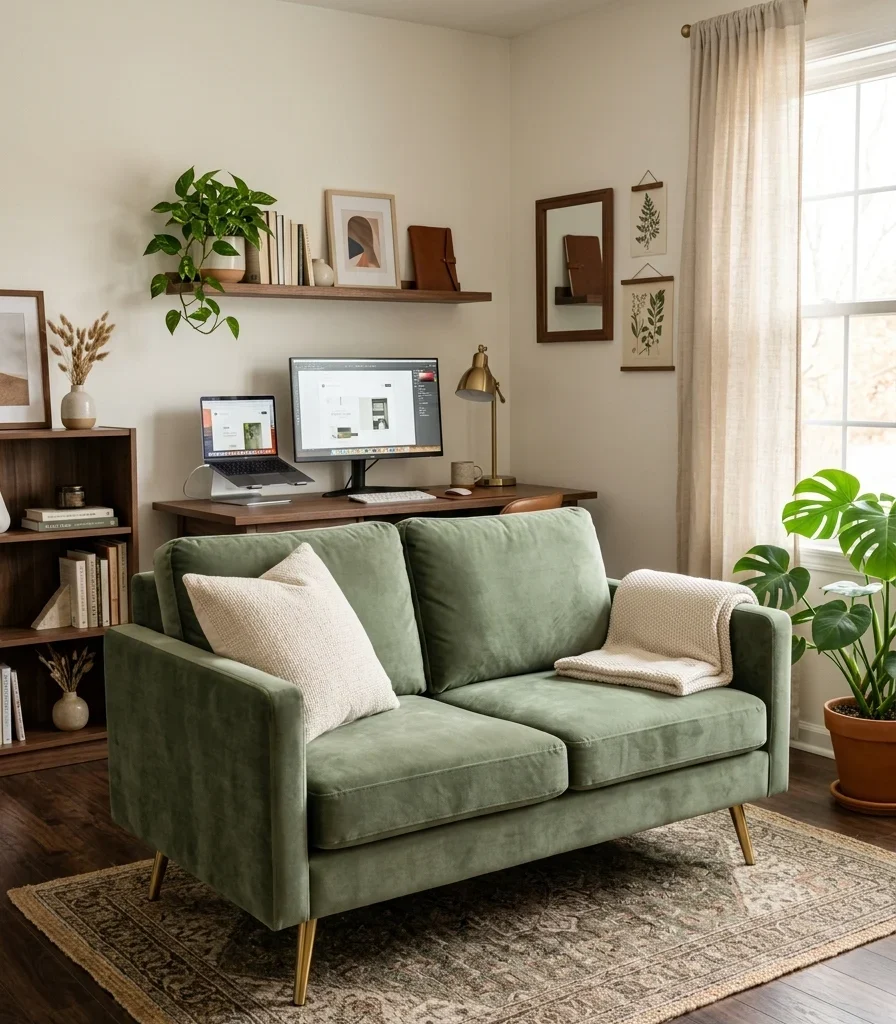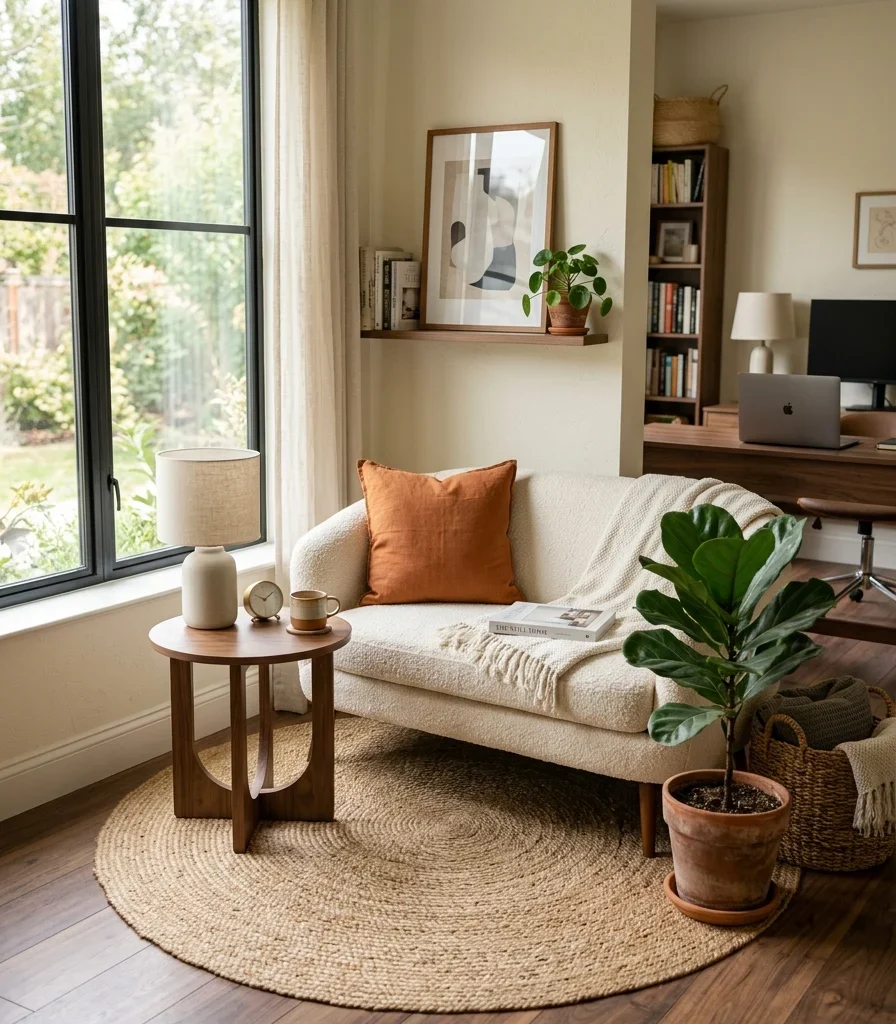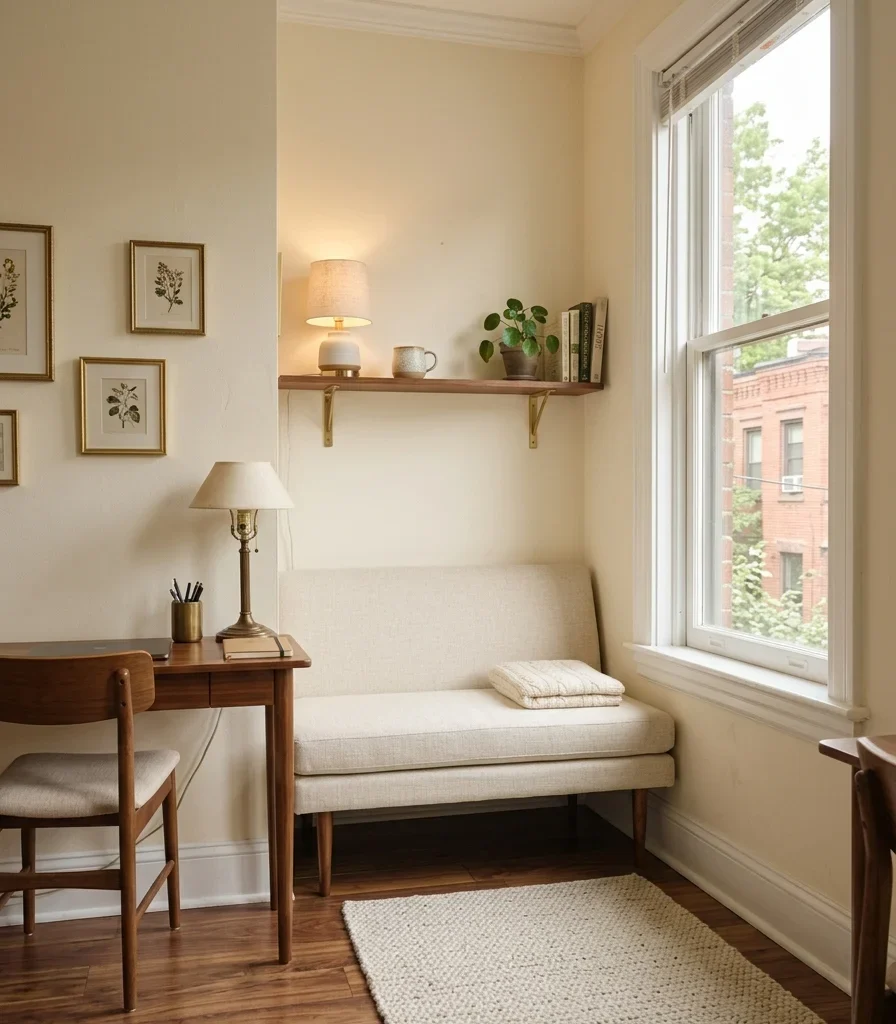
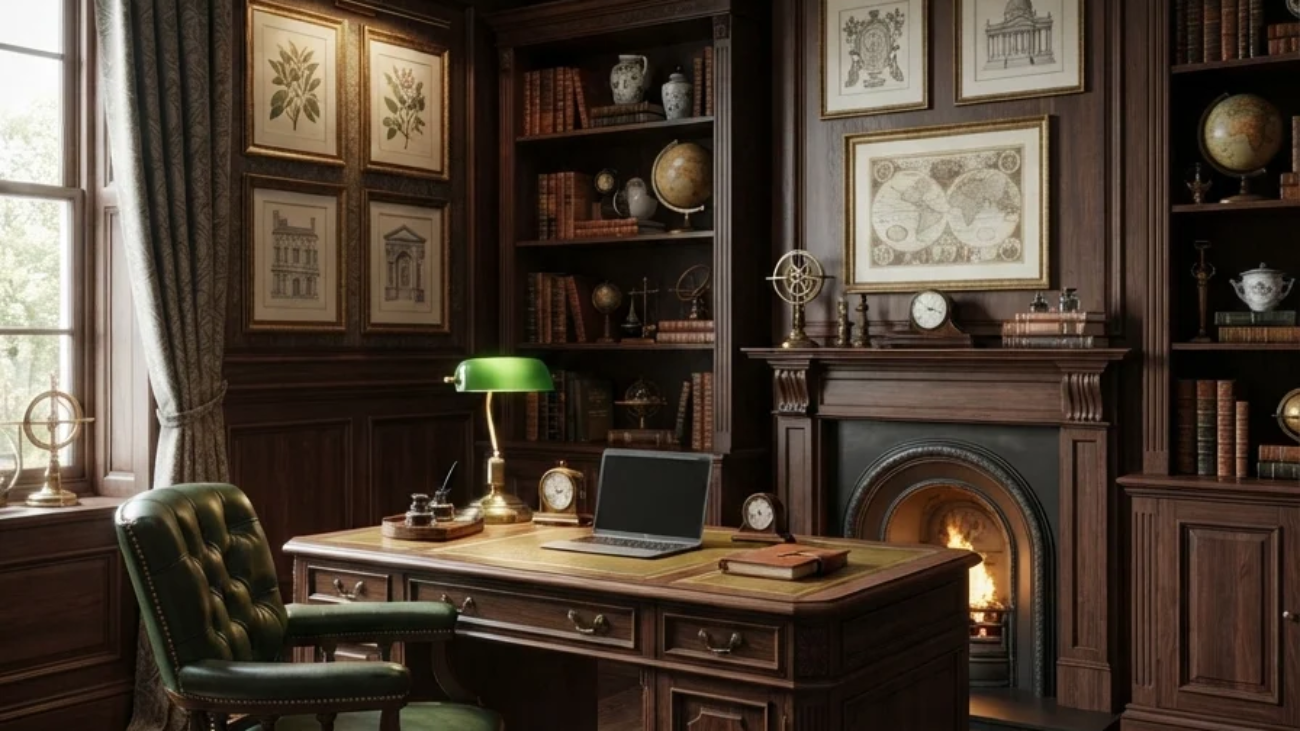
19 Victorian Style Home Office Ideas to Master the Art of Timeless Workspaces

19 Victorian Style Home Office Design Ideas

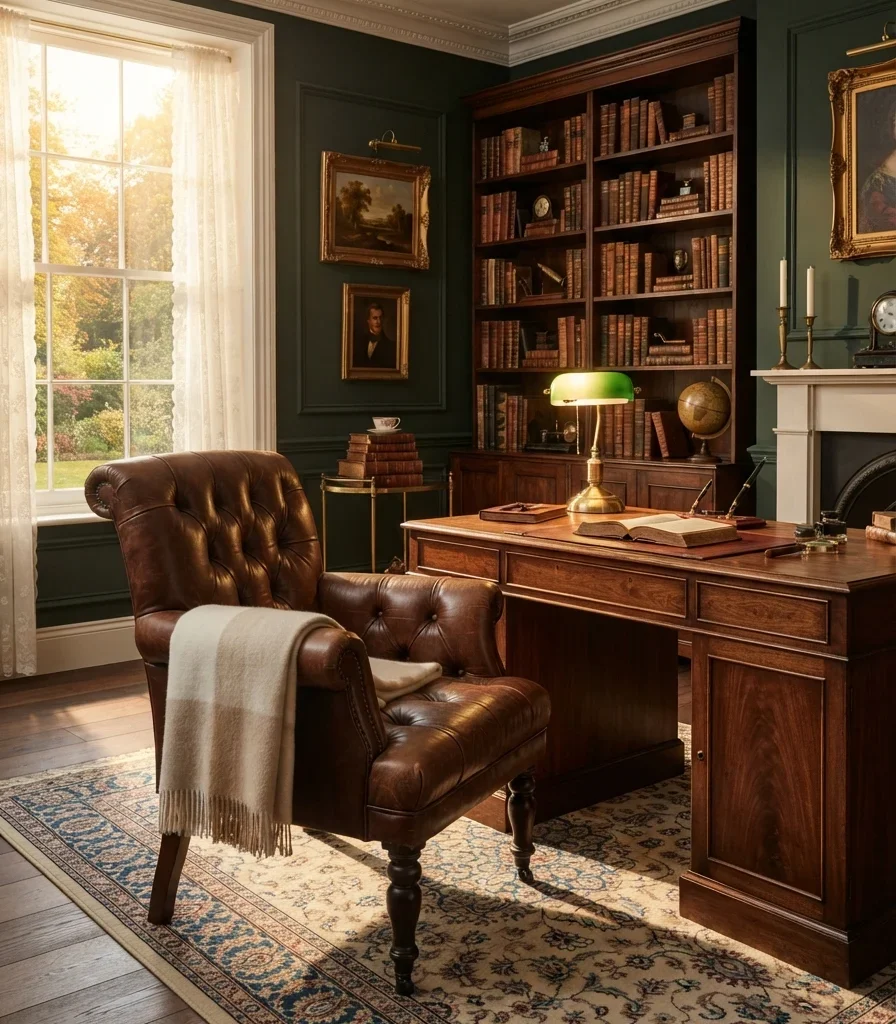
Victorian style home office design combines the ornate craftsmanship, rich materials, dramatic color, and layered atmosphere of 19th-century interiors with the practical requirements of modern work. These 19 Victorian-style home office ideas show you how to create a workspace with character through dark wood, period-inspired lighting, patterned walls, antique details, intelligent storage, and comfortable modern function.

The room should feel substantial when you enter it: warm timber beneath your hands, brass catching a low pool of lamplight, books rising toward the ceiling, and patterned walls giving the background enough depth to hold your attention. Victorian interiors were rarely visually empty, but their richness came from relationships between materials rather than from simply filling every surface. A modern office can borrow that richness while quietly hiding chargers, monitors, paperwork, and everyday clutter. The result feels scholarly, collected, and slightly atmospheric without becoming a theatrical reproduction of a Victorian parlor. Here are 19 ideas worth saving and stealing.

Why Victorian Style Home Office Works So Well

Victorian interior design developed during Queen Victoria’s reign from 1837 to 1901, absorbing Gothic Revival, Arts and Crafts precursors, industrial manufacturing, Orientalist influences, and historic European decorative traditions. The Victorian home office or study evolved alongside expanding literacy, clerical work, libraries, correspondence, and professional life, making the writing desk, bookcase, reading chair, and task lighting natural components of the period’s domestic interiors. Its defining quality is layered richness rather than one rigid furniture formula.

Core materials include dark-stained oak, walnut, mahogany, leather, wool, velvet, brass, cast iron, ceramic, glass, and patterned wallpaper. Useful colors include oxblood, bottle green, deep teal, tobacco brown, warm cream, charcoal, muted mustard, and burgundy. Pattern should feel historically plausible: small-scale botanical wallpaper, damask, paisley, herringbone, ticking, Persian-inspired rugs, and subtle stripes all work better than oversized contemporary graphics.

Style at a Glance

ElementVictorian Style Home Office
PhilosophyLayered craftsmanship, scholarship, warmth
Key MaterialsWalnut, oak, leather, brass, wool, velvet
Key ColorsOxblood, bottle green, tobacco, cream, deep teal

1. Make a Walnut Writing Desk the Hero
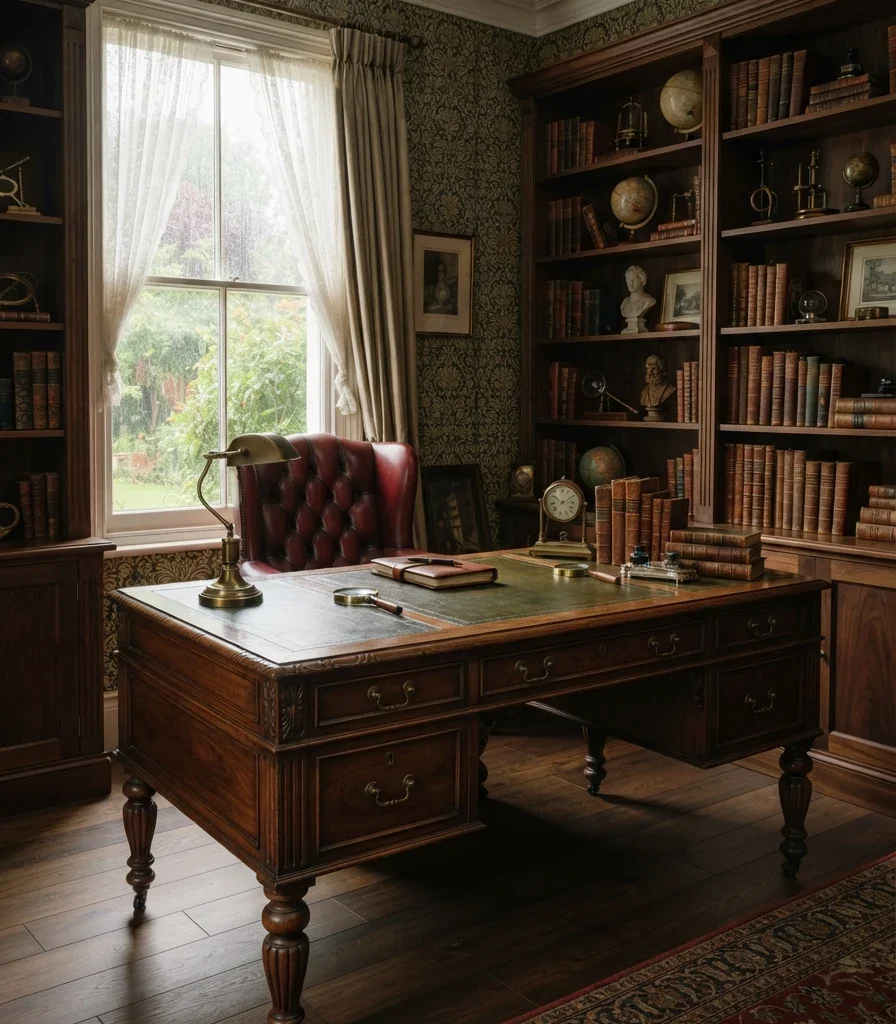
1. Make a Walnut Writing Desk the Hero

Vibe: Scholarly. The desk immediately establishes the room as a serious place for concentrated work.

Why it works: A Victorian writing desk relies on visual weight and craftsmanship rather than minimalist geometry. Dark walnut creates a deep anchor against patterned walls, while brass hardware introduces small points of reflection. The leather writing surface also adds material contrast, making the desk feel tactile rather than visually flat.

How to get it: Choose a desk with substantial legs, drawers, and a warm walnut or mahogany finish, then keep the desktop approximately 60% clear. A leather writing pad can supply the period character even when the underlying desk is contemporary.

đź’ˇ Quick Win: Add a dark brown leather desk mat and antique-brass drawer pulls to an existing wooden desk before replacing the furniture.

Shop The Look

ProductSearch on Amazon
Writing deskVictorian walnut writing desk with drawers
Leather desk matBrown full grain leather desk pad
Drawer pullsAntique brass furniture drawer pulls
Desk blotterDark green leather writing desk blotter
Pen trayVintage brass rectangular desk tray

2. Use Bottle Green as the Dominant Wall Color
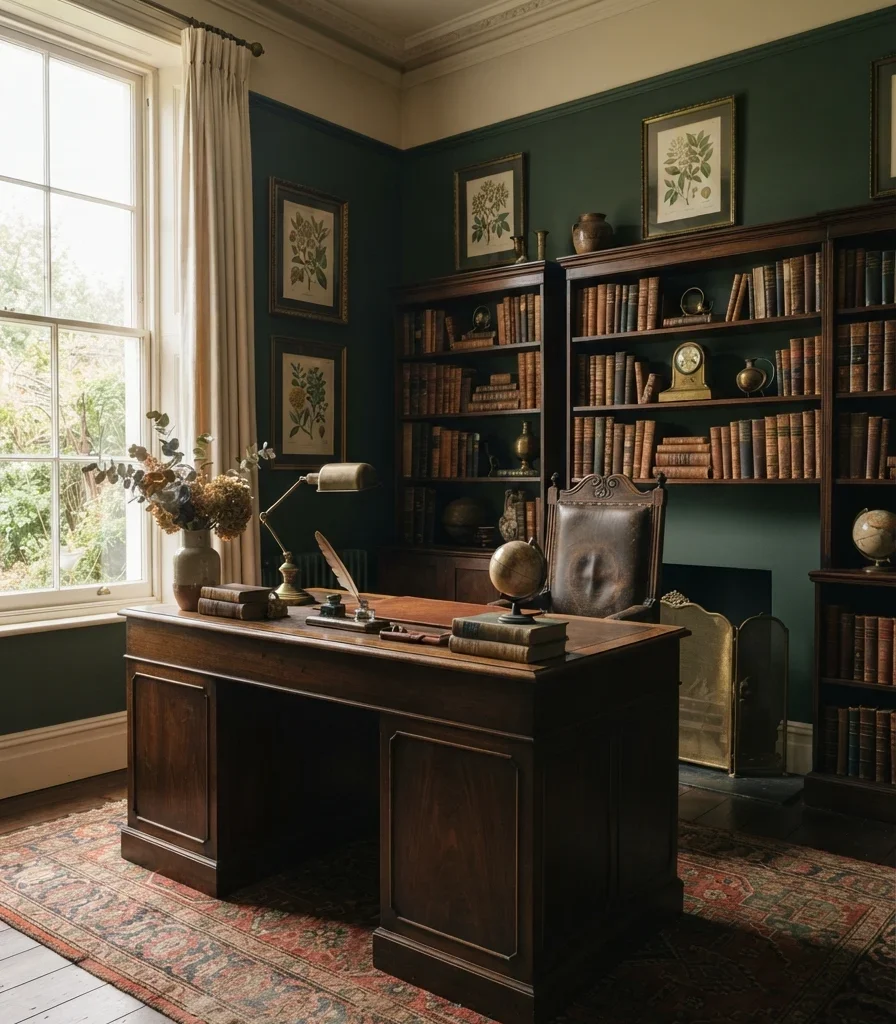
2. Use Bottle Green as the Dominant Wall Color

Vibe: Immersive. The walls create a cocooning background that encourages sustained attention.

Why it works: Deep green has enough visual weight to support dark Victorian timber while remaining connected to botanical and natural references. A matte finish absorbs rather than reflects excessive light, which helps brass, paper, and wood become the brighter points within the composition. Warm ivory on the ceiling prevents the darker palette from becoming visually compressed.

How to get it: Paint the four walls in a deep bottle or forest green with a low-sheen matte finish, then keep the trim one or two values lighter. If the room receives little daylight, use a slightly warmer green with a yellow or olive undertone.

Shop The Look

ProductSearch on Amazon
Wall paintDeep bottle green matte interior paint
Paint brush2-inch angled professional trim brush
Picture framesAntique brass vintage picture frames
Green curtainsDark forest green velvet curtain panels
Wall artVictorian botanical print set

3. Install a Traditional Brass Desk Lamp

3. Install a Traditional Brass Desk Lamp

Vibe: Luminous. The concentrated pool of warm light makes work feel deliberate.

Why it works: Victorian offices relied heavily on localized illumination, and a desk lamp continues that logic beautifully. The contrast between a dark room and a defined warm task zone creates visual hierarchy while reducing dependence on flat overhead lighting. Aged brass and green glass also echo traditional library fixtures without preventing modern LED performance.

How to get it: Choose an adjustable brass lamp with a weighted base and a green or cream glass shade. Use a warm 2700K bulb for evening work and position the lamp opposite your writing hand to reduce shadows across the desk.

Shop The Look

ProductSearch on Amazon
Desk lampAntique brass library desk lamp green glass shade
LED bulb2700K warm white dimmable LED bulb
Desk clockVintage brass mantel style desk clock
PaperweightAntique brass decorative paperweight
Ink potVintage glass and brass ink bottle

4. Build a Floor-to-Ceiling Library Wall
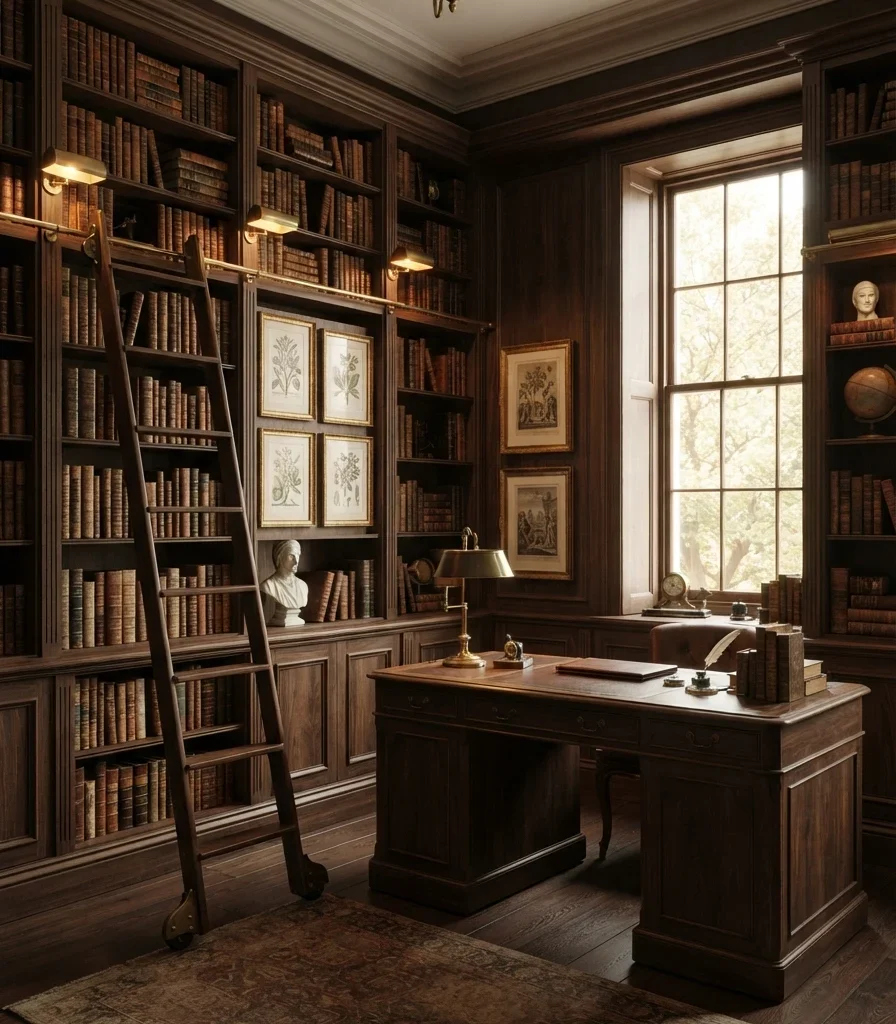
4. Build a Floor-to-Ceiling Library Wall

Vibe: Monumental vertical shelving gives the office the visual authority of a private library.

Why it works: Floor-to-ceiling storage uses vertical space while creating a strong architectural frame around the working area. Victorian interiors frequently treated bookshelves as architectural furniture, so the concept feels more authentic than scattering a few freestanding shelves around the room. Repeated dark timber also creates rhythm and visual continuity.

How to get it: Build or position shelving from floor to near-ceiling height and add a simple crown molding strip across the top. Keep the lower shelves for frequently used books and closed storage while reserving eye-level shelves for curated references and decorative objects.

Shop The Look

ProductSearch on Amazon
BookcaseTall dark walnut library bookcase
Shelf lightingWarm white rechargeable shelf lights
Library ladderRolling wooden library ladder decorative
BookendsAntique brass Victorian bookends
Crown moldingPaintable decorative crown molding strips

5. Introduce Dark Wood Through Smaller Furniture
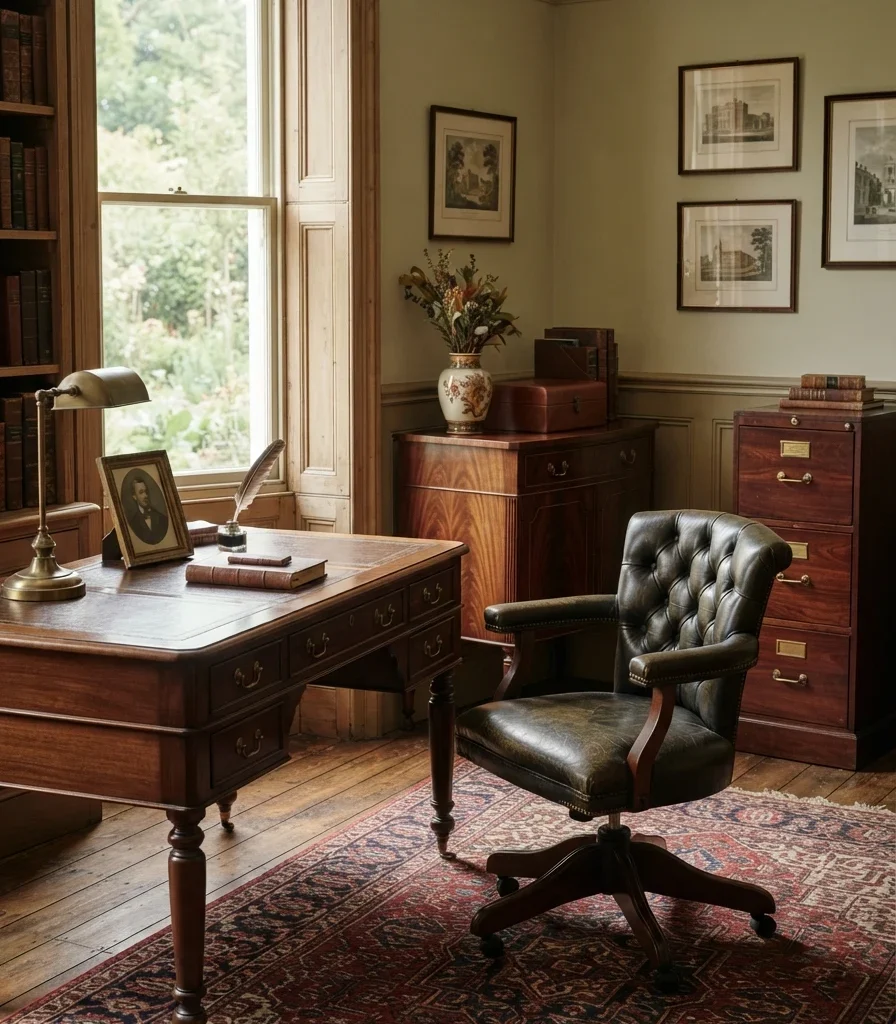
5. Introduce Dark Wood Through Smaller Furniture

Vibe: Grounded darker timber gives the room permanence without requiring oversized furniture.

Why it works: Victorian furniture depended heavily on wood as both structure and decoration, but using several related pieces at different scales creates a more believable composition than buying a matching suite. Mahogany, walnut, and dark-stained oak can coexist when their undertones are warm, and the finishes are not equally glossy.

How to get it: Introduce dark wood through one secondary cabinet, document chest, or side table instead of replacing every piece. Repeat the same wood tone in a smaller object so the materials feel connected without becoming identical.

đź’ˇ Quick Win: Replace a modern metal filing cabinet with a wood-effect document chest or add a walnut veneer top to an existing storage unit.

Shop The Look

ProductSearch on Amazon
Side cabinetMahogany Victorian style storage cabinet
Filing chestWooden antique style document filing chest
Desk pedestalDark walnut rolling file cabinet
Valet trayWalnut leather-lined catchall tray
Storage boxBrown faux leather document storage box

6. Hang Botanical Wallpaper Behind the Desk
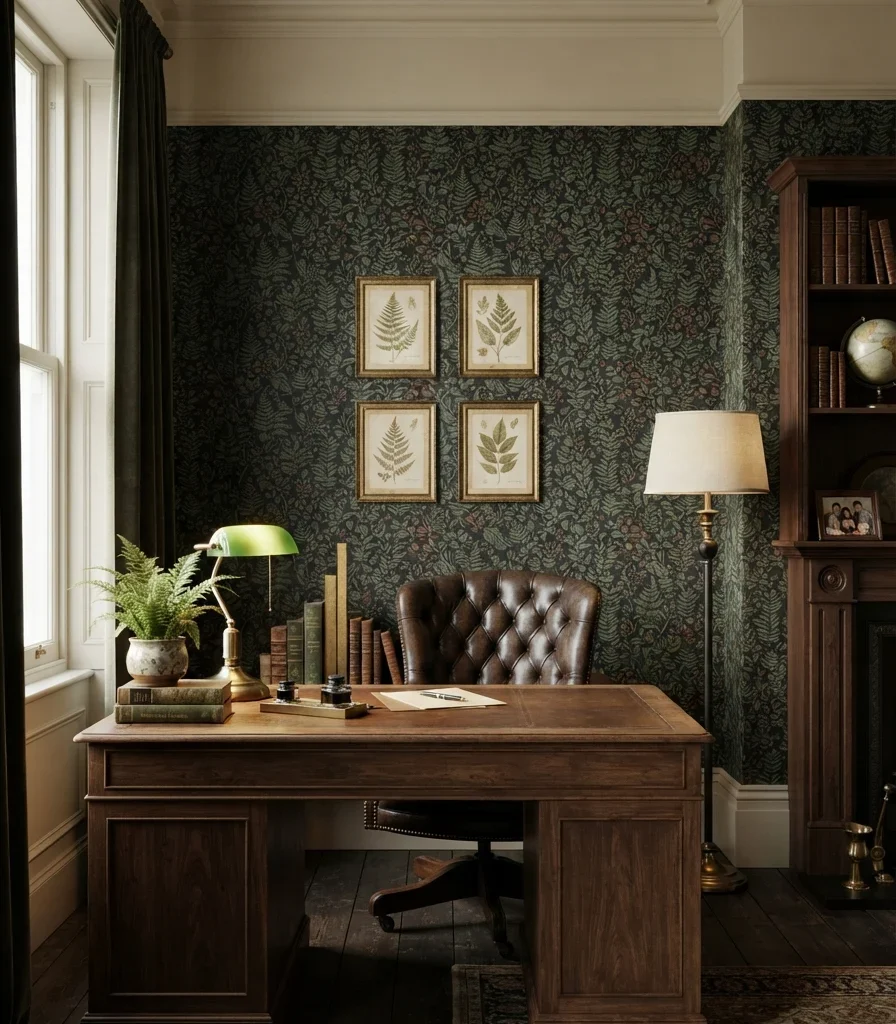
6. Hang Botanical Wallpaper Behind the Desk

Vibe: Layered; the wall becomes a textured visual field rather than a blank background.

Why it works: Victorian interiors embraced patterned wall surfaces, and botanical motifs provide historical context without requiring elaborate architectural changes. Small-scale patterns create rhythm while darker grounds visually recede, allowing the desk and artwork to sit forward. This is especially effective behind a desk because the wall acts as a deliberate backdrop for video calls and photographs.

How to get it: Select a small or medium botanical repeat rather than oversized leaves. Install it on one focal wall if the room is small, and keep the other walls painted in a related muted tone.

Shop The Look

ProductSearch on Amazon
WallpaperDark Victorian botanical peel and stick wallpaper
Wallpaper toolWallpaper smoothing tool and seam roller kit
Wallpaper pasteHeavy-duty removable wallpaper adhesive
Desk artVintage botanical engraving print
CurtainTobacco brown velvet curtain panel

7. Layer a Persian-Style Rug Under the Desk
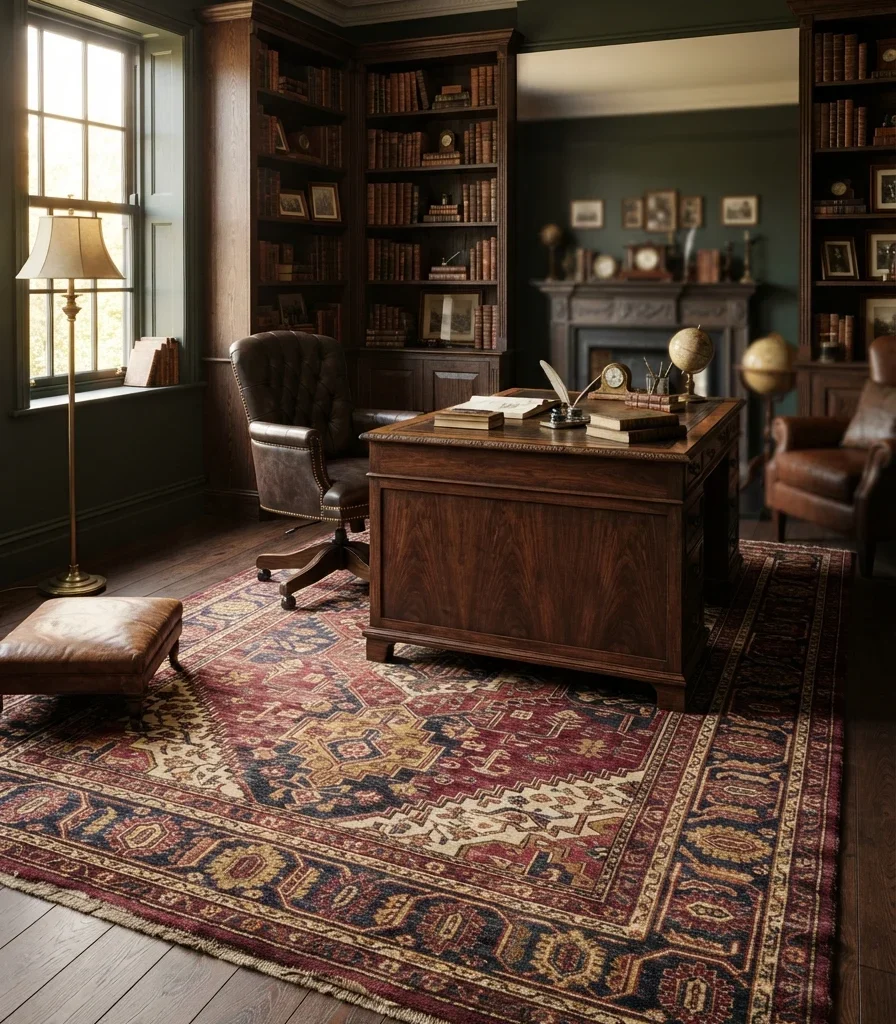
7. Layer a Persian-Style Rug Under the Desk

Vibe: Cushioned; the rug makes the workspace feel quieter and more substantial underfoot.

Why it works: Patterned rugs provide color complexity without requiring more wall decoration. A Persian-inspired design echoes the eclectic historic character of Victorian interiors, while wool contributes acoustic softness and tactile warmth. The rug also visually defines the working zone, especially in a larger room shared with a reading area.

How to get it: Choose a rug large enough for the desk chair to remain on its surface when pulled backward. Low-pile wool or washable vintage-style construction is easier to maintain than a thick shag in a rolling-chair workspace.

đź’ˇ Quick Win: If a large rug is too expensive, use a 5Ă—7 vintage-style rug under the desk and chair rather than leaving the entire work zone visually undefined.

Shop The Look

ProductSearch on Amazon
Area rug6×9 Persian vintage wool style office rug
Rug padLow-profile non-slip rug pad
Chair matClear office chair mat for low pile rug
FootstoolLeather Victorian style footstool
Rug brushCarpet and upholstery cleaning brush

8. Choose a Leather Library Chair

8. Choose a Leather Library Chair

Vibe: Substantial; the chair gives the office a comfortable seat with unmistakable visual weight.

Why it works: Leather and dark timber are naturally compatible because both develop patina with use. A tufted or traditionally shaped chair adds vertical and tactile interest, but modern ergonomic support should still be prioritized for long working sessions. Victorian appearance does not require sacrificing lumbar comfort or adjustable seating.

How to get it: Look for a leather chair with a supportive back, seat depth appropriate to your body, and a firm cushion. If the chair is primarily decorative, place it in a reading zone and use a more ergonomic desk chair for extended computer work.

Shop The Look

ProductSearch on Amazon
Office chairBrown leather Victorian library office chair
Lumbar cushionDark brown leather lumbar support cushion
FootrestWalnut wood ergonomic office footrest
ThrowOxblood wool throw blanket
Side tableSmall antique brass round side table

9. Use Warm Cream to Balance Dark Victorian Colors
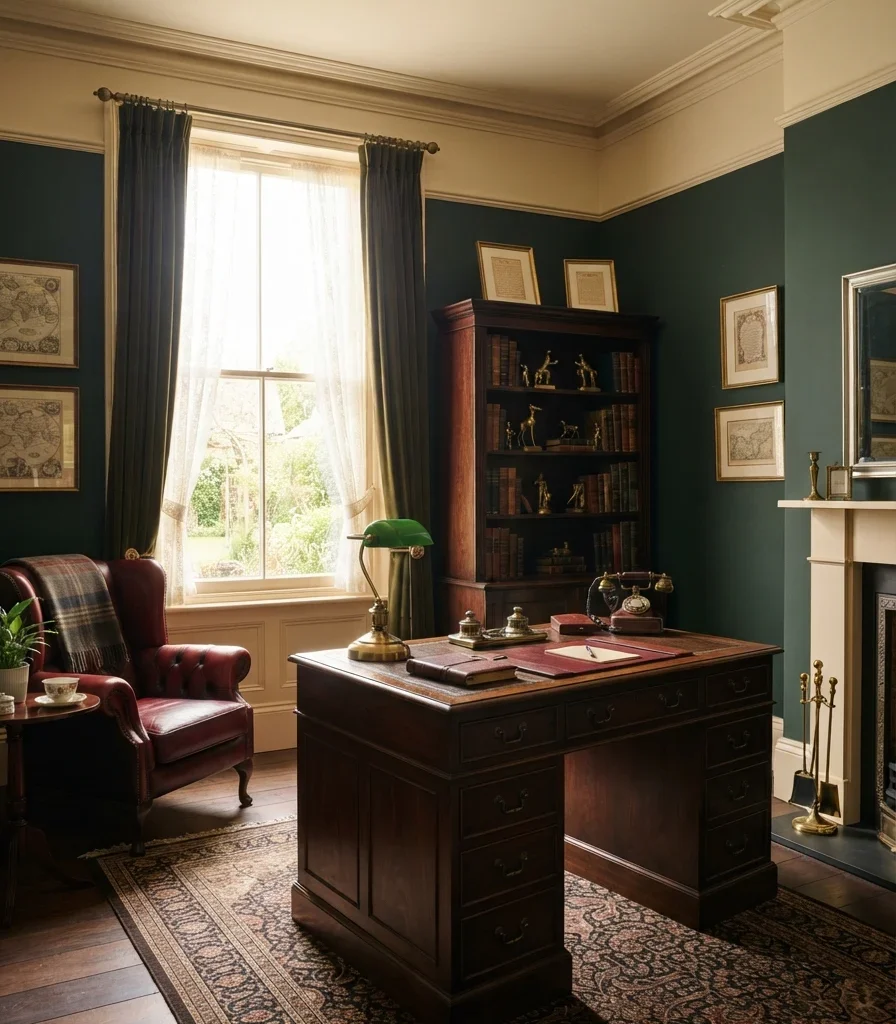
9. Use Warm Cream to Balance Dark Victorian Colors

Vibe: Balanced ale architectural surfaces prevent the darker palette from becoming oppressive.

Why it works: Dark Victorian colors become easier to live with when a lighter value interrupts them. Warm cream is more historically compatible with dark wood than stark optical white because its yellow-beige undertone relates to aged paper, plaster, and natural textiles. This contrast also improves daylight reflection without removing the room’s atmosphere.

How to get it: Use warm cream on the ceiling, door, and window trim while allowing the primary walls to remain darker. Avoid cool gray-white trim because the blue undertone can make walnut and brass appear muddy.

Shop The Look

ProductSearch on Amazon
Cream paintWarm ivory cream matte interior paint
Trim brushFine angled sash paint brush
Wall artAntique parchment botanical wall art
CurtainsCream linen velvet blend curtains
Lamp shadeWarm ivory pleated fabric lamp shade

10. Add an Antique-Style Brass Chandelier
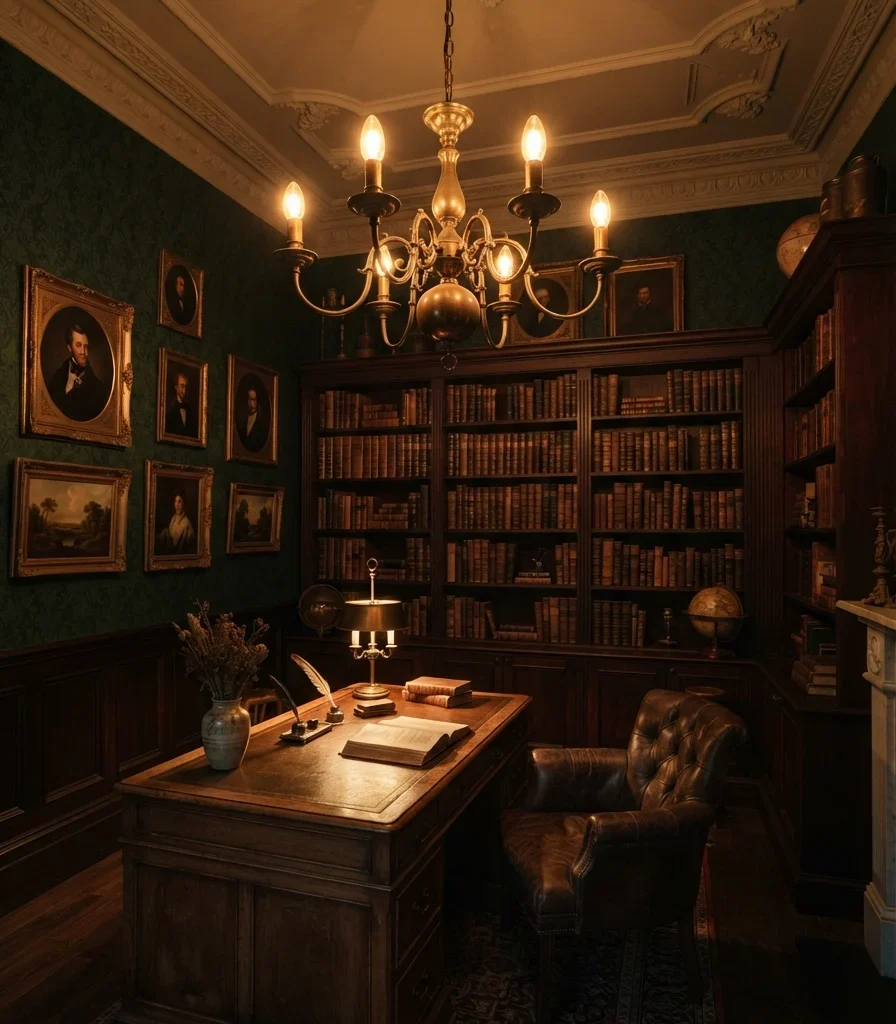
10. Add an Antique-Style Brass Chandelier

Vibe: Dramatic ceiling becomes part of the room’s composition rather than an afterthought.

Why it works: A central chandelier supplies ambient illumination while also establishing a strong period-inspired silhouette. Curved brass arms soften the vertical geometry of bookcases and desks, while multiple low-output bulbs distribute warm light more evenly than one harsh overhead fixture. The fixture should support the room rather than visually dominate it.

How to get it: Choose a chandelier scaled to the room’s dimensions and hang it so it does not interfere with standing or shelving. Six small warm bulbs are generally more convincing than a few oversized exposed bulbs.

đź’ˇ Quick Win: A plug-in swag chandelier can create the visual effect in a rental without immediately rewiring the ceiling.

Shop The Look

ProductSearch on Amazon
ChandelierAntique brass Victorian six-light chandelier
BulbsWarm amber filament LED chandelier bulbs
Ceiling hookDecorative brass ceiling hanging hook
DimmerLED compatible antique style wall dimmer
Ceiling medallionVictorian decorative ceiling medallion

11. Display Framed Engravings Instead of Generic Art

11. Display Framed Engravings Instead of Generic Art

Vibe: A curious wall invites the eye to stop, inspect, and discover.

Why it works: Victorian interiors frequently used collections of pictures, prints, scientific illustrations, and personal objects to express intellectual interests. A salon-style arrangement creates visual density while giving that density a clear structure. Repeating walnut and brass frames prevents a collection of different images from looking chaotic.

How to get it: Choose one subject – family, botany maps, architecture, or natural history- and vary the frame sizes rather than mixing unrelated decorative posters. Lay the arrangement on the floor first, keeping roughly 5–8 cm between neighboring frames.

Shop The Look

ProductSearch on Amazon
EngravingsVictorian botanical engraving print set
MapAntique world map vintage reproduction
FramesDark walnut picture frames assorted sizes
Brass frameAntique brass 5×7 picture frame
Hanging kitProfessional picture hanging wire and hooks

12. Hide Modern Technology Inside Period-Inspired Storage

12. Hide Modern Technology Inside Period-Inspired Storage

Vibe: Discreet modern technology disappears without compromising everyday accessibility.

Why it works: Period-inspired interiors can look visually inconsistent when black chargers, power strips, and tangled cables dominate the desk. Containment reduces visual noise while keeping technology functional. A wood cable box or leather document case connects practical office equipment to the room’s established material language.

How to get it: Route charging cables through a rear desk grommet and place a ventilated power strip inside a walnut cable-management box. Reserve one drawer for small electronics so the desktop remains visually quiet at the end of the workday.

Shop The Look

ProductSearch on Amazon
Cable boxWalnut wood cable management box
Charging stationWooden desktop charging station organizer
Document boxBrown leather document storage box
Desk grommetBrass cable management desk grommet
Cable clipsAntique brass adhesive cable clips

13. Create a Separate Reading and Research Zone
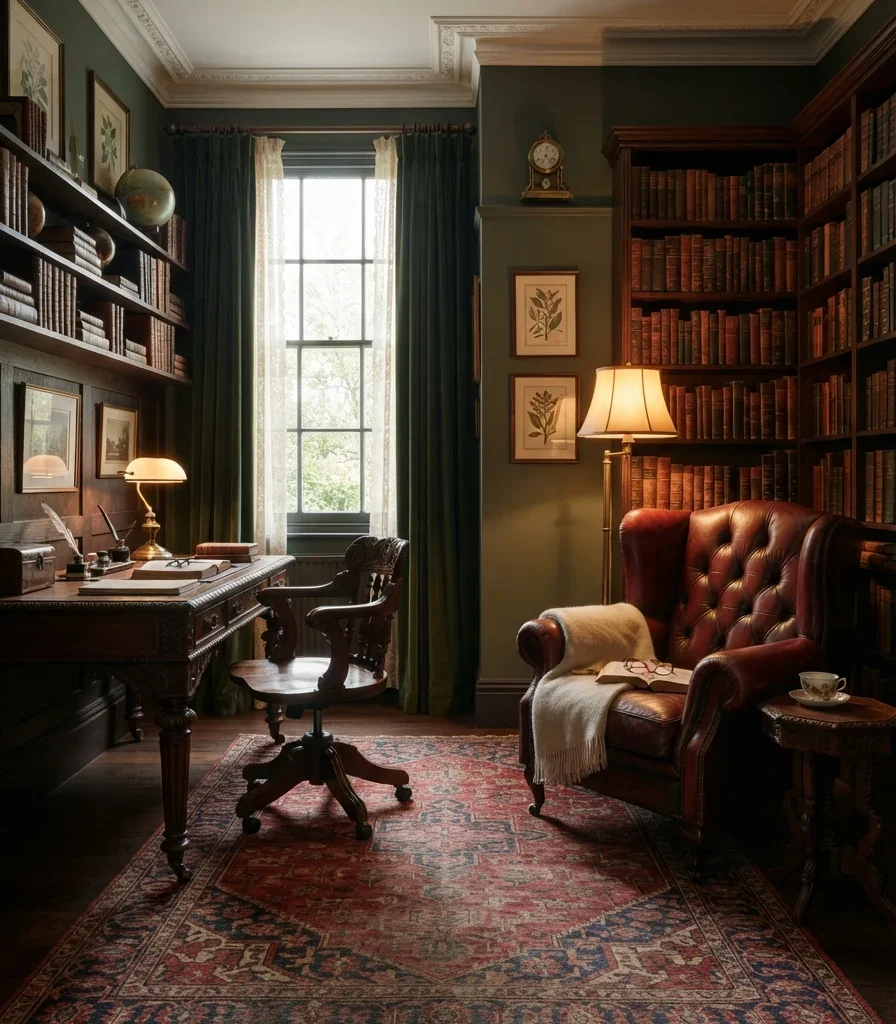
13. Create a Separate Reading and Research Zone

Vibe: Focused; each part of the room has a clear purpose without feeling divided.

Why it works: Zoning prevents a large office from becoming one undifferentiated collection of furniture. The desk supports computer and writing work, while the chair provides a distinct environment for reading, reviewing documents, or taking breaks. A shared rug or consistent wood tone visually connects the zones.

How to get it: Keep the desk perpendicular to the reading chair when possible, allowing each area to face a different visual direction. Use a floor lamp to define the reading zone rather than adding another ceiling fixture.

Shop The Look

ProductSearch on Amazon
Floor lampAntique brass Victorian library floor lamp
Reading chairTufted brown leather reading armchair
Side tableRound dark walnut occasional table
OttomanLeather Victorian footstool ottoman
Book basketWoven leather handle book storage basket

14. Use Vertical Storage in a Narrow Office

14. Use Vertical Storage in a Narrow Office

Vibe: Vertical; the eye travels upward, making the narrow room feel taller rather than crowded.

Why it works: A narrow Victorian-style office benefits from using wall height instead of floor depth. Tall shelves replicate the architectural presence of traditional libraries while keeping the center of the room open. Closed storage is especially important because exposed paperwork quickly destroys the visual calm created by the period-inspired palette.

How to get it: Use shelving no deeper than necessary for books and office files, ideally around 25–30 cm for standard paperbacks. Paint the shelving the same color as the wall so it reads as built-in architecture rather than a separate bulky object.

đź’ˇ Quick Win: Add two tall narrow bookcases rather than one wide unit and connect their tops with a painted molding strip for a built-in appearance.

Shop The Look

ProductSearch on Amazon
Narrow bookcaseTall narrow dark wood bookcase 12 inch deep
Storage boxesVintage brown document storage boxes
Shelf basketsDark woven rectangular office baskets
LabelsKraft archival storage box label tags
Wall sconcePlug-in antique brass library wall sconce

15. Add Velvet Through One Controlled Accent

15. Add Velvet Through One Controlled Accent

Vibe: Plush. One tactile accent introduces richness without turning the room into visual excess.

Why it works: Velvet has strong light-catching variation, so using it on multiple surfaces can quickly become overwhelming. One oxblood chair creates a concentrated color and texture moment against matte green walls and dark wood. The contrast is particularly effective because oxblood sits comfortably within the traditional Victorian palette while adding warmth.

How to get it: Choose velvet for one chair, footstool, or small bench rather than curtains and upholstery simultaneously. Use a medium or deep oxblood with a slightly brown undertone instead of bright red.

Shop The Look

ProductSearch on Amazon
Velvet chairOxblood burgundy velvet Victorian accent chair
CushionDark green velvet lumbar cushion
ThrowTobacco brown wool throw blanket
Side tableAntique brass drink table round
Curtain tiebacksBurgundy velvet rope curtain tiebacks

16. Use a Gallery-Style Desk Wall for Visual Focus
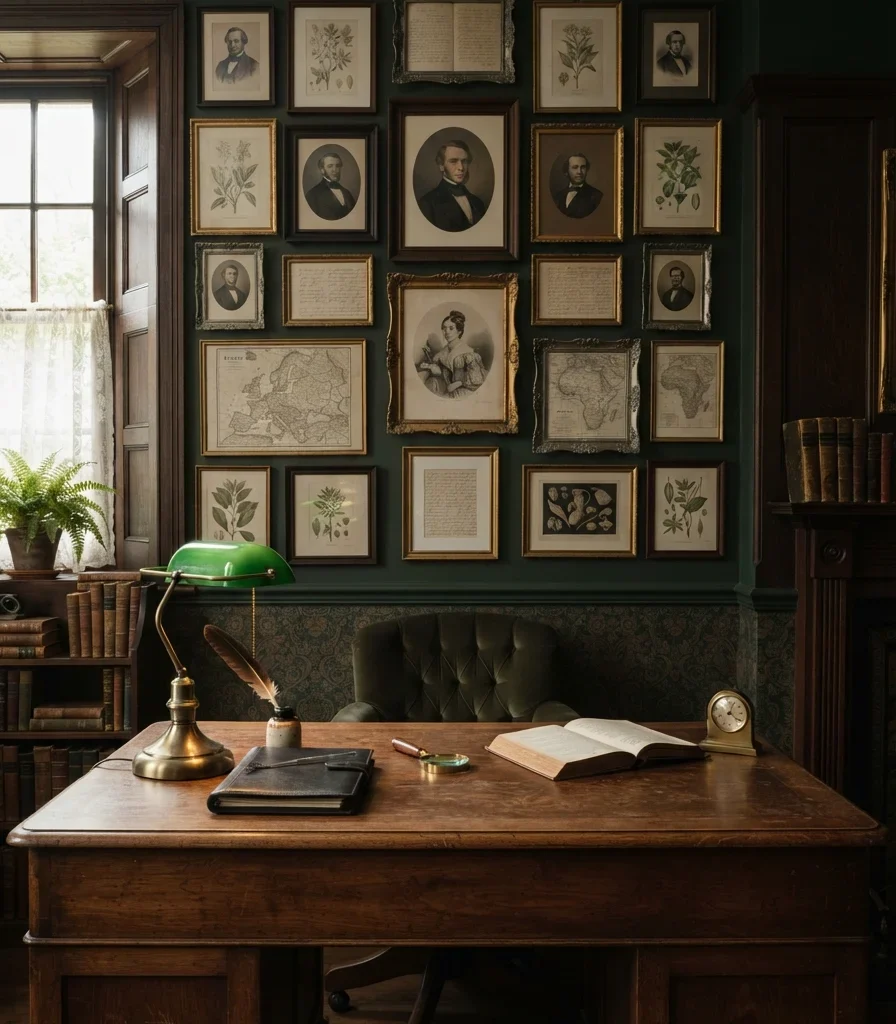
16. Use a Gallery-Style Desk Wall for Visual Focus

Vibe: Intentional; the desk feels anchored by a wall designed specifically for it.

Why it works: A gallery wall behind the desk creates a strong visual endpoint, especially when the desk is viewed from the doorway. Victorian composition benefits from repetition, framing, and collected imagery, but the arrangement still needs negative space. A consistent frame material establishes order while artwork size provides variation.

How to get it: Start with the largest central print and build outward using pairs of smaller frames. Keep the bottom edge of the arrangement approximately 20–30 cm above the desk so the artwork feels connected to the workspace rather than floating independently.

Shop The Look

ProductSearch on Amazon
Gallery printsAntique Victorian portrait and botanical print set
FramesDark wood gallery picture frame assortment
Desk lampTraditional bronze library desk lamp
FolioBrown leather document portfolio
Pen cupAntique brass and ceramic pen holder

17. Warm the Room With a Brass and Glass Library Light
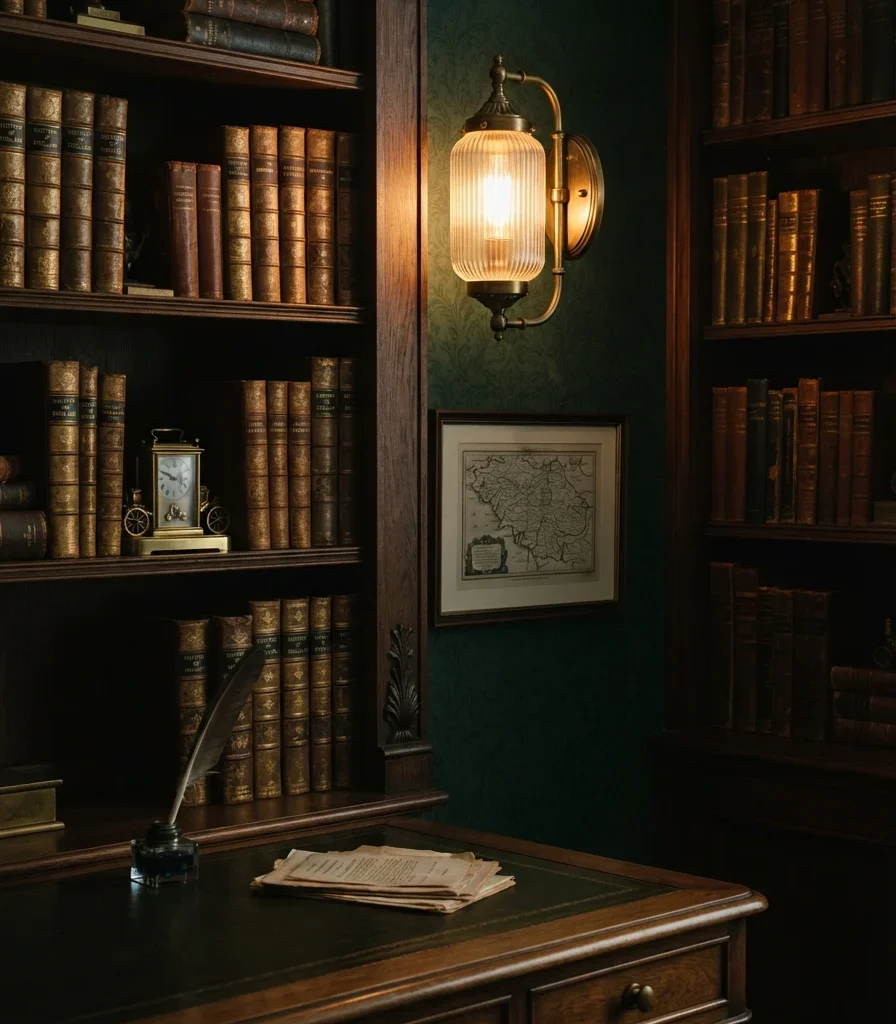
17. Warm the Room With a Brass and Glass Library Light

Vibe: Atmospheric. The bookcase glows like a private library after sunset.

Why it works: Lighting bookshelves from above or beside them creates depth because the illumination catches book spines, frame edges, and timber grain at different levels. Brass and glass fixtures also reinforce Victorian material language without requiring elaborate chandeliers. A warm 2700K source keeps the light compatible with walnut and oxblood.

How to get it: Install a small wall-mounted picture or library light above the most important bookcase rather than illuminating every shelf equally. Use one focused pool of light to create hierarchy and prevent the room from becoming uniformly bright.

đź’ˇ Quick Win: A rechargeable picture light above a bookshelf can create the same layered effect without electrical installation.

Shop The Look

ProductSearch on Amazon
Library lightAged brass picture light with glass shade
Rechargeable lightWarm rechargeable picture light brass
Bulbs2700K warm white LED bulbs small base
BookendsBrass Victorian architectural bookends
Shelf decorAntique brass miniature globe

18. Finish a Compact Desk With Period-Inspired Accessories
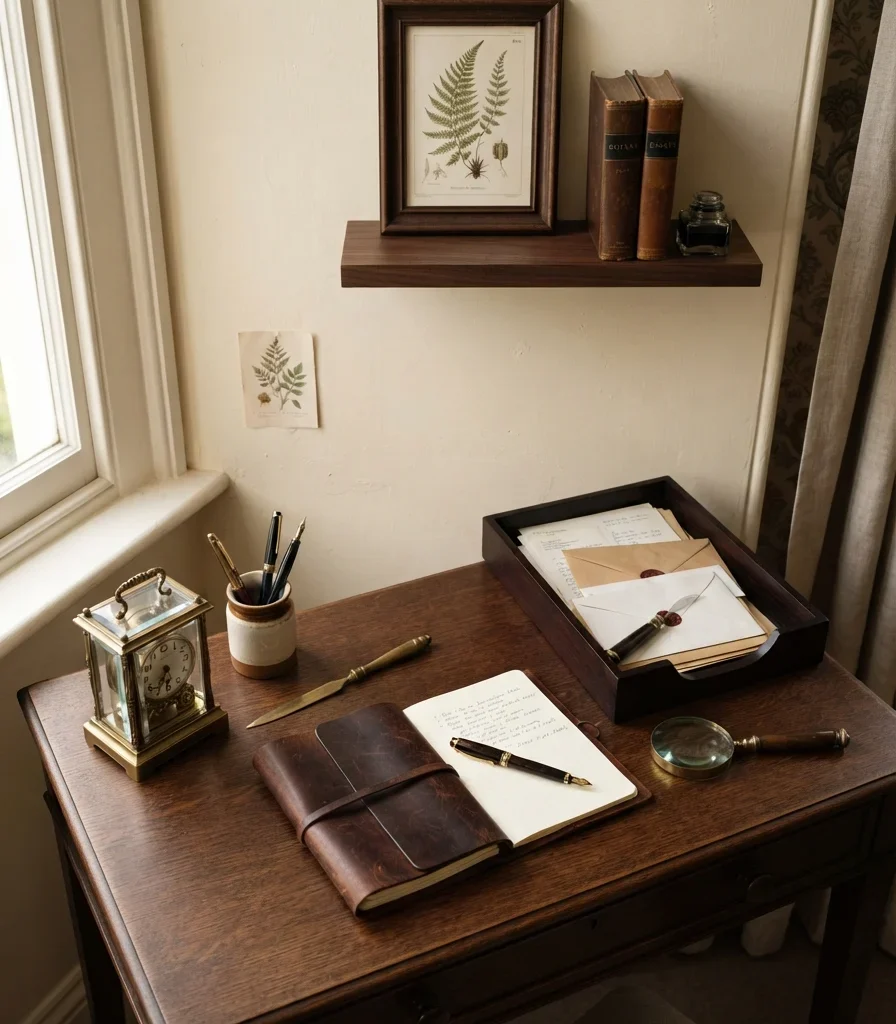
18. Finish a Compact Desk With Period-Inspired Accessories

Vibe: Precise small details make the desk feel purposeful rather than merely decorated.

Why it works: Victorian studies often contained specialized writing objects, correspondence tools, books, and personal artifacts, so functional accessories are particularly appropriate to the style. The key principle is curation: a small desk benefits from fewer substantial objects rather than a crowded collection of miniature decorations. Brass, leather, ceramic, and walnut provide enough material variation without needing bright color.

How to get it: Limit the working desktop to five visible categories: writing instrument, notebook, document tray, lamp, and one personal object. Store everything else in drawers or a nearby cabinet so the desk remains usable.

Shop The Look

ProductSearch on Amazon
Letter openerAntique brass vintage letter opener
NotebookBrown leather refillable writing journal
Pen holderCeramic Victorian style pen holder
Document trayWalnut wooden letter document tray
Magnifying glassBrass handle vintage magnifying glass

19. Balance the Richness With Deliberate Negative Space

19. Balance the Richness With Deliberate Negative Space

Vibe: Restful; the room feels rich without asking the eye to process everything simultaneously.

Why it works: Victorian interiors can become visually heavy when every wall, shelf, and surface is filled. Negative space gives the eye somewhere to pause and makes the remaining materials appear more substantial. The contrast between decorated zones and intentionally quiet surfaces is what keeps historical richness from becoming clutter.

How to get it: After styling the office, remove approximately 10–20% of the decorative objects and reassess the room from the doorway. Leave one wall, floor section, or shelf group relatively quiet so the most important elements- desk, books, artwork, and lighting- retain visual priority.

đź’ˇ Quick Win: Before buying anything else, remove five small decorative objects from the office and photograph the room again; the comparison usually reveals which pieces actually contribute to the composition.

Shop The Look

ProductSearch on Amazon
Brass clockAntique brass round desk clock
Ceramic vaseTraditional cream ceramic bud vase
Leather portfolioDark brown leather writing portfolio
Book stackVintage style decorative antique books
Wool throwForest green wool blend office throw

How to Start Your Victorian Style Home Office Transformation

Start with one dark walnut writing desk. It is the functional and visual anchor of a Victorian office, giving you a clear material direction for the chair, shelving, lighting, hardware, and accessories. Once the desk is established, choose supporting pieces that repeat its warm brown undertone rather than trying to coordinate every item as an identical furniture set.

The most common mistake is making every surface dark. Walnut furniture, black-green walls, dark curtains, black shelving, and an almost-black rug can eliminate the tonal variation that makes a Victorian room feel rich. Keep at least one major light value- warm cream ceiling, linen curtains, parchment artwork, or lighter rug- to create contrast and preserve depth.

Three inexpensive entry points can make an immediate difference: an antique-brass desk lamp, a brown leather desk mat, and a small Victorian botanical print in a dark wood frame, each often available for under $50. They introduce the style’s key language without requiring construction or major furniture purchases.
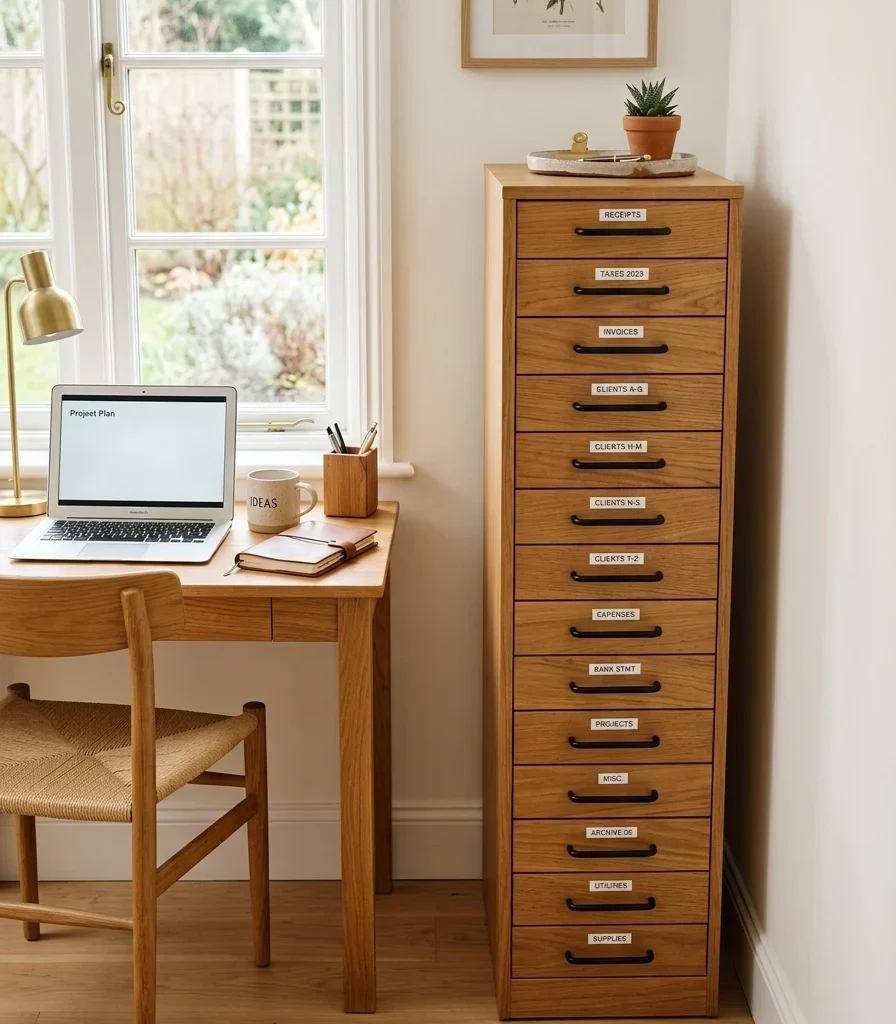
A starter transformation can happen over one weekend for roughly $200–$600. A fuller office with wallpaper, substantial shelving, quality lighting, rug, desk, and chair can realistically reach $1,000–$4,000+, while custom millwork or genuine antique furniture can take several months to source and significantly increase the budget.

Frequently Asked Questions About Victorian Style Home Office

What is a Victorian style home office and how is it different from a traditional office?

A Victorian style home office draws from 19th-century British interiors through dark timber, patterned walls, leather, brass, books, traditional lighting, and layered decorative objects. A generic traditional office may use similar furniture but does not necessarily follow the Victorian period’s stronger preference for material richness and historical pattern. The Victorian version is usually more atmospheric and visually layered.

Which colors work best in a Victorian home office?

Bottle green, oxblood, deep teal, tobacco brown, warm cream, and muted mustard are particularly effective. Deep green is one of the easiest starting colors because it complements walnut, brass, and leather without becoming as visually severe as pure black. In a dark room, use warm cream on the ceiling and trim to preserve reflected light.

How much does a Victorian style home office cost?

A budget-conscious refresh can begin around $200–$600 using paint, a desk lamp, framed prints, a leather desk mat, and secondhand accessories. A more complete room with a quality desk, leather chair, rug, shelving, wallpaper, and layered lighting can reach $1,000–$4,000 or more. Genuine antiques and custom cabinetry can push the investment substantially higher.
Can Victorian style work in a modern home office?

Yes. The most successful approach is to combine Victorian materials with modern ergonomics. For example, a walnut desk and brass lamp can sit comfortably beside an ergonomic contemporary office chair if the chair uses leather or a restrained dark upholstery. Avoid reproducing every historical detail; choose a few strong period references and let the rest of the room support modern work.
What type of desk is best for a Victorian home office?

A walnut or mahogany writing desk with drawers is the strongest visual choice because dark timber and traditional proportions immediately establish the period reference. A desk around 120–160 cm wide provides useful working space without overwhelming most rooms. For extensive computer work, add a discreet monitor riser, cable-management system, and ergonomic chair so the historical appearance does not compromise comfort.

Ready to Create Your Dream Victorian Style Home Office?

These 19 Victorian-style home office ideas explore color, dark timber, leather, brass, wallpaper, lighting, library storage, functional zoning, period-inspired accessories, and the negative space needed to keep all that richness controlled. You do not need to transform the room in one expensive project; beginning with one walnut desk or brass lamp gives the rest of the design a direction to follow. Today, clear your existing desk completely and choose the single piece that will become your office’s visual anchor. Once the room combines warm light, tactile materials, books, and a few meaningful historical references, working there can feel more settled, focused, and deeply personal. Save or pin the ideas that capture the private-library feeling you want, especially the dark green walls, walnut furniture, brass lighting, and curated bookcase details.

You Might Also Like

15 Ways to Optimize a Home Office Setup in Small Spaces

15 Ways to Optimize a Home Office Setup in Small Spaces

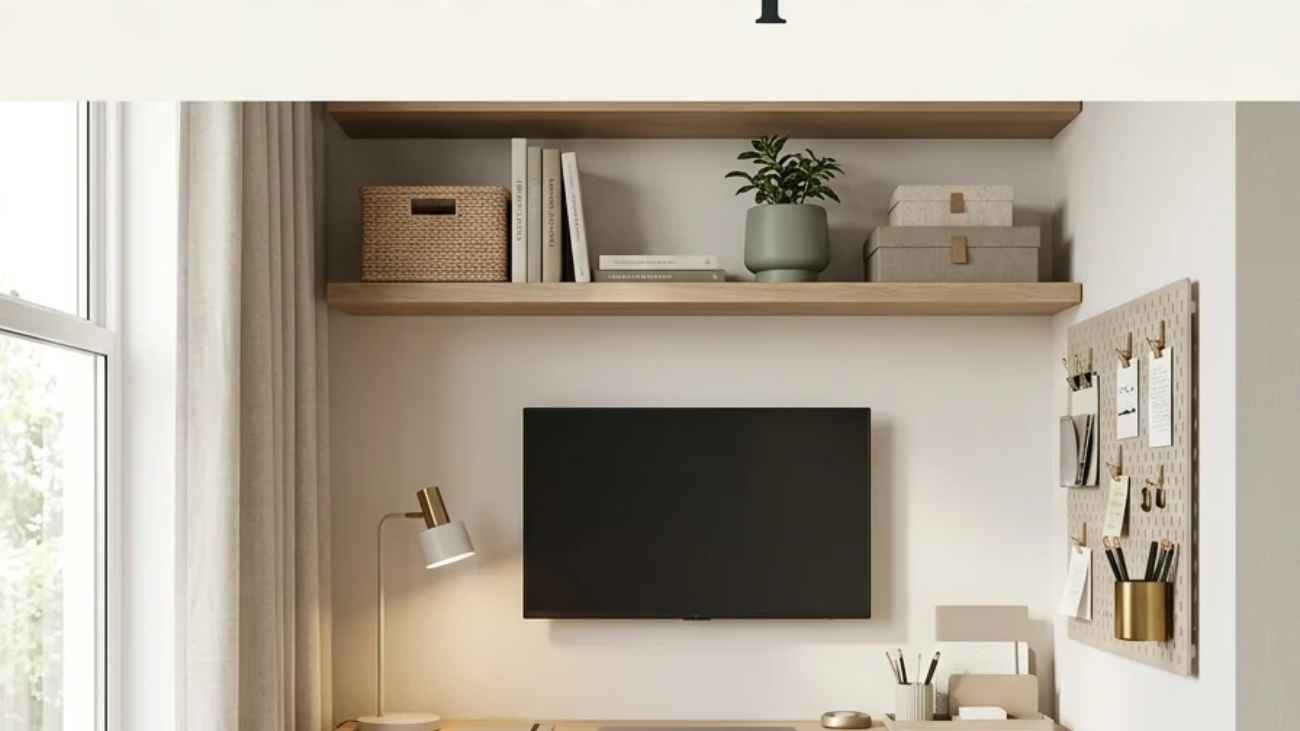
Optimizing a home office in a small space means building a genuinely functional workspace into whatever square footage your home actually has a living room corner, a hallway alcove, the gap under a staircase using furniture and layout choices that pull double duty rather than claiming a room you don’t have to spare. This article gives you 15 real ways to do exactly that, covering color, material, lighting, furniture, and layout, each one built for a home where a dedicated office was never part of the floor plan.

The feel you’re after is efficient without feeling makeshift: a desk that earns its exact spot, storage that climbs the wall instead of eating the floor, a workspace that looks intentional rather than squeezed in as an afterthought. Here are 15 ideas worth saving and stealing.

Why Optimizing a Home Office in Small Spaces Works So Well

Fitting a real workspace into a small home isn’t a decorating style; it’s a space-planning discipline that applies to studio apartments, compact hallways, under-stair gaps, and living room corners alike, drawing on the same multi-purpose furniture tradition that’s shaped small European apartments and Japanese micro-housing for decades. What makes this challenge distinct from furnishing a dedicated office room is that every choice has to justify its footprint against whatever else that same square footage was already doing.

The materials that solve this best share one trait: a light visual and physical footprint. Slim metal-leg desks, wall-mounted shelving instead of floor cabinets, and furniture built to fold, nest, or convert between functions all matter more here than in a room with space to spare. Keeping colors consistent and neutral warm white, soft greige across the workspace and its surrounding furniture is what keeps a small home from feeling visually carved up by the addition of a desk.

Style at a Glance

ElementFixed-Room SolutionsFlexible & Movable Solutions
PhilosophyBuilt into a corner, nook, or wall permanentlyRepositionable furniture doing double duty
MaterialsWall-mounted shelving, built-in desk shelvesFolding, stacking, or convertible furniture
Color PaletteWarm white, soft greige, consistent throughoutSame neutral base, one accent to mark the zone

1. A Desk Color That Matches the Room to Minimize Visual Bulk

1. A Desk Color That Matches the Room to Minimize Visual Bulk

Vibe: The desk feels quiet, nearly disappearing against its own backdrop.

Why it works: A desk finished in a color closely matching its surrounding wall reduces the eye’s contrast between furniture and background, which is the specific technique that makes a physically present object read as visually smaller than it actually is. This matters most in a small living room or shared space, where every additional piece of furniture with strong contrast against its background compounds a sense of visual crowding.

How to get it: Choose a desk in the same warm white or cream family as your wall paint, and check the finish sheen under your room’s actual lighting, since a glossy desk surface can still stand out in a matching color if its sheen differs noticeably from the matte wall behind it.

đź’ˇ Quick Win: A can of matching wall-color paint applied to an existing desk is often cheaper than buying a new one specifically for this color-matching effect.

Shop the Look

Product
Warm white desk, matte finish
Brass task lamp, compact
Ceramic desktop tray
Warm white wall paint, matching
Small woven desk basket

2. A Slim Console Table That Converts Into a Desk

2. A Slim Console Table That Converts Into a Desk

Vibe: The console feels dual-purpose, a hallway or living room piece doing genuine office duty.

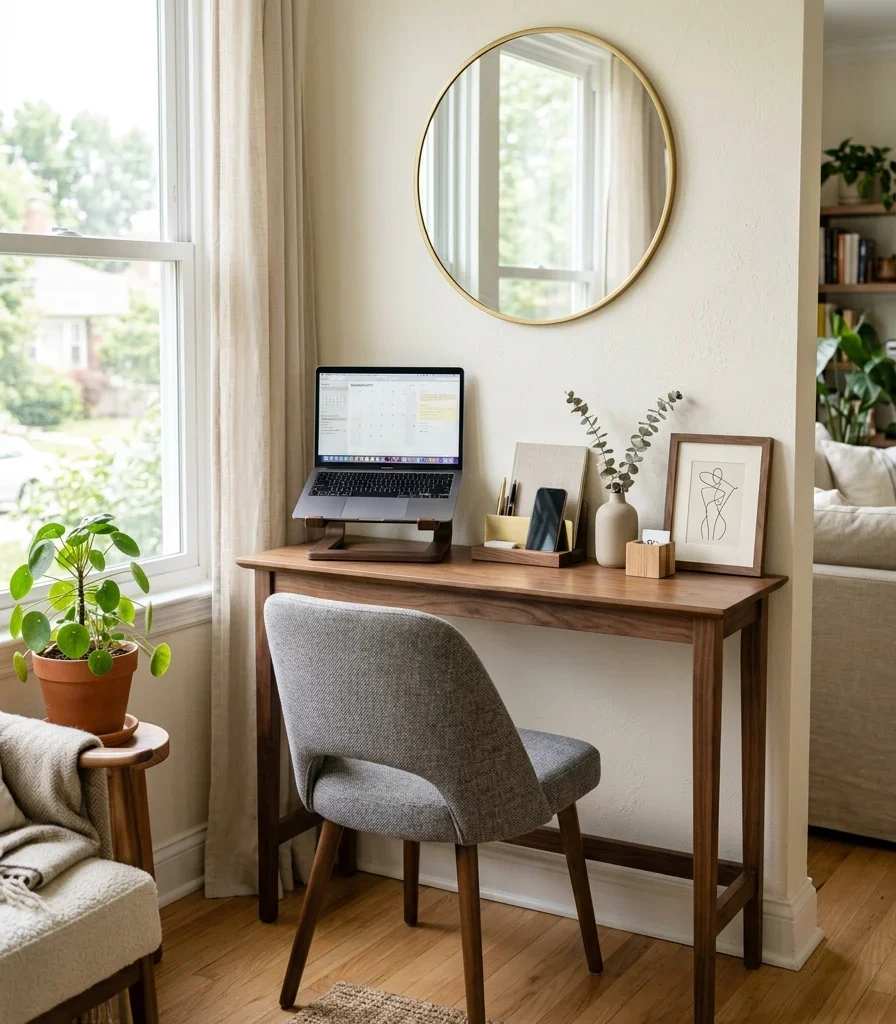
Why it works: A console table, typically only 12–16 inches deep, occupies a fraction of a standard desk’s footprint while still providing enough surface area for a laptop and small organizer since consoles are designed to sit flush against a wall in a hallway or living room already, repurposing one as a desk avoids introducing a distinctly “office” furniture silhouette into a shared space at all. This is furniture that already belonged in the room doing double duty rather than a dedicated desk competing for new floor space.

How to get it: Choose a console at standard desk height (28–30 inches) rather than a shorter decorative console, and keep styled decor objects to one end of the surface so the remaining space stays usable for actual work.

Shop the Look

Product
Slim console table, desk height
Laptop stand, adjustable
Small ceramic organizer
Small ceramic vase
Compact desk lamp

3. A Pendant Light Instead of a Desk Lamp to Save Surface Space

3. A Pendant Light Instead of a Desk Lamp to Save Surface Space

Vibe: The desk feels efficient, light, doing its job without claiming any surface space.

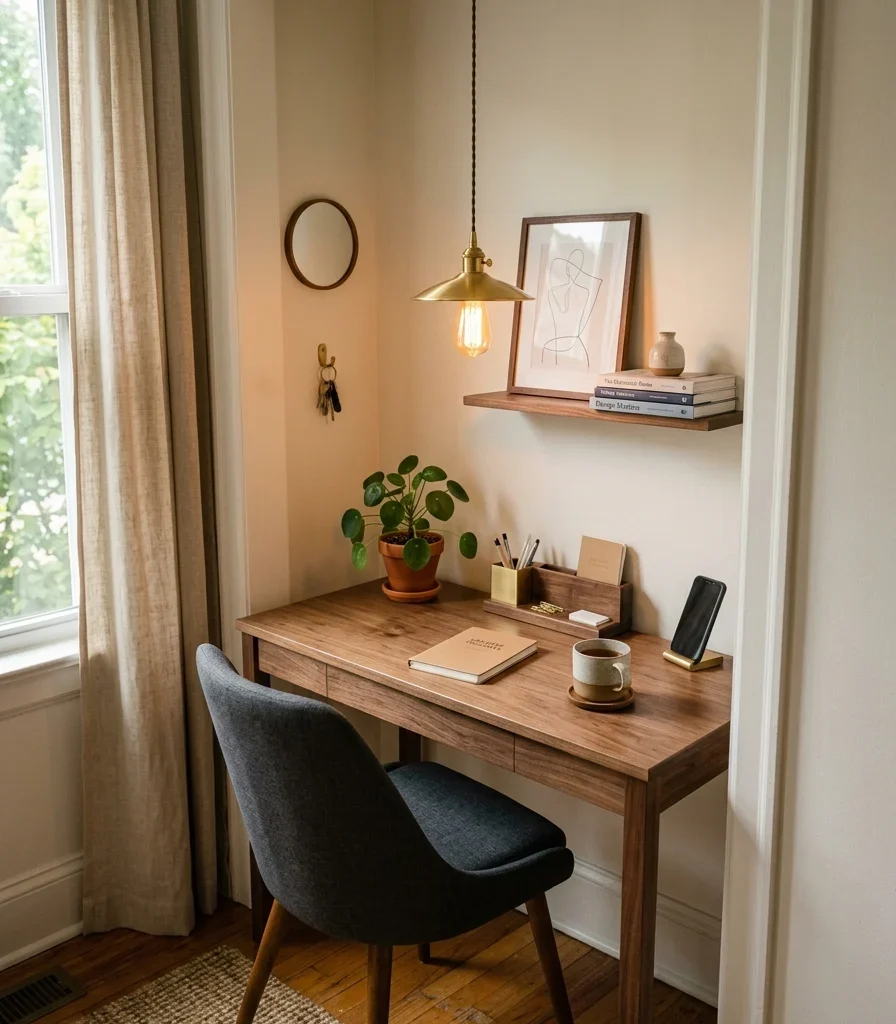
Why it works: A standard desk lamp base can occupy a genuinely meaningful percentage of a small desk’s usable surface, which is exactly the trade-off a ceiling-mounted or plug-in pendant avoids entirely by delivering the same task lighting from overhead instead. This swap matters disproportionately on genuinely small desks, where every square inch of clear surface directly affects how comfortably the space can actually be used for work.

How to get it: Hang the pendant with its bottom edge roughly 24–30 inches above the desk surface, positioned slightly behind where you’d sit to avoid direct glare, and choose a plug-in style if a hardwired ceiling fixture isn’t feasible in a rental.

Shop the Look

Product
Small brass pendant light, plug-in
Warm white dimmable bulb
Desk organizer tray
Small potted plant
Adhesive cord clips for cord routing

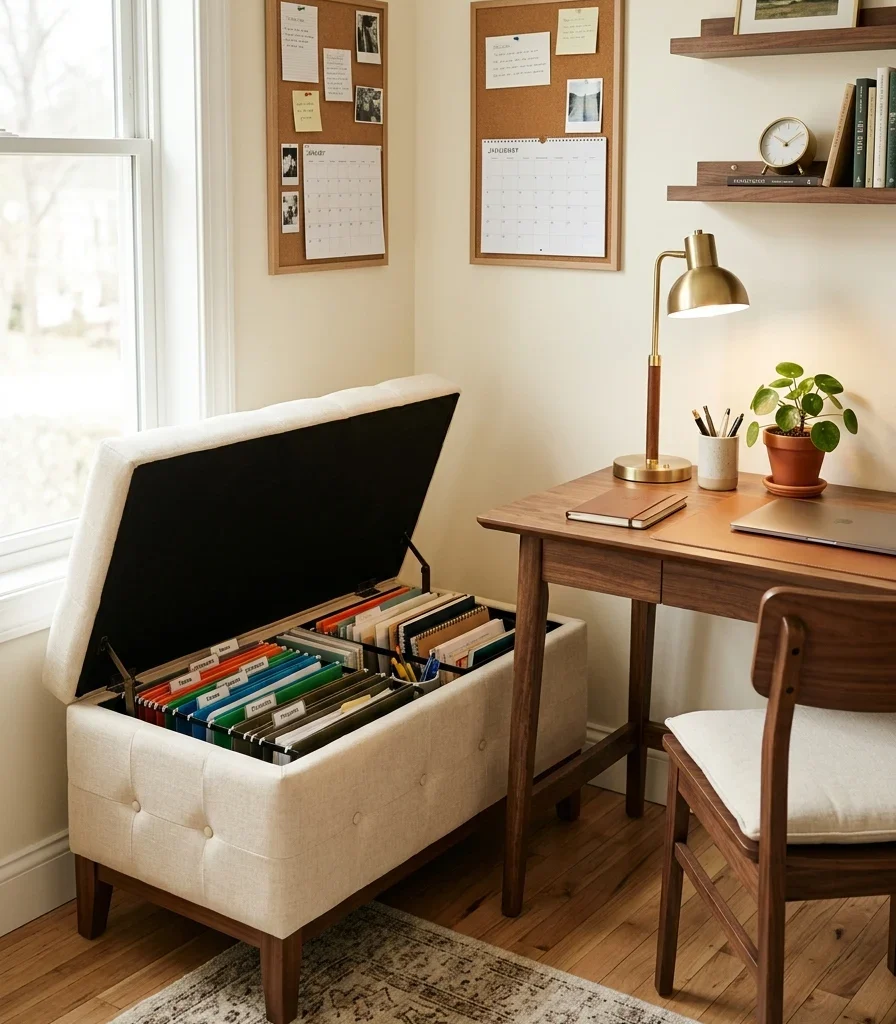
4. A Multi-Functional Ottoman With Hidden Office Storage

4. A Multi-Functional Ottoman With Hidden Office Storage

Vibe: The ottoman feels versatile, seating and storage sharing one small footprint.

Why it works: A storage ottoman functions as extra seating for guests, a footrest, and enclosed office storage all within one piece of furniture’s footprint, which is a genuinely efficient trade compared to a separate filing cabinet and an additional chair that would otherwise claim their own floor space individually. Because it reads as living room furniture rather than office equipment, it also blends into a shared space without visually announcing “workspace” the way a filing cabinet would.

How to get it: Choose an ottoman with a flat, sturdy hinged lid capable of holding weight, and use hanging file folders or small bins inside to keep contents organized rather than loose, since a disorganized ottoman interior defeats the storage benefit.

Shop the Look

Product
Storage ottoman, hinged lid
Hanging file folder set
Small storage bin set, ottoman-sized
Walnut desk
Desk organizer tray

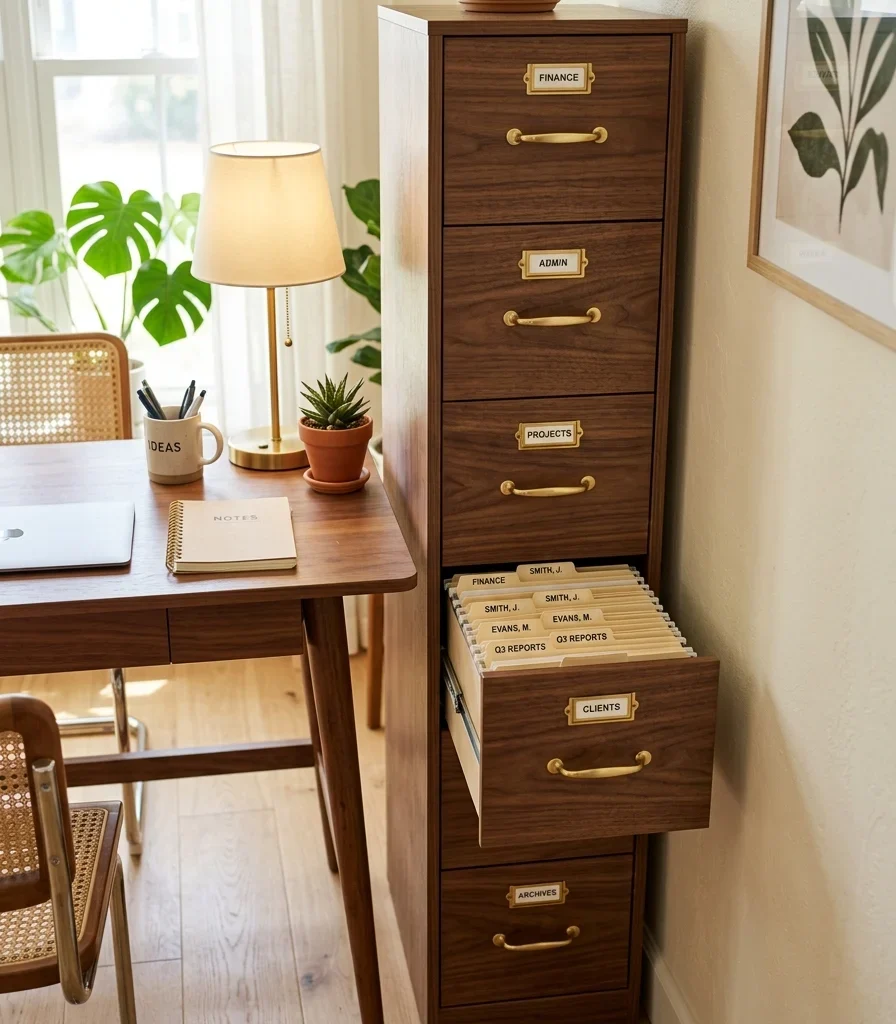
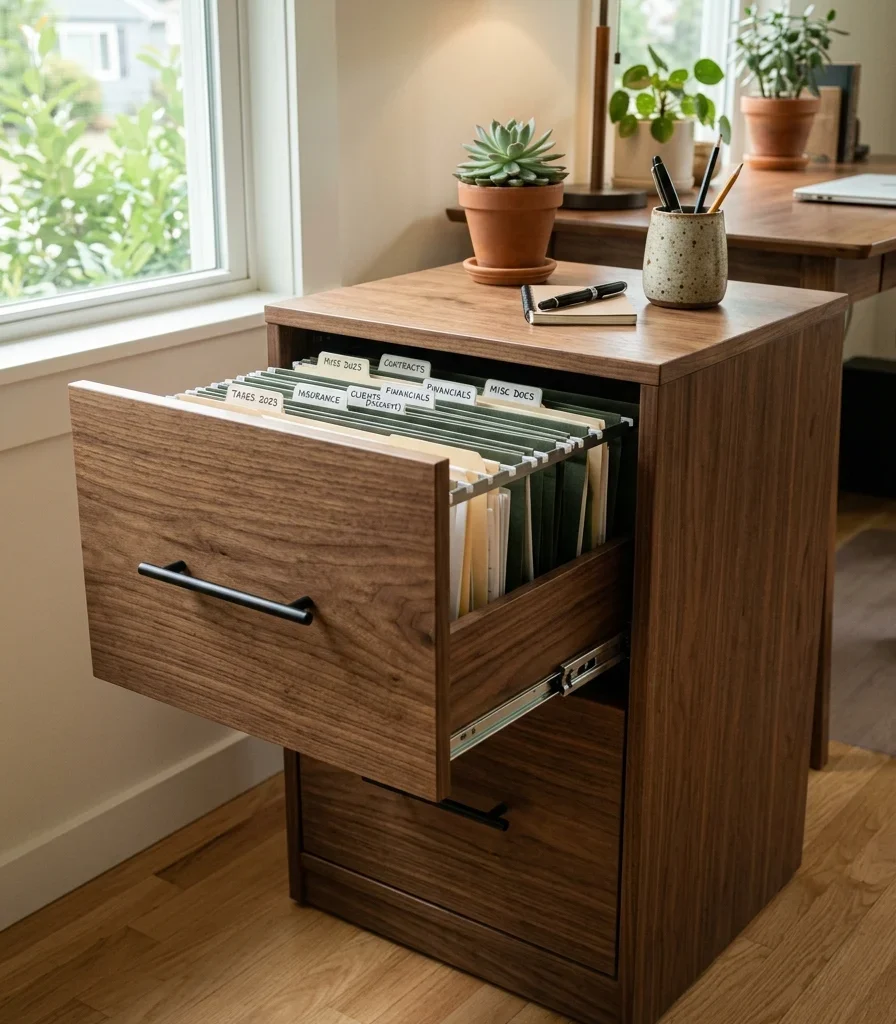
5. A Vertical File Tower Instead of a Wide Filing Cabinet

5. A Vertical File Tower Instead of a Wide Filing Cabinet

Vibe: The corner feels organized, with storage climbing instead of spreading out.

Why it works: A vertical file tower provides the same document storage capacity as a standard two-drawer lateral filing cabinet in roughly half the floor footprint, since the extra capacity comes from height rather than width a straightforward trade that matters significantly in any room where floor space is the tightest constraint. This is the same vertical-over-horizontal principle that governs floating shelves over floor bookcases, applied specifically to file storage.

How to get it: Measure your available floor footprint before shopping, prioritizing towers under 14 inches wide, and label each drawer clearly since narrow file towers hold less per drawer than wide cabinets and benefit more from clear organization.

Shop the Look

Product
Vertical file tower, narrow footprint
File folder label set
Small desk lamp
Desk organizer tray
Felt floor pads, tower base

6. Painting Just the Office Nook a Deeper Tone to Frame It

6. Painting Just the Office Nook a Deeper Tone to Frame It

Vibe: The nook feels intentional, one wall of color announcing exactly where work happens.

Why it works: Painting only the wall or alcove behind a small desk in a deeper tone than the surrounding room creates a framed focal point, the same accent-wall principle used elsewhere in decorating, but applied specifically to visually contain and define a workspace that has no walls of its own to separate it from the rest of the room. This gives an open-plan desk area a sense of architectural boundary that pure furniture placement alone can’t achieve.

How to get it: Choose a color roughly two to three shades deeper than your room’s base wall color within the same family, containing it strictly to the nook’s boundaries rather than letting it extend onto adjacent walls.

Shop the Look

Product
Sage green interior paint, sample size
Walnut desk
Small floating shelf
Painter’s tape, sharp-edge
Compact desk lamp

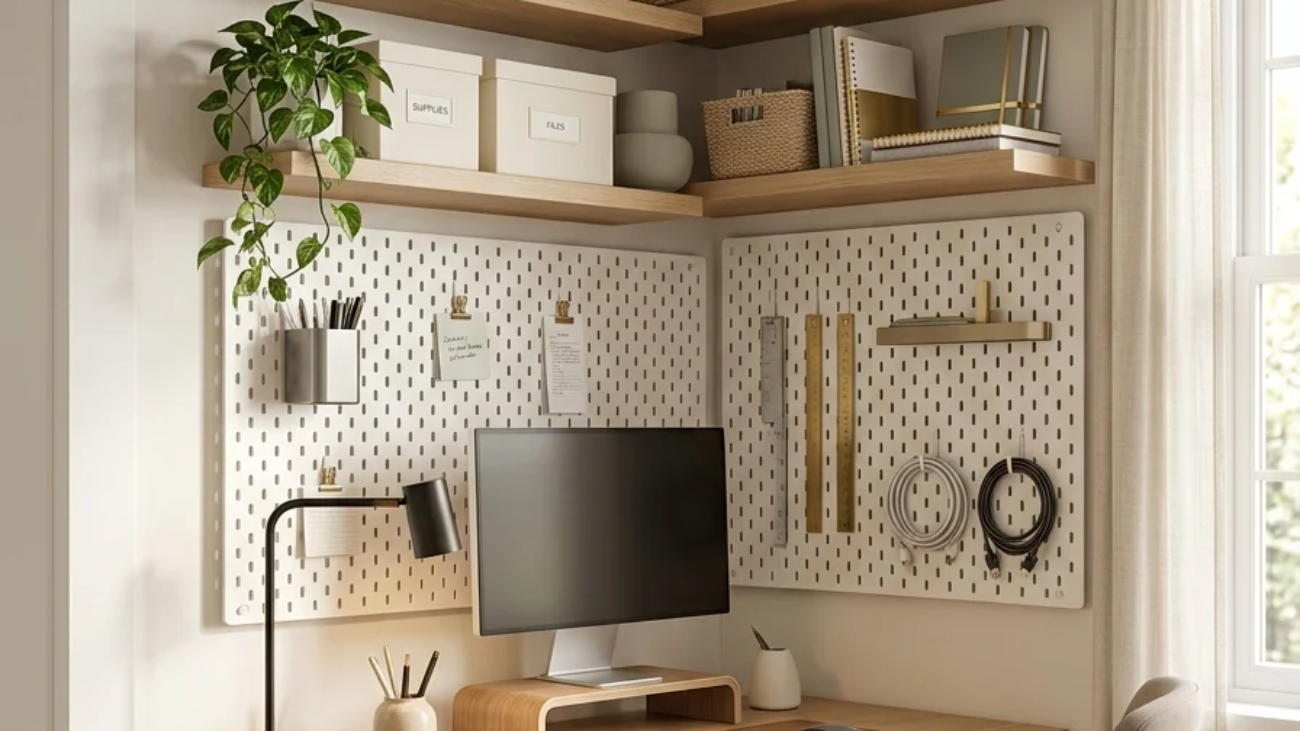
7. A Wall-Mounted Pegboard for Tool-Free Reconfigurable Storage

7. A Wall-Mounted Pegboard for Tool-Free Reconfigurable Storage

Vibe: The wall feels adaptable, storage rearranging itself as needs shift.

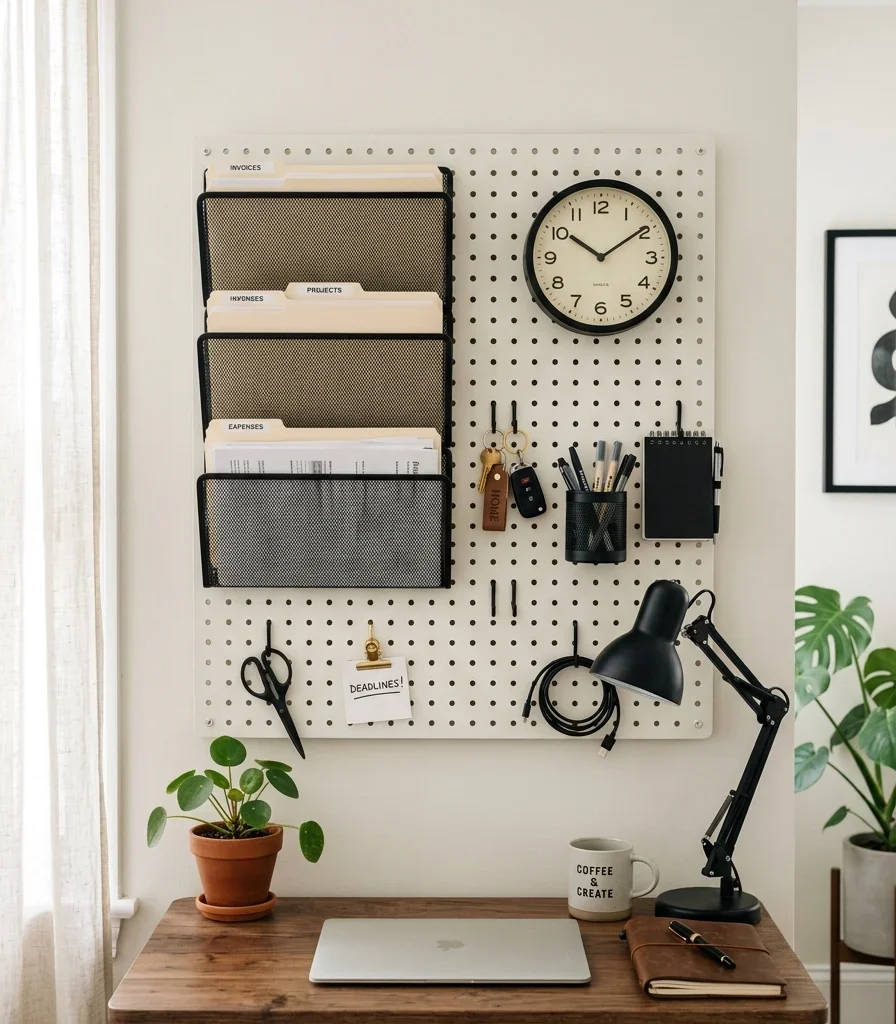
Why it works: A pegboard panel provides fully reconfigurable vertical storage using one thin wall-mounted surface, letting hooks, small shelves, and organizers move without new hardware or holes as the workspace’s needs change over time a genuine advantage over fixed shelving in a small space where the exact storage mix often needs adjusting more than once as the setup gets used daily.

How to get it: Mount the pegboard directly above the desk within arm’s reach, and start with just three or four accessories rather than filling every hole, since an overloaded pegboard reads as cluttered in a small, already visually busy space.

Shop the Look

Product
Wood pegboard panel, wall-mounted
Pegboard hook and shelf accessory set
Small potted plant, desk-safe
Pegboard cup holder
Wall mounting hardware kit

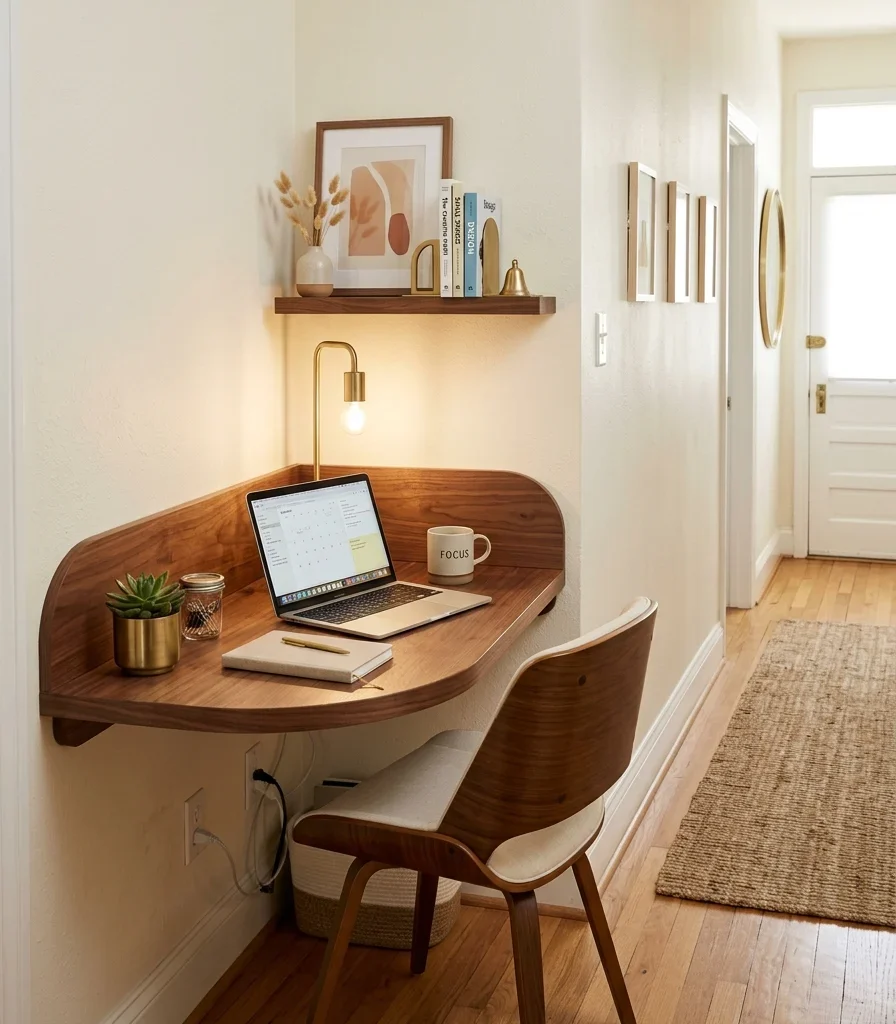
8. Turning a Living Room Corner Into a Compact Office

8. Turning a Living Room Corner Into a Compact Office

Vibe: The corner feels tidy, previously wasted space finally earning its keep.

Why it works: Room corners are consistently the most underused square footage in a living room, since standard rectangular furniture arrangements rarely reach fully into them. A desk shaped or angled specifically to fit a 90-degree corner claims genuinely dead space rather than competing with the room’s more usable central floor area where seating and traffic flow already need room to work.

How to get it: Measure both walls of your intended corner precisely before shopping, and choose a chair that tucks fully under the desk when not in use, since a chair left pulled out in a corner setup often becomes the actual obstacle to traffic flow.

Shop the Look

Product
Corner desk, compact footprint
Slim task chair
Small wall shelf above desk
Compact desk lamp
Under-desk cable management tray

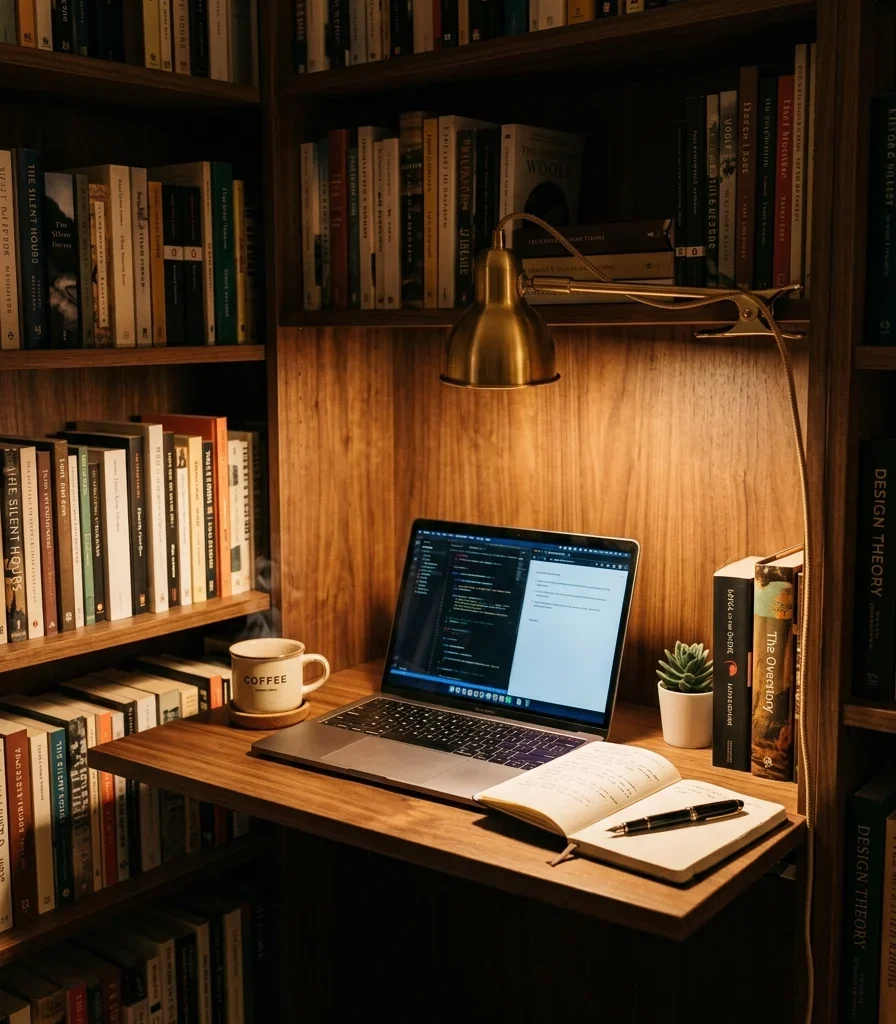
9. Clip-On Task Lighting for a Bookshelf Nook

9. Clip-On Task Lighting for a Bookshelf Nook

Vibe: The nook feels compact, light clamped exactly where a lamp base couldn’t fit.

Why it works: A clip-on task light attaches directly to a shelf edge without requiring its own base or footprint, which solves the specific lighting problem a bookshelf-integrated desk creates; there’s often no room for a standard lamp base beside a laptop in a nook this tight. This is the lighting equivalent of choosing a pendant over a desk lamp, applied to a built-in shelving context rather than open floor space.

How to get it: Choose a clip-on light with a flexible gooseneck arm so it can be angled precisely toward the work surface regardless of exactly where on the shelf edge it’s clamped, and confirm the shelf material can handle the clip’s grip without marking or damage.

Shop the Look

Product
Clip-on gooseneck task light
Warm white LED bulb, small base
Compact laptop stand
Small desk organizer
Felt shelf protector pad

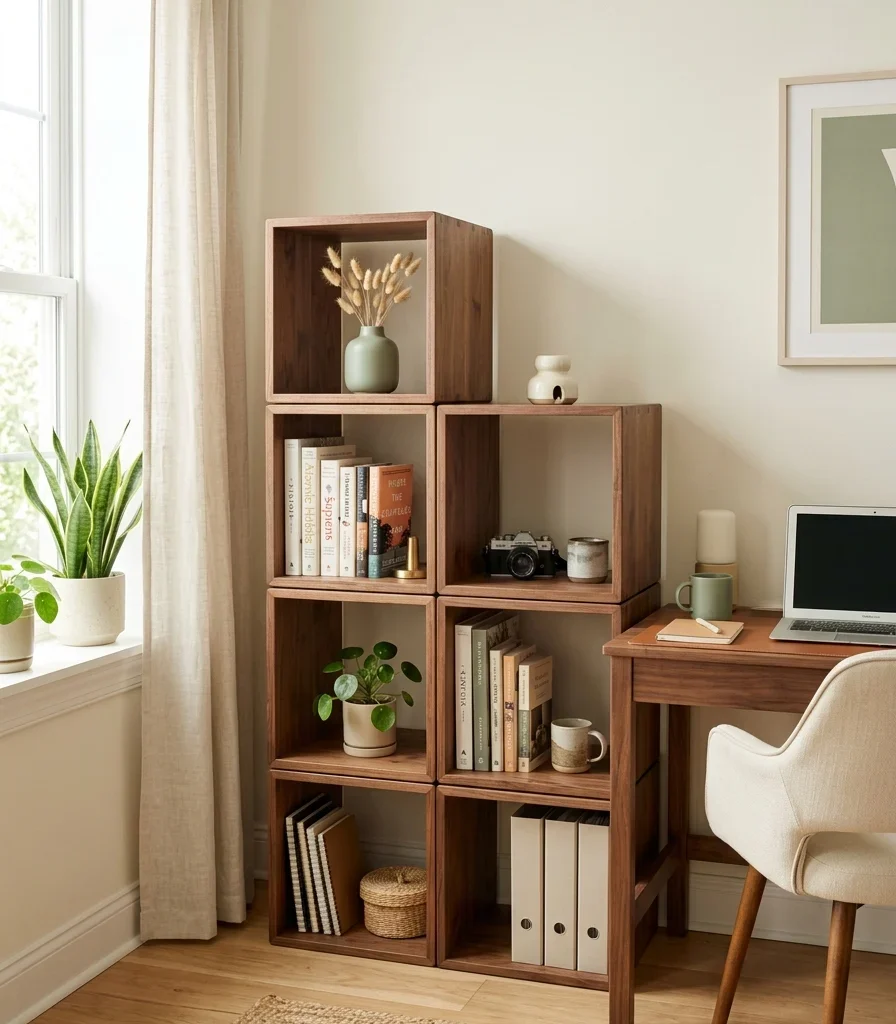
10. Stackable Modular Cubes for a Flexible Small-Space Layout

10. Stackable Modular Cubes for a Flexible Small-Space Layout

Vibe: The corner feels flexible, storage reconfiguring itself as the room’s needs shift.

Why it works: Modular cube storage can be stacked, rearranged, or split into separate small groupings as a small space’s furniture needs change, which is a genuine advantage over a fixed-dimension bookshelf or cabinet that can’t adapt if the room is later repurposed or the desk setup needs to move. This flexibility matters specifically in small, multi-use spaces where the same square footage might need to serve different functions at different times.

How to get it: Choose cubes in a consistent finish and size so they stack cleanly in multiple configurations, and mix open cube fronts with a few closed-door cubes to balance genuine storage with visual variety.

Shop the Look

Product
Stackable modular storage cube set
Small ceramic decorative object
Neutral book stack
Small woven storage basket, cube-sized
Felt floor pads, cube base

11. A Curved-Back Desk for Tight Walkways

11. A Curved-Back Desk for Tight Walkways

Vibe: The hallway feels considerate, one rounded edge making a tight space walk easier.

Why it works: A sharp rectangular desk edge protruding into a narrow walkway creates a hard collision point people have to consciously navigate around, while a curved or rounded back edge on the same desk softens that same intrusion, letting people pass closer without the same physical or visual obstruction. This is the same curved-furniture-for-tight-corners principle used elsewhere in small-space design, applied specifically to desks positioned along circulation paths rather than tucked fully into a dead corner.

How to get it: Choose a desk with a curved or bullnose edge specifically on the side facing your walkway, keeping the opposite working edge standard and flat for normal desk use.

Shop the Look

Product
Desk with curved back edge
Small wall shelf above desk
Compact desk lamp
Slim task chair
Runner rug, hallway-width

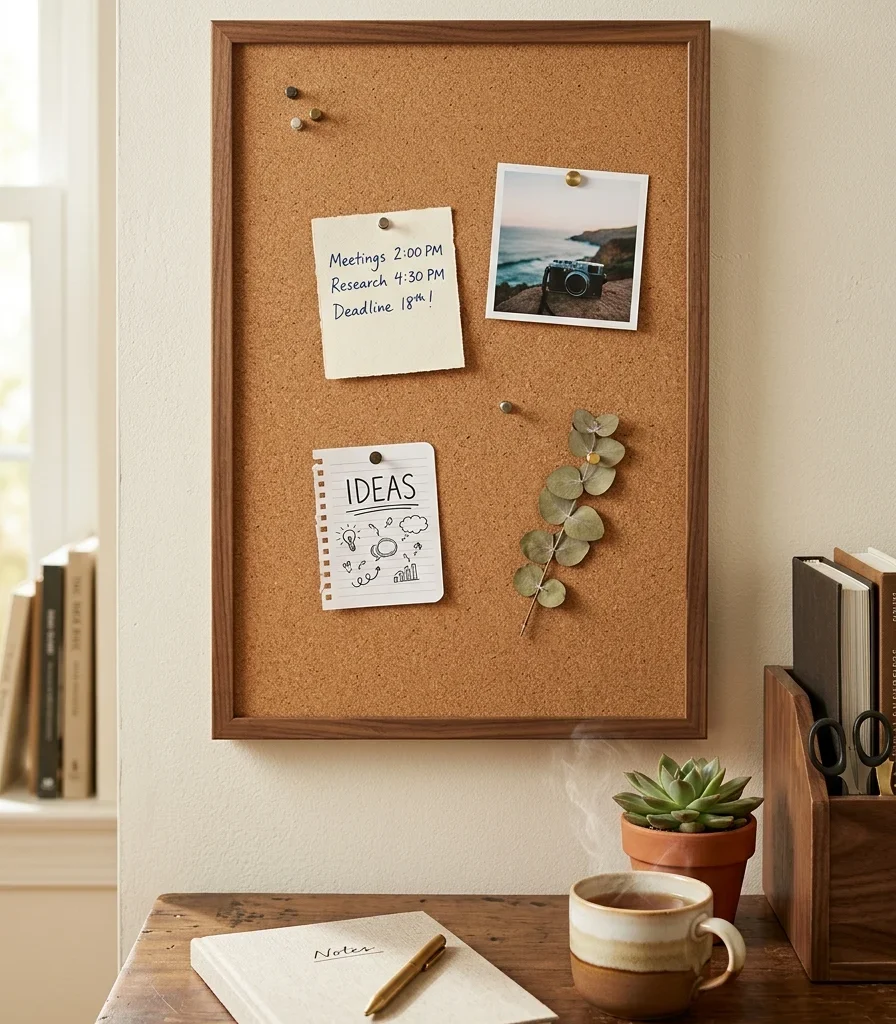
12. A Cork Board Insert Framed Like Wall Art

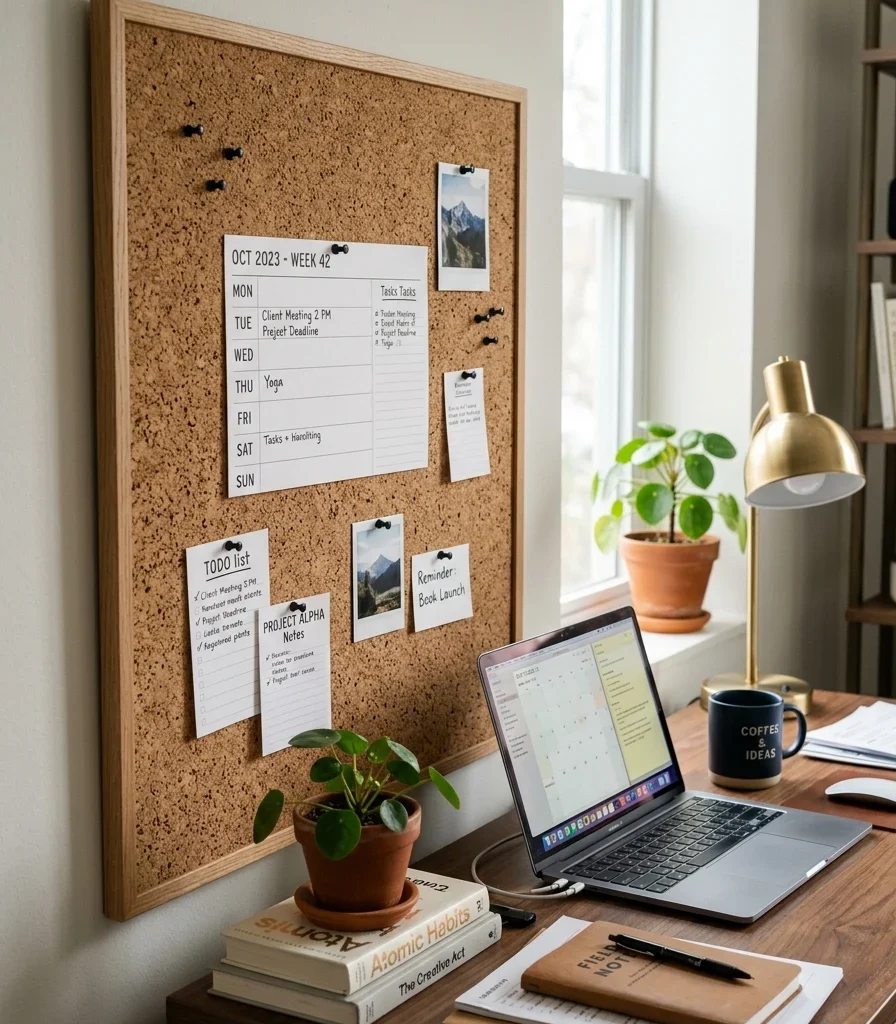
12. A Cork Board Insert Framed Like Wall Art

Vibe: The wall feels considered, a genuinely useful board disguised as decor.

Why it works: A standard unframed cork board reads as purely utilitarian, while the same cork surface mounted in a proper picture frame integrates into a room’s existing wall decor rather than announcing itself as office equipment. This matters specifically in shared or open-plan spaces, where a workspace’s storage and organization tools benefit from blending into the room’s overall styling rather than visually separating from it.

How to get it: Choose a frame finish that matches your desk or nearby furniture, and style the board with just a few genuinely useful pinned items rather than filling it, so it reads as curated rather than cluttered.

đź’ˇ Quick Win: A thin cork sheet cut to fit an existing empty picture frame is a faster, cheaper version of this idea than buying a pre-made framed corkboard.

Shop the Look

Product
Framed cork board, walnut frame
Decorative push pin set
Small framed print, matching decor
Wall mounting hardware
Small desk organizer

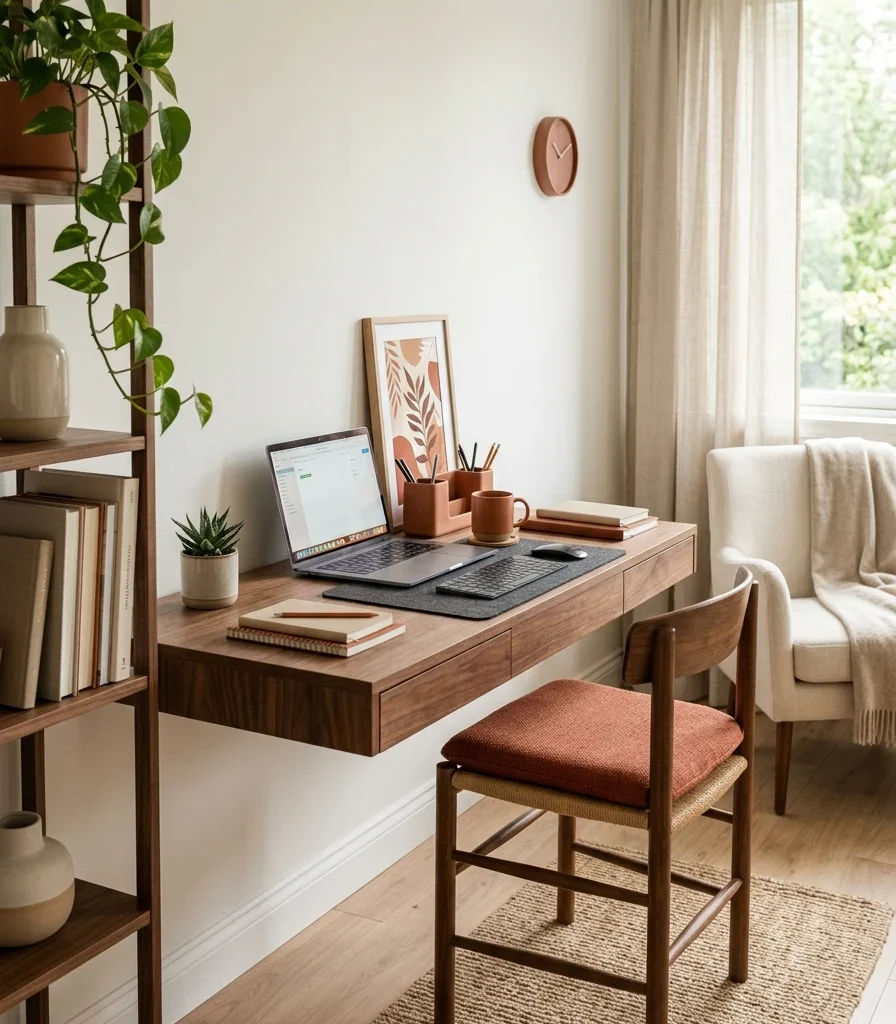
13. A Single Warm Accent Color to Mark the Work Corner

13. A Single Warm Accent Color to Mark the Work Corner

Vibe: The corner feels signaled, one confined color marking exactly where the desk lives.

Why it works: Confining a single accent color exclusively to objects within arm’s reach of the desk a chair cushion, an organizer, a small print reinforces the workspace’s boundaries the same way a rug or paint treatment would, using color repetition instead of a physical marker. This technique works especially well when a desk sits within a larger shared room, since it draws a clear visual line around the work zone without requiring any furniture rearrangement or wall treatment.

How to get it: Choose one accent color and use it only on objects living within the desk’s immediate reach, keeping the rest of the room in your base neutral palette so the color functions as a clear zone marker rather than a general room accent.

Shop the Look

Product
Terracotta desk chair cushion
Terracotta ceramic desk organizer
Small terracotta-toned framed print
Walnut desk
Neutral surrounding furniture, unchanged

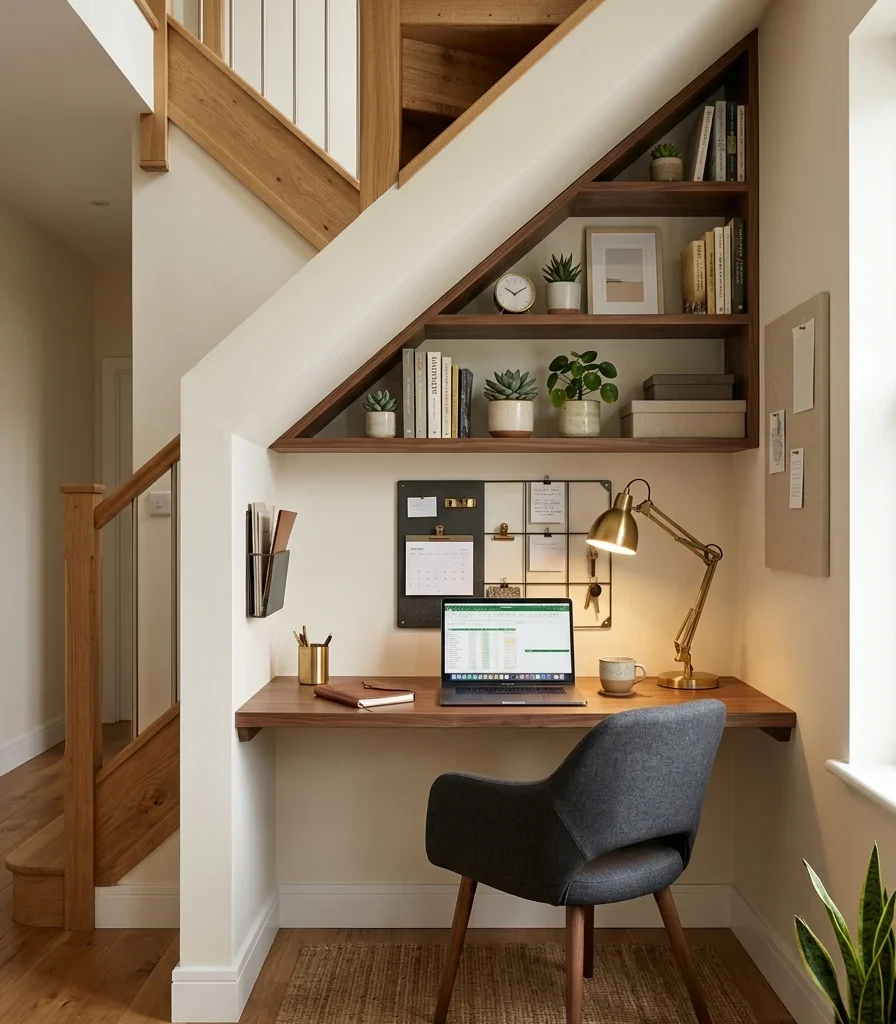
14. An Under-Stairs Nook Fitted With a Built-In Desk

14. An Under-Stairs Nook Fitted With a Built-In Desk

Vibe: The nook feels custom-fitted, an awkward architectural gap turned into a real workspace.

Why it works: The space beneath a staircase is almost always left as either dead storage or entirely unused, despite frequently offering enough depth and width for a genuine desk. Building a desk and shelving specifically fitted to the stair’s sloped underside claims square footage that was contributing nothing to the home’s usable space before. This is the most literal example of finding truly dead space in a small home and giving it real function, since the location itself makes it unlikely to compete with any other use.

How to get it: Have shelving and the desk surface custom-cut to follow the stair’s exact angle rather than using standard rectangular furniture that would leave awkward gaps at the sloped ceiling line, maximizing every inch of the nook’s irregular shape.

Shop the Look

Product
Custom-cut desk shelf, angled to fit
Angled wall shelving, stair-following
Small desk lamp
Wall organizer bins
Slim task chair, low profile

15. Micro-Zoning a Studio Apartment With a Single Floor Rug

15. Micro-Zoning a Studio Apartment With a Single Floor Rug

Vibe: The studio feels open, one rug doing the zoning work a wall would in a bigger home.

Why it works: A single area rug positioned beneath a desk in an otherwise open studio signals a distinct functional zone the same way a change in flooring material would in a larger home, without consuming any of the studio’s already-limited floor space the way a divider or built partition would. This is the lightest-touch zoning technique available in a genuinely single-room living situation, adding definition purely through a change underfoot rather than any vertical element that could make an already small space feel more visually cut up.

How to get it: Size the rug so the desk and chair sit fully on it with a few inches of margin on all sides, choosing a texture or color distinct enough from the surrounding floor to read clearly as a separate zone from across the room.

Shop the Look

Product
Small area rug, desk zone
Rug pad, non-slip
Walnut desk
Small floating shelf
Slim task chair

How to Start Optimizing Your Small-Space Home Office

Your first move should be walking your entire home and identifying the single most underused pocket of space a corner, a hallway alcove, the gap under a staircase before shopping for any furniture at all, since the right location does more for a small-space setup’s success than any desk or storage purchase that follows it.

The most common mistake is buying a standard-sized desk before measuring the actual space it needs to fit, which forces an awkward retrofit or blocks a walkway once the desk arrives. Fix it by measuring your chosen spot’s exact width, depth, and any walkway clearance first, then shopping specifically within those constraints rather than falling for a desk you like the look of and hoping it fits.

Three specific items under $50 that create immediate impact: a set of pegboard wall hooks to move supplies off the desk surface, a small area rug to define the work zone underfoot, and a clip-on gooseneck task light for a shelf or nook without room for a lamp base.

A basic setup using an existing corner, a compact desk, and a rug typically takes a single afternoon and costs $100–$250. A fuller setup with wall-mounted storage or a custom-fitted nook generally runs $300–$700 and takes one weekend, while a built-in solution like an under-stair desk realistically takes two to three weekends and $400–$900 depending on custom shelving needs.

Frequently Asked Questions About Small-Space Home Offices

What is the best way to add a home office to a small apartment with no spare room?

The best approach is identifying genuinely underused space within rooms you already have a living room corner, a hallway alcove, an under-stair gap, rather than trying to carve a dedicated room out of space that’s already fully committed to another function. Multi-functional furniture, like a storage ottoman or a console table doing double duty as a desk, further reduces the total footprint a workspace needs to claim from an already tight floor plan.

What colors work best for a small-space home office?

Warm white and soft greige remain the most versatile choices, since matching the desk and surrounding furniture closely to the room’s existing wall color minimizes how much visual bulk the workspace appears to add. A single confined accent color often terracotta or sage applied only to objects within the desk’s immediate reach is the most common way to mark the zone without requiring a paint treatment or physical divider.

How much does it cost to set up a home office in a small space?

A basic setup using a compact desk, task lighting, and a defining rug typically costs $100–$250. A fuller setup incorporating wall-mounted storage or a multi-functional furniture piece like a storage ottoman generally runs $300–$700, while a custom-built solution like an under-stair desk nook usually falls between $400 and $900 depending on the extent of custom shelving and cutting required.

Does a small-space home office work in a shared or open-plan home?

Yes, and zoning technique matters more here than in a private room. A single area rug, a confined accent color, or a framed cork board that blends into the room’s existing decor all define the workspace without requiring walls or a door. In genuinely shared spaces, choosing furniture that reads as normal living-room or hallway pieces, like a console table used as a desk, helps the workspace integrate rather than visually announce itself as separate office equipment.

What furniture makes the biggest difference in a small home office?

Multi-functional pieces make the single biggest difference, since a storage ottoman, a convertible console table, or stackable modular cubes each reduce the total number of separate furniture items a small space needs to accommodate. Vertical storage floating shelves, a narrow file tower, a pegboard is the second most impactful category, since claiming wall space instead of floor space is consistently the highest-leverage move available in any genuinely small room.

Ready to Optimize Your Home Office in a Small Space?

These 15 ideas span color, material, lighting, furniture, and layout, from a console table doing double duty as a desk to an under-stair nook built entirely around the space’s own awkward angle, so there’s a genuinely practical starting point here, whatever your home’s actual floor plan looks like. You don’t need every idea at once, and finding the right underused pocket of space before buying a single piece of furniture is not a smaller first step; it’s the decision every other idea on this list depends on working properly. Today’s specific action: walk through your entire home and identify the one corner, alcove, or gap that currently does nothing, then measure it precisely before you shop for anything at all. Once a real workspace exists in that exact spot, sized and chosen specifically for it, the space will finally feel like it was planned rather than squeezed in, no matter how small the square footage actually is. Save the ideas that match your own home’s real gaps today that under-stair desk, that console table conversion because in small-space design, the setup that fits the space you actually have is the one that lasts.

You Might Also Like

15 Ways to Optimize a Home Office Multiple Monitor Setup

15 Ways to Optimize a Home Office Multiple Monitor Setup

An optimized multiple monitor setup arranges two or more screens, their mounting hardware, cabling, and surrounding lighting specifically around how the eyes and neck move between displays, rather than simply lining up extra monitors on a flat desk. This article gives you 15 genuinely effective ways to optimize a home office multiple monitor setup, covering furniture, lighting, material, and layout decisions that keep a multi-screen workstation comfortable across a full workday instead of straining the neck by lunchtime.

It feels like the whole field of view finally makes sense: screens angled just enough that the neck doesn’t twist to check a side monitor, cables routed so cleanly they disappear from thought entirely, light balanced so no single panel glares brighter than the rest. This is a multiple monitor setup at its most resolved: deliberate, calm, built around how attention actually travels across more than one screen. Every adjustment earns its place because a multi-monitor desk has more that can go wrong than a single-screen one.

Here are 15 ideas worth saving and stealing.

Why Optimizing a Multiple Monitor Setup Works So Well

A properly optimized multi-monitor setup draws from ergonomics research originally developed for financial trading floors and broadcast control rooms in the 1990s, where operators needed to track many data sources at once without the neck and eye strain that comes from constantly turning toward off-center screens. What distinguishes a genuinely optimized setup from simply owning more monitors is that every additional screen is treated as a source of potential physical strain that has to be actively managed through angle, distance, and lighting, not just plugged in and left flat on the desk.

The core materials favor matte, non-reflective finishes throughout: matte black monitor bezels for visual consistency, felt or wool desk pads to dampen sound across a wider keyboard zone, and matte walnut or oak for extra-deep desks that can physically support the added screen weight and depth. Color leans toward warm charcoal or matte black directly behind the monitor array, since a multi-screen setup multiplies the glare problem a single bright wall creates behind one monitor.

Style at a Glance

ElementCore Trait 1Core Trait 2
PhilosophyEvery additional screen actively managed for strain, not just added to the deskConsistency across all monitors reduces visual noise
MaterialsMatte black bezels, felt desk pads, matte walnut deskAnti-glare screen filters, matte wall paint
Color PaletteWarm charcoal or matte black focus wallWarm white surrounding walls

15 Ways to Optimize a Home Office Multiple Monitor Setup

1. Choose an Extra-Deep Walnut Desk to Support Multiple Screens

1. Choose an Extra-Deep Walnut Desk to Support Multiple Screens

Vibe: Still a desk with enough physical depth that three screens sit comfortably without crowding the keyboard forward.

Why it works: Desk depth is a proportion principle that most single-monitor desks never need to solve. A standard 24-inch desk works fine for one screen, but three monitors (even on slim stands) require enough rear clearance for cables and airflow, so a desk depth of at least 30 inches keeps the keyboard zone from being pushed uncomfortably close to the edge.

How to get it: Choose a solid walnut or walnut-veneer desk at least 30 inches deep and 60 inches wide for a three-monitor array, and confirm the desk’s weight rating accounts for the combined load of monitors, arms, and any additional equipment before mounting anything.

đź’ˇ Quick Win: A desk depth extension shelf under $40 adds several inches of rear clearance to an existing shallower desk without a full replacement.

Shop the Look

Product
Extra deep walnut desk 30 inch
Desk depth extension shelf
Matte black monitor stand riser
Small ceramic pen cup
Cable management tray under-desk

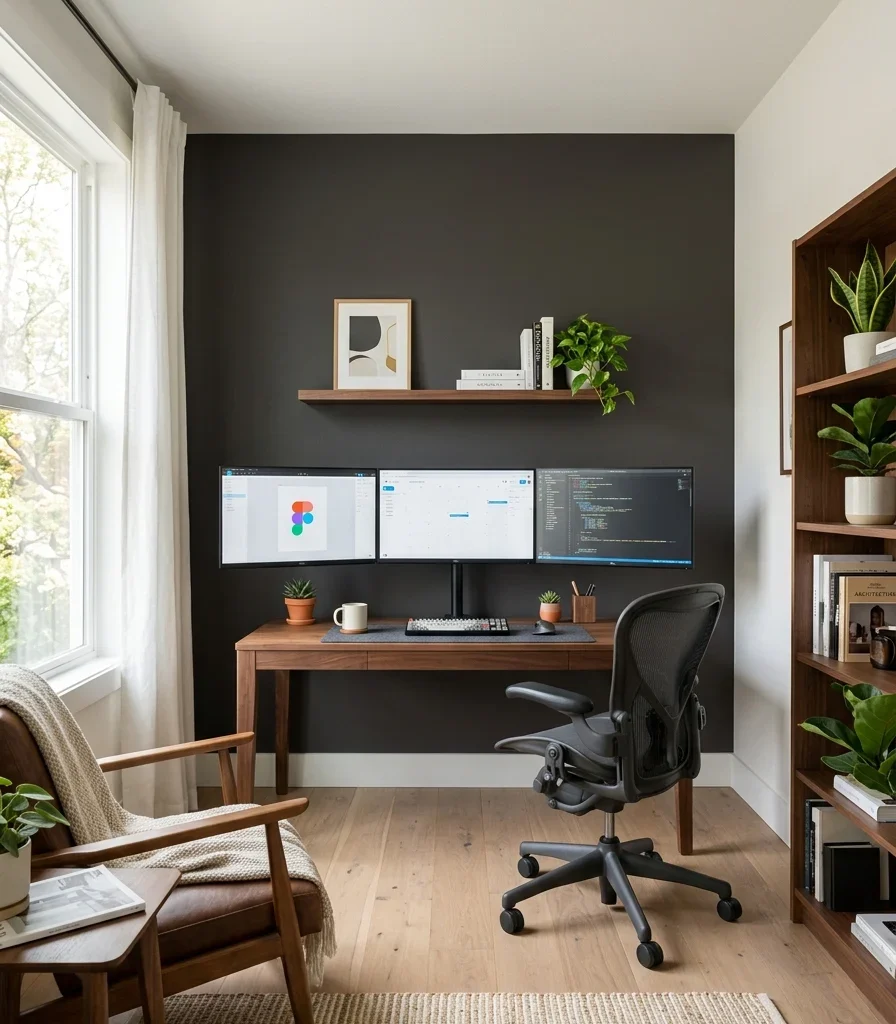
2. Paint a Warm Charcoal Wall Behind the Monitor Array

2. Paint a Warm Charcoal Wall Behind the Monitor Array

Vibe: Grounded a wall dark enough to disappear behind three screens instead of reflecting into all of them at once.

Why it works: Wall color behind the monitor matters more with multiple screens than with one; a bright white wall reflects ambient light into peripheral vision across the entire width of a multi-monitor array, multiplying the contrast strain a single screen alone would create, while a matte warm charcoal absorbs that reflected light across the full span.

How to get it: Paint the wall section spanning the full width of the monitor array (not just directly behind one screen) in a matte warm charcoal, extending at least 6 inches beyond the outermost monitor on each side so peripheral vision doesn’t catch a bright wall edge.

Shop the Look

Product
Warm charcoal matte wall paint
Small desk plant ceramic pot
Matte black monitor stand
Painter’s tape precision edge
Anti-glare monitor mount arm

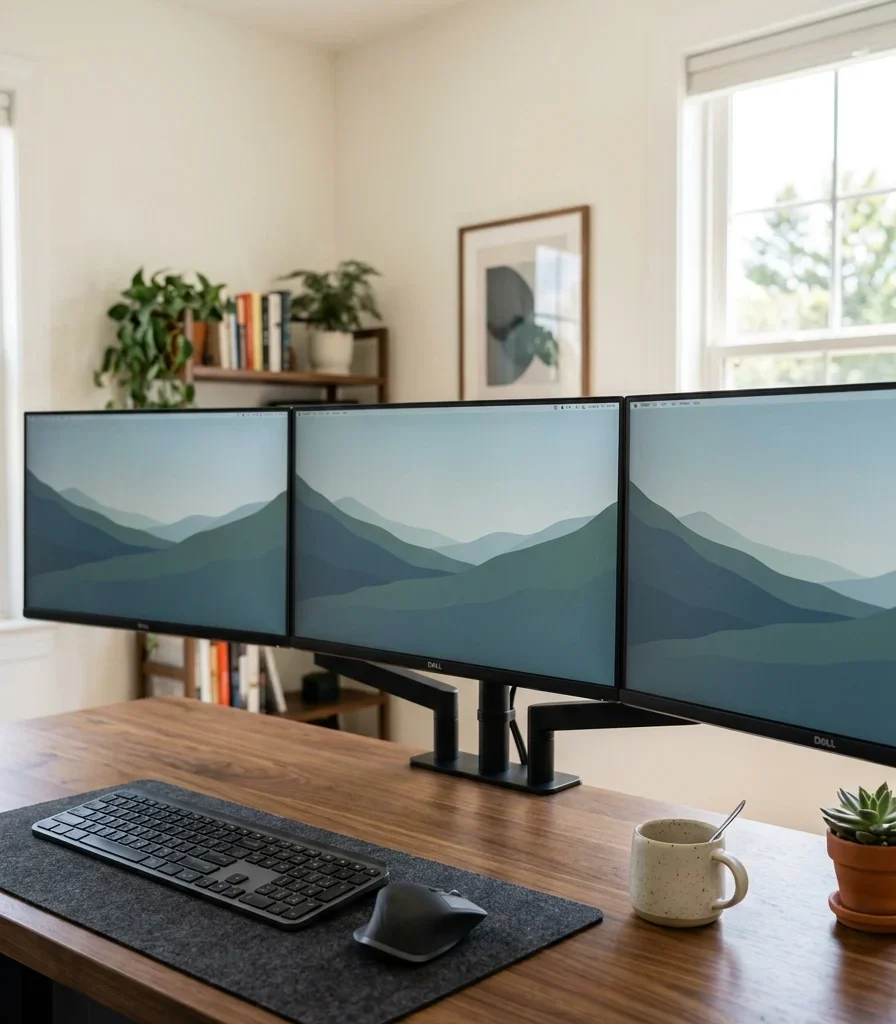
3. Add a Triple-Monitor Arm Mount to Clear the Desk

3. Add a Triple-Monitor Arm Mount to Clear the Desk

Vibe: Functional three full-size monitors floating above a desk that still has genuine room left to work on.

Why it works: A triple-monitor arm applies negative space and proportion principles at a scale flat stands can’t match; mounting all three screens on one articulated system reclaims the desk depth each stand would otherwise occupy, while allowing independent height, angle, and distance adjustment for every screen rather than accepting whatever a fixed stand provides.

How to get it: Choose a triple-monitor arm rated for the combined weight of all three screens, mount it to a desk clamp or grommet base rated for the same load, and set the center monitor’s top edge at eye level with the two side monitors angled inward rather than staying perfectly flat.

Shop the Look

Product
Triple monitor articulated arm mount
VESA mount adapter plate set
Small ceramic coffee mug
Desk clamp weight-rated base
Anti-fatigue desk mat

4. Add Bias Lighting Behind Each Monitor to Balance Brightness

4. Add Bias Lighting Behind Each Monitor to Balance Brightness

Vibe: Hushed, a soft, even glow behind every screen so no single monitor reads brighter or darker than its neighbors.

Why it works: Bias lighting behind a single monitor reduces screen-to-wall contrast, but across multiple monitors it solves a second problem too: without matched lighting behind each screen, the outer monitors in a multi-screen array can appear dimmer relative to a brightly lit center screen, and consistent bias lighting behind all three equalizes that perceived brightness difference.

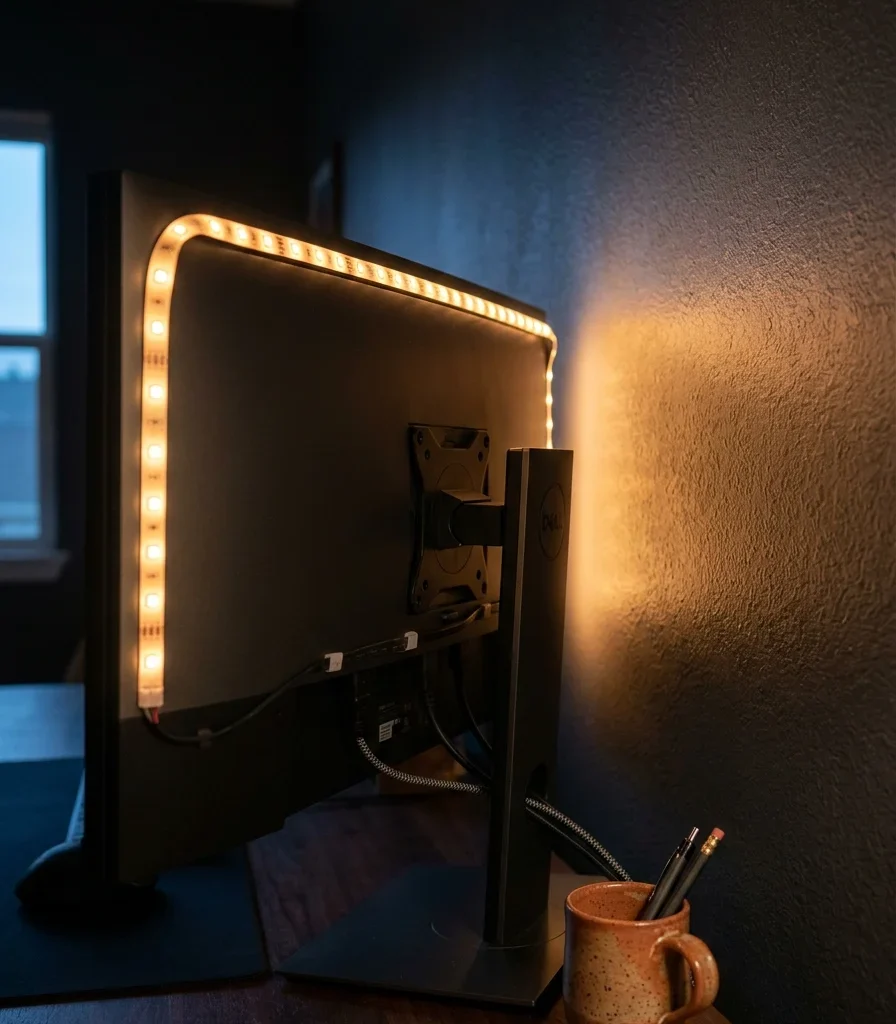
How to get it: Mount identical warm 2700–3000K LED strips behind each monitor at the same brightness setting (roughly 10% of each monitor’s own brightness), rather than lighting only the center screen, so the eye doesn’t have to readjust when shifting attention between monitors.

đź’ˇ Quick Win: A three-pack of USB-powered adhesive bias light strips under $25 lights all three monitors from a single low-cost purchase.

Shop the Look

Product
USB-powered LED bias light strip 3-pack
Warm 2700K adhesive LED strip
Small ceramic desk mug
Monitor-mount cable clip set
Dimmable LED controller

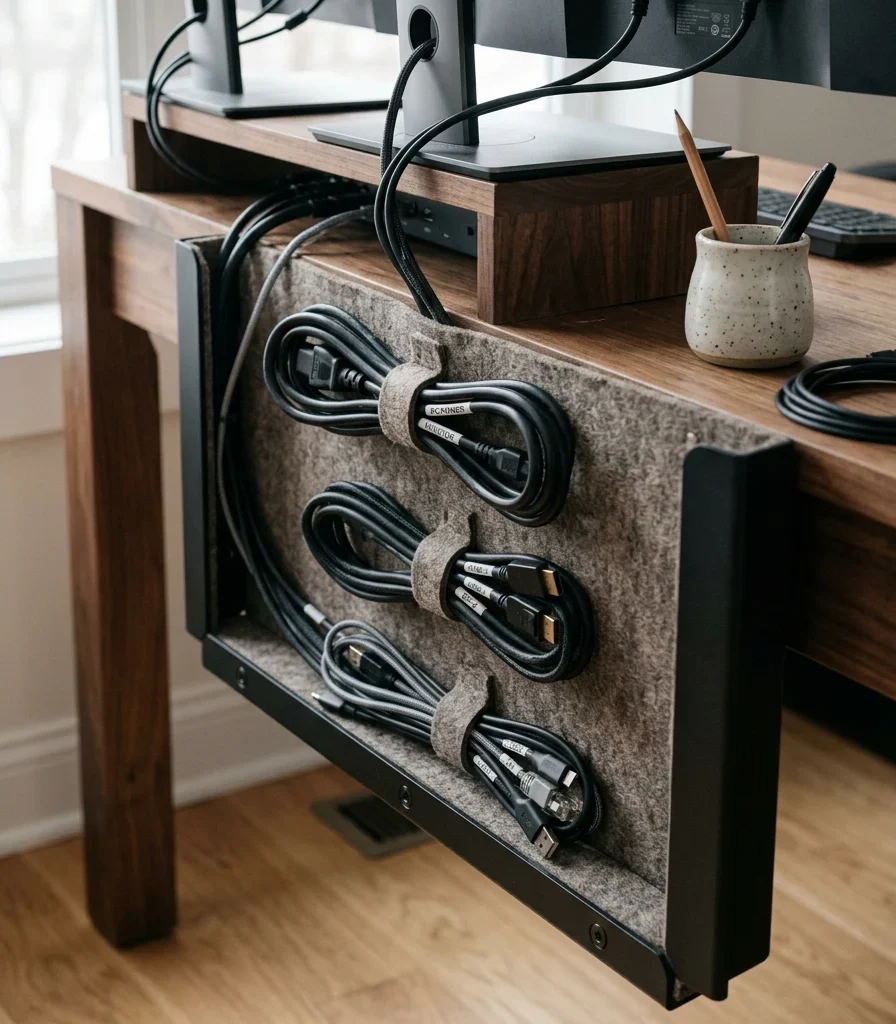
5. Install a Felt-Lined Cable Channel for Multi-Monitor Wiring

5. Install a Felt-Lined Cable Channel for Multi-Monitor Wiring

Vibe: Still three monitors’ worth of cabling contained in one quiet channel instead of tangling into one mass.

Why it works: A felt-lined channel solves a material and organizational problem specific to multi-monitor setups with three power cables, three video cables, and often a USB hub all running to one desk; plain cable tray lets them tangle together, while felt lining keeps each monitor’s cable bundle separated and cushioned against vibration and rattling.

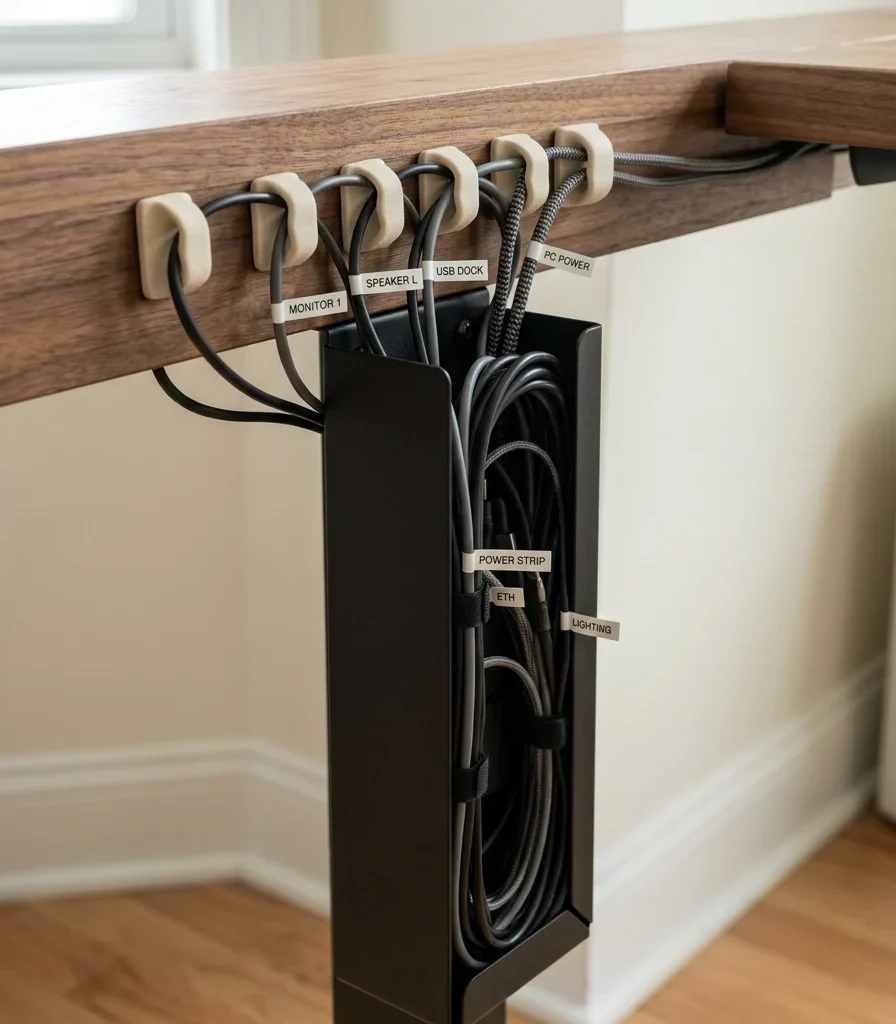
How to get it: Choose a cable channel wide enough to hold three separated cable bundles without compression, line it with a felt insert if it doesn’t come with one, and label each bundle at both ends so troubleshooting one monitor doesn’t require untangling all three.

Shop the Look

Product
Felt-lined cable management channel
Cable label tag set
Velcro cable tie set
Small ceramic pen holder
Power strip cable box

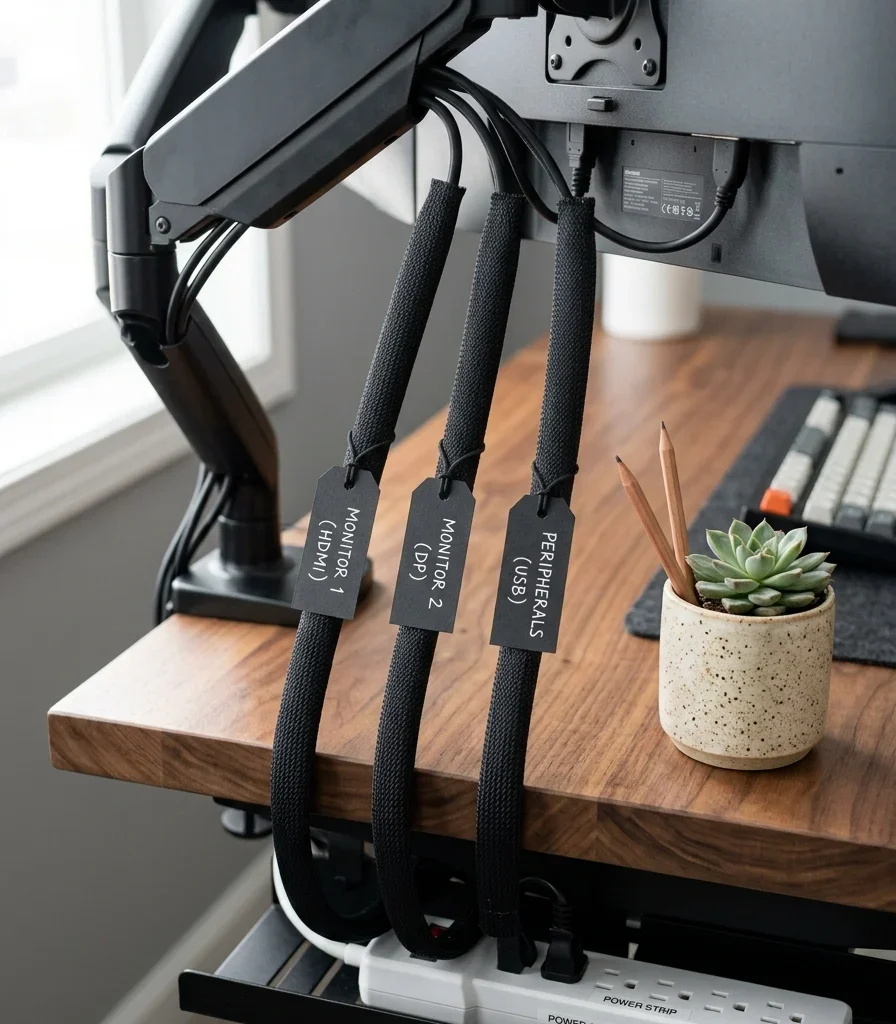
6. Use Labeled Cable Sleeves for Each Monitor’s Cord Run

6. Use Labeled Cable Sleeves for Each Monitor's Cord Run

Vibe: Tidy three individual cable runs that stay identifiable at a glance instead of merging into one indistinguishable bundle.

Why it works: Labeling matters specifically once a setup exceeds two monitors; with only one or two screens, tracing a cable back to its source is manageable by sight, but a three-or-more monitor array multiplies the number of cables enough that troubleshooting without labels becomes genuinely time-consuming, undermining the calm the rest of the setup is meant to provide.

How to get it: Wrap each monitor’s full cable run (power and video together) in its own fabric sleeve, and attach a small write-on label at both the monitor end and the power strip end identifying which screen it belongs to.

Shop the Look

Product
Fabric cable management sleeve set
Write-on cable label tags
Small ceramic desk organizer
Cable sleeve zipper closure
Labeled power strip surge protector

7. Choose Matte Black Bezels for Visual Consistency

7. Choose Matte Black Bezels for Visual Consistency

Vibe: Cohesive three screens that read as one connected field of view instead of three separate mismatched devices.

Why it works: Bezel and finish consistency is a visual-continuity principle that matters more with three monitors than one, since mismatched bezel colors or widths across an array create a visible seam the eye has to mentally correct for each time attention shifts between screens, adding a small but constant cognitive interruption over a full workday.

How to get it: Match monitor model, bezel width, and finish as closely as possible across all screens in the array, prioritizing identical models for the two side monitors flanking a center screen even if the center display is a different size, since mismatched side monitors are the most visually disruptive combination.

Shop the Look

Product
Matte black monitor bezel matching set
Monitor calibration color kit
Small ceramic desk mug
Matte black monitor riser
Cable clip matching finish

8. Choose a Curved Ultrawide Monitor Instead of Two Flat Screens

8. Choose a Curved Ultrawide Monitor Instead of Two Flat Screens

Vibe: Airy, a continuous field of view with no bezel line interrupting the middle of the screen.

Why it works: A curved ultrawide monitor eliminates the bezel-gap problem rather than managing it because the display is one physical panel rather than two or three separate monitors pushed together; there’s no seam where content gets visually cut off mid-window, and the curve itself keeps the edges of a very wide display at a consistent viewing distance from the eyes.

How to get it: Choose a curved ultrawide with a curvature radius matched to your typical viewing distance (roughly 1000R for a desk sitting 30 inches away), and mount it on a monitor arm rather than its included stand if the desk depth is limited, since ultrawide panels are often deeper than standard monitors.

Shop the Look

Product
Curved ultrawide monitor
Ultrawide compatible monitor arm
Matte black monitor riser
Small ceramic desk mug
Anti-glare screen filter ultrawide

9. Layer Ambient Light to Offset Multi-Screen Glare

9. Layer Ambient Light to Offset Multi-Screen Glare

Vibe: Warm a room lit consistently enough that no single monitor becomes the brightest object in the field of view.

Why it works: Ambient room lighting matters proportionally more with multiple monitors, since a wider array of bright screens against a dim room creates a more pronounced contrast strain than one monitor would alone; an ambient ceiling or pendant light set at a moderate level keeps the whole room’s brightness closer to the monitors’ own light output, reducing the pupil’s constant readjustment between screen and surroundings.

How to get it: Set the room’s ambient ceiling light to roughly 40–50% brightness during screen-heavy work (rather than very dim or very bright), pairing it with the bias lighting behind each monitor covered earlier so the two layers work together rather than one compensating entirely for the other’s absence.

Shop the Look

Product
Dimmable ceiling pendant light
In-line dimmer switch
Warm 2700K LED bulb
Small ceramic desk mug
Light level meter app-compatible sensor

10. Add Anti-Glare Screen Filters for Side Monitors

10. Add Anti-Glare Screen Filters for Side Monitors

Vibe: Functional: a screen that stays readable even when a window happens to sit at an unlucky angle behind it.

Why it works: Side monitors in a multi-screen array often catch window glare differently than a center screen facing straight ahead, since their angle relative to a window changes as they turn outward; an anti-glare matte filter specifically on the side monitors (rather than the whole array) addresses this asymmetric glare problem without dulling the sharper, more frequently viewed center display.

How to get it: Apply an anti-glare matte filter only to monitors that show visible window reflection during the brightest part of the day, testing each screen individually at midday before deciding which ones actually need the filter, since applying it universally can unnecessarily soften image clarity on screens that don’t have a glare problem.

Shop the Look

Product
Anti-glare matte screen filter
Screen filter mounting clips
Small ceramic desk mug
Microfiber screen cleaning cloth
Adjustable monitor arm tilt

11. Paint Surrounding Walls Warm White for Balanced Brightness

11. Paint Surrounding Walls Warm White for Balanced Brightness

Vibe: Fresh, a room bright enough for comfortable daytime visibility without straining to see any one of three screens.

Why it works: Keeping the room’s remaining walls in warm white while the specific wall behind the monitor array stays charcoal applies contrast strategically rather than uniformly; a multi-monitor setup needs enough general room brightness for peripheral comfort and video calls, while only the direct sightline behind the screens needs the darker tone to manage glare.

How to get it: Paint the room’s remaining walls in a warm white with a slight yellow undertone, reserving the charcoal specifically for the wall section spanning the monitor array’s width as covered in the earlier idea, so the two tones work together rather than one canceling out the other’s purpose.

Shop the Look

Product
Warm white matte wall paint
Small framed abstract print
Walnut wood picture frame
Warm white LED ceiling bulb
Painter’s tape edge trim

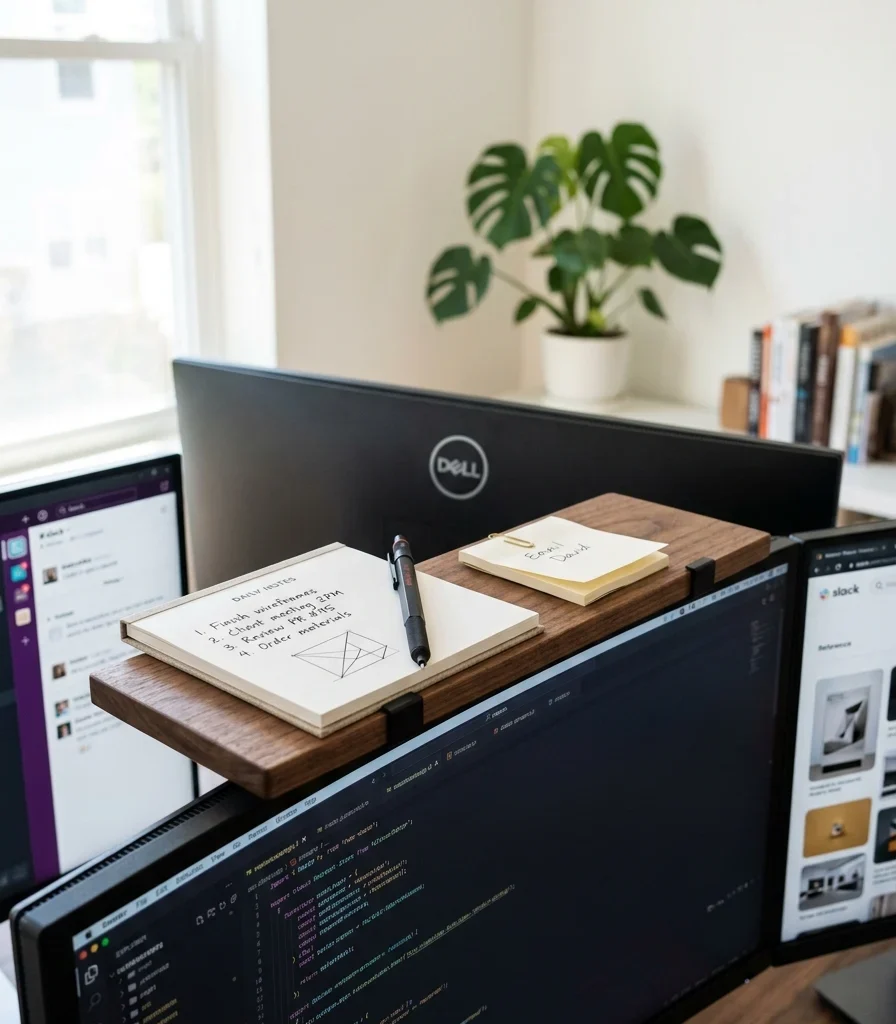
12. Add a Monitor-Top Shelf for Small Accessories

12. Add a Monitor-Top Shelf for Small Accessories

Vibe: Tidy a small extra surface that uses vertical space a wide multi-monitor desk otherwise wastes.

Why it works: A monitor-top shelf applies vertical negative space specifically valuable in a multi-monitor setup, where desk surface is already divided among three screens’ worth of stands or an arm’s footprint, leaving less flat space for small items like a notepad or phone than a single-monitor desk would have.

How to get it: Mount a slim walnut shelf across the top of the center monitor only (not the side screens, which would raise their height above the ideal eye-level position), using a clip-on mount rated for the monitor’s top-edge thickness, and limit items on it to lightweight essentials since weight can affect monitor arm balance.

Shop the Look

Product
Monitor top-mounted shelf walnut
Small notepad and pen set
Clip-on shelf mounting hardware
Small sticky note pad
Slim phone stand for shelf

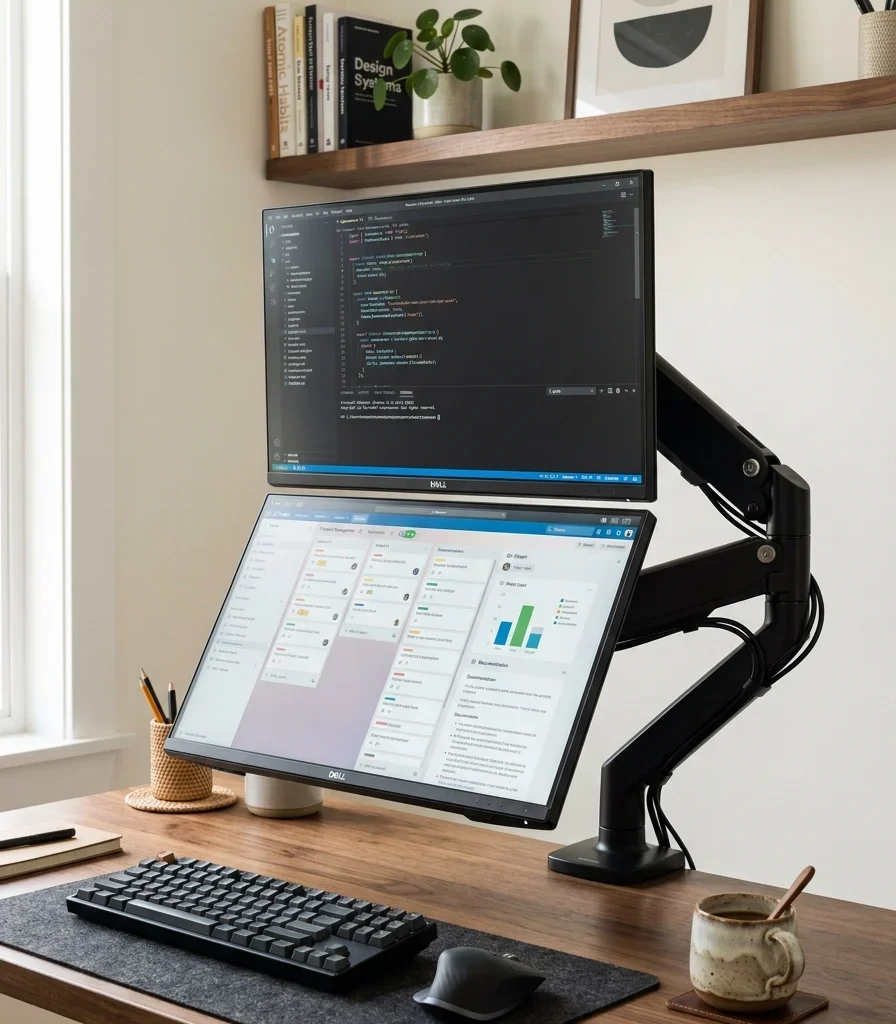
13. Configure a Stacked Dual-Monitor Setup for Vertical Space

13. Configure a Stacked Dual-Monitor Setup for Vertical Space

Vibe: Functional two screens stacked to use height instead of desk width, ideal for a narrower work surface.

Why it works: Stacking monitors vertically rather than side by side is a furniture-arrangement principle that trades desk width for vertical space, which suits reference-heavy work (reading documentation on the lower screen while writing on the upper one) better than a horizontal array, and requires significantly less desk width than adding a third monitor beside the first two.

How to get it: Mount the primary working monitor at standard eye level and the secondary reference monitor directly below it, angled slightly upward toward the user rather than flat, since a stacked lower screen viewed at a downward angle needs that upward tilt to stay comfortably readable.

đź’ˇ Quick Win: A simple stacking monitor mount under $60 converts two existing monitors into a vertical arrangement without buying new displays.

Shop the Look

Product
Vertical stacking monitor mount
Adjustable lower monitor tilt bracket
Small ceramic desk mug
Cable management for stacked arms
Desk clamp base weight rated

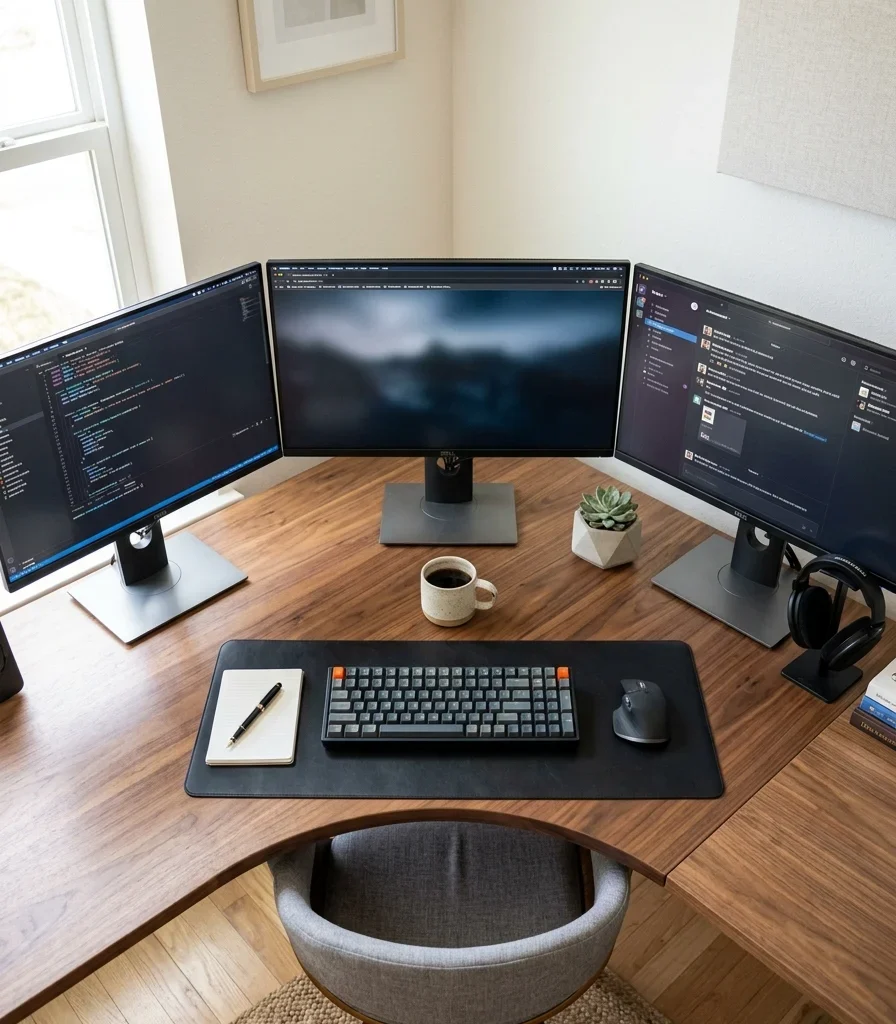
14. Angle the Side Monitors Inward for a Wraparound Field of View

14. Angle the Side Monitors Inward for a Wraparound Field of View

Vibe: Layered three screens curved around the user’s field of view instead of standing in a flat, unbroken line.

Why it works: Angling side monitors inward is a traffic-flow principle applied to eye movement rather than physical walking paths; a flat three-monitor row forces the neck to turn a full 15–20 degrees to view the outer edges of the side screens, while angling them inward at roughly 20–30 degrees keeps their content at a more consistent viewing distance and reduces that neck rotation.

How to get it: Set the side monitors at a 20 to 30 degree inward angle using an articulated arm rather than a fixed stand (fixed stands rarely allow this adjustment), and confirm the angle by sitting in your normal position and checking that you can read text on the outer edge of each side screen without turning your head fully toward it.

Shop the Look

Product
Articulated triple monitor arm
Angle adjustment monitor bracket
Small ceramic desk mug
Desk clamp mounting base
Cable management for angled arms

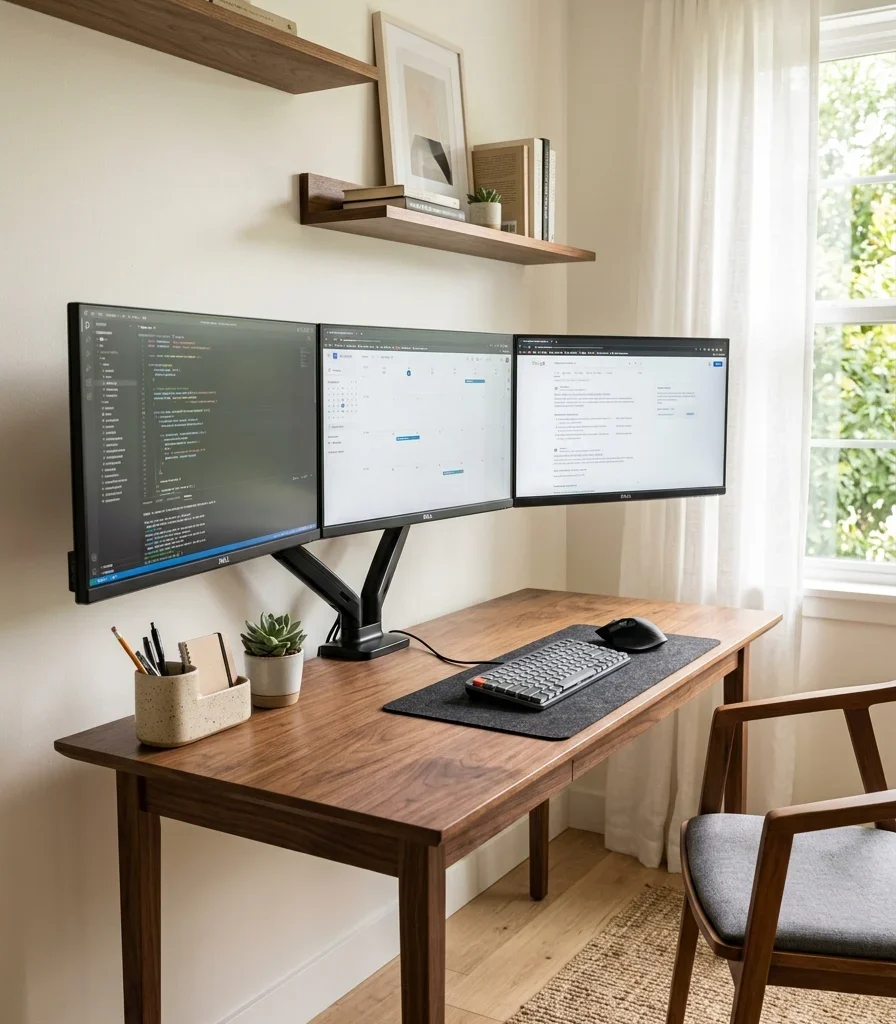
15. Build a Compact Triple-Monitor Setup for a Narrow Desk

15. Build a Compact Triple-Monitor Setup for a Narrow Desk

Vibe: Still three full monitors fitted into a desk width that would seem too narrow to hold them until the arm mount does its job.

Why it works: In a genuinely narrow desk under 50 inches wide, a monitor arm is the small-space adaptation that makes three screens possible at all; without an arm, three monitor stands at standard width simply won’t fit side by side on a 48-inch desk, while an articulated arm system can angle and layer the screens closer together than freestanding stands ever could.

How to get it: Choose monitors no wider than 24 inches each for a three-screen array on a desk under 50 inches, mount all three on a single compact triple-arm system rather than individual arms (which take up more base clamp space), and angle the side screens more aggressively inward than you would on a wider desk to compensate for the reduced physical spacing.

đź’ˇ Quick Win: A dual-monitor arm plus one slim monitor riser for a third central screen fits three displays on a narrow desk without a specialized triple-arm purchase.

Shop the Look

Product
Compact triple monitor arm system
Slim 24-inch monitor set
Single monitor riser stand
Small ceramic desk organizer
Narrow desk cable management tray

How to Start Your Multiple Monitor Setup Optimization

Your first move is mounting your monitors on an articulated arm before adjusting anything else. Since arm mounting determines every subsequent height, angle, and distance decision for each screen, it has to come first. Adjusting glare, lighting, or cabling around monitors still sitting on their factory stands means redoing that work again once the arm changes each screen’s position.

The most common mistake is treating all monitors in an array identically when only the center screen gets primary attention, which leads people to buy three matched high-end displays when a lower-cost secondary monitor for the side screens would serve reference material just as well. The fix is reserving the highest-quality display for the center position and choosing simpler, well-matched panels for the sides.

Three items under $50 that create immediate impact: a three-pack of USB bias light strips for behind each monitor, a felt-lined cable channel for the desk’s rear edge, and a set of labeled fabric cable sleeves.

A weekend setup arm mounting, lighting, and cable management costs $150–400. A full optimized three-monitor workstation with a curved ultrawide or matched triple-arm array typically runs $800–2,500 depending on monitor size and arm quality.

Frequently Asked Questions About Optimizing a Multiple Monitor Setup

What is the difference between a dual-monitor and triple-monitor optimized setup?

A dual-monitor setup typically needs only a standard dual arm and moderate desk depth, with less concern about side-monitor neck angle since two screens can often sit within a comfortable field of view. A triple-monitor setup requires more deliberate angling of the outer screens, wider desk depth or a compact arm system, and more attention to consistent lighting and bezel matching across all three displays.

What color works best behind a multi-monitor array?

A matte warm charcoal or matte black works best, spanning the full width of the monitor array rather than just the center screen, since a bright wall behind any part of a multi-screen setup increases glare and contrast strain across the whole field of view, not just the section directly behind one monitor.

How much does it cost to optimize a multiple monitor setup?

A budget refresh using bias lighting, cable management, and an anti-glare filter costs $50–200. A mid-range upgrade with a proper triple-monitor arm and matched displays runs $500–1,200, and a full setup with a curved ultrawide or premium matched triple array typically costs $1,200–3,000 depending on monitor size and resolution.

Can a multi-monitor setup work well on a small or narrow desk?

Yes, and a monitor arm matters even more in this case; a compact triple-arm system lets three monitors sit closer together and angle inward more aggressively than freestanding stands allow, making a narrow desk under 50 inches wide genuinely workable for a three-screen array where flat stands alone would not fit.

What is the most important adjustment for a multi-monitor setup?

Angling the side monitors inward is the most important single adjustment, since a flat, unbroken row of monitors forces repeated neck rotation toward the outer screens throughout the day. A 20 to 30 degree inward angle on an articulated arm reduces that rotation more than any single material or lighting change covered elsewhere.

Ready to Optimize Your Home Office Multiple Monitor Setup?

These 15 ideas move across furniture, lighting, color, material, and true small-space adaptations from a triple-monitor arm and angled wraparound field of view to a curved ultrawide that eliminates the bezel gap. None of this needs to happen all at once, and mounting your current monitors on an arm this week is genuinely the smartest place to start, not a smaller version of the full setup. Today’s specific action: sit in your normal position and check whether you have to turn your head to read the outer edge of your side monitors. If you do, that’s the one adjustment to make before anything else on this list. Once the angles, lighting, and cabling are all actually working together, sitting down at a multi-screen desk will feel less like managing three separate distractions and more like working inside one wide, coherent field of view. Save the ideas that fit your desk’s real dimensions and your actual monitor count; that angled arm and matched bias lighting will still be doing their job a year from now.

You Might Also Like

20 Small Office Organization Ideas to Improve Your Home

20 Small Office Organization Ideas to Improve Your Home

Small office organization is the practice of giving every paper, cable, and supply a fixed, labeled home within arm’s reach of the desk, so a compact workspace stays functional without requiring more square footage than it already has. This article gives you 20 genuinely effective small office organization ideas to improve your home, covering material, color, lighting, and layout decisions that turn a cluttered desk corner into a system that actually holds up week after week.

It feels like sitting down and knowing exactly where everything is a labeled jar for loose supplies instead of a drawer of tangled odds and ends, a filing tower that holds a year’s paperwork in a footprint the size of a chair, cables routed so cleanly they disappear from view entirely. This is small office organization at its most resolved: quiet, considered, built to survive an actual workweek instead of falling apart by Wednesday.

Here are 20 ideas worth saving nd stealing.

Why Small Office Organization Works So Well

Small office organization draws from the broader home-organization movement that gained momentum through the 2010s, which shifted the emphasis from simply owning attractive storage furniture to assigning every object a specific, labeled home a system-first approach rather than a purchase-first one. What distinguishes genuine organization from decorative storage is that every basket, jar, or shelf in a well-organized small office answers a specific question: where does this exact item live, and how do I find it again in thirty seconds?

Core materials favor matte, labeled, and modular pieces: walnut or oak filing furniture, felt-lined drawer dividers, painted MDF pegboards, and woven baskets sized to fit specific shelf openings. Color leans toward warm charcoal or matte black for storage walls (which visually recede), paired with warm white walls elsewhere to keep a small room from feeling boxed in.

This approach is trending because remote and hybrid work pushed home offices into rooms never designed to hold filing systems or supply closets, and both organizing-industry data and Pinterest search interest in “home office organization” and “small office storage” have grown steadily as more people manage real paperwork and equipment from spaces that were once a spare bedroom corner.

Yes,  a small office benefits more from deliberate organization than a large one does, since there’s no spare surface to absorb clutter. Prioritize vertical storage and drawer dividers first; floor space should be the last resort, not the starting point.

Style at a Glance

ElementCore Trait 1Core Trait 2
PhilosophyEvery item assigned a specific, labeled homeSystem-first organization over decorative storage alone
MaterialsWalnut filing furniture, felt drawer dividers, painted MDF pegboardWoven baskets, matte black hardware
Color PaletteWarm charcoal storage wallWarm white surrounding walls

20 Small Office Organization Ideas to Improve Your Home

1. Choose a Walnut Filing Cabinet With Soft-Close Drawers

1. Choose a Walnut Filing Cabinet With Soft-Close Drawers

Vibe: Still a filing system solid enough to hold a year of paperwork without ever feeling like a plastic bin.

Why it works: Material quality matters in filing furniture because soft-close mechanisms and full-extension drawer slides genuinely reduce daily friction. A drawer that sticks or slams gets used less consistently, which is the material-honesty principle behind why furniture-grade filing cabinets outperform flimsy plastic carts for actual long-term paper organization.

How to get it: Choose a walnut or walnut-veneer two-drawer cabinet with full-extension slides rated for hanging file folders, and label each folder tab clearly with a consistent system (by project or by month) rather than mixing organizing methods within the same drawer.

đź’ˇ Quick Win: A set of matching hanging file folders under $20 upgrades an existing plastic bin’s organization without any new furniture.

Shop the Look

Product
Walnut two-drawer filing cabinet
Matte black cabinet pull
Hanging file folder set labeled
Small ceramic pen cup
Full extension drawer slide kit

2. Paint a Warm Charcoal Storage Wall for Visual Calm

2. Paint a Warm Charcoal Storage Wall for Visual Calm

Vibe: Grounded a storage wall dark enough to recede rather than dominate a small room’s limited sightlines.

Why it works: Painting an entire storage wall in the same warm charcoal as its cabinetry is a visual-weight principle; matching the wall to the furniture lets the eye read the whole surface as one calm block instead of a bright wall interrupted by dark boxes, which matters specifically when a small office needs more storage volume than its square footage would typically suggest.

How to get it: Paint both the wall and any built-in shelving in the identical matte warm charcoal formula, reserving a lighter warm white for the room’s remaining walls so the storage wall reads as an intentional zone rather than an accident of leftover paint.

Shop the Look

Product
Warm charcoal matte wall paint
Small desk plant ceramic pot
Matte black shelf bracket
Painter’s tape precision edge
Warm white contrast wall paint

3. Add a Vertical Filing Tower Beside the Desk

3. Add a Vertical Filing Tower Beside the Desk

Vibe: A tidy tower that claims a narrow strip of floor and turns it into serious filing capacity.

Why it works: A vertical tower applies negative-space thinking specifically to the narrow gap beside most desks rather than a wide, shallow filing drawer built into the desk itself (which eats into legroom). A tall tower uses height instead of desk depth, holding more paper capacity in less floor footprint.

How to get it: Choose a tower no wider than 14 inches so it fits beside the desk without crowding legroom, and label each drawer by category rather than leaving them blank, since an unlabeled tower defaults back to a single miscellaneous catch-all over time.

Shop the Look

Product
Narrow vertical filing tower
Matte black drawer pull set
Drawer label tag set
Small ceramic desk tray
Felt drawer liner

4. Add Under-Shelf Task Lighting for a Clutter-Free Desk

4. Add Under-Shelf Task Lighting for a Clutter-Free Desk

Vibe: Hushed a desk that stays genuinely clear because even the light source doesn’t take up surface space.

Why it works: Under-shelf lighting solves an organization problem indirectly by removing the desk lamp that would otherwise compete for the same limited surface a small office desk already struggles to keep clear. In a compact room, every object removed from the working surface is genuine organizational gain.

How to get it: Install a warm 2700K LED strip along the underside of any shelf or cabinet directly above the desk, wired to its own switch, so task lighting comes from the cabinetry rather than an additional desk-mounted fixture.

đź’ˇ Quick Win: A battery-powered adhesive LED strip under $20 achieves the same clutter-free lighting without any wiring.

Shop the Look

Product
Warm 2700K under-shelf LED strip
Battery-powered adhesive LED strip
Small ceramic pen cup
In-line dimmer switch
Adhesive LED mounting clips

5. Use Labeled Ceramic Jars for Small Supplies

5. Use Labeled Ceramic Jars for Small Supplies

Vibe: Tidy the smallest desk supplies given their own fixed, visible home instead of loose in a drawer.

Why it works: Labeled jars solve the specific organizational failure point of small desk supplies: paperclips, pushpins, and rubber bands are too small to organize by category inside a drawer without dividers, and a labeled jar makes both storage and retrieval instant, removing the daily friction that leads small supplies to scatter across the desk.

How to get it: Use one jar per category rather than one large jar for everything, labeling each with a small wood tag or engraved marker so the system stays legible even after months of daily use.

Shop the Look

Product
Matte ceramic jar set labeled
Wood engraved label tag
Small dried botanical stem
Ceramic pen cup matching set
Small wood tray for jars

6. Install a Pegboard Wall System in Painted MDF

6. Install a Pegboard Wall System in Painted MDF

Vibe: Organized, every loose object given a fixed vertical address instead of colonizing the desk surface.

Why it works: A pegboard exploits vertical wall space, the most underused dimension in a small office where floor and desk area are fixed but wall height above the desk is typically empty. Painting the MDF to match the wall (rather than leaving it raw) keeps the system from visually competing with the desk below it.

How to get it: Mount a 24Ă—18-inch painted pegboard 6 inches above the desk’s back edge, using a mix of hook lengths and small shelf pegs so items hang at varied depths rather than crowding into one flat plane.

Shop the Look

Product
Painted MDF pegboard 24×18 inch
Matte black pegboard hook set
Small round wall clock
Pegboard shelf attachment
Canvas hanging tool pouch

7. Match the Storage Cabinet to the Wall Color

7. Match the Storage Cabinet to the Wall Color

Vibe: Serene. A storage cabinet that visually disappears into the architecture instead of announcing itself as furniture.

Why it works: Matching cabinet color to wall color is the same visual-weight technique used on the charcoal storage wall earlier, applied here to a lighter palette. A contrasting cabinet color draws the eye and makes storage feel larger and more imposing, while a matched tone lets the same physical volume feel like part of the room rather than an added block.

How to get it: Request the exact paint formula used on the walls rather than a close approximation, and keep only the hardware in a contrasting matte black to mark where the storage begins without breaking the color continuity.

Shop the Look

Product
Matching wall and cabinet paint
Matte black cabinet hardware
Small ceramic desk tray
Cabinet color matching swatch kit
Matte black cabinet hinge

8. Add a Rolling File Cart That Tucks Under the Desk

8. Add a Rolling File Cart That Tucks Under the Desk

Vibe: Functional filing storage that disappears under the desk entirely when it’s not actively in use.

Why it works: A rolling cart applies dual-function furniture thinking to the gap beneath most desks rather than leaving that space empty because a fixed cabinet wouldn’t fit around the legs; a cart on casters occupies it fully and rolls out only when files are actually needed.

How to get it: Measure the desk’s under-clearance precisely and choose a cart at least an inch narrower and shorter than that space so it slides in and out without catching, fitting each drawer with a specific labeled category rather than mixed contents.

Shop the Look

Product
Rolling file cart walnut
Caster wheel lock set
Drawer label tag set
Small ceramic desk organizer
Hanging file folder insert

9. Add Interior Cabinet Lighting for a Closed Storage Wall

9. Add Interior Cabinet Lighting for a Closed Storage Wall

Vibe: Warm a cabinet interior lit clearly enough that finding anything inside takes seconds, not a flashlight.

Why it works: Interior cabinet lighting is a light-behavior principle that directly supports organization rather than decoration. Closed storage in a small office often sits in a dim corner, and without interior light, contents get harder to find, which encourages items to migrate back out onto visible surfaces instead of staying properly filed away.

How to get it: Install a motion-activated or door-switch-triggered warm 2700K LED strip along the interior top edge of the cabinet, so light turns on automatically the moment the door opens rather than requiring a separate switch.

Shop the Look

Product
Motion-activated interior LED strip
Door switch light trigger
Small ceramic interior tray
Cabinet interior shelf divider
Warm 2700K LED bulb pack

10. Fit Woven Basket Drawers Into an Open Shelf

10. Fit Woven Basket Drawers Into an Open Shelf

Vibe: Layered open shelving that still keeps loose supplies contained rather than exposed and scattered.

Why it works: Fitting baskets into an open shelving frame combines two organizational functions at once: the shelf itself uses vertical wall space efficiently, while the baskets prevent the visual clutter open shelving alone would create, since each basket contains one specific supply category rather than leaving small items loose across bare shelves.

How to get it: Measure each cubby opening precisely before ordering baskets, since even a half-inch of extra clearance lets them shift and look untidy, and label each one by category so the system stays organized after repeated daily use.

đź’ˇ Quick Win: A single well-sized woven basket in an existing open shelf corrals loose items immediately without a full shelving purchase.

Shop the Look

Product
Open oak shelving frame
Woven basket drawer set fitted
Wood engraved label tag
Small ceramic accent jar
Felt basket liner

11. Frame a Cork Bulletin Board in Oak

11. Frame a Cork Bulletin Board in Oak

Vibe: Hushed, a soft, textured surface that holds the week’s loose papers off the desk entirely.

Why it works: A framed cork board applies material honesty to a category typically sold in bright plastic frames or unfinished black cork. Wrapping the board in a thin oak frame lets it match the room’s other wood tones while giving loose notes, reminders, and mail a dedicated wall home instead of a growing desk pile.

How to get it: Mount a 24Ă—36-inch cork board in a thin oak frame beside (not above) the monitor so it doesn’t interfere with sightlines, and limit pinned items to the current week’s essentials rather than letting it accumulate indefinitely.

Shop the Look

Product
Natural cork board oak frame
Matte black push pin set
Small printed weekly planner card
Oak wood frame trim
Cork board mounting hardware

12. Match Bookend and Binder Spines for a Cohesive Shelf

12. Match Bookend and Binder Spines for a Cohesive Shelf

Vibe: Cohesive a shelf of reference materials that reads as one organized system instead of a mismatched stack.

Why it works: Uniform binder spines and matching bookends apply a visual-consistency principle to reference storage; mismatched binder colors and brands create visual noise that makes a shelf look cluttered even when its actual organization inside each binder is sound, while a matched set signals order at a glance before anyone opens a single one.

How to get it: Replace mismatched binders with one uniform set in the same color and spine width, labeling each spine with a printed label rather than handwriting, and bookend the row with a matched pair to keep the binders upright without leaning.

Shop the Look

Product
Matching binder set warm cream
Matte brass bookend pair
Printed spine label set
Small ceramic vessel
Walnut wood shelf

13. Add Floating Shelves to Clear the Floor

13. Add Floating Shelves to Clear the Floor

Vibe: Airy storage that adds real capacity without a single floor-standing bookcase eating into the room’s walking path.

Why it works: Floating shelves reduce visual mass at floor level, a negative-space principle that matters directly in a small office where a floor-standing bookcase’s legs and base interrupt the sightline across an already tight room; mounted shelves let the eye travel across open floor uninterrupted.

How to get it: Mount floating shelves on concealed brackets rated for at least 30 lbs per shelf, spacing them 10–12 inches apart vertically, and keep the floor beneath entirely clear of boxes or baskets to preserve the open-floor effect the shelves are meant to create.

Shop the Look

Product
Floating walnut shelf set
Concealed shelf bracket rated
Small ceramic decorative vessel
Book storage box set
Small wood bookend

14. Zone the Office by Task: Work, Reference, Supplies

14. Zone the Office by Task: Work, Reference, Supplies

Vibe: Airy, a small room that still manages to separate active work from reference and supply storage.

Why it works: Zoning by task is a layout principle that prevents the most common small-office organizational failure: a single desk trying to hold active work, reference materials, and loose supplies all at once, which guarantees clutter regardless of how tidy any individual system is, since everything competes for the same surface.

How to get it: Assign the desk itself exclusively to active work, move reference binders and books to a nearby shelf, and route supplies to a cabinet or drawer tower at least a few feet away, so each zone’s location matches its specific function rather than defaulting everything to arm’s reach of the chair.

Shop the Look

Product
Zoned storage label set
Small ceramic tray per zone
Walnut reference shelf
Matte black hook set
Supply cabinet organizer bin

15. Use Felt-Lined Drawer Dividers for the Desk

15. Use Felt-Lined Drawer Dividers for the Desk

Vibe: Still a drawer where every pen, clip, and stamp has its own compartment instead of sliding loose.

Why it works: Felt dividers apply the same organizational logic as the labeled jars, but inside a drawer where visibility matters less than physical separation. Without dividers, small desk drawer contents shift and mix every time the drawer opens and closes, undoing whatever sorting was done the last time.

How to get it: Choose a felt divider tray sized to the drawer’s exact interior dimensions (measure before ordering, since even a half-inch gap lets the tray shift), with compartment sizes matched to what the drawer actually holds rather than a generic uniform grid.

Shop the Look

Product
Felt drawer divider tray
Small ceramic paperclip dish
Desk drawer organizer insert
Pen and pencil felt slot tray
Small drawer liner felt

16. Paint Walls Warm White to Make a Small Office Feel Larger

16. Paint Walls Warm White to Make a Small Office Feel Larger

Vibe: Fresh, a room bright enough that even a heavily organized wall of storage doesn’t feel closed in.

Why it works: Warm white walls apply a light-reflectivity principle that matters proportionally more in a small, storage-dense room. Every organizational system added to the walls (shelves, cabinets, pegboards) adds visual mass, and a light, reflective wall color offsets that mass by bouncing available daylight back into the room rather than absorbing it.

How to get it: Choose a warm white with a soft yellow undertone (avoid a stark, blue-based white, which can look clinical under desk lighting), applying it to every wall except any single storage-wall accent covered in an earlier idea.

Shop the Look

Product
Warm white matte wall paint
Small framed abstract print
Walnut wood picture frame
Warm white LED ceiling bulb
Painter’s tape edge trim

17. Add a Motion-Sensor Light for a Hidden Supply Nook

17. Add a Motion-Sensor Light for a Hidden Supply Nook

Vibe: Functional supply nook that lights itself the moment you reach for something, no fumbling for a switch.

Why it works: A motion-sensor light removes the last friction point in an otherwise well-organized closet or nook; even a perfectly labeled system gets used less consistently if finding anything requires groping in the dark first, so automatic lighting keeps the nook’s organization actually functional rather than just theoretically sound.

How to get it: Install a battery-powered motion-sensor LED puck light inside the nook at the top corner facing downward, and pair it with matching labeled bins so the light immediately reveals a legible system rather than a jumble.

đź’ˇ Quick Win: A single stick-on motion light under $15 solves the visibility problem in any dark cabinet or closet immediately.

Shop the Look

Product
Motion sensor LED puck light
Battery-powered stick-on light
Labeled storage bin set
Small ceramic tray
Bin label tag set

18. Add a Cable and Cord Organizer Tray

18. Add a Cable and Cord Organizer Tray

Vibe: Tidy cords with a fixed, visible path instead of drifting loose across the floor or desk edge.

Why it works: Cable clutter is a specific organizational failure unique to home offices, and an under-desk tray routes power strips and charging cables below the visible work surface, which matters because visual clutter in peripheral vision has been shown to draw low-level attention even when a person isn’t consciously looking at it.

How to get it: Mount a tray sized to hold the desk’s power strip plus at least two device cables, positioned close enough to the wall outlet that cords don’t stretch taut, and label each cable at both ends so troubleshooting doesn’t require untangling the whole tray.

Shop the Look

Product
Walnut under-desk cable tray
Cable label tag set
Velcro cable tie set
Power strip surge protector
Cable sleeve organizer

19. Position Storage Within Arm’s Reach of the Desk

Vibe: Still workspace where nothing requires actually getting up out of the chair to retrieve.

Why it works: Arm’s-reach placement is a traffic-flow and ergonomics principle that determines whether an organizational system actually gets used daily. Storage that requires standing and walking across the room, even a short distance, gets skipped under time pressure, which is how organized systems quietly break down within a few weeks of being set up.

How to get it: Arrange daily-use storage (pens, current files, chargers) within a seated arm’s reach of roughly 24–30 inches from the chair, reserving anything requiring a stand-up retrieval for archival or rarely used items only.

Shop the Look

Product
Swivel desk organizer caddy
Small ceramic desk tray
Walnut reach shelf mount
Rolling file cart nearby
Matte black desk hook

20. Add a Fold-Away Storage Cabinet for a Multi-Use Room

20. Add a Fold-Away Storage Cabinet for a Multi-Use Room

Vibe: Functional office storage that folds away entirely when the room needs to become something else.

Why it works: In a genuinely small room shared with another function, a guest bedroom or playroom fold-away cabinet is the small-space adaptation that keeps office organization from permanently claiming floor space the room needs for its other role, folding flat against the wall to reclaim that footprint instantly.

How to get it: Choose a wall-mounted cabinet with a fold-flat hinge mechanism rated for the weight of fully loaded shelves, and organize its interior with the same labeled bins and dividers covered in earlier ideas so the system stays functional every time it’s unfolded.

đź’ˇ Quick Win: A single fold-down wall desk with built-in cubbies combines workspace and storage in one foldable unit for the tightest multi-use rooms.

Shop the Look

Product
Fold-away wall mounted cabinet
Fold-down wall desk with cubbies
Labeled storage bin set
Small ceramic interior organizer
Matte black fold hinge hardware

How to Start Improving Your Small Office Organization

Your first move is doing a full paper and supply audit before buying any storage furniture, specifically, gathering every loose paper, cable, and supply currently in the room into one pile so you can see the actual volume you’re organizing for. Buying furniture before this step means guessing at capacity, which is how most home offices end up with either too little storage or bulky pieces that don’t match what they actually needed to hold.

The most common mistake is buying decorative storage baskets or bins before deciding what specific category will live in each one, which leads to mismatched sizes and items migrating back out onto visible surfaces within weeks. The fix is assigning a category to each container first, then measuring and buying to fit that specific need.

Three items under $50 that create immediate impact: a set of labeled matte ceramic jars for small supplies, a felt drawer divider tray sized to your desk drawer, and a stick-on motion-sensor light for any dark cabinet or nook.

A weekend refresh of jars, dividers, and cable management costs $80–250. A full organizational overhaul with a filing tower, floating shelves, and a fold-away cabinet typically runs $400–1,500 and can be completed in one to two weekends.

Frequently Asked Questions About Small Office Organization

What is the difference between organizing and decorating a small home office?

Decorating a small home office focuses on how storage looks: matching baskets, styled shelves, coordinated colors. Organizing focuses on function first: assigning every item a specific, labeled home and placing it within arm’s reach of where it’s actually used, with decoration applied only after the functional system is settled.

What color works best for small office storage?

Warm charcoal or matte black works best for a dedicated storage wall, since darker tones visually recede rather than dominate a small room, while warm white on the remaining walls keeps the overall space feeling open. Matching cabinet color exactly to wall color is the specific technique that keeps a large volume of storage from feeling heavy.

How much does it cost to organize a small home office?

A budget refresh using labeled jars, drawer dividers, and cable management costs $80–250. A mid-range upgrade with a filing tower and floating shelves runs $400–900, and a full organizational renovation including built-in cabinetry and a fold-away storage wall typically costs $1,500–3,500 depending on custom carpentry.

Can a shared or multi-use room still support real office organization?

Yes, a fold-away wall cabinet or a rolling file cart that tucks fully under the desk lets office storage disappear when the room needs to serve another purpose, preserving genuine organizational function without permanently claiming floor space the room needs for its other role.

What is the single most important organizational habit for a small office?

Keeping daily-use items within arm’s reach of the desk chair matters most, since storage requiring a stand-up retrieval gets used inconsistently under time pressure, which is how even a well-designed organizational system quietly breaks down within the first few weeks of daily use.

Ready to Improve Your Small Office Organization?

These 20 ideas move across material, color, lighting, layout, and true small-space solutions from a walnut filing tower and labeled ceramic jars to a fold-away cabinet that reclaims the room the moment office hours end. None of this needs to happen all at once, and starting with a paper audit and one labeled jar set is genuinely the smartest place to begin, not a smaller version of the full system. Today’s specific action: gather every loose paper and supply currently scattered across your desk into one pile, since that pile will tell you exactly which idea on this list to tackle first. Once every item finally has a fixed, labeled home, sitting down to work will feel less like managing clutter and more like everything simply being exactly where you left it. Save the ideas that fit your room’s real dimensions and your actual daily habits; that labeled filing tower and arm’s-reach supply system will still be doing their job just as well a year from now.

You Might Also Like

15 Productive Home Office Computer Setup Ideas

15 Productive Home Office Computer Setup Ideas

A productive home office computer setup is a desk arrangement built specifically around focus and screen work, monitor position, cable management, task lighting, and seating chosen to reduce physical strain and visual distraction rather than purely for decoration. This article gives you 15 genuinely effective productive home office computer setup ideas covering furniture, lighting, material, and layout decisions that turn a desk into a space you can actually concentrate at for hours.

It feels like sitting down and immediately settling in: no glare bouncing off the monitor, no tangle of cords catching your eye mid-task, no chair that needs adjusting five times before it feels right. This is a productive computer setup at its most resolved: quiet, considered, built around how attention actually works. Light falls where it should. Every surface earns its place instead of collecting clutter.

Here are 15 ideas worth saving and stealing.

Why a Productive Home Office Computer Setup Works So Well

A productive computer setup draws from two combined disciplines: ergonomics research from the corporate office design movement of the 1990s, which established the physical measurements (monitor height, chair support, keyboard distance) that reduce strain over long sitting sessions, and the more recent minimalist desk-setup culture that emerged from remote work, which treats visual clutter as a direct cost to focus rather than a purely aesthetic issue. What distinguishes a genuinely productive setup from a merely stylish one is that every decision is tested against a functional question first: does this reduce strain or distraction, or just look good?

The core materials favor matte, non-reflective surfaces: walnut or white oak desks, felt or wool desk pads, matte black or brushed aluminum hardware, and cork or acoustic panel wall treatments. Color leans toward warm charcoal or sage green as a focus-wall accent, paired with warm white walls elsewhere, since the wall directly behind a monitor affects screen glare and eye strain more than most people realize.

Style at a Glance

ElementCore Trait 1Core Trait 2
PhilosophyEvery surface and object justified by function, not decoration aloneVisual clutter treated as a direct cost to focus
MaterialsMatte walnut or oak, felt desk pads, matte black hardwareCork or acoustic wall panels, brushed aluminum
Color PaletteWarm charcoal or sage focus wallWarm white surrounding walls

15 Productive Home Office Computer Setup Ideas

1. Choose a Walnut Desk With Built-In Cable Management

1. Choose a Walnut Desk With Built-In Cable Management

Vibe: Still a desk surface with nothing on it competing for attention except the work itself.

Why it works: Material and functional design converge here: a desk with a built-in rear channel and grommet hole routes power and monitor cables below the visible surface, which matters for focus because visual clutter (a nest of cords in peripheral vision) has been shown to draw low-level attention even when a person isn’t consciously looking at it, quietly taxing concentration over a long session.

How to get it: Choose a solid walnut or walnut-veneer desk with a rear cable channel at least 2 inches deep and a single grommet hole positioned behind the monitor, and route every cable monitor, charger, desk lamp through that one channel rather than letting any of them run loose across the desktop.

đź’ˇ Quick Win: A clip-on cable channel tray under $25 retrofits an existing flat desk without requiring a new one.

Shop the Look

Product
Walnut desk with cable channel
Clip-on under-desk cable tray
Matte black cable grommet cover
Small ceramic pen cup
Cable sleeve organizer set

2. Paint a Warm Charcoal Focus Wall Behind the Monitor

2. Paint a Warm Charcoal Focus Wall Behind the Monitor

Vibe: Grounded a wall dark enough to disappear behind the screen instead of competing with it.

Why it works: Wall color directly behind a monitor affects screen contrast perception through a light-behavior principle: a bright white wall reflects ambient light into peripheral vision and increases the contrast the eye has to adjust for when looking at a darker screen, while a matte warm charcoal wall absorbs more of that reflected light, reducing the visual adjustment strain over a full workday.

How to get it: Paint just the wall section directly behind and slightly wider than the monitor setup in a matte warm charcoal (avoid gloss, which reintroduces reflection), keeping the rest of the office in a lighter tone so the charcoal reads as a deliberate focus zone rather than a full dark room.

Shop the Look

Product
Warm charcoal matte wall paint
Small desk plant ceramic pot
Matte black monitor stand
Painter’s tape precision edge
Anti-glare monitor mount arm

3. Add a Dual-Monitor Arm to Reclaim Desk Surface

3. Add a Dual-Monitor Arm to Reclaim Desk Surface

Vibe: Functional two full-size monitors floating above a desk that still has room left to actually work on.

Why it works: A monitor arm applies negative space and proportion principles directly to ergonomics : ounting monitors on an articulated arm rather than their factory stands reclaims roughly 6 to 8 inches of desk depth per monitor, space that stacks up meaningfully in a dual-monitor setup, while also allowing precise height and distance adjustment that fixed stands can’t offer.

How to get it: Choose a dual-monitor arm rated for your specific screen weight, and set the top of each monitor at or just below eye level with the top edge roughly an arm’s length away, adjusting the arm rather than stacking books or a monitor riser underneath.

Shop the Look

Product
Dual monitor articulated arm mount
VESA mount adapter plate
Small ceramic coffee mug
Cable clip for monitor arm
Anti-fatigue desk mat

4. Install Bias Lighting Behind the Monitor for Eye Comfort

4. Install Bias Lighting Behind the Monitor for Eye Comfort

Vibe: Hushed, a soft glow behind the screen that quietly reduces how hard the eyes have to work in a dim room.

Why it works: Bias lighting is a light-behavior principle borrowed directly from film and photo editing studios; placing a warm, low-intensity LED strip behind the monitor reduces the contrast between a bright screen and a dark surrounding wall, which is the specific contrast differential that causes eye strain during long evening or low-light work sessions.

How to get it: Mount a warm 2700–3000K LED strip along the back edge of the monitor (not the desk), set to roughly 10% of the monitor’s own brightness, since bias lighting that’s too bright defeats its purpose by adding its own glare rather than softening the screen’s contrast.

đź’ˇ Quick Win: An adhesive-backed USB bias light strip under $15 plugs directly into the monitor’s USB port with no separate power supply needed.

Shop the Look

Product
USB-powered LED bias light strip
Warm 2700K adhesive LED strip
Small ceramic desk mug
Monitor-mount cable clip
Dimmable LED controller

5. Add a Felt Desk Pad for a Quiet, Tactile Surface

5. Add a Felt Desk Pad for a Quiet, Tactile Surface

Vibe: Still a desk surface that softens sound and touch in a way bare wood or laminate never does.

Why it works: Felt applies a texture-layering and sensory-comfort principle specific to long-session typing ; ts dense wool fiber absorbs the sharp click of a mechanical keyboard and mouse clicks that bare desk surfaces amplify, which reduces a low-level auditory distraction most people don’t consciously register but that compounds over hours of use.

How to get it: Choose a felt pad in a thickness of at least 3mm for genuine cushioning and sound dampening, sized to cover the keyboard and mouse zone specifically (roughly 30Ă—15 inches) rather than the entire desk, so the wood grain remains visible around the edges as a material contrast.

Shop the Look

Product
Warm grey felt desk pad
Wool blend mouse pad matching
Small ceramic pen holder
Felt cable management sleeve
Matching felt wrist rest

6. Add a Vertical Cable Organizer and Ceramic Cord Clips

6. Add a Vertical Cable Organizer and Ceramic Cord Clips

Vibe: Tidy every cable with a fixed, visible path instead of drifting loose across the floor or desk edge.

Why it works: A vertical organizer tray combined with individual cord clips applies the storage principle of routing rather than hiding; unlike a single cable box that conceals a tangle without solving it, individually clipped cords each have a defined path from device to outlet, which keeps the system functional (easy to trace and troubleshoot) rather than just visually tidy for a moment.

How to get it: Mount a vertical mesh or fabric cable tray to the underside of the desk near the back edge, and clip each cable monitor, charger, desk lamp to the desk edge with its own small ceramic or silicone clip so cables stay separated rather than bundling into one mass.

Shop the Look

Product
Under-desk vertical cable tray
Matte ceramic cord clip set
Cable label tag set
Velcro cable tie set
Power strip cable box

7. Add Sage Green for a Calm Focus Zone

7. Add Sage Green for a Calm Focus Zone

Vibe: Calm , color chosen specifically because it doesn’t compete for visual attention the way a bright accent would.

Why it works: Color psychology research consistently associates muted greens with lower arousal and sustained attention compared to high-saturation colors like red or orange, which is why sage functions well as a focus-zone accent rather than merely a decorative choice; it adds warmth without introducing the visual stimulation a brighter color would.

How to get it: Limit sage to two or three small desk objects: a pen cup, a catchall tray, and a small plant rather than a full accent wall, since a large sage surface directly in the monitor’s peripheral vision can become its own mild distraction over a long session.

Shop the Look

Product
Sage green ceramic pen cup
Sage ceramic catchall tray
Small trailing plant sage pot
Warm white desk mat
Sage linen coaster

8. Choose an Ergonomic Chair Scaled to the Desk

8. Choose an Ergonomic Chair Scaled to the Desk

Vibe: Functional a chair built around actual spine support rather than appearance alone.

Why it works: Ergonomic chair design applies proportion at the body scale: seat height, lumbar curve position, and armrest height all need to correspond to the specific desk height and the individual’s own measurements, which is why a chair that looks identical to another can perform completely differently depending on whether its adjustment range actually matches the person using it.

How to get it: Adjust seat height so feet rest flat with knees at roughly 90 degrees, set lumbar support to sit in the natural curve of the lower back rather than higher on the spine, and set armrest height so shoulders stay relaxed rather than shrugged while typing.

đź’ˇ Quick Win: A separate lumbar cushion under $30 adds proper lower-back support to an existing chair without a full replacement.

Shop the Look

Product
Mesh ergonomic office chair
Adjustable lumbar support cushion
Chair caster floor protector
Small floor plant pot
Seat cushion memory foam

9. Combine Layered Task and Ambient Lighting

9. Combine Layered Task and Ambient Lighting

Vibe: Warm two light sources working together so the desk never depends on one flat overhead glow.

Why it works: Light layering combines at least two sources at different intensities; an ambient ceiling or pendant light sets the room’s overall brightness, while a directional task lamp adds focused light on the keyboard and notes area, which prevents the eye strain that comes from working under a single bright overhead fixture that creates uneven brightness across the desk surface.

How to get it: Position the task lamp so light falls on the keyboard from the side opposite your dominant hand to avoid shadow interference, using a warm 3000K bulb, and set the ambient ceiling light on a dimmer so the ratio between the two sources can shift from bright morning work to a softer evening session.

Shop the Look

Product
Articulated LED task lamp
Warm 3000K LED bulb
Dimmable ceiling pendant light
In-line dimmer switch
Small ceramic desk mug

10. Add a Cork Wall Panel for Sound and Pin-Board Function

10. Add a Cork Wall Panel for Sound and Pin-Board Function

Vibe: Layered a soft, textured surface that absorbs both sound and the day’s loose notes.

Why it works: Cork applies material honesty and a functional acoustic principle simultaneously; its porous structure absorbs sound reflections better than a flat painted wall, mildly reducing echo and room noise in a small home office, while also serving as a pin-board for notes that would otherwise clutter the desk surface itself.

How to get it: Mount a 24Ă—36 inch natural cork panel in a thin oak frame on the wall beside (not behind) the monitor, so it doesn’t interfere with the focus-wall color directly behind the screen, and limit pinned items to weekly essentials rather than letting it accumulate indefinitely.

Shop the Look

Product
Natural cork wall panel oak frame
Matte black push pin set
Small printed weekly planner card
Cork panel mounting hardware
Oak wood frame trim

11. Paint Surrounding Walls Warm White for Monitor Clarity

11. Paint Surrounding Walls Warm White for Monitor Clarity

Vibe: Fresh, a room bright enough to work in comfortably during the day without straining to see the screen.

Why it works: Keeping the walls surrounding the desk in warm white (while the wall directly behind the monitor stays darker) applies contrast strategically rather than uniformly . Theroom needs enough ambient brightness for general visibility and video calls, while only the specific wall in the monitor’s direct sightline needs to be darker to reduce screen contrast strain.

How to get it: Paint the room’s remaining walls in a warm white with a slight yellow undertone (avoid a stark, blue-based white, which can look clinical under monitor light), reserving the darker charcoal or sage tone strictly for the wall behind the screen as covered in earlier ideas.

Shop the Look

Product
Warm white matte wall paint
Small framed abstract print
Walnut wood picture frame
Warm white LED ceiling bulb
Painter’s tape edge trim

12. Add a Desk Organizer Trio for a Clutter-Free Surface

12. Add a Desk Organizer Trio for a Clutter-Free Surface

Vibe: Tidy a fixed home for the handful of physical objects a computer setup still requires.

Why it works: A matched organizer set applies visual coherence to desk clutter; three coordinated pieces in the same wood tone read as one intentional system rather than a scattered mix of mismatched trays and cups, which keeps small necessary items contained without adding visual noise to the desk’s peripheral field.

How to get it: Choose three pieces in matching walnut with matte black metal accents a document tray, a pen cup, and a small lidded box for miscellaneous items and position them along the desk’s non-dominant side so they stay out of the direct workspace between keyboard and monitor.

Shop the Look

Product
Walnut document tray
Walnut pen cup matte black trim
Small lidded walnut storage box
Folder organizer set
Walnut coaster set

13. Add a Standing Desk Converter for Movement Breaks

13. Add a Standing Desk Converter for Movement Breaks

Vibe: Functional  desk that adapts to the body instead of asking the body to sit still for eight hours straight.

Why it works: A standing desk converter applies a furniture-arrangement principle around movement rather than static positioning; research on sustained sitting consistently links regular position changes to better sustained attention over a workday, and a converter that sits on top of an existing desk achieves that flexibility without requiring a full electric standing desk replacement.

How to get it: Choose a dual-tier converter with a gas-spring or crank lift mechanism rated for your specific monitor and keyboard weight, and set a rough goal of alternating between sitting and standing every 45 to 60 minutes rather than standing continuously, which is easier to sustain and matches most ergonomic research recommendations.

đź’ˇ Quick Win: A single-tier converter under $80 handles just the keyboard and mouse for a lower-cost entry into the same movement benefit.

Shop the Look

Product
Dual-tier standing desk converter
Gas spring lift mechanism model
Anti-fatigue standing mat
Small ceramic mug lower tier
Cable management clip for converter

14. Position the Desk Perpendicular to the Window

14. Position the Desk Perpendicular to the Window

Vibe: Airy, a desk lit by genuine daylight without a single glare streak crossing the monitor.

Why it works: Desk orientation relative to windows is a layout and light-behavior principle that most home offices get wrong by default facing the desk directly toward a window causes glare that forces squinting, while facing away puts the window directly behind the monitor, creating harsh backlighting that makes the screen hard to read; positioning the desk perpendicular to the window avoids both problems by letting daylight fall from the side.

How to get it: Rotate the desk so the window sits to the left or right of the monitor rather than in front of or behind it, and add a light, adjustable curtain to soften direct midday sun without blocking the window’s general daylight contribution to the room.

Shop the Look

Product
Sheer linen curtain panel
Curtain rod adjustable
Small desk plant ceramic pot
Anti-glare monitor screen filter
Curtain ring clips

15. Build a Compact L-Shaped Desk for a Multi-Monitor Small Room

15. Build a Compact L-Shaped Desk for a Multi-Monitor Small Room

Vibe: Still  full multi-monitor setup fitted into a corner most rooms would otherwise leave copty.

Why it works: In a genuinely small room, an L-shaped desk is the small-space adaptation that provides the same total work surface as a large rectangular desk while occupying a footprint that fits into an actual corner rather than requiring a full wall the two perpendicular surfaces let a monitor arm, keyboard zone, and reference materials each have dedicated space without the desk extending into the room’s walking path.

How to get it: Choose an L-shaped desk with each leg no longer than 48 inches, position the monitor arm at the corner junction so both desk surfaces remain usable, and mount a small shelf above one leg for reference materials rather than adding a second physical desk surface that would eat into the room’s remaining floor space.

đź’ˇ Quick Win: A corner desk riser shelf under $40 adds a second work tier to an existing small desk without a full furniture swap.

Shop the Look

Product
Compact L-shaped walnut desk
Corner monitor arm mount
Small corner shelf riser
Walnut desk organizer set
Cable management corner tray

How to Start Your Productive Home Office Computer Setup Transformation

Your oirst move is adjusting monitor height before any furniture purchase, specifically, raising the monitor so the top of the screen sits at or just below eye level. This single adjustment, whether achieved with a monitor arm or a simple riser, corrects the most common ergonomic mistake in home offices and affects neck strain more directly than any desk or chair upgrade that follows it.

The most common mistake is buying an oversized desk that doesn’t match the room’s actual walking clearance, which forces awkward furniture placement and leaves cables and clutter with nowhere organized to go. The fix is measuring the room’s clear floor space first and choosing a desk depth and width that leaves at least 24 inches of clearance behind the chair.

Three items under $50 that create immediate impact: a USB-powered warm LED bias light strip for behind the monitor, a felt desk pad in warm grey, and a matte black cable clip set to route cords along the desk edge.

A weekend setup monitor height, lighting, and cable management  osts $50–200. A full ergonomic overhaul with a proper chair, monitor arm, and standing desk converter typically runs $600–1,800 and can be completed in a single weekend once everything arrives.

Frequently Asked Questions About Productive Home Office Computer Setup

What is the difference between a productive setup and a standard desk setup?

A standard desk setup prioritizes appearance and basic function  : desk, chair, and monitor arranged with little attention to ergonomic measurements. A productive home office computer setup specifically adjusts monitor height, lighting position, and wall color behind the screen based on ergonomics and eye-strain research, treating every decision as a tool for sustained focus rather than decoration alone.

What color works best behind a computer monitor?

A matte warm charcoal or deep sage green works best directly behind the monitor, since darker matte tones reduce the reflected ambient light that increases screen contrast strain. Bright white or glossy paint directly behind a monitor increases glare and eye adjustment strain over a full workday, even though it may look clean in photos.

How much does a productive home office computer setup cost?

A budget refresh using a felt desk pad, bias lighting, and cable management costs $50–200. A mid-range upgrade with a monitor arm, ergonomic chair, and proper task lighting runs $500–1,200, and a full setup including a standing desk converter and custom cable routing typically costs $1,200–2,500 depending on monitor and chair quality.

Can a productive computer setup work in a small bedroom or shared room?

Yes, and in some ways it’s easier: an L-shaped desk sized to a corner, a monitor arm to reclaim surface space, and a felt desk pad to dampen sound all work particularly well in a small or shared room, where fewer surfaces mean fewer places for visual and auditory distraction to accumulate compared to a larger, more sprawling office.

What is the single most important element in a productive computer setup?

Monitor height and eye level positioning are the most important single factor, since incorrect monitor height is the most common cause of neck and upper back strain in home offices, and adjusting it costs nothing more than a monitor arm or a simple riser, unlike a full chair or desk replacement.

Ready to Create Your Dream Productive Home Office Computer Setup?

These 15 ideas move across furniture, lighting, color, material, and true small-space adaptation from a walnut desk with hidden cable routing to an L-shaped corner setup that fits a full dual-monitor workflow into a genuinely tight room. None of this needs to happen all at once, and adjusting monitor height and adding one lighting fix this week is genuinely the smartest place to start, not a smaller version of the goal. Today’s specific action: measure your current monitor’s top edge against your eye level while seated, and raise it with a stand or arm if it sits below where your eyes naturally rest. Once the ergonomics are actually correct, sitting down to work will feel less like bracing for a long day and more like settling into a space built specifically to hold your attention. Save the ideas that fit your room’s real dimensions and your actual workflow; that warm charcoal focus wall and quiet felt desk pad will still be doing their job a year from now.

You Might Also Like

17 Comfortable Home Office Setup With Couch Ideas

17 Comfortable Home Office Setup With Couch Ideas

A comfortable home office setup with a couch is a work-from-home layout that replaces or supplements a traditional desk-and-chair arrangement by using a small sofa, loveseat, or daybed as the room’s primary seating, designed for both focused laptop work and relaxed reading or calls. This article gives you 17 genuinely comfortable, achievable home office setup with couch ideas covering furniture, color, material, and lighting decisions that make a work-from-home room feel like a place you actually want to sit in.

It feels like sinking into a Sunday afternoon that happens to have a laptop open on it: soft bouclé under your palm, a lamp throwing warm light instead of the flat glare of an overhead fixture, a blanket within reach for the 4 pm slump. This is the comfortable home office at its best: still productive, but never sterile, never corporate. Light pools low instead of flooding down from the ceiling. Texture does more work here than any motivational wall print could.

Here are 17 ideas worth saving and stealing.

Why a Comfortable Home Office Setup With Couch Works So Well

A comfortable home office setup with couch draws directly from the residential-to-commercial design crossover that reshaped workspaces after 2020, borrowing from hospitality lounge design the deliberately soft, layered seating found in boutique hotel lobbies rather than the ergonomic-desk tradition of corporate office furniture. What makes it distinct from a standard home office is the seating hierarchy: the couch, not the desk, is the room’s anchor piece, with a laptop tray, side table, or fold-out surface treated as secondary and moveable.

The core materials lean soft and tactile: bouclĂ©, corduroy, and washed linen upholstery, walnut or white oak for side tables, jute or wool for rugs, and brass or matte black for lamp hardware. Color runs warm and low-contrast: cream, warm terracotta, sage green, and deep charcoal as an occasional anchor, always paired with enough neutral surrounding space that the room doesn’t tip into a living room pretending to be an office.

This setup is trending because remote and hybrid workers spend far more unstructured time in their home offices than a traditional 9-to-5 desk job ever required: video calls taken from a couch corner, reading done between meetings, a laptop moved from desk to sofa mid-afternoon. Pinterest search interest in “cozy home office” and “home office with couch” has risen steadily as people stop designing offices around a single fixed desk chair.

Yes, small spaces can absolutely pull this off, and a compact loveseat under 60 inches often fits a small office better than a full desk-and-credenza setup. Prioritize seating scale first; an oversized sofa is the fastest way to make a small home office feel crowded.

Style at a Glance

ElementCore Trait 1Core Trait 2
PhilosophySeating is the room’s anchor, not the deskComfort and function share equal priority
MaterialsBouclé, corduroy, walnut, juteWashed linen, white oak, wool, brass
Color PaletteWarm cream, terracotta, sageDeep charcoal, warm walnut, soft oat

17 Comfortable Home Office Setup With Couch Ideas

1. Choose a Loveseat as the Desk’s Anchor Piece

1. Choose a Loveseat as the Desk's Anchor Piece

Vibe: Warm, a room where the seating invites you to stay long after the workday technically ends.

Why it works: Anchoring the room around a loveseat rather than a desk chair applies a furniture-hierarchy principle: the largest, softest piece in a room draws the eye and sets the emotional register first. Hence, a bouclĂ© loveseat positioned as the room’s focal point immediately signals comfort before anyone notices the desk tucked beside it.

How to get it: Position a 54–60-inch loveseat at a slight angle to the desk rather than facing it head-on, which keeps sightlines open and lets the loveseat function independently for calls or reading without feeling like an extension of the workstation.

đź’ˇ Quick Win: A slipcovered loveseat under $400 delivers the anchor-piece effect without committing to a full custom upholstery order.

Shop the Look

Product
Cream bouclé loveseat compact
Walnut writing desk slim
Small round walnut side table
Chunky knit throw blanket
Ceramic mug matte glaze

2. Pair Warm Terracotta With Soft Cream

2. Pair Warm Terracotta With Soft Cream

Vibe: Grounded a color pairing that reads warm without tipping into the visual noise of a full accent wall.

Why it works: Terracotta and cream apply a tonal layering principle where a saturated warm color is introduced only through textiles and small objects rather than paint, keeping the room’s overall brightness high (important for video calls) while still avoiding the flat, sterile feeling that all-neutral home offices often have.

How to get it: Limit terracotta to two or three objects: a throw pillow, a ceramic vase, and a small tray against a cream or warm white sofa and walls, so the color reads as a deliberate accent rather than a competing scheme.

Shop the Look

Product
Terracotta linen throw pillow cover
Matte terracotta ceramic vase
Cream linen slipcover sofa
Small terracotta catchall tray
Dried botanical stem bundle

3. Choose Bouclé Upholstery for Tactile Comfort

3. Choose Bouclé Upholstery for Tactile Comfort

Vibe: Sun-warmed fabric texture soft enough to want to sit in even before you notice the color.

Why it works: BouclĂ©’s looped, textured weave is a tactile-layering material specifically suited to a room meant for long stretches of sitting; unlike flat-weave upholstery, its dimensional surface catches light unevenly and photographs with visible depth, which is part of why it reads as instantly cozier than a smooth linen or cotton sofa in the same neutral tone.

How to get it: Choose bouclé specifically for the primary seating piece rather than smaller accessories, since its comfort and visual impact are strongest at sofa scale, and pair it with a flat-weave linen pillow or two so the texture contrast stays intentional rather than overwhelming.

Shop the Look

Product
Ivory bouclé compact sofa
Flat weave linen throw pillow
Walnut wood sofa leg set
Bouclé ottoman footstool small
Soft wool lap blanket

4. Add a Warm Floor Lamp Beside the Couch

4. Add a Warm Floor Lamp Beside the Couch

Vibe: Hushed, a single warm light source that turns a work corner into a reading nook the moment the laptop closes.

Why it works: Task and ambient lighting layered through one floor lamp rather than an overhead fixture is a light-behavior principle central to comfort. Overhead lighting flattens a room and reads as clinical, while a floor lamp positioned beside seating throws directional, warm light exactly where it’s needed for reading or a video call, leaving the rest of the room softer.

How to get it: Position the floor lamp so its light falls just behind and to the side of where your head rests against the couch, using a 2700K warm bulb, since a cooler bulb undercuts the cozy effect a fabric shade is designed to create.

Shop the Look

Product
Brushed brass arc floor lamp
Fabric drum lamp shade cream
Warm 2700K LED bulb
Small side table for lamp
Linen bound hardcover book set

5. Layer Throw Pillows and a Chunky Knit Blanket

5. Layer Throw Pillows and a Chunky Knit Blanket

Vibe: Layered a sofa that looks like it’s been lived in rather than staged for a single photo.

Why it works: Textile layering is the principle of combining varied textures within one tonal family: a smooth linen pillow, a nubby wool one, and a chunky knit throw all in shades of oatmeal and cream create visual richness through texture contrast rather than color contrast, which keeps the room calm enough for focused work while still feeling considered.

How to get it: Use no more than four pillows total on a loveseat-scale sofa, mixing at least two different textures, and drape the knit throw over one arm rather than folding it flat, since the draped, asymmetric fold reads as more natural and lived-in.

đź’ˇ Quick Win: A single chunky knit throw under $35 instantly upgrades a plain sofa without any new pillows needed.

Shop the Look

Product
Chunky knit throw blanket cream
Oatmeal linen throw pillow set
Wool textured lumbar pillow
Small folded linen cushion
Woven pillow cover natural

6. Pair a Swivel Accent Chair With the Small Sofa

6. Pair a Swivel Accent Chair With the Small Sofa

Vibe: Layered two distinct seating options that let the room shift between solo focus work and a second seat for calls or conversation.

Why it works: Adding a second, smaller seat applies a furniture-arrangement principle around flexible negative space: a swivel chair takes up less floor area than a second sofa but doubles the room’s functional seating, letting the chair rotate to face a screen for a call or turn back toward the sofa for a casual conversation without rearranging any furniture.

How to get it: Choose a swivel chair with a base no wider than 30 inches and position it at a diagonal angle to the sofa rather than directly facing it, leaving at least 24 inches of walking clearance between the two pieces.

Shop the Look

Product
Taupe boucle swivel accent chair
Walnut tapered chair legs
Round walnut side table small
Small woven catchall basket
Textured wool throw pillow taupe

7. Anchor the Room With a Deep Charcoal Wall Behind the Couch

7. Anchor the Room With a Deep Charcoal Wall Behind the Couch

Vibe: Moody, a dark backdrop that makes the pale sofa read as the room’s clear focal point on any video call.

Why it works: Contrast is the design principle at work here: a deep charcoal wall behind a cream or ivory sofa creates the strongest possible tonal separation in the room, which does double duty as both a styling choice and a practical video-call backdrop, since the light-colored sofa reads clearly against the dark wall on camera instead of blending into a busy background.

How to get it: Paint only the single wall directly behind the couch in a warm charcoal (avoid a pure cool black, which reads harsher on camera), keeping the remaining walls in warm white so the dark wall functions as an intentional accent rather than an enclosing color.

Shop the Look

Product
Warm charcoal matte wall paint
Cream bouclé sofa compact
Brushed brass table lamp
Small framed abstract print
Walnut wood side table

8. Add a Walnut Side Table With Built-In Storage

8. Add a Walnut Side Table With Built-In Storage

Vibe: Still a surface that holds a laptop charger and notebook without either ever sitting visibly on the couch cushion.

Why it works: A storage side table solves the material and clutter problem specific to couch-based work setups without a desk drawer; cords, notebooks, and chargers tend to pile directly on the cushions, while a walnut table with one felt-lined drawer gives those items a fixed home that keeps the seating surface genuinely clear for sitting.

How to get it: Choose a side table with at least one drawer at least 3 inches deep, positioned at armrest height so it’s reachable without leaning forward, and line the drawer with felt to prevent charger cables from tangling loosely inside.

Shop the Look

Product
Walnut side table with drawer
Felt drawer organizer insert
Brass drawer pull hardware
Small ceramic catchall dish
Leather-bound notebook slim

9. Combine Ambient and Task Lighting for Calls and Focus

9. Combine Ambient and Task Lighting for Calls and Focus

Vibe: Warm two light sources working together so the room never depends on one flat overhead glow.

Why it works: Light layering combines at least two sources at different heights and intensities; an ambient pendant sets the room’s overall warmth while a clip-on task lamp adds directional brightness exactly where a laptop screen or notebook sits, which prevents the harsh, flat lighting that makes video calls from a couch look washed out or shadowed.

How to get it: Set the pendant on a dimmer at roughly 40% brightness during work hours and let the task lamp carry the functional light needed for screen visibility, adjusting the ratio toward the pendant alone once the workday ends.

đź’ˇ Quick Win: A clip-on task lamp under $30 attaches directly to a side table shelf without requiring any additional outlet or wiring.

Shop the Look

Product
Warm ceiling pendant dimmable
Clip-on directional task lamp
In-line dimmer switch cord
Small potted plant side table
Warm 2700K bulb pack

10. Build a Gallery Wall Above the Couch

10. Build a Gallery Wall Above the Couch

Vibe: Layered a wall that gives the eye something to rest on during a long call without becoming distracting.

Why it works: A gallery wall above the couch applies proportion and negative space; filling the vertical wall space directly above the sofa keeps the room from feeling top-heavy or empty on camera, while spacing frames with 2–3 inches of consistent negative space between them prevents the arrangement from reading as cluttered.

How to get it: Use five to seven frames in two finishes only (oak and matte black) rather than a fully mismatched mix, and lay the arrangement out on the floor first to confirm spacing before hanging a single piece.

Shop the Look

Product
Thin oak picture frame set
Matte black picture frame set
Abstract line art print set
Small ceramic bud vase
Picture hanging spacer template

11. Add a Fold-Out Lap Desk for Couch Work Sessions

11. Add a Fold-Out Lap Desk for Couch Work Sessions

Vibe: A functional surface that turns the couch into a genuine workstation without a single permanent desk in sight.

Why it works: A fold-out lap desk is the piece of furniture that makes couch-based work practically viable rather than just aesthetically appealing. It solves the ergonomic gap between a soft cushion and a hard laptop by providing a stable, slightly elevated surface, and because it folds flat, it doesn’t occupy permanent floor space when not in use.

How to get it: Choose a walnut lap desk with folding legs rather than a flat cushion-style laptop tray, since the folding-leg design keeps the surface level even on a soft cushion, and store it leaning against the side table when not in use rather than under the couch, where it’s harder to reach.

Shop the Look

Product
Walnut fold-out lap desk
Felt-lined laptop desk pad
Small ceramic coffee mug
Leather-bound notebook
Slim wireless mouse walnut

12. Choose a Sage Green Velvet Couch as a Statement

12. Choose a Sage Green Velvet Couch as a Statement

Vibe: Grounded, a single piece of color-saturated furniture that gives the whole room its personality.

Why it works: Committing the room’s largest single object to a saturated color is the same anchoring principle used earlier, applied here to color rather than scale. A sage velvet loveseat surrounded by warm white walls lets the color carry the entire room’s identity without requiring any additional accent wall or bold wallpaper.

How to get it: Choose a velvet in a matte, low-pile finish rather than high-shine velvet, which can read too formal for a work-from-home setting, and keep every other upholstered piece in the room in cream or oat so the sage sofa remains the singular color statement.

đź’ˇ Quick Win: A sage velvet accent pillow under $25 lets you test the color commitment before investing in a full sofa.

Shop the Look

Product
Sage green velvet loveseat
Brushed brass tapered sofa legs
Cream linen throw pillow
Small potted plant ceramic pot
Sage velvet accent pillow

13. Ground the Room With a Jute or Wool Rug

13. Ground the Room With a Jute or Wool Rug

Vibe: Raw, a natural fiber underfoot that keeps a soft, upholstered room from floating without any material weight at floor level.

Why it works: A rug grounds a seating-heavy room through visual weight and material honesty; without one, a couch and side table can appear to float on a bare floor, disconnected from the walls, while a natural jute or wool rug anchors the furniture grouping and adds the textural roughness that balances out soft bouclé and velvet upholstery.

How to get it: Size the rug so at least the front legs of the sofa and any accent chair rest on it (an 8Ă—10 rug typically works for a small office seating group), and choose jute for a more casual, textural room or a low-pile wool for a softer underfoot feel near bare feet.

Shop the Look

Product
Natural jute area rug 8×10
Low pile wool area rug
Rug pad non-slip
Small woven basket rug edge
Jute rug binding tape

14. Use a Low Coffee Table That Doubles as a Laptop Stand

14. Use a Low Coffee Table That Doubles as a Laptop Stand

Vibe: Functional: a table low enough to keep the room’s proportions relaxed while still holding a full workday’s worth of gear.

Why it works: Table height is a proportion principle specific to couch-based work; a standard 18-inch coffee table sits at a comfortable viewing angle for a laptop screen when working from a low-backed sofa, while a taller table would force an awkward neck angle, so the height decision directly affects whether this setup is comfortable for actual multi-hour work sessions.

How to get it: Choose a coffee table between 16 and 18 inches tall with a surface large enough to hold a laptop and notebook side by side (at least 36 inches long), and add a small raised laptop stand on top if extra screen height is needed for calls.

Shop the Look

Product
Walnut low coffee table
Portable laptop riser stand
Small ceramic desk tray
Leather notebook cover
Wireless charging pad walnut

15. Store Cushions and Cables in a Woven Basket

15. Store Cushions and Cables in a Woven Basket

Vibe: Tidy a single basket that absorbs the small clutter a couch-based office setup accumulates fastest.

Why it works: A floor basket beside the sofa solves the specific storage gap a couch-based office has that a desk-based one doesn’t. There’s no drawer built into the seating, so extra cushions, chargers, and cables need one dedicated, out-of-the-way home, and a woven basket keeps those items accessible without visually cluttering the room the way a plastic bin would.

How to get it: Choose a basket at least 16 inches tall with a wide opening for easy one-handed access, positioned directly beside the armrest closest to the outlet, and reserve it exclusively for work-adjacent items rather than letting it become general household storage.

Shop the Look

Product
Tall woven seagrass floor basket
Cable organizer coil set
Extra throw pillow insert
Small charging cable clips
Folded knit throw natural

16. Zone the Couch Corner Away From Video-Call Traffic

16. Zone the Couch Corner Away From Video-Call Traffic

Vibe: Still a corner that reads as its own contained zone even without a wall separating it from the rest of the room.

Why it works: Traffic-flow zoning is the layout principle of grouping furniture tightly enough, and placing it far enough from a doorway or main walking path, that the eye reads it as a defined area rather than furniture scattered through open space critical for a couch-based office because background movement during video calls is more distracting than it would be behind a stationary desk.

How to get it: Position the sofa and side table so the main walking path runs behind the seating rather than in front of it or across the camera’s field of view, and use a rug to visually outline the zone’s boundary even in an open-plan room.

Shop the Look

Product
Natural jute zone-defining rug
Small floor plant zone marker
Walnut side table corner
Cream throw pillow set
Woven floor basket accent

17. Choose a Compact Loveseat for a Tiny Office Nook

17. Choose a Compact Loveseat for a Tiny Office Nook

Vibe: Airy proof that a comfortable couch setup doesn’t require a room bigger than a closet.

Why it works: In a genuinely tight nook under 50 square feet, seat width becomes the limiting factor for the entire comfortable-couch concept. A standard 72-inch sofa simply won’t clear most narrow rooms, while a 48-inch loveseat with a shallow 30-inch depth fits the same footprint as a single armchair but still provides the two-person, sink-in comfort the style is built around.

How to get it: Measure the nook’s narrowest point before buying, choose a loveseat no deeper than 30 inches, and replace a floor lamp with a wall-mounted sconce or shelf-mounted lamp to free up the limited floor space a compact nook can’t spare.

đź’ˇ Quick Win: A slim armless loveseat under 48 inches wide fits nooks a standard two-seat sofa never could.

Shop the Look

Product
Slim 48-inch armless loveseat
Wall-mounted floating shelf oak
Small brass wall sconce
Compact ceramic mug set
Folded throw blanket cream

How to Start Your Comfortable Home Office With Couch Transformation

Your first move is choosing the couch before anything else, specifically, a loveseat between 48 and 60 inches wide in a soft, low-maintenance fabric like bouclĂ© or performance linen. Every other decision in this list, from side table height to rug size, is scaled around the couch’s footprint, so committing to the wrong size first is the mistake that undoes every subsequent choice.

The most common mistake is buying a full-size sofa meant for a living room and squeezing it into a home office, which leaves no clearance for a side table, lap desk, or walking path. The fix is measuring the room’s actual clear floor space first and shopping strictly within that footprint, even if it means a smaller loveseat than initially planned.

Three items under $50 that create immediate comfort: a chunky knit throw blanket in warm cream, a felt-lined charging cable organizer for the side table drawer, and a single sage velvet lumbar pillow to test a color commitment.

A weekend project: new pillows, a throw, and a floor lamp costs $150–350. A full couch-centered office transformation with a new loveseat, side table, rug, and lighting typically runs $1,200–3,500 and takes two to three weeks including furniture delivery.

Frequently Asked Questions About Comfortable Home Office Setup With Couch

What is the difference between a couch-based home office and a traditional desk office?

A traditional desk office is built around a fixed desk and ergonomic chair as the primary workstation, with seating chosen for task focus over comfort. A comfortable home office setup with a couch treats a loveseat or small sofa as the primary seating, supported by a lap desk or side table, prioritizing flexibility between focused work and relaxed reading or calls over a single rigid workstation.

What color works best for a comfortable home office couch?

Warm cream, soft oat, and sage green are the most reliable choices, since they photograph well on video calls and read calm rather than corporate. Deep charcoal works well as a background wall color behind a pale sofa but is generally too heavy for the couch itself in a room meant to feel relaxed rather than dramatic.

How much does a comfortable home office setup with a couch cost?

A budget refresh using pillows, a throw blanket, and a floor lamp costs $150–400. A mid-range setup with a new loveseat, side table, and rug runs $1,200–2,500, and a fully furnished room with a velvet or bouclé sofa, custom lighting, and a gallery wall typically costs $2,500–4,500 depending on fabric and furniture quality.

Can a couch-based office setup work for daily video calls?

Yes, with two specific adjustments: position the sofa so a solid wall or gallery wall sits behind it rather than a doorway or window, and add a low coffee table or laptop riser to bring the camera to eye level, since a couch’s low seat height otherwise creates an unflattering upward camera angle.

What is the most important piece of furniture in a couch-based home office?

The couch itself is the most important decision, since every other furniture and layout choice in the room scales around its width and depth. A loveseat between 48 and 60 inches, in a low-maintenance fabric like performance bouclé, is the single piece that determines whether the rest of the room feels proportioned or crowded.

Ready to Create Your Dream Comfortable Home Office Setup With Couch?

These 17 ideas move across furniture, color, material, lighting, and true small-space solutions, from a bouclĂ© loveseat anchoring the whole room to a compact 48-inch sofa that proves this setup works in even the narrowest nook. None of this needs to happen at once, and starting with a throw blanket and one good lamp is genuinely the right way to begin, not a smaller version of the vision. Today’s specific action: measure your room’s clear floor space and confirm exactly how wide a loveseat it can actually hold before you shop for anything else. Once the right-sized couch is in place, the room stops feeling like a workstation you tolerate and starts feeling like a corner you choose to sit in even after the laptop closes. Save the ideas that fit your room’s real dimensions and your own sense of comfort; that chunky knit throw and warm brass lamp will still feel exactly right a year from now.

You Might Also Like