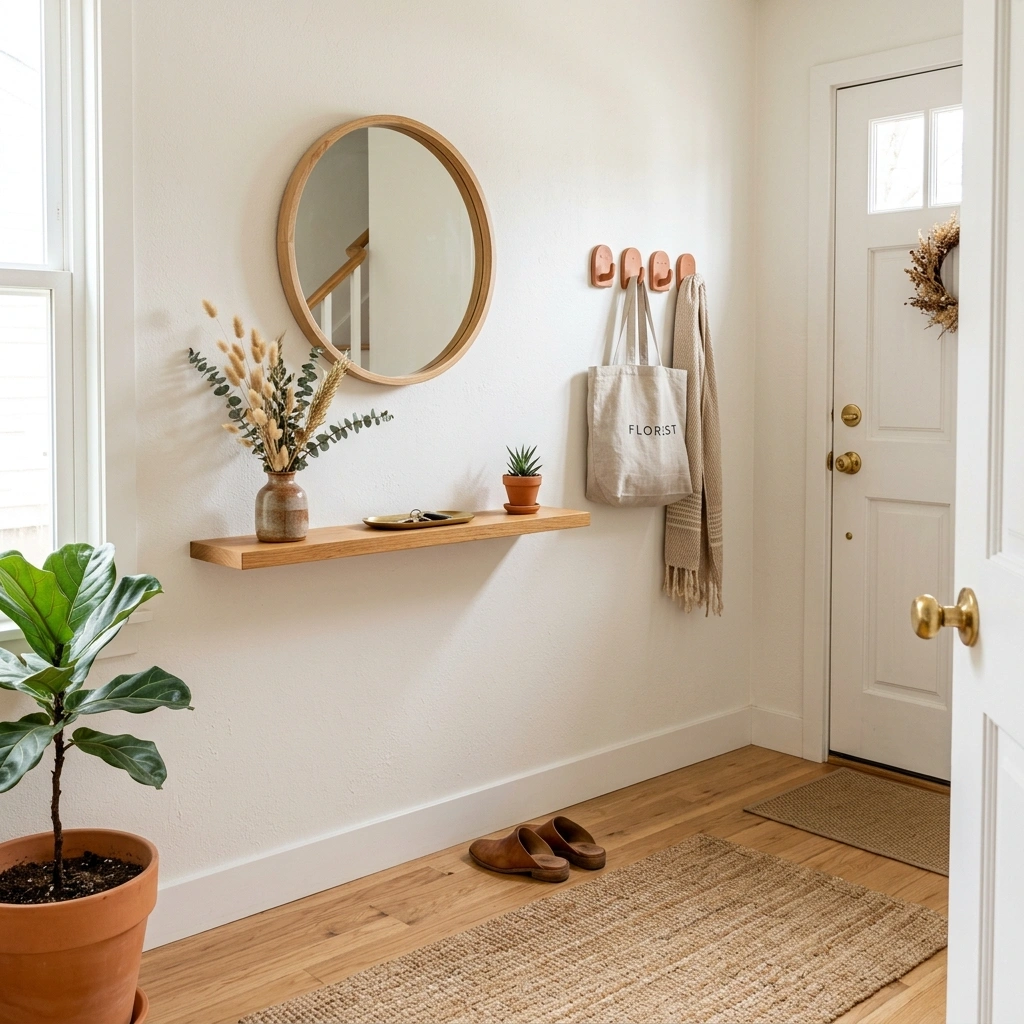
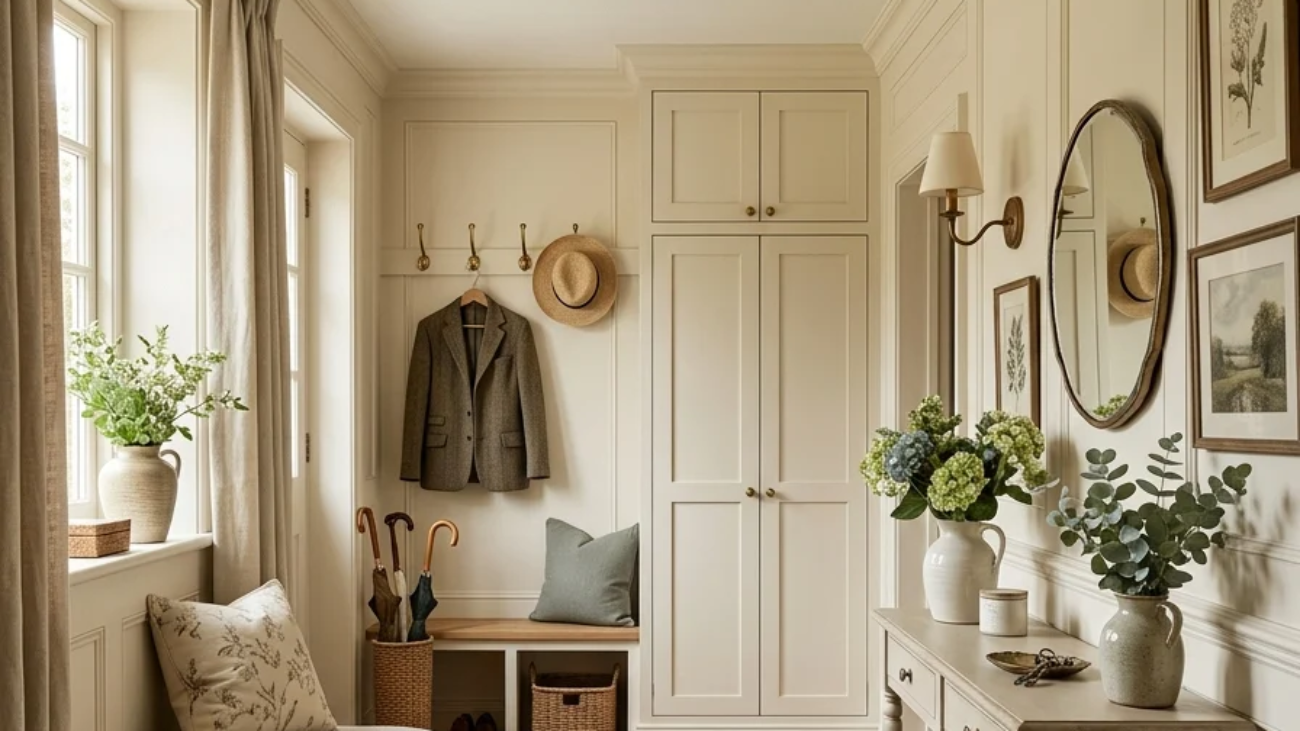
17 Enchanting English Countryside Hallway Ideas Full of Warmth and Character

17 English Countryside Hallway Ideas Full of Character

English countryside hallway design draws on the layered, collected charm of British country houses, where pattern, antique furniture, and rich color turn a passageway into a room worth lingering in. This guide gives you 17 enchanting English countryside hallway ideas covering color, materials, lighting, and layout so your entry feels storied rather than staged.

Picture a hallway where dark oak paneling meets deep forest green walls, where brass catches candlelight, and where every surface holds a small piece of history: a worn leather hook, a jug of garden flowers, a stair runner in faded tartan. It’s a look built on warmth and quiet drama, layered pattern over pattern until the whole space feels lived-in for generations. English countryside hallways turn a passage into the first chapter of the house’s story. Here are 17 ideas worth saving and stealing.

Why Enchanting English Countryside Hallway Ideas Work So Well

What is it? English countryside style traces back to the British country house tradition, where practical mudroom function met the decorative habits of generations of collectors: antique furniture, family portraits, and hunting or botanical prints passed down rather than bought new. It differs from modern farmhouse, which favors a neutral, pared-back palette, by embracing rich color, layered pattern, and visible age.

Materials and colors. Expect deep forest green, warm terracotta, cream, and rich burgundy tartan against dark oak paneling, flagstone or slate flooring, worn leather, and aged brass. Chintz-style botanical wallpaper, wicker, and hand-forged hardware carry the character down the length of a hall.

Why it’s trending now. As Pinterest searches for “grandmillennial” and “English country house” style have climbed, homeowners are moving away from stark minimalism toward rooms with visible history and pattern. The renewed appeal of antique and vintage furniture, driven partly by sustainability concerns, fits naturally with a style built on collected rather than matched pieces.

Can small spaces achieve this? Yes, with restraint. A narrow hallway should prioritize one patterned element a runner or a wallpaper rather than layering several at once, since a tight space can absorb only so much visual richness before it reads as cluttered instead of collected.

Style at a Glance

ElementCore Trait 1Core Trait 2
PhilosophyCollected over generations, not matchedPractical function paired with decorative charm
MaterialsDark oak paneling, flagstone, worn leatherAged brass, chintz wallpaper, wicker
Color paletteDeep forest green, terracottaCream, rich burgundy tartan

17 Enchanting English Countryside Hallway Ideas

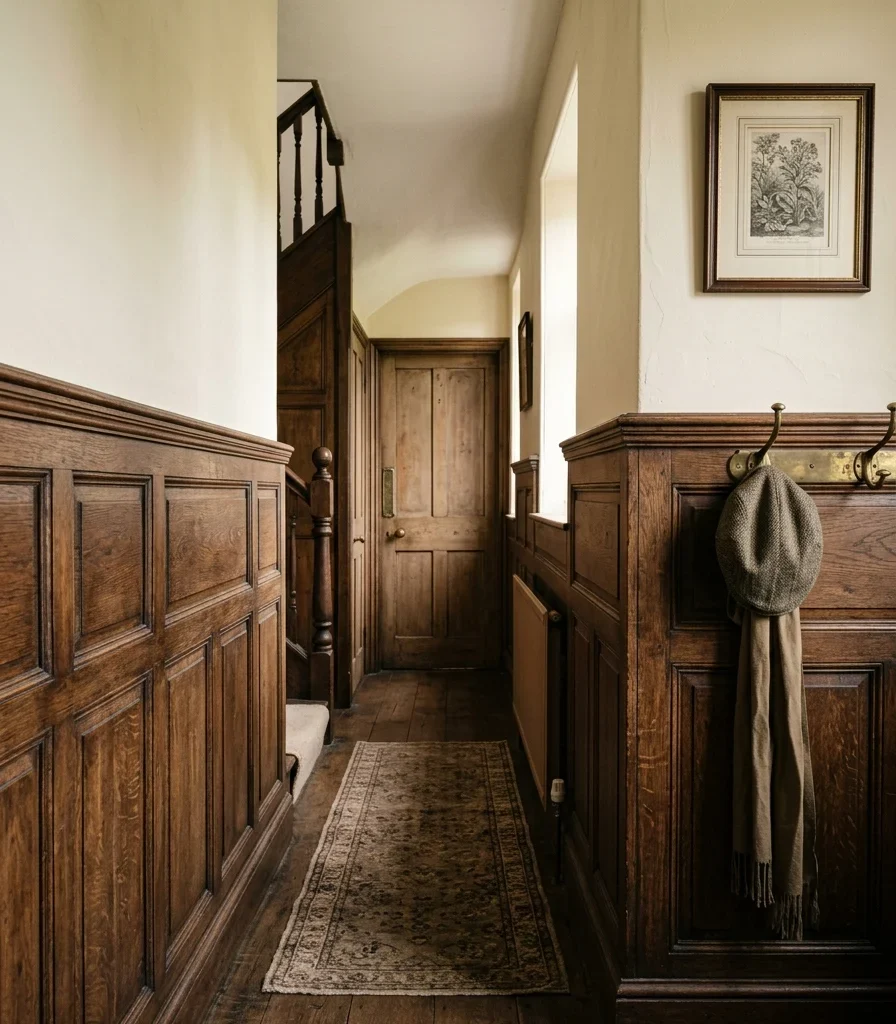
1. Dark Oak Wood-Paneled Wainscoting
1. Dark Oak Wood-Paneled Wainscoting

Vibe: Grounded  the corridor feels older than the house actually is.

Why it works: Raised panel wainscoting adds physical texture and shadow depth to the lower wall, a visual weight that anchors the hallway the way it would in an original country house, where paneling protected walls from daily wear and time.

How to get it: Install raised panel wainscoting to 42-inch height in a dark oak stain, leaving the upper wall in a lighter tone so the paneling reads as a deliberate architectural feature rather than the whole room’s finish.

πŸ’‘ Quick Win: Wood panel wallpaper in a dark oak print achieves the same visual grounding without any carpentry.

Shop the Look

Product
Dark oak raised panel wainscoting kit
Wood panel wallpaper alternative
Brass coat hook
Small framed botanical print
Wood stain dark walnut

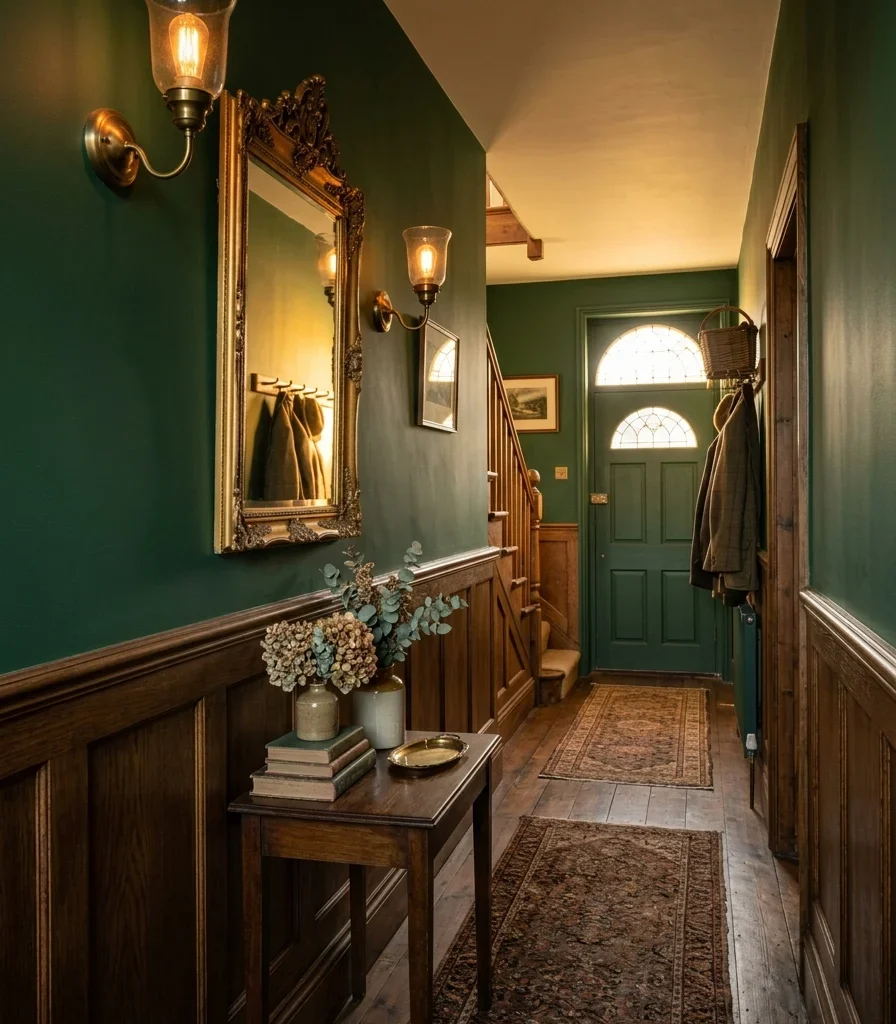
2. Deep Forest Green Walls Above the Paneling
2. Deep Forest Green Walls Above the Paneling

Vibe: WarmΒ  ; e deep color feels enveloping rather than dark.

Why it works: Pairing a saturated forest green with warm brass and oak keeps a dark color from reading as cold, using the contrast between deep hue and warm metal tones to hold the room’s warmth even without much natural light.

How to get it: Paint the upper wall in a matte deep forest green such as Farrow & Ball’s Studio Green, keeping the trim and chair rail in cream to define the color’s edge clearly.

Shop the Look

Product
Deep forest green matte wall paint
Cream trim paint
Brass wall sconce
Gilt-framed round mirror
Brass picture hanging rail

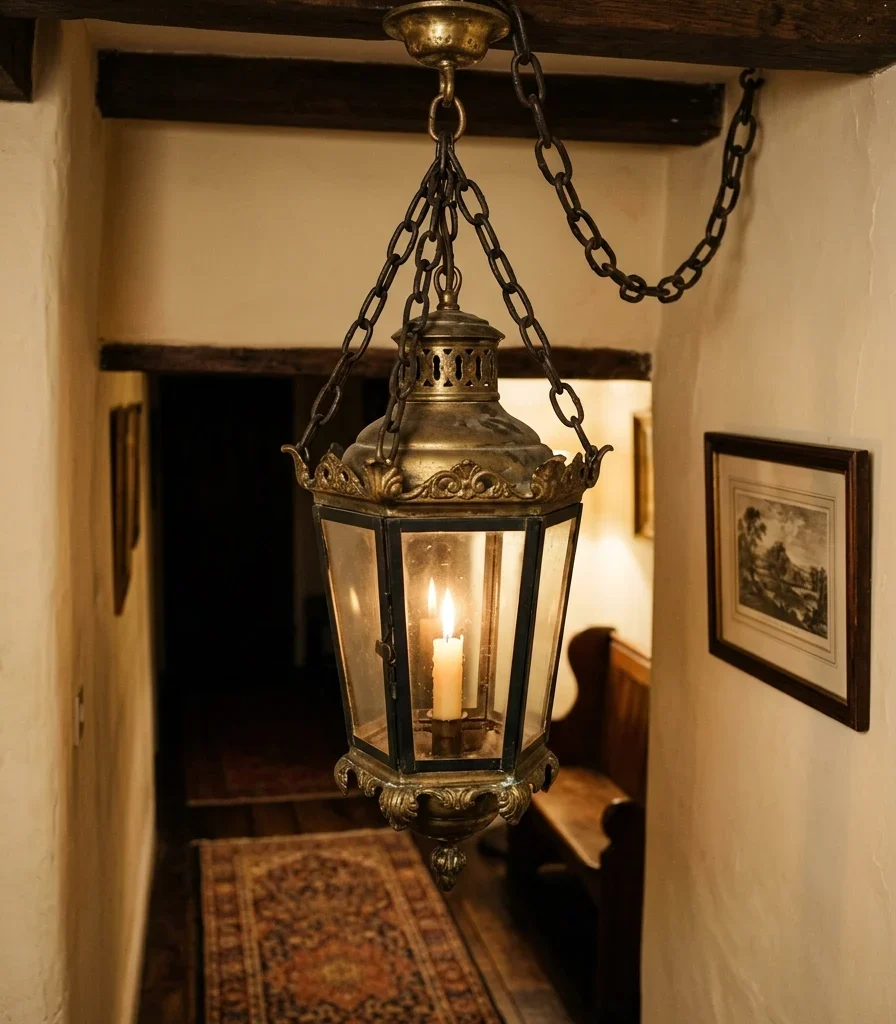
3. Antique Brass Lantern Pendant

3. Antique Brass Lantern Pendant

Vibe: Romantic; the light feels like it belongs to an older century.

Why it works: A lantern-style fixture with visible glass panes and a chain scatters light unevenly across the ceiling and walls, the specific light behavior that reads as warm and historic rather than the flat wash of a modern flush-mount.

How to get it: Hang an aged brass lantern pendant at a height that clears headroom by at least 78 inches, choosing a finish with visible tarnish rather than polished brass for authenticity.

Shop the Look

Product
Antique brass lantern pendant
Warm LED candle bulb
Ceiling chain extension kit
Wool runner rug
Brass picture frame

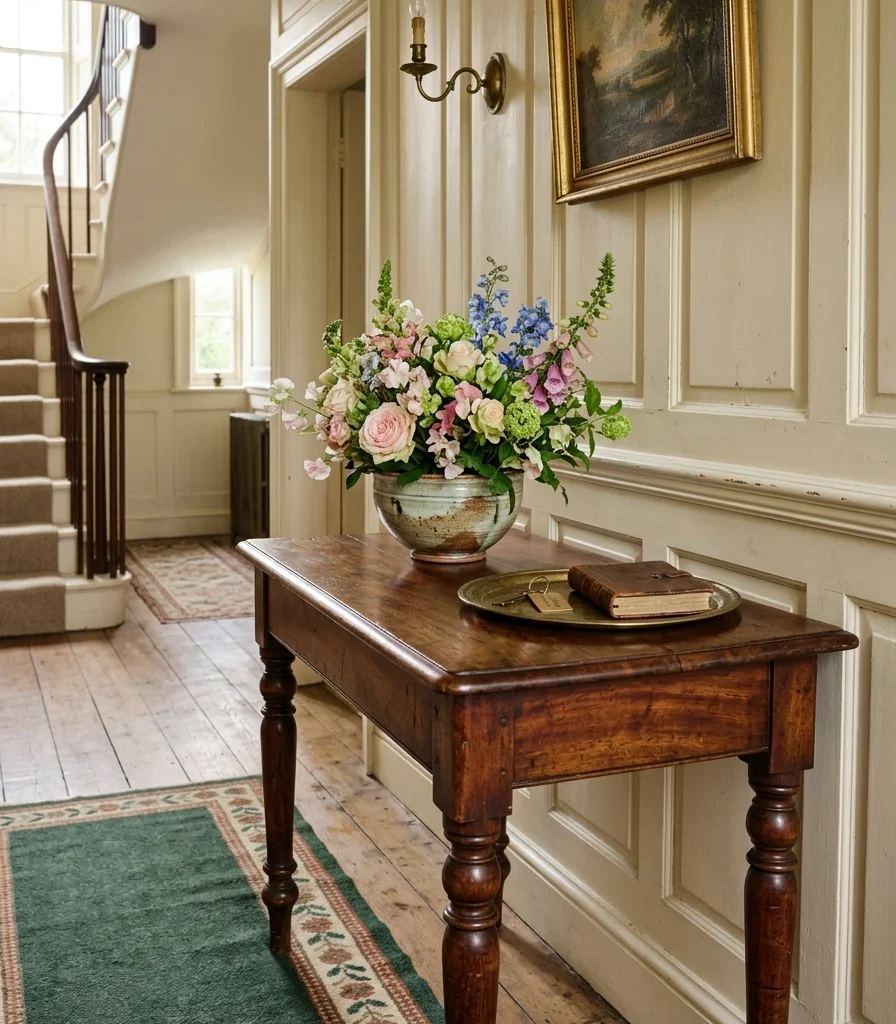
4. Antique Mahogany Hall Table

4. Antique Mahogany Hall Table

Vibe: Layered; the table looks like it has always been there.

Why it works: An antique mahogany table’s turned legs and visible patina bring genuine age into the hallway, a material honesty that reproduction furniture can’t replicate no matter how carefully it’s distressed.

How to get it: Choose a narrow antique or vintage-style hall table no deeper than 14 inches for tight corridors, keeping at least 30 inches of clear walking space in front of it.

Shop the Look

Product
Antique-style mahogany hall table
Ceramic bowl for keys
Small brass tray
Ceramic flower jug
Brass drawer pull

5. Botanical Chintz Wallpaper on the Upper Wall
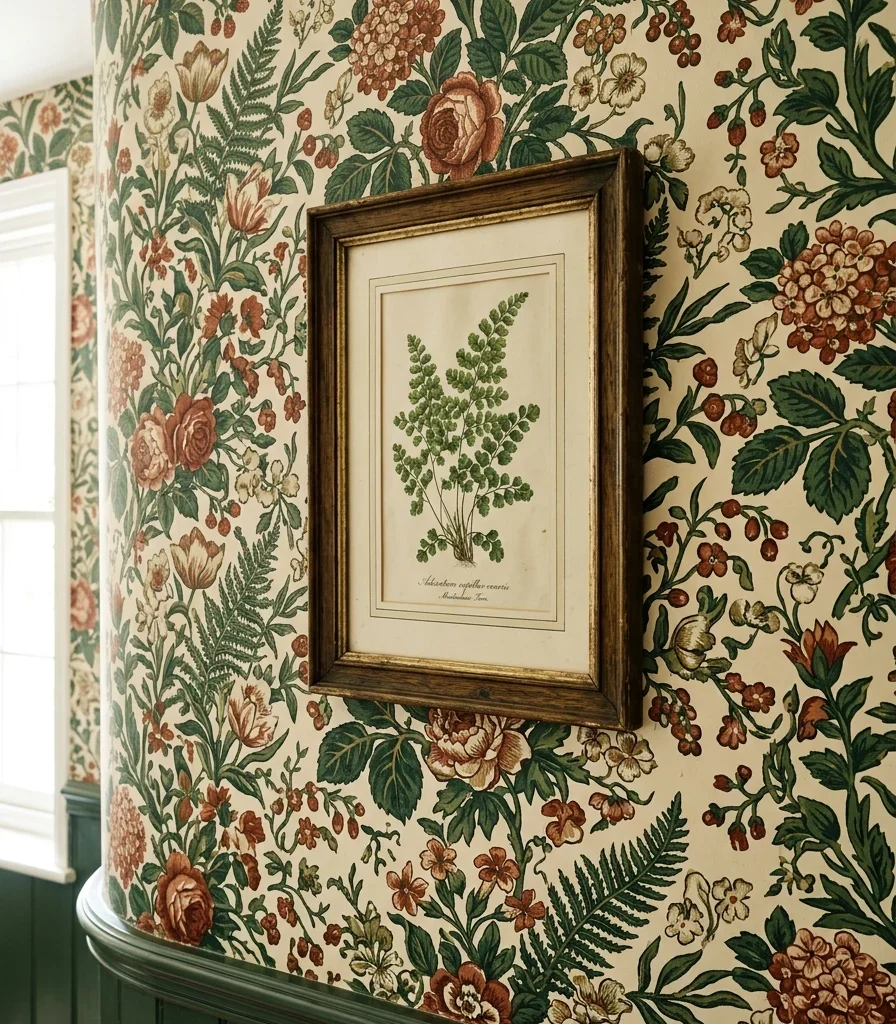
5. Botanical Chintz Wallpaper on the Upper Wall

Vibe: Layered; the wall itself becomes a garden.

Why it works: A dense botanical print on the upper wall introduces pattern at a scale large enough to read from across the hallway, using visual density the same way a garden uses foliage layering busy up close, cohesive from a distance.

How to get it: Apply chintz-style botanical wallpaper above the chair rail only, keeping the lower wainscoting solid so the pattern has a clean boundary rather than covering the entire wall.

πŸ’‘ Quick Win: A wallpapered accent nook or the reveal around a single doorway tests the pattern before committing to a full hallway.

Shop the Look

Product
Botanical chintz wallpaper roll
Wallpaper adhesive paste
Slim framed print
Brass picture hook
Wood chair rail trim

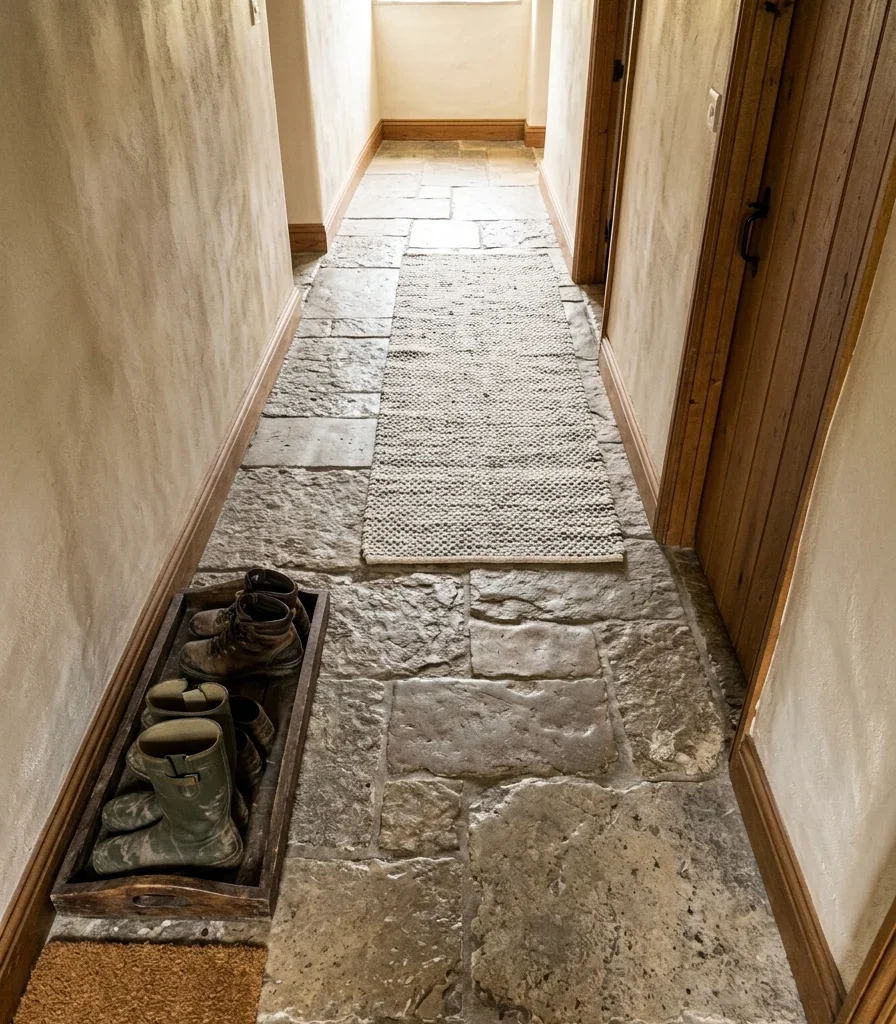
6. Flagstone or Slate Flooring

6. Flagstone or Slate Flooring

Vibe: Raw; the floor carries genuine material history underfoot.

Why it works: Flagstone’s irregular shape and natural color variation add texture at floor level that manufactured tile can’t replicate, grounding the hallway in the same material honesty that defines a genuine country house entry.

How to get it: Lay natural flagstone or slate tile in a random, irregular pattern rather than a uniform grid, using a warm gray grout that doesn’t compete with the stone’s natural color variation.

Shop the Look

Product
Natural flagstone floor tile
Warm gray grout
Wool boot tray
Runner rug wool
Stone sealant finish

7. Warm Terracotta and Cream Layered Palette
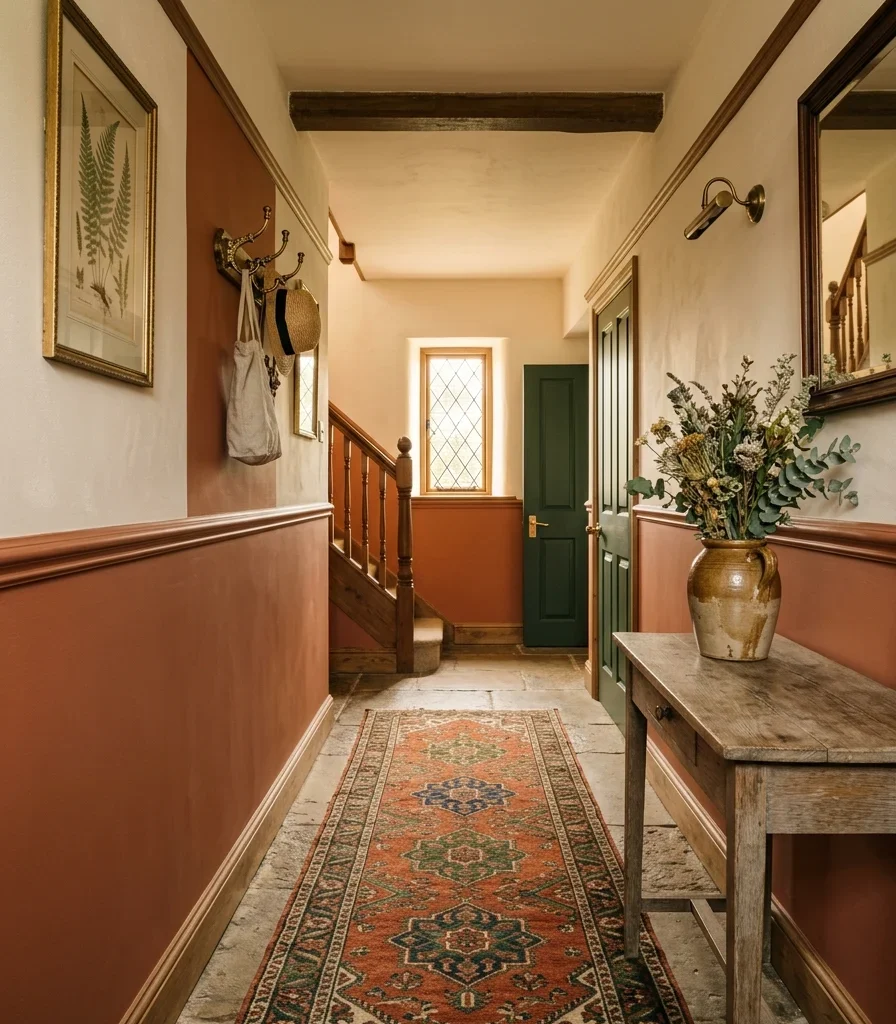
7. Warm Terracotta and Cream Layered Palette

Vibe: Warm  the palette feels sun-baked even without direct light.

Why it works: Layering terracotta below and cream above uses value contrast to keep a warm, saturated tone from overwhelming the hallway, the same principle a wainscoted room uses but achieved entirely through paint rather than paneling.

How to get it: Paint the lower third of the wall in matte terracotta and the upper two-thirds in warm cream, adding a thin trim line at the division for a crisp edge.

Shop the Look

Product
Terracotta matte wall paint
Warm cream wall paint
Wood trim strip natural
Ceramic decorative urn
Brass wall hook

8. Defined Boot and Coat Zone by the Back Door
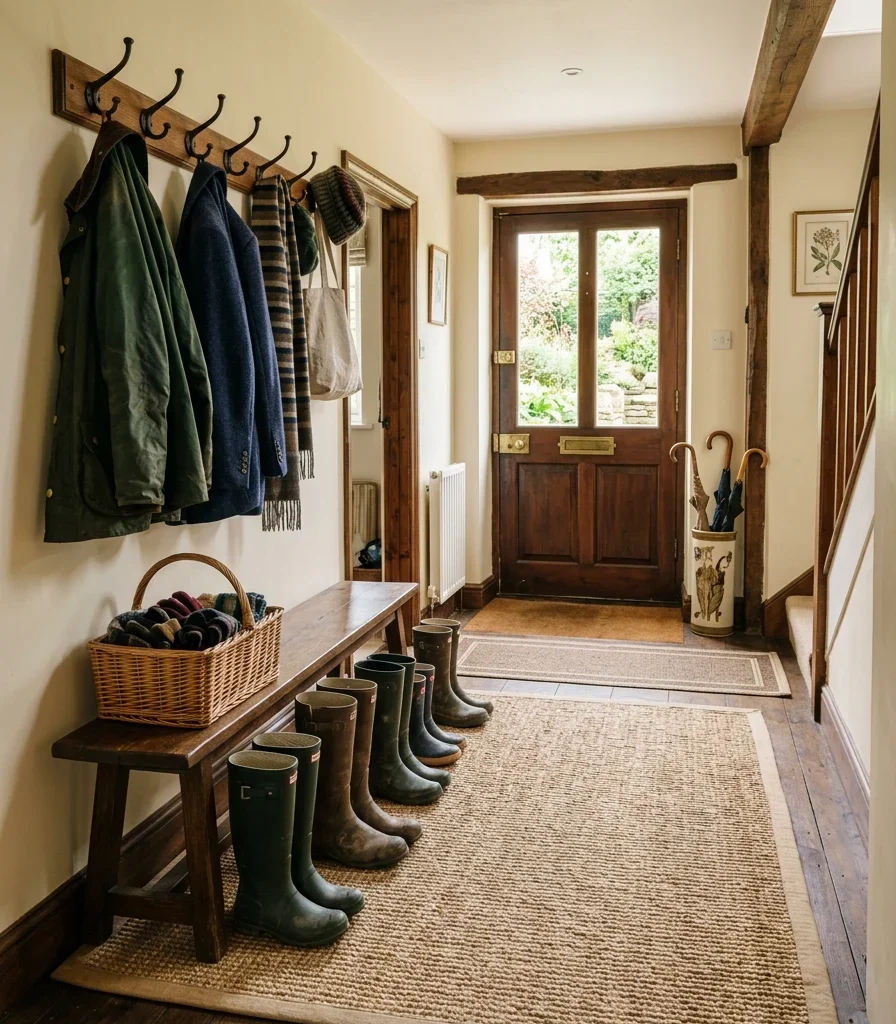
8. Defined Boot and Coat Zone by the Back Door

Vibe: Cozy  the muddiest part of the house still feels charming.

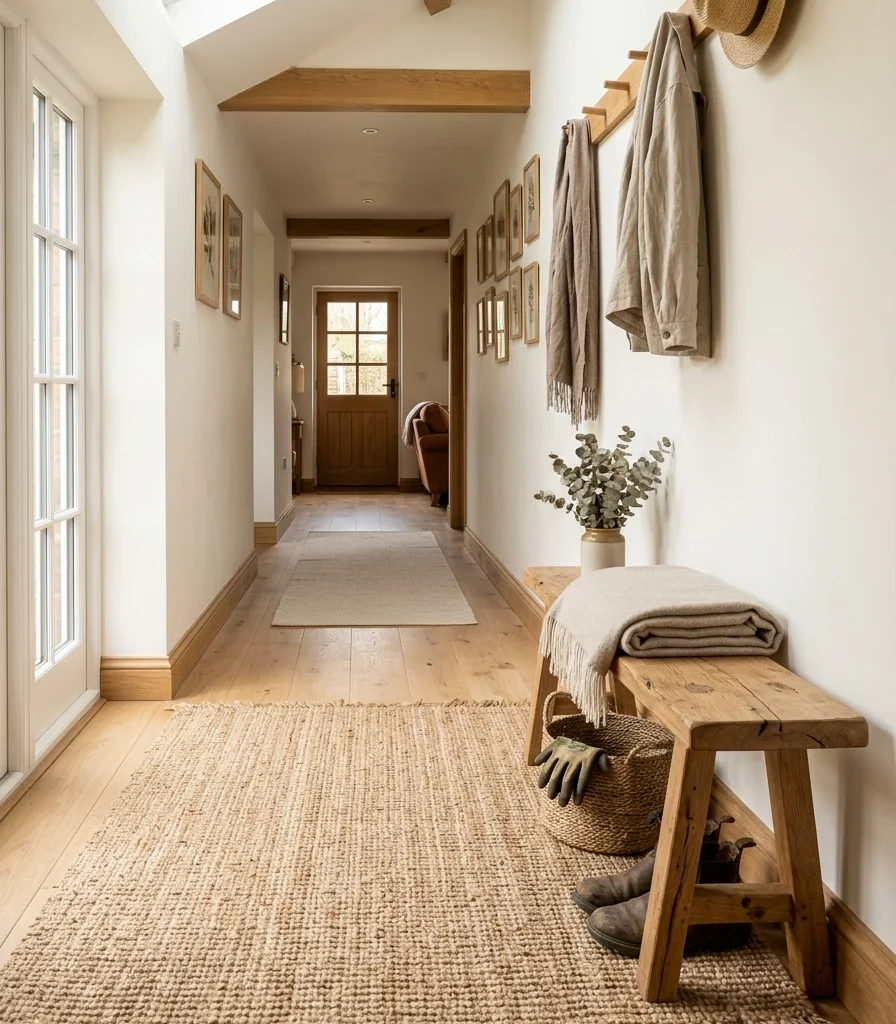
Why it works: Marking the boot and coat area with its own flooring mat, distinct from the main hallway runner, uses zone definition to separate practical mudroom function from the decorative passage beyond it, a layout choice that keeps mud contained without hiding the function away.

How to get it: Place a durable jute or coir mat at the back door zone, sized to stop clearly before the main hallway runner begins, so the two flooring textures visually divide the space.

Shop the Look

Product
Coir entry mat durable
Wicker storage basket
Boot tray rubber lined
Wall-mounted coat hook rail
Wool runner rug for main hall

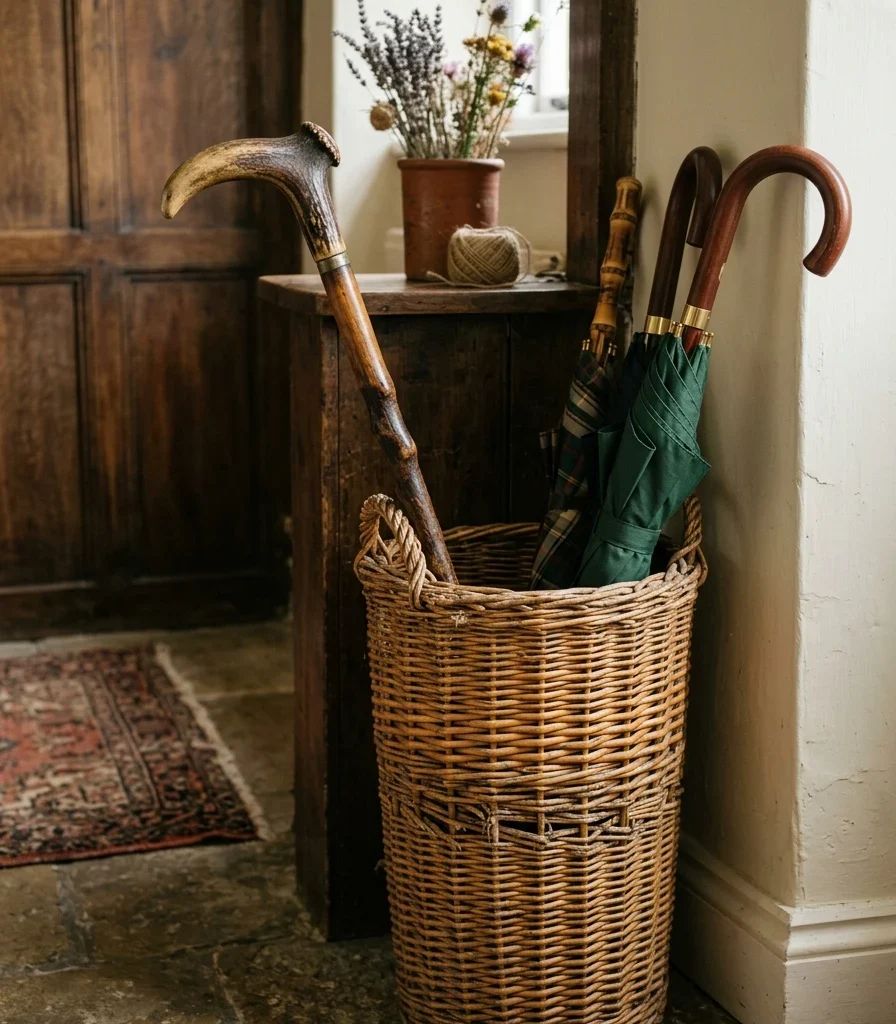
9. Weathered Wicker Umbrella Stand

9. Weathered Wicker Umbrella Stand

Vibe: Layered, even the umbrella storage looks intentional.

Why it works: A wicker stand’s organic, woven texture softens the hard lines of paneling and stone flooring nearby, adding the same natural material variety that keeps a fully paneled hallway from feeling like a single continuous surface.

How to get it: Choose a tall, weathered wicker or rattan umbrella stand and place it in the corner nearest the front door, limiting contents to three or four items so it stays functional rather than overflowing.

πŸ’‘ Quick Win: A vintage wicker log basket repurposed as an umbrella stand costs less than most new options and already has the weathered look this style wants.

Shop the Look

Product
Weathered wicker umbrella stand
Wood walking stick
Small dried flower bundle
Brass umbrella stand liner
Wool doormat

10. Wall-Mounted Brass Picture Lights Over Framed Prints
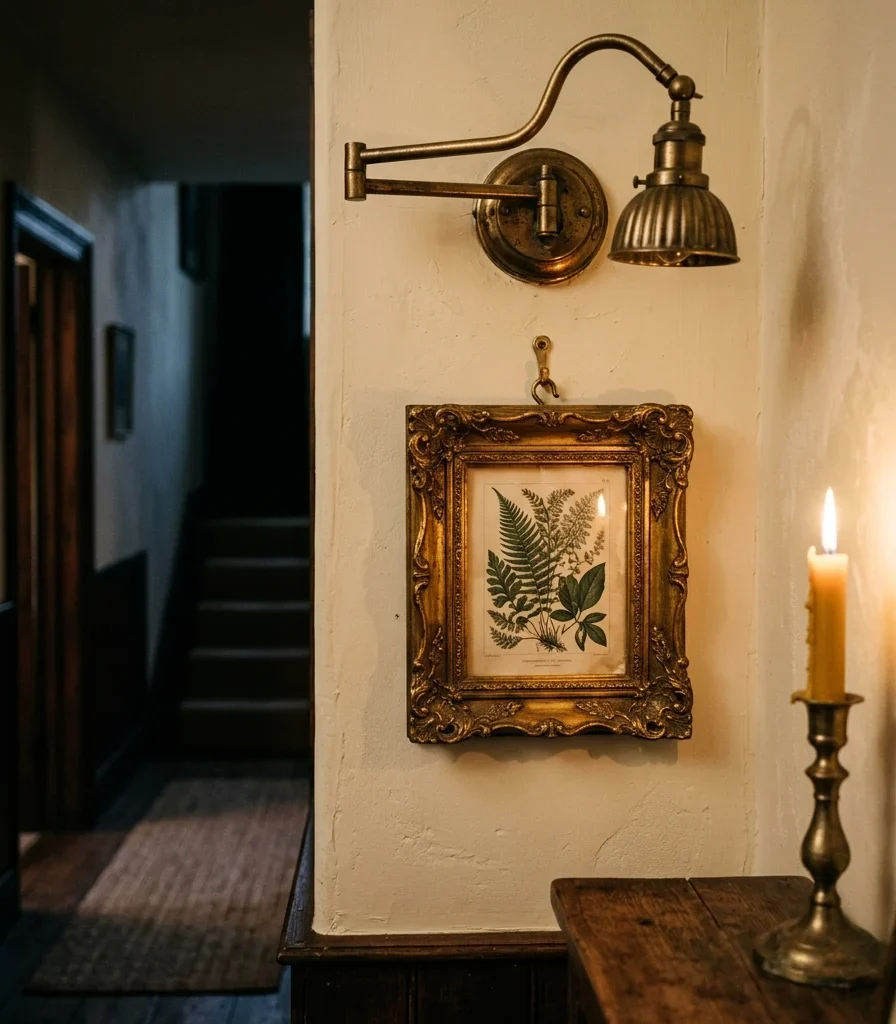
10. Wall-Mounted Brass Picture Lights Over Framed Prints

Vibe: Intimate; each print gets its own small spotlight of history.

Why it works: A dedicated picture light gives framed art its own warm light source rather than relying on the hallway’s ambient fixtures, the same light behavior used in country house galleries to make oil paintings and prints glow rather than sit flat in shadow.

How to get it: Mount an articulated brass picture light centered above each significant print, angled to wash light evenly down the frame without direct glare on the glass.

Shop the Look

Product
Brass articulated picture light
Gilt frame botanical print
Warm LED candle bulb
Brass frame hanging wire
Small brass switch plate

11. Gallery of Vintage Equestrian and Botanical Prints

11. Gallery of Vintage Equestrian and Botanical Prints

Vibe: Quiet; the gallery reads as a family’s history, not a decorator’s choice.

Why it works: Mixing frame styles rather than matching them mirrors how a genuine country house gallery accumulates pieces over decades, using intentional inconsistency in frame material as the design principle instead of uniform repetition.

How to get it: Group six to eight prints in varied gilt and dark wood frames, keeping the print subject matter (equestrian, botanical, or both) consistent even as the frames differ.

Shop the Look

Product
Vintage equestrian print set
Botanical print set gilt frame
Mixed wood picture frame set
Picture hanging spacing template
Small brass picture light

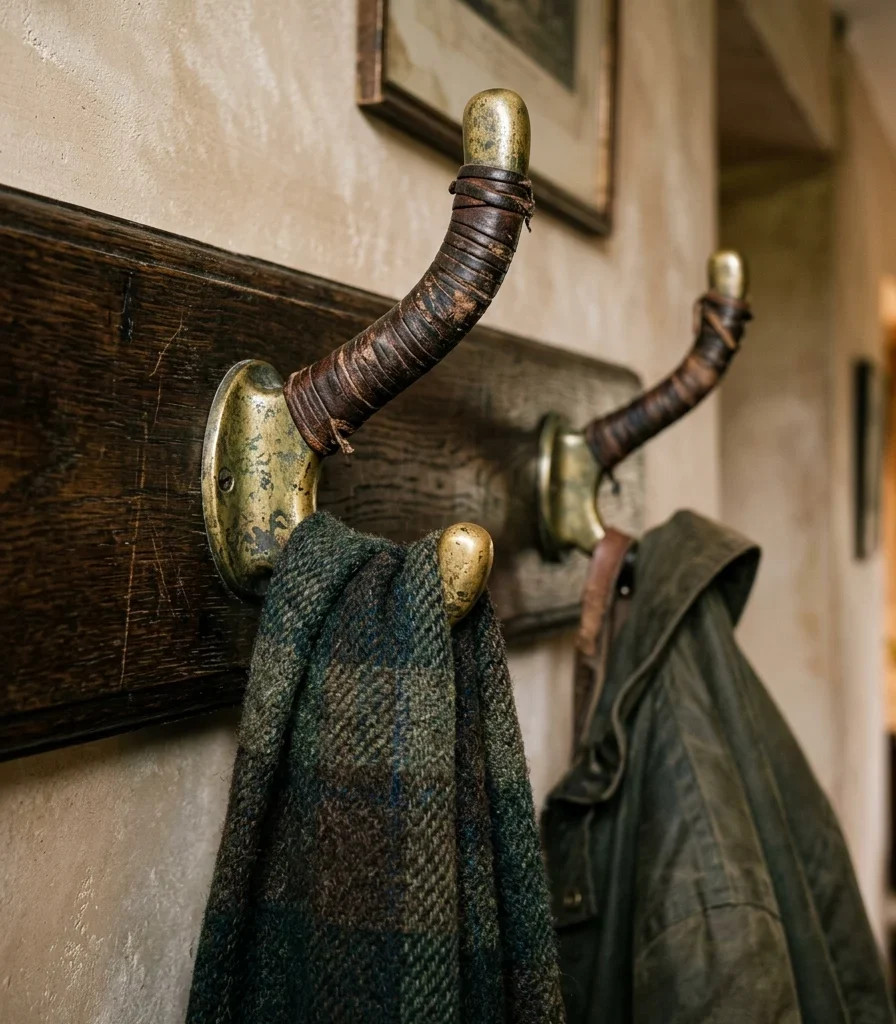
12. Worn Leather and Brass Coat Hooks

12. Worn Leather and Brass Coat Hooks

Vibe: Raw  the hooks look like they’ve held decades of coats.

Why it works: Leather-wrapped brass hooks add tactile material contrast against the smooth paneling behind them, and their visible wear pattern reinforces the sense of genuine age this style depends on rather than a uniform, factory-new finish.

How to get it: Mount leather-and-brass hooks on a dark oak rail at 60-inch height, spacing them 6 inches apart and limiting the display to items actually worn that week.

Shop the Look

Product
Leather-wrapped brass coat hook
Dark oak hook rail
Wool scarf
Canvas field coat
Brass wall anchor hardware

13. Tartan Plaid Stair Runner in Rich Reds
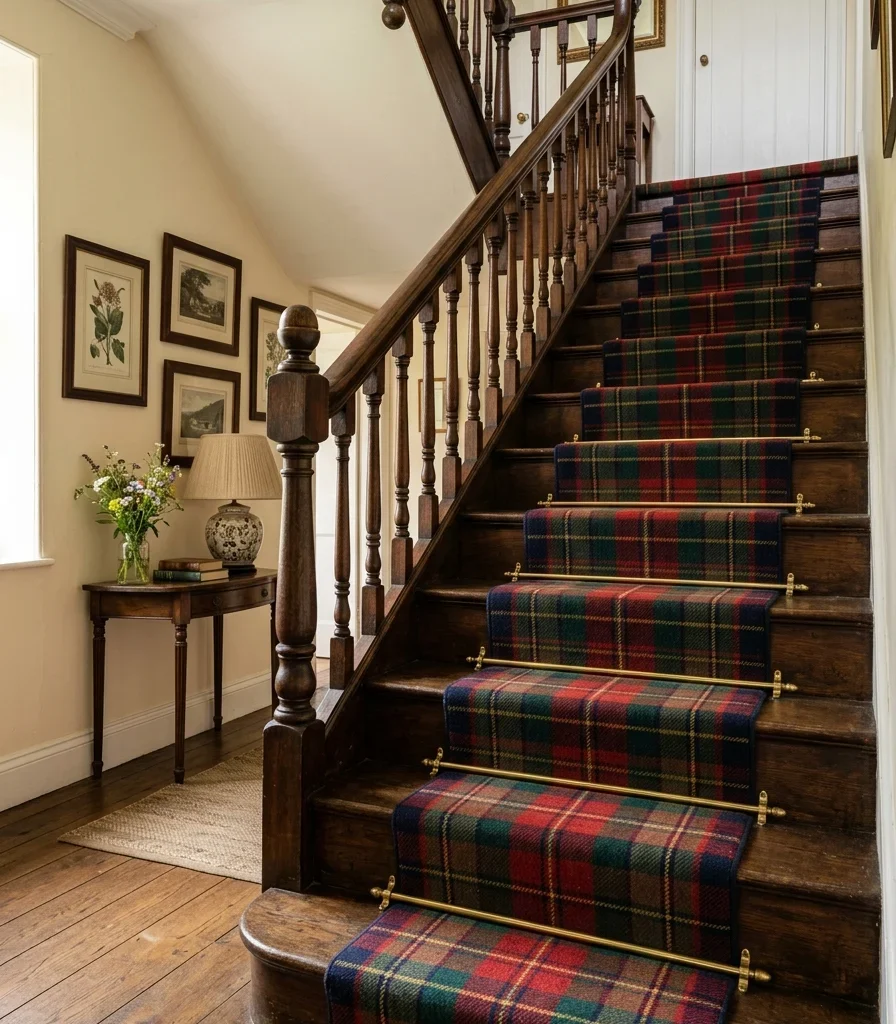
13. Tartan Plaid Stair Runner in Rich Reds

Vibe: Layered; the staircase becomes the hallway’s boldest moment.

Why it works: A tartan runner introduces the richest color and pattern in the entire hallway on the staircase specifically, using the stairs’ natural visual prominence to carry a bold pattern that would overwhelm a flat wall at the same scale.

How to get it: Install a wool tartan runner secured with brass stair rods at each step, choosing a pattern with rich burgundy and forest green tones that echo the wall colors used elsewhere in the hall.

πŸ’‘ Quick Win: A tartan-patterned door mat at the base of the stairs tests the pattern’s impact before committing to a full runner installation.

Shop the Look

Product
Wool tartan stair runner
Brass stair rod set
Stair runner grip pad
Dark oak stair rail finish
Tartan wool door mat

14. Narrow Console with a Mirror to Widen a Tight Passage
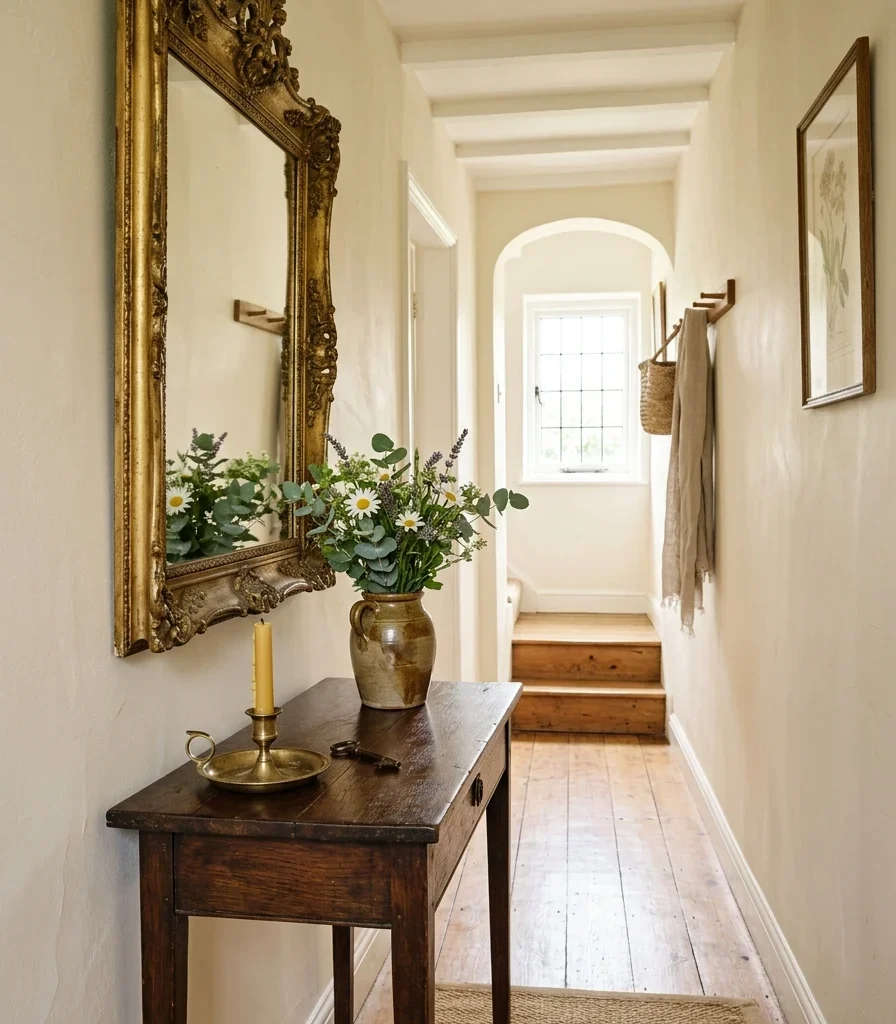
14. Narrow Console with a Mirror to Widen a Tight Passage

Vibe: Luminous. The narrowest passage borrows light it doesn’t have.

Why it works: A large gilt mirror positioned to reflect the nearest window or doorway doubles the perceived depth of a tight corridor, an illusion technique that adds spatial quality and reflects candlelight or lantern glow back into the space at night.

How to get it: Hang the largest mirror the wall width allows above a console no deeper than 10 inches, positioning it to face the nearest natural light source directly.

Shop the Look

Product
Large gilt-framed wall mirror
Narrow antique-style console table
Ceramic vase small
Small brass tray
Wall anchor mounting kit

15. Antique Grandfather Clock as an Anchor Piece
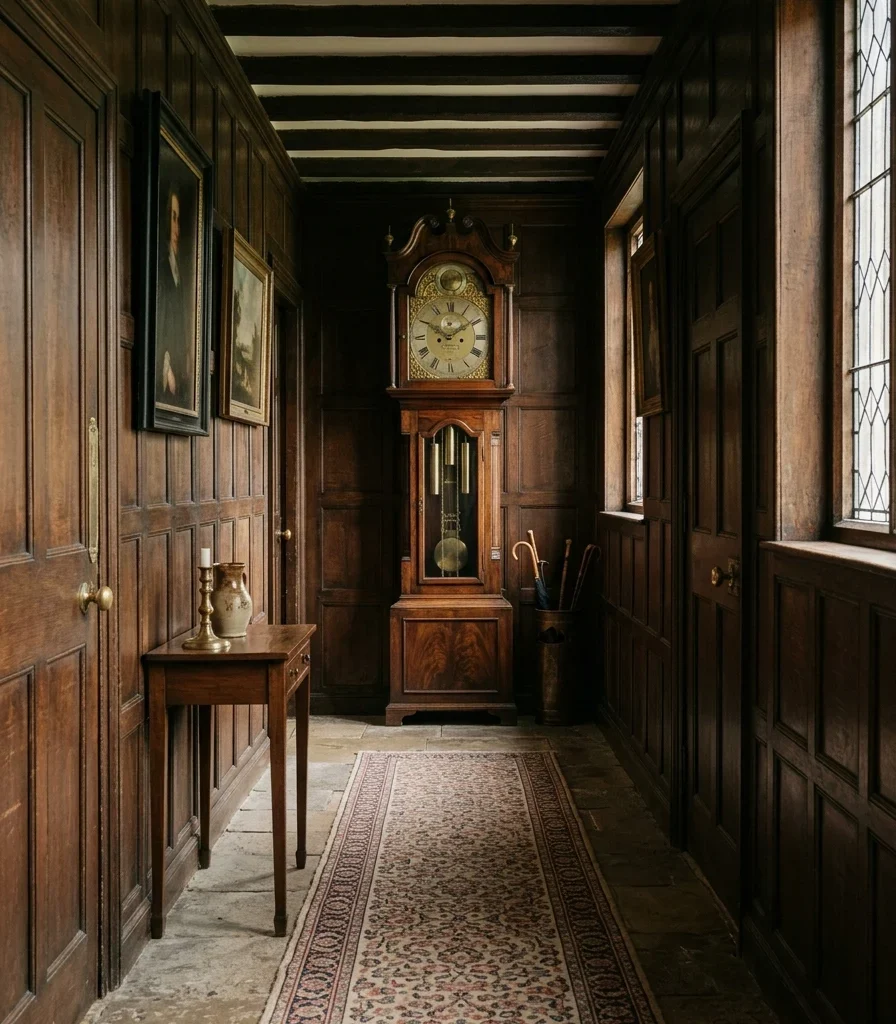
15. Antique Grandfather Clock as an Anchor Piece

Vibe: GroundedΒ ; the hallway gains a single, unmistakable focal point.

Why it works: A tall grandfather clock uses vertical scale and visual weight to anchor the far end of a corridor, giving the eye a destination to travel toward down the length of the hall rather than an empty wall at the end.

How to get it: Place an antique or vintage-style grandfather clock at the hallway’s terminus, ensuring at least 24 inches of clearance around it so it doesn’t obstruct the walking path.

Shop the Look

Product
Antique-style grandfather clock
Wool runner rug leading path
Brass clock key
Wood floor protector pads
Small wall sconce nearby

16. Flickering Candle-Style Wall Sconces
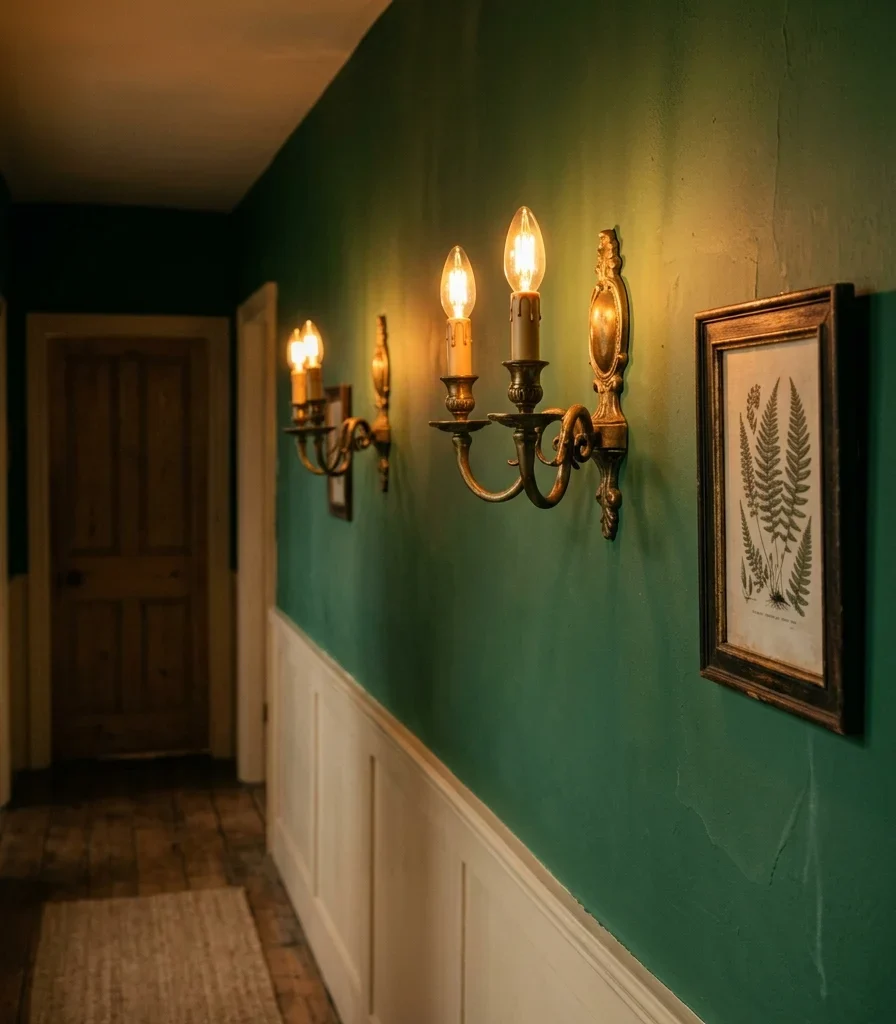
16. Flickering Candle-Style Wall Sconces

Vibe: Romantic. The hallway glows the way it would by real candlelight.

Why it works: Flicker-effect warm bulbs in candelabra-style sconces recreate the uneven, moving light quality of actual candlelight, a specific light behavior that static LED fixtures can’t replicate and one that reinforces the historic character of the space.

How to get it: Mount candle-style brass sconces at a 66-inch height, spaced every 6 to 8 feet, using warm flicker-effect bulbs rather than standard steady LEDs for the full effect.

Shop the Look

Product
Candle-style brass wall sconce
Flicker-effect warm LED bulb
Brass candle cover sleeve
Small framed print nearby
Wall anchor mounting hardware

17. Fresh-Cut Garden Flowers in a Ceramic Jug
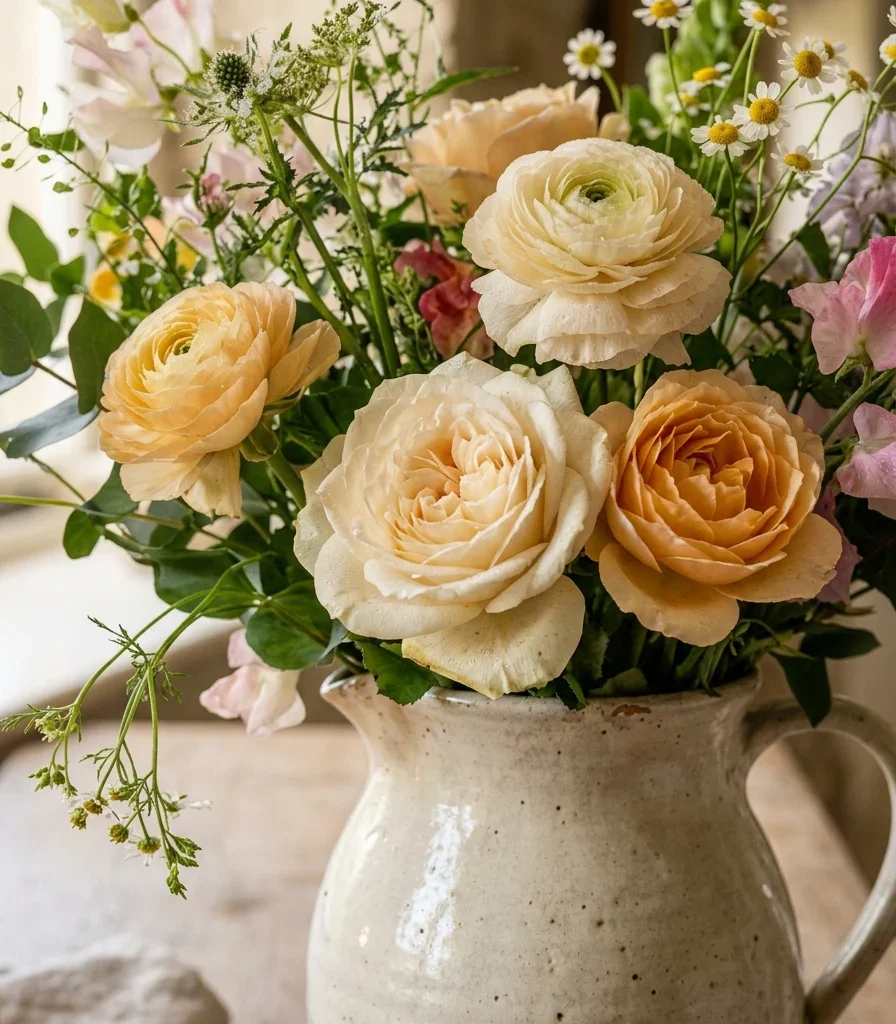
17. Fresh-Cut Garden Flowers in a Ceramic Jug

Vibe: Sun-warm; the hallway feels connected to the garden just outside.

Why it works: A loose, informal arrangement in a simple ceramic jug rather than a tight, styled bouquet reflects how flowers are actually cut and brought indoors in a working country house, adding organic texture that no artificial arrangement matches.

How to get it: Cut whatever is blooming that week and place it loosely in a cream ceramic jug without arranging stems into a symmetrical shape, refreshing the water every few days to keep the display genuine rather than static.

πŸ’‘ Quick Win: A single grocery-store bunch of seasonal flowers in a plain ceramic jug achieves the same effect for under $15 a week.

Shop the Look

Product
Cream ceramic flower jug
Small brass tray
Ceramic dish for stems
Garden shears small
Wood console shelf

How to Start Your English Countryside Hallway Transformation

Your first move should be the wall color, specifically a deep forest green like Farrow & Ball’s Studio Green on the upper wall. This single choice sets the tone every other decision builds from, since the depth and warmth of that green determines how brass, oak, and terracotta all read against it.

The most common mistake is buying reproduction furniture that’s too uniformly distressed, which looks manufactured rather than genuinely aged. Fix it by mixing at least one true vintage or antique piece with newer furniture, letting real wear sit alongside cleaner lines rather than faking age across everything at once.

Three items under $50 that create immediate impact: a cream ceramic flower jug for fresh-cut stems (around $24), a set of leather-wrapped brass coat hooks (around $34), and a small gilt-framed botanical print (around $28).

A weekend refresh with flowers and coat hooks costs $150–$350. A full hallway transformation with paneling, a stair runner, and antique furniture runs $2,000–$6,000 and typically takes four to eight weeks depending on whether an antique hall table or clock needs sourcing.

Frequently Asked Questions About English Countryside Hallway Ideas

What is the difference between English countryside and modern farmhouse hallway style?

English countryside style embraces rich color, pattern, and antique furniture with visible age, while modern farmhouse favors a neutral, pared-back palette with cleaner lines and less pattern. Farmhouse hallways typically use shiplap and black iron hardware, while English countryside leans on paneling, brass, and chintz wallpaper. Both value practicality, but English countryside treats decoration as part of that function rather than something separate from it.

What colors work best in an English countryside hallway?

Deep forest green paired with warm cream, plus accents of terracotta and rich burgundy tartan, is the most reliable English countryside palette. Avoid cool, gray-based neutrals, which read as contemporary rather than historic against brass and oak. A forest green upper wall over dark oak wainscoting is one of the most searched combinations for this style.

How much does it cost to decorate an English countryside hallway?

A budget refresh with paint, flowers, and coat hooks runs $150–$400. A mid-range update adding a runner rug and framed prints lands between $600–$1,800. A full transformation with paneling, a stair runner, and antique furniture typically costs $2,500–$8,000 depending on how much furniture is sourced antique versus new.

Does English countryside style work in a small or narrow hallway?

Yes, with one adjustment: choose a single patterned element rather than layering wallpaper, a tartan runner, and a gallery wall all at once, since a tight corridor can only absorb so much visual richness before it feels cluttered. A large gilt mirror over a narrow console is the single most effective small-space addition, widening the passage while still fitting the style’s character.

What kind of lighting is best for an English countryside hallway?

Candle-style brass wall sconces with warm flicker-effect bulbs, paired with a lantern-style pendant near the entry, create the layered, historic light quality this style depends on. This avoids the flat, even glow of a single modern flush-mount fixture. Adding a brass picture light above a gallery wall gives framed prints their own warm spotlight, the same way a country house gallery lights its collection.

Ready to Create Your Dream English Countryside Hallway?

These 17 ideas cover color, material, lighting, furniture, and layout, so there’s a genuine entry point whether your hallway is grand and long or narrow and tight. Starting small is not a lesser version of this style; one ceramic jug of fresh flowers or a single leather coat hook is a legitimate first step, not a placeholder for a full renovation later. Today, cut whatever is blooming nearby and set it loosely in any jug you already own, then notice how much warmth that one gesture adds. Once the hallway comes together, walking through your own front door should feel like stepping into a small, familiar story rather than passing through space. Save the ideas that matched your light, your wood tone, and the pattern you keep circling back to, and start with the tartan runner, the brass hooks, or the flowersΒ  whichever one you can’t stop picturing.

You Might Also Like

13 Modern Cottage Hallway Ideas for a Warm, Welcoming Entry

13 Modern Cottage Hallway Ideas for a Warm, Welcoming Entry

Modern cottage hallway design blends worn, cozy cottage textures with the clean lines and quiet palette of contemporary interiors. This guide gives you 13 modern cottage hallway ideas covering color, materials, lighting, and layout so the passage into your home feels as considered as any other room.

Picture a narrow hall where morning light catches whitewashed wood, where a woven runner softens every footstep, and where nothing feels rushed even though it’s the space you walk through fastest. It’s a look built on warmth without clutter: sage, oat, and worn brass carried through a corridor most homes treat as an afterthought. Modern cottage hallways turn a transitional space into the first real impression of the house. Here are 13 ideas worth saving nd stealing.

Why Modern Cottage Hallway Ideas Work So Well

What is it? Modern cottage hallway design applies the informal, hand-me-down warmth of English and American cottage interiors beadboard, peg rails, worn textiles to the restrained furniture profiles and pared-back palettes of contemporary design. It differs from farmhouse hallways, which lean on heavier black hardware and barn-style details, by staying softer, lighter, and less industrial.

Materials and colors. Expect warm white, oat, dusty sage, and terracotta blush against whitewashed wood, unfinished oak, rattan, and brushed brass. Runners in jute or wool, board-and-batten paneling, and vintage brass hooks are the materials that carry the style down a corridor.

Why it’s trending now. Entryways became a design priority once more people started working from home and noticing their hallway daily instead of passing through it twice a day. Pinterest searches for “cottage hallway” and “entryway makeover” have climbed alongside the broader slow-living, cottagecore movement.

Can small spaces achieve this? Yes, narrow hallways are actually where this style performs best. Prioritize a mirror to bounce light, a slim console rather than a bulky one, and vertical paneling to make a tight corridor feel taller rather than narrower.

Style at a Glance

ElementCottageModern
PhilosophyWarmth, nostalgia, hand-me-down charmRestraint, clean lines, functional simplicity
MaterialsWhitewashed wood, rattan, jute, brushed brassSlim furniture profiles, matte finishes, streamlined hardware
Color paletteWarm white, oat, terracotta blushDusty sage, warm charcoal, soft greige

13 Modern Cottage Hallway Ideas

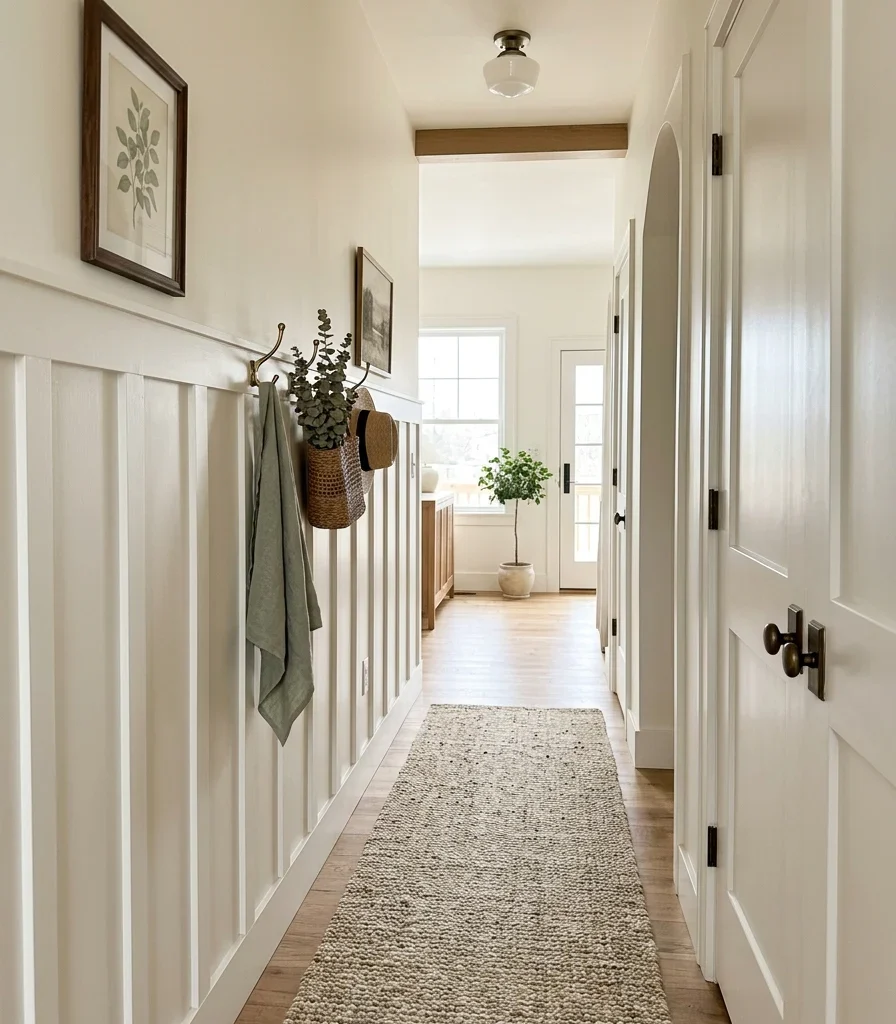
1. Board-and-Batten Wainscoting Hallway Walls

1. Board-and-Batten Wainscoting Hallway Walls

Vibe: Serene; the corridor gains rhythm without any extra color.

Why it works: Vertical battens create repeated linear detail that draws the eye down the hallway’s length rather than across its width, a proportion trick that makes narrow corridors feel more architectural and less like leftover space.

How to get it: Install wainscoting panels to a 42-inch height and paint the same warm white as the upper wall so the texture reads as detail, not a color block.

πŸ’‘ Quick Win: Peel-and-stick board-and-batten panels achieve the same vertical rhythm in a weekend with no cutting required.

Shop the Look

Product
Board-and-batten wall panel kit
Warm white matte wall paint
Small framed botanical print
Woven jute runner rug
Brass picture hanging hook set

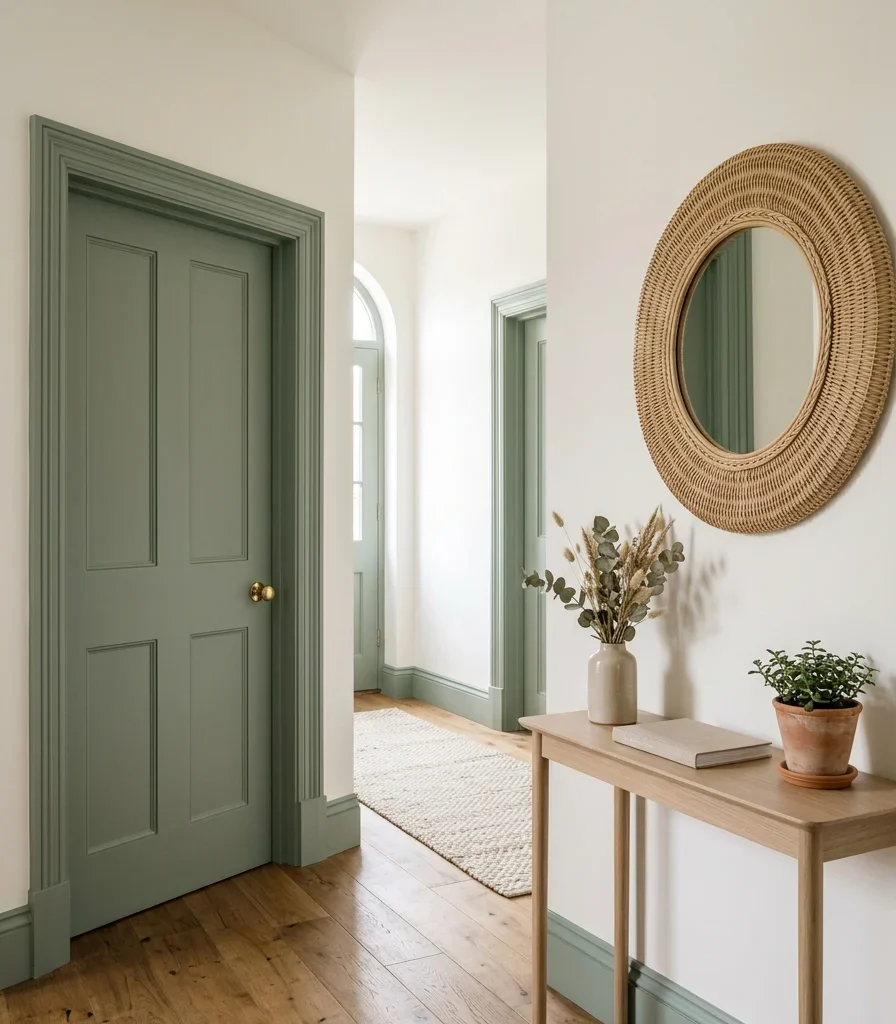
2. Warm White Walls with Sage Green Door Trim

2. Warm White Walls with Sage Green Door Trim

Vibe: Still, the hallway feels paused and unhurried.

Why it works: Painting only the door casings and baseboards in sage introduces color contrast at the architectural edges of the space, defining each doorway along the hall without committing to a full accent wall.

How to get it: Paint walls in a warm white, then paint every door frame and baseboard along the hallway in a dusty sage such as Farrow & Ball’s Pigeon for a repeated, rhythmic accent.

Shop the Look

Product
Warm white matte wall paint
Dusty sage trim paint satin
Rattan round wall mirror
Slim entryway console table
Ceramic catchall dish

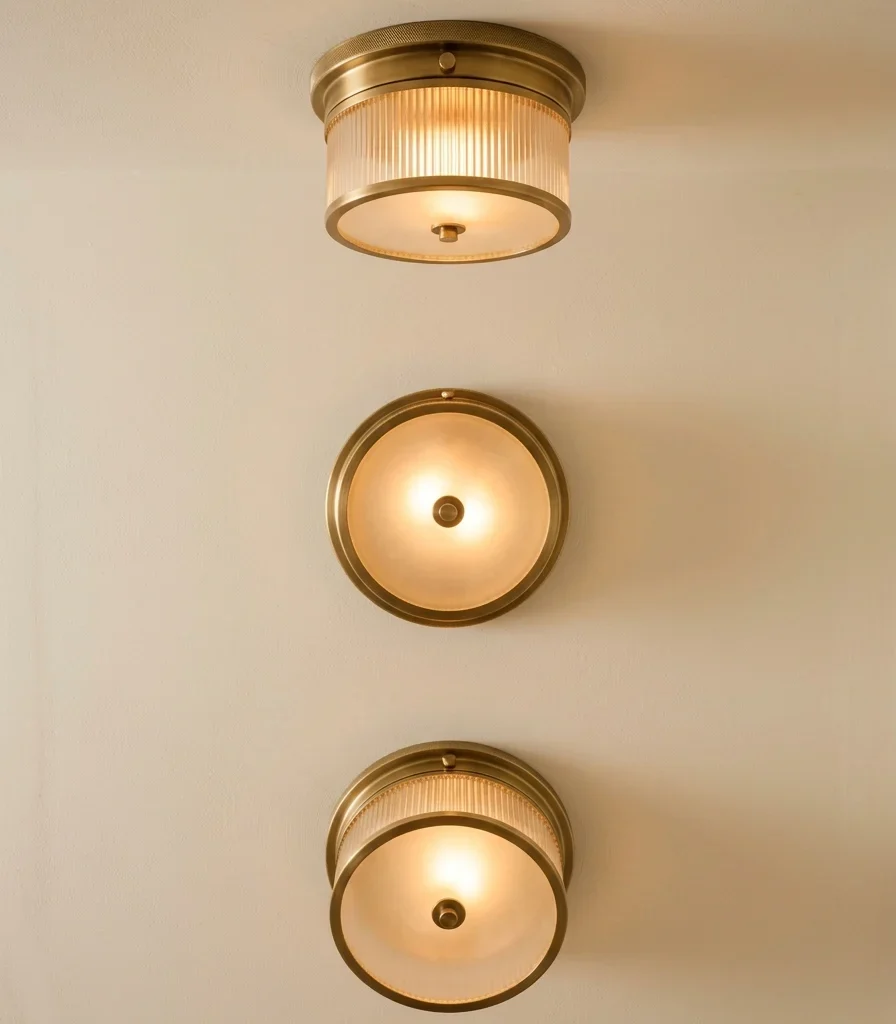
3. Row of Brass Flush-Mount Ceiling Lights

3. Row of Brass Flush-Mount Ceiling Lights

Vibe: Warm; even a windowless hallway feels lit like a room.

Why it works: Spacing multiple flush-mounts evenly rather than relying on one central fixture creates consistent light behavior along the entire length of the hall, eliminating the dark end that a single fixture always leaves behind.

How to get it: Install fluted-glass brass flush-mounts every 6 to 8 feet down the ceiling line, wired to a single dimmer switch so brightness can shift from daytime to evening.

Shop the Look

Product
Brushed brass flush-mount ceiling light
Fluted glass shade fixture
Dimmer switch single-pole
Warm LED bulb 2700K
Wool runner rug oat

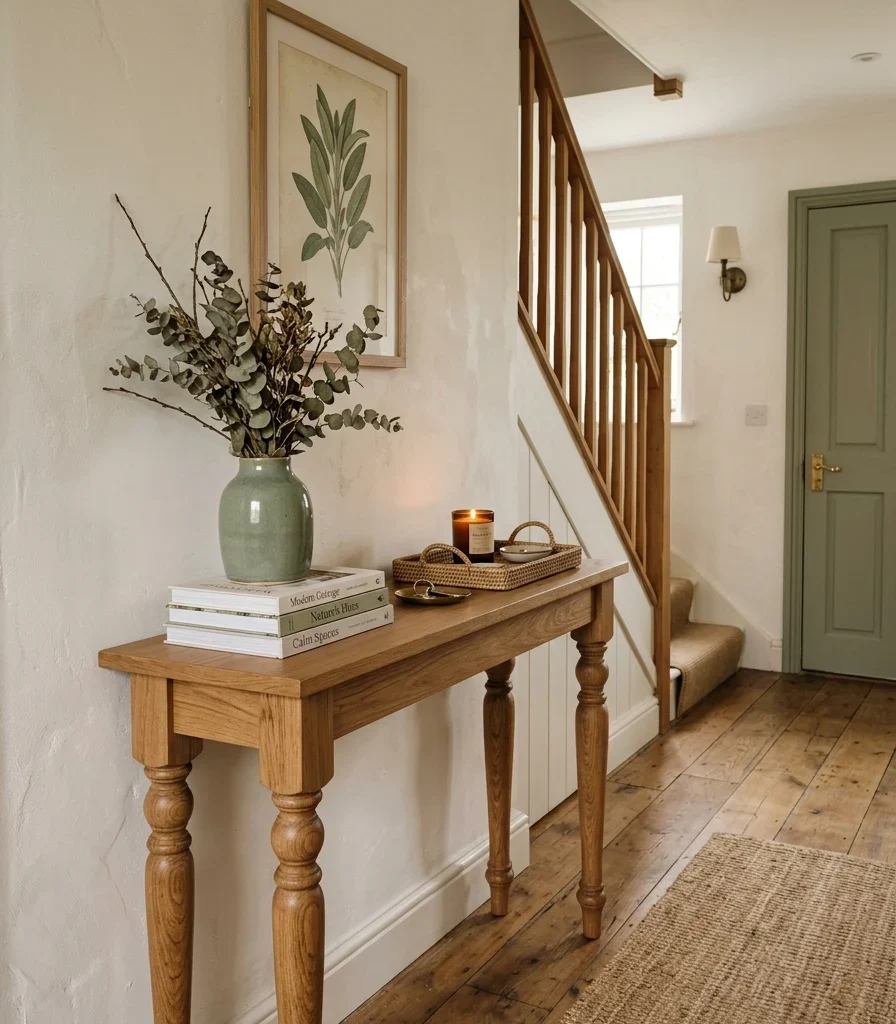
4. Slim Console Table with Turned Legs

4. Slim Console Table with Turned Legs

Vibe: Layered, a small surface doing a lot of quiet work.

Why it works: Turned wood legs add a traditional cottage silhouette in a piece scaled thin enough not to block hallway traffic, balancing furniture character against the negative space a corridor needs to function.

How to get it: Choose a console no deeper than 12 inches for hallways under 42 inches wide, keeping at least 30 inches of clear walking path in front of it.

πŸ’‘ Quick Win: A vintage turned-leg table from a secondhand shop costs less than most new consoles and adds instant character.

Shop the Look

Product
Slim wood console table turned legs
Ceramic vase small neutral
Woven rattan catchall tray
Stack of linen-bound books
Small dish for keys

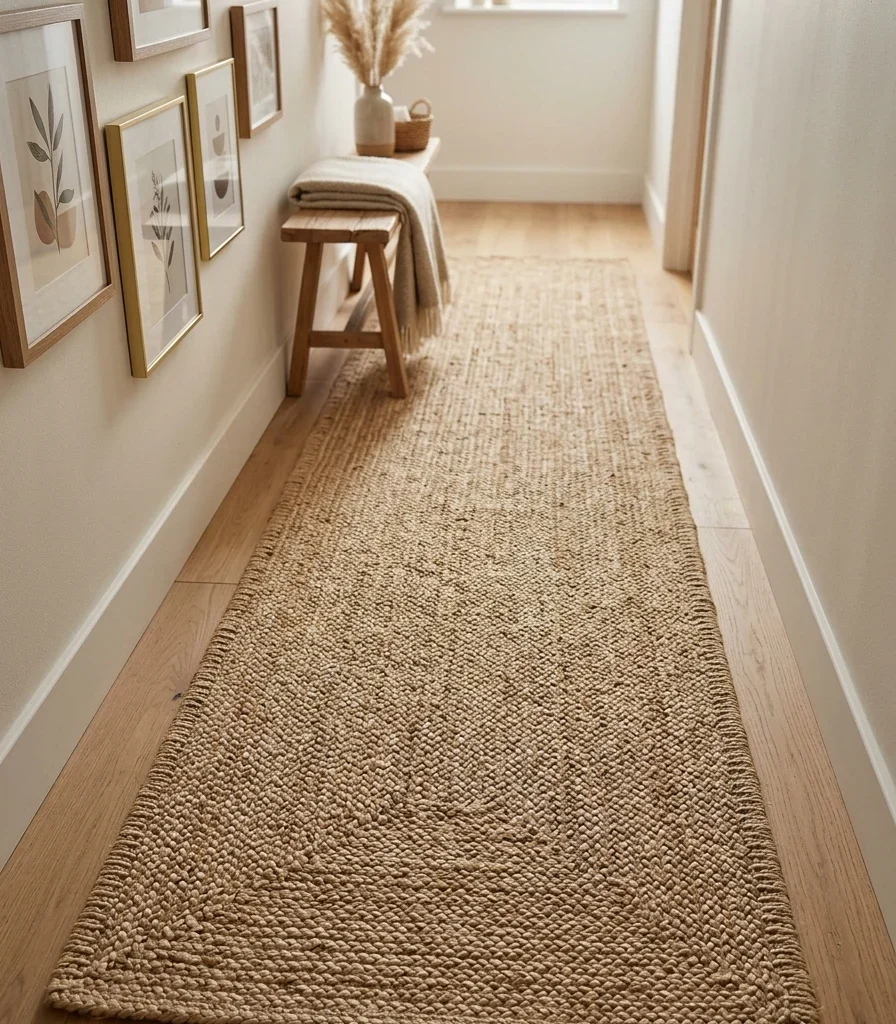
5. Woven Runner Rug the Length of the Hall

5. Woven Runner Rug the Length of the Hall

Vibe: Grounded; the hallway gets a visual floor, not just a functional one.

Why it works: A single continuous runner unifies a long corridor visually, using the texture-layering principle to soften hard flooring while its length reinforces the architectural line of the hallway rather than interrupting it.

How to get it: Measure for a runner that leaves 4 to 6 inches of exposed flooring on each side, and choose a flat jute weave over a plush pile so it sits low enough not to catch on doors.

Shop the Look

Product
Jute runner rug natural
Rug grip pad non-slip
Small entryway bench
Framed print set slim frame
Ceramic bowl for keys

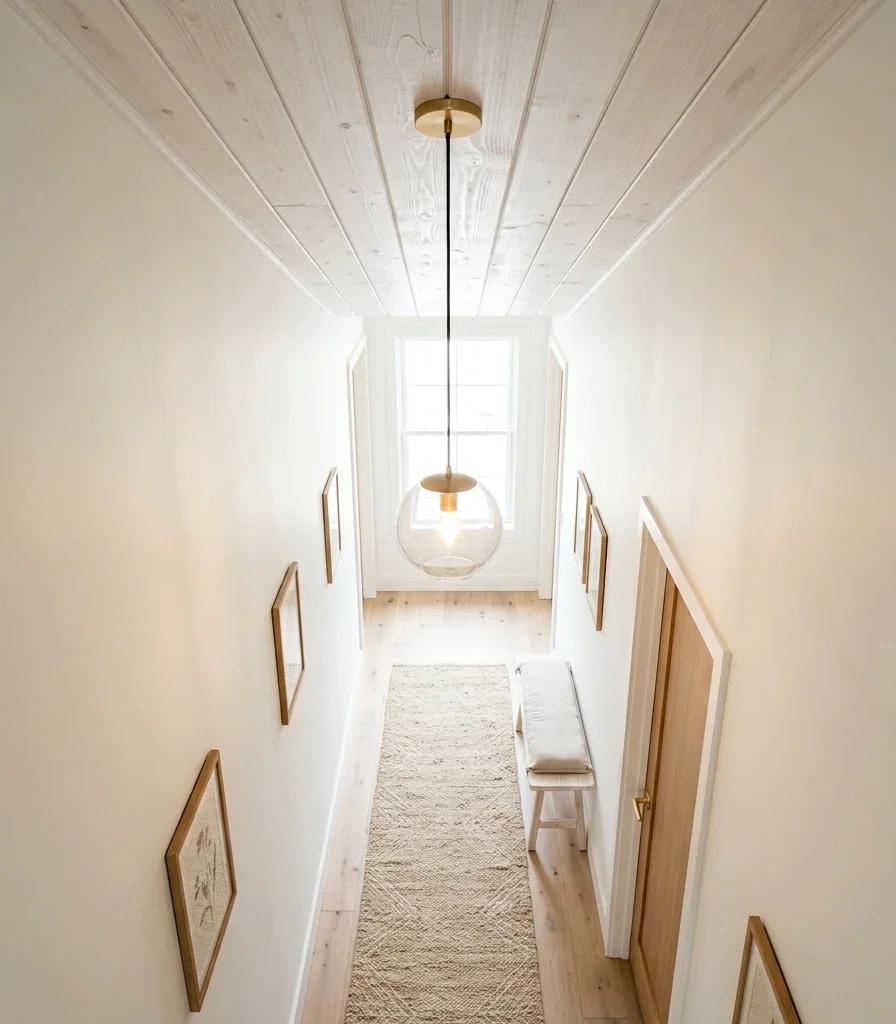
6. Whitewashed Wood Plank Ceiling

6. Whitewashed Wood Plank Ceiling

Vibe: Airy; the ceiling adds texture without adding weight.

Why it works: A whitewashed plank ceiling introduces material texture overhead while staying light in value, which keeps a narrow hallway from feeling boxed in the way a dark or heavily textured ceiling would.

How to get it: Install tongue-and-groove pine planks and apply a thin 1:1 white paint-to-water wash with a dry brush, wiping excess so grain remains visible.

Shop the Look

Product
Tongue-and-groove pine ceiling plank
Whitewash stain finish
Brass pendant light small
Ceiling medallion trim natural wood
Runner rug wool oat

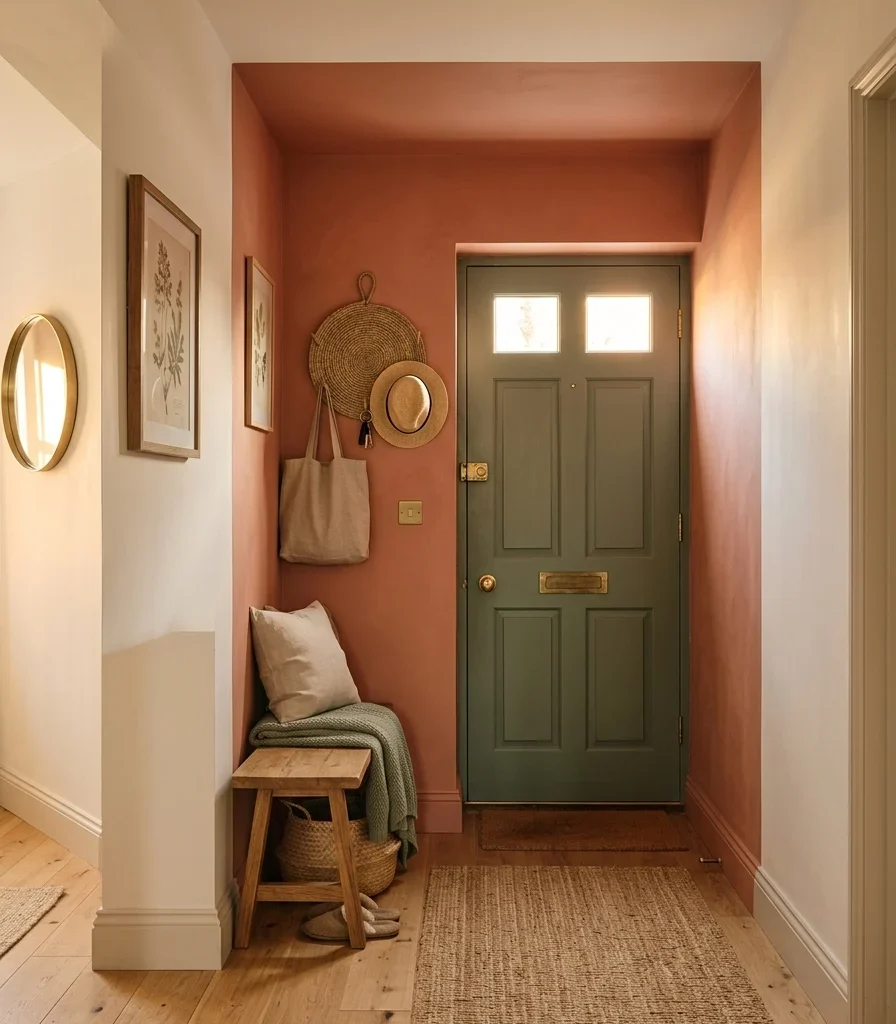
7. Terracotta Blush Painted Front Door Alcove

7. Terracotta Blush Painted Front Door Alcove

Vibe: Warm; the entry gets its own small, glowing moment.

Why it works: Confining a saturated terracotta tone to the door alcove alone treats that recessed area as a distinct architectural zone, using color to mark the transition point between outside and in rather than repainting the whole hallway.

How to get it: Paint just the alcove around the front door, he reveal walls, and the door itself in matte terracotta blush, keeping the rest of the hallway in warm white.

πŸ’‘ Quick Win: If painting the alcove feels permanent, start with a terracotta ceramic planter or doormat to test the tone.

Shop the Look

Product
Terracotta blush matte paint
Woven wall hook rack
Small entry bench oak
Ceramic planter terracotta
Natural fiber doormat

8. Defined Entry Zone with a Boot Bench

8. Defined Entry Zone with a Boot Bench

Vibe: Cozy; the first few steps inside feel like arriving somewhere, not just entering.

Why it works: Placing a bench and a mat at the entry point, distinct from the runner used in the rest of the hallway, uses zone definition to separate “arrival” from “passage,” a layout principle that keeps a single corridor doing two different jobs clearly.

How to get it: Set a boot bench against the wall nearest the door, with a smaller jute mat beneath it that visually stops where the main hallway runner begins.

Shop the Look

Product
Wood boot bench with storage
Small jute entry mat
Woven storage basket
Folded wool throw
Wall hook rail above bench

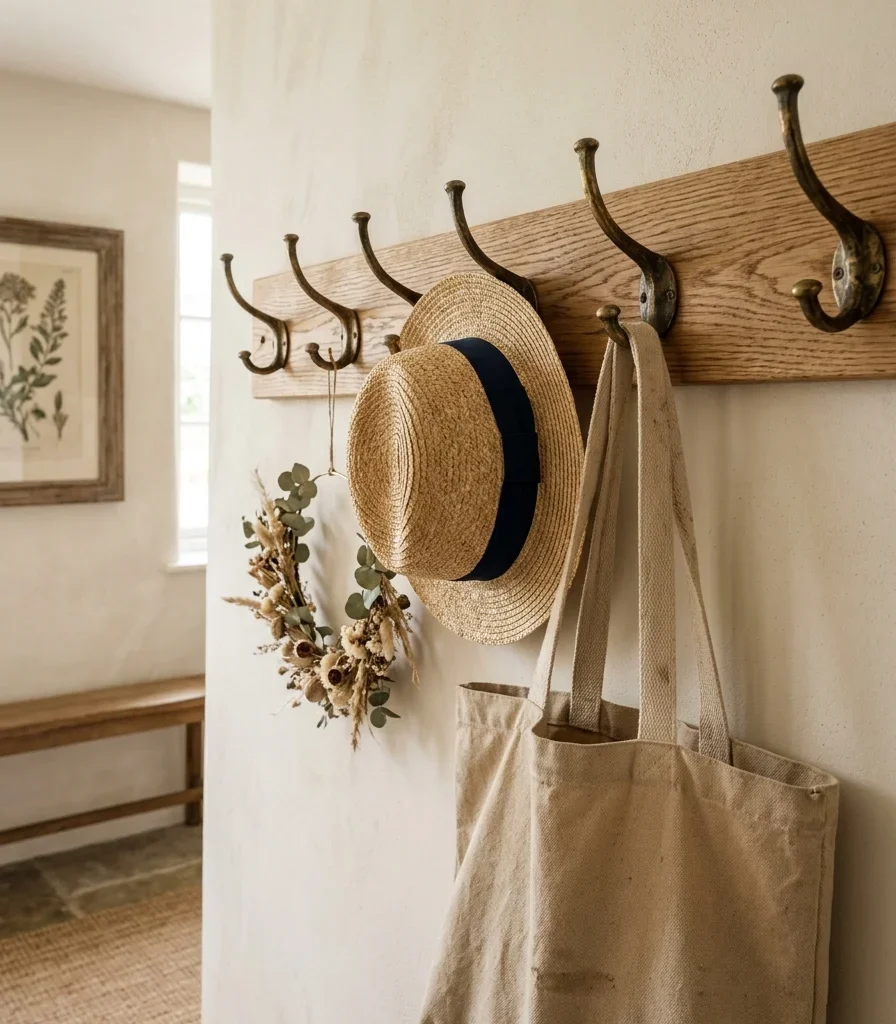
9. Wall-Mounted Peg Rail with Vintage Hooks

9. Wall-Mounted Peg Rail with Vintage Hooks

Vibe: Layered everyday objects become the decoration.

Why it works: A peg rail keeps functional items visible and accessible rather than hidden in a closet, which is the same design honesty that makes cottage interiors feel lived-in rather than staged; the coat hanging there is the coat worn today.

How to get it: Mount an oak peg rail with brass shaker-style pegs at 60 inches high, spacing pegs 6 inches apart, and hang no more than three to four items so it reads as curated rather than cluttered.

πŸ’‘ Quick Win: A three-peg rail from a hardware store, stained to match existing trim, costs under $30 and installs in ten minutes.

Shop the Look

Product
Oak peg rail with brass hooks
Canvas tote bag natural
Straw sun hat
Small dried wreath natural
Wall anchor mounting hardware

10. Wall Sconces Lighting a Gallery Wall

10. Wall Sconces Lighting a Gallery Wall

Vibe: Intimate; the gallery gets museum-quality attention.

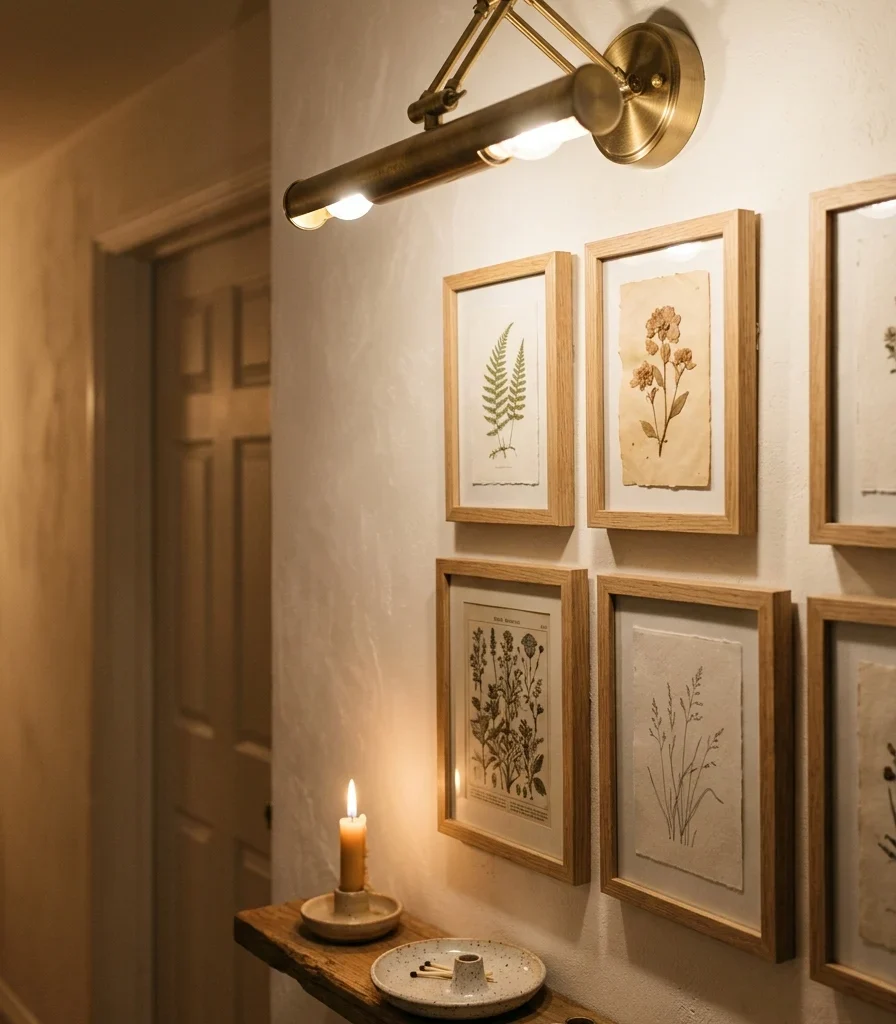
Why it works: A dedicated picture light above the frames gives the gallery its own light source rather than relying on the hallway’s ambient fixtures, which is the specific light behavior that makes framed art readable and warm in the evening rather than dim and flat.

How to get it: Mount a slim brass picture-light sconce centered above the gallery’s midpoint, angled slightly downward to wash light evenly across the frames below.

Shop the Look

Product
Brass articulated picture light
Slim oak print frame set
Warm LED bulb 2200K
Small floating ledge shelf
Ceramic dish for small objects

11. Botanical Gallery Wall Along the Hallway

11. Botanical Gallery Wall Along the Hallway

Vibe: Quiet; the walk down the hall becomes a small, slow experience.

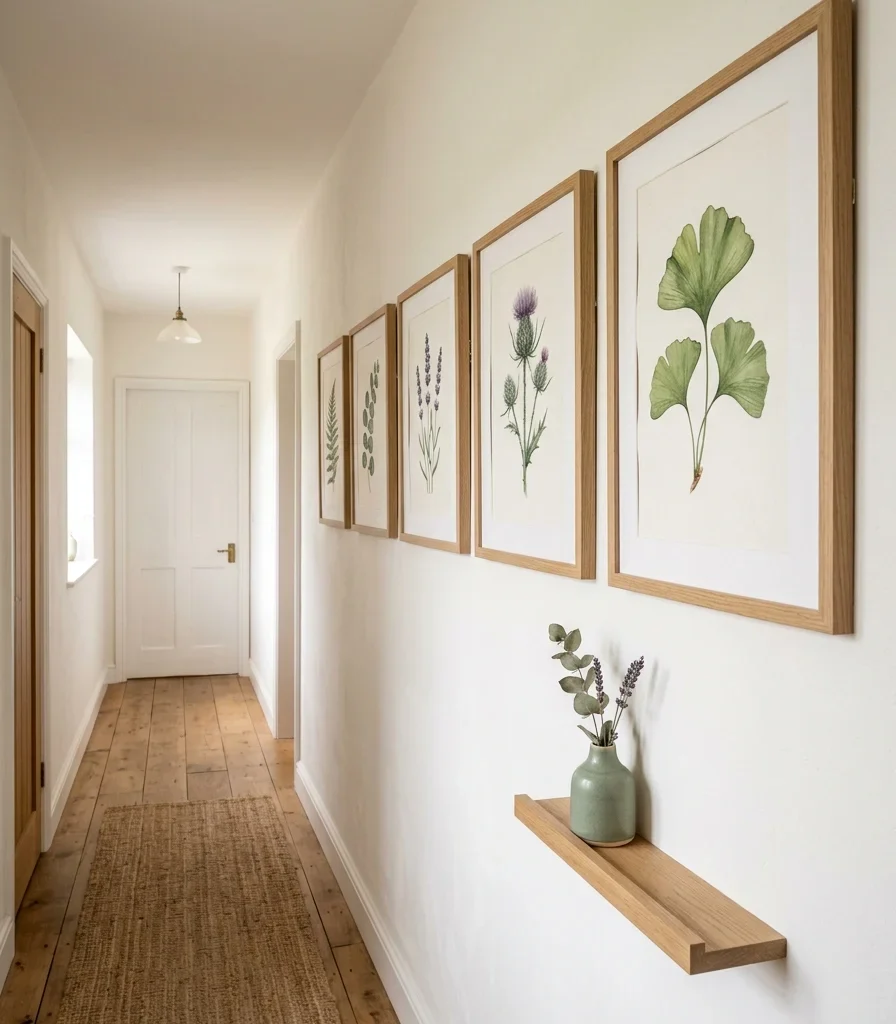
Why it works: Repeating the same frame finish and consistent spacing across multiple prints turns a long, otherwise blank wall into a single visual composition, using repetition rather than a single statement piece to hold a hallway’s greater length.

How to get it: Space five matching slim oak frames at equal intervals along the wall at 60-inch center height, using a botanical print series so the content, not just the frames, reads as cohesive.

πŸ’‘ Quick Win: Printable botanical prints from online marketplaces cost under $10 each when framed in matching budget frames.

Shop the Look

Product
Botanical print set five-piece
Slim oak picture frame set
Floating wood ledge shelf
Small ceramic bud vase
Picture hanging spacing template

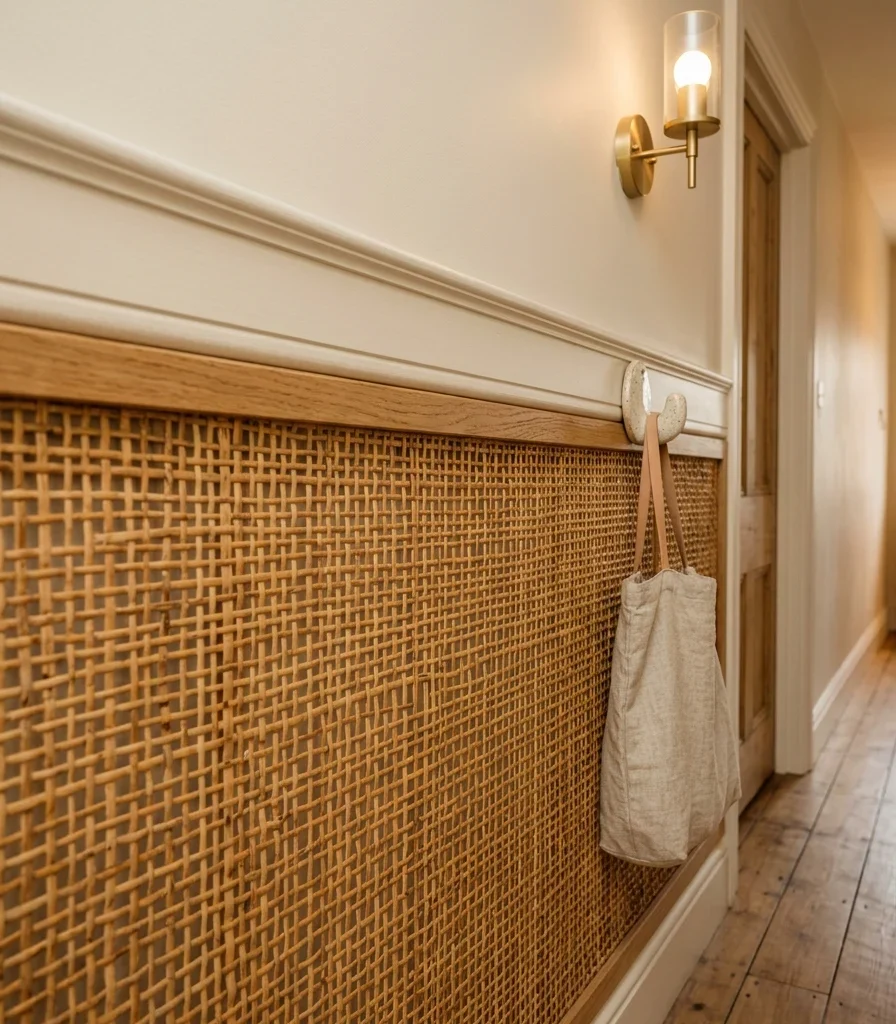
12. Rattan Wall Panels on a Half Wall

12. Rattan Wall Panels on a Half Wall

Vibe: Warm; the wall itself becomes a textile.

Why it works: Rattan’s open weave introduces the same material warmth as a woven basket, applied at architectural scale, and its horizontal placement at wainscoting height keeps the texture at hand-height where it’s most tactile and most noticed.

How to get it: Install rattan cane panels to 36-inch height with a wood chair rail trim above, in a lightly finished honey tone that echoes the console or bench wood elsewhere in the hall.

Shop the Look

Product
Woven rattan cane wall panel
Wood chair rail trim strip
Brass wall sconce small
Ceramic wall hook
Wood panel adhesive strips

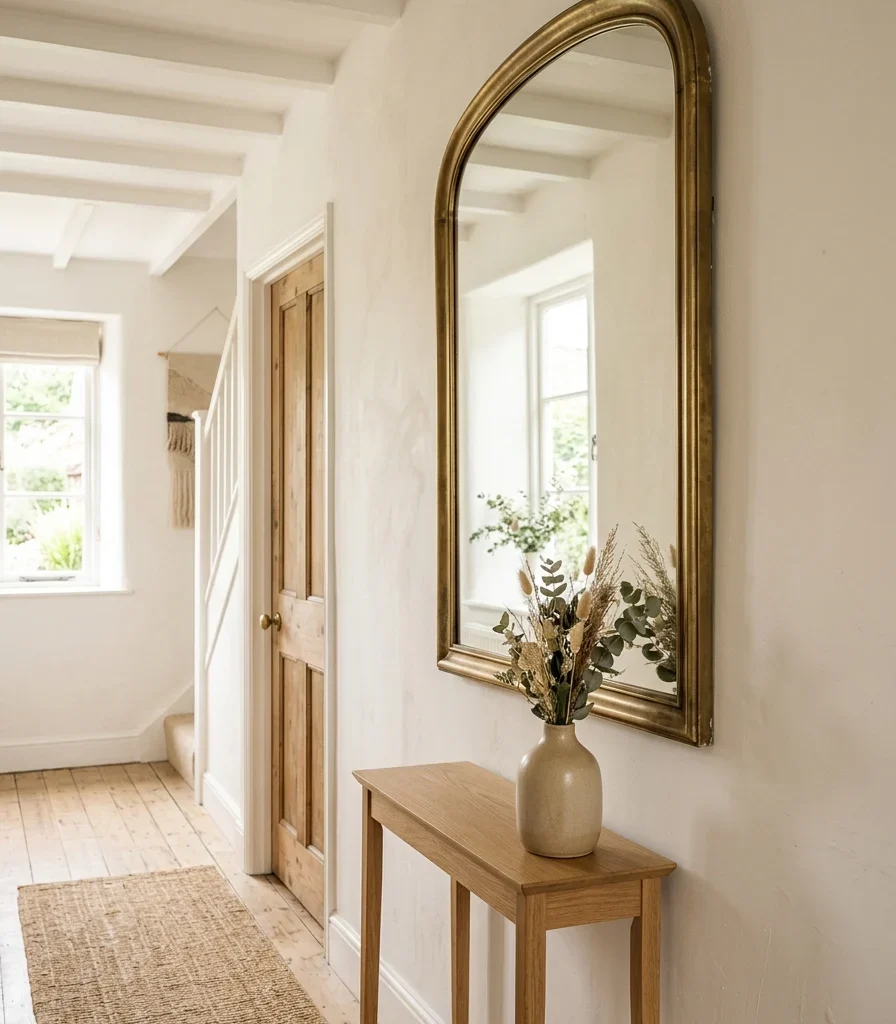
13. Mirror Wall to Widen a Narrow Hallway

Vibe: Luminous; the narrowest hallway suddenly reads twice as wide.

Why it works: A large mirror positioned to catch a window or doorway’s natural light doubles the perceived depth of a narrow hallway, an illusion technique that adds spatial quality without any structural change.

How to get it: Hang the largest mirror that fits the wall width, leaving at least 4 inches of margin on each side, directly across from or adjacent to the nearest light source so it actively reflects daylight rather than a blank wall.

πŸ’‘ Quick Win: A single arched mirror over a slim console does more to widen a tight hallway than any other single purchase on this list.

Shop the Look

Product
Large arched wall mirror brass edge
Slim console table narrow
Ceramic vase single stem
Wall anchor mirror mounting kit
Small brass wall hook

How to Start Your Modern Cottage Hallway Transformation

Your first move should be the runner rug, not the paint. A jute or wool runner sets the hallway’s undertone and length-to-width proportion, and every other decision all color, console size, lighting warmth reads more clearly once that anchor is in place underfoot.

The most common mistake is choosing a console table too deep for the hallway’s width, which leaves less than the 30 inches of clearance a corridor needs to feel walkable rather than obstructed. Fix it by measuring the hallway’s total width first and choosing furniture no deeper than a third of that measurement.

Three items under $50 that create immediate impact: a jute door mat in natural fiber (around $28), a three-peg oak wall rail with brass hooks (around $32), and a single stem in a small ceramic bud vase for the console (around $16).

A weekend refresh- paint touch-up and a peg rail starts at $150–$300. A full hallway transformation with paneling, lighting, and a console runs $800–$2,500 and typically takes two to four weeks depending on whether walls need new trim work.

Frequently Asked Questions About Modern Cottage Hallway Ideas

What is the difference between a modern cottage hallway and a farmhouse hallway?

Modern cottage hallways lean softer, using rattan, brass, and lighter wood tones, while farmhouse hallways favor black iron hardware, shiplap, and heavier reclaimed wood. Farmhouse styling often includes barn-door hardware and darker stains that modern cottage skips in favor of whitewashed or honey-toned wood. Both share a neutral base, but modern cottage adds terracotta and sage where farmhouse stays closer to gray and white.

What colors work best in a modern cottage hallway?

Warm white as the base wall color, with dusty sage on trim and terracotta blush reserved for a single alcove or accent, is the most reliable palette. Avoid cool, stark whites in hallways with limited natural light t; they read as clinical rather than warm. A repeated sage trim color along multiple doorways ties a long hallway together visually.

How much does it cost to decorate a modern cottage hallway?

A budget refresh with a runner, paint, and a peg rail runs $150–$400. A mid-range update adding a console table and new lighting lands between $500–$1,200. A full transformation with wall paneling, a mirror, and custom lighting typically costs $1,500–$3,000 depending on hallway length and whether electrical work is involved.

Does modern cottage style work in a narrow hallway?

Yes, and narrow hallways are often where it works best. Prioritize a large mirror to reflect light, a console no deeper than 12 inches, and vertical wall paneling to draw the eye upward rather than emphasizing the narrow width. Avoid a bulky bench or wide console, which can reduce the walkway below the comfortable 30-inch clearance.

What kind of lighting is best for a modern cottage hallway?

A row of brushed brass flush-mount ceiling lights spaced every 6 to 8 feet, paired with a dimmer switch, is the most reliable modern cottage hallway lighting setup. This avoids the single dark end that one central fixture always leaves in a long corridor. Adding a picture light above a gallery wall gives artwork its own warm light source separate from the overhead fixtures.

Ready to Create Your Dream Modern Cottage Hallway?

These 13 ideas cover color, material, lighting, and layout, so there’s a genuine entry point whether your hallway is long and dark or short and narrow. Starting small is not a lesser version of this style; a single runner rug or one peg rail is a legitimate first step, not a placeholder for later. Today, measure your hallway’s width and note where the light falls flattest, then choose the one idea from this list that solves that exact problem. Once it comes together, walking through your own front door should feel like a small daily welcome rather than a rushed pass-through. Save the ideas that matched your hallway’s light and width, and start with the mirror, the runner, or the peg rail, whichever one you keep picturing.

You Might Also Like

Boho Entryway Decor ideas

14 Boho Entryway Decor Ideas for a Warm Welcome

Boho entryway decor layers vintage textiles, natural fiber, and sun-worn color into the one room every guest sees first, trading polish for personality. This article provides 14 boho entryway decor ideas, ranging from rugs to lighting to storage, designed to create a welcoming landing spot.

The feeling is unmistakable: a kilim rug has faded just enough to look collected, macrame catching the afternoon shadow on the wall, with warmth that has nothing to do with the thermostat. Boho doesn’t arrive matched  it arrives gathered, one piece at a time. Here are 14 ideas worth saving and stealing.

Why Boho Entryway Decor Ideas Work So Well

What is it? Boho traces back to 19th-century Bohemian artists in Paris who rejected rigid Victorian formality in favor of a freer, more personal way of living, and it resurfaced through the 1960s and ’70s counterculture alongside a surge in global travel and textile trade. What separates real boho from the retail version often labeled “boho chic” is genuine eclecticism, pieces collected across time and culture rather than a single curated palette bought as a set.

What are its core materials and colors? The palette runs warm terracotta, rust, mustard, and warm clay, layered against natural undyed tones. Materials stay tactile and handmade: vintage kilim wool, rattan, cane, jute, macrame cotton, and reclaimed wood. Nothing is uniform pattern and textures are expected to vary piece to piece rather than match.

Why is it trending now? Boho entryway searches have grown alongside a broader post-pandemic desire for homes that read as personal and well-traveled rather than showroom-styled, and the secondhand and vintage-thrifting movement has made genuinely collected textiles more accessible than ever. Pinterest’s continued strong search volume for “boho entryway” reflects a shift away from single-source, matched furniture sets.

Can small spaces achieve this style? Yes  boho actually suits small entryways well, since a single layered rug and one textural wall moment can carry the whole look. Prioritize restraint in furniture scale first, then let textiles and layering do the rest of the work.

ElementPhilosophyKey Materials
Core valueCollected over curatedVintage kilim, rattan, macrame
Color approachSun-worn warmth, layeredReclaimed wood, jute, cane

14 Boho Entryway Decor Ideas

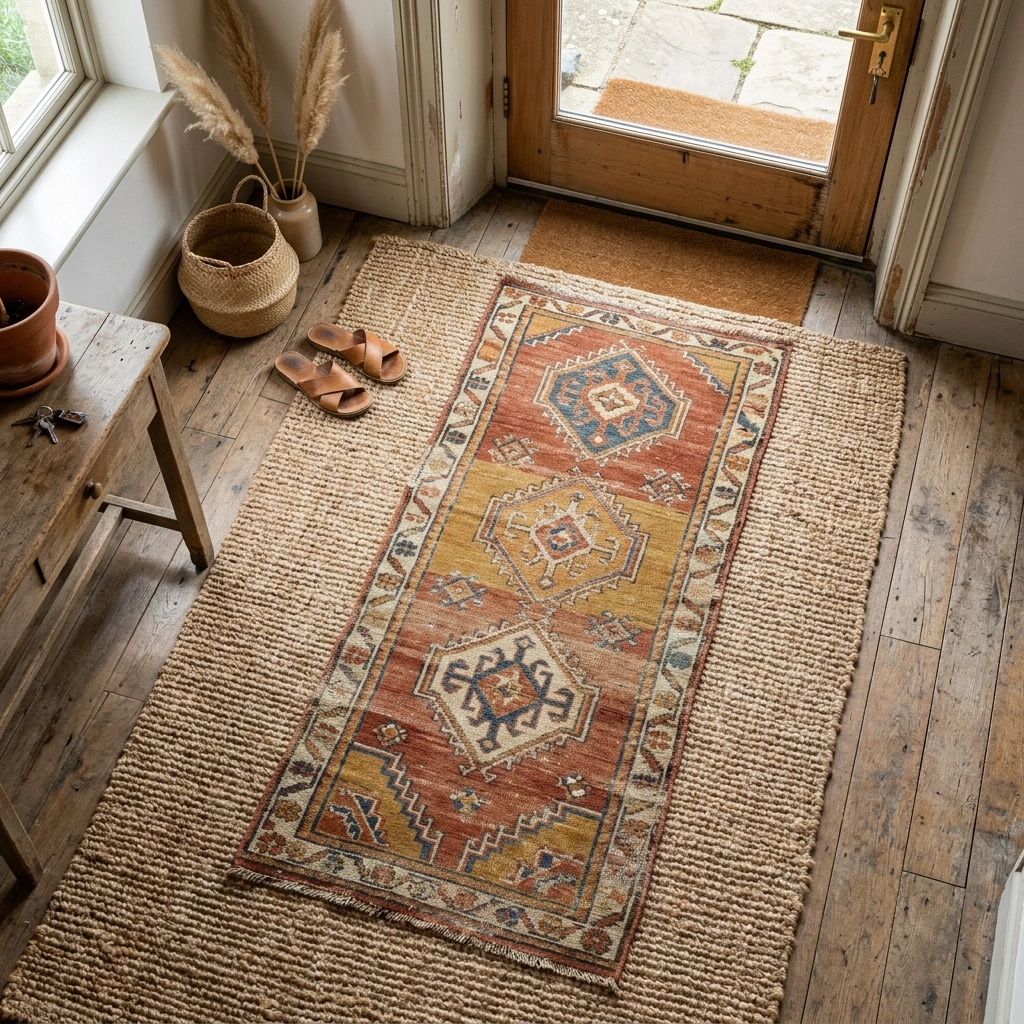
1. Vintage Kilim Runner Layered Over Jute

1. Vintage Kilim Runner Layered Over Jute

Vibe: The floor feels layered, two textures doing what one flat rug never could.

Why it works: Stacking a smaller patterned kilim over a larger jute rug creates textural depth at floor level, a layering technique that adds visual richness without requiring a large or expensive single rug. The kilim’s faded, hand-woven pattern also reads as genuinely collected in a way a printed rug can’t replicate.

How to get it: Choose a jute rug sized to the full entry footprint, then center a smaller vintage or vintage-style kilim runner on top, offset slightly rather than perfectly centered so the layering looks gathered, not staged.

πŸ’‘ Quick Win: A vintage-style printed kilim runner under $60 gives the same visual layering if an authentic vintage piece isn’t in budget yet.

Shop the Look

Product
Vintage-style wool kilim runner rug
Natural jute area rug
Leather-woven sandal tray
Small woven storage basket
Dried pampas grass stem

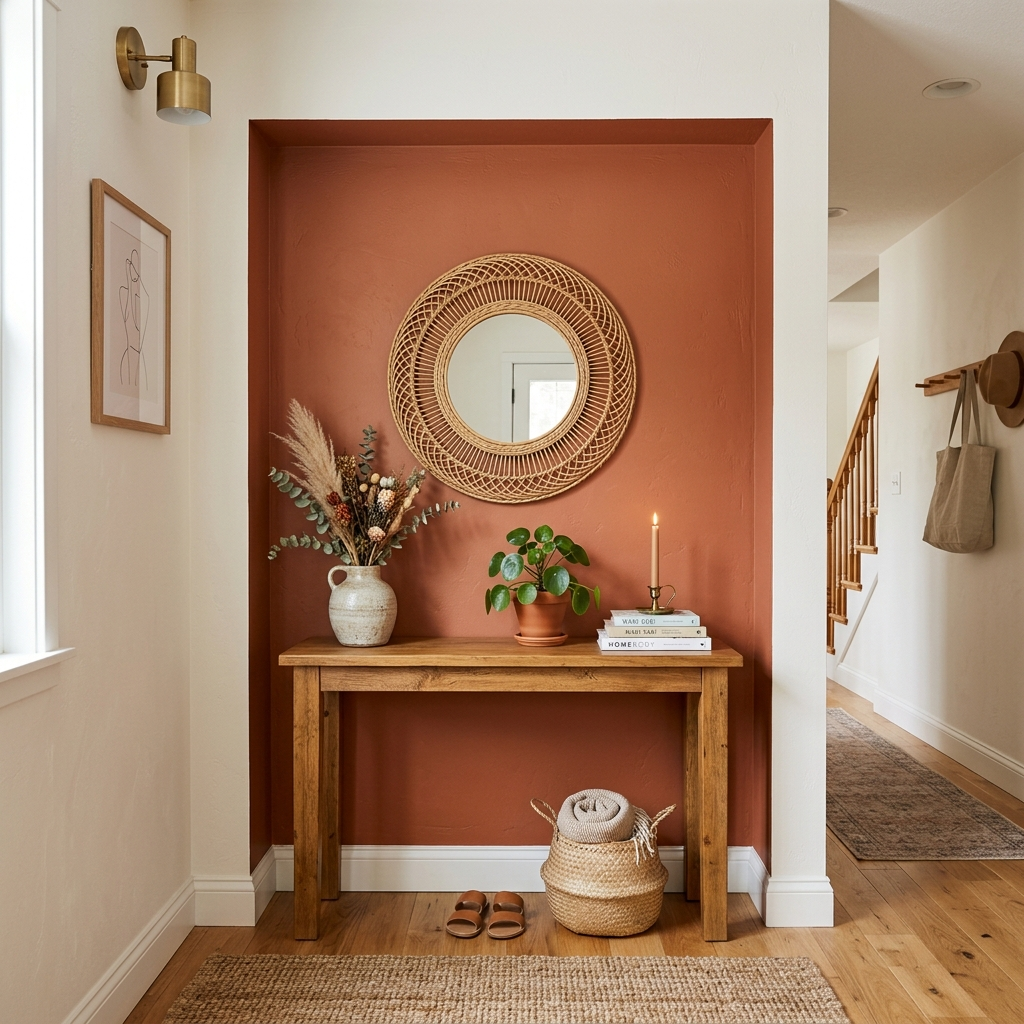
2. Warm Terracotta Wall Nook Behind the Console

2. Warm Terracotta Wall Nook Behind the Console

Vibe: The nook feels sun-warmed, one wall carrying the room’s entire temperature.

Why it works: Painting only the recessed or console-backing wall in terracotta uses a focal-point technique; the color stays contained to a defined area rather than committing the whole entry, so the effect reads as intentional rather than overwhelming a small footprint. Terracotta’s earthy undertone also grounds the natural materials typically layered in front of it.

How to get it: Paint the wall section directly behind the console in a warm terracotta such as Farrow & Ball’s Terracotta No. 240, keeping surrounding walls in warm white so the color reads as a defined nook rather than a full room commitment.

Shop the Look

Product
Terracotta interior wall paint matte
Ceramic vase ribbed warm glaze
Rattan-framed round wall mirror
Small potted plant terracotta pot
Warm white interior wall paint

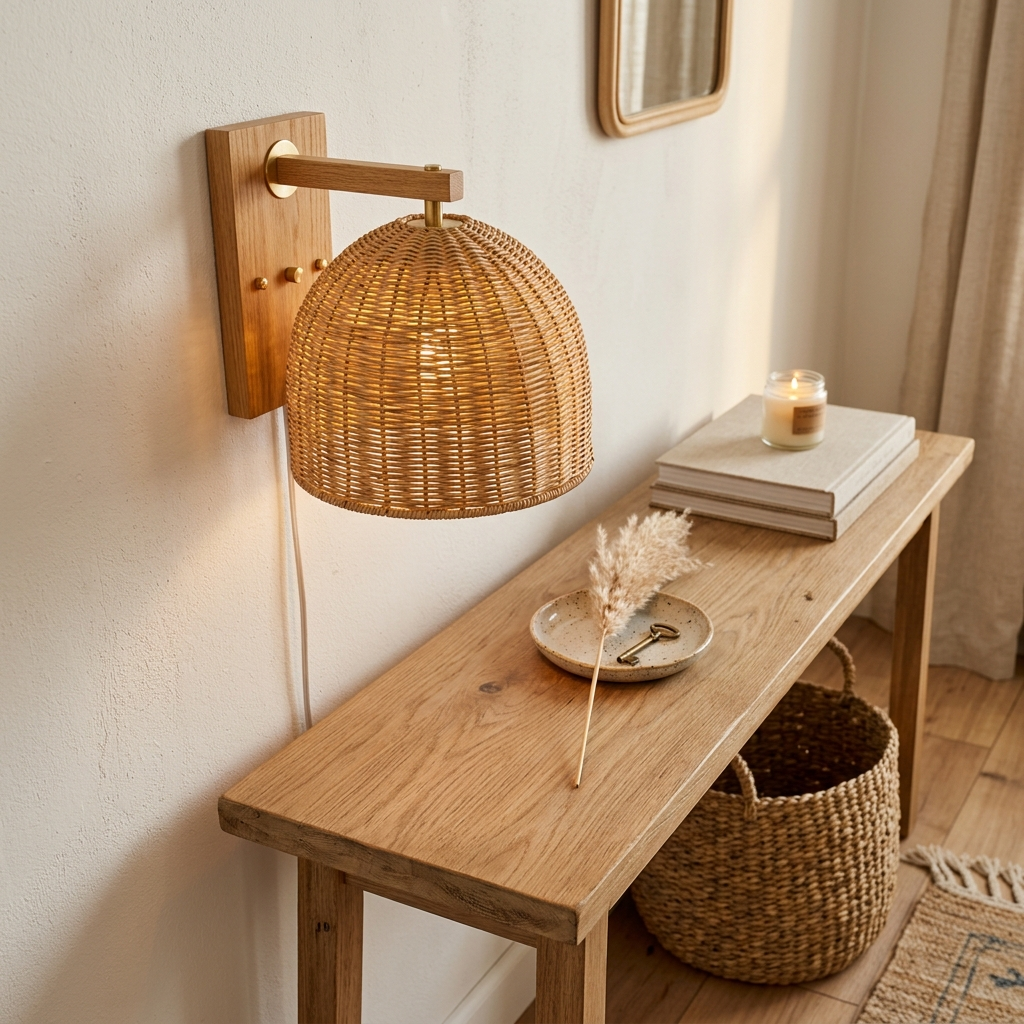
3. Woven Rattan Wall Sconce for Soft Ambient Glow

3. Woven Rattan Wall Sconce for Soft Ambient Glow

Vibe: The wall feels hushed, light filtering through fiber instead of falling in a hard beam.

Why it works: A rattan sconce diffuses light through its open weave rather than casting it directly, softening the entry’s first impression the moment someone steps through the door  a lighting behavior far better suited to boho’s warmth than a bright overhead flush mount alone. Mounting it at eye level also draws attention away from the ceiling and toward the wall’s texture.

How to get it: Install a rattan or woven wall sconce at 60 inches from the floor beside the console, fitted with a warm 2700K bulb so the woven shadow pattern reads amber rather than white.

πŸ’‘ Quick Win: A plug-in rattan wall sconce avoids any wiring and can be mounted with adhesive hooks for a rental-friendly update.

Shop the Look

Product
Woven rattan wall sconce plug-in
Warm 2700K LED bulb dimmable
Ceramic catchall dish small
Dried grass stem bundle natural
Woven storage basket small

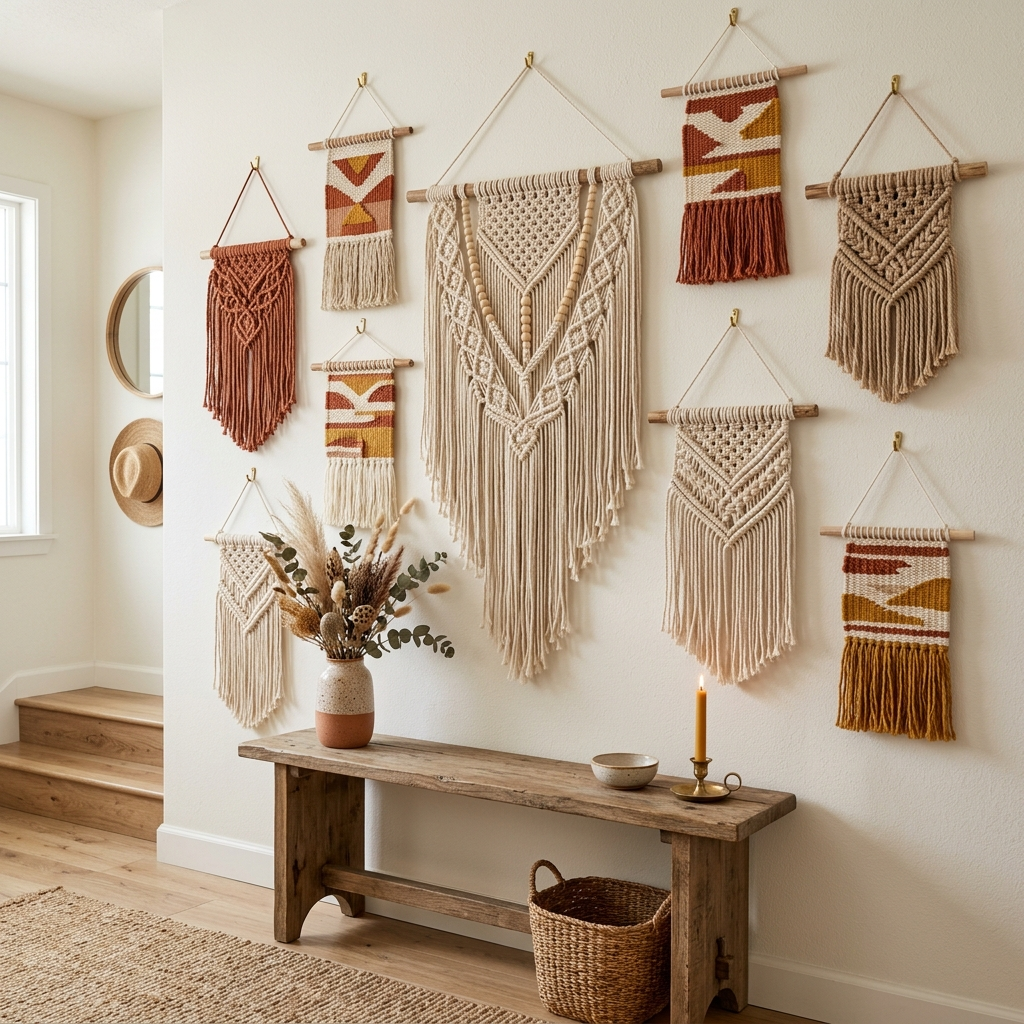
4. Gallery of Macrame and Woven Wall Hangings

4. Gallery of Macrame and Woven Wall Hangings

Vibe: The wall feels gathered, as it grew slowly rather than arriving all at once.

Why it works: Mixing macrame and small woven pieces at varied heights and fringe lengths creates asymmetric texture layering, the boho equivalent of a gallery wall. Negative space between pieces still matters here, since crowding every inch would flatten the visual interest rather than add to it. Cotton macrame also catches light and shadow differently than a flat framed print, adding dimension a picture wall can’t.

How to get it: Choose three macrame or woven pieces in varying sizes and knot patterns, all within a natural cotton or jute color family, and hang them with at least 6 inches of breathing room between each.

Shop the Look

Product
Macrame wall hanging, natural cotton
Small woven textile wall art
Reclaimed wood console table
Ceramic bud vase with warm glaze
Dried floral stem bundle

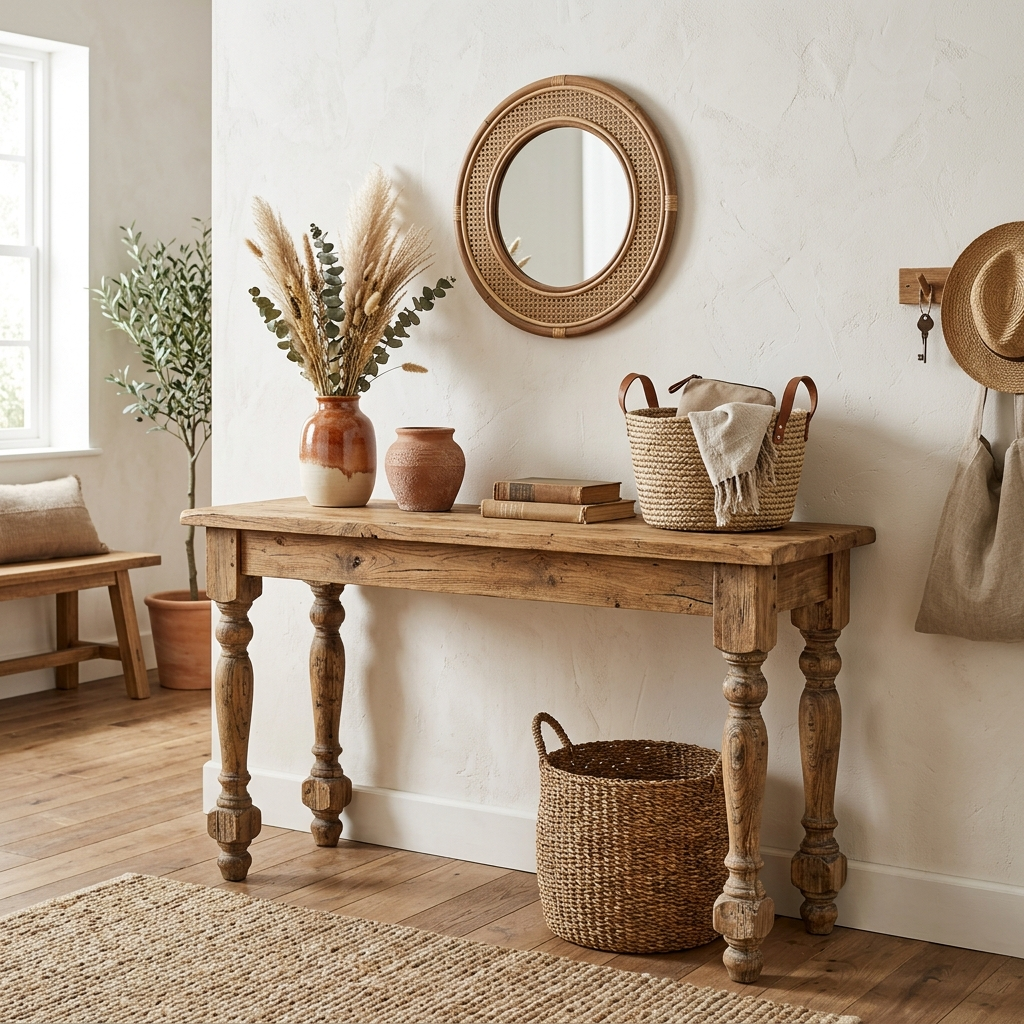
5. Reclaimed Wood Console with Turned Legs

5. Reclaimed Wood Console with Turned Legs

Vibe: The console feels grounded, a piece of furniture that looks like it has a history.

Why it works: A console with visible turned legs rather than a solid base lets light and floor show through beneath it, keeping the entry’s negative space intact even with a substantial piece of furniture in the room. Reclaimed wood’s weathered grain also reads as genuinely collected, reinforcing boho’s preference for pieces with visible age over uniform new finishes.

How to get it: Choose a console built from genuine reclaimed wood with turned or spindle legs, sized to leave at least 36 inches of clear walking space in front for traffic flow.

Shop the Look

Product
Reclaimed wood console turned legs
Woven seagrass basket set
Ceramic vase warm glaze
Rattan-framed wall mirror
Small potted plant ceramic pot

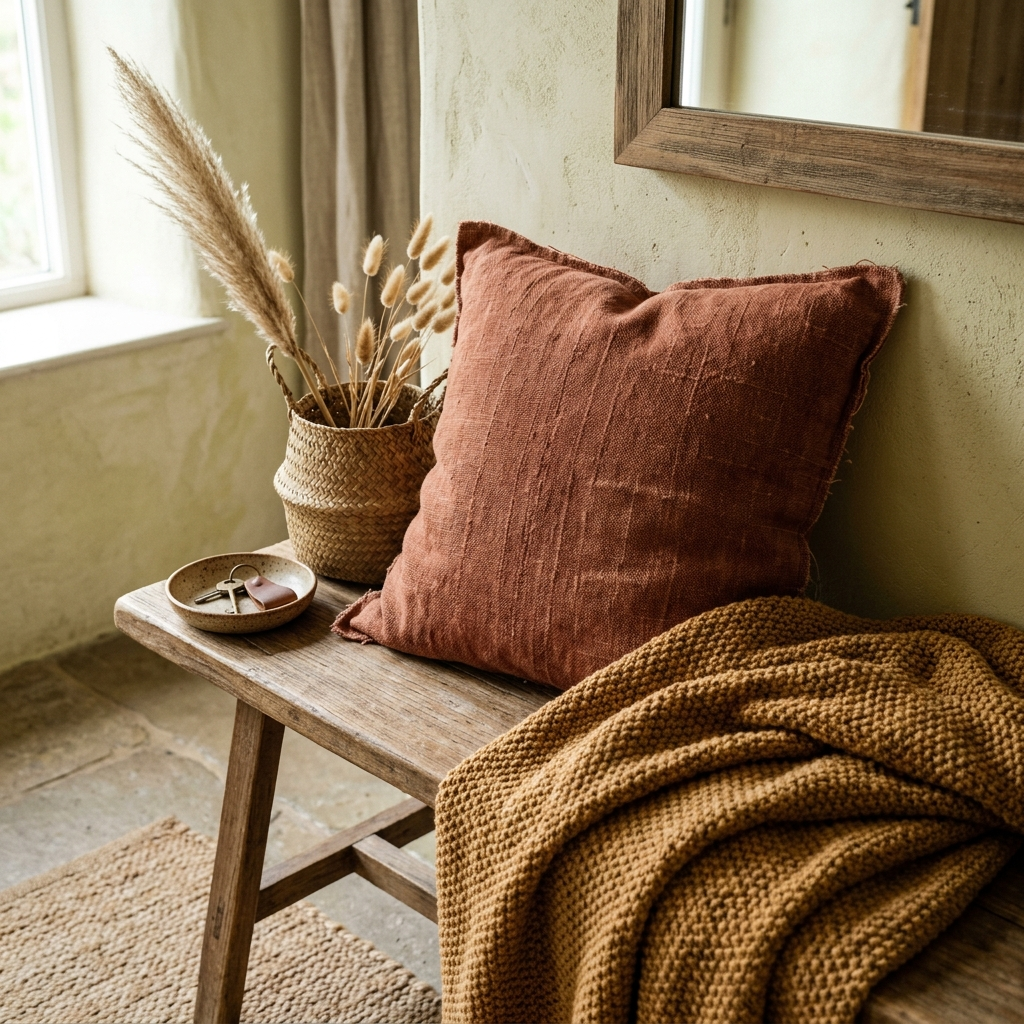
6. Sun-Faded Rust and Mustard Textile Layering

6. Sun-Faded Rust and Mustard Textile Layering

Vibe: The bench feels sun-warmed, color layered like fabric left out in real weather.

Why it works: Pairing rust and mustard within the same warm-toned family creates tonal layering rather than color contrast, which is why the combination reads as cohesive despite being two distinct hues; both sit close enough on the color wheel to feel like variations of one warmth rather than competing accents.

How to get it: Choose a rust cushion cover and a mustard throw in similar fabric weights, avoiding a glossy synthetic blend, so the textures read as naturally worn rather than mismatched in finish.

πŸ’‘ Quick Win: A single mustard throw draped over an existing neutral bench updates the color story without buying new cushions.

Shop the Look

Product
Rust cushion cover set
Mustard cotton throw blanket
Woven storage basket small
Dried grass stem bundle
Ceramic catchall dish

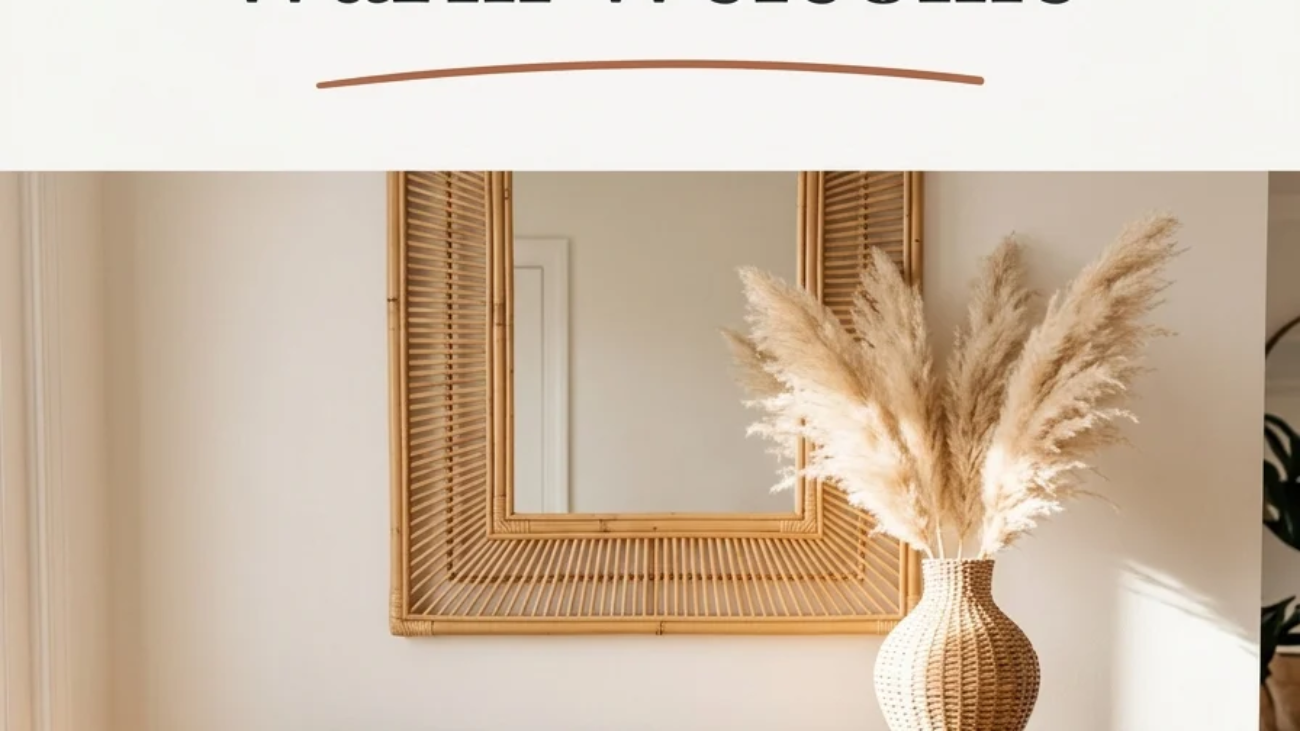
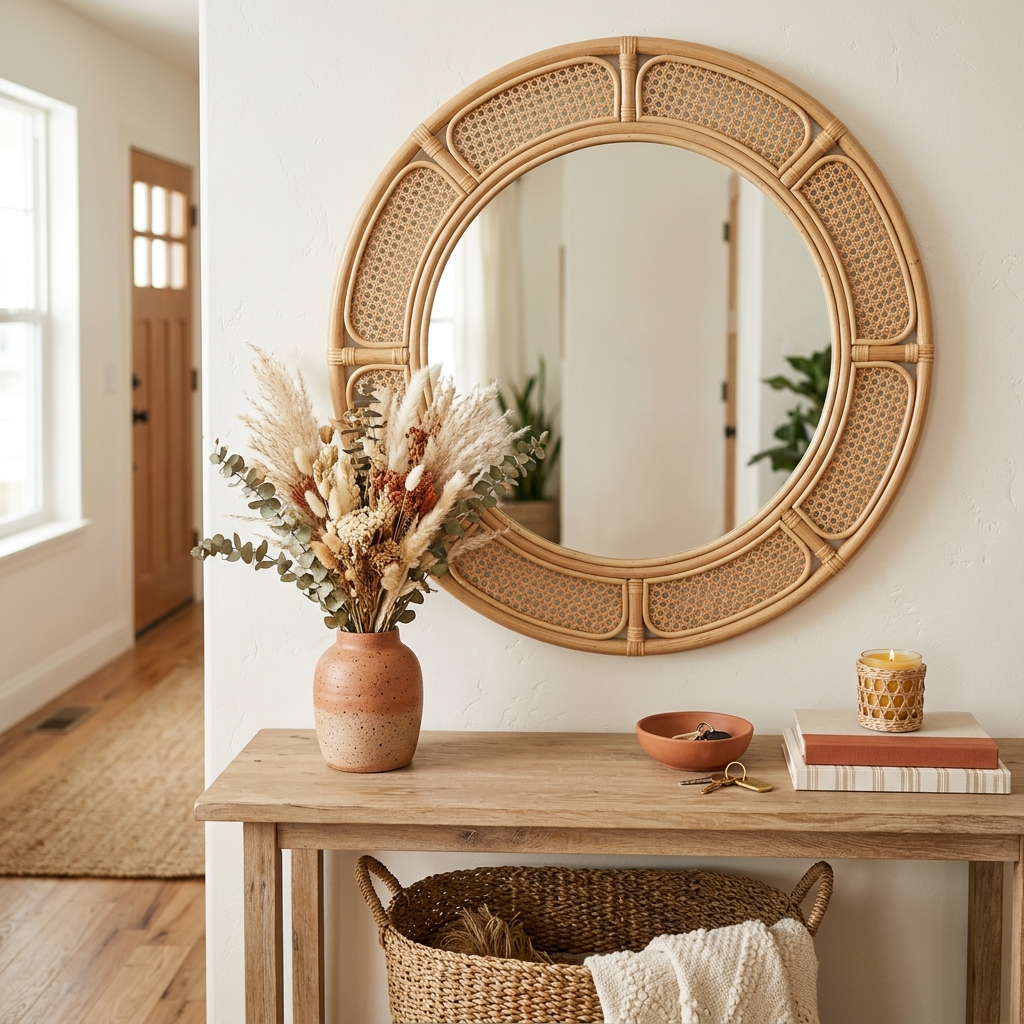
7. Rattan and Cane Mirror Frame

7. Rattan and Cane Mirror Frame

Vibe: The mirror feels light, its open weave frame letting the wall show through at the edges.

Why it works: A cane or rattan mirror frame introduces texture-based visual interest without adding a new color, and its open weave keeps the piece from reading as heavy the way a solid wood or metal frame would above a console. The mirror also functions practically, bouncing entry light deeper into the room.

How to get it: Choose a round or arched cane-frame mirror sized to roughly two-thirds the width of the console beneath it, hung so its bottom edge sits about 6 inches above any styled objects on the console top.

Shop the Look

Product
Cane and rattan framed round mirror
Ceramic vase warm glaze
Dried floral stem bundle
Woven storage basket small
Reclaimed wood console table

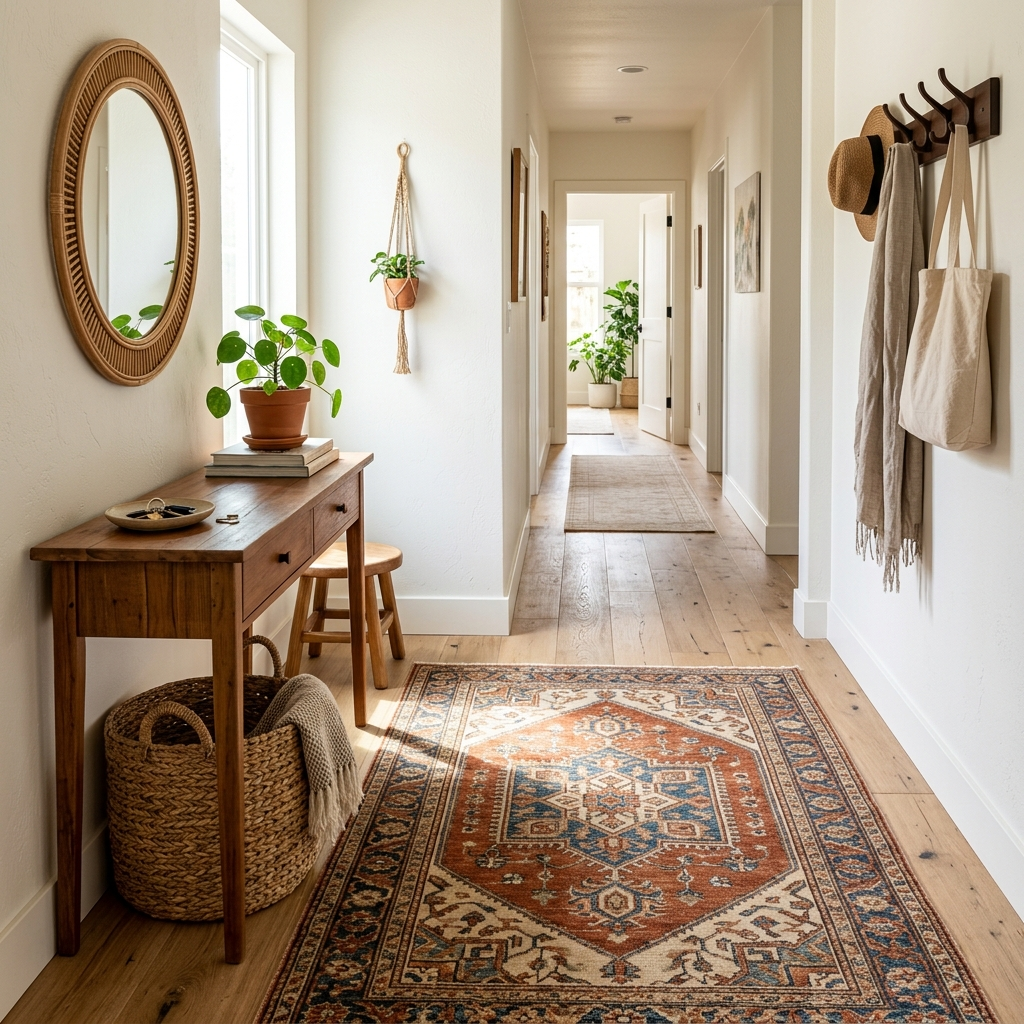
8. Drop Zone Defined by a Vintage Rug Border

8. Drop Zone Defined by a Vintage Rug Border

Vibe: The entry feels defined, a floor boundary doing the work a wall usually would.

Why it works: A rug sized to the entry’s exact footprint rather than one that trails into the hallway  creates a layout boundary that visually separates the drop zone from the rest of the home, a zone-definition technique especially useful in open floor plans without a distinct entry hall. The transition from patterned rug to bare floor signals “arrival complete” the moment someone steps past it.

How to get it: Measure the entry’s natural footprint (typically the width of the door swing plus a few feet of depth) and size the rug to end just at that boundary, rather than choosing a rug based on furniture placement alone.

Shop the Look

Product
Vintage-pattern wool area rug
Reclaimed wood console table
Woven storage basket small
Ceramic catchall dish
Rattan-framed wall mirror

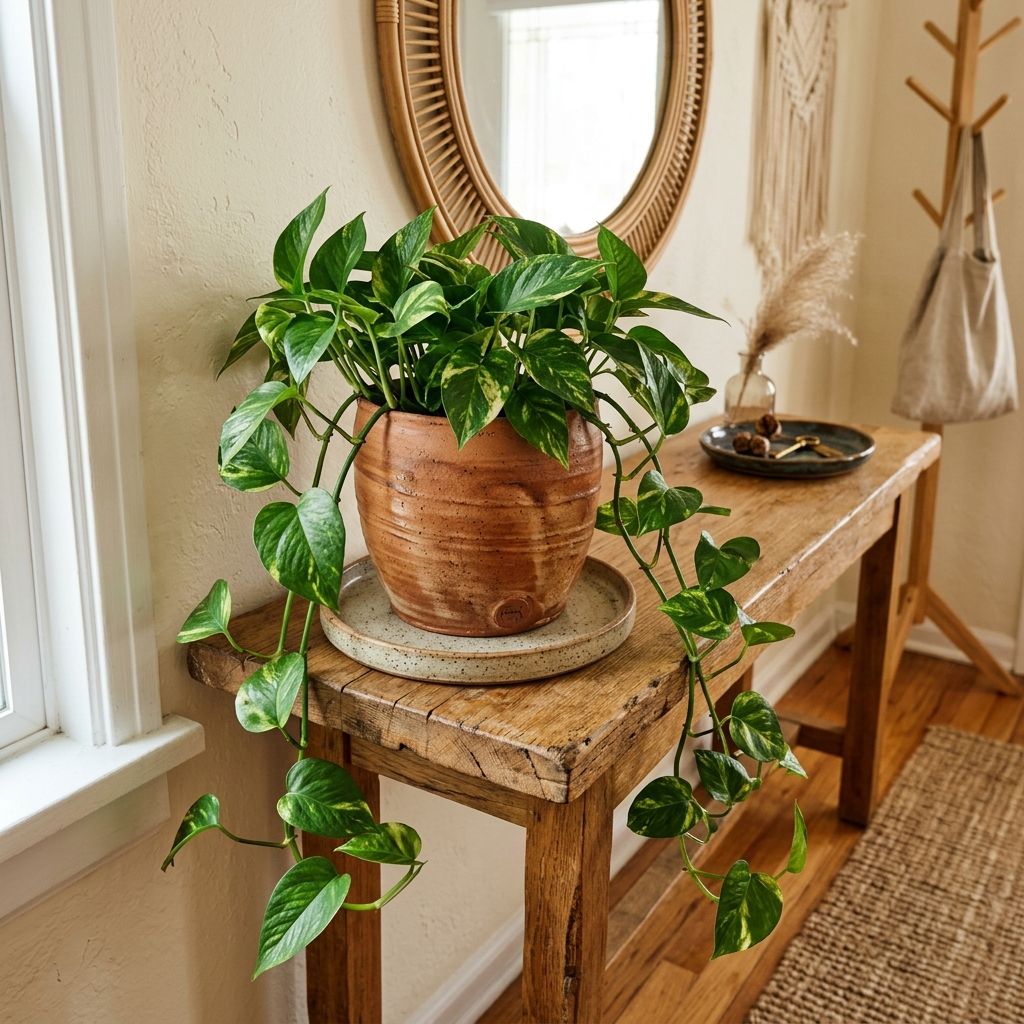
9. Trailing Pothos in a Hand-Thrown Ceramic Pot

9. Trailing Pothos in a Hand-Thrown Ceramic Pot

Vibe: The console feels alive, one trailing vine softening every hard edge around it.

Why it works: A trailing plant introduces organic, irregular lines against a console’s straight edges, the same contrast principle a live-edge table brings to a living room. The vine’s movement breaks up an otherwise static tabletop arrangement. A hand-thrown ceramic pot also adds the same visible-imperfection quality that boho values in its textiles.

How to get it: Choose a pothos or similar low-light trailing vine in a hand-thrown terracotta pot, positioned near the console’s edge so the vine can drape naturally rather than sitting propped against the wall.

πŸ’‘ Quick Win: A faux trailing vine in the same pot style works identically for entries with little natural light, without maintenance concerns.

Shop the Look

Product
Trailing pothos plant, faux or live
Hand-thrown ceramic terracotta pot
Ceramic catchall tray
Dried grass stem bundle
Small ceramic dish

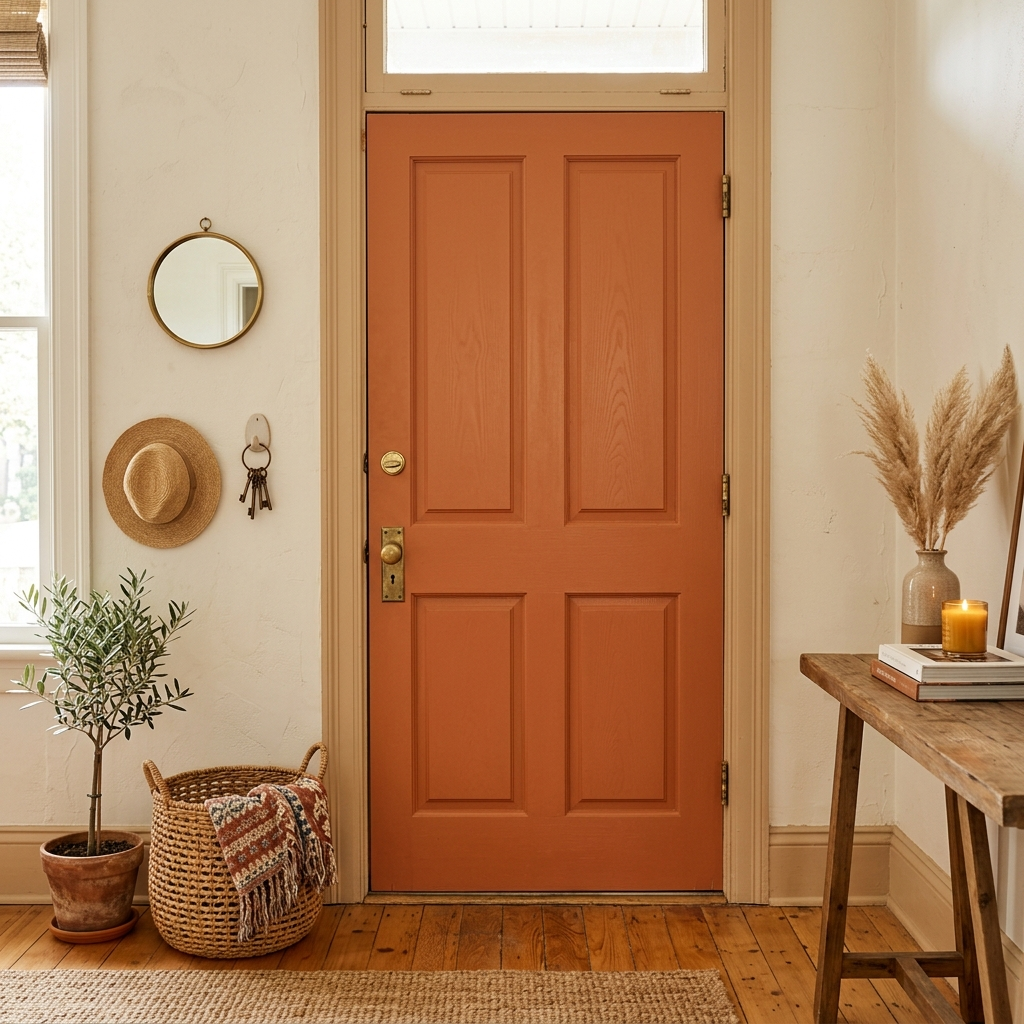
10. Warm Clay Painted Front Door Seen from Inside

10. Warm Clay Painted Front Door Seen from Inside

Vibe: The door feels sun-warmed, color greeting you before anything else in the room does.

Why it works: Painting the interior face of the front door in warm clay treats the door itself as a color-blocked focal point rather than an afterthought, a technique that makes the entry’s boldest color choice something you notice on the way out as much as on the way in. Brass hardware against the clay tone repeats the room’s warm metal note.

How to get it: Paint the interior door panel in a warm clay orange, such as Benjamin Moore’s Rust HC-59, and keep surrounding trim in warm white so the door reads as a deliberate accent rather than blending into the wall.

Shop the Look

Product
Warm clay interior door paint
Brass door hardware set
Woven storage basket small
Ceramic wall hook set
Rattan-framed wall mirror

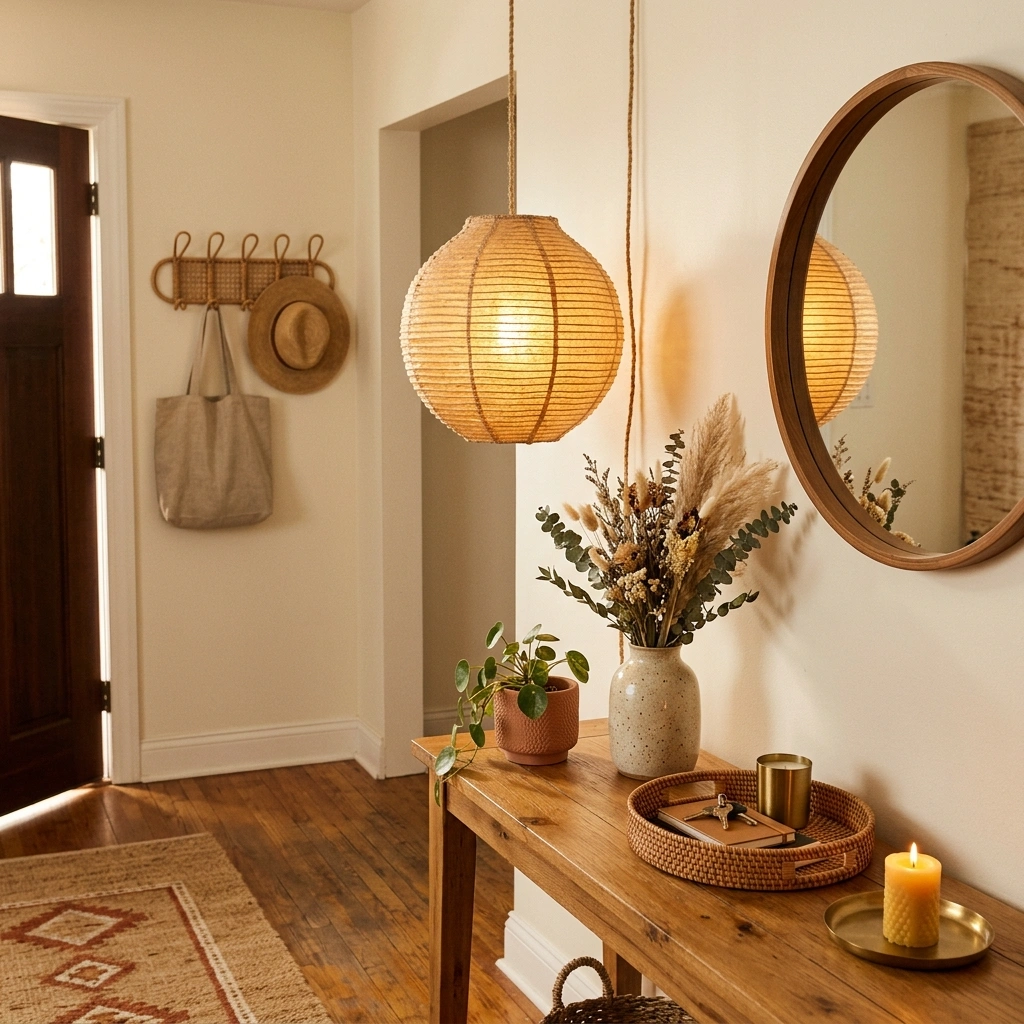
11. Paper Lantern Pendant for Diffused Warmth

11. Paper Lantern Pendant for Diffused Warmth

Vibe: The entry feels luminous, light glowing evenly instead of pooling in one bright spot.

Why it works: A paper lantern pendant diffuses light through its entire surface rather than through a single exposed bulb, applying the same soft light-behavior principle as a rattan pendant but with an even, all-around glow suited to a smaller entry ceiling. Hanging it centered above the console also anchors the room’s vertical sightline the moment someone walks in.

How to get it: Hang a woven paper lantern pendant 30–34 inches above the console surface, fitted with a warm 2700K bulb, and choose a natural fiber cord rather than a metal chain to keep the material language consistent.

πŸ’‘ Quick Win: A battery-operated LED puck light inside an existing paper lantern shade avoids any wiring for renters.

Shop the Look

Product
Woven paper lantern pendant light
Warm 2700K LED bulb dimmable
Ceramic vase, warm glaze
Woven storage basket small
Dried floral stem bundle

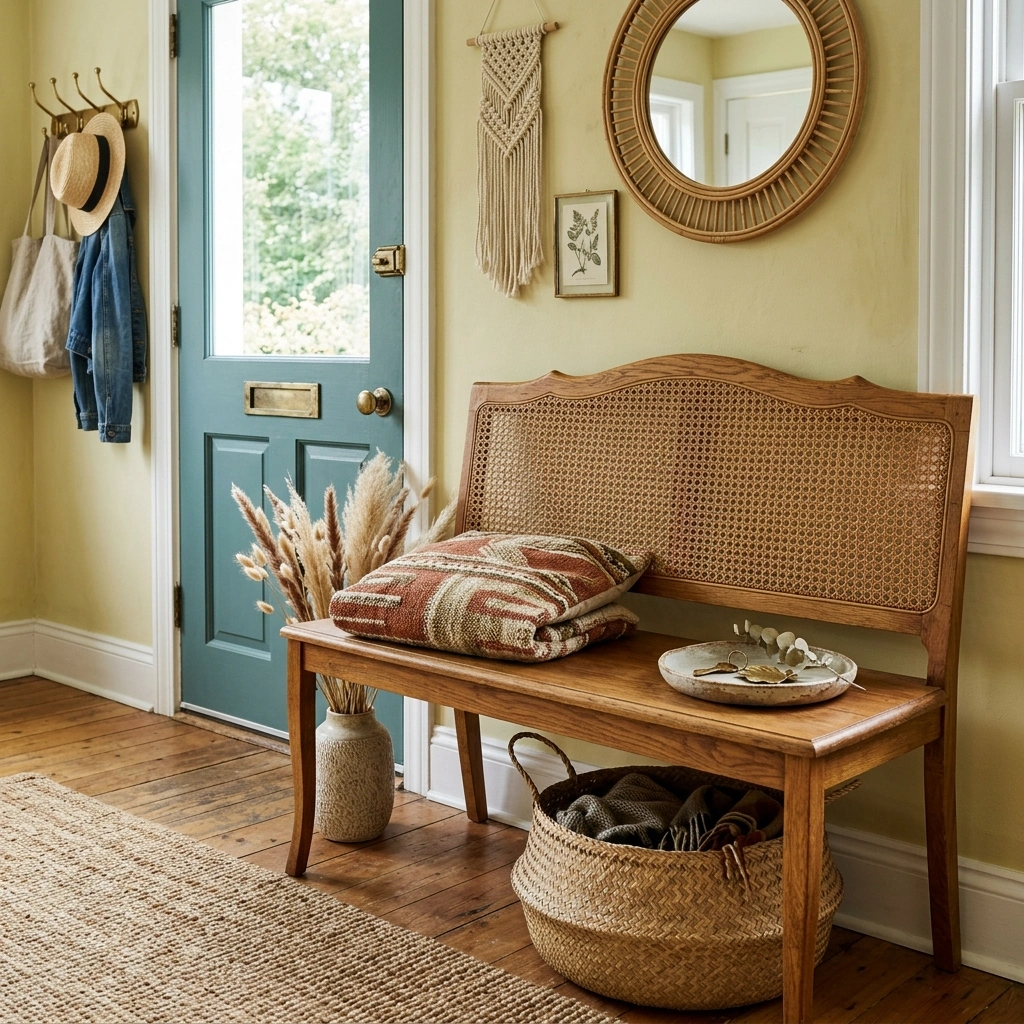
12. Vintage Cane Bench for a Shoe-Off Landing Spot

12. Vintage Cane Bench for a Shoe-Off Landing Spot

Vibe: The bench feels welcoming, a landing spot that invites you to pause before moving further in.

Why it works: A cane-backed bench introduces the same open-weave visual lightness as a rattan mirror or sconce, keeping a functional seating piece from adding heavy visual weight to a small entry. Positioning it perpendicular to the door’s swing rather than directly opposite also keeps the traffic path clear.

How to get it: Choose a bench no deeper than 16 inches for a tight entry, with a cane or rattan backrest panel rather than solid upholstery, and slide a woven basket underneath for shoe storage.

Shop the Look

Product
Cane-backed wood entryway bench
Woven seat cushion cover
Woven storage basket for shoes
Ceramic catchall dish
Dried grass stem bundle

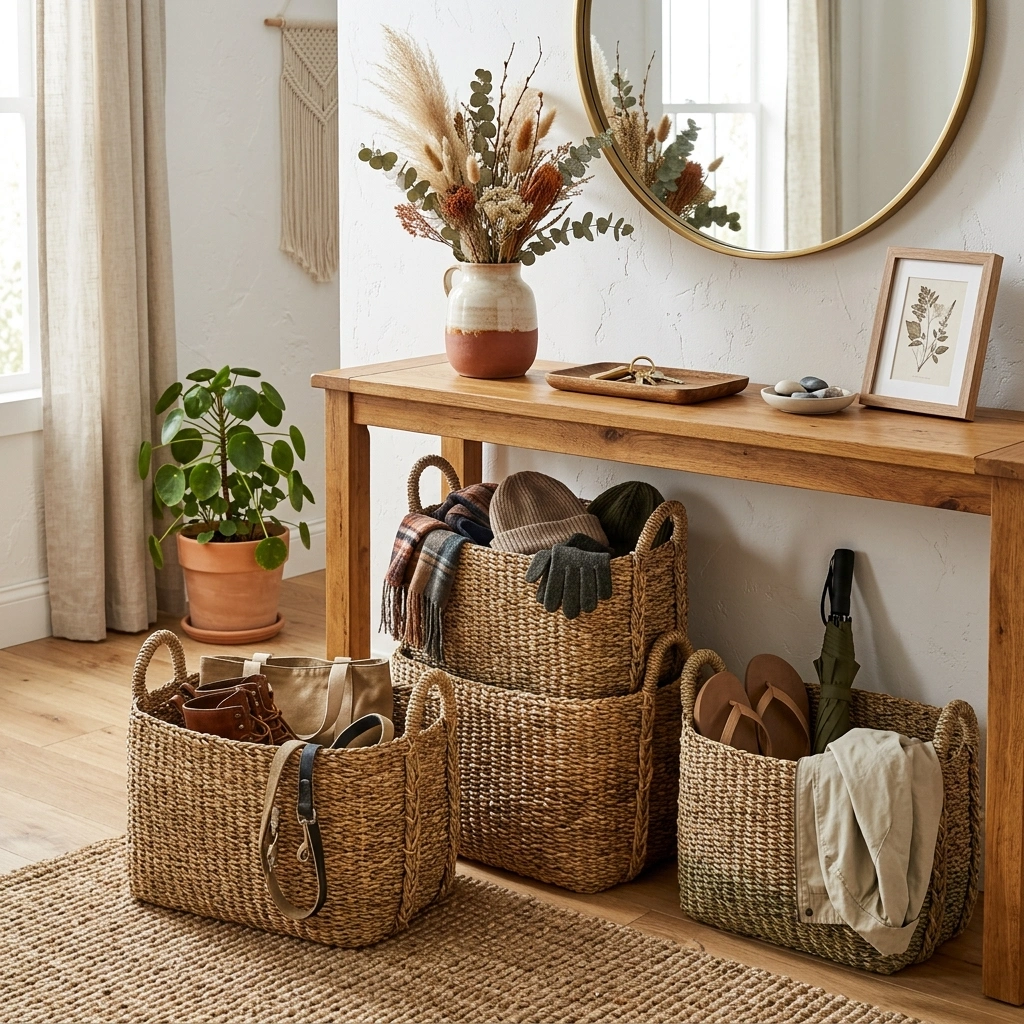
13. Woven Seagrass Baskets for Catch-All Storage

13. Woven Seagrass Baskets for Catch-All Storage

Vibe: The floor feels organized without feeling sparse, with a woven texture softening pure function.

Why it works: Seagrass baskets hide the visual clutter of daily items, such as shoes, umbrellas, and mail  while keeping the material language natural rather than plastic, which matters because entryway storage is one of the most clutter-prone zones in a boho scheme. Varying basket sizes slightly also adds the same collected-over-time quality as mismatched textiles elsewhere in the room.

How to get it: Choose two or three seagrass baskets in graduated sizes, placed beneath the console rather than stacked, so each basket has a defined single use (shoes, outdoor gear, mail) rather than becoming a single junk-drawer basket.

Shop the Look

Product
Woven seagrass storage basket set
Reclaimed wood console table
Ceramic vase warm glaze
Dried floral stem bundle
Small ceramic catchall tray

14. Slim Wall-Mounted Shelf Ledge Instead of a Console

14. Slim Wall-Mounted Shelf Ledge Instead of a Console

Vibe: The entry feels open, a thin ledge doing a console’s job without claiming its footprint.

Why it works: In tight entries, a wall-mounted shelf ledge no deeper than 8–10 inches solves the tension between wanting a landing surface and needing clear walking space. A solid console can genuinely block a narrow hallway, while a shallow floating ledge keeps the floor plane entirely open beneath it.

How to get it: Mount a slim oak shelf ledge at 34–36 inches from the floor, paired with a row of ceramic or brass wall hooks below it so the wall does double duty as both a landing surface and a coat-hanging zone.

Shop the Look

Product
Slim wall-mounted wood shelf ledge
Ceramic wall hook row set
Small round wall mirror
Ceramic bud vase with warm glaze
Dried grass stem, small bundle

How to Start Your Boho Entryway Transformation

Start with the rug, not the wall art. A vintage or vintage-style kilim runner is the single piece that establishes the room’s color story and texture level all at once, because every other layer, wall color, wood tone, and plant choice gets chosen to sit correctly against that rug’s palette.

The most common mistake is buying an entire matched boho furniture set from one retailer. This breaks the look because boho’s warmth comes specifically from pieces that read as collected across time, not coordinated in one order; fix it by swapping at least one console-top object for a genuinely vintage or secondhand piece before adding anything new.

Three items under $50 that create immediate impact: a mustard cotton throw draped over an existing bench, a hand-thrown terracotta pot for a trailing pothos, and a small woven storage basket for shoes.

A full boho entryway transformation with new furniture, rug, and lighting realistically takes 3–5 weeks and costs $800–$2,200. A weekend refresh using textiles, a plant, and a rug costs $150–$400 and shifts the room’s warmth immediately, before any furniture arrives.

Frequently Asked Questions About Boho Entryway Decor

What’s the difference between boho and boho chic entryway decor?

Boho relies on genuinely mismatched pieces collected over time, vintage textiles, secondhand furniture, and varied cultural references, while “boho chic” often describes a curated retail version built from a single matched collection designed to look eclectic. A true boho entryway typically includes at least one piece with visible age or history rather than everything purchased new at once.

What color palette works best for a boho entryway?

Warm terracotta, rust, and mustard form the base accent palette, layered against natural undyed tones like jute tan and honey oak. Benjamin Moore’s Rust HC-59 and Farrow & Ball’s Terracotta No. 240 are common reference points for an accent wall or door. Avoid cool blue-grey tones, which read more Scandinavian than boho.

How much does a boho entryway makeover cost?

A budget refresh using a rug, textiles, and a plant typically runs $150–$500. A mid-range update adding a console and lighting costs $800–$2,000. A full transformation with new flooring, a built-in bench, and custom lighting can reach $3,500–$6,000 depending on square footage and how much is sourced vintage versus new.

Does boho entryway style work with a modern or minimalist home?

Yes  boho blends well with modern through shared natural materials like rattan and reclaimed wood, as long as the modern base stays neutral enough to let the boho layering read as intentional contrast. It pairs less easily with strict minimalism, where boho’s layered texture and pattern directly conflict with minimalism’s preference for negative space and restraint.

What’s the most important element in boho entryway decor?

Layered texture is the most important element, more than any single color choice; the mix of woven fiber, worn wood, and vintage textile is what makes an entryway read as genuinely boho rather than simply warm-toned. An entry with the right colors but only smooth, uniform materials will still feel flat rather than gathered.

Ready to Create Your Dream Boho Entryway?

These 14 ideas move through layered rugs, warm color, woven lighting, and small-space storage tricks, showing that boho entryway decor comes together through many small, collected choices rather than one furniture order. Starting with a single kilim runner or one terracotta wall nook is not a lesser version of the style; it’s exactly how these entries are meant to come together over time. Today, drape a mustard throw over your existing bench or chair and notice how much warmer the space feels by evening. Done well, the entry will start to feel like a genuine welcome rather than a hallway you pass through, personality visible from the moment the door opens. Save the ideas that matched your own light and your own walls, that came-framed mirror, that trailing pothos, because a boho entryway rewards the room built slowly, one collected piece at a time.

You Might Also Like