
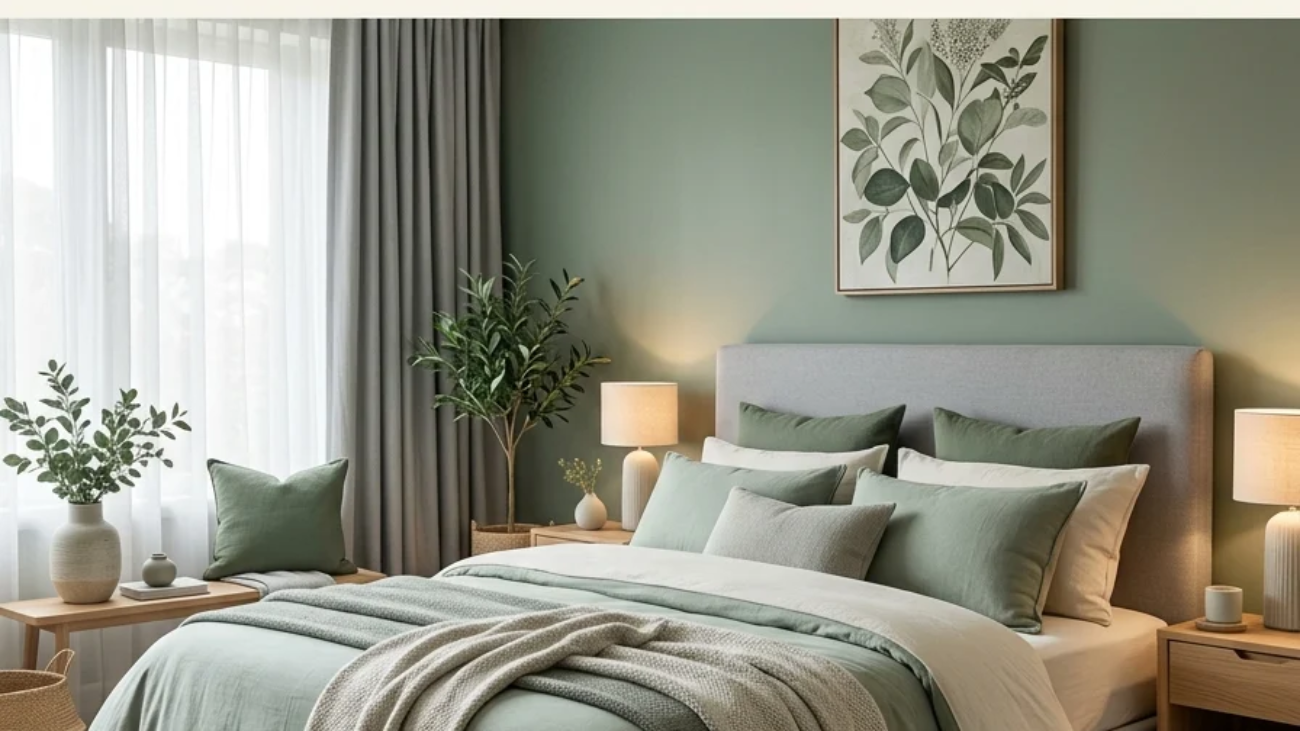
A relaxing green grey bedroom pairs muted botanical sage with warm, soft gray tones to build a sleep space engineered for calm rather than just good looks. This article gives you 10 ways to create a relaxing green grey bedroom: color, materials, lighting, furniture, layout, and small-space fixes, each with a shoppable “Steal the Look” list.
Picture a room where nothing competes for your attention: the walls settle into a soft, grayed sage, the light dims low enough to feel like evening even before the sun sets, and the textures underhand are all soft, natural, and quiet. Nothing here is trying to impress anyone; it’s trying to help you fall asleep faster and stay there. Here are 10 ideas worth saving and stealing.
Why a Relaxing Green Grey Bedroom Works So Well
A relaxing green grey bedroom pairs the biophilic calm of muted sage green the color psychology research most consistently links to lowered heart rate and reduced anxiety with the grounded, distraction-free minimalism of warm gray, an approach rooted in both Scandinavian sleep-focused design and clinical sleep-hygiene guidance. What makes it distinct from a purely decorative “sage bedroom” is that every choice gets filtered through one question: does this help or hurt actual rest?
Its materials are specific: pure linen or brushed cotton sheeting, boucle upholstery, unglazed ceramic, wool rugs, and matte-finish hardware in brushed nickel rather than reflective chrome. Colors worth naming: sage, moss, and eucalyptus green against warm gray, greige, and soft charcoal always warm-toned grays, since cool blue-based gray can read clinical rather than calming under evening light.
This approach is trending because sleep science has entered mainstream home decor conversation. Pinterest and wellness-app data both show rising searches for “sleep sanctuary bedroom” and “calming bedroom colors,” reflecting a broader post-pandemic shift toward bedrooms designed around rest quality, not just Instagram appeal. Blue-light awareness and circadian-lighting research have pushed warm, dimmable lighting from a nice-to-have into a genuine design requirement.
Small bedrooms can absolutely achieve this, but need to prioritize differently; visual clutter undermines calm faster in a small room than color choice ever will. Small-space decorators should tackle decluttering and closed storage before adding any new sage or gray textiles, since an overstuffed small room fights the relaxation goal no matter how good the palette is.
| Element | Green Influence | Gray Influence |
| Philosophy | Biophilic calm, botanical restfulness | Grounded minimalism for sleep focus |
| Materials | Linen, boucle, rattan, unglazed ceramic | Wool, brushed nickel, matte finishes |
| Color Palette | Sage, moss, eucalyptus | Warm gray, greige, soft charcoal |
1. Soft Sage Walls With Warm Dove Gray Trim
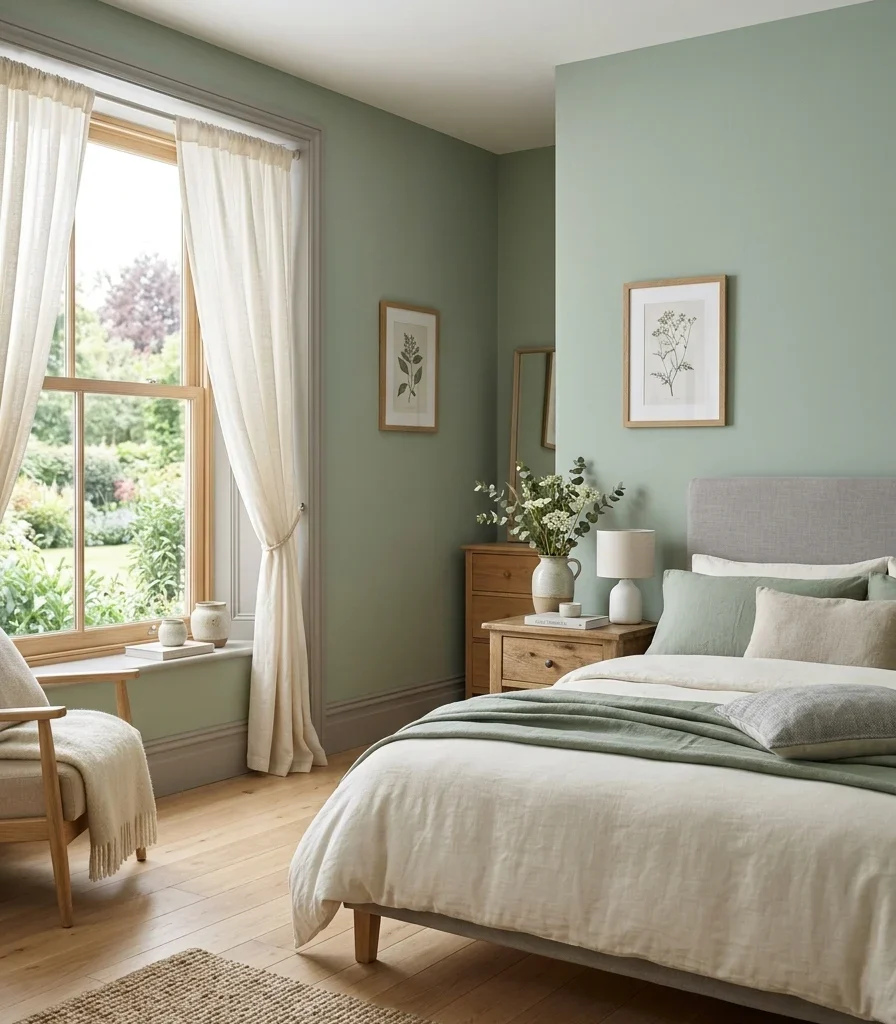
Vibe: Serene a wall color chosen for how it feels at 9 pm, not just how it photographs at noon.
Why it works: Muted sage has a grayed-down undertone that keeps it from reading as an energetic, saturated color, which matters for a room meant to lower stimulation rather than raise it. This is a saturation principle, where lower-chroma colors read as calmer regardless of hue.
How to get it: Paint walls in a chalky matte sage such as Sherwin-Williams “Clary Sage” and trim in a warm dove gray like Benjamin Moore “Gray Owl,” avoiding a glossy sheen that reflects light and disrupts the calm the color is meant to create.
💡 Quick Win: Not ready to paint? A sage green linen curtain panel introduces the same calming tone at the window without touching a wall.
Shop The Look
| Product |
| Sage green matte wall paint sample |
| Warm dove gray trim paint |
| Ceramic vase sage glaze |
| Linen curtain panel sage green |
| Wool throw blanket ivory |
2. Natural Linen Bedding for Relaxing Texture
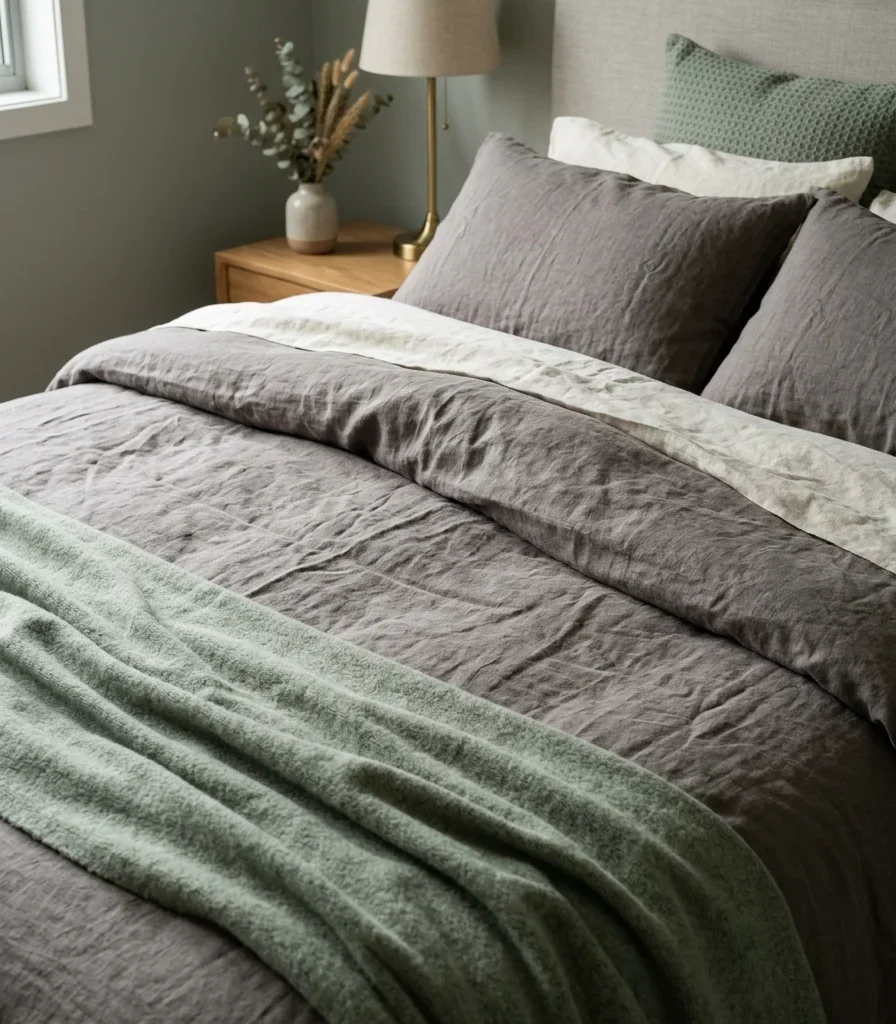
Vibe: Still bedding that feels like it’s already settled in for the night.
Why it works: Linen’s breathable, temperature-regulating weave supports actual sleep comfort, unlike synthetic sheeting that traps heat, and its naturally relaxed, slightly wrinkled texture reads as effortless rather than stiff a material-authenticity principle that pure cotton sateen can’t replicate.
How to get it: Choose stonewashed linen sheets in warm gray rather than pure white, which shows every wrinkle starkly, and add one sage green linen throw at the foot of the bed as the room’s single green textile note.
Shop The Look
| Product |
| Stonewashed linen sheet set warm gray |
| Linen duvet cover warm gray |
| Sage green linen throw blanket |
| Linen pillowcase set ivory |
| Fabric refresher spray natural scent |
3. Warm Dimmable Lighting for a Wind-Down Routine
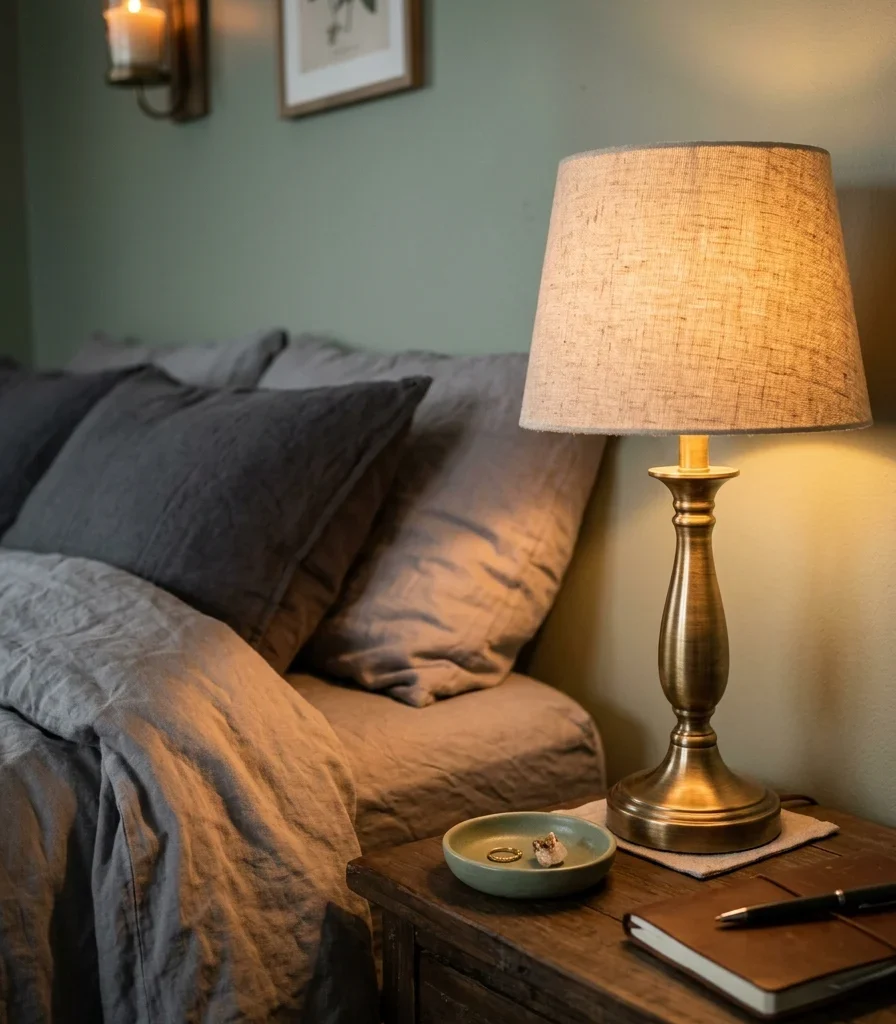
Vibe: Hushed light, dim and warm enough to signal the body that it’s time to slow down.
Why it works: Circadian lighting research shows that bright, cool-toned light in the evening suppresses melatonin production, while warm 2700K light dimmed low in the hour before bed supports the body’s natural wind-down process. This is a light-behavior principle with a direct physiological effect, not just a mood one.
How to get it: Install a dimmer switch on the bedside lamp and set it to 2700K bulbs only, dimming the light to roughly 20–30% brightness starting an hour before your intended bedtime.
Shop The Look
| Product |
| Brass table lamp linen shade |
| Warm white 2700K dimmable bulb set |
| In-line dimmer switch cord |
| Small ceramic catch-all dish |
| Smart plug with scheduled dimming |
4. Tonal Green-to-Gray Gradient Layering
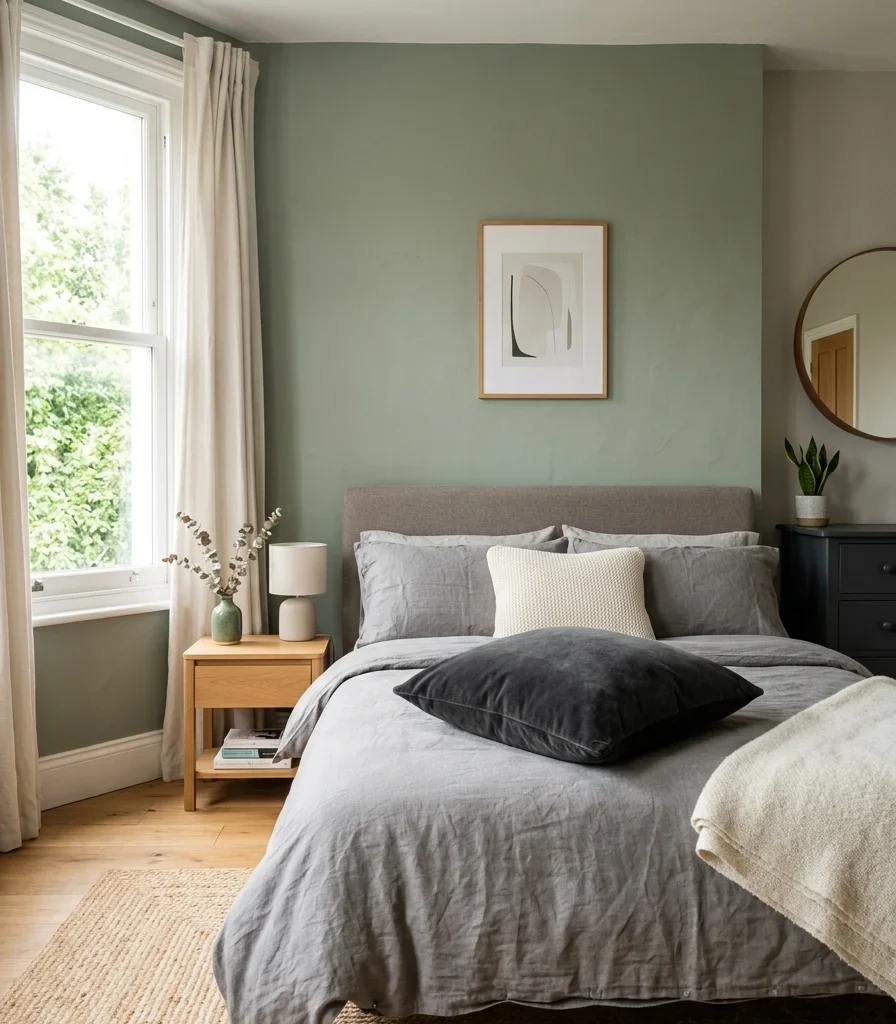
Vibe: Layered, a room where the eye settles instead of jumping between colors.
Why it works: A gradual color gradient from sage walls to gray bedding to one charcoal accent gives the eye a smooth path to travel across the room, rather than the visual friction of two unrelated colors placed side by side tonal-layering principle that supports the room’s overall calming intent.
How to get it: Keep walls sage, bedding in warm gray linen, and add exactly one charcoal velvet cushion as the deepest note; adding a second bold accent color breaks the calm the gradient is built to create.
Shop The Look
| Product |
| Gray linen duvet cover set |
| Charcoal velvet throw pillow cover |
| Small sage green ceramic bud vase |
| Wool area rug warm gray |
| Sage green wall paint sample |
5. Low-Profile Upholstered Bed for a Grounded Feel
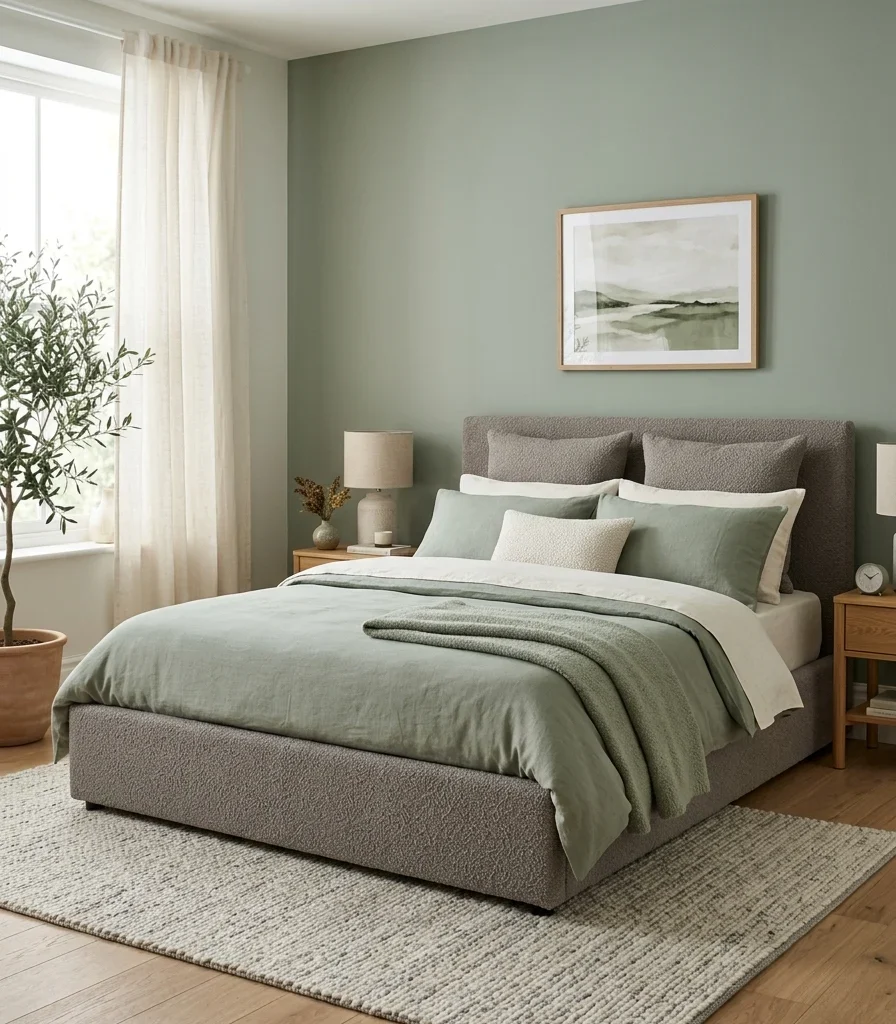
Vibe: Grounded furniture low enough to make the whole room feel less demanding on the eye.
Why it works: A low-profile frame reduces the visual weight and height a tall, ornate headboard carries, applying a proportion principle where lower horizontal lines leave more visible open space, which reads as calmer than a room with a tall, imposing furniture silhouette.
How to get it: Choose a platform or low-profile upholstered bed frame no taller than 90cm at the headboard, in warm gray boucle rather than a patterned or dark fabric that adds visual weight.
💡 Quick Win: Removing the bed skirt and box spring in favor of a simple platform frame instantly lowers the bed’s visual height without buying anything new.
Shop The Look
| Product |
| Low-profile upholstered bed frame gray boucle |
| Sage green throw blanket |
| Warm oak nightstand pair |
| Wool area rug ivory |
| Brass bed frame leg caps |
6. Blackout Curtains in Sage Linen for Deeper Sleep
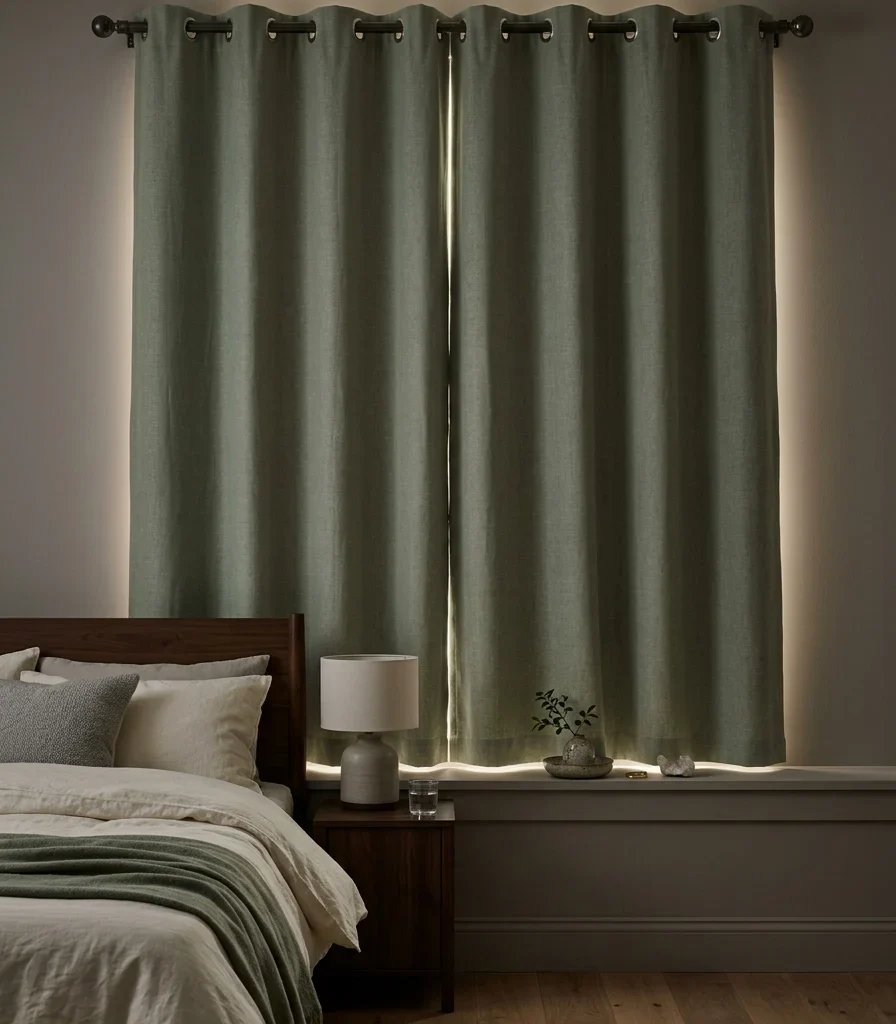
Vibe: Dim a room that can go fully dark whenever the body needs it to.
Why it works: Blackout fabric blocks the streetlight and early-morning light that disrupts deep sleep cycles, and a linen-textured sage fabric delivers that function without looking like a hotel-grade blackout panel a material choice that serves both the relaxation function and the room’s color story at once.
How to get it: Hang sage green blackout curtains with a linen-look texture from a rod mounted just below ceiling height, extending at least 15cm past the window frame on each side to block light gaps.
Shop The Look
| Product |
| Sage green blackout curtain panel set |
| Ceiling-height curtain rod extendable |
| Curtain rod finial set brass |
| Small ceramic dish for windowsill |
| Blackout curtain liner add-on |
7. Weighted Blanket and Textured Throws for Calm
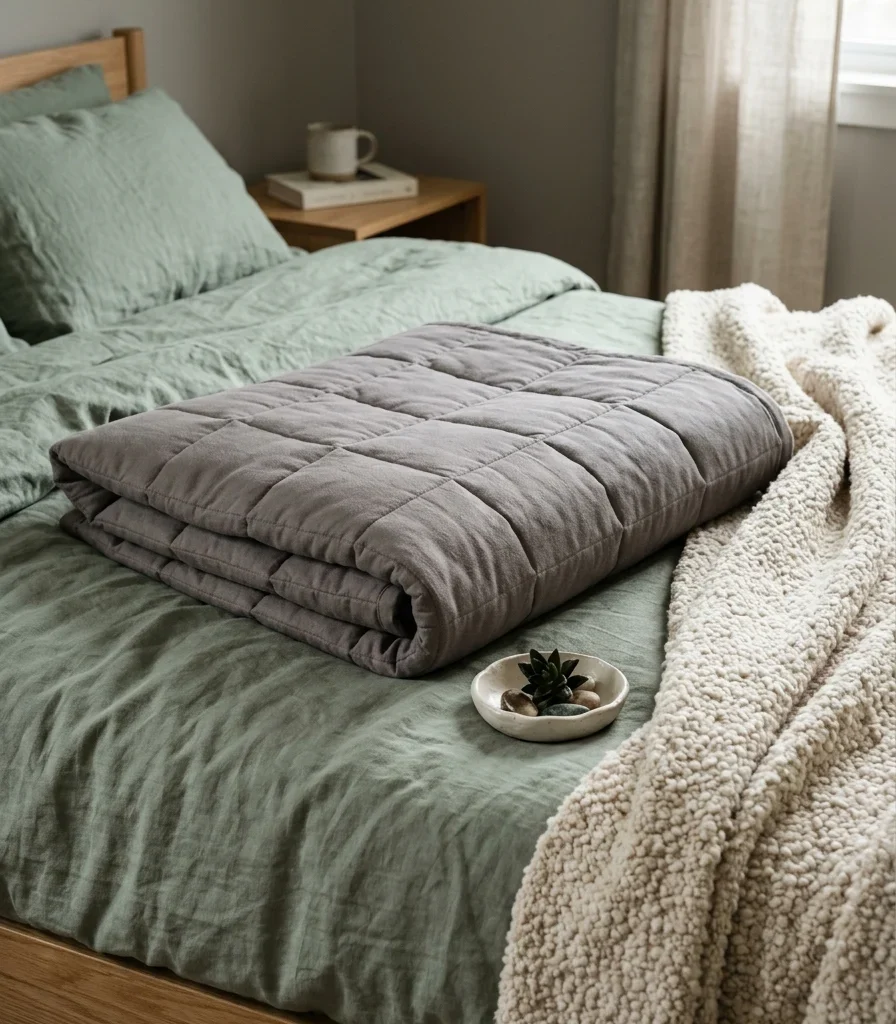
Vibe: Grounded the layer that turns a nice-looking bed into a genuinely calming one to lie in.
Why it works: Weighted blankets provide deep pressure stimulation that some people find measurably calming, and layering one over the existing sage-and-gray bedding adds a functional relaxation tool without disrupting the palette, since most weighted blankets come in matching neutral covers.
How to get it: Choose a weighted blanket at roughly 10% of body weight in a warm gray cotton cover, folded in thirds at the foot of the bed over the sage top layer.
💡 Quick Win: A boucle throw draped over one corner of the bed adds textural softness for under $40 if a full weighted blanket isn’t in the budget yet.
Shop The Look
| Product |
| Weighted blanket cotton cover warm gray |
| Boucle throw blanket ivory |
| Sage green quilted coverlet |
| Removable duvet-style blanket cover |
| Small ceramic dish nearby styling |
8. Decluttering and Zoning for a Distraction-Free Sleep Space
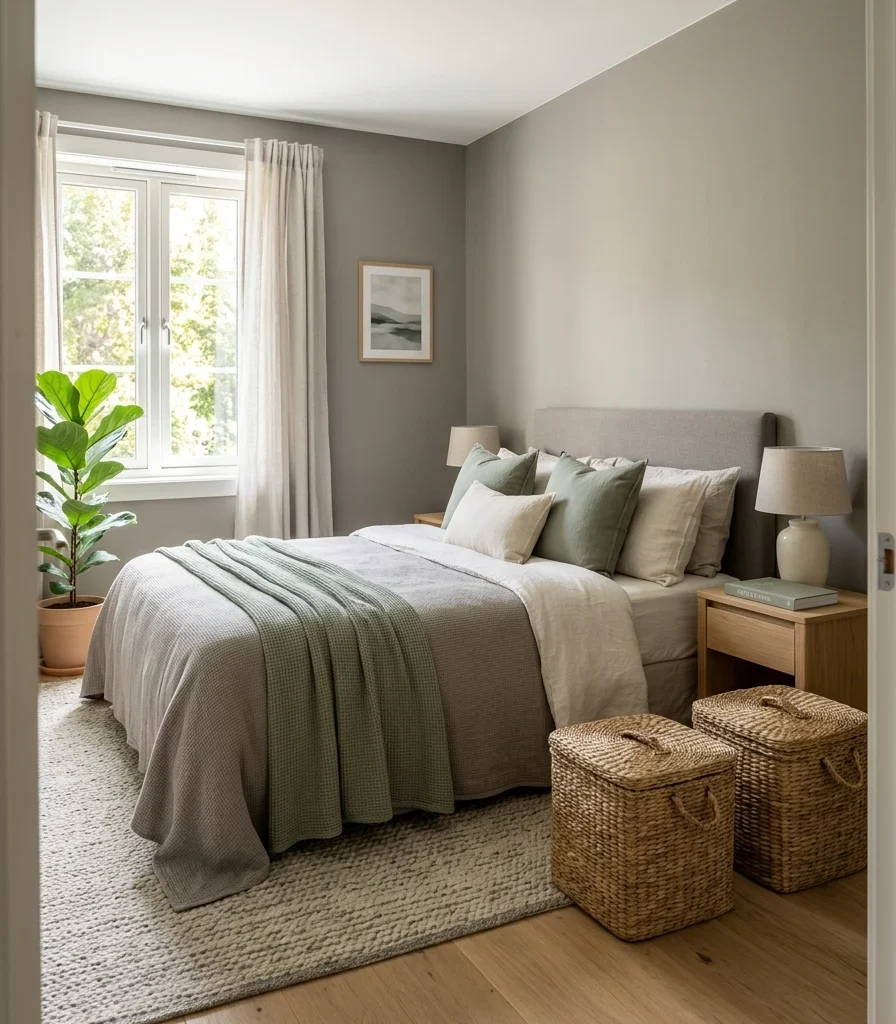
Vibe: Consider a room with nothing left out to catch the eye or the mind before sleep.
Why it works: Visual clutter increases cognitive load even when it’s not consciously noticed, which works directly against a bedroom’s relaxation goal. This is a negative-space principle, where empty, uncluttered surfaces genuinely read as calmer to the brain than busy ones, regardless of color palette.
How to get it: Limit each nightstand to no more than three items: a lamp, a book, a small dish, and move everything else into closed woven baskets or a dresser drawer rather than open shelving.
Shop The Look
| Product |
| Woven storage basket lidded set |
| Closed dresser with drawer organizers |
| Nightstand with drawer storage |
| Small ceramic dish for essentials |
| Drawer organizer tray set |
9. Layered Nightstand and Reading Lights for Evening Calm
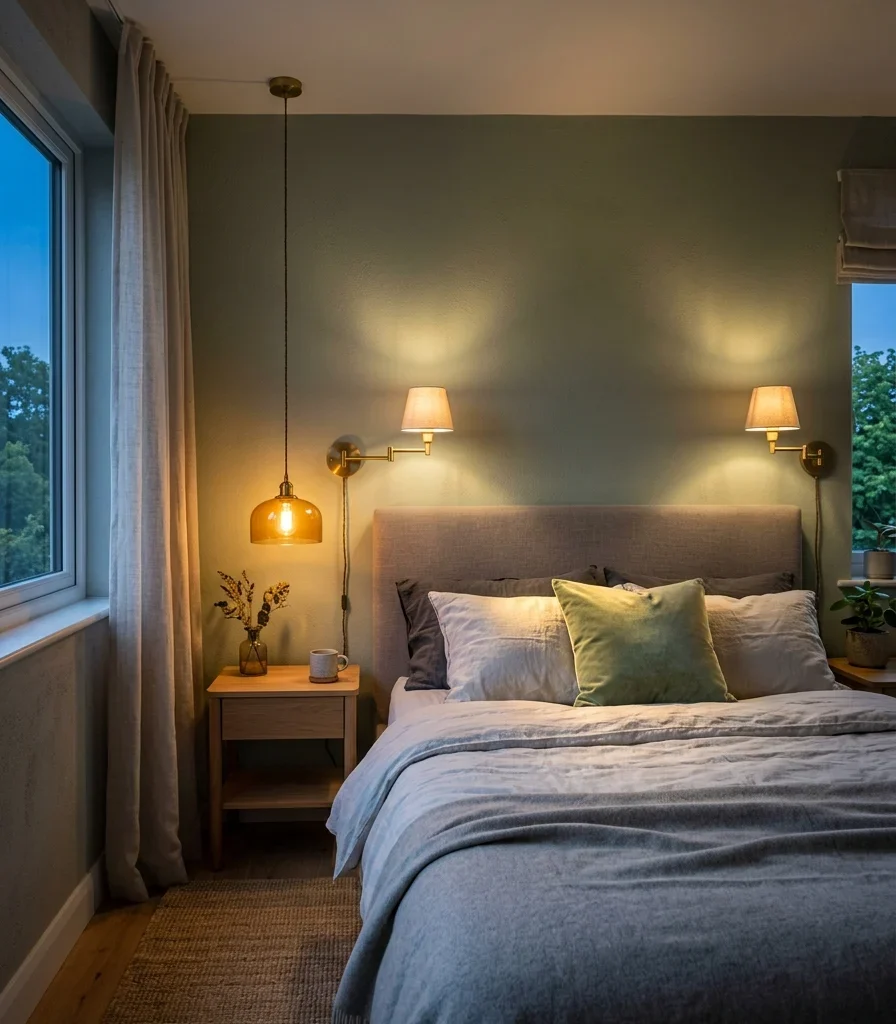
Vibe: Glowing enough layered light that no single source has to work too hard or shine too bright.
Why it works: Wall-mounted reading lights free up nightstand space (supporting the decluttering goal) while giving each side of the bed independent light control, so one partner can read while the other sleeps a practical layout benefit layered on top of the room’s overall warm-light strategy.
How to get it: Mount adjustable brass reading lights at roughly 60cm above the mattress on each side, each on its own switch, paired with a dimmed ceiling pendant for ambient fill light.
Shop The Look
| Product |
| Brass adjustable wall reading light pair |
| Individual switch cord for each light |
| Low-hanging pendant light warm brass |
| Warm white 2700K bulb set |
| Wall-mount bracket hardware kit |
10. Green-Gray Layering Tricks for Small Relaxing Bedrooms
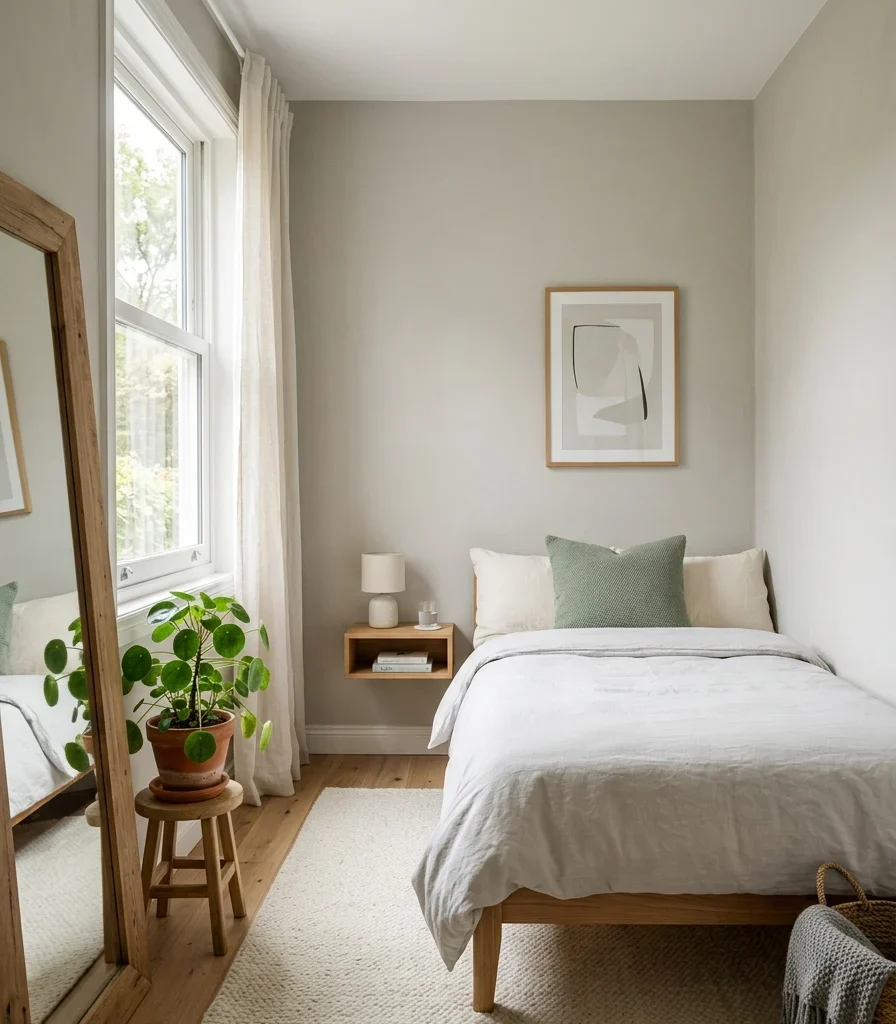
Vibe: Airy proof that a small bedroom can feel just as restful as a large one.
Why it works: Light warm gray as the dominant wall tone reflects more available light than a saturated sage would in a small room, while confining green to one or two small textiles keeps the calming color story intact without adding visual weight a compact space can’t spare.
How to get it: Paint walls in a light warm gray, add one sage green cushion or throw as the only green element, and lean a full-length mirror across from the window to bounce daylight back into the room.
Shop The Look
| Product |
| Light warm gray wall paint sample |
| Sage green cushion cover single |
| Leaning full-length mirror slim frame |
| Small potted plant faux |
| Compact nightstand with storage |
How to Start Your Relaxing Green Grey Bedroom Transformation
Start with the lighting, not the paint. Before choosing a wall color, install a dimmer switch and swap every bulb in the room to warm 2700K. This single change affects how every future color choice actually reads at night, since even the perfect sage-and-gray palette looks flat and cold under cool-white light.
The most common mistake beginners make is choosing a cool, blue-based gray instead of a warm gray, which fights sage green’s warmth and reads clinical rather than calming, especially under evening lighting. The fix is checking the paint’s undertone in your own lamp light before buying, since warm grays like “Gray Owl” or “Agreeable Gray” look noticeably different under warm bulbs than they do on a lit showroom wall.
Three items under $50 that make an immediate impact: a warm white 2700K dimmable bulb set ($10–$16) for existing lamps; a sage green linen throw ($20–$35) for the foot of the bed; and a lidded woven storage basket ($18–$28) to clear nightstand clutter.
Realistic expectations: A starter version lighting, bedding, decluttering takes a weekend and costs $100–$300. A full transformation with paint, furniture, and blackout curtains runs $1,200–$3,500 over three to six weeks.
Frequently Asked Questions About Relaxing Green Grey Bedrooms
What is a relaxing green grey bedroom, and how is it different from a regular sage green bedroom?
A relaxing green grey bedroom filters every design choice through sleep-quality impact: lighting temperature, fabric breathability, and clutter levels, while a regular sage green bedroom focuses primarily on the visual palette. The relaxation-focused version treats warm lighting and decluttering as equally important as the wall color itself.
What shade of gray works best paired with sage green for a calming bedroom?
Warm grays with a beige or greige undertone, like Benjamin Moore “Gray Owl” or “Agreeable Gray,” pair best because they complement sage’s warmth rather than fighting it the way a cool, blue-based gray does. A cool gray under warm evening lighting can look muddy or clinical, which works against the room’s calming goal.
How much does it cost to create this kind of relaxing bedroom?
A budget-conscious version focused on lighting, bedding, and decluttering costs roughly $100–$300 and can be done in a weekend. A fuller transformation including paint, a new low-profile bed frame, and blackout curtains typically runs $1,200–$3,500, depending on whether furniture is new or sourced secondhand.
Does this style work with existing furniture, like a dark walnut dresser or a taller bed frame?
Yes, a dark walnut dresser grounds the palette nicely and doesn’t need to change, though a taller bed frame works against the low, grounded feel this style aims for. If replacing the bed isn’t an option, removing a bed skirt or box spring can lower the visual height without buying new furniture.
What’s the single most important factor for actually improving sleep, not just the room’s appearance?
Light temperature and dimming matter more for actual sleep quality than any color choice. Warm 2700K bulbs dimmed low in the hour before bed support the body’s natural wind-down process, while bright, cool-white light in the evening can suppress melatonin regardless of how calming the wall color looks. Blackout curtains are the second most impactful factor, since uncontrolled morning light disrupts sleep cycles more than most people realize.
Ready to Create Your Dream Relaxing Green Grey Bedroom?
These 10 ideas cover the full range of what this palette and approach can do, from the calming power of warm sage and gray tones, to functional relaxation tools like blackout curtains and dimmable lighting, to small-space layouts that keep a compact bedroom feeling just as restful as a large one. Building a room like this happens gradually: swap the bulbs first, then the bedding, then the paint, and there’s no need to overhaul everything before you start sleeping better. If you’re starting today, install a dimmer switch and switch every bulb in the room to warm 2700K before you buy a single new textile. Once the light is warm and the clutter is gone, this is the kind of bedroom that makes falling asleep feel like less of an effort every single night. Save the ideas that match your room’s light and your own sleep habits, and start building your calm, sage-and-gray retreat tonight.
You Might Also Like
- 15 Serene Atmosphere Green Bedroom Ideas
- 12 Cozy Green Terracotta Bedroom Ideas Worth Saving
- 10 Black and Green Bedroom Design Ideas Worth Saving
- 12 Green Comforter Bedroom Ideas for Max Comfort
- 16 Ways to Optimize a Home Office Setup in a Small Bedroom
- 16 Modern Cottage Bedroom Ideas That Feel Warm, Clean, and Effortless