
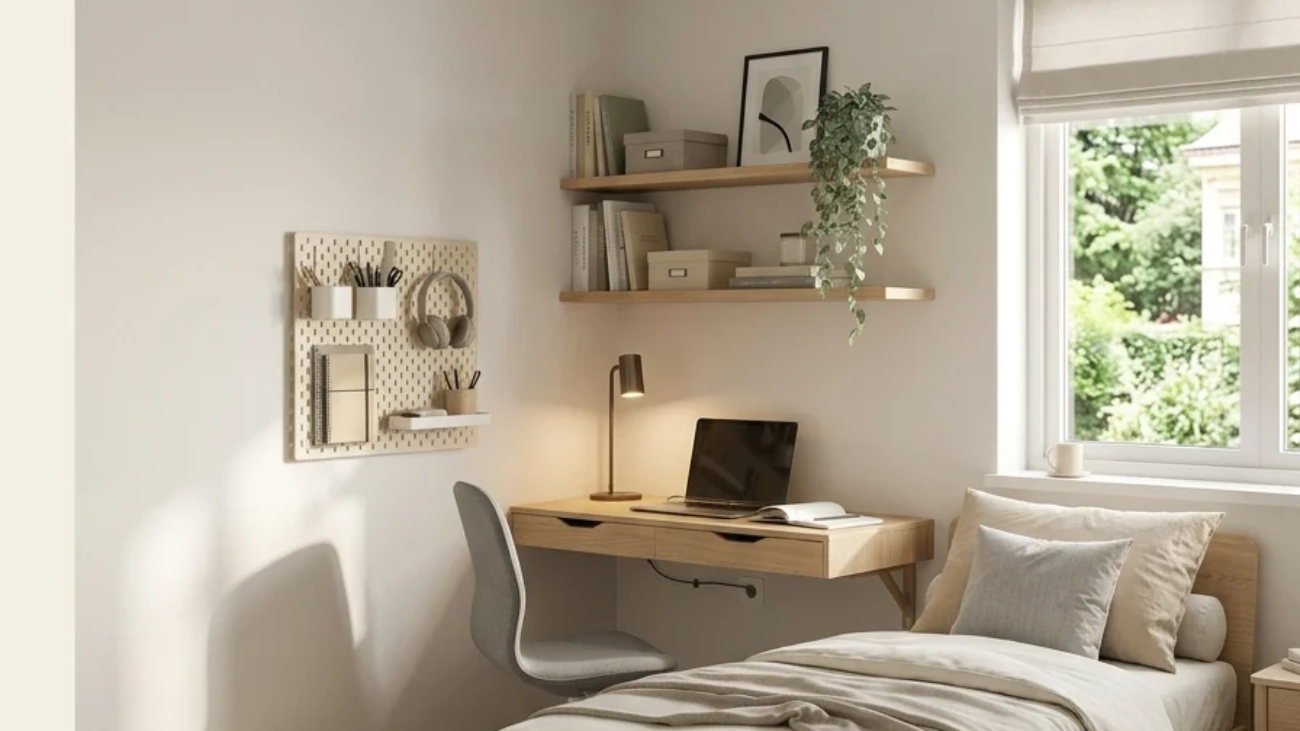
A small-bedroom home office is a compact work zone built directly into a bedroom’s existing footprint: a desk, storage system, and lighting plan scaled down and positioned so the work area shares space with the bed without visually competing with it. This article gives you 16 practical, genuinely space-smart ideas for building a home office setup that fits a small bedroom, covering furniture, layout, color, lighting, and storage decisions that make an 8×10 or 10×12 room function as both a bedroom and a workday-ready office.
It feels like exhaling a room where the desk doesn’t announce itself the moment you open the door, where the bed still reads as a bed at 9 pm, and where every surface has been asked to do more than one job without looking like it’s straining to do it. Light falls across a slim desk instead of a sprawling one. Texture woven rattan, warm oak, soft linen does the visual work that square footage can’t. This is small-bedroom home office design at its most resolved: quiet, considered, dual-purpose.
Here are 16 ideas worth saving and stealing.
Why Small Bedroom Home Office Design Works So Well
Small-bedroom home office design is the practical discipline of merging two competing room functions rest and focused work inside a footprint that was architecturally intended for only one. It draws from two design traditions simultaneously: Japanese multifunctional furniture design (which has solved for compact living for centuries through fold-away, stackable, and convertible pieces) and Scandinavian minimalism (which prioritizes light, negative space, and a restrained material palette over volume of furniture). What makes it distinct from a standalone home office is that every decision has to satisfy two rooms at once a desk lamp has to look right at 2 pm and 11 pm, and a chair has to disappear visually when the laptop closes.
The core materials read light and unobtrusive: warm white and soft greige walls, pale ash or white oak for desks and shelving, woven rattan and cane for baskets and headboards, matte black or brushed brass for hardware and lighting, and linen or cotton canvas for any soft textiles. Color stays largely neutral with one accent dusty sage, warm terracotta, or soft blush used sparingly on a chair, a lamp shade, or a stack of folders, never across a full wall.
This approach is trending because remote and hybrid work became permanent for millions of people who live in studio apartments, one-bedroom flats, and starter homes where a dedicated office was never in the floor plan. Pinterest search volume for “small bedroom office ideas” and “work from home small space” has climbed steadily as people stopped treating remote work as temporary and started asking their bedrooms to perform like real offices.
Yes, small spaces can absolutely achieve this, but priorities matter. Vertical storage, a desk under 42 inches wide, and visual zoning (rug, curtain, or color block) should come before any decorative purchase. Skipping the zoning step is the single biggest reason small-bedroom offices feel chaotic instead of calm.
Style at a Glance
| Element | Detail |
| Philosophy | Every piece must serve both the sleep zone and the work zone; dual function outranks decoration in every decision |
| Key Materials | Pale ash and white oak, woven rattan and cane, linen, matte black metal, brushed brass, cotton canvas |
| Key Colors | Warm white, soft greige, dusty sage, warm terracotta, soft blush, warm charcoal accent |
16 Small Bedroom Home Office Ideas
1. Tuck the Desk Into an Unused Corner Nook
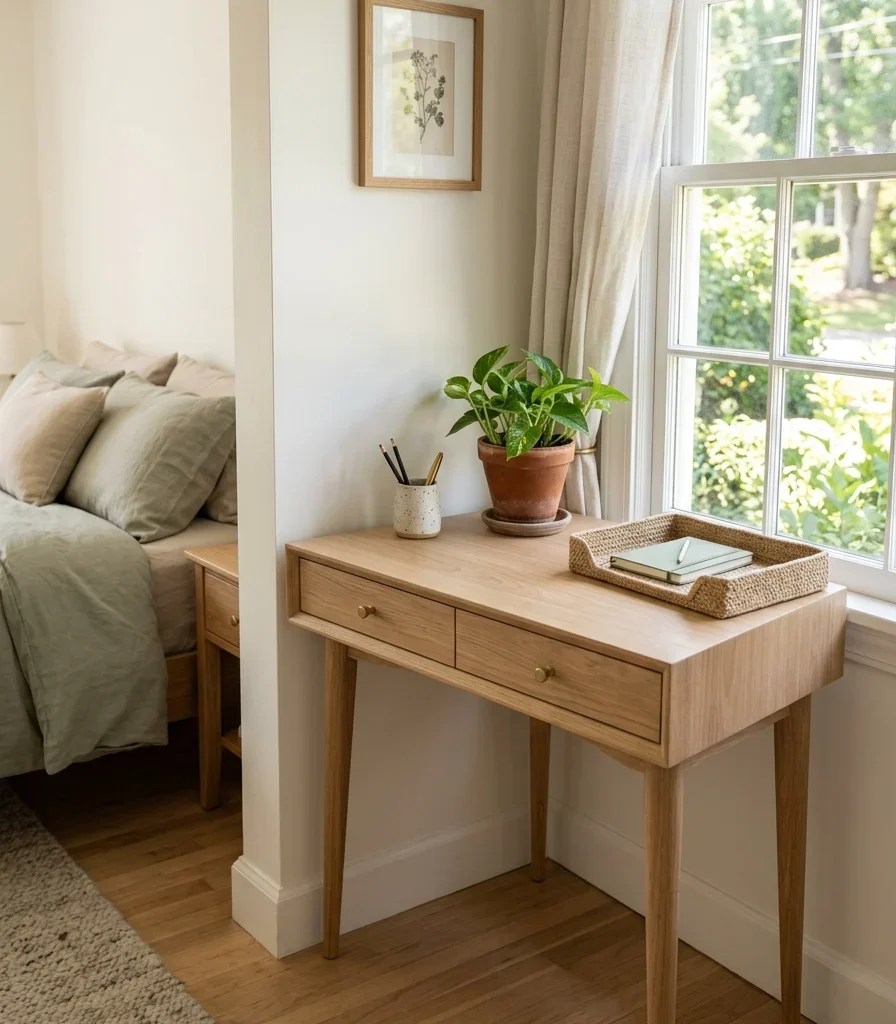
Vibe: Grounded. The corner that was dead space becomes the room’s quietest, most functional square footage.
Why it works: Corners are the most underused square footage in any bedroom because furniture is instinctively placed against flat walls, leaving the diagonal corner empty. Angling a desk into that corner uses negative space that isn’t competing with the bed, dresser, or door swing, which is a principle of spatial efficiency rather than decoration. A 30-inch-wide desk fits into most corners without blocking a window or closet.
How to get it: Choose a desk no wider than 30 inches with a shallow 18-inch depth, and angle it at 45 degrees into the corner rather than pushing it flush against both walls, which leaves a usable triangle of floor space in front of the chair instead of a cramped dead zone.
💡 Quick Win: A corner desk under $150 with hairpin legs instantly claims unused square footage without requiring any wall-mounted installation.
Shop the Look
| Product |
| White oak corner desk 30 inch |
| Brushed brass drawer pull set |
| Small ceramic pen holder matte |
| Woven paper document tray |
| Potted pothos in terracotta pot |
2. Mount a Floating Wall Desk to Reclaim Floor Space
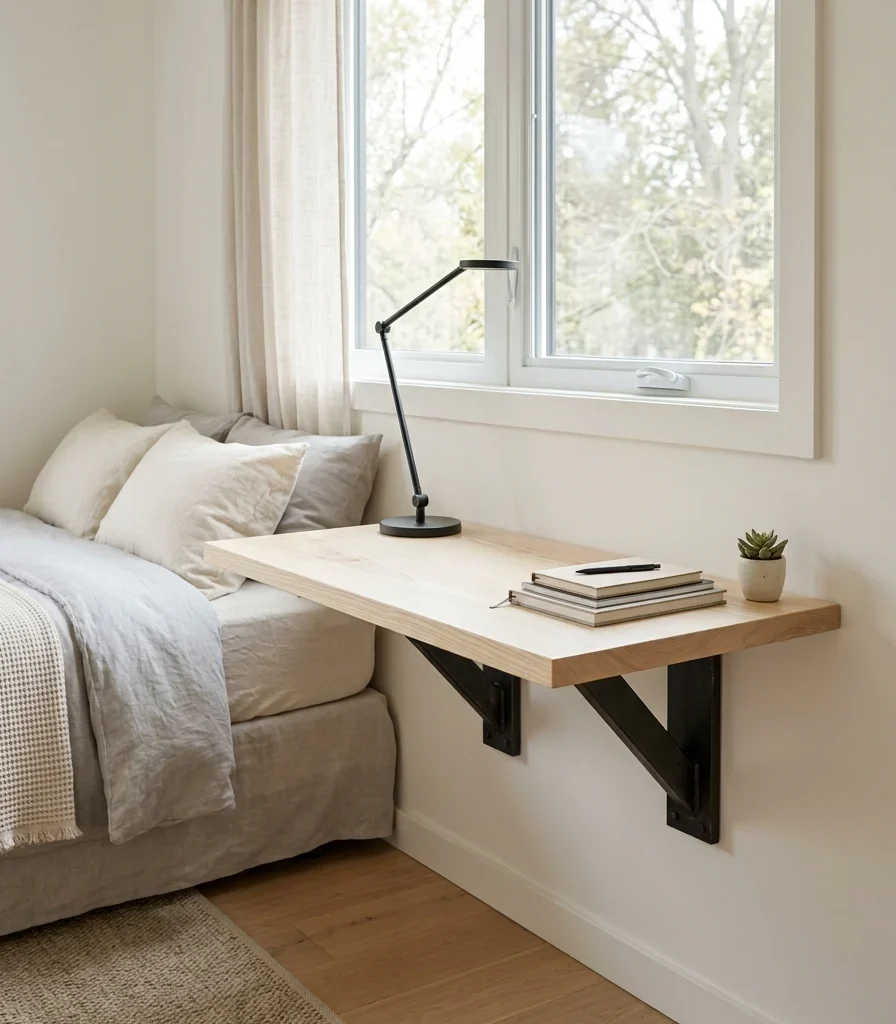
Vibe: A weightless desk that appears to hover, leaving the floor beneath it entirely visible and open.
Why it works: Floating furniture reduces visual mass at floor level, a principle interior designers use specifically in small rooms because the eye reads open floor as more square footage than furniture legs interrupting the sightline. A wall-mounted desk with no legs eliminates the “furniture forest” effect four-legged pieces create when packed into a tight room.
How to get it: Install a 24-inch-deep floating desk on concealed steel brackets rated for at least 100 lbs, mounted at standard desk height of 29 inches, and keep the wall behind it clear of shelving directly above knee height so the open-floor effect isn’t undercut by visual clutter beneath.
Shop the Look
| Product |
| Floating wall desk pale ash |
| Concealed steel desk bracket set |
| Slim adjustable task lamp black |
| Linen-covered notebook stack |
| Cable management tray under-desk |
3. Paint the Work Zone Wall in Warm Greige
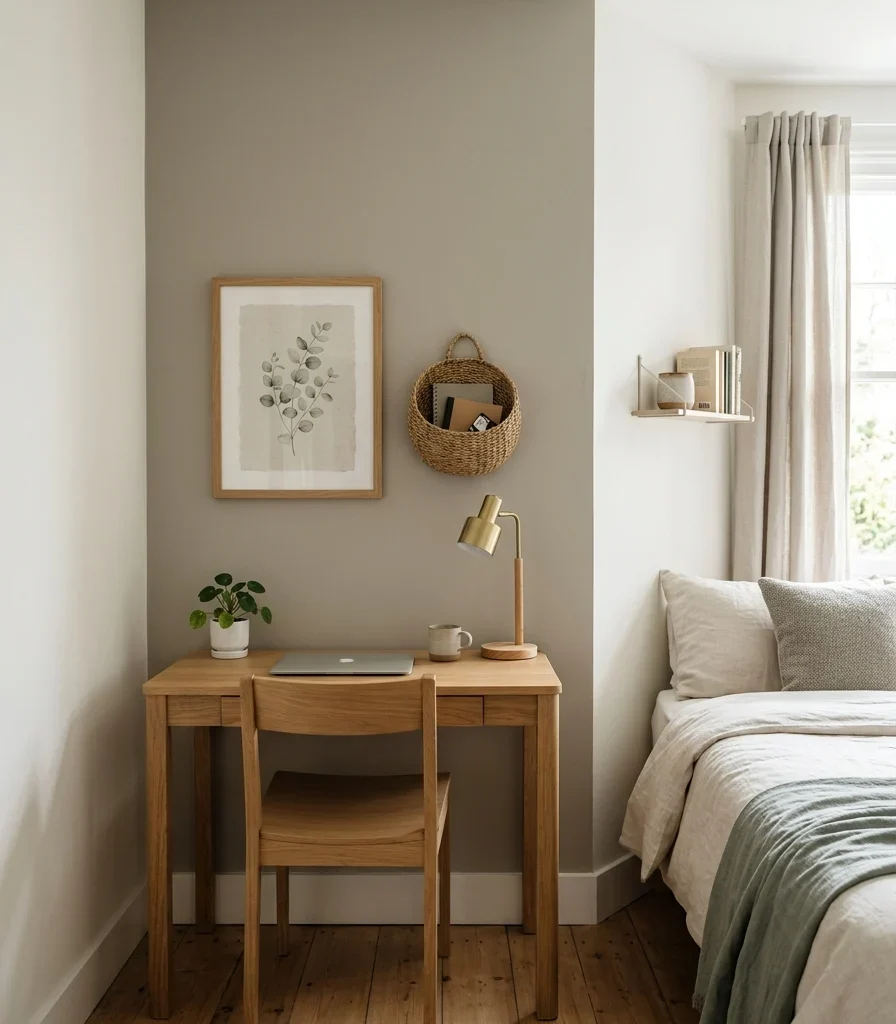
Vibe: Settled. The work corner feels intentionally separate from the sleep zone the instant you look at it.
Why it works: Color blocking is a zoning technique that divides one room into two functional areas without a physical partition. A warm greige applied only to the work-zone wall while the sleep zone stays warm white creates a visual boundary the brain registers instantly, which is the same psychological cue used in studio apartments to separate kitchen from living space.
How to get it: Paint only the wall directly behind or beside the desk in a warm greige with a pink-yellow undertone (avoid cool blue-grey undertones, which read cold against warm oak furniture), in an eggshell finish so the color shifts subtly with the room’s natural light throughout the day.
💡 Quick Win: Removable peel-and-stick greige wallpaper achieves the same zoning effect in an afternoon for renters who can’t paint.
Shop the Look
| Product |
| Warm greige eggshell interior paint |
| Peel and stick greige wallpaper |
| Framed botanical line-art print |
| Small woven seagrass basket |
| Painter’s tape precision edge |
4. Add an Adjustable LED Task Lamp for Focused Light
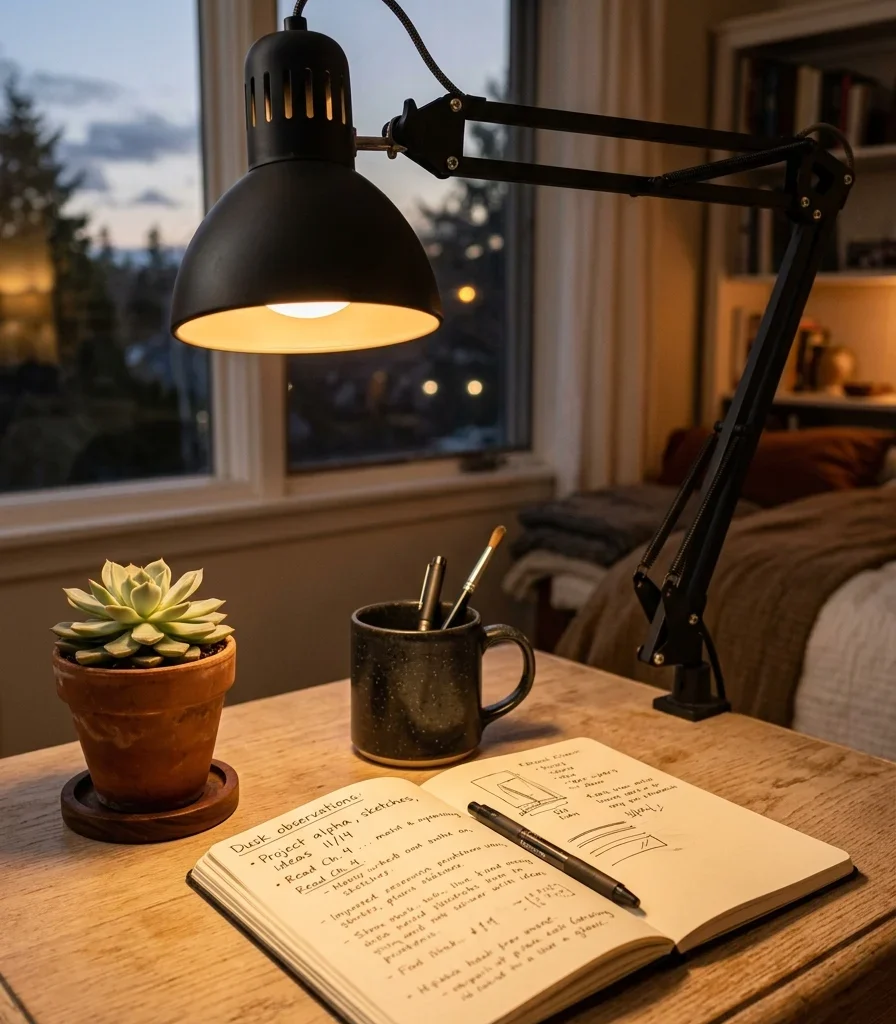
Vibe: Focused, a pool of warm, directed light that separates “working” from “winding down” without touching the overhead fixture.
Why it works: Task lighting operates on the design principle of light layering; a single overhead bedroom fixture creates flat, shadowless light appropriate for sleep prep but inadequate for close work. A dedicated task lamp with an articulated arm delivers direct light exactly where reading or typing happens, reducing eye strain without flooding the whole bedroom in bright light at 9 pm.
How to get it: Choose a lamp with an adjustable arm and a 3000K warm-white LED bulb (avoid 5000K daylight bulbs in a bedroom setting, which disrupt the room’s evening atmosphere), and position it so the light falls across the desk from the non-dominant-hand side to avoid shadow interference while writing.
Shop the Look
| Product |
| Adjustable articulating LED desk lamp |
| Warm white 3000K LED bulb |
| Small ceramic coffee mug matte |
| Mini succulent in ceramic pot |
| Leather-bound notebook slim |
5. Install a Pegboard for Vertical Wall Organization
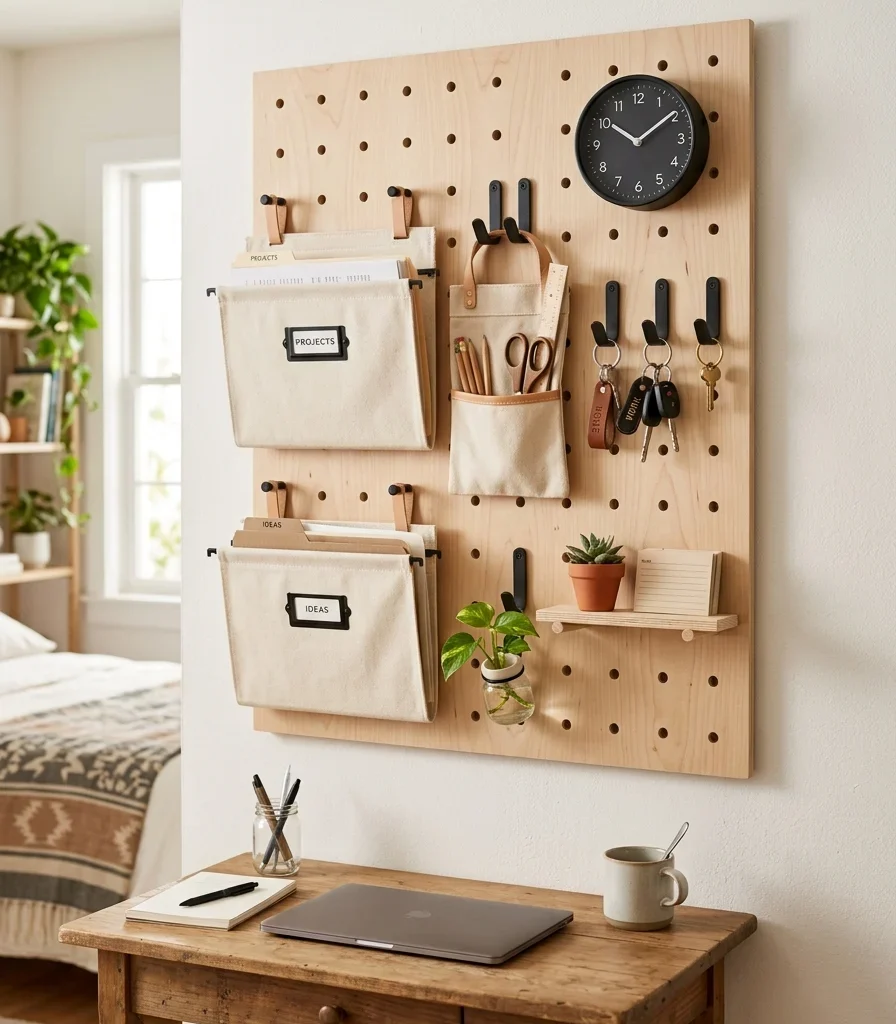
Vibe: Ordered; every loose object has a fixed vertical address instead of colonizing the desk surface.
Why it works: A pegboard exploits vertical space, the single most underused dimension in a small bedroom where floor and desk surface area are fixed but wall height above the desk is typically empty. This is a direct application of the storage principle that vertical square footage is free square footage; nothing on the pegboard touches the working desk surface below it.
How to get it: Mount a 24×18-inch natural birch pegboard 6 inches above the back edge of the desk, and use a mix of hook lengths and small shelf pegs so items hang at varied depths rather than crowding into a single flat plane, which keeps the wall from reading as cluttered even when it’s holding a dozen items.
💡 Quick Win: A pack of matte black pegboard hooks under $15 instantly converts blank wall space into functional storage.
Shop the Look
| Product |
| Birch wood pegboard 24×18 inch |
| Matte black pegboard hook set |
| Small round wall clock minimal |
| Canvas hanging tool pouch |
| Wall-mount pegboard shelf small |
6. Layer in Woven Rattan Storage Baskets
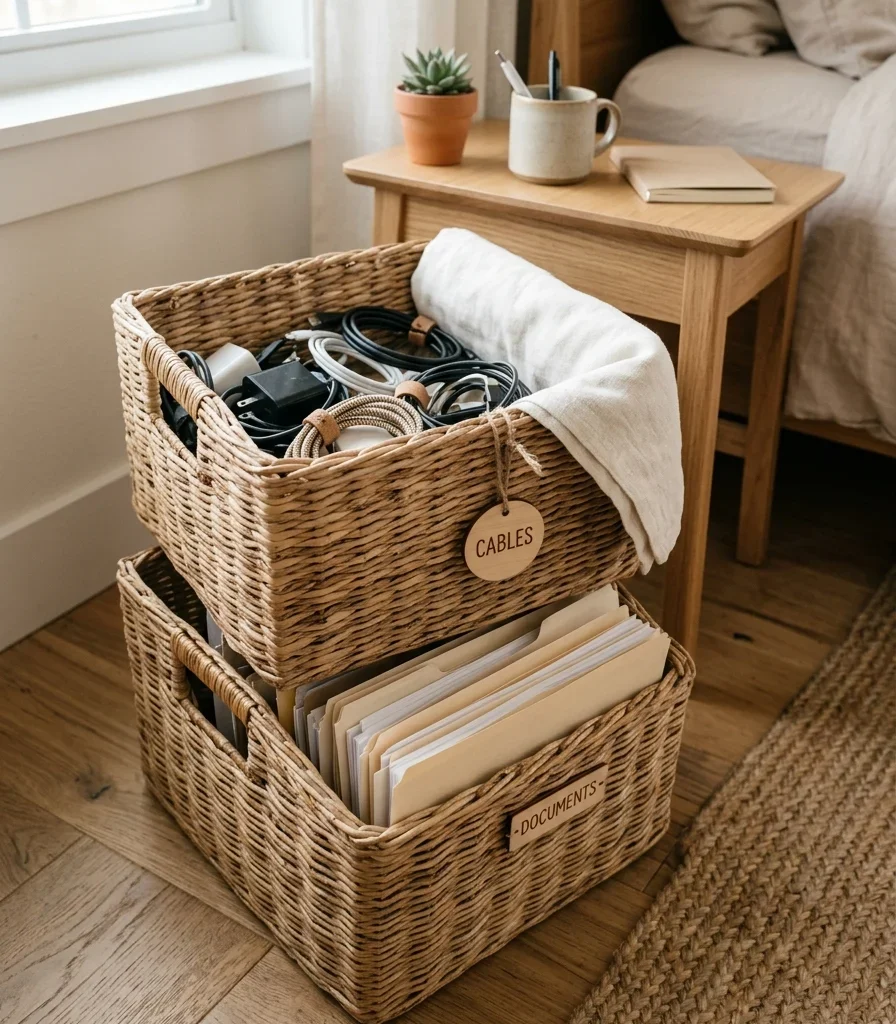
Vibe: Textural baskets that hide the visual noise of a functioning office without introducing a single hard plastic edge.
Why it works: Woven rattan solves the material-honesty problem that most office storage creates: plastic bins and metal file boxes read as “office equipment” and clash visually with bedroom textiles like linen bedding and wood furniture. Rattan shares the same natural-fiber language as the rest of the room, so storage disappears into the decor instead of announcing itself.
How to get it: Use one basket sized for hanging file folders (roughly 13×10×10 inches) tucked beside or under the desk, and a second smaller basket on the desk’s corner for loose cables and chargers, lining both with a plain linen fabric to prevent small items from slipping through the open weave.
Shop the Look
| Product |
| Woven rattan file storage basket |
| Small rattan desk organizer basket |
| Natural linen basket liner fabric |
| Wood engraved label tag set |
| Rattan magazine holder slim |
7. Divide Sleep and Work Zones With a Sheer Curtain
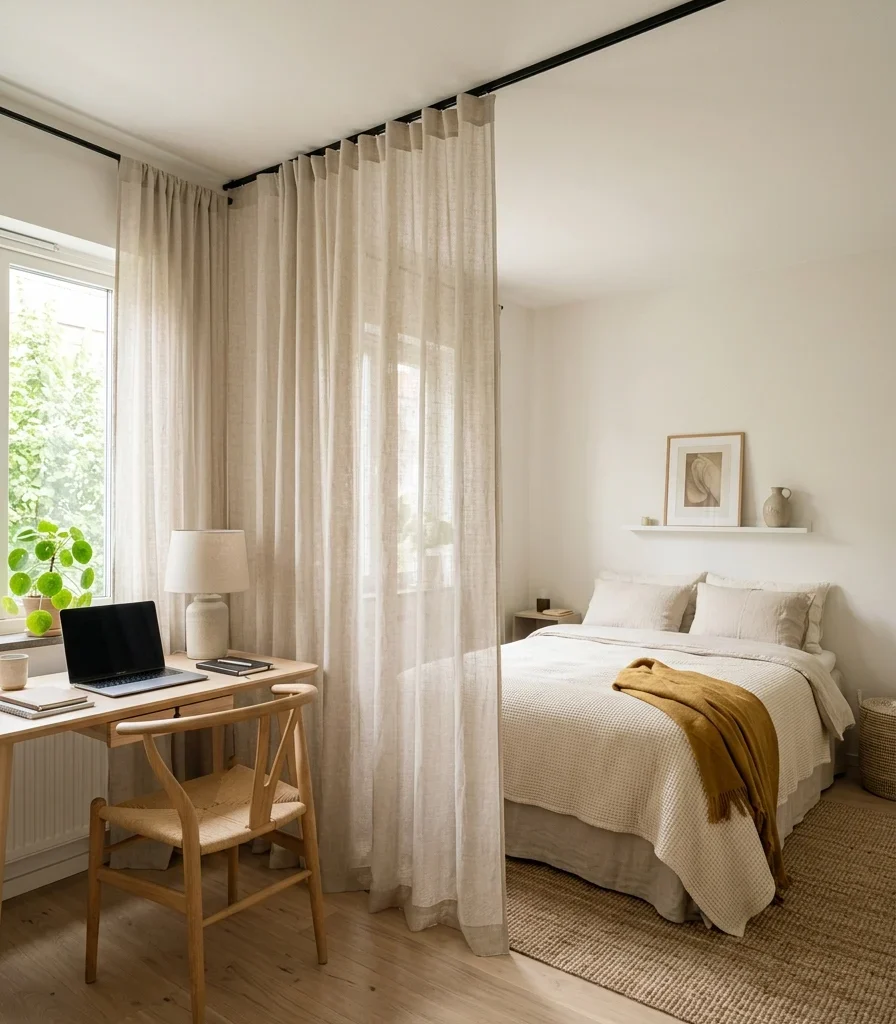
Vibe: Layered, a soft boundary that separates without ever fully closing off light or airflow.
Why it works: Traffic flow and zone definition in a shared-function room depend on a visual cue that signals “this is a different area” without requiring a wall. A sheer curtain on a ceiling track achieves spatial separation through translucency rather than opacity, which keeps the small room from feeling chopped up or darker than it already is a real risk with solid partitions in rooms under 120 square feet.
How to get it: Install an L-shaped or straight ceiling-mounted curtain track positioned to run between the desk and the bed, and hang an unlined natural linen curtain that can be pulled fully open during work hours and closed at night, keeping the zoning flexible rather than permanent.
💡 Quick Win: A tension rod and single sheer panel under $40 create the same zoning effect without any ceiling installation.
Shop the Look
| Product |
| Ceiling mount curtain track L-shape |
| Sheer natural linen curtain panel |
| Tension rod adjustable curtain |
| Curtain ring clips brass |
| Folded cotton throw neutral |
8. Choose a Slim-Profile Ergonomic Chair
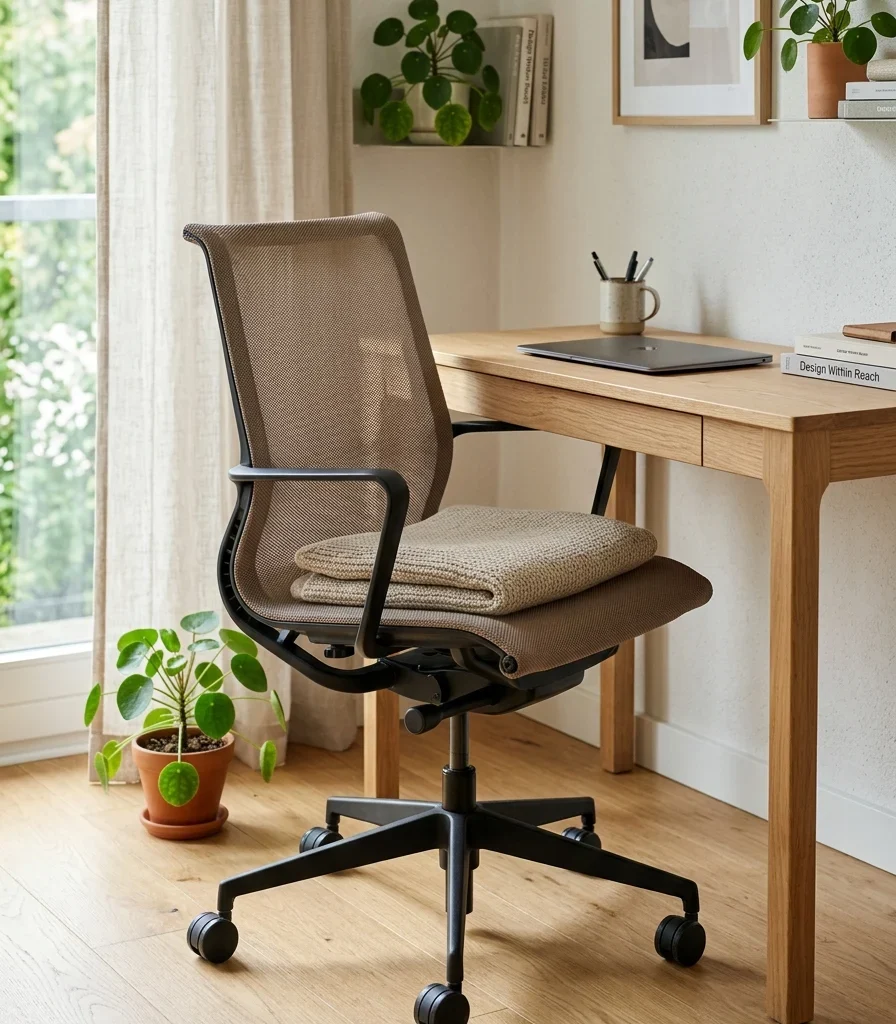
Vibe: Streamlined, a chair sized to disappear visually the moment it’s tucked under the desk.
Why it works: Furniture scale is the design principle most frequently ignored in small-room seating; a bulky executive chair with wide armrests reads as oversized against a compact desk and eats floor space that a slim frame wouldn’t. A chair with a narrow 18-inch seat width and a low-profile mesh back provides ergonomic support without the visual bulk of a traditional office chair.
How to get it: Select a chair with a seat width under 19 inches and armrests that either fold or sit flush enough to tuck fully under the desk, in a warm taupe or oatmeal upholstery that coordinates with linen bedding rather than the harsh black mesh typical of corporate office chairs.
Shop the Look
| Product |
| Slim mesh ergonomic desk chair |
| Warm taupe seat cushion pad |
| Small round floor plant pot |
| Chair caster floor protector set |
| Lumbar support cushion linen |
9. Roll Office Supplies Into Under-Bed Storage
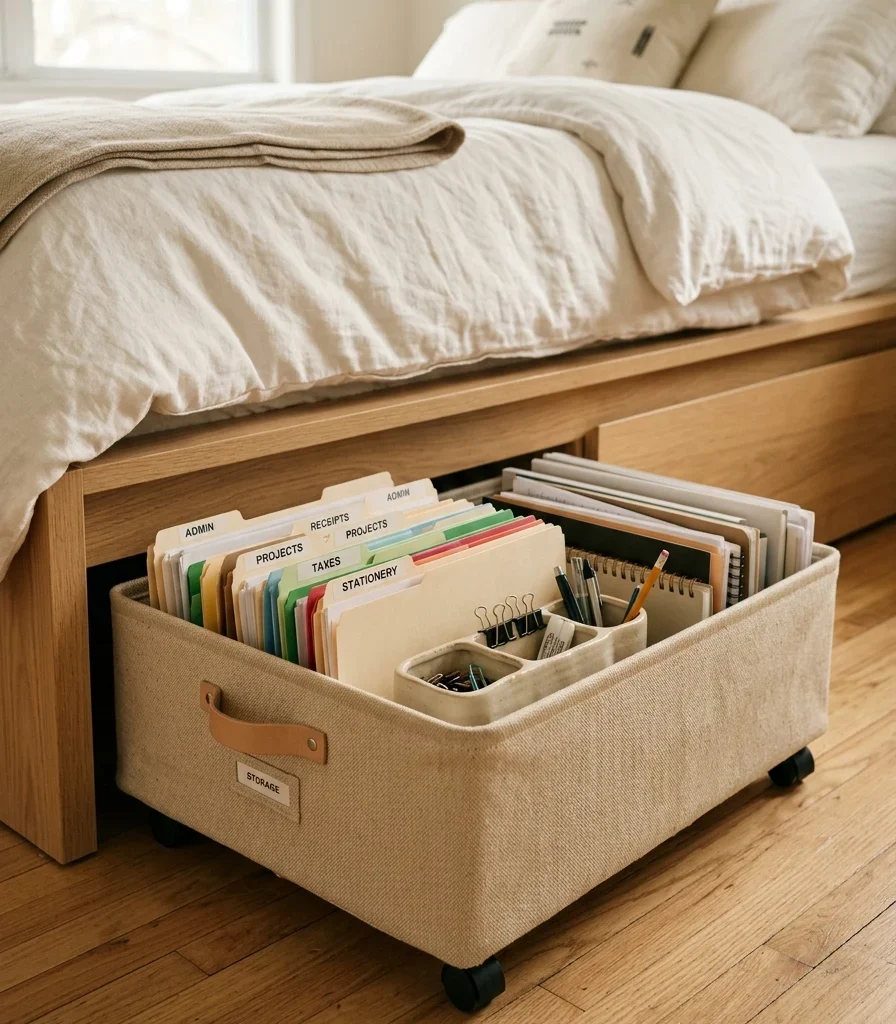
Vibe: Hidden supplies that vanish completely from view the second the workday ends.
Why it works: Under-bed space is the largest unused storage volume in most small bedrooms, typically 6 to 10 inches of clearance running the full footprint of the bed. Routing paper, extra cables, and reference binders into low rolling bins here removes them from the desk and closet entirely, which is the single highest-capacity small-space storage move available in a bedroom.
How to get it: Measure clearance under the bed frame before buying (most platform beds clear 7 inches), and choose a canvas or woven bin no taller than that clearance with wheels for easy access, reserving it specifically for supplies used weekly rather than daily items that need to stay on the desk.
💡 Quick Win: A flat under-bed canvas bin under $25 instantly adds hidden storage without any furniture purchase.
Shop the Look
| Product |
| Low-profile rolling under-bed bin |
| Canvas storage bin with wheels |
| Labeled hanging file folder set |
| Ceramic paperclip organizer dish |
| Flat document storage box |
10. Introduce Dusty Sage as the Single Accent Color
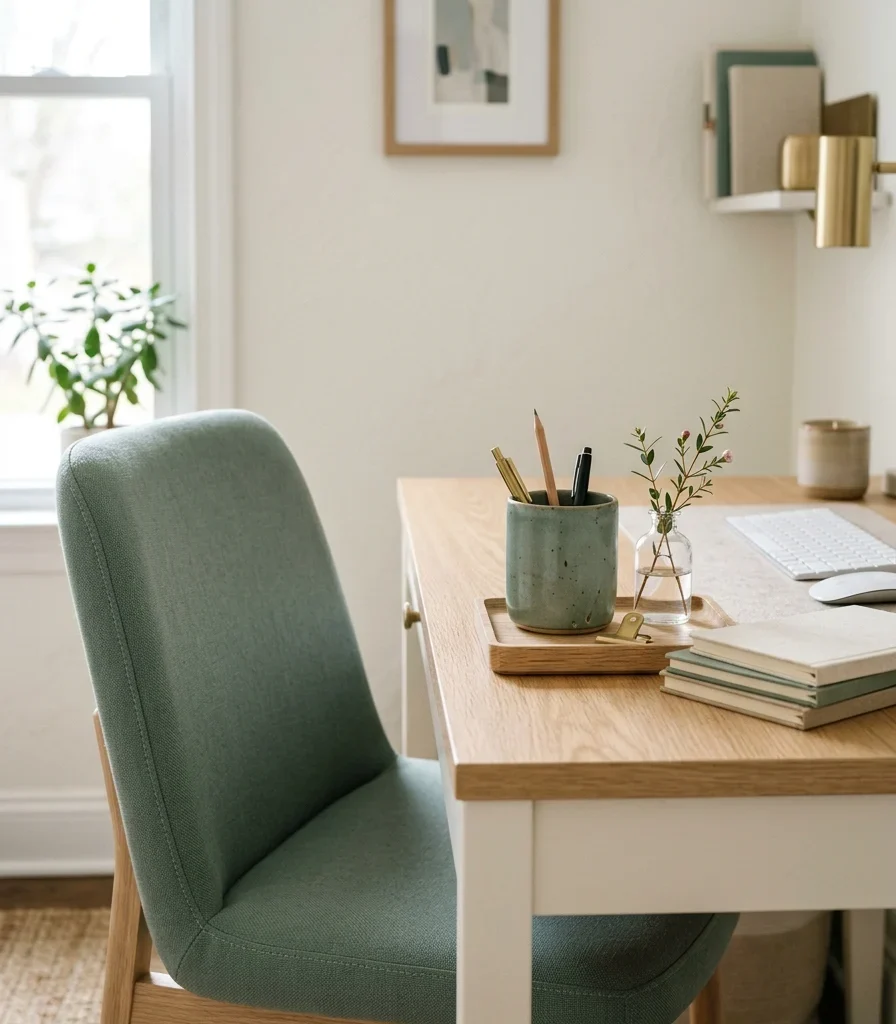
Vibe: Fresh one considered color that keeps the neutral palette from tipping into flat or sterile.
Why it works: Restricting an accent to a single color across two or three objects rather than scattering multiple accent colors is a discipline of color layering that prevents visual competition in a small room where every object is seen at close range. Dusty sage specifically reads calm rather than energetic, which suits a room that has to support sleep in the evening.
How to get it: Apply sage to exactly two or three objects maximum a chair cushion, a ceramic vase, and a desk tray and keep every other surface in warm white, oak, or brass so the sage reads as a deliberate accent rather than a second competing palette.
Shop the Look
| Product |
| Dusty sage desk chair cushion |
| Sage green ceramic bud vase |
| Oak wood desk catch-all tray |
| Sage linen coaster set |
| Brass single-stem bud vase |
11. Hang a Linen-Covered Cork Board for Daily Notes
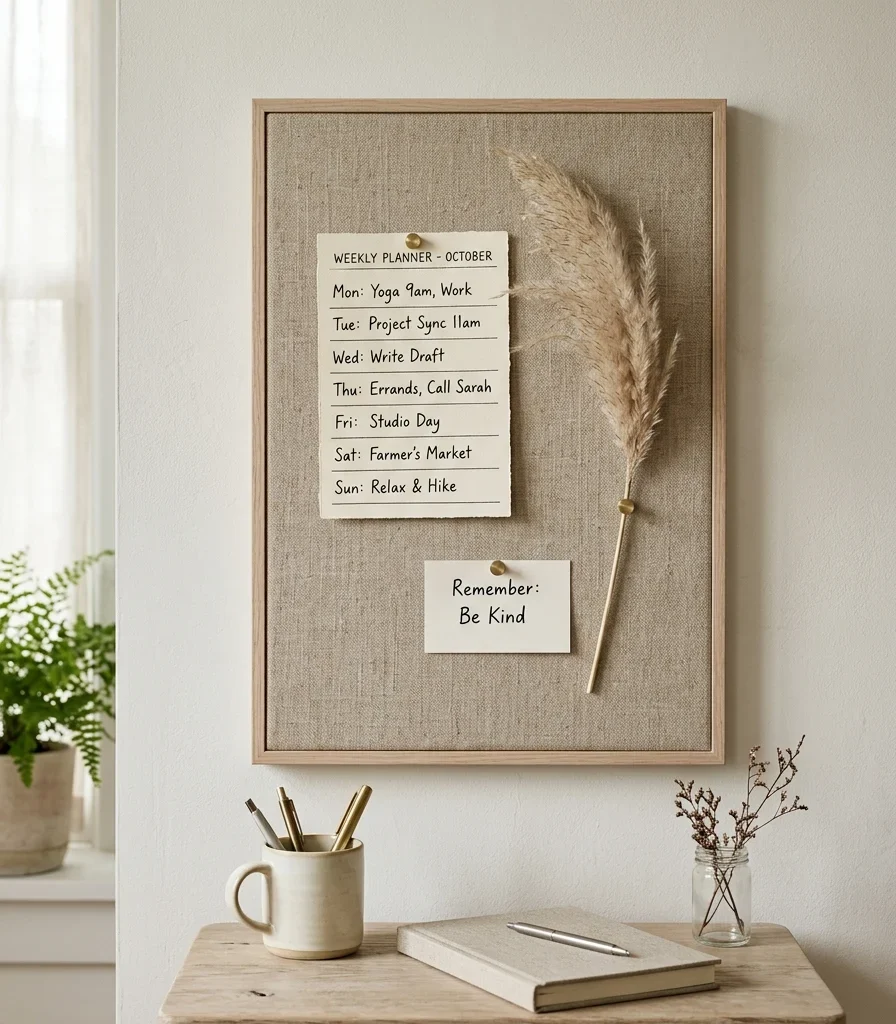
Vibe: Hushed, a soft, fabric-covered surface that holds the week’s to-do list without a single loud color.
Why it works: A linen-covered board applies the same material-coherence principle as the rest of the room to a category of bulletin boards that’s normally sold in bright primary colors or black cork. Wrapping the cork base in natural linen before framing it lets the note-taking surface match the room’s textile language instead of introducing an office-supply-store aesthetic.
How to get it: Stretch a plain natural linen fabric over a standard cork board and staple it to the back before framing in a thin oak border, then use brushed brass push pins exclusively; mixed-color pins are the detail that most quickly makes a styled board look untidy.
💡 Quick Win: Wrapping an existing black cork board in linen fabric with a staple gun is a 20-minute fix that costs under $10.
Shop the Look
| Product |
| Natural linen cork board oak frame |
| Brushed brass push pin set |
| Dried pampas grass stem single |
| Small printed weekly planner card |
| Oak wood board mounting hardware |
12. Add a Narrow Cane Vertical Shelving Unit
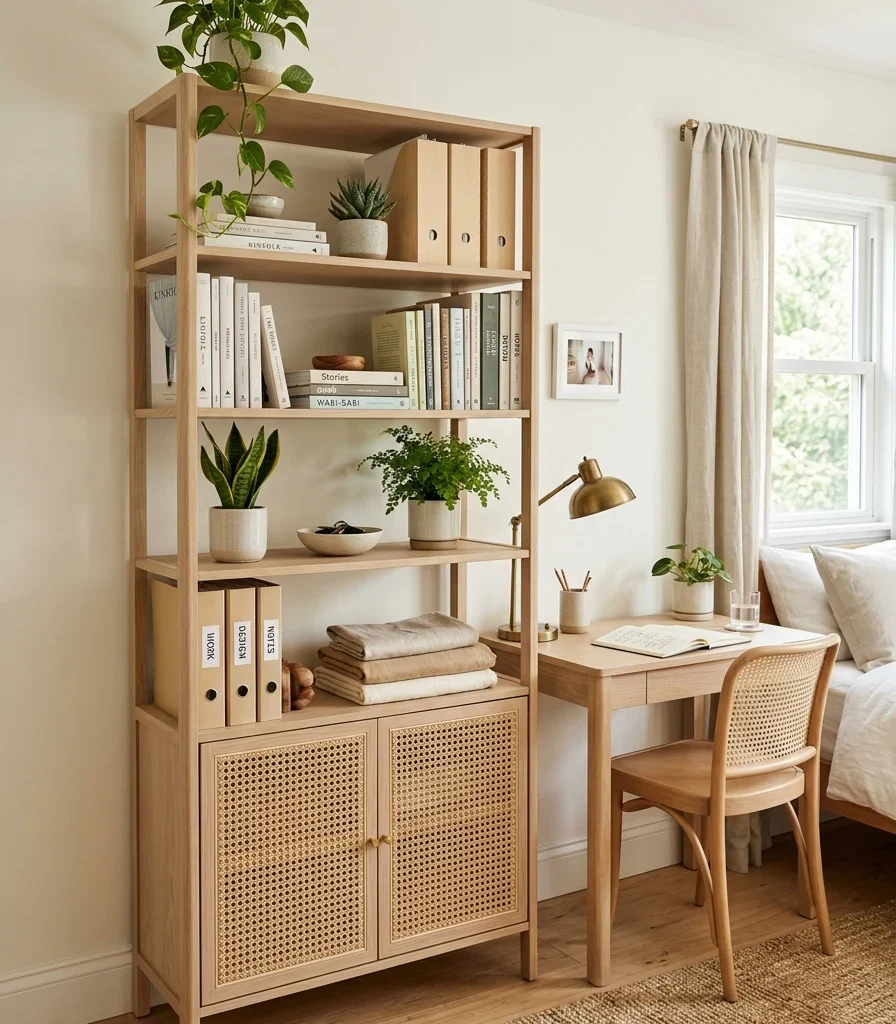
Vibe: Layered, a tall, narrow footprint that stores far more than its floor space suggests it should.
Why it works: Vertical shelving addresses the same principle as the pegboard idea but at a larger storage capacity. A unit 16 inches wide and 60 inches tall occupies less than 2 square feet of floor while holding the storage volume of a much wider low dresser. The cane-front lower doors add texture and conceal less attractive supplies, while open upper shelves display the objects worth seeing.
How to get it: Choose a shelving unit no wider than 18 inches so it fits beside a desk without crowding the walking path, and reserve the lowest cane-fronted section for items you don’t want visible daily spare paper, chargers, old files while styling only the top two open shelves.
Shop the Look
| Product |
| Narrow cane front shelving unit |
| Pale oak tall bookshelf 18 inch |
| Small ceramic catchall bowl |
| Stacked linen-bound book set |
| Small trailing plant in pot |
13. Layer Ambient String Lighting Behind the Desk Lamp
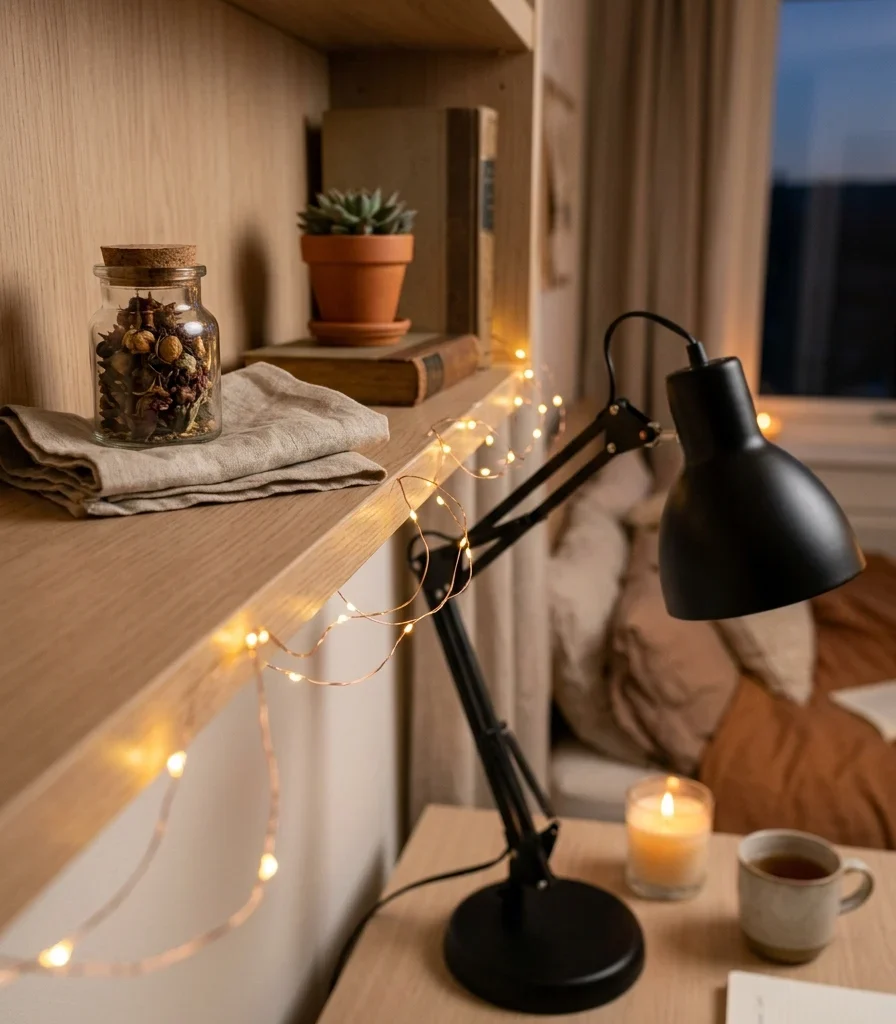
Vibe: Warm, a soft secondary glow that carries the desk area from workday brightness into evening softness.
Why it works: Light layering means combining at least two light sources at different heights and intensities rather than relying on one overhead fixture. Ambient string lights positioned along a shelf edge behind the task lamp add a low, diffused glow that makes the work corner feel inviting after 6 pm instead of clinically lit, extending the desk’s usefulness into a relaxed evening reading nook.
How to get it: Choose warm 2200K micro LED string lights (avoid cool white, which clashes with the task lamp’s 3000K bulb) and drape them along the underside of a shelf or the top edge of a headboard adjacent to the desk, plugged into a separate switch from the task lamp so each light source can be controlled independently.
Shop the Look
| Product |
| Warm 2200K micro LED string lights |
| Copper wire fairy light set |
| Small glass jar light diffuser |
| Dual outlet plug timer switch |
| Folded linen napkin accent |
14. Install a Fold-Away Secretary Desk
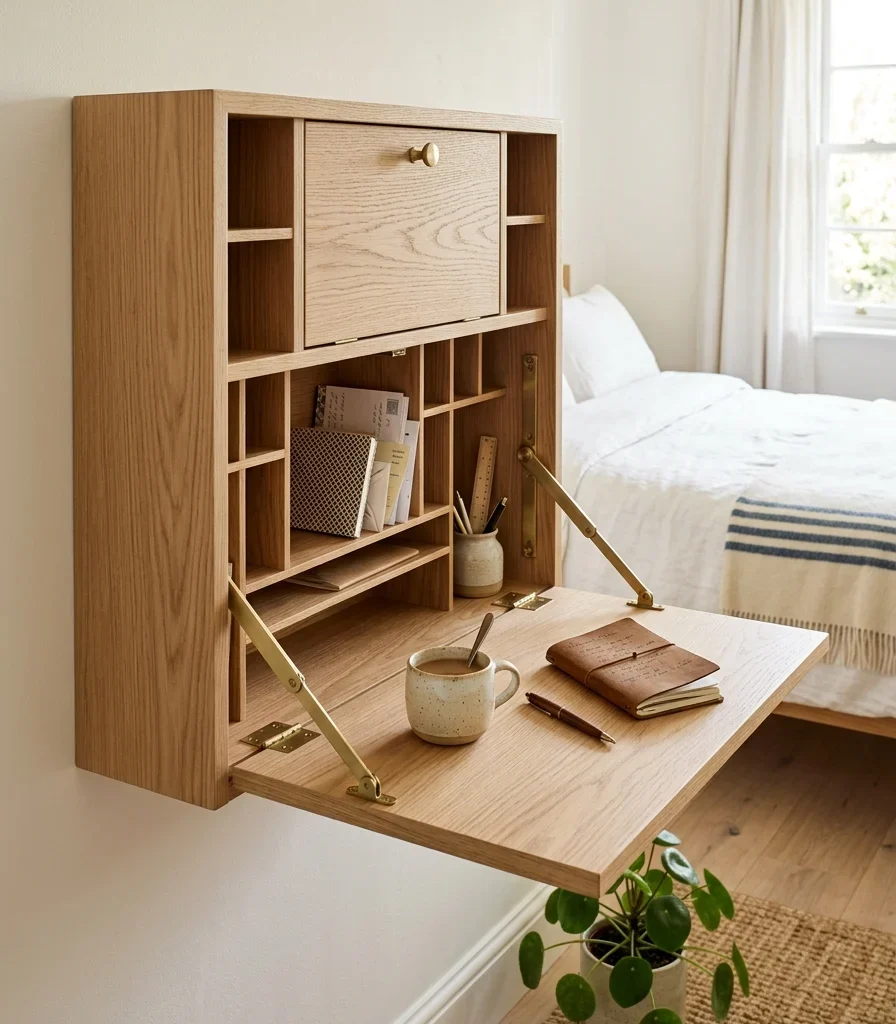
Vibe: Resolved: a desk that exists only when you need it and disappears completely into the wall when you don’t.
Why it works: A fold-away secretary desk is the most direct application of dual-function furniture design available for a genuinely tiny bedroom; when folded shut, it presents as a slim 6-inch-deep cabinet rather than a 24-inch-deep desk, reclaiming nearly two feet of floor space during non-work hours. This matters most in bedrooms under 100 square feet where a permanent desk footprint competes directly with walking space around the bed.
How to get it: Mount the unit so the fold-down surface, when open, sits at standard 29-inch desk height, and choose a model with at least two interior cubbies so pens, chargers, and notepads stay contained inside the cabinet rather than needing separate desk storage once it’s folded shut.
💡 Quick Win: A compact fold-down laptop shelf under $60 delivers the same space-reclaiming effect at a fraction of the cost of a full secretary desk.
Shop the Look
| Product |
| Wall mount fold-down secretary desk |
| Brass fold-out hinge hardware |
| Compact fold-down laptop shelf |
| Interior cubby organizer insert |
| Small ceramic mug matte glaze |
15. Lean a Full-Length Mirror Beside the Desk
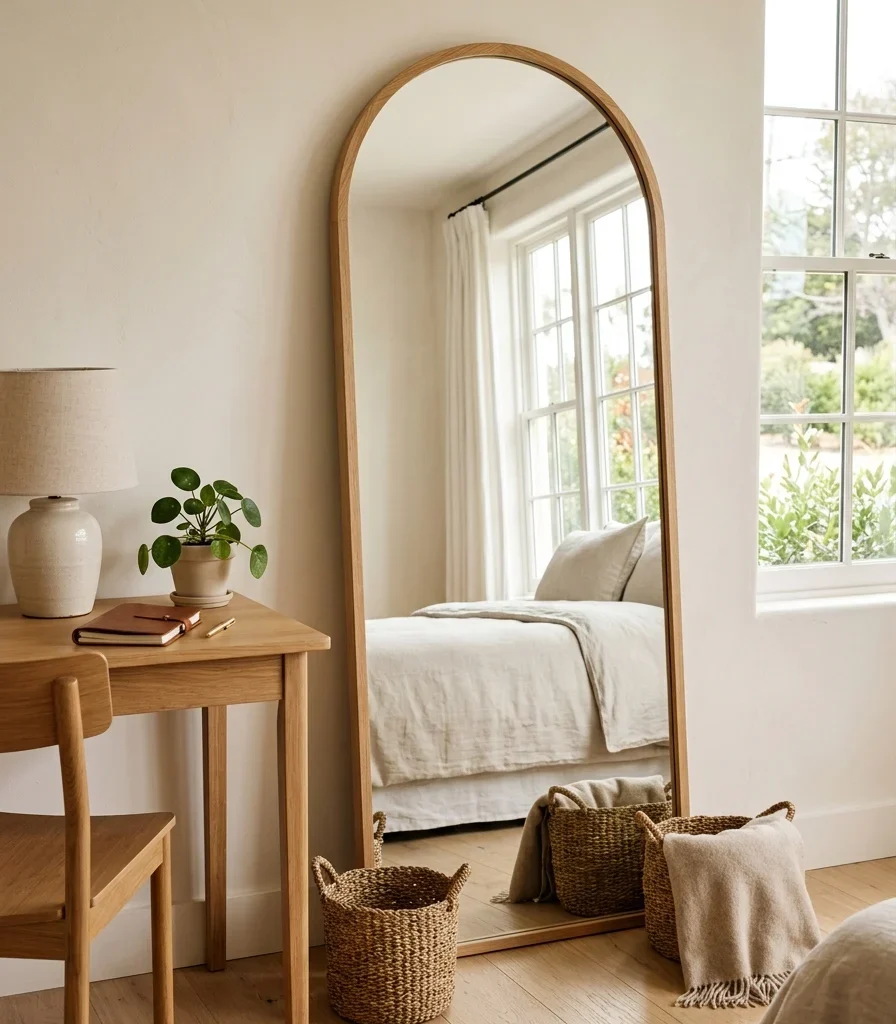
Vibe: A luminous room that visually doubles in depth the moment a mirror bounces the window light back across it.
Why it works: A leaning mirror is a classic small-space illusion technique that works on the principle of reflected light and perceived depth. Positioning it to face the room’s main window doubles the apparent light source and reflects the far wall, which reads to the eye as additional square footage even though the physical dimensions haven’t changed at all.
How to get it: Lean a mirror at least 60 inches tall against the wall directly across from the window, angled very slightly outward rather than flush against the wall, so it catches and redirects daylight across the desk area rather than reflecting only the ceiling.
Shop the Look
| Product |
| Full-length arched leaning mirror |
| Thin oak wood mirror frame |
| Small woven basket mirror base |
| Folded knit throw neutral tone |
| Anti-tip mirror wall strap |
16. Finish With Warm Terracotta Desk Accessories
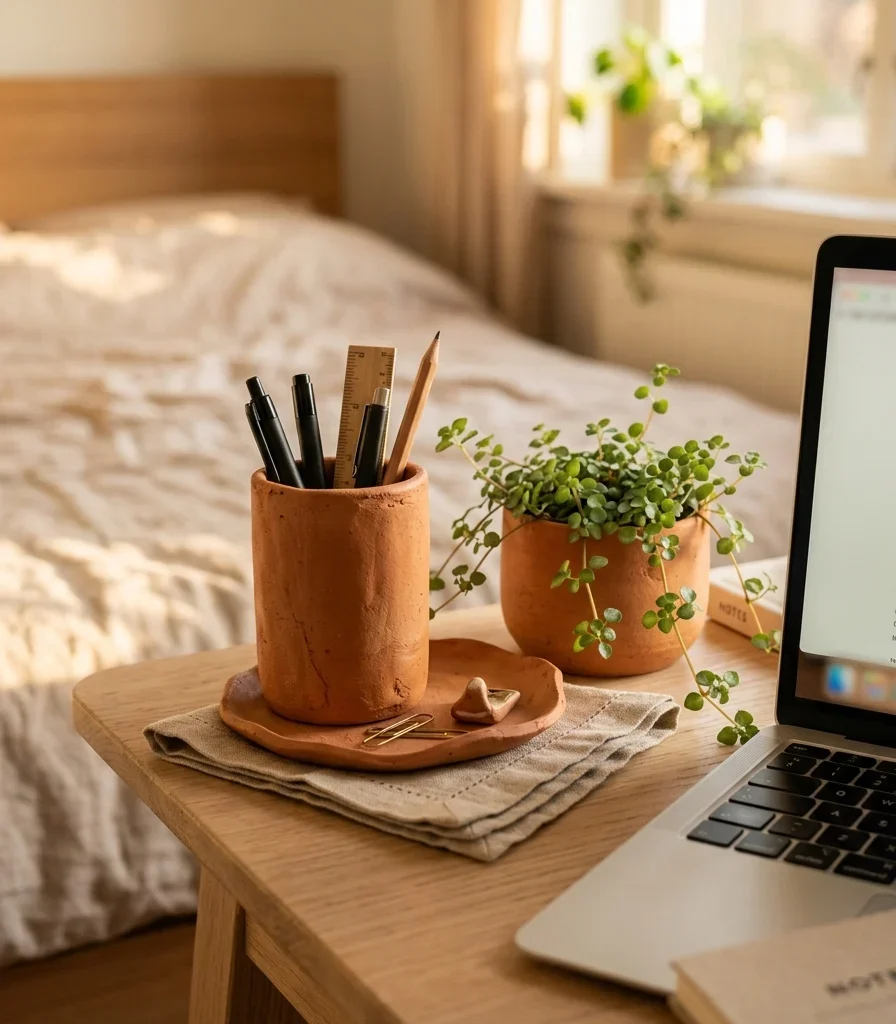
Vibe: Grounded a warm final layer of color that gives the whole desk setup a lived-in, considered finish.
Why it works: Closing a design scheme with one final, cohesive accessory grouping is a principle of visual weight distribution. After fifteen decisions about furniture, storage, and zoning, a small cluster of terracotta objects on the desk gives the eye a single warm focal point without introducing any new material into the room’s established palette of oak, linen, rattan, and neutral paint.
How to get it: Group three unglazed terracotta pieces a pen cup, a shallow catch-all tray, and a small planter on one corner of the desk only, keeping the rest of the surface clear so the terracotta cluster reads as a styled moment rather than scattered clutter.
💡 Quick Win: A single terracotta planter under $15 anchors the whole desk palette without committing to a full accessory set.
Shop the Look
| Product |
| Unglazed terracotta pen cup |
| Terracotta shallow catchall tray |
| Small terracotta planter pot |
| Trailing pothos plant small |
| Woven linen desk coaster set |
How to Start Your Small Bedroom Home Office Transformation
Your first move is choosing the desk before anything else, specifically, a desk no wider than 30 inches and no deeper than 24 inches. Every other decision in this list, from chair scale to lighting placement to storage volume, is sized in relation to the desk’s footprint, so committing to an undersized desk first prevents the far more common mistake of choosing furniture room-by-room and discovering too late that nothing fits together.
The most common mistake in small-bedroom office setups is buying a full-size or oversized desk chair meant for a dedicated home office, then finding it visually and physically dominates a room that also has to function as a bedroom. The fix is scale-matching: every piece, from chair to shelving to lamp, should be selected against the desk’s dimensions, not against a standard office furniture catalog sized for larger rooms.
Three items under $50 that create immediate impact: a warm 3000K LED desk lamp bulb pack, a woven rattan desk-corner basket for cables, and a single terracotta planter to anchor the desk’s color story.
A focused weekend can accomplish desk placement, lighting, and one storage piece for $150–400. A full 16-idea transformation new desk, chair, shelving, curtain divider, and styled accessories typically runs $600–1,800 and takes two to four weekends spread across paint drying time, furniture delivery, and styling.
Frequently Asked Questions About Small Bedroom Home Office Setup
What is the difference between a small bedroom home office and a regular home office?
A regular home office is designed around a single function and typically occupies a dedicated room, allowing full-size furniture and permanent storage. A small bedroom home office has to satisfy two functions in one footprint, which means every piece desk, chair, lighting, storage is chosen at a reduced scale and often selected for dual use, such as under-bed storage bins or fold-away desks that a standalone office would never need.
What color works best for a small bedroom home office?
Warm white or soft greige on the main walls, paired with one accent color such as dusty sage or warm terracotta used on no more than two or three objects, works best. Cool grey or stark white can make a small room feel clinical and less restful at night, while a warm greige with a pink-yellow undertone keeps the room feeling calm during work hours and cozy after dark.
How much does it cost to set up a small bedroom home office?
A basic functional setup desk, chair, and task lamp typically costs $150–400 using budget-friendly pieces. A fully styled version with shelving, a curtain divider, woven storage, and coordinated accessories generally runs $600–1,800, depending on whether the desk is a simple flat-pack option or a built-quality piece in solid oak.
Can a small bedroom home office work if I share the room with a partner?
Yes, but zoning becomes more important a sheer curtain divider or a corner desk placed away from the direct sightline of the bed helps the work area feel separate even in a shared room. Noise-dampening elements like a woven rug under the desk and a closing storage cabinet for work materials also help the space transition back into a shared bedroom at the end of the workday.
What is the single most important element in a small bedroom home office?
Desk size is the single most important decision, because every other furniture and storage choice in the room is scaled against it. A desk under 30 inches wide with a shallow 18–24-inch depth leaves enough walking clearance around the bed to keep the room from feeling like an office that happens to have a bed in it, which is the most common failure point in small-bedroom office design.
Ready to Create Your Dream Small Bedroom Home Office?
These 16 ideas move across color, material, lighting, layout, and true small-space tricks from a warm greige zoning wall and layered task-and-string lighting to a fold-away secretary desk and a mirror that doubles the room’s daylight. None of this has to happen at once, and starting with just the desk and one storage piece is genuinely the right way to begin rather than a compromise. Today’s specific action: measure your desk corner and order a desk no wider than 30 inches; that single measurement decides the scale of everything that follows. Once it’s in place, you’ll notice the room finally feels like it belongs to you at both 2 pm and 10 pm, calm enough to close a laptop and exhale into. Save the ideas that fit your room’s actual corners and your budget’s actual limits; those are the ones, sage accents and woven baskets included, that you’ll still be glad you pinned a year from now.
[…] 16 Ways to Optimize a Home Office Setup in a Small Bedroom […]
[…] 16 Ways to Optimize a Home Office Setup in a Small Bedroom […]
[…] 16 Ways to Optimize a Home Office Setup in a Small Bedroom […]
[…] 16 Ways to Optimize a Home Office Setup in a Small Bedroom […]
[…] 16 Ways to Optimize a Home Office Setup in a Small Bedroom […]
[…] 16 Ways to Optimize a Home Office Setup in a Small Bedroom […]
[…] 16 Ways to Optimize a Home Office Setup in a Small Bedroom […]
[…] 16 Ways to Optimize a Home Office Setup in a Small Bedroom […]
[…] 16 Ways to Optimize a Home Office Setup in a Small Bedroom […]