
Modern farmhouse is the pairing of rustic, weathered textures with clean, minimal lines rough wood next to crisp white walls, iron hardware against soft linen. This article gives you 15 modern farmhouse living room ideas, from paint colors to lighting to layout tricks, that you can actually use.
The feeling is unmistakable: sun through sheer curtains landing on a worn wood floor, the quiet weight of a stone fireplace, linen that’s soft from washing, not from trying. It’s a room that looks lived-in on day one and feels calmer every year after. Modern farmhouse doesn’t shout it settles. Here are 15 ideas worth saving and stealing.
Why Modern Farmhouse Works So Well
What is it? Modern farmhouse blends two opposing traditions: the utilitarian, hand-built aesthetic of 19th-century American and European farmhouses, and the restrained, uncluttered lines of contemporary minimalism. It borrows shiplap and barn-door hardware from rural vernacular architecture, then strips away the ornate florals and heavy antiques that defined traditional country decor. The result sits between rustic and refined — worn but never messy, simple but never cold.
What are its core materials and colors? The palette leans on warm white, greige, soft charcoal, and terracotta blush, with black or bronze as the grounding accent. Materials are tactile and imperfect: whitewashed shiplap, unfinished white oak, reclaimed barnwood, linen upholstery, wrought iron, and woven jute. Nothing is glossy. Everything has a slight texture your hand wants to touch.
Why is it trending now? Search interest in “modern farmhouse” has stayed high on Pinterest for nearly a decade, but the current wave is driven by post-pandemic nesting — people want homes that feel handmade and durable rather than showroom-perfect. The sustainability movement has also pushed reclaimed wood and natural fiber back into favor over synthetic, mass-produced finishes.
Can small spaces achieve this style? Yes, with one condition: restraint. Small farmhouse rooms fail when every surface gets a “rustic touch.” Prioritize one hero material (a wood beam, a shiplap wall) and keep everything else quiet and pale so the room doesn’t feel cluttered.
| Element | Trait 1 | Trait 2 |
| Philosophy | Rustic texture, minimal clutter | Function before ornamentation |
| Materials | Whitewashed shiplap, white oak | Wrought iron, linen, jute |
| Color palette | Warm white, greige | Charcoal, terracotta blush |
15 Modern Farmhouse Living Room Ideas
1. Whitewashed Shiplap Accent Wall
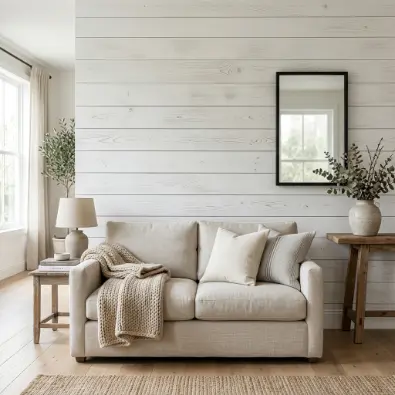
Vibe: The wall feels raw, like reclaimed barn siding softened by paint.
Why it works: Shiplap creates horizontal texture and shadow lines that add depth to an otherwise flat wall — a classic technique for adding visual interest without adding color. The whitewash keeps the grain visible, which is what separates an authentic farmhouse from a flat white paint job.
How to get it: Install pine shiplap boards, then apply a diluted white paint-to-water wash (roughly 1:1 ratio) with a rag, wiping with the grain so wood texture stays visible underneath.
💡 Quick Win: Peel-and-stick shiplap wallpaper panels achieve 80% of the look in an afternoon, no nail gun required.
Shop the Look
| Product |
| Whitewashed pine shiplap wall panel kit |
| Ivory linen 3-seat slipcovered sofa |
| Matte black round wall mirror 30 inch |
| Cream ceramic vase ribbed textured |
| Chunky knit wool throw blanket, oatmeal |
2. Warm White Walls with Greige Trim
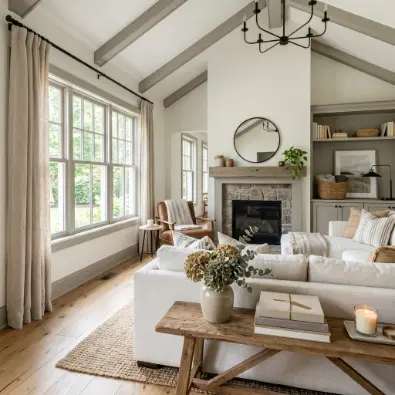
Vibe: The room feels luminous, like a page that hasn’t been written on yet.
Why it works: Pairing a warm white wall with a slightly darker greige trim uses tonal contrast rather than color contrast, which reads as sophisticated instead of stark. This is the same low-contrast layering technique used in Scandinavian interiors, adapted with warmer undertones.
How to get it: Paint walls in a warm white with a yellow-beige undertone, then paint trim, baseboards, and window casings two shades darker in a warm greige to define the architecture without introducing a new hue.
Shop the Look
| Product |
| Woven seagrass storage basket set |
| Natural linen curtain panels 84 inch |
| Oak wood picture ledge shelf |
| Neutral linen-bound decorative books set |
| Cream boucle accent pillow cover 20×20 |
3. Oversized Iron Chandelier
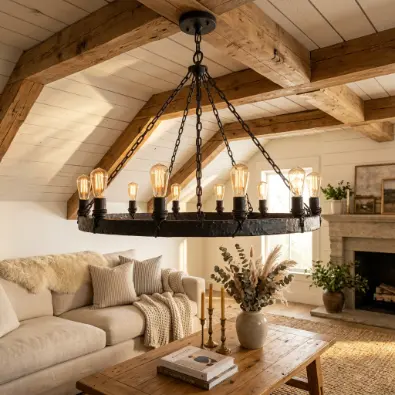
Vibe: The room feels grounded, anchored by one dark, weighty shape overhead.
Why it works: A single oversized fixture creates visual weight at ceiling height, balancing heavier furniture below it — a proportion rule where the light fixture should span roughly one-third to one-half the width of the seating area it hangs over. Wrought iron adds the rustic material note without darkening the walls.
How to get it: Choose a ring or candelabra-style iron chandelier with exposed Edison bulbs, and hang it 30–34 inches above the coffee table for proper scale.
💡 Quick Win: Swap only the bulbs in your existing fixture to warm 2700K Edison-style bulbs for an instant mood shift before buying new hardware.
Shop the Look
| Product |
| Black wrought iron ring chandelier |
| Edison filament bulbs warm 2700K set |
| Sheepskin throw rug ivory |
| Brass taper candlestick holders set |
| Honey oak round coffee table |
4. Layered Vintage-Inspired Textiles
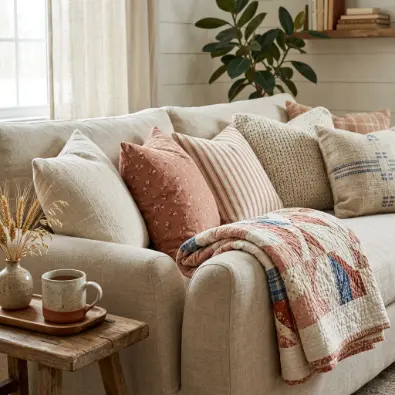
Vibe: The sofa feels welcoming, the kind of texture layering that invites you to sit down without asking.
Why it works: Mixing pillow sizes (one 22-inch, one 18-inch, one lumbar) and fabrics within one tonal family creates depth without visual noise — a principle called tonal layering, where texture does the work color usually does. A folded quilt across the arm breaks the sofa’s straight lines.
How to get it: Choose three pillow covers in linen, waffle-weave cotton, and a small block-print pattern, all within warm white to terracotta tones, and drape a vintage-style quilt diagonally across one arm.
Shop the Look
| Product |
| Linen throw pillow cover set of 3 |
| Waffle weave cotton lumbar pillow cover |
| Block print quilted throw blanket |
| Dried wheat stem bundle decor |
| Ceramic stoneware mug with earthy glaze |
5. Slipcovered Sectional with Turned Legs
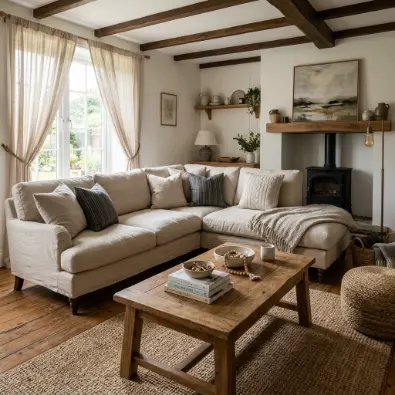
Vibe: The seating feels relaxed, like it was made to be sat on, not photographed.
Why it works: Slipcovered upholstery softens what could otherwise be a boxy, oversized sectional silhouette, and exposed turned wood legs add a furniture-making detail that keeps the piece from reading as purely modern. Visible legs also lighten a large sofa’s visual weight by letting light pass underneath.
How to get it: Look for a sectional with a relaxed linen or cotton-blend slipcover and turned or tapered oak legs rather than upholstered skirting, which hides the floor and makes the room feel heavier.
💡 Quick Win: If reupholstering isn’t in the budget, a slipcover kit over an existing sectional achieves the same silhouette for a fraction of the cost.
Shop the Look
| Product |
| Linen slipcover sectional sofa turned legs |
| Woven jute pouf ottoman round |
| Honey oak coffee table trestle base |
| Ceramic decorative bowl, neutral glaze |
| Neutral linen-bound coffee table books set |
6. Charcoal Black Accent Wall
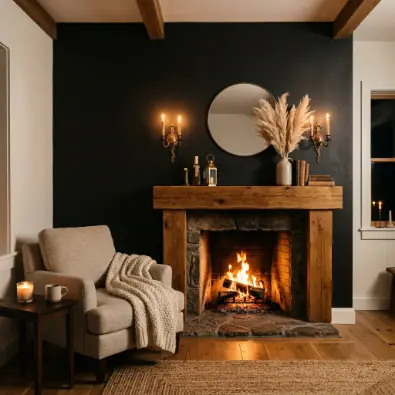
Vibe: The wall feels intimate, pulling the eye inward like a held breath.
Why it works: A single dark wall behind a focal point uses contrast in reverse — instead of lighting a small room, it deepens one, making the fireplace or built-in the undeniable visual anchor. Matte black also absorbs light rather than reflecting it, which keeps the mood warm instead of stark.
How to get it: Paint only the fireplace or built-in wall in a warm-toned matte charcoal black, and keep the surrounding walls in warm white so the dark wall reads as intentional, not overwhelming.
Shop the Look
| Product |
| Brass wall sconce candle holder set |
| Linen upholstered armchair natural |
| Dried pampas grass stems are tall |
| Wood mantel shelf unfinished oak |
| Black iron fireplace tool set |
7. Reclaimed Wood Beam Ceiling
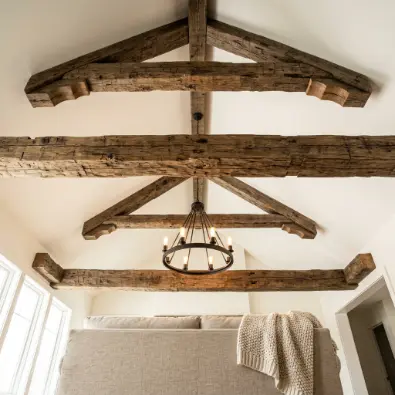
Vibe: Looking up feels grounding, like the room has a visible skeleton.
Why it works: Exposed beams add architectural texture at a plane most rooms leave untouched, drawing the eye upward and making ceilings feel taller by contrast against the white plane around them. Reclaimed wood’s saw marks and knots read as authentic in a way new lumber can’t replicate.
How to get it: Install faux or reclaimed wood beam wraps along the ceiling’s structural joists, spaced evenly, and leave the ceiling itself painted white so the beams stay the clear focal point.
💡 Quick Win: A single beam centered over the seating area gives the effect without the cost of wrapping the whole ceiling.
Shop the Look
| Product |
| Reclaimed wood faux ceiling beam wrap |
| Black iron pendant light fixture |
| Ivory linen 3-seat sofa |
| White matte ceiling paint gallon |
| Woven wood tray decorative |
8. Open-Concept Zoning with Area Rugs
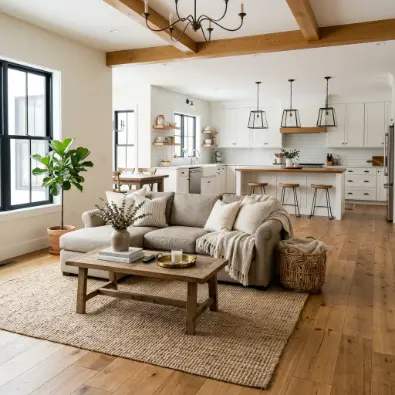
Vibe: The room feels open but not aimless, each zone quietly defined.
Why it works: In open floor plans, a large-format rug acts as a floor-level boundary, telling the eye where the living zone starts and stops without walls — a layout principle called anchoring, where furniture legs sit at least partially on the rug to visually “claim” the space.
How to get it: Size the rug so all front legs of the sofa and chairs sit on it, extending 12–18 inches beyond the furniture on each side, and choose a natural jute or wool weave to keep the zone visually lighter than a solid dark rug would.
Shop the Look
| Product |
| Taupe jute area rug 8×10 |
| Ivory linen sofa track arm |
| Honey oak round coffee table |
| Woven seagrass storage basket |
| Natural fiber runner rug hallway |
9. Gallery Wall of Botanical Prints
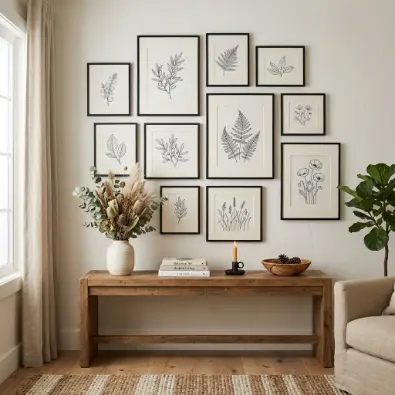
Vibe: The wall feels curated, as it grew there slowly over the years.
Why it works: An asymmetric gallery wall uses varied frame sizes and generous negative space between pieces to avoid looking cluttered, following the rule of keeping 2–3 inches of breathing room between frames so the eye can rest between images. Matching frame color (all black) unifies mismatched art subjects.
How to get it: Use uniform black wood frames in three sizes, arrange botanical or line-art prints with a shared cream matting, and lay the arrangement out on the floor first before hanging.
💡 Quick Win: Free printable botanical line art paired with $10 frames from a craft store achieves the look for under $60.
Shop the Look
| Product |
| Black wood picture frame set, assorted sizes |
| Botanical line art print set |
| Wood console table narrow |
| Ceramic bud vase matte finish |
| Dried eucalyptus stem bundle |
10. Terracotta and Cream Palette
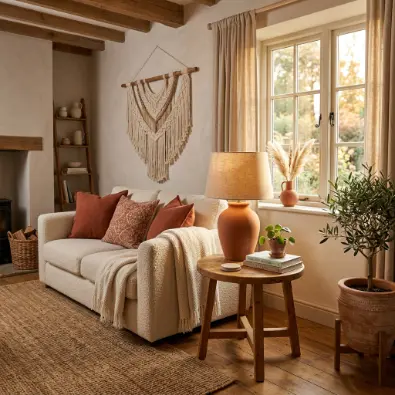
Vibe: The room feels sun-warmed, like clay left out in late afternoon light.
Why it works: Terracotta functions as a warm neutral rather than a bold accent, which is why it layers so easily with cream and oak without competing for attention — the earthy undertone in both keeps the palette cohesive rather than contrasting. This is a shift from the cooler, greige-heavy farmhouse palettes of a few years ago.
How to get it: Introduce terracotta through two or three items — a ceramic lamp base, one accent pillow, a woven wall hanging — rather than paint, so the warmth reads as intentional accent, not overwhelming color.
Shop the Look
| Product |
| Terracotta ceramic table lamp base |
| Cream boucle throw pillow cover |
| Woven macrame wall hanging natural |
| Honey oak side table round |
| Ivory linen curtain panels |
11. Layered Task and Ambient Lighting
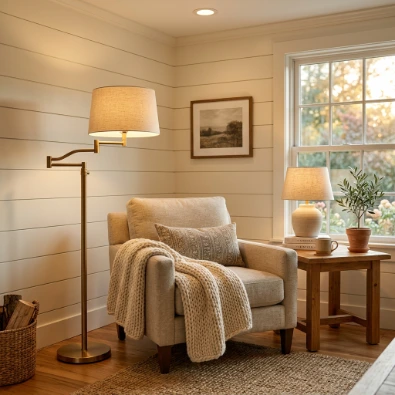
Vibe: The room feels hushed, lit in pools instead of one flat wash.
Why it works: Relying on a single overhead fixture flattens a room’s depth; layering ambient, task, and accent light at three different heights creates pools of light and shadow that make the space feel larger and more dimensional after dark. This is a lighting design principle borrowed directly from hospitality interiors.
How to get it: Add a brushed brass floor lamp beside the reading chair, a table lamp on the console, and dimmable overhead lighting set to warm 2700K so no single source does all the work.
💡 Quick Win: A $10 plug-in dimmer switch on an existing lamp gives you controllable ambient light without rewiring anything.
Shop the Look
| Product |
| Brushed brass floor lamp arc |
| Ceramic table lamp, warm white shade |
| Plug-in lamp dimmer switch |
| Linen upholstered armchair |
| Chunky wool throw blanket cream |
12. Live-Edge Coffee Table as Anchor
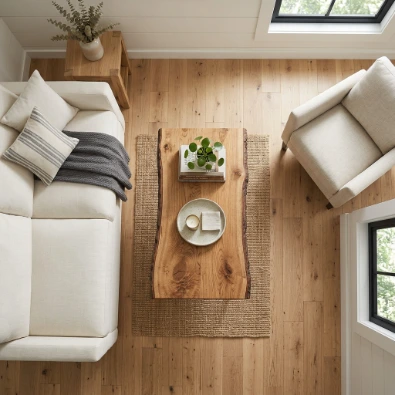
Vibe: The table feels raw, a slice of tree still visibly a tree.
Why it works: A live-edge slab introduces organic, irregular lines into a room otherwise built on straight furniture edges, creating contrast that keeps the space from feeling too uniform. Pairing it with thin black iron hairpin legs keeps the piece visually light despite its solid top.
How to get it: Choose a single-slab live-edge table in walnut or oak with exposed grain and knots left untreated, and set it on hairpin or trestle legs rather than a solid wood base to keep the silhouette light.
Shop the Look
| Product |
| Live-edge wood coffee table hairpin legs |
| Ceramic decorative tray oval |
| Stacked hardcover coffee table books neutral |
| Small potted plant faux olive |
| Woven coaster set, natural fiber |
13. Woven Rattan and Jute Textures
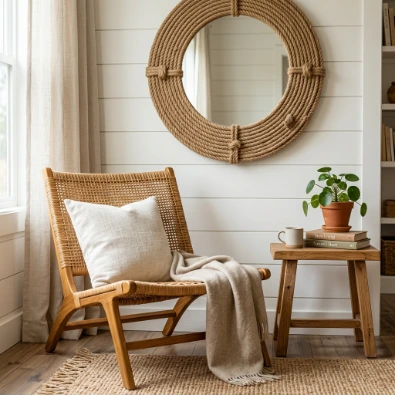
Vibe: The corner feels light, with a woven texture doing what a bold pattern usually would.
Why it works: Rattan and jute add texture-based visual interest without introducing new color, which keeps a neutral farmhouse palette from feeling flat or sterile. The open weave of rattan also reads as visually lighter than solid wood, useful for balancing heavier upholstered pieces nearby.
How to get it: Add one rattan-framed accent chair and one jute-wrapped mirror or lampshade in the same seating area so the woven texture repeats without becoming the room’s only focus.
💡 Quick Win: A jute-wrapped mirror frame kit can be added to an existing plain mirror for under $30.
Shop the Look
| Product |
| Rattan woven accent chair natural |
| Jute-wrapped round wall mirror |
| Linen seat cushion cover natural |
| Wood side table round small |
| Woven rattan pendant lampshade |
14. Multi-Functional Console Behind Sofa
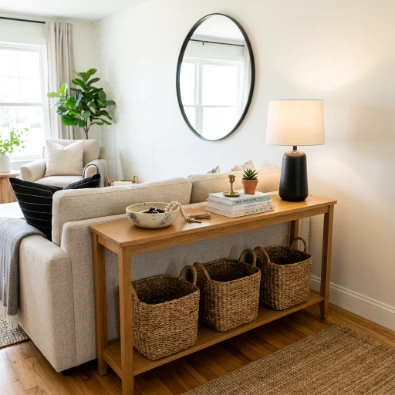
Vibe: The space feels efficient, every inch doing double duty without feeling tight.
Why it works: In small living rooms, a narrow console behind the sofa creates a defined back edge to the seating zone while adding hidden storage in woven baskets underneath — solving both a layout and a storage problem with one piece. A mirror above it also bounces natural light deeper into the room.
How to get it: Choose a console no deeper than 14 inches so it doesn’t crowd walking space, and add two woven baskets underneath for blankets or media instead of an open shelf that collects visual clutter.
Shop the Look
| Product |
| Narrow wood console table 14 inch depth |
| Woven storage basket set of two |
| Round wall mirror with a black frame |
| Ceramic table lamp small |
| Ceramic catchall bowl entry |
15. Sage Green Accent Pillows and Throws
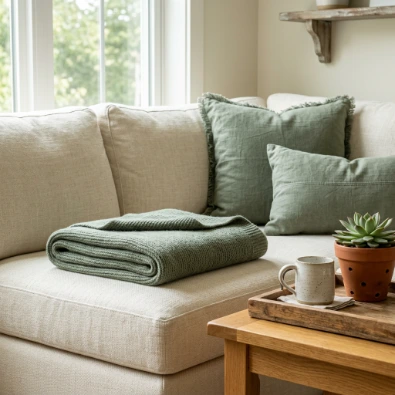
Vibe: The sofa feels still, a quiet green settling into a warm neutral room.
Why it works: Muted sage sits close enough to the room’s neutral palette in tone and saturation that it reads as an extension of the natural materials, not a competing color — unlike a saturated green, which would pull focus away from the wood and linen. It also echoes the botanicals typically styled nearby.
How to get it: Add sage through two pillow covers and one folded throw only, choosing a matte, slightly greyed sage rather than a bright kelly green to keep it in the same muted family as the rest of the room.
💡 Quick Win: A single sage green throw draped over one armrest updates a neutral sofa seasonally without buying new pillows.
Shop the Look
| Product |
| Sage green linen throw pillow cover |
| Sage green wool throw blanket |
| Small potted plant faux fern |
| Wood serving tray round |
| Ceramic stoneware mug sage glaze |
How to Start Your Modern Farmhouse Transformation
Start with paint, not furniture. A single gallon of warm white on your main wall — something with a slight yellow-beige undertone rather than a stark cool white — anchors every other decision, because your furniture, trim, and accent colors are chosen to sit against that base tone.
The most common beginner mistake is mixing cool-toned “farmhouse grey” with warm wood furniture. Cool undertones clash against honey oak and reclaimed wood, making the whole room feel visually off, even when every individual piece is correct. Fix it by testing paint swatches next to your actual wood tones before buying.
Three items under $50 that create immediate impact: a single stem of dried pampas grass in a matte black ceramic vase, a set of black iron curtain rod finials, and a chunky knit throw blanket in oatmeal wool blend draped over one armrest.
A starter refresh — paint, textiles, and lighting swaps — is realistically a weekend project costing $150–$400. A full room transformation with new furniture, shiplap, and beams takes 4–8 weeks and typically runs $2,500–$6,000, depending on whether furniture is reupholstered or replaced.
Frequently Asked Questions About Modern Farmhouse Living Rooms
What’s the difference between modern farmhouse and traditional farmhouse style?
Traditional farmhouse leans into heavier antiques, florals, and ornate details, while modern farmhouse strips decor down to clean lines and minimal accessories. Modern farmhouse also favors matte black hardware and iron over the brass and lace typical of traditional country decor. Think fewer knick-knacks, more negative space.
What color should I paint a modern farmhouse living room?
Warm white with a yellow-beige undertone, such as a shade in the Sherwin-Williams Alabaster or Benjamin Moore White Dove family, is the most common base wall color. Trim is typically painted two shades darker in greige for subtle contrast. Avoid cool, blue-based whites, which clash with warm wood tones.
How much does it cost to get a modern farmhouse living room?
A budget refresh using paint, textiles, and a few new accessories can run $200–$500. A mid-range update adding a slipcovered sofa and lighting typically costs $1,500–$3,000. A full renovation with shiplap, beams, and new furniture can reach $5,000–$10,000, depending on labor costs.
Does modern farmhouse work with other styles like boho or industrial?
Yes — modern farmhouse blends easily with boho through woven jute and rattan textures, and with industrial through black iron fixtures and exposed wood. The key is keeping one dominant material language (wood and linen) so the mix doesn’t feel like two unrelated rooms fighting for attention.
What’s the most important element in a modern farmhouse living room?
Texture layering is the single most important element — the mix of matte wood, woven fiber, and soft linen is what makes the style read as authentic rather than a paint color alone. A room with the “right” white walls but no textural variety will still look flat and generic.
Ready to Create Your Dream Modern Farmhouse Living Room?
These 15 ideas cover the full range from paint undertones and accent colors to lighting layers, furniture profiles, and small-space console tricks. You don’t need to do all of it at once, and starting with one wall or one lamp is genuinely the right way to begin. Tonight, pick up a sample pot of warm white paint and test it against your existing wood furniture before committing to a full gallon. Once the layers come together, the room will feel less like a showroom and more like a quiet place you actually want to sit still in. Save the ideas that pulled at you that whitewashed wall, that terracotta lamp because modern farmhouses reward the slow build, not the one-day overhaul.
[…] 15 Modern Farmhouse Living Room Ideas […]