
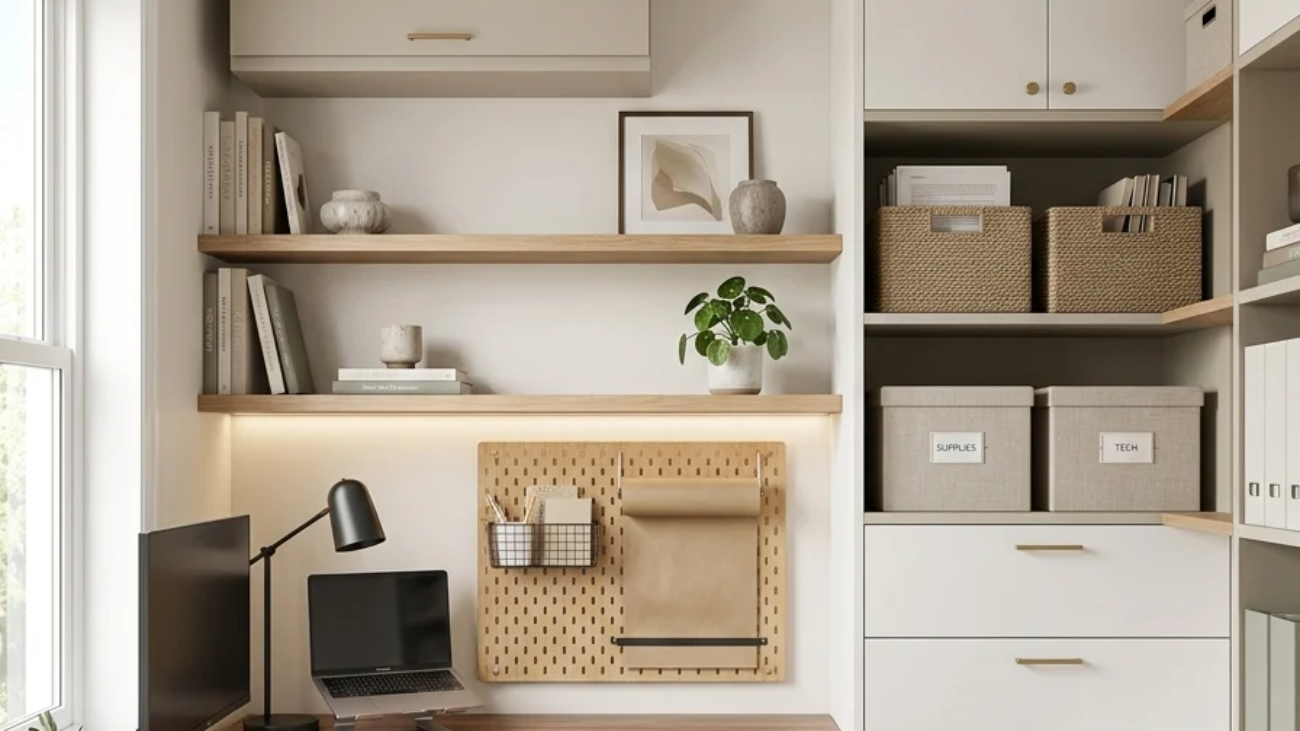
Optimized home office storage is a system that gives every supply, cable, and document a fixed home so your desk never becomes the default catch-all. This guide walks through 15 ways to optimize home office storage space, covering color, materials, lighting, and layout tricks that work whether you have a full room or a single corner.
Picture a wall that holds twice as much as a desk drawer ever could, cables that vanish the moment you close a laptop, and supplies sorted by how often you actually reach for them rather than how they happened to land. The room feels controlled rather than chaotic, with nothing hunting for a home. It has the quiet efficiency of a well-run studio, where every surface stays clear because everything else has somewhere better to be.
Here are 15 ideas worth saving and stealing.
Why Optimized Home Office Storage Works So Well
Home office storage optimization isn’t a decor movement like farmhouse or Japandi; it’s a functional design category built on systems thinking, borrowed from professional studio and workshop organization, where tools live exactly where they’re used. What separates it from generic “office decor” is that every choice gets judged on retrieval speed first and appearance second.
The palette leans warm white, soft sage, and warm charcoal, kept minimal so storage reads as calm rather than busy. Materials do the real work: powder-coated steel for rolling carts and filing units, unfinished white oak for floating shelves, woven rattan for soft-sided baskets, and matte glass or ceramic for small supply jars that keep loose items visible and contained.
This approach is trending because hybrid work turned spare corners and closets into permanent offices almost overnight, and Pinterest searches for “home office organization” and “desk storage ideas” have climbed steadily as people furnish smaller footprints without formal built-ins.
Small spaces handle optimized storage better than large ones; honestly, a big office tempts you to spread supplies across multiple surfaces, while a small one forces vertical thinking from day one. Prioritize wall space above the desk first; what genuinely doesn’t work is adding floor-standing furniture before you’ve claimed every inch of wall.
Style at a Glance
| Element | Detail |
| Philosophy | A fixed home for every item |
| Key Materials | powder-coated steel, white oak, rattan, glass |
| Key Colors | warm white, soft sage, warm charcoal |
15 Ways to Optimize Home Office Storage Space
1. Pegboard Wall System That Turns Vertical Space Into Storage
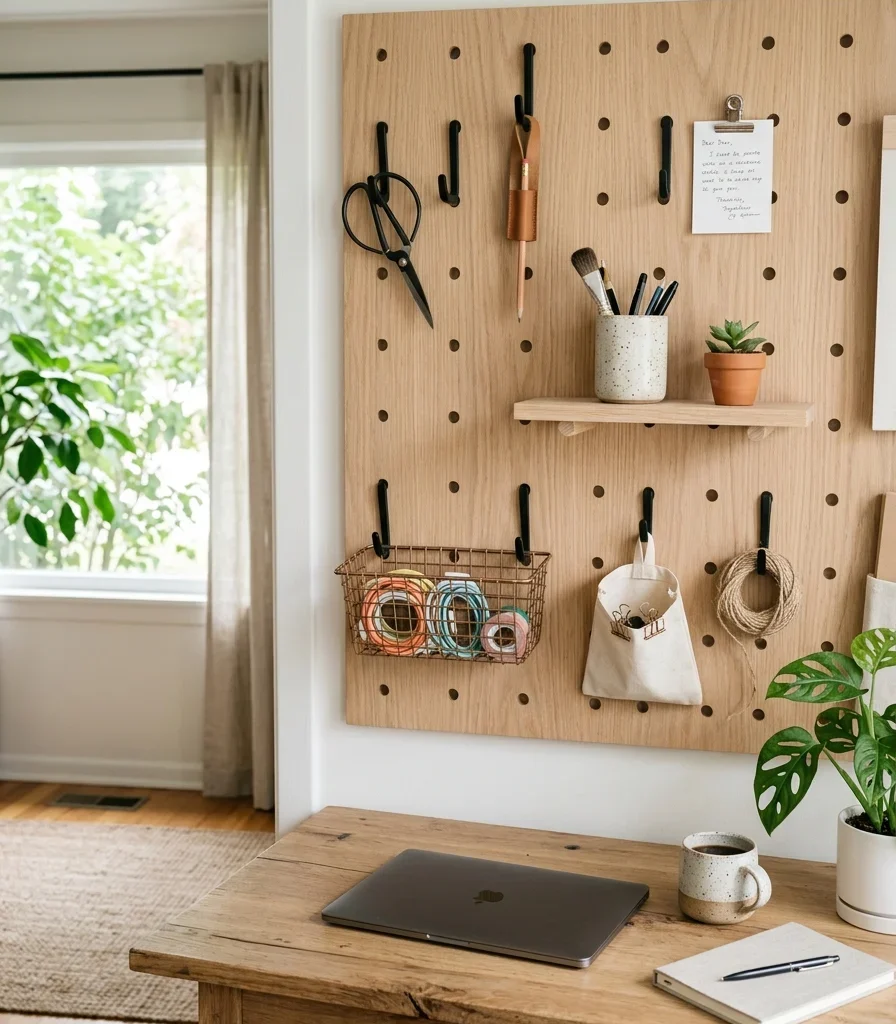
Vibe: Airy. A pegboard wall claims the one surface most offices never use, turning it into the busiest storage zone in the room.
Why it works: This applies vertical proportion at its most literal. A standard desk uses maybe 20 square feet of a room, while the wall above it offers the same footprint entirely untouched. Pegboard also lets storage reconfigure instantly as needs change, unlike fixed shelving.
How to get it: Mount a 36-by-24-inch white oak pegboard panel directly above the desk, spacing peg holes one inch apart, and start with just three hooks and one small shelf so the system grows only as needed.
Shop the Look
- White oak pegboard panel, 36×24-inch
- Matte black pegboard hook set
- Small pegboard-mount floating shelf
- Ceramic pegboard cup holder
2. Warm White Cabinetry That Makes Storage Disappear
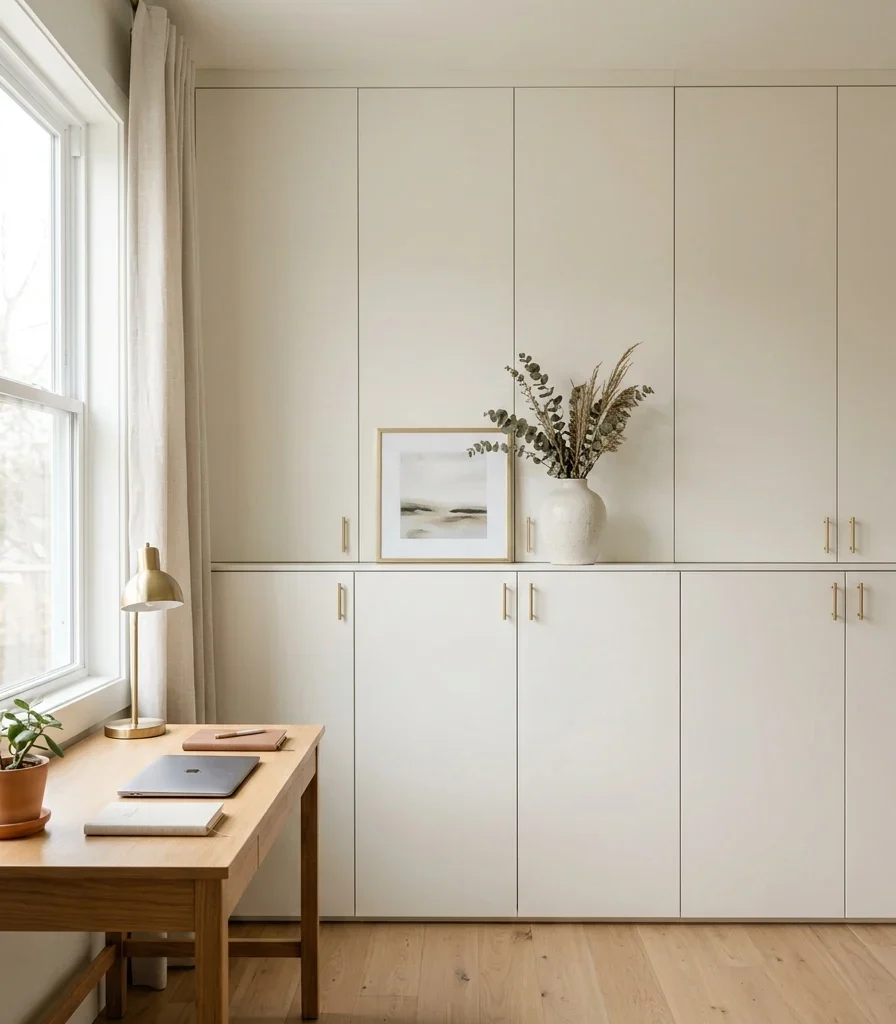
Vibe: Serene, closed cabinetry in one continuous tone makes an entire wall of storage read as calm architecture, not clutter.
Why it works: Color continuity is a proven visual-weight trick. Painting or finishing every cabinet front in the same warm white as the surrounding wall removes the contrast that would otherwise draw the eye to how much is actually stored behind those doors.
How to get it: Finish all storage cabinetry in one consistent warm white such as Benjamin Moore Simply White, keeping hardware in a single brushed brass finish across every door so the wall reads as one uninterrupted surface.
💡 Quick Win: Repainting existing cabinet fronts in the same white as the wall costs far less than replacing them and achieves the same disappearing effect.
Shop the Look
- Benjamin Moore Simply White paint sample
- Brushed brass cabinet pull, bar style
- Small framed neutral print
- Ceramic bud vase, matte white
3. Powder-Coated Steel Filing Cart on Casters
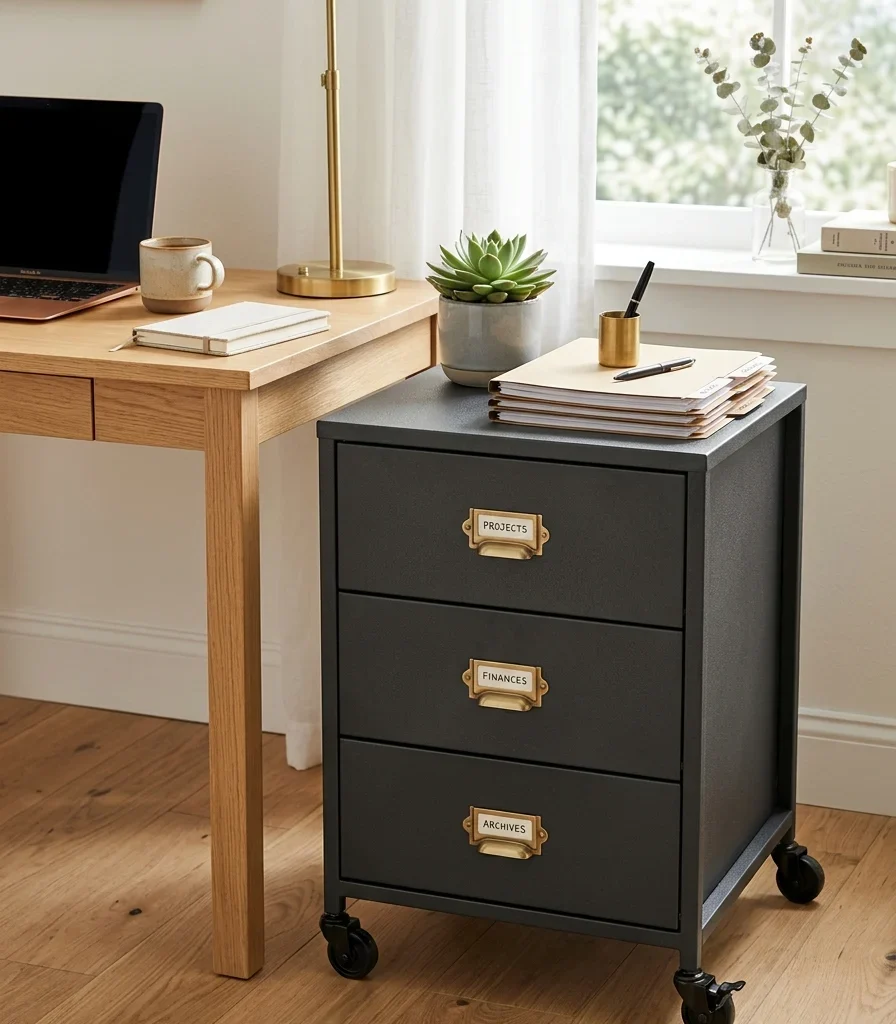
Vibe: Grounded. A rolling steel cart holds file weight that wood furniture can’t, without the bulk of a full filing cabinet.
Why it works: Material choice matters directly for function here; powder-coated steel resists the sag and warping that particleboard drawers develop under heavy paper loads, while its mobility means the entire filing system can roll out of sight when the desk needs to look clear.
How to get it: Choose a three-drawer powder-coated steel cart in matte charcoal, labeling each drawer with a brass label holder so retrieval takes seconds instead of a search through unmarked files.
Shop the Look
- Powder-coated steel filing cart, 3-drawer, matte charcoal
- Brass label holder set
- Hanging file folder set, kraft
- Small potted succulent, ceramic pot
4. Under-Shelf LED Strips That Light Storage Without Clutter
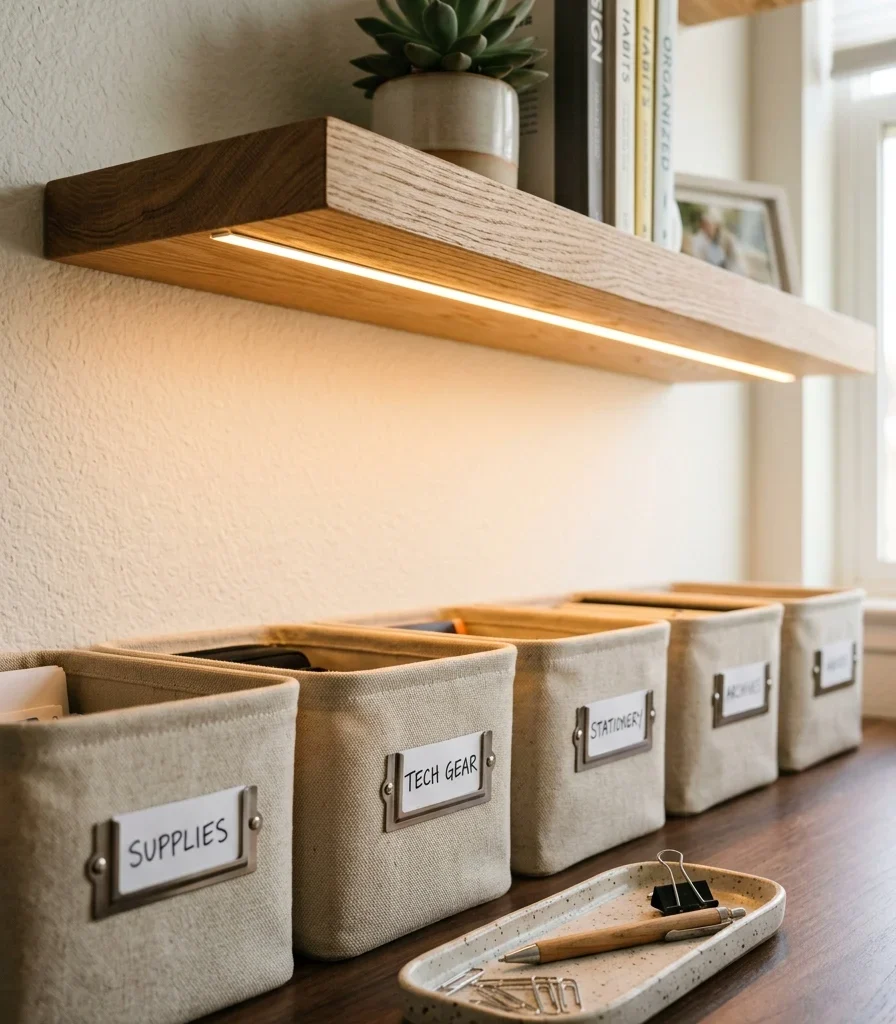
Vibe: Warm light tucked under a shelf illuminates exactly what’s stored below without adding a single visible fixture.
Why it works: This uses light behavior to solve a real retrieval problem: shelving above eye level often sits in its own shadow, making labeled bins hard to read at a glance. A warm 2700K strip mounted at the shelf’s front edge removes that shadow entirely without cluttering the surface with a lamp.
How to get it: Run an adhesive warm white LED strip along the underside front edge of any storage shelf, wiring it to a small switch mounted at the shelf’s side so it can be turned off when not needed.
Shop the Look
- Warm white LED strip light, 2700K, adhesive
- White oak floating shelf, 30-inch
- Canvas storage bin with label window, set of 3
- Small in-line LED switch
5. Modular Cube Shelving Sized to Fit Any Wall
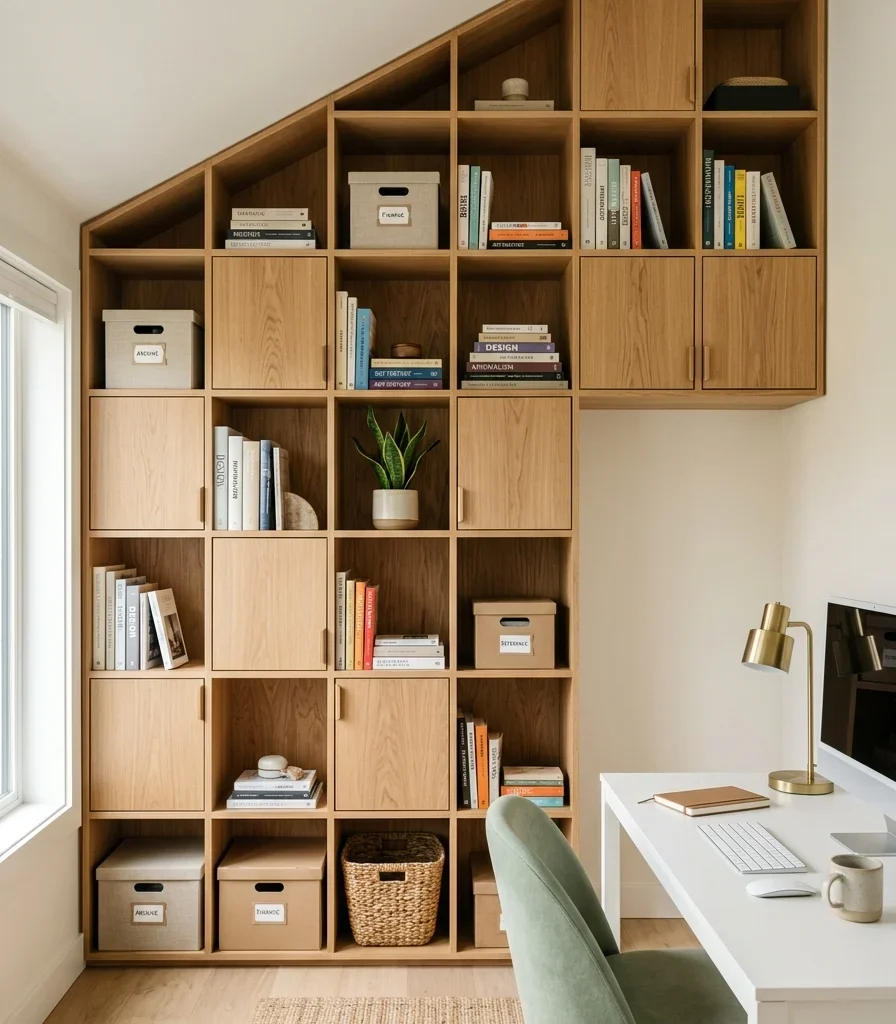
Vibe: Layered. A modular grid adapts to whatever oddly shaped wall a home office actually has, instead of forcing a standard bookcase to fit.
Why it works: Furniture arrangement in awkward rooms benefits from modularity. Individual cube units in white oak can stack in any configuration, filling a narrow or uneven wall that a single fixed bookcase would leave gaps around or overhang entirely.
How to get it: Build a cube shelving wall using individual 12-inch modular units, mixing open cubes for frequently used items with closed-door cubes for anything you’d rather not see daily.
Shop the Look
- Modular cube shelf unit, white oak, 12-inch, set of 6
- Closed-door cube insert panel, set of 2
- Labeled fabric storage box, set of 3
- Small potted pothos, ceramic pot
6. Charcoal Bins That Hide Cable Clutter in Open Shelving
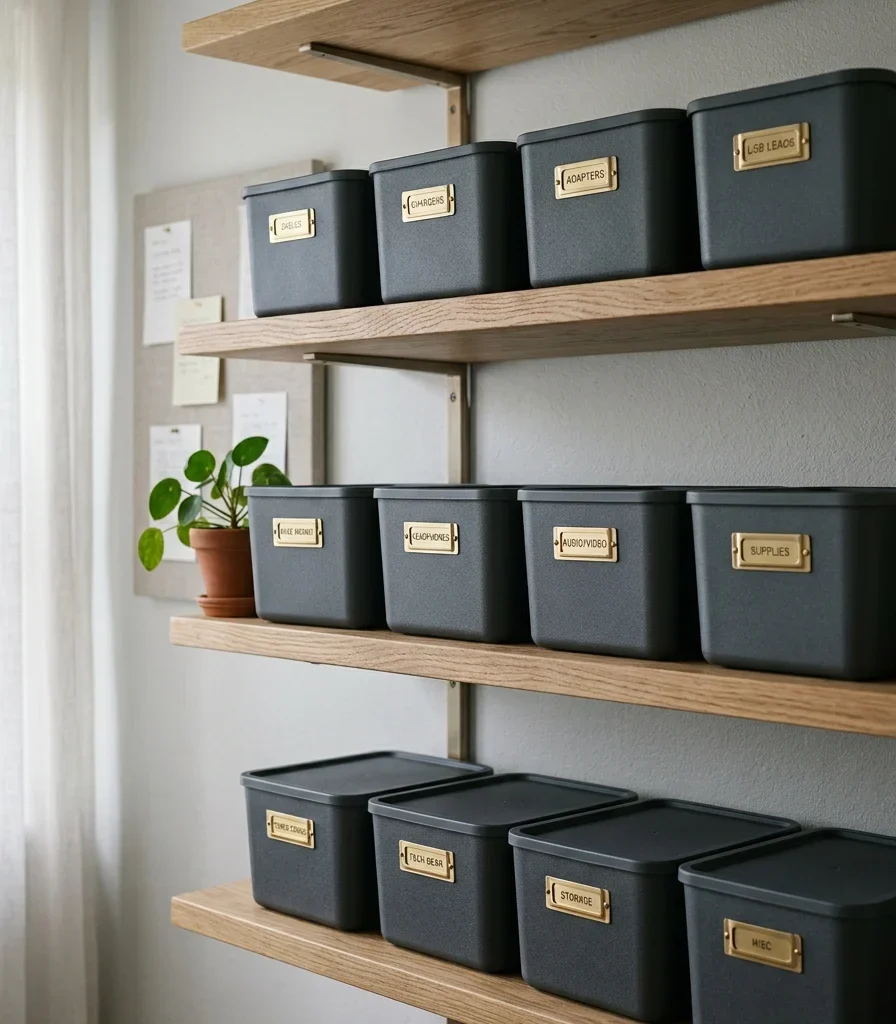
Vibe: Grounded. Dark bins absorb visual attention rather than reflecting it, so tangled contents inside stay genuinely out of sight.
Why it works: Color choice affects what the eye notices first. Light-colored bins on light shelving draw attention to their contents through shadow and gap, while matte charcoal bins on the same shelf recede, using contrast in reverse to hide rather than highlight what’s stored.
How to get it: Fill three matte charcoal bins with cables, chargers, and adapters sorted by device type, labeling each with a small brass tag so cable clutter never touches the open shelf surface directly.
Shop the Look
- Matte charcoal storage bin, set of 3
- White oak open wall shelf, 36-inch
- Brass label tag, set of 3
- Velcro cable ties, black, pack of 20
7. Labeled Glass Jars for Small Office Supplies
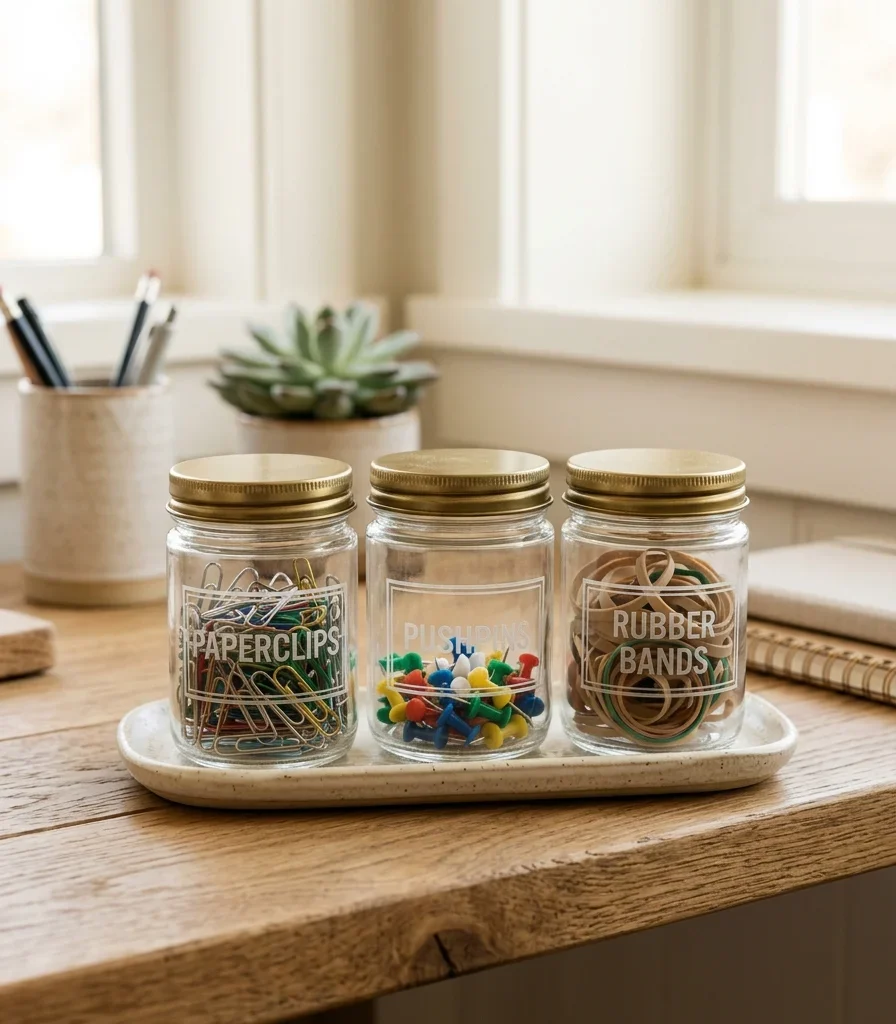
Vibe: Calm matching jars turn a drawer’s worth of loose supplies into a single visible, grabbable row.
Why it works: Repetition and visibility work together here. Clear glass jars let you see contents at a glance without opening anything, while matching brass lids across every jar create the kind of visual rhythm that makes a supply shelf look curated instead of chaotic.
How to get it: Decant paper clips, pushpins, and rubber bands into three matching etched glass jars with brass screw lids, arranging them in a single row on the shelf closest to your desk chair.
💡 Quick Win: Small mason jars with a coat of matte spray paint on the lid only create the same look for a fraction of the cost.
Shop the Look
- Etched glass storage jar with brass lid, set of 3
- Small ceramic supply tray
- White oak shelf riser, small
- Brass label sticker sheet
8. Unfinished Oak Floating Shelves Above the Desk
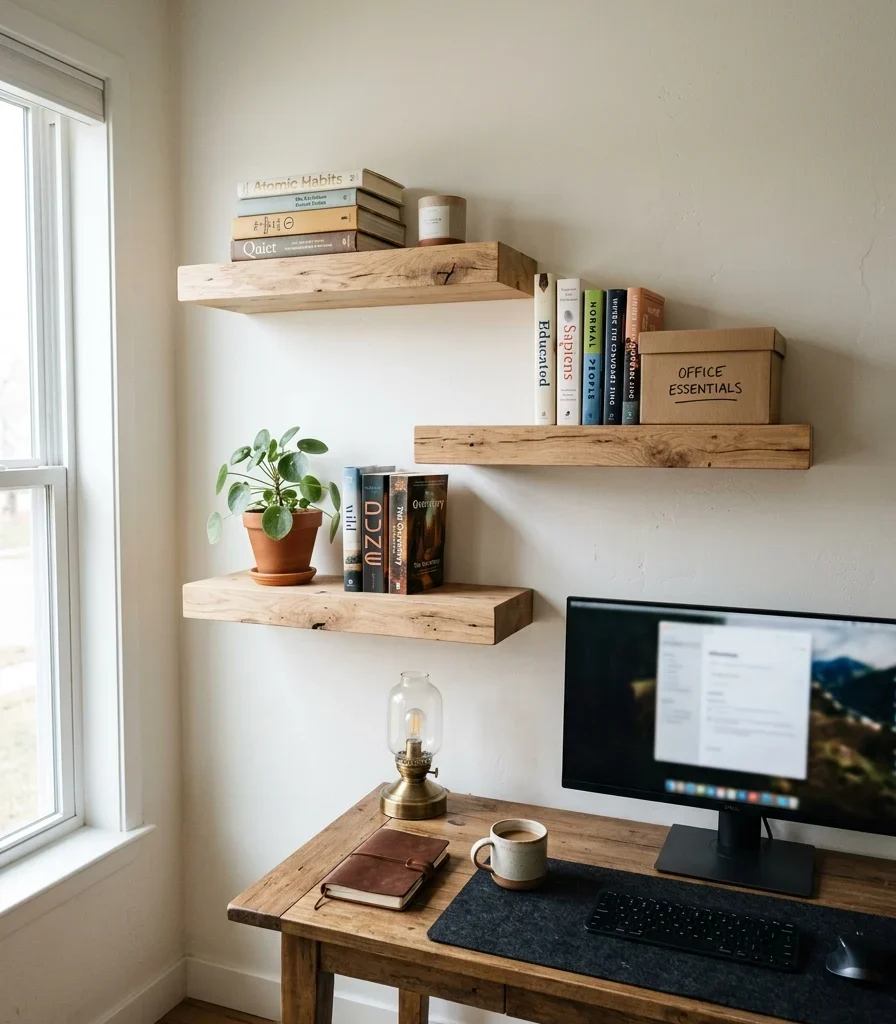
Unfinished oak keeps the wood’s natural texture visible, which grounds a wall that could otherwise feel purely utilitarian.
Why it works: Material honesty matters in storage-heavy walls. Unfinished oak’s visible grain and occasional knot add texture layering that painted MDF shelving can’t, keeping a purely functional wall from reading as sterile or purely industrial.
How to get it: Mount three unfinished white oak floating shelves in a staggered height pattern above the desk, using concealed steel brackets rated for at least 40 pounds each so book weight doesn’t sag the surface over time.
Shop the Look
- Unfinished white oak floating shelf, set of 3
- Concealed steel shelf bracket, 40-lb rated
- Labeled storage box, kraft and white
- Small trailing plant, ceramic pot
9. Zone Your Supplies by Frequency of Use
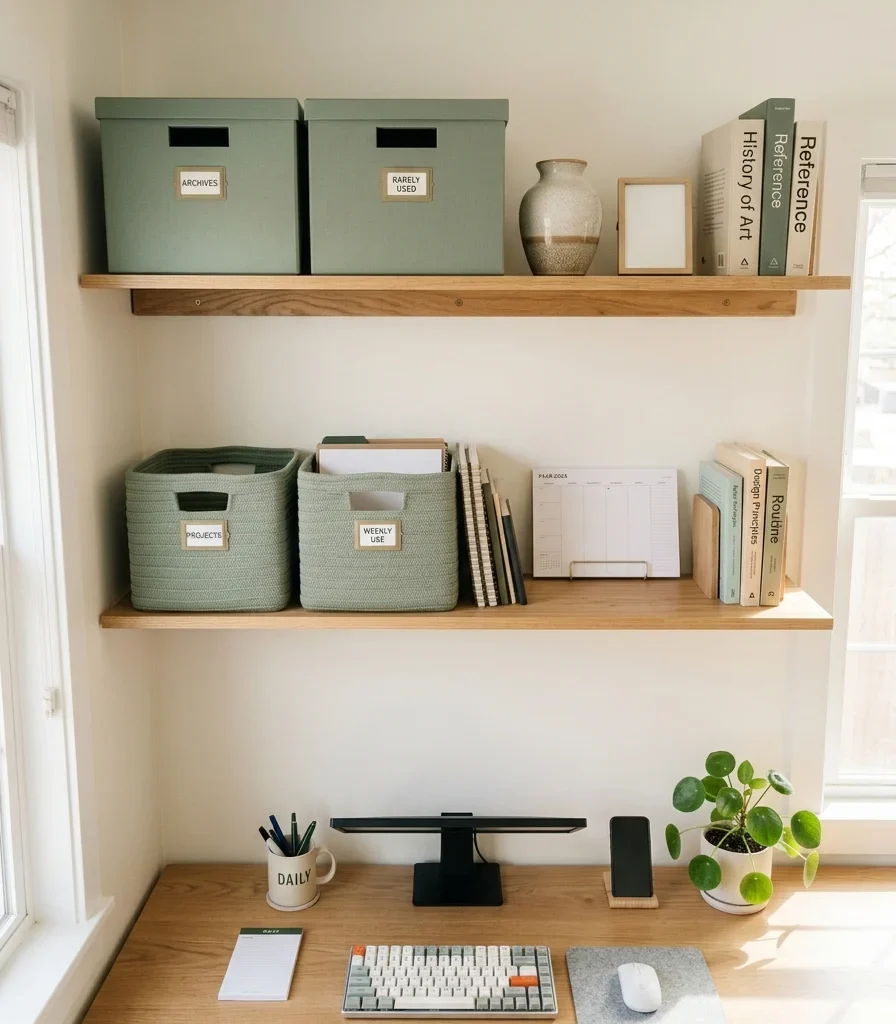
Vibe: Airy. A shelf organized by how often you reach for something removes the daily friction of searching.
Why it works: This is a pure layout principle, not a decor one. Placing items by frequency of use rather than by category alone follows the same logic professional kitchens use for tool placement, keeping the desk’s immediate reach zone reserved only for what you touch daily.
How to get it: Sort supplies into three tiers: daily items within arm’s reach on the desk or lowest shelf, weekly items on a mid shelf, and rarely used items on the top shelf or in closed storage, and commit to re-sorting once a season as habits shift.
Shop the Look
- White oak wall shelf, 3-tier set
- Labeled canvas bin, small, set of 3
- Desktop supply organizer, oak finish
- Small potted plant, ceramic pot
10. Sage Green Storage Boxes That Blend Into Open Shelving
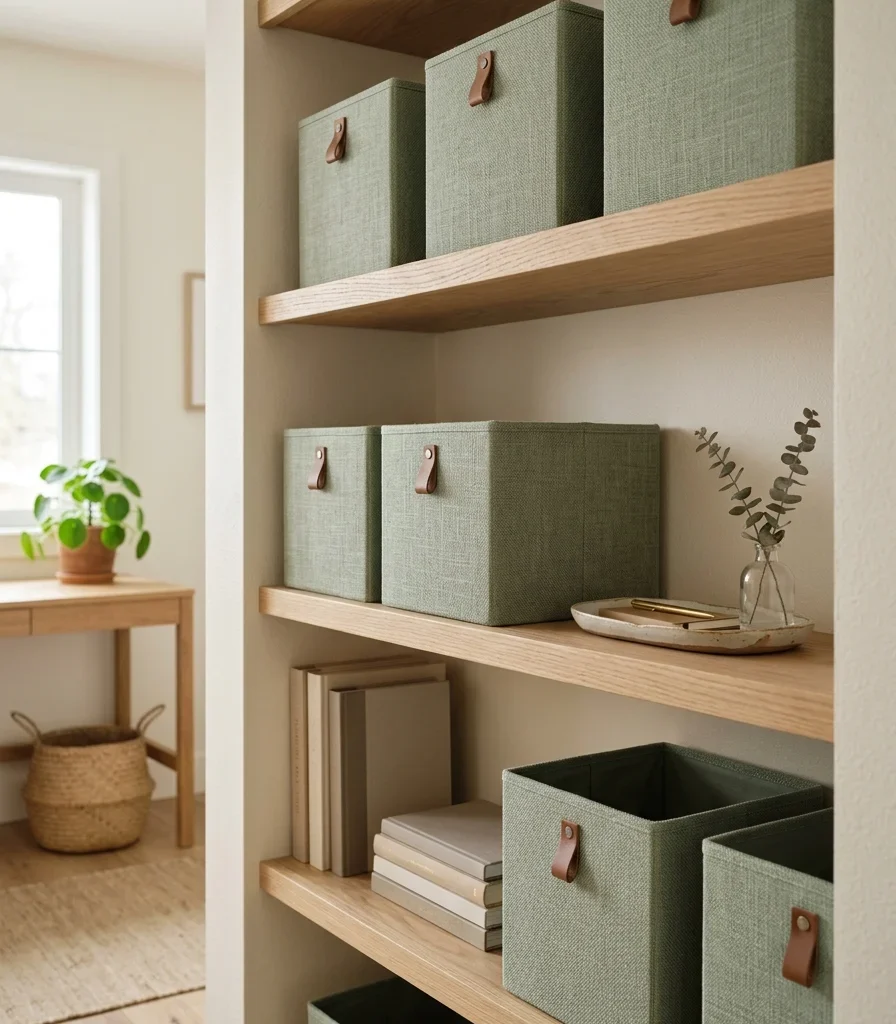
Vibe: Calm sage boxes read as intentional styling, not the leftover bins most storage walls default to.
Why it works: Color choice determines whether storage reads as decor or clutter. A muted sage tone against natural oak shelving uses tonal layering rather than stark contrast, letting the boxes blend into the room’s palette instead of announcing themselves as storage.
How to get it: Line matching soft sage fabric storage boxes with leather pull tabs across one full shelf, keeping the row uniform in size so the shelf reads as a single design element rather than mismatched containers.
Shop the Look
- Sage green fabric storage box, leather tab, set of 4
- White oak open wall shelf, 40-inch
- Ceramic bud vase, single-stem
- Small woven catch-all tray
11. Task Lighting Built Into a Storage Hutch
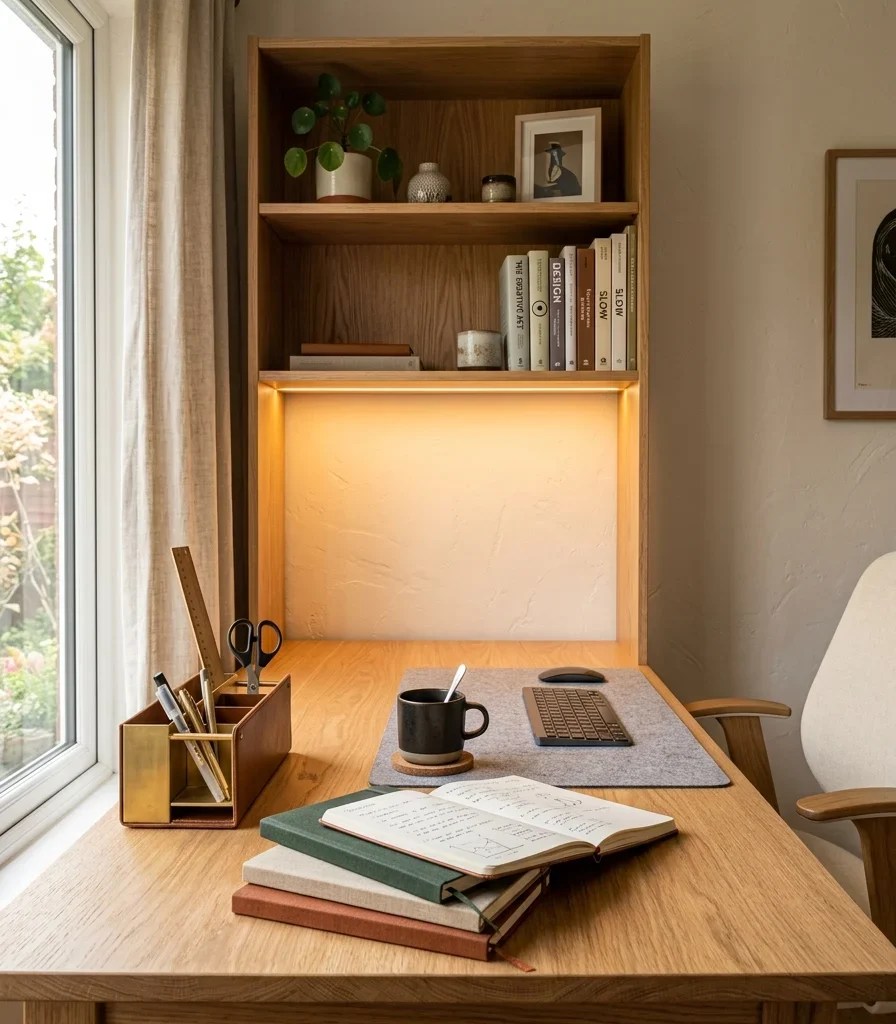
Vibe: Warm. A hutch with built-in lighting solves storage and task light in one purchase instead of two separate fixtures.
Why it works: Combining function into a single piece follows the same efficiency principle as dual-purpose furniture. A hutch shelf positioned above the desk already blocks some natural light from above, so building an LED strip into its underside replaces exactly the light it takes away.
How to get it: Choose a white oak desk hutch with an integrated warm 2700K LED strip under its lowest shelf, positioned to cast light directly onto the desk surface rather than into your eyes.
💡 Quick Win: Retrofitting an existing hutch with an adhesive LED strip achieves the same effect without buying new furniture.
Shop the Look
- White oak desk hutch with integrated LED
- Adhesive warm white LED strip, 2700K, retrofit
- Oak desk organizer tray
- Small stack of lined notebooks
12. Slim Filing Cabinet That Doubles as a Printer Stand
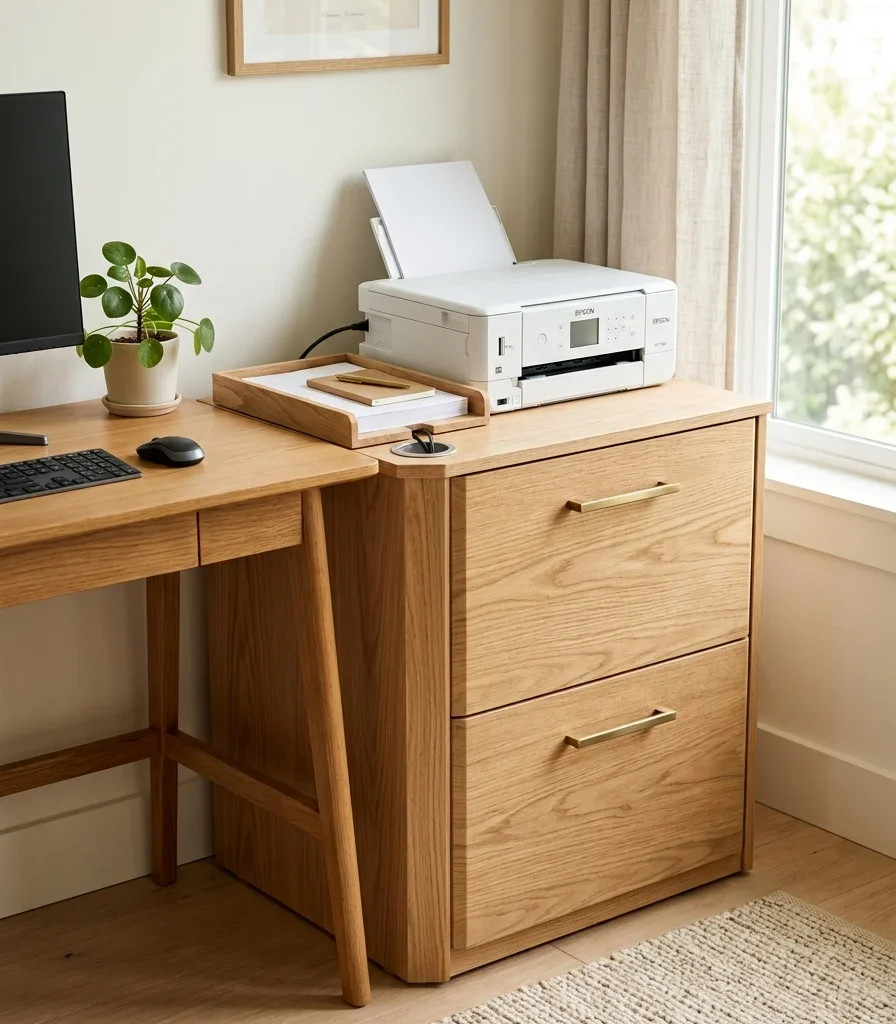
Vibe: Efficient. A single piece holding both files and a printer means one less surface competing for floor space.
Why it works: Furniture that stacks function vertically solves a proportion problem small offices face constantly. A printer alone needs a surface, and a filing cabinet alone needs floor space, but combining them into one 18-inch-wide unit claims a single footprint instead of two.
How to get it: Choose a slim two-drawer white oak filing cabinet rated to support at least 20 pounds on top, routing the printer’s power and USB cables through a rear grommet hole so nothing dangles across the desk.
Shop the Look
- Slim two-drawer filing cabinet, white oak, 18-inch
- Compact wireless printer, white finish
- Brass drawer pull, bar style
- Cable grommet hole cover, brass
13. Woven Rattan Baskets for Soft-Sided Storage
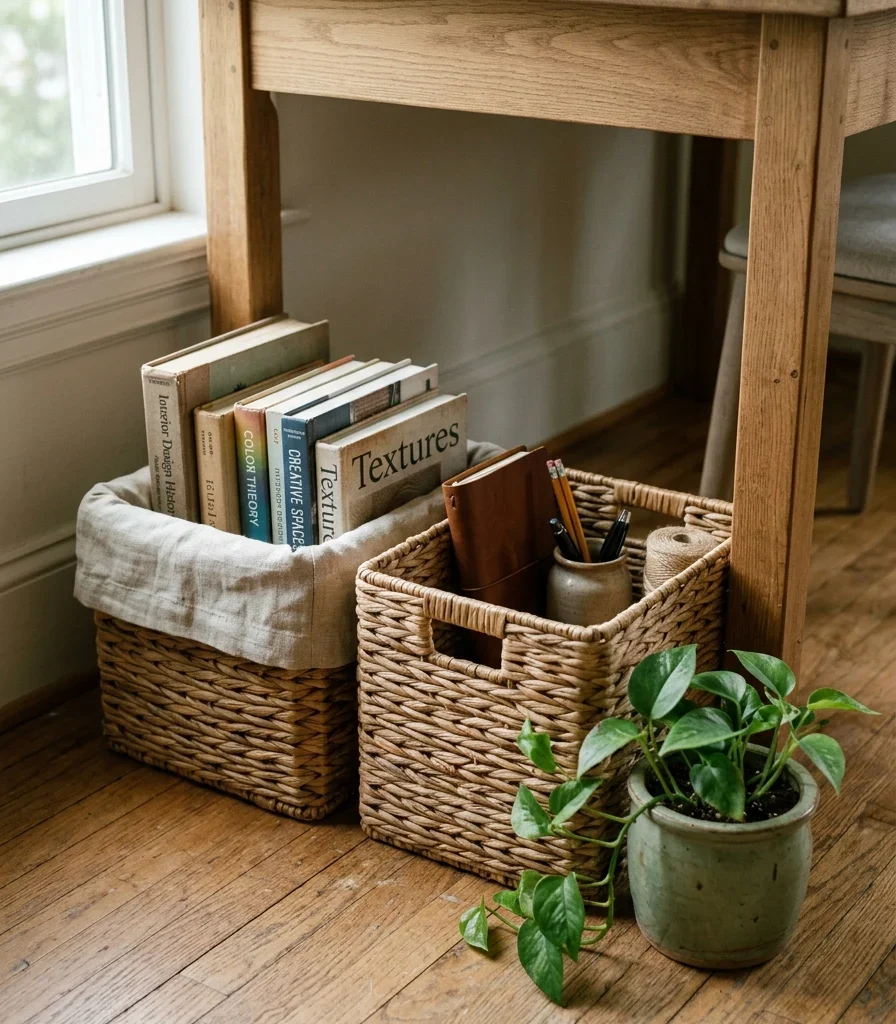
Vibe: Raw soft-sided rattan baskets slide into under-desk space that rigid drawers can’t always reach.
Why it works: Material flexibility solves a real spatial problem. Woven rattan baskets compress slightly and have no rigid corners, so they fit into under-desk gaps of slightly irregular width where a hard plastic bin would jam or leave wasted space on either side.
How to get it: Slide two woven rattan baskets with fabric liners under the desk on either side of your legs, using one for reference books and one for spare office supplies you don’t need daily.
Shop the Look
- Woven rattan storage basket, fabric-lined, set of 2
- Cotton basket liner, natural
- Small potted succulent, ceramic pot
- Rattan lid tray, small
14. Wall-Mounted Cork and Magnetic Boards for Paper Overflow
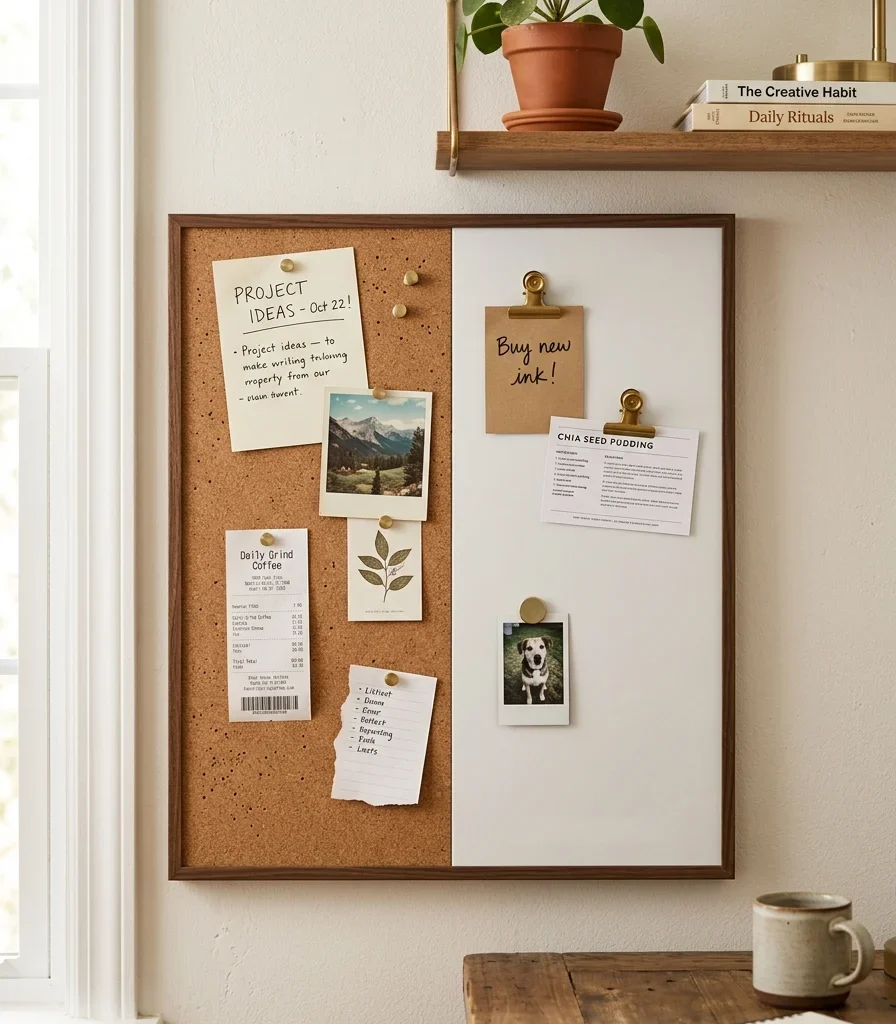
Vibe: Layered. A split cork-and-magnet panel gives loose paper two different homes depending on how long it needs to stay.
Why it works: This solves the paper problem most storage systems ignore. Cork works for temporary pinned notes you’ll remove within days, while a magnetic surface holds recurring reference sheets, splitting overflow paper by lifespan rather than letting it all pile on the desk indiscriminately.
How to get it: Mount a combined cork-and-magnetic board, roughly 24 by 36 inches, directly at eye level beside the desk, using the cork half for temporary notes and the magnetic half for anything you reference weekly.
Shop the Look
- Cork and magnetic combination board, 24×36-inch
- Brass push pin set
- Brass magnetic clip, set of 6
- Small printed note card set
15. Under-Desk Zone Dedicated Entirely to Cable and Tech Storage
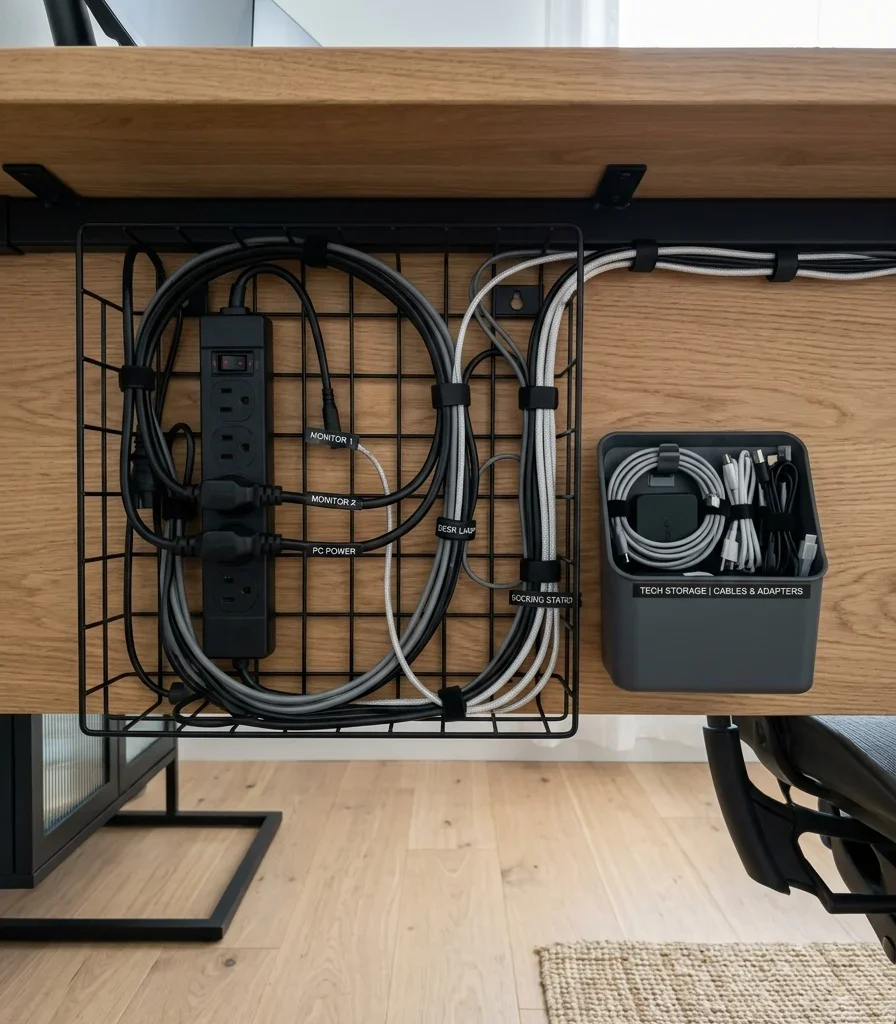
Vibe: Efficient. A fully dedicated under-desk zone means cables and chargers never surface on the visible desktop at all.
Why it works: This is a layout decision applied to the one zone most storage advice skips entirely. The space under the desk is functionally invisible from a seated position, so routing every cable, power strip, and charger there through a mounted tray keeps the working surface completely clear without any hiding trick above it.
How to get it: Mount a metal cable management tray to the underside of the desk, securing the power strip to it with a hook-and-loop strap and bundling excess cord length with Velcro ties so nothing hangs into the leg space.
Shop the Look
- Under-desk metal cable management tray
- Hook-and-loop power strip mount
- Velcro cable ties, black, pack of 20
- Small labeled tech storage bin, matte black
How to Start Your Home Office Storage Optimization
Start with the wall above your desk; specifically, install one floating shelf or a small pegboard panel there before touching anything else. This single move claims the largest unused surface in most home offices and anchors where every other storage decision, from bins to lighting, gets placed afterward.
The most common mistake is buying storage furniture before sorting what you actually own. Beginners fill a new cabinet with the same disorganized pile it replaced, which breaks the whole system within a month. The fix is a one-time sort into keep, donate, and toss piles before a single new container enters the room.
Three items under $50 create real impact fast: a set of three etched glass apothecary jars with brass lids (around $28), an under-desk metal cable management tray (around $22), and a woven rattan storage basket with a fabric liner (around $32).
A weekend covers shelving, jars, and cable routing; a full cabinetry or hutch build takes two to four weeks with a contractor. Budget $150–$400 for a starter refresh, or $1,500–$4,000 for a full built-in storage wall.
Frequently Asked Questions About Optimized Home Office Storage
What’s the difference between home office storage and regular home storage?
Regular home storage can afford some inefficiency since items are retrieved occasionally. Optimized home office storage has to support daily, repeated use, which is why frequency-based zoning and fixed “homes” for supplies matter far more here. A system that saves ten seconds per retrieval adds up across an entire workday, every day.
What is the best color for home office storage furniture?
Warm white, such as Benjamin Moore Simply White, keeps storage visually quiet by matching the surrounding wall, while soft sage works well for fabric bins that need to feel intentional rather than utilitarian. Reserve warm charcoal for bins or cables you specifically want to disappear into shadow rather than draw attention.
How much does it cost to optimize home office storage?
A starter refresh using shelving, jars, and cable management runs $150 to $400. A mid-range setup with a filing cart and modular cube shelving typically lands between $600 and $1,500. A full built-in storage wall with custom cabinetry can reach $1,500 to $4,000 depending on materials and hardware.
Can home office storage optimization work in a shared or multi-use room?
Yes, closed cabinetry and rolling carts are the two best tools for a shared room, since both can fully conceal office supplies when the space needs to function as something else. A filing cart on casters in particular can roll into a closet entirely when not in use, which fixed shelving can’t do.
What is the best storage solution for cables and cords in a home office?
An under-desk metal cable management tray paired with a hook-and-loop power strip mount is the most searched and most effective combination, since it routes every cord below the sightline entirely rather than relying on decorative boxes on the desktop. Velcro ties for bundling excess length complete the system for under $10 more.
Ready to Optimize Your Home Office Storage?
From pegboard walls to zoned shelving and under-desk cable trays, these 15 ways to optimize home office storage space cover color, materials, and layout so every supply finally has a fixed home. You don’t need to overhaul the whole room this weekend; starting with just the wall above your desk is genuinely the right way to begin, not a half-measure. Sort one drawer today into keep, donate, and toss piles before you buy a single new bin. Once the system is in place, sitting down to work will feel clear-headed rather than distracted, because nothing on your desk is quietly asking to be dealt with. Pin your favorites now, especially the under-desk and pegboard ideas you can picture solving your own clutter first.