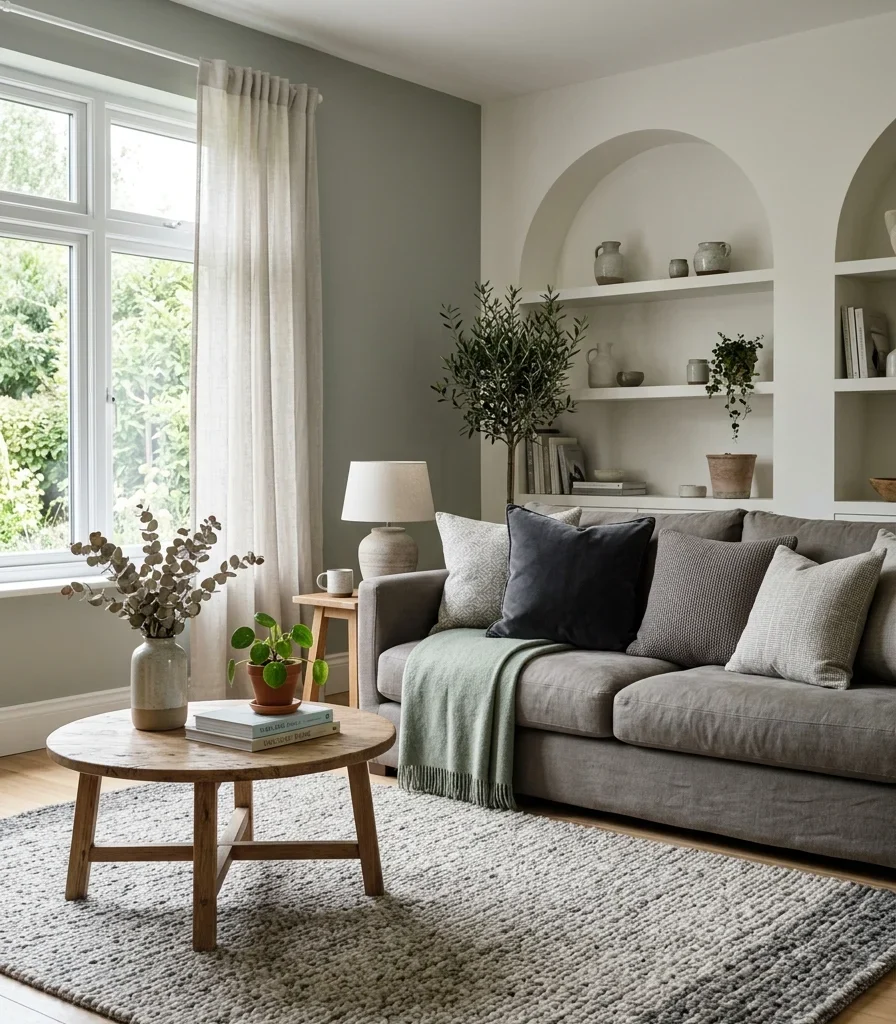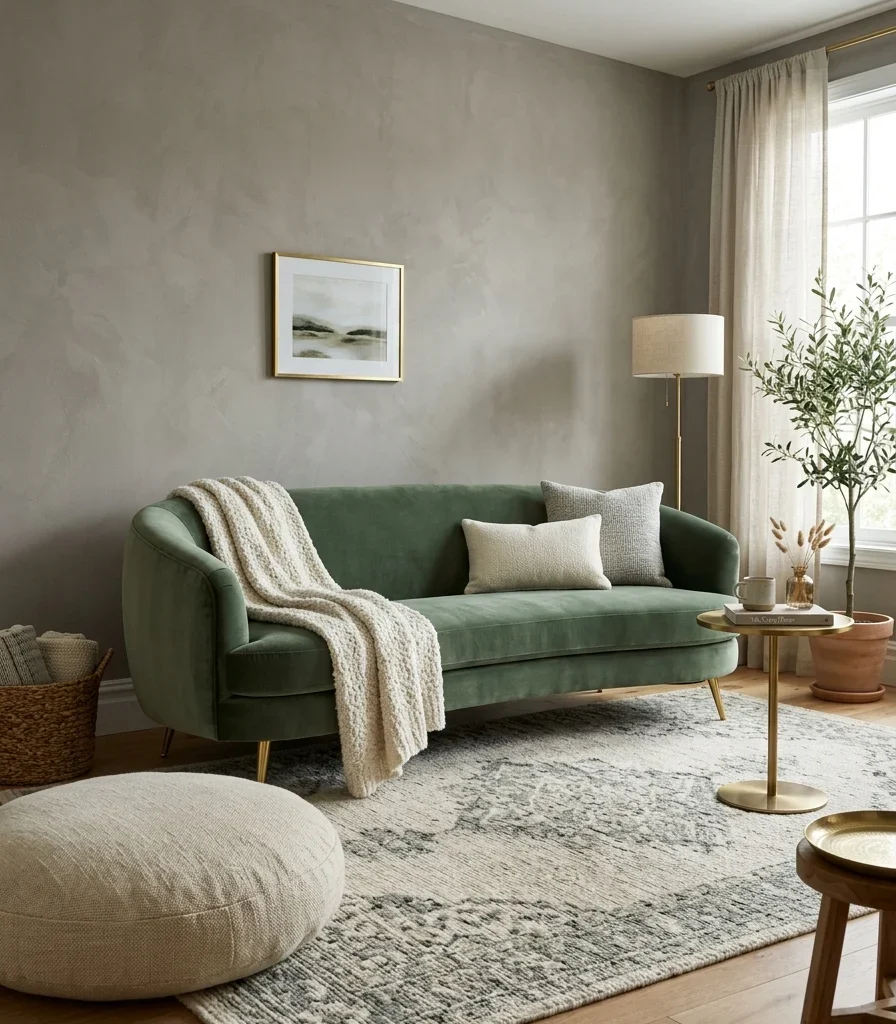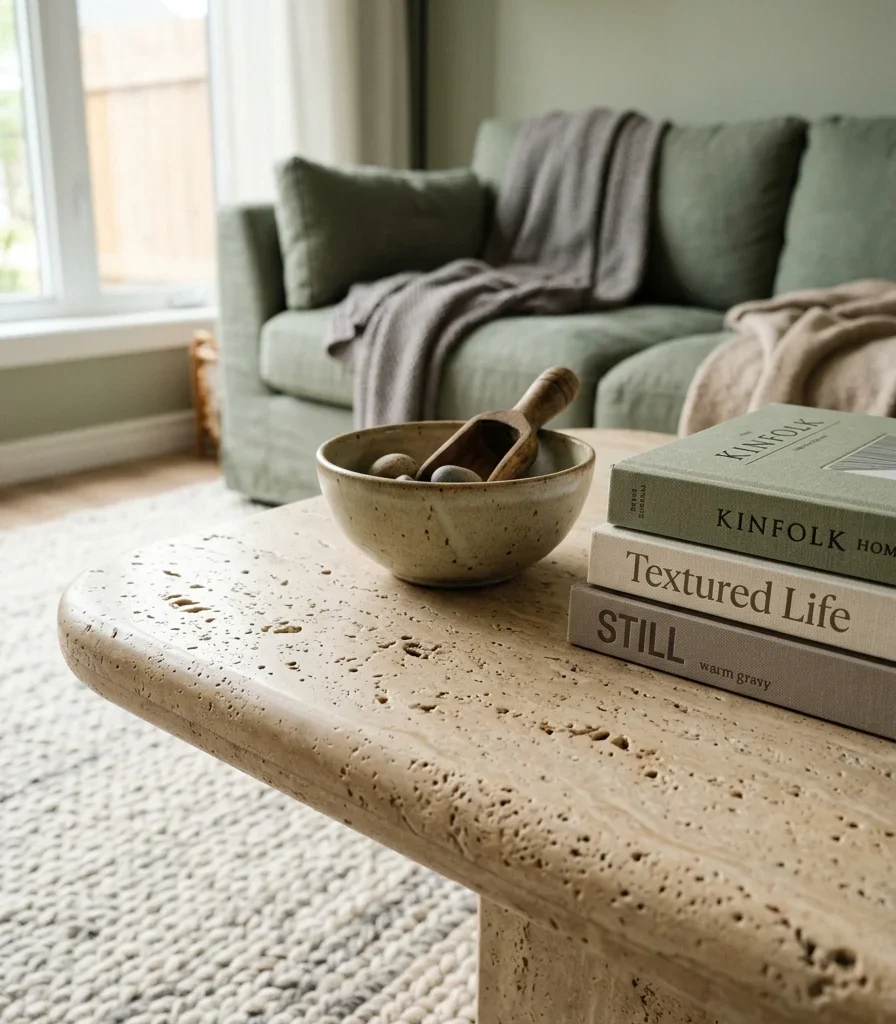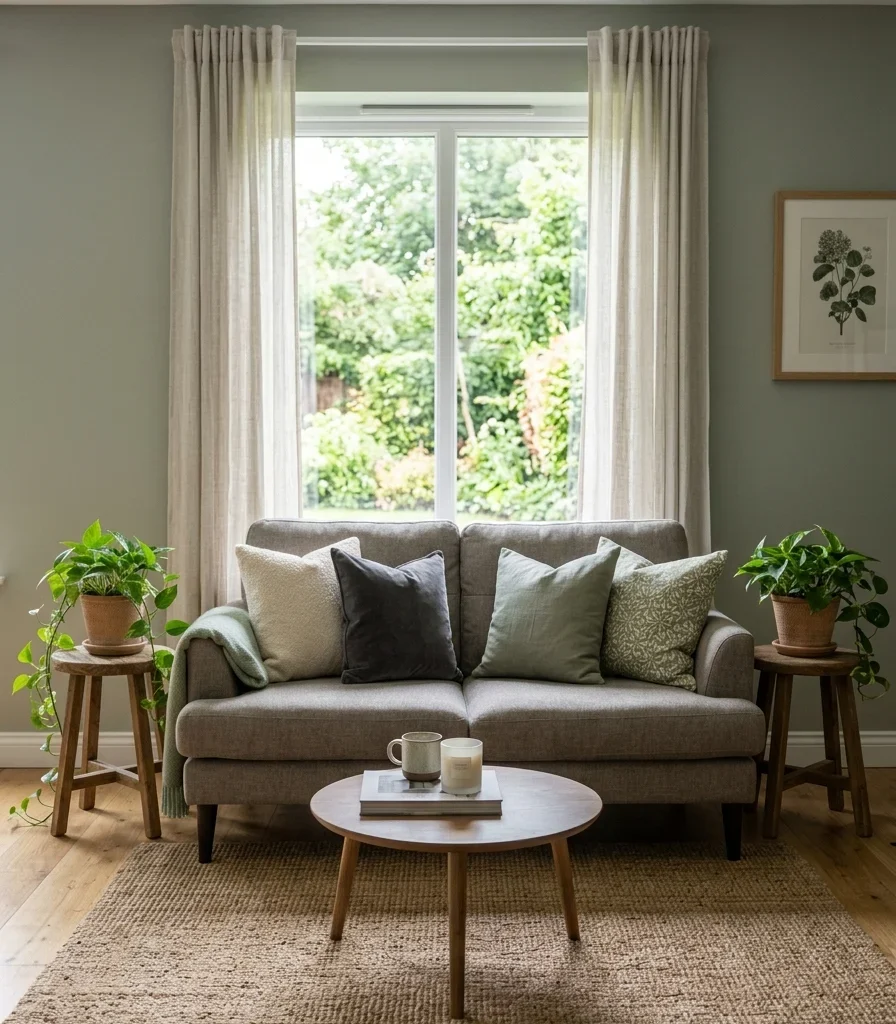
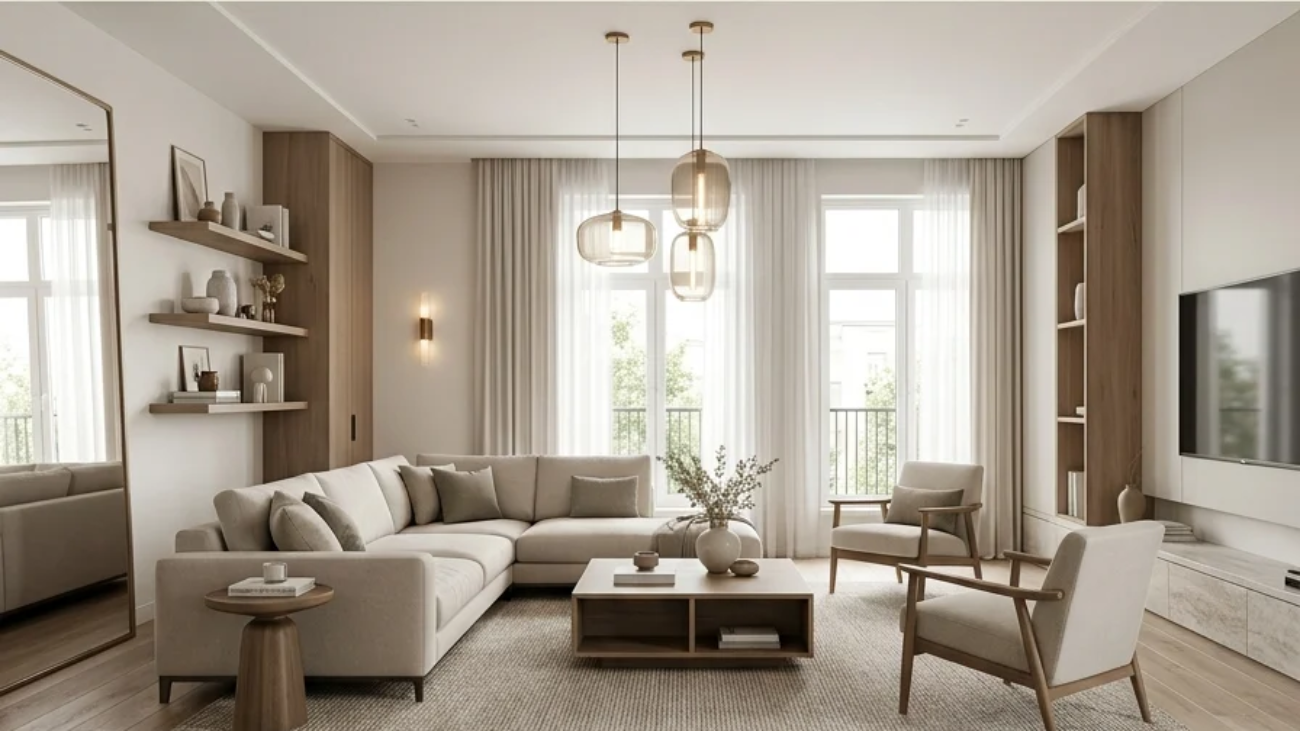
15 Ways to Maximize Open Space and Functionality in Your Living Room

15 Smart Ways to Get More Function From an Open Living Room

Maximizing open space and functionality in a living room means choosing furniture and layout decisions specifically for how much usable floor space and daily function they deliver, not just how they look sitting still. This article gives you 15 genuinely effective ways to maximize open space and functionality in your living room, covering material, color, lighting, and layout decisions that let one room hold more real use without feeling more crowded.

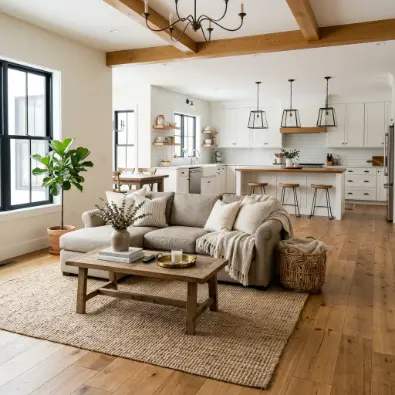
It feels like a room that works harder without looking like it’s trying: an ottoman that’s also storage, a lamp that frees up an entire table surface, furniture legs slim enough that the floor stays visible beneath them. This is functional open-space living room design at its most resolved: efficient, considered, never sacrificing comfort for the sake of empty floor. Every piece earns its place because a living room that’s asked to hold seating, storage, work, and rest all at once has no room for anything that only does one job.

Here are 15 ideas worth saving and stealing.

Why Maximizing Open Space and Functionality Works So Well

This approach draws from the space-efficiency principles refined in small-apartment and mid-century Scandinavian furniture design, both of which treated multi-function pieces and negative floor space as design priorities rather than compromises forced by a lack of square footage. What separates a genuinely functional open-space living room from a merely tidy one is that every furniture decision is evaluated against two questions at once: does it serve more than one purpose, and does it visually or physically reduce the floor space around it?

Core materials favor lightweight, visually minimal choices: slim metal furniture legs that let the floor read through, glass or lucite tabletops that don’t visually block sightlines, and light-reflective wall paint that keeps a room feeling open regardless of its actual dimensions. Color stays anchored to a cohesive palette where furniture and walls share close tones, letting larger pieces visually recede rather than announce their full bulk.

This approach is trending because more households are asking one living room to hold work, exercise, guest sleeping, and traditional relaxation all in the same square footage that once served a single function, and Pinterest and design-industry search data both show sustained interest in “multi-functional living room furniture” and “space-saving living room ideas” as a genuinely practical response.

Yes, a small living room benefits from these techniques more than a large one, since every square foot recovered through smart furniture choices matters proportionally more. Prioritize multi-function furniture and slim-profile pieces first; a small room gains more from those two decisions than from any single layout trick.

Style at a Glance

ElementCore Trait 1Core Trait 2
PhilosophyEvery piece evaluated for multi-function value and visual floor-space impactNegative space treated as a design resource, not empty leftover room
MaterialsSlim metal furniture legs, glass or lucite tabletopsLight-reflective wall paint
Color PaletteCohesive tones that let furniture recedeFurniture matched closely to wall color

15 Ways to Maximize Open Space and Functionality in Your Living Room

1. Choose a Storage Ottoman With a Removable Tray Top
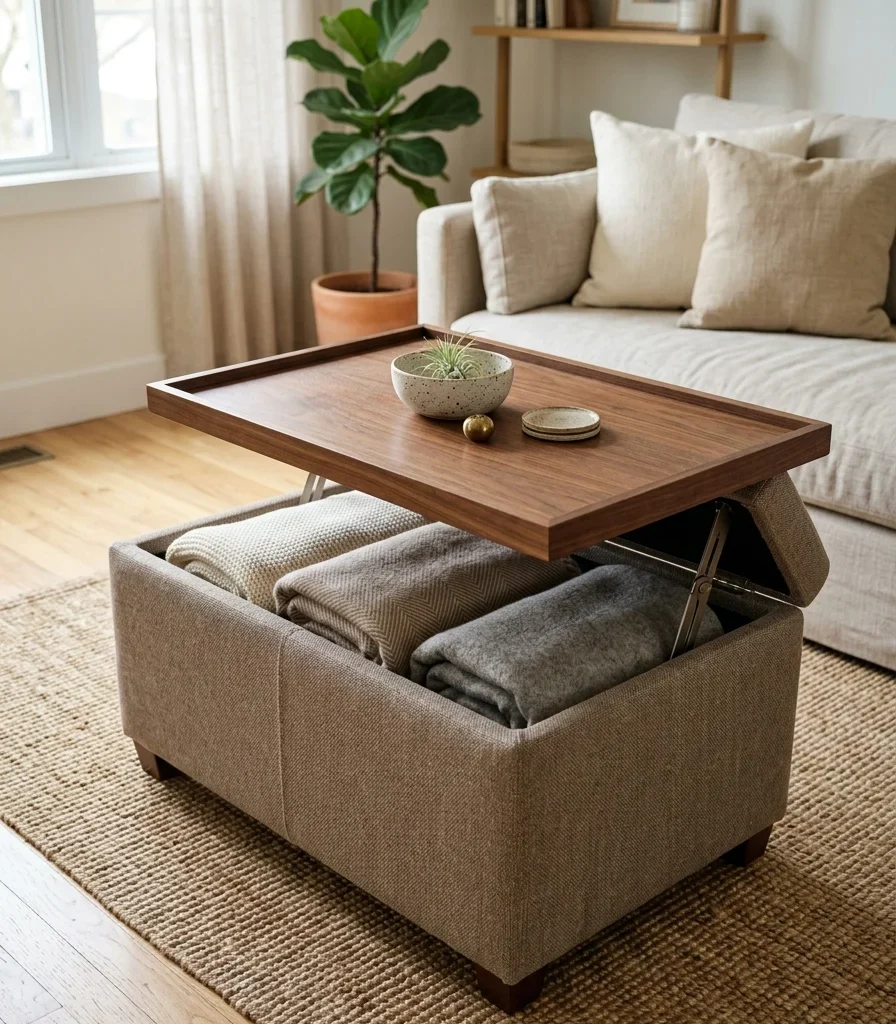
1. Choose a Storage Ottoman With a Removable Tray Top

Vibe: Still a coffee table, footrest, extra seat, and storage bin, all inside one piece of furniture.

Why it works: A storage ottoman with a removable tray top applies dual-function furniture thinking at the room’s most central piece rather than a separate coffee table and a separate storage bin each claiming their own floor space; one ottoman performs both roles, freeing the square footage a second piece would otherwise occupy.

How to get it: Choose an ottoman with a genuinely removable (not just hinged) wood tray top so it functions as an actual serving surface, sized large enough to store folded blankets or throw pillows inside without overstuffing the interior.

💡 Quick Win: A storage ottoman under $80 in a durable performance fabric handles daily foot-resting use while still functioning as genuine hidden storage.

Shop the Look

Product
Storage ottoman removable tray
Walnut wood tray top
Small ceramic tray bowl
Folded throw blanket
Ottoman floor protector pads

2. Paint Walls a Light-Reflective Color to Keep the Room Feeling Larger
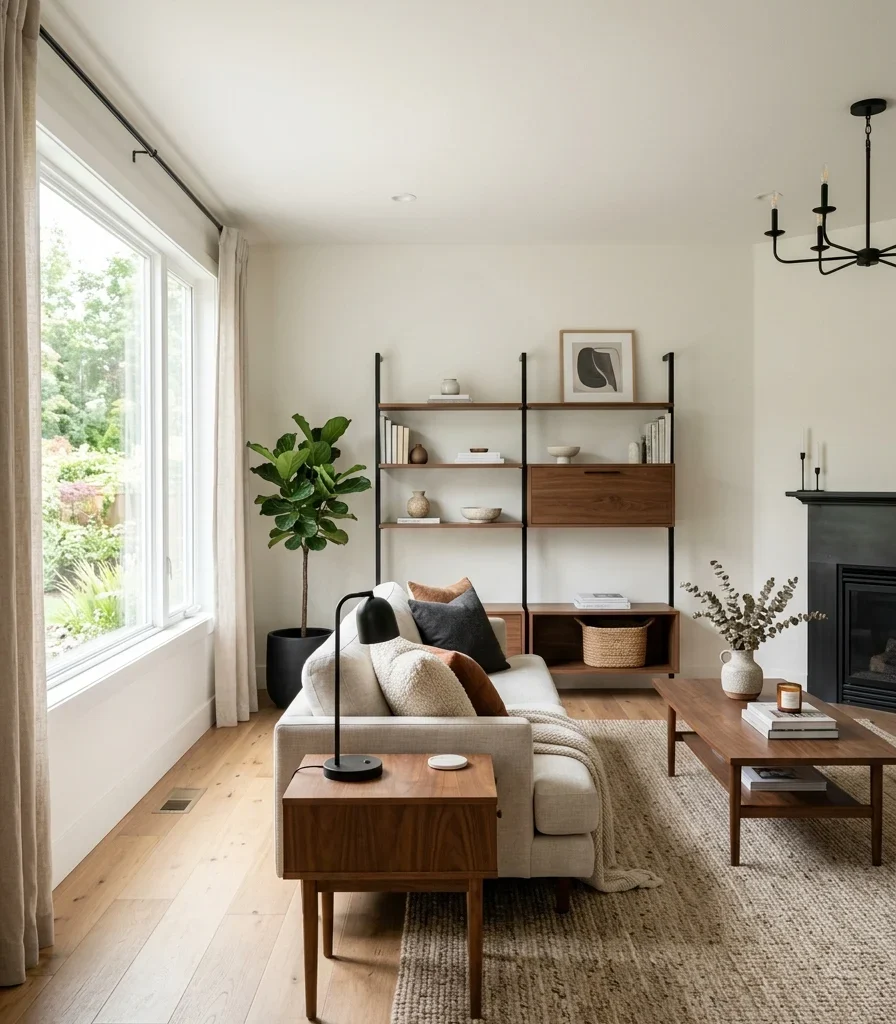
2. Paint Walls a Light-Reflective Color to Keep the Room Feeling Larger

Vibe: Fresh, a room bright enough that every piece of furniture in it reads as taking up less space than it actually does.

Why it works: A light-reflective wall color applies a light-behavior principle directly to perceived floor space. A warm white or soft greige bounces available daylight back into the room more effectively than a darker or more saturated color would, and that increased ambient brightness makes furniture and clutter register as less visually heavy, even though nothing has physically moved.

How to get it: Choose a warm white with a soft yellow undertone rather than a stark, blue-based white (which can feel clinical), applying it consistently across every wall rather than introducing a darker accent wall that would reintroduce visual weight.

Shop the Look

Product
Warm white matte wall paint
Small ceramic decorative vessel
Walnut accent trim
Matte black outlet cover
Warm white LED ceiling bulb

3. Choose a Modular Sectional That Reconfigures for Different Uses
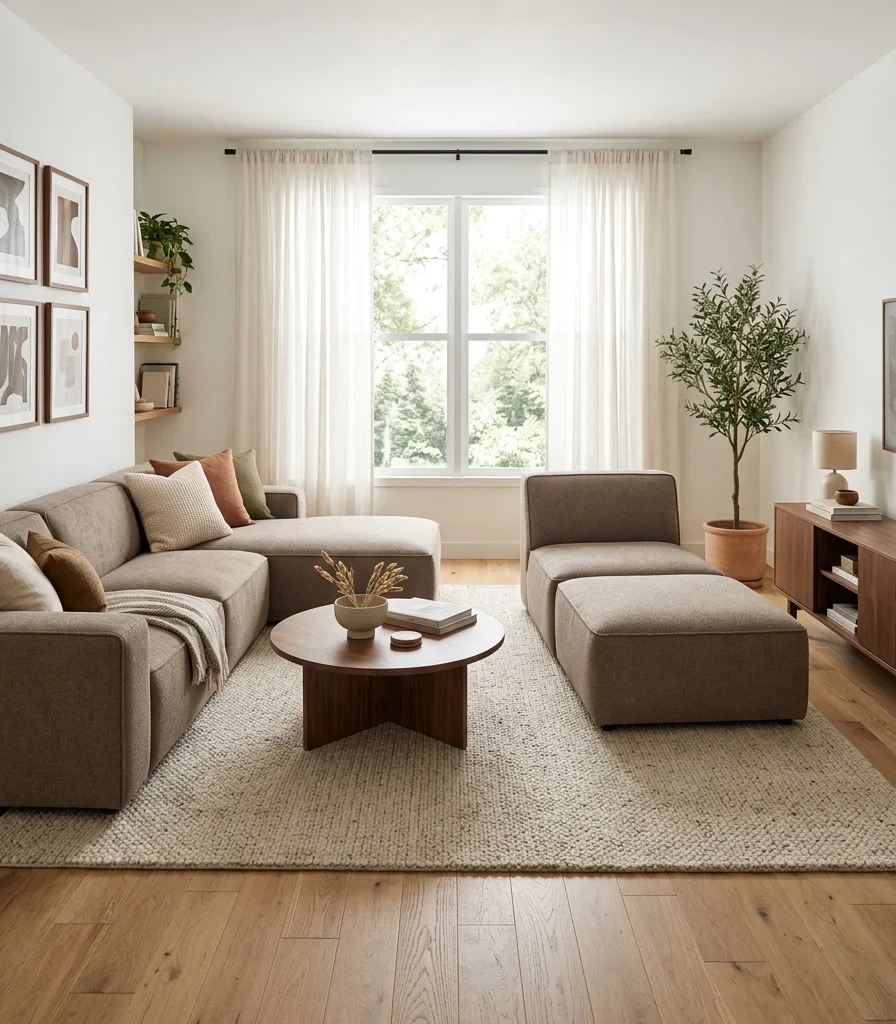
3. Choose a Modular Sectional That Reconfigures for Different Uses

Vibe: Layered one-piece of furniture that becomes an entirely different seating arrangement depending on what the day calls for.

Why it works: A modular sectional applies dual-function furniture thinking at full seating scale; individual sections can split apart for a movie-night configuration, reconfigure into two smaller seating clusters for a gathering, or push together for maximum lounging, giving one furniture purchase the functional range that would otherwise require multiple separate sofas.

How to get it: Choose a modular system with at least three independent pieces (rather than a fixed L-shape), confirming the fabric and cushion depth stay consistent across all sections so any reconfiguration still looks like one coordinated set.

Shop the Look

Product
Modular sectional sofa three piece
Matching accent pillow set
Small ceramic coffee table bowl
Walnut coffee table
Sectional connector clips

4. Use Floor Lamps Instead of Table Lamps to Free Up Surface Space
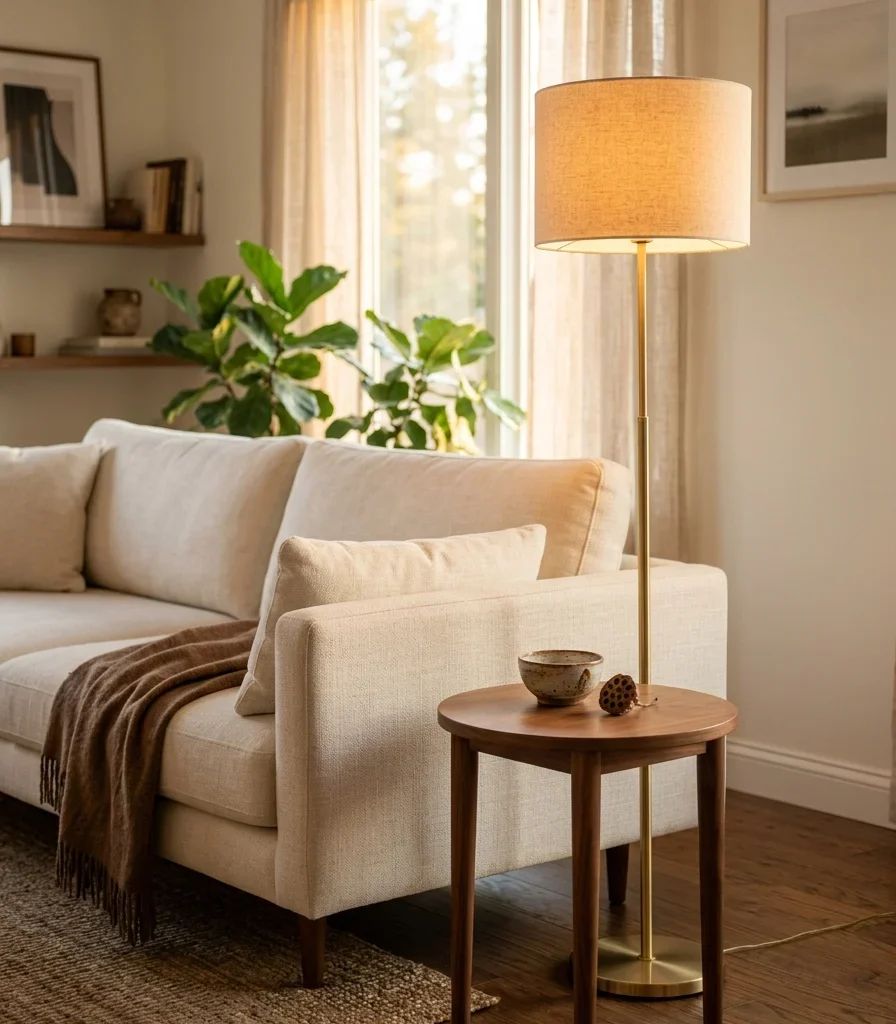
4. Use Floor Lamps Instead of Table Lamps to Free Up Surface Space

Vibe: Warm light without a single lamp base eating into the side table’s already limited surface.

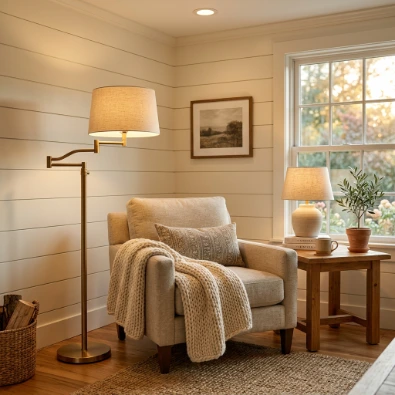
Why it works: A floor lamp applies negative-space thinking directly to a side table’s small footprint; a table lamp typically claims a third or more of a standard side table’s surface, while a floor lamp positioned beside the table provides the same ambient light entirely from the floor, leaving the table’s full surface available for a drink, a book, or a phone.

How to get it: Choose a floor lamp with a base no wider than 12 inches so it doesn’t itself become an obstacle, positioning it directly beside rather than behind the seating so its light still falls naturally over a shoulder for reading.

Shop the Look

Product
Slim brass floor lamp
Warm 2700K LED bulb
Walnut side table
Small ceramic table bowl
Floor lamp foot switch

5. Choose a Glass-Top Coffee Table That Doesn’t Block Sightlines
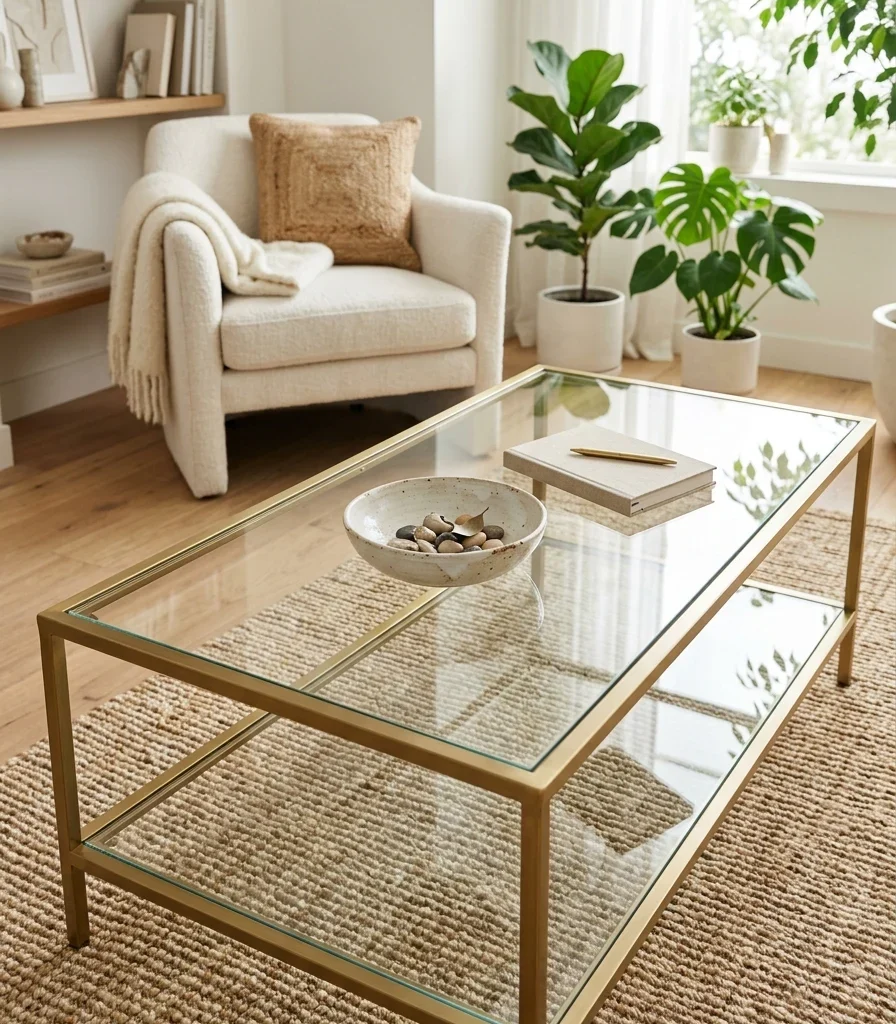
5. Choose a Glass-Top Coffee Table That Doesn't Block Sightlines

Vibe: Airy, a table that provides a full surface without ever visually breaking the floor beneath it.

Why it works: A glass or lucite tabletop applies negative-space principles to a piece of furniture that normally occupies significant visual floor area because the material is transparent; the rug pattern and floor beneath the table remain visible, which makes the coffee table register as far less bulky than a solid wood table of the identical footprint.

How to get it: Choose tempered glass at least ⅜ inch thick on a slim brass or matte black frame, positioning it where the rug pattern beneath will actually show through, since that visibility is the whole point of the material choice.

Shop the Look

Product
Glass top coffee table brass frame
Small ceramic coffee table bowl
Tempered glass cleaning cloth
Brass table leg caps
Coaster set for glass surface

6. Mount Shelving on the Wall Instead of a Floor-Standing Bookcase
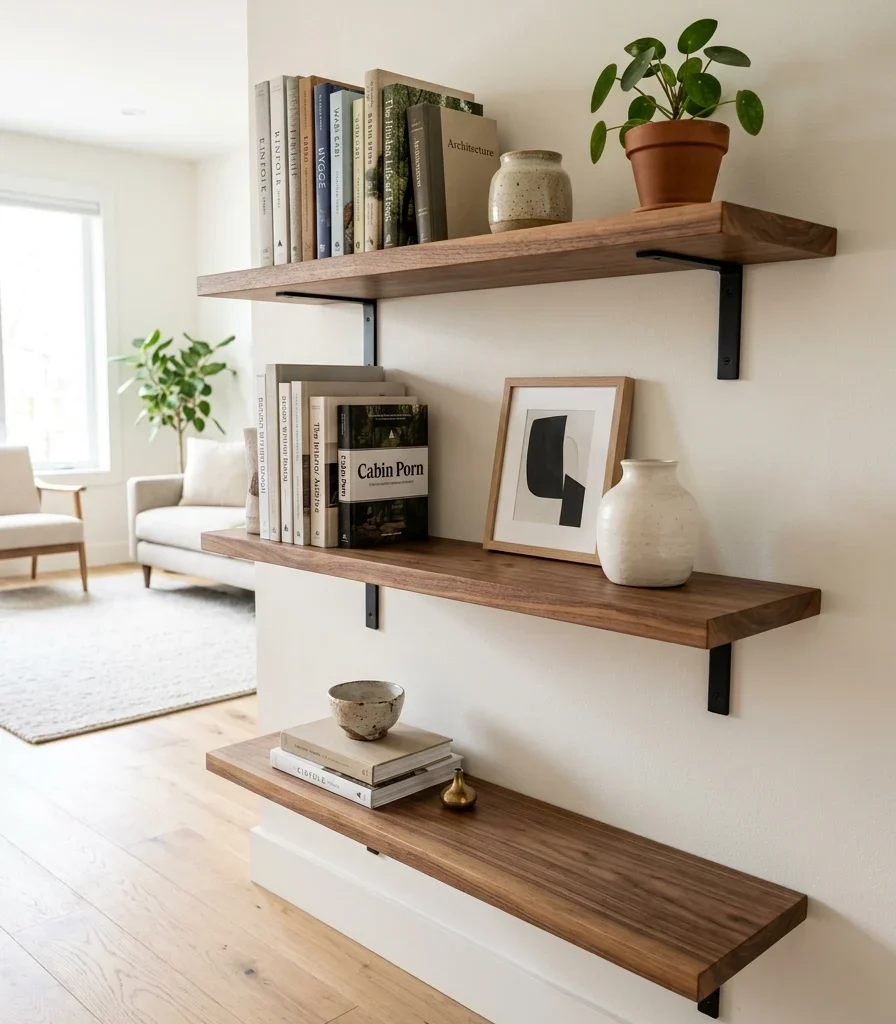
6. Mount Shelving on the Wall Instead of a Floor-Standing Bookcase

Vibe: Airy storage that claims wall space instead of a floor-standing bookcase’s full footprint.

Why it works: Floating shelves reduce visual and physical mass at floor level, a negative-space principle that recovers genuine usable floor area a bookcase’s base and legs would otherwise occupy. The same book and decor storage capacity exists, but the floor beneath stays entirely clear for walking or additional furniture.

How to get it: Mount floating shelves on concealed brackets rated for at least 30 lbs per shelf, spacing them 10–12 inches apart vertically, and keep the wall beneath clear of any secondary furniture to preserve the recovered floor space.

Shop the Look

Product
Floating walnut shelf set
Concealed shelf bracket rated
Small ceramic decorative vessel
Book storage box set
Small wood bookend

7. Use a Monochrome Palette to Let Furniture Visually Recede
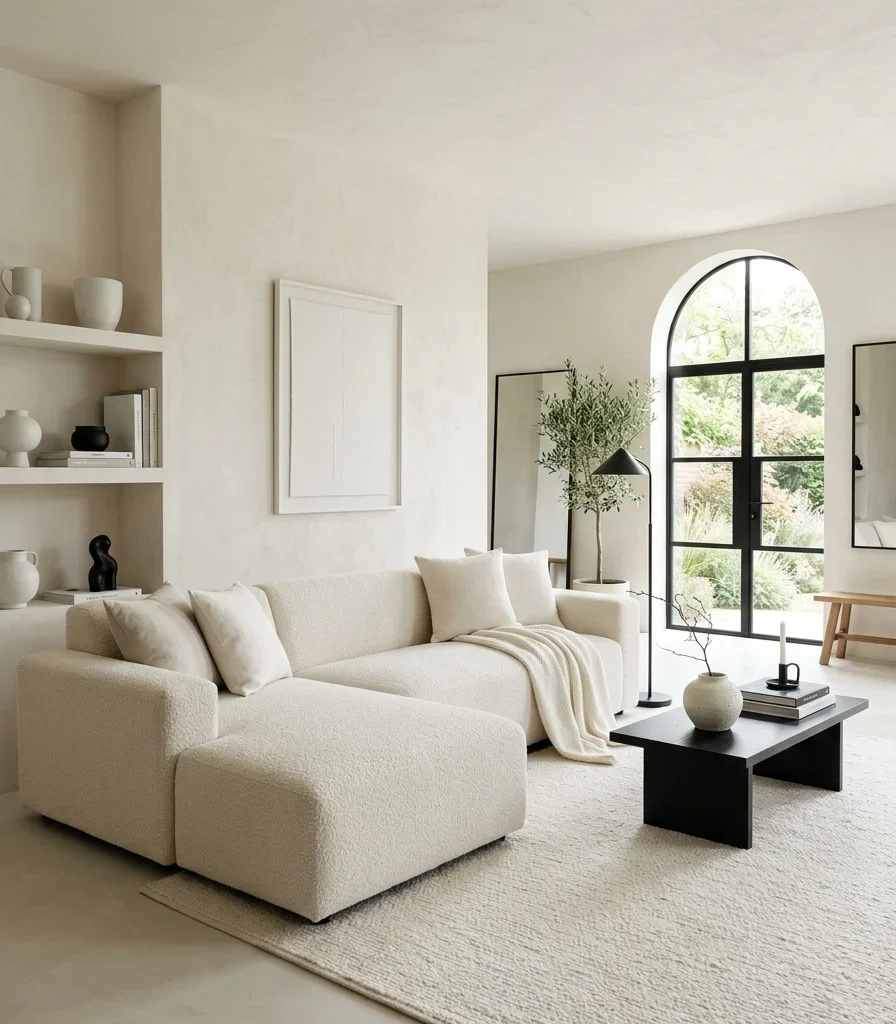
7. Use a Monochrome Palette to Let Furniture Visually Recede

Vibe: Calm. A sofa that visually melts into the wall behind it instead of standing out as a heavy, separate object.

Why it works: A monochrome palette applies contrast principles in reverse: where most rooms use contrast to make furniture stand out, matching a sofa’s tone closely to the wall color behind it lets the furniture visually recede, which is a genuine functionality benefit in a room where the goal is maximizing perceived open space rather than showcasing individual pieces.

How to get it: Choose upholstery within one or two shades of the wall color, testing both in the same room’s natural light before committing, since even a monochrome scheme needs the tones to genuinely relate rather than clash under different lighting.

Shop the Look

Product
Warm white upholstered sofa
Warm white matte wall paint
Matte black accent hardware
Small ceramic decorative vessel
Soft cream throw pillow

8. Choose Nesting Tables That Consolidate Into One Footprint
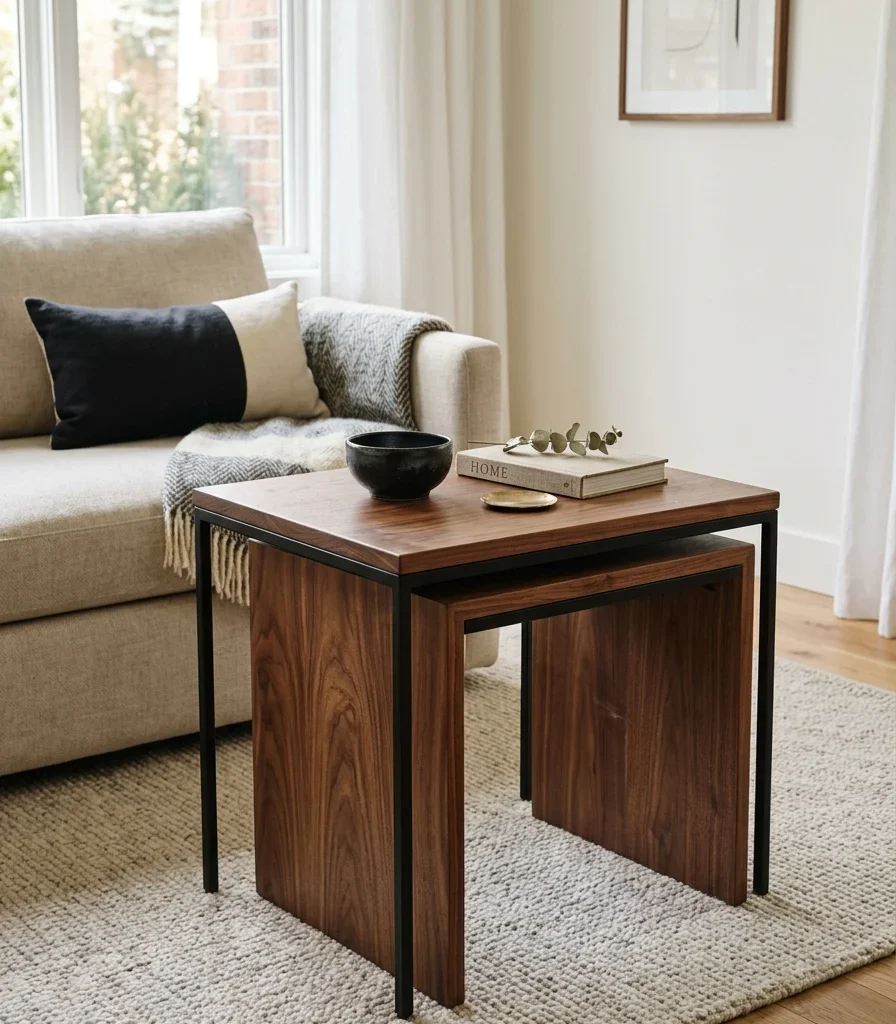
8. Choose Nesting Tables That Consolidate Into One Footprint

Vibe: Still two surfaces that collapse into the footprint of one whenever the second isn’t needed.

Why it works: Nesting tables apply dual-function furniture thinking to the specific problem of occasional extra surface area- a second table for drinks or a laptop during a gathering, -without permanently committing floor space to two separate pieces, since the smaller table slides fully beneath the larger one between uses.

How to get it: Choose a nesting pair with the smaller table at least 2 inches shorter and narrower than the larger one so it tucks completely underneath, pulling it out only when genuinely needed for extra surface area.

Shop the Look

Product
Walnut nesting table set
Small ceramic bowl for top table
Matte black table tray insert
Coaster set walnut
Small ceramic candle holder

9. Recess Ceiling Lighting to Eliminate Floor and Table Lamp Clutter
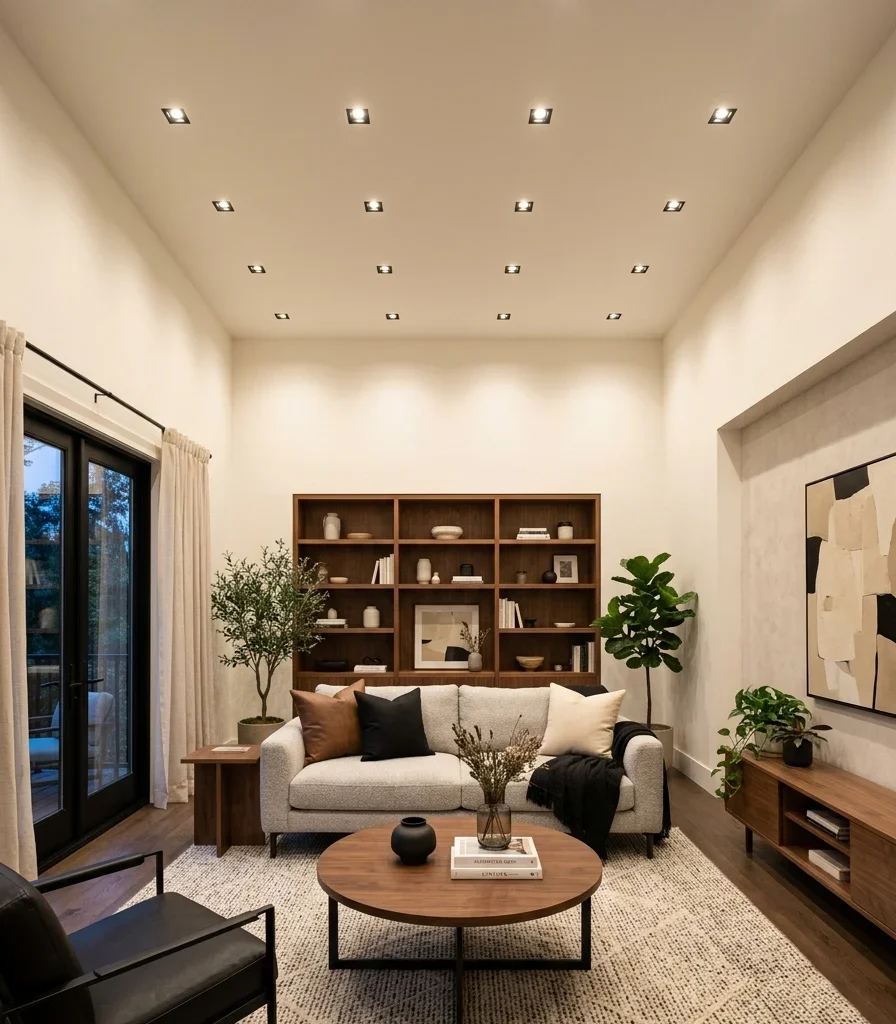
9. Recess Ceiling Lighting to Eliminate Floor and Table Lamp Clutter

Vibe: Airy, a room lit entirely from above, with not a single lamp claiming floor or table space.

Why it works: Recessed lighting applies negative-space thinking to illumination itself while floor and table lamps each occupy physical square footage and surface area; recessed ceiling fixtures provide the room’s ambient light from a plane that costs zero usable floor space, which matters most in a genuinely small living room where every lamp represents square footage that could otherwise be walked through or used.

How to get it: Install recessed fixtures on a dimmer at roughly one fixture per 4×4 feet of ceiling area for even coverage, choosing warm 2700K bulbs so the room doesn’t lose the cozy quality lamps typically provide.

Shop the Look

Product
Recessed ceiling light fixture
Warm 2700K recessed bulb
Dimmer switch for recessed lights
Small ceramic decorative vessel
Ceiling light trim kit

10. Choose Furniture on Slim Metal Legs to Keep the Floor Visible
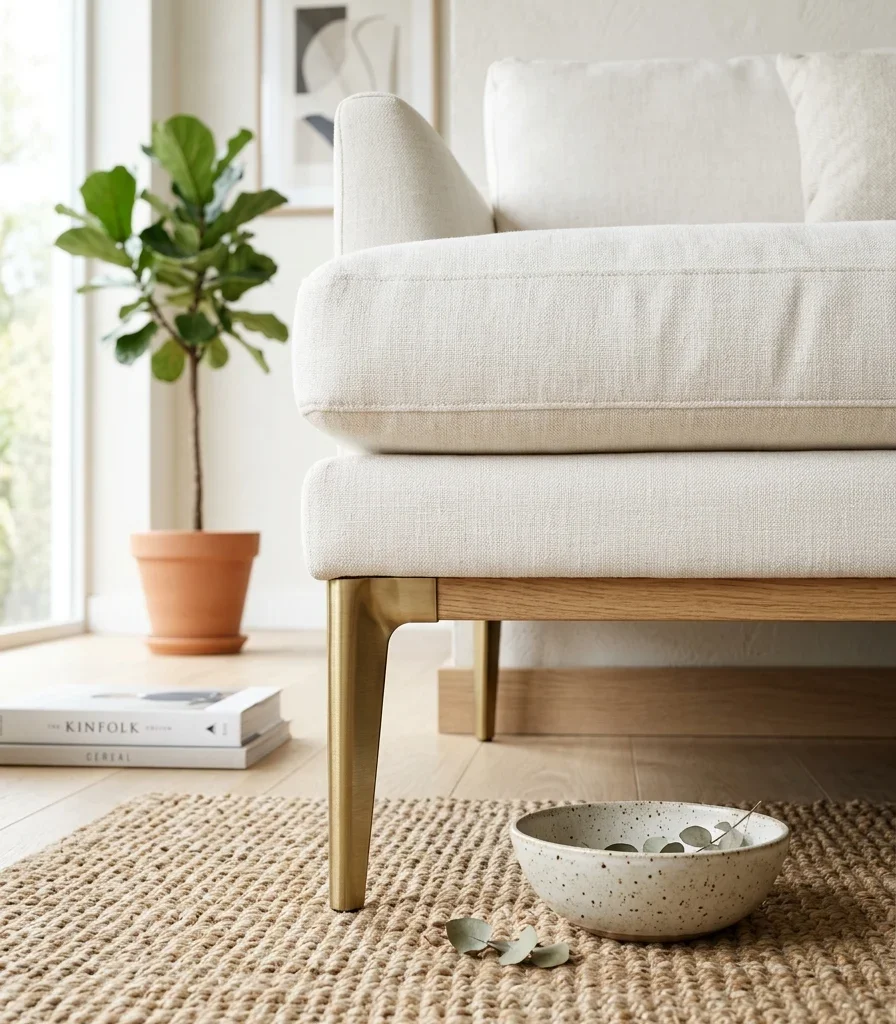
10. Choose Furniture on Slim Metal Legs to Keep the Floor Visible

Vibe: Still sofa that appears to hover slightly, letting the floor read continuously beneath its full length.

Why it works: Slim metal legs reduce visual mass at floor level across every piece of furniture in the room, not just one table or shelf a sofa or chair with a solid, boxy base blocks the floor along its entire footprint, while raised, slim legs let the eye travel underneath, which is the same negative-space principle applied consistently across the whole furniture collection rather than a single piece.

How to get it: Choose seating and tables with legs at least 4 inches tall and no wider than 1 inch in diameter, in a consistent metal finish across every piece, so the floor-visibility effect compounds across the whole room rather than working for only one item.

Shop the Look

Product
Slim brass sofa leg set
Brass accent chair legs
Natural jute area rug
Small ceramic table bowl
Brass table leg caps

11. Match Furniture Color to the Wall to Minimize Visual Bulk
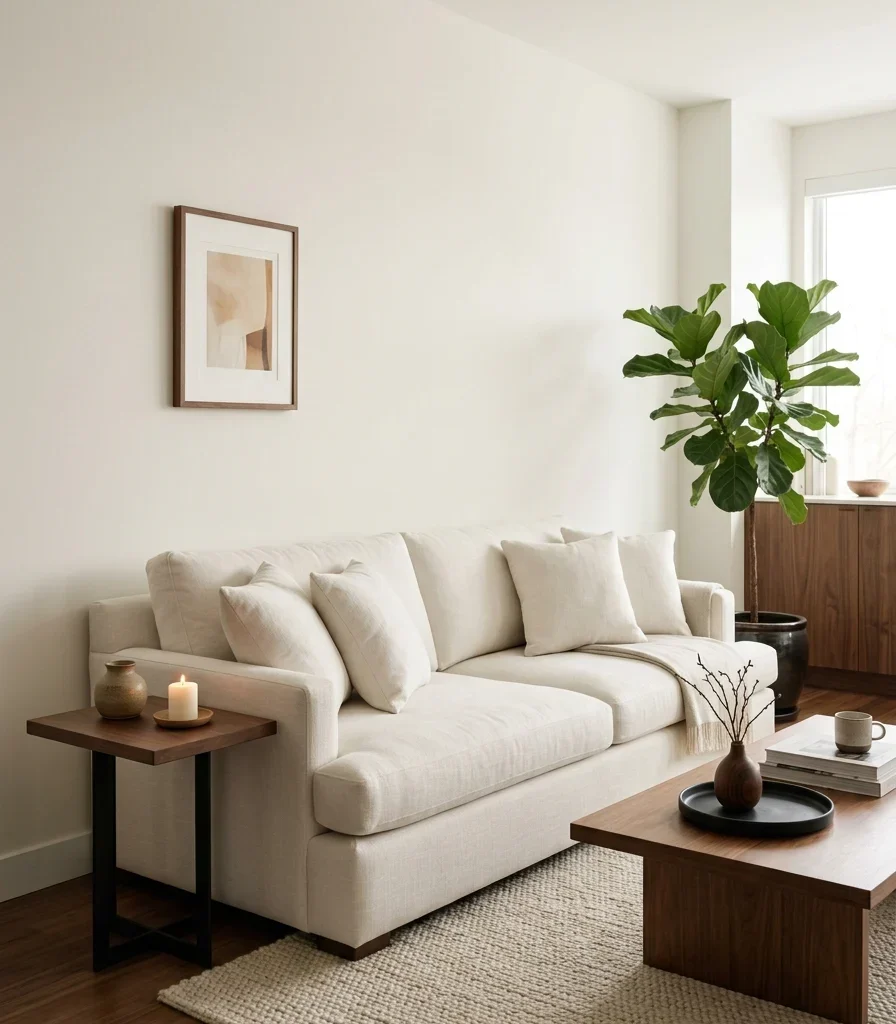
11. Match Furniture Color to the Wall to Minimize Visual Bulk

Vibe: Serene, a sofa that visually dissolves into the wall behind it instead of reading as a separate, heavy block.

Why it works: Matching a large furniture piece’s color directly to the wall behind it is a visual-weight principle that lets even a genuinely large sofa or sectional feel smaller in the room. A contrasting color draws the eye and makes the furniture register as an imposing separate object, while a matched tone lets the same physical volume feel like part of the architecture.

How to get it: Request the exact paint formula used on the walls when selecting slipcover or upholstery fabric, rather than eyeballing a close match, since even a slightly off shade undercuts the visual-recession effect this technique depends on.

Shop the Look

Product
Warm white slipcover sofa
Matching wall paint formula
Matte black accent hardware
Small ceramic decorative vessel
Walnut side table accent

12. Mount a Media Console on the Wall Instead of the Floor
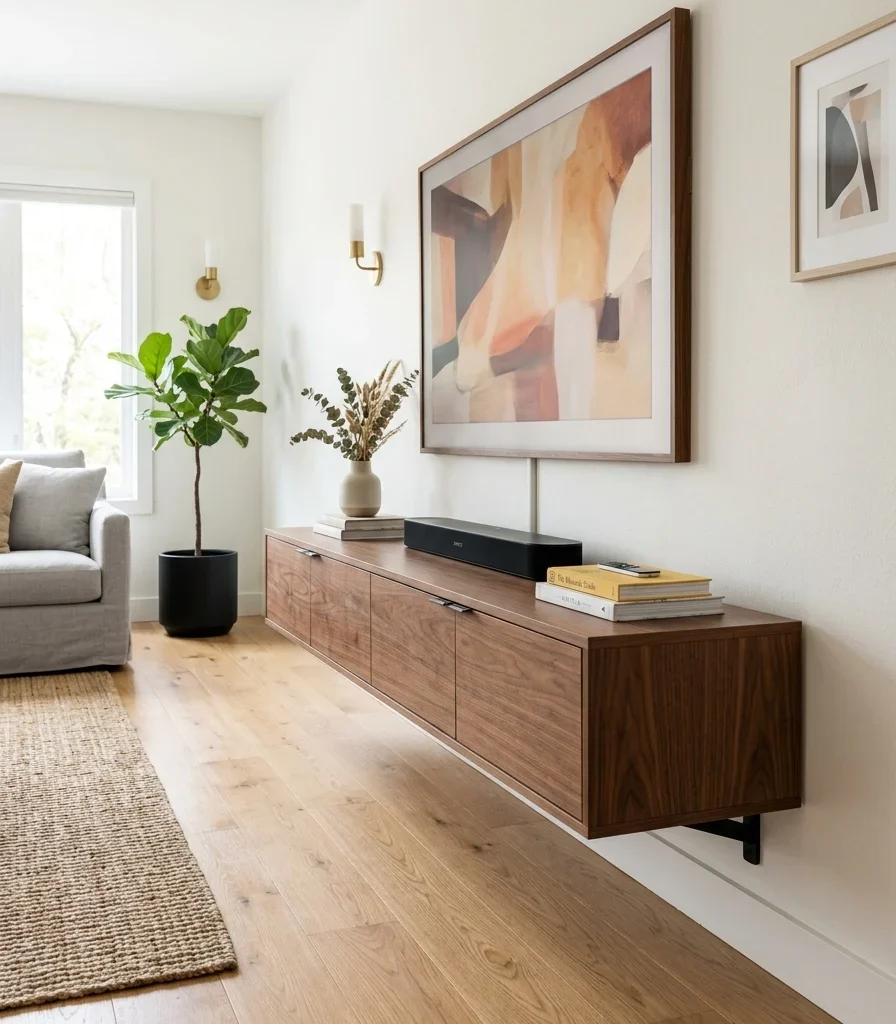
12. Mount a Media Console on the Wall Instead of the Floor

Vibe: Airy media storage that floats above the floor instead of anchoring a solid block beneath the television.

Why it works: A wall-mounted media console applies the same negative-space principle as floating shelves at a larger furniture scale; a floor-standing console occupies a significant footprint directly in the room’s most trafficked sightline (facing the seating), while a mounted version recovers that entire floor area for walking clearance or additional furniture.

How to get it: Mount the console on a wall bracket rated for the combined weight of the unit and any equipment stored inside, positioning it at a height that clears any baseboard heating or outlets while still sitting at a comfortable viewing height for the television above it.

Shop the Look

Product
Wall-mounted floating media console
Wall bracket rated for media unit
Small ceramic decorative vessel
Cable management channel
Matte black hardware set

13. Choose a Daybed That Replaces Both Sofa and Guest Bed
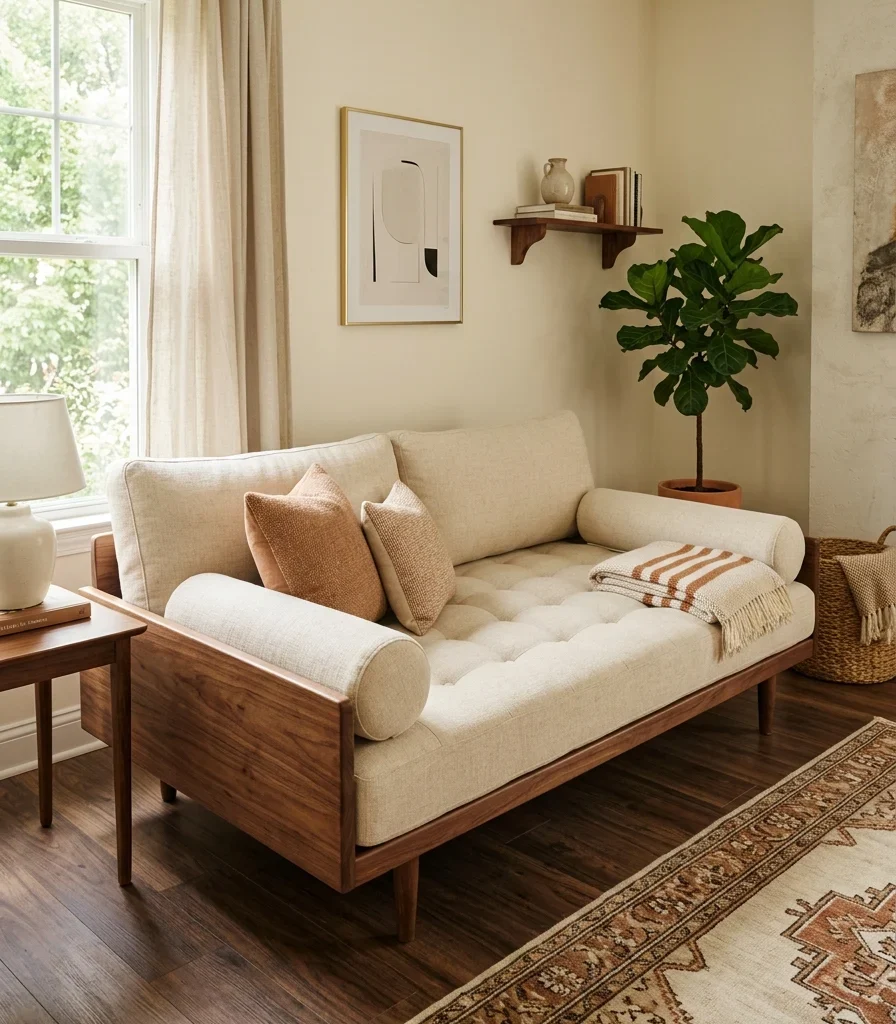
13. Choose a Daybed That Replaces Both Sofa and Guest Bed

Vibe: Layered seating that reads as a sofa by day and quietly offers a guest bed the moment it’s needed.

Why it works: A daybed applies dual-function furniture thinking specifically suited to a living room that occasionally hosts overnight guests without a dedicated spare room. Itssingle-depth frame with bolster pillows on each end functions as genuine seating during the day, eliminating the need for both a full sofa and a separate guest bed elsewhere in the home.

How to get it: Choose a daybed frame with a mattress-depth cushion (at least 4 inches) rather than a thin decorative pad, and dress it with two matching bolster pillows so it reads clearly as living room seating rather than an obvious bed during normal use.

Shop the Look

Product
Daybed frame with bolster ends
Bolster pillow pair matching
Daybed cushion mattress topper
Folded throw blanket
Small walnut side table

14. Float Furniture Away From Walls to Create Multiple Use Zones
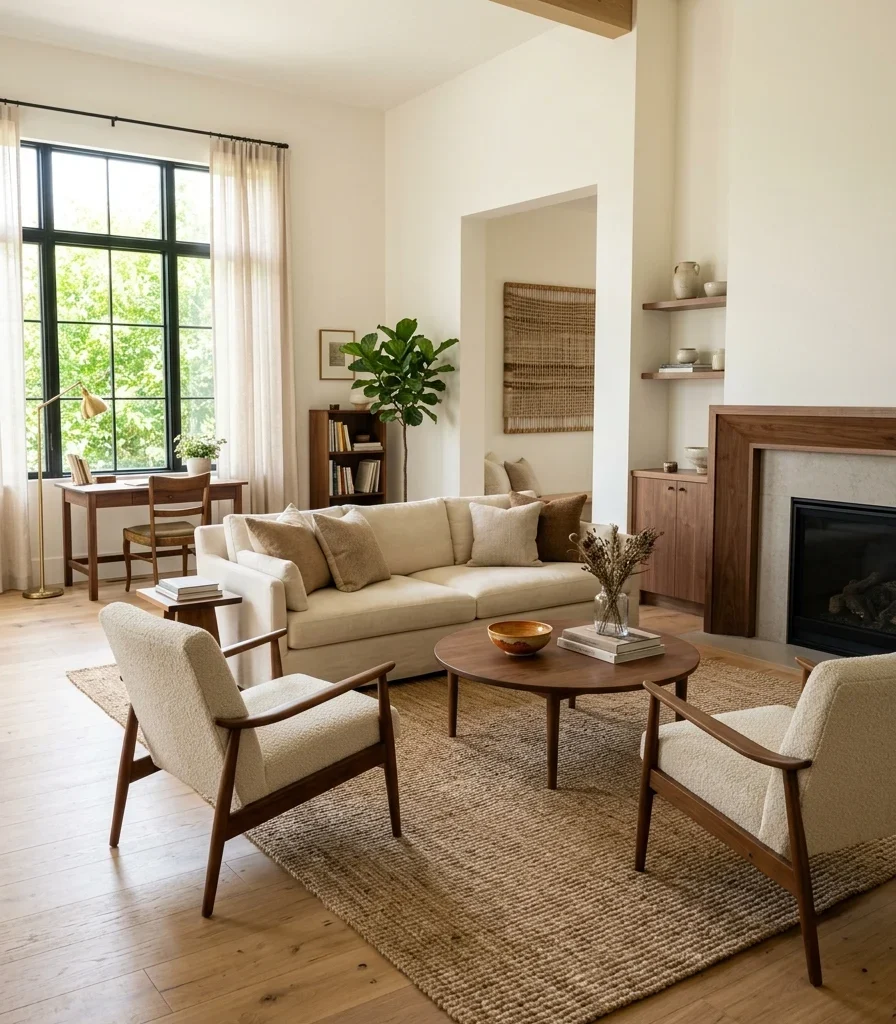
14. Float Furniture Away From Walls to Create Multiple Use Zones

Vibe: Airy one room holding two distinct functions because the furniture stopped hugging every wall.

Why it works: Pushing furniture against every wall (a common instinct) actually reduces a living room’s functional flexibility, since it leaves only the room’s center usable. Floating the main seating group away from the walls with a rug beneath it frees the remaining perimeter space for a second function, like a small desk or reading chair, that wall-hugging furniture would have crowded out entirely.

How to get it: Position the main seating group at least 18 inches from the nearest wall, using the reclaimed perimeter space for one additional functional zone, and define both areas with separate area rugs so each reads as its own defined space.

Shop the Look

Product
Large area rug for main seating
Small area rug for secondary zone
Walnut reading chair
Small ceramic bowl
Floor lamp for secondary zone

15. Build a Fold-Away Desk Into a Living Room Wall Unit
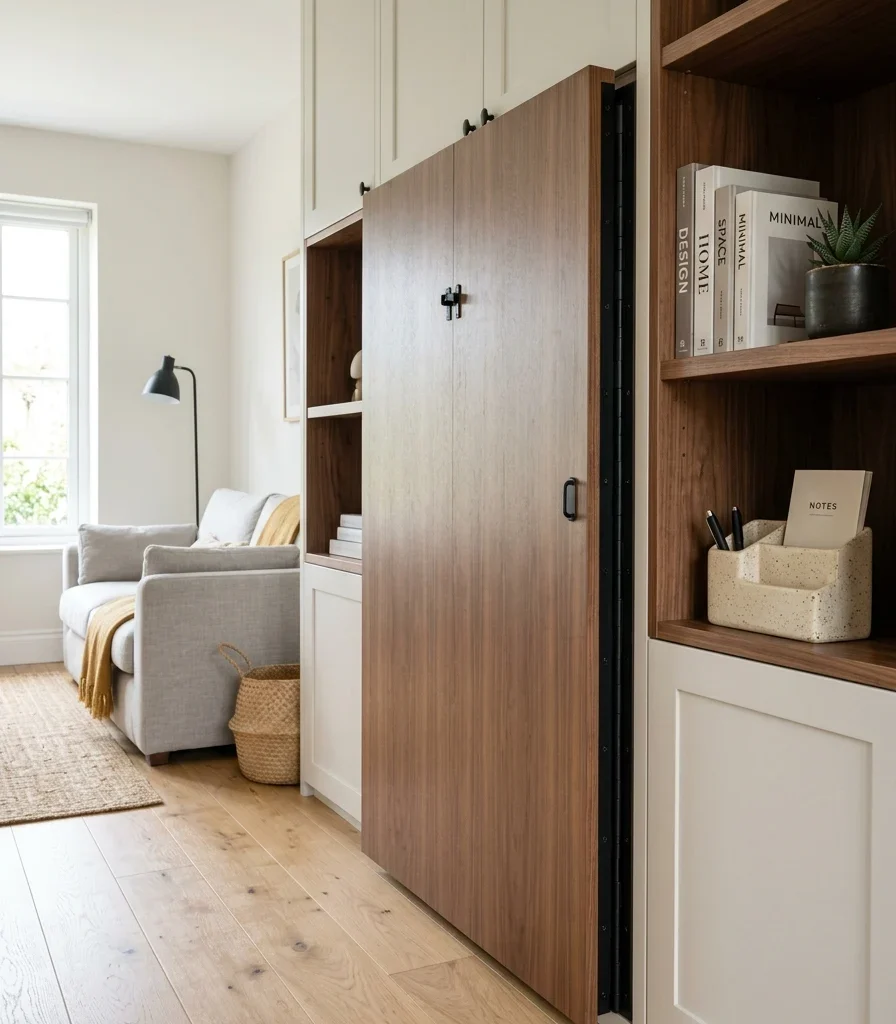
15. Build a Fold-Away Desk Into a Living Room Wall Unit

Vibe: Still a genuine workstation that disappears entirely into the wall once the workday ends.

Why it works: In a genuinely small living room asked to also serve as a home office, a fold-away desk built into a wall unit is the small-space adaptation that recovers real floor space daily, unlike a permanent desk that occupies its footprint around the clock; the fold-away version returns that square footage to the living room’s primary function the moment work is done.

How to get it: Build the desk into an existing or new wall unit with a fold-flat hinge rated for daily use, positioning adjacent shelving to hold supplies so the desktop can be cleared and folded away completely rather than staying propped open with items still on it.

💡 Quick Win: A slim wall-mounted fold-up laptop shelf achieves a similar effect in an even smaller footprint than a full fold-away desk unit.

Shop the Look

Product
Fold-away wall unit desk
Matte black fold hinge hardware
Adjacent storage shelf
Small ceramic desk organizer
Slim fold-up laptop shelf

How to Start Maximizing Open Space and Functionality in Your Living Room

Your one first move is auditing every single-function piece of furniture in the room before buying anything new, specifically identifying which pieces (a plain side table, a purely decorative bench) could be replaced by a multi-function equivalent. Since the core principle is getting more use out of the same floor space, this audit tells you exactly where the room is currently underperforming before any purchase happens.

The most common mistake is buying multi-function furniture without checking that each function is genuinely usable in the room’s actual dimensions. A fold-out desk that can’t fully open because a nearby chair blocks it delivers neither function well. The fix is measuring the true clearance each function requires (a fully extended nesting table, a folded-out daybed) before committing to any piece.

Three items under $50 that create immediate impact: a slim floor lamp to free up a side table, a set of nesting tables in a compact size, and matte black leg caps to visually lighten an existing solid-base sofa.

A weekend refresh, a storage ottoman and lighting swap, costs $100–350. A full functional reconfiguration with modular seating and wall-mounted storage typically runs $2,000–6,000 and takes two to four weeks including furniture delivery.

Frequently Asked Questions About Maximizing Open Space and Functionality in a Living Room

What is the difference between maximizing open space and simply decluttering a living room?

Decluttering removes unnecessary items from a room that’s already furnished as intended. Maximizing open space and functionality goes further, actively choosing furniture, multi-function pieces, slim-profile legs, and wall-mounted storage specifically because they recover usable floor space and add functional range, treating the room’s layout as something to actively design for efficiency rather than simply tidy.

What color works best for a functionally maximized living room?

Warm white or soft cream works best as a base, since light-reflective tones make furniture visually recede and keep the room feeling open regardless of its actual square footage. Matching large furniture pieces closely to the wall color specifically helps bulky items like sofas feel less imposing in the room.

How much does it cost to maximize functionality in a living room?

A budget refresh using a storage ottoman, floor lamp, and leg caps costs $150–450. A mid-range upgrade with a modular sectional and wall-mounted shelving runs $2,000–4,500, and a full reconfiguration including a fold-away desk unit and daybed typically costs $4,500–8,000 depending on furniture quality.

Can a genuinely small living room hold multiple functions at once?

Yes, floating the main seating away from the walls to free perimeter space, combined with multi-function pieces like a storage ottoman and a fold-away desk, lets even a room under 200 square feet support seating, storage, and occasional work or guest sleeping without any single function permanently dominating the floor plan.

What is the single most effective way to maximize a living room’s functionality?

Choosing multi-function furniture over single-purpose pieces is the most effective single change, since a storage ottoman, a modular sectional, or a daybed each perform the work of two separate furniture items in the footprint of one, delivering more genuine functionality per square foot than any layout trick or color choice applied to single-purpose furniture.

Ready to Maximize Open Space and Functionality in Your Living Room?

These 15 ideas move across material, color, lighting, layout, and true small-space solutions, from a storage ottoman doing triple duty to a fold-away desk that reclaims the whole floor the moment the workday ends. None of this needs to happen all at once, and starting with a furniture audit and one multi-function swap is genuinely the smartest place to begin, not a smaller version of the full plan. Today’s specific action: walk through your living room and note every single-function piece of furniture currently taking up floor space, since that list will tell you exactly which item to replace first. Once the room finally asks less of your square footage and gives back more of it, sitting down in that space will feel less like navigating around furniture and more like using a room built to actually keep up with everything you need it to do. Save the ideas that fit your room’s real dimensions and your household’s actual daily needs; that slim-legged sofa and fold-away desk will still be earning their keep a year from now.

You Might Also Like

12 Cozy Sage Green Gray Living Room Ideas Worth Saving

12 Cozy Sage Green Gray Living Room Ideas Worth Saving

A cozy sage green gray living room pairs muted botanical green with warm, layered gray tones to build a space that feels calm without feeling cold. This article gives you 12 cozy sage green gray living room ideas: color, materials, lighting, furniture, layout, and small-space fixes, each with a shoppable “Steal the Look” list.

Picture a room where the gray never reads as flat or corporate because sage green is warming it from every corner: a throw here, a painted trim there, a ceramic vase catching the afternoon light. The textures do most of the emotional work: boucle that begs to be sat in, oak that still shows its grain, wool that holds warmth after the sun moves off it. Nothing shouts. Everything settles. Here are 12 ideas worth saving and stealing.

Why a Cozy Sage Green Gray Living Room Works So Well

A sage green gray living room is a color-palette-driven style drawing from biophilic design: muted, botanical greens that calm the way real plants do, layered against the warm-neutral minimalism of Scandinavian and modern farmhouse interiors. What separates it from a plain “neutral living room” is the intentional two-tone anchor: sage brings life, gray brings grounding.

Its materials are specific: boucle upholstery, white oak or ash furniture, unglazed stoneware, brushed nickel or matte black hardware, and wool or jute rugs. The colors worth naming are sage, moss, and eucalyptus green against warm gray, greige, and soft charcoal never a cool, blue-based gray, which fights the warmth the green is trying to introduce.

This pairing is trending because it answers two search behaviors at once. Pinterest shows sustained interest in “sage green living room” and “warm gray living room” independently, and combining them meets the post-pandemic pull toward rooms that feel restorative rather than showroom-perfect.

Small living rooms can do this, but should lead with gray as the dominant wall tone and let sage arrive through furniture and textiles; two saturated colors competing for wall space in a tight room reads busy rather than calm.

ElementGreen InfluenceGray Influence
PhilosophyBiophilic calm, botanical warmthGrounded warm-neutral minimalism
MaterialsLinen, boucle, rattan, unglazed ceramicTravertine, white oak, wool, brushed nickel
Color PaletteSage, moss, eucalyptusWarm gray, greige, soft charcoal

1. Sage Green Accent Wall Paired With Warm Gray Trim

1. Sage Green Accent Wall Paired With Warm Gray Trim

Vibe: Serene the wall color that makes the whole room exhale.

Why it works: Sage advances visually less aggressively than a saturated green, so a single accent wall reads calm, not dominant. Pairing it with warm gray trim rather than stark white keeps the contrast soft; lower values create harmony, wider gaps create tension.

How to get it: Paint one wall in a chalky matte sage such as Farrow & Ball “Card Room Green” or Sherwin-Williams “Clary Sage,” and trim in a warm gray like Benjamin Moore “Revere Pewter” rather than bright white.

💡 Quick Win: No time to paint? A large sage green boucle throw draped over the sofa back gives the same color anchor in an afternoon.

Shop The Look

Product
Sage green matte paint sample pot
Warm gray trim paint sample
Ceramic vase sage green glaze
Woven cotton throw blanket ivory
Small potted eucalyptus plant faux

2. Boucle and White Oak Furniture Pairing

2. Boucle and White Oak Furniture Pairing

Vibe: Textural room you want to run your hand across before you sit down.

Why it works: Texture layering pairs a soft, nubby fabric with a hard, grained material, so the eye has contrast without extra color. Boucle’s dimensional weave catches light differently than flat upholstery, so it photographs warmer than it measures on a chip.

How to get it: Choose a gray boucle sofa and pair it with white oak side and coffee tables rather than walnut or espresso; the lighter wood keeps the palette from tipping too dark, and its visible grain adds the material honesty this style depends on.

Shop The Look

Product
Gray boucle upholstered sofa
White oak coffee table round
White oak side table small
Sage green ceramic bowl decorative
Linen lumbar cushion cover ivory

3. Warm Amber Floor and Table Lamps

3. Warm Amber Floor and Table Lamps

Vibe: Hushed light that makes evenings in this room feel unhurried.

Why it works: Warm 2700K bulbs shift a gray room away from clinical and toward cocooning, since cool-toned gray under cool-white light reads flat and office-like. Two layered light pools soften the shadows a single overhead fixture leaves behind.

How to get it: Add a brushed brass floor lamp with a linen shade beside the sofa and a ceramic table lamp on the console, both fitted with 2700K bulbs and, if possible, dimmable.

💡 Quick Win: Swapping existing bulbs to 2700K “warm white” costs under $12 for a pair and instantly warms up a cool gray room.

Shop The Look

Product
Brushed brass floor lamp linen shade
Ceramic table lamp warm sage glaze
Warm white 2700K LED bulb set
Small ceramic catch-all dish
Linen lamp shade replacement ivory

4. Tonal Gray Layering From Charcoal to Greige

4. Tonal Gray Layering From Charcoal to Greige

Vibe: Layered gray shows up at three depths instead of one flat tone.

Why it works: Tonal layering within one color family creates depth that a single flat gray can’t achieve. A light greige wall, a mid-gray sofa, and one charcoal cushion give the eye a gradient to travel across, the same principle behind tonal green layering elsewhere in this palette.

How to get it: Paint walls in a light greige like Sherwin-Williams “Agreeable Gray,” choose a mid-toned gray linen sofa, and add one charcoal velvet cushion as the deepest note; resist adding a fourth gray shade, which flattens the gradient instead of extending it.

Shop The Look

Product
Light greige wall paint sample
Mid-gray linen sofa slipcover
Charcoal velvet throw pillow cover
Wool area rug warm gray
Sage green throw blanket folded

5. Curved Sage Green Sofa as Anchor

5. Curved Sage Green Sofa as Anchor

Vibe: Grounded, a sofa shape that softens every hard line in the room around it.

Why it works: A curved sofa reduces the visual weight a boxy silhouette carries at the same footprint; rounded forms read as lighter to the eye. Choosing sage for the sofa rather than the wall puts the boldest hue on the most-used piece of furniture, where it earns its presence daily.

How to get it: Source a curved sofa in sage green velvet or performance fabric rather than the more common cream or gray, and keep the wall behind it in warm gray so the sofa remains the room’s clear color statement.

💡 Quick Win: Not ready for a new sofa? A sage green velvet bench at the foot of an existing sofa introduces the same anchor color at a fraction of the cost.

Shop The Look

Product
Curved sage green velvet sofa
Sage green upholstered bench small
Brass sofa leg caps set
Oversized floor cushion ivory
Wool throw blanket warm gray

6. Travertine or Textured Stone Coffee Table

6. Travertine or Textured Stone Coffee Table

Vibe: Tactile a surface with more visual interest than any accessory placed on it.

Why it works: Honed travertine’s natural pitting provides material authenticity that glass or laminate can’t replicate; light catches its uneven surface differently at every angle. A rounded profile also softens the room the way the curved sofa does.

How to get it: Choose a round or oval travertine coffee table in a honed (matte) rather than polished finish. Polished stone throws hard reflections that compete with the room’s soft lighting scheme.

Shop The Look

Product
Honed travertine coffee table round
Ceramic decorative bowl sage green
Small hardback book stack neutral
Travertine stone coaster set
Natural stone sealer for maintenance

7. Textured Throw Pillows and Botanical Greenery

7. Textured Throw Pillows and Botanical Greenery

Vibe: Lush, the small living touch that keeps the room from feeling too composed.

Why it works: Mixing pillow textures boucle, linen, velvet within one narrow color range adds richness without a new hue, the same texture-layering principle used on the sofa and coffee table. A trailing plant grounds the painted sage tones in something alive.

How to get it: Style the sofa with five pillows in three different textures, all within the sage-to-charcoal range, and place one trailing pothos or philodendron in a terracotta or ceramic planter within view of the seating area.

💡 Quick Win: A single faux trailing plant on a plant stand beside the sofa delivers the same visual softness with zero watering required.

Shop The Look

Product
Boucle throw pillow cover sage
Linen throw pillow cover charcoal
Velvet lumbar pillow cover warm gray
Trailing pothos plant faux or live
Ceramic planter pot sage glaze

8. Defining a Conversation Zone With Rugs

8. Defining a Conversation Zone With Rugs

Vibe: Consider a room that reads as arranged rather than furniture placed at random.

Why it works: A properly sized rug applies zone definition; when every seating piece rests at least its front legs on the rug, the eye reads the grouping as one connected conversation area rather than scattered furniture.

How to get it: Size the rug so the sofa and both accent chairs can rest at least their front legs on it. For a standard living room, this usually means an 8×10 rug minimum, not the smaller 5×7 that leaves furniture floating off the edges.

Shop The Look

Product
Wool area rug 8×10 warm gray
Non-slip rug pad underlay
Round coffee table centered oak
Sage green accent chair pair
Rug corner grippers set

9. Layered Picture Lights and Dimmable Sconces

9. Layered Picture Lights and Dimmable Sconces

Vibe: Glowing light sources placed high enough to wash the walls instead of just the floor.

Why it works: Wall-mounted picture lights and sconces add light at eye level and above; illuminating vertical surfaces makes a room feel larger than relying on table and floor lamps alone, which only light the lower third of a space.

How to get it: Install a brass picture light above the room’s largest artwork and add one pair of dimmable sconces flanking a console or media unit, all on 2700K bulbs.

💡 Quick Win: A plug-in wall sconce with a hardwired look installs with no electrician needed, just a nearby outlet and a cord cover.

Shop The Look

Product
Brass picture light for artwork
Dimmable wall sconce pair brass
Plug-in wall sconce with cord cover
Warm white 2700K LED bulb set
Console table narrow oak

10. Mixed Accent Chairs for Visual Balance

10. Mixed Accent Chairs for Visual Balance

Vibe: Balanced seating group that feels curated rather than matched from a single showroom set.

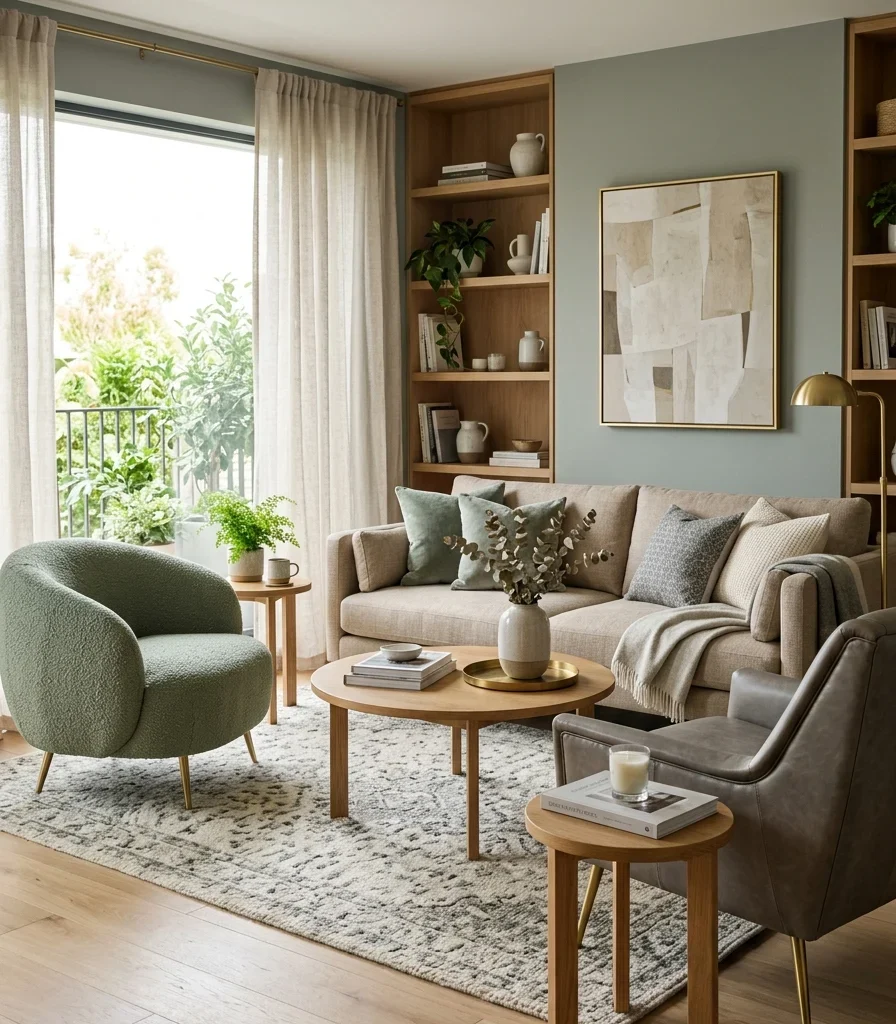
Why it works: Pairing two different accent chairs in the two anchor colors, rather than a matching pair, balances visual weight. Each chair carries equal presence through matched scale and leg finish, even though the fabrics differ, so the room avoids feeling like a showroom set.

How to get it: Choose one sage boucle chair and one warm gray leather or performance-fabric chair, matched only in leg finish and general scale, and place them at a slight angle facing the sofa rather than in strict mirror symmetry.

Shop The Look

Product
Sage green boucle accent chair
Warm gray leather accent chair
Brass tapered chair legs set
Small round side table oak pair
Ceramic coaster set for side tables

11. Gallery Wall in Sage and Charcoal Tones

11. Gallery Wall in Sage and Charcoal Tones

Vibe: Curated wall that signals this palette was chosen with intention.

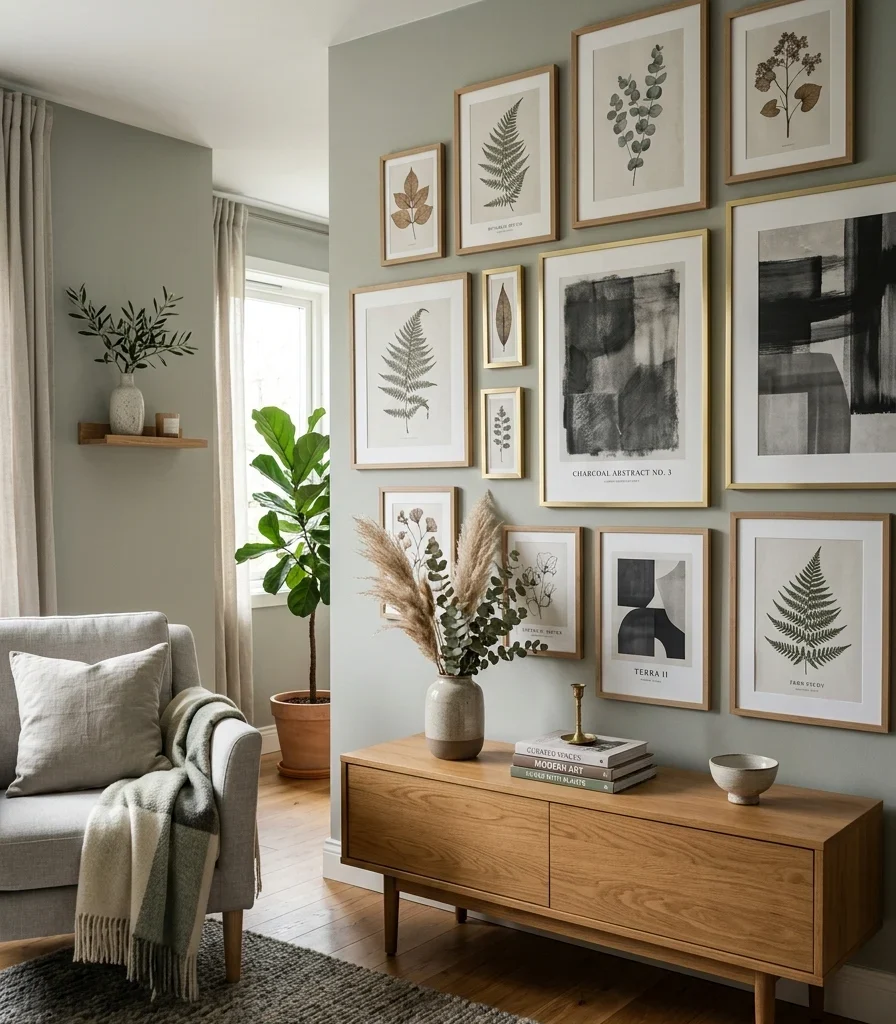
Why it works: Mixing botanical prints with abstract charcoal canvases keeps the gallery tied to both anchor colors instead of drifting into unrelated hues, and varying frame widths between oak and brass adds the material mix this style relies on.

How to get it: Lay the arrangement out on the floor first using painter’s tape as a guide, mixing two botanical prints with two or three abstract pieces in sage and charcoal tones, spaced 5–8cm apart.

💡 Quick Win: Three botanical prints in identical oak frames, evenly spaced in a single row, create an instant gallery moment without any complex layout planning.

Shop The Look

Product
Botanical print framed art set
Abstract charcoal canvas art set
Oak picture frame set assorted
Small floating wood shelf
Ceramic vase for shelf styling

12. Vertical Layering for Compact Living Rooms

12. Vertical Layering for Compact Living Rooms

Vibe: Airy; prove this palette can live in a small room without feeling closed in.

Why it works: Vertical layering tall, narrow furniture and ceiling-height curtains draws the eye upward, making a compact room feel taller than its footprint. Keeping sage confined to small objects while gray carries the large surfaces prevents the palette from crowding a tight floor plan.

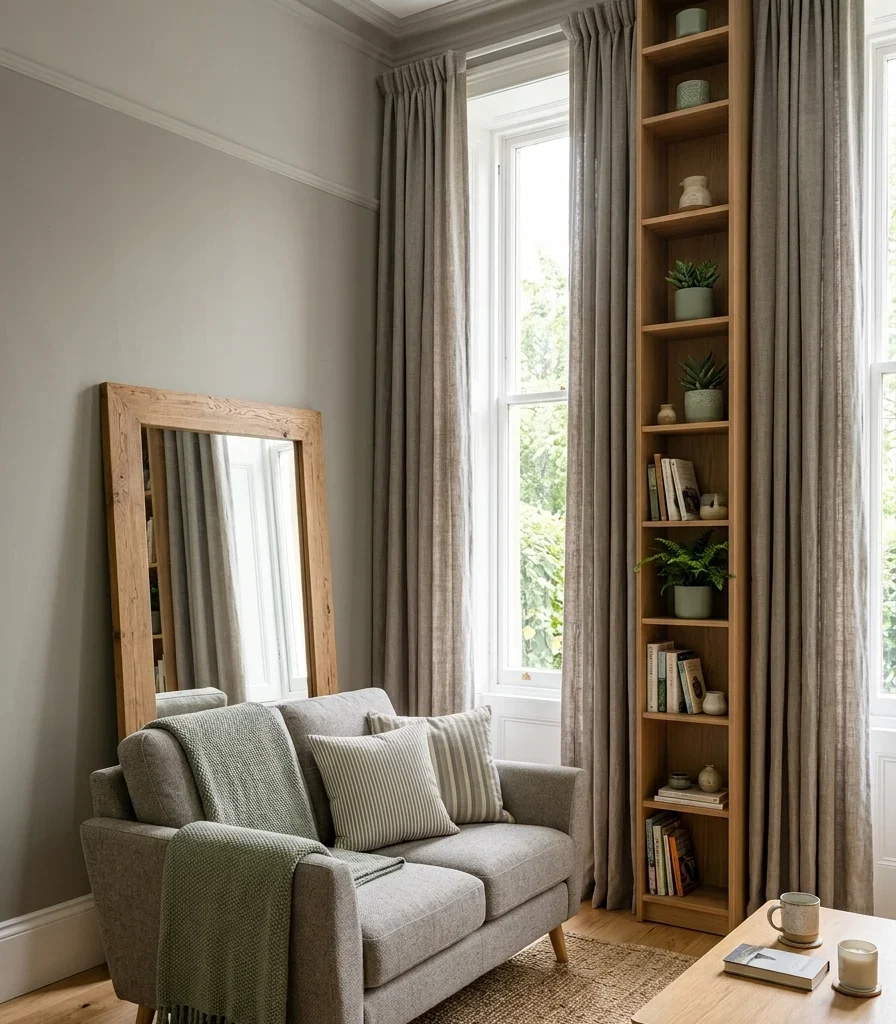
How to get it: Mount curtain rods at ceiling height in warm gray linen, add one tall narrow bookshelf in white oak, and reserve sage green for small accessories only: a planter, a stack of books, a single throw.

Shop The Look

Product
Ceiling-height curtain rod extendable
Warm gray linen curtain panel pair
Tall narrow bookshelf white oak
Small sage green ceramic planter set
Leaning full-length mirror slim frame

How to Start Your Sage Green Gray Living Room Transformation

Start with the sofa. Before choosing a wall color, a rug, or any accessories, decide whether your sofa will be gray or sage. This single decision determines every other color choice in the room, since everything else is selected to support whichever anchor color the largest piece of furniture carries.

The most common mistake beginners make is choosing a cool, blue-based gray instead of a warm gray, which fights against sage green rather than supporting it. The two undertones clash, and the room reads sterile instead of cozy. The fix is checking the paint’s undertone in natural daylight before buying; warm grays like “Agreeable Gray” or “Revere Pewter” lean beige, not blue.

Three items under $50 that make an immediate impact: a sage green ceramic vase ($20–$30) on the coffee table; a warm gray wool throw ($25–$40) draped over the sofa arm; and a warm white 2700K bulb set ($10–$14) replacing cool-white bulbs in existing lamps.

Realistic expectations: A starter version- new pillows, a throw, and a plant takes an afternoon and costs $100–$250. A full room transformation with new furniture, paint, and lighting runs $2,000–$6,000 and typically unfolds over six to ten weeks.

Frequently Asked Questions About Cozy Sage Green Gray Living Room Ideas

What is a sage green gray living room, and how is it different from a plain neutral living room?

A cozy sage green gray living room deliberately pairs two anchor colors: muted botanical sage and warm gray, rather than pulling from a broad neutral palette of beiges, tans, and whites. A plain neutral living room skips color almost entirely, while this style uses sage as a controlled, intentional accent that keeps the gray from feeling flat or corporate.

What shade of gray pairs best with sage green in a living room?

Warm grays with a beige or greige undertone, such as Benjamin Moore “Revere Pewter” or Sherwin-Williams “Agreeable Gray,” pair best because their warmth complements sage’s soft, grayed-green tone. Cool, blue-based grays clash with sage and should be avoided, since the two undertones pull the room in opposite temperature directions.

How much does it cost to decorate a living room in this style?

A budget-conscious refresh using pillows, a throw, and a few ceramic accents costs roughly $100–$250 and can be done in an afternoon. A fuller transformation with a new sofa, rug, and lighting typically runs $2,000–$6,000, depending on whether furniture is new or sourced secondhand.

Does this palette work with existing furniture, like a brown leather sofa or dark wood floors?

Yes, a brown leather sofa can stay in the room as long as new textiles and wall color lean into the sage-and-gray story, since leather’s warmth actually complements sage well. Dark wood floors ground the palette nicely too; just keep coffee and side tables in a lighter oak to avoid an all-dark furniture footprint.

What’s the single most important element for making this style feel cozy rather than cold?

Warm lighting is the deciding factor: 2700K bulbs and layered light sources (a floor lamp, a table lamp, and at least one wall-mounted fixture) keep the gray from reading sterile. Cool white or single-overhead lighting is the fastest way to make an otherwise well-styled sage and gray room feel like a waiting room instead of a living room.

Ready to Create Your Dream Sage Green Gray Living Room?

These 12 ideas cover the full range of what this palette can do, from the color-anchoring power of a sage accent wall, to the material richness of boucle and travertine, to small-space tricks that make a compact room feel just as layered as a large one. Building a room like this happens one throw pillow, one lamp, one wall at a time;n o rule says the whole space needs to change at once. If you’re starting today, pick one sage green accessory and set it against your current gray or neutral sofa to see how the pairing actually feels in your light. Once the textures are layered and the light is warm, this is the kind of living room that makes coming home feel like an actual exhale. Save the ideas that match your room’s light and size and start building your sage-and-gray moodboard tonight.

You Might Also Like

2. Warm White Walls with Greige Trim

15 Modern Farmhouse Living Room Ideas

Modern farmhouse is the pairing of rustic, weathered textures with clean, minimal lines rough wood next to crisp white walls, iron hardware against soft linen. This article gives you 15 modern farmhouse living room ideas, from paint colors to lighting to layout tricks, that you can actually use.

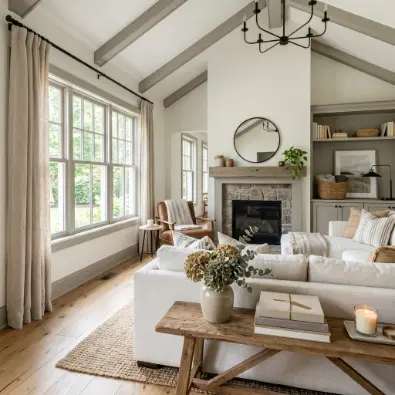
The feeling is unmistakable: sun through sheer curtains landing on a worn wood floor, the quiet weight of a stone fireplace, linen that’s soft from washing, not from trying. It’s a room that looks lived-in on day one and feels calmer every year after. Modern farmhouse doesn’t shout it settles. Here are 15 ideas worth saving and stealing.

Why Modern Farmhouse Works So Well

What is it? Modern farmhouse blends two opposing traditions: the utilitarian, hand-built aesthetic of 19th-century American and European farmhouses, and the restrained, uncluttered lines of contemporary minimalism. It borrows shiplap and barn-door hardware from rural vernacular architecture, then strips away the ornate florals and heavy antiques that defined traditional country decor. The result sits between rustic and refined — worn but never messy, simple but never cold.

What are its core materials and colors? The palette leans on warm white, greige, soft charcoal, and terracotta blush, with black or bronze as the grounding accent. Materials are tactile and imperfect: whitewashed shiplap, unfinished white oak, reclaimed barnwood, linen upholstery, wrought iron, and woven jute. Nothing is glossy. Everything has a slight texture your hand wants to touch.

Why is it trending now? Search interest in “modern farmhouse” has stayed high on Pinterest for nearly a decade, but the current wave is driven by post-pandemic nesting — people want homes that feel handmade and durable rather than showroom-perfect. The sustainability movement has also pushed reclaimed wood and natural fiber back into favor over synthetic, mass-produced finishes.

Can small spaces achieve this style? Yes, with one condition: restraint. Small farmhouse rooms fail when every surface gets a “rustic touch.” Prioritize one hero material (a wood beam, a shiplap wall) and keep everything else quiet and pale so the room doesn’t feel cluttered.

ElementTrait 1Trait 2
PhilosophyRustic texture, minimal clutterFunction before ornamentation
MaterialsWhitewashed shiplap, white oakWrought iron, linen, jute
Color paletteWarm white, greigeCharcoal, terracotta blush

15 Modern Farmhouse Living Room Ideas

1. Whitewashed Shiplap Accent Wall

1. Whitewashed Shiplap Accent Wall

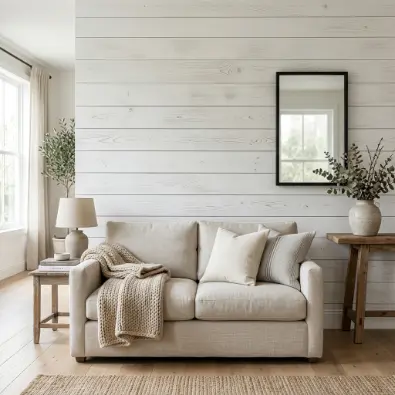
Vibe: The wall feels raw, like reclaimed barn siding softened by paint.

Why it works: Shiplap creates horizontal texture and shadow lines that add depth to an otherwise flat wall — a classic technique for adding visual interest without adding color. The whitewash keeps the grain visible, which is what separates an authentic farmhouse from a flat white paint job.

How to get it: Install pine shiplap boards, then apply a diluted white paint-to-water wash (roughly 1:1 ratio) with a rag, wiping with the grain so wood texture stays visible underneath.

💡 Quick Win: Peel-and-stick shiplap wallpaper panels achieve 80% of the look in an afternoon, no nail gun required.

Shop the Look

Product
Whitewashed pine shiplap wall panel kit
Ivory linen 3-seat slipcovered sofa
Matte black round wall mirror 30 inch
Cream ceramic vase ribbed textured
Chunky knit wool throw blanket, oatmeal

2. Warm White Walls with Greige Trim

2. Warm White Walls with Greige Trim

Vibe: The room feels luminous, like a page that hasn’t been written on yet.

Why it works: Pairing a warm white wall with a slightly darker greige trim uses tonal contrast rather than color contrast, which reads as sophisticated instead of stark. This is the same low-contrast layering technique used in Scandinavian interiors, adapted with warmer undertones.

How to get it: Paint walls in a warm white with a yellow-beige undertone, then paint trim, baseboards, and window casings two shades darker in a warm greige to define the architecture without introducing a new hue.

Shop the Look

Product
Woven seagrass storage basket set
Natural linen curtain panels 84 inch
Oak wood picture ledge shelf
Neutral linen-bound decorative books set
Cream boucle accent pillow cover 20×20

3. Oversized Iron Chandelier

3. Oversized Iron Chandelier

Vibe: The room feels grounded, anchored by one dark, weighty shape overhead.

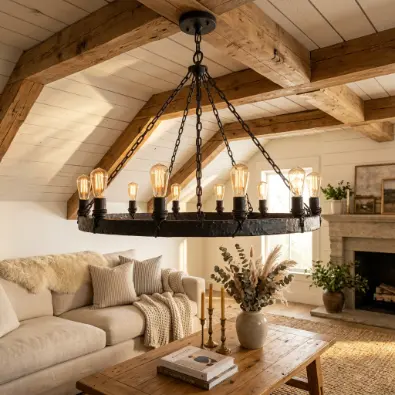
Why it works: A single oversized fixture creates visual weight at ceiling height, balancing heavier furniture below it — a proportion rule where the light fixture should span roughly one-third to one-half the width of the seating area it hangs over. Wrought iron adds the rustic material note without darkening the walls.

How to get it: Choose a ring or candelabra-style iron chandelier with exposed Edison bulbs, and hang it 30–34 inches above the coffee table for proper scale.

💡 Quick Win: Swap only the bulbs in your existing fixture to warm 2700K Edison-style bulbs for an instant mood shift before buying new hardware.

Shop the Look

Product
Black wrought iron ring chandelier
Edison filament bulbs warm 2700K set
Sheepskin throw rug ivory
Brass taper candlestick holders set
Honey oak round coffee table

4. Layered Vintage-Inspired Textiles

4. Layered Vintage-Inspired Textiles

Vibe: The sofa feels welcoming, the kind of texture layering that invites you to sit down without asking.

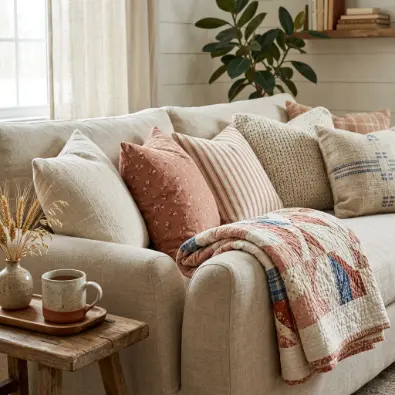
Why it works: Mixing pillow sizes (one 22-inch, one 18-inch, one lumbar) and fabrics within one tonal family creates depth without visual noise — a principle called tonal layering, where texture does the work color usually does. A folded quilt across the arm breaks the sofa’s straight lines.

How to get it: Choose three pillow covers in linen, waffle-weave cotton, and a small block-print pattern, all within warm white to terracotta tones, and drape a vintage-style quilt diagonally across one arm.

Shop the Look

Product
Linen throw pillow cover set of 3
Waffle weave cotton lumbar pillow cover
Block print quilted throw blanket
Dried wheat stem bundle decor
Ceramic stoneware mug with earthy glaze

5. Slipcovered Sectional with Turned Legs

5. Slipcovered Sectional with Turned Legs

Vibe: The seating feels relaxed, like it was made to be sat on, not photographed.

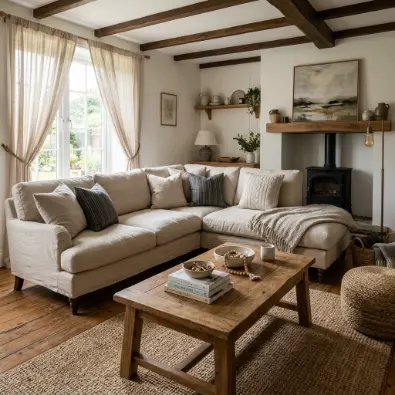
Why it works: Slipcovered upholstery softens what could otherwise be a boxy, oversized sectional silhouette, and exposed turned wood legs add a furniture-making detail that keeps the piece from reading as purely modern. Visible legs also lighten a large sofa’s visual weight by letting light pass underneath.

How to get it: Look for a sectional with a relaxed linen or cotton-blend slipcover and turned or tapered oak legs rather than upholstered skirting, which hides the floor and makes the room feel heavier.

💡 Quick Win: If reupholstering isn’t in the budget, a slipcover kit over an existing sectional achieves the same silhouette for a fraction of the cost.

Shop the Look

Product
Linen slipcover sectional sofa turned legs
Woven jute pouf ottoman round
Honey oak coffee table trestle base
Ceramic decorative bowl, neutral glaze
Neutral linen-bound coffee table books set

6. Charcoal Black Accent Wall

6. Charcoal Black Accent Wall

Vibe: The wall feels intimate, pulling the eye inward like a held breath.

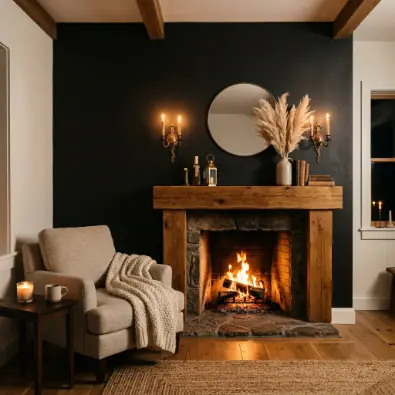
Why it works: A single dark wall behind a focal point uses contrast in reverse — instead of lighting a small room, it deepens one, making the fireplace or built-in the undeniable visual anchor. Matte black also absorbs light rather than reflecting it, which keeps the mood warm instead of stark.

How to get it: Paint only the fireplace or built-in wall in a warm-toned matte charcoal black, and keep the surrounding walls in warm white so the dark wall reads as intentional, not overwhelming.

Shop the Look

Product
Brass wall sconce candle holder set
Linen upholstered armchair natural
Dried pampas grass stems are tall
Wood mantel shelf unfinished oak
Black iron fireplace tool set

7. Reclaimed Wood Beam Ceiling

7. Reclaimed Wood Beam Ceiling

Vibe: Looking up feels grounding, like the room has a visible skeleton.

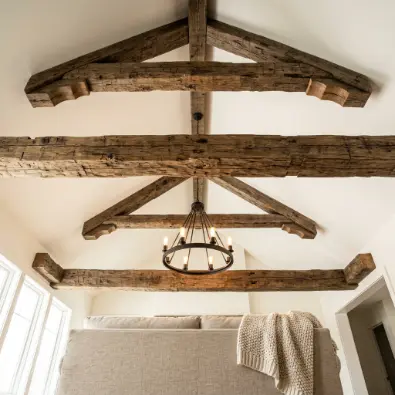
Why it works: Exposed beams add architectural texture at a plane most rooms leave untouched, drawing the eye upward and making ceilings feel taller by contrast against the white plane around them. Reclaimed wood’s saw marks and knots read as authentic in a way new lumber can’t replicate.

How to get it: Install faux or reclaimed wood beam wraps along the ceiling’s structural joists, spaced evenly, and leave the ceiling itself painted white so the beams stay the clear focal point.

💡 Quick Win: A single beam centered over the seating area gives the effect without the cost of wrapping the whole ceiling.

Shop the Look

Product
Reclaimed wood faux ceiling beam wrap
Black iron pendant light fixture
Ivory linen 3-seat sofa
White matte ceiling paint gallon
Woven wood tray decorative

8. Open-Concept Zoning with Area Rugs

8. Open-Concept Zoning with Area Rugs

Vibe: The room feels open but not aimless, each zone quietly defined.

Why it works: In open floor plans, a large-format rug acts as a floor-level boundary, telling the eye where the living zone starts and stops without walls — a layout principle called anchoring, where furniture legs sit at least partially on the rug to visually “claim” the space.

How to get it: Size the rug so all front legs of the sofa and chairs sit on it, extending 12–18 inches beyond the furniture on each side, and choose a natural jute or wool weave to keep the zone visually lighter than a solid dark rug would.

Shop the Look

Product
Taupe jute area rug 8×10
Ivory linen sofa track arm
Honey oak round coffee table
Woven seagrass storage basket
Natural fiber runner rug hallway

9. Gallery Wall of Botanical Prints

9. Gallery Wall of Botanical Prints

Vibe: The wall feels curated, as it grew there slowly over the years.

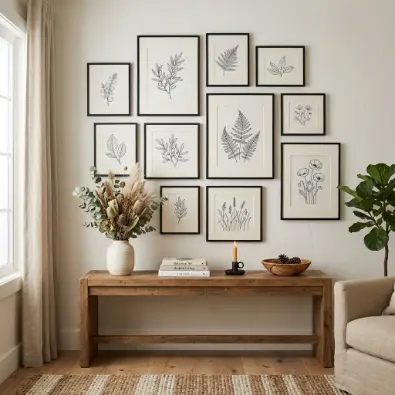
Why it works: An asymmetric gallery wall uses varied frame sizes and generous negative space between pieces to avoid looking cluttered, following the rule of keeping 2–3 inches of breathing room between frames so the eye can rest between images. Matching frame color (all black) unifies mismatched art subjects.

How to get it: Use uniform black wood frames in three sizes, arrange botanical or line-art prints with a shared cream matting, and lay the arrangement out on the floor first before hanging.

💡 Quick Win: Free printable botanical line art paired with $10 frames from a craft store achieves the look for under $60.

Shop the Look

Product
Black wood picture frame set, assorted sizes
Botanical line art print set
Wood console table narrow
Ceramic bud vase matte finish
Dried eucalyptus stem bundle

10. Terracotta and Cream Palette

10. Terracotta and Cream Palette

Vibe: The room feels sun-warmed, like clay left out in late afternoon light.

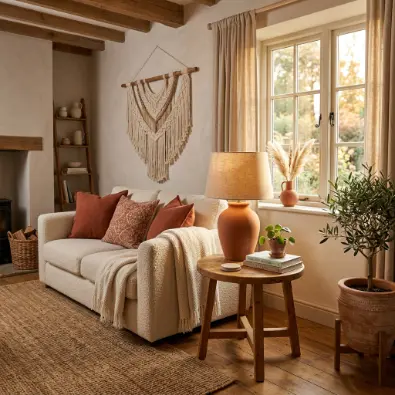
Why it works: Terracotta functions as a warm neutral rather than a bold accent, which is why it layers so easily with cream and oak without competing for attention — the earthy undertone in both keeps the palette cohesive rather than contrasting. This is a shift from the cooler, greige-heavy farmhouse palettes of a few years ago.

How to get it: Introduce terracotta through two or three items — a ceramic lamp base, one accent pillow, a woven wall hanging — rather than paint, so the warmth reads as intentional accent, not overwhelming color.

Shop the Look

Product
Terracotta ceramic table lamp base
Cream boucle throw pillow cover
Woven macrame wall hanging natural
Honey oak side table round
Ivory linen curtain panels

11. Layered Task and Ambient Lighting

11. Layered Task and Ambient Lighting

Vibe: The room feels hushed, lit in pools instead of one flat wash.

Why it works: Relying on a single overhead fixture flattens a room’s depth; layering ambient, task, and accent light at three different heights creates pools of light and shadow that make the space feel larger and more dimensional after dark. This is a lighting design principle borrowed directly from hospitality interiors.

How to get it: Add a brushed brass floor lamp beside the reading chair, a table lamp on the console, and dimmable overhead lighting set to warm 2700K so no single source does all the work.

💡 Quick Win: A $10 plug-in dimmer switch on an existing lamp gives you controllable ambient light without rewiring anything.

Shop the Look

Product
Brushed brass floor lamp arc
Ceramic table lamp, warm white shade
Plug-in lamp dimmer switch
Linen upholstered armchair
Chunky wool throw blanket cream

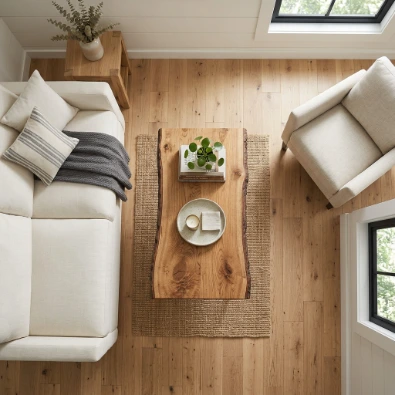
12. Live-Edge Coffee Table as Anchor

12. Live-Edge Coffee Table as Anchor

Vibe: The table feels raw, a slice of tree still visibly a tree.

Why it works: A live-edge slab introduces organic, irregular lines into a room otherwise built on straight furniture edges, creating contrast that keeps the space from feeling too uniform. Pairing it with thin black iron hairpin legs keeps the piece visually light despite its solid top.

How to get it: Choose a single-slab live-edge table in walnut or oak with exposed grain and knots left untreated, and set it on hairpin or trestle legs rather than a solid wood base to keep the silhouette light.

Shop the Look

Product
Live-edge wood coffee table hairpin legs
Ceramic decorative tray oval
Stacked hardcover coffee table books neutral
Small potted plant faux olive
Woven coaster set, natural fiber

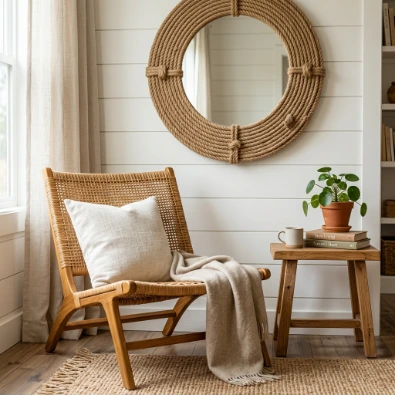
13. Woven Rattan and Jute Textures

13. Woven Rattan and Jute Textures

Vibe: The corner feels light, with a woven texture doing what a bold pattern usually would.

Why it works: Rattan and jute add texture-based visual interest without introducing new color, which keeps a neutral farmhouse palette from feeling flat or sterile. The open weave of rattan also reads as visually lighter than solid wood, useful for balancing heavier upholstered pieces nearby.

How to get it: Add one rattan-framed accent chair and one jute-wrapped mirror or lampshade in the same seating area so the woven texture repeats without becoming the room’s only focus.

💡 Quick Win: A jute-wrapped mirror frame kit can be added to an existing plain mirror for under $30.

Shop the Look

Product
Rattan woven accent chair natural
Jute-wrapped round wall mirror
Linen seat cushion cover natural
Wood side table round small
Woven rattan pendant lampshade

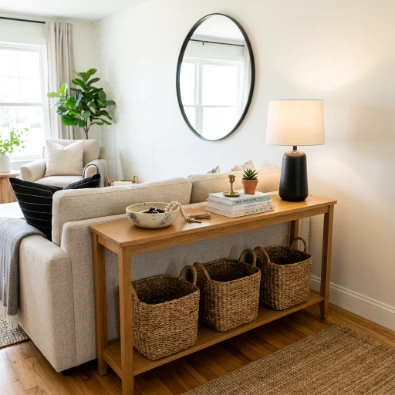
14. Multi-Functional Console Behind Sofa

14. Multi-Functional Console Behind Sofa

Vibe: The space feels efficient, every inch doing double duty without feeling tight.

Why it works: In small living rooms, a narrow console behind the sofa creates a defined back edge to the seating zone while adding hidden storage in woven baskets underneath — solving both a layout and a storage problem with one piece. A mirror above it also bounces natural light deeper into the room.

How to get it: Choose a console no deeper than 14 inches so it doesn’t crowd walking space, and add two woven baskets underneath for blankets or media instead of an open shelf that collects visual clutter.

Shop the Look

Product
Narrow wood console table 14 inch depth
Woven storage basket set of two
Round wall mirror with a black frame
Ceramic table lamp small
Ceramic catchall bowl entry

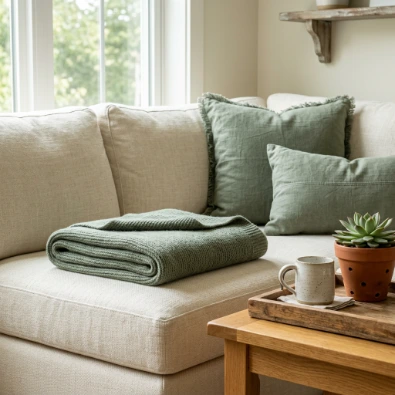
15. Sage Green Accent Pillows and Throws

15. Sage Green Accent Pillows and Throws

Vibe: The sofa feels still, a quiet green settling into a warm neutral room.

Why it works: Muted sage sits close enough to the room’s neutral palette in tone and saturation that it reads as an extension of the natural materials, not a competing color — unlike a saturated green, which would pull focus away from the wood and linen. It also echoes the botanicals typically styled nearby.

How to get it: Add sage through two pillow covers and one folded throw only, choosing a matte, slightly greyed sage rather than a bright kelly green to keep it in the same muted family as the rest of the room.

💡 Quick Win: A single sage green throw draped over one armrest updates a neutral sofa seasonally without buying new pillows.

Shop the Look

Product
Sage green linen throw pillow cover
Sage green wool throw blanket
Small potted plant faux fern
Wood serving tray round
Ceramic stoneware mug sage glaze

How to Start Your Modern Farmhouse Transformation

Start with paint, not furniture. A single gallon of warm white on your main wall — something with a slight yellow-beige undertone rather than a stark cool white — anchors every other decision, because your furniture, trim, and accent colors are chosen to sit against that base tone.

The most common beginner mistake is mixing cool-toned “farmhouse grey” with warm wood furniture. Cool undertones clash against honey oak and reclaimed wood, making the whole room feel visually off, even when every individual piece is correct. Fix it by testing paint swatches next to your actual wood tones before buying.

Three items under $50 that create immediate impact: a single stem of dried pampas grass in a matte black ceramic vase, a set of black iron curtain rod finials, and a chunky knit throw blanket in oatmeal wool blend draped over one armrest.

A starter refresh — paint, textiles, and lighting swaps — is realistically a weekend project costing $150–$400. A full room transformation with new furniture, shiplap, and beams takes 4–8 weeks and typically runs $2,500–$6,000, depending on whether furniture is reupholstered or replaced.

Frequently Asked Questions About Modern Farmhouse Living Rooms

What’s the difference between modern farmhouse and traditional farmhouse style?

Traditional farmhouse leans into heavier antiques, florals, and ornate details, while modern farmhouse strips decor down to clean lines and minimal accessories. Modern farmhouse also favors matte black hardware and iron over the brass and lace typical of traditional country decor. Think fewer knick-knacks, more negative space.

What color should I paint a modern farmhouse living room?

Warm white with a yellow-beige undertone, such as a shade in the Sherwin-Williams Alabaster or Benjamin Moore White Dove family, is the most common base wall color. Trim is typically painted two shades darker in greige for subtle contrast. Avoid cool, blue-based whites, which clash with warm wood tones.

How much does it cost to get a modern farmhouse living room?

A budget refresh using paint, textiles, and a few new accessories can run $200–$500. A mid-range update adding a slipcovered sofa and lighting typically costs $1,500–$3,000. A full renovation with shiplap, beams, and new furniture can reach $5,000–$10,000, depending on labor costs.

Does modern farmhouse work with other styles like boho or industrial?

Yes — modern farmhouse blends easily with boho through woven jute and rattan textures, and with industrial through black iron fixtures and exposed wood. The key is keeping one dominant material language (wood and linen) so the mix doesn’t feel like two unrelated rooms fighting for attention.

What’s the most important element in a modern farmhouse living room?

Texture layering is the single most important element — the mix of matte wood, woven fiber, and soft linen is what makes the style read as authentic rather than a paint color alone. A room with the “right” white walls but no textural variety will still look flat and generic.

Ready to Create Your Dream Modern Farmhouse Living Room?

These 15 ideas cover the full range from paint undertones and accent colors to lighting layers, furniture profiles, and small-space console tricks. You don’t need to do all of it at once, and starting with one wall or one lamp is genuinely the right way to begin. Tonight, pick up a sample pot of warm white paint and test it against your existing wood furniture before committing to a full gallon. Once the layers come together, the room will feel less like a showroom and more like a quiet place you actually want to sit still in. Save the ideas that pulled at you that whitewashed wall, that terracotta lamp because modern farmhouses reward the slow build, not the one-day overhaul.

You Might Also Like