
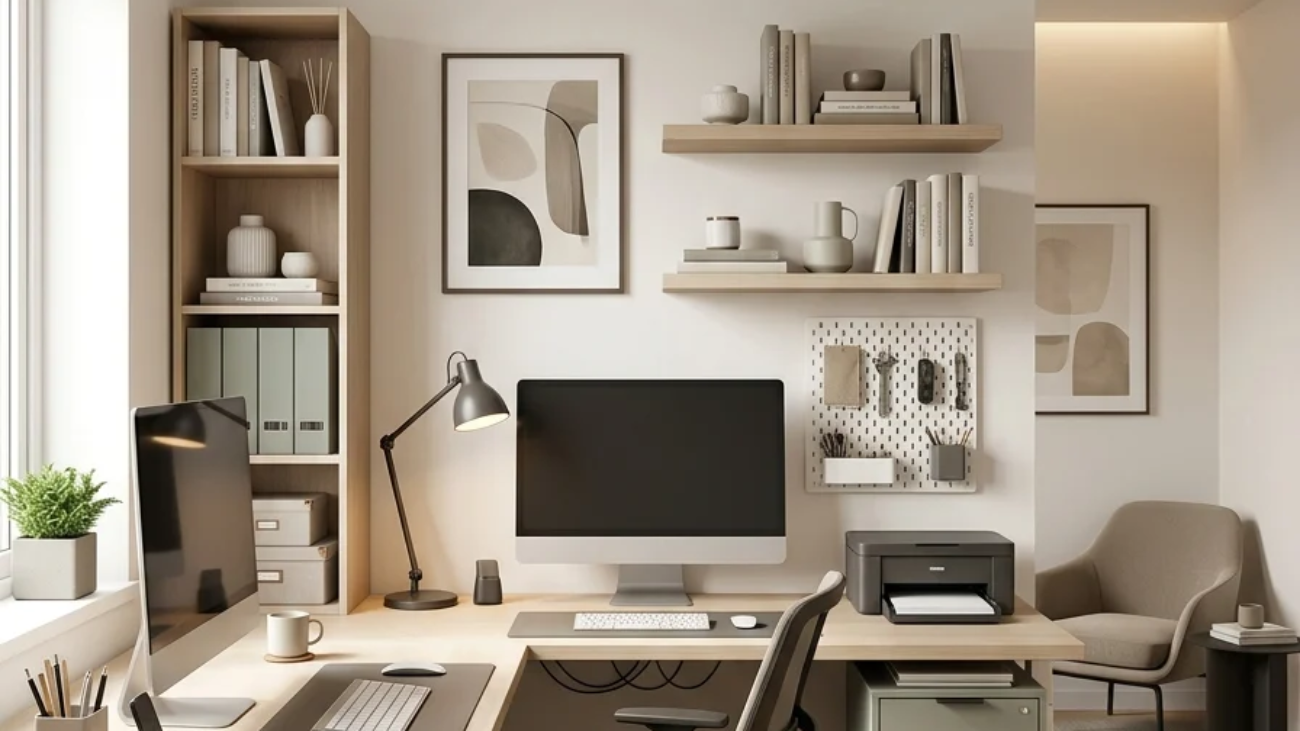
An efficient small business home office is a workspace built for running an actual business, not just remote employment: a desk that handles invoicing, a corner that photographs products accurately, and storage that keeps inventory and client files separate from everyday household clutter. This article gives you 15 genuinely efficient small business home office ideas covering material, color, lighting, and layout decisions built specifically for entrepreneurs working from home.
It feels like a room that takes the business as seriously as any storefront would: a locking file drawer for client contracts, a corner with light balanced enough to photograph a product accurately, a packing station that turns shipping into a five-minute task instead of a scavenger hunt for tape and boxes. This is a small business home office at its most functional: efficient, professional, built around the specific rhythms of running something rather than simply clocking hours. Every choice earns its place because a home business asks more of a room than a standard desk job ever does.
Here are 15 ideas worth saving and stealing.
Why an Efficient Small Business Home Office Works So Well
The home-based small business office draws from the rapid growth of solo entrepreneurship and e-commerce over the past two decades, which turned spare bedrooms and basement corners into genuine order fulfillment centers, client meeting spaces, and product studios almost overnight. What separates an efficient small business setup from a standard remote-employee home office is that it has to serve multiple distinct business functions client-facing, fulfillment, bookkeeping often within the same modest square footage a single desk job would otherwise occupy.
Core materials favor durable, functional surfaces: walnut or oak for a desk deep enough to hold both a laptop and paperwork, locking metal or wood file storage for client and financial documents, and neutral matte wall paint that keeps product photography color-accurate. Color stays deliberately restrained in camera-facing zones, with a business’s actual brand color introduced through smaller accents rather than the walls.
Style at a Glance
| Element | Core Trait 1 | Core Trait 2 |
| Philosophy | One room serving distinct business functions: client-facing, fulfillment, bookkeeping | Efficiency and professionalism prioritized over pure aesthetics |
| Materials | Walnut or oak desk, locking file storage | Neutral matte walls for accurate photography |
| Color Palette | Restrained neutral base | Brand color introduced through small accents |
15 Efficient Small Business Home Office Ideas
1. Choose a Walnut Desk Deep Enough for Laptop and Paperwork
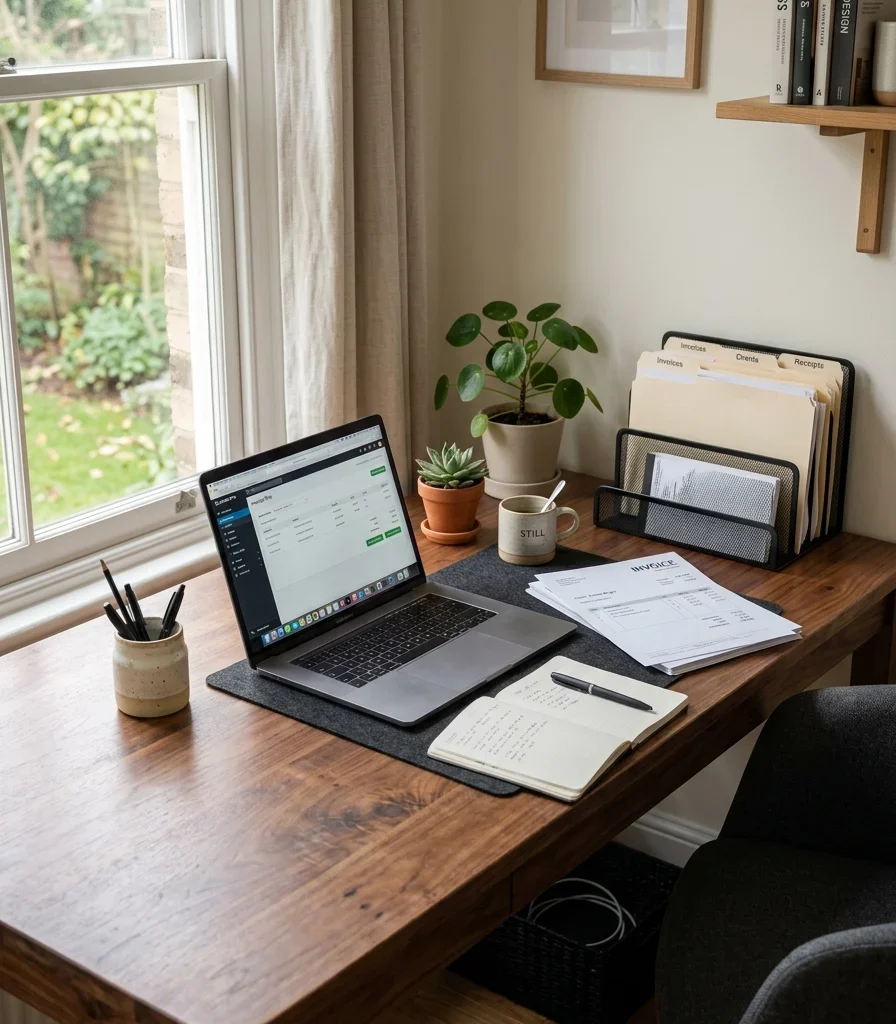
Vibe: Still a desk with enough surface that invoicing and screen work never have to compete for the same six inches.
Why it works: Desk depth is a proportion principle that matters specifically for a small business, since the same surface has to hold a laptop, physical paperwork, and often a card reader or shipping label printer at once. A standard 24-inch desk crowds these functions together, while a 30-inch or deeper desk gives each its own defined zone without constant shuffling.
How to get it: Choose a solid walnut or walnut-veneer desk at least 30 inches deep and 60 inches wide, positioning a small filing tray permanently on one side so paperwork has a fixed home rather than spreading across the whole surface.
💡 Quick Win: A desk depth extension shelf under $40 adds functional surface area to an existing shallower desk without full replacement.
Shop the Look
| Product |
| Extra deep walnut desk 30 inch |
| Matte black desk organizer tray |
| Small ceramic pen cup |
| Desk depth extension shelf |
| Cable management tray under-desk |
2. Paint a Warm Charcoal Video-Call Backdrop Wall
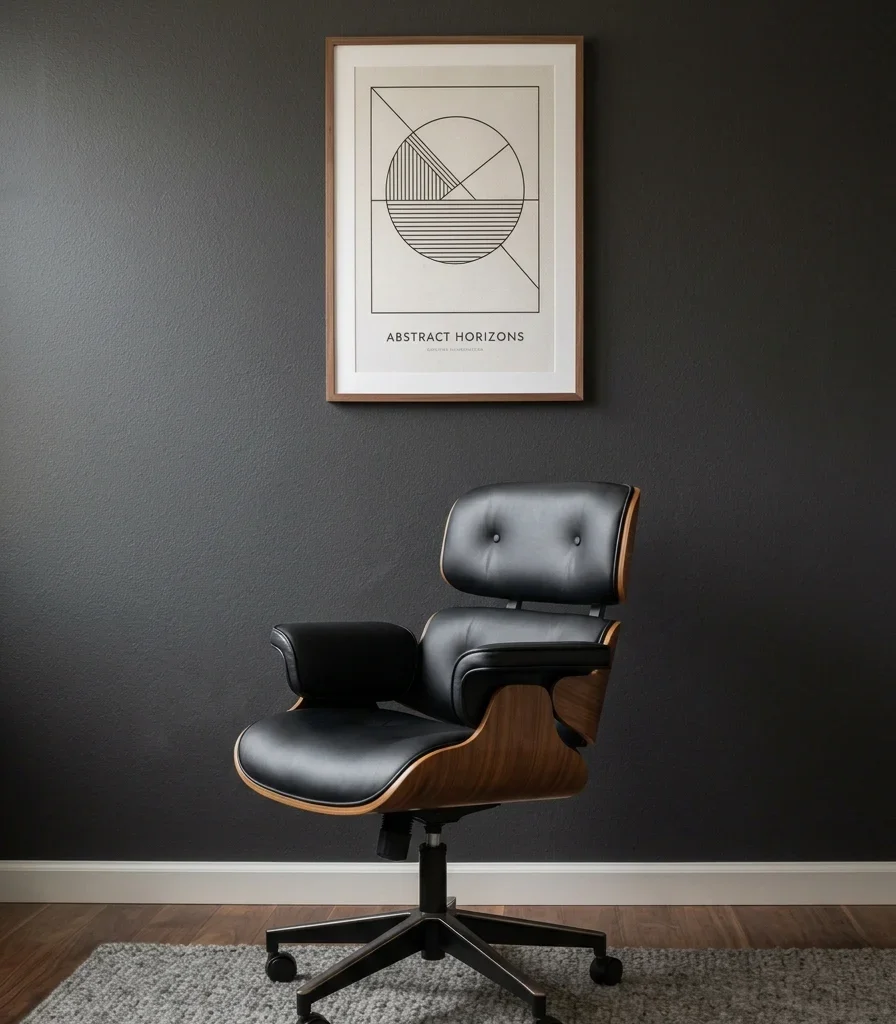
Vibe: Grounded a wall that reads as deliberate and professional the moment a client’s screen loads.
Why it works: A matte charcoal wall behind the desk chair applies contrast and light-behavior principles specifically for video-call professionalism; plain wall photographs as flat and unfinished on camera, while a saturated matte tone gives the frame depth and reads as an intentional backdrop rather than whatever happened to be behind the desk.
How to get it: Paint only the wall section directly behind where the desk chair sits (not the whole room) in matte warm charcoal, keeping decor in that frame minimal one framed print or a single shelf since a busy backdrop distracts from a client call more than a plain one.
Shop the Look
| Product |
| Warm charcoal matte wall paint |
| Small framed abstract print |
| Matte black picture frame |
| Painter’s tape precision edge |
| Warm white ceiling light |
3. Add a Packing and Shipping Station Cart
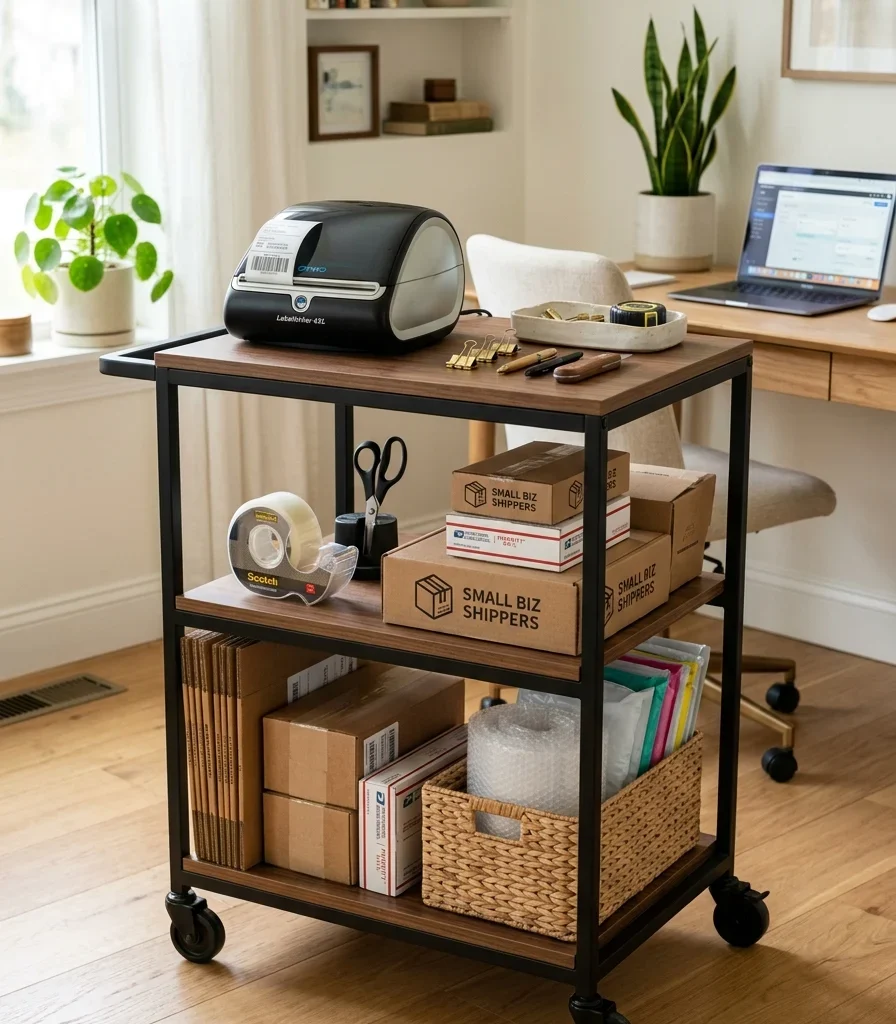
Vibe: Functional, with very shipping supplies within one rolling reach instead of scattered across three different closets.
Why it works: A dedicated cart applies furniture-arrangement thinking to a task most home offices never anticipate: order fulfillment requires boxes, tape, a label printer, and packing material all at once, and a rolling cart with tiered storage keeps every component together and mobile, rather than requiring a fixed packing table that would occupy permanent floor space.
How to get it: Choose a cart with at least three tiers, dedicating one specifically to a label printer and shipping supplies, one to boxes in common sizes, and one to packing material, rolling it out only when fulfilling orders and tucking it against a wall otherwise.
Shop the Look
| Product |
| Rolling shipping station cart |
| Label printer stand |
| Small ceramic supply tray |
| Packing tape dispenser |
| Caster wheel lock set |
4. Add Adjustable Lighting for Product Photos and Calls
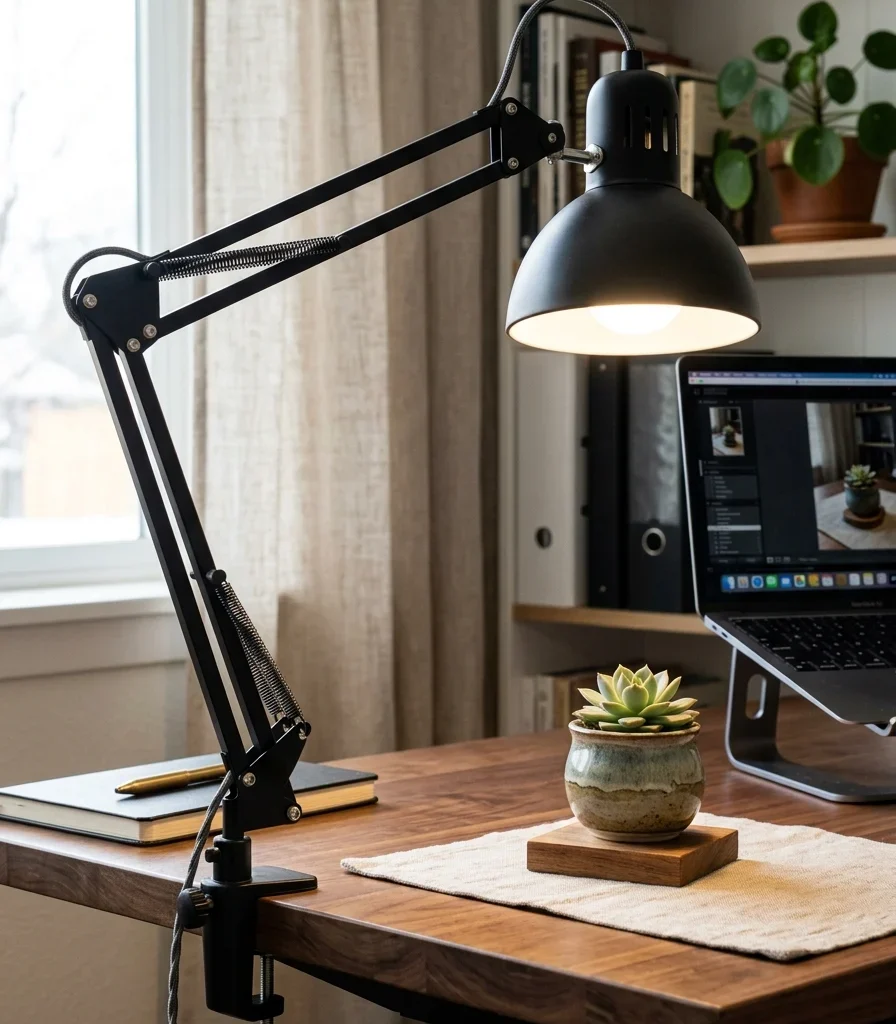
Vibe: Functional one light doing double duty for a client call in the morning and a product photo in the afternoon.
Why it works: A daylight-balanced (5000–5600K) adjustable lamp applies light-behavior principles that serve two distinct business needs at once: he same neutral, even light that flatters a face on a video call also renders product colors accurately for photography, which matters because inconsistent lighting between listing photos makes a small shop’s catalog look unprofessional.
How to get it: Choose a lamp with a genuine daylight-balanced bulb (5000–5600K, labeled specifically for photography or color-accurate work) rather than a standard warm 2700K desk bulb, mounted on an articulated arm that swings between the call position and a small product staging area.
Shop the Look
| Product |
| Daylight-balanced articulating lamp |
| 5000K photography bulb |
| Small product staging riser |
| Matte black lamp clamp mount |
| White foam board reflector |
5. Add a Cork or Felt Bulletin Wall for Order Tracking
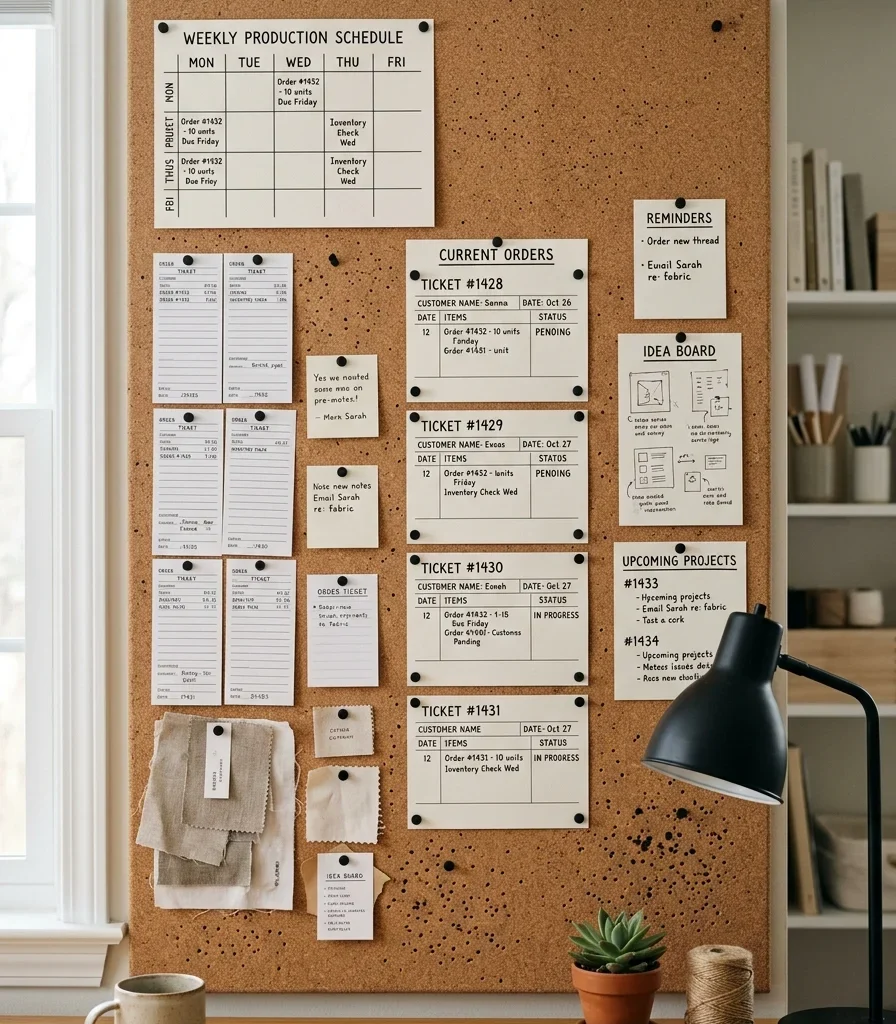
Vibe: An organized wall that holds every active order at a glance instead of scattered sticky notes across the desk.
Why it works: A dedicated bulletin wall applies material honesty to a genuinely business-specific need, unlike a personal to-do list; small business order tracking often involves multiple simultaneous jobs at different stages, and a large cork or felt surface gives each order a visible, physical status marker that a digital list alone doesn’t provide at a glance.
How to get it: Install a cork or felt panel at least 3×2 feet near the desk, organizing pinned items into columns by status (new, in progress, shipped) rather than a single unsorted cluster, and clear completed orders weekly so the board stays genuinely useful.
Shop the Look
| Product |
| Large cork bulletin panel |
| Felt pin board alternative |
| Matte black push pin set |
| Order ticket printable template |
| Oak wood frame trim |
6. Style a Branded Stationery Tray for Invoices and Mail
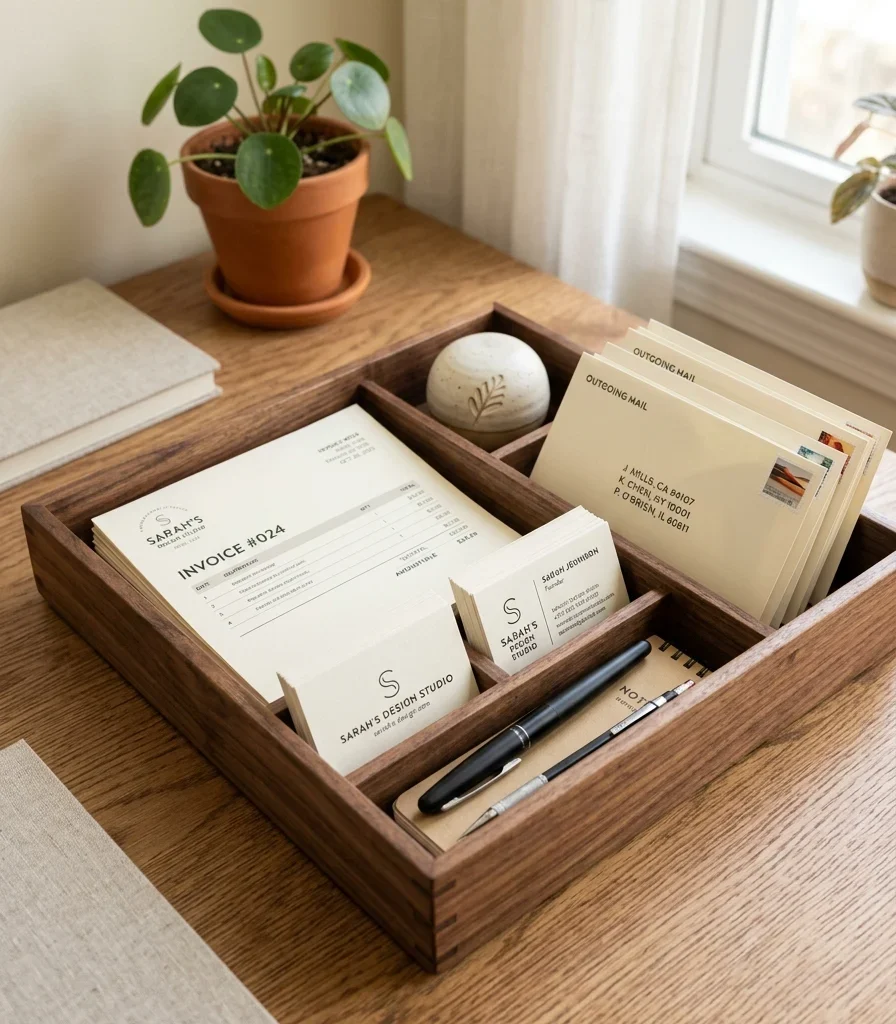
Vibe: Tidy paperwork with a fixed, visible home instead of drifting into a general desk pile.
Why it works: A dedicated stationery tray applies accessory-layering to the specific paper flow a small business generates: invoices to send, business cards to hand out, mail to post. Separating these from personal desk clutter, which matters because financial and client paperwork needs to stay identifiable and not get lost among household mail.
How to get it: Choose a tray with at least two compartments, reserving one exclusively for outgoing business mail and invoices and the other for business cards or promotional material, clearing both to zero at the end of each week.
Shop the Look
| Product |
| Walnut two-compartment stationery tray |
| Business card holder walnut |
| Small ceramic paperweight |
| Envelope organizer insert |
| Matte black letter opener |
7. Introduce a Consistent Brand-Color Accent Throughout

Vibe: Warm a color that quietly reinforces the business’s own identity every time a client sees the room.
Why it works: Repeating a business’s actual brand color as a small office accent is a color-layering principle that reinforces brand consistency even in an informal home setting. Appearing subtly in the room on client calls or in product photography backgrounds, it extends the business’s visual identity beyond the logo alone.
How to get it: Apply the brand color to exactly three small objects: a desk accessory, a chair cushion, and a small print, keeping every larger surface (walls, desk, flooring) neutral so the accent reads as deliberate rather than overwhelming the room.
Shop the Look
| Product |
| Terracotta desk accessory set |
| Terracotta chair cushion |
| Small framed print terracotta |
| Small ceramic accent vessel |
| Walnut desk accent trim |
8. Build a Small Photography Corner With a Seamless Backdrop
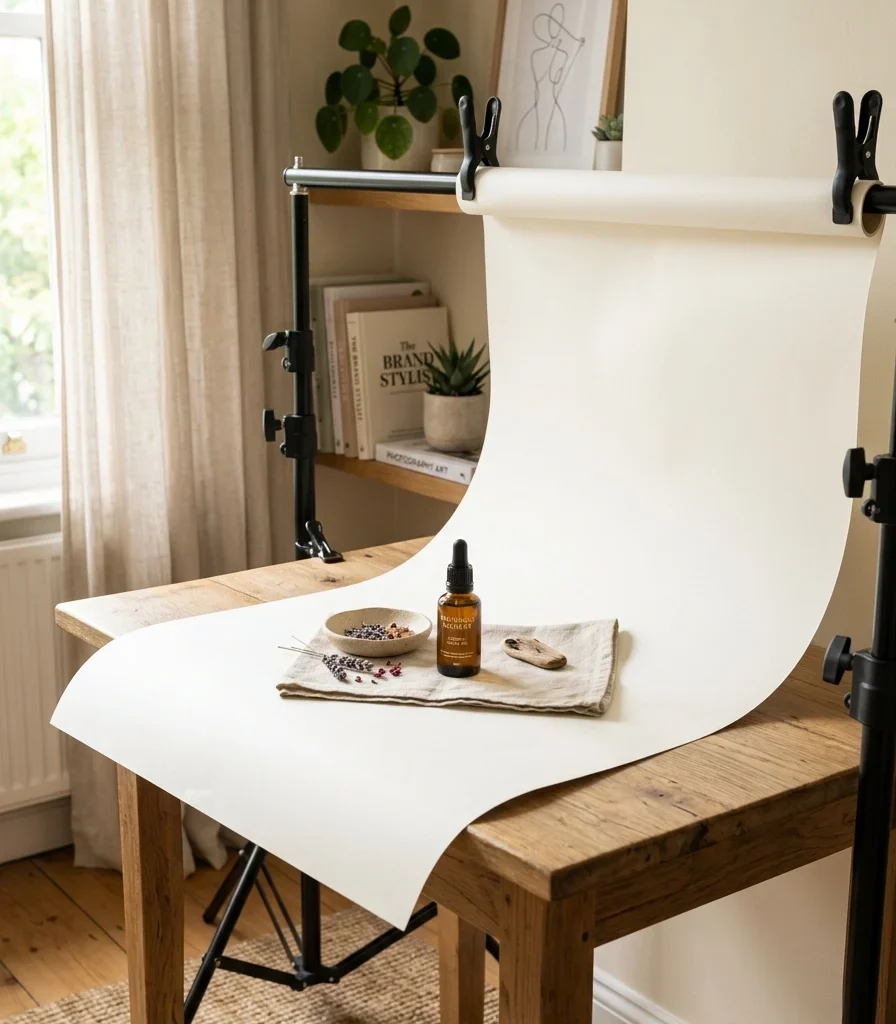
Vibe: Still a dedicated corner that turns product photography into a repeatable five-minute setup instead of a fresh negotiation every time.
Why it works: A permanent (or quickly reassembled) photography corner applies furniture-arrangement thinking to a specific and recurring business task rather than clearing a table and improvising lighting for every product shoot; a fixed backdrop and staging surface removes the setup friction that causes many small business owners to skip regular photography entirely.
How to get it: Mount a seamless paper backdrop roll on a wall-mounted stand in a corner with good natural or daylight-balanced artificial light, pairing it with a small stable table at a consistent height so lighting and framing stay repeatable from shoot to shoot.
💡 Quick Win: A tabletop light tent under $40 achieves consistent, even lighting for small products without a full backdrop setup.
Shop the Look
| Product |
| Seamless paper backdrop roll |
| Wall mount backdrop stand |
| Small photography styling table |
| Tabletop light tent |
| Small ceramic photo prop set |
9. Add Daylight-Balanced Lighting for Accurate Product Photography
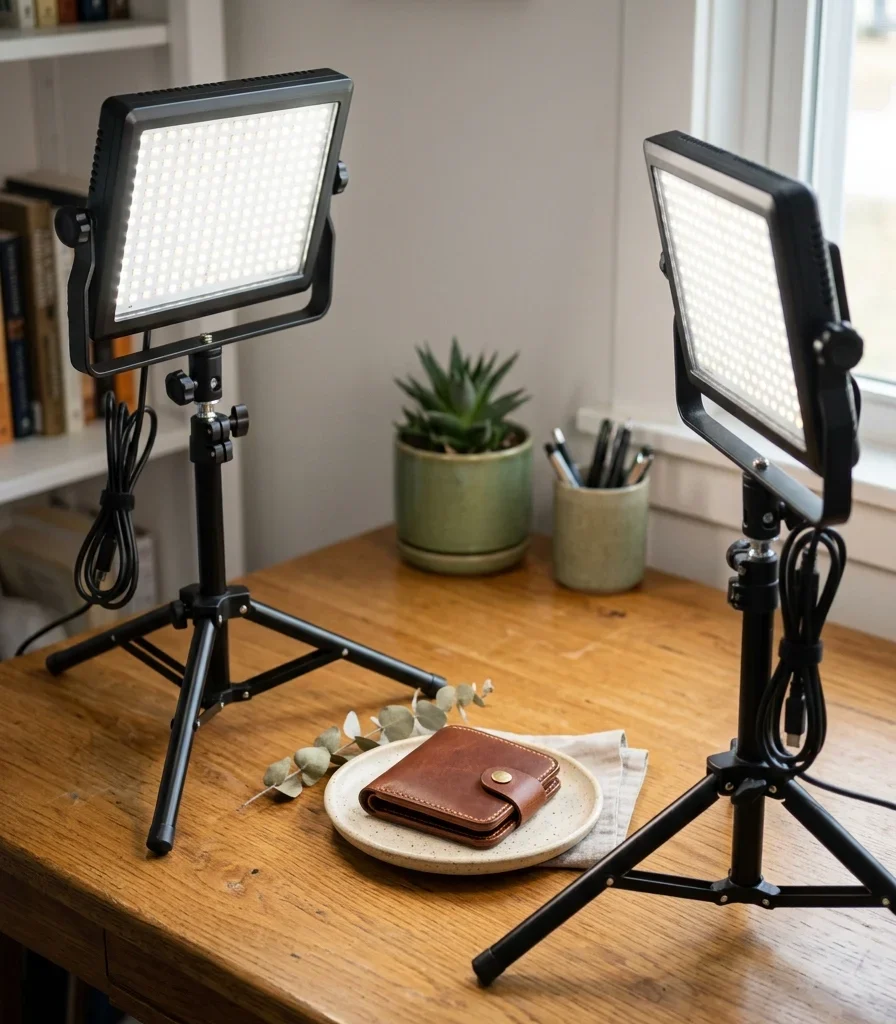
Vibe: Functional light consistent enough that every product photo in a shop’s catalog looks like it came from the same session.
Why it works: Dedicated daylight-balanced panel lighting is a light-behavior principle distinct from the earlier adjustable desk lamp; here that lamp serves double duty for calls and quick shots; a proper two-panel LED setup gives serious product photography even, shadow-free light from two directions, which single-source lighting can’t achieve regardless of its color temperature.
How to get it: Position two daylight-balanced LED panels at roughly 45-degree angles on either side of the product staging table, both set to the same 5000K color temperature and brightness so shadows fall evenly rather than harshly on one side.
Shop the Look
| Product |
| Daylight-balanced LED panel pair |
| Panel light stand set |
| Small product staging table |
| White foam board reflector |
| Small ceramic photo prop |
10. Install a Locking File Cabinet for Client and Financial Documents
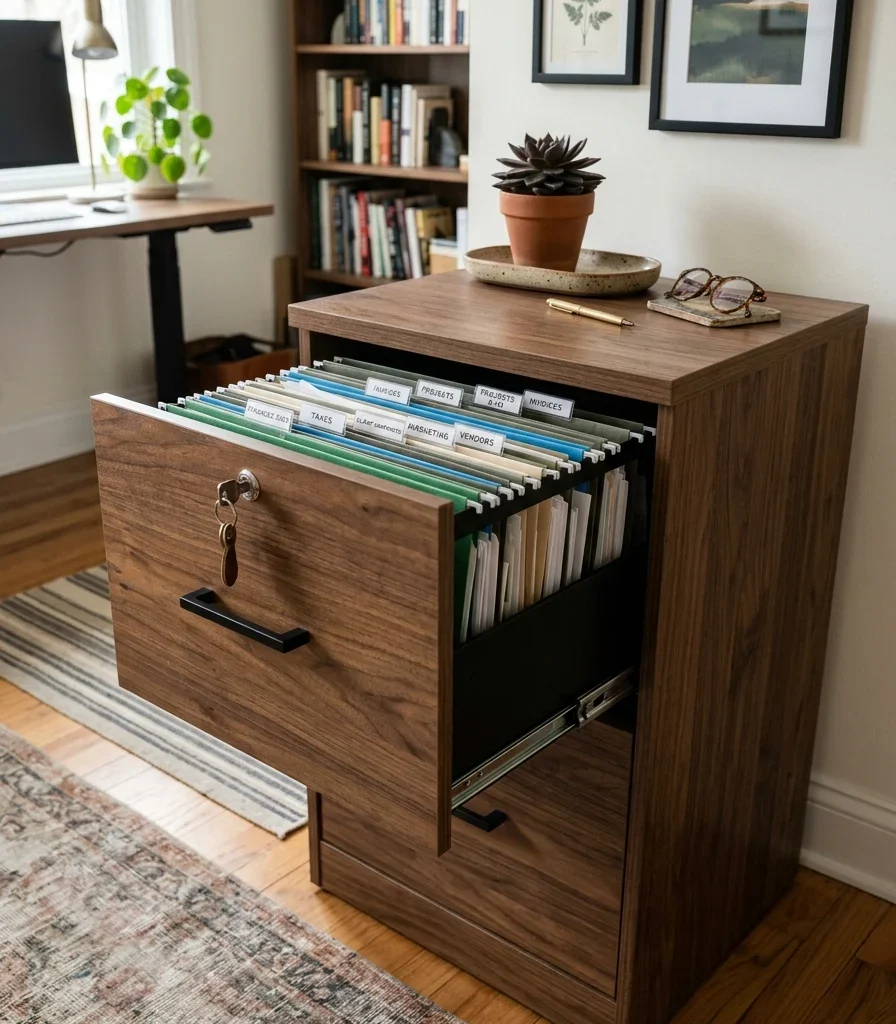
Vibe: Still a cabinet with genuine security, holding client contracts and financial records the way a business, not a household, requires.
Why it works: A locking file cabinet addresses a material and security need specific to running a business from home that a standard employee’s home office never has to solve: client contracts, tax documents, and financial records need protection from household members, guests, and general household disorganization in a way personal paperwork typically doesn’t.
How to get it: Choose a walnut or matte black locking two-drawer cabinet with full-extension slides rated for hanging files, storing the key somewhere separate from the cabinet itself, and label folders by client or fiscal year for quick retrieval.
Shop the Look
| Product |
| Locking walnut file cabinet |
| Hanging file folder set labeled |
| Small ceramic desk tray |
| Full extension drawer slide |
| Matte black cabinet lock hardware |
11. Keep One Wall Neutral to Protect Product Photo Accuracy
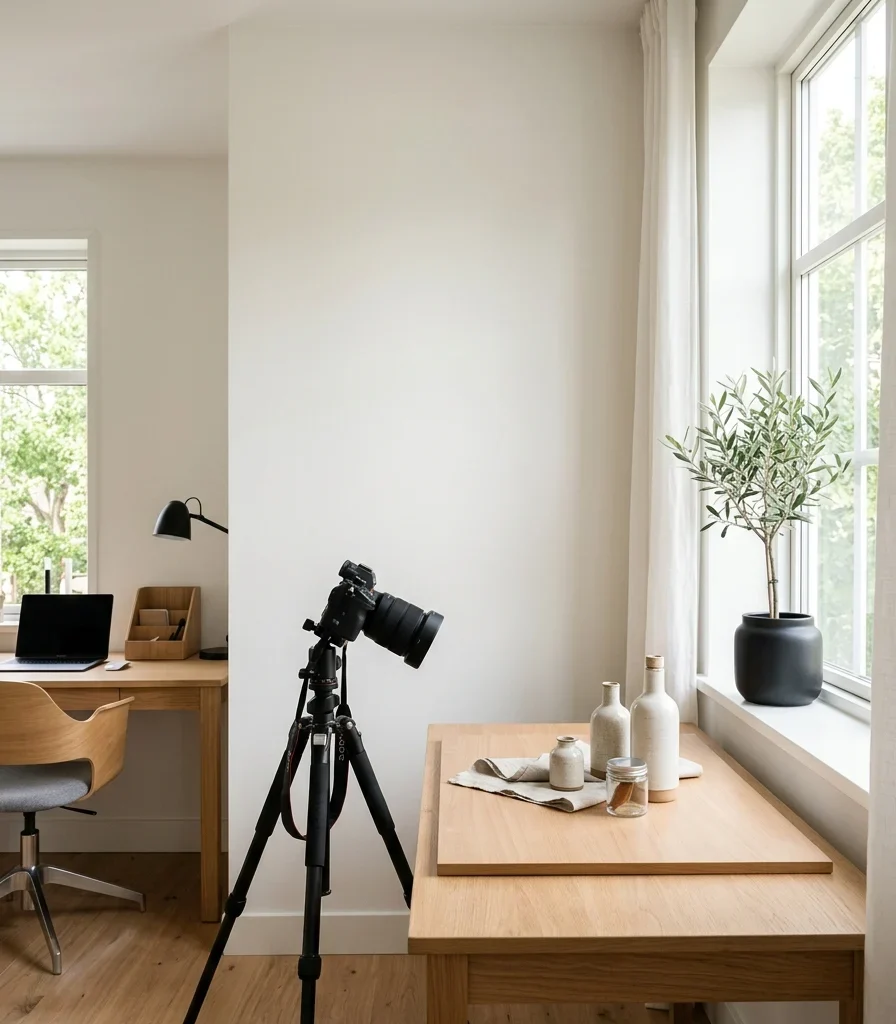
Vibe: Fresh, a wall left intentionally plain because its job is staying out of the way of every product photo taken in front of it.
Why it works: Colored or patterned walls reflect their own hue onto anything photographed nearby, a light-behavior principle that causes color-cast problems in product photography most small business owners don’t realize until their listing photos look subtly off. A neutral warm white wall avoids this entirely, keeping product colors true regardless of what’s being photographed against it.
How to get it: Reserve one wall near the photography corner in a true neutral warm white with no undertone strong enough to cast color, testing it by photographing a plain white object against it and checking whether the object’s white balance shifts.
Shop the Look
| Product |
| True neutral warm white paint |
| Color accuracy test card |
| Small photography styling table |
| Matte black backdrop clamp |
| White foam board reflector |
12. Style an Inventory Shelf With Labeled Bins
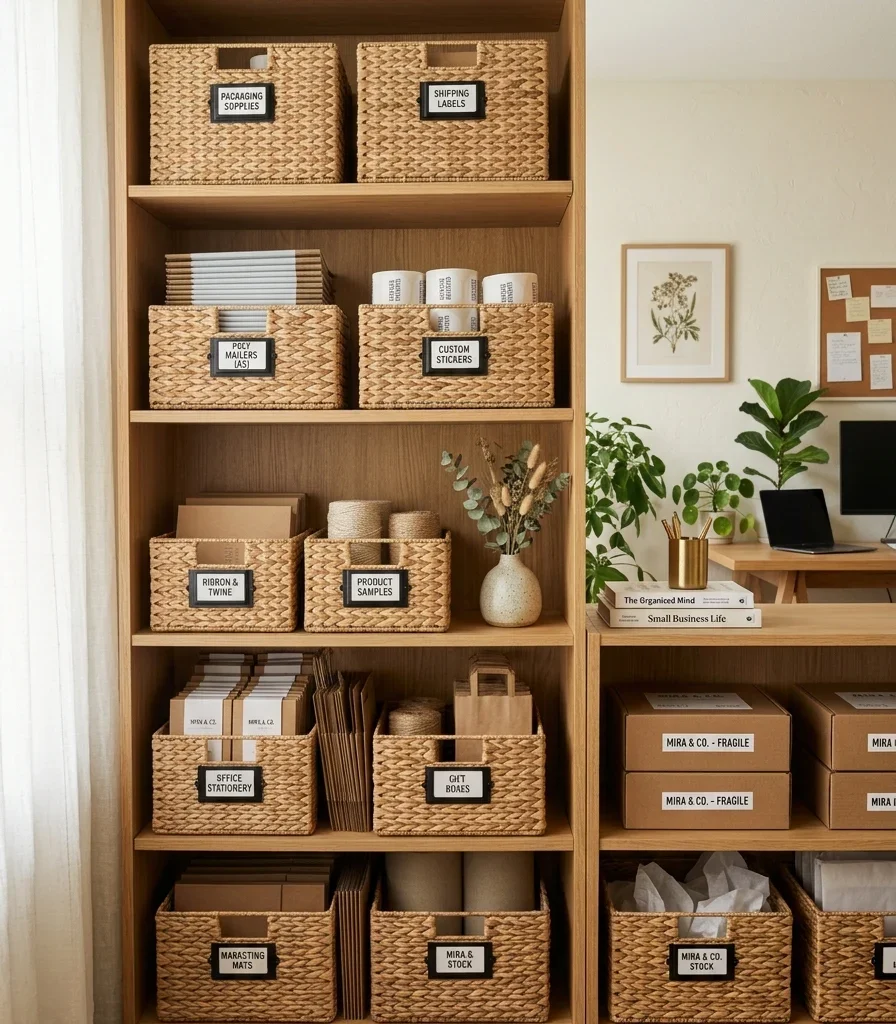
Vibe: Layered inventory with a genuine tracking system instead of a growing pile in the corner of the room.
Why it works: Labeled inventory bins apply the same organizational logic as the earlier bulletin wall but to physical product rather than paperwork. A small business managing even modest stock needs a visible, categorized system, since an unlabeled pile makes it nearly impossible to know what’s actually in stock without physically digging through it.
How to get it: Use one bin per product line or SKU category, labeling each clearly with both the product name and current quantity on a small whiteboard tag that updates as stock moves, positioned on open shelving rather than closed cabinets so inventory levels stay visible at a glance.
Shop the Look
| Product |
| Open oak shelving unit |
| Woven inventory storage bin set |
| Whiteboard label tag set |
| Small ceramic accent piece |
| Bin quantity tracker cards |
13. Add a Fold-Down Table for Occasional Client Consultations
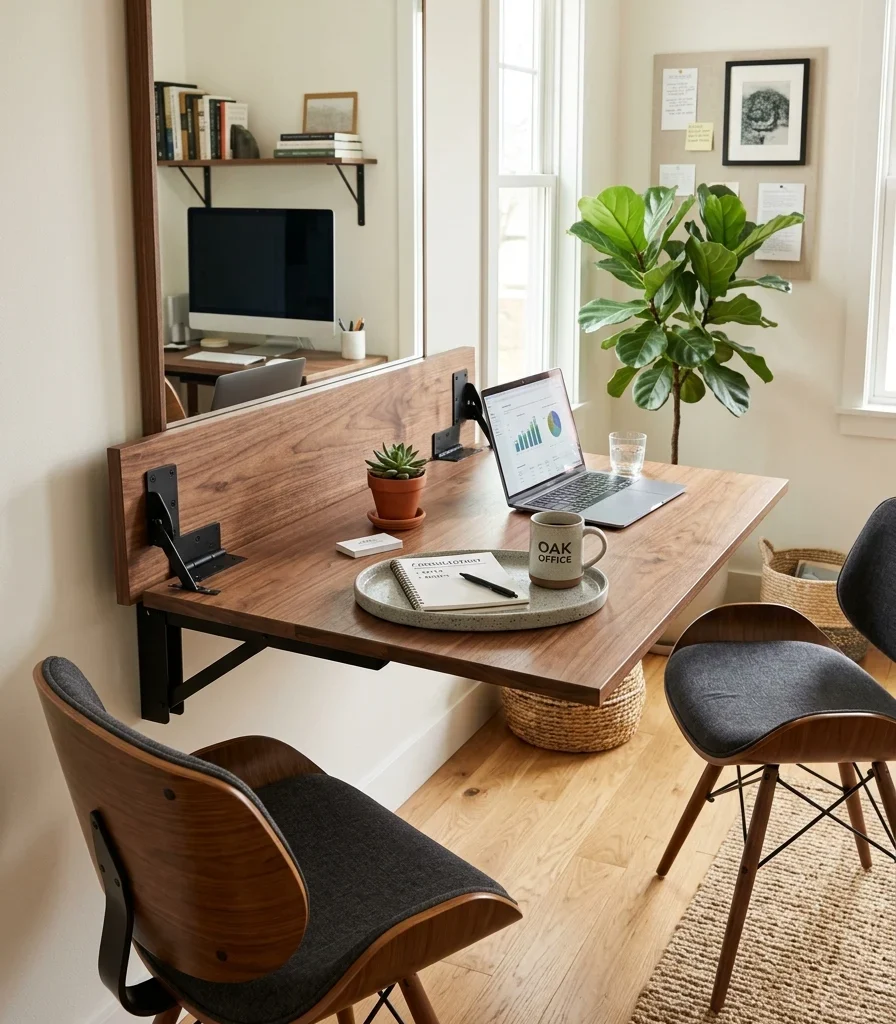
Vibe: Functional: a meeting table that exists only when a client is actually sitting at it, folding away the rest of the time.
Why it works: A fold-down table applies dual-function furniture thinking to the specific, occasional need of in-person client meetings. Most home-based businesses don’t need a permanent conference table taking up floor space daily, but a fold-down surface provides that function on the rare occasion it’s genuinely needed without sacrificing the room’s everyday layout.
How to get it: Mount a fold-down table on a wall with enough clearance for two chairs when extended, choosing a hinge rated for repeated daily use, and keep two stackable chairs nearby specifically for this purpose rather than repurposing the desk chair.
Shop the Look
| Product |
| Fold-down wall-mounted table |
| Stackable client chair pair |
| Matte black fold hinge hardware |
| Small ceramic serving tray |
| Walnut table surface finish |
14. Separate the Client-Facing Zone From the Fulfillment Zone
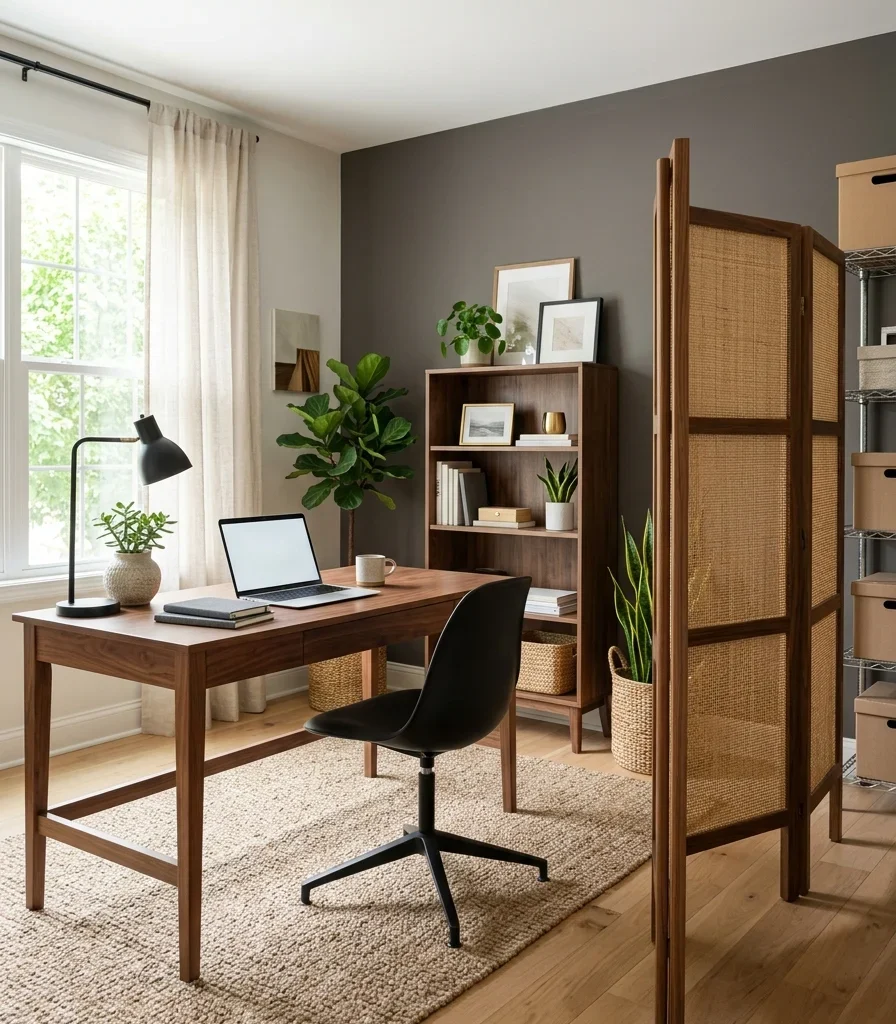
Vibe: An airy room that keeps its polished side facing forward while the working mess stays genuinely out of view.
Why it works: Physically separating the video-call and client-facing desk area from the packing, inventory, and shipping zone is a traffic-flow and zone-definition principle unique to a small business office. Unlike a standard home office, this room has to look camera-ready on one side while functioning as a working fulfillment center on the other, and a folding screen or simple furniture placement keeps those two functions from visually colliding.
How to get it: Position the desk and video-call backdrop wall facing away from the packing cart and inventory shelving, adding a folding screen between the two zones if they’re within the same sightline, so a client call never accidentally shows shipping boxes in the background.
Shop the Look
| Product |
| Folding room divider screen |
| Walnut desk client-facing |
| Matte black screen hardware |
| Small ceramic vessel client zone |
| Warm charcoal backdrop paint |
15. Convert a Closet Into a Compact Business Office
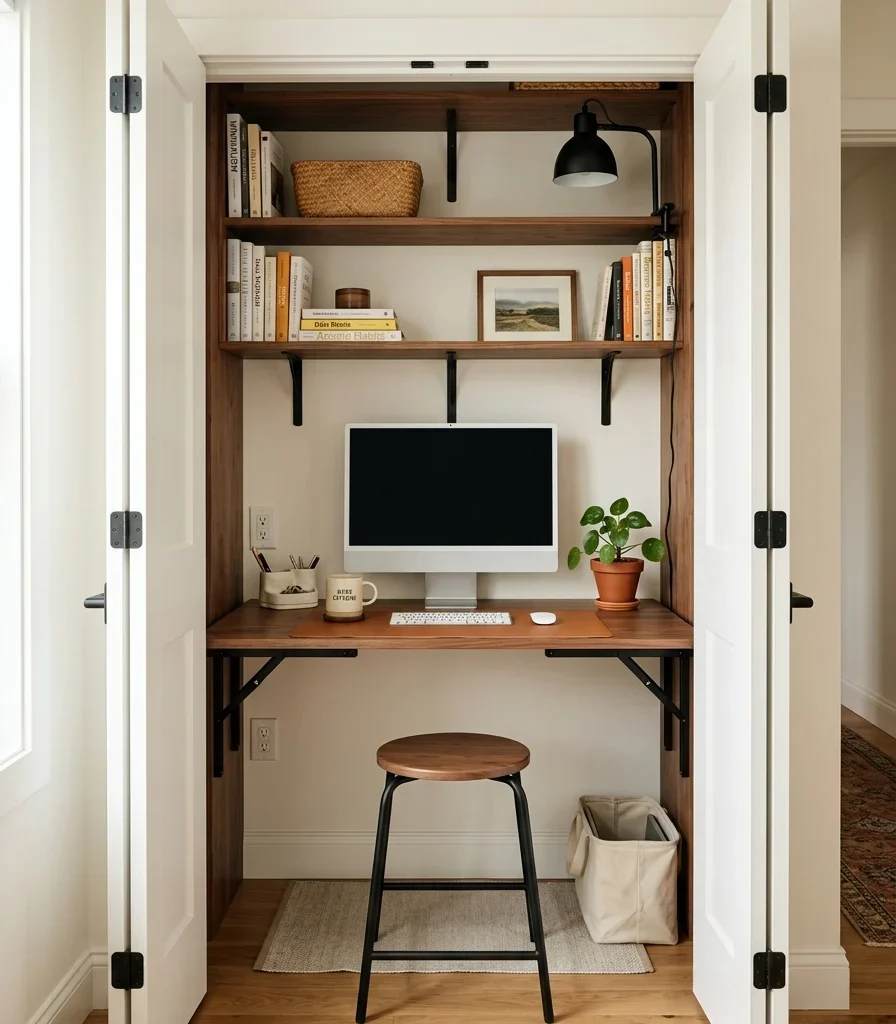
Vibe: Still a full working business setup that closes its doors and disappears the moment the workday ends.
Why it works: In a genuinely small home without a spare room to dedicate, a closet conversion is the small-space adaptation that concentrates desk, storage, and even light shipping supplies into a footprint that closes away entirely this matters specifically for a business owner sharing living space, since the closet doors provide the same visual containment a folding screen offers, but with a hard boundary that fully hides the workspace.
How to get it: Fit a fold-out desk surface at standard desk height inside the closet, with shelving above and below for supplies and files, and choose closet doors that open a full 180 degrees so the desk area has genuine working clearance when in use.
💡 Quick Win: A slim wall-mounted fold-up desk inside an even shallower closet nook achieves the same closed-office effect in a genuinely tiny space.
Shop the Look
| Product |
| Fold-out closet desk system |
| Fitted closet shelving unit |
| Matte black fold hardware |
| Small ceramic desk organizer |
| Slim fold-up wall desk |
How to Start Building Your Efficient Small Business Home Office
Your one first move is installing a locking file solution before any other purchase, specifically, a locking two-drawer cabinet for client contracts and financial documents. Since this addresses a genuine security and liability need unique to running a business, it should be settled before any desk, lighting, or photography setup that follows.
The most common mistake is treating a small business home office exactly like a standard remote-employee setup, buying only a desk and monitor while ignoring the fulfillment, storage, and client-facing needs a business actually generates. The fix is mapping every distinct function the room needs to serve: desk work, calls, packing, photography before furnishing any single zone.
Three items under $50 that create immediate impact: a walnut two-compartment stationery tray for invoices and mail, a set of labeled woven inventory bins, and a color accuracy test card to check your product photography wall.
A weekend refresh: stationery tray, bulletin wall, and lighting swap costs $150–450. A full efficient small business home office with a locking file cabinet, photography corner, and packing station typically runs $1,200–3,500 and can be set up over two to three weekends.
Frequently Asked Questions About Efficient Small Business Home Offices
What is the difference between a small business home office and a standard remote-work home office?
A standard remote-work home office is built around a desk, chair, and monitor for a single employee’s daily tasks. A small business home office has to additionally support client-facing video calls, order fulfillment or packing, inventory storage, and often product photography, requiring distinct zones within the same room rather than one unified workstation.
What color works best for a small business home office used for video calls?
A matte warm charcoal wall behind the desk chair works best for video calls, since it reads as an intentional backdrop rather than a blank wall, while a separate neutral warm white wall should be reserved specifically for any product photography zone to keep colors accurate in listing photos.
How much does it cost to set up an efficient small business home office?
A budget refresh using a stationery tray, inventory bins, and lighting costs $150–500. A mid-range setup with a locking file cabinet and a photography corner runs $1,200–2,500, and a full setup including a packing station cart and a fold-down client table typically costs $2,500–4,500 depending on furniture and equipment quality.
Can a small business office work inside a shared or multi-use room?
Yes, separating the client-facing desk zone from the fulfillment and packing zone with a folding screen, or converting a closet into a self-contained office that closes its doors at day’s end, both let a small business function fully without requiring a dedicated spare room.
What is the single most important addition for a home-based small business office?
A locking file cabinet is the most important single addition, since it’s the one need a small business genuinely has that a standard home office setup doesn’t: protecting client contracts and financial records is both a professional and often legal responsibility that a household desk drawer was never designed to handle.
Ready to Build Your Efficient Small Business Home Office?
These 15 ideas move across material, color, lighting, layout, and true small-space solutions, rom a locking file cabinet and a dedicated photography corner to a closet conversion that closes its doors on the whole operation at day’s end. None of this needs to happen all at once, and starting with a locking file drawer and one stationery tray is genuinely the smartest place to begin, not a smaller version of the full setup. Today’s specific action: list out every distinct task your business actually requires this room to do calls, packing, invoicing, photography and check which one currently has no dedicated space at all, since that gap is where to start. Once the room finally has a defined place for every part of running the business, sitting down to work will feel less like managing chaos in a spare bedroom and more like operating from a space built specifically to hold the business you’re actually running. Save the ideas that fit your business’s real workflow and your room’s actual footprint; that locking file drawer and labeled inventory shelf will still be earning their keep a year from now.
[…] 15 Efficient Small Business Home Office Ideas […]