
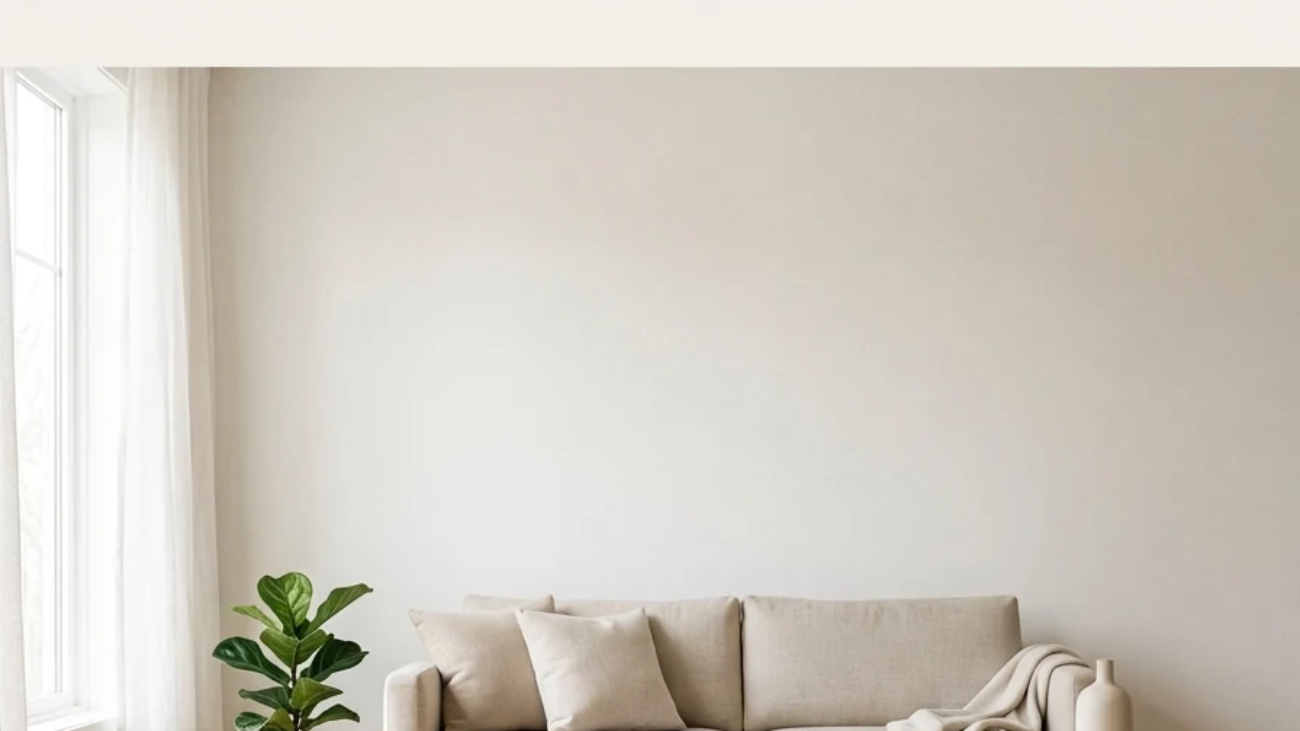
Minimalist home decor strips a room down to what’s functional, well-made, or both, trusting restraint over accumulation to create calm. This article gives you 13 minimalist home decor ideas, from wall color to lighting to storage, built to work across an entire home rather than one room alone.
The feeling is unmistakable: a wall left intentionally bare, one ceramic vessel holding all the room’s ornament, light falling evenly across a floor with nothing interrupting it. Minimalist decor doesn’t feel empty; it feels edited, every remaining object carrying real weight. Here are 13 ideas worth saving and stealing.
Why Minimalist Home Decor Ideas Work So Well
What is it? Minimalist decor traces to the 1960s minimalist art movement, Donald Judd and Agnes Martin among its clearest architectural influences, crossed with Japanese Zen aesthetics and Bauhaus functionalism, all of which valued removing anything that didn’t serve a room’s core purpose. What separates it from Scandinavian minimalism is austerity: Scandinavian design still leans on hygge warmth and layered texture, while true minimalism accepts a starker, more architectural restraint.
What are its core materials and colors? The palette runs warm white, soft greige, and warm charcoal reserved for a single accent wall. Materials stay honest and consistent: unfinished white oak, honed concrete or micro-cement, and brushed steel, chosen for how few material transitions they create room to room. Nothing decorative is added without a functional reason behind it.
Why is it trending now? The decluttering movement that gained mainstream traction through the 2010s has evolved into a broader “quiet luxury” aesthetic, with Pinterest search interest in minimalist interiors climbing as people prioritize fewer, better-made pieces over frequent decor turnover. Sustainability concerns have reinforced this, since buying less by design outlasts any single decorating trend.
Can small spaces achieve this style? Yes, minimalism arguably suits small homes best, since its core discipline of removing anything non-essential directly solves the clutter problem small spaces face first. Prioritize built-in, concealed storage before any decorative styling.
| Element | Philosophy | Key Materials |
| Core value | Function and restraint over accumulation | Unfinished white oak, honed concrete |
| Color approach | Monochromatic, one contained accent | Warm white, soft greige |
13 Minimalist Home Decor Ideas
1. Unfinished White Oak Furniture Throughout for Material Consistency
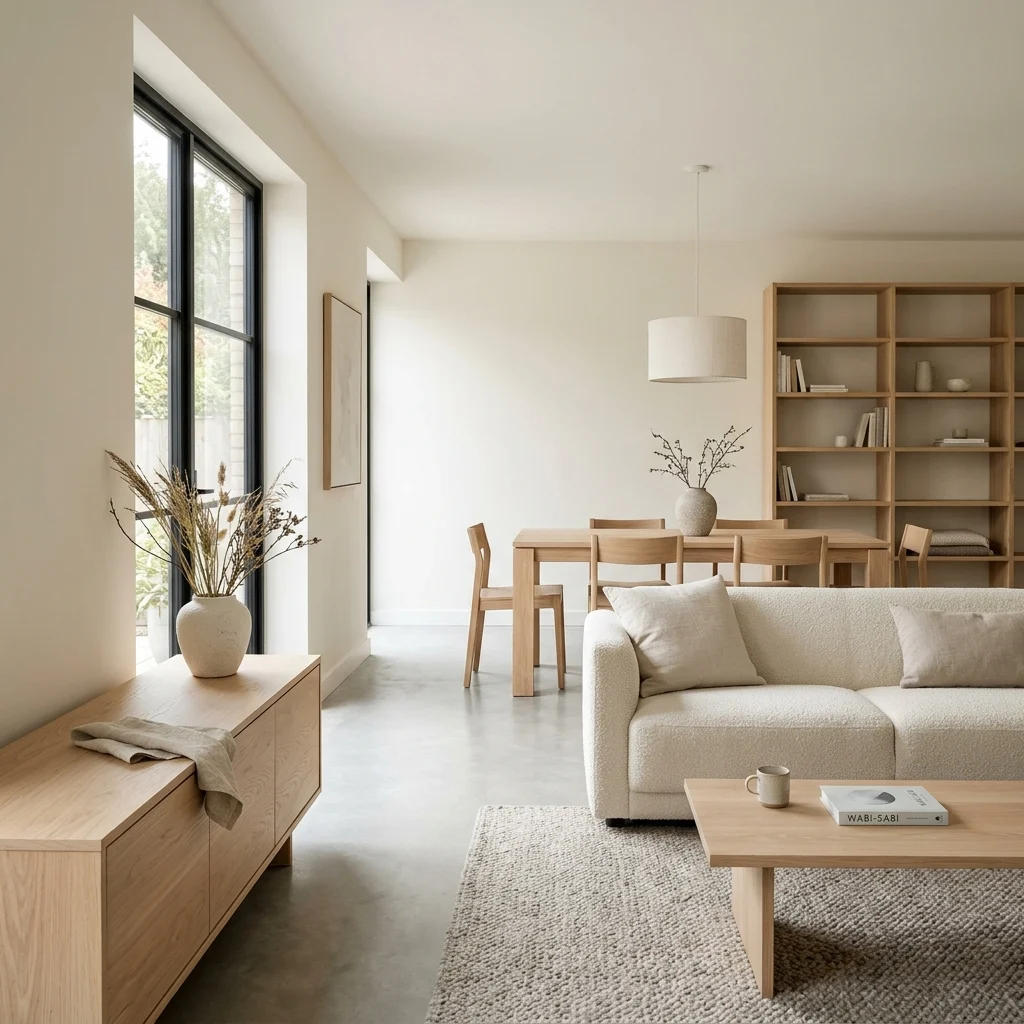
Vibe: The rooms feel connected, one material carrying the eye from space to space without interruption.
Why it works: Using the same unfinished white oak across every major furniture piece in the home eliminates the material transitions that normally signal “new room, new decision,” a consistency principle that makes open-plan or adjoining spaces read as one considered whole rather than separately decorated rooms. Raw, unstained oak also shows its own grain instead of a manufactured finish, keeping the material honest.
How to get it: Choose furniture from the same wood species and finish level (raw oiled, not stained or lacquered) across your main pieces, even if they come from different retailers, so the tone reads as intentional rather than coincidental.
💡 Quick Win: A raw oak oil finish applied to one existing darker wood piece can shift its tone closer to the rest of your furniture for under $20 in material cost.
Shop the Look
| Product |
| Unfinished white oak console table |
| Raw oak dining table |
| Light oak floating shelf set |
| Ceramic vessel unglazed |
| Linen table runner natural |
2. Monochromatic Warm White Palette from Room to Room
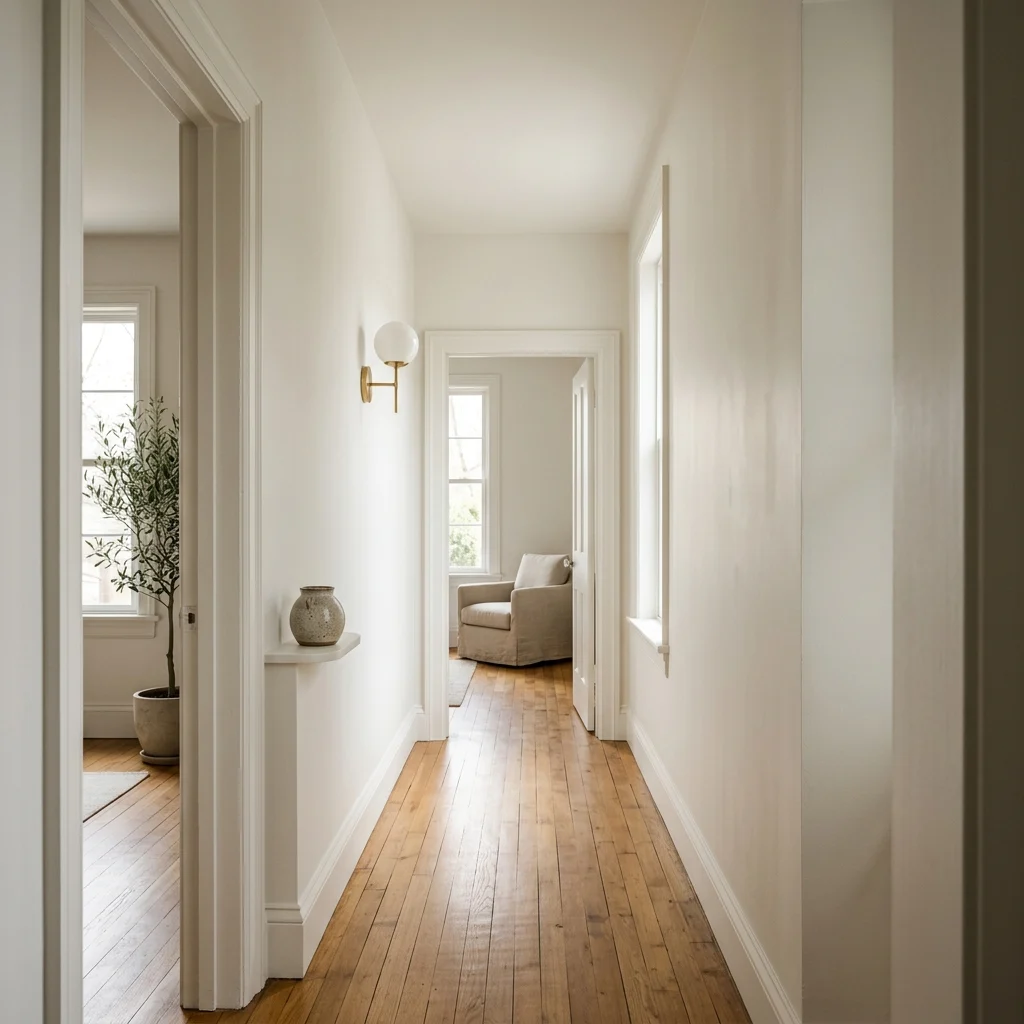
Vibe: The home feels continuous, walls disappearing into each other rather than announcing new rooms.
Why it works: Painting every connected space in the same warm white removes the color contrast that would otherwise chop a home into visually separate segments, a technique that makes even a modestly sized floor plan read as more expansive since the eye never registers a hard stop. Texture and material, not paint color, become the only variation.
How to get it: Choose one warm white, such as Benjamin Moore White Dove, and carry it through every connected hallway, living space, and doorway trim, rather than treating each room as its own separate paint decision.
Shop the Look
| Product |
| Warm white interior wall paint |
| Matte white door trim paint |
| Wall sconce, minimal brass |
| Ceramic decorative object small |
| Linen curtain panels warm white |
3. Sculptural Single-Bulb Pendant as the Room’s Only Light Feature
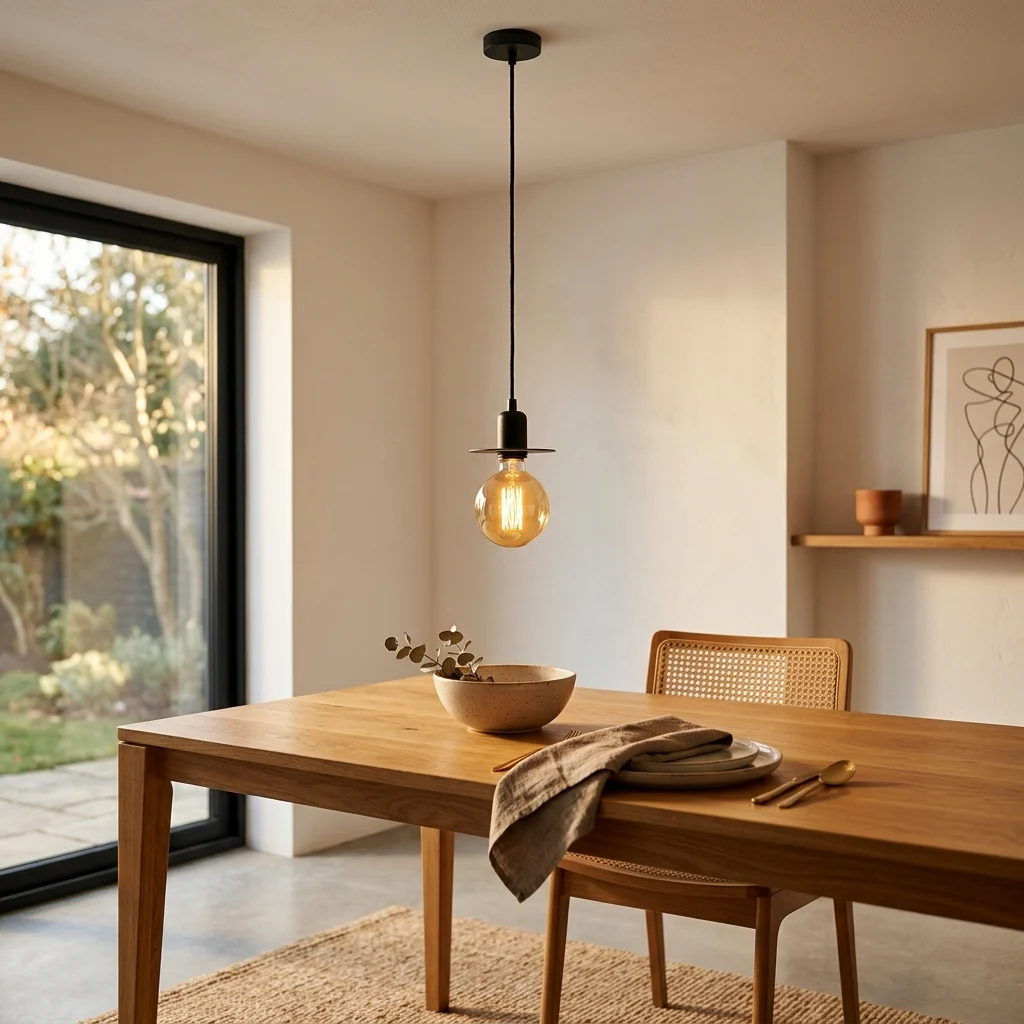
Vibe: The table feels grounded, one light source doing what a chandelier’s many bulbs usually would.
Why it works: A single, sculptural pendant applies minimalism’s core discipline directly to lighting one well-chosen fixture instead of multiple decorative sources, letting the object itself function as the room’s art rather than adding wall decor alongside it. The exposed filament bulb also keeps the fixture visually honest about its own mechanism.
How to get it: Hang one matte black or brushed steel pendant with an exposed Edison-style bulb, centered 30–34 inches above the table, and remove any additional decorative wall sconces from the same room.
💡 Quick Win: Swapping only the bulb in an existing pendant to a warm 2400K filament style shifts the mood without buying new hardware.
Shop the Look
| Product |
| Matte black single-bulb pendant light |
| Warm 2400K filament LED bulb |
| Ceramic serving bowl white |
| Linen table runner natural |
| Dimmer switch plate kit |
4. One Oversized Ceramic Vessel Instead of Multiple Small Objects
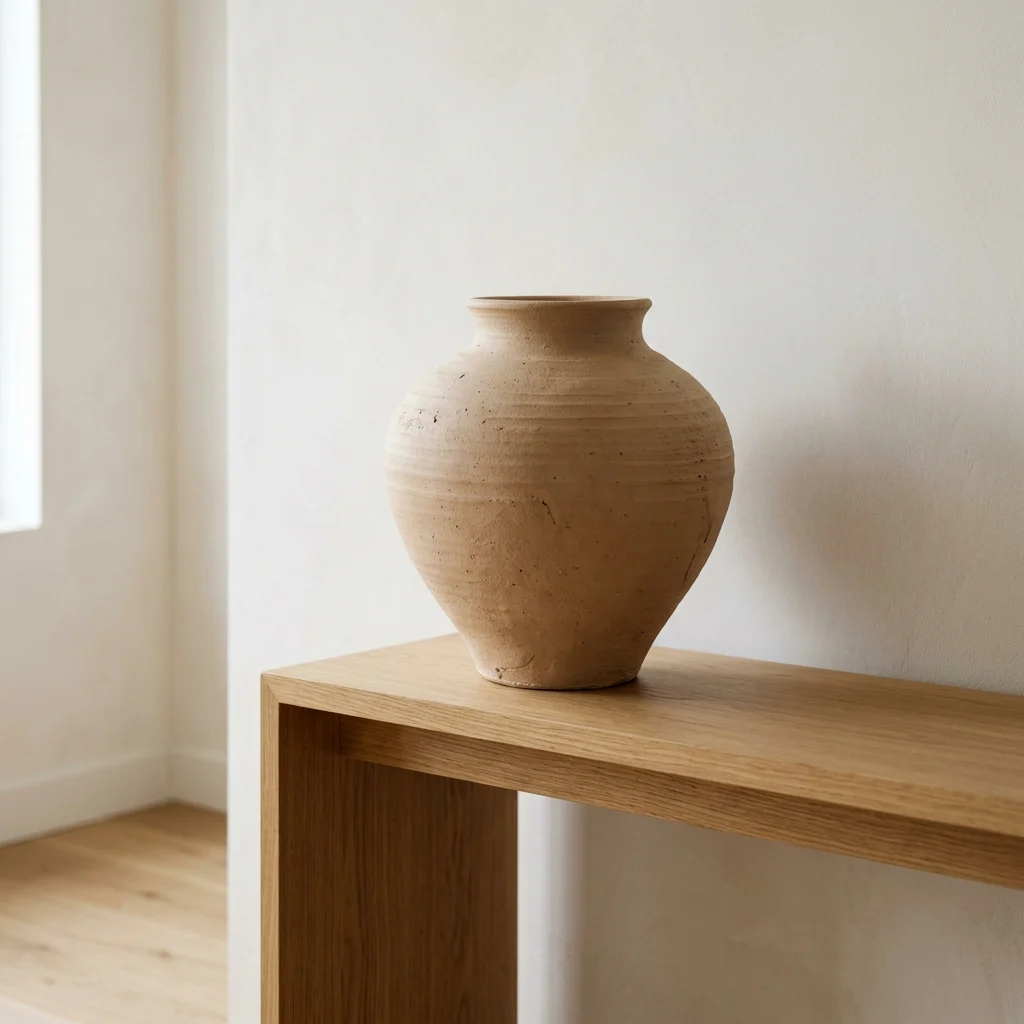
Vibe: The console feels deliberate, one object carrying the weight a dozen smaller pieces usually would.
Why it works: Restricting a surface to a single, larger-scale object forces visual focus onto that object’s texture and form; the irregularity of hand-thrown unglazed ceramic becomes noticeable precisely because nothing else on the surface competes with it. This is the direct opposite of grouping smaller objects in threes, a styling habit minimalism deliberately avoids.
How to get it: Choose one ceramic vessel scaled to roughly a third of the console’s length, and resist adding a second smaller object beside it, even if the remaining space looks “empty” at first.
Shop the Look
| Product |
| Large unglazed ceramic vessel |
| Oak console table |
| Linen table runner |
| Wall sconce minimal |
| Small drawer organizer for clutter |
5. Low-Profile Furniture with Exposed Legs for Negative Space
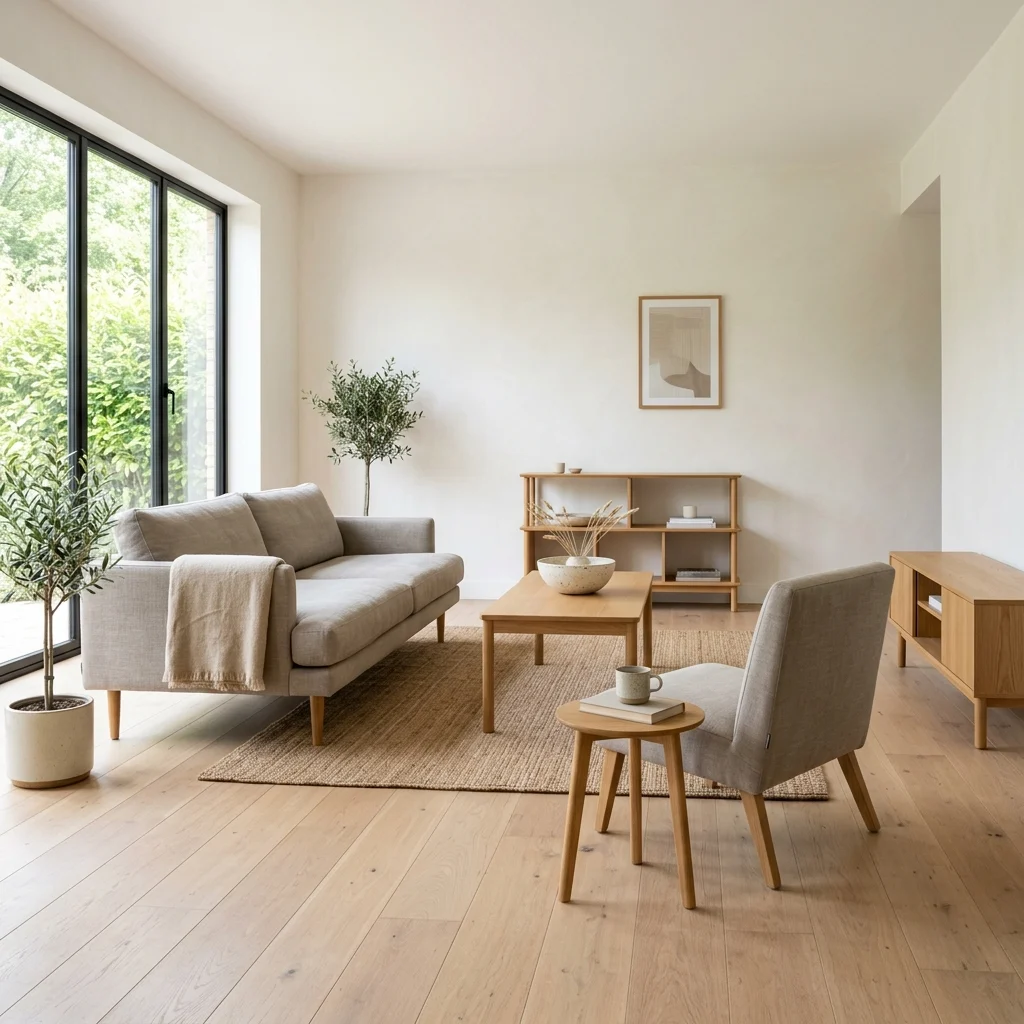
Vibe: The room feels open, ceilings appearing taller simply because furniture stopped competing with them.
Why it works: Keeping every furniture piece under a consistent low height with visible legs creates a horizon line across the room that leaves the upper two-thirds of the wall as open negative space, the same proportion principle behind Japandi interiors, but applied here without the material warmth Japandi typically adds. Visible legs also let light and floor show through beneath each piece.
How to get it: Choose sofas, consoles, and side tables with exposed tapered or straight legs rather than skirted bases, matched in height so the eye reads them as one coordinated low plane.
💡 Quick Win: Swapping a skirted ottoman for one with visible metal legs is a same-day change that lightens a room’s floor-level visual weight.
Shop the Look
| Product |
| Low-profile sofa exposed oak legs |
| Low console table tapered legs |
| Ceramic decorative bowl |
| Linen throw blanket warm white |
| Metal leg ottoman set |
6. Warm Charcoal Used Only on a Single Architectural Wall
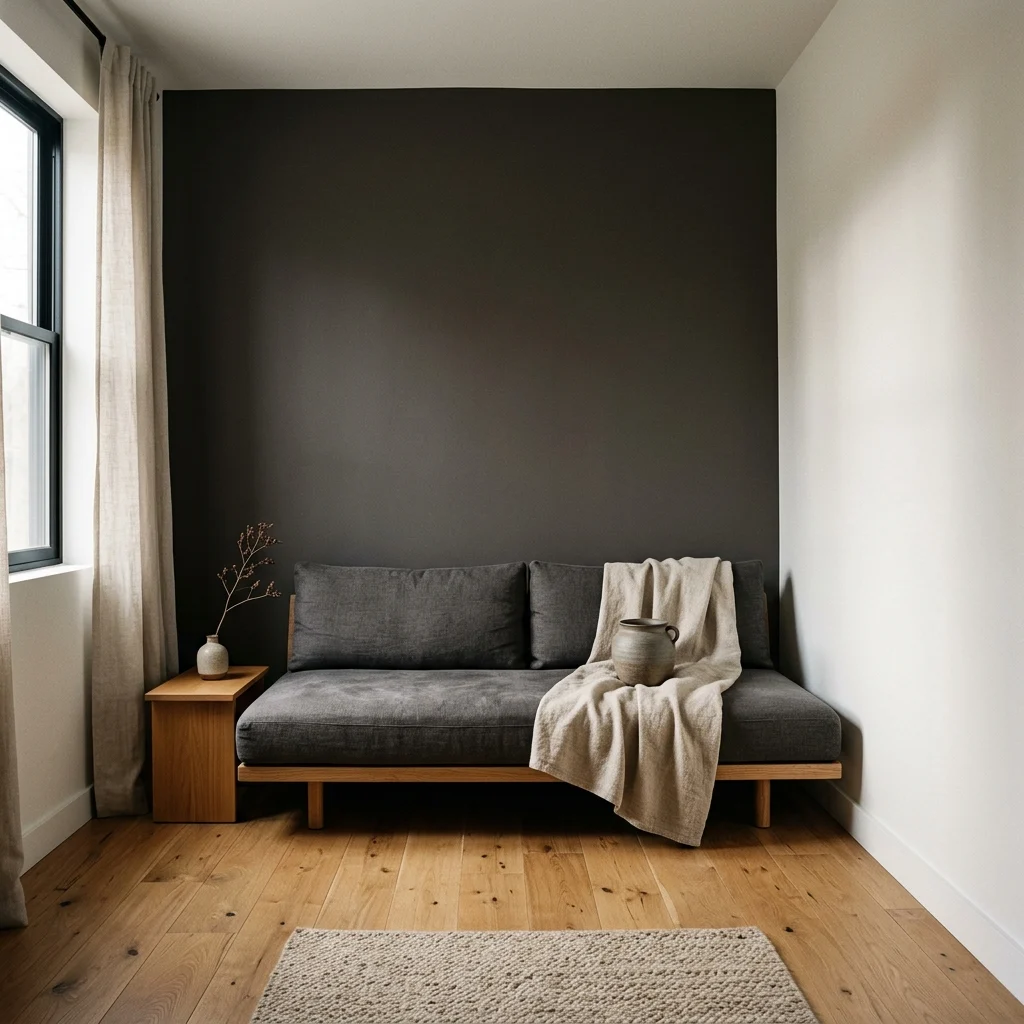
Vibe: The wall feels enveloping, one dark plane concentrating the room’s attention without darkening the whole space.
Why it works: Confining warm charcoal to a single architectural wall rather than an entire room uses value contrast as a controlled accent, applying the same restraint minimalism uses everywhere else, specifically to color. The dark wall absorbs light instead of reflecting it, making the low sofa and any warm-white textiles in front of it appear to glow by comparison.
How to get it: Paint only the wall directly behind the main seating in a warm-toned charcoal such as Benjamin Moore Wrought Iron 2124-10, keeping every adjoining wall in warm white so the accent stays contained.
Shop the Look
| Product |
| Warm charcoal matte wall paint |
| Warm white interior wall paint |
| Low-profile sofa oak legs |
| Ceramic vessel unglazed |
| Linen throw blanket, warm white |
7. Honed Concrete or Micro-Cement Flooring for Seamless Continuity
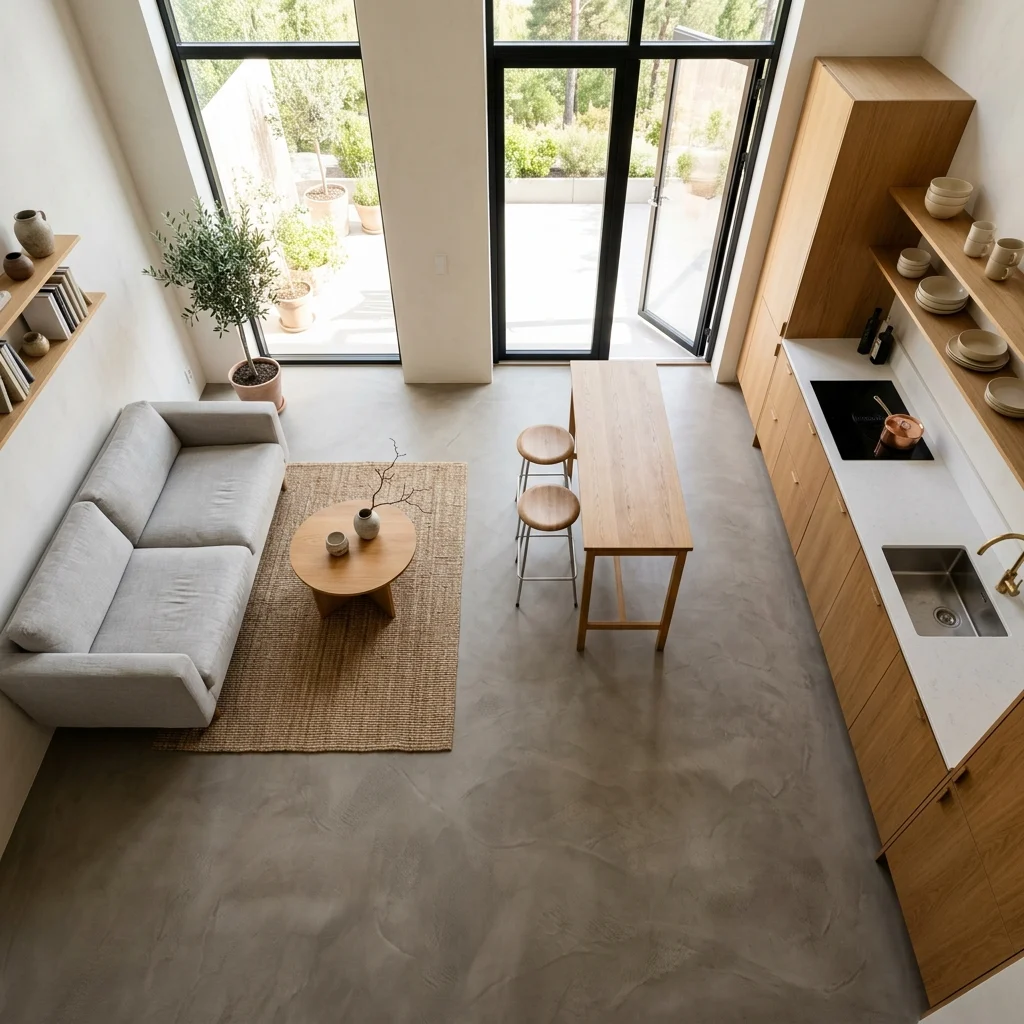
Vibe: The floor feels continuous, one surface doing the work several different flooring materials usually would.
Why it works: Micro-cement or honed concrete applied without transition strips between rooms removes the visual break that different flooring materials create at doorways, reinforcing minimalism’s preference for uninterrupted sightlines throughout a home. Its inherent tonal variation also gives a monochrome floor visual depth without needing a pattern.
How to get it: Specify a warm-toned (not cool grey) micro-cement system applied in a single continuous pour across connected rooms, sealed for the specific traffic and moisture level of each zone.
💡 Quick Win: A large-format warm grey porcelain tile with minimal grout lines approximates the seamless look at a lower material and labor cost than true micro-cement.
Shop the Look
| Product |
| Warm grey micro-cement flooring system |
| Large format porcelain floor tile |
| Low-profile sofa |
| Ceramic vessel unglazed |
| Floor sealer wet-rated |
8. Open Sightlines Between Rooms Instead of Room-by-Room Zoning
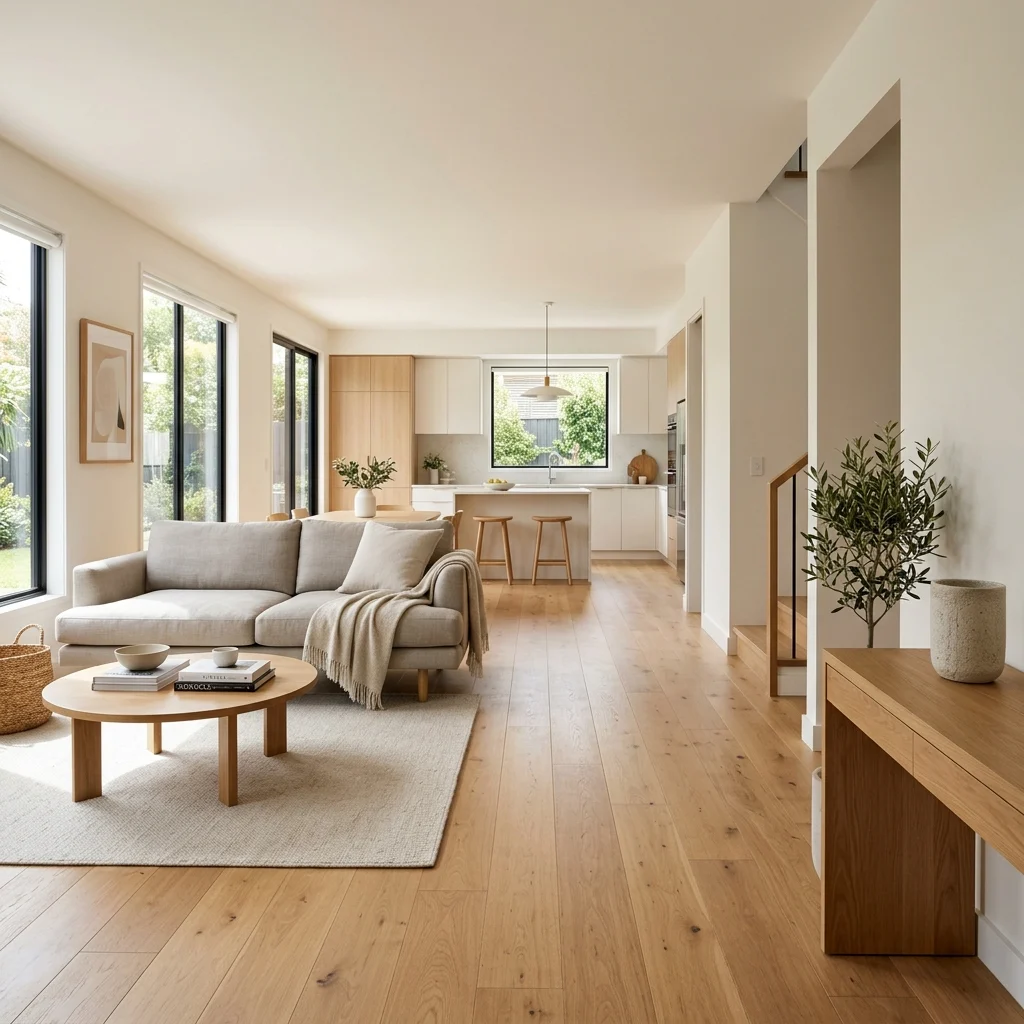
Vibe: The home feels expansive, one long view doing more for the sense of space than any single room’s size.
Why it works: Arranging furniture to preserve a clear sightline from the entry through to the farthest window uses a layout principle that has more impact on perceived spaciousness than square footage alone. The eye reads distance, not floor area, as the measure of a home feeling large. This works against the instinct to zone every room with a rug or furniture grouping that blocks the view.
How to get it: Position your tallest furniture pieces (bookcases, cabinets) along the sides of a room rather than across its depth, keeping anything above 30 inches tall out of the direct line between the entry and the farthest window.
Shop the Look
| Product |
| Low-profile bookcase side placement |
| Low console table |
| Ceramic vessel unglazed |
| Linen curtain panels |
| Floor lamp slim profile |
9. A Single Framed Print Per Wall, Never a Gallery
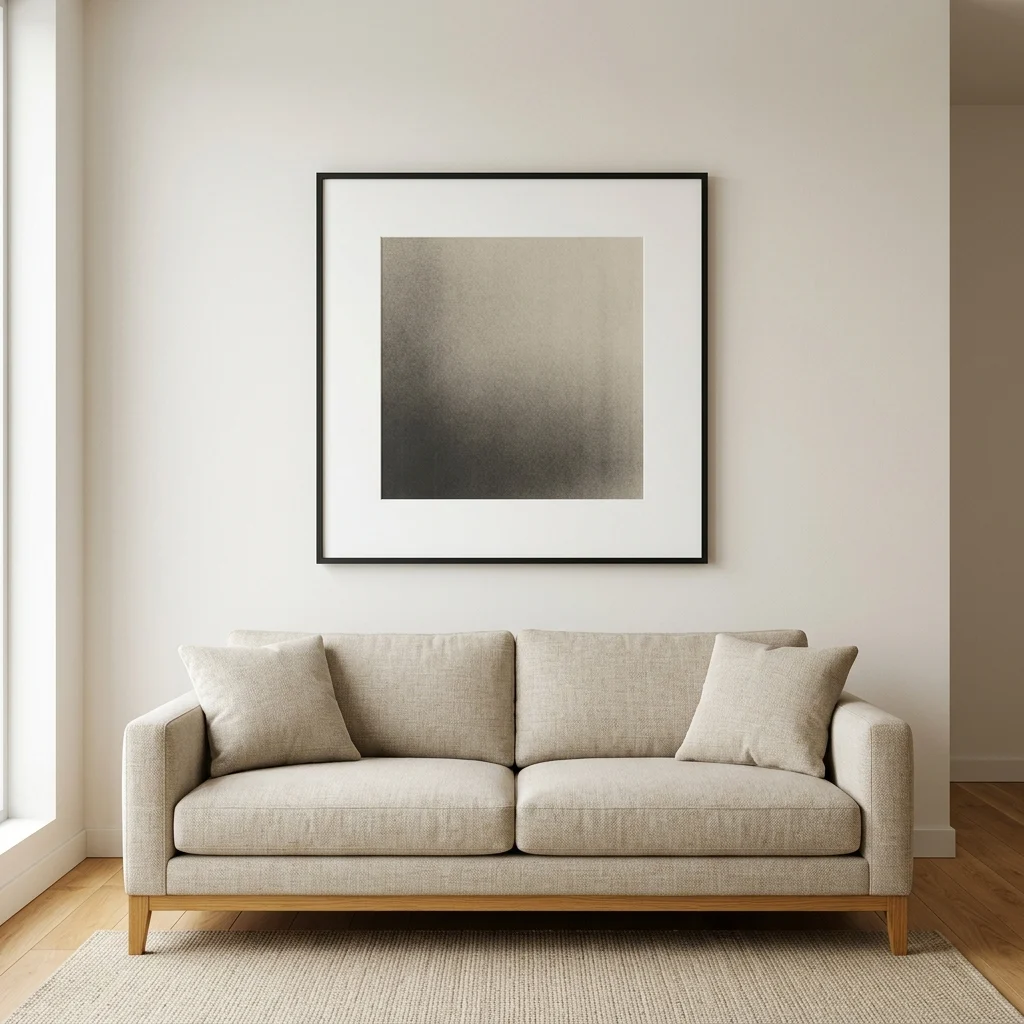
Vibe: The wall feels composed, one image carrying the attention that a gallery wall would split across many.
Why it works: A gallery wall introduces multiple frame edges and focal points, which directly conflict with minimalism’s preference for a single, uncontested point of visual rest per wall. One large-scale print instead gives the eye exactly one place to land, and the negative space surrounding it becomes as much a part of the composition as the art itself.
How to get it: Choose one print sized to roughly two-thirds the width of the furniture below it, in a minimal black or natural wood frame, and leave every other wall in that room bare.
💡 Quick Win: A single black-and-white photograph in a plain frame achieves the same restrained effect at a lower cost than a large abstract canvas.
Shop the Look
| Product |
| Large minimal framed print |
| Black-and-white photography print |
| Minimal black frame oversized |
| Picture hanging kit |
| Museum putty for level hanging |
10. Soft Greige as the Connective Tissue Between Rooms
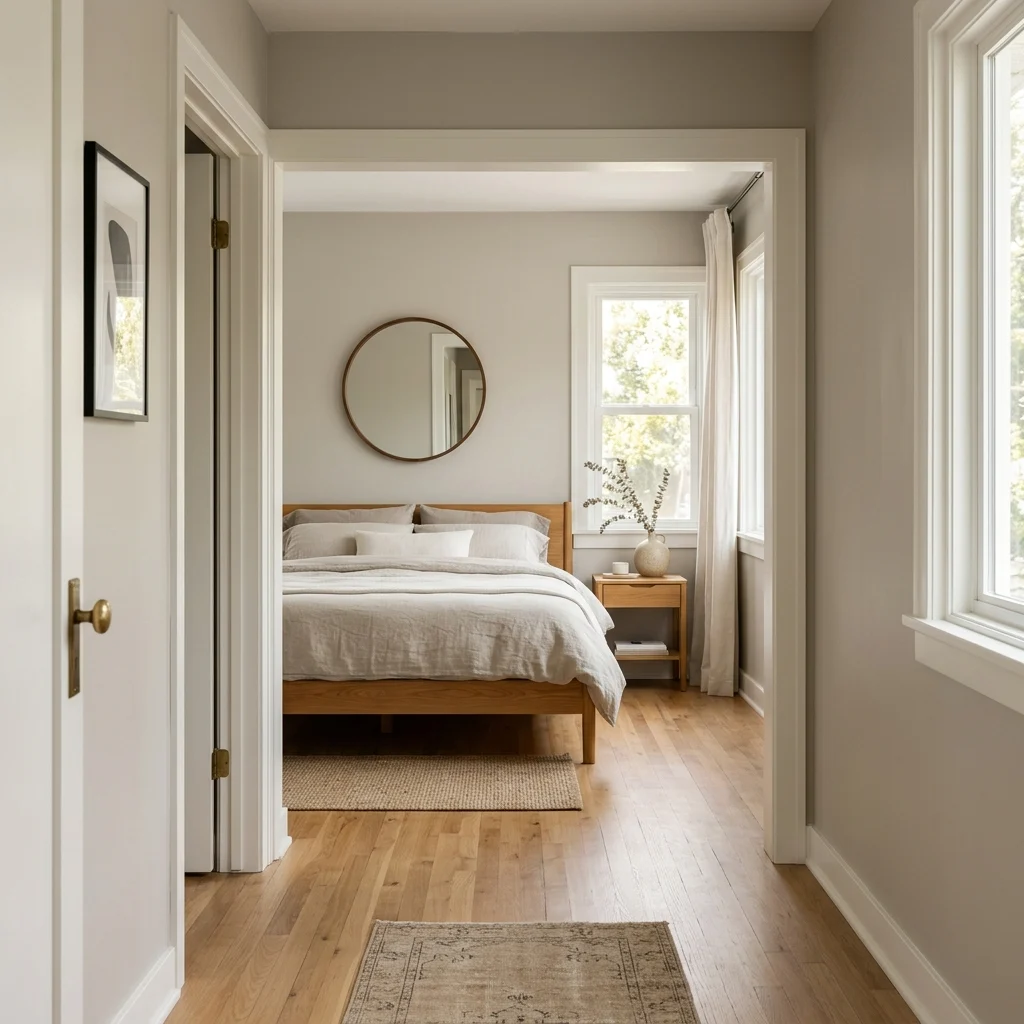
Vibe: The rooms feel unified, one warm neutral carrying through spaces that serve completely different functions.
Why it works: Soft greige sits warm enough to avoid the cold, clinical read of a blue-based grey, which is why it works as a connective color across bedrooms, hallways, and living spaces without needing to match each room’s specific furniture. Consistent trim in warm white against it defines architecture without introducing a third competing tone.
How to get it: Choose a warm-toned greige such as Benjamin Moore Balboa Mist OC-27 for walls throughout connected private spaces, keeping trim and doors in a single warm white for contrast.
Shop the Look
| Product |
| Soft greige interior wall paint |
| Warm white trim paint |
| Low platform bed frame oak |
| Ceramic vessel unglazed |
| Linen bedding set warm white |
11. Recessed Lighting Instead of Visible Fixtures for a Clean Ceiling
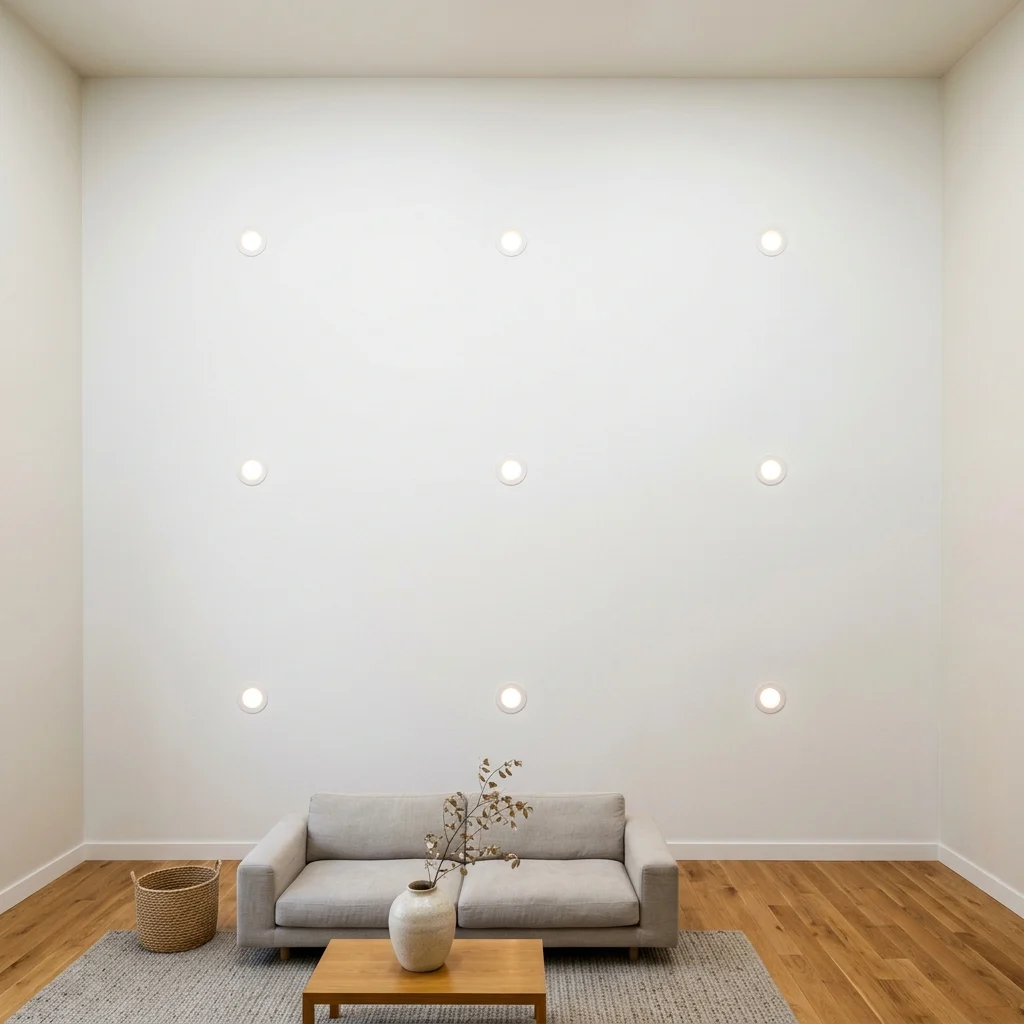
Vibe: The ceiling feels uninterrupted, light present without any object marking where it comes from.
Why it works: Recessed lighting eliminates the visual object a pendant or flush-mount fixture would otherwise add to the ceiling plane, keeping that surface as clean and uninterrupted as the walls below it, a light-behavior choice that reinforces minimalism’s preference for architecture over ornament even at the ceiling level. This trades a decorative lighting moment for architectural quiet, a genuine limitation worth knowing before committing.
How to get it: Space recessed cans roughly 4–6 feet apart on a dimmer circuit set to warm 2700K, reserving any single sculptural pendant only for a dedicated focal area like a dining table.
Shop the Look
| Product |
| Recessed LED can light kit |
| Warm 2700K dimmer switch |
| Low-profile sofa |
| Ceramic vessel unglazed |
| Linen throw blanket |
12. A Single Statement Chair Instead of Multiple Accent Pieces
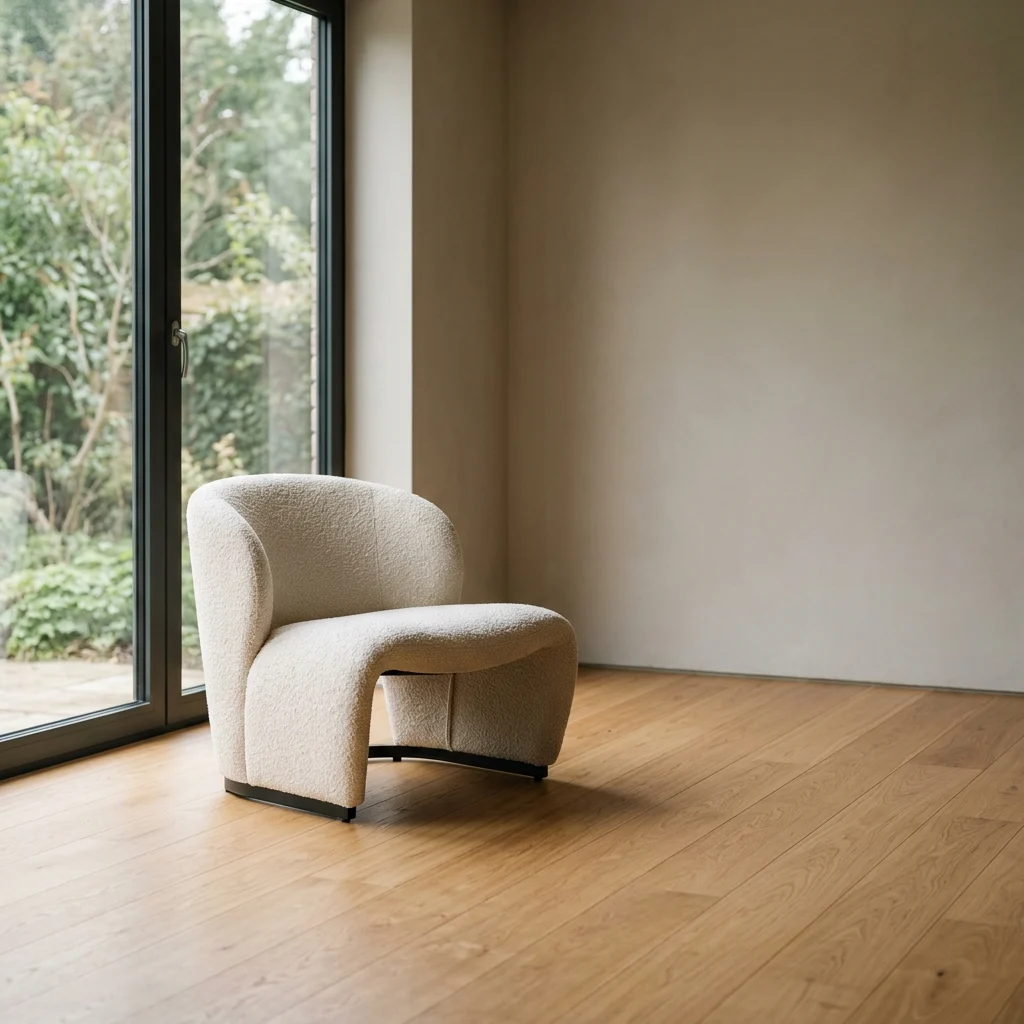
Vibe: The corner feels considered, one chair holding more visual weight than a full seating arrangement would.
Why it works: A single sculptural accent chair, left with generous floor space around it, applies the same restraint principle used throughout minimalist decor directly to furniture arrangement. One well-designed piece communicates more than several competing accent pieces crowded into the same zone. The chair’s negative space also gives its silhouette room to actually be seen.
How to get it: Choose one chair with a distinct, sculptural silhouette rather than a standard club or accent chair, and position it with at least 24 inches of clearance on all open sides.
💡 Quick Win: Removing a second accent chair from an existing pair instantly gives the remaining chair the visual presence this idea depends on.
Shop the Look
| Product |
| Sculptural accent chair minimal |
| Low side table oak |
| Linen throw blanket |
| Ceramic bud vase |
| Floor lamp slim profile |
13. Built-In Storage Behind Flush Cabinetry to Hide Everyday Clutter
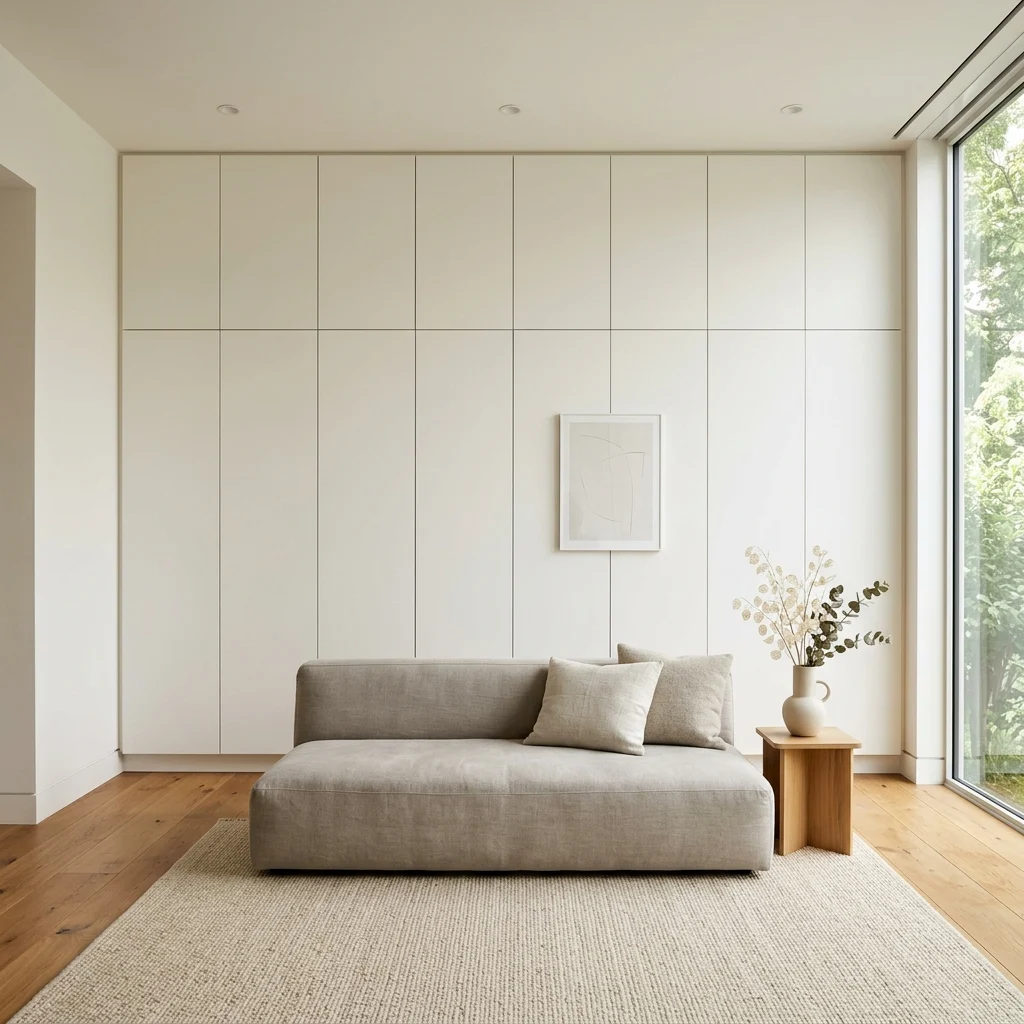
Vibe: The room feels weightless, storage disappearing into the architecture instead of adding visible furniture.
Why it works: In small homes, flush built-in cabinetry painted to match the surrounding wall removes the visual bulk a standalone dresser or bookcase would add, directly solving the tension minimalism creates between wanting genuinely empty surfaces and still needing somewhere to put everyday items. Push-to-open hardware keeps the fronts free of handles that would otherwise break the flush plane.
How to get it: Build cabinetry flush to the wall with push-to-open mechanisms, painted the exact wall color rather than a contrasting wood tone, so the storage reads as architecture rather than furniture.
Shop the Look
| Product |
| Flush push-to-open wall cabinet unit |
| Matching wall paint for cabinetry |
| Low-profile sofa |
| Ceramic vessel unglazed |
| Linen throw blanket |
How to Start Your Minimalist Home Transformation
Start with wall color, not furniture. Choosing one warm white, such as Benjamin Moore White Dov, and carrying it through every connected room is the single move that anchors the whole home’s cohesion, because every furniture and material decision afterward gets chosen to sit correctly against that consistent base.
The most common mistake is decorating room by room without a shared material or color plan, which results in a home that reads as several disconnected minimalist attempts rather than one coherent whole. Fix it by choosing your wood tone, wall white, and one accent color before buying anything for a single room, then applying that same trio throughout.
Three items under $50 that create immediate impact: an unglazed ceramic vessel for a console, a single black-and-white framed photograph, and a raw oak oil finish kit to unify an existing mismatched wood piece.
A full, whole-home minimalist transformation realistically takes 3–6 months and costs $8,000–$25,000, depending on how much built-in storage and flooring work is involved. A single-room weekend refresh using paint and decluttering costs $150–$400 and shifts the feel of that space immediately.
Frequently Asked Questions About Minimalist Home Decor
What’s the difference between minimalist and Scandinavian home decor?
Minimalist decor is more austere and architectural, often stripping color and texture down further than Scandinavian design, which still layers in hygge warmth through wool throws, candles, and varied natural materials. A minimalist living room might feature one chair and one plant; a Scandinavian living room would likely add several textured cushions and warmer lighting to the same space.
What color palette works best for minimalist home decor?
Warm white forms the base across every connected room, with soft greige as a secondary neutral and warm charcoal reserved for a single accent wall. Benjamin Moore White Dove and Balboa Mist OC-27 are common reference points. Avoid cool, blue-based whites and multiple competing accent colors across different rooms, both of which break the palette’s continuity.
How much does a minimalist home makeover cost?
A single-room refresh using paint and decluttering runs $150–$500. A mid-range whole-home update adding consistent furniture and lighting typically costs $5,000–$12,000. A full transformation, including built-in storage, new flooring, and custom cabinetry, can reach $20,000–$35,000 depending on square footage and how much millwork is involved.
Does minimalist decor work in a home with kids or a busy household?
Yes, with adjustment built in, concealed storage becomes even more important in a busy household, since minimalism’s visible restraint depends on having somewhere functional to put daily clutter out of sight. Families often find a modified version works best: minimalist principles in shared living spaces, with more flexibility in bedrooms or playrooms.
What’s the most important element in minimalist home decor?
Material and color consistency across rooms is the most important element, more than any single furniture choice, whether the same wood tone and wall color carry through connected spaces determines whether a home reads as genuinely minimalist or simply a sparsely furnished room by room. A home with the “right” empty surfaces but mismatched wood tones from room to room will still feel disjointed.
Ready to Create Your Dream Minimalist Home?
These 13 ideas move through material consistency, contained color, quiet lighting, and concealed storage, showing that minimalist home decor comes together through disciplined, connected choices rather than one dramatic room reveal. Starting with a single warm white paint color carried through your hallway is not a lesser version of the transformation; it’s exactly the kind of foundational move this style rewards. Today, remove one object from a console or shelf and leave the space empty rather than immediately filling it with something else. Done well, the home will start to feel like a held breath rather than a finished project, calm settling into every room the same way. Save the ideas that matched your own light and your own walls, that single sculptural pendant, that flush built-in wall, because minimalist home decor rewards the space built slowly, one considered choice at a time.
You Might Also Like
- 12 Small Space Decor Ideas for a Modern Minimalist Home
- Eco Friendly Bamboo Home Decor: 9 Stunning Ways to Style Every Room
- 10 Stylish Shelf Decor Ideas for Every Room
- Modern Home Decor: 15 Ideas Worth Saving and Stealing
- 15 Scandinavian Decor Ideas for Simple, Hygge-Inspired Living
- 20 Vintage Home Decor Ideas for a Home Full of Character
[…] 13 Minimalist Home Decor Ideas for a Calm, Clutter-Free Space […]
[…] 13 Minimalist Home Decor Ideas for a Calm, Clutter-Free Space […]
[…] 13 Minimalist Home Decor Ideas for a Calm, Clutter-Free Space […]
[…] 13 Minimalist Home Decor Ideas for a Calm, Clutter-Free Space […]
[…] 13 Minimalist Home Decor Ideas for a Calm, Clutter-Free Space […]
[…] 13 Minimalist Home Decor Ideas for a Calm, Clutter-Free Space […]
[…] 13 Minimalist Home Decor Ideas for a Calm, Clutter-Free Space […]