
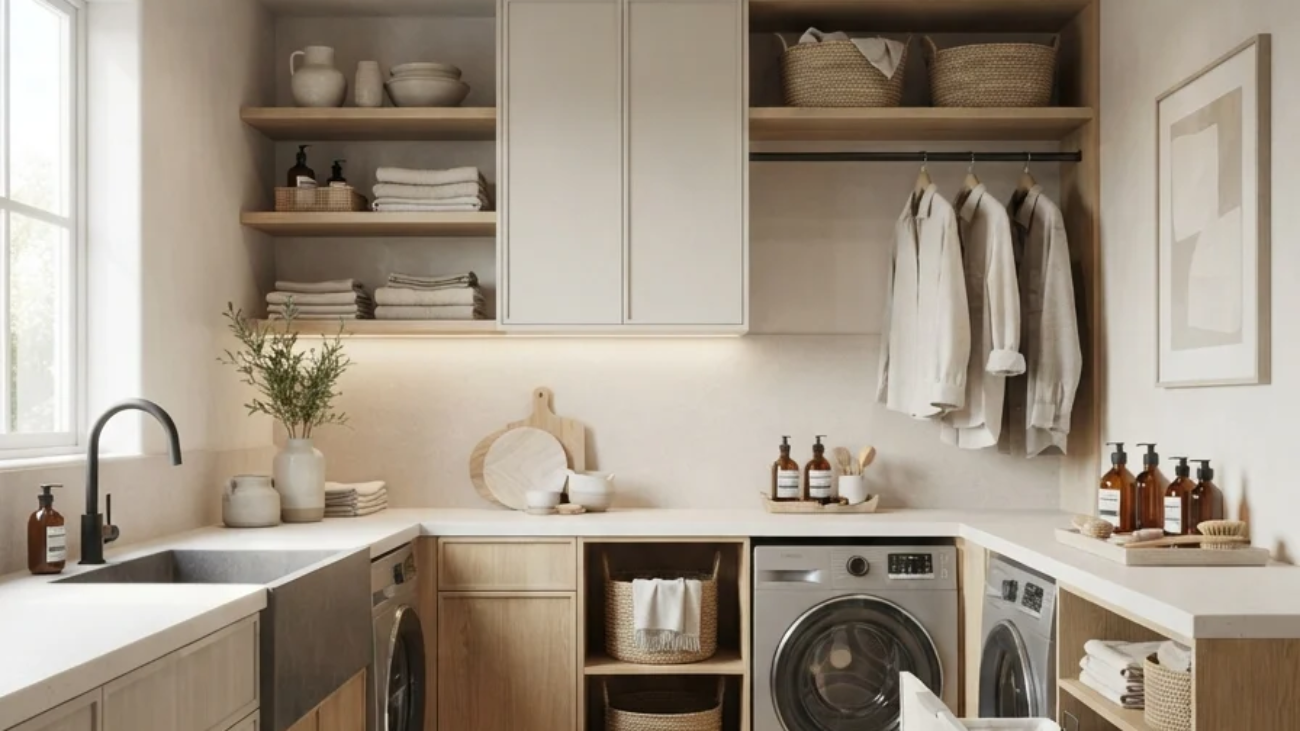
Japandi is a calming interior style that combines Japanese restraint and natural material honesty with Scandinavian warmth, function, and comfort. These 20 how to create a Zen Japandi utility room ideas show you how to turn a hardworking laundry and storage space into somewhere calm, organized, tactile, and genuinely pleasant to use.
The best Japandi utility rooms feel quiet rather than decorative, with soft daylight falling across pale oak, warm greige cabinetry, handmade ceramics, and neatly concealed everyday necessities. Linen, bamboo, stoneware, and natural wood bring subtle texture without creating visual noise, while carefully planned storage keeps detergent bottles, cleaning tools, and laundry supplies from dominating the room. Even a narrow utility room can feel spacious when every object has a place and space is treated as part of the design. Here are 20 ideas worth saving and stealing.
Why 20 How to Create a Zen Japandi Utility Room Ideas Work So Well
Japandi is a contemporary fusion of Japanese and Scandinavian design rather than a historical Japanese style in itself. It combines Japanese ideas associated with wabi-sabi, natural materials, restraint, and appreciation of imperfection with Scandinavian functionalism, warmth, and hygge; the term became widely used in design media during the 2010s. The two traditions share an emphasis on simplicity, craftsmanship, natural materials, and uncluttered spaces.
The strongest Japandi utility-room palette uses warm white, oatmeal, greige, mushroom, muted sage, clay, pale oak, ash, walnut, and restrained charcoal. Materials should feel tactile and honest: unfinished or matte-finished oak, bamboo, linen, rattan, handmade ceramic, stone, brushed stainless steel, and matte black metal can all work when their proportions remain controlled. Natural materials and neutral colors are particularly characteristic of Japandi interiors.
Style at a Glance
| Element | Core Trait 1 | Core Trait 2 |
| Philosophy | Functional restraint | Calm through negative space |
| Materials | Oak, bamboo, linen | Ceramic, stone, rattan |
| Color palette | Warm white, greige, oatmeal | Sage, clay, soft charcoal |
20 How to Create a Zen Japandi Utility Room Ideas
1. Use Warm Greige Cabinetry

Vibe: Still.
Why it works: Warm greige reduces the visual contrast between cabinetry and walls, creating the continuous background that makes a small utility room feel calmer. The principle is tonal continuity: matte cabinetry supplies structure while pale oak introduces natural variation without adding another strong color.
How to get it: Choose a greige with beige rather than blue undertones and test it beside your appliances under both daylight and 2700K artificial light. Use flat-front doors with minimal pulls so the cabinetry reads as architecture rather than furniture.
Shop The Look
| Product | Amazon search phrase |
| Cabinet pulls | Brushed nickel slim bar cabinet pulls Japandi |
| Countertop | Light oak countertop utility room worktop |
| Laundry basket | Natural seagrass rectangular laundry basket |
| Ceramic vessel | Handmade matte cream ceramic vase |
| Linen towels | Oatmeal linen utility room hand towel set |
2. Choose Pale Oak for the Main Work Surface
Vibe: Grounded.
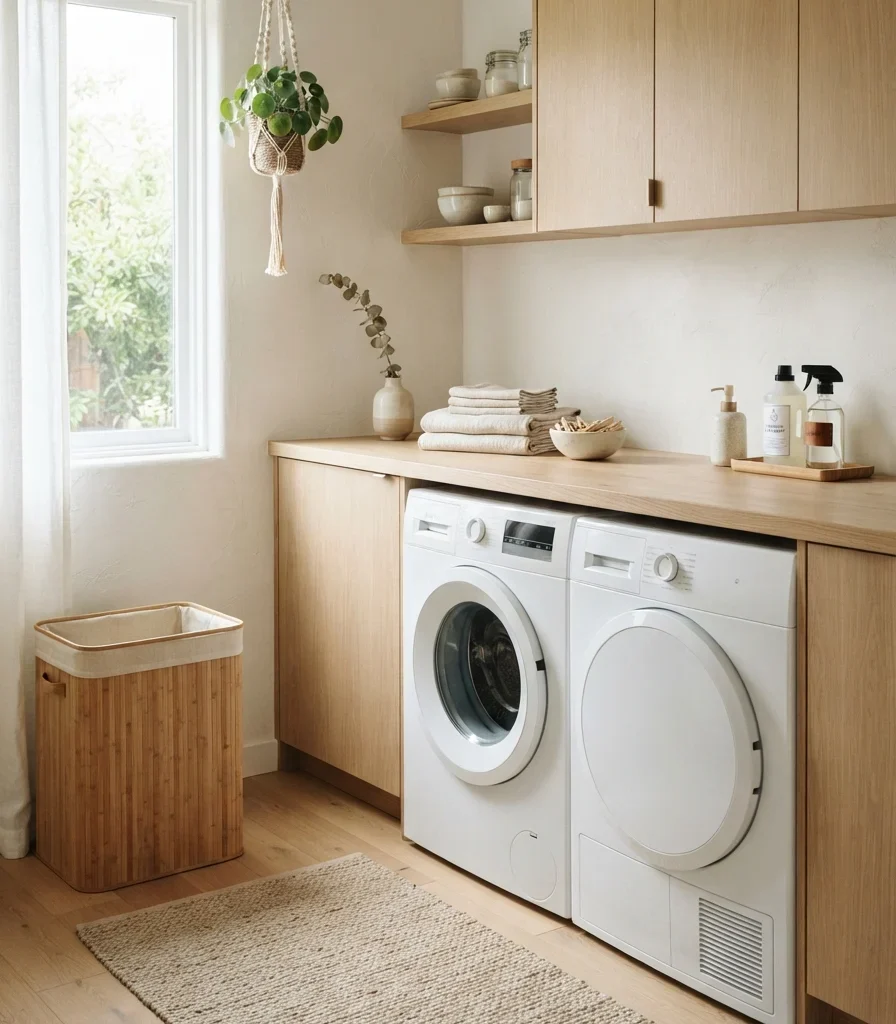
Why it works: A continuous wood countertop visually joins separate appliances into one horizontal composition. This is visual bridging: the natural oak interrupts the hard metallic appearance of washers and dryers while providing a practical folding surface.
How to get it: Select a moisture-appropriate countertop finish and leave manufacturer-required ventilation and access clearances around appliances. Use a matte or low-sheen oil-look finish rather than glossy lacquer to preserve the tactile character associated with Japandi.
💡 Quick Win: A removable 18–24-inch-wide oak countertop board can create a temporary folding surface while you decide whether a permanent worktop is worthwhile.
Shop The Look
| Product | Amazon search phrase |
| Oak board | Unfinished white oak countertop board |
| Bamboo tray | Large natural bamboo utility tray |
| Soap dispenser | Matte stone ceramic soap dispenser |
| Folding mat | Neutral silicone laundry folding mat |
| Cloths | Natural cotton waffle cleaning cloth set |
3. Add Soft 2700K Under-Cabinet Lighting
Vibe: Hushed.
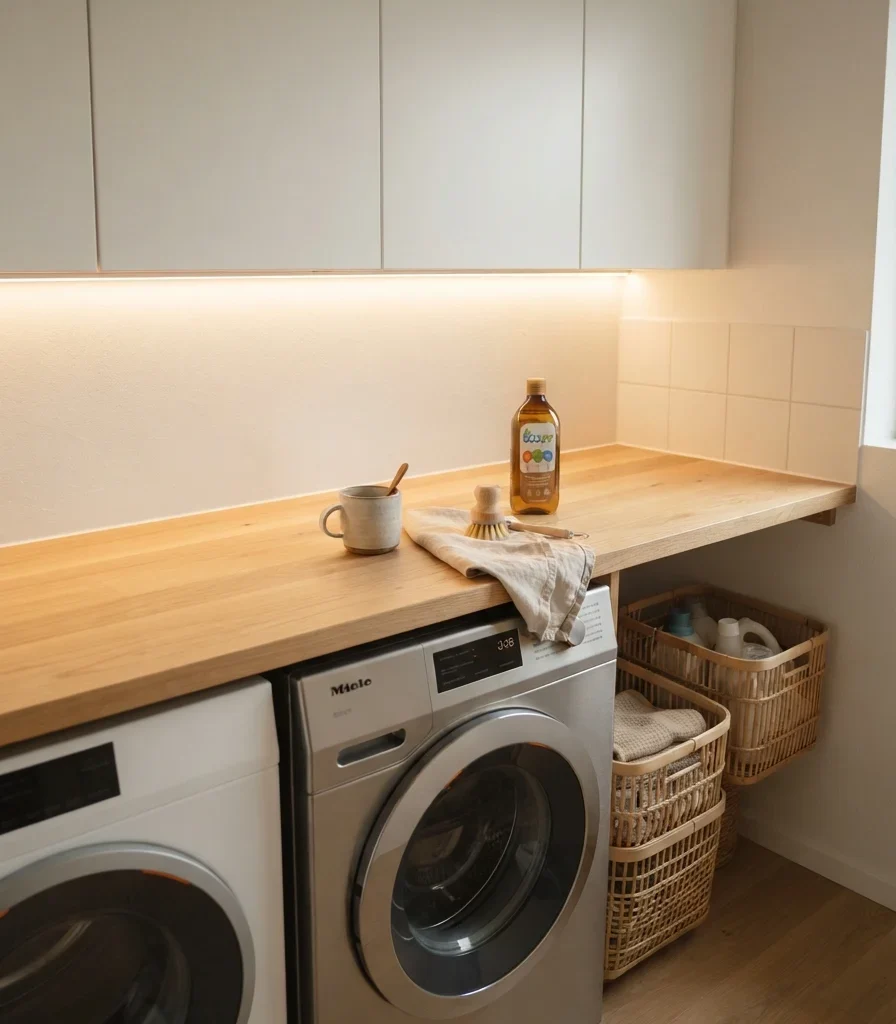
Why it works: Utility rooms need task lighting, but bright overhead illumination can flatten the textures that make Japandi feel warm. Layered light places useful illumination exactly where folding, sorting, and cleaning happen while allowing the rest of the room to remain visually quiet.
How to get it: Install a concealed LED strip with a 2700K–3000K color temperature beneath wall cabinets and connect it to a dimmer where possible. Hide the light source behind a small lip so you see the glow rather than individual LED points.
Shop The Look
| Product | Amazon search phrase |
| LED strip | 2700K dimmable under cabinet LED strip |
| Light channel | Slim aluminum LED diffuser channel |
| Dimmer | Plug-in LED dimmer, warm white lighting |
| Motion sensor | Cabinet motion sensor LED switch |
| Cord cover | White adhesive cable management channel |
4. Install a Slim Oak Folding Counter

Vibe: Efficient.
Why it works: A folding counter adds a useful work surface without permanently consuming floor area. Transformable furniture is especially valuable in utility rooms because the same square footage must accommodate laundry sorting, appliance access, circulation, and storage.
How to get it: Use a solid or engineered oak panel mounted on properly rated folding brackets, with the counter depth determined by your available clearance. Keep the folded profile slim enough that doors, drawers, and appliance access remain unobstructed.
Shop The Look
| Product | Amazon search phrase |
| Folding brackets | Heavy duty folding shelf brackets white |
| Oak panel | Natural oak floating shelf board wide |
| Wall hooks | Minimal black wall hooks utility room |
| Laundry bag | Natural cotton canvas laundry sorter bag |
| Measuring tape | Compact matte black retractable measuring tape |
5. Style Open Shelves with Only Three Objects

Vibe: Meditative.
Why it works: Japandi treats space as an active compositional element, so a utility shelf should not become a storage overflow zone. The principle of negative space gives each handmade ceramic, linen textile, or wooden object enough visual room to register individually. HomeDreamStyle uses a similar restrained three-object approach in its Japandi shelf guidance.
How to get it: Start with an empty shelf and add only one vertical, one horizontal, and one tactile object. Leave generous gaps between them instead of filling the entire shelf.
💡 Quick Win: Use a folded linen tea towel, one dried branch in a small ceramic vase, and a wooden brush you already own before buying decorative objects.
Shop The Look
| Product | Amazon search phrase |
| Floating shelf | Pale ash wood floating shelf minimalist |
| Vase | Tall handmade matte ivory ceramic bud vase |
| Linen cloth | Natural oatmeal linen tea towel |
| Brush | Wooden laundry scrub brush natural bristle |
| Dried branch | Natural dried eucalyptus stem single |
6. Create a Clear Laundry-to-Storage Workflow
Vibe: Ordered.
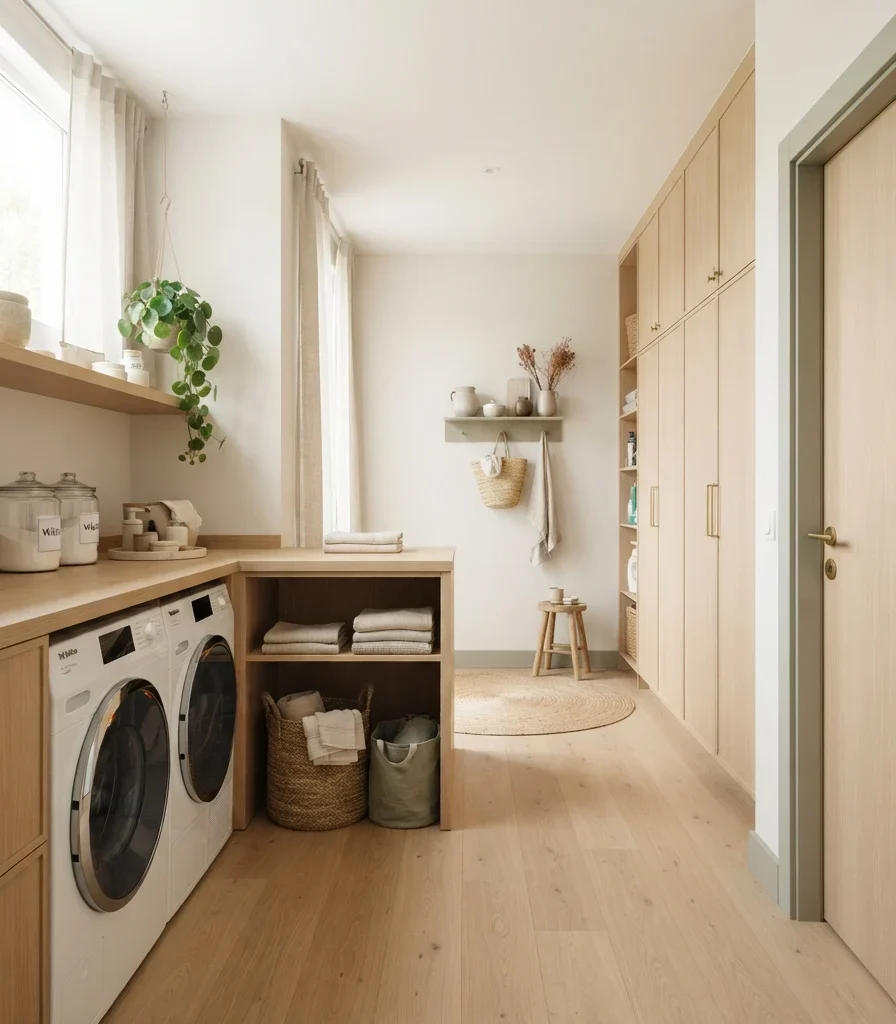
Why it works: A Zen utility room is not merely uncluttered; it should reduce unnecessary movement during repetitive chores. Workflow zoning places washing, folding, and storage in a logical sequence, so the room feels calmer because the work itself becomes easier.
How to get it: Arrange the room around the order you naturally perform laundry: dirty clothes entering, washing and drying, folding, then storage. Keep the main walking path clear and avoid placing frequently used baskets where appliance doors must open.
Shop The Look
| Product | Amazon search phrase |
| Laundry sorter | Three compartment natural canvas laundry sorter |
| Storage basket | Rectangular woven laundry storage basket |
| Label clips | Minimal bamboo basket label clips |
| Folding board | Compact wooden laundry folding board |
| Utility hooks | Natural wood peg rail wall hooks |
7. Hide a Drying Rack Inside a Tall Cabinet
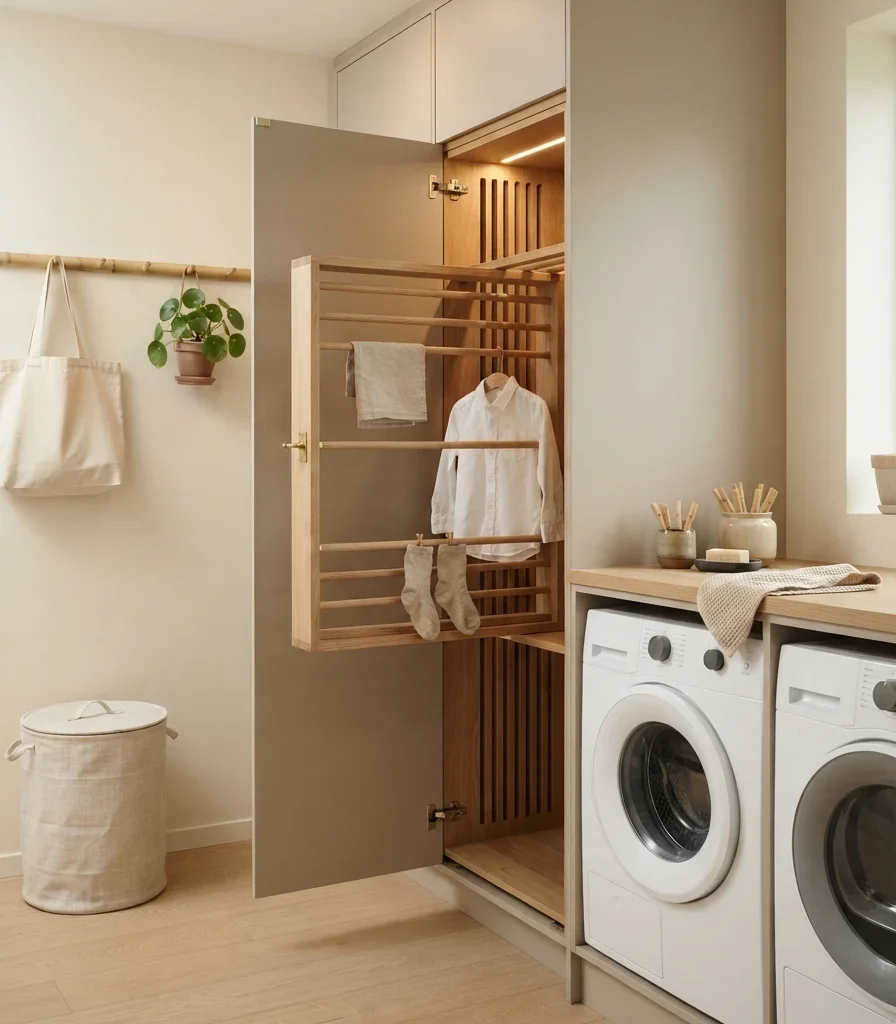
Vibe: Airy.
Why it works: Drying racks are useful but can visually dominate a small utility room when permanently exposed. Concealed functionality keeps the room visually quiet while preserving an essential laundry function; contemporary utility-room design increasingly uses integrated pull-out or wall-mounted drying solutions to free floor space.
How to get it: Install a pull-out rack inside a cabinet only if the enclosure allows adequate airflow and drying conditions; otherwise choose a fold-away wall or ceiling system. Keep the rack close to the washer rather than across the room.
💡 Quick Win: Replace a freestanding floor rack with a fold-down wall-mounted drying rack and store it flat when not in use.
Shop The Look
| Product | Amazon search phrase |
| Drying rack | Fold down wall mounted wooden drying rack |
| Cabinet rail | Pull out laundry drying rack cabinet |
| Bamboo pegs | Natural bamboo laundry clothespins |
| Hanger | Slim wooden clothes hanger set natural |
| Laundry clips | Bamboo wooden clothes pins storage bag |
8. Introduce Muted Sage as the Only Accent Color
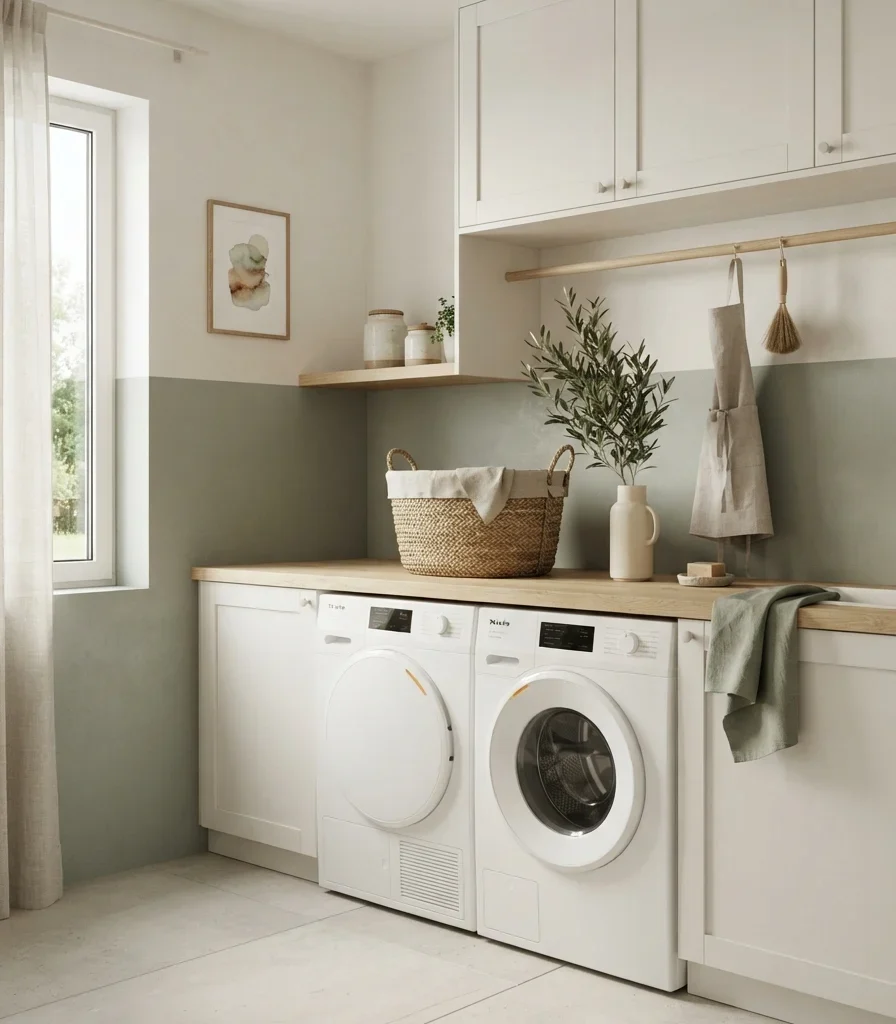
Vibe: Restorative.
Why it works: A single muted organic color gives the neutral palette a point of visual life without undermining restraint. Accent repetition works best when the sage appears in only two or three small locations rather than becoming a competing secondary palette.
How to get it: Try a dusty sage around the lower third of the room or on one cabinetry run, then repeat the color in a linen towel and small botanical element. Avoid saturated emerald or mint, which shifts the room away from the muted Japandi register.
Shop The Look
| Product | Amazon search phrase |
| Linen towel | Muted sage green linen hand towel |
| Ceramic bowl | Sage green handmade ceramic bowl |
| Planter | Matte sage ceramic planter small |
| Olive stems | Artificial olive branch muted green |
| Storage box | Sage fabric storage box with lid |
9. Use Vertical Fluted Oak for Texture
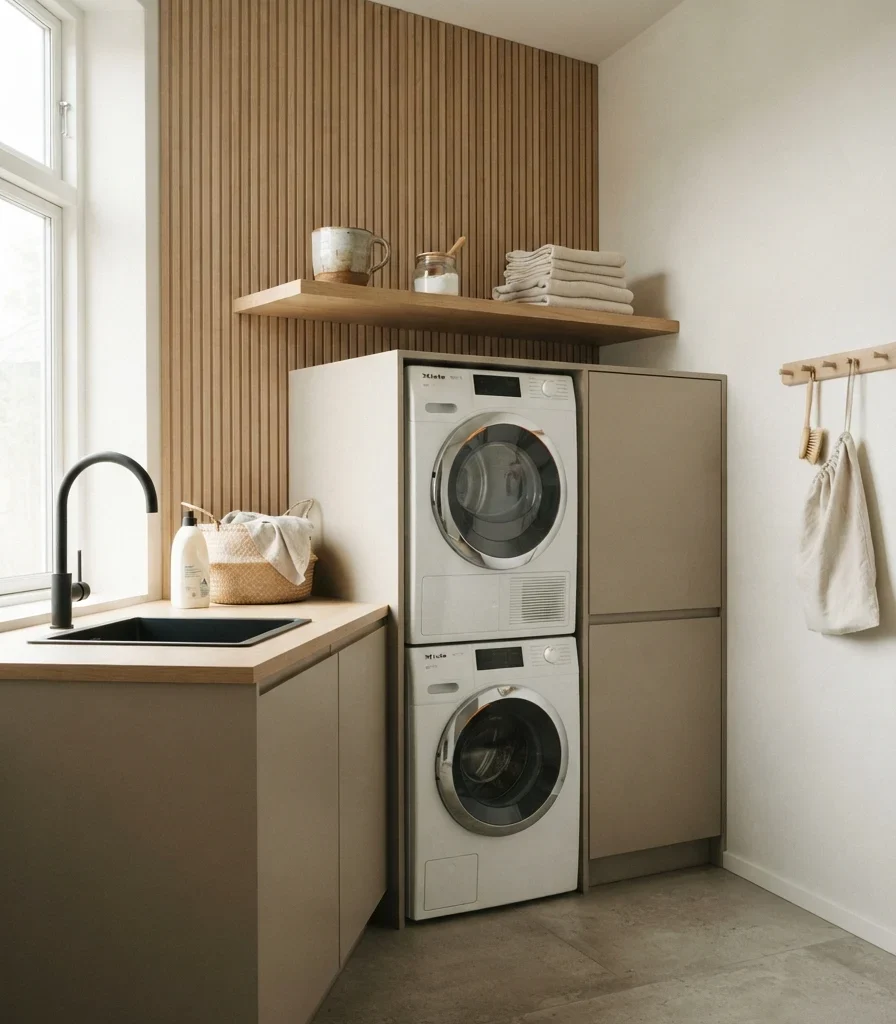
Vibe: Tactile.
Why it works: Fluted oak creates texture without relying on pattern or decoration. Repetition and vertical rhythm add architectural depth while keeping the palette restrained, which suits Japandi’s preference for natural materials and simple forms.
How to get it: Use fluting on one controlled surface rather than every cabinet and wall. Keep the wood finish matte and coordinate its undertone with the main countertop so the two oak elements read as related rather than competing.
Shop The Look
| Product | Amazon search phrase |
| Wall panels | Light oak fluted wood wall panel |
| Floating shelf | Natural oak floating shelf thick edge |
| Stoneware cup | Handmade beige stoneware utility cup |
| Wooden scoop | Small natural wood storage scoop |
| Cabinet liner | Natural cork drawer liner roll |
10. Replace Harsh Ceiling Light with a Paper Pendant

Vibe: Gentle.
Why it works: Paper and fabric shades diffuse the point-source glare common in utility-room ceiling fixtures. Light diffusion softens the room’s hard appliance surfaces while reinforcing the Japanese side of the Japandi material vocabulary.
How to get it: Choose a simple rice-paper or linen pendant with a warm 2700K bulb and size it according to the room rather than choosing the smallest fixture automatically. Keep the pendant centered over the primary work zone, not necessarily the exact geometric center of the room.
💡 Quick Win: A plug-in paper lantern pendant can test the visual effect before you commit to hardwired lighting.
Shop The Look
| Product | Amazon search phrase |
| Pendant | Japanese rice paper pendant light minimalist |
| Bulb | 2700K warm white LED dimmable globe bulb |
| Ceiling hook | White ceiling pendant cord hook kit |
| Linen shade | Natural linen pendant lamp shade |
| Extension cord | White fabric covered extension cord |
11. Choose a Low-Profile Utility Stool
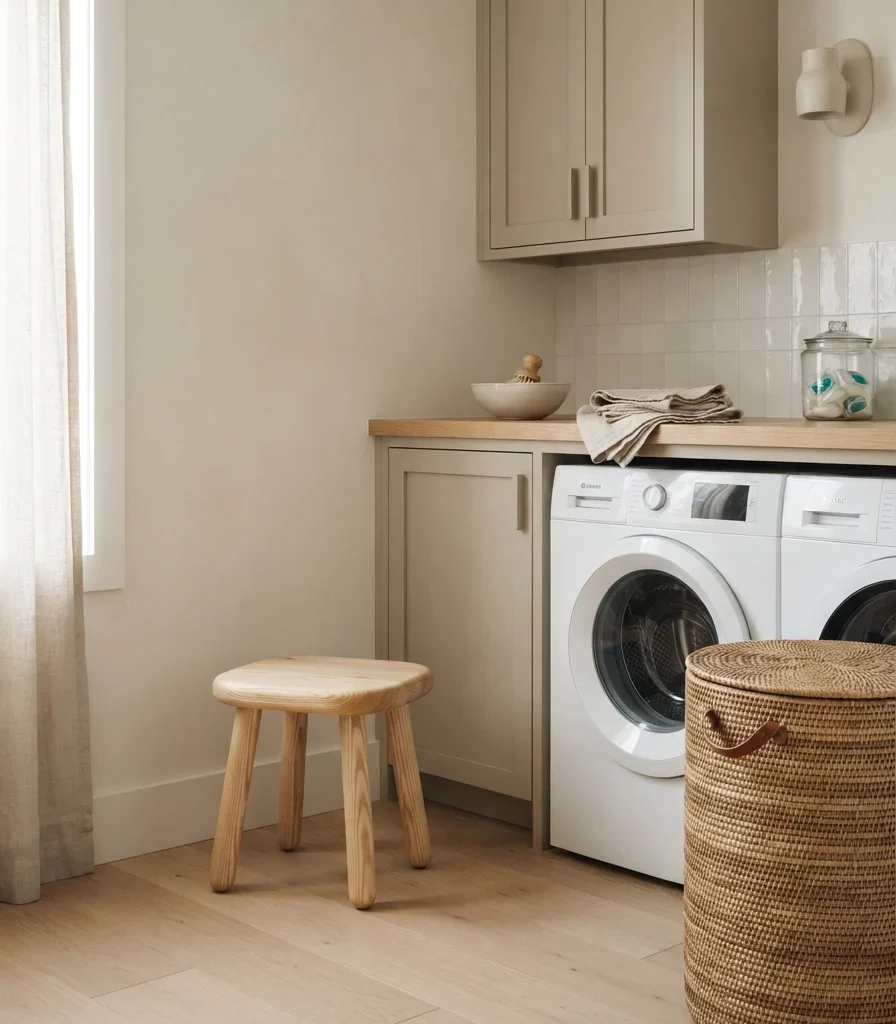
Vibe: Restful.
Why it works: A utility stool is functional but can easily become visual clutter. A compact natural-wood profile supports proportion and negative space, giving the room somewhere to sit without introducing a large piece of furniture.
How to get it: Select a stool with a simple three- or four-leg structure and a seat height suited to your counter or folding station. Keep it tucked completely beneath the counter when not in use.
Shop The Look
| Product | Amazon search phrase |
| Stool | Natural ash wood low stool minimalist |
| Seat cushion | Oatmeal linen round stool cushion |
| Felt pads | Neutral felt furniture floor protectors |
| Wood oil | Natural matte wood finishing oil |
| Basket | Small round seagrass floor basket |
12. Use Linen Instead of Synthetic Textiles

Vibe: Soft.
Why it works: Utility rooms are dominated by hard appliances and cabinetry, so textiles provide necessary texture contrast. Linen and cotton add tactile softness without introducing loud prints, preserving the quiet material palette that defines Japandi.
How to get it: Replace visible polyester baskets and decorative textiles with washed linen, cotton canvas, or hemp where practical. Keep the textile palette within flax, oatmeal, warm white, and mushroom rather than mixing multiple colors.
Shop The Look
| Product | Amazon search phrase |
| Linen towels | Washed linen utility hand towel oatmeal |
| Laundry bag | Natural linen drawstring laundry bag |
| Cotton basket | Cotton rope laundry basket neutral |
| Soap dish | Handmade cream ceramic soap dish |
| Cloth bags | Natural canvas reusable storage bags |
13. Create a Dedicated Cleaning-Tool Wall
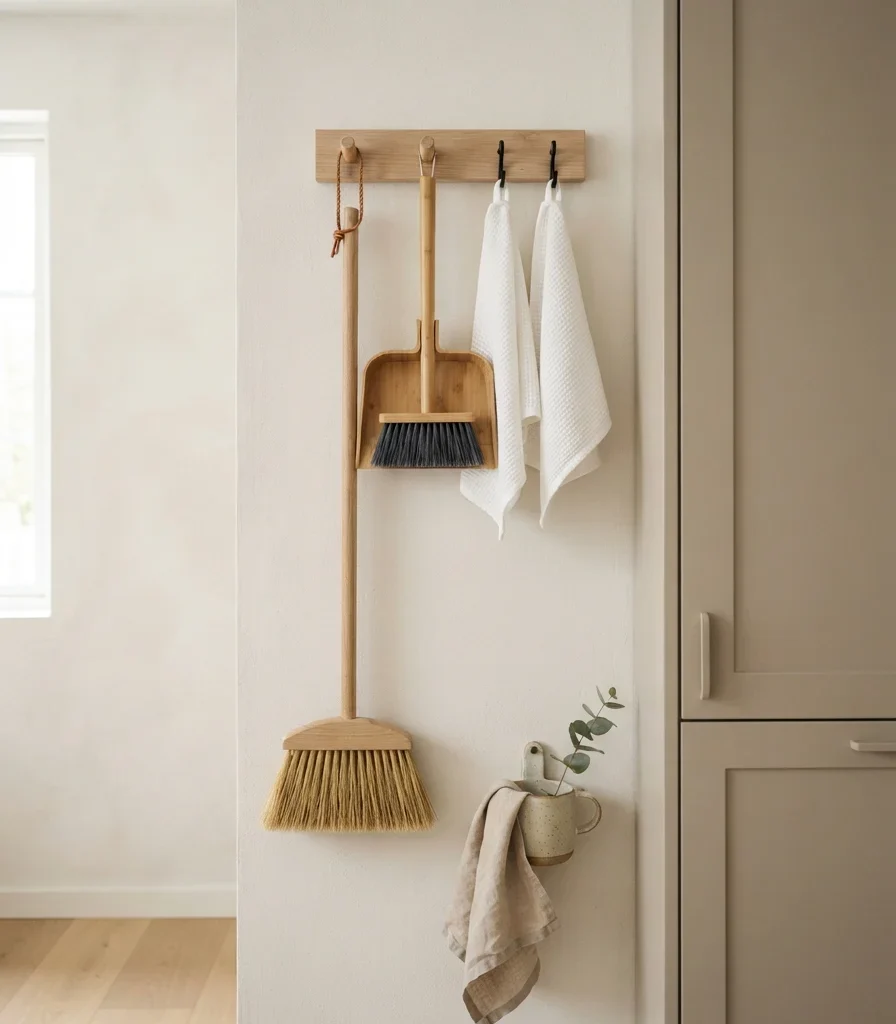
Vibe: Purposeful.
Why it works: Everyday tools become visually calmer when they are arranged as a deliberate composition instead of hidden randomly behind doors. Functional display works especially well in Japandi because objects can remain visible when their materials and forms are simple.
How to get it: Install a narrow peg rail near the utility-room entrance and assign one hook to each frequently used tool. Keep the visible collection limited to the tools used weekly and store specialty equipment elsewhere.
Shop The Look
| Product | Amazon search phrase |
| Peg rail | Natural oak peg rail wall organizer |
| Broom | Bamboo handle minimalist cleaning broom |
| Dustpan | Natural bamboo dustpan and brush set |
| Hooks | Matte black S hooks utility room |
| Cloths | Reusable beige cotton cleaning cloths |
14. Use a Sliding Door for a Narrow Utility Room
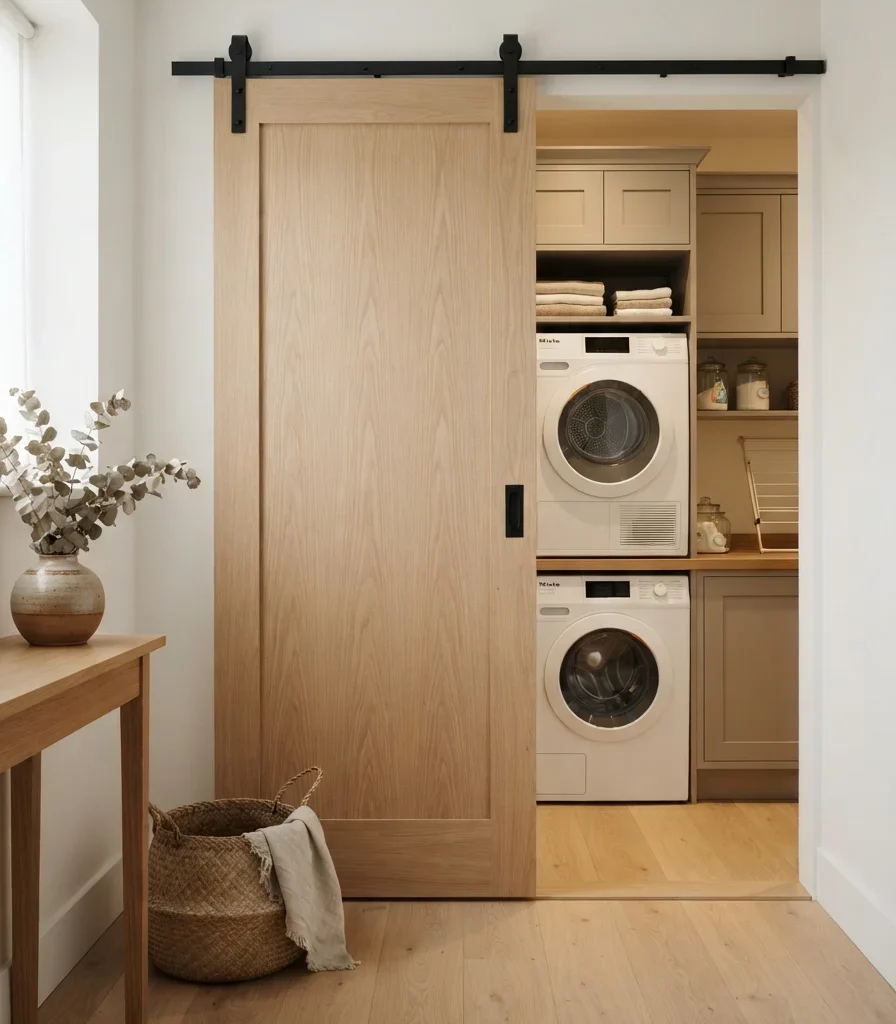
Vibe: Quiet.
Why it works: Swing doors consume valuable clearance in narrow utility rooms, while a sliding door can preserve circulation and conceal the working room when laundry is unfinished. Spatial efficiency becomes part of the aesthetic because fewer visible interruptions create a cleaner sightline.
How to get it: Choose a door system that provides the required clearance and allows full appliance access when open. A flush pale-oak door with minimal black hardware keeps the entrance aligned with Japandi’s low-visual-noise approach.
💡 Quick Win: If construction is not possible, use a simple ceiling-mounted linen curtain in warm oatmeal as a soft temporary visual screen.
Shop The Look
| Product | Amazon search phrase |
| Sliding door | Natural oak interior sliding barn door minimalist |
| Hardware | Matte black sliding door hardware modern |
| Door pull | Recessed black sliding door pull |
| Curtain | Oatmeal linen room divider curtain |
| Curtain rod | Ceiling mount curtain track white |
15. Add a Clay-Toned Backsplash for Warmth

Vibe: Earthy.
Why it works: A clay-toned backsplash adds warmth while remaining close enough to the neutral palette to avoid visual competition. Texture over pattern is the key: subtle tile irregularity provides the handmade character associated with wabi-sabi without requiring bold decoration.
How to get it: Select matte ceramic or porcelain tile in a muted clay-beige tone and use warm off-white grout rather than a dramatic contrasting color. Keep the tile format simple so the surface reads as texture rather than graphic pattern.
Shop The Look
| Product | Amazon search phrase |
| Tile | Matte clay beige ceramic subway tile |
| Grout | Warm white flexible tile grout |
| Soap bottle | Stoneware refillable soap dispenser beige |
| Towel | Clay beige linen kitchen towel |
| Brush holder | Small handmade ceramic brush cup |
16. Build a Compact Folding Station Under a Window
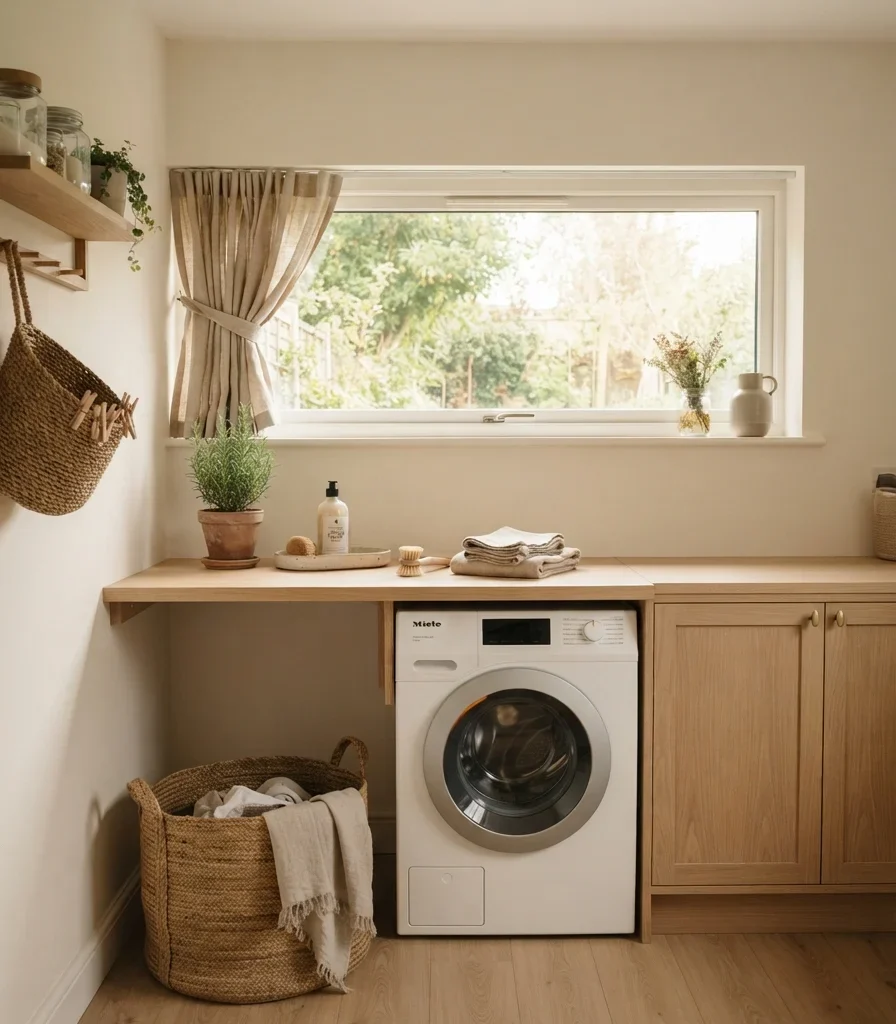
Vibe: Sun-warmed.
Why it works: A small utility room benefits from putting its most frequently used surface where daylight is available. Light orientation improves both practical visibility and perceived spaciousness, while a shallow counter avoids consuming the entire room.
How to get it: Measure the windowsill height, appliance depth, and required work clearance before specifying the counter. Use a shallow linen Roman shade or café curtain only if privacy is necessary, keeping the window as visually open as possible.
Shop The Look
| Product | Amazon search phrase |
| Roman shade | Natural linen Roman shade flax |
| Counter | Slim pale oak wall-mounted folding counter |
| Herb pot | Small matte stoneware herb planter |
| Tray | Oval light wood catchall tray |
| Laundry basket | Slim vertical rattan laundry hamper |
17. Choose Brushed Stainless Steel for Quiet Contrast
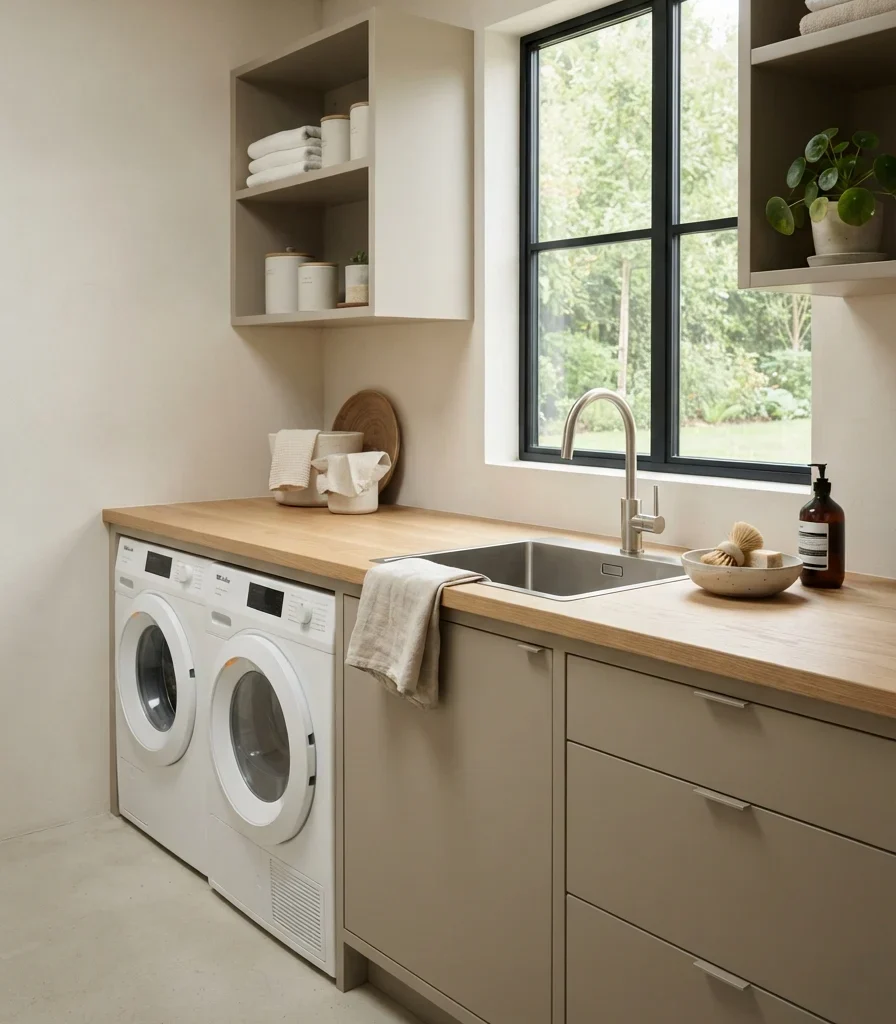
Vibe: Balanced.
Why it works: Brushed stainless steel introduces a durable working material without the visual glare of polished chrome. Controlled material contrast lets the utility room acknowledge its hardworking purpose while oak, linen, and ceramic keep the overall composition warm.
How to get it: Repeat brushed steel in only two or three locations, such as the sink, faucet, and appliance details. Avoid mixing polished chrome, brass, copper, and black hardware in the same small room.
Shop The Look
| Product | Amazon search phrase |
| Faucet | Brushed stainless steel utility sink faucet |
| Sink grid | Stainless steel utility sink bottom grid |
| Drain strainer | Brushed stainless steel sink drain strainer |
| Utility hooks | Stainless steel adhesive utility hooks |
| Sink caddy | Brushed stainless steel sink organizer |
18. Add a Bamboo Laundry Ladder

Vibe: Natural.
Why it works: Vertical storage takes advantage of unused wall height without requiring a deep cabinet. Vertical organization is especially effective in compact utility rooms because the floor remains available for baskets and appliance access.
How to get it: Select a narrow bamboo ladder with enough rung spacing for towels and cloths, then limit visible items to two or three. Do not use it as a general dumping rail; its visual simplicity disappears quickly when overloaded.
💡 Quick Win: A slim bamboo ladder can often be added without drilling, making it one of the fastest ways to introduce natural texture and vertical storage.
Shop The Look
| Product | Amazon search phrase |
| Ladder | Slim natural bamboo blanket ladder |
| Towels | Oatmeal waffle cotton hand towels |
| Hooks | Natural bamboo removable hooks |
| Basket | Small woven bamboo floor basket |
| Cloth | Natural linen cleaning cloth set |
19. Finish with One Wabi-Sabi Ceramic Statement
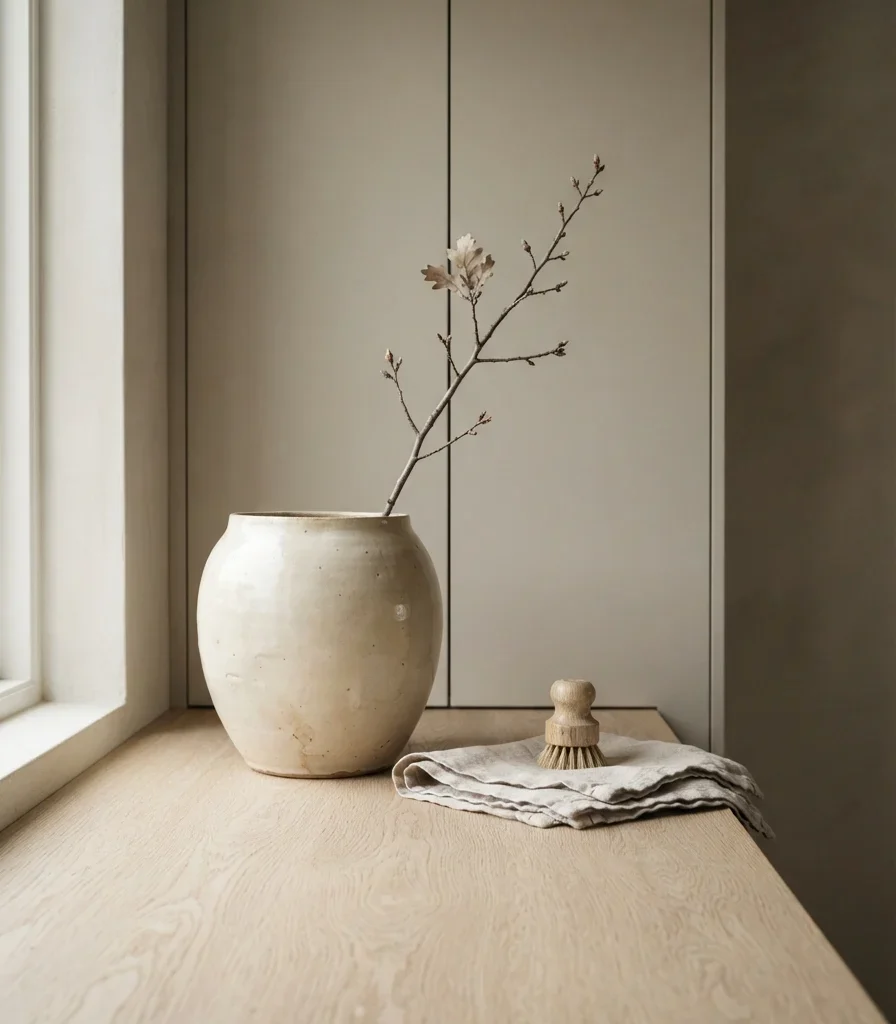
Vibe: Contemplative.
Why it works: Wabi-sabi values natural variation and the character of handmade objects, making one imperfect ceramic piece more appropriate than a collection of decorative accessories. Intentional scarcity gives the object visual importance and keeps the counter available for actual laundry work.
How to get it: Choose one hand-thrown ceramic vessel with visible irregularity, matte glaze, or subtle tonal variation and leave at least 12–18 inches of clear counter around it. The empty surface is part of the composition.
Shop The Look
| Product | Amazon search phrase |
| Vessel | Large handmade wabi sabi ceramic vase cream |
| Branch | Natural dried manzanita branch decorative |
| Tray | Minimal raw wood rectangular tray |
| Stone | Natural river stone decorative large |
| Linen | Undyed flax linen hand towel |
20. Keep Everyday Clutter Behind Full-Height Doors
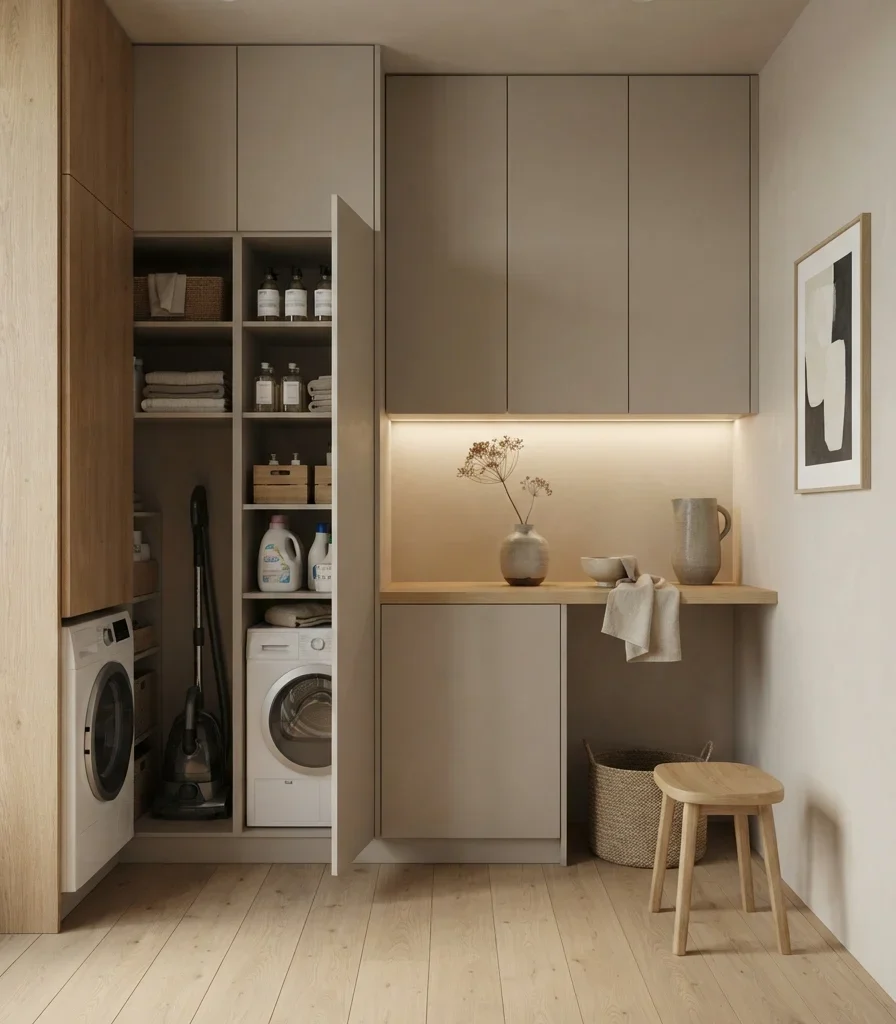
Vibe: Peaceful.
Why it works: The most effective Japandi utility room is not one where fewer things exist; it is one where fewer things remain visually exposed. Visual editing allows necessary household equipment to coexist with calm architecture, while full-height storage uses vertical volume efficiently.
How to get it: Design storage around the actual objects you own: vacuum height, detergent bottles, mop length, ironing board dimensions, and laundry baskets. Keep approximately 70% of storage closed and reserve open shelves for a small number of intentional objects.
Shop The Look
| Product | Amazon search phrase |
| Storage cabinet | Tall warm oak utility storage cabinet |
| Organizer bins | Neutral fabric cabinet storage bins with handles |
| Lazy Susan | Bamboo rotating cabinet organizer |
| Drawer dividers | Natural bamboo adjustable drawer dividers |
| Label set | Minimal black and white storage labels |
How to Start Your Zen Japandi Utility Room Transformation
Start with warm greige cabinetry as the visual anchor. A soft mushroom-greige finish gives the utility room enough warmth to work with pale oak, linen, bamboo, and cream ceramics while remaining neutral enough for stainless-steel appliances; once this foundation is established, the rest of the palette becomes much easier to control.
The most common mistake is treating Japandi as an instruction to remove everything and leave the room empty. That creates a sterile space rather than a Zen one; the fix is to replace visual quantity with material quality, keeping useful objects but choosing natural wood, linen, ceramic, bamboo, and restrained hardware wherever those objects remain visible.
Three inexpensive entry points can shift the atmosphere immediately: a 2700K warm-white LED bulb, a small oatmeal linen hand towel, and a matte cream ceramic soap dispenser. Each can usually be sourced for under $50 individually, and together they introduce the warm light, tactile textile, and handmade-looking ceramic language that makes Japandi recognizable.
A cosmetic refresh can happen in a weekend, while cabinetry, countertops, flooring, electrical changes, plumbing, or custom drying storage can take several weeks. A simple styling-led update may cost $150–$800, while a more substantial utility-room renovation can range from roughly $3,000–$15,000+, depending on cabinetry, appliances, plumbing, flooring, and labor. Plan ventilation, appliance clearances, water protection, and electrical work before decorative purchases.
Frequently Asked Questions About Zen Japandi Utility Room
What is the difference between Japandi and minimalist utility room design?
Japandi is more than minimalism because it combines restraint with warmth, natural materials, craftsmanship, and tactile imperfection. A purely minimalist utility room might emphasize stark white cabinetry and almost no visible objects, while Japandi can use pale oak, linen, bamboo, handmade ceramics, and muted sage to create warmth. The goal is not simply fewer things; it is fewer unnecessary visual distractions.
What colors are best for a Zen Japandi utility room?
Warm white, oatmeal, mushroom, greige, pale oak, muted sage, clay, and soft charcoal are particularly useful. A warm greige cabinet paired with pale oak is a reliable starting combination because it provides enough tonal contrast without becoming busy. Keep stronger colors limited to one accent family rather than introducing several competing hues.
How much does it cost to create a Japandi utility room?
A styling-focused update can start around $150–$800 when the existing cabinets and appliances are usable. Replacing cabinetry, countertops, flooring, lighting, plumbing fixtures, or appliances can push the renovation toward $3,000–$15,000 or more. The biggest savings usually come from keeping the existing appliance layout and improving storage and finishes around it.
Can Japandi work in a very small utility room?
Yes, and the style can be particularly effective in compact rooms because it already values negative space and visual restraint. Use full-height storage, pale colors, shallow cabinetry, wall-mounted drying solutions, and a continuous work surface instead of filling the floor with freestanding organizers. Keep frequently used items accessible but visually grouped so the room remains easy to work in.
Which materials make a utility room feel most Japandi?
Pale oak, ash, bamboo, linen, natural cotton, matte ceramic, stone, rattan, and brushed stainless steel create a strong Japandi material vocabulary. For a utility room, durability matters, so use moisture-appropriate finishes around sinks and appliances rather than choosing a material purely for appearance. A practical combination is pale oak cabinetry, matte ceramic accessories, linen textiles, and brushed stainless steel hardware.
Ready to Create Your Dream Zen Japandi Utility Room with These 20 Ideas?
These 20 how to create a Zen Japandi utility room ideas move through warm greige cabinetry, pale oak, layered lighting, concealed drying, muted sage, natural textiles, efficient zoning, compact storage, and carefully chosen wabi-sabi accessories. You do not need to renovate everything at once; Japandi actually rewards the slower approach of editing, replacing, and refining one element at a time. Today, change the utility room’s main bulb to a 2700K warm-white LED and clear one visible surface completely. As the room becomes quieter, more tactile, and easier to use, the everyday work of laundry can begin to feel less like visual noise and more like a simple, orderly domestic ritual. Save and pin the ideas that speak to you most- especially the pale-oak worktop, concealed drying rack, three-object shelf, and full-height storage concepts- so you have a calm Japandi reference board when you’re ready to transform the room.
You Might Also Like
- 13 Minimalist Home Decor Ideas for a Calm, Clutter-Free Space
- 20 Home Styling Ideas That Make a Room Feel Finished
- 20 Interior Design Inspiration Ideas for Any Style You Love
- 15 Home Makeover Ideas for a Real Before-and-After Transformation
- 10 Stylish Shelf Decor Ideas for Every Room
- 20 DIY Home Decor Ideas You Can Actually Make Yourself