
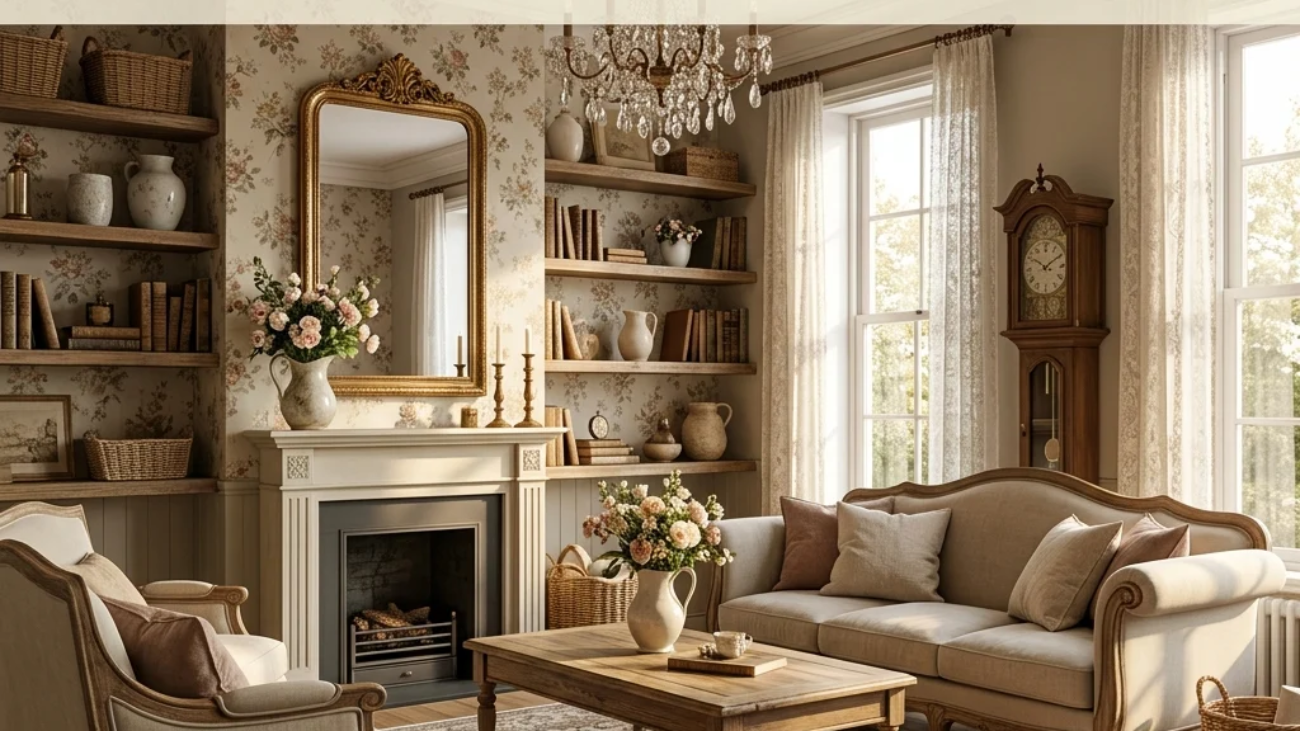
Vintage home decor is the practice of furnishing a home with genuinely aged or period-authentic pieces, mostly sourced secondhand from estate sales, flea markets, and antique dealers, rather than new furniture built to imitate an older look. This article gives you 20 vintage home decor ideas spanning color, material, lighting, furniture, and layout, all grounded in real design eras from the Victorian and Georgian periods through mid-century modern.
The feel is unmistakable: light catching the facets of cut crystal, brass hardware worn smooth by decades of hands, a rug whose pattern has softened just enough to look lived-in rather than new. Vintage rooms carry weight and history in a way no reproduction piece quite manages, because the wear itself is the design detail. This is decorating with real objects instead of manufactured stand-ins, and the resulting rooms feel collected rather than purchased. Here are 20 ideas worth saving and stealing.
Why Vintage Home Decor Works So Well
Vintage decor draws from several distinct historical periods rather than one single movement. Georgian and Victorian formality, Art Deco’s geometric glamour of the 1920s, and mid-century modern’s cleaner lines from the 1950s and 60s all fall under the vintage umbrella. What unifies them isn’t a shared aesthetic but a shared sourcing method: genuine vintage pieces are at least 20 years old and typically bought secondhand, which is what distinguishes true vintage decor from the newly manufactured “vintage-inspired” furniture sold at most big-box retailers.
The materials carry real age: aged brass and bronze with visible patina, cut crystal and pressed glass, ironstone and hand-painted ceramic, mahogany and walnut with a deep hand-rubbed finish, and chippy painted wood where layers of old paint show through rather than being sanded smooth. Colors lean into warm, saturated tones, burgundy, forest green, warm mustard, and the faded jewel tones found in worn Persian and Oriental rugs alongside milk glass white as a softening neutral.
Vintage decor’s current resurgence tracks directly with the broader secondhand and sustainability movement. Resale platforms like Chairish and 1stDibs have made sourcing genuine antique pieces dramatically easier than a decade ago, while Pinterest search data shows steady year-over-year growth in searches for “grandmillennial” and “collected home” interiors, both terms describing this same return to real, aged objects over disposable new ones.
Small spaces can absolutely embrace vintage decor, though the honest limit is scale; many genuine antiques, especially Victorian case furniture, were built for larger rooms than most modern apartments offer. Prioritize smaller-scale vintage pieces first: a single accent chair, a vintage mirror, a collection of ironstone rather than a full antique dining set, so the room gains character without losing floor space.
Style at a Glance
| Element | Formal Antique Register | Collected Eclectic Register |
| Philosophy | Period-authentic pieces, sourced with intention | Mismatched objects gathered over time |
| Materials | Mahogany, gilt, cut crystal, ironstone | Chippy paint, brass, pressed glass, worn textiles |
| Color Palette | Burgundy, forest green, warm gold | Faded florals, milk glass white, jewel-tone rugs |
═══════════════════════════════════
20 Vintage Home Decor Ideas
1. Faded Floral Wallpaper as a Vintage Color Anchor
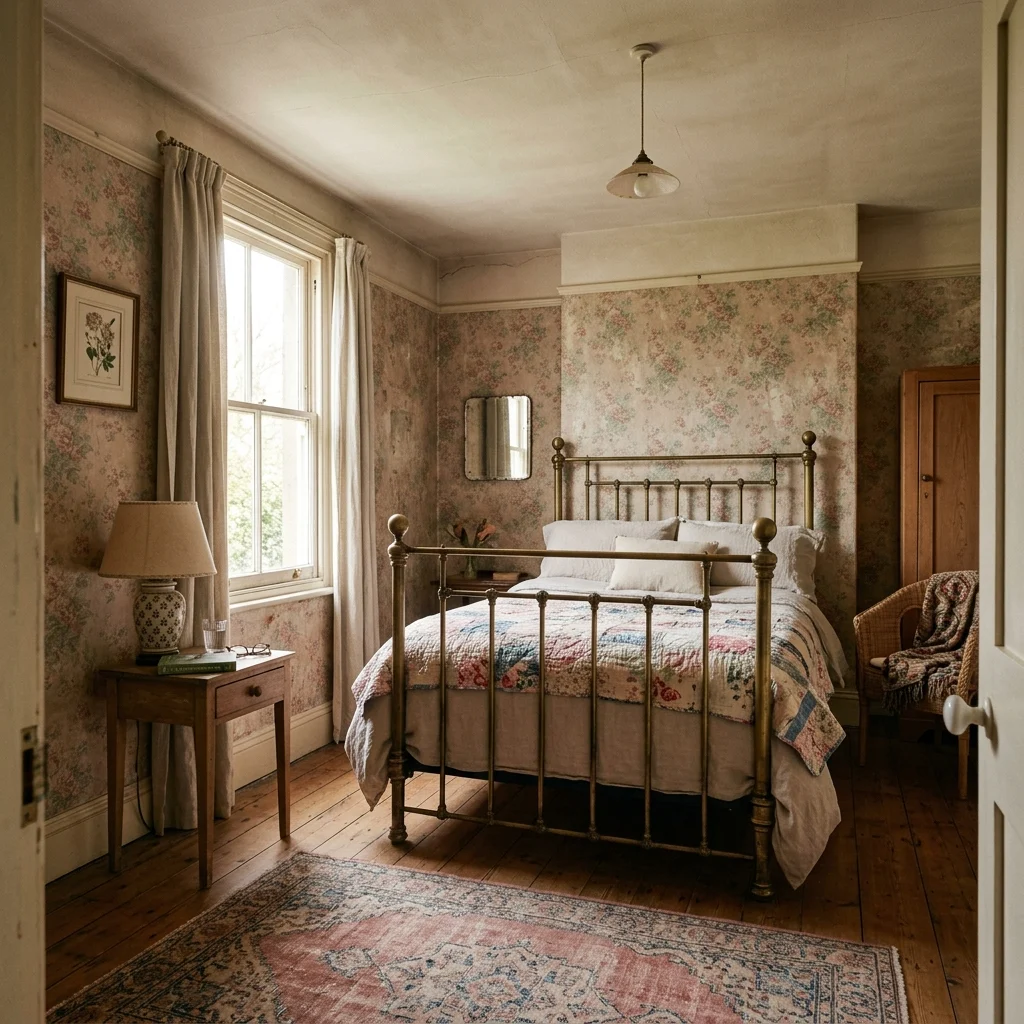
Vibe: The room feels nostalgic, like a memory softened at the edges.
Why it works: Faded floral wallpaper, a pattern deliberately printed with a muted, slightly desaturated palette rather than crisp saturated color, mimics the look of genuine antique paper that has aged under decades of sunlight, which is why it reads as authentically vintage rather than costume-like. This is a period technique with roots in Victorian and William Morris-era pattern design, where the multi-tonal print itself carried the room’s entire color story without needing additional accent walls.
How to get it: Choose wallpaper described specifically as “faded” or “muted” floral rather than bright reproduction prints, and pair it with matte (not glossy) painted trim in a warm white so the wall doesn’t compete with its own molding.
💡 Quick Win: A faded floral wallpaper applied to just one accent wall, or even the back of a single bookshelf, delivers the same effect at a fraction of the material cost.
Shop the Look
| Product |
| Faded floral peel-and-stick wallpaper |
| Antique brass bed frame |
| Vintage-style quilted bedspread |
| Ceramic table lamp, floral base |
| Warm white matte trim paint |
2. Aged Brass Hardware With Real Patina
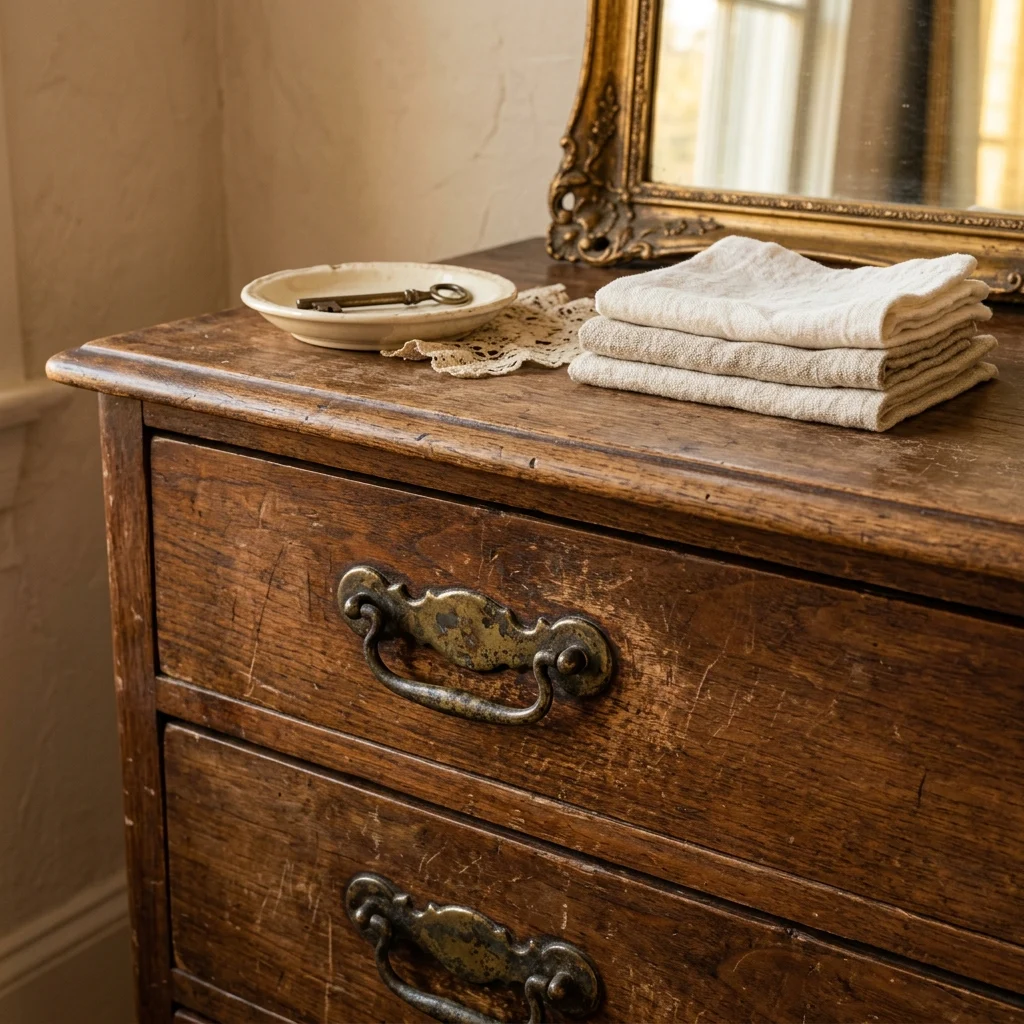
Vibe: The dresser feels storied, like it has genuinely been touched for decades.
Why it works: Unlacquered brass develops a natural patina, a soft, uneven darkening through years of oxidation and handling, which is chemically impossible to fully replicate in a factory finish, no matter how convincing the “antique brass” label sounds. This is why serious vintage collectors specifically seek unlacquered, aged hardware rather than new hardware finished to look old: the irregularity itself, darker in the recesses and worn brighter at contact points, is what reads as genuine rather than manufactured.
How to get it: Source hardware explicitly labeled “unlacquered brass” or “aged brass, antique finish” rather than “brushed brass,” since brushed finishes are uniform and won’t develop the same organic patina variation over time.
Shop the Look
| Product |
| Unlacquered aged brass drawer pulls |
| Vintage-style oval wall mirror |
| Ceramic vanity tray, floral pattern |
| Linen guest towel set |
| Antique-finish brass cabinet knobs |
3. Stained and Amber Glass Lamp Shades
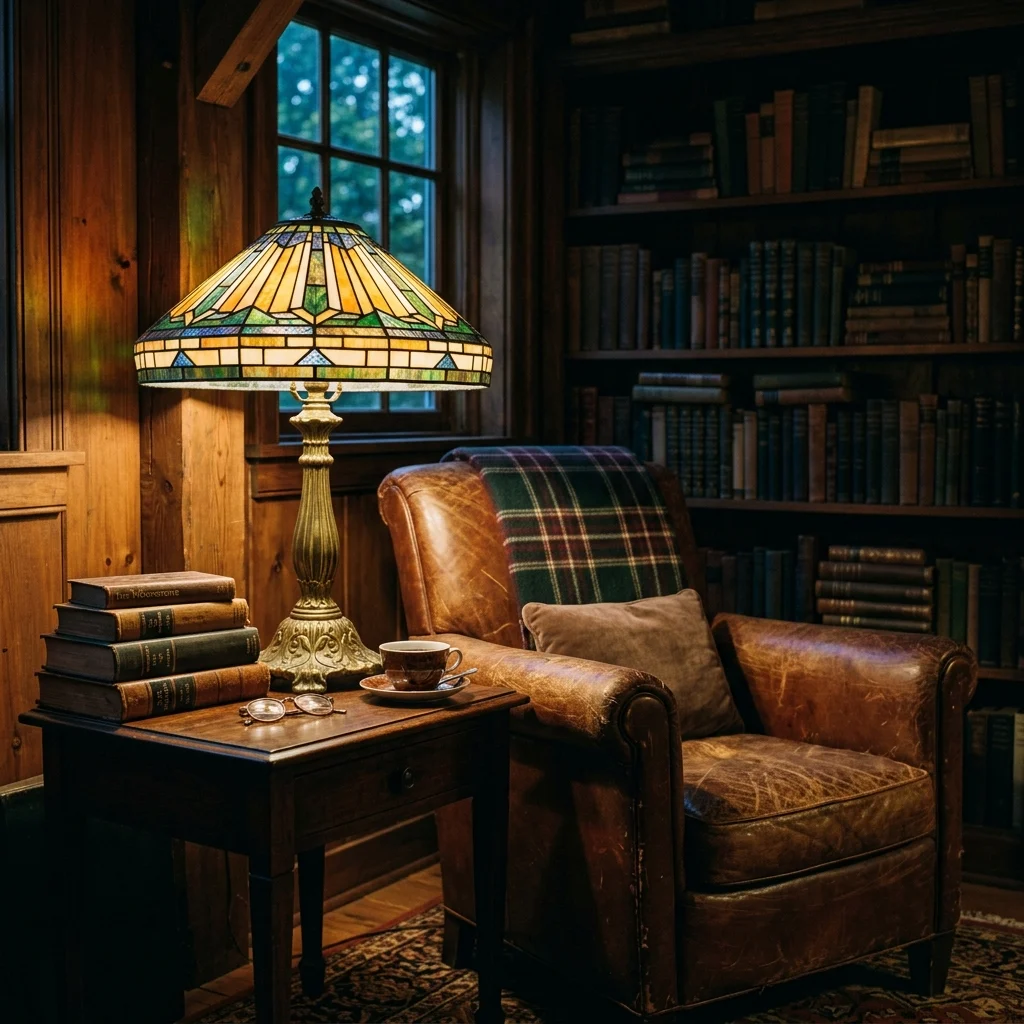
Vibe: The nook feels romantic, colored light pooling like something from another decade.
Why it works: Stained and leaded glass lamp shades, popularized in the Tiffany studio lamps of the early 1900s, filter light through colored panels rather than letting it pass through clear or fabric shades, which produces the warm, jewel-toned glow that reads instantly as vintage. This is a light-behavior principle distinct from anything achievable with modern LED fixtures: the color comes from the glass itself, not a tinted bulb, so the effect shifts naturally as the bulb warms up or dims.
How to get it: Choose a genuine or well-made reproduction leaded glass shade in amber and green tones over a brass base, and pair it with a warm incandescent-style bulb rather than a cool LED, since cool light flattens the stained glass’s intended warmth.
💡 Quick Win: A single stained glass accent lamp on a side table introduces this effect without committing an entire room to the look.
Shop the Look
| Product |
| Stained glass table lamp, brass base |
| Vintage-bound hardcover book set |
| Worn leather accent chair |
| Warm incandescent-style light bulb |
| Small walnut side table |
4. A Genuine Antique Chesterfield Sofa Anchor
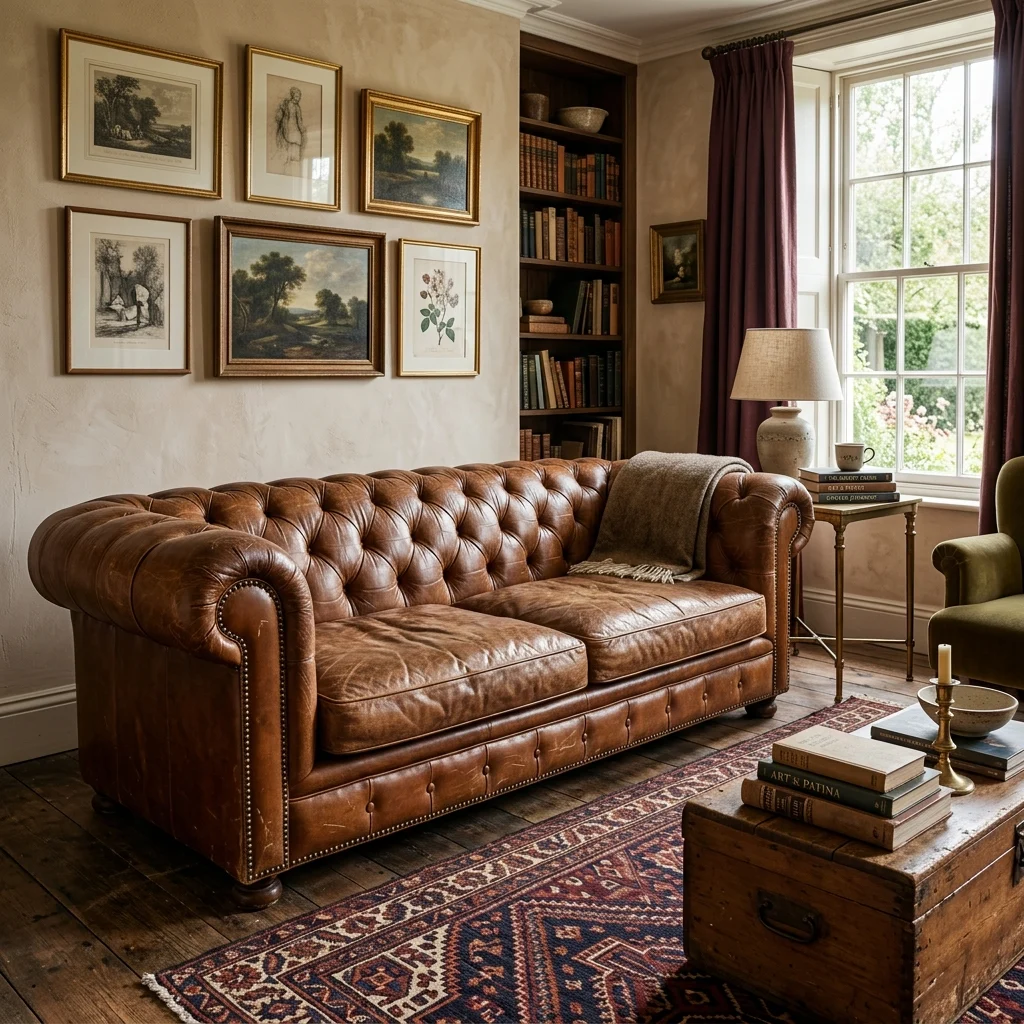
Vibe: The room feels collected, anchored by one piece with obvious history.
Why it works: A genuine or well-aged leather Chesterfield sofa, with its deep button-tufting and rolled arms, has remained a defining vintage furniture silhouette since its origins in 18th-century English club rooms because the tufting pattern and nailhead trim create structural visual interest that never needed pattern or color to work. Real aged leather also creases and lightens unevenly at high-contact points, arm rests, and seat edges in a way new leather simply hasn’t had time to do, which is the detail that separates an authentic piece from a reproduction.
How to get it: Source a genuinely vintage or estate-sale Chesterfield where possible, and if buying new, choose full-grain leather (not bonded or faux) in cognac or a deep burgundy tone, since these develop the most convincing patina over years of actual use.
Shop the Look
| Product |
| Cognac leather Chesterfield-style sofa |
| Vintage kilim area rug |
| Brass and glass side table |
| Vintage hardcover book stack |
| Brass nailhead trim accent pillow |
5. A Gallery Wall of Gilt-Framed Portraits and Prints
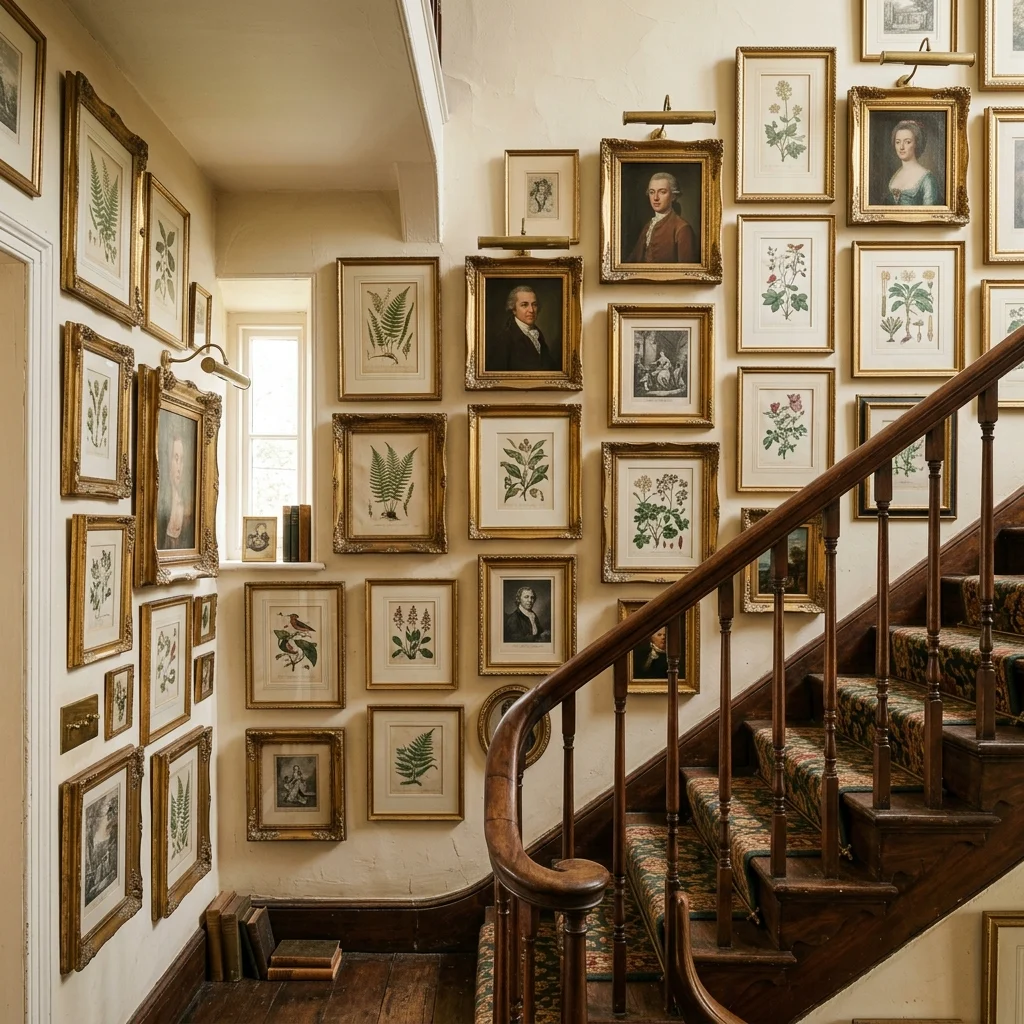
Vibe: The wall feels layered, like generations of collecting hung at once.
Why it works: Dense, mismatched gallery walls in gilt frames reference the historic “salon-style” hanging tradition of 18th and 19th-century European homes and galleries, where art was displayed floor to ceiling rather than in the sparse, evenly spaced arrangements common today. The visual density itself is the point at which a salon wall works because it embraces asymmetry and varied frame styles rather than fighting them, which is the opposite instinct most modern gallery-wall guides teach.
How to get it: Mix genuinely different gilt frame sizes and finishes rather than a matched set, and hang them with minimal gaps (2–3 inches between frames) rather than the wider, evenly measured spacing typical of contemporary gallery walls.
💡 Quick Win: Start with just three mismatched gilt frames in a loose triangle. The salon-style density can be built up gradually as more pieces are found.
Shop the Look
| Product |
| Gilt ornate picture frame set |
| Vintage-style botanical print set |
| Brass picture light, plug-in |
| Antique-finish mirror, oval |
| Vintage portrait art print |
6. Jewel-Toned Persian Rug Layering
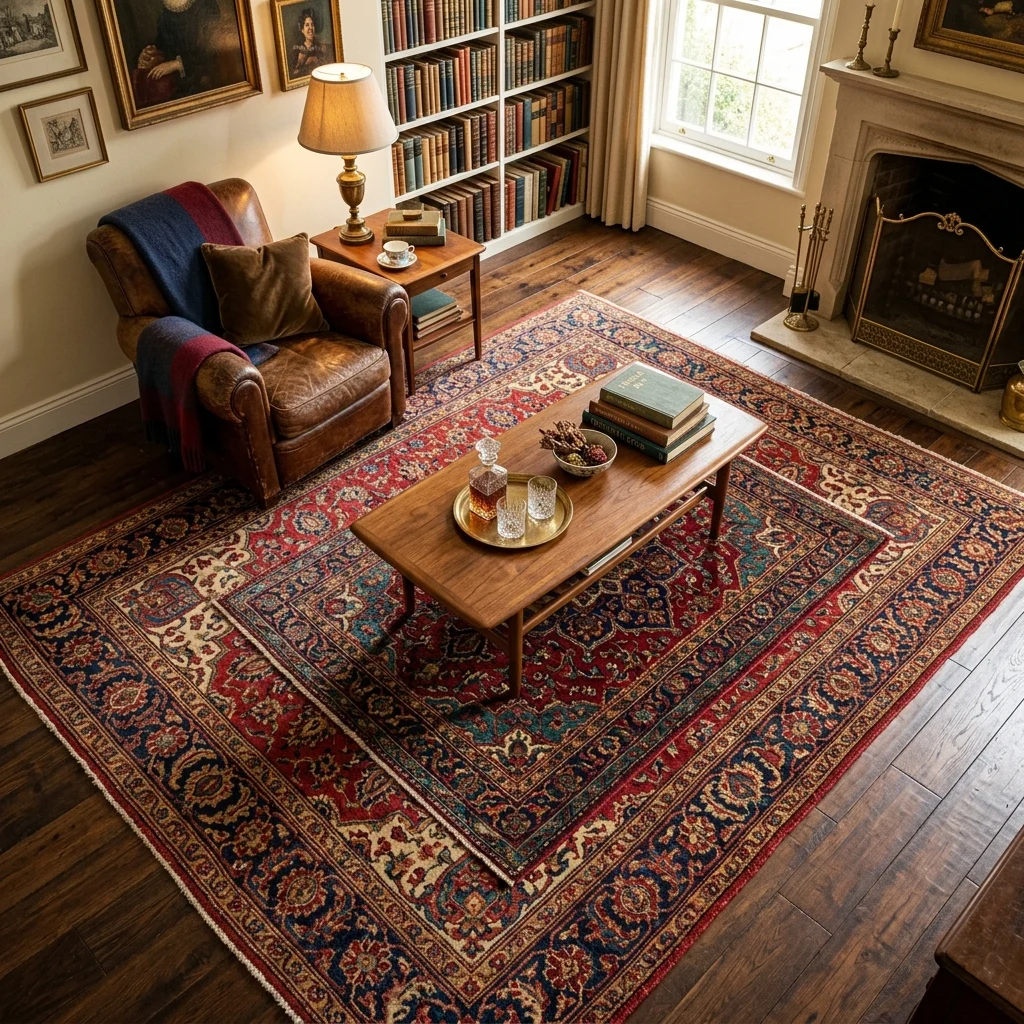
Vibe: The floor feels rich, like history laid down in wool.
Why it works: Genuine Persian and Oriental rugs carry deep, saturated jewel tones, burgundy, indigo, and warm gold that have softened slightly with decades of wear, producing a color depth that new machine-made rugs in similar patterns rarely achieve. Layering a smaller, worn rug over a larger neutral jute or wool rug, a technique borrowed directly from how these rugs were traditionally used in older European and American homes, adds visual texture at floor level without requiring any additional furniture.
How to get it: Layer a smaller, more pattern-dense vintage rug at roughly two-thirds the size of a larger plain jute or wool rug beneath it, offsetting the edges slightly rather than centering them for a more collected, less staged look.
Shop the Look
| Product |
| Vintage-style Persian area rug |
| Large jute base rug |
| Walnut coffee table, turned legs |
| Brass table lamp |
| Leather accent armchair |
7. Ironstone and Antique Ceramic Collections
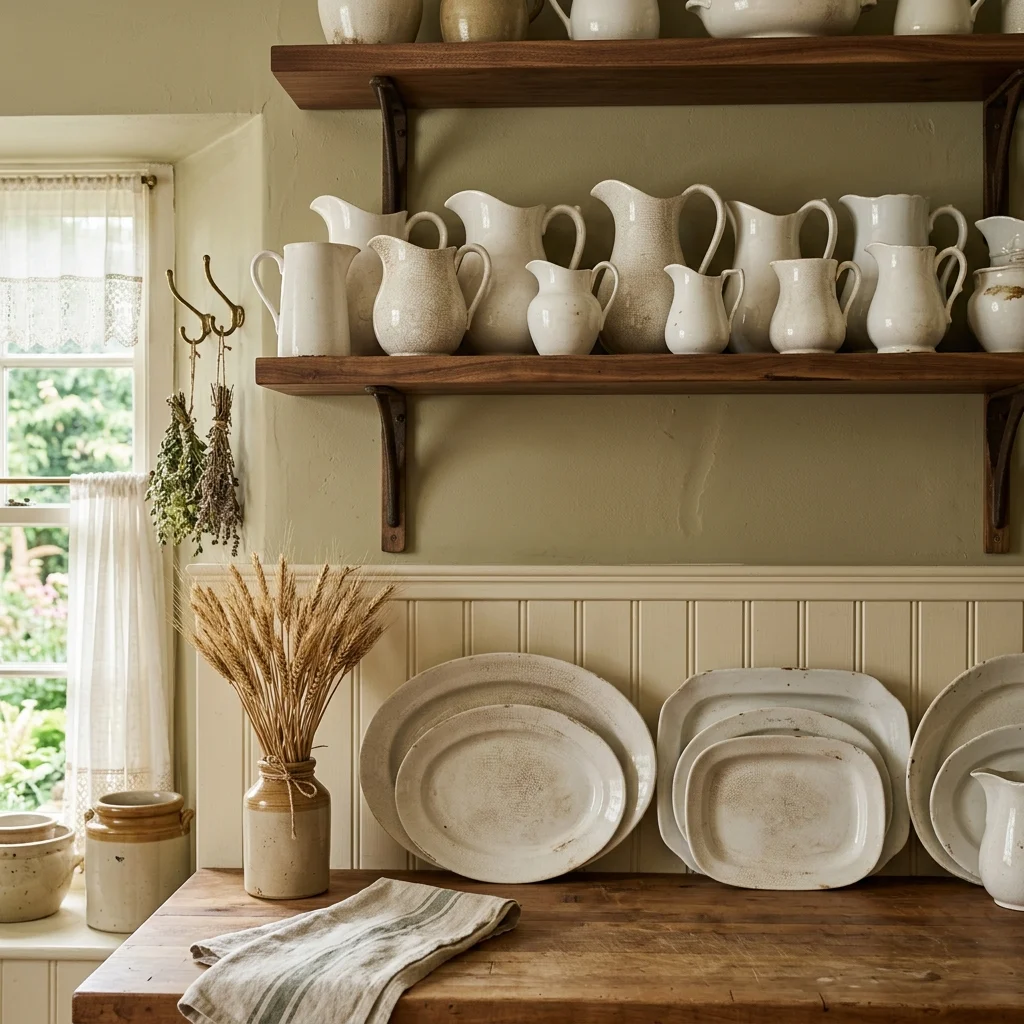
Vibe: The shelf feels collected, ivory pieces gathered one at a time.
Why it works: Ironstone, a durable white stoneware first produced in 19th-century England, develops a fine web of surface cracking called crazing as its glaze ages, a detail that’s become the specific marker collectors look for to distinguish genuine antique pieces from new reproductions. Grouping ironstone pitchers, platters, and tureens of varied sizes on open shelving creates the same collected-over-time quality as a gallery wall, but in three dimensions and in a single warm-white tone that reads as cohesive despite the variety.
How to get it: Look specifically for “antique ironstone” or “English ironstone” with visible crazing at estate sales or resale marketplaces, and group pieces by height rather than by matching pattern, since true collections were rarely uniform.
💡 Quick Win: Even three mismatched ironstone pitchers on a single shelf establish the collected look without committing to a full set.
Shop the Look
| Product |
| Antique-style ironstone pitcher set |
| Ironstone serving platter |
| Open walnut wall shelving |
| Dried wheat stem bundle |
| Linen kitchen towel, striped |
8. Formal Furniture Groupings Around a Rug
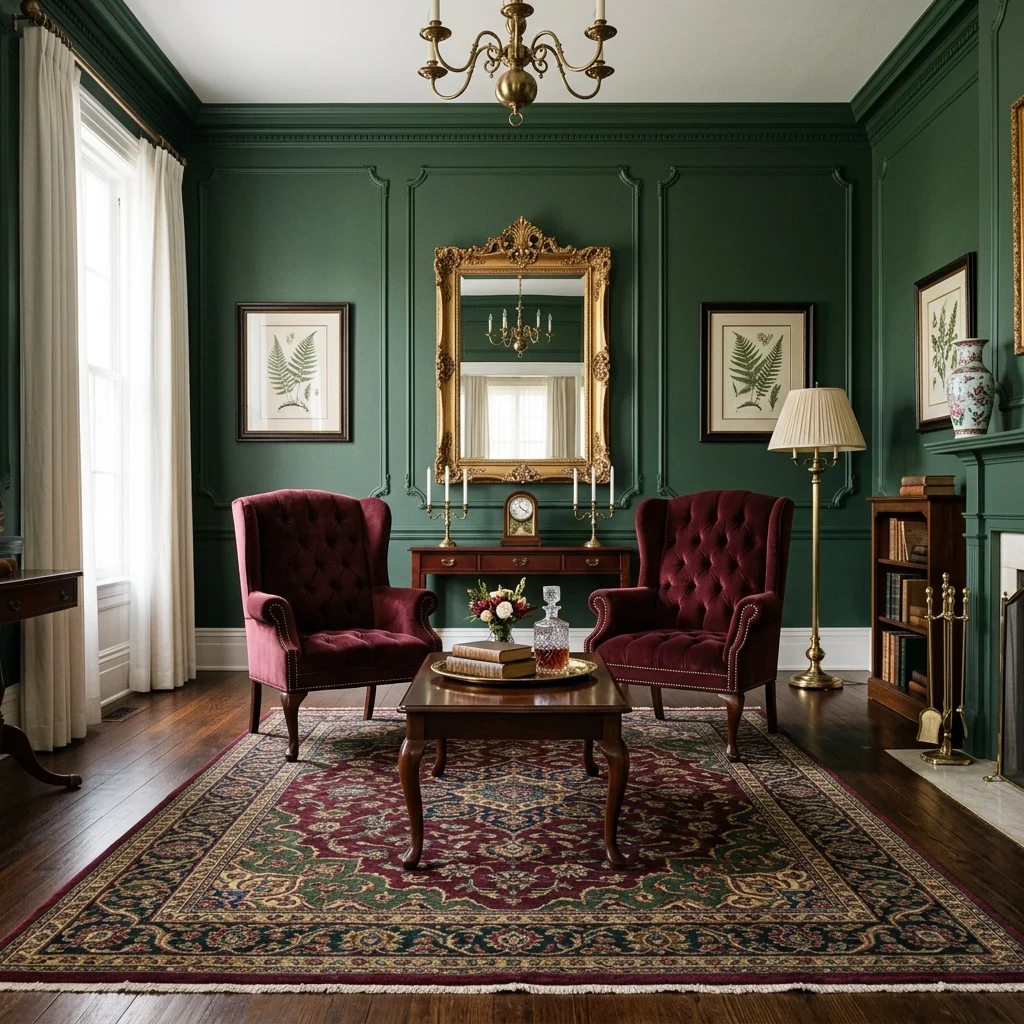
Vibe: The room feels formal, arranged with the deliberate symmetry of an older era.
Why it works: Victorian and Georgian parlors organized furniture in balanced, symmetrical groupings, a pair of matched chairs, a centered sofa, all oriented toward a defined rug boundary because formal entertaining spaces prioritized visual order and clear conversational hierarchy over the looser, asymmetric arrangements common in contemporary layouts. Centering the grouping on a well-defined rug boundary, rather than letting furniture float freely across the bare floor, reinforces this formality by giving the whole arrangement a clear visual edge.
How to get it: Size your rug so all furniture legs sit fully on it, and arrange seating in a symmetrical, facing configuration of two matched chairs opposite a sofa rather than the angled, asymmetric groupings more common in casual layouts.
Shop the Look
| Product |
| Matched wingback accent chair pair |
| Persian-style parlor area rug |
| Brass floor lamp, vintage style |
| Gilt ornate wall mirror |
| Botanical framed print set |
9. Vertical Vintage Display for Small Apartments
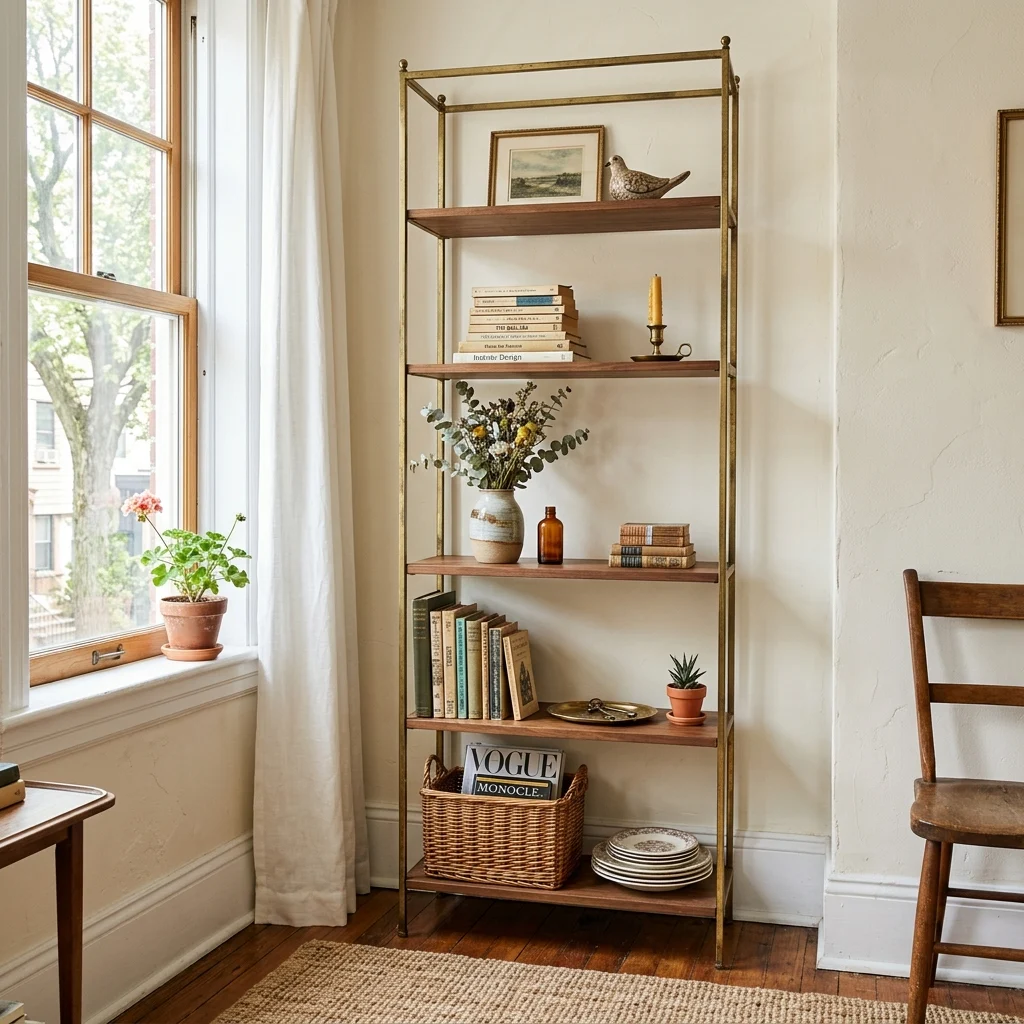
Vibe: The corner feels efficient, height doing the work floor space can’t.
Why it works: A tall, slim étagère, a vertical open shelving form popular in 19th-century French interiors, lets a small apartment display a genuine vintage collection without consuming the floor footprint a dresser or sideboard would require. Because the frame itself is typically thin brass or turned wood rather than solid panels, it also keeps sightlines open across the room, which matters more in compact spaces than in larger rooms where a heavier piece can be absorbed without visual cost.
How to get it: Choose an étagère with a slim metal or turned-wood frame rather than a boxy bookcase, and style each shelf with only two or three objects at varied heights to keep the piece from reading as cluttered in a small room.
💡 Quick Win: A single tall étagère in a studio apartment corner can replace both a bookshelf and a display cabinet in one footprint.
Shop the Look
| Product |
| Slim brass étagère shelving unit |
| Small ceramic vase, vintage glaze |
| Vintage-bound book stack |
| Brass candlestick pair |
| Small vintage trinket box |
10. Mismatched Dining Chairs Collected Over Time
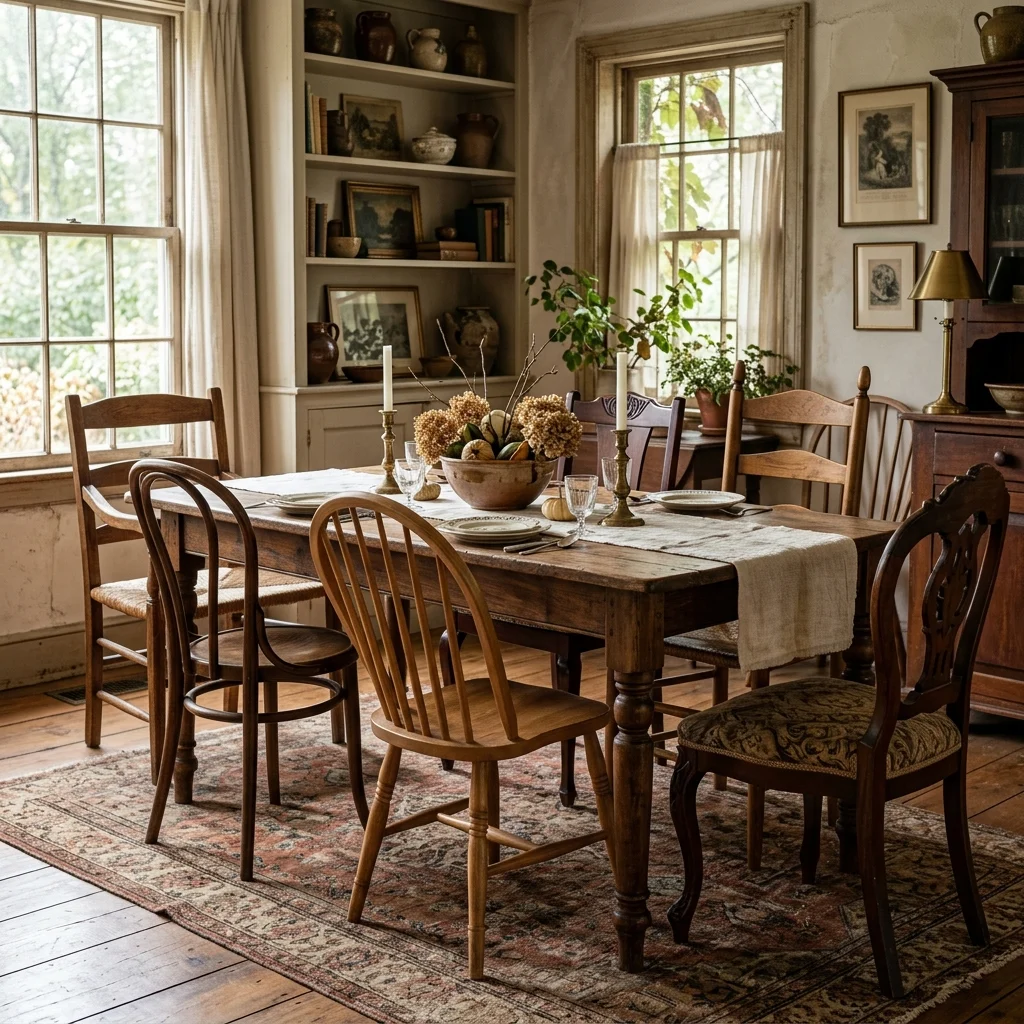
Vibe: The table feels eclectic, like every chair arrived from a different decade.
Why it works: Mismatched dining chairs, gathered individually from different estate sales or antique shops rather than bought as a matched set, are a specifically vintage styling signal; a fully matched dining set almost always indicates new manufacture, since genuine antique sets rarely survive intact in groups of six or eight. The technique works visually because consistent seat height, generally 17–19 inches, and a shared wood tone family with several walnut or mahogany finishes together keep the variety from reading as chaotic.
How to get it: Collect chairs individually over time rather than buying a matched set, keeping seat heights within an inch of each other, and staying within one or two wood tone families so the mismatch reads as curated rather than accidental.
Shop the Look
| Product |
| Vintage-style wood dining chair, set of two |
| Mahogany-finish dining chair pair |
| Linen table runner, natural |
| Brass candlestick set |
| Ceramic centerpiece bowl, vintage glaze |
11. Candlestick-Style Wall Sconces
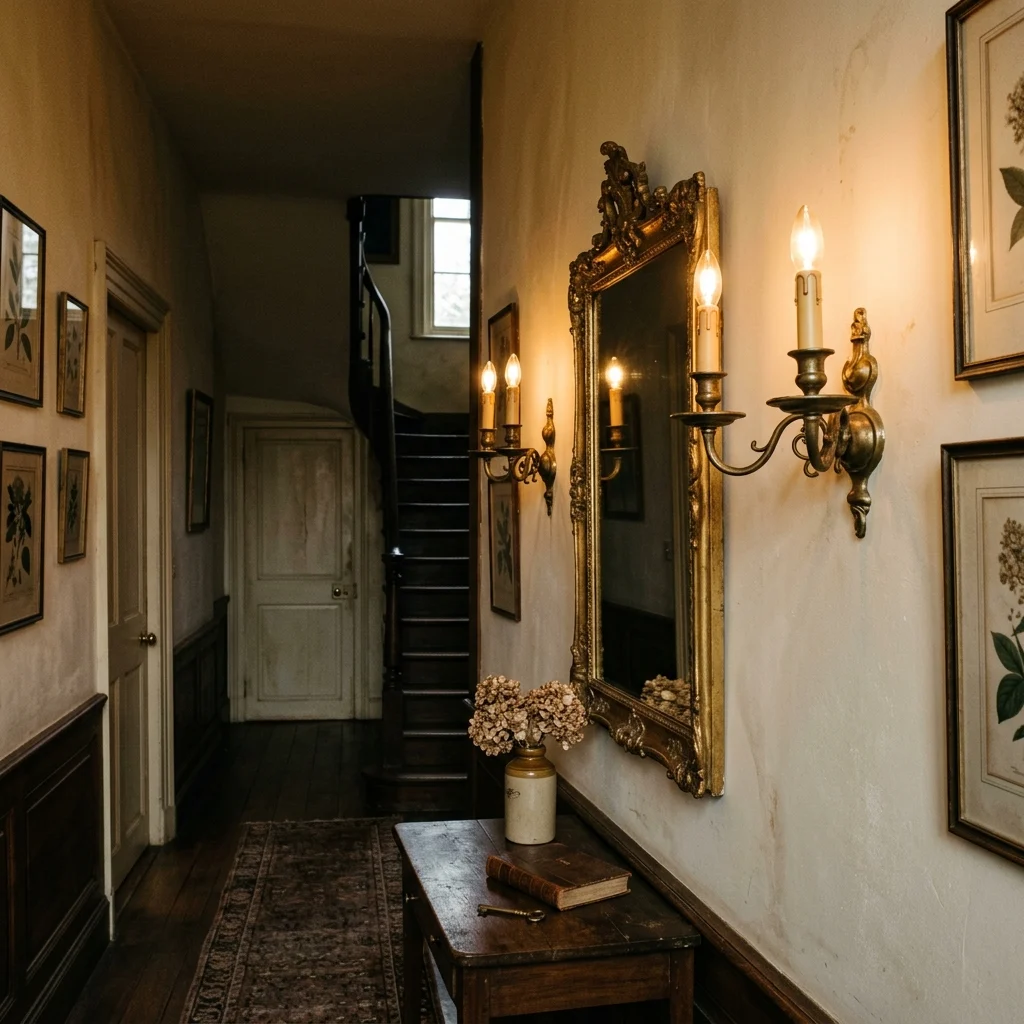
Vibe: The hallway feels intimate, lit like a room from before electricity was assumed.
Why it works: Candlestick-style wall sconces, designed to mimic the shape and warm flicker of actual candle lighting from pre-electric homes, use small flame-shaped bulb covers that cast a softer, more directional light than a standard shaded sconce. This detail matters specifically in vintage decor because it references the exact source of light older homes actually had, rather than approximating it with modern fixture shapes that only vaguely gesture at the period.
How to get it: Choose sconces with visible candle-shaped bulb covers in aged or unlacquered brass, paired with warm flame-tip LED bulbs designed to flicker gently, rather than a standard steady-glow bulb that undercuts the candlelit effect.
💡 Quick Win: Installing just one pair of candlestick sconces in an entryway or hallway introduces this detail without rewiring an entire room.
Shop the Look
| Product |
| Brass candlestick wall sconce pair |
| Flame-tip flicker LED bulb set |
| Gilt console mirror |
| Small marble-top console table |
| Vintage-style brass wall plate |
12. Chippy Painted Wood Furniture Finishes
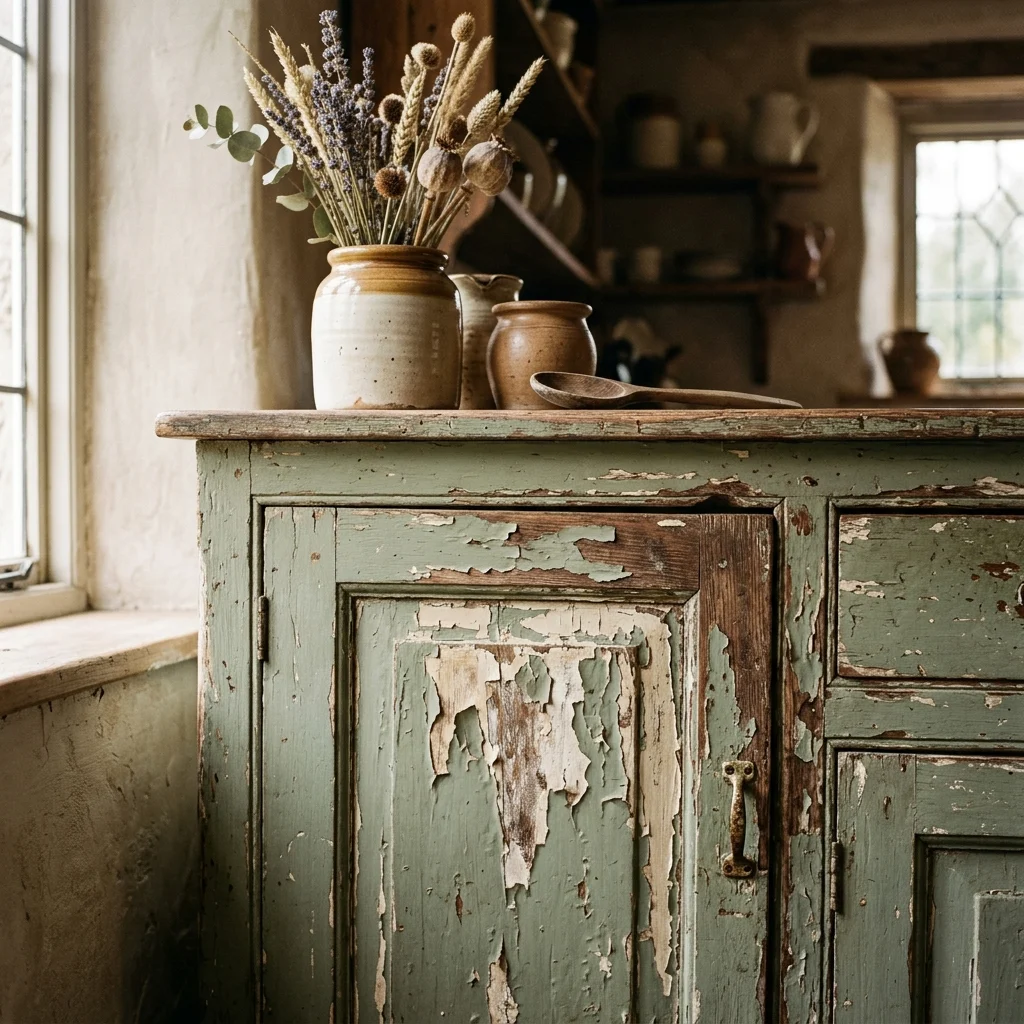
Vibe: The cabinet feels worn, layers of old color showing through like tree rings.
Why it works: Chippy paint, where a top coat has worn away in patches to reveal one or more older paint layers beneath, occurs naturally over decades of use,,e and repaint g it’s genuinely difficult to fake convincingly, which is exactly why collectors prize authentic chippy pieces over the sanded-smooth reproductions most furniture stores sell. The layered colors visible in the chips also add a subtle multi-tone quality to what would otherwise be a single flat painted surface.
How to get it: Look specifically for furniture described as “original paint” or “old chippy finish” rather than “distressed,” since true distressing methods used on new furniture rarely replicate the specific irregular wear pattern that decades of real use produce.
Shop the Look
| Product |
| Vintage-style chippy paint cabinet |
| Ceramic storage jar set |
| Dried floral bundle, natural |
| Antique-finish cabinet latch |
| Woven lidded storage basket |
13. Vintage Books Stacked and Displayed
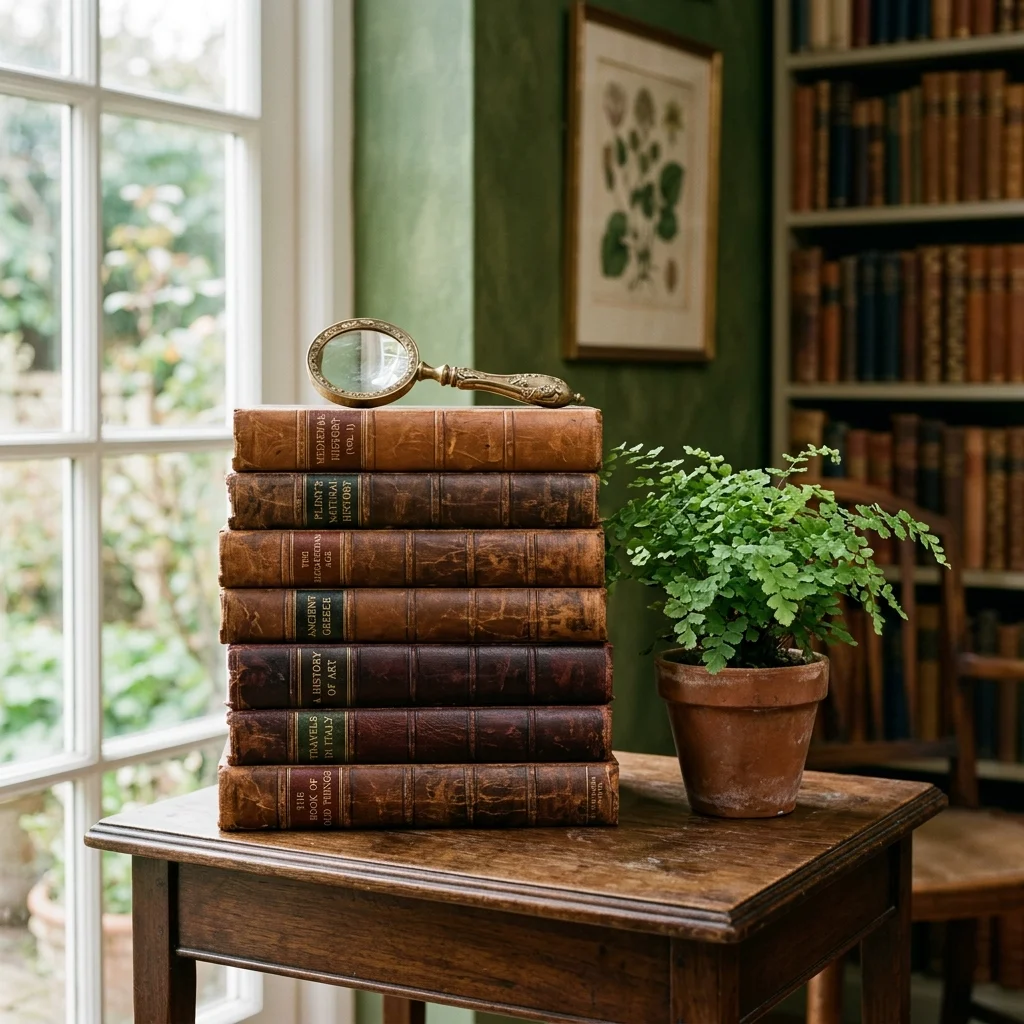
Vibe: The table feels scholarly, quiet in the way old libraries are quiet.
Why it works: Genuinely worn hardcover and leather-bound books, with visibly aged spines and faded gold-leaf lettering, add both color texture and a sense of accumulated time that new decorative books often sold in matched sets with fake spines simply cannot replicate. Stacking books horizontally rather than shelving them vertically also creates a low, sturdy surface for a small object on top, a specific styling layer that adds height variation to an otherwise flat tabletop.
How to get it: Source genuinely used hardcover books from thrift stores or estate sales rather than decorative book sets, and stack three to five at varied heights, topped with one small object: a brass candlestick, a small bust, a paperweight.
💡 Quick Win: A single stack of three worn books under a table lamp instantly adds vintage texture to an otherwise plain side table.
Shop the Look
| Product |
| Vintage hardcover book bundle |
| Brass magnifying glass, decorative |
| Small potted fern, artificial |
| Walnut round side table |
| Brass bookend pair |
14. Milk Glass White as a Vintage Neutral
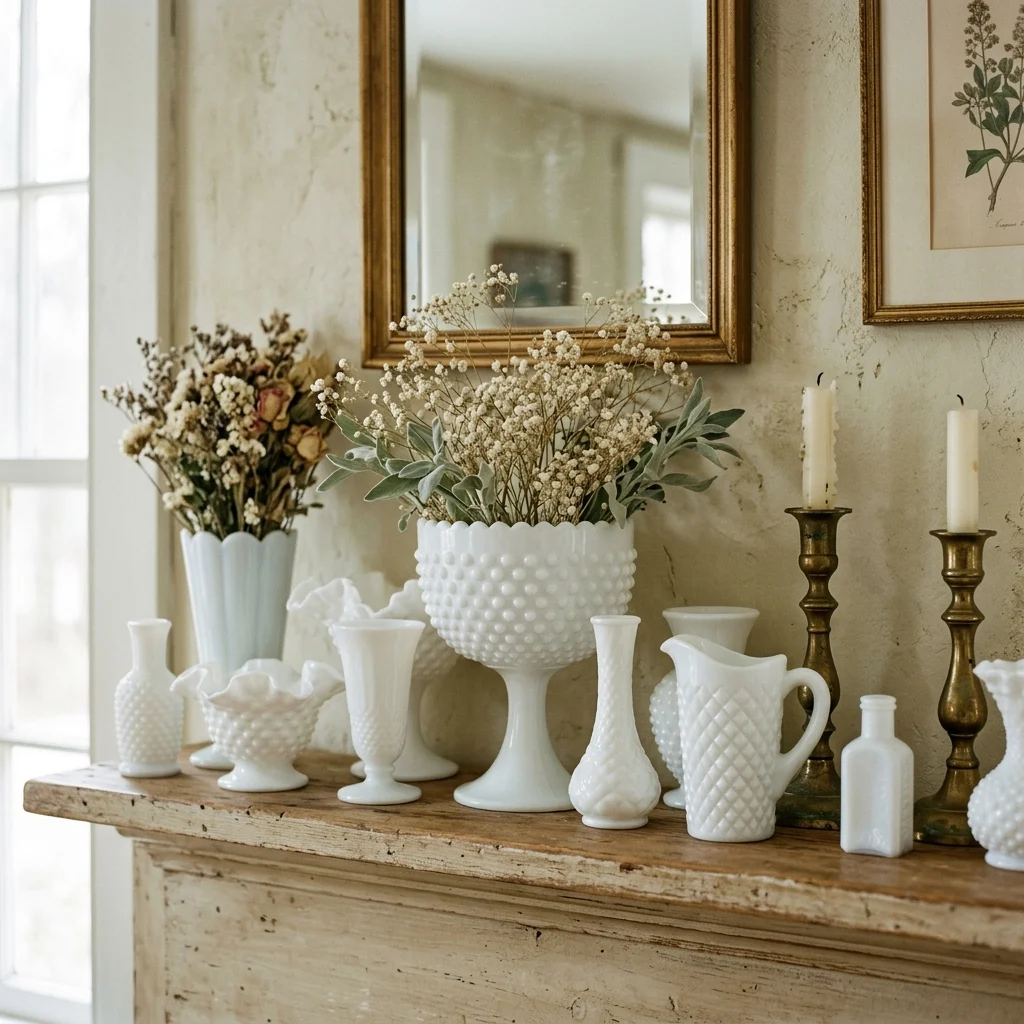
Vibe: The mantel feels luminous, soft, opaque white catching the light differently than clear glass ever could.
Why it works: Milk glass, an opaque white glass first popular in the late 19th century and again through the mid-20th, diffuses light rather than transmitting it clearly the way cut crystal does, giving it a soft, almost porcelain-like glow that functions as a genuine neutral among more saturated vintage colors. Grouping milk glass pieces of varied silhouette: a compote, a bud vase, a footed bowl, creates the same collected-over-time visual variety as ironstone, but in glass rather than ceramic.
How to get it: Group three to five milk glass pieces of different shapes and heights, rather than a matched set, and use them as the neutral base layer beneath more colorful elements like dried florals or a jewel-toned rug nearby.
Shop the Look
| Product |
| Milk glass compote, vintage style |
| Milk glass bud vase set |
| Dried baby’s breath bundle |
| Brass candlestick pair |
| Vintage-style mantel clock |
15. A Dedicated Reading Corner With a Wingback Chair
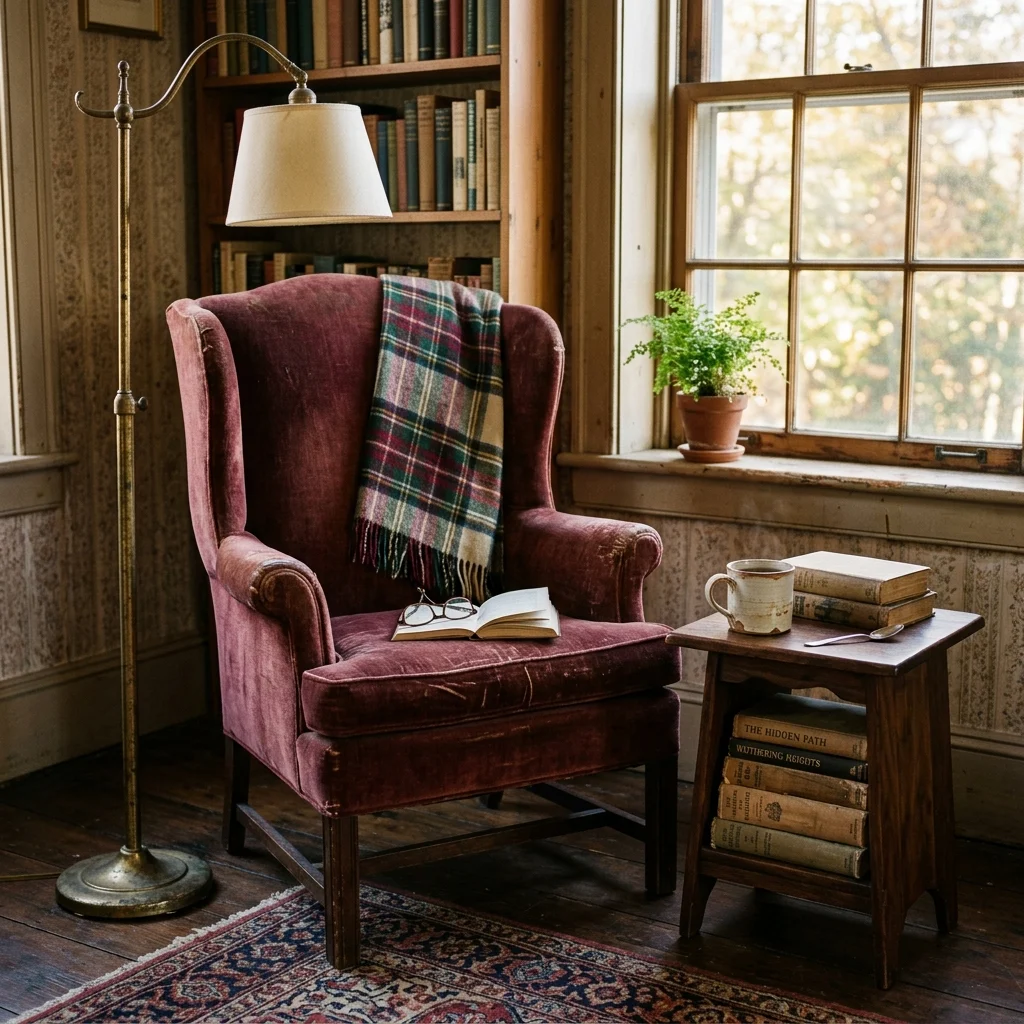
Vibe: The corner feels hushed, set apart from the rest of the room on purpose.
Why it works: The wingback chair’s tall, enclosing side panels, originally designed in the 18th century to block drafts near a fireplace, create a defined sense of enclosure that makes a single chair function as its own small zone within a larger room, a layout technique distinct from the open, sprawling seating arrangements common in newer furniture styles. Positioning it slightly apart from the main seating group, near a window or lamp rather than facing the television, reinforces that it’s a dedicated reading spot rather than overflow seating.
How to get it: Place the wingback chair at a slight angle away from the room’s main furniture grouping, with its own side table and light source, so it reads as a defined destination rather than an extra seat pulled into the main conversation area.
Shop the Look
| Product |
| Worn burgundy wingback accent chair |
| Brass floor lamp, vintage style |
| Small walnut side table |
| Plaid wool throw blanket |
| Ceramic mug, vintage pattern |
16. Cut Crystal and Pressed Glass Accents
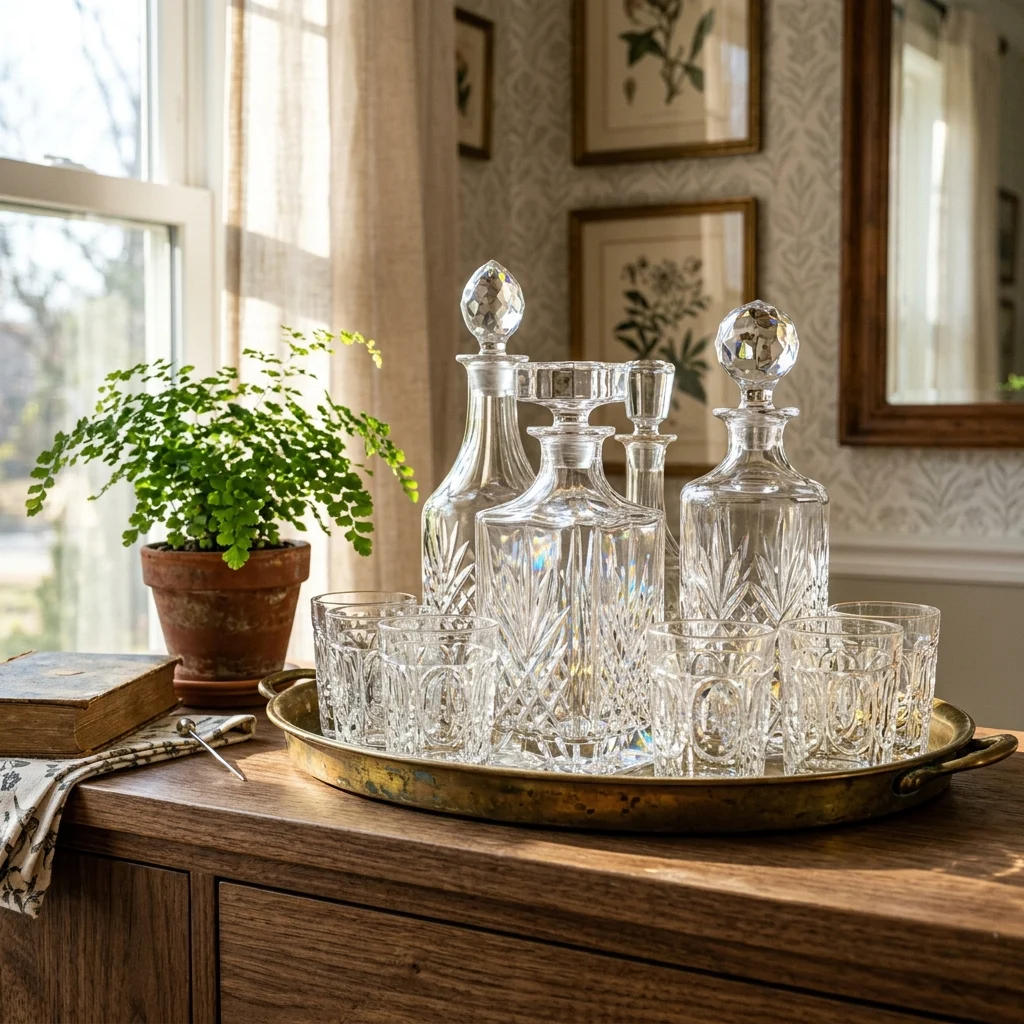
Vibe: The sideboard feels sparkling, light breaking apart across every facet.
Why it works: Cut crystal’s deep, angular faceting refracts light into small prisms in a way that flat glass or plastic simply cannot replicate, which is precisely why genuine crystal decanters and glassware remain a defining vintage material even in an era of cheap glass reproduction. Grouping several pieces on a tray amplifies this effect, since each piece catches and redirects light differently depending on its angle to the window.
How to get it: Source genuine lead crystal (identifiable by its noticeably heavier weight and sharper facet edges compared to pressed glass) and display it on a brass or mirrored tray positioned to catch direct afternoon light for the most visible sparkle.
💡 Quick Win: A single vintage crystal decanter on an otherwise plain shelf catches enough light to read as a genuine styling moment on its own.
Shop the Look
| Product |
| Cut crystal decanter, vintage style |
| Pressed glass tumbler set |
| Brass serving tray, footed |
| Mirrored vanity tray |
| Small brass bar tool set |
17. Warm Mahogany and Burgundy Color Pairing
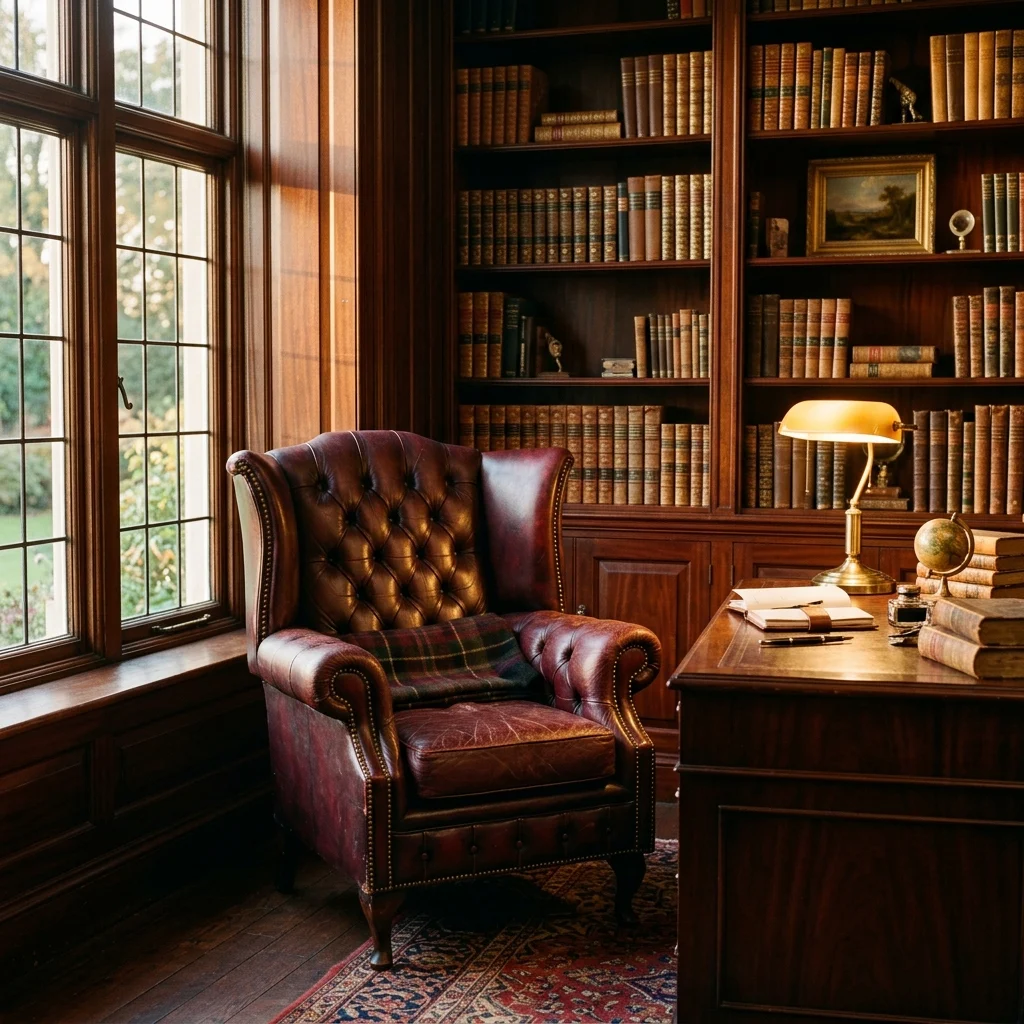
Vibe: The study feels grounded, wrapped in the deepest tones vintage decor offers.
Why it works: Mahogany’s deep reddish-brown grain and burgundy leather or velvet share enough of the same warm red undertone that pairing them creates a cohesive, almost monochromatic depth rather than competing colors, a combination that defined countless Victorian and Edwardian studies and libraries. This tonal closeness is what allows the pairing to feel rich rather than heavy, since both materials sit in the same warm color family, even at different values.
How to get it: Choose furniture and paneling in true mahogany rather than a red-toned stain on a different wood species, and pair it with burgundy leather or velvet upholstery rather than a cooler red, since a true burgundy shares mahogany’s warm undertone in a way brighter reds do not.
Shop the Look
| Product |
| Mahogany writing desk, antique style |
| Burgundy leather tufted armchair |
| Brass desk lamp, adjustable |
| Leather-bound decorative book set |
| Mahogany bookend pair |
18. Vintage Bar Cart as a Functional Focal Point
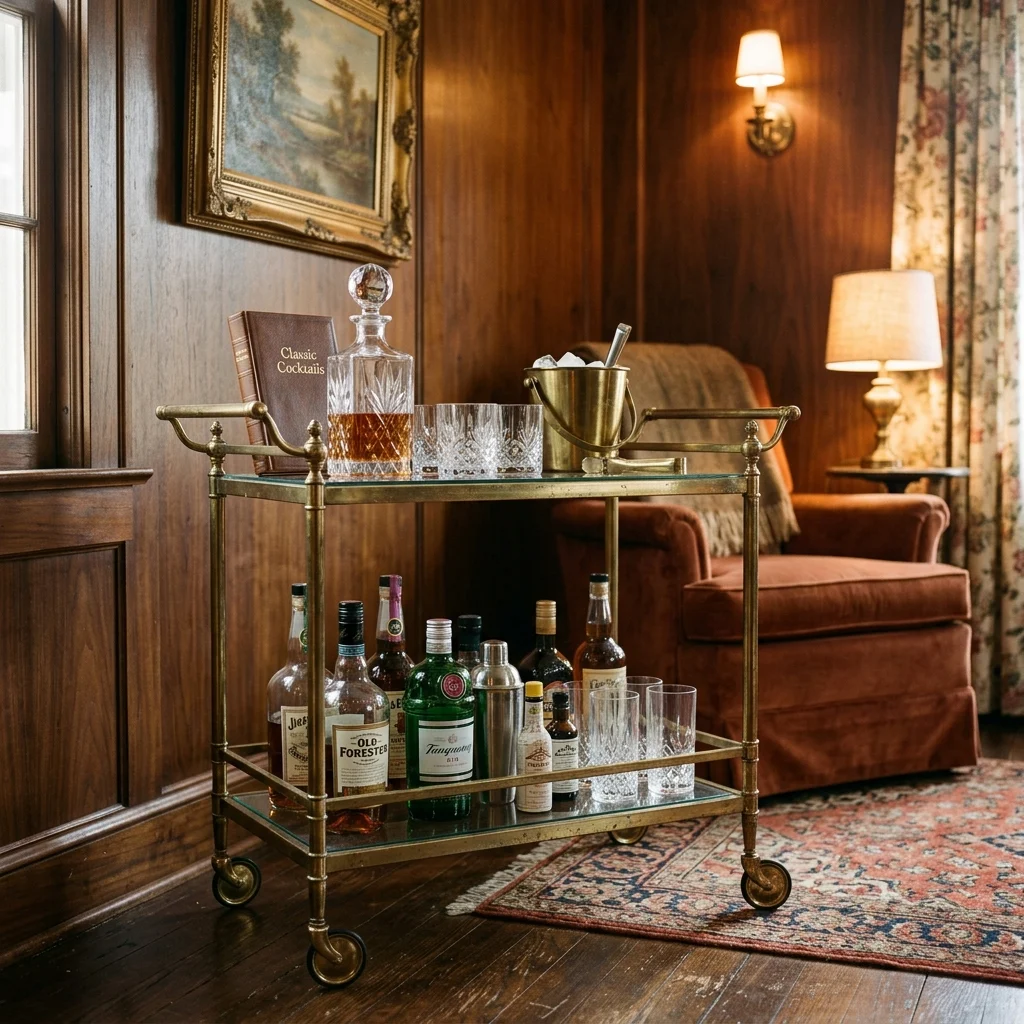
Vibe: The corner feels sociable, set up for an evening that hasn’t started yet.
Why it works: The bar cart, a furniture form that gained popularity in mid-century American homes as home entertaining grew more casual, works as a focal point because its open glass shelving and slim brass frame keep it visually light,t even when fully styled. The transparency of the glass tiers prevents the piece from reading as bulky, the way a solid sideboard would in the same footprint. It also functions as a piece of genuine daily use, which is part of what makes vintage decor feel lived-in rather than staged.
How to get it: Choose a cart with genuine brass (not brass-toned aluminum) and glass shelving, and style it with a mix of crystal glassware and one or two brass bar tools rather than filling every surface, so the cart’s own structure stays visible.
Shop the Look
| Product |
| Brass and glass vintage bar cart |
| Crystal glassware set |
| Brass ice bucket, vintage style |
| Cut crystal decanter |
| Brass bar tool set |
19. A Vintage Chandelier as the Room’s Centerpiece
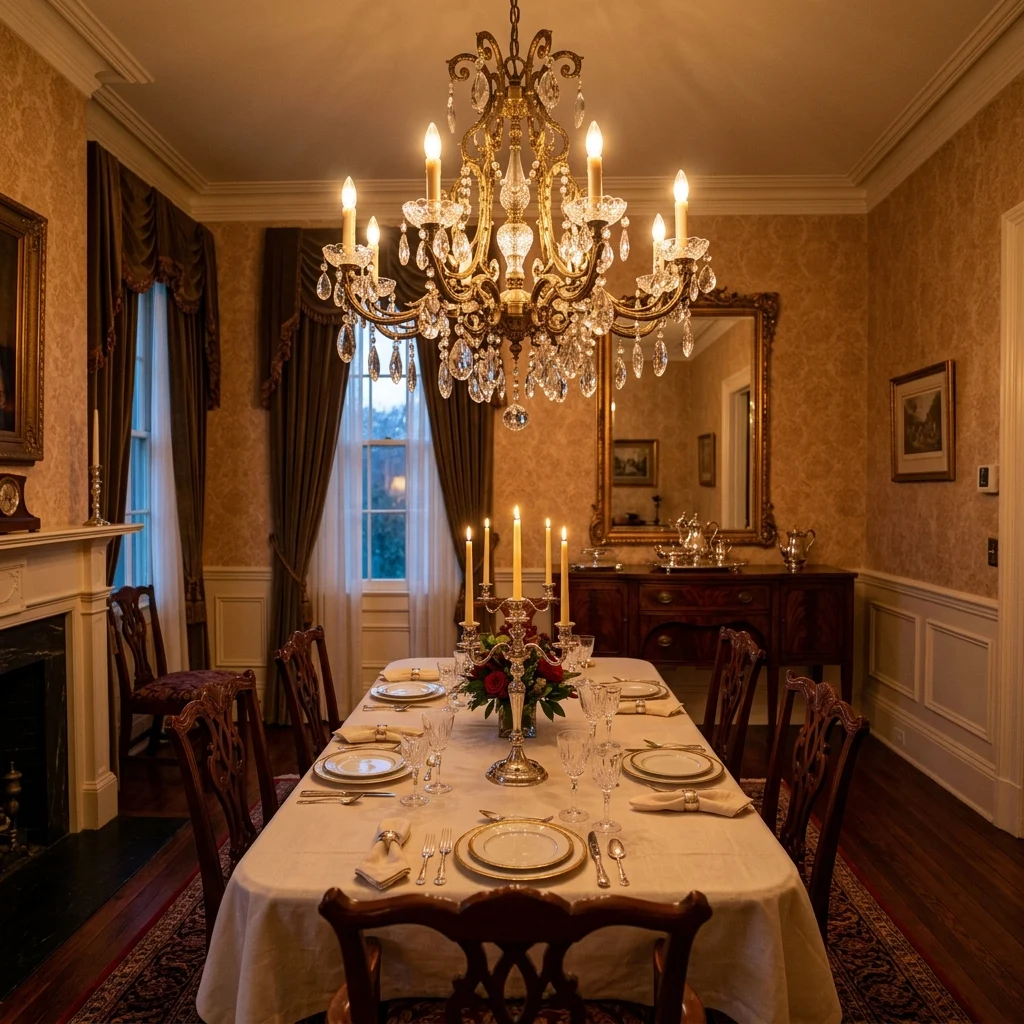
Vibe: The dining room feels formal, gathered under one warm, glinting centerpiece.
Why it works: A vintage brass and crystal chandelier functions the same way a single oversized pendant does in more contemporary lighting schemes as the room’s clear visual anchor, but adds the additional layer of dozens of small light-catching facets that scatter warm light across the ceiling and table below rather than casting one uniform glow. This layered light behavior is difficult to replicate with a single-shade fixture, which is why chandeliers remain the definitive vintage dining room choice even now.
How to get it: Size the chandelier to roughly one-third to one-half the width of the table beneath it, hang it 30–34 inches above the surface, and choose warm dimmable bulbs so the crystal facets read as glowing rather than harshly lit.
💡 Quick Win: A smaller vintage crystal flush-mount fixture achieves a similar formal effect in rooms too low-ceilinged for a full hanging chandelier.
Shop the Look
| Product |
| Brass and crystal vintage chandelier |
| Warm dimmable candelabra bulb set |
| Linen tablecloth, ivory |
| Silver-plated candlestick pair |
| Mahogany dining table |
20. Collected Vintage Trinket Trays and Curios
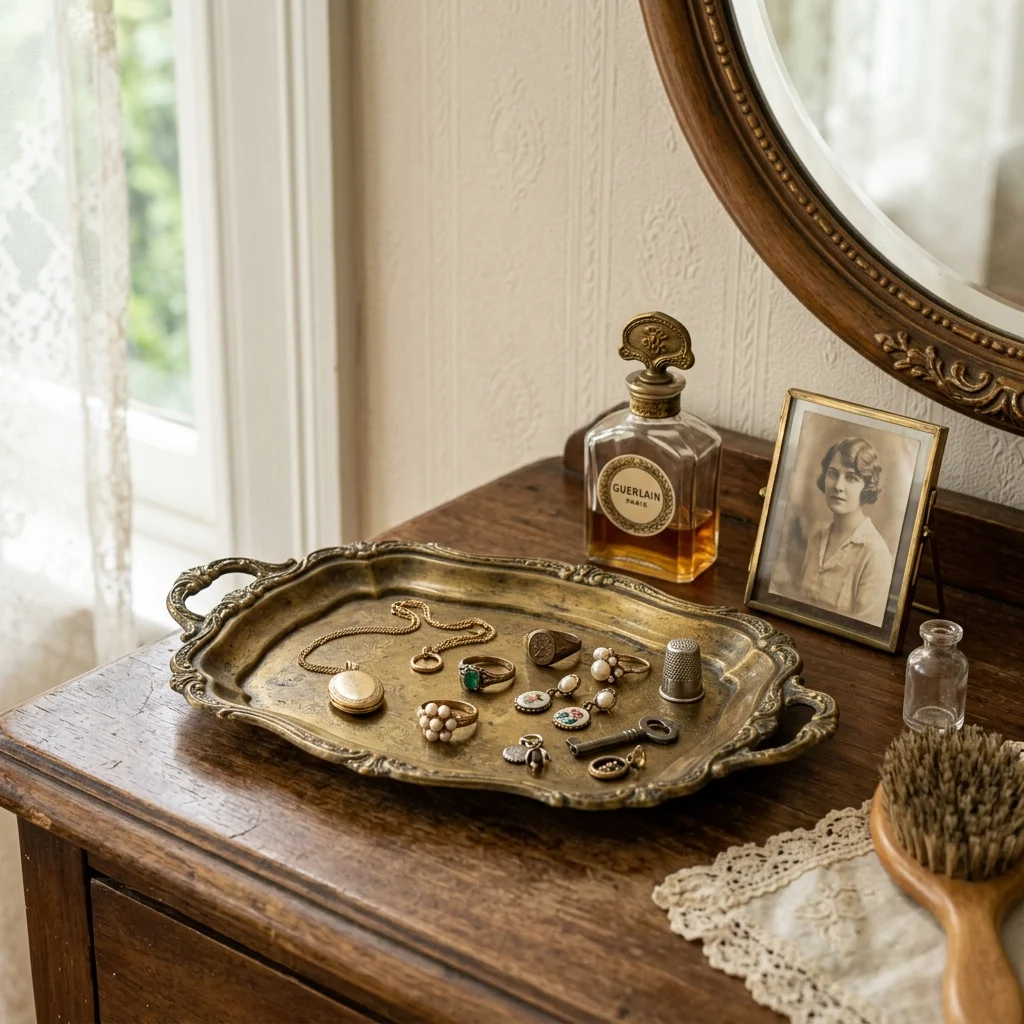
Vibe: The vanity feels personal, small objects arranged like a private collection.
Why it works: Small brass trinket trays, historically used to catch and organize jewelry, coins, and keepsakes on a dresser or vanity, add a layer of intimate, human-scale detail that larger furniture and wall decor can’t provide. This is the same instinct behind ironstone and milk glass groupings, applied at its smallest possible scale. Because these trays are functional as well as decorative, the objects sitting in them change over time, which keeps this particular vignette feeling genuinely lived-in rather than permanently staged.
How to get it: Use two or three small brass or silver trays of different shapes to corral genuinely used objects, real jewelry, a vintage perfume bottle, and a small photo rather than purely decorative filler, so the vignette reflects actual daily use.
Shop the Look
| Product |
| Small brass trinket tray set |
| Vintage-style perfume bottle |
| Small brass photo frame |
| Ceramic ring dish, vintage pattern |
| Antique-finish vanity mirror |
═══════════════════════════════════
How to Start Your Vintage Home Decor Transformation
Your single first move should be sourcing one genuine antique or estate-sale piece, a chair, a mirror, a small side table, before buying anything new, because this one authentic object sets the tone and material quality every later purchase gets measured against. Starting with a new “vintage-style” piece instead tends to anchor the whole room in reproduction rather than reality.
The most common mistake is buying an entire matched vintage-style furniture set at once, which defeats the collected-over-time quality that makes vintage decor convincing in the first place. Real vintage rooms accumulate piece by piece over the years, often from different sources and eras; fix this by committing to buying one piece at a time, even if it means living with an unfinished room longer than you’d like.
Three specific items under $50 that create immediate impact: a single vintage brass candlestick from a thrift store or estate sale, a small, worn hardcover book stack sourced secondhand, and a milk glass bud vase with one dried floral stem.
A realistic full-room vintage transformation, built piece by piece through estate sales and resale marketplaces, typically takes three to twelve months and costs $800–$3,000, depending on how many genuine antiques versus well-made reproductions you mix in. A single weekend can realistically deliver one styled vignette, a bookshelf, a bar cart, and a mantel, while a full room takes patience and ongoing collecting.
═══════════════════════════════════
Frequently Asked Questions About Vintage Home Decor
What is the difference between vintage and antique home decor?
Vintage generally describes objects at least 20 years old, while antique specifically refers to pieces 100 years or older, meaning all antiques are vintage, but not all vintage pieces qualify as antiques. A 1970s brass floor lamp counts as vintage but not antique, while a genuine Victorian writing desk from the 1880s qualifies as both. Most vintage home decor rooms mix true antiques with newer vintage pieces from the mid-20th century, which is why the two terms are often used together rather than as strict categories.
What colors work best in vintage home decor?
Warm, saturated tones dominate burgundy, forest green, warm mustard, and deep mahogany brown, often layered with the faded jewel tones found in worn Persian rugs, alongside milk glass white as a softening neutral. Faded floral wallpaper in muted rose and sage is a common color anchor for bedrooms, specifically. Bright, highly saturated modern colors tend to work against the aged, softened quality that makes vintage decor read as authentic rather than new.
How much does it cost to decorate a room with genuine vintage pieces?
A single styled vignette, a bar cart, a bookshelf, and a mantel arrangement sourced from thrift stores and estate sales can often be assembled for $100–$300. A full room built gradually through estate sales, flea markets, and resale platforms like Chairish or 1stDibs typically costs $800–$3,000 over several months, while a room built quickly with one large genuine antique piece (an antique sofa or dining set) can run $2,000–$5,000 or more depending on the piece’s age and condition.
Does vintage decor work in a small apartment?
Yes, though scale matters more than in any other style, many genuine Victorian and Georgian antiques were built for larger 19th-century rooms and can overwhelm a small modern space. Prioritize smaller-scale pieces first: a single accent chair, a vintage mirror, an étagère, or a collection of ironstone rather than a full antique dining set, so the apartment gains character without losing usable floor space.
Where can I find genuine vintage home decor pieces?
Estate sales and flea markets remain the most reliable sources for genuinely aged pieces at the lowest prices, though they require patience and repeat visits. Online resale platforms like Chairish, 1stDibs, and Etsy’s vintage category have made sourcing dramatically easier over the past decade, letting buyers search by specific era, material, or piece type rather than relying on chance finds. Local antique dealers and auction houses are the best sources for higher-value pieces like genuine Chesterfield sofas or crystal chandeliers, where authentication matters more.
═══════════════════════════════════
Ready to Create Your Dream Vintage Home?
These 20 vintage home decor ideas span color, material, lighting, furniture, and layout rom faded floral wallpaper and aged brass patina to a genuine leather Chesterfield anchoring an entire room, o wherever your space needs the most character, there’s a real, sourceable starting point here. You don’t need to find every piece at once, and building a vintage room gradually, one estate sale or flea market visit at a time, is not a slower path to the same result; it’s the only path that actually produces the collected, lived-in quality this style is built on. Today’s specific action: visit one local estate sale, thrift store, or resale listing and look specifically for a single small brass or ceramic object, a candlestick, a milk glass vase, rather than trying to furnish an entire room in one trip. Once a few genuine pieces are in place, the room stops feeling decorated and starts feeling like it has actually been lived in, layer by layer, the way real vintage rooms always have. Save the pieces that catch your eye today, that stained glass lamp, that mismatched chair, because in vintage decorating, the things worth keeping rarely show up twice.
You Might Also Like
- Eco Friendly Bamboo Home Decor: 9 Stunning Ways to Style Every Room
- 10 Stylish Shelf Decor Ideas for Every Room
- Modern Home Decor: 15 Ideas Worth Saving and Stealing
- 13 Minimalist Home Decor Ideas for a Calm, Clutter-Free Space
- 12 Small Space Decor Ideas for a Modern Minimalist Home
- 15 Scandinavian Decor Ideas for Simple, Hygge-Inspired Living