
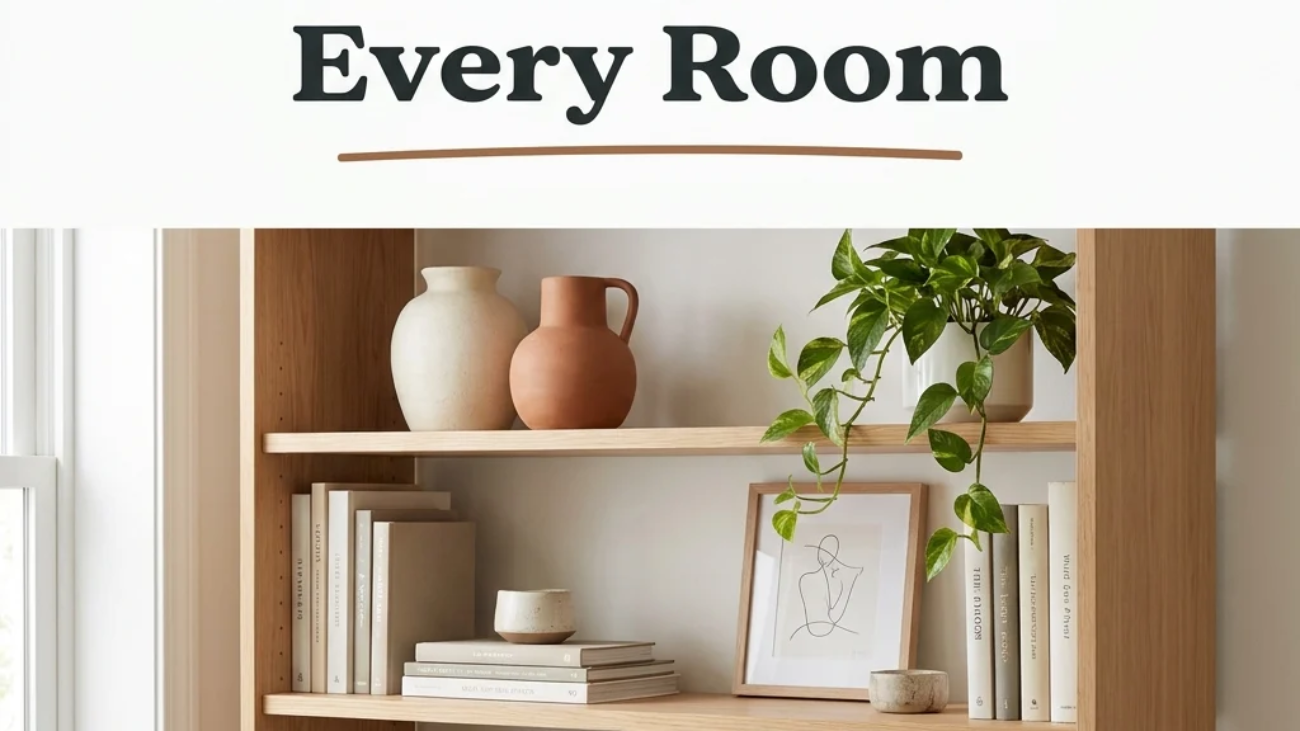
Stylish shelf decor is the practice of arranging objects, plants, and accessories on open shelving with real design intent, so a functional surface reads as a curated display instead of accidental clutter. This guide walks through 10 stexactly ylish shelf decor ideas, one for a different room of the house, so you can style a shelf wherever you actually have one — whether that’s a single floating ledge above a sofa or a full wall of built-ins in a home office.
There’s a specific calm that comes from a shelf someone clearly thought about — heights that rise and fall on purpose, gaps left on purpose, objects that feel chosen rather than accumulated over years of not deciding. It’s warm without being busy, personal without being messy, the visual equivalent of a room that already knows what it wants to say. A shelf like this doesn’t shout for attention; it rewards a second look, the way a good bookshelf reveals a little more about its owner each time you glance at it.
Here are 10 ideas worth saving — and stealing.
Why Stylish Shelf Decor Works So Well
Shelf styling as a design habit traces back to the Wunderkammer, the 16th and 17th century “cabinet of curiosities” where European collectors displayed natural specimens, art, and scientific instruments together on open shelving to show off both taste and curiosity. Mid-century modernism carried that same instinct forward into ordinary homes, pairing sculptural ceramics with everyday books on low sideboards and wall-mounted units. Japandi and Scandinavian interiors today simply pare the same idea down to its quietest form — a shelf as a small, edited statement rather than overflow storage for whatever didn’t fit in a closet.
The materials repeat across well-styled shelves, and they’re specific enough to shop from directly: matte and glazed ceramics in warm white, sage green, and terracotta; unfinished oak, walnut, and rattan for warmth and texture; brass or matte black hardware for contrast against those warmer tones; and dried or living botanicals — trailing pothos, dried pampas grass, a single eucalyptus stem — for the organic irregularity that keeps a shelf from feeling too rigid. Color stays mostly neutral and warm, with one deliberate accent tone, like forest green or deep charcoal, doing the heavy lifting rather than several competing colors fighting for attention.
This approach is having a real moment, and the reason is practical rather than purely aesthetic: shelf styling is nearly free. It doesn’t require a renovation budget, a contractor, or even a full weekend — just an afternoon and objects you likely already own, rearranged with more intention than before. That low barrier to entry is exactly why it dominates home-inspiration searches on Pinterest and Google alike; it’s the highest-leverage decorating move available to anyone working with a fixed space, a fixed budget, and the desire to see a visible difference by dinnertime.
Small rooms benefit the most from this approach, since shelving is often the only vertical display surface available where floor space is already fully spoken for by a bed, a desk, or a dining table. A single well-edited floating shelf in a narrow hallway, a small bathroom, or a cramped studio apartment does more visual work per square foot than almost any other change you can make, and it does it without blocking a single walking path.
Style at a Glance
| Element | Trait 1 | Trait 2 |
| Philosophy | Curated display over storage | Intentional over abundant |
| Materials | Ceramic, oak, rattan | Brass, linen, dried botanicals |
| Color palette | Warm white, sage, terracotta | Walnut brown, matte black |
10 Stylish Shelf Decor Ideas for Every Room
1. Living Room Shelf Decor: The Rule-of-Three Ceramic Groupin
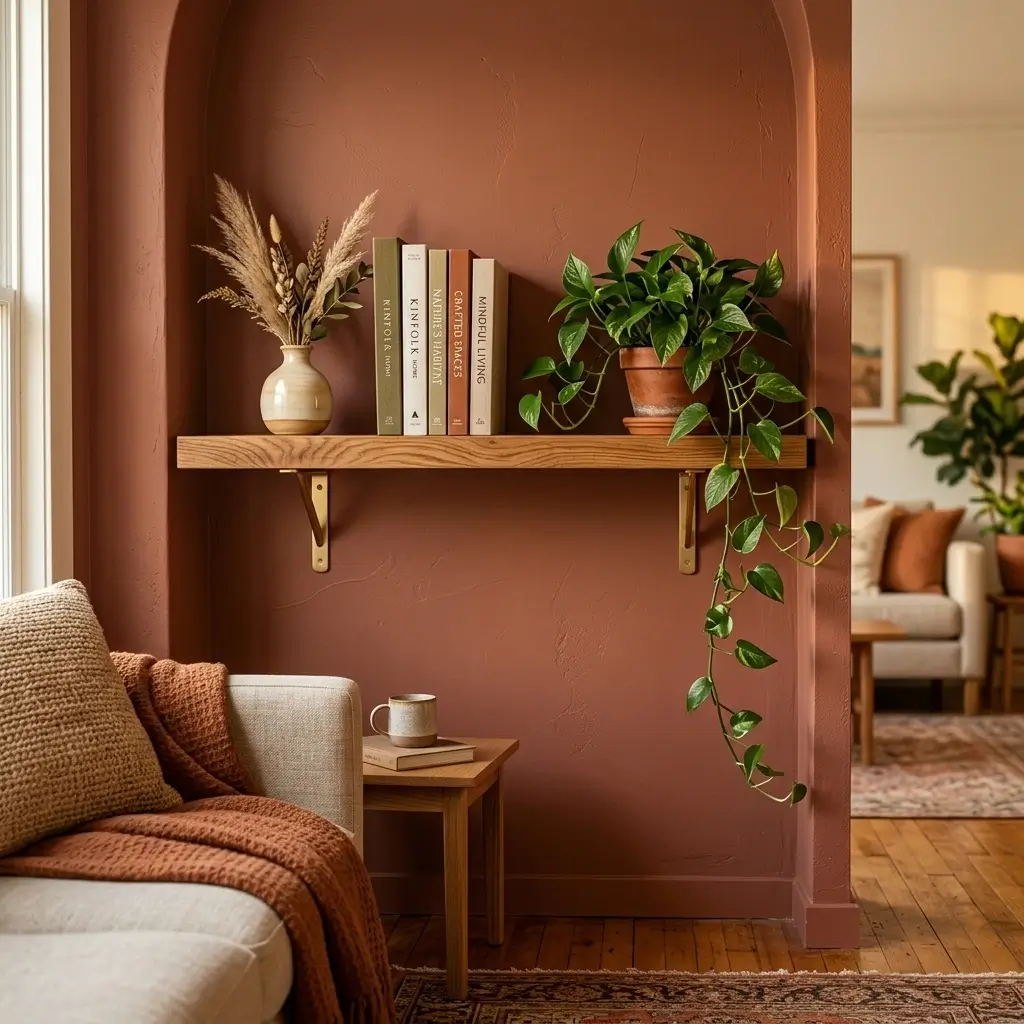
Vibe: Serene, the kind of arrangement that makes the wall around it look considered rather than incidental.
Why it works: Odd-numbered groupings read as dynamic rather than static because the eye can’t resolve them into a perfectly symmetrical pair, so it keeps moving across the arrangement instead of settling flatly on one point. Placing three vessels at distinctly different heights creates a triangular silhouette that pulls attention both upward and across the shelf, which is a far more active composition than a matched set lined up in a row.
How to get it: Set the tallest vessel toward the back and slightly off-center, the medium one in front and to one side, and the smallest pulled forward at the opposite end, using the shelf’s front-to-back depth instead of lining all three along the flat back edge like a mantelpiece display.
Common mistake to avoid: Buying three vessels in the exact same shape and finish defeats the purpose — the grouping needs variation in height and silhouette, not just quantity, or it reads as a matched set rather than a curated collection.
💡 Quick Win: Three secondhand ceramic pieces in a shared matte finish but different heights, found for $5–$12 total, create an instantly curated grouping with zero new purchases needed.
Shop The Look
| Product | Why It Fits |
| Tall matte white ceramic vase minimalist | Anchors the back of the grouping as the tallest silhouette |
| Sage green ceramic bowl medium matte glaze | Adds the mid-height point and a soft accent color |
| Small terracotta bud vase handmade shape | Completes the triangle as the smallest, forward-pulled piece |
| Floating oak wall shelf natural finish | Gives the grouping enough depth to stagger front-to-back |
| Dried eucalyptus stem bunch natural | Softens the ceramic edges with an organic, irregular line |
2. Kitchen: Color-Blocked Open Shelving with Labeled Jars
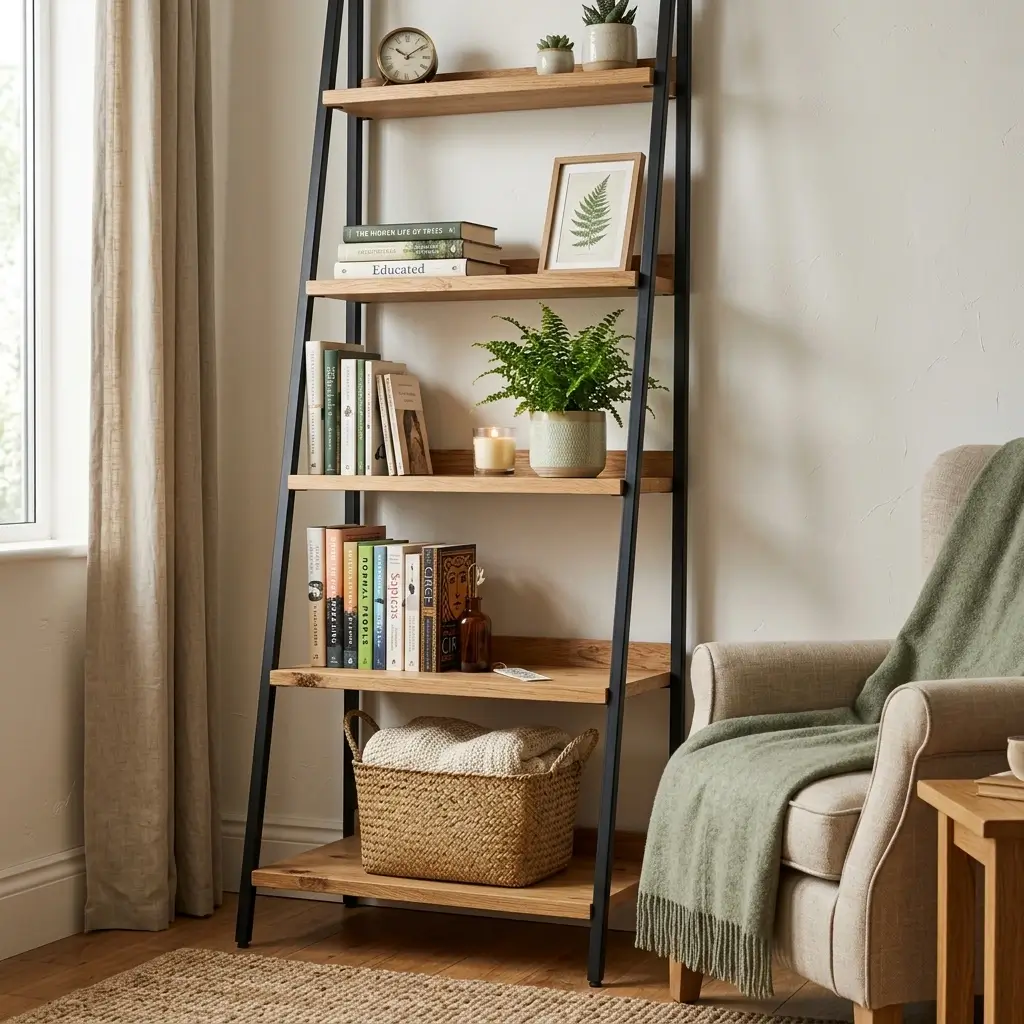
Vibe: Warm, the kind of kitchen shelf that looks designed rather than merely stocked with whatever was on sale.
Why it works: Grouping kitchen jars and canisters by color family rather than by pure function turns a purely practical shelf into a large-scale color field, the same visual logic that makes color-blocked textiles or paint schemes feel intentional instead of random. A kitchen shelf sorted by color also happens to be genuinely faster to use, since the eye can scan for a tone instead of reading every label.
How to get it: Sort dry-goods jars and canisters into two or three tonal groups — cream and sand, then terracotta and rust — and cluster each group together rather than alternating colors across the shelf, using a chalk pen directly on ceramic for labels instead of adhesive stickers that peel and yellow in a kitchen environment within a few months.
Common mistake to avoid: Mixing more than three color families on one shelf run undoes the effect entirely — pick two or three tones maximum and resist adding a fourth accent color even if you own it.
Shop The Look
| Product | Why It Fits |
| Ceramic kitchen canister set cream matte | Forms the base of the cream-and-sand color group |
| Glass storage jar set with wood lids | Adds a second material texture without breaking the palette |
| Chalk paint marker fine tip ceramic | Keeps labels legible and rewriteable without peeling adhesive |
| Small potted basil plant terracotta pot | Introduces the warm terracotta accent tone |
| Linen kitchen tea towel set folded | Echoes the cream tone as a soft textile layer |
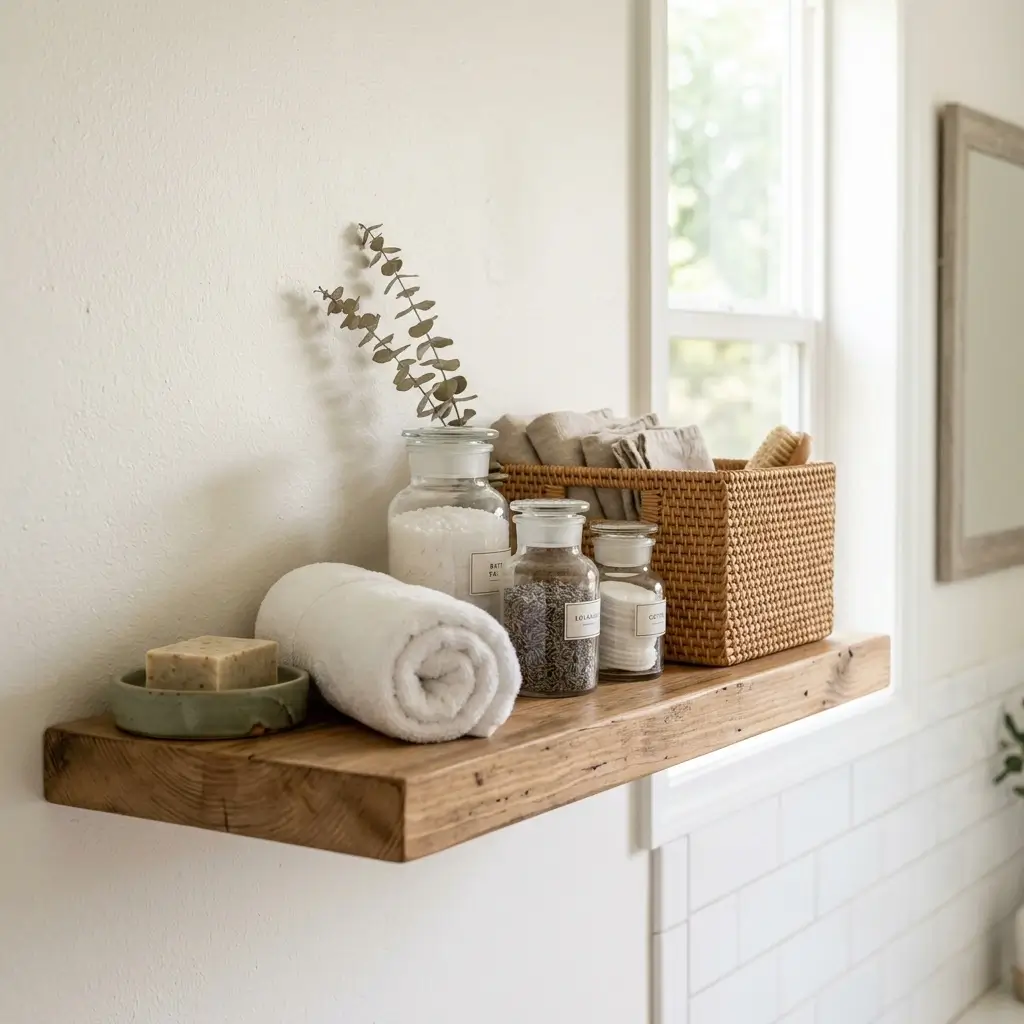
3. Bathroom: Woven Texture and Apothecary Jars
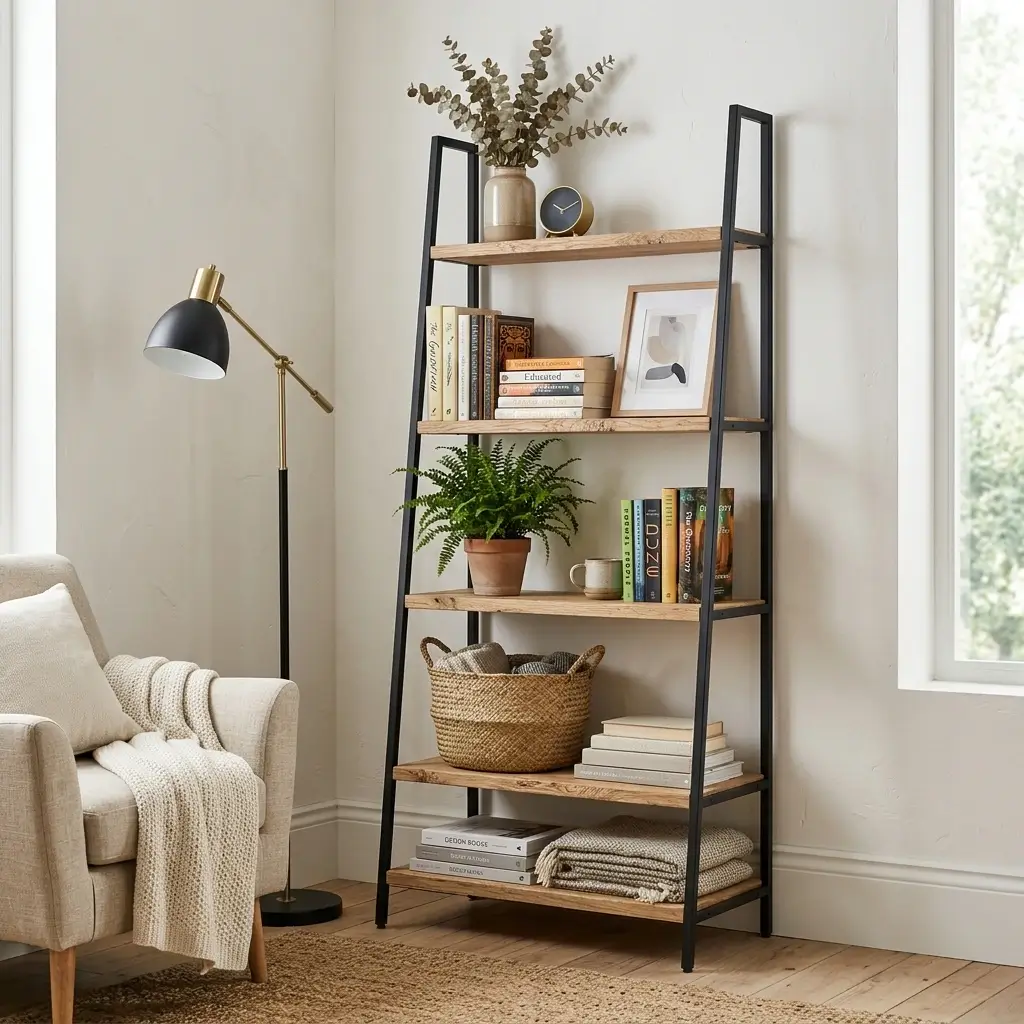
Vibe: Calm, the specific stillness of a surface where every object clearly belongs and nothing feels like overflow.
Why it works: Woven rattan against smooth tile or painted drywall creates textural contrast that keeps a minimal bathroom from reading as cold or clinical, while clear glass jars turn everyday consumables like cotton rounds or bath salts into intentional display rather than visual clutter behind a mirror.
How to get it: Decant loose bathroom items into two or three clear glass apothecary jars of varying height, add one woven rattan basket for softness and texture, and cap the total object count at five or six — bathroom shelves tip from calm to cluttered surprisingly fast past that point, especially in a room with limited natural light.
Common mistake to avoid: Leaving product labels visible through clear glass jars breaks the calm effect instantly — decant fully, or choose frosted rather than fully transparent glass if you’d rather skip that step.
💡 Quick Win: A set of three glass apothecary jars under $18 turns a messy bathroom counter shelf into a styled vignette in under ten minutes.
Shop The Look
| Product | Why It Fits |
| Clear glass apothecary jar set 3 sizes | Holds decanted essentials in varying heights for visual rhythm |
| Woven rattan storage basket small | Adds the textural contrast against smooth tile surfaces |
| White cotton hand towel rolled set | Fills negative space with soft, uniform texture |
| Ceramic soap dish matte white | Grounds the display with one purely functional piece |
| Dried eucalyptus sprig small bunch | Introduces organic softness without needing water upkeep |
4. Bedroom Shelf Decor: LED-Lit Floating Nightstand
Vibe: Intimate, a nightstand replacement that takes up zero floor space and looks calmer than most bedside tables ever manage to.
Why it works: A warm 2700K LED strip tucked beneath the shelf’s front edge draws the eye upward at night without a harsh overhead source flooding the room, while the shelf’s narrower depth than a typical nightstand forces a strict object limit that suits a genuinely restful bedroom better than a cluttered surface piled with chargers and half-read magazines.
How to get it: Mount the shelf at mattress-top height plus roughly 10 inches, install a warm white LED strip along the hidden underside front edge so the light source itself stays out of view, and restrict the surface to four objects maximum — one light source, one book, one water vessel, one small plant.
Common mistake to avoid: Choosing a cool-toned LED strip above 3000K undoes the calming effect entirely — bedroom lighting should stay firmly in the warm 2700K range regardless of how bright the rest of the home’s lighting runs.
Shop The Look
| Product | Why It Fits |
| Floating walnut wall shelf 24 inch | Sized to replace a nightstand without crowding the bed |
| Warm white 2700K LED strip battery powered | Provides the hidden underglow without a harsh overhead fixture |
| Small ceramic candle holder matte white | Adds a second warm light source for evening ambiance |
| Glass water carafe bedside small | Covers the practical need within the four-object limit |
| Trailing string of pearls small pot | Softens the walnut edge with a low-maintenance trailing plant |
5. Home Office: Negative-Space Furniture Arrangement
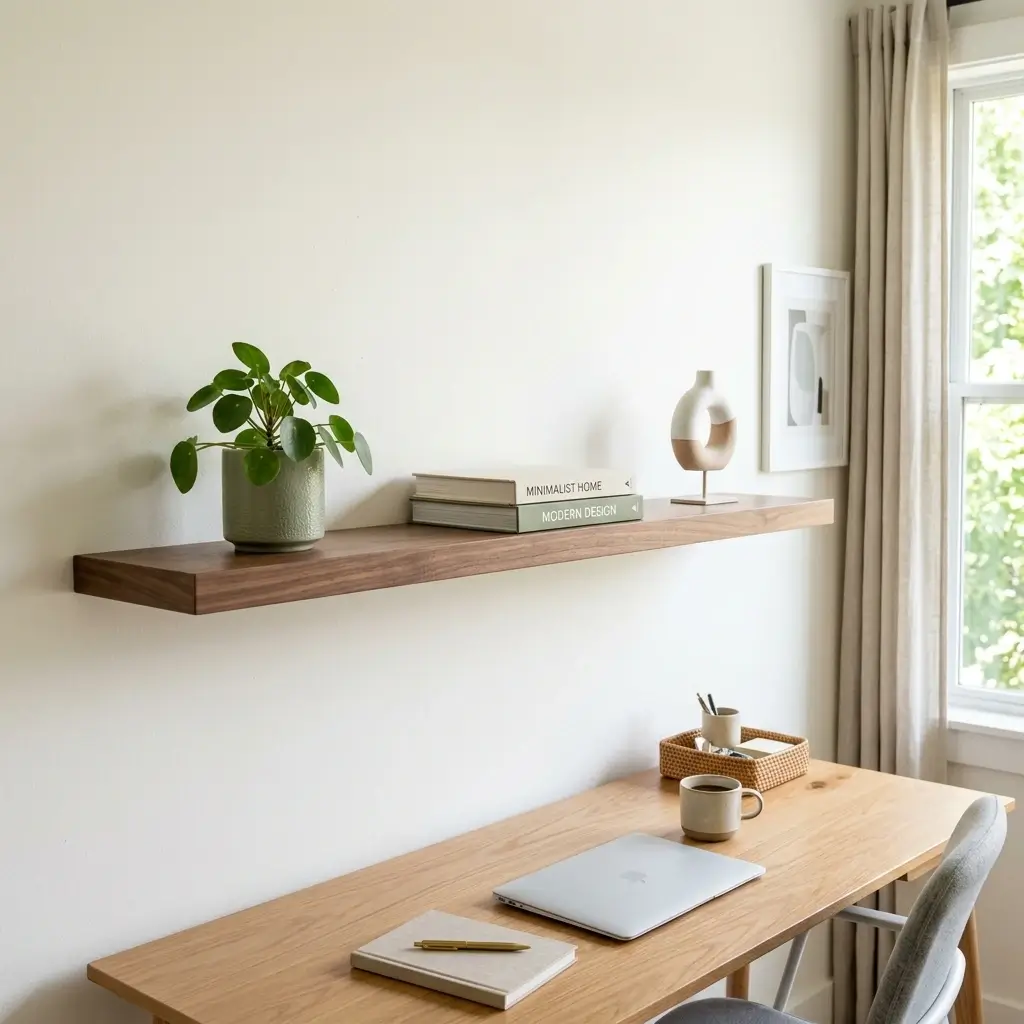
Vibe: Focused, the kind of shelf that gives a busy desk somewhere for the eyes to rest between tasks.
Why it works: In a workspace, an overcrowded shelf competes with the desk itself for visual attention and quietly adds cognitive noise throughout a workday; wide gaps between a small number of objects reduce that noise by giving each item enough visual weight to register on its own instead of blurring together into background clutter.
How to get it: Limit the shelf directly above a desk to three objects total, spaced at least six inches apart, and route any additional storage need to closed boxes on a separate shelf rather than adding more open display pieces to the same surface.
Common mistake to avoid: Using open shelving as the only storage in a home office backfires quickly — cables, paperwork, and supplies need a closed home, or the “negative space” concept collapses within a week of real use.
💡 Quick Win: Removing a third of what’s currently on a home office shelf, with no new purchases at all, is usually the fastest visible improvement available in any workspace.
Shop The Look
| Product | Why It Fits |
| Walnut wood floating shelf 36 inch | Wide enough for three well-spaced objects above a desk |
| Small abstract ceramic sculpture neutral | Serves as the single decorative focal point |
| Potted snake plant matte ceramic pot | Adds one living element without demanding daily care |
| Two matching hardcover books cream cover | Fills the third slot without introducing extra colors |
| White storage box set with lids | Moves clutter off the open shelf and out of sight |
6. Entryway: The Command-Center Shelf
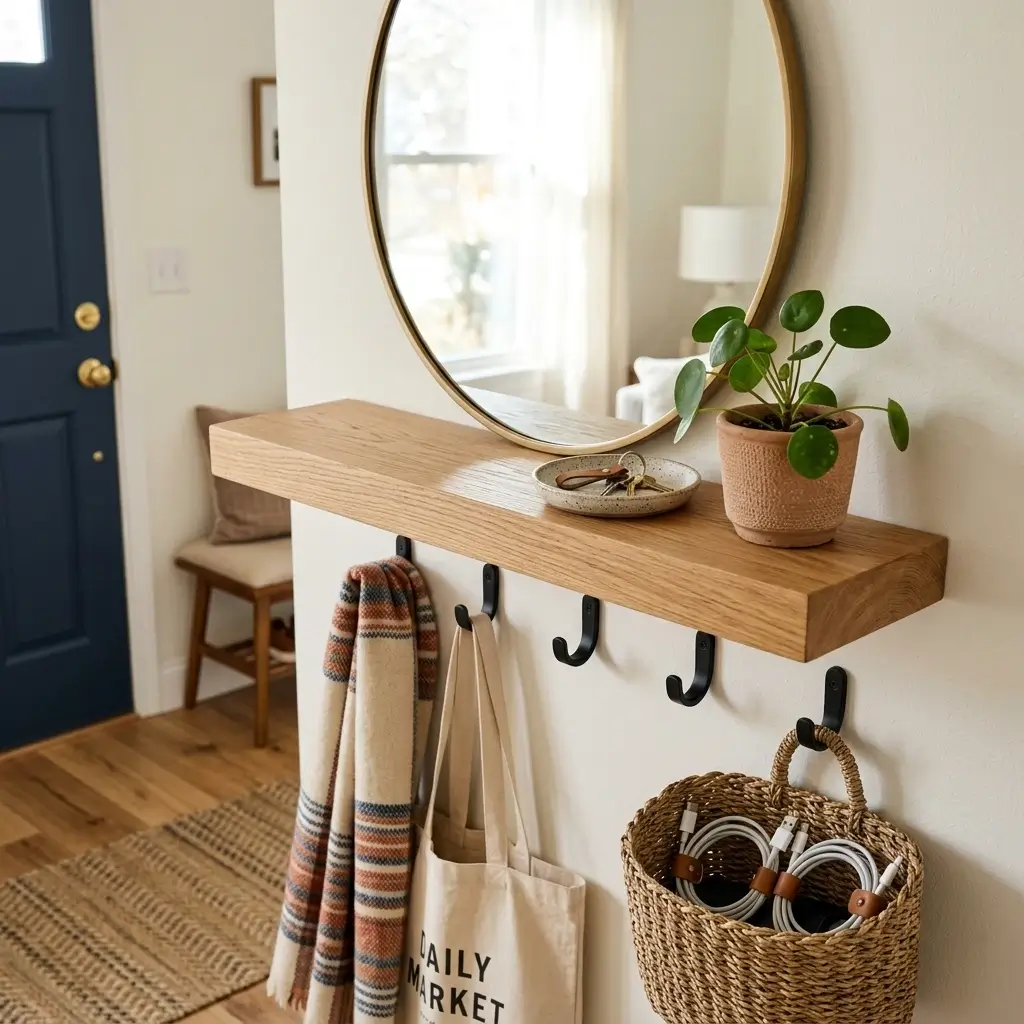
Vibe: Welcoming, the calm of arriving home to a space that already has a place for what you’re carrying.
Why it works: Placing a key dish at the front edge removes the small daily friction of searching for keys, and a small mirror propped at the back of the shelf reflects light from the entry door, making a typically dim hallway feel noticeably brighter without adding a single new light fixture.
How to get it: Mount the shelf around shoulder height, install coat hooks just below it, and keep purely decorative objects to two — a plant and one other piece — so the rest of the surface stays functional enough to actually use every day without feeling precious.
Common mistake to avoid: Styling an entryway shelf purely for looks, with no functional catch-all for keys or mail, guarantees the surface fills up with random daily clutter within a week regardless of how it started.
Shop The Look
| Product | Why It Fits |
| Ceramic key dish small round matte | Gives keys a fixed home right at the front edge |
| Small framed round mirror simple | Bounces entry light deeper into the hallway |
| Matte black wall hook set of 4 | Handles coats and bags below the shelf itself |
| Floating oak shelf 30 inch entryway | Sized for daily use without overwhelming a narrow hall |
| Woven basket small lidded charging station | Hides cables while keeping devices within reach |
7. Dining Room Shelf Decor: Tonal Sideboard Display
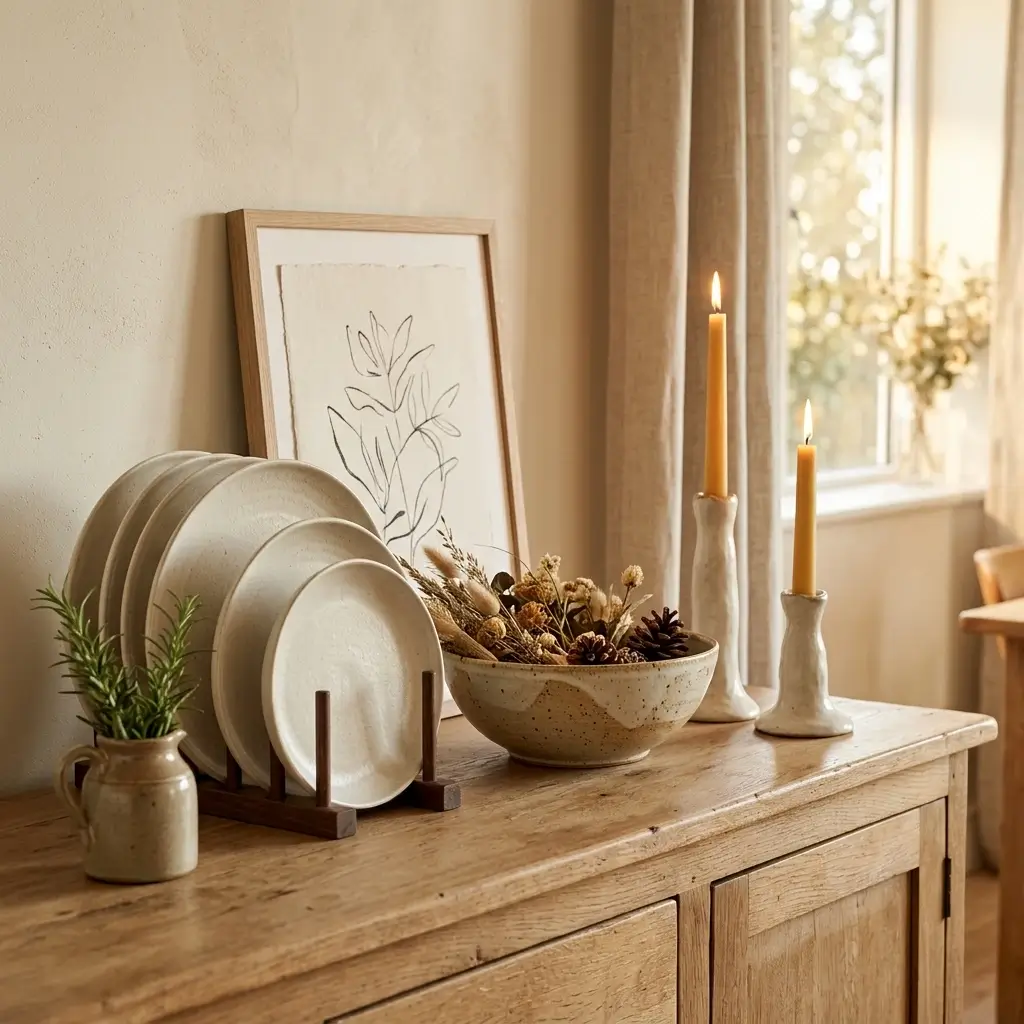
Vibe: Warm, a display that celebrates the table even when no meal is currently in progress.
Why it works: Restricting a sideboard shelf to one tonal family removes color contrast so texture carries the visual interest instead, while two candlesticks of noticeably different heights introduce just enough asymmetry to keep the whole display from feeling stiffly formal or like a hotel lobby arrangement.
How to get it: Stand a matching dinnerware set upright in a wood plate rack as the back anchor, place a wide ceramic bowl in front as the central piece, and add two candlesticks of clearly different heights on either side rather than a matched pair pulled straight from a box set.
Common mistake to avoid: Using an exactly matched candlestick pair, rather than two different heights, is the single most common reason a sideboard display reads as generic rather than styled.
💡 Quick Win: One wide ceramic bowl and a pair of mismatched candlesticks, both under $15 each, can carry an entire sideboard shelf on their own with nothing else needed.
Shop The Look
| Product | Why It Fits |
| Wooden plate display rack standing | Anchors the display with upright, visible dinnerware |
| Wide ceramic serving bowl cream matte | Serves as the central, largest piece of the grouping |
| Taper candlestick pair unequal heights | Introduces asymmetry that keeps the tonal palette lively |
| Small framed still life print | Adds a quiet background layer behind the objects |
| Fresh herb sprig small ceramic jug | Brings one living, changeable element to the display |
8. Kids’ Room: Low Montessori Face-Forward Shelf
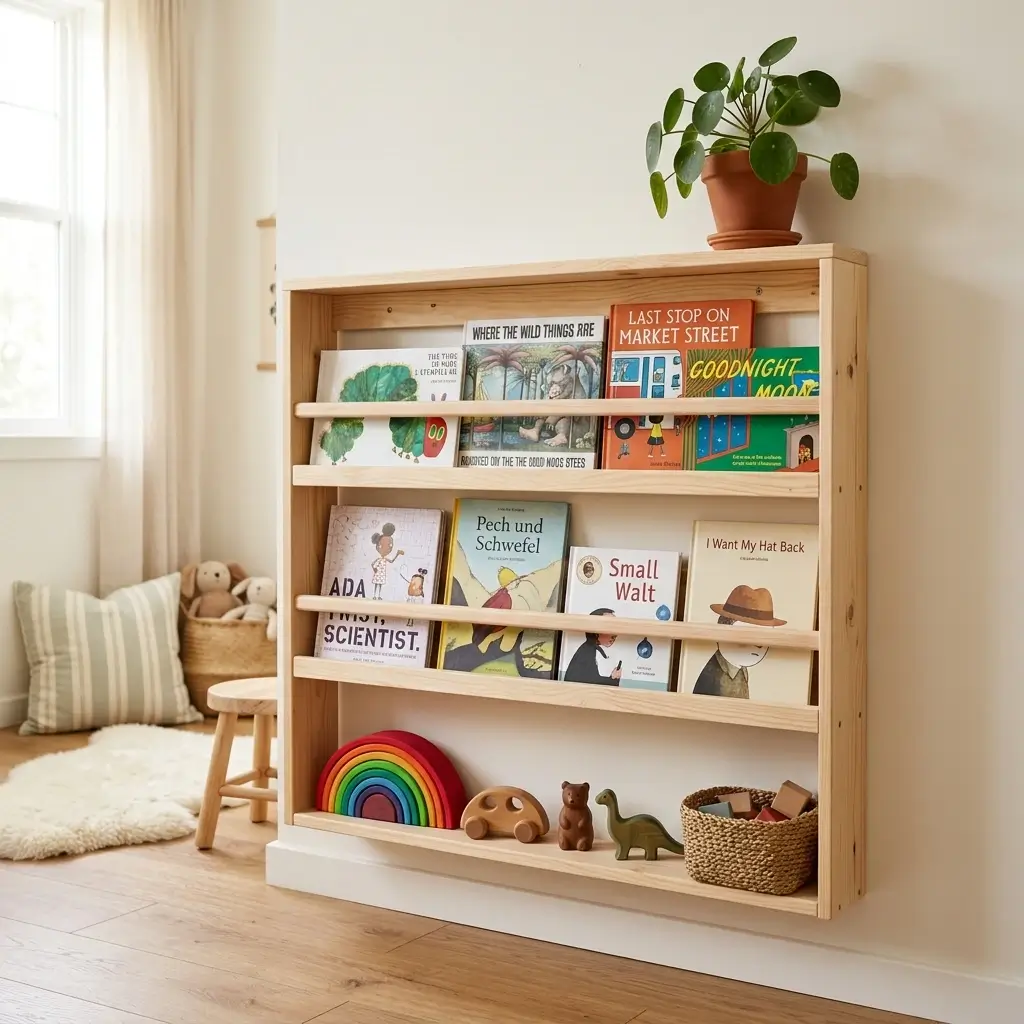
Vibe: Inviting, a small shelf scaled exactly to curious hands and a child’s own height.
Why it works: Pre-readers choose books by cover, not spine, so displaying titles face-forward on a ledge shelf makes independent selection genuinely possible in a way spine-out shelving never does, and keeping the total object count low prevents the sensory overload that dense toy storage tends to create in a small room.
How to get it: Mount the shelf roughly 12 to 16 inches from the floor, use a narrow ledge for face-forward books, and limit the shelf to one full activity set per category — one puzzle, one block set — rather than scattering partial sets across the surface where nothing feels complete.
Common mistake to avoid: Mounting a children’s shelf at adult eye level defeats its entire purpose — the whole point is independence, which only works if a child can actually reach and see everything without help.
💡 Quick Win: Rotating just a few toys onto the shelf monthly, and storing the rest in a closet bin, keeps a child’s shelf feeling new without adding a single new purchase.
Shop The Look
| Product | Why It Fits |
| Low natural wood bookshelf children’s | Sized and mounted for genuine child-height access |
| Face-forward book ledge shelf natural wood | Lets pre-readers choose titles by cover art |
| Small woven basket set child-safe | Corrals loose pieces without hard edges or small parts |
| Wooden toy figure set natural finish | Fills one complete activity category on the shelf |
| Small child-safe succulent ceramic pot | Adds a living element that’s safe within reach |
9. Living Room: Mixed Wood-and-Metal Ladder Shelf
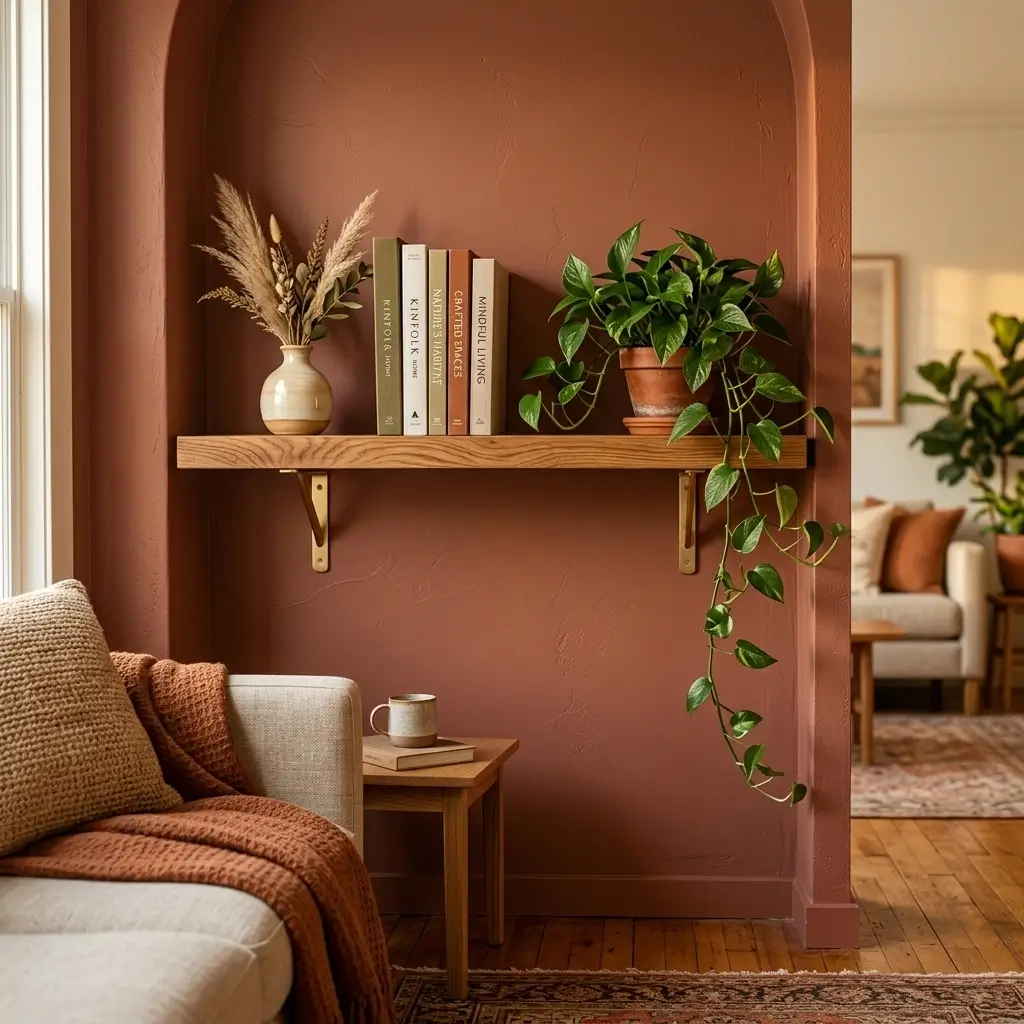
Vibe: Layered, the kind of shelf that looks collected over years rather than bought in a single trip.
Why it works: Pairing a warm raw material like oak with a cool material like matte black steel creates textural contrast that keeps a single freestanding piece from reading as flat or one-note, and a heavier object anchoring the bottom shelf keeps the whole arrangement visually grounded rather than top-heavy.
How to get it: Choose a ladder shelf with a matte black powder-coated steel frame and solid oak boards, and place one noticeably heavier object — a woven basket or a stack of large books — on the bottom shelf so the piece reads as stable rather than precarious against a wall.
Common mistake to avoid: Leaving the bottom shelf empty or styled with the lightest objects makes a ladder shelf look unstable even when it’s structurally fine — visual weight should increase, not decrease, toward the floor.
Shop The Look
| Product | Why It Fits |
| Black metal and oak ladder bookshelf | Provides the core wood-and-metal material contrast |
| Woven seagrass storage basket with handles | Anchors the bottom shelf with real visual weight |
| Matte black hardware spray paint | Lets existing shelf brackets match the frame finish |
| Small potted fern ceramic pot | Adds a soft, living counterpoint to the metal frame |
| Hardcover book set neutral covers | Fills upper shelves without introducing extra color |
10. Small-Space Shelf Decor: Vertical Corner Shelving
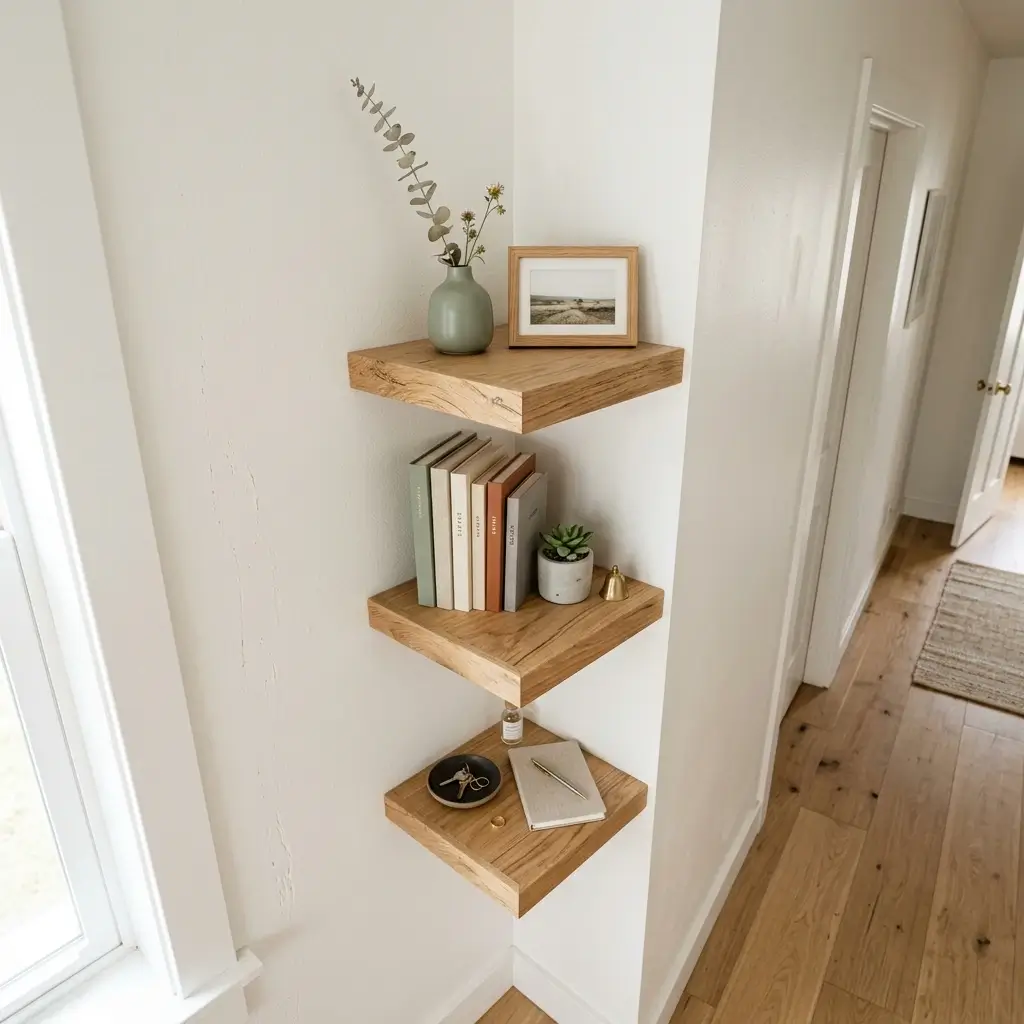
Vibe: Efficient, the kind of corner that used to feel wasted and now feels genuinely planned.
Why it works: Stacking narrow shelves vertically in an unused corner adds display and storage area without consuming any floor footprint, which is the core small-space illusion technique height compensates for width you simply don’t have in a tight apartment or narrow hallway.
How to get it: Use shelves no deeper than 6 inches, mount three or four of them vertically spaced 10 to 12 inches apart in the corner, and keep every object slim enough that nothing protrudes into the walking path beside it.
Common mistake to avoid: Using standard 10-to-12-inch-deep shelving in a tight corner instead of a slim 6-inch profile turns a space-saving idea into a walking hazard, especially in a narrow hallway with regular foot traffic.
💡 Quick Win: One narrow 6-inch shelf in an awkward corner nook can hold a bud vase and two books for a fast styling win under $25.
Shop The Look
| Product | Why It Fits |
| Narrow 6-inch deep floating oak shelf | Keeps the corner passable while adding display space |
| Small ceramic bud vase set | Fits the shallow depth without protruding |
| Thin hardcover book set neutral spines | Adds height variation within a slim footprint |
| Small brass tabletop photo frame | Personalizes the corner without taking up depth |
| Corner wall anchor mounting kit | Secures stacked shelves safely in a tight space |
How to Start Your Shelf Decor Transformation
Start by completely clearing one shelf — the one that frustrates you most every time you walk past it — before buying anything new. Most homes already own enough interesting objects to style a shelf well; those objects are simply buried under whatever accumulated there by accident over months or years, and removing everything first is what actually lets you see what you have to work with, rather than styling around clutter that should have been put away already.
The most common mistake across every room is lining objects up at the same height along the back edge of a shelf, which produces a flat, one-dimensional row with no visual movement for the eye to follow. Fix it with the three-height rule used throughout this guide: always include one tall, one medium, and one low element on any given shelf section, and use the shelf’s front-to-back depth rather than just its width, pulling some objects forward and pushing others back.
Three items under $50 that create real impact in almost any room: a bundle of dried eucalyptus stems, typically around $10, for instant organic texture that never needs water; a set of three varying-height glass apothecary jars, around $15, that work equally well in a bathroom, kitchen, or home office; and a single framed art print in a plain wood frame, around $20, that establishes a background layer for any shelf vignette without committing to a permanent gallery wall.
A single shelf refresh using only what you already own takes 20 to 40 minutes and costs nothing beyond that time. Adding two or three new pieces to complement what you have runs roughly $20 to $60 and noticeably lifts an entire room’s feel. A full multi-shelf project spanning two or three rooms, including new hardware or under-shelf lighting, is realistically a full weekend of work and somewhere between $80 and $200 depending on how many shelves you’re adding rather than simply restyling.
Frequently Asked Questions About Stylish Shelf Decor
What is the rule of three in shelf decorating and why does it work?
The rule of three groups objects in odd numbers because the eye can’t resolve an odd-numbered group into an exactly symmetrical pair, which creates just enough visual tension to hold attention rather than resolving instantly. Three objects at graduated heights form a triangular silhouette that gives the eye a clear path to follow across the shelf instead of scanning it as one flat block. This principle scales beyond a single grouping too — three shelves in a bathroom ladder arrangement or three color zones on a long bookcase apply the same underlying logic as three objects on one surface.
What colors work best for shelf styling in a small apartment?
Warm white, sand, and sage green form a flexible base palette that reads calm without feeling cold or sterile, and terracotta or warm charcoal works well as a single accent tone rather than a dominant color across every shelf. Sticking to one accent color per shelf, instead of introducing three or four competing tones, keeps a small space from feeling visually busy on top of already being physically tight. Cool grays and stark whites tend to clash with the warm materials, like oak and brass, that anchor most shelf styling.
How much does it cost to style shelves across a whole home?
A single shelf refresh using entirely existing objects costs nothing beyond the time it takes. Adding a handful of new pieces per shelf typically runs $20 to $60 per shelf once you include a jar, a plant, and a small decorative object. A full-home project touching five or six shelves across multiple rooms, including new hardware, lighting, and a mix of new and existing accessories, realistically falls between $150 and $400 depending on how much you already own versus what genuinely needs to be purchased new.
Do shelves work in small rooms like a bathroom or hallway, or do they make the space feel smaller?
Shelves generally help small rooms rather than hurt them, since they add display and storage capacity without using any floor space that a small room can’t spare. The key constraint is object count rather than the shelf itself a small bathroom or hallway shelf should carry no more than five or six items total, and deliberately leaving 20 to 30 percent of the surface visibly empty keeps the room feeling open rather than cramped, which matters more in a small space than in a larger one.
How many objects should go on one shelf?
Object count should scale directly with shelf width rather than following one fixed rule for every surface. A shelf around 24 inches wide, like a bedroom nightstand shelf, works best with three or four objects total. A shelf around 36 to 48 inches, typical in a living room or home office, comfortably holds five to seven objects without feeling sparse or crowded. A full-width bookcase shelf can carry eight to twelve items including books, as long as roughly a quarter of the total surface stays visibly empty to keep the density from tipping into clutter.
Ready to Create Your Dream Shelf Decor?
These 10 ideas move across nearly every room in the house living room ceramics, kitchen color-blocking, bathroom texture, bedroom lighting, and a small-space corner solution among them so there’s a genuine starting point no matter which room needs it most right now. You don’t have to tackle every shelf in the house this weekend; picking just one and doing it properly is the right way to begin, and it’s exactly how most well-styled homes actually got that way, one shelf at a time rather than all at once.
Today, clear the one shelf that’s been bothering you, set a 30-minute timer, and put back only what you’d genuinely choose to display if you were starting from nothing. Once it’s done, that shelf will stop looking like leftover storage and start feeling like a small, considered part of the room you actually notice every time you walk past it. Save whichever idea matched your space, especially if it’s the entryway command center or the kids’ room face-forward shelf they tend to change how a room feels the fastest of everything on this list.
You Might Also Like
- Eco Friendly Bamboo Home Decor: 9 Stunning Ways to Style Every Room
- Modern Home Decor: 15 Ideas Worth Saving and Stealing
- 13 Minimalist Home Decor Ideas for a Calm, Clutter-Free Space
- 12 Small Space Decor Ideas for a Modern Minimalist Home
- 15 Scandinavian Decor Ideas for Simple, Hygge-Inspired Living
- 20 Vintage Home Decor Ideas for a Home Full of Character
[…] 10 Stylish Shelf Decor Ideas for Every Room […]