

A contemporary dark dining room is a dining space built around deep, sophisticated colors, clean-lined furniture, tactile materials, and controlled lighting without becoming visually heavy or old-fashioned. These 13 contemporary dark dining room design ideas show how to use charcoal, espresso, ink blue, walnut, smoked glass, sculptural lighting, and warm metallic accents to create a dining room that feels current, intimate, and highly intentional.
The atmosphere is deeper from the moment you enter: walls absorb daylight rather than bouncing it harshly, walnut surfaces catch small pools of warm illumination, and textured upholstery gives the darkness something soft to settle against. Instead of feeling gloomy, the room can feel hushed and grounded, especially when 2700K lighting, natural wood, and warm stone are layered carefully. Contemporary design keeps that richness from becoming traditional by using simple silhouettes, generous negative space, and fewer but more substantial decorative objects. Here are 13 ideas worth saving and stealing.
Why 13 Contemporary Dark Dining Room Design Ideas Work So Well
Contemporary interior design developed from the broader modernist movement but differs from strict modernism because it is not tied to one historical period or fixed visual vocabulary. It responds to what feels relevant now, combining clean architectural lines with influences from mid-century furniture, minimalism, industrial materials, natural textures, and increasingly traditional or vintage elements. A contemporary dark dining room uses that flexibility particularly well: the darkness supplies visual depth while streamlined furniture, restrained ornament, and open circulation keep the room unmistakably current.
The core palette works best when “dark” means layered rather than simply black. Think warm charcoal, graphite, espresso brown, ink blue, deep olive, mushroom taupe, and smoked umber, balanced with walnut, blackened oak, honed limestone, smoked glass, dark bronze, aged brass, boucle, linen, and wool. A useful contemporary combination is a matte charcoal wall with medium-dark walnut, mushroom upholstery, aged brass, and a small amount of warm ivory. The contrast between matte and reflective surfaces is as important as the contrast between light and dark.
Style at a Glance
| Element | Contemporary Dark Dining Room |
| Philosophy | Deep atmosphere balanced by clean lines and intentional negative space |
| Key Materials | Walnut, blackened oak, smoked glass, honed stone, linen, wool, dark bronze |
| Color Palette | Warm charcoal, espresso, ink blue, deep olive, mushroom, warm ivory |
1. Wrap the Walls in Warm Charcoal for a Seamless Dark Envelope
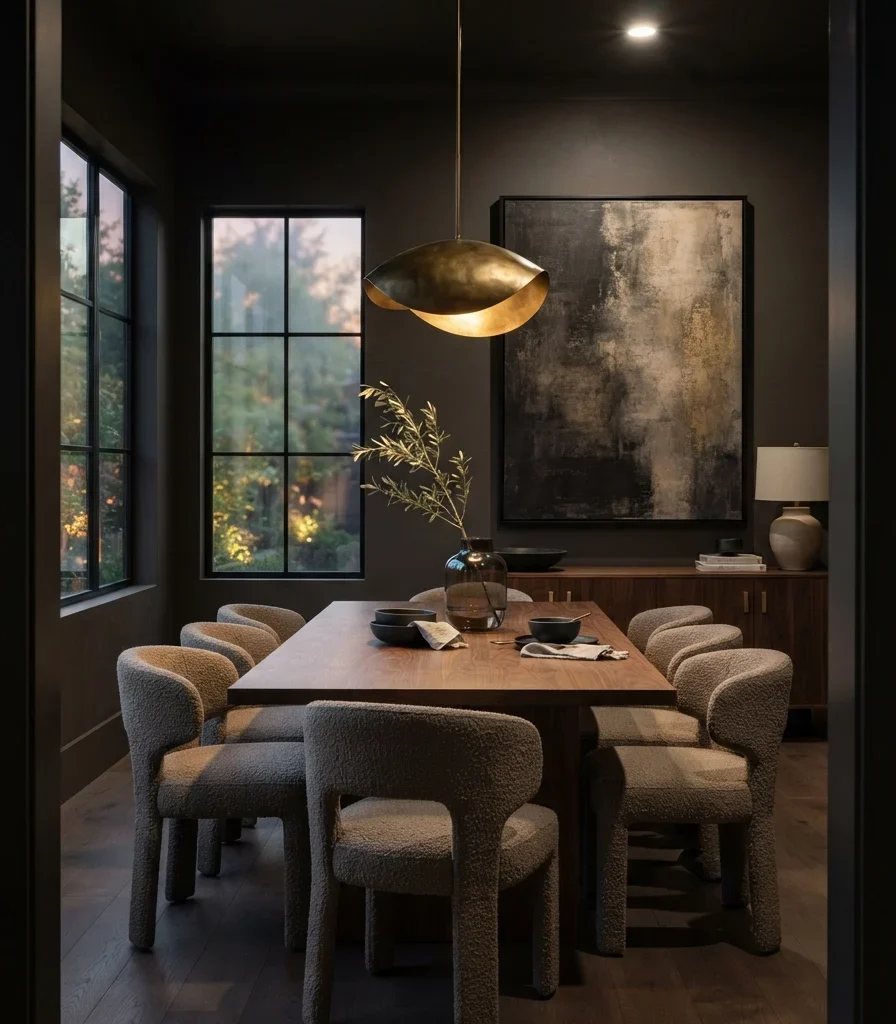
Vibe: Hushed; the room feels cocooned without feeling closed in.
Why it works: The design principle is color continuity: painting the walls, trim, and doors within the same warm charcoal family reduces visual interruptions and makes the architecture feel more intentional. Walnut and mushroom upholstery then provide enough tonal separation to keep the dining table and chairs from disappearing into the background. Matte paint is particularly useful because it absorbs stray reflections rather than competing with the brass fixture.
How to get it: Use a warm charcoal with a brown or neutral undertone rather than a blue-black gray, and paint the trim in the same family at a slightly different sheen. Keep the ceiling one step lighter only if the room has limited natural light; otherwise, carrying the charcoal upward can create a more architectural contemporary effect.
💡 Quick Win: Before repainting, test three charcoal samples on the actual dining-room wall and view them at morning, afternoon, and evening light. A $10–$20 sample test can prevent an expensive undertone mistake.
Shop The Look
| Product | Search on Amazon |
| Warm charcoal interior wall paint | Warm charcoal matte interior wall paint |
| Mushroom bouclé dining chair | Mushroom boucle upholstered dining chair modern |
| Aged brass linear pendant | Aged brass linear dining room pendant light |
| Smoked glass decorative vase | Smoked glass vase modern dining table |
| Walnut rectangular dining table | Dark walnut rectangular dining table contemporary |
2. Pair a Sculptural Black Table With Soft Upholstered Chairs
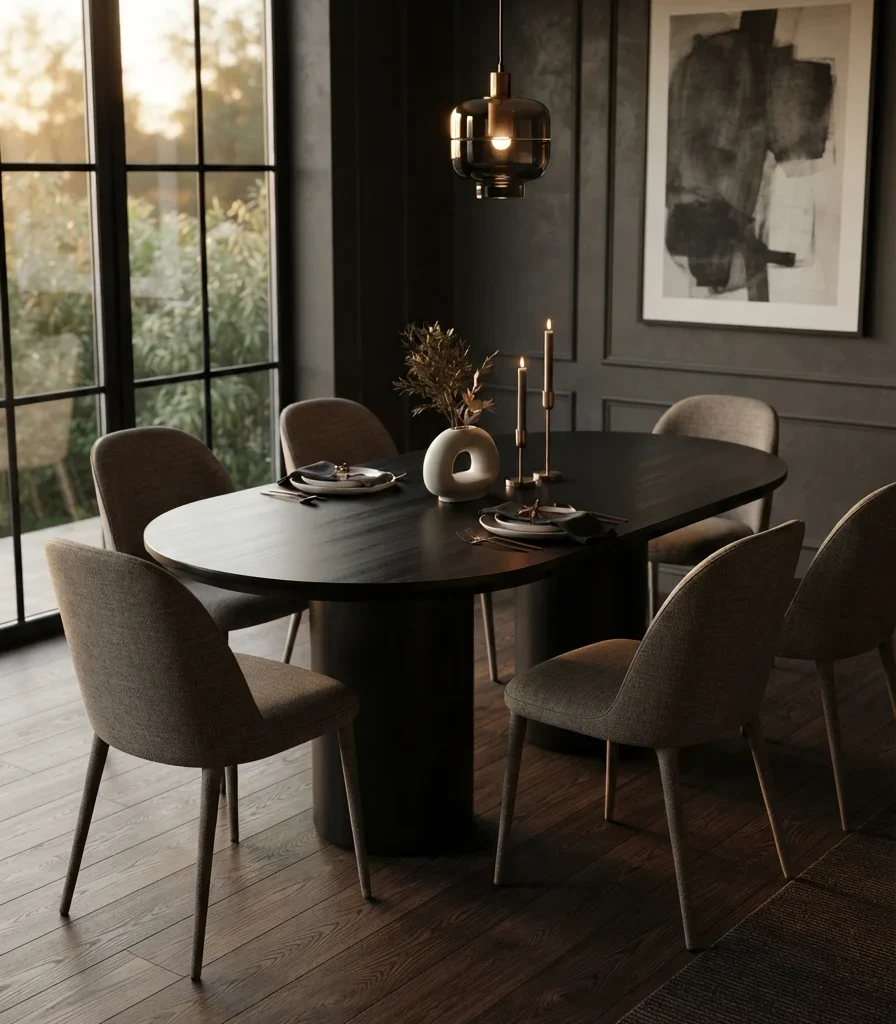
Vibe: Grounded; the furniture feels substantial without becoming bulky.
Why it works: This arrangement relies on visual-weight contrast. A dark sculptural table has strong visual mass, so pairing it with softly curved upholstered chairs prevents the composition from becoming a collection of hard black rectangles. The rounded chair backs also introduce ergonomic softness while preserving the clean geometry expected in contemporary dining furniture.
How to get it: Choose one dominant black finish for the table, preferably matte or satin rather than glossy, then select chairs at least 5–8cm lower than the tabletop’s visual midpoint so the arrangement remains open. Leave approximately 60cm of table width per seated person for comfortable everyday dining.
Shop The Look
| Product | Search on Amazon |
| Black oval pedestal dining table | Matte black oval pedestal dining table modern |
| Warm gray upholstered dining chairs | Warm gray curved upholstered dining chairs |
| Dark oak dining room rug | Dark oak brown neutral dining room area rug |
| Minimal ceramic centerpiece bowl | Matte black low ceramic centerpiece bowl |
| Bronze candleholder set | Brushed bronze modern candle holders set |
3. Use Smoked Glass to Add Light Without Losing the Mood

Vibe: Luminous darkness becomes a backdrop for controlled reflections.
Why it works: Smoked glass introduces light behavior rather than simply another decorative color. The translucent surface catches warm bulbs and creates layered reflections while allowing the fixture itself to remain visually lighter than a solid black pendant. Against charcoal or espresso walls, that subtle glow prevents the room from becoming visually flat.
How to get it: Choose smoked or gray-tinted glass with visible bulbs inside rather than opaque shades, and use warm 2700K LEDs with high color rendering. Hang the lowest part of the pendant roughly 75–90cm above the tabletop so the light feels intimate without blocking conversation across the table.
💡 Quick Win: If your existing fixture has replaceable shades, swap only the shades for smoked-glass globes rather than replacing the entire electrical fixture.
Shop The Look
| Product | Search on Amazon |
| Smoked glass globe pendant | Smoked glass globe pendant dining room |
| 2700K warm LED bulbs | 2700K dimmable warm white LED bulbs |
| Amber glass tumbler set | Amber smoked glass drinking glasses set |
| Walnut dining sideboard | Dark walnut narrow dining sideboard |
| Low black ceramic vase | Matte black low ceramic vase modern |
4. Bring in Deep Olive Instead of Using Black Everywhere

Vibe: Earthy; the darkness feels connected to the landscape rather than manufactured.
Why it works: Deep olive provides chromatic depth, giving you the atmosphere of a dark dining room without relying exclusively on neutrals. Its yellow-green undertone works particularly well with walnut, bronze, linen, and warm white because those materials contain enough warmth to prevent the green from feeling cold or overly botanical.
How to get it: Select a muted olive with gray or brown undertones rather than a saturated emerald, and repeat the color in only two smaller elements such as artwork and napkins. Keeping the repetition controlled prevents the room from becoming theme-driven.
Shop The Look
| Product | Search on Amazon |
| Deep olive interior paint | Deep olive green matte interior wall paint |
| Blackened oak dining table | Blackened oak rectangular dining table |
| Natural linen dining chairs | Beige natural linen upholstered dining chairs |
| Aged bronze wall mirror | Aged bronze round wall mirror dining |
| Rust olive abstract artwork | Olive rust abstract wall art large |
5. Make the Dining Table the Warmest Object in the Room
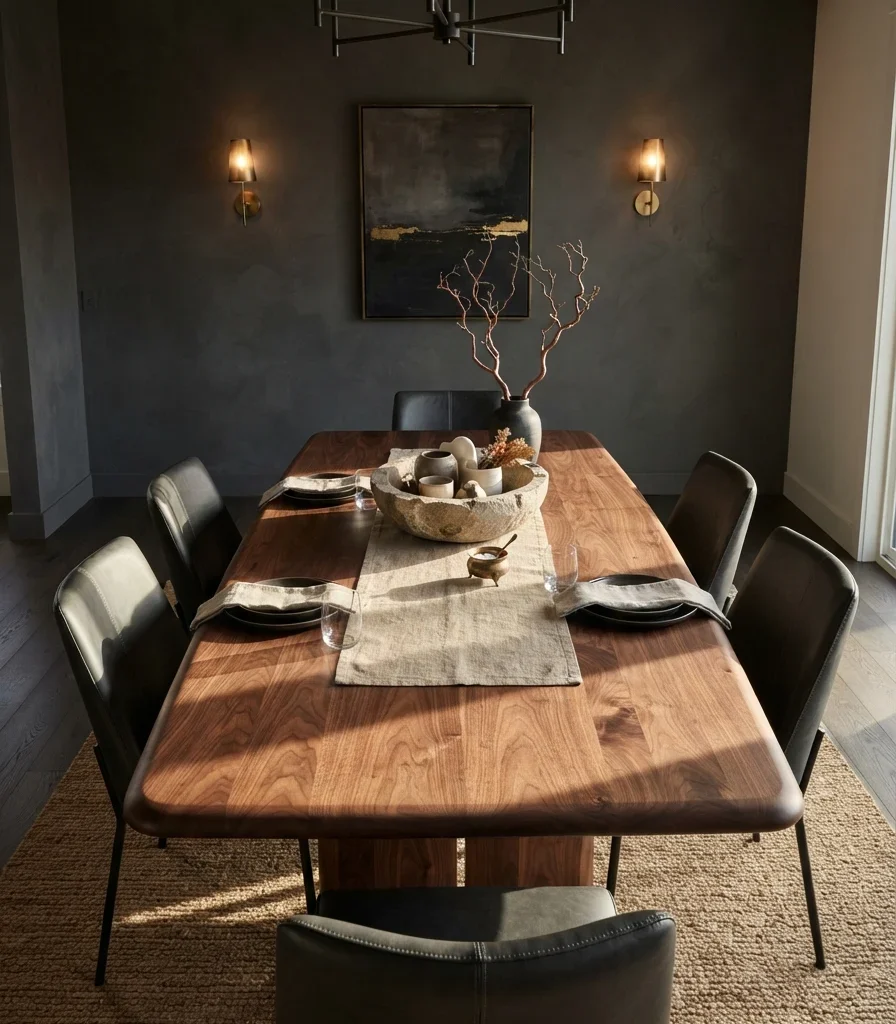
Vibe: Tactile; the tabletop becomes something you want to touch.
Why it works: A dark room needs material variation, not simply color contrast. Walnut provides natural grain, subtle reddish-brown undertones, and a warmer visual temperature than painted black furniture. Against a dark wall, the grain becomes the detail that separates the table from the background while giving the room an organic counterpoint to contemporary silhouettes.
How to get it: Choose a walnut or walnut-finished table with a low-sheen oil or matte appearance, then keep the tabletop mostly clear. One stone bowl, one linen runner, or one low ceramic object is enough because excessive tabletop accessories compete with the wood grain.
💡 Quick Win: If replacing the table is not practical, use a removable walnut-toned tabletop overlay or refinish the existing top in a deep walnut stain while keeping the base black.
Shop The Look
| Product | Search on Amazon |
| Walnut dining table | Solid walnut dining table contemporary |
| Charcoal leather dining chairs | Charcoal leather dining chairs modern |
| Honed stone centerpiece bowl | Honed stone decorative bowl dining table |
| Natural linen table runner | Natural linen table runner dark dining |
| Brass salt and pepper set | Aged brass salt pepper cellar set |
6. Install a Long Linear Pendant for Architectural Drama
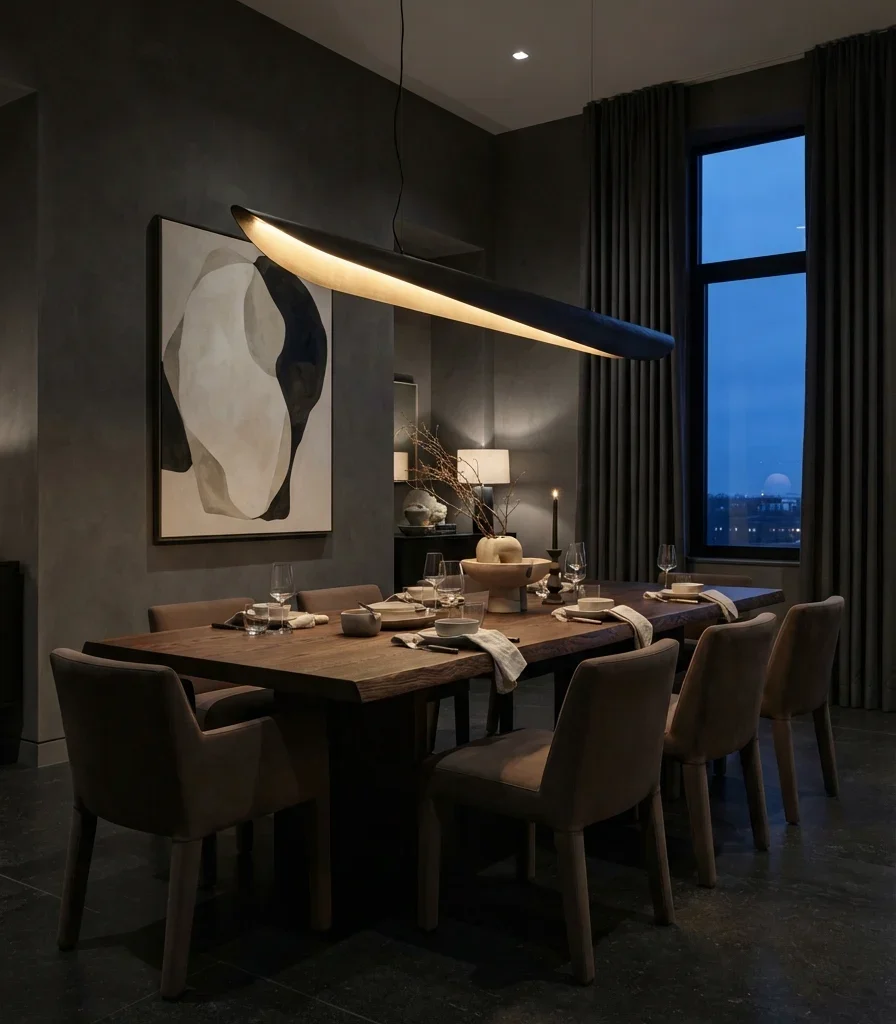
Vibe: Cinematic; the light becomes part of the architecture.
Why it works: The principle here is horizontal visual anchoring. A long pendant reinforces the length of a rectangular dining table and creates a deliberate visual axis, which is especially effective in contemporary dining rooms with high ceilings. Multiple light sources along the fixture also distribute illumination more evenly than a single central pendant.
How to get it: Choose a fixture approximately 50–70% of the table length, then center it precisely over the table rather than the room. Use a dimmer so the same fixture can provide brighter illumination for everyday meals and a lower setting for evening entertaining.
Shop The Look
| Product | Search on Amazon |
| Long linear black pendant | Long linear black dining room chandelier |
| Dimmable pendant LED bulbs | Dimmable warm LED bulbs 2700K dining |
| Taupe upholstered dining chairs | Taupe upholstered dining chair contemporary |
| Dark oak dining table | Dark oak long rectangular dining table |
| Textured neutral wall art | Large textured neutral abstract wall art |
7. Add a Dark Stone Sideboard With a Pale Stone Top

Vibe: Serene; the pale stone gives the darkness room to breathe.
Why it works: This is a study in hard-material contrast. Blackened oak absorbs light while honed travertine reflects it softly, creating depth without introducing a bright, glossy surface. The combination also gives the dining room practical serving storage, which matters because contemporary dining rooms increasingly need to support everyday use rather than occasional formal meals.
How to get it: Choose honed rather than polished stone so reflections remain subtle, and pair it with a sideboard no deeper than about 45cm if circulation is limited. Leave at least 90cm between the sideboard and table when possible so chairs and serving traffic can coexist comfortably.
💡 Quick Win: Place a removable ivory travertine-look slab or large stone serving board on an existing dark sideboard to reproduce the light-over-dark contrast for very little money.
Shop The Look
| Product | Search on Amazon |
| Black oak sideboard | Black oak modern dining room sideboard |
| Ivory travertine serving tray | Ivory travertine decorative serving tray |
| Sculptural ceramic table lamp | Sculptural cream ceramic table lamp |
| Bronze cabinet pulls | Aged bronze cabinet pulls modern |
| Black stone decorative bowl | Black stone decorative bowl contemporary |
8. Use One Oversized Artwork Instead of a Gallery Wall

Vibe: Artistic; the wall feels collected without becoming crowded.
Why it works: Large-scale artwork uses proportion to balance a dark room. Small framed pieces can look visually fragmented against a deep wall, while one oversized canvas creates a single readable shape and gives the eye a resting point. The artwork should contain at least one lighter tone so it interacts with the dining furniture instead of disappearing into the wall.
How to get it: Choose artwork approximately two-thirds the width of the dining table or sideboard below it, and hang its center around 145–150cm from the floor. Look for textured canvas or thick paper rather than glossy prints, because matte surfaces behave better under directional dining-room lighting.
Shop The Look
| Product | Search on Amazon |
| Oversized charcoal abstract canvas | Oversized charcoal cream abstract canvas |
| Black oval dining table | Matte black oval dining table contemporary |
| Walnut dining chairs | Walnut frame upholstered dining chairs |
| Aged bronze picture light | Aged bronze picture light wall mounted |
| Stone ceramic vase | Natural stone look ceramic vase large |
9. Introduce a Mushroom Bouclé Bench for Softness
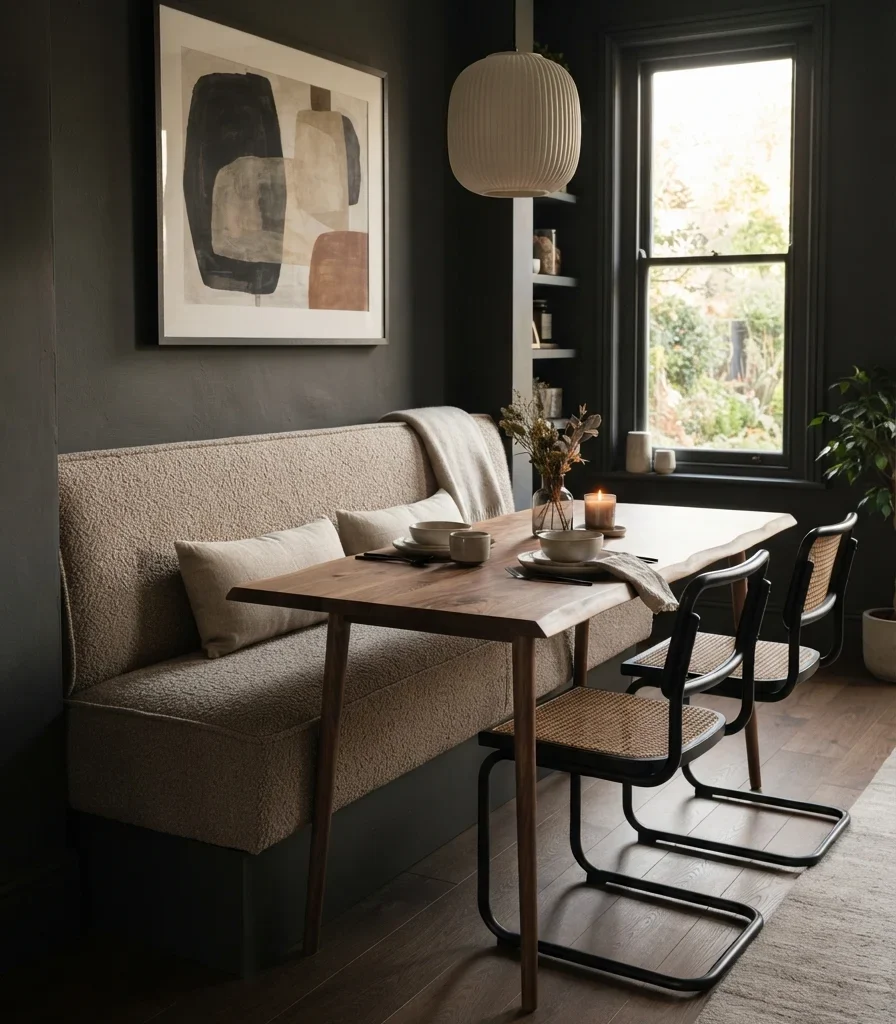
Vibe: Cushioned; the room feels softer despite its dark palette.
Why it works: Upholstery introduces texture layering that prevents a dark dining room from feeling excessively hard. Bouclé is particularly effective because its looped surface catches light differently across the fabric, producing subtle tonal variation without requiring a bright color. A bench also uses wall-side space efficiently and can accommodate more people than individual chairs.
How to get it: Use a mushroom or oatmeal bouclé bench against the darkest wall and keep the opposite chairs visually lighter or slimmer. Allow approximately 45–50cm of seating depth and avoid overstuffing the bench with cushions; two lumbar pillows are enough to preserve the contemporary profile.
💡 Quick Win: Add a 120–150cm mushroom bouclé bench cushion to an existing wooden bench instead of purchasing a fully upholstered banquette.
Shop The Look
| Product | Search on Amazon |
| Mushroom bouclé dining bench | Mushroom boucle dining bench modern |
| Walnut dining table | Walnut dining table rounded edge contemporary |
| Black sculptural dining chair | Black sculptural dining chair modern |
| Oatmeal linen lumbar pillows | Oatmeal linen lumbar pillow covers |
| Charcoal textured wall art | Charcoal textured abstract wall art |
10. Use Floor-to-Ceiling Curtains to Soften the Darkness
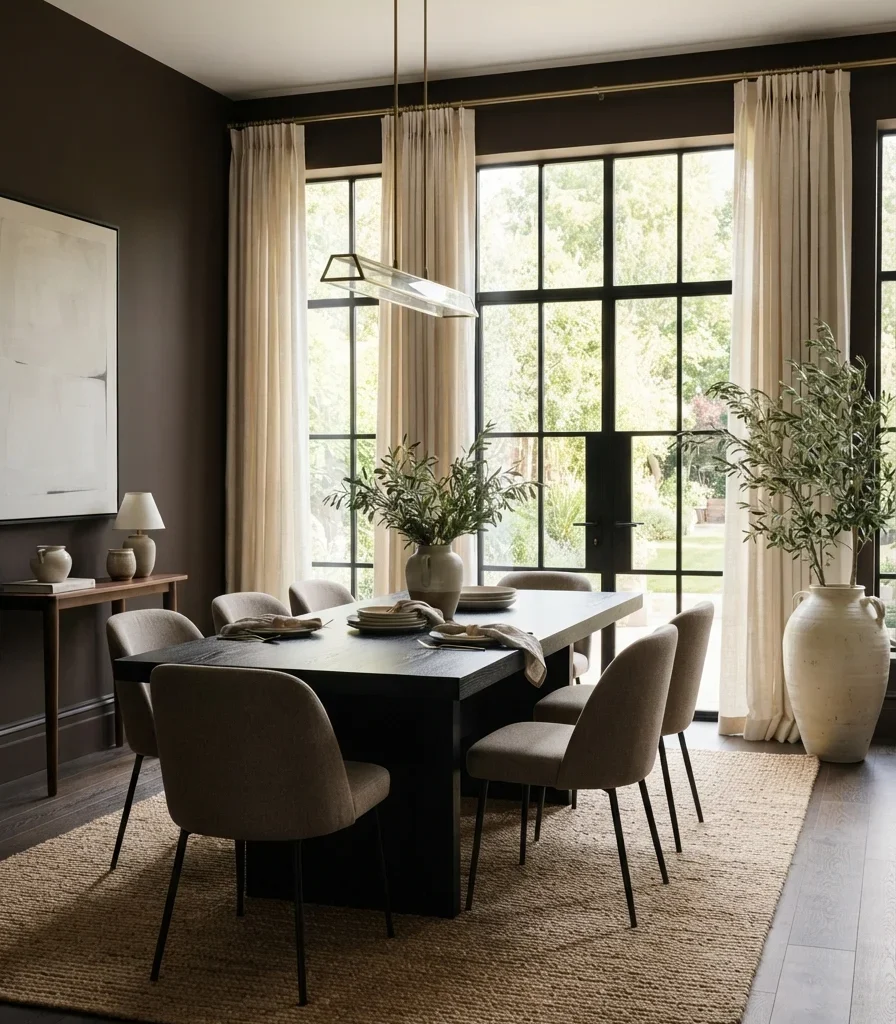
Vibe: Airy; the dark room gains movement and softness around its edges.
Why it works: Curtains create vertical softness and light modulation. A warm ivory linen panel against chocolate or charcoal walls introduces a controlled contrast that makes the windows appear larger while softening hard architectural lines. Linen also filters daylight rather than blocking it completely, which is important in a dark dining scheme.
How to get it: Mount the curtain rod 10–15cm above the window frame or as close to the ceiling as practical, then let panels just kiss the floor. Choose a natural or warm ivory linen with enough opacity to diffuse daylight but not create a stark white rectangle.
Shop The Look
| Product | Search on Amazon |
| Warm ivory linen curtains | Warm ivory linen floor length curtain panels |
| Dark chocolate interior paint | Deep chocolate brown interior wall paint |
| Black oak dining table | Black oak dining table modern |
| Brass curtain rod | Aged brass curtain rod contemporary |
| Woven neutral dining rug | Natural woven neutral dining room rug |
11. Repeat Dark Bronze Instead of Mixing Too Many Metals
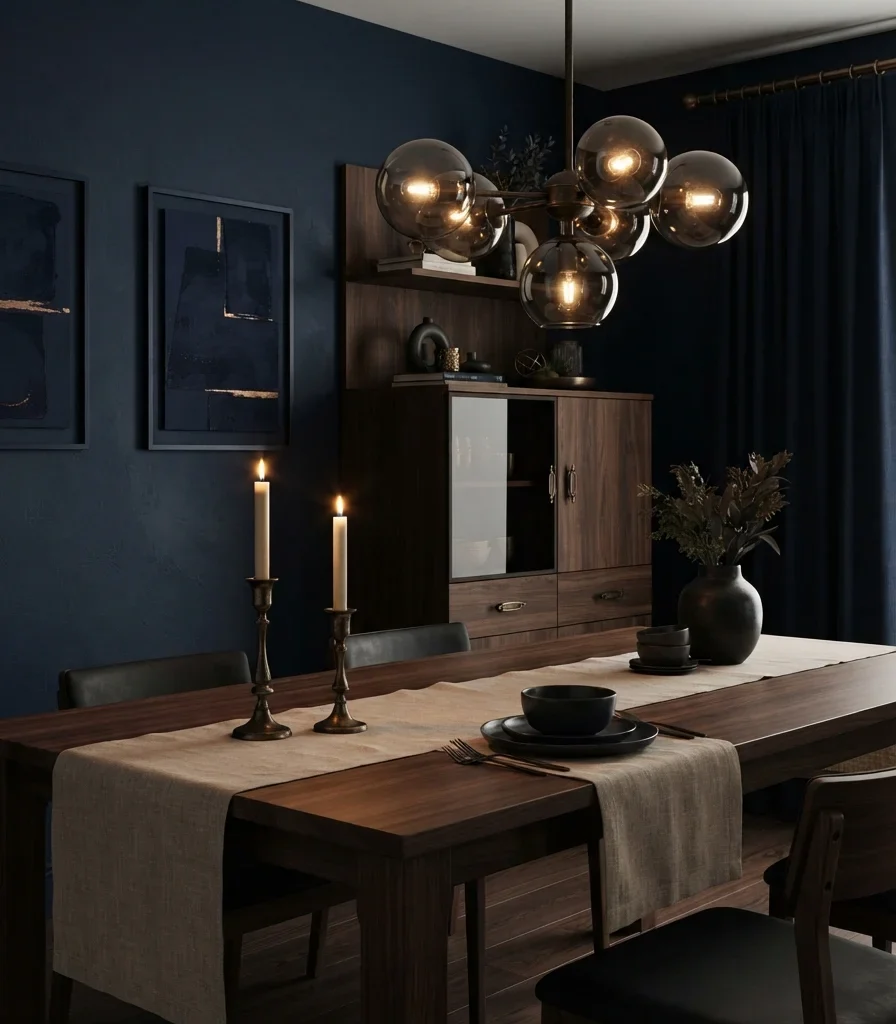
Vibe: Intimate; the room feels quietly connected from one surface to another.
Why it works: Repeating one metal finish creates material rhythm. Dark bronze is especially effective because it sits between black and warm brass, giving you warmth without introducing the brighter reflective quality of polished gold. Repetition across four or five small elements makes the finish feel architectural rather than decorative.
How to get it: Select dark bronze for the main pendant first, then repeat it in no more than three secondary locations such as cabinet pulls, curtain hardware, and candleholders. Avoid adding chrome or bright yellow brass afterward unless there is a deliberate reason for the contrast.
💡 Quick Win: Replace only the dining room’s cabinet or sideboard pulls with dark bronze hardware. Six matching pulls can often change the entire visual language for under $40.
Shop The Look
| Product | Search on Amazon |
| Dark bronze pendant light | Dark bronze dining room pendant |
| Dark bronze cabinet pulls | Dark bronze cabinet pulls modern set |
| Bronze candlestick holders | Dark bronze modern candlestick set |
| Navy ceramic vase | Deep navy ceramic vase matte |
| Walnut serving tray | Dark walnut serving tray dining |
12. Design a Compact Dark Dining Nook With a Round Table
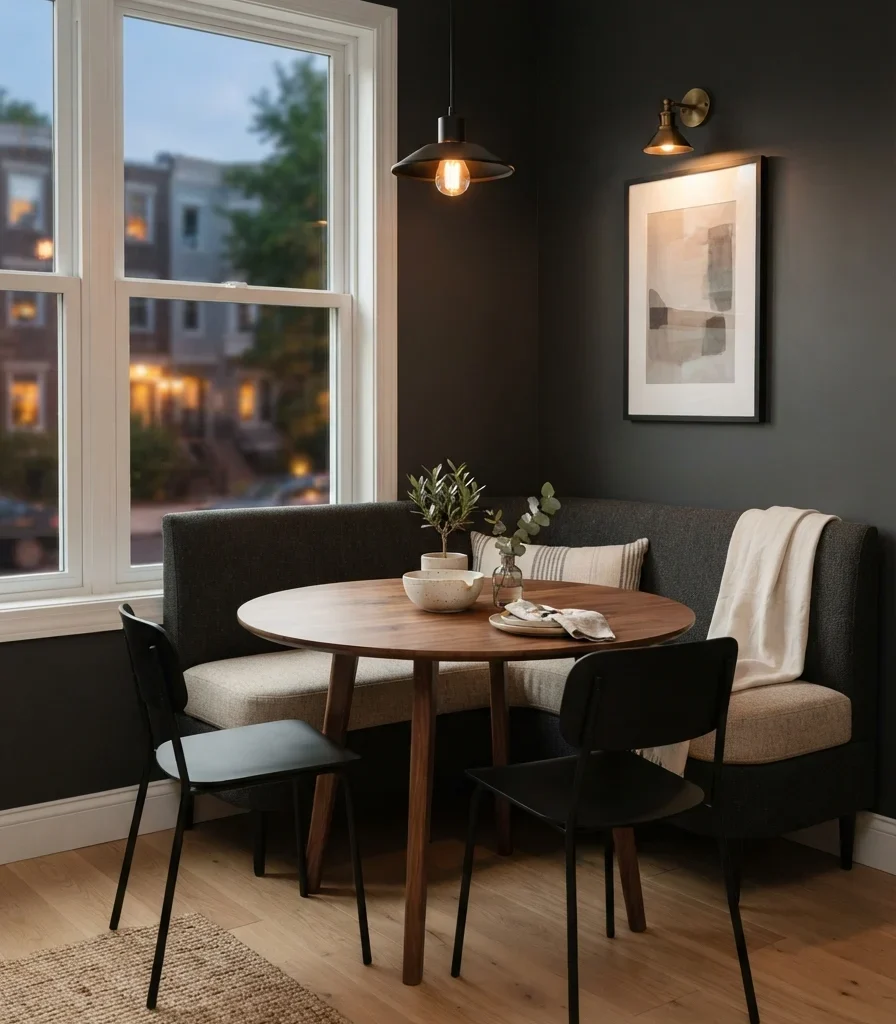
Vibe: Efficient; every centimeter feels deliberately used.
Why it works: A round table uses circulation geometry to solve a small-space problem because it eliminates sharp corners that interrupt movement. Keeping the table around 90–105cm wide provides a usable two- to four-person dining surface without consuming the footprint of a rectangular table. The dark wall visually defines the nook while the curved seating prevents the space from feeling boxy.
How to get it: Push one side of the dining arrangement against a wall with a fixed bench or banquette, then use a round pedestal table rather than four-legged furniture. Keep at least 75cm of clear walking space on the primary traffic side whenever possible.
Shop The Look
| Product | Search on Amazon |
| 100cm round walnut table | Small round walnut dining table pedestal |
| Compact curved dining bench | Curved upholstered dining bench small space |
| Slim black dining chairs | Slim black dining chairs contemporary |
| Small globe pendant | Small smoked glass globe pendant |
| Small ceramic planter | Small matte ceramic planter neutral |
13. Layer Espresso, Black, and Warm Ivory for a No-Pattern Finish
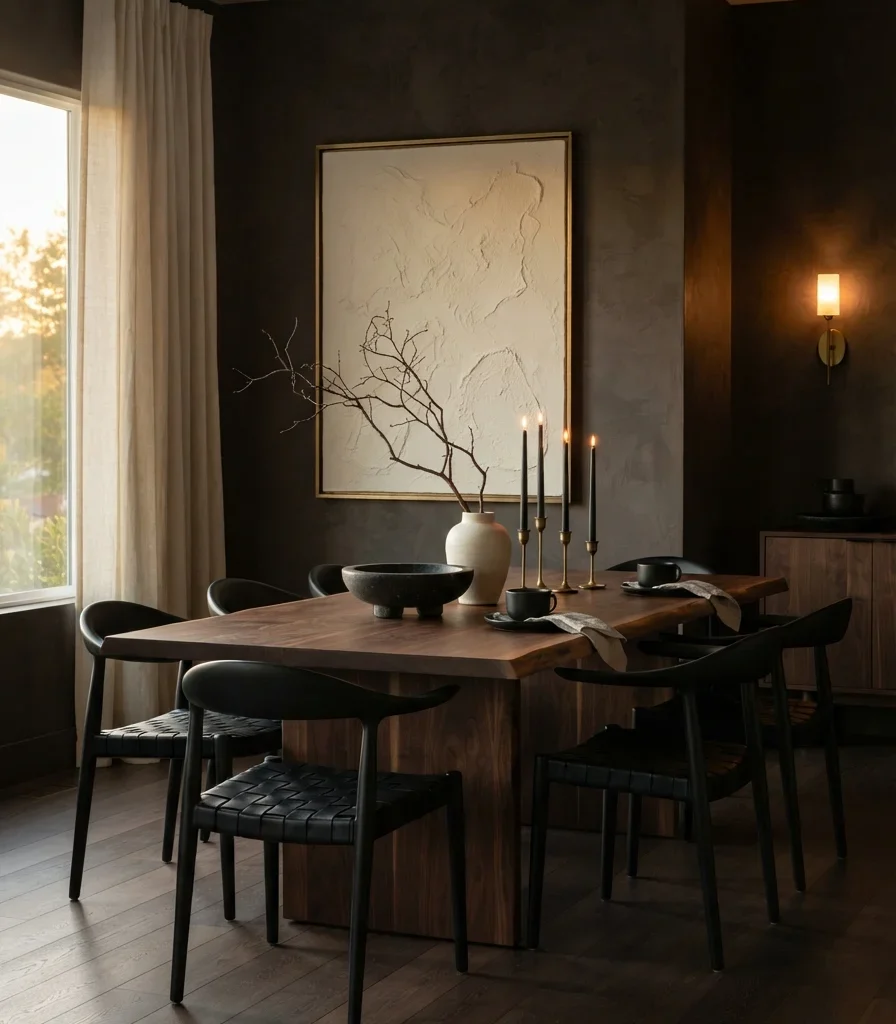
Vibe: Rich; the room feels deep without depending on pattern.
Why it works: The design principle is tonal layering, where several neighboring dark values create depth without introducing busy visual information. Espresso walls, black chairs, and walnut furniture are technically different finishes and temperatures, so the eye can distinguish each element even though the palette remains restrained. Warm ivory then supplies the minimum contrast necessary to keep the room readable.
How to get it: Work from three dark values- approximately 20% lighter, 50% lighter, and nearly blac insteadd of trying to match every dark surface exactly. Add warm ivory only through large elements such as curtains, upholstery, or artwork so the contrast feels intentional rather than scattered.
💡 Quick Win: Remove five small decorative objects from the dining room and replace them with one large warm-ivory ceramic vessel. The increased negative space will make the existing dark furniture feel more deliberate immediately.
Shop The Look
| Product | Search on Amazon |
| Espresso brown wall paint | Espresso brown matte interior wall paint |
| Deep walnut dining table | Deep walnut dining table contemporary |
| Black leather dining chairs | Black leather dining chairs modern |
| Warm ivory ceramic vase | Large warm ivory ceramic vase |
| Aged brass taper holder | Aged brass taper candle holder set |
How to Start Your Contemporary Dark Dining Room Transformation. Your first
Yourfirstt move should be to establish a warm charcoal wall color, ideally a charcoal with a subtle brown undertone rather than a blue-gray black. The wall color becomes the visual backdrop for the table, lighting, art, and upholstery, making later decisions easier because you can judge every material against the same dark foundation. Test the color in your actual dining room before committing, particularly if the room faces north or receives limited daylight.
The most common mistake is making every surface equally black. Black walls, black table, black chairs, black rug, black curtains, and black accessories can flatten the room because there is no change in texture, reflectivity, or value. Fix it by keeping the darkness but varying the materials: matte paint, figured walnut, bouclé, honed stone, smoked glass, and aged bronze each respond differently to light.
Three affordable entry points are a 2700K dimmable LED bulb set for about $10–$20, a dark bronze candleholder pair around $20–$30, and a small smoked-glass vase around $15–$25. Together, they can change the room’s lighting, metal language, and reflective quality without replacing furniture.
A small styling refresh can take one weekend and roughly $100–$300. A more substantial transformation with paint, lighting, curtains, rug, and several furniture upgrades commonly reaches $1,500–$4,000, while a full renovation can go much higher. Furniture and architectural changes may take several months; paint, lighting, textiles, and styling can transform the room within days.
Frequently Asked Questions About 13 Contemporary Dark Dining Room Design Ideas
What is the difference between a contemporary dark dining room and a traditional dark dining room?
A contemporary dark dining room uses deep color with cleaner silhouettes, less ornament, and more intentional negative space. Traditional rooms may rely more heavily on carved furniture, decorative molding, patterned textiles, or formal symmetry. Contemporary versions can still include walnut, brass, vintage pieces, or artwork, but those elements are edited so the room remains visually current.
Which colors work best in a contemporary dark dining room?
Warm charcoal, espresso, deep olive, ink blue, mushroom brown, and smoky graphite are particularly versatile. If the room receives little daylight, choose a charcoal or mushroom shade with a warm undertone rather than true black. For contrast, use warm ivory, oatmeal, or muted stone instead of stark white, which can create a sharper visual break than the palette needs.
How much does it cost to create a contemporary dark dining room?
A simple update using paint, warm LED bulbs, curtains, and a few accessories can begin around $150–$500. A mid-range transformation with a dining table, chairs, lighting, rug, and storage can easily reach $1,500–$4,000 depending on furniture quality and room size. Custom cabinetry, natural stone, designer lighting, and architectural work can push the budget substantially higher.
Can a small dining room use dark colors without looking smaller?
Yes, but the room needs deliberate contrast and circulation. Use a continuous dark wall color, a round or pedestal dining table, visually lighter upholstery, and curtains that extend close to the ceiling. Keep major walking paths around 75–90cm where possible, and use mirrors, smoked glass, or pale stone selectively to return some light into the room.
What lighting is best for a contemporary dark dining room?
A dimmable fixture using warm 2700K light is an excellent starting point because it creates a flattering evening atmosphere without turning the room orange. A linear pendant works especially well over a rectangular table, while globe or clustered pendants suit round tables. Add wall sconces or a picture light when possible so the walls receive illumination rather than leaving the entire room dependent on one overhead source.
Ready to Create Your Contemporary Dark Dining Room?
These 13 contemporary dark dining room design ideas cover far more than dark paint, combining color, walnut and stone, sculptural lighting, upholstery, artwork, circulation, and compact-space planning. You do not need to transform everything at once; beginning with one wall color or lighting change is often the smartest way to understand how a darker palette behaves in your own home. Today, test a warm charcoal paint sample beside your dining table and look at it once in daylight and again after the room is illuminated at 2700K. When the transformation is complete, the room should feel grounded, intimate, and comfortable enough that dinner naturally lasts longer. Save or pin your favorite combination of charcoal walls, walnut grain, smoked glass, and warm bronze so you have a clear visual direction when you are ready to make the next change.
You Might Also Like
- 20 The Timeless Elegance of an English Countryside Dining Room
- 12 Minimalist Dining Room Ideas for a Room That Says Enough
- 13 Minimalist Home Decor Ideas for a Calm, Clutter-Free Space
- 20 Home Styling Ideas That Make a Room Feel Finished
- 20 Interior Design Inspiration Ideas for Any Style You Love
- 15 Home Makeover Ideas for a Real Before-and-After Transformation
[…] 13 Contemporary Dark Dining Room Design Ideas […]