
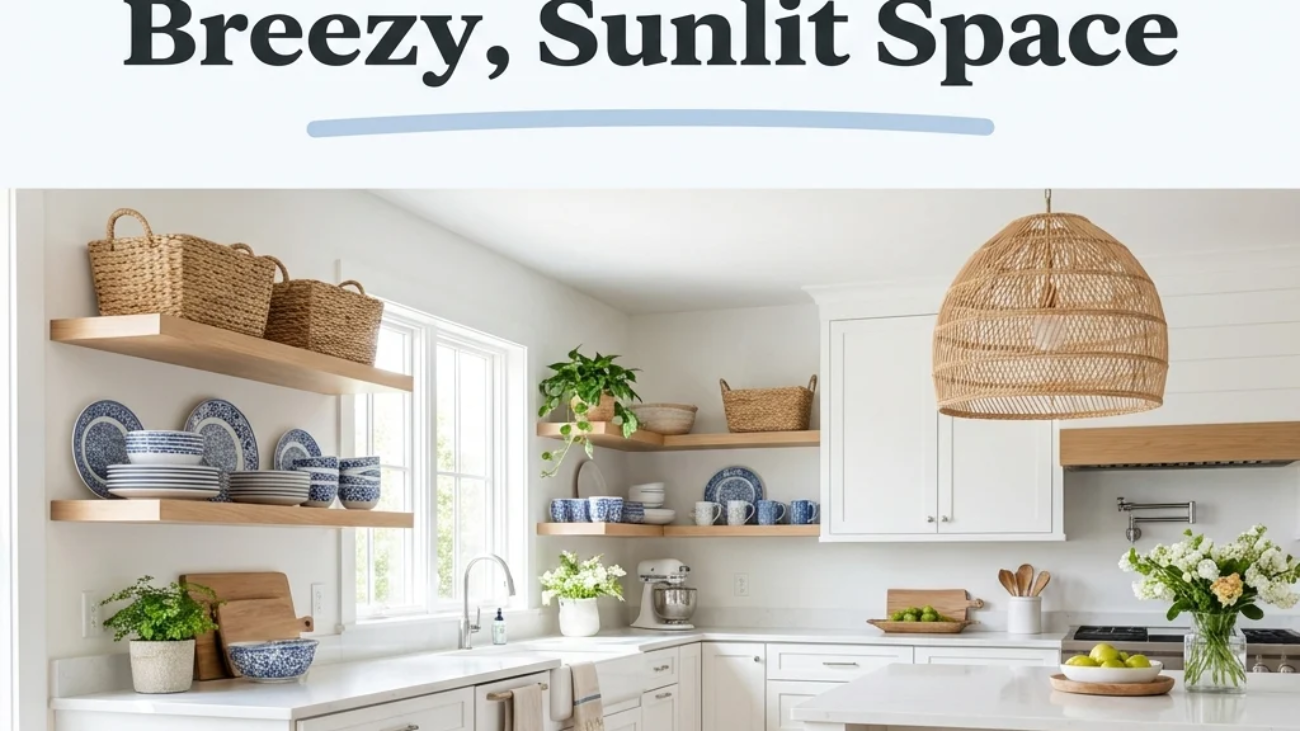
Coastal kitchen decor takes its cues from weathered shingle-style beach cottages sun-bleached wood, sea-glass color, and light that bounces rather than sits still. This article gives you 14 coastal kitchen decor ideas, from cabinet color to lighting to layout tricks, built for a room you actually cook in.
The feeling is unmistakable: morning light hitting whitewashed shelves, linen curtains lifting slightly at an open window, the quiet hum of a kitchen that never feels heavy no matter how much is happening in it. Coastal doesn’t chase a theme it chases air and worn texture instead. Here are 14 ideas worth saving and stealing.
Why Coastal Kitchen Decor Ideas Work So Well
What is it? Coastal style traces to the late-19th-century shingle-style cottages of New England’s Cape Cod and Nantucket, where salt air, sun exposure, and practical seaside living shaped homes built for light and easy upkeep rather than formality. It differs sharply from “nautical” decor no anchors, rope trim, or navy-and-red stripes leaning instead on bleached wood, worn stone, and a palette pulled from sand and sea rather than a ship’s flag.
What are its core materials and colors? The palette runs warm white, sea-glass blue-green, sandy beige, and driftwood grey. Materials stay tactile and light-catching: whitewashed oak, honed soapstone or marble, woven rattan, linen, and unglazed ceramic. Nothing is dark or glossy every surface is chosen to reflect light rather than absorb it.
Why is it trending now? Coastal search volume climbed sharply through 2022–2024 as the “coastal grandmother” aesthetic merged the style’s classic calm with a slower, more textural approach to daily life, part of the broader post-pandemic shift toward homes built for comfort over display. Sustainability trends have also pushed reclaimed and driftwood-finish materials back into favor.
Can small spaces achieve this style? Yes — coastal actually favors small kitchens, since light-reflecting whites and open shelving (rather than heavy upper cabinets) are the style’s default move anyway. Prioritize removing visual weight from eye level first.
| Element | Philosophy | Key Colors |
| Core value | Light and worn texture over polish | Warm white, sea-glass blue |
| Material approach | Reflective, tactile, salt-air-worn | Sandy beige, driftwood grey |
14 Coastal Kitchen Decor Ideas
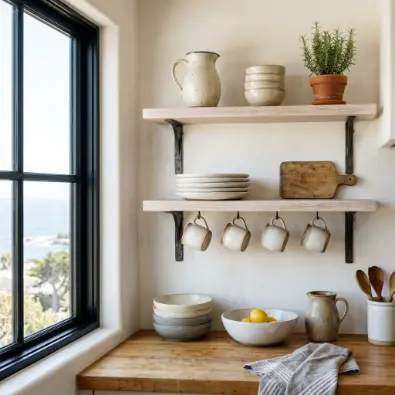
Vibe: The wall feels luminous, dishware doing the decorating instead of cabinet doors.
Why it works: Removing upper cabinet doors in favor of open shelving increases light reflection at eye level. This technique makes a kitchen feel larger by letting the wall color continue uninterrupted behind the shelves. Whitewashed oak retains the grain’s visibility under a thin paint wash, which is what distinguishes authentic coastal whitewash from a flat-painted board.
How to get it: Mount two or three floating oak shelves with a diluted white paint wash (roughly 1:1 paint to water, wiped with the grain), and style them with no more than five objects each so the openness reads as intentional.
💡 Quick Win: Removing just one cabinet door and whitewashing the interior back panel gives the open-shelf effect without a full renovation.
Shop the Look
| Product |
| Whitewashed oak floating shelf set |
| Ceramic pitcher with ribbed white glaze |
| Stacked ceramic mixing bowl set |
| Small terracotta herb pot |
| Brass shelf bracket set |
2. Soft Sea-Glass Blue Cabinetry
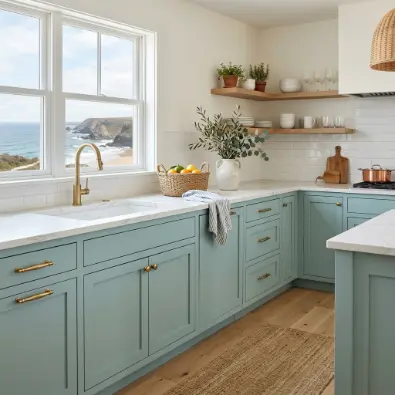
Vibe: The cabinets feel calm, color pulled straight from shallow water rather than a paint chart.
Why it works: Sea-glass blue-green sits at a low enough saturation to function as a neutral rather than a bold color choice, which is why it pairs easily with warm white counters without competing for attention. Farrow & Ball’s Green Blue No. 84 and Benjamin Moore’s Palladian Blue HC-144 are both reference points landing squarely in this tonal range.
How to get it: Paint only the lower cabinets in a soft sea-glass tone, keeping upper cabinets or open shelving in warm white, and finish with brushed brass or unlacquered brass pulls to avoid a cool, sterile contrast.
Shop the Look
| Product |
| Sea-glass blue cabinet paint matte |
| Brushed brass cabinet pull set |
| Woven seagrass basket small |
| Ceramic bud vase white |
| Linen kitchen towel set |
3. Woven Rattan Pendant Lights Over the Island
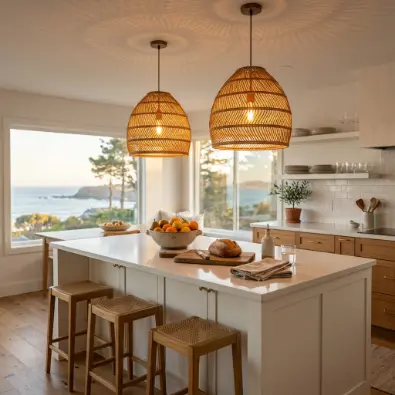
Vibe: The island feels sun-warmed, light filtering through woven fiber instead of falling flat.
Why it works: Rattan pendants diffuse light through their open weave, casting soft shadow patterns rather than a direct beam — a lighting behavior that echoes natural sunlight moving through a woven beach hat. Hanging two fixtures rather than one also balances an island’s horizontal length, a basic proportion rule for pendant spacing.
How to get it: Hang two rattan pendants 30 inches apart and 30–32 inches above the island surface, fitted with warm 2700K bulbs so the woven shadow reads amber rather than white.
💡 Quick Win: Swapping only the pendant shades on an existing fixture to rattan clip-on shades achieves the texture change in under an hour.
Shop the Look
| Product |
| Woven rattan pendant light fixture |
| Warm 2700K LED bulb dimmable |
| Ceramic fruit bowl, white glaze |
| Linen napkin set natural |
| Wood cutting board, oak |
4. Ceramic Pitchers and Stoneware Styled on Open Shelves
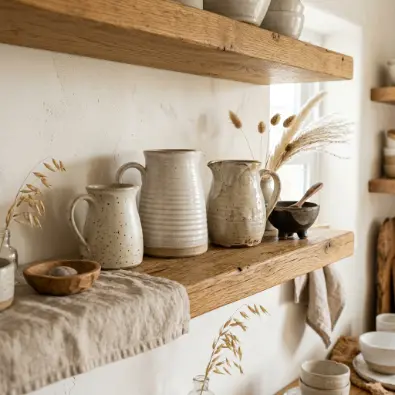
Vibe: The shelf feels collected, as it grew slowly rather than arriving all at once.
Why it works: Grouping ceramics in varied but tonally related glazes creates texture-based visual interest without introducing new color, keeping the coastal palette intact while avoiding a matched, showroom look. Uneven, hand-thrown rims catch light differently than uniform manufactured dishware, adding the worn-in quality central to the style.
How to get it: Choose three to five ceramic pieces in warm white to sandy beige glazes with visible handmade texture, and group them by height rather than by type so the arrangement reads as curated, not stocked.
Shop the Look
| Product |
| Ceramic stoneware pitcher set |
| Handmade ceramic bowl warm white |
| Dried coastal grass stem bundle |
| Small wood catchall bowl |
| Linen table runner natural |
5. Rattan Counter Stools with Woven Backs
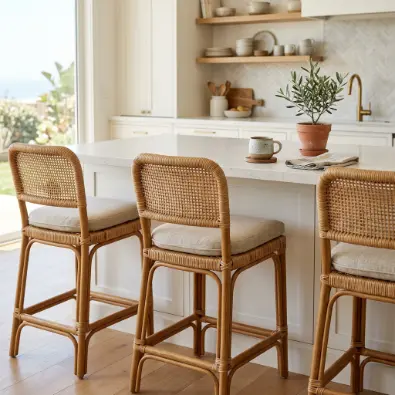
Vibe: The stools feel light, open weave, letting the island counter stay visually uncluttered behind them.
Why it works: Rattan’s open weave keeps counter stools from visually blocking the island the way solid upholstered seating would, preserving sightlines through the kitchen — a proportion consideration especially important in open-plan layouts. The natural fiber also repeats the texture established in pendant lighting or shelving, tying the room together without matching colors exactly.
How to get it: Choose stools with woven rattan backs and light wood or metal legs rather than fully upholstered seats, sized so the seat sits 10–12 inches below the counter surface for comfortable knee clearance.
💡 Quick Win: Adding a single linen seat cushion to existing plain wood stools introduces softness without replacing the furniture.
Shop the Look
| Product |
| Rattan back counter stool set |
| Linen seat cushion natural |
| Small potted plant ceramic pot |
| Ceramic mug with warm white glaze |
| Woven placemat set of natural fiber |
6. Warm White Walls with Sandy Beige Backsplash
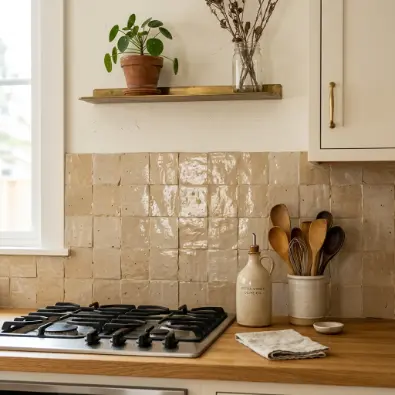
Vibe: The backsplash feels sun-warmed, tile catching light unevenly like sand at low tide.
Why it works: Handmade zellige or subway tile in sandy beige introduces subtle tonal variation across the wall, a texture effect that flat single-tone tile can’t replicate, and this variation is what keeps a mostly white kitchen from feeling sterile. Warm white walls surrounding it maintain the light-reflecting quality that coastal kitchens depend on.
How to get it: Choose a handmade zellige-style tile in sandy beige for the backsplash only, laid in a simple stacked or brick pattern, and keep grout in a matching warm tone so the tile’s texture stays the focal point rather than the grout lines.
Shop the Look
| Product |
| Sandy beige zellige-style backsplash tile |
| Wood utensil holder crock |
| Ceramic olive oil bottle |
| Small potted plant, terracotta |
| Warm white interior wall paint |
7. Honed Marble or Soapstone Countertops
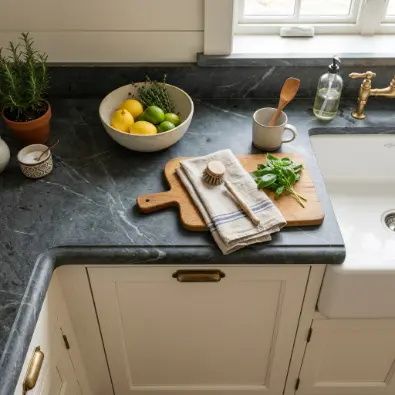
Vibe: The counter feels grounded, its matte surface absorbing light instead of throwing it back.
Why it works: A honed (matte) finish on marble or soapstone diffuses reflection rather than mirroring it the way a polished counter would, which keeps the material from reading as formal or cold — an important distinction for a style built on ease rather than showroom polish. Soapstone in particular develops a natural patina over time, aligning with coastal’s appreciation for worn material.
How to get it: Choose a honed rather than polished finish when selecting marble or soapstone, and let any natural etching or patina develop rather than resealing aggressively, since that wear is part of the material’s coastal character.
💡 Quick Win: A honed quartz counter with a marble-look veining pattern offers a lower-maintenance stand-in if natural stone isn’t in budget.
Shop the Look
| Product |
| Honed soapstone-look quartz countertop sample |
| Ceramic mixing bowl, warm white |
| Wood cutting board round |
| Linen kitchen towel natural |
| Marble pastry board honed finish |
8. Galley Kitchen Zoned by a Butcher-Block Island
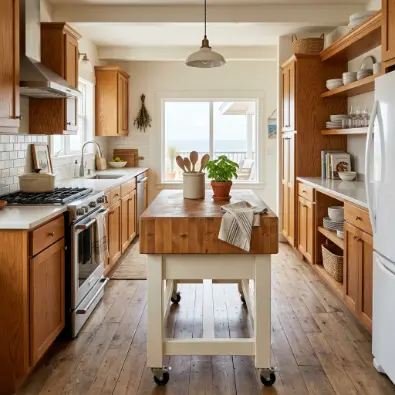
Vibe: The galley feels efficient, one warm wood zone anchoring a narrow room without crowding it.
Why it works: In a galley layout, a rolling butcher-block island creates a defined prep zone within an otherwise long, narrow footprint, a layout technique that adds counter space without a permanent build-out. Keeping it on wheels also preserves the traffic flow a galley kitchen depends on, since it can shift out of the walkway when not in use.
How to get it: Choose an island no wider than 24 inches for a galley under 8 feet across, with locking caster wheels so it can roll clear of the main walkway during cooking and cleanup.
Shop the Look
| Product |
| Butcher block rolling kitchen island |
| Ceramic utensil crock warm white |
| Woven produce basket, natural |
| Small terracotta herb pot |
| Wood cutting board set |
9. Linen Café Curtains Instead of Blinds
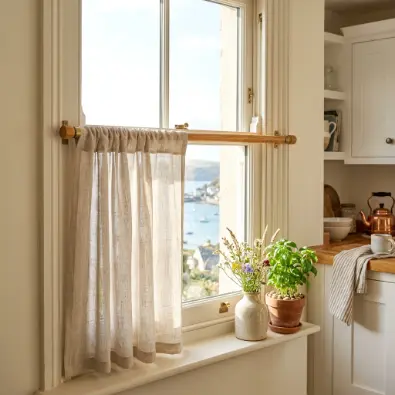
Vibe: The window feels open, light pouring over a curtain that covers just enough.
Why it works: Café curtains cover only the lower half of a window, preserving natural light through the upper pane while still providing counter-level privacy — a light-behavior solution far better suited to coastal kitchens than blinds, which block the window’s full height even half-closed. Sheer linen also filters rather than blocks light, keeping the glow soft rather than dim.
How to get it: Mount a slim wood or brass rod at the window’s midpoint and hang a sheer linen panel gathered loosely, rather than pleated tightly, so it moves slightly with air from an open window.
💡 Quick Win: An existing curtain panel can be cut and hemmed to café length in under 20 minutes with no sewing machine needed if using fusible hem tape.
Shop the Look
| Product |
| Sheer linen café curtain panel |
| Slim wood curtain rod natural |
| Ceramic windowsill vase small |
| Small potted herb terracotta pot |
| Brass curtain rod bracket set |
10. Driftwood Grey Lower Cabinets with White Uppers
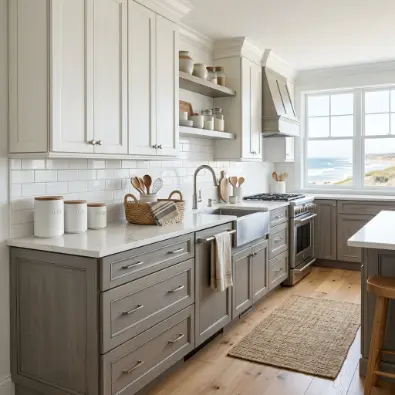
Vibe: The kitchen feels balanced, weight sitting low while the top half stays light and open.
Why it works: Two-tone cabinetry with a deeper driftwood grey below and warm white above follows a visual weight principle — darker tones read as heavier, so keeping them at floor level grounds the room while the paler upper cabinets keep the ceiling plane feeling tall and open. This is a more restrained alternative to painting all cabinetry the same saturated color.
How to get it: Paint lower cabinets in a warm-toned driftwood grey such as Sherwin-Williams Anew Grey SW 7030, keeping upper cabinets or open shelving in warm white so the contrast stays soft rather than stark.
Shop the Look
| Product |
| Driftwood grey cabinet paint matte |
| Warm white cabinet paint eggshell |
| Brushed nickel cabinet pull set |
| Ceramic kitchen canister set |
| Woven storage basket small |
11. Skylight or Solar Tube for Overhead Daylight
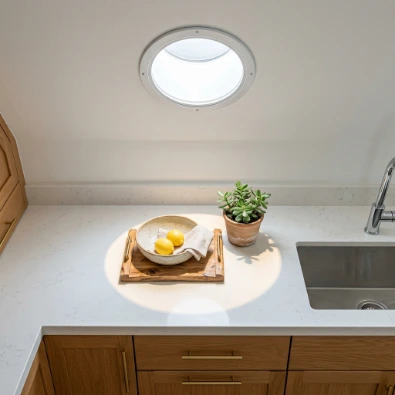
Vibe: The counter feels lit from within, daylight arriving from directly overhead instead of through a side window.
Why it works: A solar tube or skylight introduces overhead daylight that side windows can’t reach into the center of a kitchen, a light-behavior solution especially useful in interior or north-facing kitchens where natural light typically falls short of coastal’s airy requirement. Overhead daylight also shifts color temperature through the day, keeping the room feeling alive rather than static.
How to get it: Install a 10–14-inch solar tube directly above the island or main prep area, positioned where roof access allows a straight run to the attic, for daylight without the cost of a full skylight.
💡 Quick Win: Swapping a flush ceiling fixture to a daylight-mimicking 4000K LED is a same-day substitute if a solar tube isn’t feasible yet.
Shop the Look
| Product |
| Solar tube skylight kit 10 inch |
| Daylight LED flush mount fixture |
| Ceramic serving bowl white |
| Wood serving tray round |
| Small potted plant ceramic pot |
12. Open Plate Rack Instead of Upper Cabinets
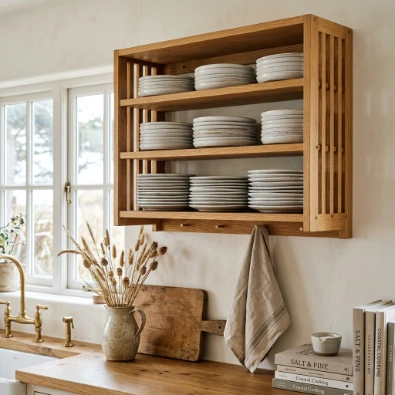
Vibe: The wall feels functional and layered at once, dishware turned into visible texture.
Why it works: A slatted wood plate rack replaces the visual bulk of a closed upper cabinet with open, rhythmic lines, letting light and wall color show through — the same negative-space logic as open shelving, applied specifically to daily-use dishware. The repeated plate edges also create a pattern the coastal palette otherwise avoids through paint or tile.
How to get it: Mount a slatted oak plate rack directly above the sink or prep counter, sized to hold your most-used dinner plates only, so the display stays functional rather than purely decorative.
Shop the Look
| Product |
| Wood slatted wall plate rack |
| Ceramic dinner plate set, warm white |
| Ceramic pitcher ribbed |
| Linen hand towel natural |
| Dried grass stem, small bundle |
13. Woven Seagrass Baskets for Pantry Storage
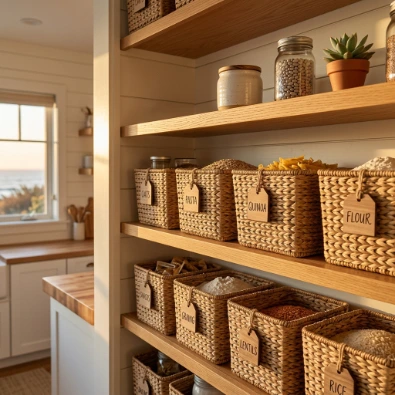
Vibe: The pantry feels organized without feeling clinical, with a woven texture softening what could be a purely functional shelf.
Why it works: Seagrass baskets hide visual clutter from loose packaging while keeping the material language natural rather than plastic, which matters because pantry storage is one of the few coastal zones prone to breaking the palette with printed boxes and bags. The open weave also allows quick visual identification of contents without needing to lift a lid.
How to get it: Decant dry goods into glass jars or fabric bags first, then group them inside uniform seagrass baskets by category, labeling each basket with a small wood tag rather than adhesive labels.
💡 Quick Win: Two baskets for the most-used shelf (grains and snacks) is enough to visually calm a pantry without redoing the whole space at once.
Shop the Look
| Product |
| Woven seagrass storage basket set |
| Glass pantry storage jar set |
| Wood basket label tag set |
| Ceramic flour canister warm white |
| Small potted plant terracotta pot |
14. Fold-Down Breakfast Nook Table
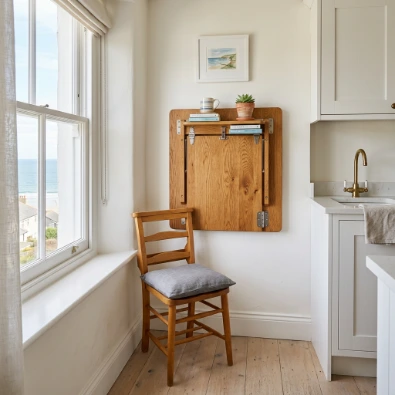
Vibe: The nook feels efficient, a full table appearing only when the room needs it.
Why it works: In small coastal kitchens, a wall-mounted fold-down table solves the tension between wanting a dedicated eating spot and needing open floor space most of the day — when folded flat, it returns the full footprint to the room, which keeps a small kitchen from feeling permanently cramped by furniture used only twice a day.
How to get it: Mount a folding oak table at standard dining height (28–30 inches) against an underused wall, paired with two lightweight folding or stacking chairs that can be stored elsewhere when not in use.
Shop the Look
| Product |
| Fold-down wall-mounted wood table |
| Stacking wood folding chair pair |
| Ceramic mug with warm white glaze |
| Small potted plant ceramic pot |
| Linen placemat set natural |
How to Start Your Coastal Kitchen Transformation
Start with wall color, not cabinetry. A warm white, such as Benjamin Moore White Dove on the main walls, is the single move that anchors every other decision, because it sets the light-reflecting base against which every cabinet color, tile, and wood tone in a coastal kitchen is chosen to sit.
The most common mistake is leaning too hard into “nautical” theming — rope trim, anchor motifs, navy-and-red stripes. This breaks the look because coastal’s calm comes from worn, natural materials and light, not literal beach props; fix it by removing any themed decor item and replacing it with one made of an honest material like linen, rattan, or ceramic.
Three items under $50 that create immediate impact: a ribbed ceramic pitcher in warm white glaze, a sheer linen café curtain panel for one window, and a small woven seagrass basket for the counter.
A full coastal kitchen transformation with new cabinetry, tile, and lighting realistically takes 6–10 weeks and costs $8,000–$20,000. A weekend refresh using paint, textiles, and open shelving costs $200–$600 and delivers the atmosphere immediately, even before any structural changes happen.
Frequently Asked Questions About Coastal Kitchen Decor
What’s the difference between coastal and nautical kitchen decor?
Coastal decor draws on weathered natural materials and light whitewashed wood, linen, sea-glass color while nautical decor relies on literal beach symbols like anchors, rope, and navy-and-red stripe patterns. Coastal is closer to a lived-in Nantucket cottage; nautical leans toward themed novelty decor. Most modern coastal kitchens intentionally avoid nautical motifs altogether.
What color should I paint a coastal kitchen?
Warm white with a soft undertone, such as Benjamin Moore White Dove or Sherwin-Williams Alabaster, is the standard base wall color. Sea-glass blue-green (Farrow & Ball Green Blue No. 84) or sandy beige are common cabinet accent choices layered on top. Avoid cool, stark blue-whites, which read more clinical than coastal.
How much does a coastal kitchen makeover cost?
A budget refresh using paint, textiles, and open shelving typically runs $200–$800. A mid-range update adding new cabinet paint and lighting costs $2,500–$6,000. A full renovation with new cabinetry, stone counters, and tile backsplash can reach $15,000–$25,000 depending on square footage and material choices.
Does coastal kitchen style work with a modern or farmhouse home?
Yes — coastal blends naturally with modern through its clean lines and light palette, and with farmhouse through shared materials like whitewashed wood and open shelving. It pairs less easily with heavily traditional or dark academia interiors, where deep wood tones and formal symmetry conflict with coastal’s intentionally relaxed, sun-bleached character.
What’s the most important element in coastal kitchen decor?
Natural light behavior is the most important element more than any single color or material, how light moves through the room via open shelving, sheer curtains, and reflective warm-white surfaces is what makes a coastal kitchen decor scheme read as airy rather than simply beachy in color alone. A kitchen with the right palette but heavy blinds and closed cabinets will still feel dim.
Ready to Create Your Dream Coastal Kitchen?
These 14 ideas move through cabinet color, natural materials, overhead light, and small-space layout tricks, showing that coastal kitchen decor is built from many small, honest choices rather than one big theme purchase. Starting with a single whitewashed shelf or one sea-glass cabinet is not a lesser version of the style it’s exactly how these rooms are meant to come together. Today, hang one sheer linen café curtain on your kitchen window and notice how the light changes by evening. Done right, the space will start to feel like the exhale at the end of a long day, unhurried no matter what’s cooking. Save the ideas that matched your own light and your own walls that ribbed ceramic pitcher, that driftwood grey cabinet because coastal kitchen decor rewards the room built slowly, one worn, natural material at a time.
You Might Also Like
- 15 Ways to Decorate an Open Plan Kitchen Dining Space
- 15 Ways to Maximize Space in an Open Plan Kitchen Room
- 15 Luxurious Classic Kitchen Design Ideas With Real Architectural Detail
- 15 Open Shelving in the Kitchen | Kitchen Storage Ideas
- 15 Ways to Create a Modern Luxury Kitchen Ceiling Design
- 15 Ways to Achieve a Luxurious Contemporary Kitchen Design
[…] 14 Coastal Kitchen Decor Ideas for a Breezy, Sunlit Space […]
[…] 14 Coastal Kitchen Decor Ideas for a Breezy, Sunlit Space […]
[…] 14 Coastal Kitchen Decor Ideas for a Breezy, Sunlit Space […]
[…] 14 Coastal Kitchen Decor Ideas for a Breezy, Sunlit Space […]
[…] 14 Coastal Kitchen Decor Ideas for a Breezy, Sunlit Space […]
[…] 14 Coastal Kitchen Decor Ideas for a Breezy, Sunlit Space […]
[…] 14 Coastal Kitchen Decor Ideas for a Breezy, Sunlit Space […]
[…] 14 Coastal Kitchen Decor Ideas for a Breezy, Sunlit Space […]
[…] 14 Coastal Kitchen Decor Ideas for a Breezy, Sunlit Space […]