
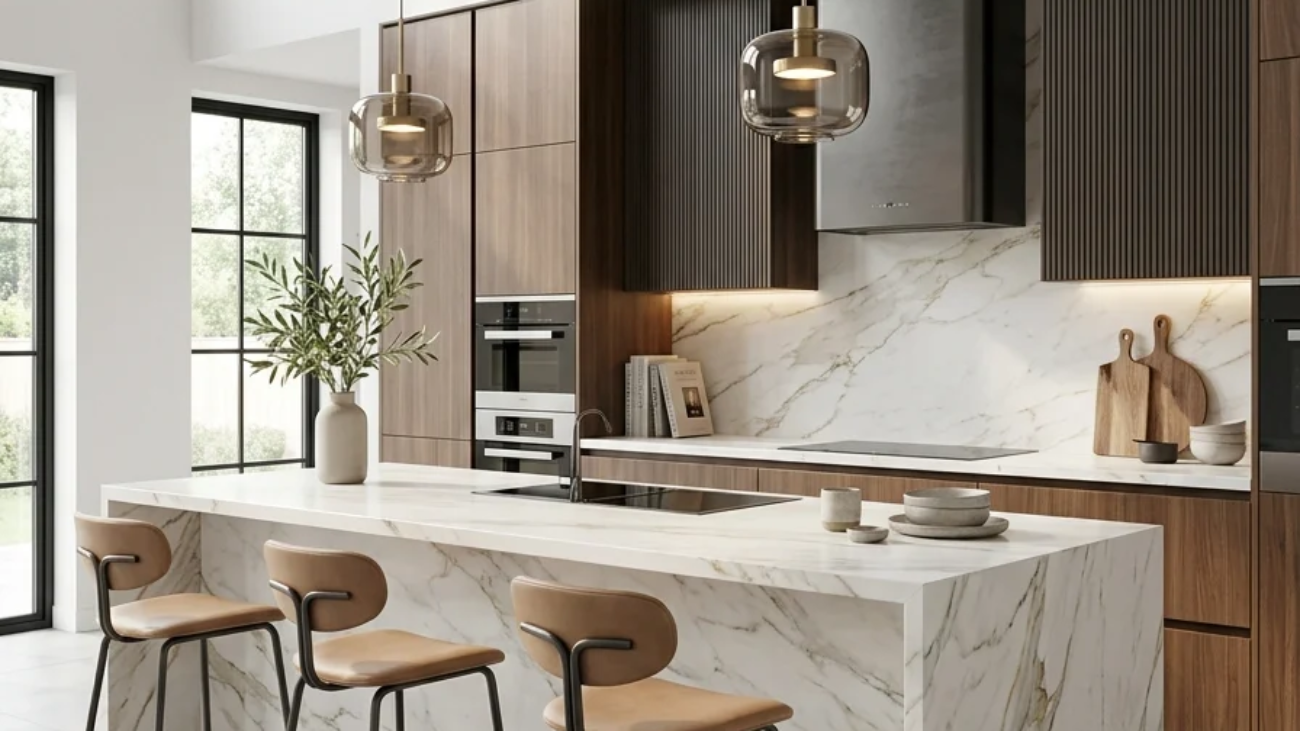
Italian modern luxury kitchen design is a design tradition built on sculptural cabinetry silhouettes, high-gloss lacquer finishes, and bold natural stone, drawing directly from the post-war Italian furniture movement that treated the kitchen as a designed object rather than a purely functional room. This article gives you 15 genuinely striking Italian modern luxury kitchen design ideas covering material, color, lighting, and layout decisions that give a kitchen the confident, sculptural presence this tradition is known for.
It feels like standing inside a piece of considered design rather than a room assembled from a catalog: lacquer catching light with the same depth as a lacquered sports car, marble veining moving across a waterfall edge like brushed ink, brass warming under a Murano-inspired glow. This is Italian modern luxury at its most confident: bold, sculptural, unapologetically expressive with color and form. Every surface behaves like it was designed by someone who trusted their own eye.
Here are 15 ideas worth saving and stealing.
Why Italian Modern Luxury Kitchen Design Works So Well
Italian modern luxury kitchen design traces directly to the post-war Milanese furniture movement of the 1950s through 1970s, when Italian manufacturers began treating kitchen cabinetry with the same sculptural ambition as furniture shown at the Salone del Mobile, prioritizing bold form and high-gloss finish over the flatter, purely functional cabinetry common elsewhere in Europe at the time. What separates it from other modern luxury traditions is its willingness to use saturated, high-gloss color and dramatic curved silhouettes rather than staying strictly neutral and rectilinear.
Core materials are high-gloss lacquer in bold jewel tones, Carrara and Calacatta marble with dramatic veining, terrazzo with visible brass or stone fleck, and warm brass or bronze hardware, often paired with leather-wrapped pulls. Color runs confidently saturated burgundy, deep olive, warm terracotta, a marked departure from the neutral restraint of Scandinavian or quiet-luxury kitchens.
This style is trending because a broader shift toward maximalist color and sculptural form has followed several years of minimalist neutral kitchens, with Pinterest and design-industry trend data both showing rising interest in “Italian kitchen design” and “lacquer kitchen cabinets” as homeowners look for a kitchen with a stronger visual identity than an all-white or all-taupe scheme provides.
Yes, though a genuinely small kitchen should commit its boldest color choice to one cabinetry run rather than the whole room, since a fully saturated high-gloss color across every surface in a tight space can read as overwhelming rather than confident.
Style at a Glance
| Element | Core Trait 1 | Core Trait 2 |
| Philosophy | Cabinetry as sculptural, designed object rather than purely functional storage | Confident, saturated color over neutral restraint |
| Materials | High-gloss lacquer, Carrara marble, terrazzo | Warm brass, leather-wrapped hardware |
| Color Palette | Burgundy, deep olive | Warm terracotta, warm white marble |
15 Italian Modern Luxury Kitchen Design Ideas
1. Install a Carrara Marble Waterfall Island
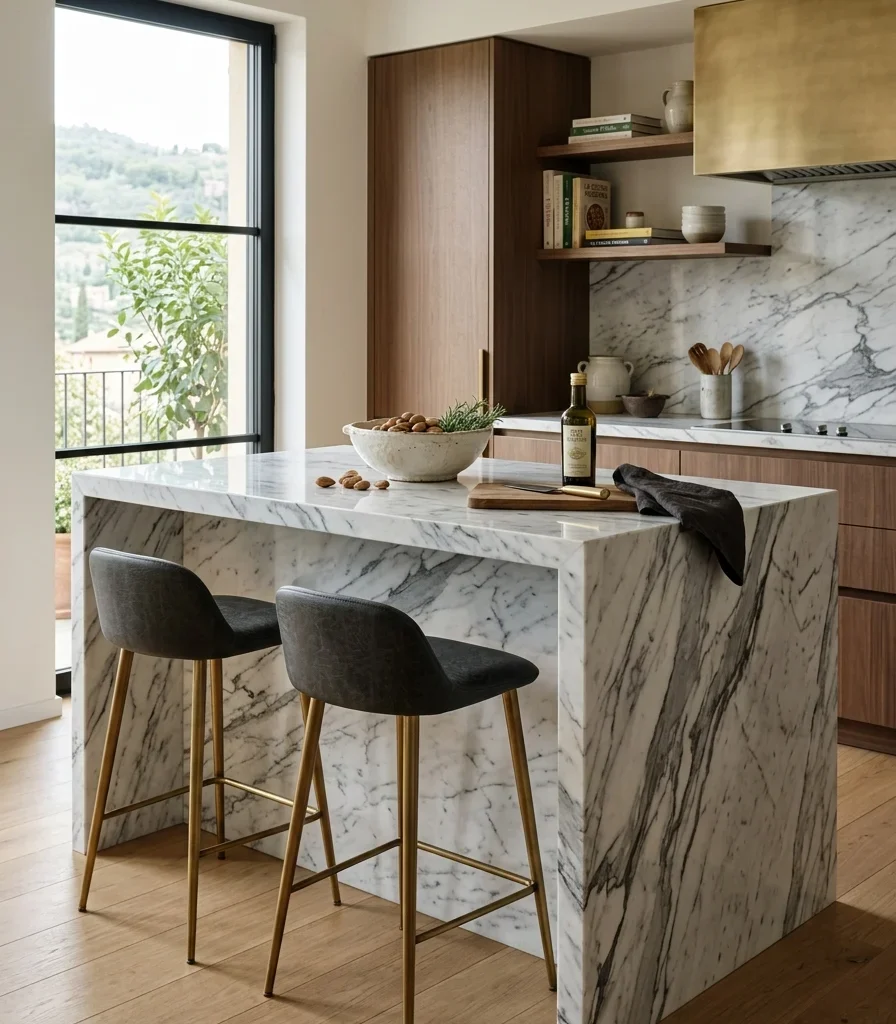
Vibe: Grounded on an island with enough polished presence to anchor the entire room around it.
Why it works: A polished (rather than honed) marble finish is a deliberate material choice specific to Italian design’s confidence with reflection and shine; the high polish amplifies the veining’s contrast and lets the island catch and bounce light across the room, a visual-weight principle distinct from the muted honed stone favored by more restrained modern traditions.
How to get it: Specify genuine Carrara marble with a high polish finish (not a matte or leathered texture, which mutes the effect this idea depends on), and request the fabricator orient the slab so the most dramatic vein movement runs the length of the waterfall edge rather than across the flat top.
💡 Quick Win: A polished Carrara-look porcelain slab achieves a similar dramatic waterfall effect at a lower cost and with less maintenance than natural marble.
Shop the Look
| Product |
| Polished Carrara marble slab |
| Warm brass counter stool set |
| Small ceramic countertop bowl |
| Marble polish maintenance kit |
| Brass island pendant light |
2. Choose High-Gloss Burgundy Lacquer Cabinetry
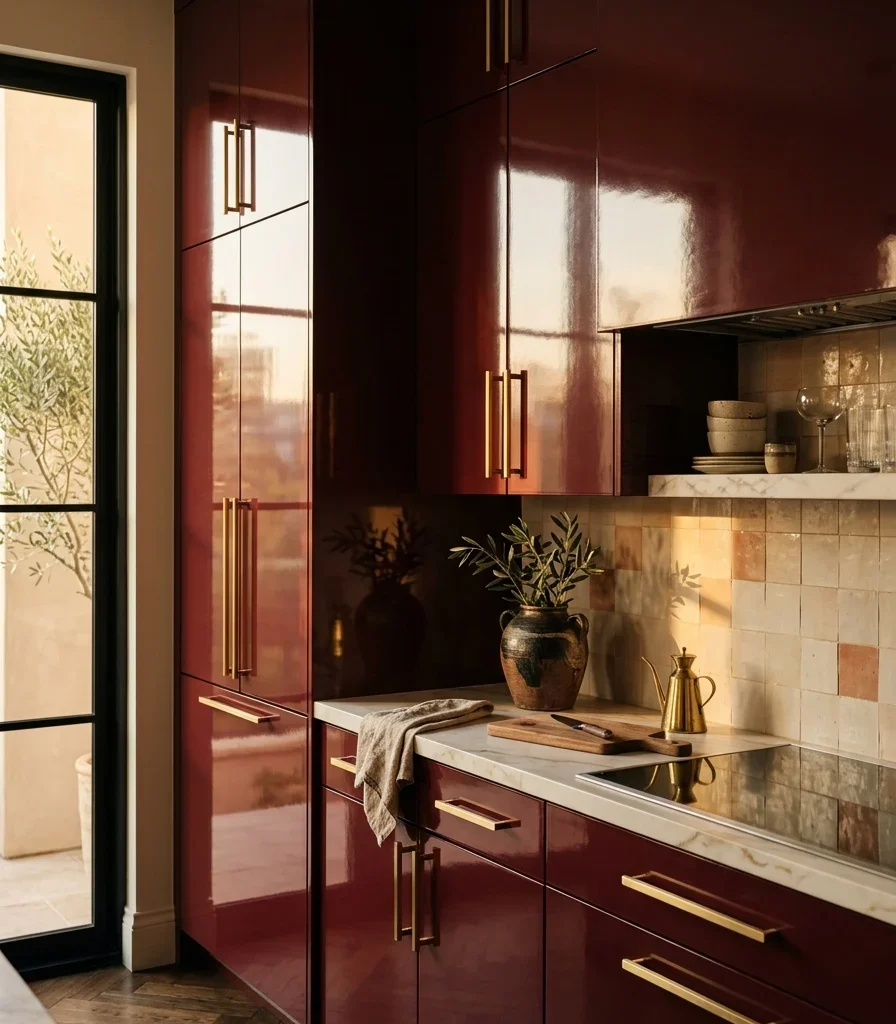
Vibe: Moody cabinetry with a mirror-like depth that shifts color slightly as you move past it.
Why it works: High-gloss lacquer in a saturated jewel tone is the signature material technique of Italian cabinetry design; the mirror-like finish reflects ambient light and color from the rest of the room onto itself, creating a depth and richness that a matte finish in the same burgundy simply can’t replicate, which is why lacquer specifically (not just any glossy paint) defines this look.
How to get it: Specify a genuine multi-coat automotive-grade lacquer finish (the same buildup process used on luxury car paint) rather than a single-coat glossy enamel, and pair it exclusively with warm brass hardware rather than matte black, since brass’s warmth complements burgundy’s depth more than a cool black would.
Shop the Look
| Product |
| High-gloss burgundy lacquer cabinet finish |
| Warm brass cabinet pull set |
| Warm brass cabinet hinge hardware |
| Small ceramic countertop vessel |
| Brass cabinet knob set |
3. Shape a Sculptural Curved Island Silhouette
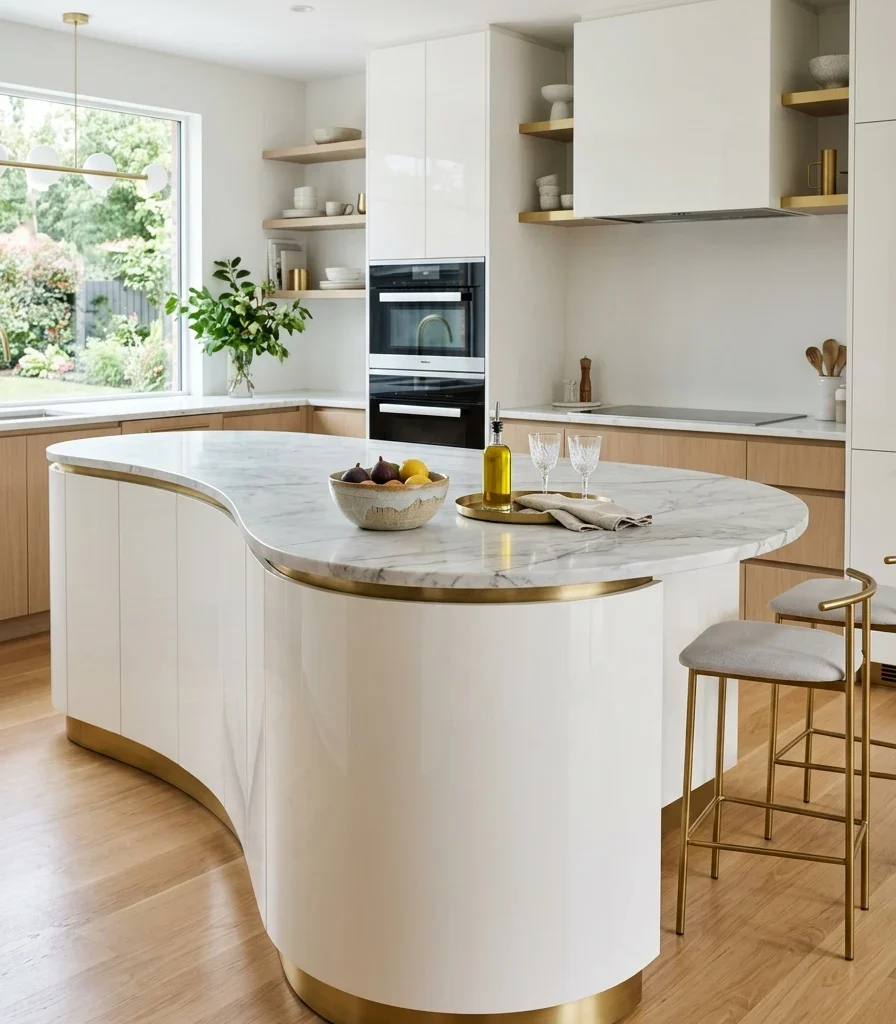
Vibe: Layered, an island shaped more like a piece of sculpture than a standard rectangular block.
Why it works: A curved island silhouette applies contrast and proportion principles directly against the room’s typically rectilinear cabinetry and walls; the organic curve breaks up an otherwise boxy kitchen footprint, a design move rooted in Italian furniture design’s long history of curved, sculptural forms rather than the strictly rectangular cabinetry common in other modern traditions.
How to get it: Choose a curved island profile with at least one rounded corner or a fully organic kidney shape, wrapped in a seamless high-gloss lacquer that follows the curve without a visible seam, and finish the toe kick in warm brass trim to emphasize the shape’s edge at floor level.
Shop the Look
| Product |
| Curved island cabinet base |
| High-gloss lacquer wrap finish |
| Brass toe kick trim strip |
| Small ceramic countertop bowl |
| Brass island pendant light |
4. Hang a Statement Murano-Style Glass Pendant
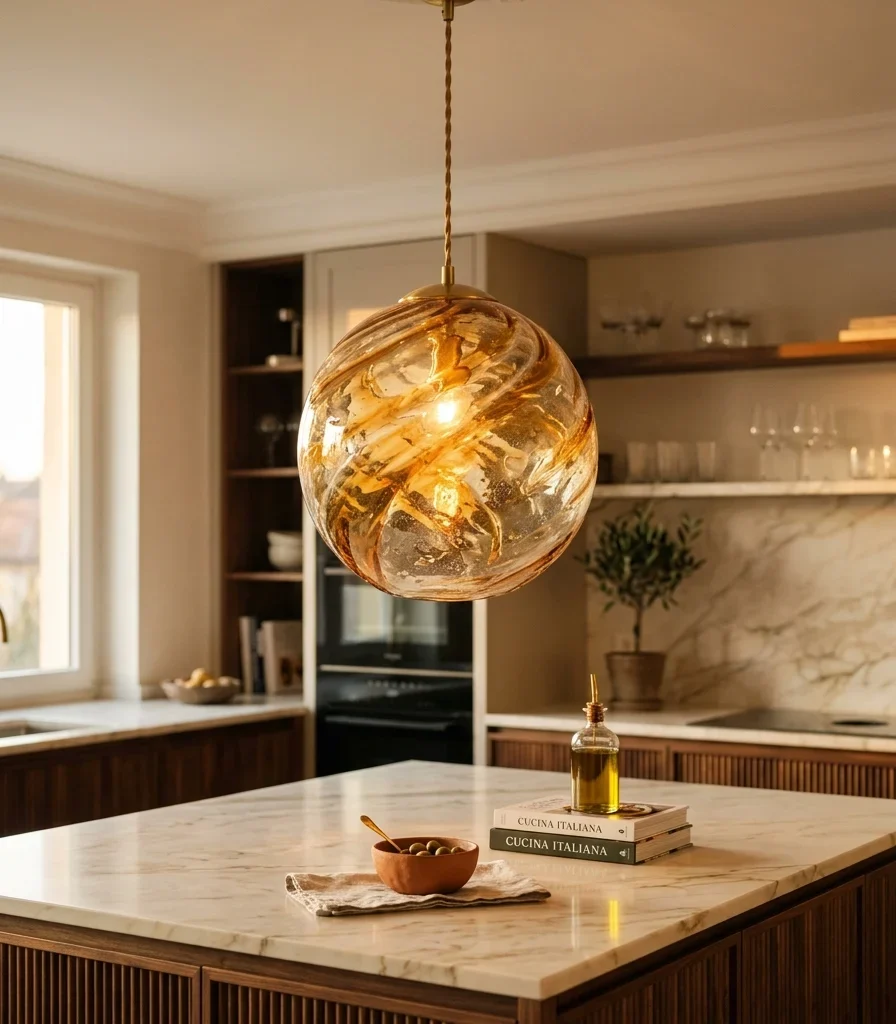
Vibe: Warm, a fixture with enough individual artistry to function as the room’s centerpiece sculpture.
Why it works: A Murano-style glass pendant applies light-behavior and material-honesty principles together: hand-blown glass with visible swirl or bubble texture refracts light unevenly, casting a warmer, more dynamic glow across the island than a uniform manufactured glass shade, referencing the centuries-old Venetian glassblowing tradition that has long informed Italian lighting design.
How to get it: Choose a single oversized pendant (18 inches or larger) in swirled amber or smoked glass rather than a cluster of smaller fixtures, hung at 30–34 inches above the island counter, with a brass ceiling canopy to coordinate with the room’s other hardware.
💡 Quick Win: A single mid-scale Murano-style pendant centered over a smaller prep area delivers similar sculptural impact at a lower cost than a full-size island fixture.
Shop the Look
| Product |
| Murano-style swirled glass pendant |
| Brass ceiling canopy trim |
| Warm 2700K bulb for pendant |
| Adjustable pendant cord kit |
| Small ceramic countertop bowl |
5. Lay a Terrazzo Floor With Brass Fleck Inlay
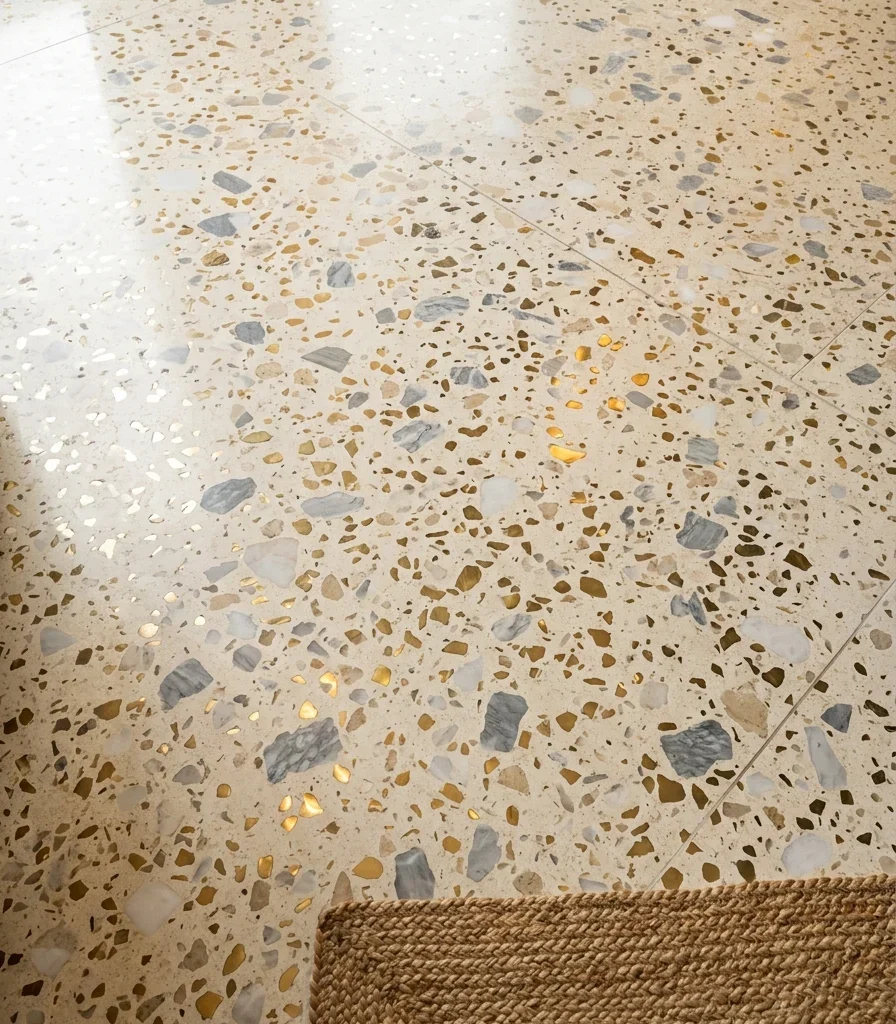
Vibe: Layered a floor with genuine sparkle and depth underfoot, distinct from a flat stone or tile surface.
Why it works: Terrazzo is a material choice with deep Italian design roots, originally developed by Venetian construction workers using marble chip remnants set in cement, and modern brass-fleck terrazzo continues that same principle of embedding varied material scraps into one poured surface, creating texture and light-catching depth that a uniform stone floor cannot replicate.
How to get it: Choose a cream-base terrazzo with a mix of white marble chips and brass fleck at a medium density (too sparse reads flat, too dense competes with other materials), and specify a matte-honed rather than high-polish sealant on the floor specifically for slip safety, reserving the high shine for countertops instead.
Shop the Look
| Product |
| Cream terrazzo floor tile brass fleck |
| Matte honed floor sealant |
| Small woven jute floor mat |
| Terrazzo baseboard trim |
| Brass floor transition strip |
6. Add Leather-Wrapped Cabinet Pulls and Trays
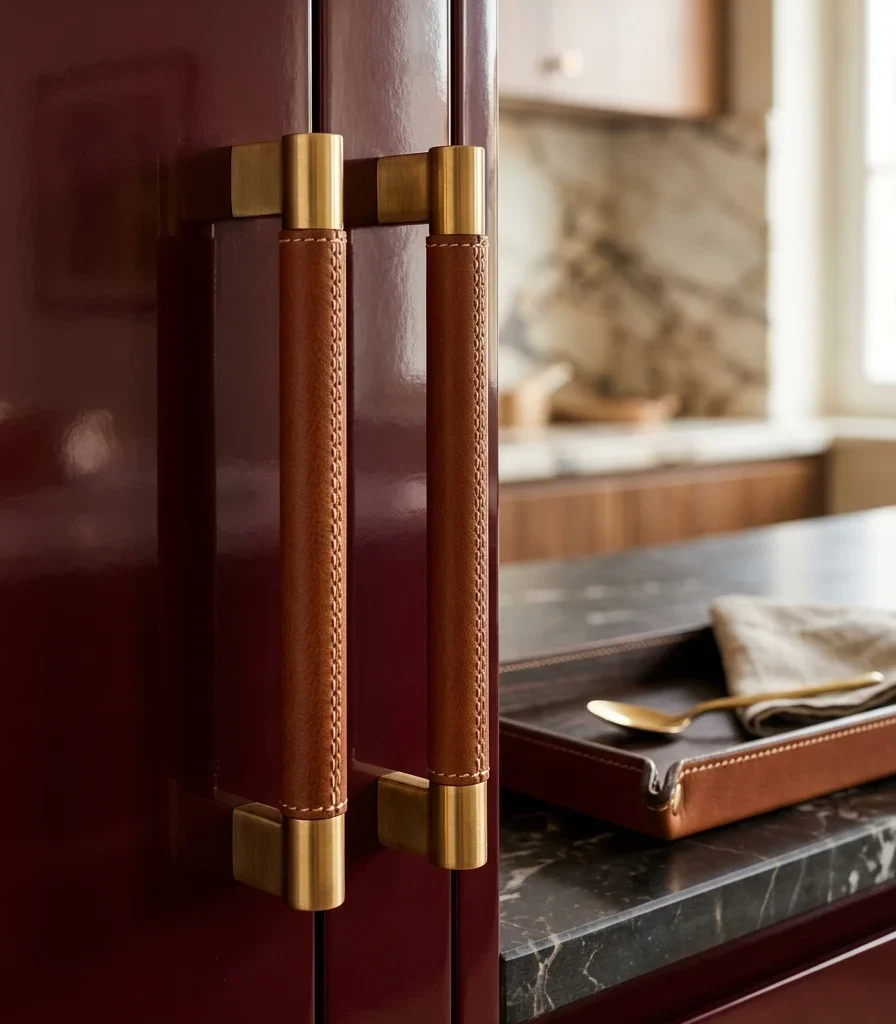
Vibe: Warm hardware with a tactile softness that contrasts directly against the cabinetry’s hard lacquer shine.
Why it works: Leather-wrapped hardware is a texture-layering principle that introduces a soft, warm material against the room’s otherwise hard, reflective surfaces. The specific pairing of leather and brass draws directly from Italian furniture design’s long history of combining fine leather upholstery with brass or bronze hardware fittings, a material contrast rarely used in other modern kitchen traditions.
How to get it: Choose brass pulls with a genuine stitched leather wrap (not a printed leather-look vinyl) in a cognac or warm tan tone, and extend the same leather material to a serving tray or two on the counter so the texture repeats intentionally rather than appearing only once.
Shop the Look
| Product |
| Leather wrapped brass cabinet pull |
| Cognac leather serving tray |
| Brass drawer pull matching set |
| Leather coaster set |
| Leather cabinet hinge trim |
7. Introduce Deep Olive Green Lacquer on Lower Cabinets
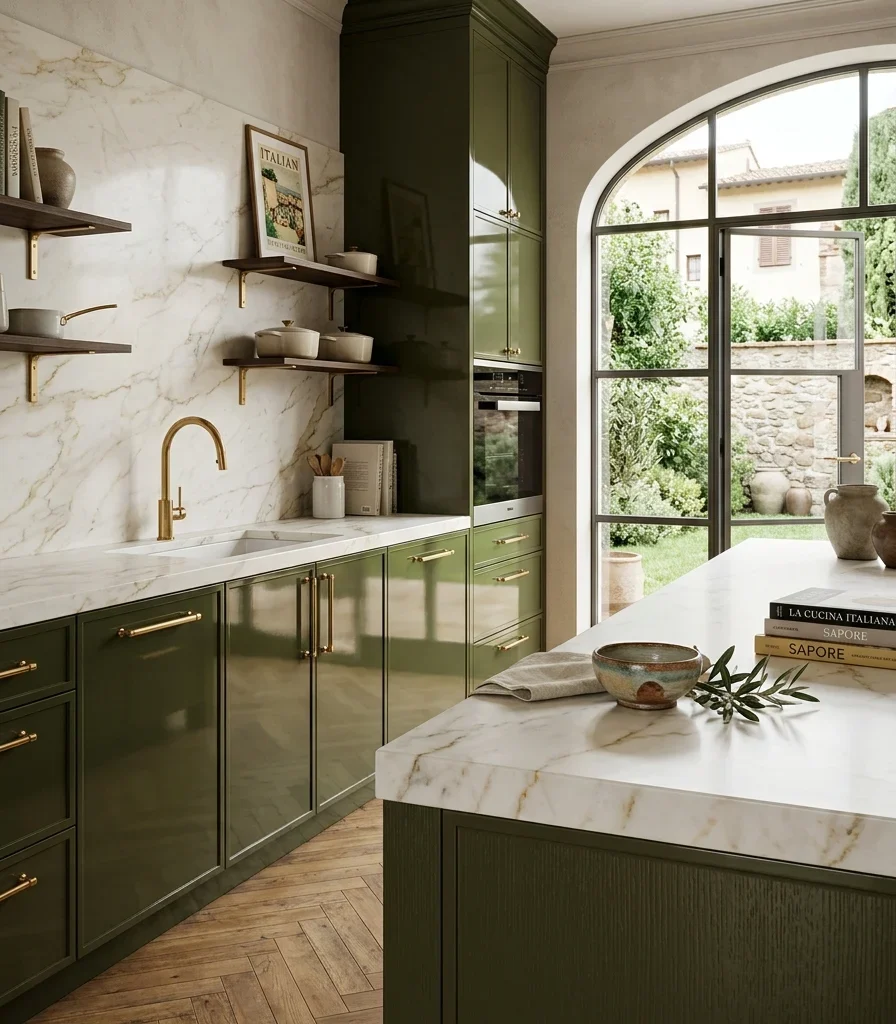
Vibe: Grounded, a saturated green deep enough to feel confident rather than trend-driven.
Why it works: Olive green lacquer applies proportion by staying on lower cabinetry only, letting the heavier, more saturated color ground the room visually while lighter marble above keeps the space feeling open. This specific approach to bold color placement, rather than avoiding saturation altogether, is what distinguishes Italian design’s confidence from more restrained modern traditions.
How to get it: Reserve the olive lacquer for base cabinets in a genuine high-gloss finish (matte olive reads more farmhouse than Italian modern), keeping upper surfaces and walls in warm white marble or plaster, and pair with warm brass rather than the brushed nickel more common in Scandinavian-influenced kitchens.
Shop the Look
| Product |
| High-gloss olive green lacquer finish |
| Warm brass cabinet pull |
| Warm white marble upper counter |
| Small ceramic countertop bowl |
| Brass cabinet hinge set |
8. Add a Freestanding Marble-Topped Prep Table
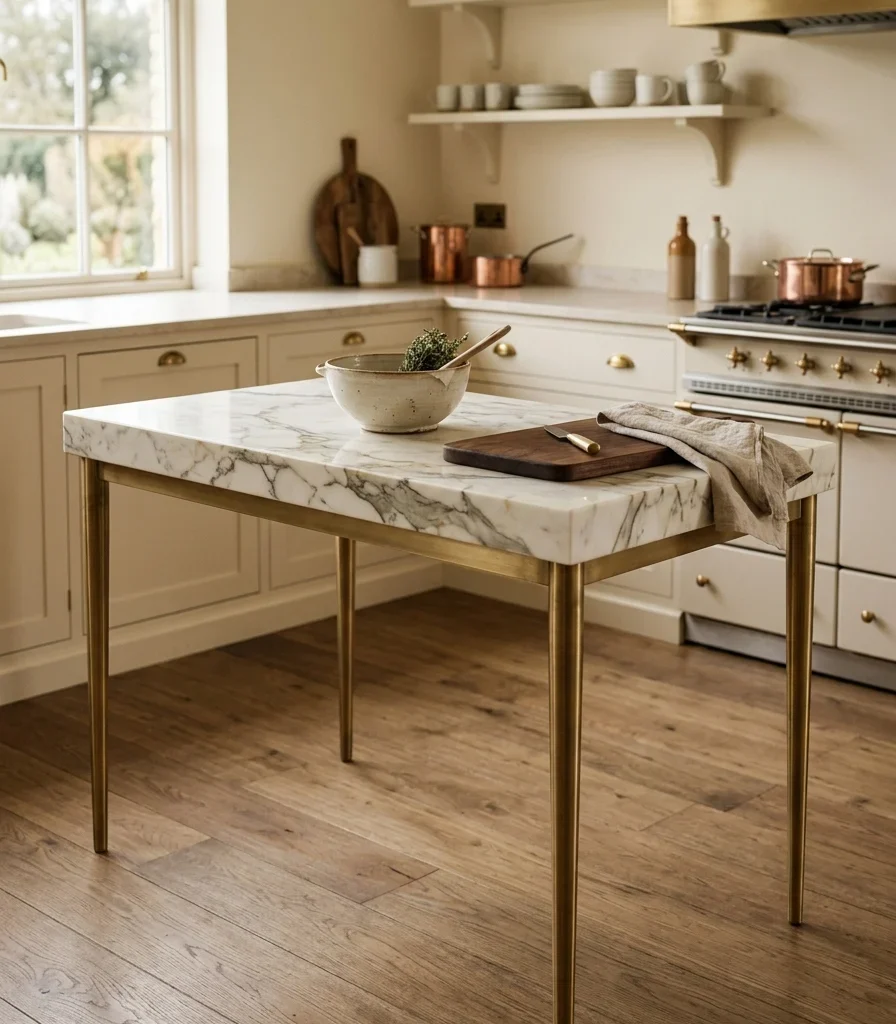
Vibe: Still a piece of furniture doing kitchen work, rather than a built-in surface pretending to be furniture.
Why it works: A freestanding prep table applies the furniture-as-object philosophy central to Italian design at a smaller, more flexible scale than the main island; its slim brass legs and marble top read as a genuine standalone piece rather than fixed cabinetry, echoing the mid-century Italian tradition of moveable, sculptural kitchen furniture rather than wall-to-wall built-ins.
How to get it: Choose a marble-topped table on slim tapered brass legs sized to roll or slide easily (casters help in a working kitchen), positioned as a secondary surface near the range or sink rather than replacing the main island, so it functions as genuine extra workspace rather than pure decoration.
Shop the Look
| Product |
| Marble top prep table brass legs |
| Small ceramic mixing bowl |
| Marble cutting board |
| Brass caster wheel set |
| Small brass utensil holder |
9. Add Integrated Linear Lighting Under Floating Shelves
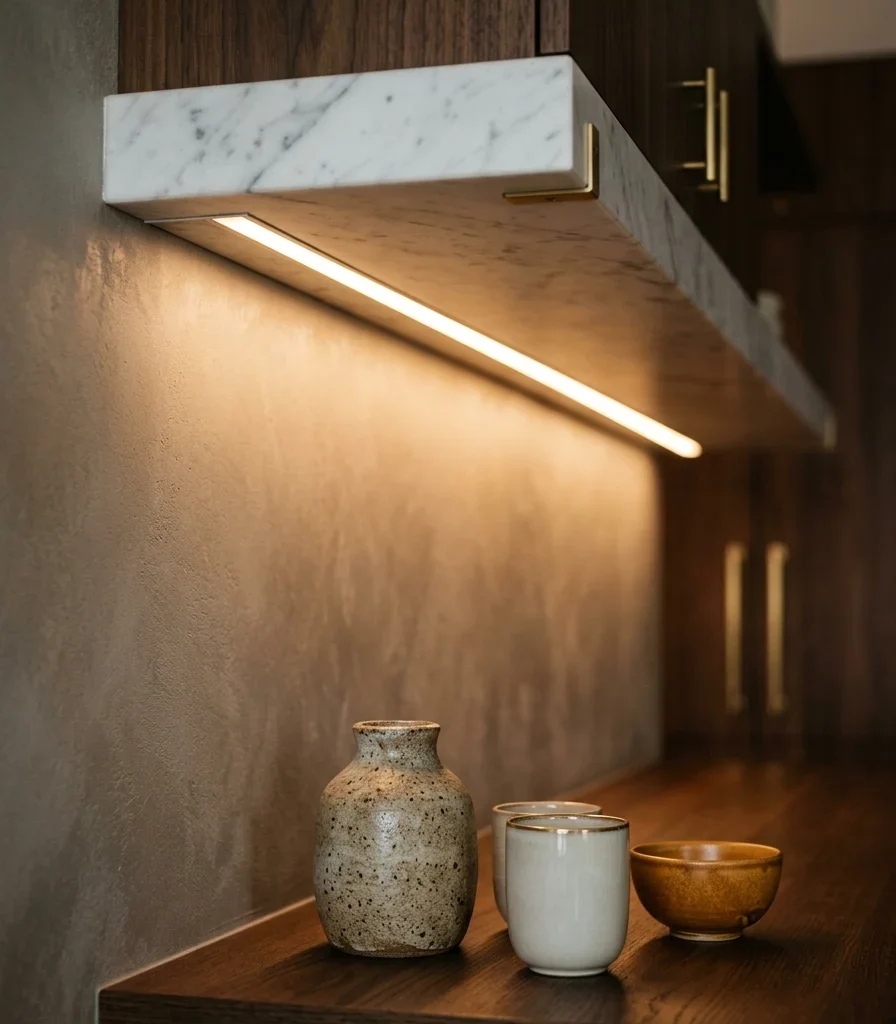
Vibe: Hushed, a shelf that seems to glow from within rather than being lit from an outside source.
Why it works: Integrated under-shelf lighting is a light-layering technique that treats displayed objects as gallery pieces; the recessed, hidden light source illuminates ceramics or glassware from directly above without a visible fixture competing with the display, a curatorial approach to kitchen lighting consistent with Italian design’s treatment of everyday objects as worth showcasing.
How to get it: Recess a warm 2700K LED strip into a routed channel on the underside of a floating marble or lacquer shelf, angled to wash downward evenly across whatever is displayed on the shelf below, wired to its own switch separate from the room’s main lighting.
Shop the Look
| Product |
| Recessed warm LED shelf light |
| Floating marble display shelf |
| Warm 2700K LED strip |
| Small ceramic vessel collection |
| Brass shelf bracket hardware |
10. Specify a Book-Matched Calacatta Backsplash
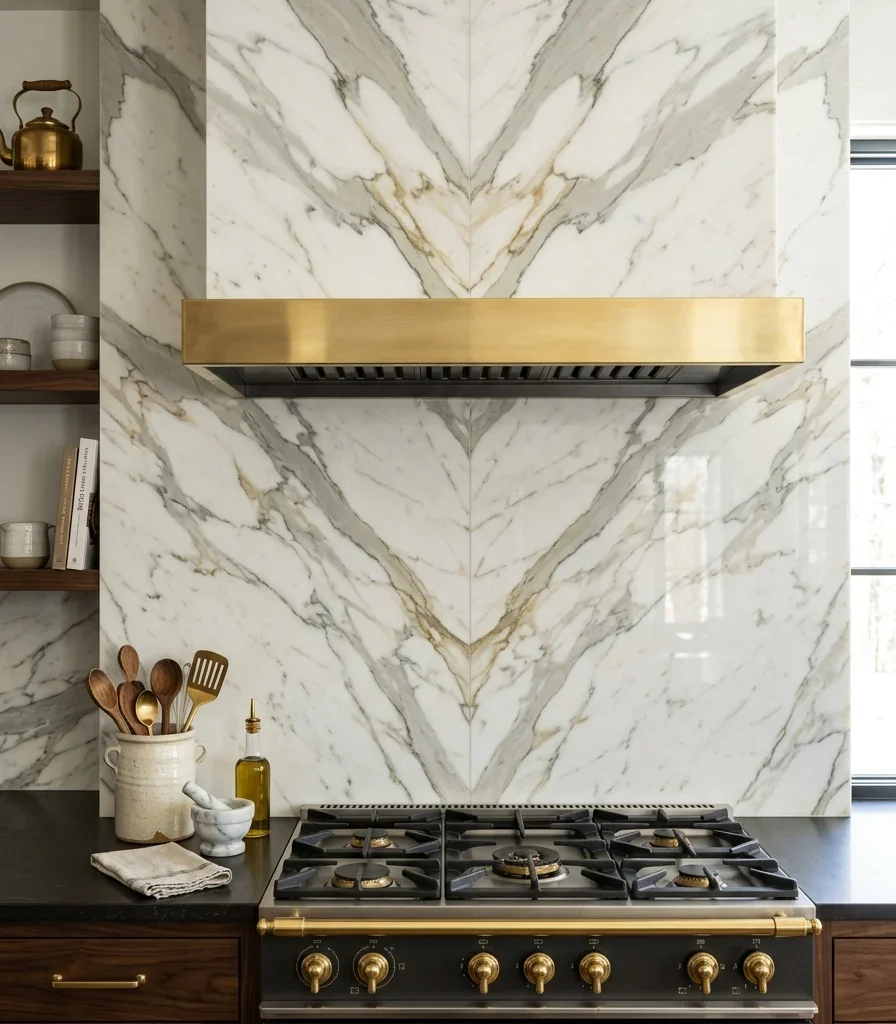
Vibe: Layer a backsplash with a symmetrical pattern dramatic enough to function as the kitchen’s primary artwork.
Why it works: Book-matching a full-height Calacatta backsplash behind the range concentrates the kitchen’s boldest material moment on a single focal wall rather than spreading marble thin across every surface, a proportion principle that gives the veining’s natural symmetry maximum visual impact exactly where the eye lands first when entering the room.
How to get it: Extend the book-matched slab pair from counter to the underside of a range hood or ceiling, rather than stopping at a standard 18-inch backsplash height, and coordinate the range hood in brass or bronze trim to frame the marble without competing with its pattern.
Shop the Look
| Product |
| Book-matched Calacatta slab pair |
| Brass range hood trim kit |
| Small ceramic utensil crock |
| Marble sealant polish |
| Brass switch plate cover |
11. Pair Two-Tone Lacquer With a Bold Contrast Island
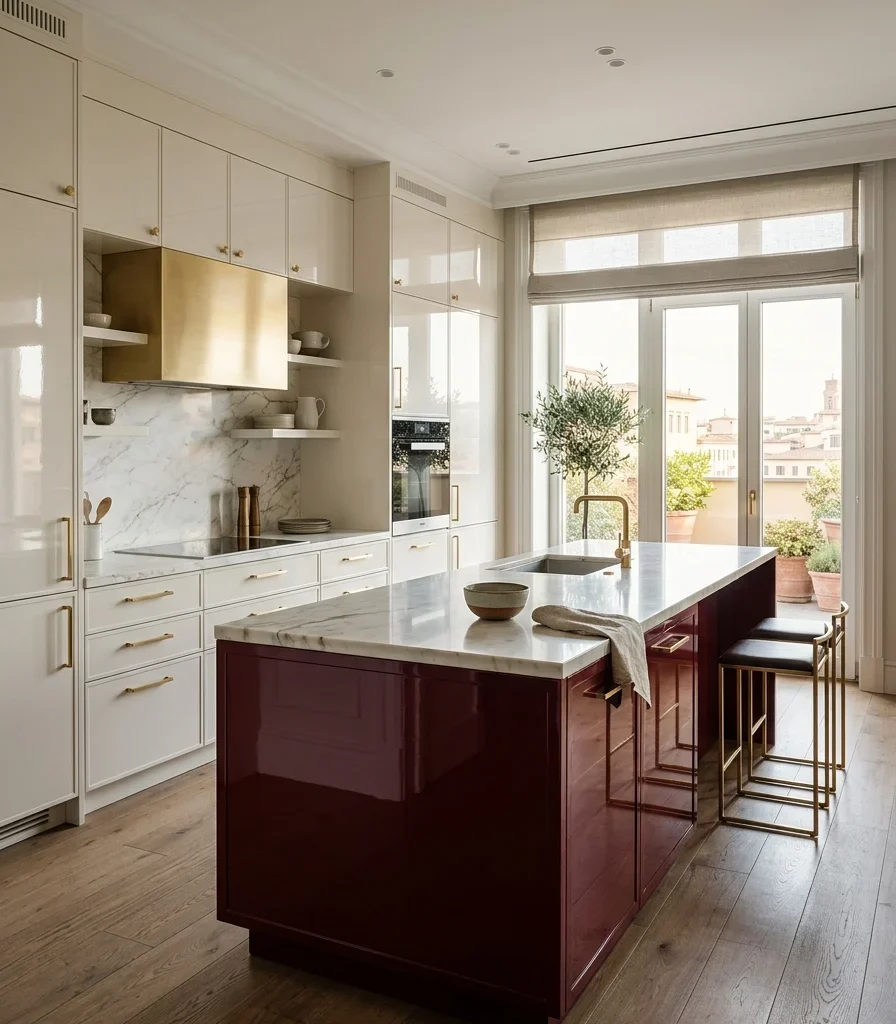
Vibe: Moody, an island bold enough to function as the room’s clear centerpiece against a calmer perimeter.
Why it works: Two-tone lacquer applies contrast and visual weight distribution together; keeping the perimeter cabinetry in warm white lacquer maximizes reflected daylight across the room’s largest surfaces, while a saturated burgundy island commands attention at the center, a zoning technique that reads as confidently intentional rather than mismatched.
How to get it: Keep both cabinet colors in the same high-gloss lacquer finish (mixing matte and gloss within the same two-tone scheme reads as inconsistent), and use identical brass hardware across both tones to visually unify the contrast into one coordinated scheme.
Shop the Look
| Product |
| Warm white lacquer perimeter cabinet |
| Deep burgundy lacquer island cabinet |
| Warm brass cabinet pull set |
| Small ceramic countertop bowl |
| Brass cabinet knob matching set |
12. Style a Curated Ceramic Still-Life Arrangement
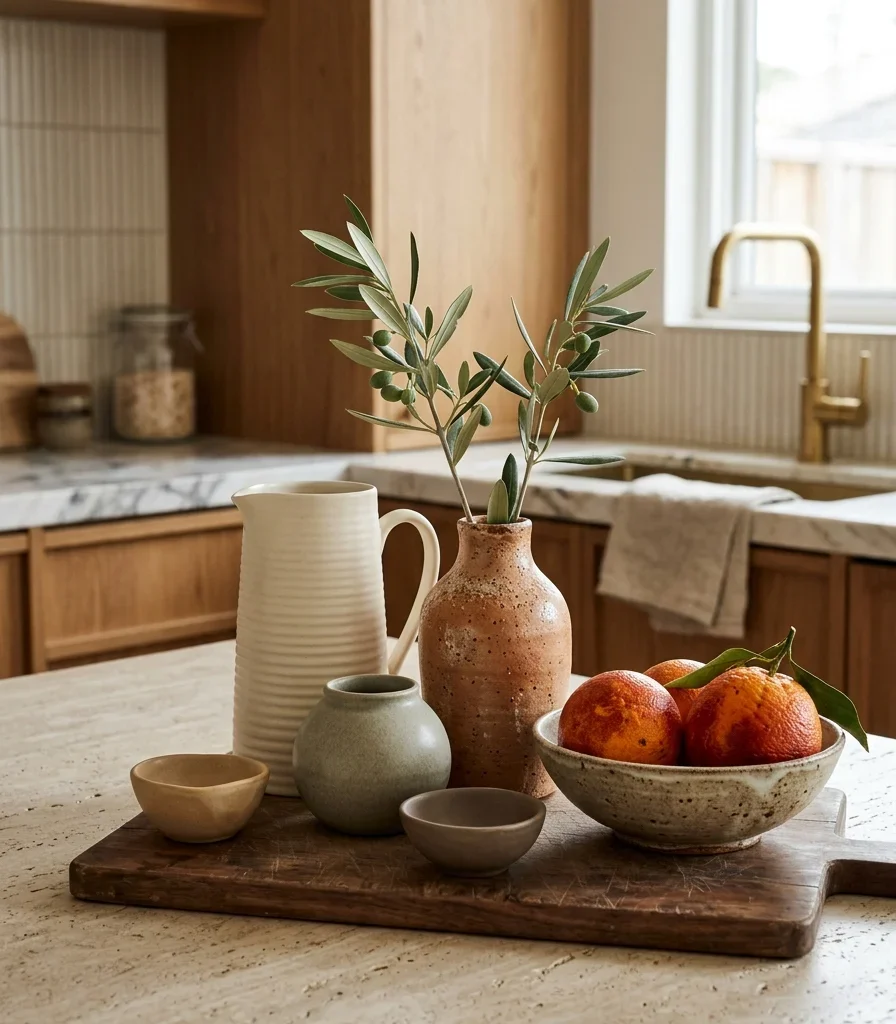
Vibe: Layered, a counter styled the way an Italian still-life painting composes fruit and vessels together.
Why it works: A still-life-inspired counter arrangement is an accessory-layering principle drawn directly from Italian visual art tradition. Grouping a ceramic bowl of citrus with one or two matte vessels and a single olive branch stem creates the same compositional balance found in classical still-life painting, giving the counter genuine visual interest without relying on abstract or purely decorative objects.
How to get it: Group three to four objects of varied height with one citrus fruit bowl as the anchor, keeping the ceramic glazes within a warm cream and terracotta family, and refresh the citrus regularly so the arrangement stays genuinely functional rather than becoming static decoration.
Shop the Look
| Product |
| Matte ceramic fruit bowl warm cream |
| Small ceramic vessel set |
| Olive branch stem faux |
| Brass fruit bowl stand |
| Ceramic serving platter terracotta |
13. Build an Open Wine and Glassware Display Cabinet
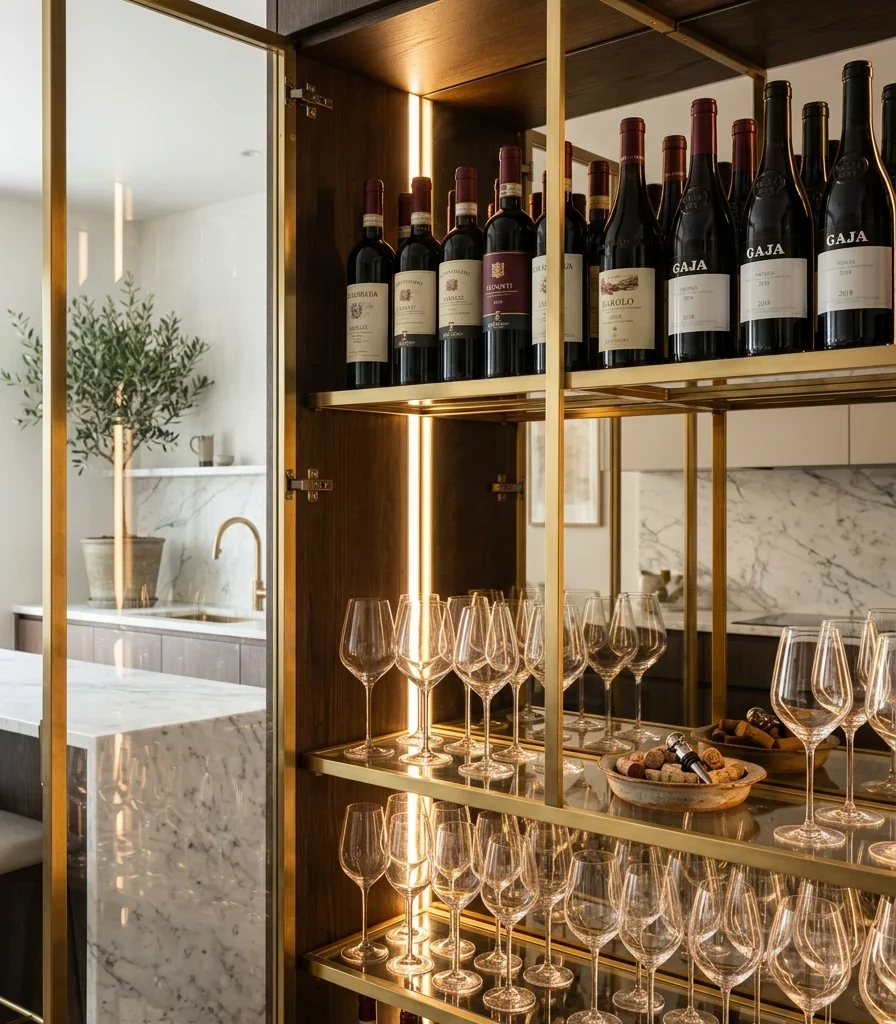
Vibe: Warm, a cabinet that turns everyday glassware and wine into part of the room’s visual story.
Why it works: An open, lit display cabinet applies furniture-arrangement and accessory-layering principles together; rather than hiding wine and stemware behind solid doors, this treats them as objects worth showing, a hospitality-forward instinct rooted in Italian dining culture’s emphasis on wine and entertaining as central to the kitchen’s identity.
How to get it: Install interior LED lighting on a warm 2700K setting inside a glass-front cabinet, with brass shelf trim and adjustable shelf heights to accommodate both bottles and varied stemware sizes, positioning the cabinet where it’s visible from the main entry to the kitchen.
Shop the Look
| Product |
| Glass front display cabinet |
| Interior LED cabinet light strip |
| Brass shelf trim kit |
| Stemware glass set |
| Small ceramic wine stopper dish |
14. Anchor the Room With a Central Sculptural Island
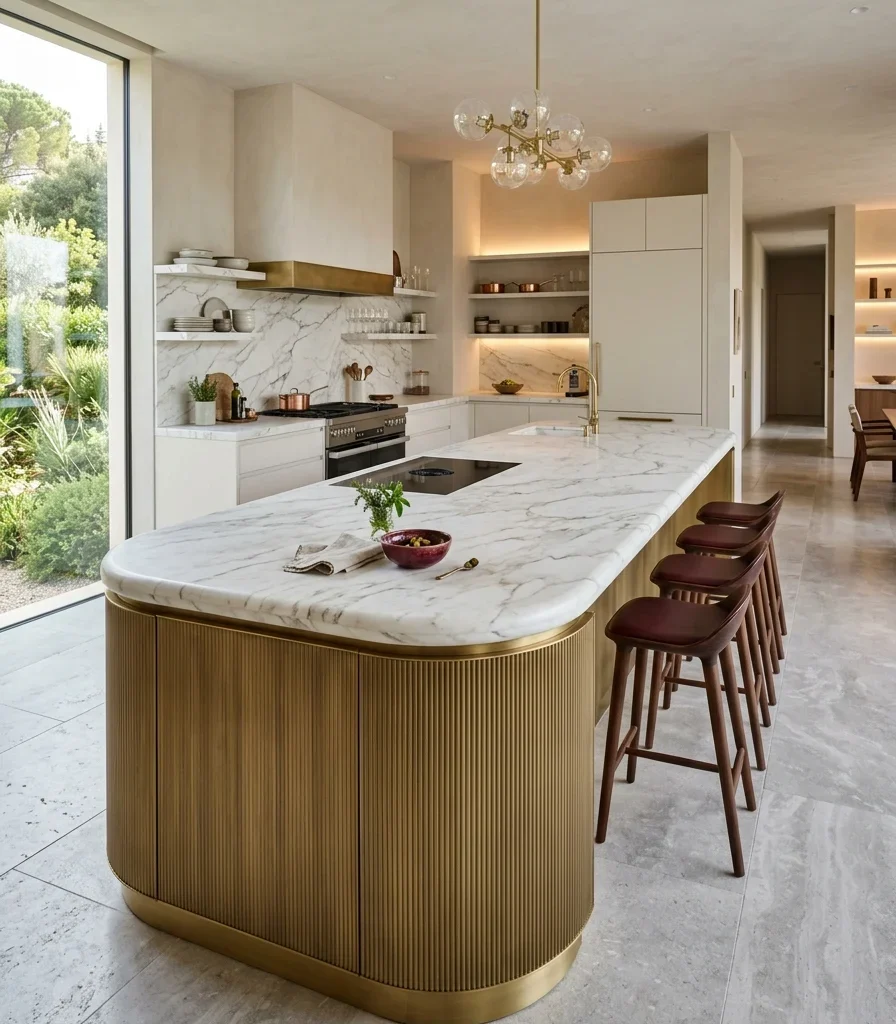
Vibe: Grounded a layout where every sightline in the room resolves back to one central, sculptural piece.
Why it works: Positioning the island as the room’s literal and visual center is a layout principle distinct from simply placing an island for workflow convenience. Walking paths, cabinetry runs, and even lighting placement all radiate outward from the island’s position, treating it the way a sculpture gallery treats its centerpiece rather than as one workstation among several.
How to get it: Center the island within the room’s total floor plan rather than offsetting it toward one wall, maintain at least 42 inches of clearance on all sides so the island reads as a freestanding piece rather than crowded cabinetry, and orient any pendant lighting symmetrically above it to reinforce the centered composition.
Shop the Look
| Product |
| Marble top island with brass base |
| Symmetrical pendant light pair |
| Small ceramic countertop bowl |
| Brass floor transition trim |
| Counter stool set brass legs |
15. Design a Compact Italian Galley Kitchen With a Mirrored Backsplash
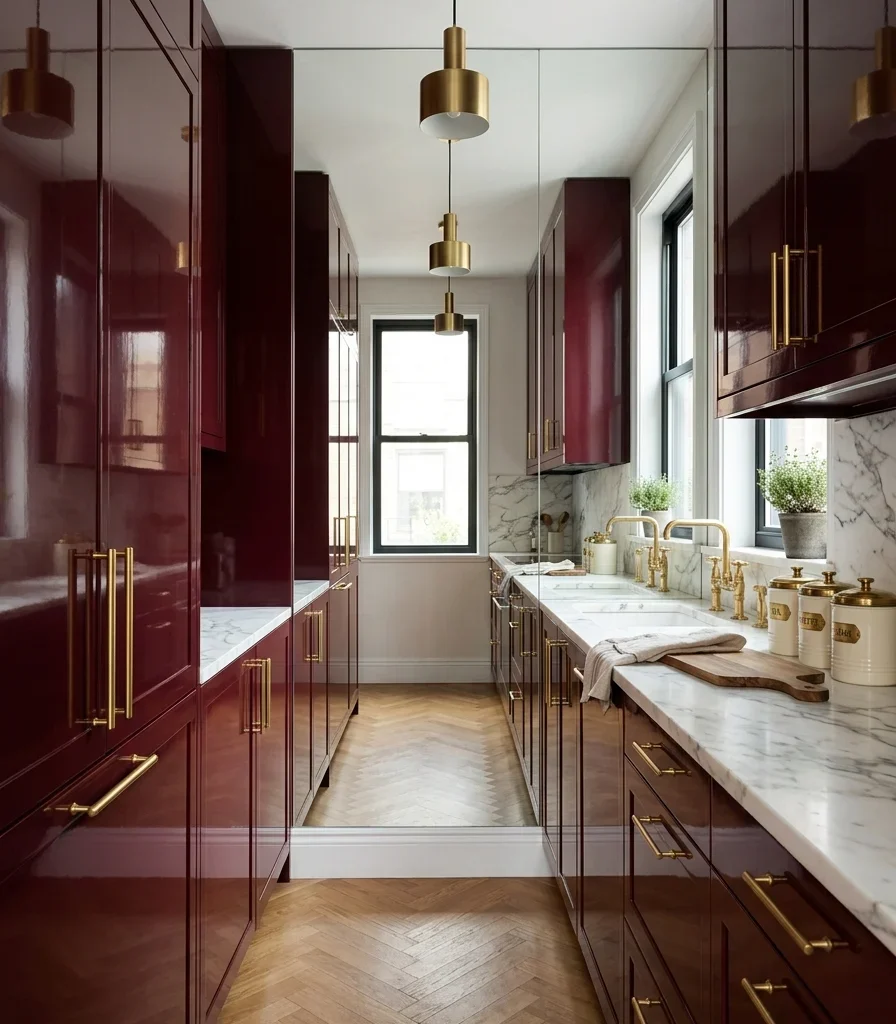
Vibe: Still a narrow kitchen that reads twice as wide the moment the mirrored wall catches the light.
Why it works: In a genuinely narrow galley kitchen, a mirrored backsplash is the small-space illusion technique that lets Italian design’s confident color and gloss finishes still read as spacious rather than closed-in. The mirror reflects both natural light and the marble counter’s pattern into the room, doubling the perceived depth without adding a single inch of actual floor area.
How to get it: Install an antiqued or smoked mirror panel (rather than clear mirror, which can feel too stark against warm lacquer) as the backsplash on the galley’s longer wall, and keep the opposing wall’s cabinetry in the same high-gloss color so the reflection shows a continuous, coordinated scene rather than a jarring color mismatch.
💡 Quick Win: A smoked mirror tile panel installed only behind the range achieves a similar light-expanding effect on a smaller budget than a full-wall mirror.
Shop the Look
| Product |
| Antiqued smoked mirror panel |
| High-gloss burgundy lacquer cabinet |
| Brass mirror mounting trim |
| Small ceramic canister set |
| Marble counter slab narrow run |
How to Start Your Italian Modern Luxury Kitchen Transformation
Your first move is choosing the lacquer or marble hero color before any layout or hardware decision. Since Italian design commits to bold, saturated finishes rather than staying neutral, this single color choice burgundy, olive, or a dramatic marble veining pattern sets the emotional tone every other material and metal finish decision in the kitchen gets measured against.
The most common mistake is applying the bold color everywhere at once, covering every cabinet run in the same saturated lacquer, which can overwhelm a room rather than reading as confident. The fix is reserving the boldest color for one element, the island or lower cabinetry, while keeping the remaining surfaces in warm white or marble.
Three items under $50 that create immediate impact: a small terracotta ceramic fruit bowl for the counter, a set of brass drawer pull hardware for an existing cabinet, and a single faux olive branch stem in a small ceramic vessel.
A weekend refresh hardware and styling costs $200–600. A full Italian modern luxury kitchen renovation with lacquer cabinetry, a marble island, and terrazzo flooring typically runs $90,000–220,000 and takes four to eight months depending on custom lacquer and marble fabrication lead times.
Frequently Asked Questions About Italian Modern Luxury Kitchen Design
What is the difference between Italian modern luxury and Scandinavian modern luxury kitchen design?
Scandinavian modern luxury kitchen design favors muted, neutral tones and matte natural wood, prioritizing restraint and calm. Italian modern luxury kitchen design uses saturated, high-gloss lacquer colors like burgundy and olive, dramatic marble veining, and sculptural curved forms, treating bold color and shine as a design strength rather than something to avoid.
What color defines Italian modern luxury kitchen design?
Deep burgundy and olive green lacquer are the leading colors, typically applied to one cabinetry run (often the island) while the remaining surfaces stay in warm white marble or lacquer. These saturated jewel tones pair specifically with warm brass hardware rather than chrome or matte black, since brass’s warmth complements the depth of high-gloss color.
How much does an Italian modern luxury kitchen renovation cost?
A partial refresh using lacquer cabinet refinishing and brass hardware costs $10,000–25,000. A mid-range renovation with a marble waterfall island and lacquer cabinetry runs $70,000–140,000, and a full high-end renovation including terrazzo flooring and a book-matched Calacatta backsplash typically costs $140,000–250,000 or more depending on the region.
Can a small galley kitchen achieve an Italian modern luxury look?
Yes, a mirrored backsplash and one bold lacquer cabinet run achieve the style’s confident color statement even in a narrow footprint without an island, since the mirror reflects both light and the marble counter’s pattern to counteract the visual tightness a saturated color might otherwise create in a small space.
What is the most requested material in Italian modern luxury kitchens right now?
High-gloss lacquer cabinetry is currently the most requested single material in Italian modern luxury kitchen design, according to design-industry trend reports, followed closely by Carrara and Calacatta marble waterfall islands and terrazzo flooring with brass fleck inlay.
Ready to Create Your Dream Italian Modern Luxury Kitchen?
These 15 ideas move across material, color, lighting, layout, and genuine small-space adaptations from a polished Carrara waterfall island and high-gloss burgundy lacquer to a mirrored galley kitchen that proves this style’s confidence travels even into a narrow footprint. None of this needs to happen all at once, and starting with one bold lacquer cabinet run or a single Murano-style pendant is genuinely the smarter first step, not a scaled-down version of the vision. Today’s specific action: pull burgundy or olive lacquer paint chips and hold them against a Carrara marble sample in natural daylight to see which saturated color actually anchors the kitchen you’re imagining. Once that confident color and material story is settled, the kitchen stops feeling like a neutral backdrop and starts feeling like a room designed with the same conviction as a piece of considered Italian furniture. Save the ideas that match your kitchen’s actual footprint and your own appetite for bold color; mirror-gloss lacquer and marble veining will still feel just as expressive years from now.
You Might Also Like
- 14 Coastal Kitchen Decor Ideas for a Breezy, Sunlit Space
- 15 Luxurious Classic Kitchen Design Ideas With Real Architectural Detail
- 15 Ways to Decorate an Open Plan Kitchen Dining Space
- 15 Open Shelving in the Kitchen | Kitchen Storage Ideas
- 15 Ways to Create a Modern Luxury Kitchen Ceiling Design
- 15 Ways to Achieve a Luxurious Contemporary Kitchen Design