
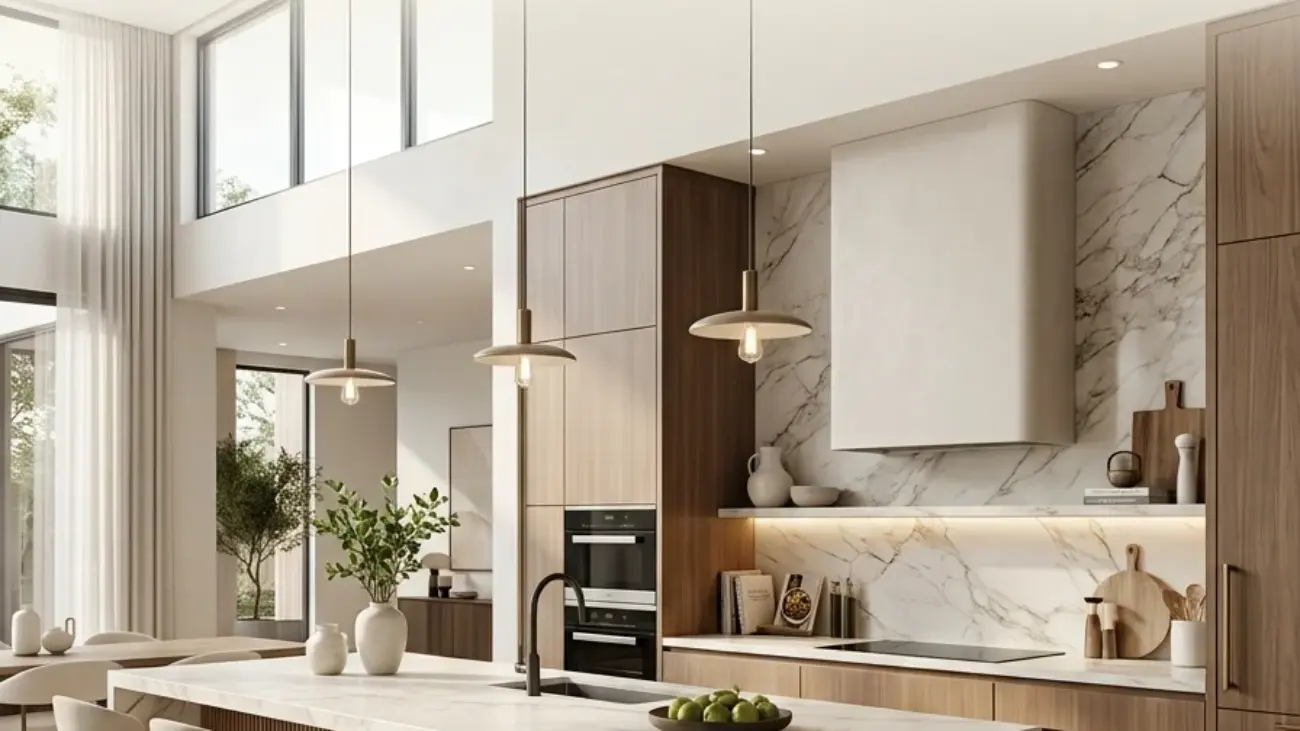
Modern kitchen design luxury in 2025 is a restrained, high-material approach that replaces visible hardware, ornate detailing, and mixed finishes with handleless cabinetry, monolithic stone surfaces, and a single unified metal tone, treating quiet material quality as the actual luxury signal rather than decorative flourish. This article gives you 15 leading modern kitchen design ideas for 2025, covering material, color, lighting, and layout decisions currently defining the top of the high-end kitchen market.
It feels like a room engineered for calm: a waterfall island with no visible seam, cabinetry that opens with a soft push instead of a pull, light traced along a ceiling edge instead of dropped from a fixture overhead. This is modern luxury kitchen design at its most confident right now: pared back, materially rich, built to disappear into its own quiet precision rather than announce itself.
Here are 15 ideas worth saving and stealing.
Why Modern Luxury Kitchen Design Works So Well in 2025
Modern luxury kitchen design in 2025 draws from the “quiet luxury” shift that moved from fashion into interiors, a reaction against the ornate, heavily branded maximalism of the previous decade, favoring materials that communicate quality through texture and craftsmanship rather than visible logos or decorative excess. What separates this year’s version from earlier “modern luxury” kitchens is the near-total disappearance of visible hardware and appliance fronts, a level of integration that requires more precise cabinetry work than a decade ago’s flat-panel modern kitchens attempted.
Core materials are honed quartzite or micro-cement for monolithic counters and waterfall islands, smoked or fumed oak for cabinet fronts, and one unified warm metal brushed nickel or warm bronze carried across every visible fixture. Color has moved toward warm taupe, deep olive green, and smoked charcoal, away from the stark white and grey that defined the 2010s modern kitchen.
This look is trending in 2025 because post-pandemic home spending shifted decisively toward fewer, higher-quality purchases rather than frequent trend-driven updates, a pattern design-industry trend reports and Pinterest search data both confirm under terms like “quiet luxury kitchen” and “handleless kitchen,” which have overtaken more decorative luxury search terms from a few years earlier.
Yes, but the disappearing-hardware detail requires precise measurement regardless of kitchen size; a genuinely small kitchen can achieve this look by concentrating the budget on one hero material (the island stone or a smoked oak wall of cabinetry) rather than spreading it thin across a full renovation.
Style at a Glance
| Element | Core Trait 1 | Core Trait 2 |
| Philosophy | Quality signaled through material restraint, not visible ornament | Integration and disappearance over decorative statement |
| Materials | Honed quartzite, micro-cement, smoked oak | Unified brushed nickel or warm bronze metal |
| Color Palette | Warm taupe, deep olive green | Smoked charcoal, warm bronze accent |
15 Modern Kitchen Design Luxury 2025 Ideas
1. Pour a Micro-Cement Waterfall Island Counter
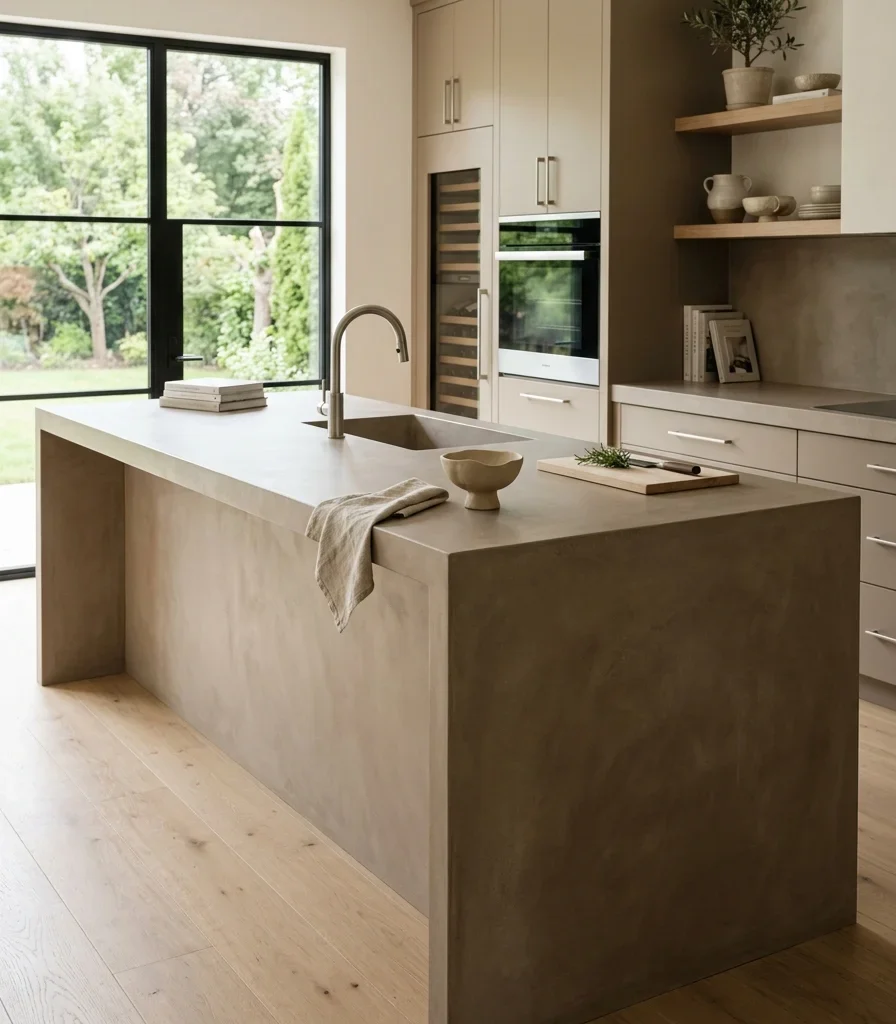
Vibe: Still a surface with no visible seam anywhere across its entire folded form.
Why it works: Micro-cement is a material-honesty and continuity principle taken further than natural stone can achieve because it’s applied as a poured, seamless coating rather than fabricated from cut slabs. A micro-cement island can wrap corners and edges with zero visible joint lines, which reads as more monolithic and considered than even a well-matched stone waterfall.
How to get it: Specify a warm taupe or greige micro-cement finish applied by a fabricator experienced specifically with kitchen-grade cementitious surfaces (not decorative wall-only applicators), and request a sealed matte finish rather than gloss, since matte reads calmer and shows fewer fingerprints on a heavily touched island edge.
💡 Quick Win: A micro-cement-look large-format porcelain slab achieves a similar seamless appearance at a lower cost and faster installation than true poured cement.
Shop the Look
| Product |
| Micro-cement look porcelain slab |
| Brushed nickel counter stool set |
| Small sculptural ceramic bowl |
| Matte sealant for cementitious surface |
| Brushed nickel pendant light |
2. Pair Warm Taupe With Brushed Nickel

Vibe: Grounded, a palette warm enough to feel inviting without any of the coldness grey once carried.
Why it works: Warm taupe represents the specific color correction the industry has made to the previous decade’s grey-dominated modern kitchens; it retains the same neutral, versatile base that grey offered, but its warmer undertone photographs and reads as more current, paired specifically with brushed nickel rather than the chrome that grey kitchens typically used.
How to get it: Choose a warm taupe with a visible yellow-brown undertone (test it against natural daylight, since taupe shifts more under artificial light than most neutrals), and commit to brushed nickel exclusively across faucet, cabinet hardware, and lighting rather than mixing in chrome or brass.
Shop the Look
| Product |
| Warm taupe cabinet-grade paint |
| Brushed nickel faucet single hole |
| Brushed nickel cabinet pull set |
| Small ceramic countertop vessel |
| Brushed nickel pendant fixture |
3. Install Handleless Push-to-Open Cabinetry
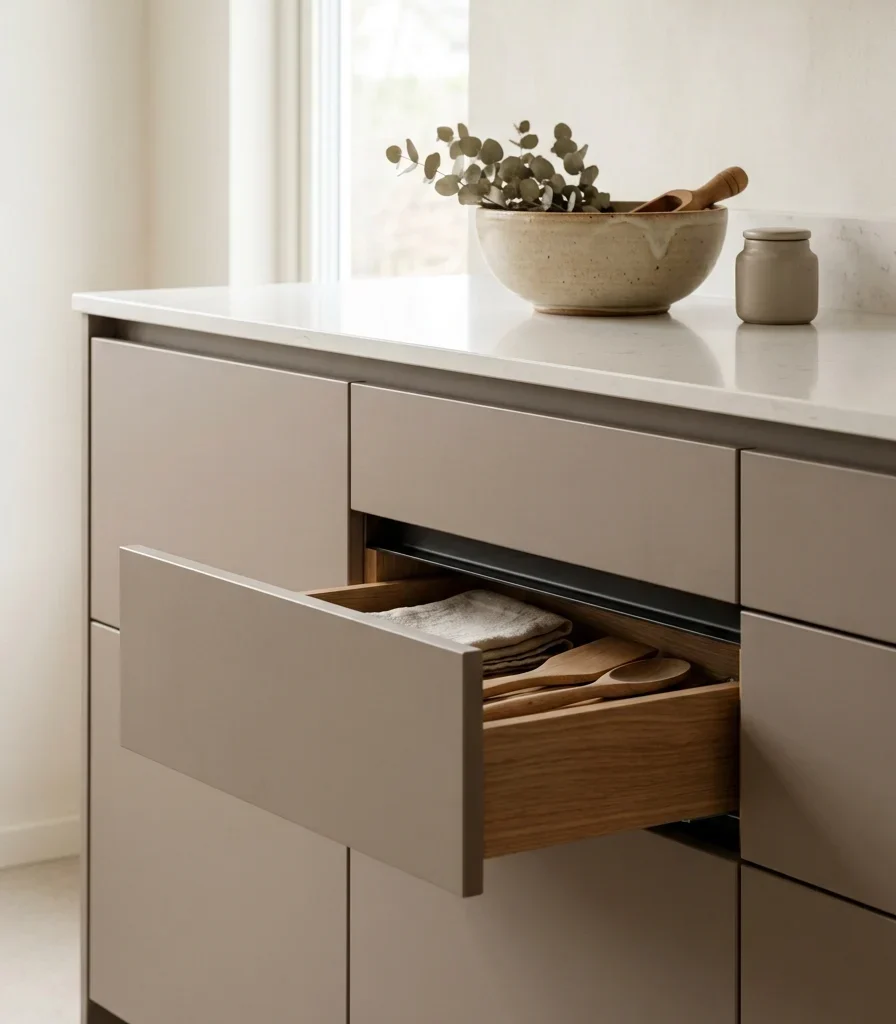
Vibe: Serene cabinetry with nothing protruding to catch the eye or a passing sleeve.
Why it works: Removing visible hardware entirely is the negative-space principle central to 2025’s version of luxury minimalism a flat, uninterrupted cabinet front reads as more monolithic and calm than even the slimmest pull, and the push-to-open mechanism achieves full function without sacrificing that visual continuity.
How to get it: Specify a push-to-open (also called touch-latch) mechanism rated for daily heavy use rather than a budget-grade version prone to failure, and pair it with a subtle recessed finger groove at the top edge of lower cabinets for the drawers that still need manual pulling open.
Shop the Look
| Product |
| Push-to-open cabinet latch hardware |
| Recessed finger groove cabinet profile |
| Soft-close drawer slide set |
| Small ceramic countertop bowl |
| Flat panel cabinet door set |
4. Trace an Integrated LED Light Line Along the Island Edge
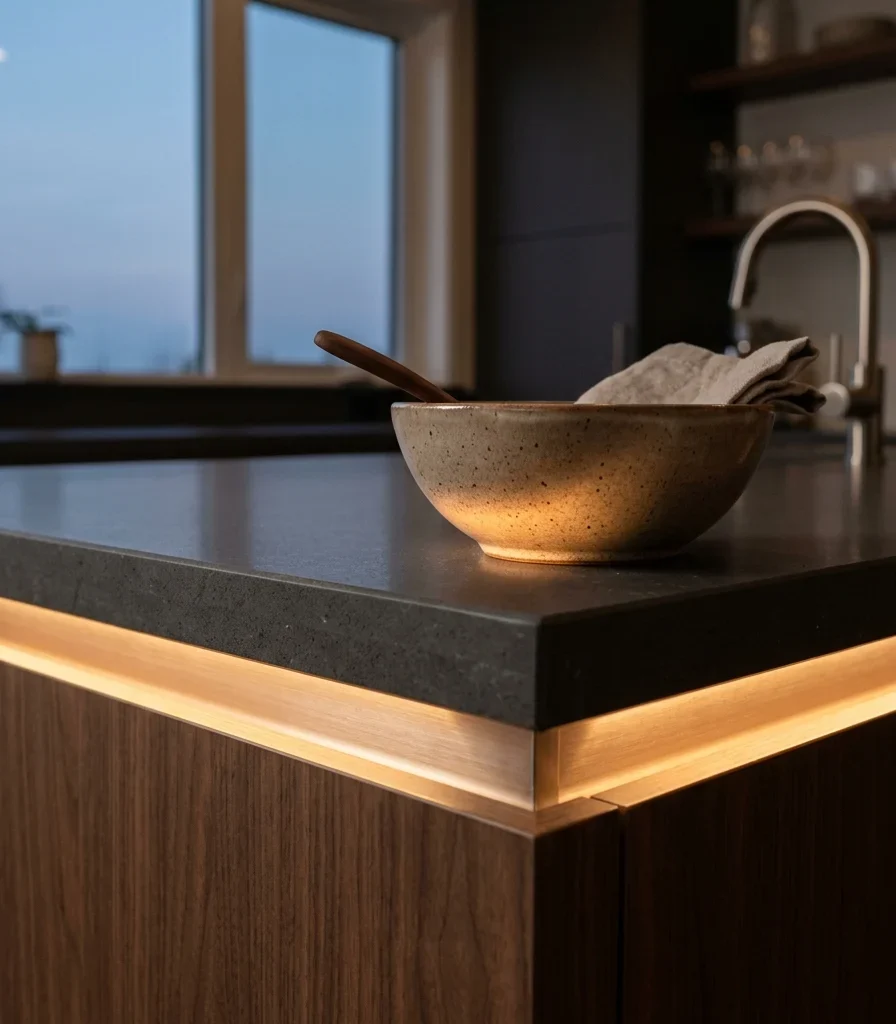
Vibe: Hushed, a thin line of light that makes the island appear to float slightly above the floor at night.
Why it works: A light line traced into the underside island edge is a light-layering technique that adds a low, horizontal glow distinct from pendant or overhead lighting this thin, architectural detail is what currently separates a genuinely current luxury kitchen from an older one, since it requires the light source to be planned into the cabinetry build rather than added afterward.
How to get it: Recess a warm 2700K LED strip into a routed channel along the island’s underside edge, facing the light downward so the source itself stays hidden and only the glow it casts on the floor is visible, wired to a separate switch from the main task lighting.
Shop the Look
| Product |
| Recessed warm LED light channel |
| Warm 2700K LED strip |
| In-line dimmer switch |
| Small ceramic countertop bowl |
| Brushed nickel switch plate |
5. Choose Smoked Oak Cabinet Fronts
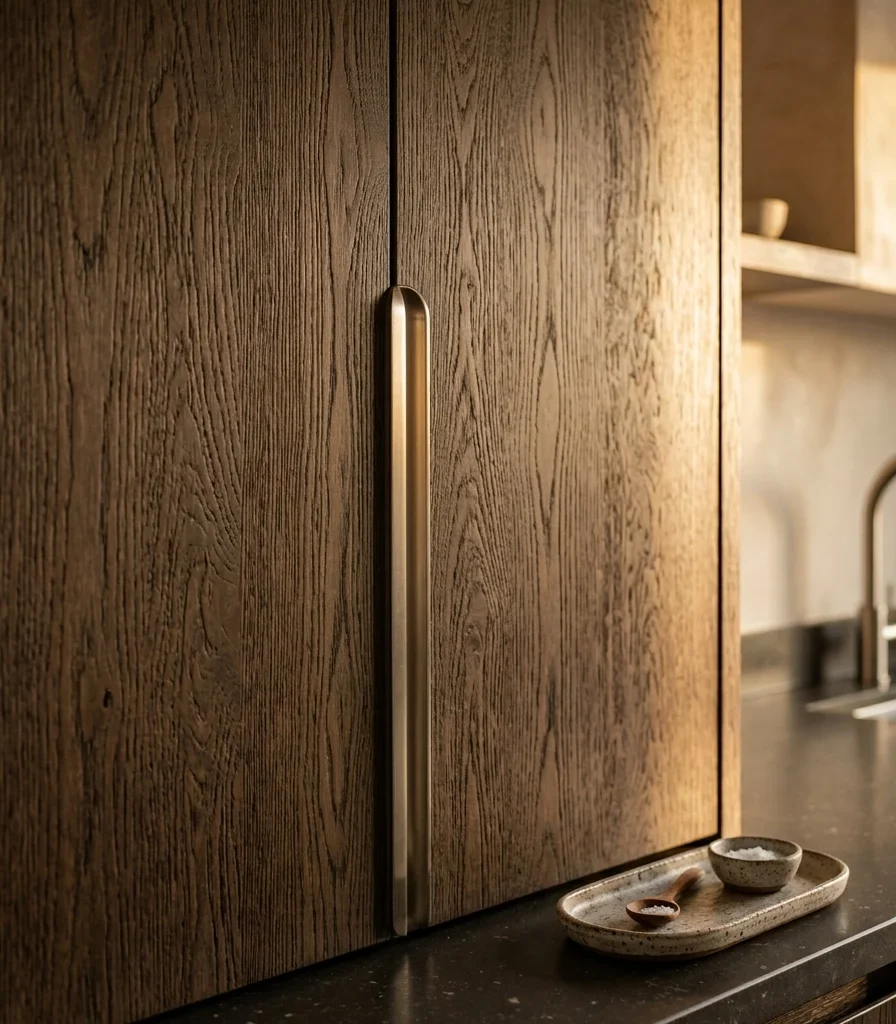
Vibe: Warm wood dark enough to feel formal, but with grain still visible enough to read as genuinely natural.
Why it works: Smoking oak (a fuming process that reacts the wood’s tannins with ammonia to deepen its tone) is a material technique distinct from simply staining wood darker the smoking process darkens the wood evenly through its grain structure rather than sitting on the surface, which is why smoked oak reads as richer and more dimensional than a dark-stained oak veneer under close inspection.
How to get it: Specify genuinely smoked or fumed solid oak (not a dark stain marketed as “smoked”) for at least one bank of cabinetry, and seal it with a matte polyurethane that preserves the visible grain rather than a high-gloss finish that would flatten the wood’s natural texture.
Shop the Look
| Product |
| Smoked oak cabinet panel |
| Matte polyurethane wood sealant |
| Brushed nickel finger groove trim |
| Small ceramic serving tray |
| Smoked oak edge banding |
6. Style the Counter With Sculptural Ceramic Vessels
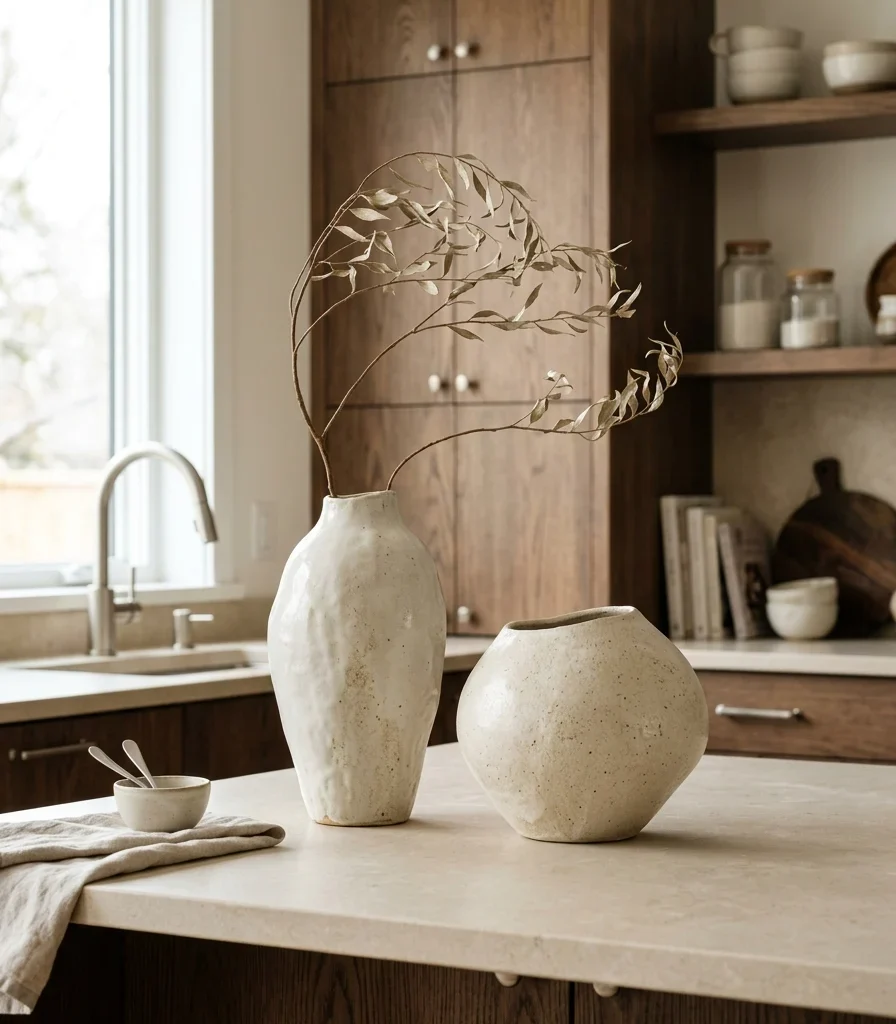
Vibe: Layered objects with enough sculptural presence to function as art rather than mere counter clutter.
Why it works: Restraint in accessory choice is the styling principle that separates 2025 luxury kitchens from earlier maximalist counter styling. Two or three genuinely sculptural ceramic pieces, chosen for their form rather than as part of a themed collection, carry more visual weight individually than a dozen smaller decorative objects would collectively.
How to get it: Choose no more than two or three ceramic vessels in varied heights and organic (not perfectly geometric) shapes, keeping their glaze finishes within the same warm cream or taupe family as the rest of the kitchen, and leave the majority of the counter surface empty around them.
Shop the Look
| Product |
| Sculptural matte ceramic vessel set |
| Small dried branch bundle |
| Warm cream ceramic bowl |
| Smoked oak counter tray |
| Brushed nickel candle holder |
7. Introduce Deep Olive Green Lower Cabinetry
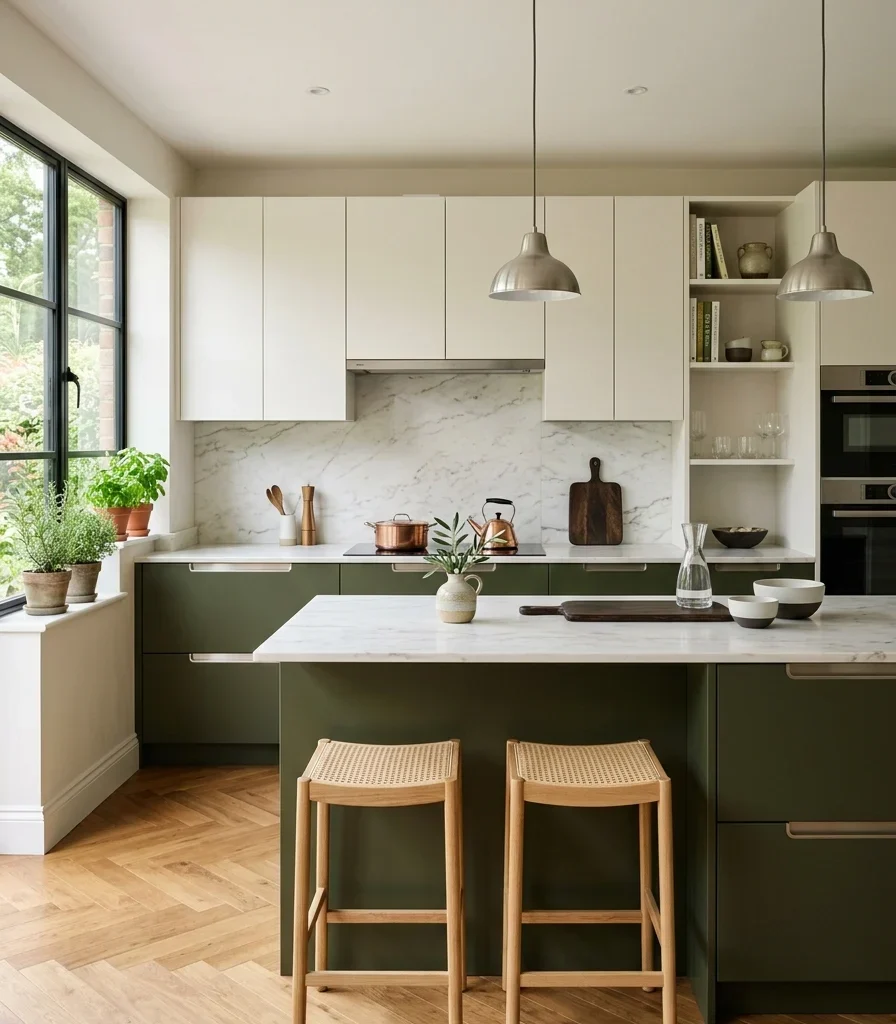
Vibe: Grounded, a color deep and earthy enough to feel deliberate rather than trend-chasing.
Why it works: Olive green has replaced the more saturated sage and forest greens of a few years earlier as the current leading green in luxury kitchen palettes, applying a proportion principle by staying on lower cabinetry only the deeper, more muted olive tone reads as more sophisticated and less overtly “trendy” than brighter greens, aligning with the broader quiet-luxury restraint driving this year’s palette shift.
How to get it: Reserve olive green for base cabinetry in a matte finish, keeping upper cabinets in warm white or the same smoked oak used elsewhere in the room, and test the olive against natural daylight before committing, since olive shifts noticeably warmer or cooler depending on a room’s light direction.
💡 Quick Win: Cabinet refacing film in olive green achieves the color commitment on existing cabinets without a full replacement.
Shop the Look
| Product |
| Deep olive green cabinet paint |
| Brushed nickel finger groove profile |
| Cabinet refacing film olive |
| Warm white upper cabinet paint |
| Small ceramic countertop vessel |
8. Add a Disappearing Appliance Garage
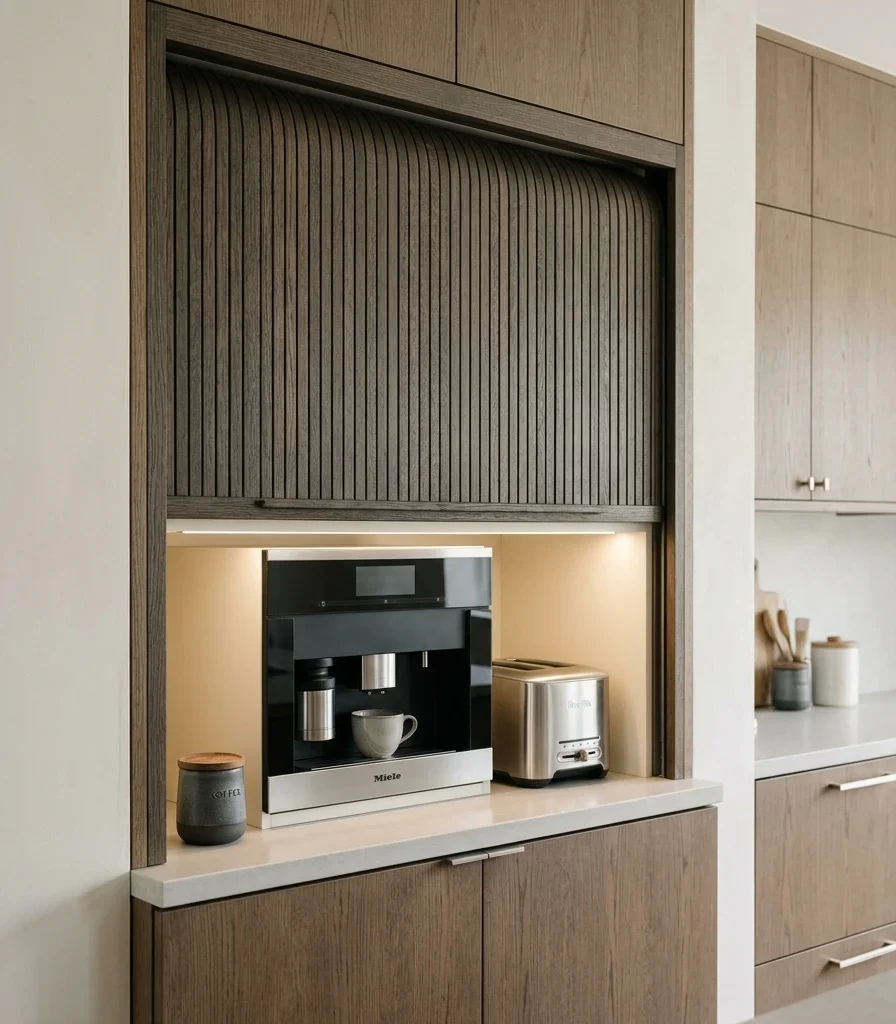
Vibe: Still a counter that stays genuinely clear because everyday appliances have their own concealed home.
Why it works: An appliance garage applies negative space and visual weight principles at the room scale hiding small appliances behind a tambour or lift-up door keeps the main counter surfaces uninterrupted, which is what allows the restrained accessory styling covered earlier to actually read as intentional rather than a staged version of a normally cluttered counter.
How to get it: Build the appliance garage with a vertical tambour door finished to match the surrounding cabinetry exactly, sized to fit a coffee maker and toaster with an integrated outlet inside, and position it at the counter’s end run rather than centered, where it would interrupt prime workspace.
Shop the Look
| Product |
| Vertical tambour appliance garage door |
| Matching cabinet finish panel |
| Integrated outlet strip |
| Small ceramic canister set |
| Cabinet interior task light |
9. Recess Cove Lighting Along the Ceiling Perimeter
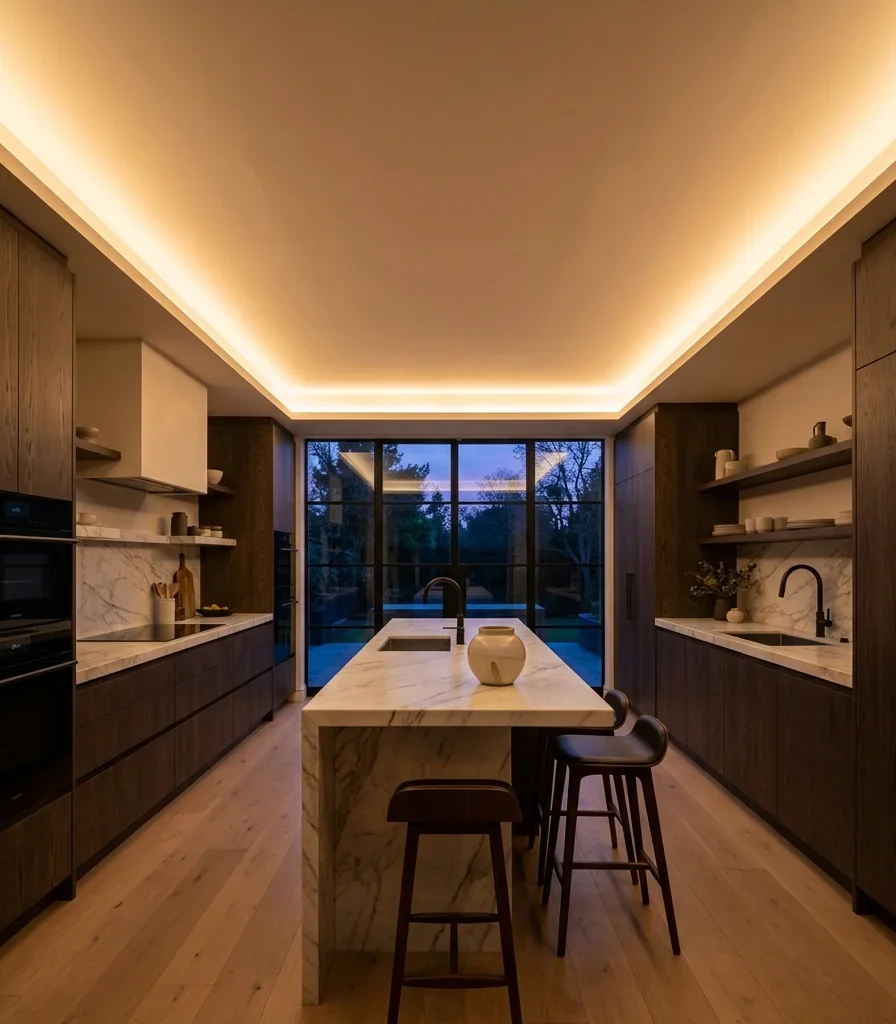
Vibe: Warm a ceiling that glows softly at its edges instead of relying on a single central fixture.
Why it works: Cove lighting is an architectural light-layering technique that washes the ceiling with indirect light from a hidden recessed channel, raising the perceived ceiling height and adding a soft ambient layer that complements task and pendant lighting rather than competing with it, a detail typically reserved for higher-budget builds because it must be planned into the ceiling structure itself.
How to get it: Recess a warm 2700–3000K LED strip into a routed cove channel set back at least 4 inches from the ceiling edge, angled to wash upward and outward across the ceiling surface, and run it on its own dimmer separate from the room’s other lighting layers.
Shop the Look
| Product |
| Recessed cove LED channel kit |
| Warm 2700K LED strip |
| Ceiling cove dimmer switch |
| Small ceramic decorative vessel |
| Cove channel trim molding |
10. Specify Honed Quartzite With Bold Veining
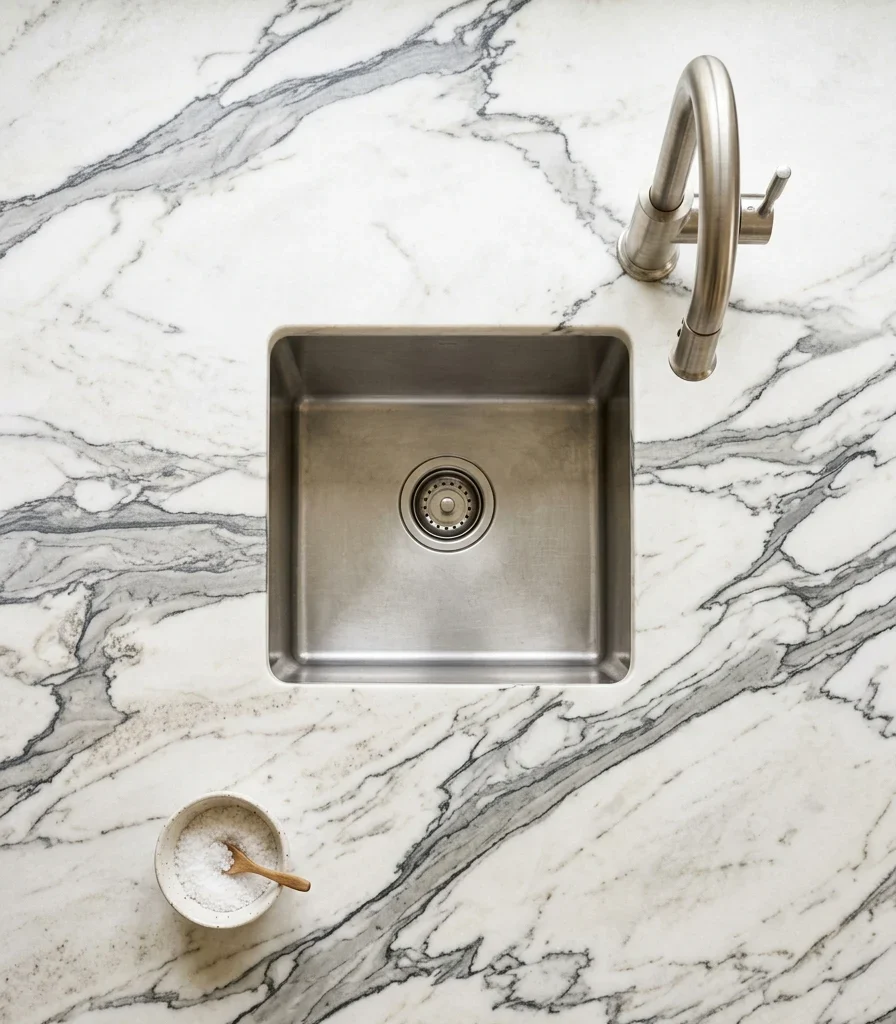
Vibe: Raw tone with vein movement dramatic enough to function as the room’s focal artwork.
Why it works: A honed (rather than polished) finish is the specific material update that separates 2025’s stone preference from the glossy quartzite of a few years earlier honing mutes the surface’s reflectivity, which lets the veining pattern itself carry the visual interest instead of competing with a high-shine glare, a texture-and-contrast principle that reads as more current and less showroom-polished.
How to get it: Select a quartzite slab with dramatic, continuous vein movement rather than a busy, scattered pattern, and specify a honed finish explicitly when ordering, since most fabricators default to polished unless told otherwise.
Shop the Look
| Product |
| Honed quartzite slab |
| Brushed nickel single-hole faucet |
| Small ceramic countertop bowl |
| Quartzite penetrating sealer |
| Brushed nickel soap dispenser |
11. Carry Warm Bronze Metal Accents Throughout

Vibe: Warm metal with enough depth and patina that it reads as aged rather than freshly manufactured.
Why it works: Warm bronze represents a shift away from the brushed nickel and matte black that dominated the previous several years, applying the same hardware-consistency principle discussed for other finishes but with a metal that develops visible depth and patina over time, which aligns with the quiet-luxury preference for materials that age rather than stay artificially uniform.
How to get it: Choose warm bronze (not the cooler oil-rubbed bronze of a decade ago) across every visible fixture faucet, cabinet hardware, pendant fixtures, and outlet covers ourced from a single product line where possible, since bronze finishes vary noticeably in warmth between manufacturers.
Shop the Look
| Product |
| Warm bronze cabinet pull set |
| Warm bronze single hole faucet |
| Warm bronze pendant light |
| Small ceramic countertop vessel |
| Warm bronze outlet cover plate |
12. Style Open Shelving With a Single Curated Object Row
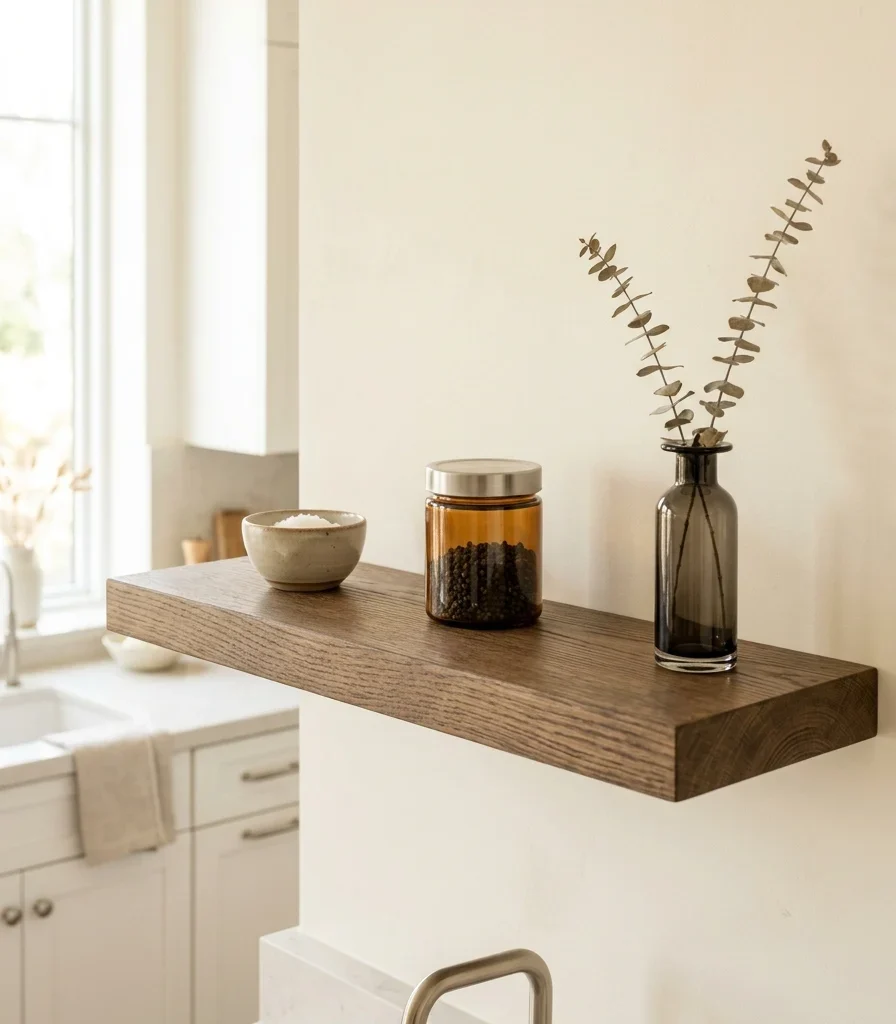
Vibe: Still a shelf edited down to exactly the objects worth looking at and nothing more.
Why it works: Extreme restraint in open shelving styling is a negative-space principle that has intensified in 2025 luxury kitchens compared to the fuller, more layered open shelving popular a few years ago spacing just three objects evenly across a single shelf, with generous space between each, gives every individual piece more visual weight than a densely styled shelf ever could.
How to get it: Limit the shelf to exactly three objects in varied heights, spaced at roughly equal intervals with visible negative space on both sides, and choose one glass and one ceramic material rather than an all-ceramic grouping for subtle material contrast.
Shop the Look
| Product |
| Smoked oak floating shelf |
| Matte ceramic vessel small |
| Slim glass bud vase |
| Brushed nickel shelf bracket |
| Single dried stem bundle |
13. Build an Integrated Banquette With Hidden Storage
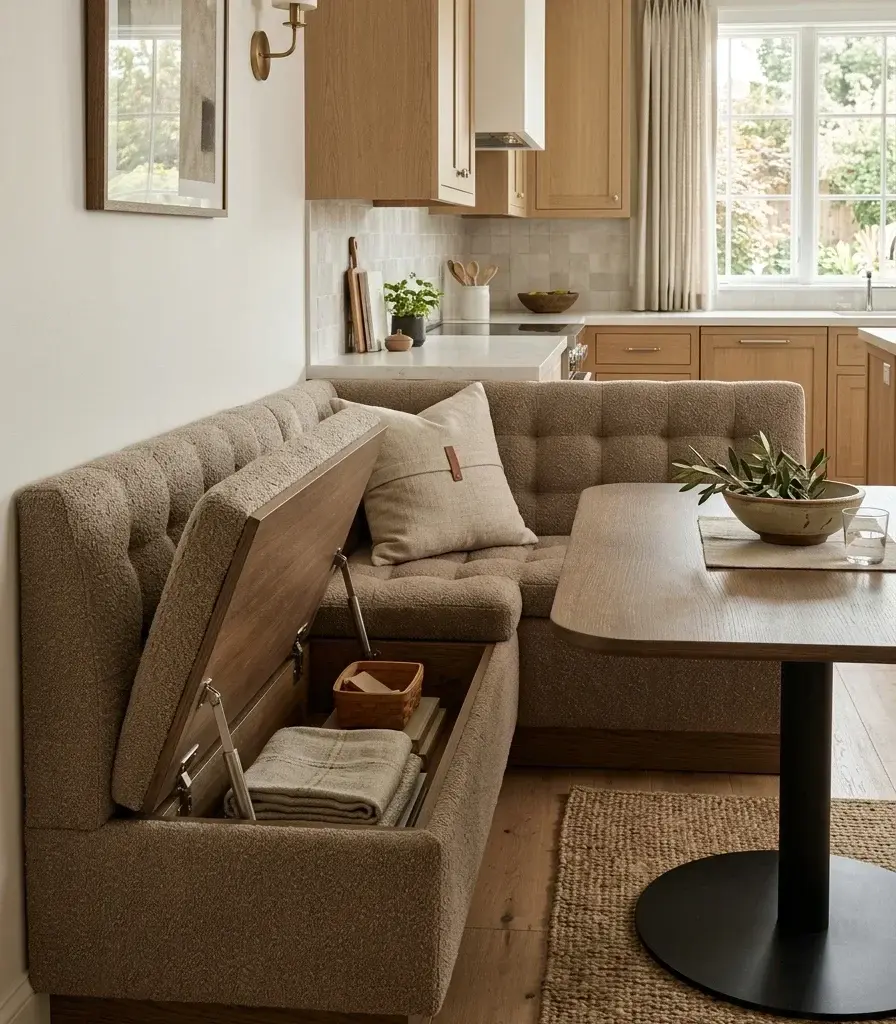
Vibe: Warm a built-in seat that also quietly solves a storage problem most kitchens can’t hide as gracefully.
Why it works: A banquette with a lift-up storage bench applies dual-function furniture design at the room scale the seating itself provides the negative-space benefit of built-in furniture over a bulky freestanding bench, while the hidden storage cavity underneath absorbs items (linens, seasonal dishware) that would otherwise need a separate cabinet, keeping the kitchen’s visible cabinetry run cleaner.
How to get it: Build the bench seat as a hinged lid rather than a fixed cushion top, upholstered in a durable performance bouclé that can handle daily use, and size the interior storage cavity to standard bin or basket dimensions so contents stay organized rather than loose.
Shop the Look
| Product |
| Lift-up bench seat hinge hardware |
| Taupe bouclé upholstery fabric |
| Smoked oak banquette table |
| Storage bin for bench interior |
| Linen throw pillow set |
14. Frame an Indoor-Outdoor Pass-Through Window

Vibe: Airy, a kitchen that extends its own counter surface straight out into the yard or patio.
Why it works: A pass-through window is a traffic-flow and zone-connection layout principle that has become a defining feature of 2025 luxury kitchens with any outdoor access it visually and functionally links interior and exterior entertaining space, letting food and drinks move directly through rather than requiring a full walk-around path, which changes how the kitchen actually functions during gatherings rather than just how it looks.
How to get it: Extend the same interior quartzite or micro-cement counter material through as the windowsill so the surface reads as one continuous plane from inside to outside, and specify a window that opens fully upward or slides completely away rather than a fixed pane with a smaller cutout.
Shop the Look
| Product |
| Full open pass-through window kit |
| Matching quartzite sill extension |
| Small ceramic herb pot |
| Outdoor bar stool set, weather-resistant |
| Exterior counter support bracket |
15. Design a Compact One-Wall Luxury Kitchen Layout
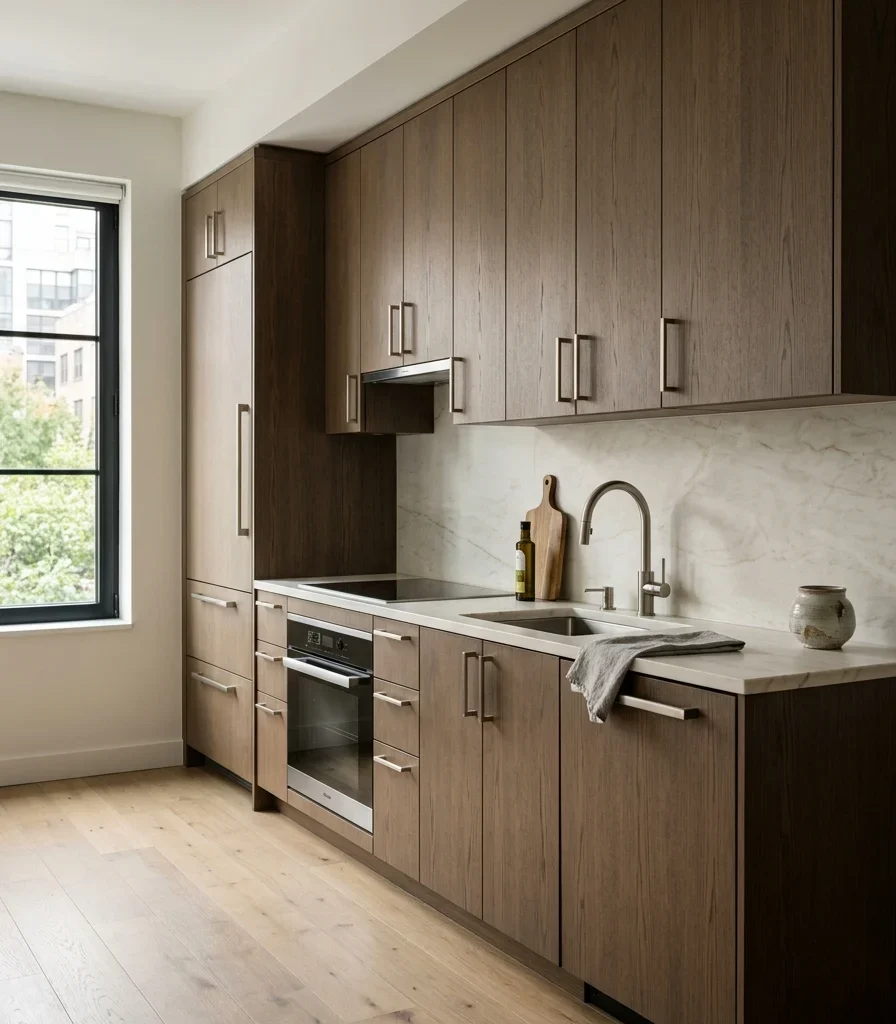
Vibe: Still proof that luxury material quality, not floor plan size, is what actually defines the look.
Why it works: In a genuinely small kitchen without room for an island, the one-wall layout is the small-space adaptation that concentrates every luxury material decision onto a single uninterrupted run full-height cabinetry to the ceiling, one continuous counter material, and integrated appliances all read as considered rather than compromised, since there’s no secondary surface diluting the material story.
How to get it: Run cabinetry to the ceiling rather than leaving a gap above (which reclaims storage and reads as more intentional), use the same countertop material for the full wall length without a seam if possible, and integrate the refrigerator and dishwasher behind matching cabinet panels so the whole wall reads as one continuous material plane.
💡 Quick Win: Full-height cabinet panels above existing upper cabinets close the ceiling gap affordably without a full cabinetry replacement.
Shop the Look
| Product |
| Full-height smoked oak cabinet panel |
| Integrated appliance panel kit |
| Continuous quartzite counter slab |
| Brushed nickel cabinet hardware set |
| Small ceramic countertop vessel |
How to Start Your Modern Luxury Kitchen 2025 Transformation
Your first move is selecting the hero counter material before any cabinet color or hardware decision. Since a honed quartzite or micro-cement waterfall island carries the most visual weight in the room, its specific tone and veining pattern set the reference point every other finish gets measured against, and it should be chosen first rather than fitted around an already-decided cabinet color.
The most common mistake is mixing metal finishes: brushed nickel hardware paired with a warm bronze faucet and a chrome pendant, for example, which undercuts the cohesive, restrained look this style depends on. The fix is committing to one metal family across every visible fixture before ordering anything else.
Three items under $50 that create immediate impact: a warm 2700K LED strip for under-cabinet or island-edge lighting, a set of sculptural matte ceramic vessels for counter styling, and a single dried branch bundle in a slim glass vase.
A weekend refresh ighting and hardware swaps costs $200–600. A full modern luxury kitchen renovation with a micro-cement island, smoked oak cabinetry, and integrated appliances typically runs $70,000–180,000 and takes four to seven months depending on custom cabinetry lead times.
Frequently Asked Questions About Modern Kitchen Design Luxury 2025
What is the difference between modern luxury and traditional luxury kitchen design?
Traditional luxury kitchen design uses furniture-grade detailing, turned legs, and visible ornate hardware to signal quality. Modern luxury kitchen design in 2025 signals the same quality through material restraint instead handleless cabinetry, seamless waterfall counters, and hidden appliance integration treating the near-total absence of visible hardware and ornament as the actual luxury marker rather than decorative detail.
What color defines modern luxury kitchen design in 2025?
Warm taupe and deep olive green are the leading colors this year, replacing the stark white and cool grey that defined modern kitchens for the previous decade. Both pair specifically with brushed nickel or warm bronze rather than chrome, since the warmer neutral base needs a correspondingly warm metal tone to read as current rather than dated.
How much does a modern luxury kitchen renovation cost in 2025?
A partial refresh using hardware, lighting, and a quartz-look countertop costs $8,000–20,000. A mid-range renovation with handleless cabinetry and a micro-cement island runs $60,000–110,000, and a full high-end renovation with smoked oak cabinetry, integrated appliances, and cove lighting typically costs $110,000–200,000 or more depending on the region and cabinetry lead time.
Can a small kitchen achieve modern luxury design without an island?
Yes, a one-wall layout with full-height smoked oak cabinetry and a single continuous quartzite counter run achieves the same material-quality signal an island-centered kitchen does, since the style’s luxury marker is material restraint and integration rather than square footage or a specific layout shape.
What is the most requested feature in modern luxury kitchens right now?
Handleless push-to-open cabinetry is currently the most requested single detail in modern luxury kitchen design, according to design-industry trend reports, followed closely by micro-cement or honed quartzite waterfall islands and integrated LED light lines along island edges and ceiling coves.
Ready to Create Your Dream Modern Luxury Kitchen?
These 15 ideas move across material, color, lighting, layout, and genuine small-space adaptations, from a seamless micro-cement island and handleless cabinetry to a one-wall layout that proves material quality matters more than floor plan size. None of this needs to happen all at once, and starting with one hero material or a single lighting layer is genuinely the smarter first step, not a scaled-down compromise. Today’s specific action: pull quartzite or micro-cement samples and hold them against smoked oak or taupe cabinet swatches in natural daylight to settle on the one material story the rest of the kitchen will follow. Once that quiet, considered material palette is in place, the kitchen stops reading as decorated and starts reading as genuinely resolved: a room that feels expensive because of what it leaves out, not what it adds on. Save the ideas that match your kitchen’s actual footprint and your project’s actual budget; that seamless waterfall edge and warm bronze glow will still feel just as current years from now.
You Might Also Like
- 14 Coastal Kitchen Decor Ideas for a Breezy, Sunlit Space
- 15 Luxurious Classic Kitchen Design Ideas With Real Architectural Detail
- 15 Ways to Decorate an Open Plan Kitchen Dining Space
- 15 Open Shelving in the Kitchen | Kitchen Storage Ideas
- 15 Ways to Create a Modern Luxury Kitchen Ceiling Design
- 15 Ways to Achieve a Luxurious Contemporary Kitchen Design