
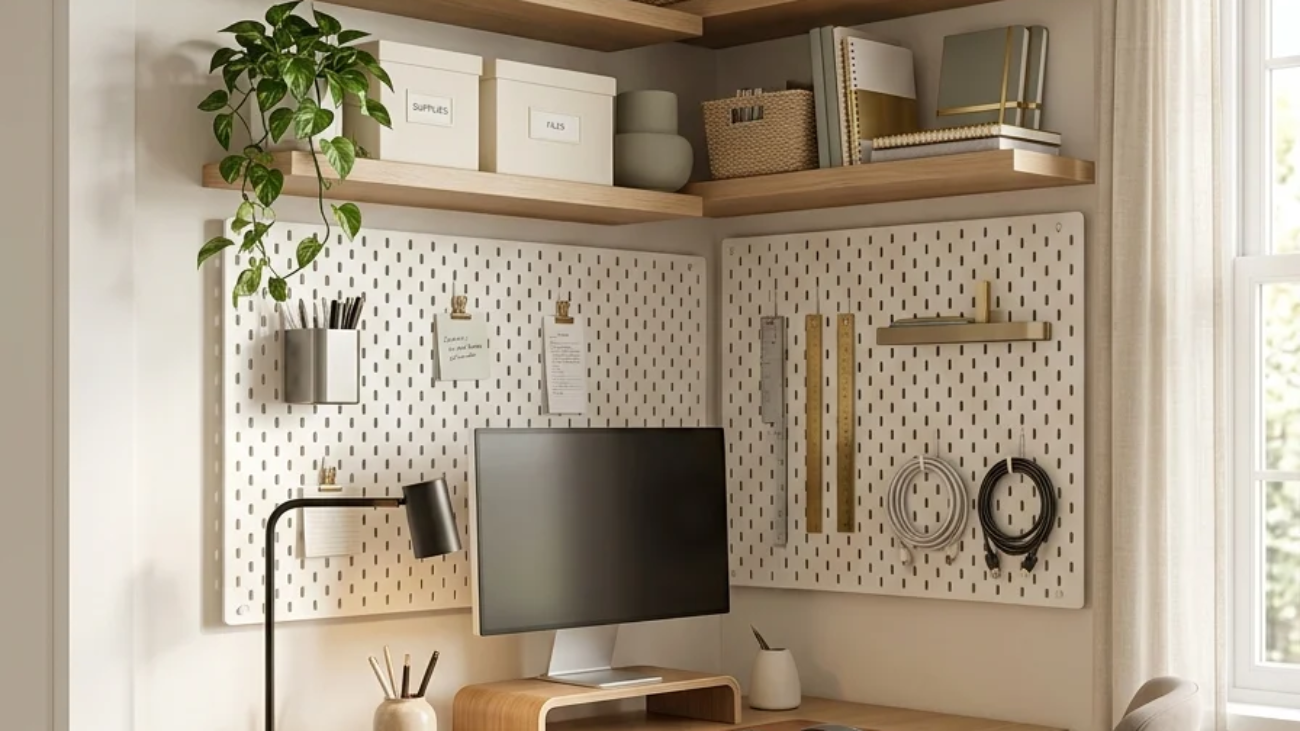
Small office organization is the practice of giving every paper, cable, and supply a fixed, labeled home within arm’s reach of the desk, so a compact workspace stays functional without requiring more square footage than it already has. This article gives you 20 genuinely effective small office organization ideas to improve your home, covering material, color, lighting, and layout decisions that turn a cluttered desk corner into a system that actually holds up week after week.
It feels like sitting down and knowing exactly where everything is a labeled jar for loose supplies instead of a drawer of tangled odds and ends, a filing tower that holds a year’s paperwork in a footprint the size of a chair, cables routed so cleanly they disappear from view entirely. This is small office organization at its most resolved: quiet, considered, built to survive an actual workweek instead of falling apart by Wednesday.
Here are 20 ideas worth saving nd stealing.
Why Small Office Organization Works So Well
Small office organization draws from the broader home-organization movement that gained momentum through the 2010s, which shifted the emphasis from simply owning attractive storage furniture to assigning every object a specific, labeled home a system-first approach rather than a purchase-first one. What distinguishes genuine organization from decorative storage is that every basket, jar, or shelf in a well-organized small office answers a specific question: where does this exact item live, and how do I find it again in thirty seconds?
Core materials favor matte, labeled, and modular pieces: walnut or oak filing furniture, felt-lined drawer dividers, painted MDF pegboards, and woven baskets sized to fit specific shelf openings. Color leans toward warm charcoal or matte black for storage walls (which visually recede), paired with warm white walls elsewhere to keep a small room from feeling boxed in.
This approach is trending because remote and hybrid work pushed home offices into rooms never designed to hold filing systems or supply closets, and both organizing-industry data and Pinterest search interest in “home office organization” and “small office storage” have grown steadily as more people manage real paperwork and equipment from spaces that were once a spare bedroom corner.
Yes, a small office benefits more from deliberate organization than a large one does, since there’s no spare surface to absorb clutter. Prioritize vertical storage and drawer dividers first; floor space should be the last resort, not the starting point.
Style at a Glance
| Element | Core Trait 1 | Core Trait 2 |
| Philosophy | Every item assigned a specific, labeled home | System-first organization over decorative storage alone |
| Materials | Walnut filing furniture, felt drawer dividers, painted MDF pegboard | Woven baskets, matte black hardware |
| Color Palette | Warm charcoal storage wall | Warm white surrounding walls |
20 Small Office Organization Ideas to Improve Your Home
1. Choose a Walnut Filing Cabinet With Soft-Close Drawers
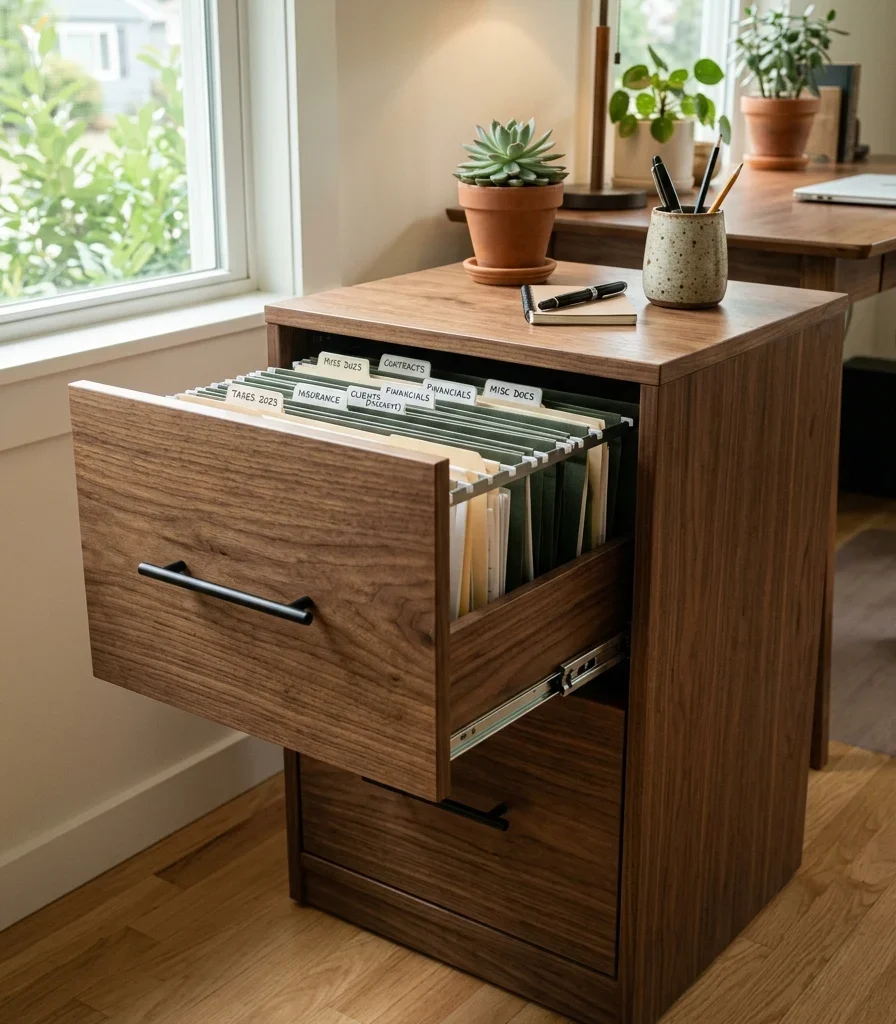
Vibe: Still a filing system solid enough to hold a year of paperwork without ever feeling like a plastic bin.
Why it works: Material quality matters in filing furniture because soft-close mechanisms and full-extension drawer slides genuinely reduce daily friction. A drawer that sticks or slams gets used less consistently, which is the material-honesty principle behind why furniture-grade filing cabinets outperform flimsy plastic carts for actual long-term paper organization.
How to get it: Choose a walnut or walnut-veneer two-drawer cabinet with full-extension slides rated for hanging file folders, and label each folder tab clearly with a consistent system (by project or by month) rather than mixing organizing methods within the same drawer.
💡 Quick Win: A set of matching hanging file folders under $20 upgrades an existing plastic bin’s organization without any new furniture.
Shop the Look
| Product |
| Walnut two-drawer filing cabinet |
| Matte black cabinet pull |
| Hanging file folder set labeled |
| Small ceramic pen cup |
| Full extension drawer slide kit |
2. Paint a Warm Charcoal Storage Wall for Visual Calm
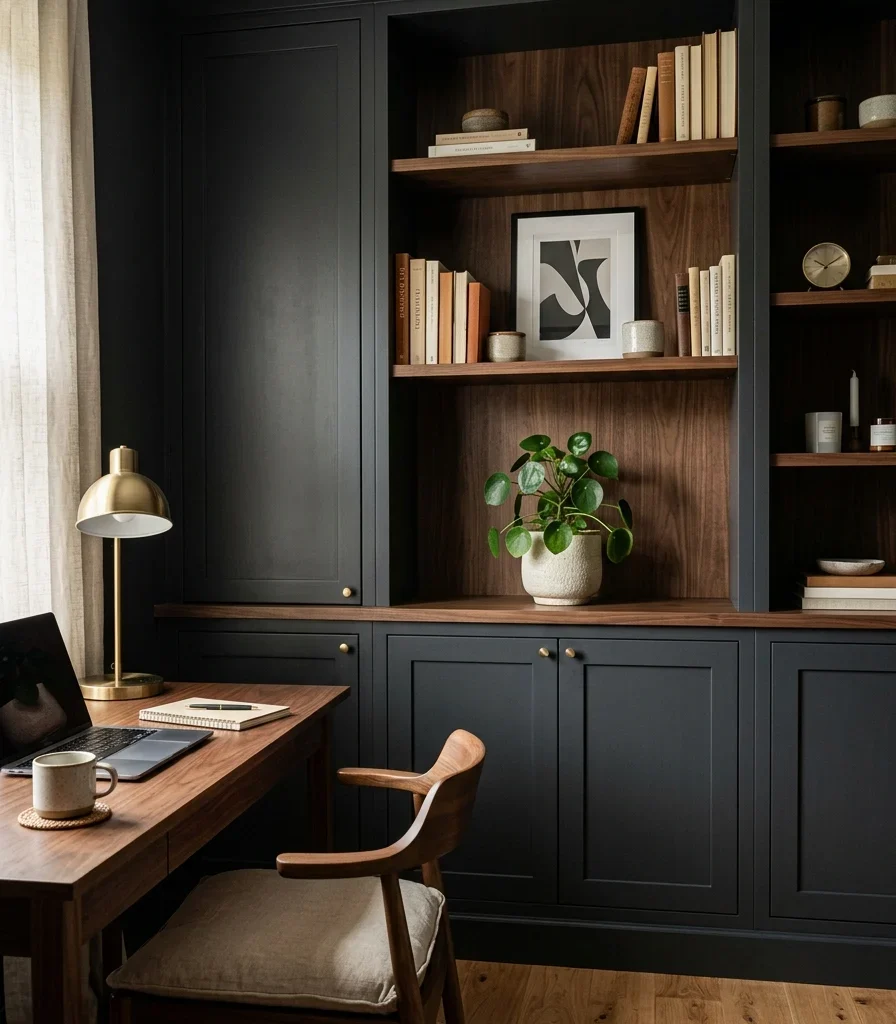
Vibe: Grounded a storage wall dark enough to recede rather than dominate a small room’s limited sightlines.
Why it works: Painting an entire storage wall in the same warm charcoal as its cabinetry is a visual-weight principle; matching the wall to the furniture lets the eye read the whole surface as one calm block instead of a bright wall interrupted by dark boxes, which matters specifically when a small office needs more storage volume than its square footage would typically suggest.
How to get it: Paint both the wall and any built-in shelving in the identical matte warm charcoal formula, reserving a lighter warm white for the room’s remaining walls so the storage wall reads as an intentional zone rather than an accident of leftover paint.
Shop the Look
| Product |
| Warm charcoal matte wall paint |
| Small desk plant ceramic pot |
| Matte black shelf bracket |
| Painter’s tape precision edge |
| Warm white contrast wall paint |
3. Add a Vertical Filing Tower Beside the Desk
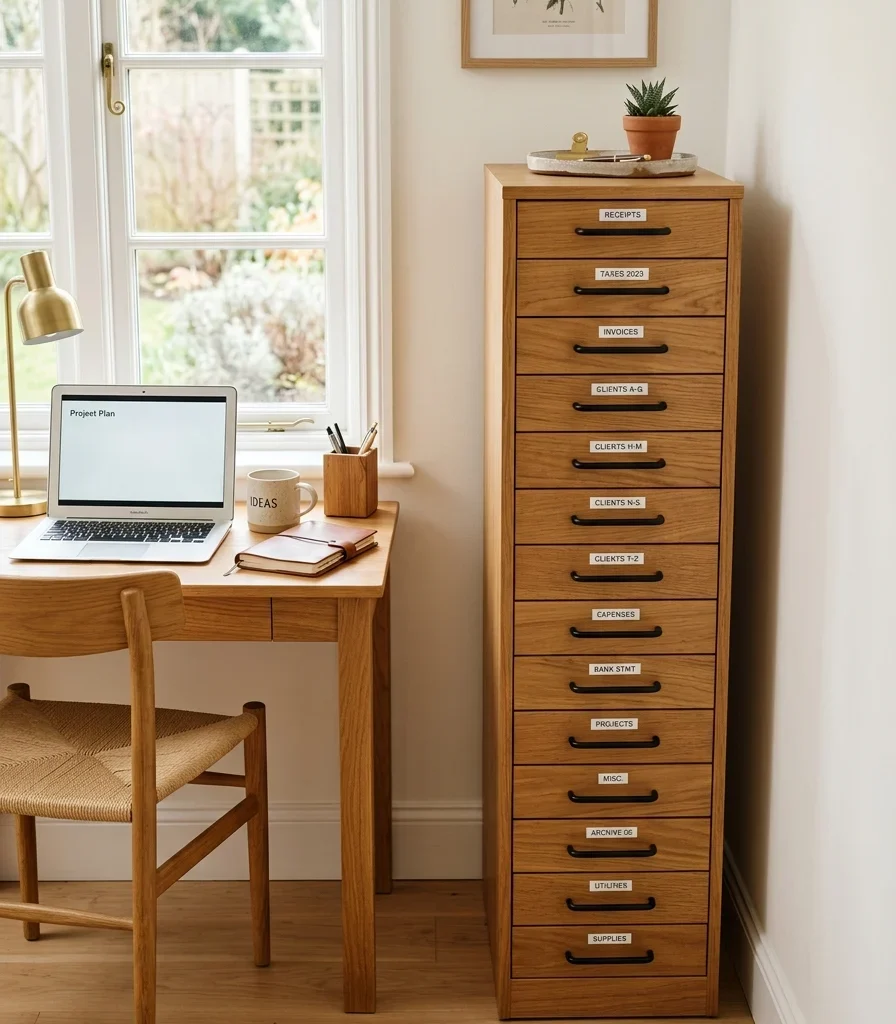
Vibe: A tidy tower that claims a narrow strip of floor and turns it into serious filing capacity.
Why it works: A vertical tower applies negative-space thinking specifically to the narrow gap beside most desks rather than a wide, shallow filing drawer built into the desk itself (which eats into legroom). A tall tower uses height instead of desk depth, holding more paper capacity in less floor footprint.
How to get it: Choose a tower no wider than 14 inches so it fits beside the desk without crowding legroom, and label each drawer by category rather than leaving them blank, since an unlabeled tower defaults back to a single miscellaneous catch-all over time.
Shop the Look
| Product |
| Narrow vertical filing tower |
| Matte black drawer pull set |
| Drawer label tag set |
| Small ceramic desk tray |
| Felt drawer liner |
4. Add Under-Shelf Task Lighting for a Clutter-Free Desk
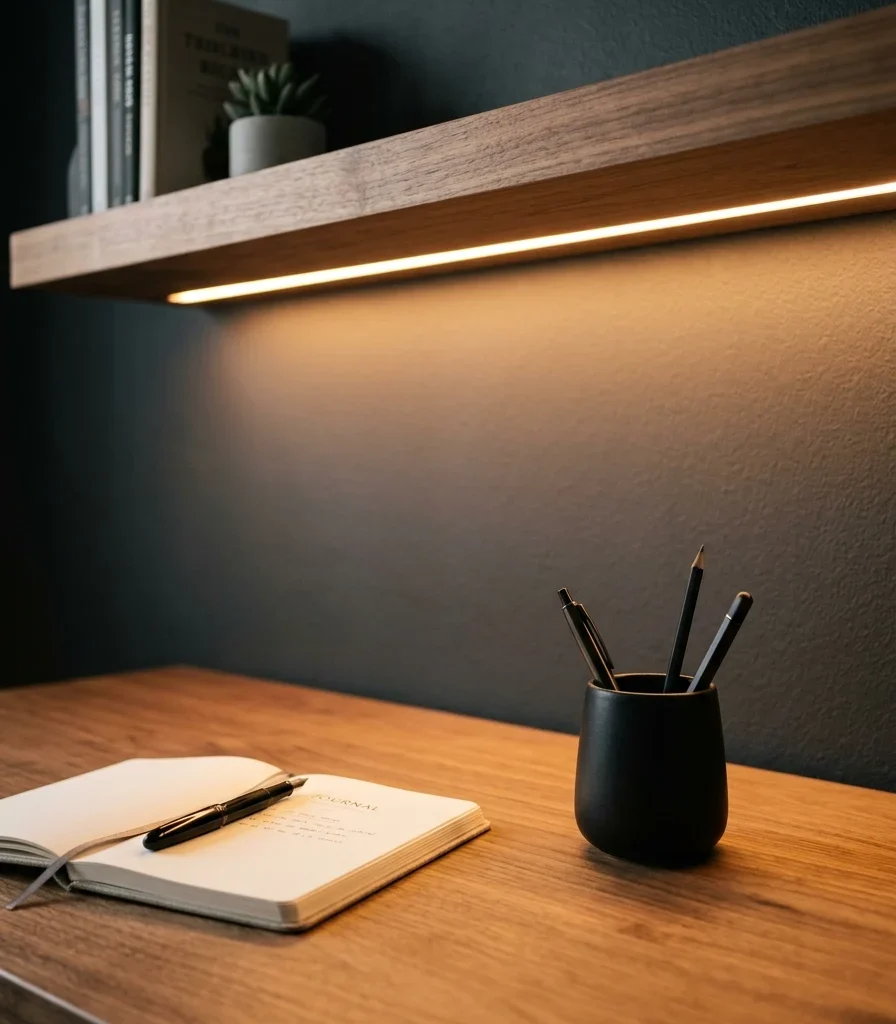
Vibe: Hushed a desk that stays genuinely clear because even the light source doesn’t take up surface space.
Why it works: Under-shelf lighting solves an organization problem indirectly by removing the desk lamp that would otherwise compete for the same limited surface a small office desk already struggles to keep clear. In a compact room, every object removed from the working surface is genuine organizational gain.
How to get it: Install a warm 2700K LED strip along the underside of any shelf or cabinet directly above the desk, wired to its own switch, so task lighting comes from the cabinetry rather than an additional desk-mounted fixture.
💡 Quick Win: A battery-powered adhesive LED strip under $20 achieves the same clutter-free lighting without any wiring.
Shop the Look
| Product |
| Warm 2700K under-shelf LED strip |
| Battery-powered adhesive LED strip |
| Small ceramic pen cup |
| In-line dimmer switch |
| Adhesive LED mounting clips |
5. Use Labeled Ceramic Jars for Small Supplies
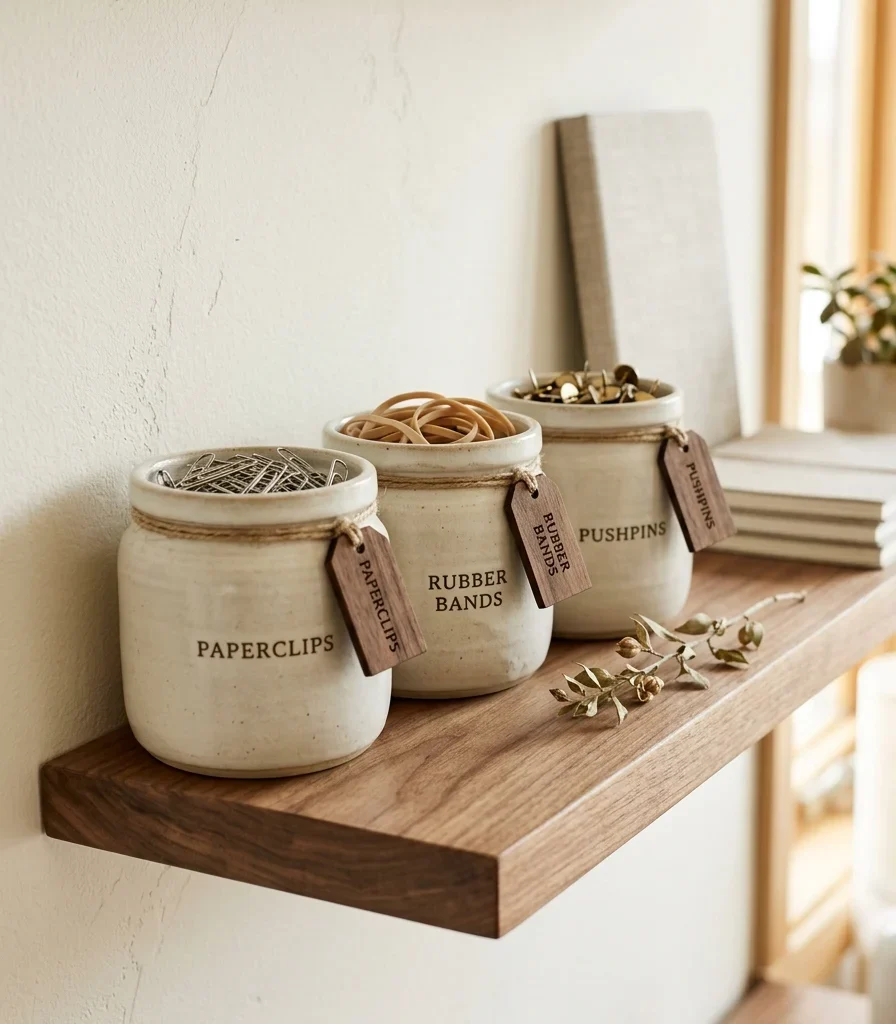
Vibe: Tidy the smallest desk supplies given their own fixed, visible home instead of loose in a drawer.
Why it works: Labeled jars solve the specific organizational failure point of small desk supplies: paperclips, pushpins, and rubber bands are too small to organize by category inside a drawer without dividers, and a labeled jar makes both storage and retrieval instant, removing the daily friction that leads small supplies to scatter across the desk.
How to get it: Use one jar per category rather than one large jar for everything, labeling each with a small wood tag or engraved marker so the system stays legible even after months of daily use.
Shop the Look
| Product |
| Matte ceramic jar set labeled |
| Wood engraved label tag |
| Small dried botanical stem |
| Ceramic pen cup matching set |
| Small wood tray for jars |
6. Install a Pegboard Wall System in Painted MDF
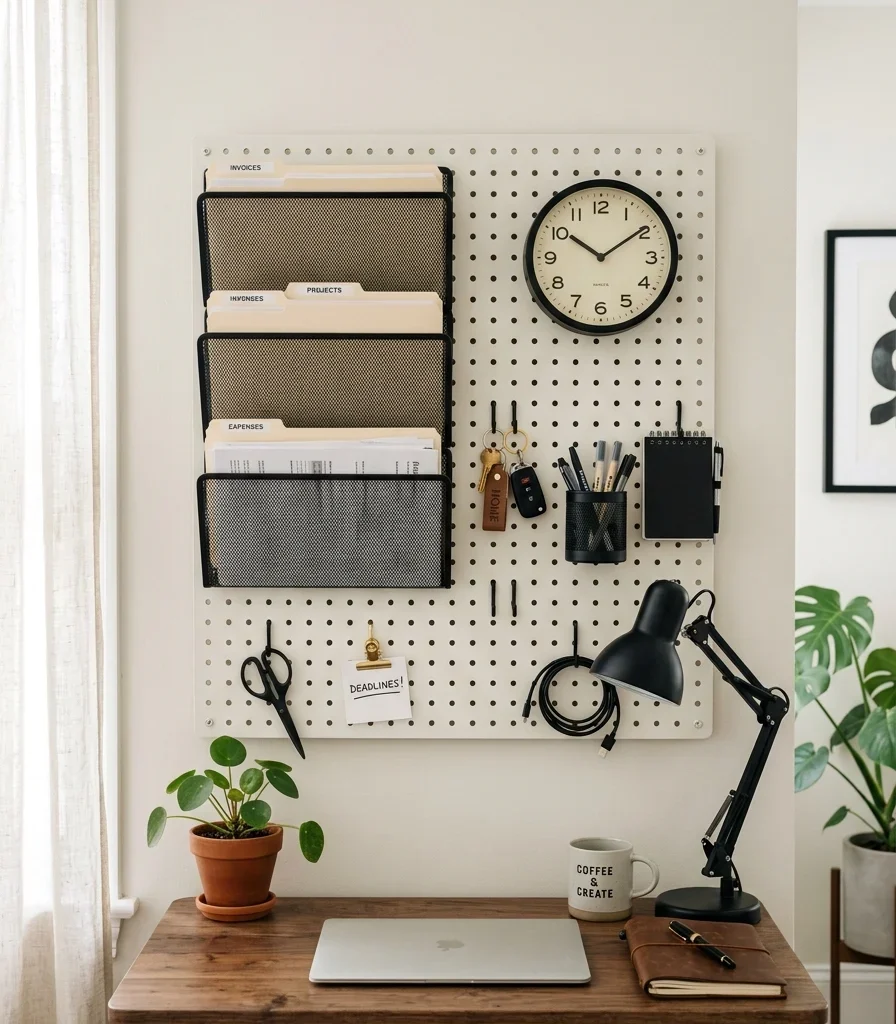
Vibe: Organized, every loose object given a fixed vertical address instead of colonizing the desk surface.
Why it works: A pegboard exploits vertical wall space, the most underused dimension in a small office where floor and desk area are fixed but wall height above the desk is typically empty. Painting the MDF to match the wall (rather than leaving it raw) keeps the system from visually competing with the desk below it.
How to get it: Mount a 24×18-inch painted pegboard 6 inches above the desk’s back edge, using a mix of hook lengths and small shelf pegs so items hang at varied depths rather than crowding into one flat plane.
Shop the Look
| Product |
| Painted MDF pegboard 24×18 inch |
| Matte black pegboard hook set |
| Small round wall clock |
| Pegboard shelf attachment |
| Canvas hanging tool pouch |
7. Match the Storage Cabinet to the Wall Color
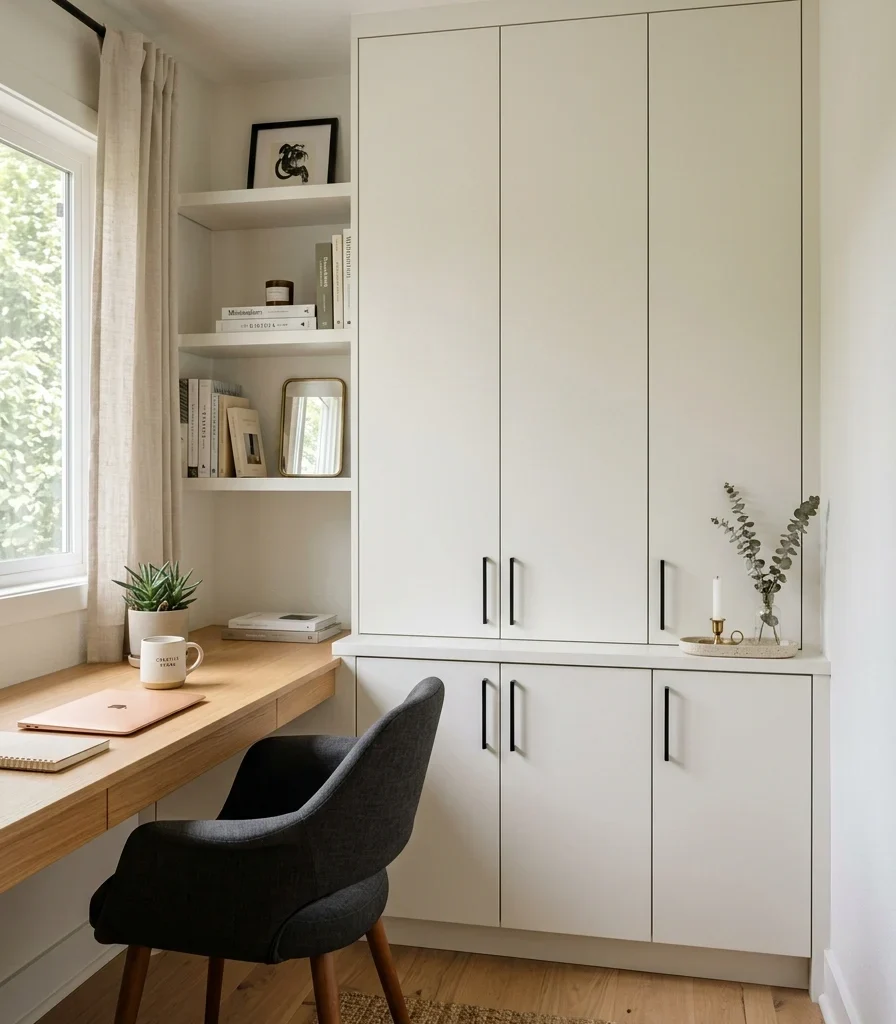
Vibe: Serene. A storage cabinet that visually disappears into the architecture instead of announcing itself as furniture.
Why it works: Matching cabinet color to wall color is the same visual-weight technique used on the charcoal storage wall earlier, applied here to a lighter palette. A contrasting cabinet color draws the eye and makes storage feel larger and more imposing, while a matched tone lets the same physical volume feel like part of the room rather than an added block.
How to get it: Request the exact paint formula used on the walls rather than a close approximation, and keep only the hardware in a contrasting matte black to mark where the storage begins without breaking the color continuity.
Shop the Look
| Product |
| Matching wall and cabinet paint |
| Matte black cabinet hardware |
| Small ceramic desk tray |
| Cabinet color matching swatch kit |
| Matte black cabinet hinge |
8. Add a Rolling File Cart That Tucks Under the Desk
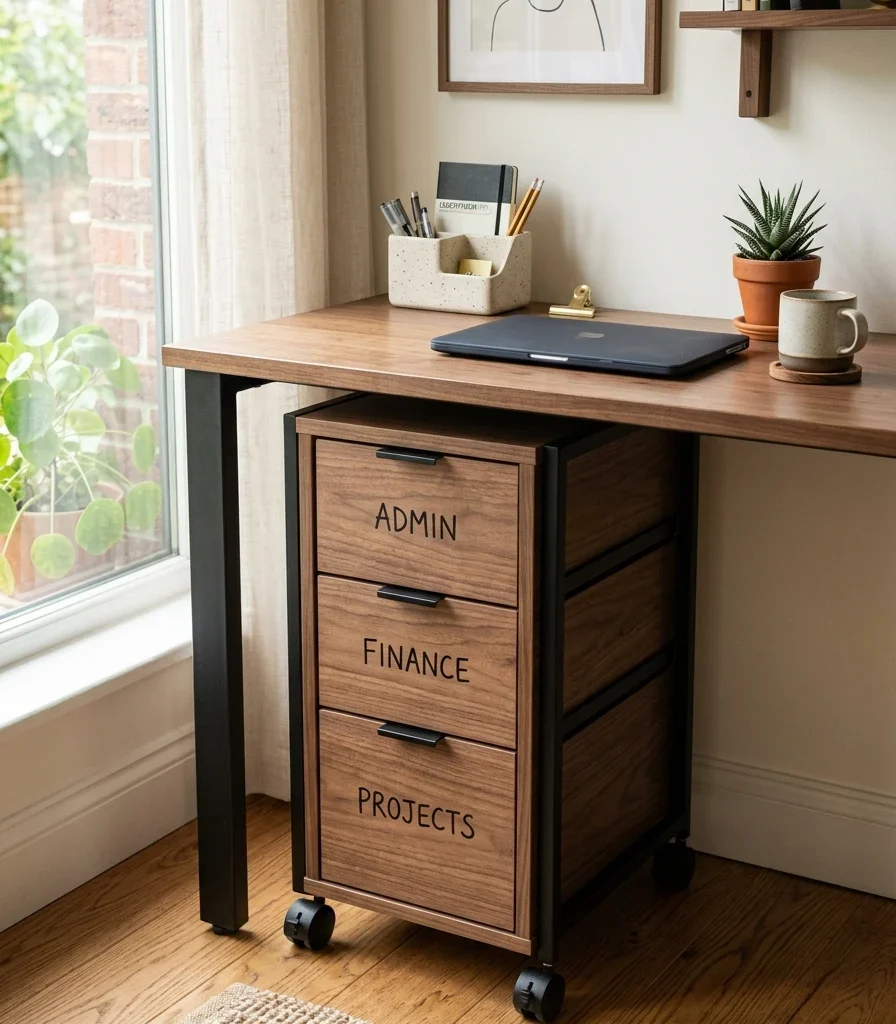
Vibe: Functional filing storage that disappears under the desk entirely when it’s not actively in use.
Why it works: A rolling cart applies dual-function furniture thinking to the gap beneath most desks rather than leaving that space empty because a fixed cabinet wouldn’t fit around the legs; a cart on casters occupies it fully and rolls out only when files are actually needed.
How to get it: Measure the desk’s under-clearance precisely and choose a cart at least an inch narrower and shorter than that space so it slides in and out without catching, fitting each drawer with a specific labeled category rather than mixed contents.
Shop the Look
| Product |
| Rolling file cart walnut |
| Caster wheel lock set |
| Drawer label tag set |
| Small ceramic desk organizer |
| Hanging file folder insert |
9. Add Interior Cabinet Lighting for a Closed Storage Wall
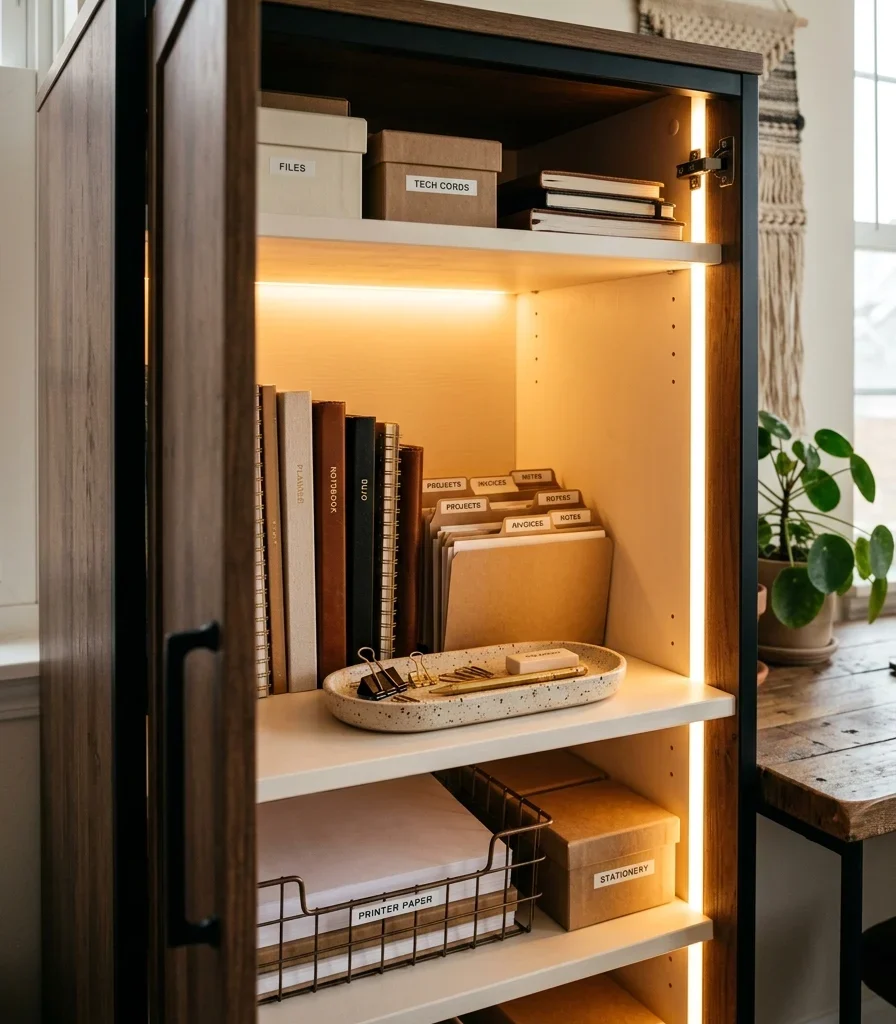
Vibe: Warm a cabinet interior lit clearly enough that finding anything inside takes seconds, not a flashlight.
Why it works: Interior cabinet lighting is a light-behavior principle that directly supports organization rather than decoration. Closed storage in a small office often sits in a dim corner, and without interior light, contents get harder to find, which encourages items to migrate back out onto visible surfaces instead of staying properly filed away.
How to get it: Install a motion-activated or door-switch-triggered warm 2700K LED strip along the interior top edge of the cabinet, so light turns on automatically the moment the door opens rather than requiring a separate switch.
Shop the Look
| Product |
| Motion-activated interior LED strip |
| Door switch light trigger |
| Small ceramic interior tray |
| Cabinet interior shelf divider |
| Warm 2700K LED bulb pack |
10. Fit Woven Basket Drawers Into an Open Shelf
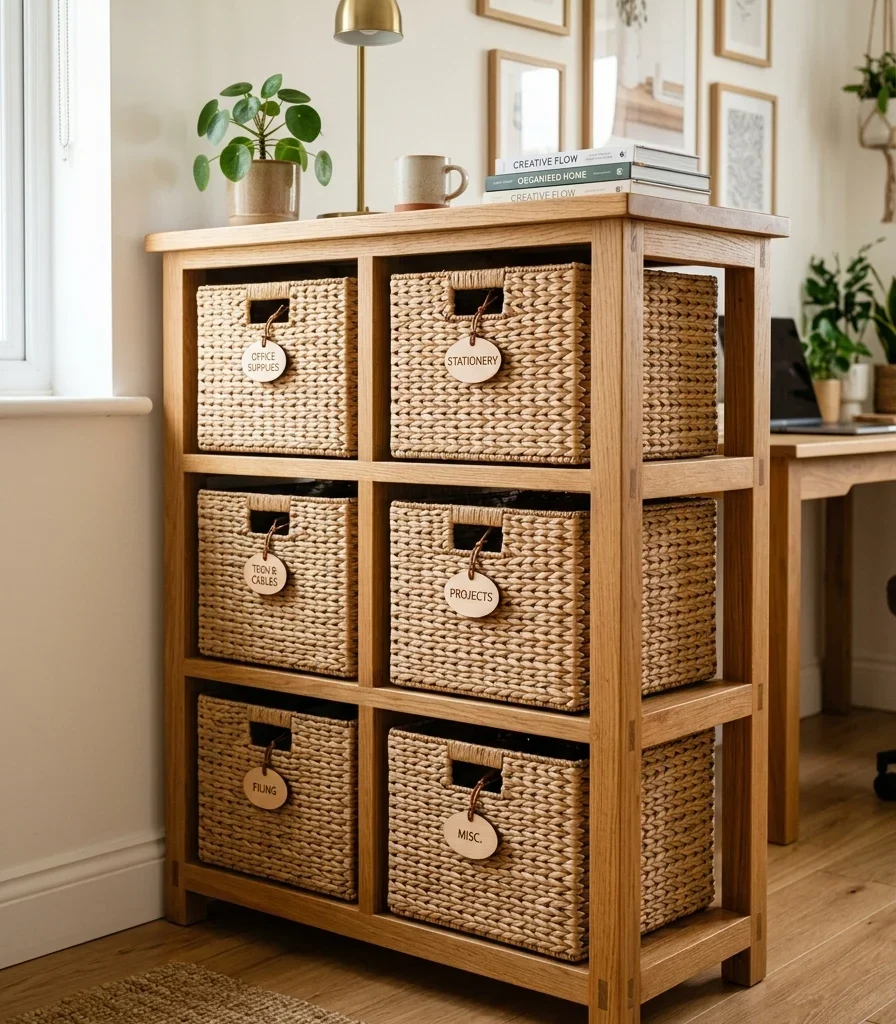
Vibe: Layered open shelving that still keeps loose supplies contained rather than exposed and scattered.
Why it works: Fitting baskets into an open shelving frame combines two organizational functions at once: the shelf itself uses vertical wall space efficiently, while the baskets prevent the visual clutter open shelving alone would create, since each basket contains one specific supply category rather than leaving small items loose across bare shelves.
How to get it: Measure each cubby opening precisely before ordering baskets, since even a half-inch of extra clearance lets them shift and look untidy, and label each one by category so the system stays organized after repeated daily use.
💡 Quick Win: A single well-sized woven basket in an existing open shelf corrals loose items immediately without a full shelving purchase.
Shop the Look
| Product |
| Open oak shelving frame |
| Woven basket drawer set fitted |
| Wood engraved label tag |
| Small ceramic accent jar |
| Felt basket liner |
11. Frame a Cork Bulletin Board in Oak
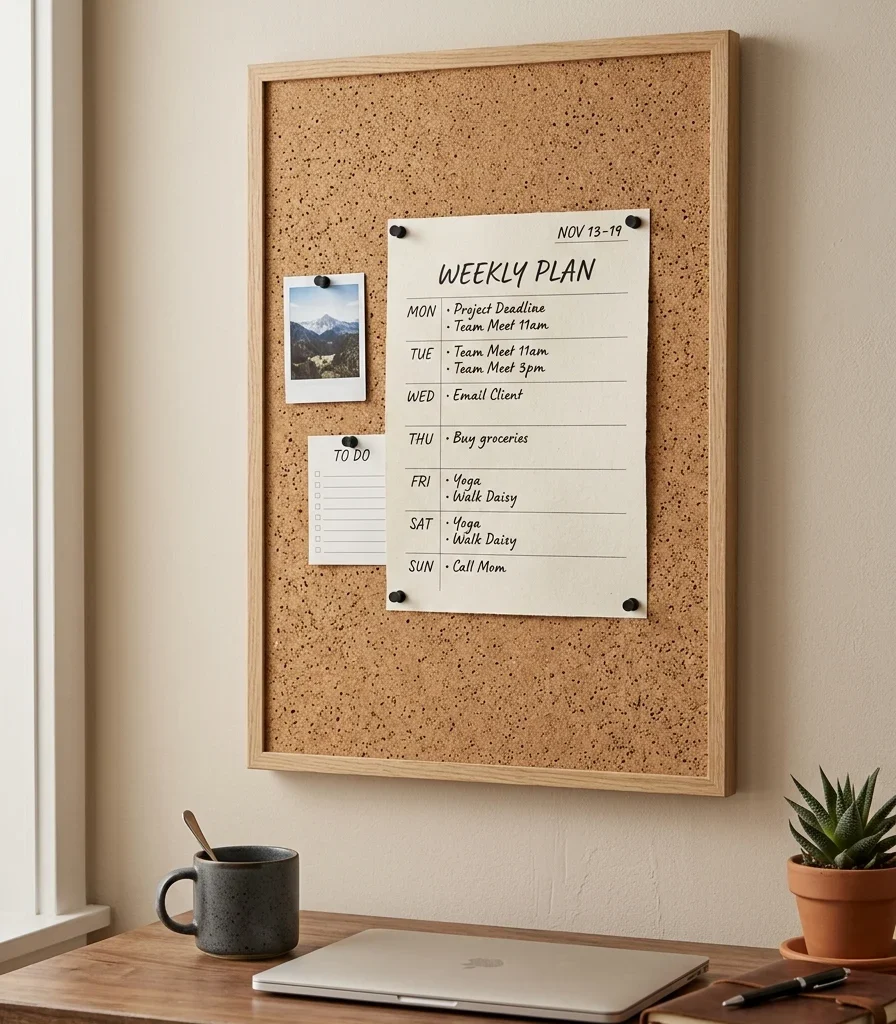
Vibe: Hushed, a soft, textured surface that holds the week’s loose papers off the desk entirely.
Why it works: A framed cork board applies material honesty to a category typically sold in bright plastic frames or unfinished black cork. Wrapping the board in a thin oak frame lets it match the room’s other wood tones while giving loose notes, reminders, and mail a dedicated wall home instead of a growing desk pile.
How to get it: Mount a 24×36-inch cork board in a thin oak frame beside (not above) the monitor so it doesn’t interfere with sightlines, and limit pinned items to the current week’s essentials rather than letting it accumulate indefinitely.
Shop the Look
| Product |
| Natural cork board oak frame |
| Matte black push pin set |
| Small printed weekly planner card |
| Oak wood frame trim |
| Cork board mounting hardware |
12. Match Bookend and Binder Spines for a Cohesive Shelf
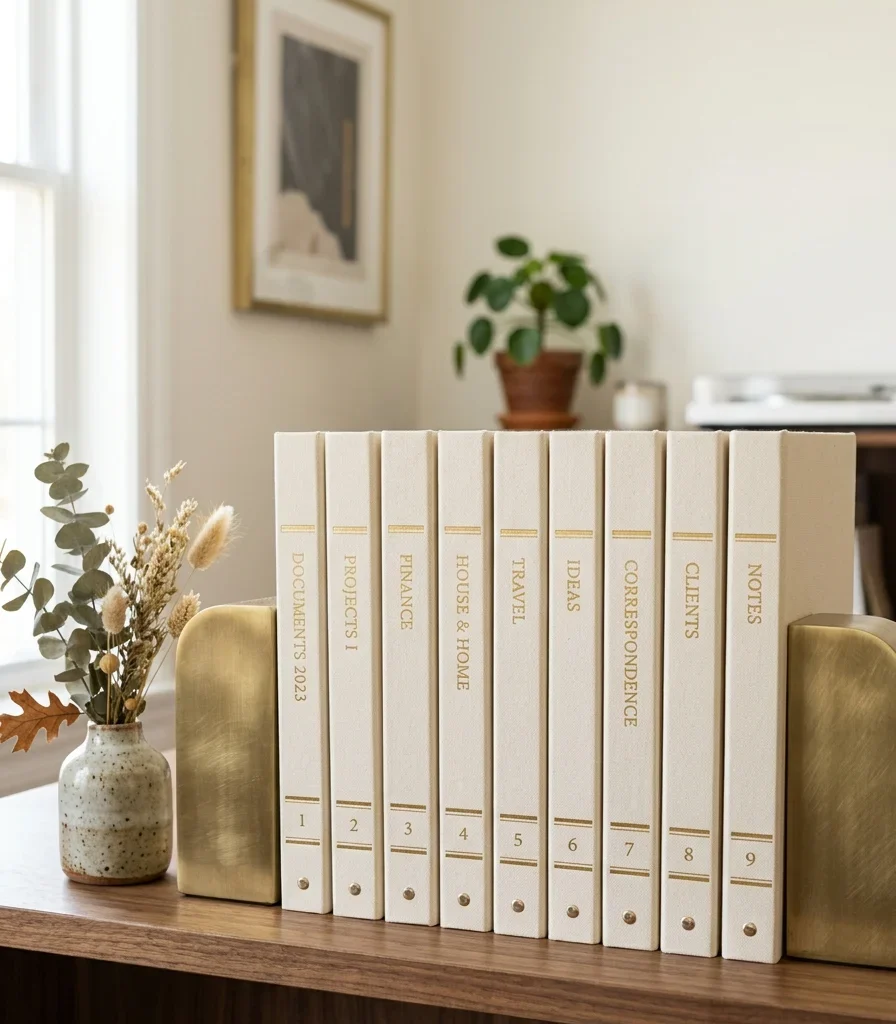
Vibe: Cohesive a shelf of reference materials that reads as one organized system instead of a mismatched stack.
Why it works: Uniform binder spines and matching bookends apply a visual-consistency principle to reference storage; mismatched binder colors and brands create visual noise that makes a shelf look cluttered even when its actual organization inside each binder is sound, while a matched set signals order at a glance before anyone opens a single one.
How to get it: Replace mismatched binders with one uniform set in the same color and spine width, labeling each spine with a printed label rather than handwriting, and bookend the row with a matched pair to keep the binders upright without leaning.
Shop the Look
| Product |
| Matching binder set warm cream |
| Matte brass bookend pair |
| Printed spine label set |
| Small ceramic vessel |
| Walnut wood shelf |
13. Add Floating Shelves to Clear the Floor
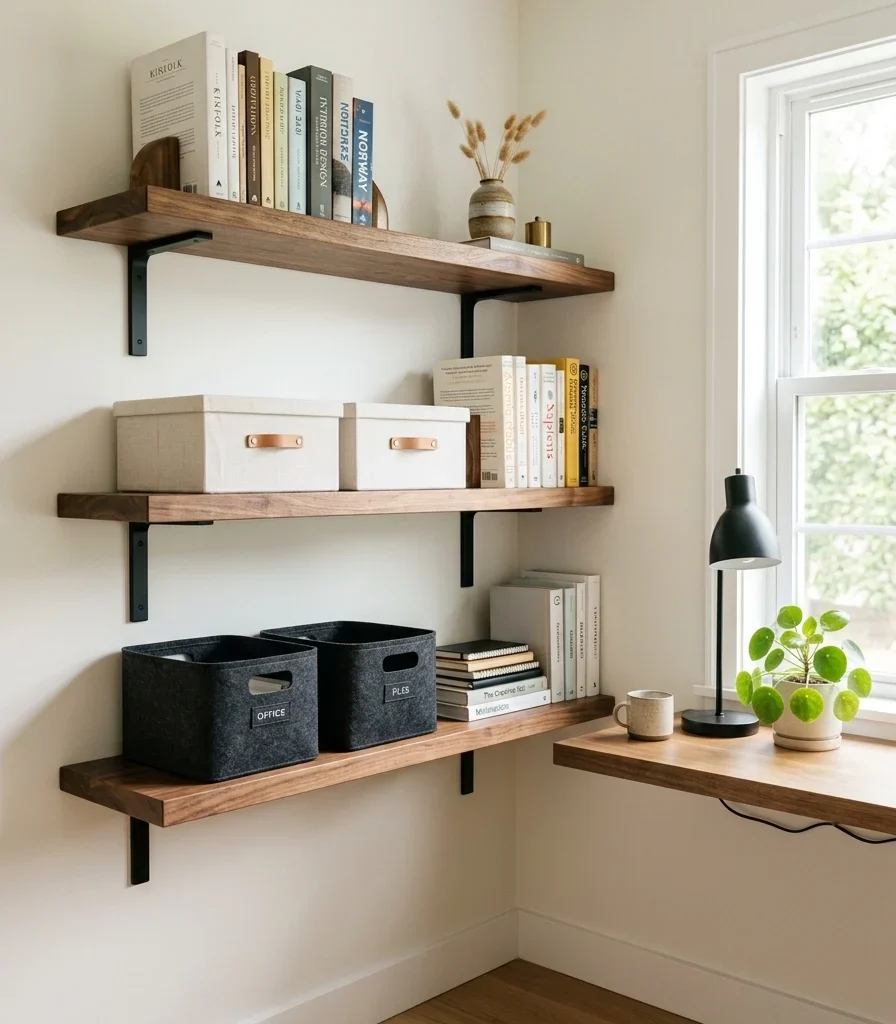
Vibe: Airy storage that adds real capacity without a single floor-standing bookcase eating into the room’s walking path.
Why it works: Floating shelves reduce visual mass at floor level, a negative-space principle that matters directly in a small office where a floor-standing bookcase’s legs and base interrupt the sightline across an already tight room; mounted shelves let the eye travel across open floor uninterrupted.
How to get it: Mount floating shelves on concealed brackets rated for at least 30 lbs per shelf, spacing them 10–12 inches apart vertically, and keep the floor beneath entirely clear of boxes or baskets to preserve the open-floor effect the shelves are meant to create.
Shop the Look
| Product |
| Floating walnut shelf set |
| Concealed shelf bracket rated |
| Small ceramic decorative vessel |
| Book storage box set |
| Small wood bookend |
14. Zone the Office by Task: Work, Reference, Supplies
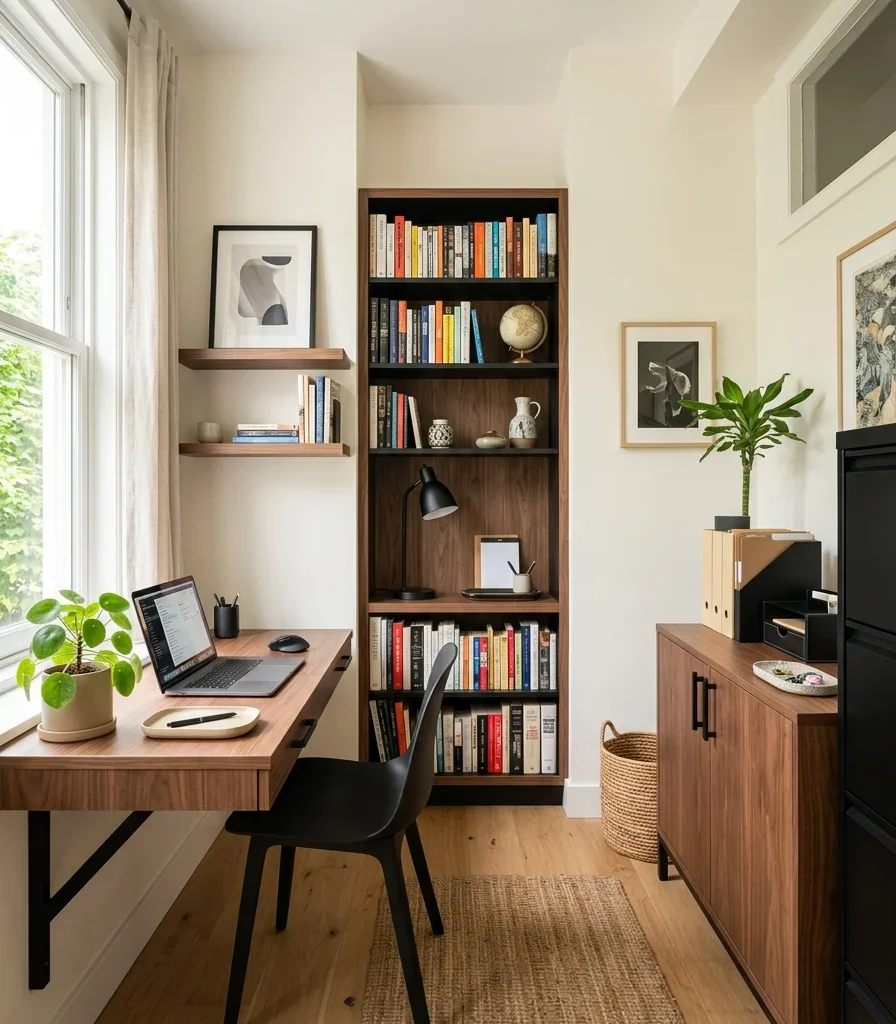
Vibe: Airy, a small room that still manages to separate active work from reference and supply storage.
Why it works: Zoning by task is a layout principle that prevents the most common small-office organizational failure: a single desk trying to hold active work, reference materials, and loose supplies all at once, which guarantees clutter regardless of how tidy any individual system is, since everything competes for the same surface.
How to get it: Assign the desk itself exclusively to active work, move reference binders and books to a nearby shelf, and route supplies to a cabinet or drawer tower at least a few feet away, so each zone’s location matches its specific function rather than defaulting everything to arm’s reach of the chair.
Shop the Look
| Product |
| Zoned storage label set |
| Small ceramic tray per zone |
| Walnut reference shelf |
| Matte black hook set |
| Supply cabinet organizer bin |
15. Use Felt-Lined Drawer Dividers for the Desk
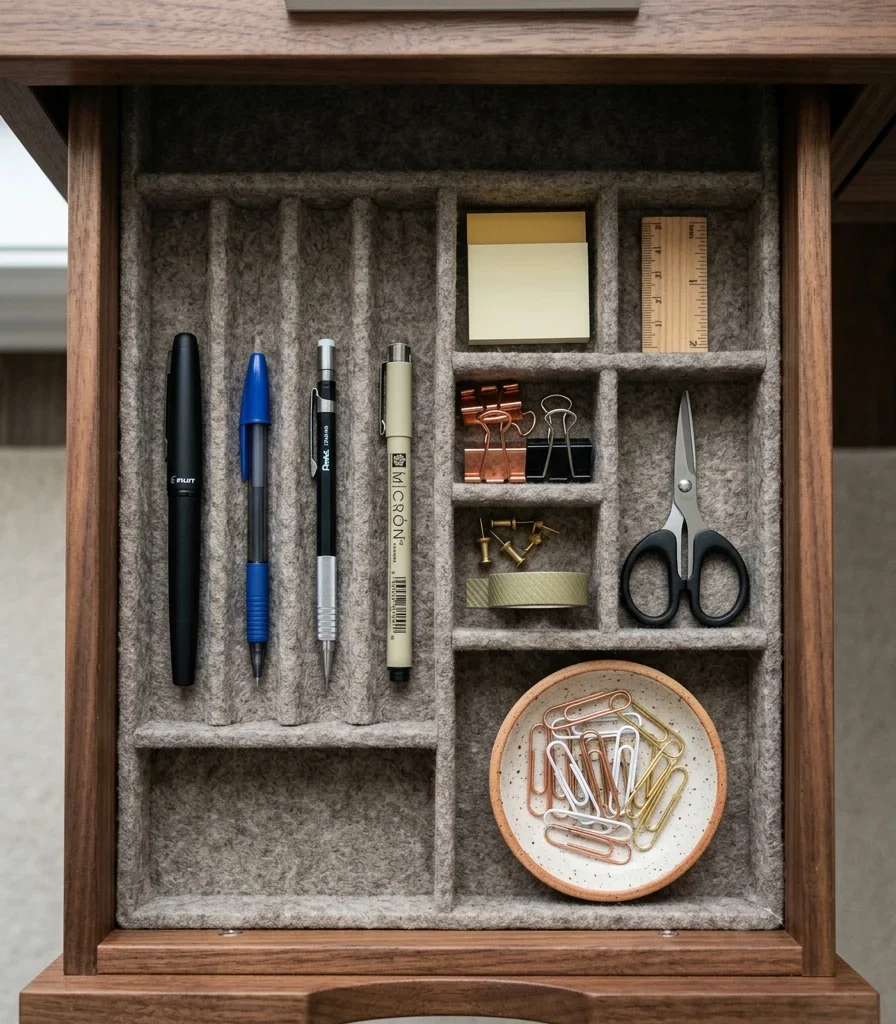
Vibe: Still a drawer where every pen, clip, and stamp has its own compartment instead of sliding loose.
Why it works: Felt dividers apply the same organizational logic as the labeled jars, but inside a drawer where visibility matters less than physical separation. Without dividers, small desk drawer contents shift and mix every time the drawer opens and closes, undoing whatever sorting was done the last time.
How to get it: Choose a felt divider tray sized to the drawer’s exact interior dimensions (measure before ordering, since even a half-inch gap lets the tray shift), with compartment sizes matched to what the drawer actually holds rather than a generic uniform grid.
Shop the Look
| Product |
| Felt drawer divider tray |
| Small ceramic paperclip dish |
| Desk drawer organizer insert |
| Pen and pencil felt slot tray |
| Small drawer liner felt |
16. Paint Walls Warm White to Make a Small Office Feel Larger
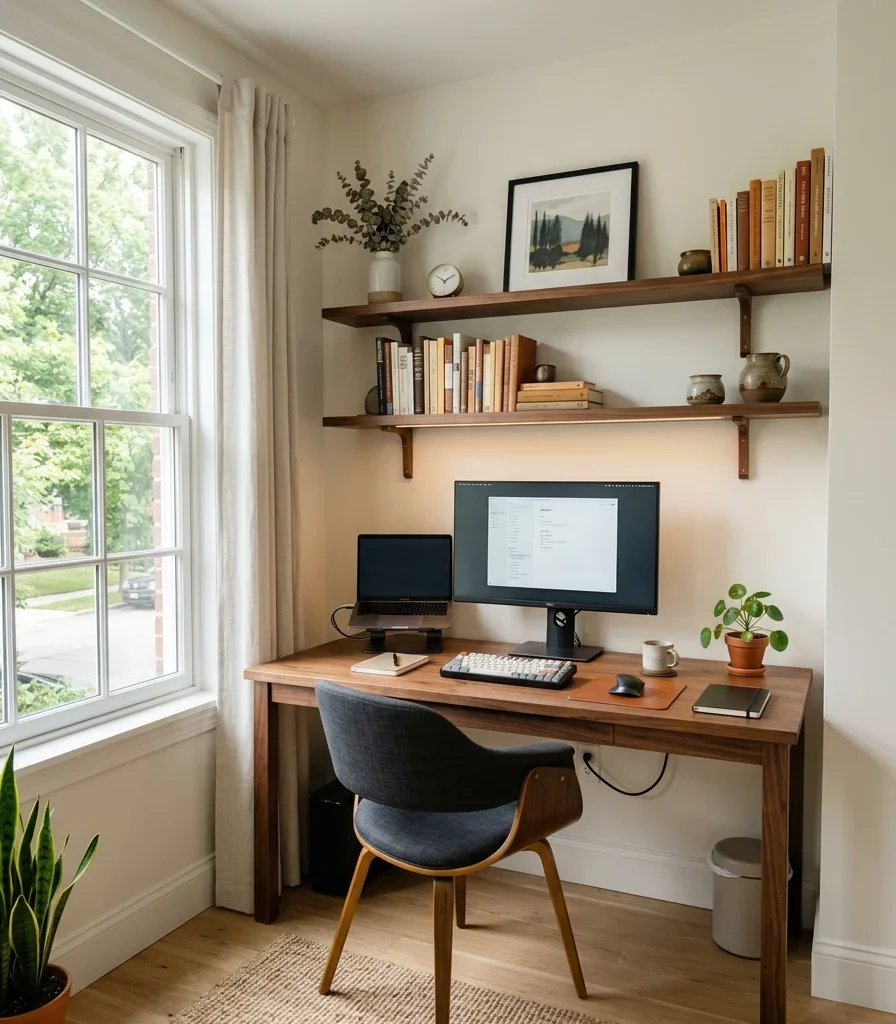
Vibe: Fresh, a room bright enough that even a heavily organized wall of storage doesn’t feel closed in.
Why it works: Warm white walls apply a light-reflectivity principle that matters proportionally more in a small, storage-dense room. Every organizational system added to the walls (shelves, cabinets, pegboards) adds visual mass, and a light, reflective wall color offsets that mass by bouncing available daylight back into the room rather than absorbing it.
How to get it: Choose a warm white with a soft yellow undertone (avoid a stark, blue-based white, which can look clinical under desk lighting), applying it to every wall except any single storage-wall accent covered in an earlier idea.
Shop the Look
| Product |
| Warm white matte wall paint |
| Small framed abstract print |
| Walnut wood picture frame |
| Warm white LED ceiling bulb |
| Painter’s tape edge trim |
17. Add a Motion-Sensor Light for a Hidden Supply Nook
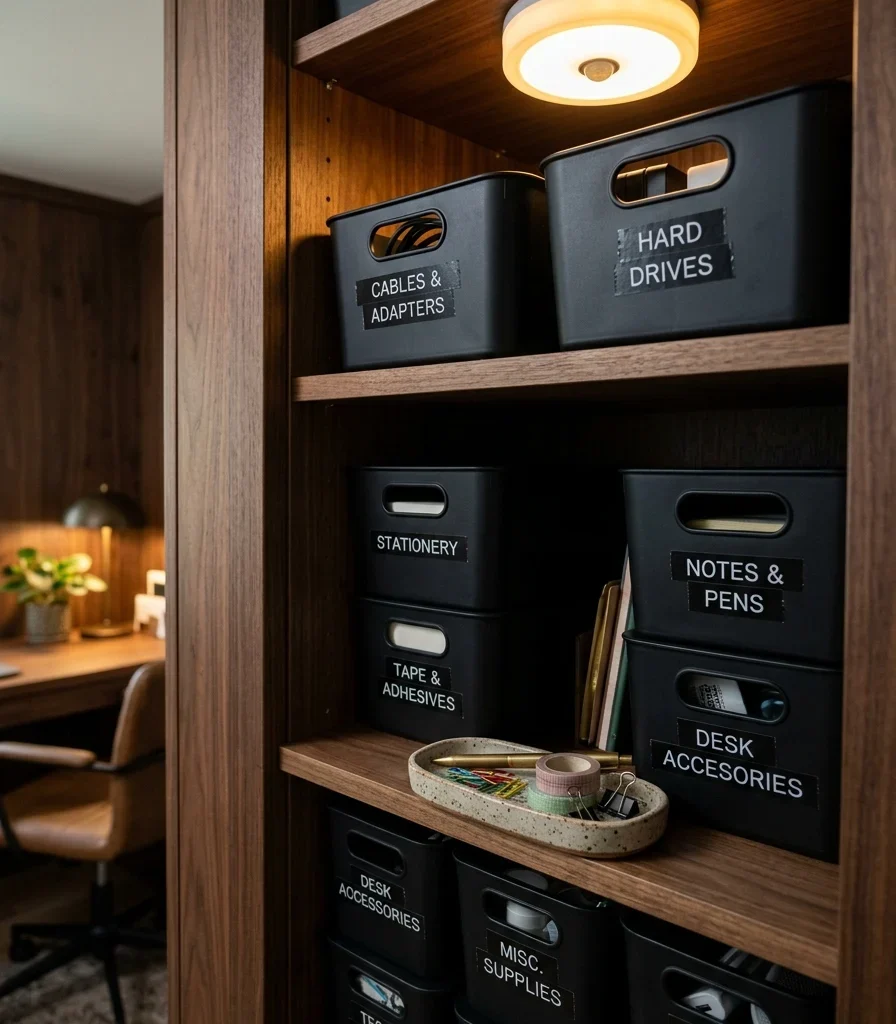
Vibe: Functional supply nook that lights itself the moment you reach for something, no fumbling for a switch.
Why it works: A motion-sensor light removes the last friction point in an otherwise well-organized closet or nook; even a perfectly labeled system gets used less consistently if finding anything requires groping in the dark first, so automatic lighting keeps the nook’s organization actually functional rather than just theoretically sound.
How to get it: Install a battery-powered motion-sensor LED puck light inside the nook at the top corner facing downward, and pair it with matching labeled bins so the light immediately reveals a legible system rather than a jumble.
💡 Quick Win: A single stick-on motion light under $15 solves the visibility problem in any dark cabinet or closet immediately.
Shop the Look
| Product |
| Motion sensor LED puck light |
| Battery-powered stick-on light |
| Labeled storage bin set |
| Small ceramic tray |
| Bin label tag set |
18. Add a Cable and Cord Organizer Tray
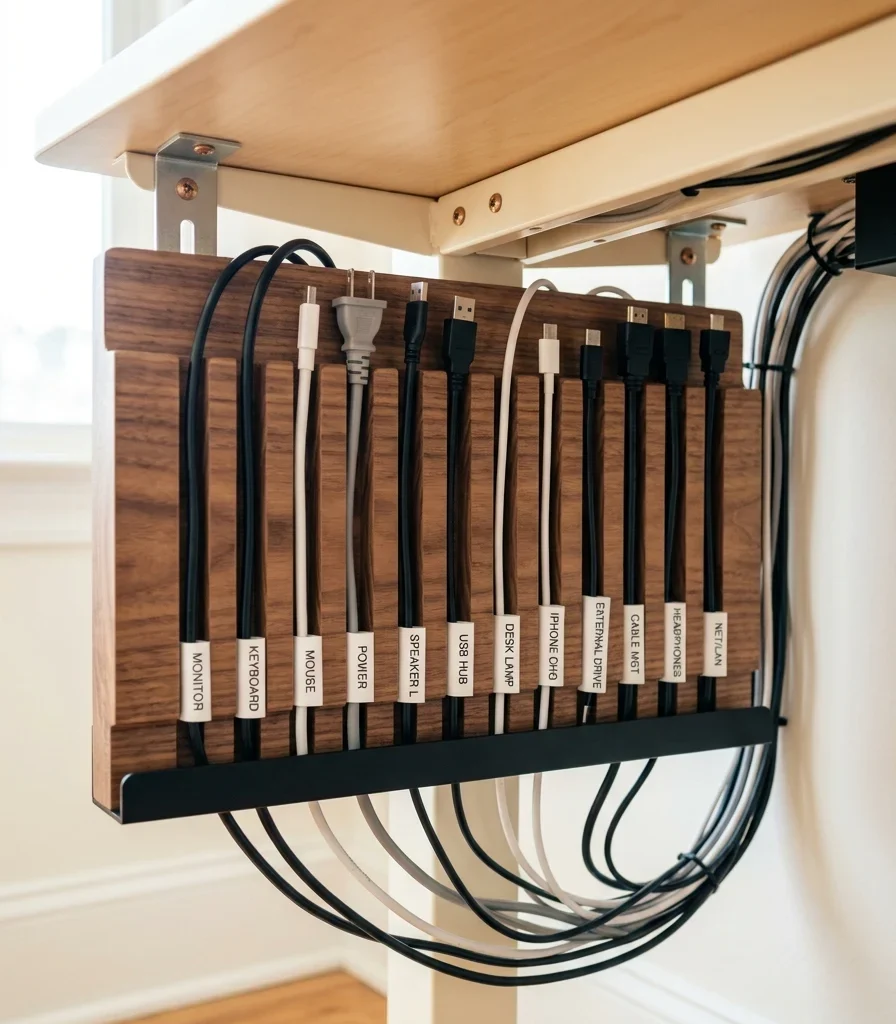
Vibe: Tidy cords with a fixed, visible path instead of drifting loose across the floor or desk edge.
Why it works: Cable clutter is a specific organizational failure unique to home offices, and an under-desk tray routes power strips and charging cables below the visible work surface, which matters because visual clutter in peripheral vision has been shown to draw low-level attention even when a person isn’t consciously looking at it.
How to get it: Mount a tray sized to hold the desk’s power strip plus at least two device cables, positioned close enough to the wall outlet that cords don’t stretch taut, and label each cable at both ends so troubleshooting doesn’t require untangling the whole tray.
Shop the Look
| Product |
| Walnut under-desk cable tray |
| Cable label tag set |
| Velcro cable tie set |
| Power strip surge protector |
| Cable sleeve organizer |
19. Position Storage Within Arm’s Reach of the Desk
Vibe: Still workspace where nothing requires actually getting up out of the chair to retrieve.
Why it works: Arm’s-reach placement is a traffic-flow and ergonomics principle that determines whether an organizational system actually gets used daily. Storage that requires standing and walking across the room, even a short distance, gets skipped under time pressure, which is how organized systems quietly break down within a few weeks of being set up.
How to get it: Arrange daily-use storage (pens, current files, chargers) within a seated arm’s reach of roughly 24–30 inches from the chair, reserving anything requiring a stand-up retrieval for archival or rarely used items only.
Shop the Look
| Product |
| Swivel desk organizer caddy |
| Small ceramic desk tray |
| Walnut reach shelf mount |
| Rolling file cart nearby |
| Matte black desk hook |
20. Add a Fold-Away Storage Cabinet for a Multi-Use Room
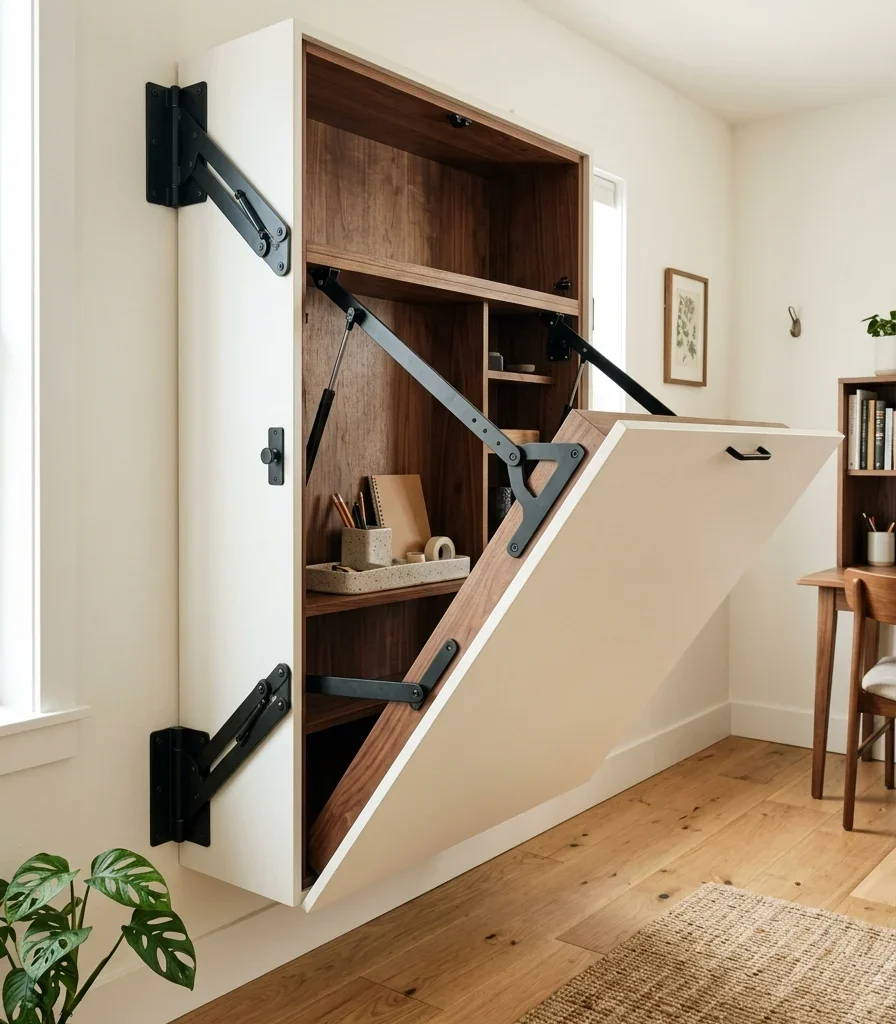
Vibe: Functional office storage that folds away entirely when the room needs to become something else.
Why it works: In a genuinely small room shared with another function, a guest bedroom or playroom fold-away cabinet is the small-space adaptation that keeps office organization from permanently claiming floor space the room needs for its other role, folding flat against the wall to reclaim that footprint instantly.
How to get it: Choose a wall-mounted cabinet with a fold-flat hinge mechanism rated for the weight of fully loaded shelves, and organize its interior with the same labeled bins and dividers covered in earlier ideas so the system stays functional every time it’s unfolded.
💡 Quick Win: A single fold-down wall desk with built-in cubbies combines workspace and storage in one foldable unit for the tightest multi-use rooms.
Shop the Look
| Product |
| Fold-away wall mounted cabinet |
| Fold-down wall desk with cubbies |
| Labeled storage bin set |
| Small ceramic interior organizer |
| Matte black fold hinge hardware |
How to Start Improving Your Small Office Organization
Your first move is doing a full paper and supply audit before buying any storage furniture, specifically, gathering every loose paper, cable, and supply currently in the room into one pile so you can see the actual volume you’re organizing for. Buying furniture before this step means guessing at capacity, which is how most home offices end up with either too little storage or bulky pieces that don’t match what they actually needed to hold.
The most common mistake is buying decorative storage baskets or bins before deciding what specific category will live in each one, which leads to mismatched sizes and items migrating back out onto visible surfaces within weeks. The fix is assigning a category to each container first, then measuring and buying to fit that specific need.
Three items under $50 that create immediate impact: a set of labeled matte ceramic jars for small supplies, a felt drawer divider tray sized to your desk drawer, and a stick-on motion-sensor light for any dark cabinet or nook.
A weekend refresh of jars, dividers, and cable management costs $80–250. A full organizational overhaul with a filing tower, floating shelves, and a fold-away cabinet typically runs $400–1,500 and can be completed in one to two weekends.
Frequently Asked Questions About Small Office Organization
What is the difference between organizing and decorating a small home office?
Decorating a small home office focuses on how storage looks: matching baskets, styled shelves, coordinated colors. Organizing focuses on function first: assigning every item a specific, labeled home and placing it within arm’s reach of where it’s actually used, with decoration applied only after the functional system is settled.
What color works best for small office storage?
Warm charcoal or matte black works best for a dedicated storage wall, since darker tones visually recede rather than dominate a small room, while warm white on the remaining walls keeps the overall space feeling open. Matching cabinet color exactly to wall color is the specific technique that keeps a large volume of storage from feeling heavy.
How much does it cost to organize a small home office?
A budget refresh using labeled jars, drawer dividers, and cable management costs $80–250. A mid-range upgrade with a filing tower and floating shelves runs $400–900, and a full organizational renovation including built-in cabinetry and a fold-away storage wall typically costs $1,500–3,500 depending on custom carpentry.
Can a shared or multi-use room still support real office organization?
Yes, a fold-away wall cabinet or a rolling file cart that tucks fully under the desk lets office storage disappear when the room needs to serve another purpose, preserving genuine organizational function without permanently claiming floor space the room needs for its other role.
What is the single most important organizational habit for a small office?
Keeping daily-use items within arm’s reach of the desk chair matters most, since storage requiring a stand-up retrieval gets used inconsistently under time pressure, which is how even a well-designed organizational system quietly breaks down within the first few weeks of daily use.
Ready to Improve Your Small Office Organization?
These 20 ideas move across material, color, lighting, layout, and true small-space solutions from a walnut filing tower and labeled ceramic jars to a fold-away cabinet that reclaims the room the moment office hours end. None of this needs to happen all at once, and starting with a paper audit and one labeled jar set is genuinely the smartest place to begin, not a smaller version of the full system. Today’s specific action: gather every loose paper and supply currently scattered across your desk into one pile, since that pile will tell you exactly which idea on this list to tackle first. Once every item finally has a fixed, labeled home, sitting down to work will feel less like managing clutter and more like everything simply being exactly where you left it. Save the ideas that fit your room’s real dimensions and your actual daily habits; that labeled filing tower and arm’s-reach supply system will still be doing their job just as well a year from now.