
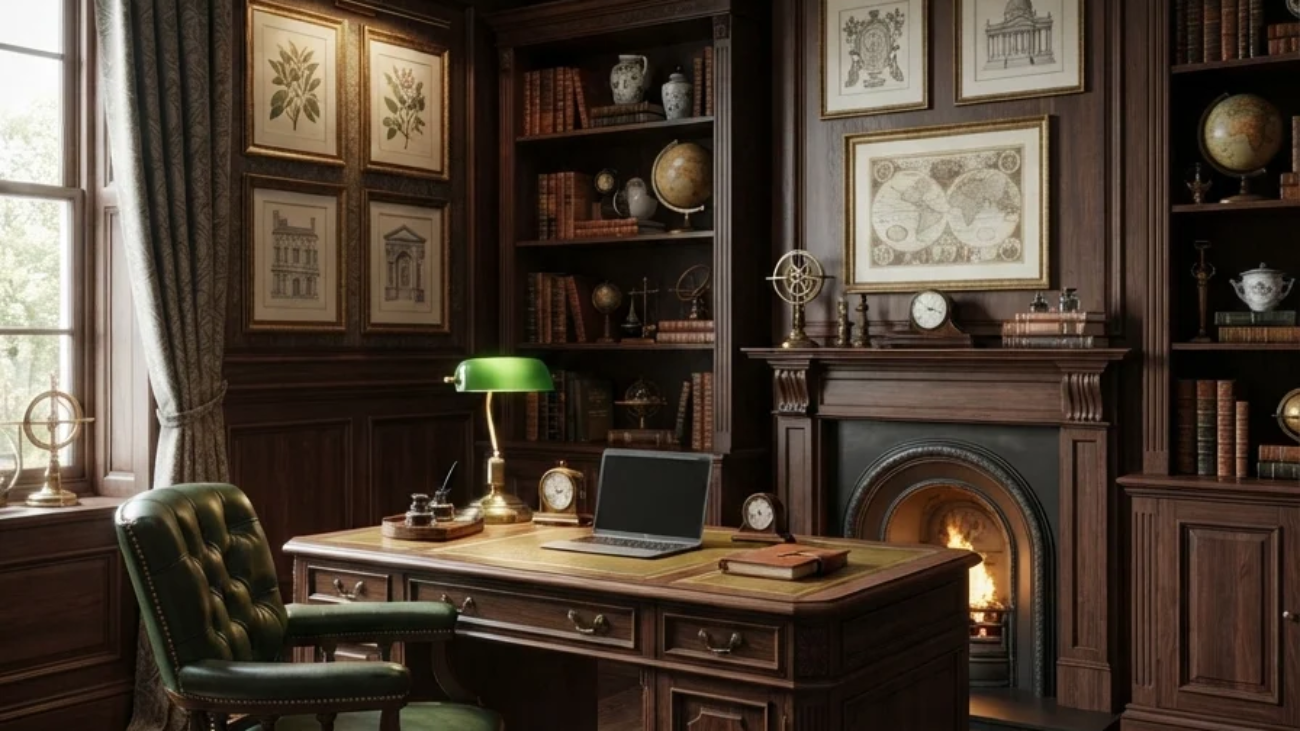
Victorian style home office design combines the ornate craftsmanship, rich materials, dramatic color, and layered atmosphere of 19th-century interiors with the practical requirements of modern work. These 19 Victorian-style home office ideas show you how to create a workspace with character through dark wood, period-inspired lighting, patterned walls, antique details, intelligent storage, and comfortable modern function.
The room should feel substantial when you enter it: warm timber beneath your hands, brass catching a low pool of lamplight, books rising toward the ceiling, and patterned walls giving the background enough depth to hold your attention. Victorian interiors were rarely visually empty, but their richness came from relationships between materials rather than from simply filling every surface. A modern office can borrow that richness while quietly hiding chargers, monitors, paperwork, and everyday clutter. The result feels scholarly, collected, and slightly atmospheric without becoming a theatrical reproduction of a Victorian parlor. Here are 19 ideas worth saving and stealing.
Why Victorian Style Home Office Works So Well
Victorian interior design developed during Queen Victoria’s reign from 1837 to 1901, absorbing Gothic Revival, Arts and Crafts precursors, industrial manufacturing, Orientalist influences, and historic European decorative traditions. The Victorian home office or study evolved alongside expanding literacy, clerical work, libraries, correspondence, and professional life, making the writing desk, bookcase, reading chair, and task lighting natural components of the period’s domestic interiors. Its defining quality is layered richness rather than one rigid furniture formula.
Core materials include dark-stained oak, walnut, mahogany, leather, wool, velvet, brass, cast iron, ceramic, glass, and patterned wallpaper. Useful colors include oxblood, bottle green, deep teal, tobacco brown, warm cream, charcoal, muted mustard, and burgundy. Pattern should feel historically plausible: small-scale botanical wallpaper, damask, paisley, herringbone, ticking, Persian-inspired rugs, and subtle stripes all work better than oversized contemporary graphics.
Style at a Glance
| Element | Victorian Style Home Office |
| Philosophy | Layered craftsmanship, scholarship, warmth |
| Key Materials | Walnut, oak, leather, brass, wool, velvet |
| Key Colors | Oxblood, bottle green, tobacco, cream, deep teal |
1. Make a Walnut Writing Desk the Hero
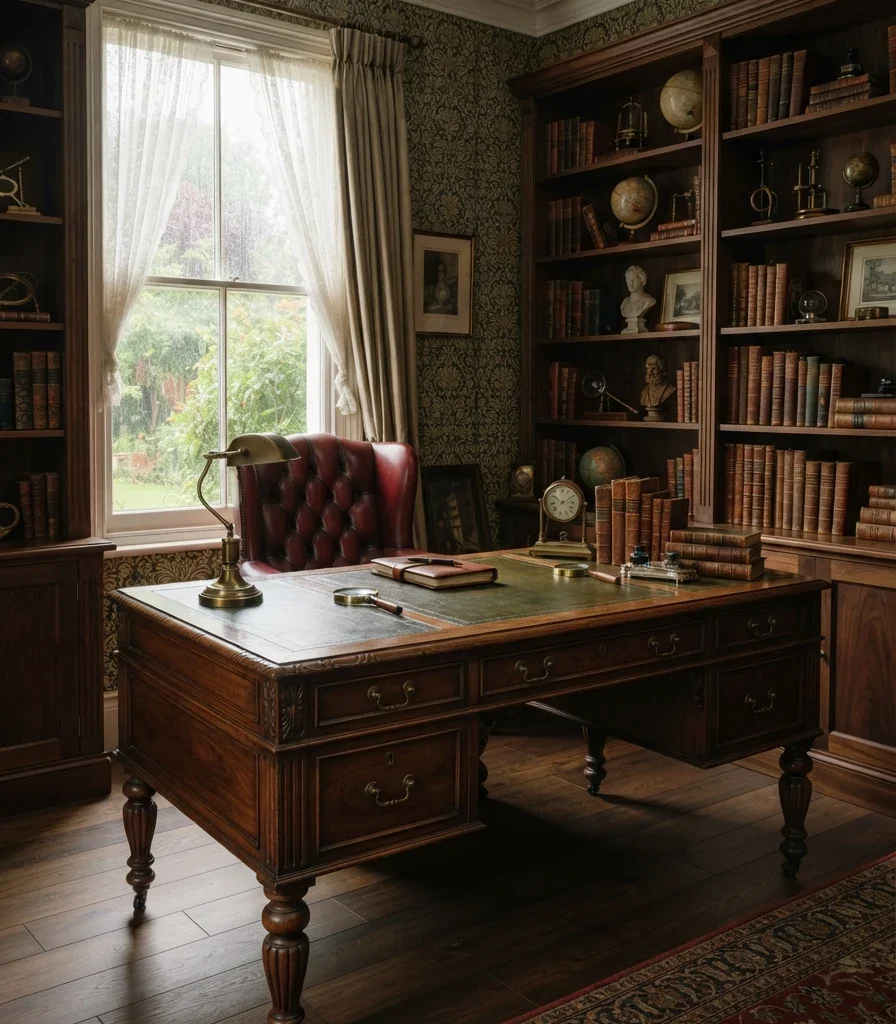
Vibe: Scholarly. The desk immediately establishes the room as a serious place for concentrated work.
Why it works: A Victorian writing desk relies on visual weight and craftsmanship rather than minimalist geometry. Dark walnut creates a deep anchor against patterned walls, while brass hardware introduces small points of reflection. The leather writing surface also adds material contrast, making the desk feel tactile rather than visually flat.
How to get it: Choose a desk with substantial legs, drawers, and a warm walnut or mahogany finish, then keep the desktop approximately 60% clear. A leather writing pad can supply the period character even when the underlying desk is contemporary.
💡 Quick Win: Add a dark brown leather desk mat and antique-brass drawer pulls to an existing wooden desk before replacing the furniture.
Shop The Look
| Product | Search on Amazon |
| Writing desk | Victorian walnut writing desk with drawers |
| Leather desk mat | Brown full grain leather desk pad |
| Drawer pulls | Antique brass furniture drawer pulls |
| Desk blotter | Dark green leather writing desk blotter |
| Pen tray | Vintage brass rectangular desk tray |
2. Use Bottle Green as the Dominant Wall Color
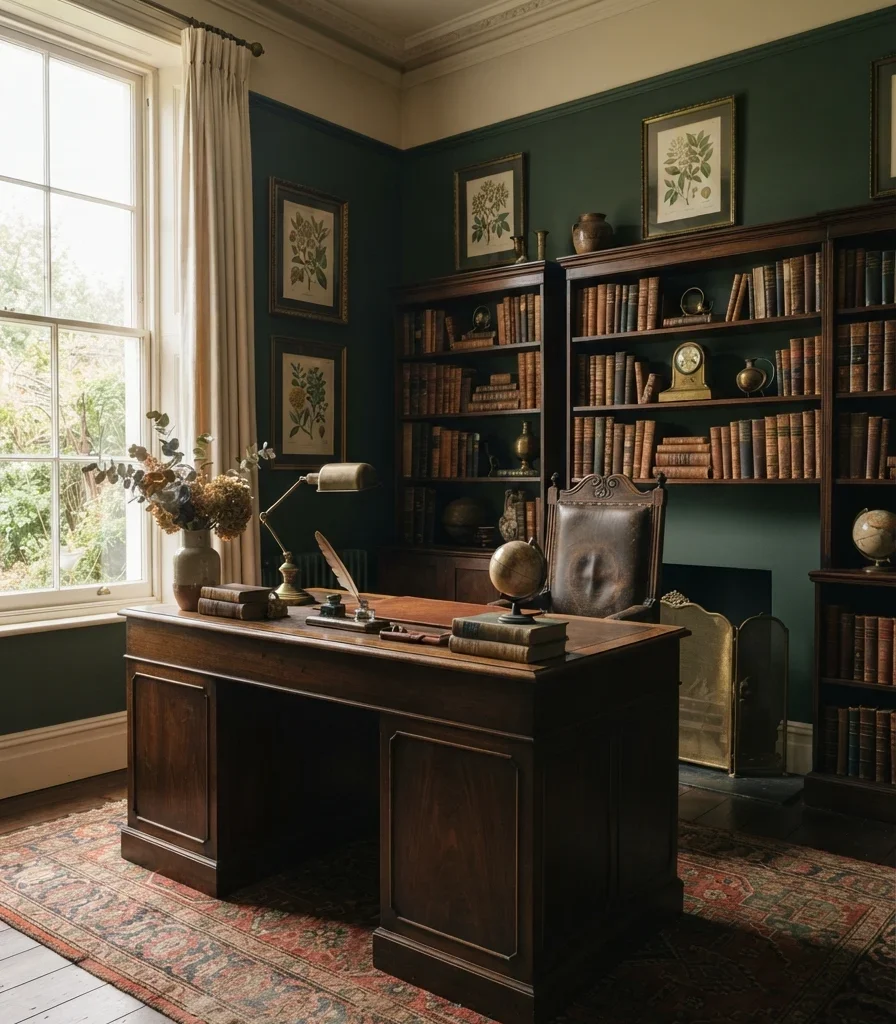
Vibe: Immersive. The walls create a cocooning background that encourages sustained attention.
Why it works: Deep green has enough visual weight to support dark Victorian timber while remaining connected to botanical and natural references. A matte finish absorbs rather than reflects excessive light, which helps brass, paper, and wood become the brighter points within the composition. Warm ivory on the ceiling prevents the darker palette from becoming visually compressed.
How to get it: Paint the four walls in a deep bottle or forest green with a low-sheen matte finish, then keep the trim one or two values lighter. If the room receives little daylight, use a slightly warmer green with a yellow or olive undertone.
Shop The Look
| Product | Search on Amazon |
| Wall paint | Deep bottle green matte interior paint |
| Paint brush | 2-inch angled professional trim brush |
| Picture frames | Antique brass vintage picture frames |
| Green curtains | Dark forest green velvet curtain panels |
| Wall art | Victorian botanical print set |
3. Install a Traditional Brass Desk Lamp
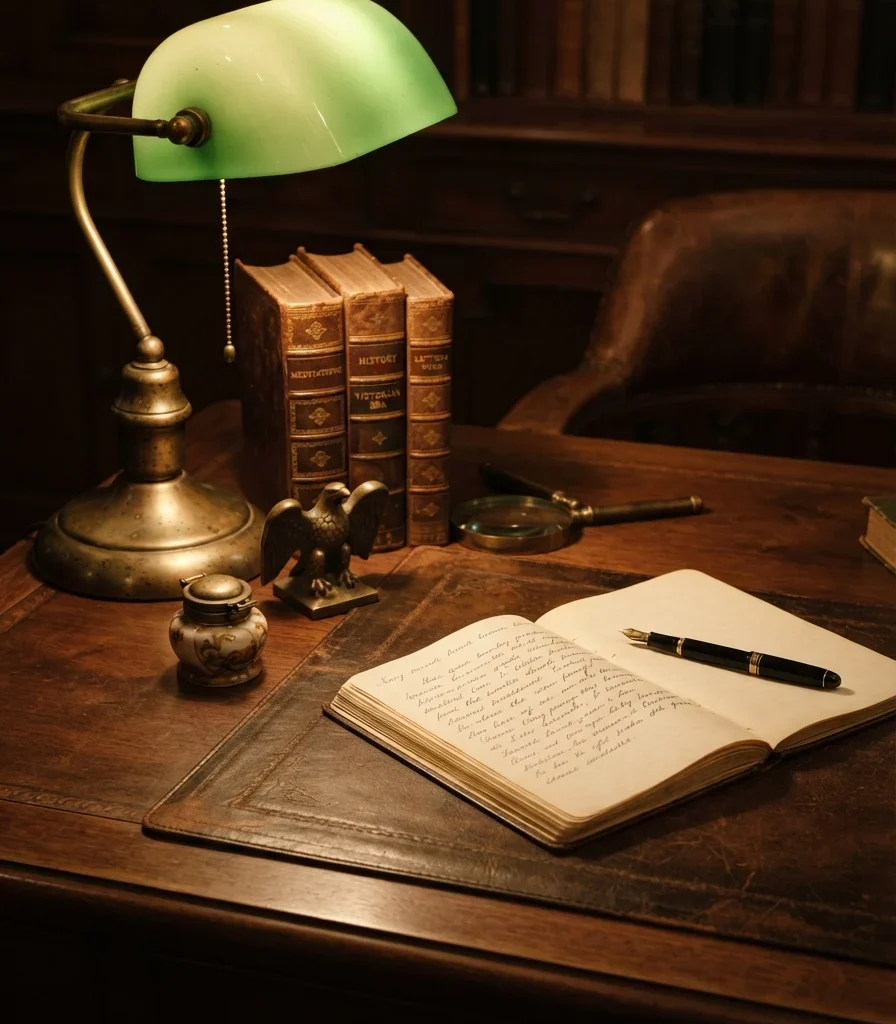
Vibe: Luminous. The concentrated pool of warm light makes work feel deliberate.
Why it works: Victorian offices relied heavily on localized illumination, and a desk lamp continues that logic beautifully. The contrast between a dark room and a defined warm task zone creates visual hierarchy while reducing dependence on flat overhead lighting. Aged brass and green glass also echo traditional library fixtures without preventing modern LED performance.
How to get it: Choose an adjustable brass lamp with a weighted base and a green or cream glass shade. Use a warm 2700K bulb for evening work and position the lamp opposite your writing hand to reduce shadows across the desk.
Shop The Look
| Product | Search on Amazon |
| Desk lamp | Antique brass library desk lamp green glass shade |
| LED bulb | 2700K warm white dimmable LED bulb |
| Desk clock | Vintage brass mantel style desk clock |
| Paperweight | Antique brass decorative paperweight |
| Ink pot | Vintage glass and brass ink bottle |
4. Build a Floor-to-Ceiling Library Wall
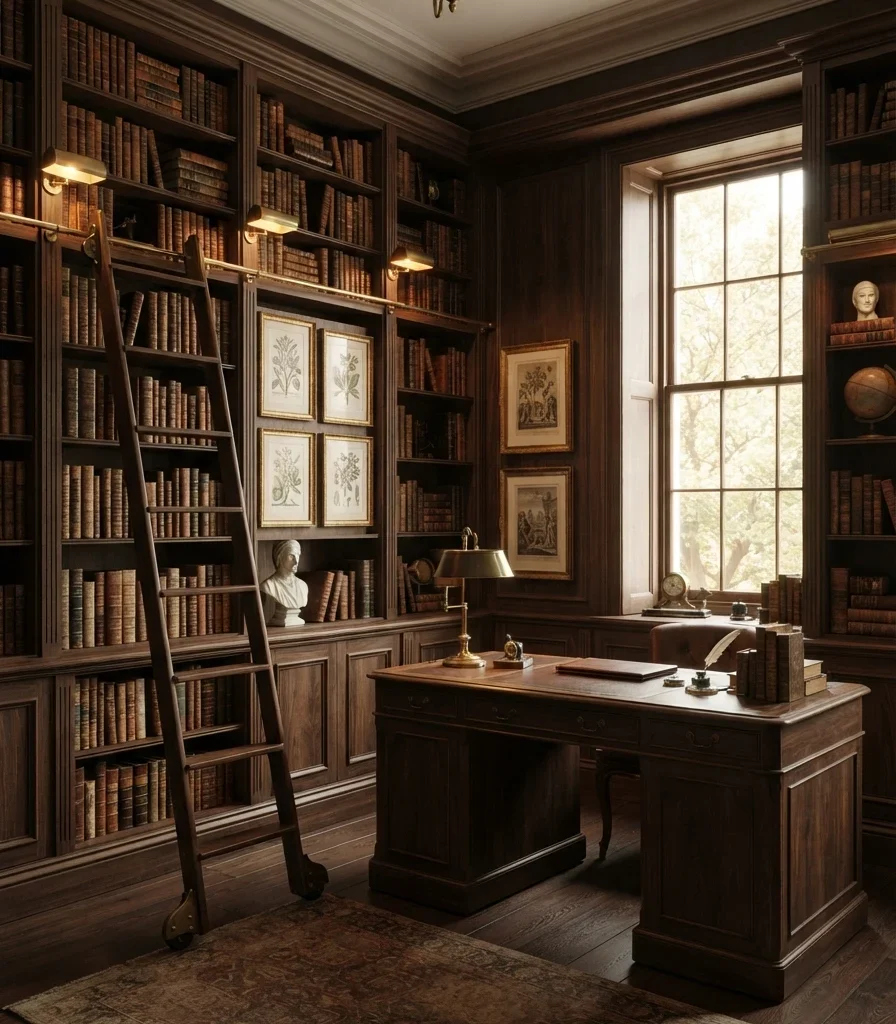
Vibe: Monumental vertical shelving gives the office the visual authority of a private library.
Why it works: Floor-to-ceiling storage uses vertical space while creating a strong architectural frame around the working area. Victorian interiors frequently treated bookshelves as architectural furniture, so the concept feels more authentic than scattering a few freestanding shelves around the room. Repeated dark timber also creates rhythm and visual continuity.
How to get it: Build or position shelving from floor to near-ceiling height and add a simple crown molding strip across the top. Keep the lower shelves for frequently used books and closed storage while reserving eye-level shelves for curated references and decorative objects.
Shop The Look
| Product | Search on Amazon |
| Bookcase | Tall dark walnut library bookcase |
| Shelf lighting | Warm white rechargeable shelf lights |
| Library ladder | Rolling wooden library ladder decorative |
| Bookends | Antique brass Victorian bookends |
| Crown molding | Paintable decorative crown molding strips |
5. Introduce Dark Wood Through Smaller Furniture
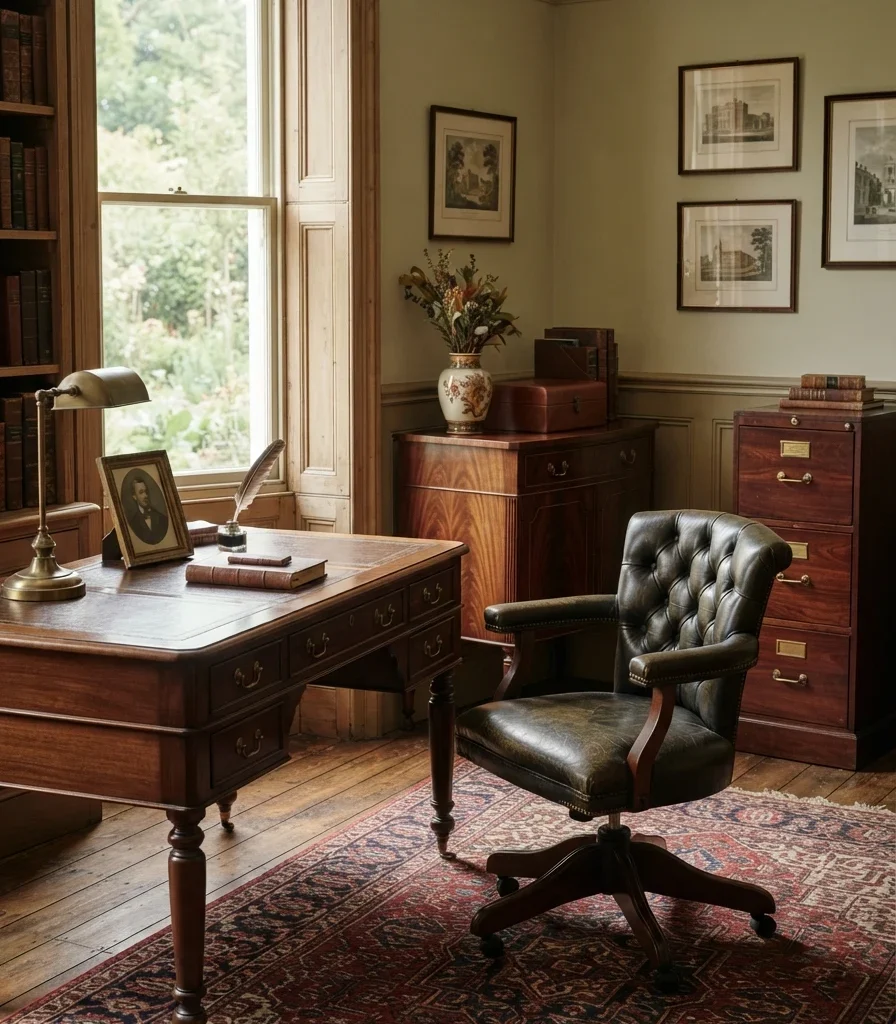
Vibe: Grounded darker timber gives the room permanence without requiring oversized furniture.
Why it works: Victorian furniture depended heavily on wood as both structure and decoration, but using several related pieces at different scales creates a more believable composition than buying a matching suite. Mahogany, walnut, and dark-stained oak can coexist when their undertones are warm, and the finishes are not equally glossy.
How to get it: Introduce dark wood through one secondary cabinet, document chest, or side table instead of replacing every piece. Repeat the same wood tone in a smaller object so the materials feel connected without becoming identical.
💡 Quick Win: Replace a modern metal filing cabinet with a wood-effect document chest or add a walnut veneer top to an existing storage unit.
Shop The Look
| Product | Search on Amazon |
| Side cabinet | Mahogany Victorian style storage cabinet |
| Filing chest | Wooden antique style document filing chest |
| Desk pedestal | Dark walnut rolling file cabinet |
| Valet tray | Walnut leather-lined catchall tray |
| Storage box | Brown faux leather document storage box |
6. Hang Botanical Wallpaper Behind the Desk
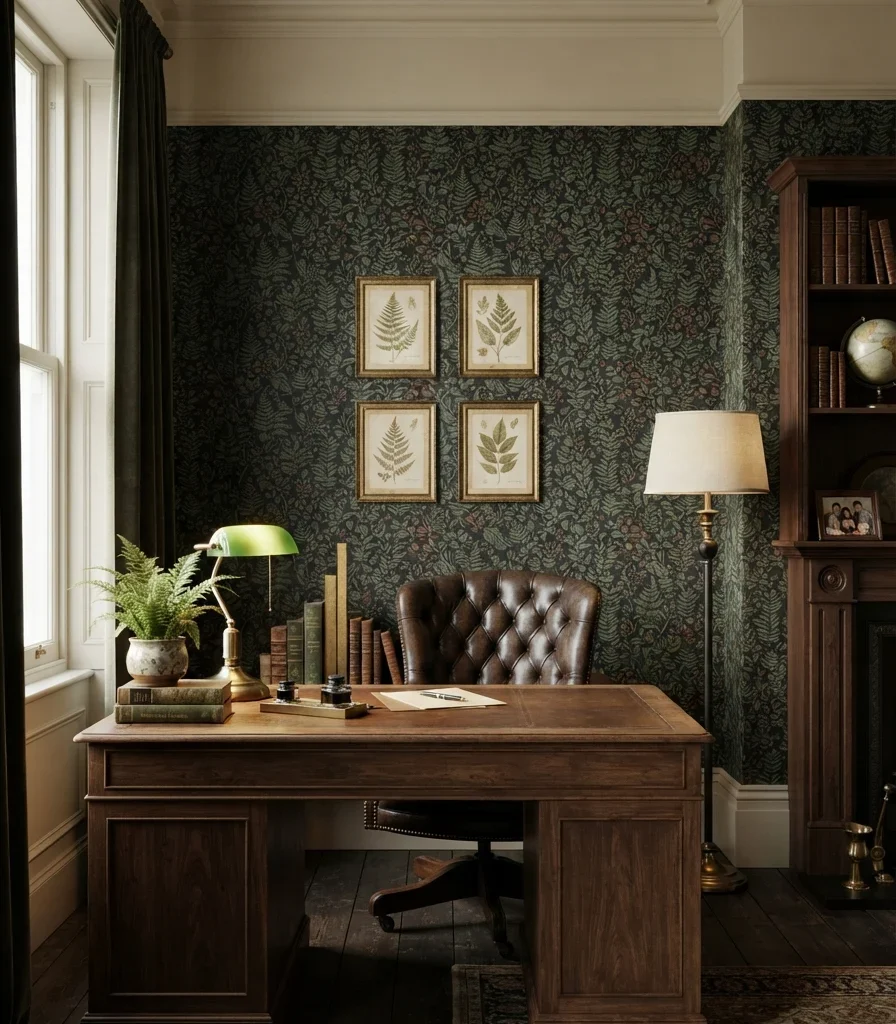
Vibe: Layered; the wall becomes a textured visual field rather than a blank background.
Why it works: Victorian interiors embraced patterned wall surfaces, and botanical motifs provide historical context without requiring elaborate architectural changes. Small-scale patterns create rhythm while darker grounds visually recede, allowing the desk and artwork to sit forward. This is especially effective behind a desk because the wall acts as a deliberate backdrop for video calls and photographs.
How to get it: Select a small or medium botanical repeat rather than oversized leaves. Install it on one focal wall if the room is small, and keep the other walls painted in a related muted tone.
Shop The Look
| Product | Search on Amazon |
| Wallpaper | Dark Victorian botanical peel and stick wallpaper |
| Wallpaper tool | Wallpaper smoothing tool and seam roller kit |
| Wallpaper paste | Heavy-duty removable wallpaper adhesive |
| Desk art | Vintage botanical engraving print |
| Curtain | Tobacco brown velvet curtain panel |
7. Layer a Persian-Style Rug Under the Desk
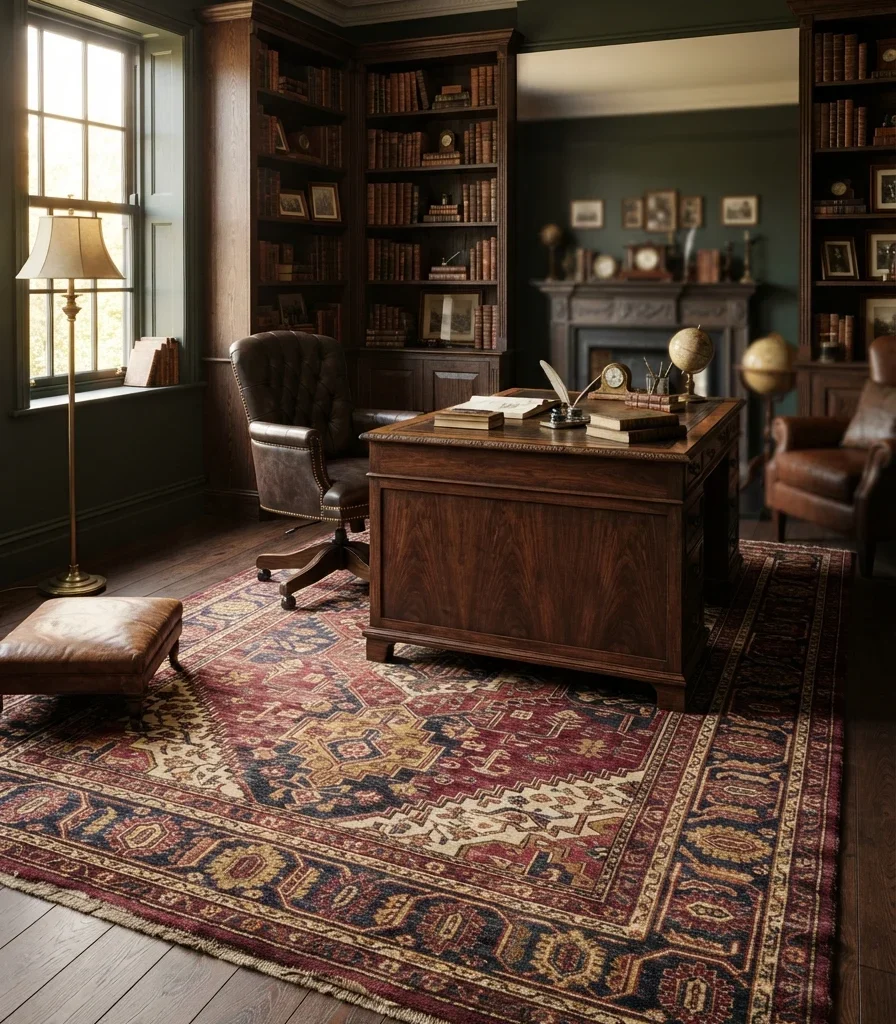
Vibe: Cushioned; the rug makes the workspace feel quieter and more substantial underfoot.
Why it works: Patterned rugs provide color complexity without requiring more wall decoration. A Persian-inspired design echoes the eclectic historic character of Victorian interiors, while wool contributes acoustic softness and tactile warmth. The rug also visually defines the working zone, especially in a larger room shared with a reading area.
How to get it: Choose a rug large enough for the desk chair to remain on its surface when pulled backward. Low-pile wool or washable vintage-style construction is easier to maintain than a thick shag in a rolling-chair workspace.
💡 Quick Win: If a large rug is too expensive, use a 5×7 vintage-style rug under the desk and chair rather than leaving the entire work zone visually undefined.
Shop The Look
| Product | Search on Amazon |
| Area rug | 6×9 Persian vintage wool style office rug |
| Rug pad | Low-profile non-slip rug pad |
| Chair mat | Clear office chair mat for low pile rug |
| Footstool | Leather Victorian style footstool |
| Rug brush | Carpet and upholstery cleaning brush |
8. Choose a Leather Library Chair
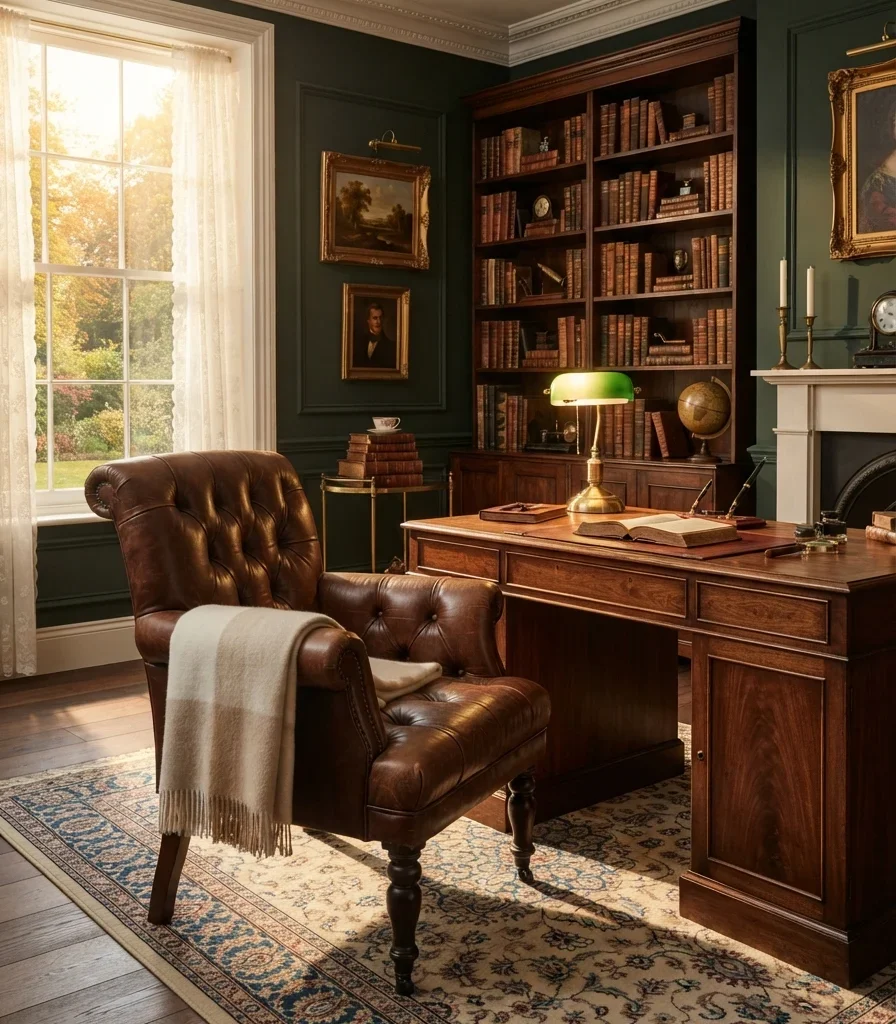
Vibe: Substantial; the chair gives the office a comfortable seat with unmistakable visual weight.
Why it works: Leather and dark timber are naturally compatible because both develop patina with use. A tufted or traditionally shaped chair adds vertical and tactile interest, but modern ergonomic support should still be prioritized for long working sessions. Victorian appearance does not require sacrificing lumbar comfort or adjustable seating.
How to get it: Look for a leather chair with a supportive back, seat depth appropriate to your body, and a firm cushion. If the chair is primarily decorative, place it in a reading zone and use a more ergonomic desk chair for extended computer work.
Shop The Look
| Product | Search on Amazon |
| Office chair | Brown leather Victorian library office chair |
| Lumbar cushion | Dark brown leather lumbar support cushion |
| Footrest | Walnut wood ergonomic office footrest |
| Throw | Oxblood wool throw blanket |
| Side table | Small antique brass round side table |
9. Use Warm Cream to Balance Dark Victorian Colors
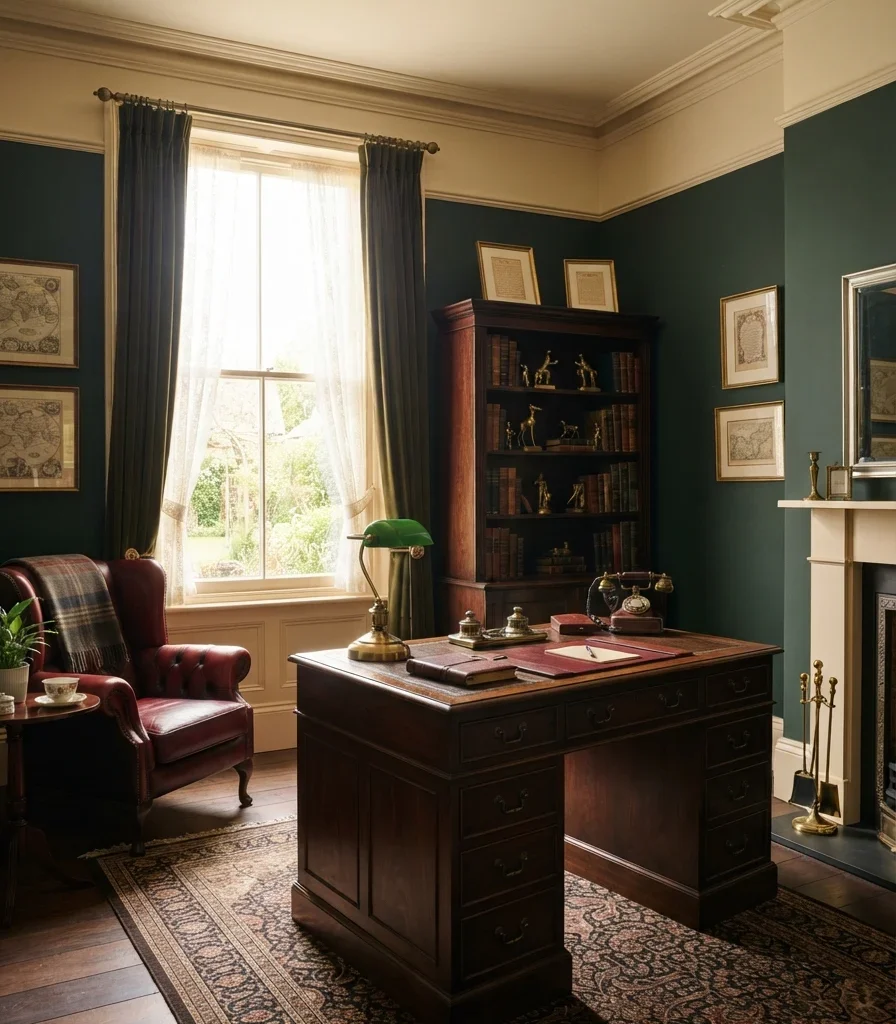
Vibe: Balanced ale architectural surfaces prevent the darker palette from becoming oppressive.
Why it works: Dark Victorian colors become easier to live with when a lighter value interrupts them. Warm cream is more historically compatible with dark wood than stark optical white because its yellow-beige undertone relates to aged paper, plaster, and natural textiles. This contrast also improves daylight reflection without removing the room’s atmosphere.
How to get it: Use warm cream on the ceiling, door, and window trim while allowing the primary walls to remain darker. Avoid cool gray-white trim because the blue undertone can make walnut and brass appear muddy.
Shop The Look
| Product | Search on Amazon |
| Cream paint | Warm ivory cream matte interior paint |
| Trim brush | Fine angled sash paint brush |
| Wall art | Antique parchment botanical wall art |
| Curtains | Cream linen velvet blend curtains |
| Lamp shade | Warm ivory pleated fabric lamp shade |
10. Add an Antique-Style Brass Chandelier
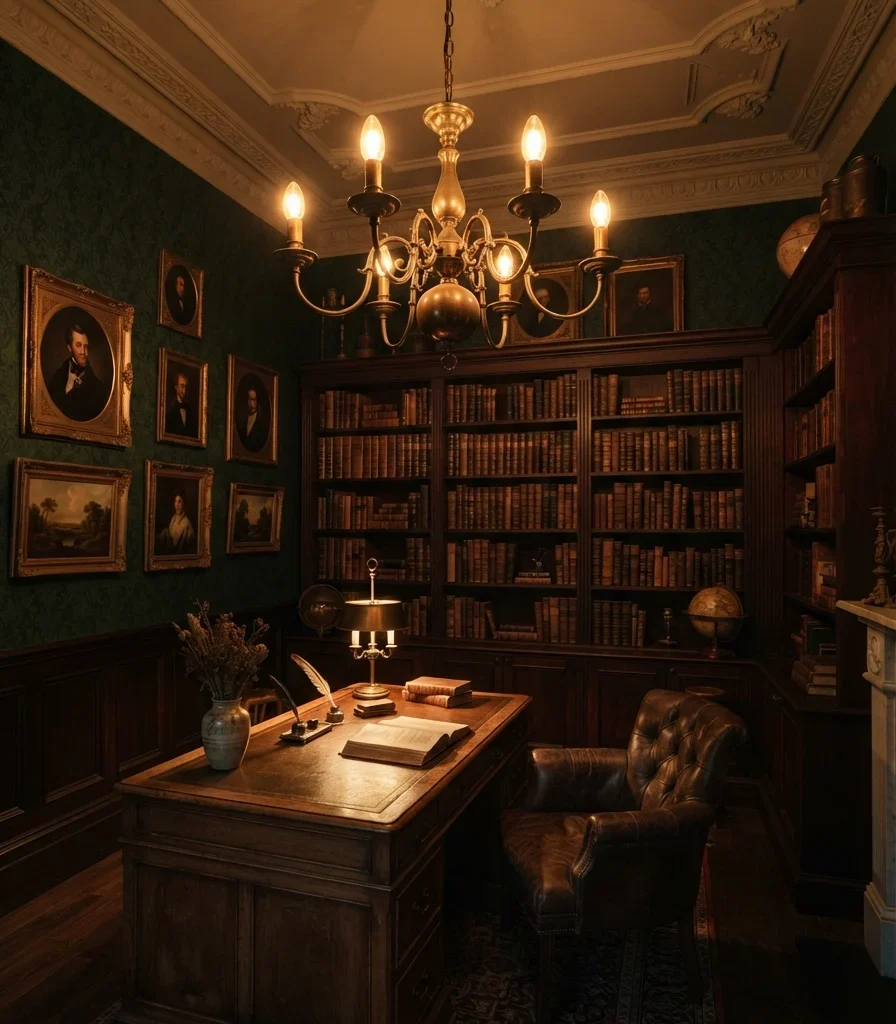
Vibe: Dramatic ceiling becomes part of the room’s composition rather than an afterthought.
Why it works: A central chandelier supplies ambient illumination while also establishing a strong period-inspired silhouette. Curved brass arms soften the vertical geometry of bookcases and desks, while multiple low-output bulbs distribute warm light more evenly than one harsh overhead fixture. The fixture should support the room rather than visually dominate it.
How to get it: Choose a chandelier scaled to the room’s dimensions and hang it so it does not interfere with standing or shelving. Six small warm bulbs are generally more convincing than a few oversized exposed bulbs.
💡 Quick Win: A plug-in swag chandelier can create the visual effect in a rental without immediately rewiring the ceiling.
Shop The Look
| Product | Search on Amazon |
| Chandelier | Antique brass Victorian six-light chandelier |
| Bulbs | Warm amber filament LED chandelier bulbs |
| Ceiling hook | Decorative brass ceiling hanging hook |
| Dimmer | LED compatible antique style wall dimmer |
| Ceiling medallion | Victorian decorative ceiling medallion |
11. Display Framed Engravings Instead of Generic Art

Vibe: A curious wall invites the eye to stop, inspect, and discover.
Why it works: Victorian interiors frequently used collections of pictures, prints, scientific illustrations, and personal objects to express intellectual interests. A salon-style arrangement creates visual density while giving that density a clear structure. Repeating walnut and brass frames prevents a collection of different images from looking chaotic.
How to get it: Choose one subject – family, botany maps, architecture, or natural history- and vary the frame sizes rather than mixing unrelated decorative posters. Lay the arrangement on the floor first, keeping roughly 5–8 cm between neighboring frames.
Shop The Look
| Product | Search on Amazon |
| Engravings | Victorian botanical engraving print set |
| Map | Antique world map vintage reproduction |
| Frames | Dark walnut picture frames assorted sizes |
| Brass frame | Antique brass 5×7 picture frame |
| Hanging kit | Professional picture hanging wire and hooks |
12. Hide Modern Technology Inside Period-Inspired Storage

Vibe: Discreet modern technology disappears without compromising everyday accessibility.
Why it works: Period-inspired interiors can look visually inconsistent when black chargers, power strips, and tangled cables dominate the desk. Containment reduces visual noise while keeping technology functional. A wood cable box or leather document case connects practical office equipment to the room’s established material language.
How to get it: Route charging cables through a rear desk grommet and place a ventilated power strip inside a walnut cable-management box. Reserve one drawer for small electronics so the desktop remains visually quiet at the end of the workday.
Shop The Look
| Product | Search on Amazon |
| Cable box | Walnut wood cable management box |
| Charging station | Wooden desktop charging station organizer |
| Document box | Brown leather document storage box |
| Desk grommet | Brass cable management desk grommet |
| Cable clips | Antique brass adhesive cable clips |
13. Create a Separate Reading and Research Zone
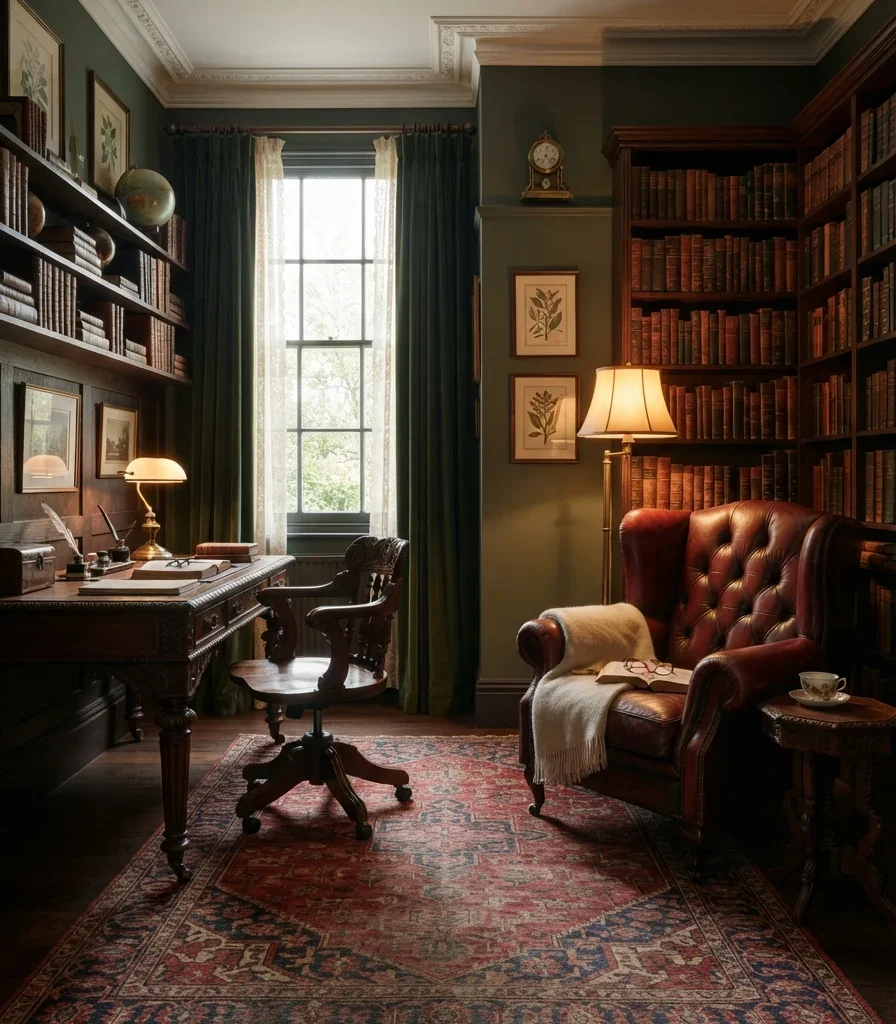
Vibe: Focused; each part of the room has a clear purpose without feeling divided.
Why it works: Zoning prevents a large office from becoming one undifferentiated collection of furniture. The desk supports computer and writing work, while the chair provides a distinct environment for reading, reviewing documents, or taking breaks. A shared rug or consistent wood tone visually connects the zones.
How to get it: Keep the desk perpendicular to the reading chair when possible, allowing each area to face a different visual direction. Use a floor lamp to define the reading zone rather than adding another ceiling fixture.
Shop The Look
| Product | Search on Amazon |
| Floor lamp | Antique brass Victorian library floor lamp |
| Reading chair | Tufted brown leather reading armchair |
| Side table | Round dark walnut occasional table |
| Ottoman | Leather Victorian footstool ottoman |
| Book basket | Woven leather handle book storage basket |
14. Use Vertical Storage in a Narrow Office

Vibe: Vertical; the eye travels upward, making the narrow room feel taller rather than crowded.
Why it works: A narrow Victorian-style office benefits from using wall height instead of floor depth. Tall shelves replicate the architectural presence of traditional libraries while keeping the center of the room open. Closed storage is especially important because exposed paperwork quickly destroys the visual calm created by the period-inspired palette.
How to get it: Use shelving no deeper than necessary for books and office files, ideally around 25–30 cm for standard paperbacks. Paint the shelving the same color as the wall so it reads as built-in architecture rather than a separate bulky object.
💡 Quick Win: Add two tall narrow bookcases rather than one wide unit and connect their tops with a painted molding strip for a built-in appearance.
Shop The Look
| Product | Search on Amazon |
| Narrow bookcase | Tall narrow dark wood bookcase 12 inch deep |
| Storage boxes | Vintage brown document storage boxes |
| Shelf baskets | Dark woven rectangular office baskets |
| Labels | Kraft archival storage box label tags |
| Wall sconce | Plug-in antique brass library wall sconce |
15. Add Velvet Through One Controlled Accent

Vibe: Plush. One tactile accent introduces richness without turning the room into visual excess.
Why it works: Velvet has strong light-catching variation, so using it on multiple surfaces can quickly become overwhelming. One oxblood chair creates a concentrated color and texture moment against matte green walls and dark wood. The contrast is particularly effective because oxblood sits comfortably within the traditional Victorian palette while adding warmth.
How to get it: Choose velvet for one chair, footstool, or small bench rather than curtains and upholstery simultaneously. Use a medium or deep oxblood with a slightly brown undertone instead of bright red.
Shop The Look
| Product | Search on Amazon |
| Velvet chair | Oxblood burgundy velvet Victorian accent chair |
| Cushion | Dark green velvet lumbar cushion |
| Throw | Tobacco brown wool throw blanket |
| Side table | Antique brass drink table round |
| Curtain tiebacks | Burgundy velvet rope curtain tiebacks |
16. Use a Gallery-Style Desk Wall for Visual Focus
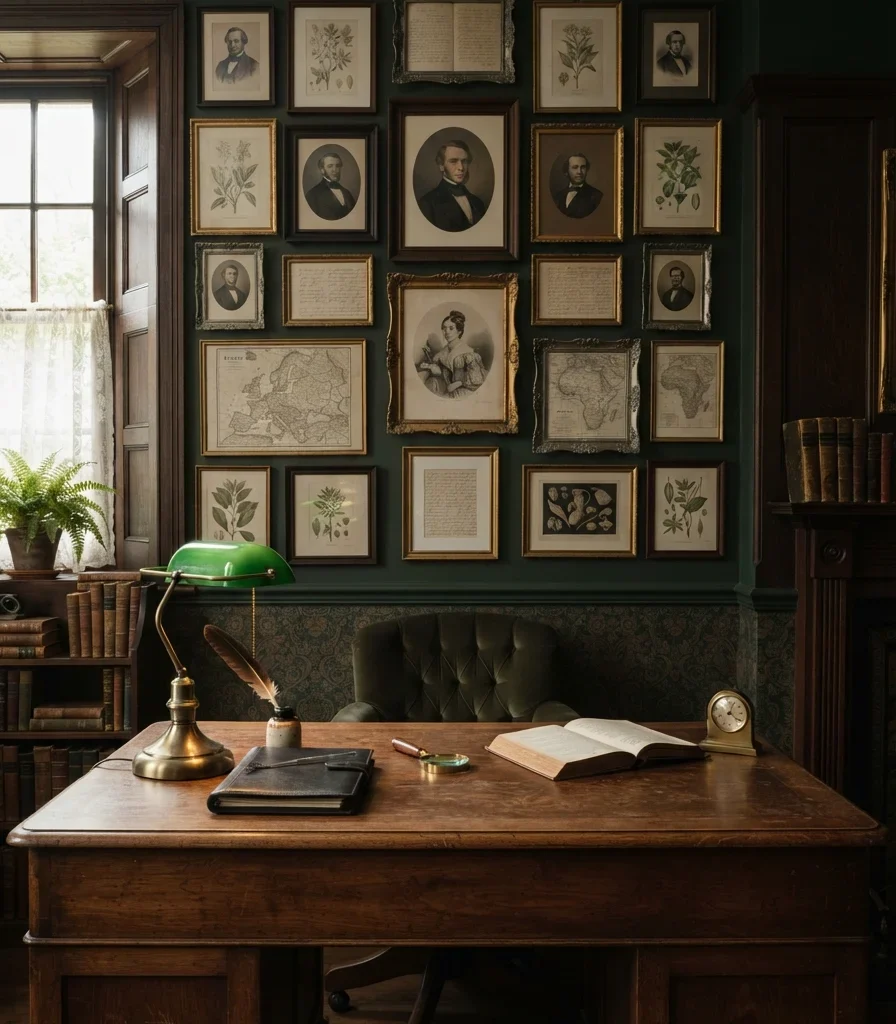
Vibe: Intentional; the desk feels anchored by a wall designed specifically for it.
Why it works: A gallery wall behind the desk creates a strong visual endpoint, especially when the desk is viewed from the doorway. Victorian composition benefits from repetition, framing, and collected imagery, but the arrangement still needs negative space. A consistent frame material establishes order while artwork size provides variation.
How to get it: Start with the largest central print and build outward using pairs of smaller frames. Keep the bottom edge of the arrangement approximately 20–30 cm above the desk so the artwork feels connected to the workspace rather than floating independently.
Shop The Look
| Product | Search on Amazon |
| Gallery prints | Antique Victorian portrait and botanical print set |
| Frames | Dark wood gallery picture frame assortment |
| Desk lamp | Traditional bronze library desk lamp |
| Folio | Brown leather document portfolio |
| Pen cup | Antique brass and ceramic pen holder |
17. Warm the Room With a Brass and Glass Library Light
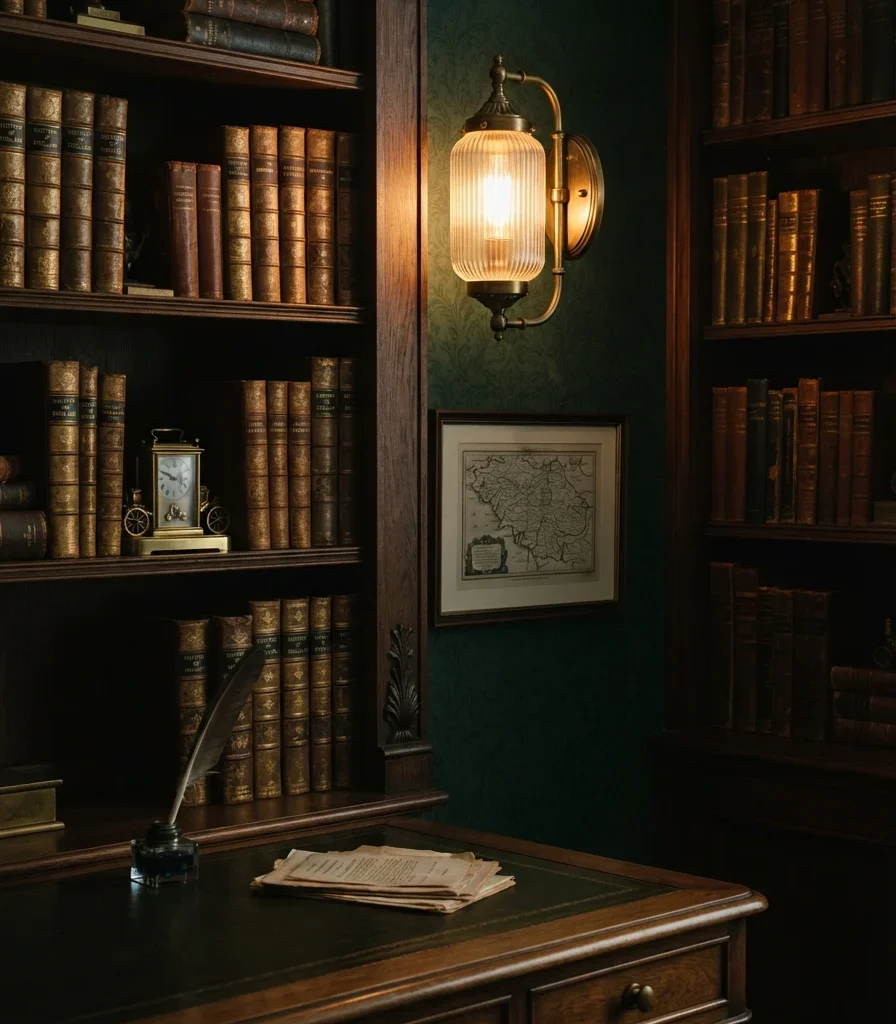
Vibe: Atmospheric. The bookcase glows like a private library after sunset.
Why it works: Lighting bookshelves from above or beside them creates depth because the illumination catches book spines, frame edges, and timber grain at different levels. Brass and glass fixtures also reinforce Victorian material language without requiring elaborate chandeliers. A warm 2700K source keeps the light compatible with walnut and oxblood.
How to get it: Install a small wall-mounted picture or library light above the most important bookcase rather than illuminating every shelf equally. Use one focused pool of light to create hierarchy and prevent the room from becoming uniformly bright.
💡 Quick Win: A rechargeable picture light above a bookshelf can create the same layered effect without electrical installation.
Shop The Look
| Product | Search on Amazon |
| Library light | Aged brass picture light with glass shade |
| Rechargeable light | Warm rechargeable picture light brass |
| Bulbs | 2700K warm white LED bulbs small base |
| Bookends | Brass Victorian architectural bookends |
| Shelf decor | Antique brass miniature globe |
18. Finish a Compact Desk With Period-Inspired Accessories
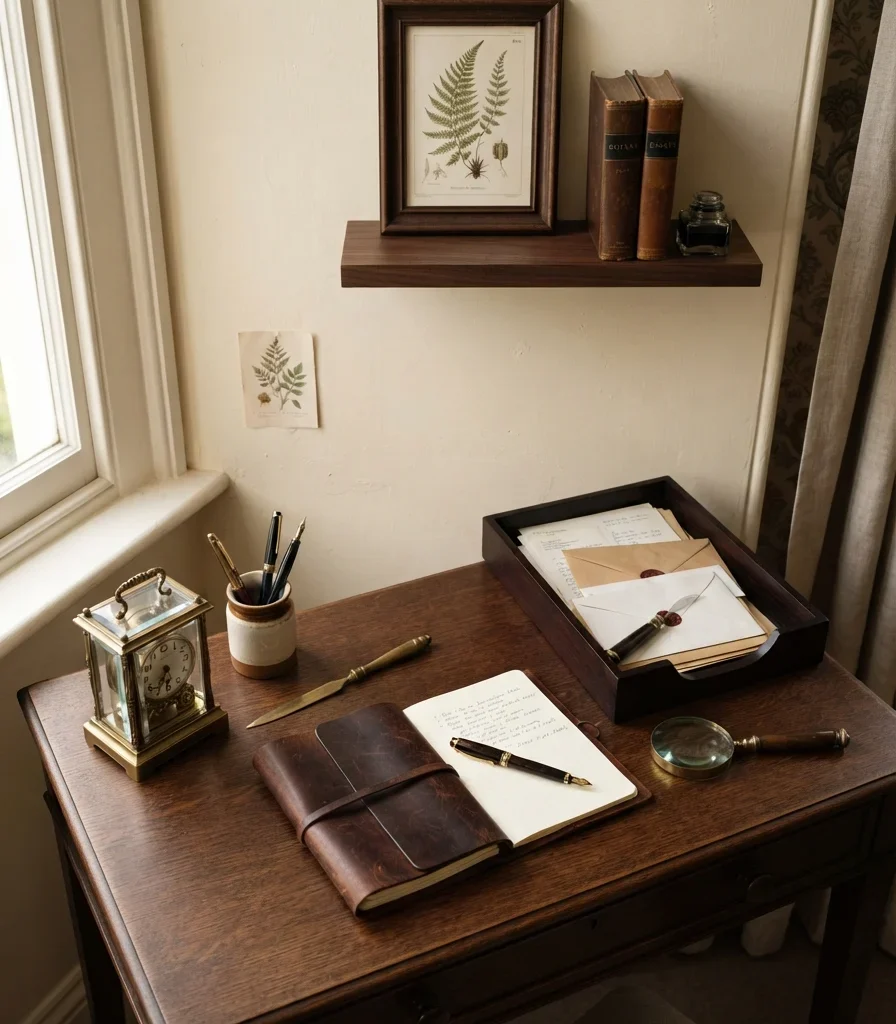
Vibe: Precise small details make the desk feel purposeful rather than merely decorated.
Why it works: Victorian studies often contained specialized writing objects, correspondence tools, books, and personal artifacts, so functional accessories are particularly appropriate to the style. The key principle is curation: a small desk benefits from fewer substantial objects rather than a crowded collection of miniature decorations. Brass, leather, ceramic, and walnut provide enough material variation without needing bright color.
How to get it: Limit the working desktop to five visible categories: writing instrument, notebook, document tray, lamp, and one personal object. Store everything else in drawers or a nearby cabinet so the desk remains usable.
Shop The Look
| Product | Search on Amazon |
| Letter opener | Antique brass vintage letter opener |
| Notebook | Brown leather refillable writing journal |
| Pen holder | Ceramic Victorian style pen holder |
| Document tray | Walnut wooden letter document tray |
| Magnifying glass | Brass handle vintage magnifying glass |
19. Balance the Richness With Deliberate Negative Space

Vibe: Restful; the room feels rich without asking the eye to process everything simultaneously.
Why it works: Victorian interiors can become visually heavy when every wall, shelf, and surface is filled. Negative space gives the eye somewhere to pause and makes the remaining materials appear more substantial. The contrast between decorated zones and intentionally quiet surfaces is what keeps historical richness from becoming clutter.
How to get it: After styling the office, remove approximately 10–20% of the decorative objects and reassess the room from the doorway. Leave one wall, floor section, or shelf group relatively quiet so the most important elements- desk, books, artwork, and lighting- retain visual priority.
💡 Quick Win: Before buying anything else, remove five small decorative objects from the office and photograph the room again; the comparison usually reveals which pieces actually contribute to the composition.
Shop The Look
| Product | Search on Amazon |
| Brass clock | Antique brass round desk clock |
| Ceramic vase | Traditional cream ceramic bud vase |
| Leather portfolio | Dark brown leather writing portfolio |
| Book stack | Vintage style decorative antique books |
| Wool throw | Forest green wool blend office throw |
How to Start Your Victorian Style Home Office Transformation
Start with one dark walnut writing desk. It is the functional and visual anchor of a Victorian office, giving you a clear material direction for the chair, shelving, lighting, hardware, and accessories. Once the desk is established, choose supporting pieces that repeat its warm brown undertone rather than trying to coordinate every item as an identical furniture set.
The most common mistake is making every surface dark. Walnut furniture, black-green walls, dark curtains, black shelving, and an almost-black rug can eliminate the tonal variation that makes a Victorian room feel rich. Keep at least one major light value- warm cream ceiling, linen curtains, parchment artwork, or lighter rug- to create contrast and preserve depth.
Three inexpensive entry points can make an immediate difference: an antique-brass desk lamp, a brown leather desk mat, and a small Victorian botanical print in a dark wood frame, each often available for under $50. They introduce the style’s key language without requiring construction or major furniture purchases.
A starter transformation can happen over one weekend for roughly $200–$600. A fuller office with wallpaper, substantial shelving, quality lighting, rug, desk, and chair can realistically reach $1,000–$4,000+, while custom millwork or genuine antique furniture can take several months to source and significantly increase the budget.
Frequently Asked Questions About Victorian Style Home Office
What is a Victorian style home office and how is it different from a traditional office?
A Victorian style home office draws from 19th-century British interiors through dark timber, patterned walls, leather, brass, books, traditional lighting, and layered decorative objects. A generic traditional office may use similar furniture but does not necessarily follow the Victorian period’s stronger preference for material richness and historical pattern. The Victorian version is usually more atmospheric and visually layered.
Which colors work best in a Victorian home office?
Bottle green, oxblood, deep teal, tobacco brown, warm cream, and muted mustard are particularly effective. Deep green is one of the easiest starting colors because it complements walnut, brass, and leather without becoming as visually severe as pure black. In a dark room, use warm cream on the ceiling and trim to preserve reflected light.
How much does a Victorian style home office cost?
A budget-conscious refresh can begin around $200–$600 using paint, a desk lamp, framed prints, a leather desk mat, and secondhand accessories. A more complete room with a quality desk, leather chair, rug, shelving, wallpaper, and layered lighting can reach $1,000–$4,000 or more. Genuine antiques and custom cabinetry can push the investment substantially higher.
Can Victorian style work in a modern home office?
Yes. The most successful approach is to combine Victorian materials with modern ergonomics. For example, a walnut desk and brass lamp can sit comfortably beside an ergonomic contemporary office chair if the chair uses leather or a restrained dark upholstery. Avoid reproducing every historical detail; choose a few strong period references and let the rest of the room support modern work.
What type of desk is best for a Victorian home office?
A walnut or mahogany writing desk with drawers is the strongest visual choice because dark timber and traditional proportions immediately establish the period reference. A desk around 120–160 cm wide provides useful working space without overwhelming most rooms. For extensive computer work, add a discreet monitor riser, cable-management system, and ergonomic chair so the historical appearance does not compromise comfort.
Ready to Create Your Dream Victorian Style Home Office?
These 19 Victorian-style home office ideas explore color, dark timber, leather, brass, wallpaper, lighting, library storage, functional zoning, period-inspired accessories, and the negative space needed to keep all that richness controlled. You do not need to transform the room in one expensive project; beginning with one walnut desk or brass lamp gives the rest of the design a direction to follow. Today, clear your existing desk completely and choose the single piece that will become your office’s visual anchor. Once the room combines warm light, tactile materials, books, and a few meaningful historical references, working there can feel more settled, focused, and deeply personal. Save or pin the ideas that capture the private-library feeling you want, especially the dark green walls, walnut furniture, brass lighting, and curated bookcase details.
You Might Also Like
- 15 Ways to Optimize a Home Office Multiple Monitor Setup
- 20 Small Office Organization Ideas to Improve Your Home
- 15 Productive Home Office Computer Setup Ideas
- 17 Comfortable Home Office Setup With Couch Ideas
- 18 Modern Cottage Kitchen Ideas for a Small Home
- 13 Modern Cottage Hallway Ideas for a Warm, Welcoming Entry