
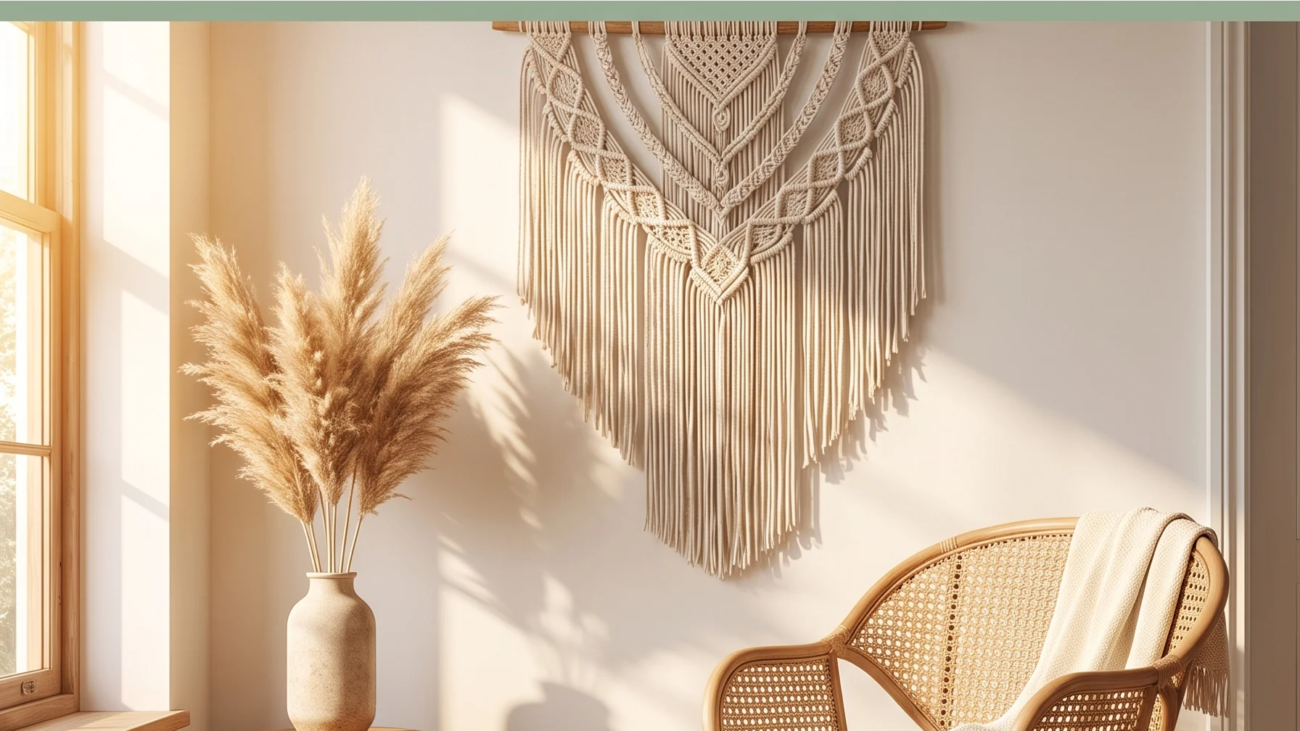
Boho home decor layers vintage textiles, natural fiber, and sun-worn color across every room, trading matched perfection for a home that reads as genuinely collected over time. This article gives you 16 boho home decor ideas, from rugs to lighting to furniture, built to work as one connected whole rather than a single styled room.
The feeling is unmistakable: a kilim rug fading just enough to look lived-in, a macrame hanging catching afternoon shadow, warmth that carries from the entry through to the last room in the house. Boho doesn’t arrive matched it arrives gathered, piece by piece, room by room. Here are 16 ideas worth saving and stealing.
Why Boho Home Decor Ideas Work So Well
What is it? Boho traces back to 19th-century Bohemian artists in Paris who rejected rigid Victorian formality in favor of a freer, more personal way of living, and it resurfaced through the 1960s and ’70s counterculture alongside a surge in global travel and textile trade. What separates real boho from the retail version often labeled “boho chic” is genuine eclecticism, pieces collected across time and culture rather than a single curated palette bought as a matched set.
What are its core materials and colors? The palette runs warm terracotta, rust, mustard, and deep indigo, layered against natural undyed tones. Materials stay tactile and handmade: vintage kilim wool, rattan, cane, macrame cotton, reclaimed wood, block-printed textile, and aged brass. Nothing is a uniform pattern, and textures are expected to vary from room to room rather than match throughout.
Why is it trending now? Boho searches have grown alongside a broader post-pandemic desire for homes that read as personal and well-traveled rather than showroom-styled, and the vintage-thrifting movement has made genuinely collected textiles more accessible than ever. Pinterest’s continued strong search volume for “boho home decor” reflects a shift away from single-source, matched furniture sets.
Can small spaces achieve this style? Yes, boho suits small homes well, since one layered rug and vertical textile layering can carry a room without needing floor-space-heavy furniture. Prioritize wall and vertical texture first in tight footprints.
| Element | Philosophy | Key Materials |
| Core value | Collected over curated | Vintage kilim, rattan, macrame |
| Color approach | Sun-worn warmth, layered | Reclaimed wood, cane, brass |
16 Boho Home Decor Ideas
1. Vintage Moroccan Kilim Rugs Layered Room to Room
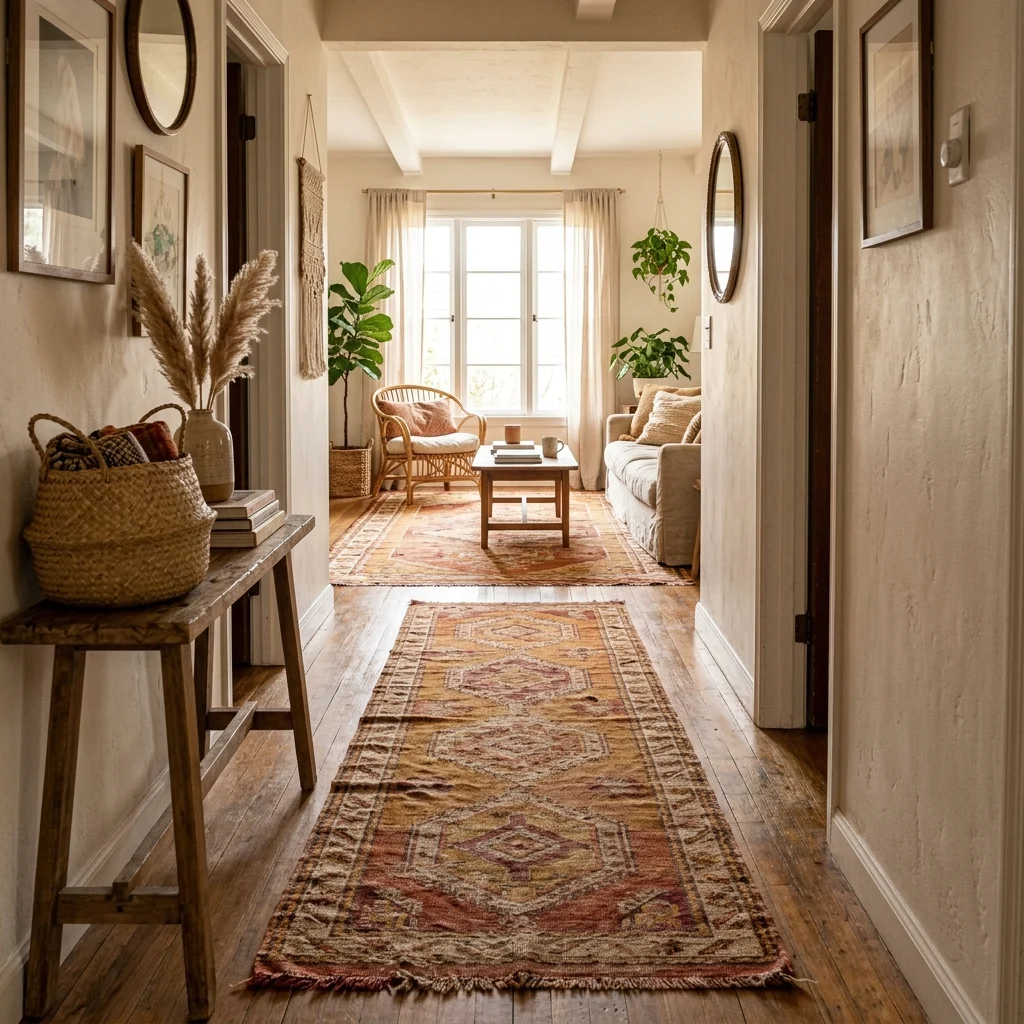
Vibe: The home feels connected, one rug family carrying warmth from room to room.
Why it works: Choosing kilim rugs from the same rust-and-mustard color family for different rooms creates a connective thread through the house without requiring identical rugs, a layering technique that lets each room feel distinct while still reading as part of one collected home. The kilim’s faded, hand-woven pattern also reads as genuinely gathered rather than matched from a single collection.
How to get it: Choose two or three vintage or vintage-style kilim rugs within the same warm color family, sized to each room’s specific footprint, rather than buying one rug pattern in multiple sizes.
💡 Quick Win: A vintage-style printed kilim runner under $70 gives the same connective color thread if authentic vintage pieces aren’t in budget yet.
Shop the Look
| Product |
| Vintage-style wool kilim runner rug |
| Vintage-style kilim area rug in the living room |
| Woven jute basket small |
| Dried pampas grass stem |
| Rug pad non-slip |
2. Sun-Faded Terracotta and Rust Palette Throughout
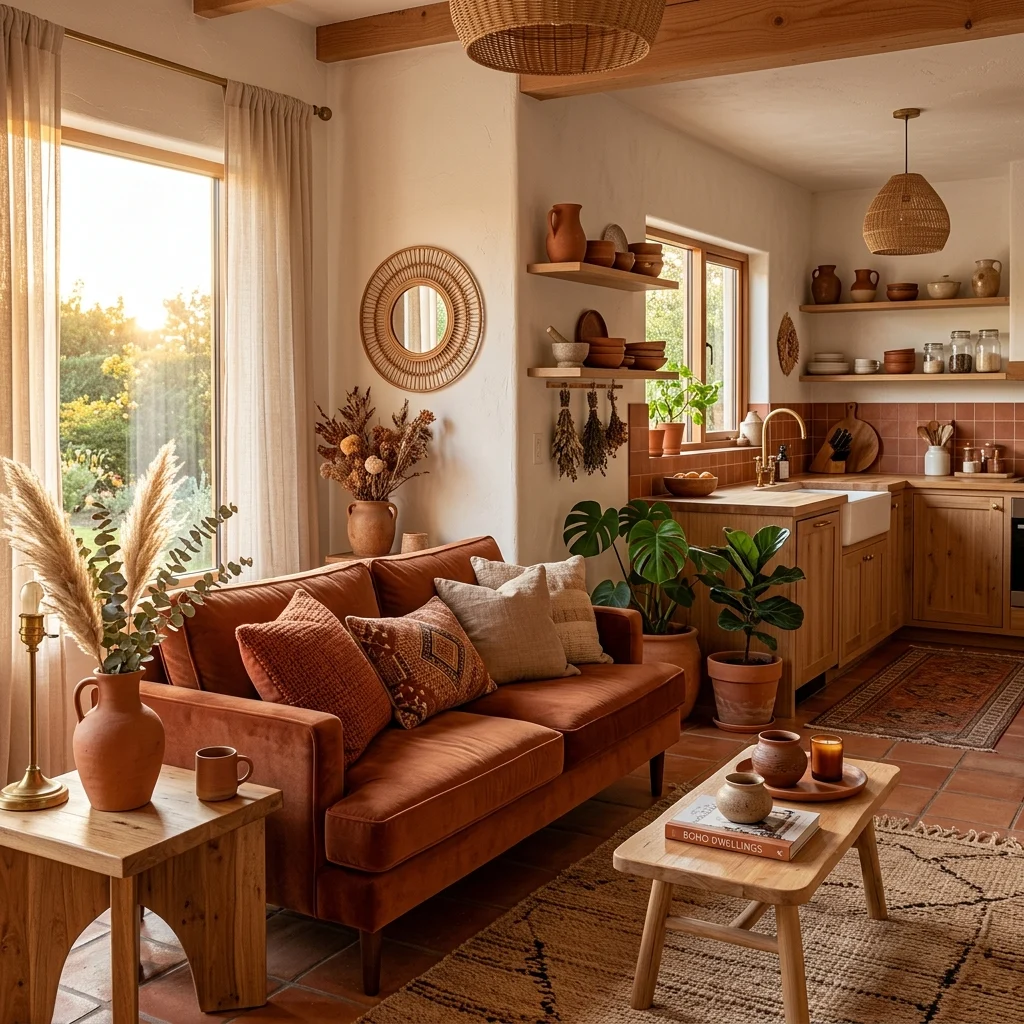
Vibe: The home feels sun-warmed, one earthy color thread carrying through completely different rooms.
Why it works: Repeating terracotta and rust across a living room’s textiles and a kitchen’s ceramics uses tonal layering as a whole-home cohesion strategy rather than confining the palette to one room, which is what keeps an eclectic mix of furniture from feeling disconnected as you move between spaces.
How to get it: Choose one terracotta paint or textile shade as your anchor tone such as Farrow & Ball’s Terracotta No. 240 and repeat it in at least one object per major room, whether that’s a cushion, a ceramic vessel, or a painted door.
Shop the Look
| Product |
| Terracotta ceramic vase set |
| Rust cushion cover set |
| Terracotta interior paint matte |
| Dried floral stem bundle |
| Ceramic serving bowl with warm glaze |
3. Woven Rattan Pendant Lights as the Home’s Signature Fixture
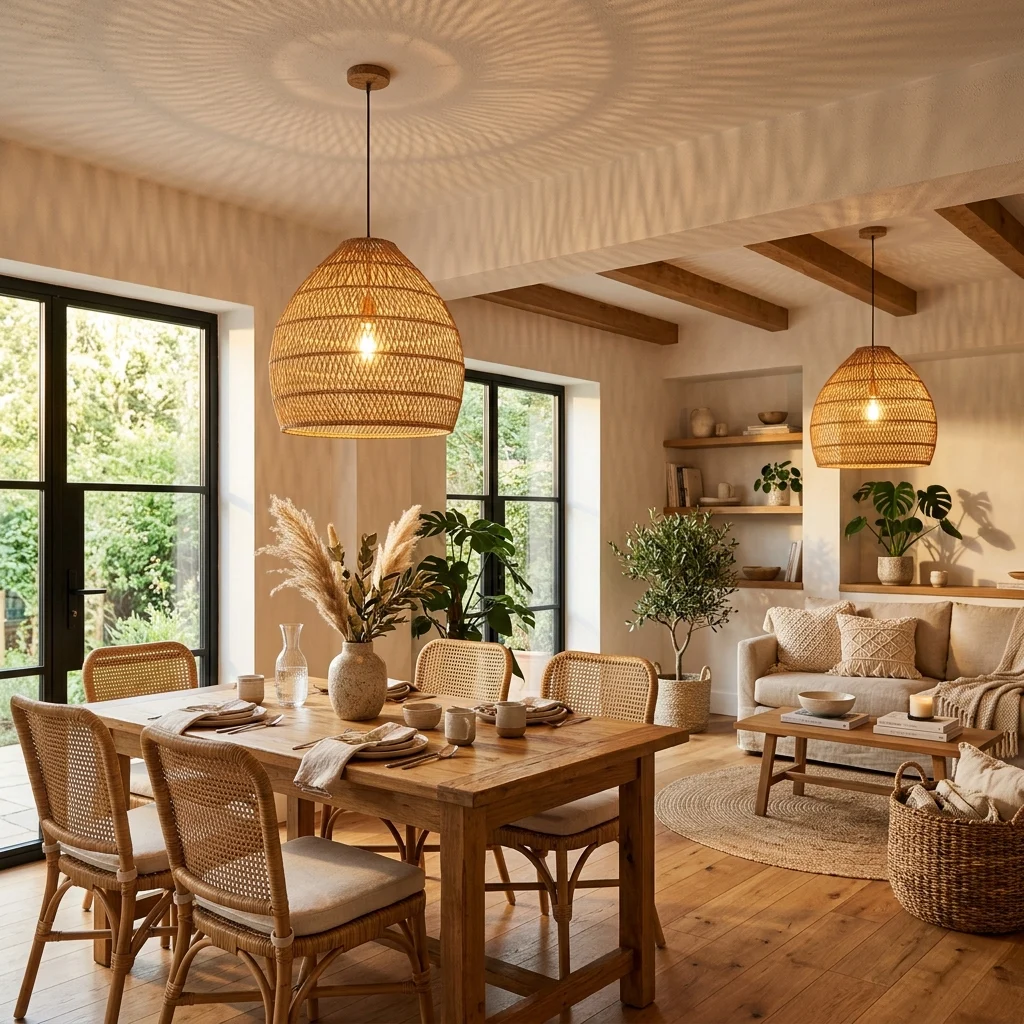
Vibe: The home feels sun-warmed, light filtering through woven fiber in every main room.
Why it works: Choosing rattan pendants as a recurring fixture type, even in different shapes per room, creates a signature lighting language throughout the home, applying material consistency to lighting the same way a repeated wood tone would to furniture. The open weave also diffuses light softly rather than casting a hard beam, a lighting-behavior quality suited to boho’s overall warmth.
How to get it: Choose rattan pendants in a consistent natural tone across your main living spaces, varying the shade, shape (dome, drum, globe), and room to room while keeping the material and finish the same.
💡 Quick Win: A rattan clip-on shade over an existing pendant updates the fixture’s texture in under an hour without rewiring.
Shop the Look
| Product |
| Woven rattan dome pendant light |
| Woven rattan globe pendant light |
| Warm 2700K LED bulb dimmable |
| Ceramic vase, warm glaze |
| Woven storage basket small |
4. Macrame Wall Hangings as Recurring Textile Art
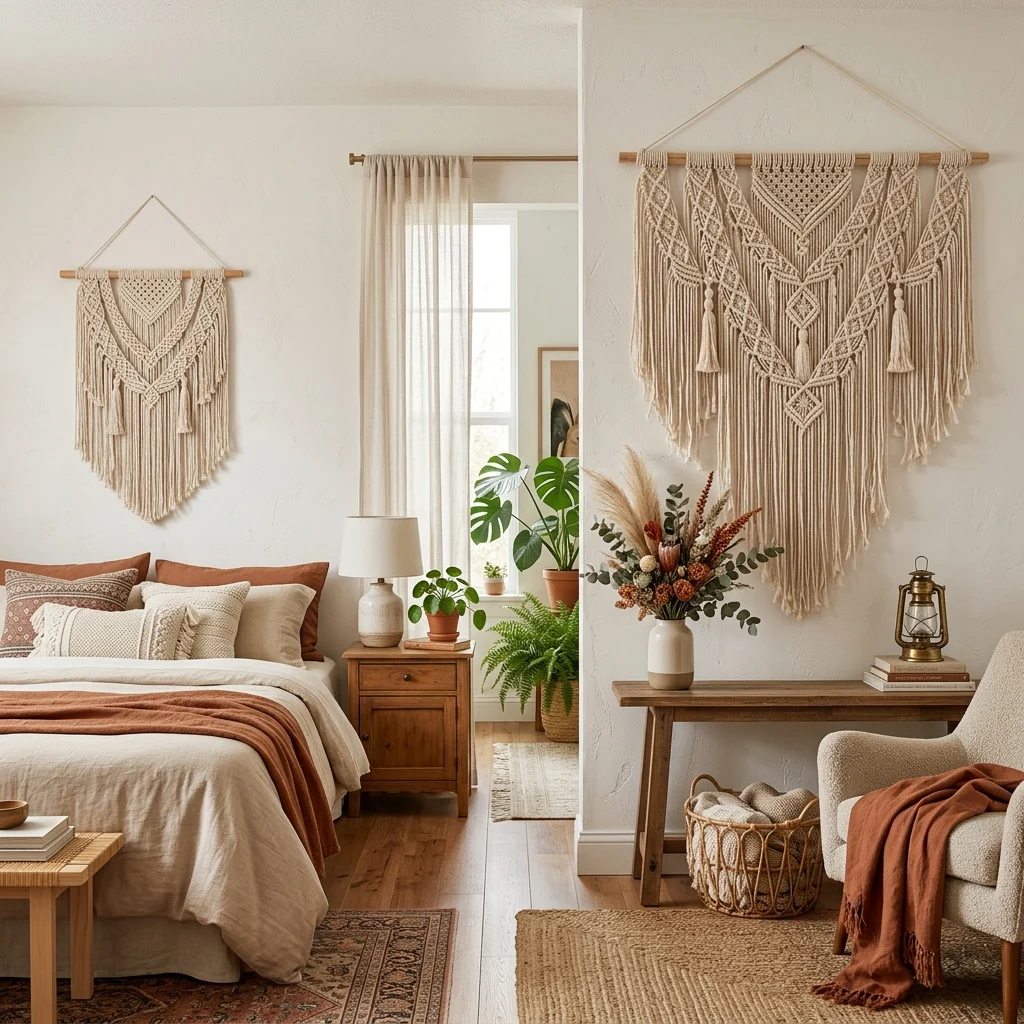
Vibe: Each room feels gathered, textile art doing what framed prints usually would.
Why it works: Using macrame as a recurring wall-art category rather than a one-off accent creates a visual rhyme between rooms without requiring identical pieces, since knot patterns and fringe lengths can vary while the natural cotton material stays consistent. This texture-based repetition works as connective tissue, the same way a repeated color would.
How to get it: Choose macrame pieces in varying sizes and knot patterns for different rooms, keeping all of them in undyed natural cotton so the material, not the pattern, is what ties them together.
Shop the Look
| Product |
| Macrame wall hanging, natural cotton, large |
| Macrame wall hanging, natural cotton, small |
| Small console table reclaimed wood |
| Dried floral stem bundle |
| Ceramic bud vase |
5. Reclaimed Wood Furniture Mixed Across Wood Tones
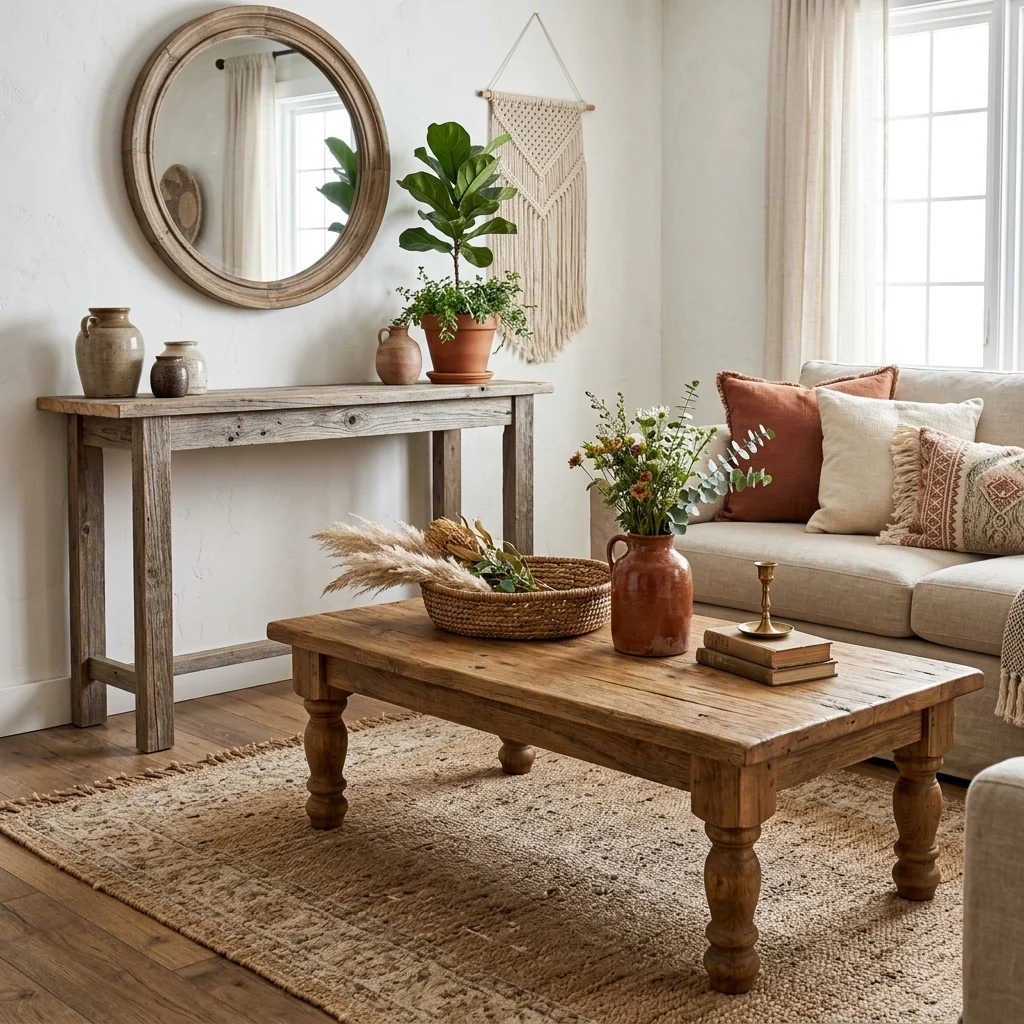
Vibe: The room feels collected, mismatched wood tones reading as gathered rather than uncoordinated.
Why it works: Boho deliberately allows wood tones to vary between pieces, unlike most other styles, which insist on matching furniture wood because genuine collections rarely arrive in one consistent finish. This works specifically because every other material (textiles, rattan, brass) stays consistent enough to hold the room together despite the wood variation.
How to get it: Choose two or three reclaimed wood pieces in genuinely different tones and finishes, and let them coexist rather than trying to match them, keeping the room’s textiles and metal accents as the true unifying thread.
💡 Quick Win: Adding a woven basket in a shared material tone between two mismatched wood pieces visually bridges the difference without refinishing anything.
Shop the Look
| Product |
| Reclaimed wood coffee table |
| Reclaimed wood console table |
| Woven seagrass basket set |
| Ceramic vase, warm glaze |
| Dried grass stem bundle |
6. Deep Indigo Accent Wall in a Reading Corner
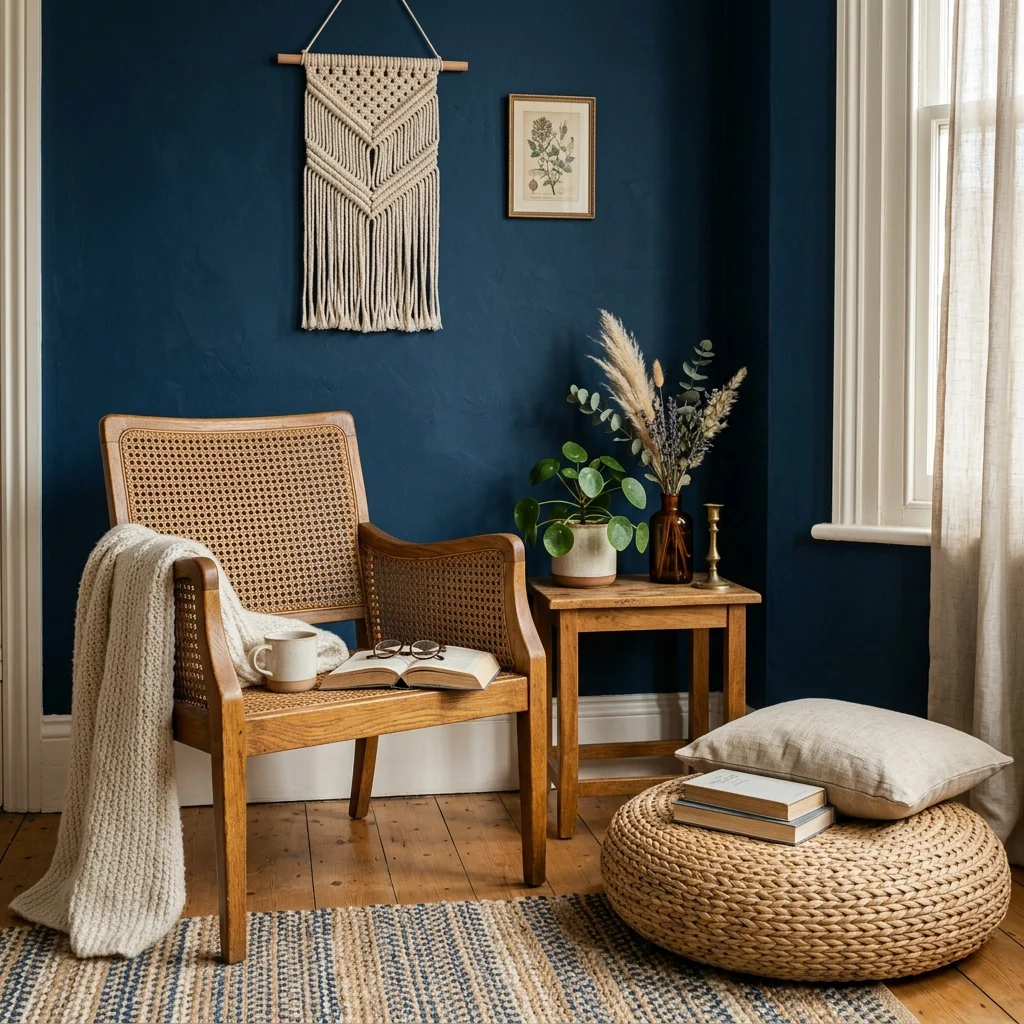
Vibe: The corner feels hushed, one deep color concentrating attention on a small, personal zone.
Why it works: Confining a saturated color like deep indigo to one small corner rather than a full room lets boho introduce genuine boldness without overwhelming the home’s overall warm-neutral base, a focal-point technique that treats the reading nook as its own contained composition. Indigo also carries a historical reference to global shibori and block-print traditions central to boho’s textile influences.
How to get it: Paint just the wall behind a reading chair in a deep indigo, such as Farrow & Ball’s Stiffkey Blue No. 281, keeping the rest of the room in warm white or terracotta so the color stays a contained accent.
Shop the Look
| Product |
| Deep indigo interior wall paint |
| Cane-backed accent chair |
| Woven floor cushion |
| Small potted plant ceramic pot |
| Dried floral stem bundle |
7. Rattan and Cane Furniture Fronts Throughout the Home
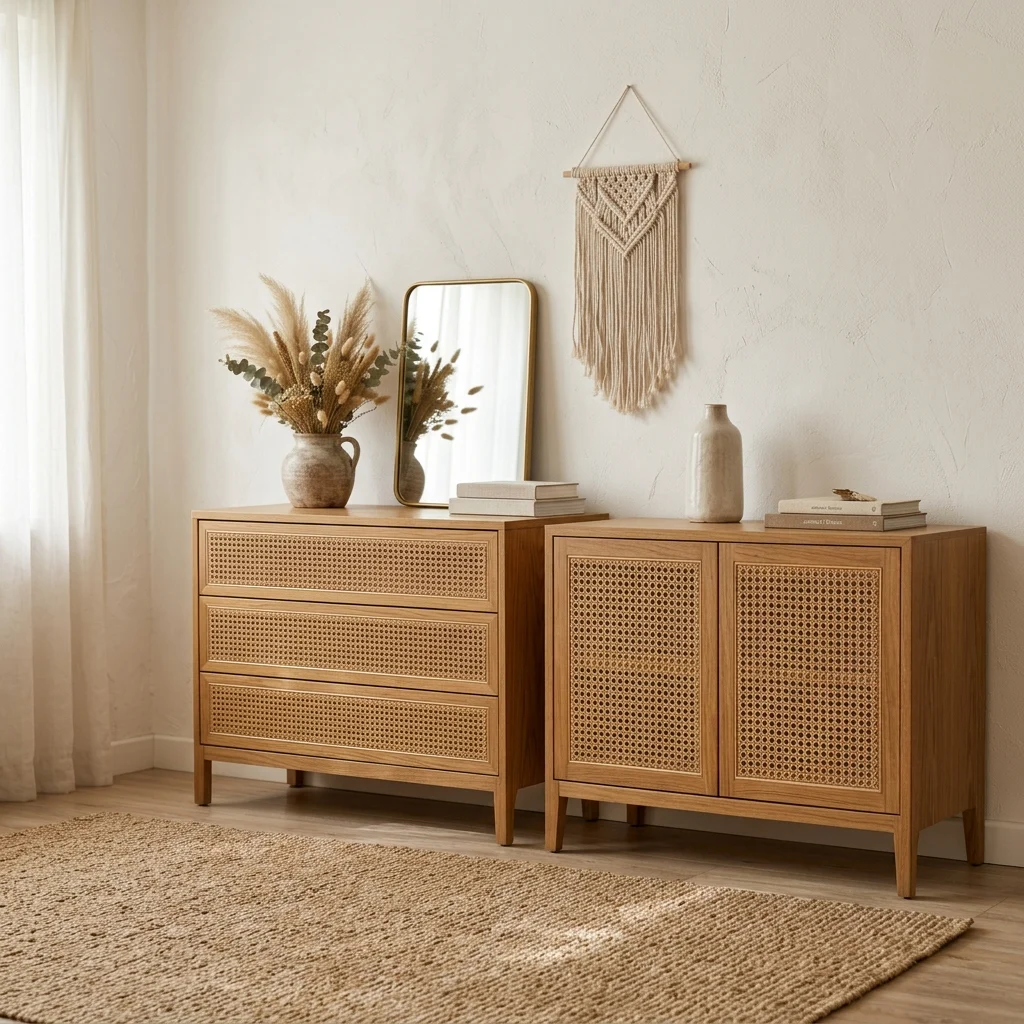
Vibe: The home feels light, open weave repeating across furniture that would otherwise read as solid and heavy.
Why it works: Cane-paneled fronts on a dresser or cabinet introduce the same texture-based visual lightness a rattan mirror brings to an entryway, letting storage furniture avoid the visual bulk of solid wood doors. Repeating this detail across different furniture pieces in different rooms creates a subtle material rhyme throughout the house.
How to get it: Choose cane or rattan-fronted furniture for at least two major storage pieces in different rooms, keeping the weave pattern and tone consistent even if the furniture silhouettes differ.
💡 Quick Win: Cane webbing panels applied to an existing flat-front cabinet door is a weekend DIY project that updates old furniture for under $50.
Shop the Look
| Product |
| Cane front dresser natural |
| Cane front cabinet living room |
| Cane webbing panel roll |
| Ceramic vase, warm glaze |
| Dried floral stem bundle |
8. Low-Floor Seating to Encourage Gathering Over Formality
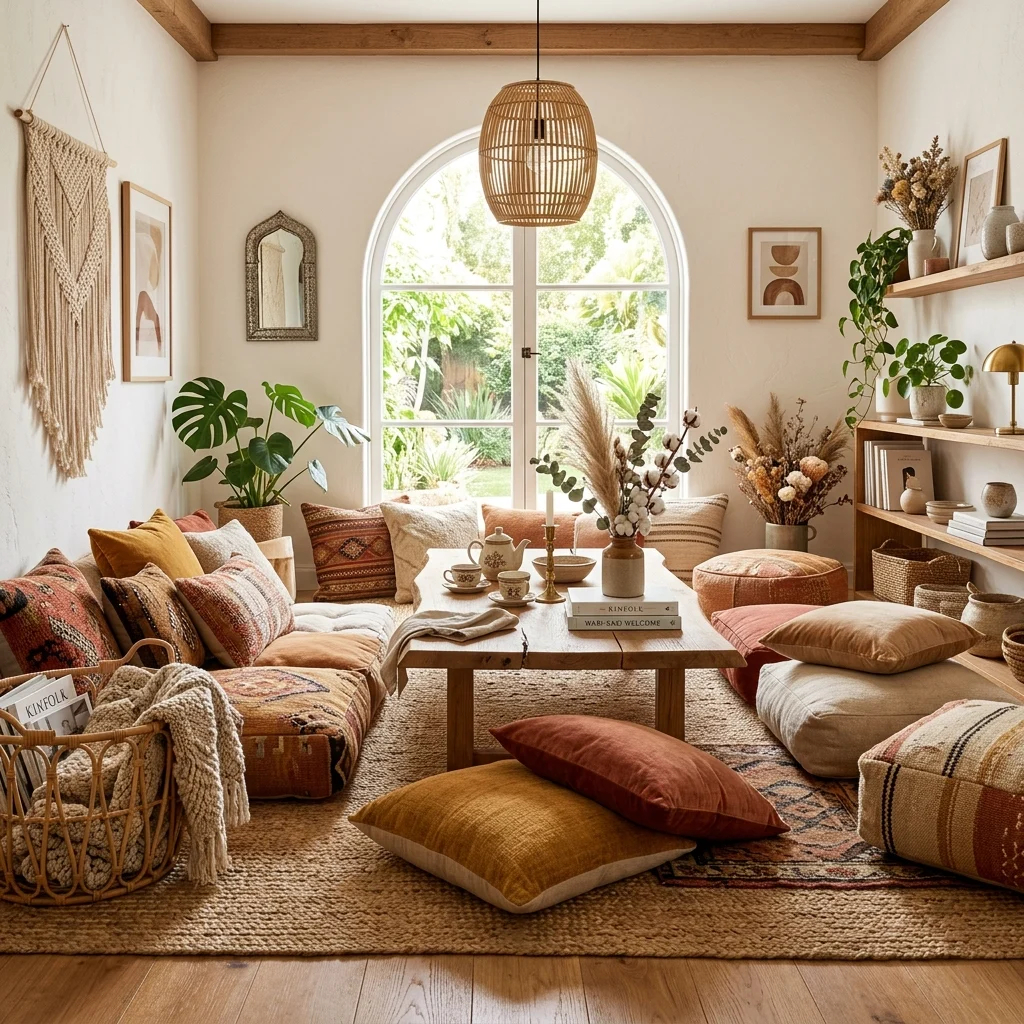
Vibe: The room feels casual, seating arranged for conversation rather than formal display.
Why it works: Low floor cushions and a low table lower the room’s overall visual weight and encourage a more communal, cross-legged gathering style than a formal sofa-and-armchair arrangement, a layout choice that reflects boho’s roots in global floor-seating traditions rather than Western formal living room conventions.
How to get it: Arrange a low wood table surrounded by varied floor cushions in mixed but tonally related patterns, leaving enough open floor space for people to shift positions rather than fixing seating in place.
Shop the Look
| Product |
| Low wood coffee table |
| Floor cushion set mixed pattern |
| Woven basket for cushion storage |
| Dried floral stem bundle |
| Ceramic tray for the low table |
9. Trailing Plants Cascading from Shelves and Ledges
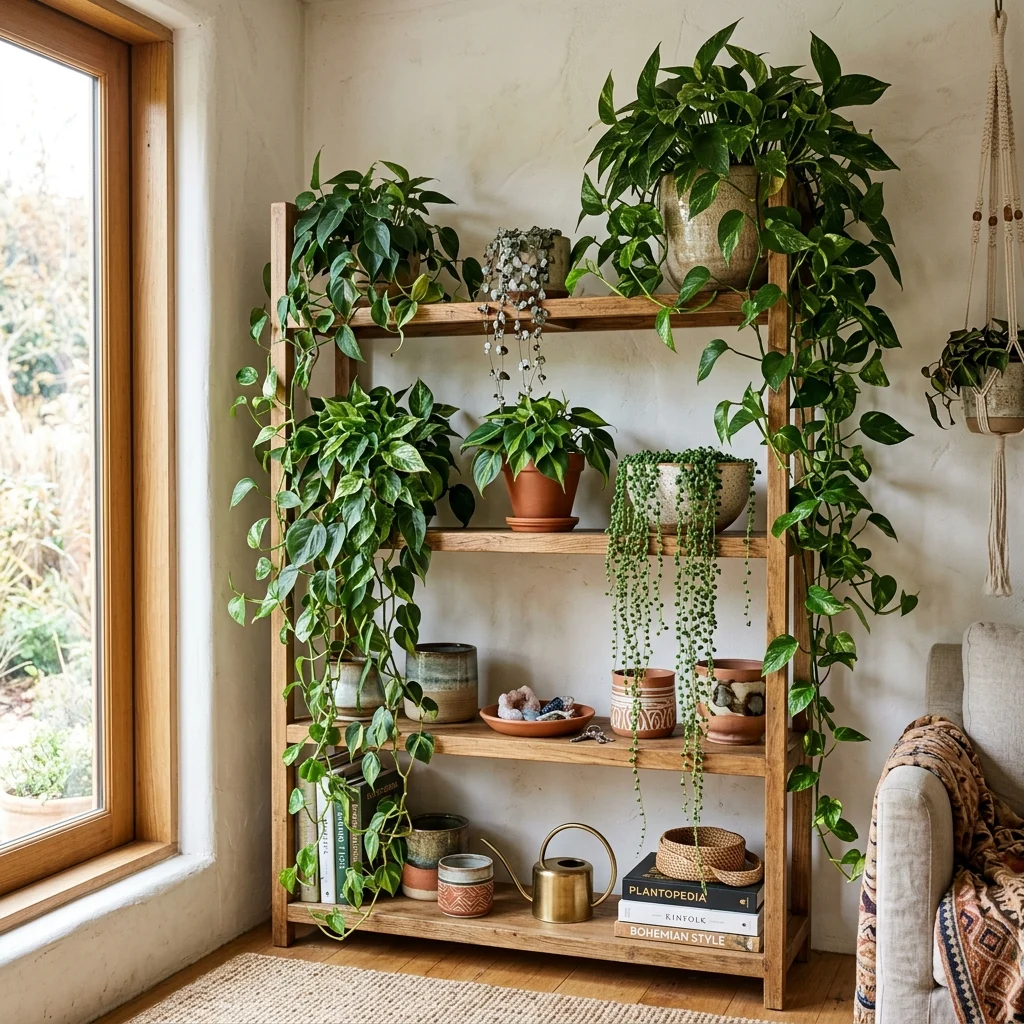
Vibe: The shelf feels alive, cascading vines softening every hard edge below them.
Why it works: Trailing plants placed at multiple shelf heights create vertical layering that a single potted plant on the floor can’t achieve, using the vines’ organic, irregular lines as contrast against the shelving’s straight edges. This also makes efficient use of vertical space in rooms where floor area for additional plants is limited.
How to get it: Position trailing pothos, string-of-pearls, or similar vines on at least two different shelf heights within the same unit, letting each vine drape at a different length so the cascade reads as varied rather than uniform.
💡 Quick Win: Faux trailing vines in the same terracotta pots work identically in low-light shelving without any plant care required.
Shop the Look
| Product |
| Trailing pothos plant, faux or live |
| String of Pearls plant in a small pot |
| Terracotta hanging planter pot set |
| Small ceramic dish for shelf |
| Tall wood shelving unit |
10. Mustard Yellow as a Recurring Accent Thread
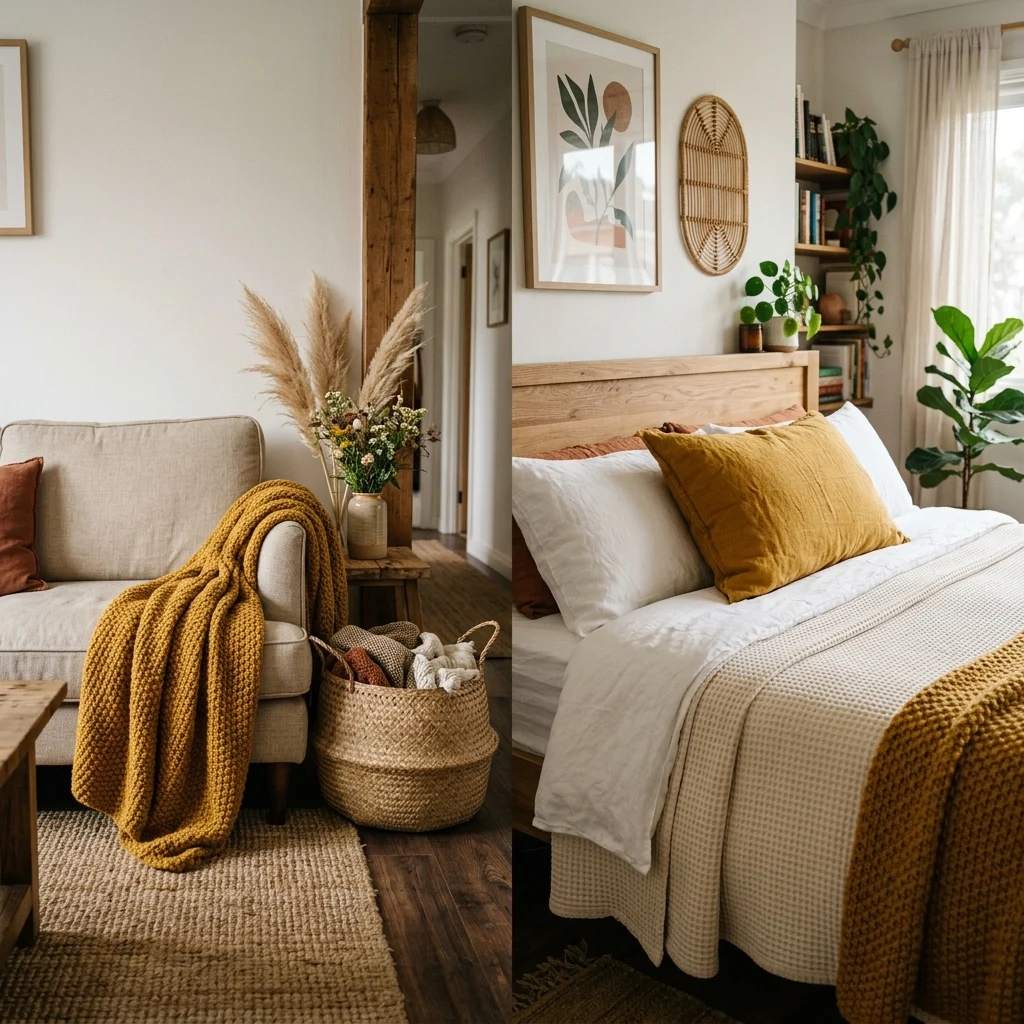
Vibe: The home feels sun-warmed, with a single recurring color thread doing more than any single statement piece could.
Why it works: Repeating mustard as a small textile accent, a throw here, a cushion there, rather than committing an entire room to the color, creates a subtle visual rhyme that ties spaces together without requiring matched furniture. This restrained repetition is what separates a genuinely cohesive eclectic home from one that simply feels randomly decorated.
How to get it: Choose one mustard fabric in a consistent weight and finish (cotton or linen, not synthetic blends), and place a small dose of it in at least two connected rooms.
Shop the Look
| Product |
| Mustard cotton throw blanket |
| Mustard linen cushion cover |
| Woven storage basket |
| Dried floral stem bundle |
| Ceramic catchall dish |
11. Layered String and Lantern Lighting for Evening Warmth
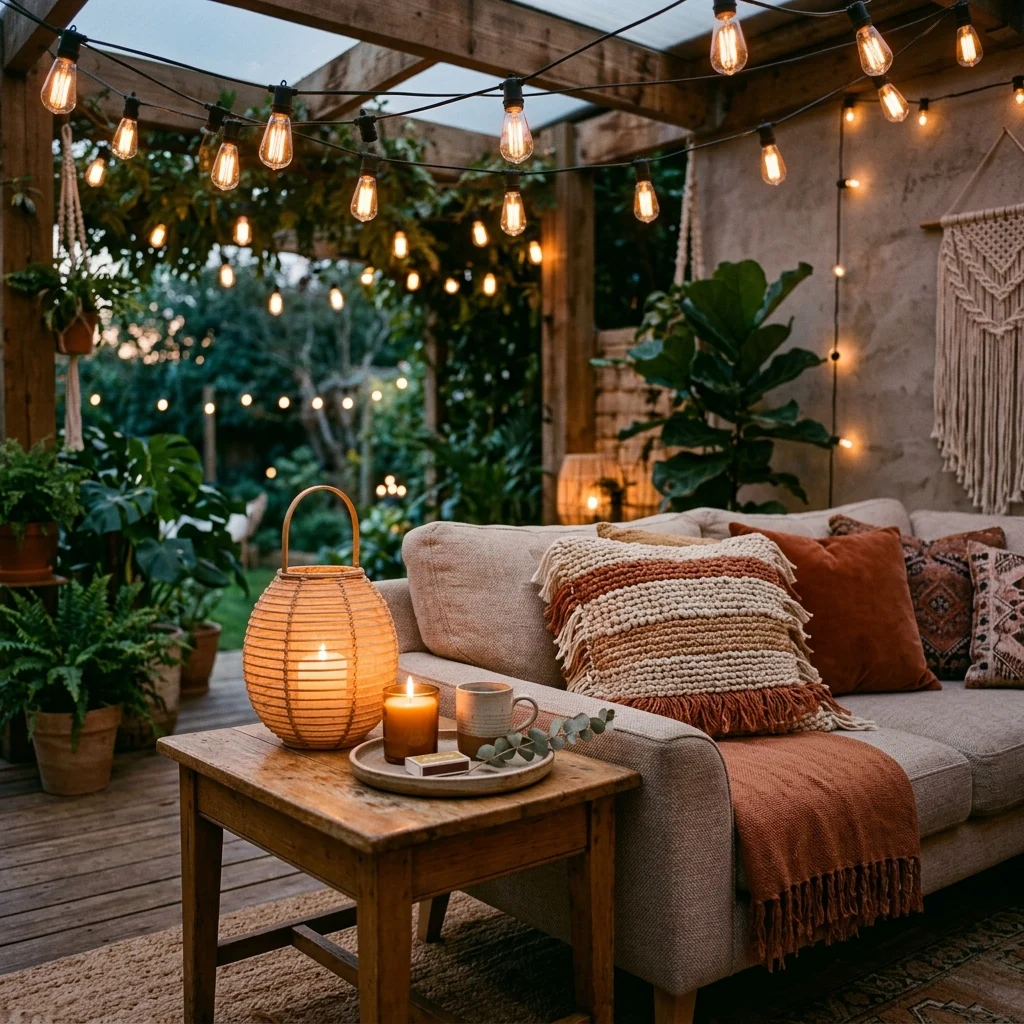
Vibe: The room feels layered, several small warm lights doing what one overhead fixture never could.
Why it works: Combining string lights at a higher plane with a lantern at seated height creates layered light at two different levels, a lighting-behavior technique that avoids the flat, single-source glow of one central fixture and instead builds the kind of ambient warmth boho spaces depend on for evening gathering.
How to get it: Hang warm-white string lights along a beam or window frame, and pair them with a woven paper lantern on a nearby side table, both fitted with warm 2400–2700K bulbs so the tones match.
💡 Quick Win: Battery-operated string lights avoid any wiring and can be added to a rental space without installing hooks into the ceiling.
Shop the Look
| Product |
| Warm white string lights indoor |
| Woven paper lantern table lamp |
| Woven cushion cover |
| Ceramic serving tray |
| Battery-operated LED fairy lights |
12. Vintage Cane-Backed Dining Chairs Mixed with a Solid Table
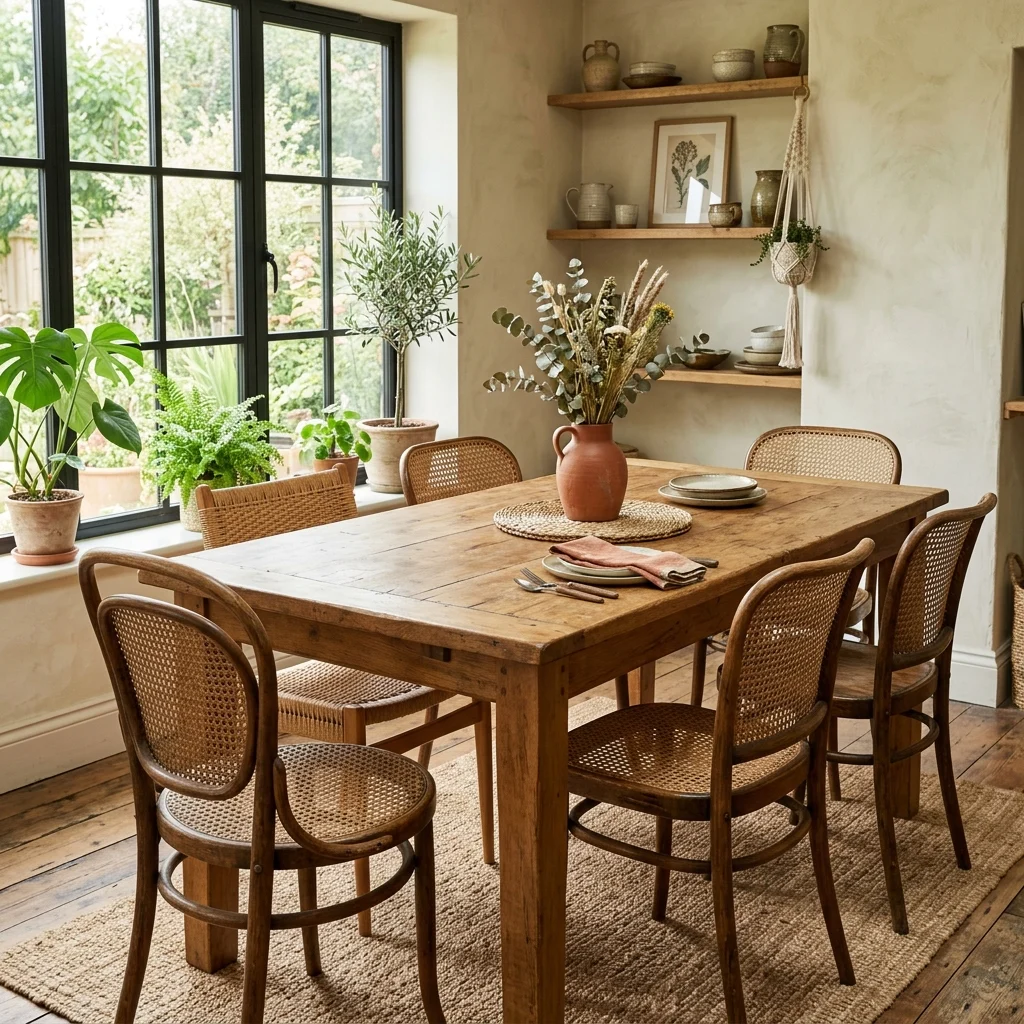
Vibe: The table feels gathered, chairs that clearly arrived from different places sharing one solid anchor.
Why it works: Pairing a single solid, substantial table with genuinely mismatched cane-backed chairs balances boho’s love of eclectic variety with enough visual weight to keep the arrangement from feeling chaotic. The table’s consistency anchors the chairs’ diversity, a contrast principle that lets both qualities read as intentional.
How to get it: Choose three or four cane-backed dining chairs in different but complementary styles, all in a similar natural wood tone, surrounding one solid reclaimed wood table that doesn’t match any individual chair.
Shop the Look
| Product |
| Vintage-style cane-backed dining chair set |
| Reclaimed wood dining table |
| Ceramic vase, warm glaze |
| Woven placemat set natural |
| Table runner block print |
13. Block-Printed Textiles on Cushions and Curtains
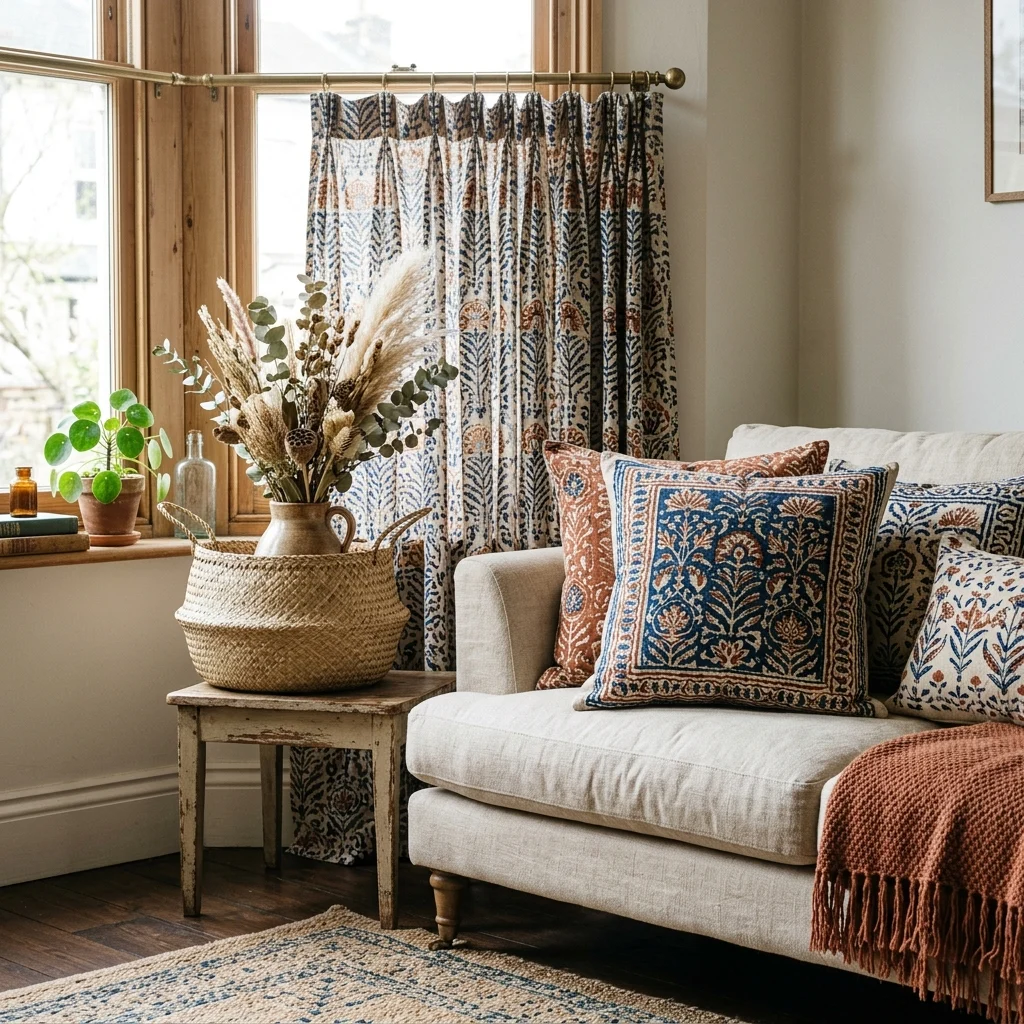
Vibe: The room feels layered, pattern repeating at two different scales without feeling busy.
Why it works: Using block-printed textiles from the same pattern family for both cushions and curtains repeats a genuine handcraft technique across different textile applications, applying pattern layering at two scales (small cushion motifs, larger curtain repeats) within one coordinated color story rather than introducing unrelated patterns.
How to get it: Choose block-printed cotton in one indigo-and-rust color family for both cushion covers and curtain panels, letting the motif scale differ between the two rather than using an identical print.
💡 Quick Win: Starting with just the cushion covers in a block print, before committing to full curtain panels, lets you test the pattern in the room first.
Shop the Look
| Product |
| Block print cotton cushion cover set |
| Block print cotton curtain panels |
| Woven jute basket |
| Dried floral stem bundle |
| Curtain rod natural wood |
14. A Curated Collection of Vintage Brass Objects
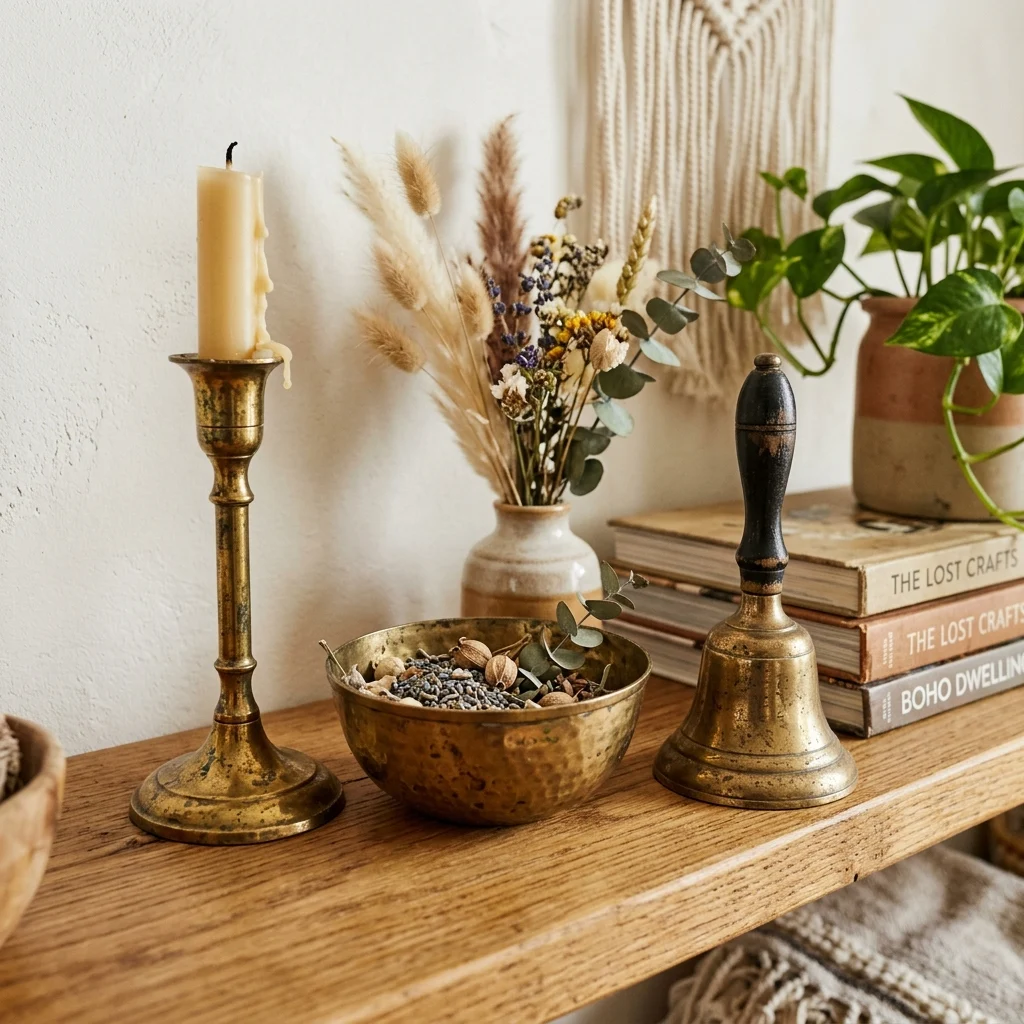
Vibe: The shelf feels gathered, tarnished metal carrying more history than a single new object could.
Why it works: A small collection of vintage brass pieces, each with slightly different tarnish and patina, introduces the same visible-imperfection quality that boho values in its textiles; no two pieces match exactly, which is precisely why the grouping reads as collected rather than purchased as a set. Brass also repeats as a warm metal note across whatever rattan or wood surrounds it.
How to get it: Group three to five vintage or vintage-style brass objects of varying scale and function (a candlestick, a small dish, a bell) rather than buying a matched brass decor set.
Shop the Look
| Product |
| Vintage-style brass candlestick set |
| Small brass decorative bowl |
| Aged brass bell ornament |
| Dried floral stem bundle |
| Small hardcover book set |
15. A Daybed as a Flexible Lounge-and-Guest-Bed Piece
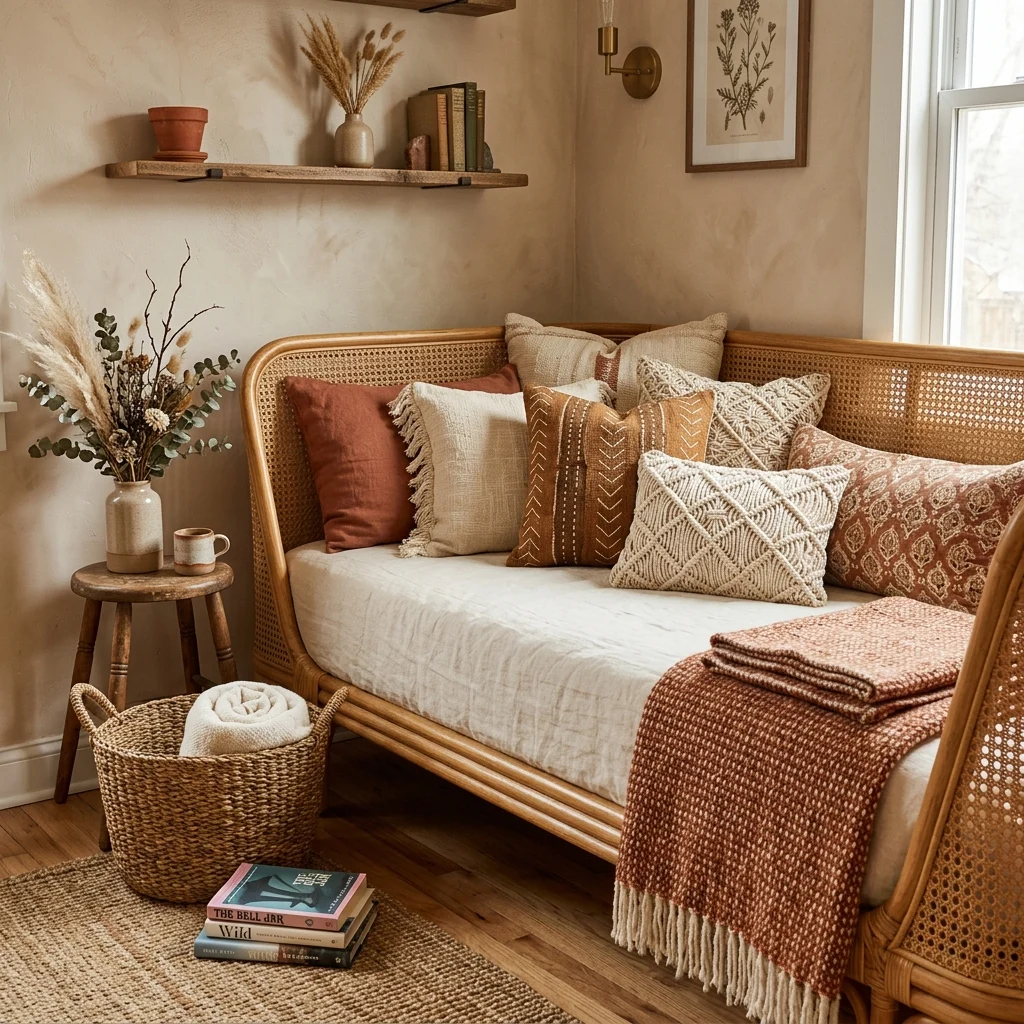
Vibe: The corner feels flexible, one piece of furniture doing double duty without looking like a spare bed.
Why it works: A cane-framed daybed layered with cushions reads as a lounge chair by day and functions as a guest bed by night, applying multi-functional furniture logic to a boho aesthetic that otherwise tends toward decorative rather than dual-purpose pieces. Layered cushions also disguise the bed’s function until it’s actually needed.
How to get it: Choose a daybed with a cane or rattan frame rather than a solid upholstered base, and layer it with four to six cushions in varied but coordinated patterns so it reads primarily as seating.
💡 Quick Win: A trundle-style daybed adds guest sleeping capacity without needing a separate spare room dedicated to it.
Shop the Look
| Product |
| Cane frame daybed with trundle |
| Layered cushion set mixed pattern |
| Folded throw blanket rust |
| Woven storage basket |
| Dried floral stem bundle |
16. Vertical Textile Layering Instead of Floor-Space-Heavy Furniture
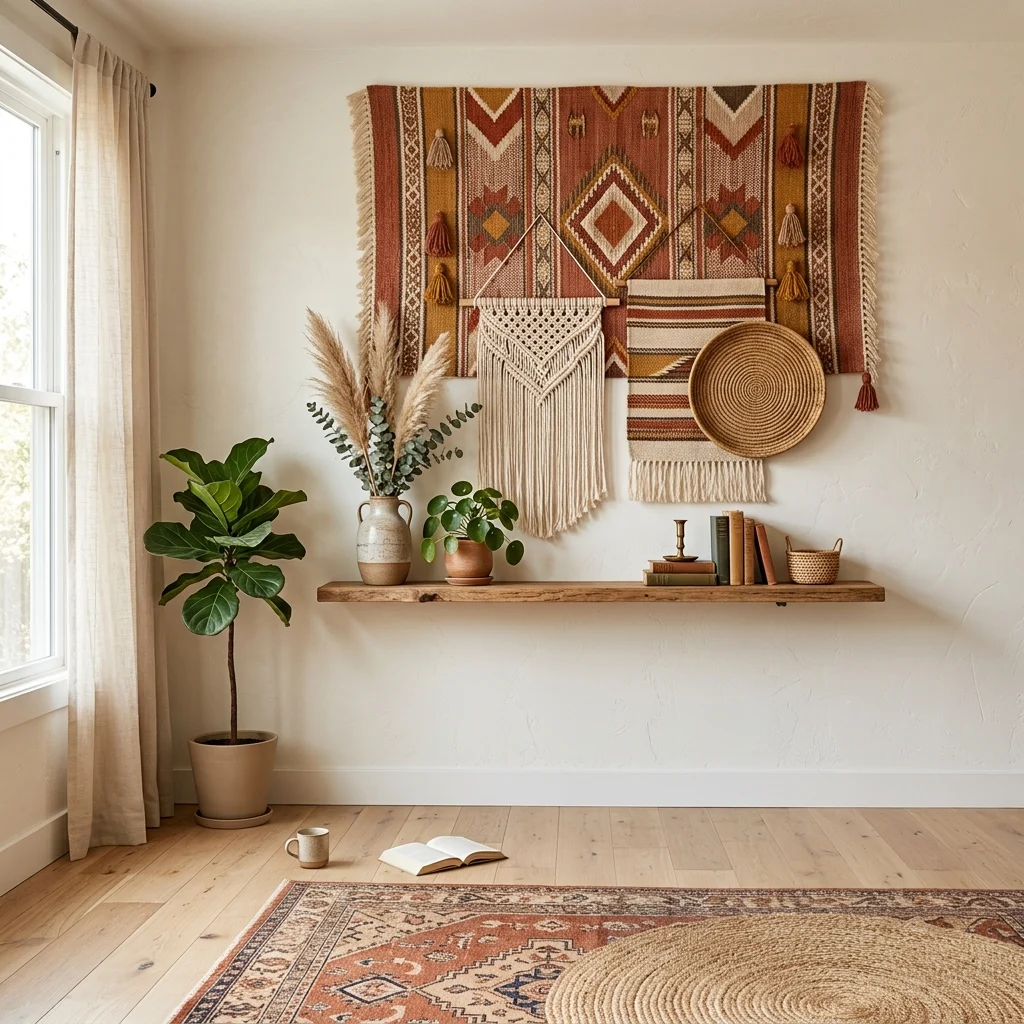
Vibe: The small room feels rich, texture stacked vertically instead of spread across the floor.
Why it works: In a small footprint, layering textiles on the wall, a tapestry with a smaller woven piece beneath it delivers boho’s signature visual richness without adding furniture that would claim floor space, solving the tension between wanting a layered look and needing to keep a tight room walkable.
How to get it: Choose one larger tapestry as the base layer and one smaller woven textile overlapping its lower edge, mounted on a single wall so the layering effect stays vertical rather than spreading across multiple surfaces.
Shop the Look
| Product |
| Woven tapestry wall hanging large |
| Small woven textile wall accent |
| Slim wood floating shelf |
| Ceramic bud vase |
| Wall mounting hardware kit |
How to Start Your Boho Home Transformation
Start with one vintage or vintage-style kilim rug, not the wall art. A rug in a rust-and-mustard color family is the single piece that establishes the color thread you’ll repeat through other rooms, because every textile and accent color decision afterward gets chosen to echo it.
The most common mistake is buying an entire matched boho furniture collection from one retailer for the whole house. This breaks the look because boho’s warmth comes specifically from pieces that read as collected across time and place, not coordinated in one order; fix it by swapping at least one piece per room for something genuinely vintage or secondhand.
Three items under $50 that create immediate impact: a mustard cotton throw for one room, a small vintage brass candlestick, and a woven seagrass basket for plant or textile storage.
A full whole-home boho transformation realistically takes 2–4 months and costs $4,000–$12,000. A weekend refresh using textiles, plants, and one rug costs $200–$600 and shifts the home’s warmth immediately, before any furniture arrives.
Frequently Asked Questions About Boho Home Decor
What’s the difference between boho and boho chic home decor?
Boho relies on genuinely mismatched pieces collected over time, vintage textiles, secondhand furniture, and varied cultural references, while “boho chic” often describes a curated retail version built from a single matched collection designed to look eclectic. A true boho home typically shows at least one piece with visible age or history in most rooms, rather than everything purchased new at once.
What color palette works best for boho home decor?
Warm terracotta, rust, and mustard form the base accent palette, layered against natural undyed tones and one broader accent like indigo. Farrow & Ball’s Terracotta No. 240 and Stiffkey Blue No. 281 are common reference points for a wall or reading nook. Avoid cool blue-grey tones throughout, which read more Scandinavian than boho.
How much does a whole-home boho decor transformation cost?
A budget refresh using textiles, plants, and one rug typically runs $200–$700. A mid-range update adding furniture and lighting across a few rooms costs $3,000–$7,000. A full whole-home transformation with new furniture, custom textiles, and lighting throughout can reach $10,000–$18,000, depending on how much is sourced vintage versus new.
Does boho home decor work with a modern or minimalist home?
Yes, boho blends well with modern through shared natural materials like rattan and reclaimed wood, as long as the modern base stays neutral enough to let the boho layering read as intentional contrast. It pairs less easily with strict minimalism, where boho’s layered texture and pattern directly conflict with minimalism’s preference for negative space and restraint.
What’s the most important element in boho home decor?
Layered texture is the most important element more than any single color choice; the mix of woven fiber, worn wood, and vintage textile carried consistently through connected rooms is what makes a home read as genuinely boho rather than simply warm-toned in one styled space. A home with the right colors but only smooth, uniform materials will still feel flat rather than gathered.
Ready to Create Your Dream Boho Home?
These 16 ideas move through layered rugs, recurring color threads, woven lighting, and space-conscious textile layering, showing that boho home decor comes together through many small, collected choices carried consistently from room to room. Starting with a single kilim rug or one mustard throw is not a lesser version of the style; it’s exactly how these homes are meant to come together over time. Today, place one small vintage or secondhand object somewhere in your main living space and notice how it changes the room’s story. Done well, the home will start to feel like a genuine reflection of the life lived in it, personality visible in every connected room rather than confined to one styled corner. Save the ideas that matched your own light and your own walls that came-backed daybed, the indigo reading nook, because a boho home rewards the space built slowly, one collected piece at a time.
You Might Also Like
- 13 Minimalist Home Decor Ideas for a Calm, Clutter-Free Space
- 12 Small Space Decor Ideas for a Modern Minimalist Home
- Eco Friendly Bamboo Home Decor: 9 Stunning Ways to Style Every Room
- 10 Stylish Shelf Decor Ideas for Every Room
- Modern Home Decor: 15 Ideas Worth Saving and Stealing
- 14 Boho Entryway Decor Ideas for a Warm Welcome
[…] 16 Boho Home Decor Ideas for a Warm, Eclectic Space […]