

Modern basement design turns an underused lower level into a clean, functional living space built around simple geometry, purposeful furniture, layered lighting, and a restrained material palette. These 17 stunning modern basement remodel ideas cover everything from warm oak walls and hidden storage to media zones, wet bars, flexible guest spaces, and low-ceiling solutions that make a basement feel intentional rather than unfinished.
A modern basement should feel calm rather than cold, with warm light washing across matte surfaces and natural textures softening crisp architectural lines. Picture pale oak against warm white walls, charcoal upholstery grounded by a textured rug, and carefully concealed storage keeping everyday clutter out of sight. Even a basement with limited daylight can gain an inviting rhythm when lighting is planned in layers instead of relying on one ceiling fixture. Here are 17 ideas worth saving and stealing.
Why Modern Basement Remodel Ideas Work So Well
Modern interior design developed from early-20th-century modernism, particularly the Bauhaus and International Style, where designers emphasized functional forms, geometric clarity, industrial materials, and the relationship between form and use. The Bauhaus, founded in 1919, helped establish an approach in which furniture, architecture, materials, and visual composition were treated as connected parts of one design system. Later International Style interiors reinforced linear forms, minimal ornament, and material efficiency.
A modern basement palette works particularly well with warm white, soft greige, warm charcoal, muted olive, natural white oak, walnut, concrete-look porcelain, blackened steel, brushed nickel, and clear or smoked glass. The trick is contrast without visual noise: pair one dominant neutral with two natural materials and a restrained dark accent rather than introducing several unrelated finishes. Natural wood is especially useful because it counterbalances the harder surfaces traditionally associated with modernism.
Style at a Glance
| Element | Core Trait 1 | Core Trait 2 |
| Philosophy | Function-led simplicity | Visual calm |
| Materials | White oak, walnut, porcelain, metal | Glass, wool, linen, concrete-look surfaces |
| Color palette | Warm white, greige, charcoal | Olive, walnut brown, muted black |
17 Stunning Modern Basement Remodel Ideas
1. Start with a Warm White Envelope
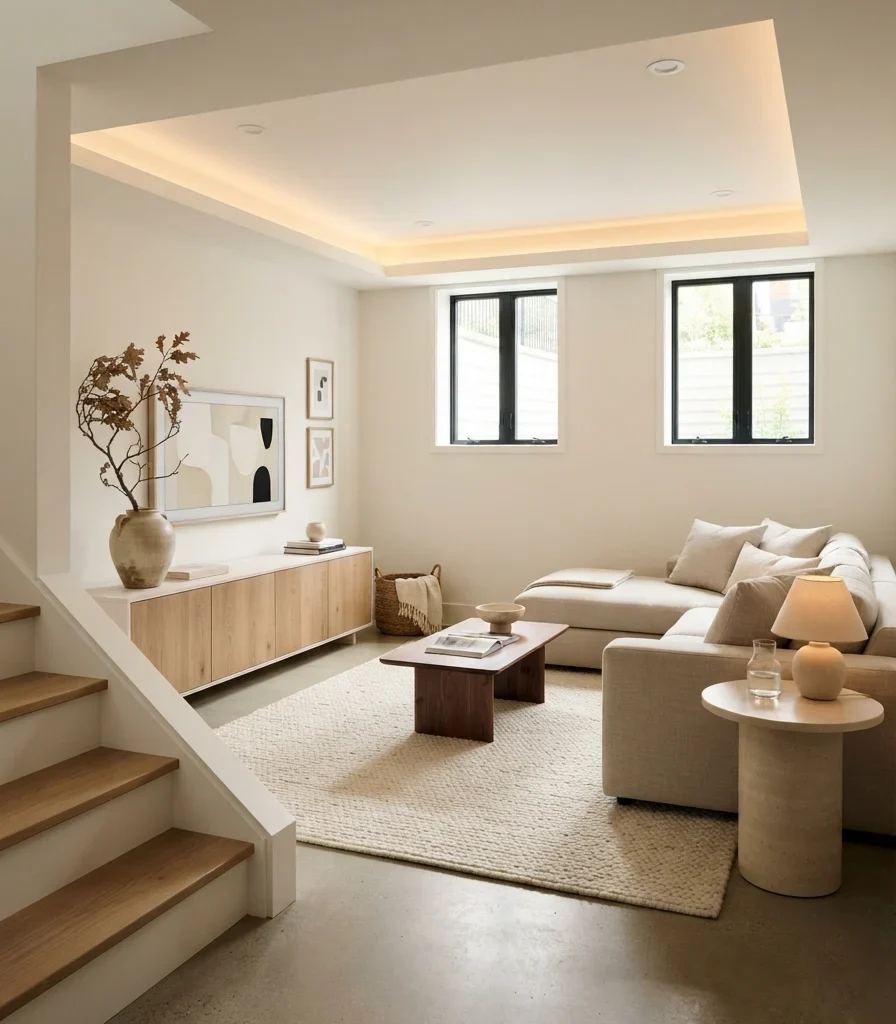
Vibe: Luminous.
Why it works: A warm-white envelope creates visual continuity across the basement’s walls and ceiling, which reduces the chopped-up appearance that lower levels can develop. The principle is background continuity: instead of competing wall colors, the eye reads one connected architectural volume, while pale oak and oatmeal upholstery introduce enough tonal variation to keep the room from feeling sterile.
How to get it: Choose a warm white with a subtle beige or yellow undertone rather than a blue-white, and test it under the basement’s artificial lighting before committing. Keep trim within the same color family but use a slightly different sheen, such as satin trim against eggshell walls, for quiet definition.
💡 Quick Win: Replace cool-white bulbs with 2700K LED bulbs before buying anything else; the same basement will immediately look warmer.
Shop The Look
| Product | Amazon search phrase |
| Sectional | Low profile oatmeal modular sectional sofa modern basement |
| Rug | Large cream textured wool-look area rug 8×10 |
| Console | Natural white oak modern media console low profile |
| Vase | Oversized matte ivory ceramic floor vase modern |
| Cushions | Neutral linen throw pillow covers cream oatmeal set |
2. Build a Long Linear Media Wall
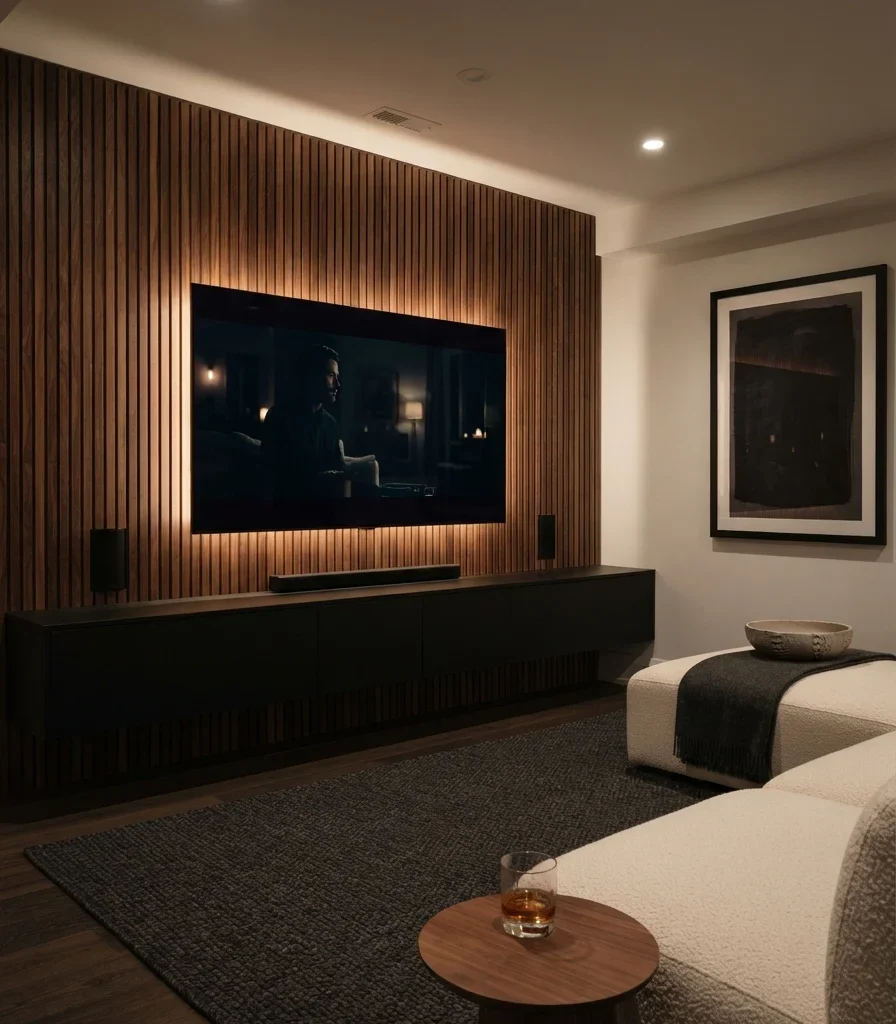
Vibe: Cinematic.
Why it works: A linear media wall gives the basement one dominant architectural focal point rather than allowing the television and electronics to become scattered visual objects. The vertical walnut battens add texture and rhythm while the floating cabinet preserves visible floor area, which is especially useful where basement ceilings are low.
How to get it: Build the composition around the television width rather than buying a wall system first. Leave a consistent 4–6 inches between decorative vertical battens and conceal power and HDMI cables inside a properly planned cable channel before closing the wall.
Shop The Look
| Product | Amazon search phrase |
| Slat panels | Walnut acoustic wood slat wall panels modern interior |
| Media cabinet | Floating matte black TV console wall mounted |
| Bias light | Warm white LED TV backlight strip 2700K |
| Speaker | Slim wall-mounted soundbar, black,k minimalist |
| Throw | Charcoal waffle knit oversized throw blanket |
3. Add Through Layered Lighting
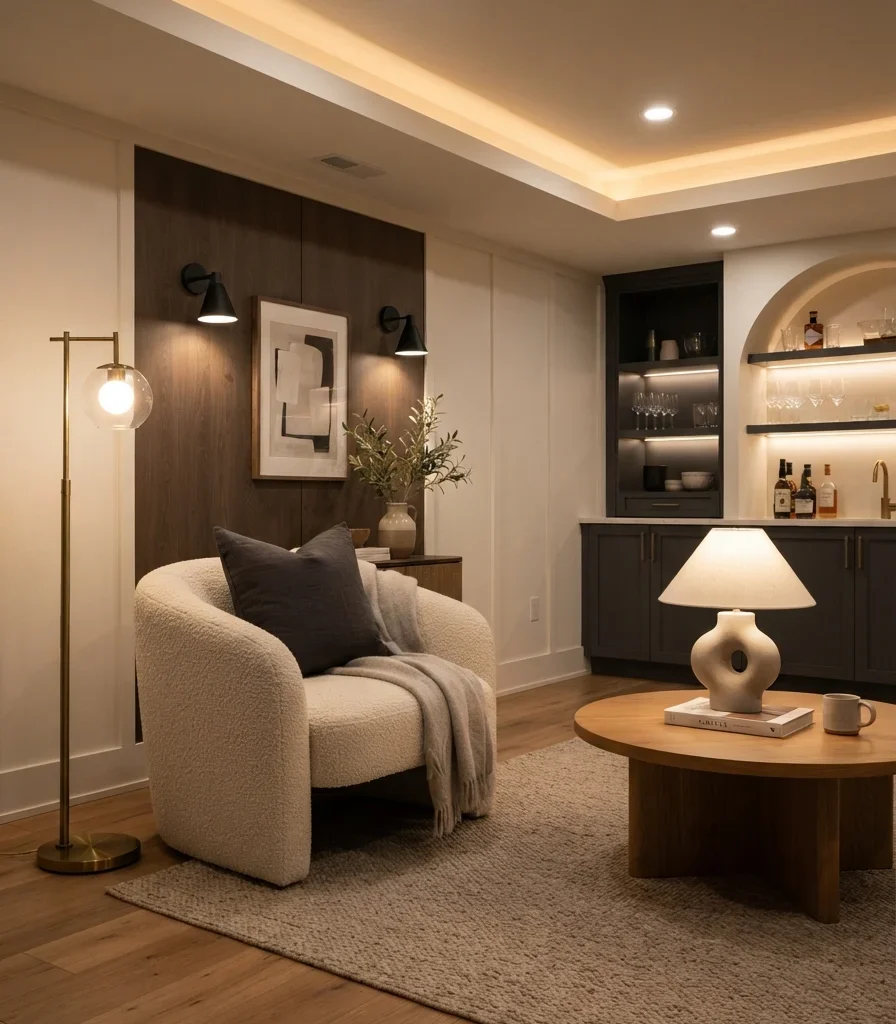
Vibe: Warm.
Why it works: Basements frequently lack abundant natural light, so relying on one overhead fixture creates harsh pools of illumination and deep shadows. A three-layer lighting system- ambient, task, and accent- creates visual depth by illuminating the room from different heights, while 2700K light keeps white walls and wood tones inviting rather than clinical.
How to get it: Install dimmable recessed fixtures for general illumination, then add at least two lower light sources such as sconces or table lamps. Use concealed LED strips only where they have a defined architectural purpose, such as washing a media wall or floating shelf.
💡 Quick Win: Add one plug-in picture light above existing artwork and one floor lamp beside the sofa rather than attempting a full electrical renovation immediately.
Shop The Look
| Product | Amazon search phrase |
| Wall sconces | Matte black plug-in modern wall sconces warm light |
| Floor lamp | Aged brass globe floor lamp modern living room |
| LED strip | Warm white dimmable COB LED strip 2700K |
| Recessed lights | Dimmable slim LED recessed ceiling lights warm white |
| Table lamp | Ceramic sculptural table lamp linen shade neutral |
4. Use Pale Oak to Warm Up Concrete and Black Metal
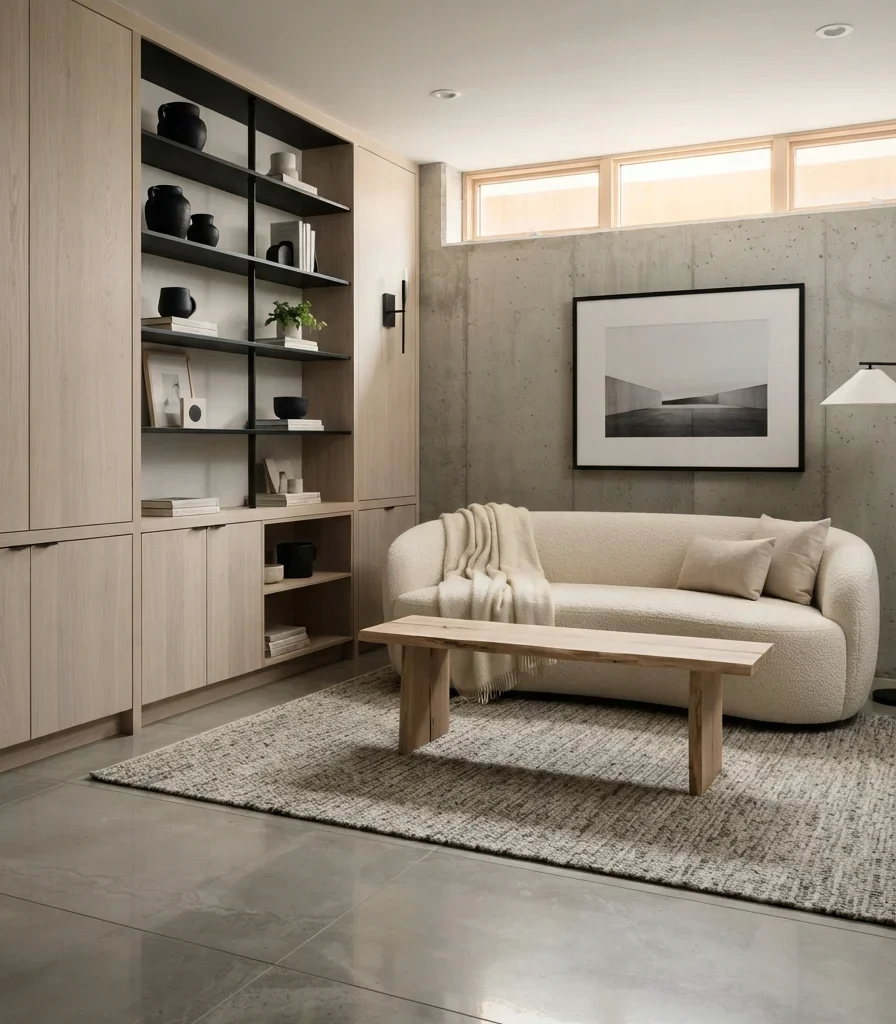
Vibe: Grounded.
Why it works: Modern basements can become visually cold when every finish is gray, black, or concrete-inspired. Material temperature contrast solves that problem: pale oak introduces natural grain and warmth against the harder visual weight of concrete-look porcelain and black steel, giving the room modern clarity without industrial severity.
How to get it: Use one dominant oak species throughout the space rather than mixing several yellow, red, and gray woods. Repeat the oak at least three times, such as cabinetry, coffee table, and shelving, to make the material read as intentional.
Shop The Look
| Product | Amazon search phrase |
| Coffee table | Light white oak rectangular modern coffee table |
| Shelving | Black metal oak wood open shelving unit |
| Ottoman | Cream boucle square storage ottoman |
| Tray | Natural oak rectangular decorative serving tray |
| Vase | Matte black ceramic cylinder vase minimalist |
5. Create a Modern Wet Bar with Full-Height Cabinetry
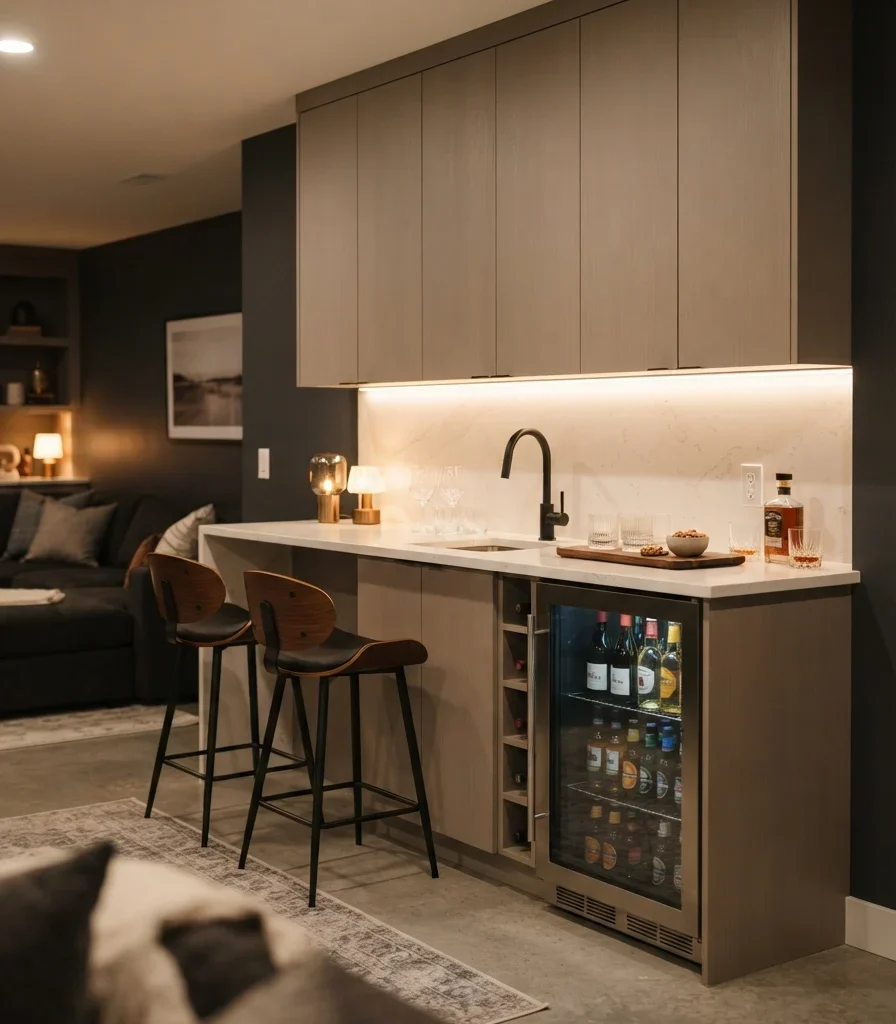
Vibe: Social.
Why it works: Full-height cabinetry uses the vertical plane instead of consuming valuable floor area, while a restrained material palette gives the bar an architectural presence. The principle is vertical emphasis: cabinetry reaching toward the ceiling makes a low basement feel more continuous and deliberately built rather than pieced together.
How to get it: Specify flat-front cabinet doors in warm greige or mushroom and pair them with a single countertop material such as white quartz. Add under-cabinet lighting at approximately 2700–3000K so the work surface remains functional without becoming visually bright.
💡 Quick Win: A freestanding beverage station with a walnut tray, glassware, and one countertop lamp can create the visual language of a wet bar before cabinetry is installed.
Shop The Look
| Product | Amazon search phrase |
| Counter stools | Walnut wood counter stools low back modern |
| Tray | Large walnut serving tray modern bar |
| Glassware | Ribbed clear glass tumbler set contemporary |
| Faucet | Matte black bar prep faucet modern single handle |
| Cabinet lighting | Rechargeable warm under cabinet light bars |
6. Zone an Open Basement Without Building Walls
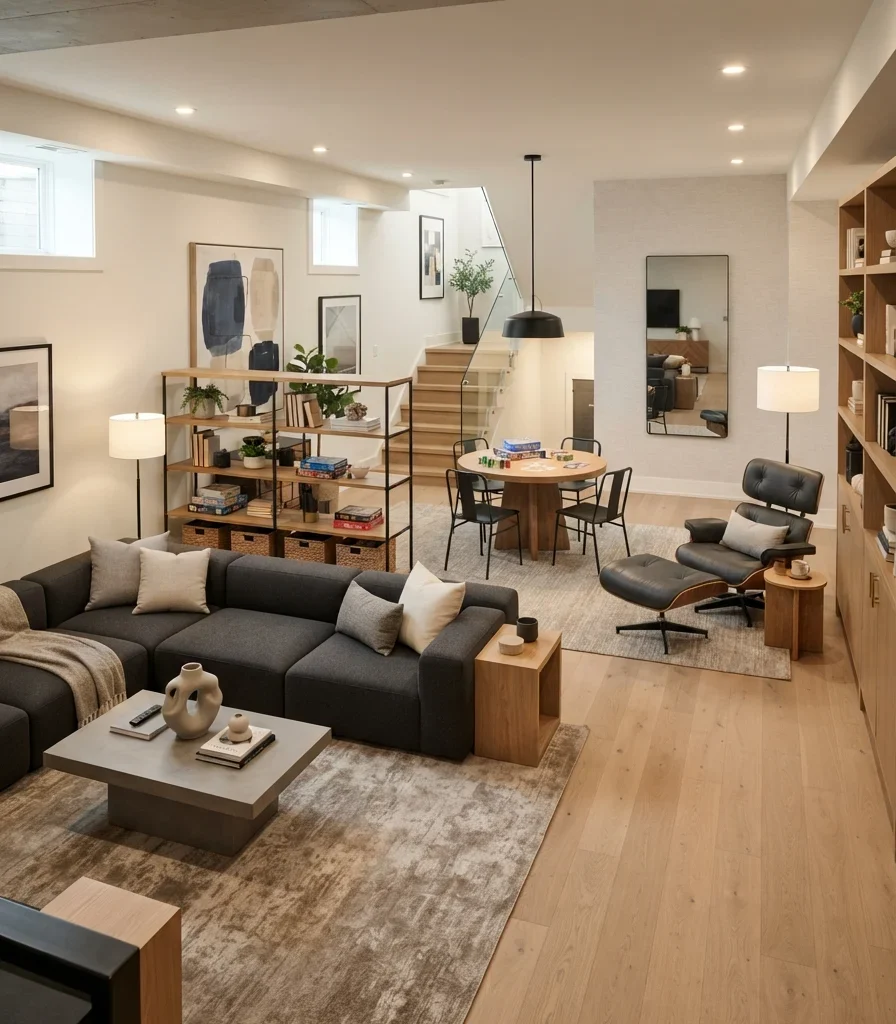
Vibe: Ordered.
Why it works: Open basements often feel undefined because several activities compete within one large rectangle. Furniture zoning creates invisible rooms without sacrificing sightlines: the rug establishes the lounge footprint, the sofa defines its boundary, and an open shelf can separate activities while preserving light and circulation.
How to get it: Map the basement into functional rectangles before purchasing furniture, leaving roughly 30–36 inches for primary walking paths where possible. Use rugs, lighting centers, and furniture backs as boundaries rather than adding unnecessary permanent walls.
Shop The Look
| Product | Amazon search phrase |
| Room divider | Modern oak open shelving room divider |
| Area rug | Taupe geometric modern area rug 8×10 |
| Floor cushion | Neutral oversized floor cushion modern |
| Basket | Woven seagrass storage basket with handles |
| Pendant | Black linear pendant light modern dining |
7. Go Horizontal
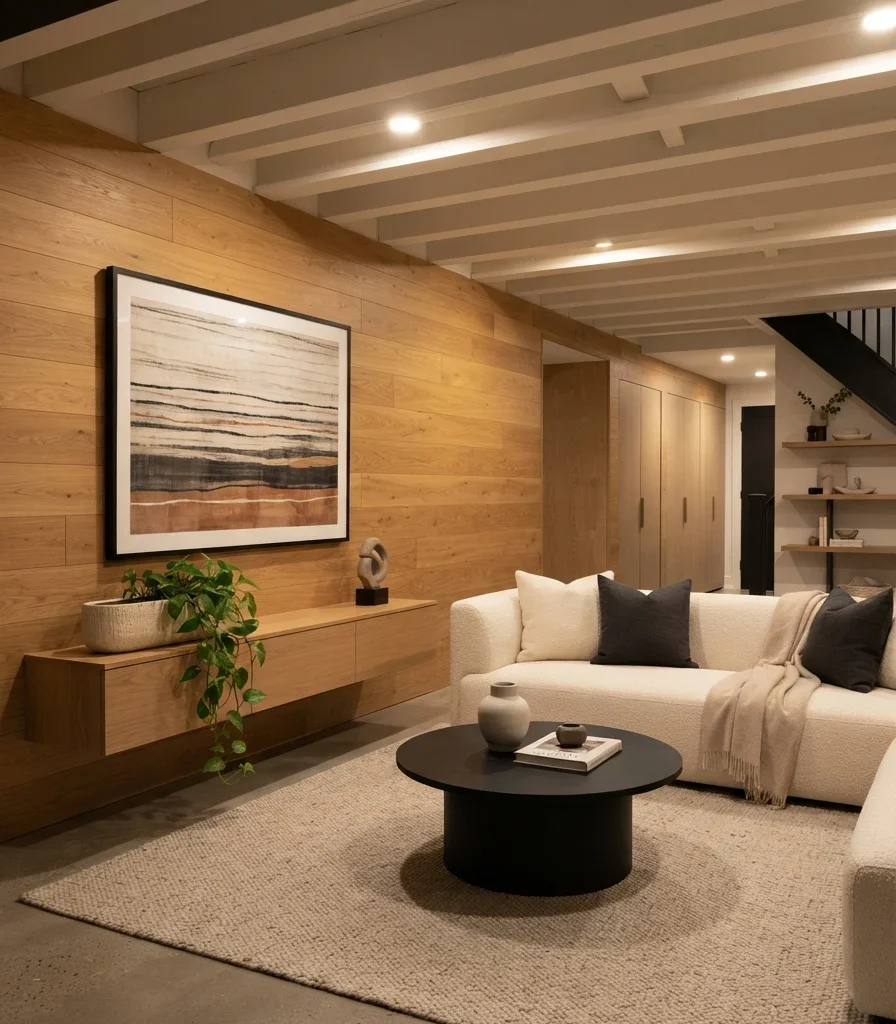
Vibe: Expansive.
Why it works: Low ceilings benefit from horizontal visual emphasis because horizontal lines encourage the eye to travel across the room instead of drawing attention upward toward a compressed ceiling plane. Low-profile furniture reinforces the effect by leaving more uninterrupted wall area above the seating.
How to get it: Choose furniture with seat heights around 16–18 inches and use long horizontal artwork or cabinetry rather than tall vertical pieces. If beams must remain exposed, paint them the same color as the ceiling to reduce visual fragmentation.
💡 Quick Win: Replace one tall storage cabinet with a low six-cube console and style only the top third of it; the room will immediately gain more visual breathing space.
Shop The Look
| Product | Amazon search phrase |
| Low console | Low profile oak storage console modern |
| Artwork | Oversized horizontal abstract canvas neutral |
| Sofa | Low profile cream modern sectional sofa |
| Planter | Long rectangular matte ceramic planter indoor |
| Cushions | Cream boucle lumbar pillow covers modern |
8. Introduce Charcoal for Controlled Contrast
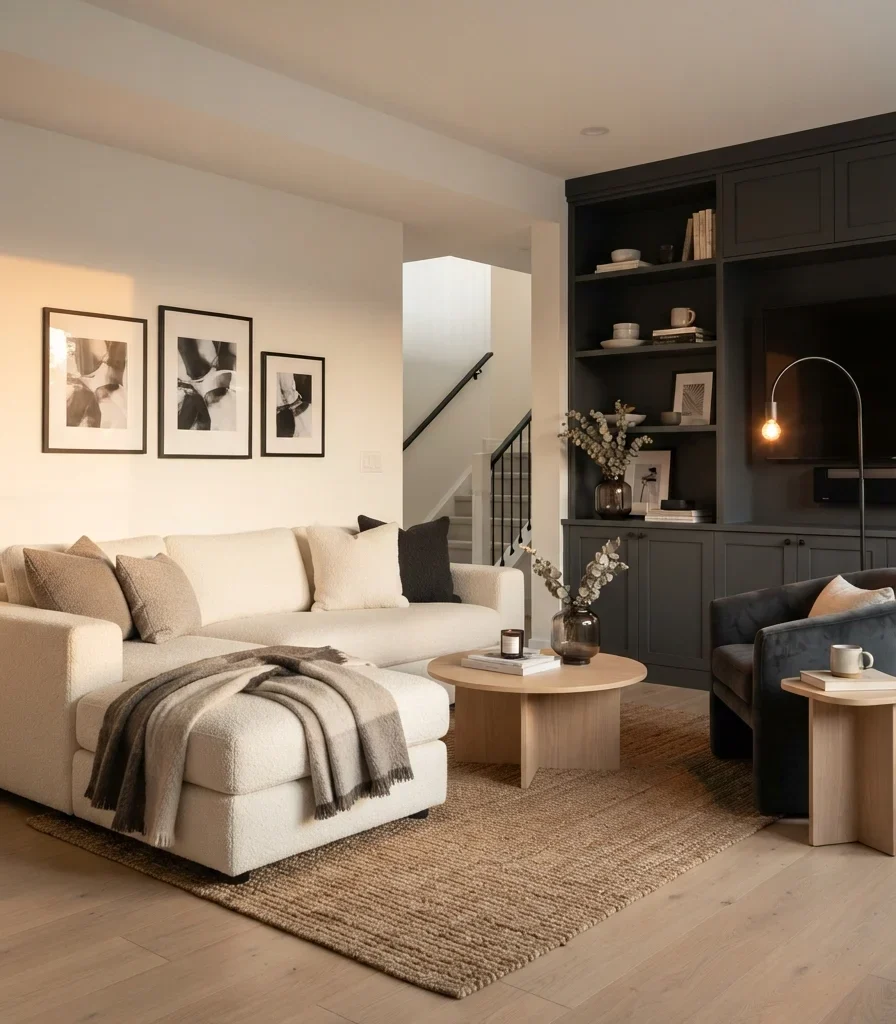
Vibe: Anchored.
Why it works: Charcoal gives a basement visual weight without the harshness of pure black. The design principle is controlled contrast: a dark value placed against warm white and pale oak creates hierarchy, allowing cabinetry or a fireplace wall to become an intentional architectural anchor.
How to get it: Choose a charcoal with a warm gray or brown undertone, then repeat it in three small areas- cabinetry, artwork frames, and one textile- to create cohesion without turning the entire room dark.
Shop The Look
| Product | Amazon search phrase |
| Accent chair | Charcoal boucle accent chair modern low profile |
| Art frames | Black thin metal picture frame set modern |
| Throw | Charcoal merino wool style throw blanket |
| Vase | Smoked gray glass decorative vase |
| Side table | Black metal round C side table modern |
9. Pair Modern Furniture with a Textured Stone-Look Fireplace
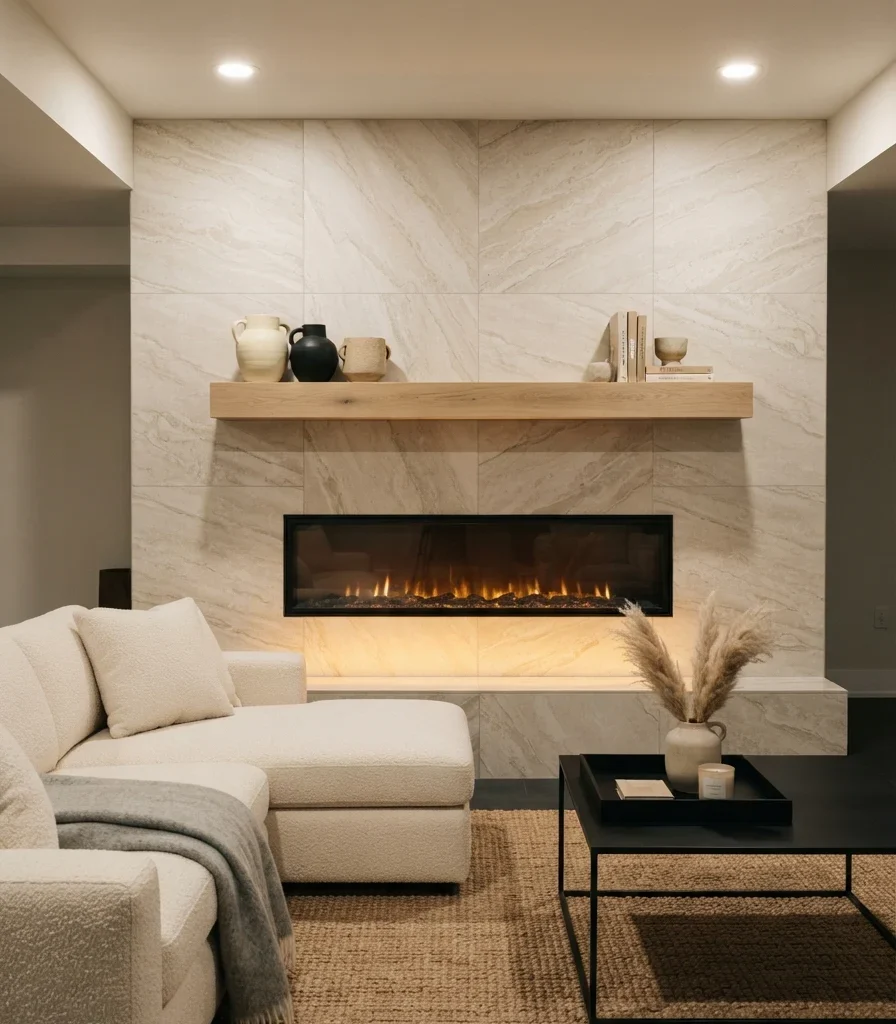
Vibe: Hushed.
Why it works: A fireplace provides the visual center modern basements sometimes lack, while large-format stone-look porcelain prevents the wall from becoming visually fragmented by many small tile joints. Material continuity makes the fireplace read as an architectural volume rather than an applied decoration.
How to get it: Use large-format porcelain or another appropriate noncombustible finish around the fireplace according to the fireplace manufacturer’s clearance requirements. Keep the mantel shallow and visually simple so the slab remains the dominant texture.
💡 Quick Win: For an existing fireplace, replace a collection of small mantel objects with one oversized ceramic vessel and two stacked neutral books.
Shop The Look
| Product | Amazon search phrase |
| Fireplace | Slim modern electric linear fireplace insert |
| Mantel shelf | Floating natural oak fireplace mantel shelf |
| Ceramic vessel | Large ivory sculptural ceramic vase |
| Books | Neutral modern architecture coffee table books |
| Fireplace tool set | Minimal matte black fireplace tool set |
10. Make a Compact Basement Office Feel Architectural

Vibe: Focused.
Why it works: A basement office works best when the workspace is treated as a built-in architectural zone rather than a desk randomly placed against a wall. Proportion and task alignment matter: a roughly 24–30-inch-deep desk provides useful working space without unnecessarily projecting into circulation.
How to get it: Use a wall-mounted desktop or custom oak worktop under the stair slope, then run cable management underneath before styling the surface. Keep open shelves above the desk limited to frequently used items and place closed storage below.
Shop The Look
| Product | Amazon search phrase |
| Desk | Wall mounted white oak floating desk modern |
| Chair | Cream ergonomic office chair modern design |
| Desk lamp | Matte black adjustable LED desk lamp |
| Cable tray | Under desk black cable management tray |
| Monitor shelf | Natural oak monitor stand riser with drawer |
11. Add a Built-In Banquette for Flexible Seating
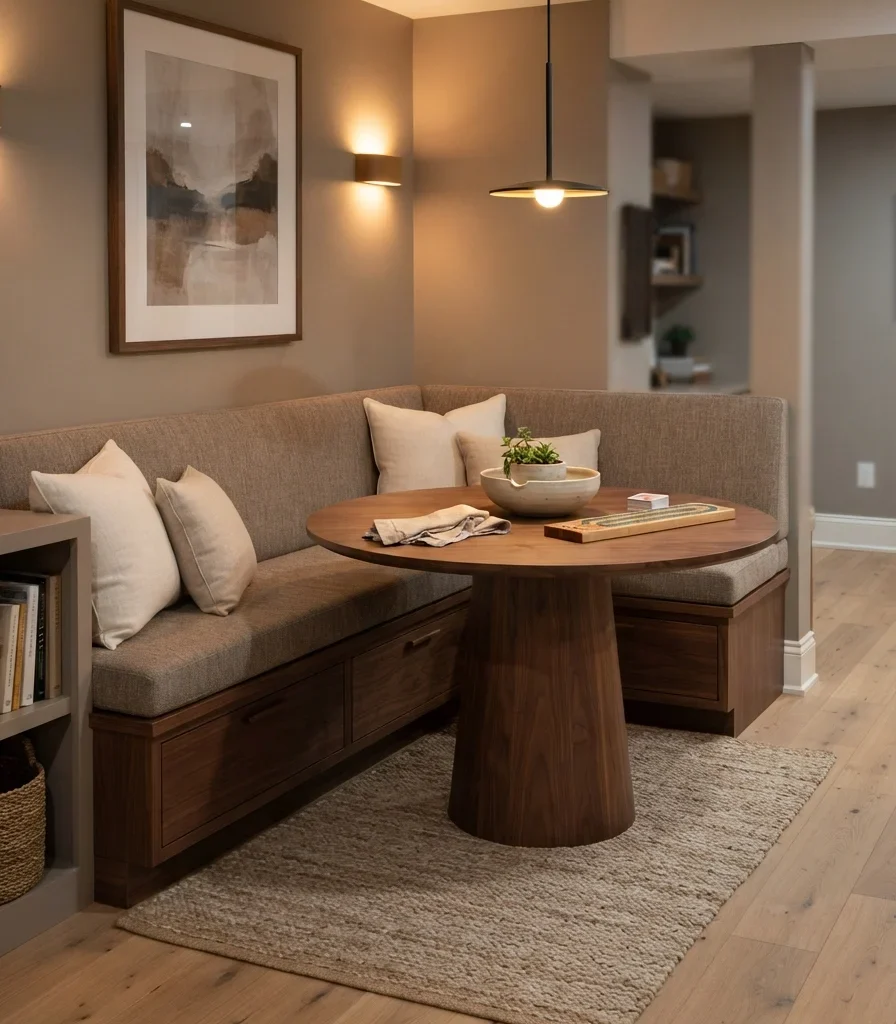
Vibe: Gathered.
Why it works: A banquette converts an otherwise awkward perimeter into seating and storage simultaneously. The principle is functional density: one architectural element handles seating, organization, and zoning, while the pedestal table preserves legroom and makes movement around the corner easier.
How to get it: Build the bench around a standard table height and choose durable performance upholstery because basement entertainment areas experience heavier use than formal dining rooms. Include lift-up lids or drawers so blankets and games disappear quickly after use.
💡 Quick Win: Test the layout with a freestanding bench, dining table, and removable cushions before committing to built-in carpentry.
Shop The Look
| Product | Amazon search phrase |
| Dining table | Walnut round pedestal dining table modern |
| Bench cushion | Custom size cream performance fabric bench cushion |
| Pendant | Slim matte black dome pendant light |
| Storage bins | Neutral fabric under bench storage bins |
| Napkins | Natural linen napkin set warm neutral |
12. Use Acoustic Materials in a Media-Focused Basement
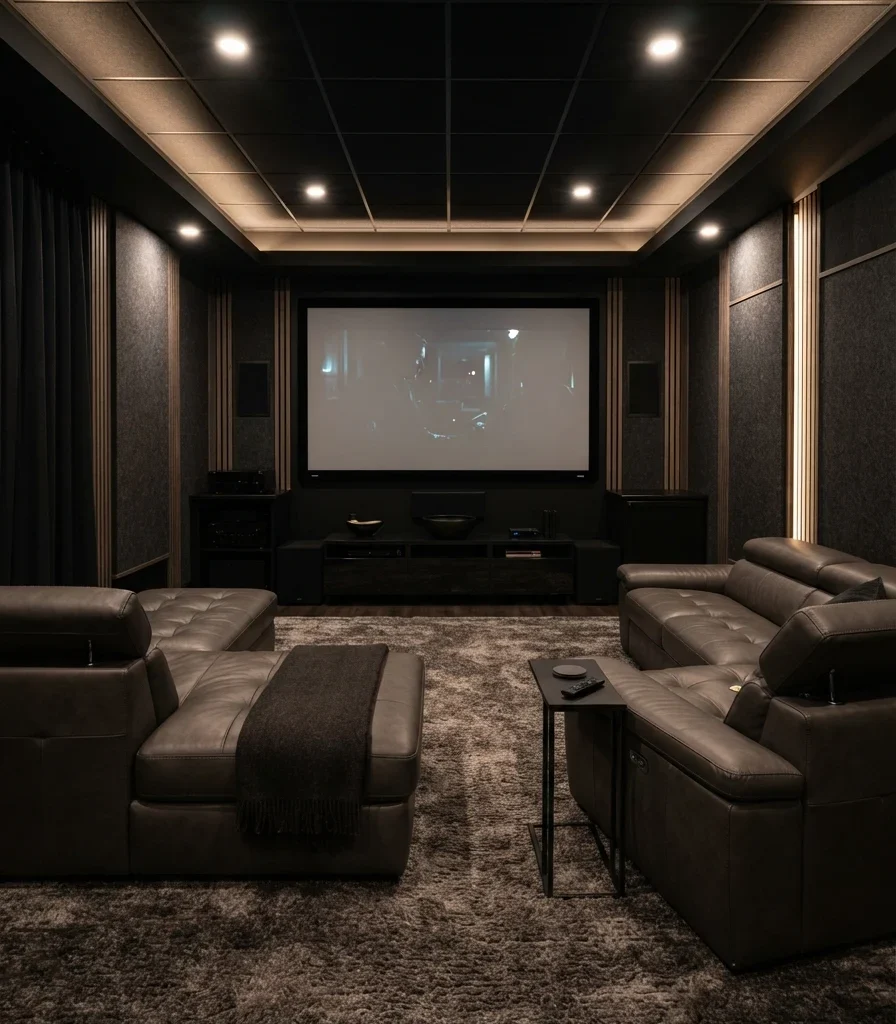
Vibe: Immersive.
Why it works: Hard basement surfaces can produce noticeable sound reflection, particularly in media rooms. Acoustic absorption adds both functional and visual texture: felt wall panels, a thick rug, upholstered seating, and curtains soften reflected sound while maintaining the disciplined geometry associated with modern interiors.
How to get it: Treat the first reflection zones rather than covering every wall. Combine acoustic panels with a substantial rug and upholstered furniture, then keep the ceiling lighting dimmable so the room can transition from social space to viewing mode.
Shop The Look
| Product | Amazon search phrase |
| Acoustic panels | Charcoal hexagon acoustic wall panels modern |
| Rug | Thick charcoal area rug 8×10 sound absorbing |
| Curtains | Blackout thermal curtain panels charcoal |
| Side table | Black round pedestal side table modern |
| Floor cushions | Oversized charcoal floor cushion theater room |
13. Add a Slim Fireplace and Oak Wall

Vibe: Restorative.
Why it works: The combination of oak and fire introduces natural warmth into an otherwise restrained modern room. Vertical rhythm gives the wall height and structure, while the narrow fireplace maintains a modern proportion instead of overwhelming the basement with a traditional mantel.
How to get it: Use rift-cut or plain-sawn oak veneer with a matte finish and repeat the same wood on only one or two other pieces. Avoid orange-toned stains; natural or lightly whitewashed oak maintains the cleaner modern palette.
Shop The Look
| Product | Amazon search phrase |
| Floor lamp | Black sculptural arc floor lamp modern |
| Accent chair | Muted olive green boucle accent chair |
| Wall shelf | Floating white oak shelf minimalist |
| Vase | Olive green ceramic vase modern |
| Pillow | Muted olive linen lumbar pillow cover |
14. Bring in a Glass Partition Instead of a Solid Wall

Vibe: Airy.
Why it works: A glass partition provides separation without the visual mass of a conventional wall. The principle is transparent zoning: the functions become distinct while borrowed light and long sightlines remain intact, which is especially useful when only one basement side receives daylight.
How to get it: Use clear rather than heavily tinted glass when daylight is limited, and keep the framing visually slim. If privacy is required, consider a curtain inside the office zone rather than replacing the transparent partition with an opaque wall.
💡 Quick Win: Before installing glass, test the concept with a slim open shelving unit positioned perpendicular to the wall; it will show whether zoning improves the room.
Shop The Look
| Product | Amazon search phrase |
| Glass divider | Black framed glass room divider modern industrial |
| Desk | Slim walnut writing desk modern |
| Chair | Black and cream ergonomic office chair |
| Curtain | Natural linen privacy curtain panel |
| Plant stand | Black metal minimalist indoor plant stand |
15. Use a Large Mirror to Multiply Basement Light
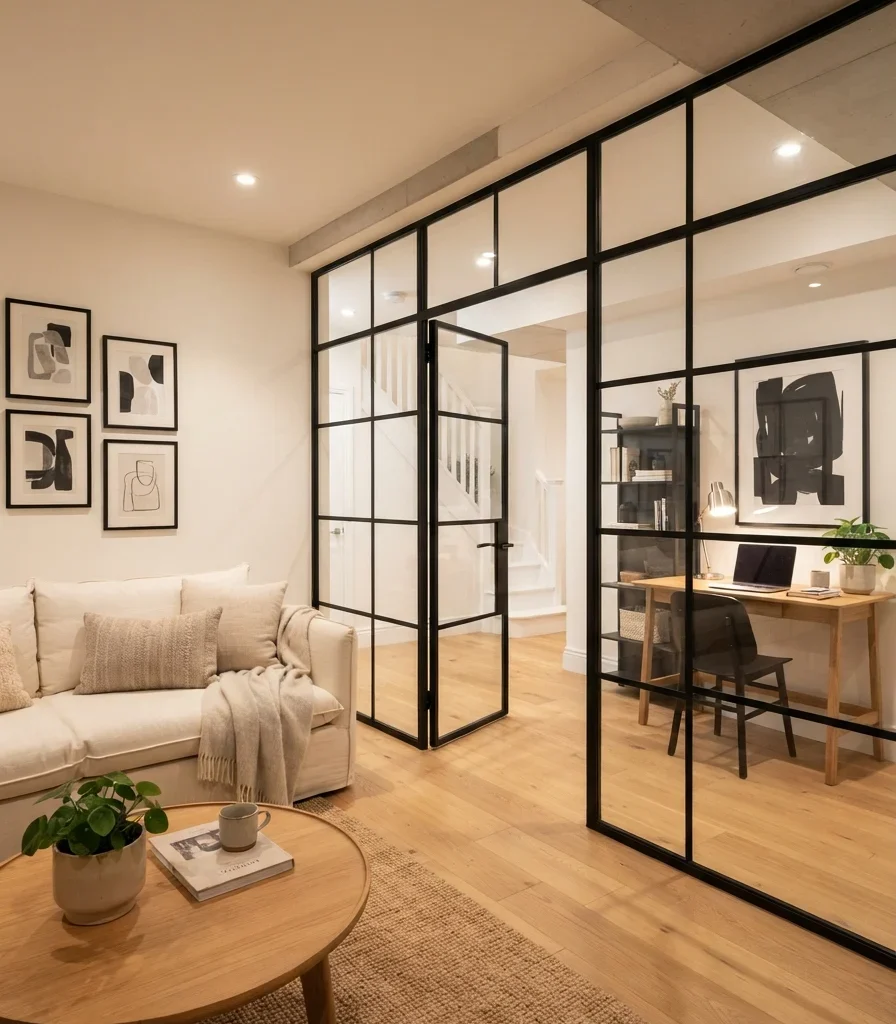
Vibe: Reflective.
Why it works: Mirrors cannot create daylight, but they can redistribute whatever natural or artificial light already exists. Reflective balance works particularly well in basements when a large mirror is positioned opposite or adjacent to a window, bright wall, or lamp rather than placed randomly on the darkest wall.
How to get it: Choose the largest proportionally appropriate mirror the wall can accommodate, ideally with a slim black, brushed metal, or frameless edge. Position it so the reflection captures a light source or open area rather than a cluttered storage zone.
Shop The Look
| Product | Amazon search phrase |
| Mirror | Oversized arched black frame floor mirror modern |
| Console | Slim light oak entry console table |
| Lamp | Matte black mushroom table lamp modern |
| Bowl | Low matte ivory ceramic decorative bowl |
| Plant | Artificial olive tree 5-foot realistic indoor |
16. Turn an Awkward Corner into a Reading Retreat

Vibe: Hushed.
Why it works: Awkward corners become useful when their scale is respected rather than filled with oversized furniture. A single lounge chair, compact table, and vertical storage create a complete micro-zone through proportion and enclosure, giving the basement another destination without stealing circulation space.
How to get it: Measure the usable corner first and choose a chair no wider than approximately 30–32 inches if the area is tight. Mount two or three shallow picture ledges above the chair instead of installing a deep bookcase.
💡 Quick Win: A secondhand leather chair paired with a new warm LED floor lamp can create the entire reading zone for a fraction of a built-in renovation.
Shop The Look
| Product | Amazon search phrase |
| Lounge chair | Cognac brown leather accent lounge chair modern |
| Side table | Small walnut round side table modern |
| Floor lamp | Warm brass reading floor lamp adjustable |
| Book ledges | Walnut floating picture ledges bookshelf |
| Basket | Woven leather handle storage basket neutral |
17. Finish the Basement with Concealed Storage
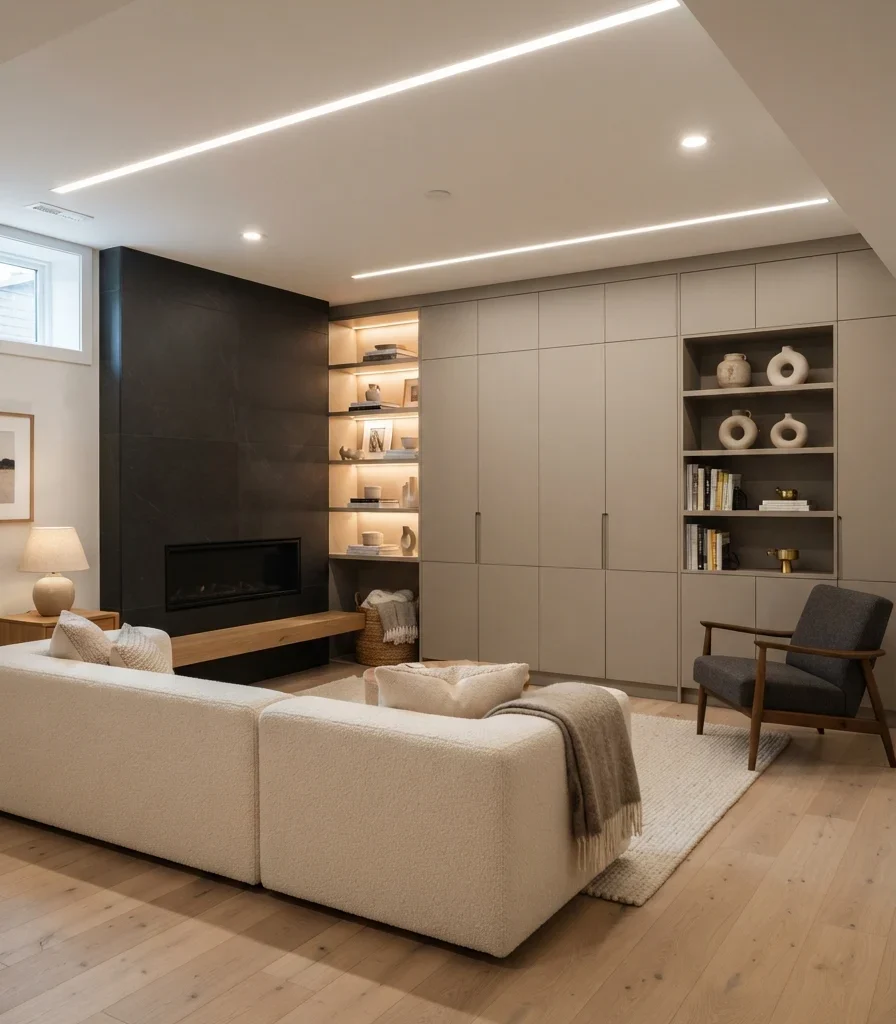
Vibe: Composed.
Why it works: The modern basement looks finished when visual clutter has somewhere intentional to go. Open-versus-closed storage balance is crucial: closed cabinetry hides cables, toys, games, and miscellaneous household items, while a small amount of open shelving gives the room personality without turning storage into decoration.
How to get it: Aim for roughly 70% concealed storage and 30% open display in a busy family basement. Use push-to-open doors or slim integrated pulls, and organize each cabinet around one category rather than allowing every compartment to become miscellaneous storage.
Shop The Look
| Product | Amazon search phrase |
| Storage cabinet | Tall handleless modern storage cabinet warm greige |
| Baskets | Large woven storage basket set neutral |
| Bookends | Matte black geometric metal bookends |
| Decorative boxes | Linen storage boxes with lids neutral |
| Shelf decor | Minimalist ceramic sculpture set neutral |
How to Start Your Modern Basement Transformation
The single first move is to establish the lighting temperature: replace the basement’s existing cool bulbs with dimmable 2700K LEDs before choosing paint, furniture, or finishes. Modern basements depend heavily on artificial light, so every subsequent color decision will be judged through that light; correcting it first gives warm white walls, oak, cream upholstery, and charcoal accents a consistent visual foundation.
The most common mistake is choosing a cold blue-gray paint because the basement already feels dark. Blue-gray can become noticeably colder under limited daylight and cool LEDs, making the lower level feel disconnected from the rest of the house. Instead, test a warm white or soft greige on two walls and observe it in both daytime and evening conditions before painting the entire room.
Three inexpensive entry points can create immediate impact: 2700K LED bulbs, a matte black plug-in wall sconce, and a large cream textured throw pillow. Together they can cost well under $50–$75 depending on quality and instantly establish the warm-modern direction.
A cosmetic refresh can happen over one weekend, while a serious basement remodel involving flooring, electrical work, built-ins, plumbing, or a bathroom can take several weeks to several months. A starter decorating transformation might land around $1,000–$4,000, while a professionally renovated basement can easily reach $20,000–$75,000+, depending on size, plumbing, finishes, structural work, and local labor. Before construction, verify moisture conditions, electrical requirements, ceiling constraints, and required egress with the appropriate local professionals and authorities.
Frequently Asked Questions About 17 Stunning Modern Basement Remodel Ideas
What makes a basement look modern rather than unfinished?
A modern basement has a deliberate relationship between architecture, furniture, lighting, and materials rather than simply having finished drywall and furniture. Warm white or greige walls, clean-lined furniture, concealed storage, natural oak, matte black accents, and layered 2700K lighting establish the visual language quickly. The most important difference is continuity: flooring, lighting, cabinetry, and furniture should appear selected as one system rather than purchased independently.
What colors make a modern basement feel brighter?
Warm white, pale greige, soft taupe, and light oak are among the most useful colors for a basement with limited daylight. Avoid automatically choosing stark pure white because it can look gray or blue beneath artificial lighting. A warm white paired with pale oak and cream upholstery gives the room brightness while retaining enough warmth to prevent the basement from feeling clinical.
How much does it cost to remodel a modern basement?
The cost varies dramatically according to whether you are decorating an already finished basement or performing a structural renovation. A cosmetic modern refresh can begin around $1,000–$4,000, while flooring, electrical work, built-ins, plumbing, insulation, bathrooms, or extensive framing can push a project into the $20,000–$75,000+ range. Prioritize infrastructure and moisture control before spending heavily on decorative finishes.
Can you make a low-ceiling basement look modern and spacious?
Yes, but furniture scale becomes especially important. Choose low-profile sofas, horizontal cabinetry, large rugs, continuous flooring, and warm light-colored walls instead of tall furniture and visually busy partitions. Keeping major walking paths around 30–36 inches where possible and reducing unnecessary visual breaks can make the same basement feel significantly more open.
What is the best flooring for a modern basement?
Water-resistant luxury vinyl plank, porcelain tile, and other basement-appropriate flooring systems are common choices, but the correct material depends on moisture conditions, subfloor construction, and local requirements. For a warm modern appearance, pale oak-look flooring works particularly well with cream upholstery and charcoal accents. Avoid choosing flooring solely from a photograph; basement moisture and installation requirements should determine the final specification.
Ready to Create Your Dream Modern Basement with These 17 Stunning Modern Basement Remodel Ideas?
These 17 stunning modern basement remodel ideas move from warm-white foundations and layered lighting to oak, charcoal, wet bars, flexible layouts, media rooms, reading corners, and concealed storage so the lower level can feel as intentional as the rest of the home. Transformation does not need to happen all at once; starting with lighting, one material, or one functional zone is often the most intelligent way to build a cohesive room. Today, replace your basement bulbs with 2700K LEDs and observe the space again before making your next purchase. When the remodel is finished, the payoff is more than a polished room; it is a calmer, warmer, more useful part of your home that supports movie nights, work, guests, family time, and quiet evenings. Save or pin your favorite modern basement ideas now, especially the lighting, pale-oak, low-ceiling, and concealed-storage concepts you can return to when the remodeling decisions begin.
You Might Also Like
- 18 Modern Cottage Kitchen Ideas for a Small Home
- 13 Modern Cottage Hallway Ideas for a Warm, Welcoming Entry
- 20 Budget Home Decor Ideas That Actually Look Expensive
- 12 Small Space Decor Ideas for a Modern Minimalist Home
- 13 Minimalist Home Decor Ideas for a Calm, Clutter-Free Space
- 20 Home Styling Ideas That Make a Room Feel Finished