
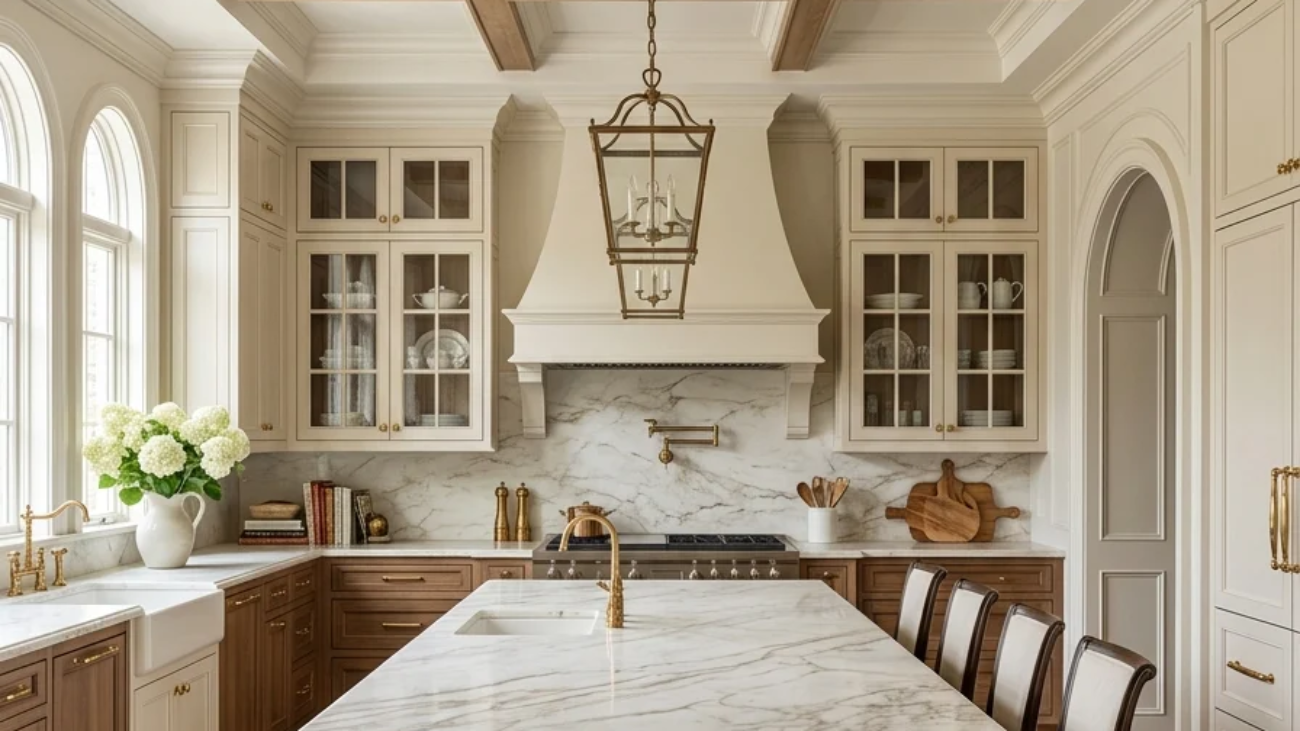
A luxurious classic kitchen draws on formal Georgian and Victorian architectural tradition: raised-panel cabinetry, decorative moldings, careful symmetry, executed in genuinely high-end materials rather than reproduced in flat, budget millwork. This article gives you 15 real luxurious classic kitchen design ideas covering color, material, lighting, furniture, and layout, each one built around the specific architectural detail that separates true classic design from a generically “traditional” kitchen.
The feel is unmistakable: crown molding meeting the ceiling at a crisp, deliberate line, a chandelier casting warm light across marble, cabinetry carved with the same care a formal dining room would receive. Classic kitchens don’t chase trends; they’re built on proportion rules old enough to have already outlasted several design cycles. Here are 15 ideas worth saving and stealing.
Why Luxurious Classic Kitchen Design Works So Well
Classic kitchen design draws directly from Georgian architectural proportion and the formal symmetry of English country house kitchens, later refined through French Provincial tradition, where raised-panel cabinetry, decorative corbels, and careful moldings were built with the same architectural seriousness given to a home’s formal rooms. This is what separates true classic design from generic “traditional” styling: classic follows specific historical proportion rules, column-style pilasters, crown molding profiles, symmetrical cabinet runs, rather than simply using warm wood tones and calling it done.
The materials that define this look include raised-panel or beaded-inset cabinetry in soft dove gray or warm ivory, hand-carved corbels and fluted pilasters, hexagon or basketweave marble mosaic flooring, and classic brass hardware like cup pulls and swing-arm faucets. Crystal chandeliers and leaded glass cabinet fronts round out the material palette, both chosen because they reference specific decorative traditions rather than purely functional needs.
Style at a Glance
| Element | Core Trait 1 | Core Trait 2 |
| Philosophy | Formal symmetry, historical proportion | Genuine architectural detail over flat panels |
| Materials | Raised-panel cabinetry, carved corbels | Marble, brass hardware, crystal lighting |
| Color Palette | Soft dove gray, warm ivory | Dark stained wood accents |
15 Luxurious Classic Kitchen Design Ideas
1. Soft Dove Gray Cabinetry With Classic White Trim
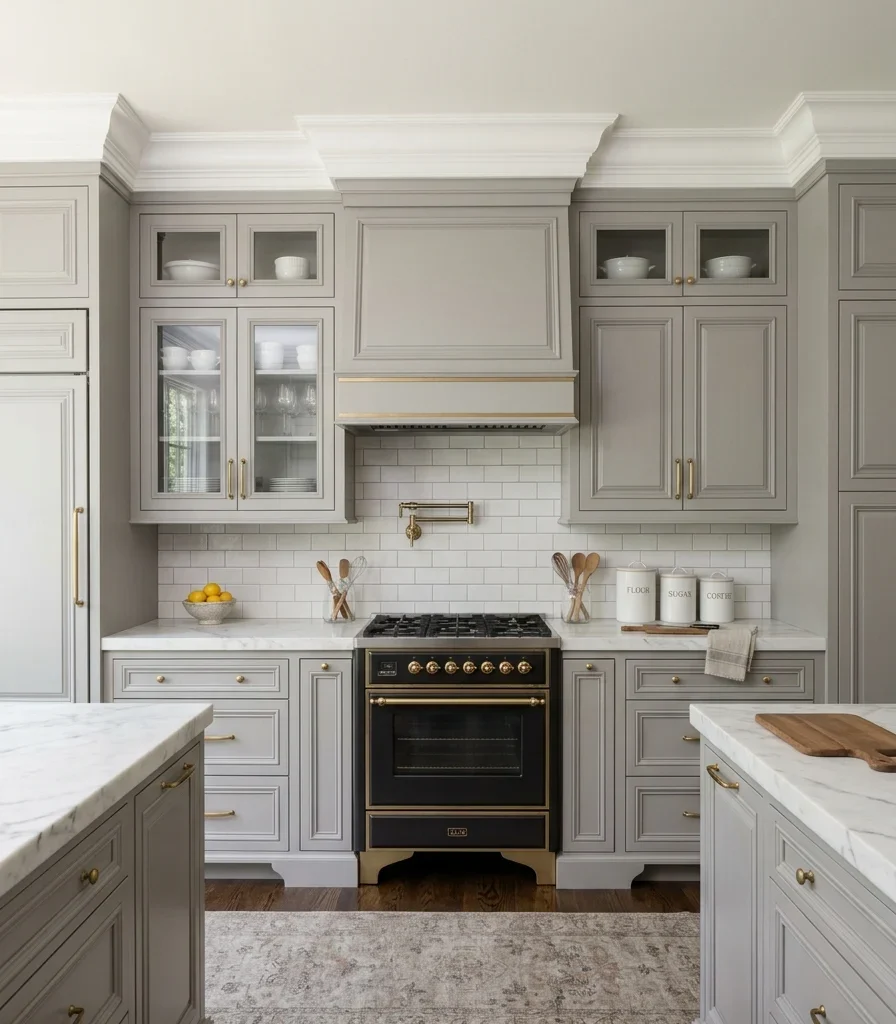
Vibe: The kitchen feels formal, soft gray settling into quiet, considered elegance.
Why it works: Dove gray sits at a specific value between true gray and greige, carrying enough warmth to avoid feeling cold while remaining neutral enough to let architectural detail raised panels, molding profiles read clearly without color competing for attention. Trimming the cabinetry in crisp white crown molding at the ceiling references classical column capital detailing, giving the cabinetry a formal, finished edge rather than simply stopping at the ceiling line.
How to get it: Choose a dove gray with a visible warm undertone rather than a cool blue-gray, and finish the cabinetry’s top edge with a genuine crown molding profile rather than a flat cap, since the molding’s dimensional shadow line is what signals real millwork investment.
💡 Quick Win: Adding crown molding to existing flat-top cabinets is a lower-cost way to introduce this classic detail without a full cabinetry replacement.
Shop the Look
| Product |
| Dove gray cabinet-grade paint |
| Crown molding trim, cabinet-height |
| Brushed brass cabinet hardware set |
| White marble-look countertop |
| Ceramic kitchen canister set |
2. Raised-Panel Cabinetry With Decorative Corbels
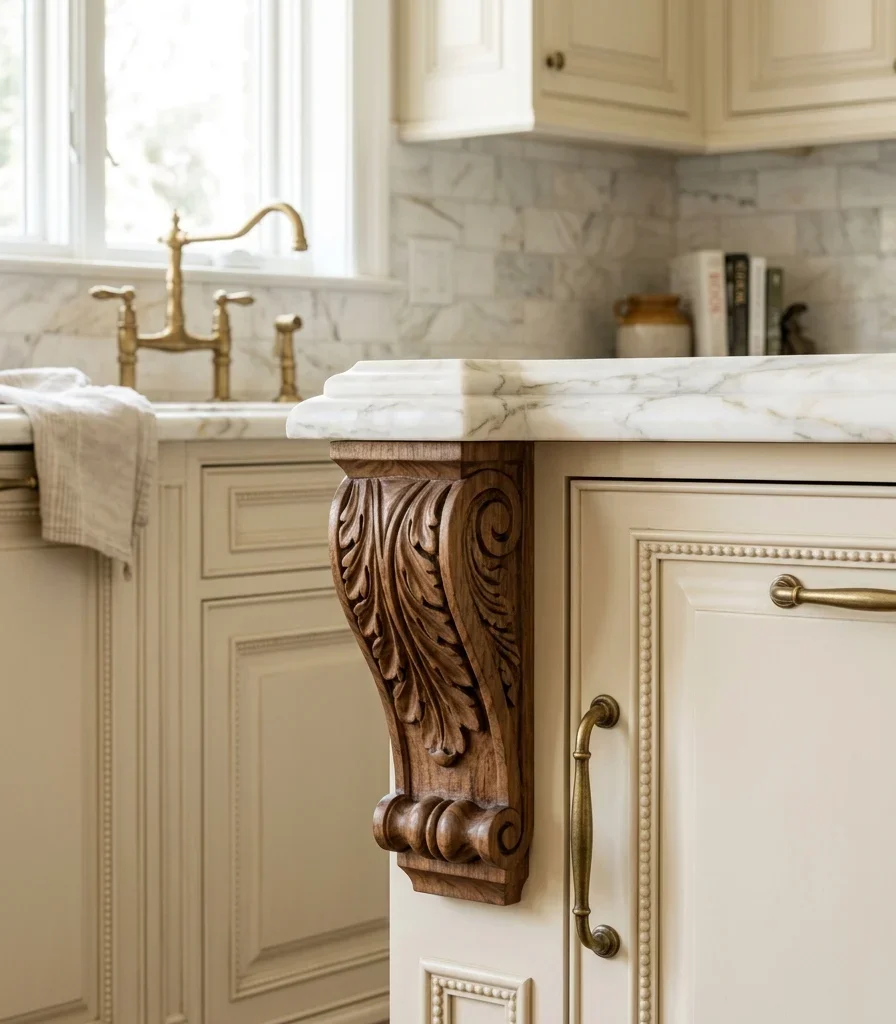
Vibe: The cabinetry feels architectural, carved detail doing what flat panels never could.
Why it works: Decorative corbels carved brackets traditionally used to support an overhanging structural element reference classical column and cornice detailing directly, and while modern countertops rarely need the actual structural support corbels once provided, including them purely for their visual weight is a specific marker of genuine classic design intent. Raised-panel doors, with their carved recessed center panel, similarly reference formal millwork traditions that flat slab or shaker cabinetry deliberately moves away from.
How to get it: Choose corbels sized proportionally to your countertop overhang, typically 10 to 12 inches for a standard island overhang, and install them at consistent spacing beneath any exposed counter edge for the most architecturally convincing result.
Shop the Look
| Product |
| Carved wood corbel pair |
| Raised-panel cabinet doors |
| Brushed brass cabinet hardware |
| Wood stain, walnut tone |
| Corbel mounting hardware kit |
3. A Crystal Chandelier as the Kitchen’s Centerpiece
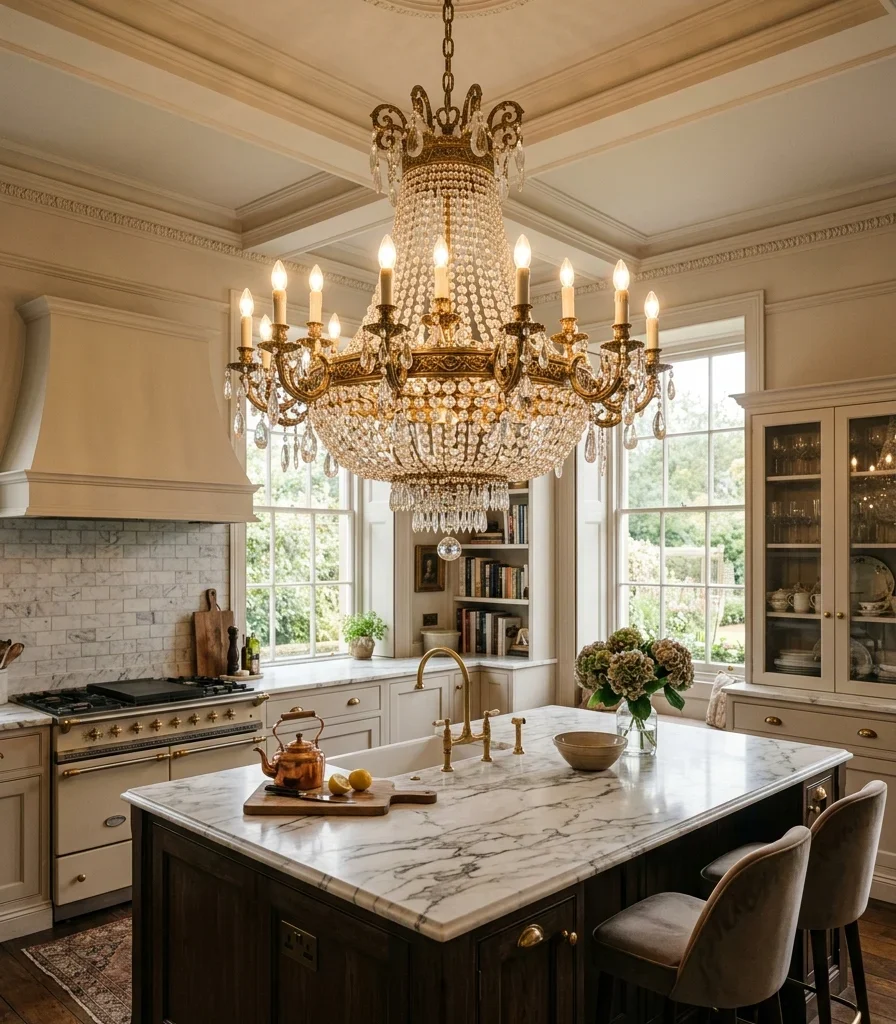
Vibe: The kitchen feels formal, light-treated with the same seriousness as a dining room.
Why it works: A crystal chandelier positioned at the kitchen’s true center, rather than only over an island, signals that the entire room is being treated as formal space worthy of the same lighting investment a dining room would receive, which is a distinctly classic design choice compared to the more function-first pendant lighting common in contemporary kitchens. The crystal facets scatter light across marble and painted cabinetry in a way that reinforces the room’s overall sense of formality.
How to get it: Center the chandelier on the kitchen’s true geometric midpoint rather than simply over the island, and choose a scale proportional to the room’s overall square footage; roughly one inch of chandelier diameter per foot of room width is a common professional guideline.
Shop the Look
| Product |
| Brass and crystal chandelier |
| Dimmer switch for chandelier |
| Warm dimmable candelabra bulb set |
| White marble countertop |
| Brass cabinet hardware, matching |
4. A Furniture-Style Hutch for China Display
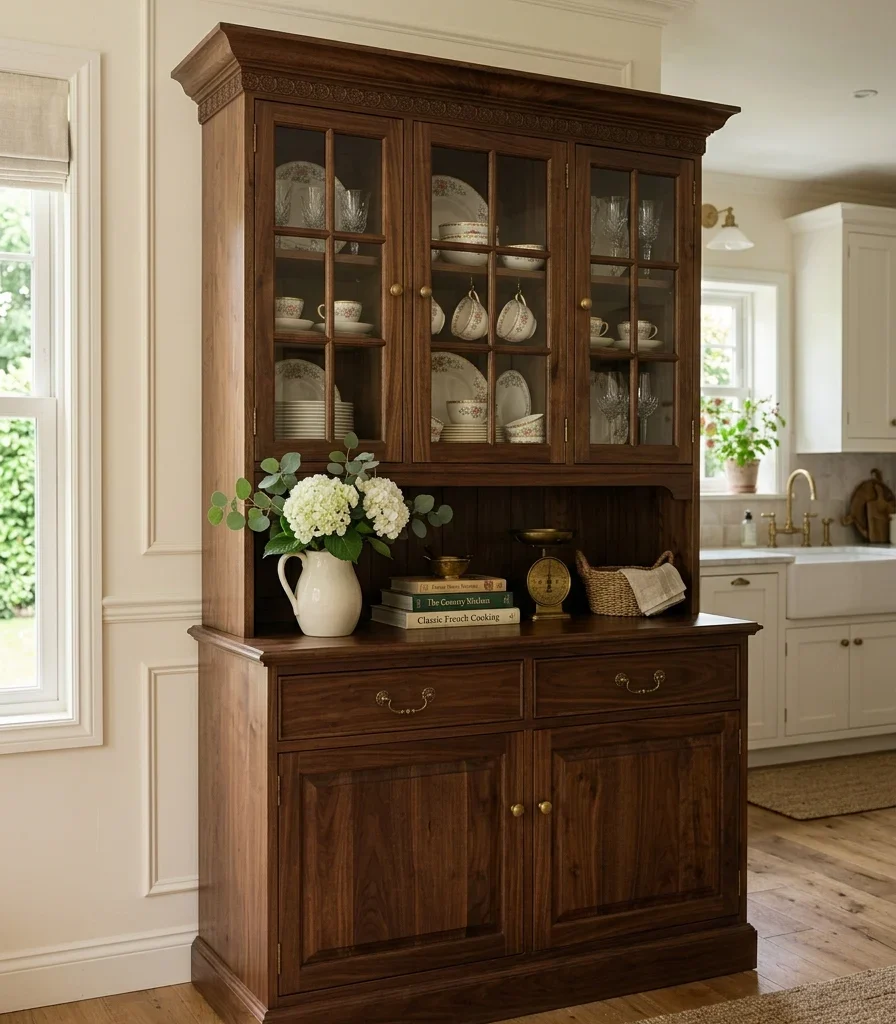
Vibe: The hutch feels collected, china displayed the way a formal dining room would show it off.
Why it works: A freestanding hutch, built and finished as genuine furniture rather than fitted cabinetry, references the pre-built-in-kitchen era when storage pieces were literal furniture moved room to room. Reintroducing one in a classic kitchen signals the same furniture-forward luxury detail used elsewhere in high-end kitchen design, while giving good china and glassware the formal display treatment a built-in cabinet typically doesn’t offer. The glass-paned doors specifically let the displayed contents contribute to the room’s visual richness.
How to get it: Choose a hutch with true divided-light glass doors, multiple small panes rather than one large sheet, since the divided pattern is the specific detail that reads as classic rather than merely glass-fronted.
Shop the Look
| Product |
| Furniture-style china hutch, glass front |
| China dinnerware set, formal |
| Glassware set, cut crystal |
| Brass hutch hardware |
| Small brass display stand |
5. Leaded Glass Cabinet Fronts for Traditional Detail
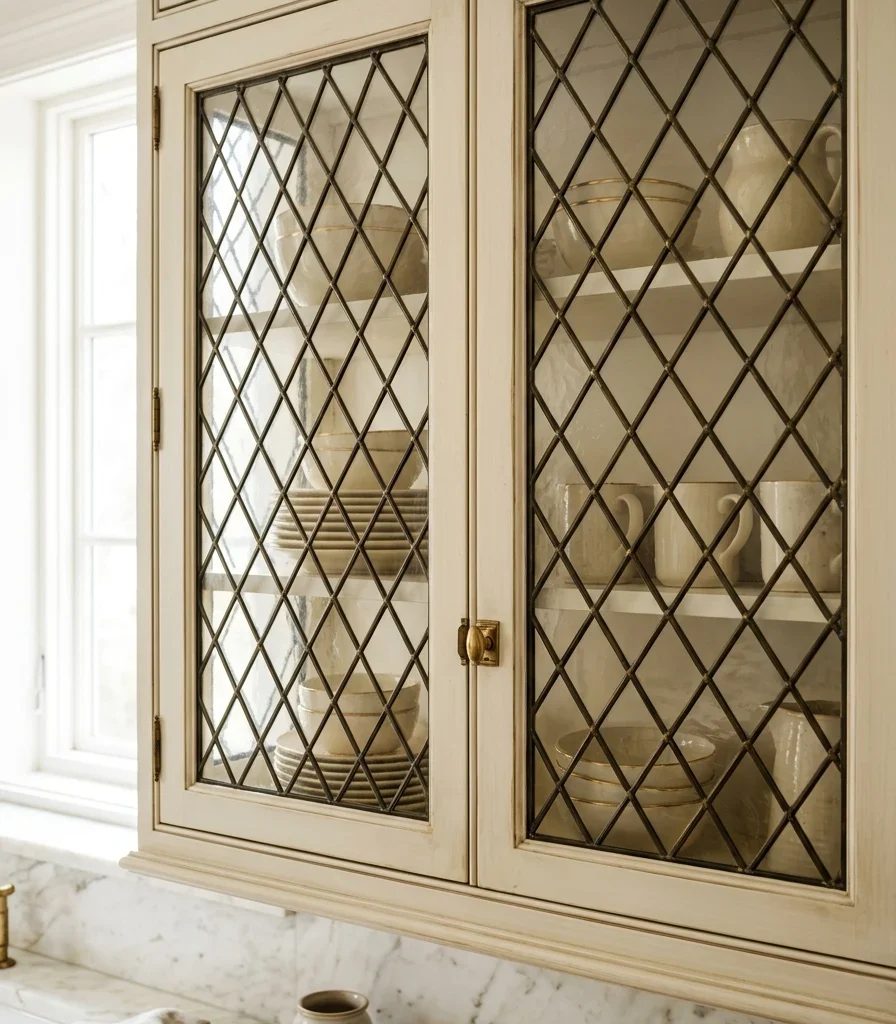
Vibe: The cabinets feel historic, glass patterned the way old windows once were.
Why it works: Leaded glass, with its diamond or rectangular mullion pattern held together by thin metal leading, was originally a window technology later adapted for formal cabinetry, and using it on kitchen cabinet fronts specifically references that architectural lineage more directly than plain glass ever could. The pattern also softens the view into the cabinet’s contents, letting displayed dishware read as a considered vignette rather than fully exposed storage.
How to get it: Choose leaded glass inserts with a diamond mullion pattern for the most traditionally accurate look, and style the cabinet interior deliberately, since the glass makes the contents genuinely visible even through the pattern’s partial obstruction.
Shop the Look
| Product |
| Leaded glass cabinet insert panels |
| Ceramic dishware set, cream glaze |
| Brass cabinet hardware |
| Cabinet interior lighting, small |
| Glass cleaning cloth, lint-free |
6. A Traditional Two-Tone Kitchen With Painted Perimeter and Stained Island
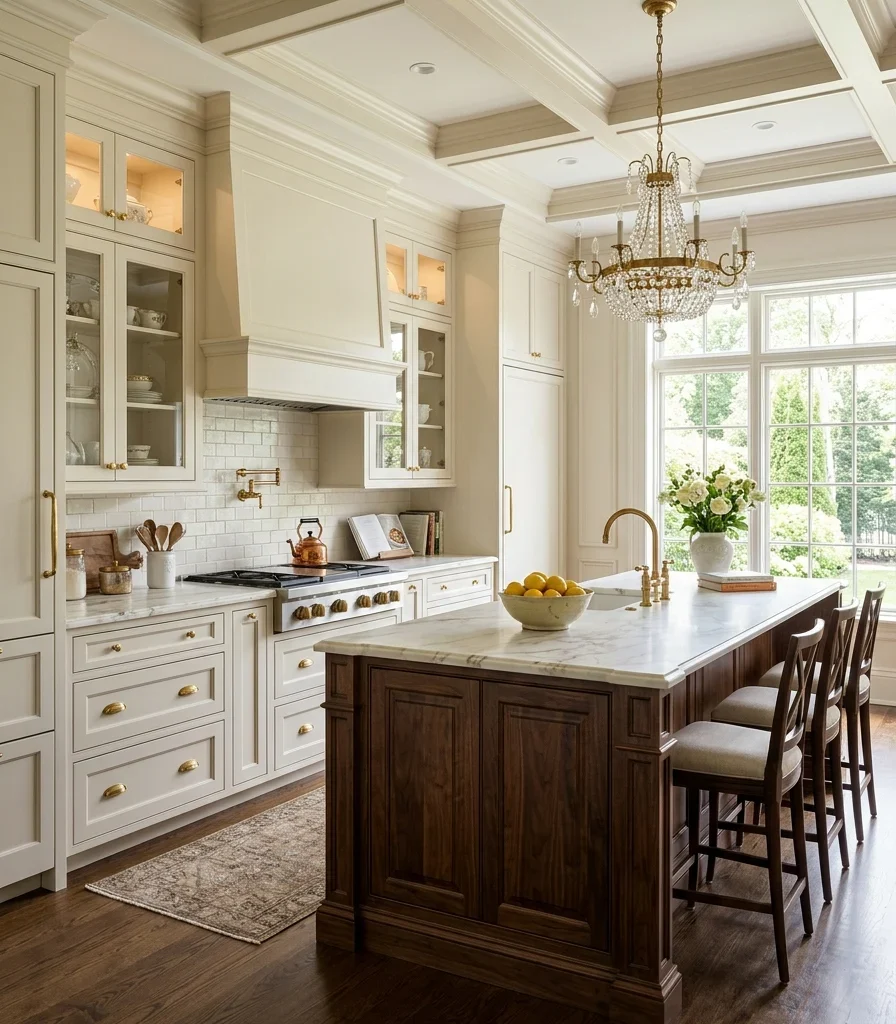
Vibe: The kitchen feels formal, one dark stained piece grounding an otherwise light room.
Why it works: Pairing a painted perimeter with a stained wood island rather than two different paint colors is a specifically classic take on the two-tone kitchen technique, since the stained wood’s natural grain reads as more traditionally furniture-like than a second painted color would. This distinguishes the approach from more contemporary two-tone kitchens, which typically use two paint colors rather than mixing paint and natural wood finish.
How to get it: Choose a dark walnut or mahogany stain for the island specifically, keeping every other cabinet surface in painted ivory or dove gray, and unify both finishes with the same brass hardware throughout so the two-material approach reads as one cohesive plan.
Shop the Look
| Product |
| Warm ivory cabinet-grade paint |
| Dark walnut wood stain |
| Brushed brass hardware set, matching |
| White marble countertop |
| Brass pendant light pair |
7. A Hexagon Marble Mosaic Floor
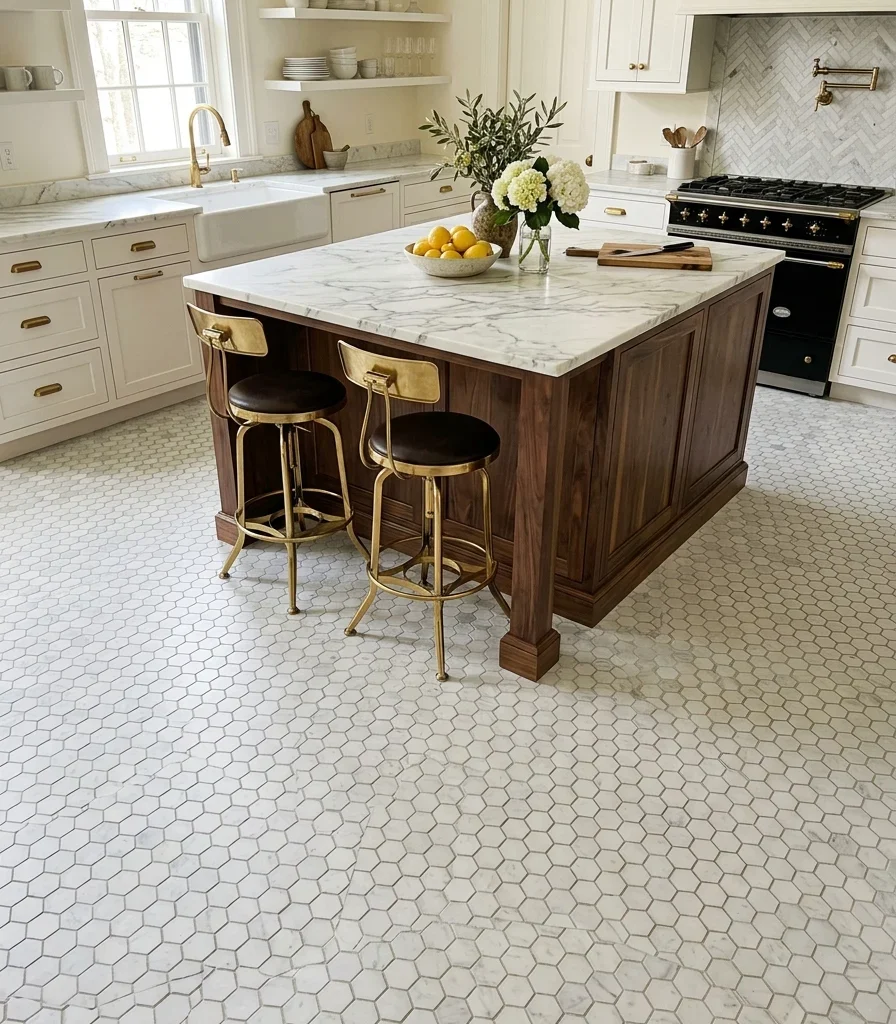
Vibe: The floor feels historic, small tiles building a pattern with real period authenticity.
Why it works: Hexagon marble mosaic flooring references early 20th-century formal kitchen and bathroom tiling directly, and the small tile scale creates a fine, detailed pattern underfoot that reads as considerably more labor-intensive and premium than larger-format tile genuine marble specifically, rather than a printed look-alike, carries subtle veining variation between individual hexagons that reinforces the material’s authenticity. This is a classic-specific flooring choice distinct from the herringbone wood flooring more common in general luxury kitchen design.
How to get it: Choose genuine marble hexagon mosaic in sheet form for consistent installation, and introduce a contrasting gray or black accent hexagon in a repeating border pattern for the most period-accurate detail.
Shop the Look
| Product |
| White marble hexagon mosaic tile |
| Gray marble accent hexagon tile |
| Marble sealant, penetrating formula |
| Walnut island base |
| Brass counter-height barstool set |
8. A Symmetrical Galley Layout With Mirrored Upper Cabinets
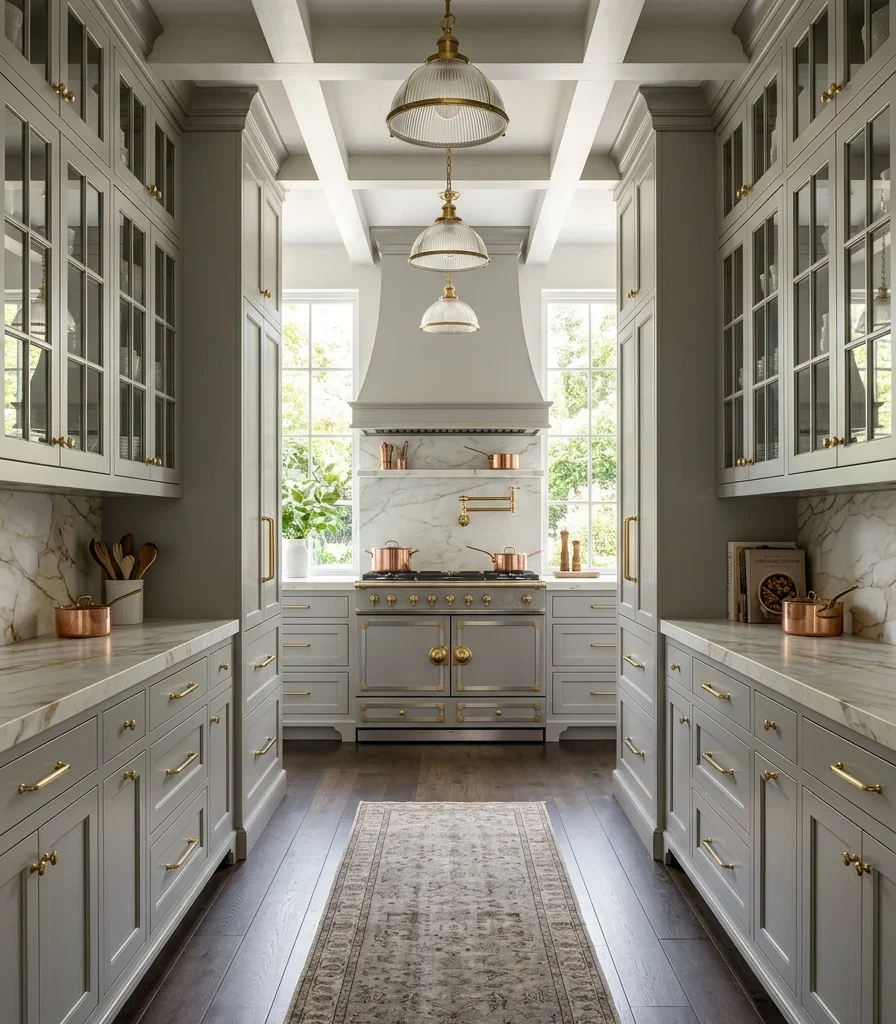
Vibe: The kitchen feels ordered, both walls mirroring each other with formal precision.
Why it works: True architectural symmetry matching cabinet runs, evenly spaced windows, a centered range references the same balance principle that governed formal Georgian room layouts, where every element on one side of a room’s central axis was mirrored on the other. This is a layout-level commitment to classic design rather than a surface-level styling choice, requiring the kitchen’s plumbing and electrical to be planned around the symmetry from the start rather than retrofitted around existing utility placement.
How to get it: Center the range or a single focal appliance on the room’s true midpoint, then plan cabinet runs, windows, and lighting fixtures in mirrored pairs extending equally in both directions from that centerline.
Shop the Look
| Product |
| Matching brass pendant light pair |
| Dove gray cabinet-grade paint |
| Brushed brass cabinet hardware set |
| White marble countertop |
| Ceramic decorative bowl, centered display |
9. Classic Brass Picture Lights Over Open Plate Racks
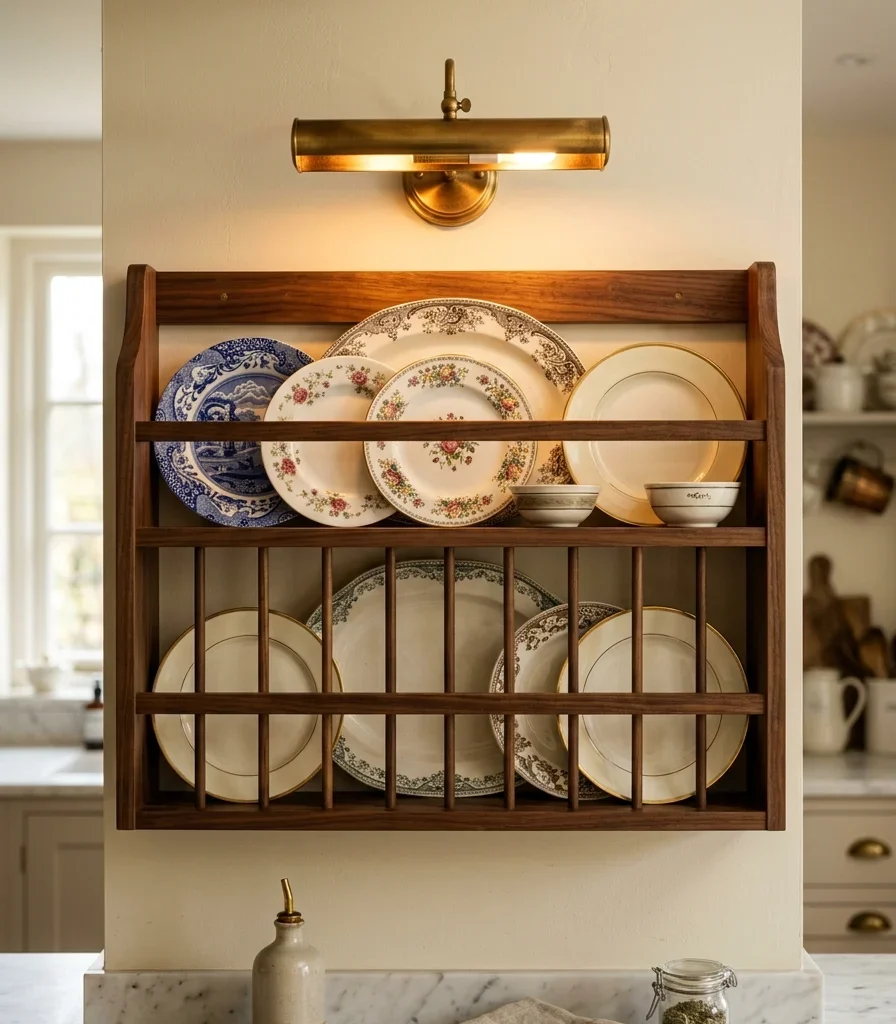
Vibe: The plate rack feels curated, lit the way a formal painting would be in a gallery.
Why it works: A picture light mounted above an open plate rack treats displayed china the same way fine art gets treated elsewhere in a formal home, using focused, directional light to make the plates the room’s clear point of visual interest rather than leaving them under general ambient lighting alone. This is emphasis through lighting applied specifically to a classic kitchen’s most decorative storage element.
How to get it: Mount the picture light 6–8 inches above the plate rack’s top shelf, angled slightly downward, and choose a warm dimmable bulb so the display can shift from bright daytime visibility to a softer evening glow.
Shop the Look
| Product |
| Brass picture light, plug-in |
| Walnut open plate rack shelving |
| China plate set, formal pattern |
| Warm white dimmable bulb |
| Brass wall mounting hardware |
10. A Traditional Apron-Front Sink in a Carved Wood Surround
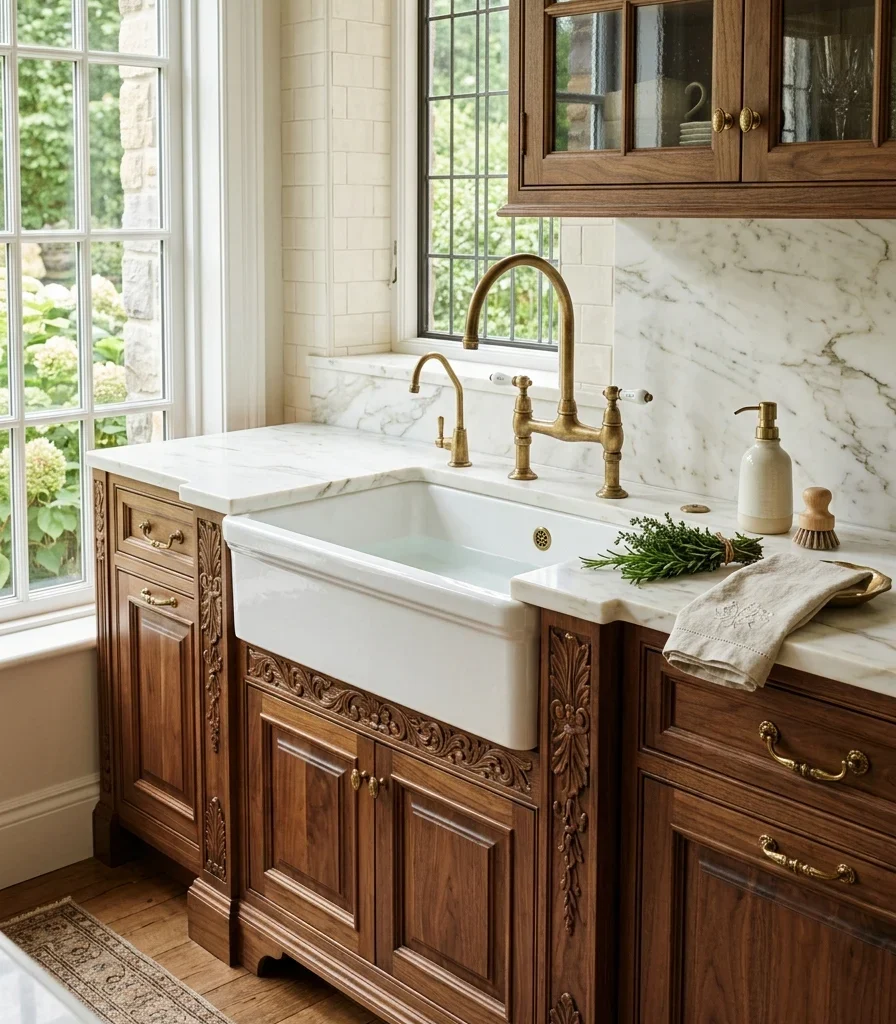
Vibe: The sink feels formal, carved wood framing it like a piece of architecture.
Why it works: An apron-front sink exposes its full front face rather than tucking behind a cabinet door, and framing that exposed face with carved wood detailing fluted panels, a decorative apron skirt extends the same architectural seriousness given to cabinetry elsewhere in the room to the sink specifically, which is often left as purely functional in less classic-focused kitchens. A brass swing-arm faucet, with its visible pivoting joint, reinforces the period-appropriate hardware detail this style depends on throughout.
How to get it: Choose a fireclay or cast iron apron-front sink for genuine material weight and durability, and have the surrounding cabinet panel carved or routed with a fluted or beaded detail rather than left flat.
Shop the Look
| Product |
| White fireclay apron-front sink |
| Brass swing-arm kitchen faucet |
| Carved wood cabinet panel, sink surround |
| Ceramic soap dispenser |
| Brass sink hardware, matching |
11. Fluted Pilasters Flanking the Range
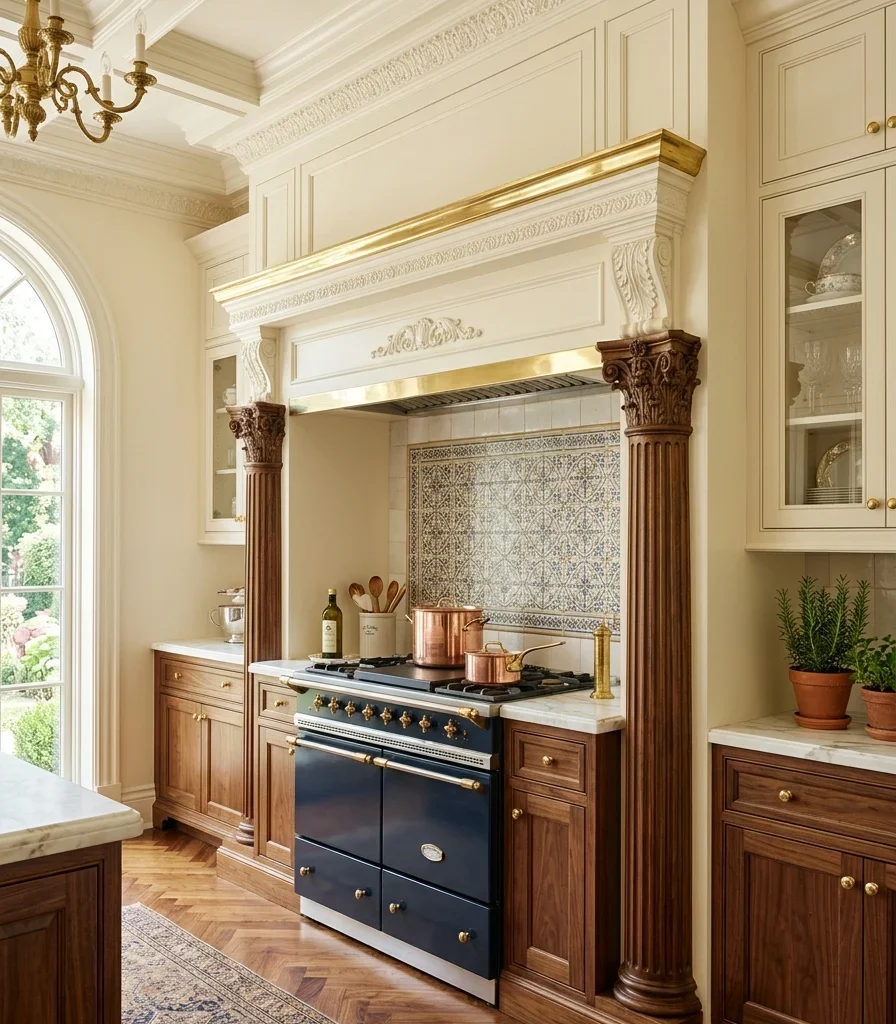
Vibe: The range wall feels architectural, columns standing guard on either side.
Why it works: Fluted pilasters are flat, column-like pieces with vertical carved grooves- reference classical Greek and Roman column orders directly, and flanking the range with them frames the kitchen’s functional centerpiece the same way a formal doorway or fireplace surround would be framed in a classic home’s other rooms. This detail transforms the range wall from a purely functional cooking zone into the room’s clear architectural focal point.
How to get it: Size pilasters proportionally to your range hood’s height, with a carved capital detail at the top where the pilaster meets the hood surround, since that transition point is what completes the classical column reference.
Shop the Look
| Product |
| Fluted wood pilaster pair |
| Carved capital trim detail |
| Brass range hood trim |
| Wood stain, walnut tone |
| Pilaster mounting hardware |
12. A Toile or Chinoiserie Wallpaper Accent
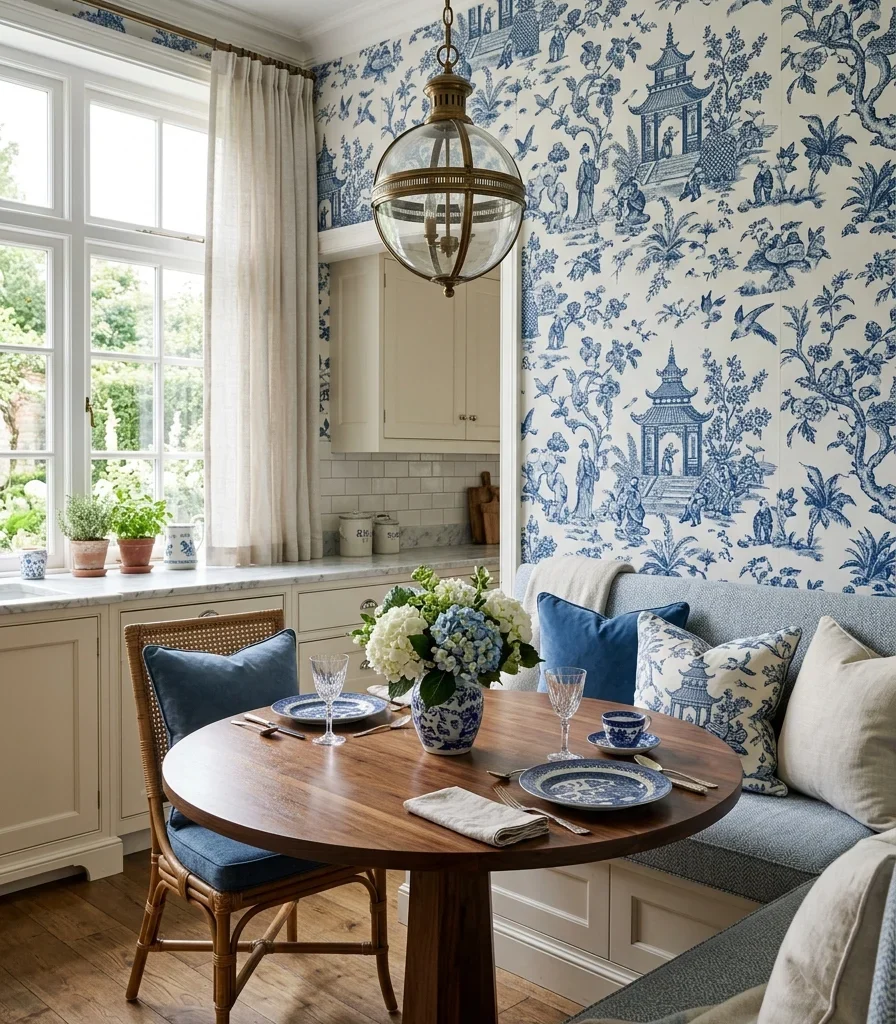
Vibe: The nook feels layered, pattern doing the work paint alone couldn’t achieve.
Why it works: Toile and chinoiserie wallpaper patterns carry direct historical lineage to 18th-century European decorative arts, when European makers began producing pattern designs inspired by imported Chinese porcelain and textiles. Using either pattern in a classic kitchen’s breakfast nook or accent wall extends the room’s historical references beyond cabinetry and millwork into a genuinely period-appropriate textile art form. This works best confined to one contained area, like a nook, rather than a full kitchen application, since the pattern’s visual density is substantial.
How to get it: Reserve the wallpaper for a contained breakfast nook or single accent wall away from cooking splash zones, and choose a pattern in a two-color scheme; blue and white remains the most traditional chinoiserie combination for the most historically accurate result.
Shop the Look
| Product |
| Chinoiserie print wallpaper, blue and white |
| Walnut breakfast table |
| Brass pendant light, above table |
| Upholstered dining chairs, classic |
| Wallpaper smoothing tool |
13. Warm Ivory Walls to Set Off Dark Wood Millwork
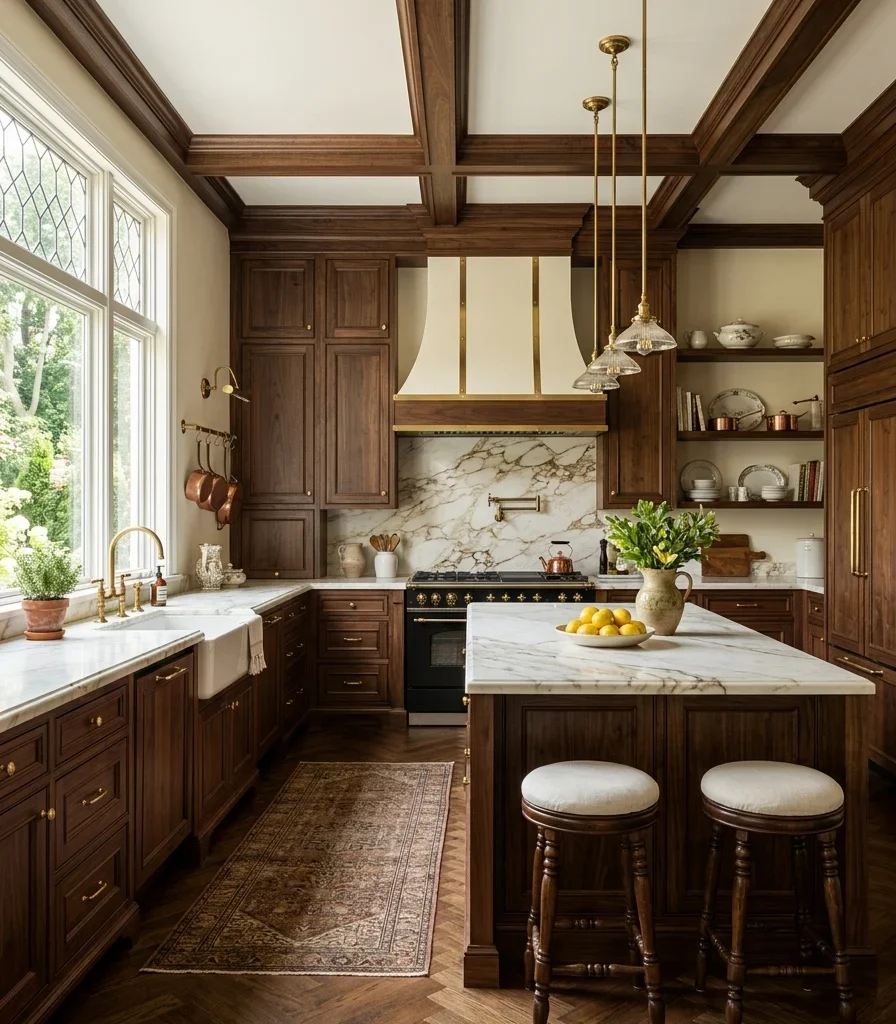
Vibe: The kitchen feels contrasted, light walls letting dark wood carry real presence.
Why it works: Warm ivory provides enough value contrast against dark stained wood to let carved detail, panel profiles, and molding shadow lines all read clearly, while still carrying enough warmth to avoid the stark, cold feeling a pure white wall would create against rich wood tones. This value-contrast principle is what allows genuinely dark, formal wood cabinetry to feel grounded rather than visually heavy within the room.
How to get it: Choose an ivory with a visible warm undertone rather than a cool or gray-leaning white, testing it directly against your wood tone’s actual stain sample before committing to a full room, since the pairing’s success depends on both colors sharing compatible warmth.
Shop the Look
| Product |
| Warm ivory interior wall paint |
| Dark walnut stained cabinetry |
| Brushed brass hardware set |
| White marble countertop |
| Brass wall sconce pair |
14. Scaled-Down Classic Symmetry for a Small Kitchen
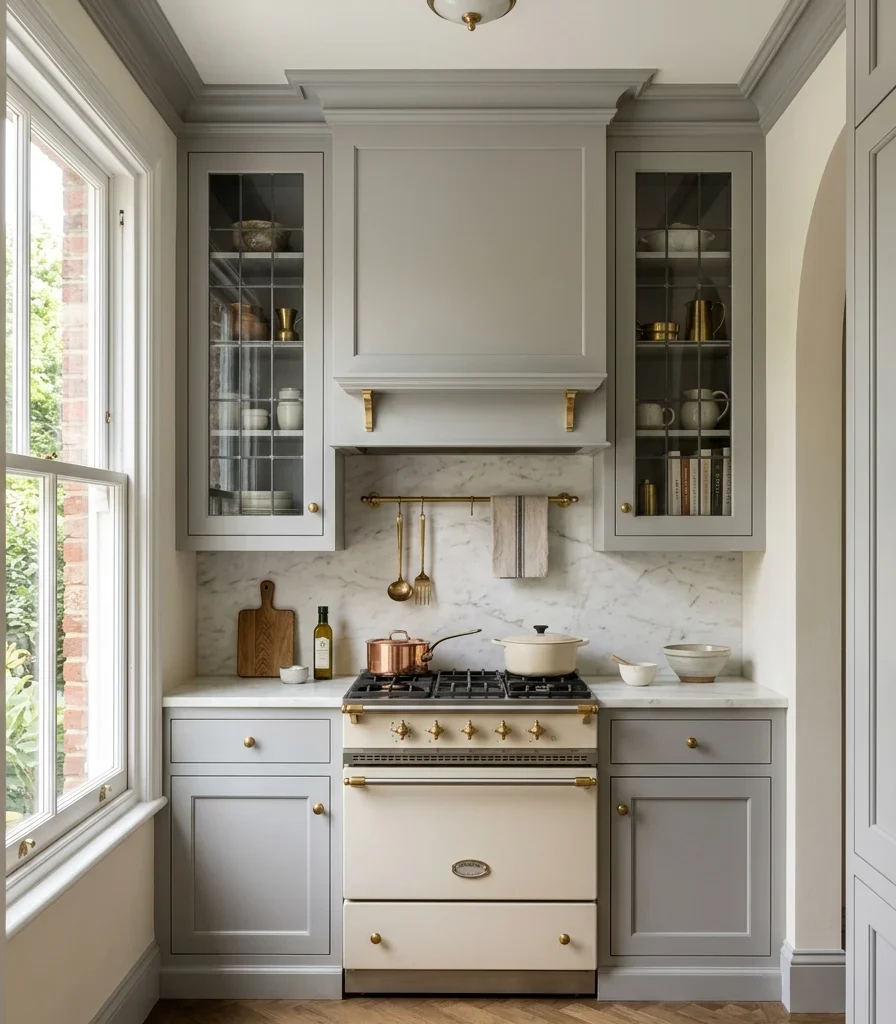
Vibe: The kitchen feels refined, formal detail scaled down without losing its seriousness.
Why it works: A small kitchen can’t accommodate full-scale corbels or a substantial crown molding profile without the detail overwhelming the room’s limited surface area, but proportionally scaling every architectural element down together narrower molding, smaller corbels, a more compact chandelier preserves the same formal symmetry principle at a size that fits. This is the small-space application of classic design’s core philosophy: the historical proportion rules themselves scale, even when the room can’t be large.
How to get it: Reduce every architectural detail’s scale by a consistent proportion relative to a standard-sized version; roughly two-thirds scale is a reliable starting point, rather than omitting some details entirely while keeping others at full size, which breaks the room’s overall proportional harmony.
Shop the Look
| Product |
| Narrow crown molding, scaled profile |
| Small carved corbel pair |
| Compact brass chandelier |
| White marble backsplash tile |
| Brushed brass cabinet hardware, small scale |
15. Classic Brass Cup Pulls Throughout
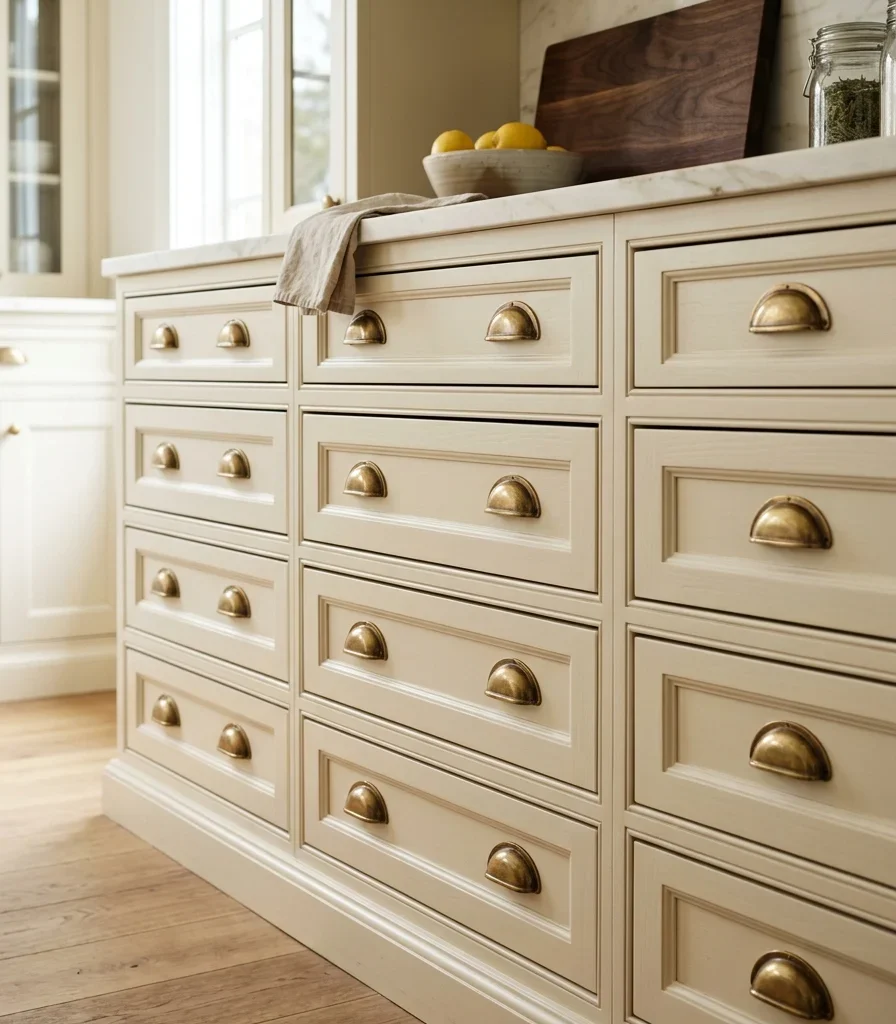
Vibe: The drawers feel cohesive, one classic hardware shape repeating with quiet consistency.
Why it works: The cup pull, with its half-circle brass shape recessed slightly into the drawer front, is one of the most historically consistent hardware styles across two centuries of formal cabinetry, which is why it remains the default choice for genuinely classic kitchens rather than the bar-style pulls common in more contemporary design. Using this single hardware style consistently across every drawer in the kitchen reinforces the room’s overall commitment to period-appropriate detail down to its smallest touchpoints.
How to get it: Choose cup pulls in an unlacquered or aged brass finish specifically, and maintain consistent vertical centering on every drawer front, typically centered both horizontally and at roughly one-third down from the top edge for the most visually uniform result across the full cabinetry run.
Shop the Look
| Product |
| Classic brass cup pull set |
| Raised-panel cabinet drawer fronts |
| Brass drawer pull template, spacing guide |
| Cabinet installation screwdriver set |
| Brass polish, patina-safe |
How to Start Your Luxurious Classic Kitchen Transformation
Your first move should be adding crown molding to your existing cabinetry, since this single detail introduces genuine architectural seriousness to the room’s largest surface area and anchors every other classic detail that follows it, from hardware to lighting.
The most common mistake is mixing flat, contemporary slab-front cabinets with classic hardware and lighting, which creates visual conflict rather than a cohesive look, since classic design depends on raised-panel or beaded-inset door profiles carrying the same formal character as the fixtures around them. Fix it by prioritizing cabinet door replacement or refacing to a raised-panel profile before investing further in classic-style hardware and lighting that would otherwise sit awkwardly against flat doors.
Three specific items under $50 that create immediate impact: a single classic brass cup pull to test against your existing cabinet drawers, a small carved wood corbel to preview beneath a counter overhang, and a ceramic canister set in a warm ivory glaze matching your intended wall color.
A cosmetic classic refresh using crown molding, hardware, and paint typically takes two to three weeks and costs $2,000–$5,000. A fuller transformation including raised-panel cabinetry and marble flooring runs $30,000–$70,000 and takes two to three months, while a complete custom classic kitchen build realistically spans four to seven months and $90,000–$180,000 depending on the extent of carved millwork and material tier.
Frequently Asked Questions About Luxurious Classic Kitchens
What is the difference between classic and traditional kitchen design?
Classic kitchen design refers specifically to formal Georgian and Victorian architectural proportion rules, symmetrical layouts, raised-panel cabinetry, decorative corbels and pilasters, while “traditional” is a broader, less precise term often used for any kitchen with warm wood tones and non-modern styling. A genuinely classic kitchen follows historical architectural conventions closely enough that a design historian could identify the specific proportion rules at work, whereas traditional design borrows the general feeling without necessarily following those same formal rules.
What colors work best for a luxurious classic kitchen?
Soft dove gray and warm ivory remain the most reliable classic cabinet colors, both chosen because they carry enough warmth to avoid feeling cold while staying neutral enough to let architectural detail like raised panels and molding profiles read clearly. Dark walnut or mahogany stain is the most common classic accent, typically reserved for an island or a single furniture-style piece like a hutch, rather than applied across full cabinetry runs the way bolder paint colors are used in more contemporary luxury kitchens.
How much does a luxurious classic kitchen renovation cost?
A cosmetic refresh using crown molding, classic hardware, and paint updates typically costs $2,000–$5,000 and takes two to three weeks. A fuller transformation including raised-panel cabinetry and marble mosaic flooring generally runs $30,000–$70,000 and takes two to three months, while a complete custom-built classic kitchen with carved corbels, pilasters, and full architectural millwork realistically falls between $90,000 and $180,000 depending on the extent of hand-carved detail specified.
Can a small kitchen achieve genuine classic luxury?
Yes, though the room’s formal symmetry and architectural detail need to be scaled down proportionally rather than included at full size. A narrower crown molding profile, smaller corbels, and a compact chandelier all preserve the same classic design philosophy in a fraction of the square footage a grand estate kitchen would use. The key limitation is that a small kitchen usually can’t support a full symmetrical galley layout with mirrored cabinet runs, so priority typically shifts to concentrated architectural detail on one or two focal elements instead.
What is the most requested classic kitchen detail right now?
Raised-panel cabinetry with decorative corbels remains the most consistently requested classic kitchen feature, reflecting sustained interest in genuine carved architectural detail over flat, minimalist cabinet profiles. Crystal chandeliers positioned as a kitchen’s central light source, rather than confined to a dining room, are also seeing renewed interest as more homeowners treat the kitchen as a formal space worthy of the same lighting investment as any other room in the home.
Ready to Design Your Dream Luxurious Classic Kitchen?
These 15 luxurious classic kitchen design ideas span color, material, lighting, furniture, and layout from raised-panel cabinetry with hand-carved corbels to a hexagon marble floor and a crystal chandelier treated as the room’s true centerpiece, so there’s a genuinely fitting starting point here whether you’re planning a full custom build or a single architectural upgrade. You don’t need every detail at once, and adding crown molding before investing in hardware or lighting is not a smaller version of the vision; it’s the sequence that gives every later classic detail something proportionally serious to build on. Today’s specific action: measure your existing cabinetry’s top edge and research a crown molding profile scaled correctly to your kitchen’s ceiling height, before any other purchase. Once that first genuine architectural line is in place, every carved corbel, brass cup pull, and marble tile layered on top of it will finally read as one considered classic kitchen rather than a collection of traditional-adjacent choices. Save the details that matched your own kitchen’s proportions today that fluted pilaster, that leaded glass cabinet front because in classic kitchen design, the proportion rules that have already outlasted a dozen passing trends are exactly what make the room feel timeless rather than dated.
You Might Also Like
- 15 Ways to Achieve a Luxurious Contemporary Kitchen Design
- 14 Coastal Kitchen Decor Ideas for a Breezy, Sunlit Space
- 15 Ways to Decorate an Open Plan Kitchen Dining Space
- 15 Open Shelving in the Kitchen | Kitchen Storage Ideas
- 15 Ways to Create a Modern Luxury Kitchen Ceiling Design
- 15 Ways to Maximize Space in an Open Plan Kitchen Room
[…] 15 Luxurious Classic Kitchen Design Ideas With Real Architectural Detail […]
[…] 15 Luxurious Classic Kitchen Design Ideas With Real Architectural Detail […]
[…] 15 Luxurious Classic Kitchen Design Ideas With Real Architectural Detail […]
[…] 15 Luxurious Classic Kitchen Design Ideas With Real Architectural Detail […]
[…] 15 Luxurious Classic Kitchen Design Ideas With Real Architectural Detail […]