

Japanese interior design is a restrained, nature-connected style built around simplicity, craftsmanship, natural materials, and a deliberate relationship between space and useful objects. These 25 Japanese dining room designs explore warm wood, low furniture, tactile ceramics, soft lighting, natural color palettes, and thoughtful layouts that make everyday meals feel more intentional.
A Japanese dining room does not need to feel sparse or cold; the best rooms feel quietly alive, with morning light moving across oak grain, the softness of linen beneath your hands, and handmade ceramics adding tiny variations to an otherwise disciplined palette. The atmosphere is calm without becoming lifeless and minimal without becoming sterile. Every object has room to breathe, yet the room still feels welcoming enough for a long dinner with friends. Natural textures do much of the visual work, allowing decoration to remain restrained while warmth comes from material rather than clutter.
Here are 25 ideas worth saving and stealing.
Why Japanese Dining Room Designs Work So Well
Traditional Japanese interiors are influenced by principles such as ma, the intentional use of negative space, and wabi-sabi, an appreciation for natural irregularity, age, simplicity, and imperfection. Rather than filling every surface, Japanese design considers the relationship between an object and the space surrounding it. This distinguishes it from contemporary minimalism, which can sometimes emphasize visual reduction alone; Japanese interiors generally retain a stronger connection to nature, craftsmanship, ritual, and tactile materials.
The material palette is deliberately honest: pale oak, hinoki-inspired woods, walnut, bamboo, rattan, handmade clay, washi-like paper, linen, cotton, stone, and matte blackened metal all work naturally. Colors tend toward warm white, rice-paper cream, sand, mushroom taupe, charcoal, muted olive, earthy brown, and occasional indigo. The goal is not a monochromatic room but a restrained tonal range in which grain, weave, shadow, and surface variation provide visual interest.
Japanese-inspired dining rooms also fit the current desire for homes that feel restorative rather than relentlessly decorated. After years of highly styled interiors dominating social media, many homeowners are gravitating toward quieter rooms, natural materials, multifunctional furniture, and fewer disposable decorative objects. Japanese dining design responds well to that shift because its visual richness comes from craftsmanship and material character rather than accumulating accessories.
Style at a Glance
| Element | Japanese Dining Room Approach |
| Philosophy | Simplicity, ma, natural connection, purposeful living |
| Key Materials | Pale oak, walnut, bamboo, linen, clay, stone, washi-inspired paper |
| Key Colors | Rice white, warm beige, sand, mushroom taupe, charcoal, muted olive |
| Furniture Profile | Low visual weight, clean lines, exposed craftsmanship |
| Lighting | Diffused, warm, indirect, paper or natural-fiber shades |
| Decor | Handmade ceramics, restrained botanicals, ikebana-inspired arrangements |
| Texture | Wood grain, linen weave, clay, woven fibers, soft plaster |
| Space Planning | Open circulation, intentional negative space, uncluttered surfaces |
1. Pale Oak Dining Table With Rice-Paper Walls
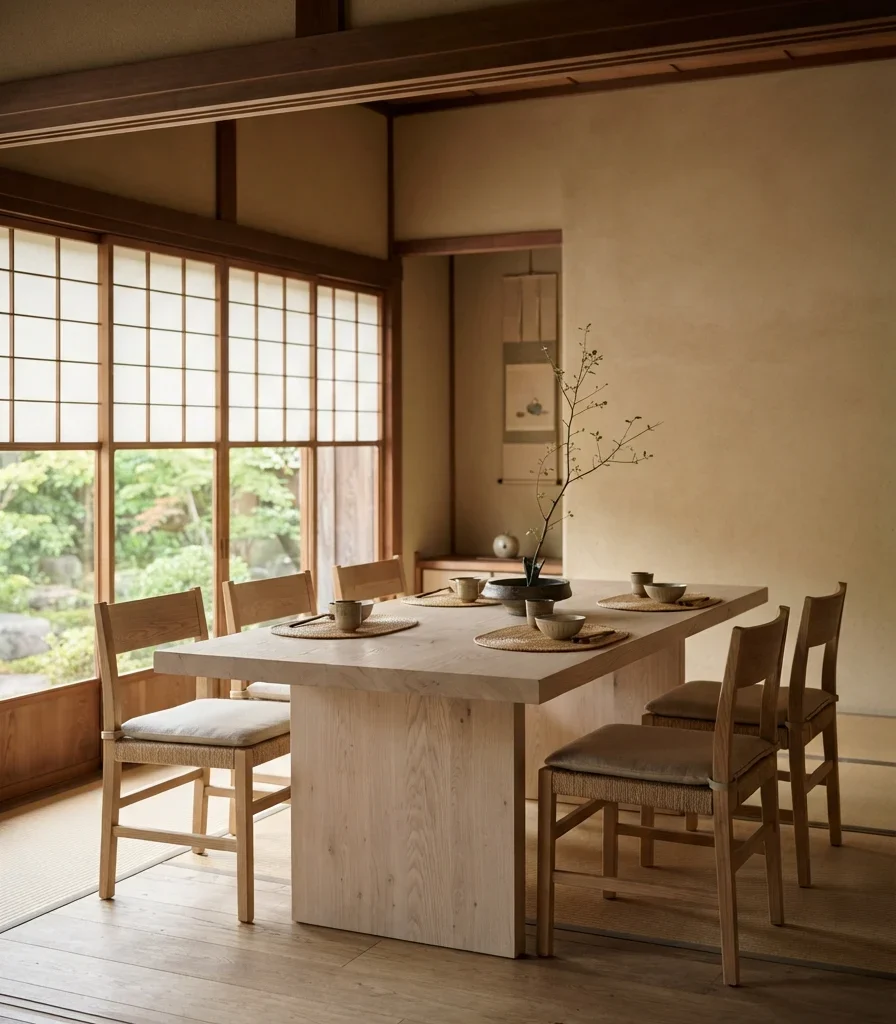
Vibe: Hushed and sun-softened, this dining room feels connected to the quiet warmth of natural timber.
Why it works: The room uses material continuity rather than decoration to create cohesion. Pale oak echoes the warm undertone of the rice-paper walls, while the dark charcoal accents create enough contrast to prevent the palette from becoming washed out.
How to get it: Choose a table with a matte or oil-finished oak surface instead of glossy lacquer, then keep surrounding furniture within one or two wood tones. Leave at least 75–90 cm of clear circulation behind occupied dining chairs so the simplicity remains functional rather than merely visual.
💡 Quick Win: Replace a glossy centerpiece with one low, irregularly shaped handmade ceramic bowl in a warm clay finish.
Shop The Look
| Product | Search phrase |
| Pale oak dining table | solid pale white oak dining table rectangular Japanese |
| Oak dining chairs | minimalist natural oak dining chair set |
| Handmade centerpiece | handmade matte beige ceramic bowl low profile |
| Linen placemats | Natural linen woven placemat set neutral |
| Branch vase | Japanese style ceramic bud vase matte cream |
2. Charcoal and Natural Wood Contrast

Vibe: Grounded, with charcoal providing quiet depth behind the lighter timber.
Why it works: This is controlled contrast rather than high contrast. The charcoal wall visually recedes while the natural oak becomes the brighter focal plane, giving the room hierarchy without introducing bright accent colors.
How to get it: Use a warm charcoal such as a brown-based graphite rather than a blue-black. Balance it with at least 50 percent lighter visual mass through the dining table, flooring, curtains, or ceiling.
💡 Quick Win: Paint only the dining wall charcoal rather than committing to all four walls.
Shop The Look
| Product | Search phrase |
| Charcoal wall finish | warm charcoal matte interior paint |
| Oak dining table | natural oak Japanese dining table |
| Black dining chairs | minimalist matte black wood dining chairs |
| Ceramic vase | charcoal handmade ceramic vase |
| Linen runner | natural oatmeal linen table runner |
3. Low-Profile Dining Furniture for a Japanese Feel
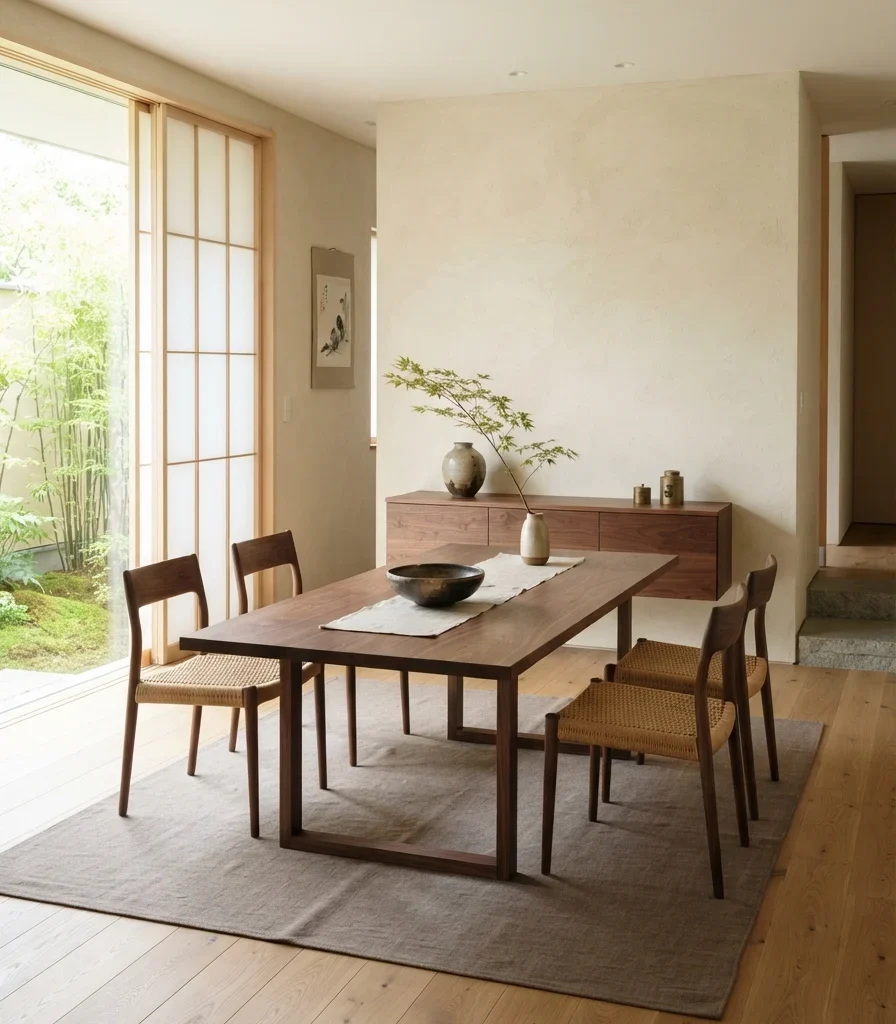
Vibe: Still and grounded, with the furniture appearing anchored close to the room rather than dominating it.
Why it works: Japanese interiors rely heavily on proportion. A table with a thin top and visually light legs creates less visual mass than chunky farmhouse furniture, allowing more of the floor and surrounding architecture to remain visible.
How to get it: Look for a dining table around 72–76 cm high with legs set inward from the corners, then pair it with chairs that have narrow backs and minimal upholstery. The visual goal is lightness, not necessarily an unusually low dining height.
Shop The Look
| Product | Search phrase |
| Walnut dining table | low profile walnut dining table minimalist |
| Slim dining chairs | Japanese minimalist wooden dining chairs |
| Low sideboard | walnut low profile dining sideboard |
| Ceramic bowl | handmade dark clay serving bowl |
| Natural runner | undyed linen dining table runner |
4. Japanese Dining Room With a Stoneware Table Setting
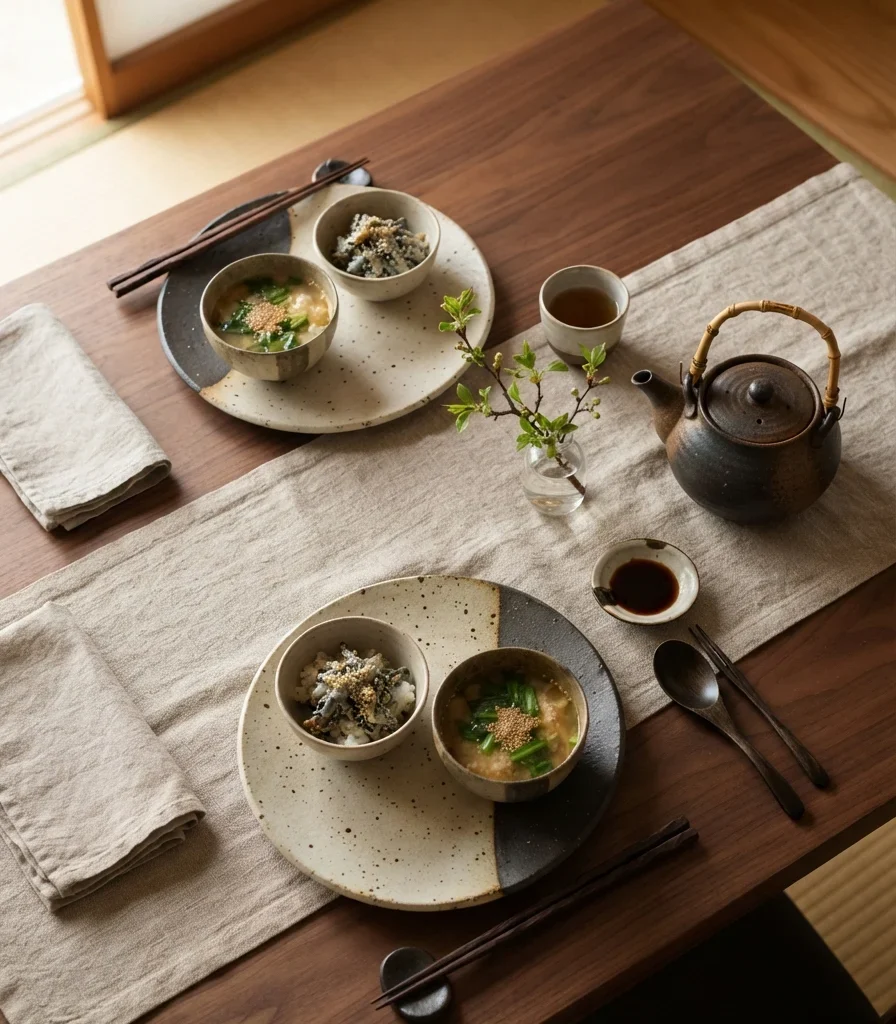
Vibe: Tactile and quietly intimate, inviting attention to the ritual of eating.
Why it works: Handmade ceramics introduce controlled irregularity into an otherwise disciplined room. Their uneven rims and mineral variation embody the wabi-sabi influence without requiring rustic furniture or excessive decoration.
How to get it: Build the table setting around three materials only: matte stoneware, natural linen, and dark wood. Keep the plates within one tonal family but allow slight variations in glaze.
💡 Quick Win: Buy two handmade-style cereal bowls rather than replacing an entire dinnerware collection.
Shop The Look
| Product | Search phrase |
| Stoneware dinnerware | Japanese handmade style stoneware dinner set |
| Clay serving bowl | irregular handmade ceramic serving bowl |
| Linen napkins | natural linen napkins set neutral |
| Wooden chopsticks | dark walnut wooden chopsticks set |
| Ceramic teapot | Matte Japanese-style ceramic teapot |
5. Warm Greige Japanese Dining Room
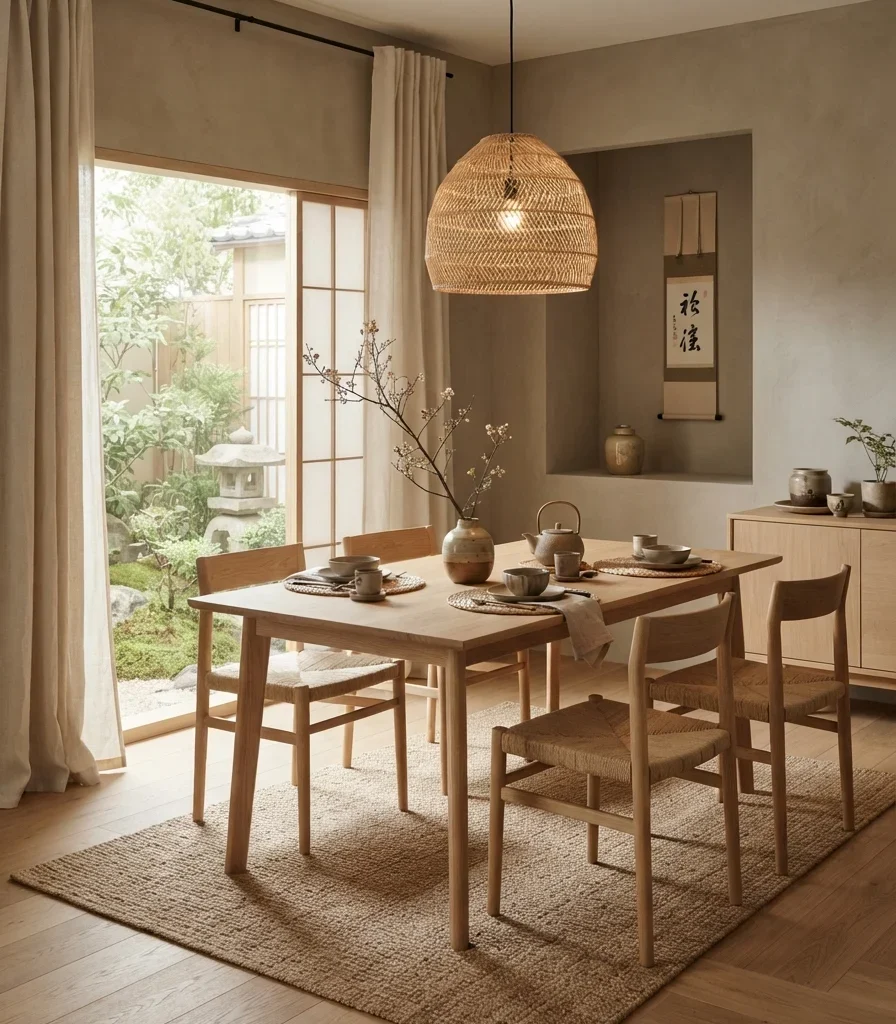
Vibe: Warm and enveloping, without losing the visual restraint associated with Japanese interiors.
Why it works: Greige works here because it bridges the coolness of pale neutrals and the warmth of timber. The tonal relationship creates depth without introducing strong saturation.
How to get it: Select a greige with beige rather than blue undertones and test it beside your actual flooring during both morning and evening light. Use matte paint to preserve the quiet, mineral quality.
Shop The Look
| Product | Search phrase |
| Greige wall paint | warm greige matte interior wall paint |
| Oak table | light oak Japanese dining table |
| Linen curtains | warm ivory linen curtain panels |
| Woven pendant | natural woven Japanese pendant light |
| Taupe vase | matte taupe ceramic vase minimalist |
6. Washi-Inspired Pendant Lighting Over the Table
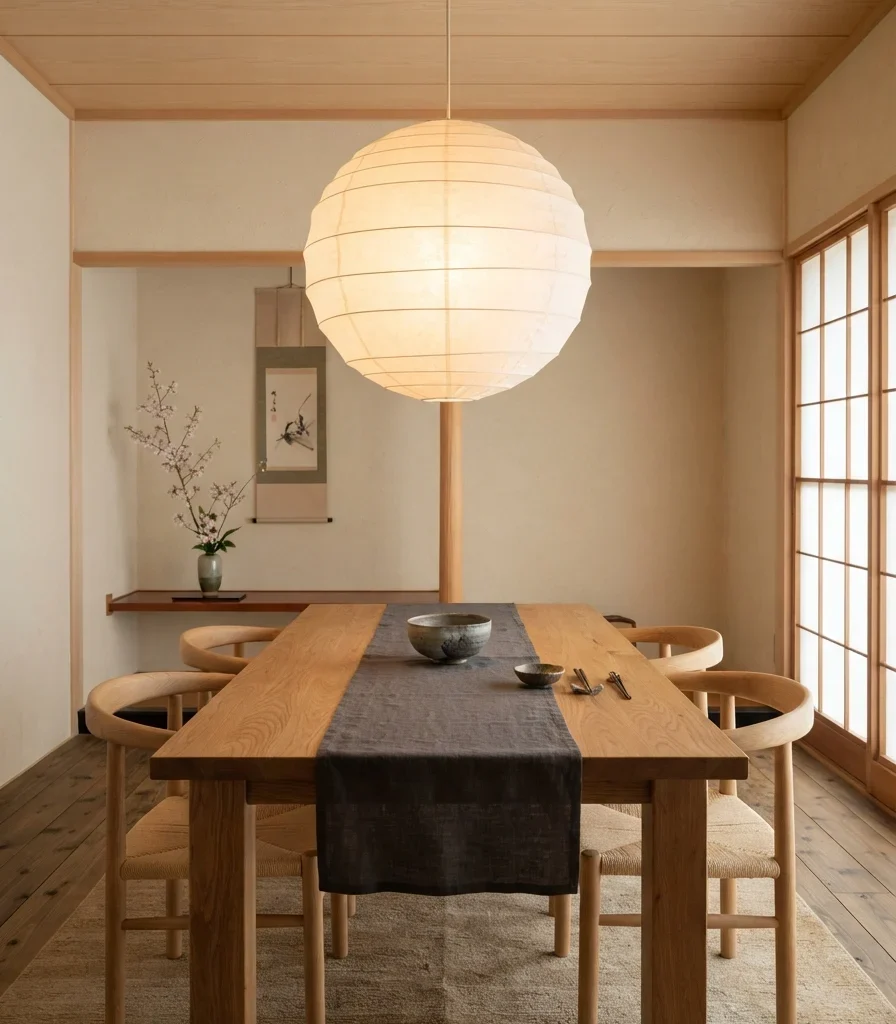
Vibe: Luminous and softly cocooned, with the pendant becoming a floating pool of warmth.
Why it works: Diffused light is essential to the atmosphere because translucent paper-style shades scatter illumination instead of producing harsh directional glare. Centering the fixture over the table establishes a strong visual axis.
How to get it: Hang the lowest point of the pendant roughly 75–90 cm above the tabletop, adjusting slightly for fixture size and sightlines. Choose a warm-white bulb around 2700K for evening dining.
💡 Quick Win: Swap a cool 4000K dining bulb for a dimmable 2700K bulb before changing any furniture.
Shop The Look
| Product | Search phrase |
| Paper pendant | Japanese washi paper pendant dining room |
| Warm bulb | dimmable 2700K warm white LED bulb |
| Oak table | natural oak dining table |
| Ceramic vase | Cream handmade ceramic vase |
| Linen runner | ivory linen dining runner |
7. Natural Wood and Blackened Metal Details

Vibe: Crisp and grounded, with dark details giving definition to the natural palette.
Why it works: The blackened metal creates visual punctuation while the oak prevents the room from becoming industrial. Repeating the dark tone in two or three small locations establishes rhythm instead of making one black object feel disconnected.
How to get it: Repeat the blackened finish at least three times, such as pendant, chair frame, and ceramic vessel, but keep the black elements visually slim.
Shop The Look
| Product | Search phrase |
| Black metal pendant | matte black Japanese dining pendant |
| Oak dining table | solid natural oak dining table |
| Black ceramic vase | matte black Japanese ceramic vase |
| Black dining chairs | slim black wood dining chairs |
| Olive plant | small olive tree indoor ceramic pot |
8. Built-In Oak Dining Bench
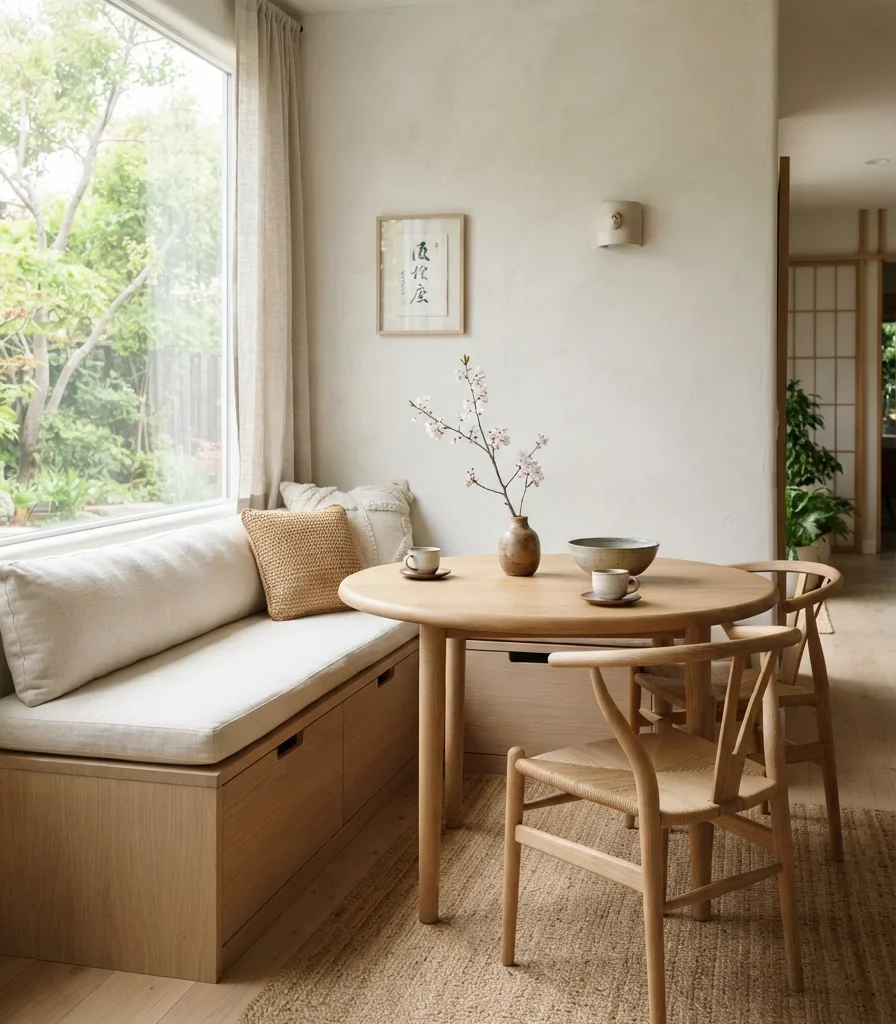
Vibe: Cozy and settled, giving the dining area the feeling of a quiet architectural alcove.
Why it works: A built-in bench reduces the number of visual furniture breaks along the wall and creates hidden storage beneath the seat. The continuous timber plane also strengthens the Japanese emphasis on craftsmanship and purposeful space.
How to get it: Design the seat around approximately 45 cm finished height and 48–52 cm depth, then use a removable linen cushion so the dining area remains practical.
💡 Quick Win: Use a freestanding oak bench with a custom-cut cream cushion before investing in permanent cabinetry.
Shop The Look
| Product | Search phrase |
| Oak bench | minimalist natural oak dining bench |
| Linen cushion | cream linen bench cushion custom style |
| Round table | small round oak dining table |
| Ceramic vase | small Japanese ceramic bud vase |
| Woven cushion | Natural woven neutral cushion cover |
9. Olive Green Accent Wall With Pale Timber

Vibe: Restorative and earthy, like bringing a shaded garden indoors.
Why it works: Muted olive works as a nature-derived accent without overwhelming the restraint of Japanese interiors. Pale timber visually lifts the darker wall, while clay accessories bridge the green and wood tones.
How to get it: Choose a gray-muted olive rather than a bright botanical green. Keep the remaining walls warm white so the accent surface remains intentional.
Shop The Look
| Product | Search phrase |
| Olive wall paint | muted olive green matte interior paint |
| Pale oak table | minimalist pale oak dining table |
| Cream chairs | cream linen dining chair set |
| Olive branches | artificial olive branch natural realistic |
| Clay bowl | Earthy brown handmade ceramic bowl |
10. Floor-Cushion-Inspired Dining Nook
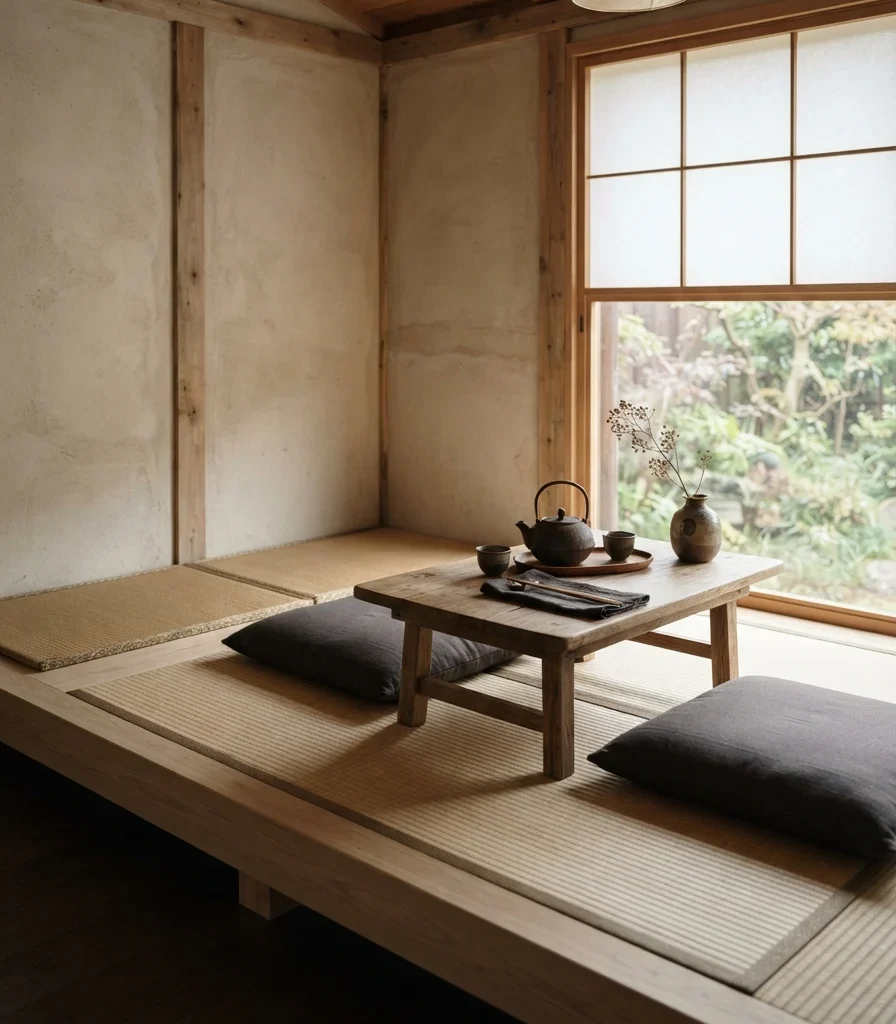
Vibe: Meditative, encouraging a slower relationship with meals.
Why it works: A low seating arrangement changes the room’s visual horizon and creates a strong connection between furniture and floor. It is more culturally specific than simply buying low furniture, so it should be used thoughtfully rather than treated as a universal dining solution.
How to get it: If using floor seating, prioritize firm cushions around 8–12 cm thick and maintain enough legroom beneath the table. Avoid using ordinary soft sofa cushions, which collapse too much for comfortable dining.
💡 Quick Win: Introduce one firm natural-cotton floor cushion beside an existing low table rather than converting the entire room.
Shop The Look
| Product | Search phrase |
| Low dining table | Japanese low wooden dining table |
| Floor cushion | firm Japanese floor cushion cotton |
| Woven mat | natural tatami style floor mat |
| Tea set | Japanese ceramic tea set neutral |
| Low vase | Handmade low ceramic vase |
11. Japanese Dining Room With a Round Table

Vibe: Airy and sociable, with the circular form softening the room’s geometry.
Why it works: Round tables eliminate sharp corners and can improve circulation in compact dining areas. The uninterrupted circular edge also gives a small room a visually lighter center than a heavy rectangular table.
How to get it: For four diners, look for a table around 100–110 cm in diameter, then maintain roughly 90 cm of circulation around the occupied seating wherever possible.
Shop The Look
| Product | Search phrase |
| Round oak table | 42 inch round natural oak dining table |
| Wooden chairs | Japanese minimalist wood dining chairs |
| Curved pendant | round paper pendant dining room |
| Ceramic centerpiece | low cream ceramic bowl centerpiece |
| Linen napkins | natural linen napkin set |
12. Handmade Clay Pendant Cluster
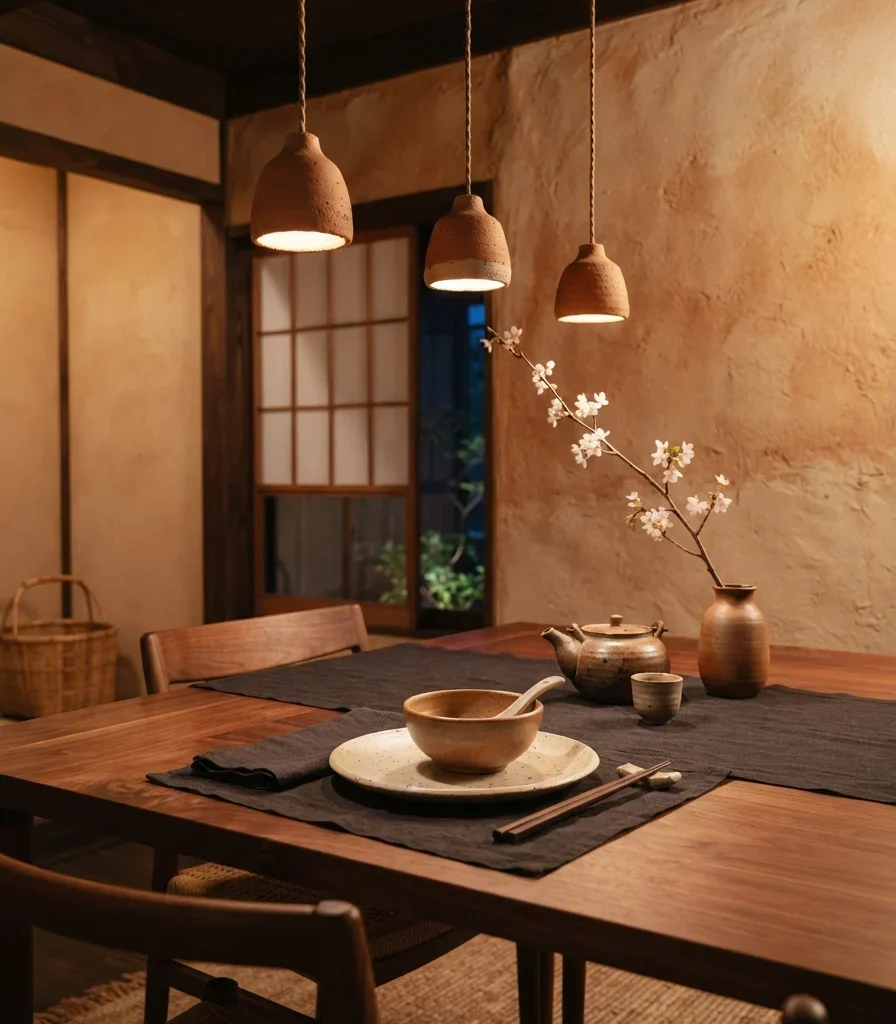
Vibe: Intimate and earthen, with handmade surfaces catching the light differently across each pendant.
Why it works: A cluster of individually imperfect clay shades introduces rhythm without resorting to decorative excess. Their material variation becomes more noticeable under warm low-angle evening light.
How to get it: Keep the pendants within one material family but vary their heights by approximately 15–25 cm. Use the cluster as the room’s decorative focal point and keep the tabletop comparatively restrained.
Shop The Look
| Product | Search phrase |
| Clay pendants | handmade clay pendant lights set 3 |
| Walnut table | minimalist walnut dining table |
| Earthenware vase | handmade terracotta ceramic vase |
| Linen runner | natural linen walnut dining runner |
| Wooden chopsticks | dark wood Japanese chopsticks set |
13. Natural Linen Dining Chairs
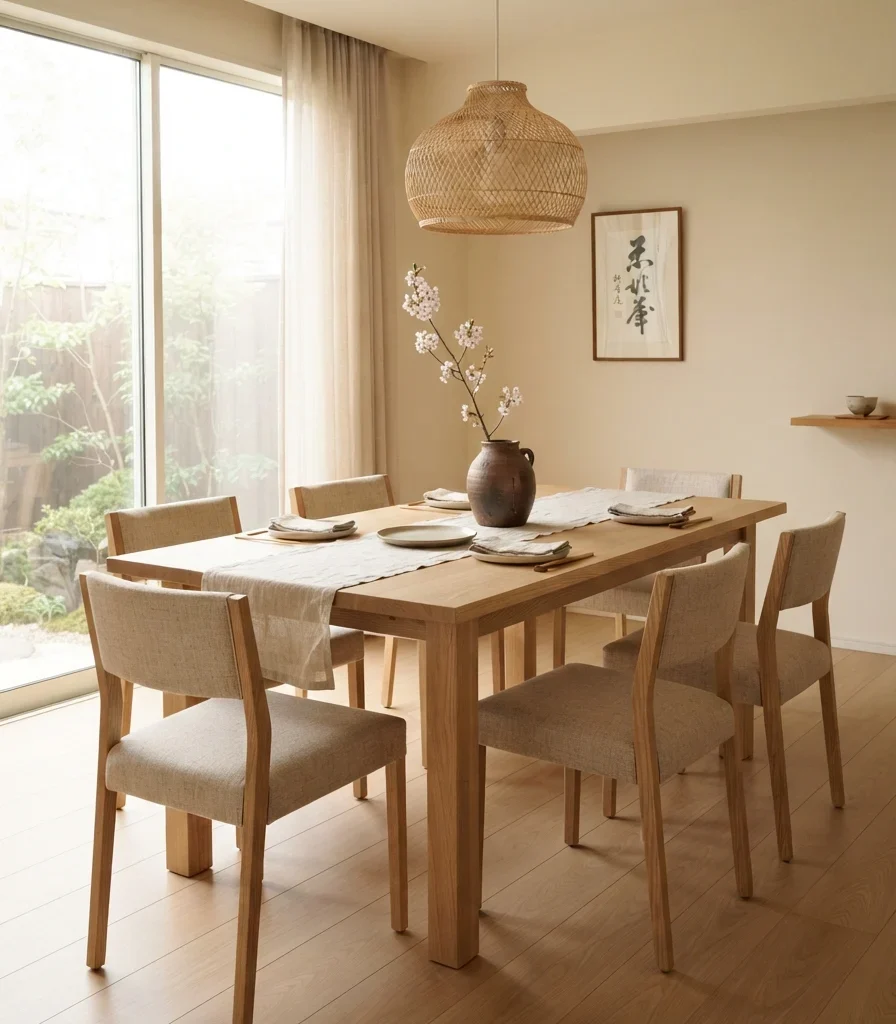
Vibe: Soft and tactile, balancing Japanese restraint with everyday dining comfort.
Why it works: Linen introduces surface texture without visual pattern. The combination of natural oak and undyed linen also keeps the chair visually connected to the room’s material palette instead of creating an isolated upholstered block.
How to get it: Select linen in oatmeal or natural flax rather than bright white. Choose chairs with exposed timber legs and narrow backs to preserve visual lightness.
💡 Quick Win: Add natural linen seat cushions to existing wooden chairs instead of replacing the chairs.
Shop The Look
| Product | Search phrase |
| Linen dining chairs | natural linen oak dining chairs set |
| Oak table | pale oak minimalist dining table |
| Linen cushions | natural flax linen chair cushions |
| Ceramic vase | oatmeal ceramic bud vase |
| Woven placemats | natural woven dining placemats |
14. Japandi-Japanese Fusion With Walnut and Cream
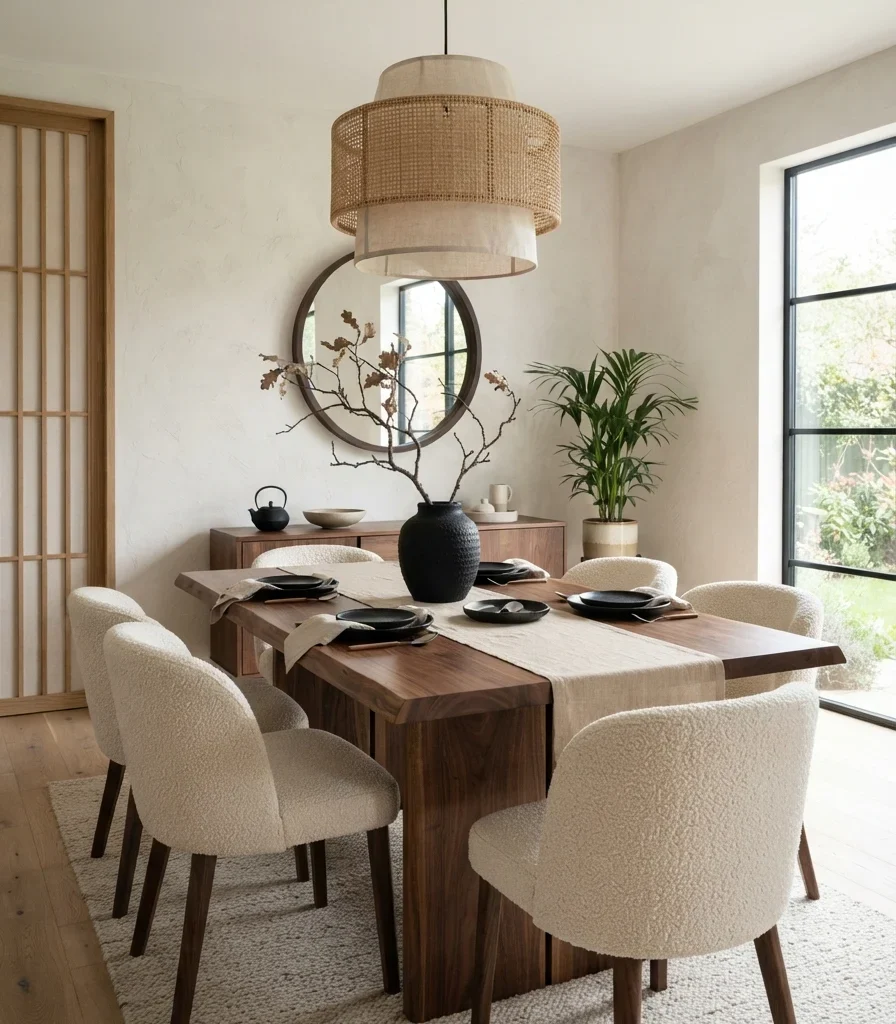
Vibe: Balanced and composed, with Scandinavian softness supporting Japanese restraint.
Why it works: Japandi works when the Scandinavian elements remain quiet rather than becoming rustic. Walnut provides visual depth while cream boucle adds softness, and black ceramic details supply the crisp punctuation found in many Japanese interiors.
How to get it: Keep the furniture count low and use one darker timber species throughout the main furniture. Introduce softness through upholstery and textiles rather than multiple decorative accessories.
Shop The Look
| Product | Search phrase |
| Walnut dining table | minimalist walnut dining table |
| Cream boucle chairs | cream boucle wood dining chairs |
| Woven pendant | natural fiber Japandi pendant |
| Black ceramic vase | matte black Japanese vase |
| Beige linen runner | neutral linen dining table runner |
15. Open Shelving for Japanese Tableware

Vibe: Organized and tactile, turning everyday dining objects into quiet visual details.
Why it works: Open storage suits Japanese design when the objects displayed are genuinely useful and visually cohesive. Negative space between groups prevents the shelving from becoming a collection of unrelated items.
How to get it: Use shelves approximately 25–30 cm deep and divide objects into small groups of three to five. Keep at least one-third of the shelf visually empty.
💡 Quick Win: Remove half the objects from an existing dining shelf and regroup the remaining pieces by material rather than color.
Shop The Look
| Product | Search phrase |
| Oak floating shelves | natural oak floating shelves 30cm deep |
| Ceramic bowls | handmade neutral ceramic bowl set |
| Stoneware plates | matte cream stoneware dinner plates |
| Linen napkins | natural linen napkin set |
| Small trailing plant | Artificial trailing green plant, realistic |
16. Black Shoji-Inspired Room Divider

Vibe: Peaceful and architectural, creating separation without making the dining area feel enclosed.
Why it works: Translucent partitions preserve light while defining zones, which is particularly useful in open-plan homes. The repeated grid creates rhythm while the pale panels prevent the divider from becoming a visually heavy wall.
How to get it: Use a slim-frame divider with translucent or frosted panels rather than opaque timber. Position it where it hides visual clutter from the dining table without blocking the primary window.
Shop The Look
| Product | Search phrase |
| Shoji divider | Japanese shoji room divider black frame |
| Oak dining table | natural oak dining table minimalist |
| Ceramic vase | Japanese cream ceramic vase |
| Linen runner | warm beige linen table runner |
| Branch decor | natural preserved branch arrangement |
17. Stone and Timber Material Pairing

Vibe: Earthy and grounded, balancing the cool mineral quality of stone with warm timber.
Why it works: Stone and wood create a useful temperature contrast: the stone feels visually cool and substantial while walnut introduces warmth and organic grain. A honed surface is preferable to high gloss because it maintains the tactile restraint of Japanese design.
How to get it: Use stone on one substantial plane, such as a sideboard top or console, rather than scattering stone accessories everywhere. Choose honed or leathered finishes instead of polished surfaces.
💡 Quick Win: Add a single small travertine or stone serving board to an existing wooden sideboard.
Shop The Look
| Product | Search phrase |
| Travertine sideboard | travertine top wood dining sideboard |
| Walnut dining table | warm walnut Japanese dining table |
| Stone serving board | natural travertine serving board |
| Clay vase | handmade sand clay vase |
| Linen textile | natural stone color linen runner |
18. Minimal Japanese Gallery Wall
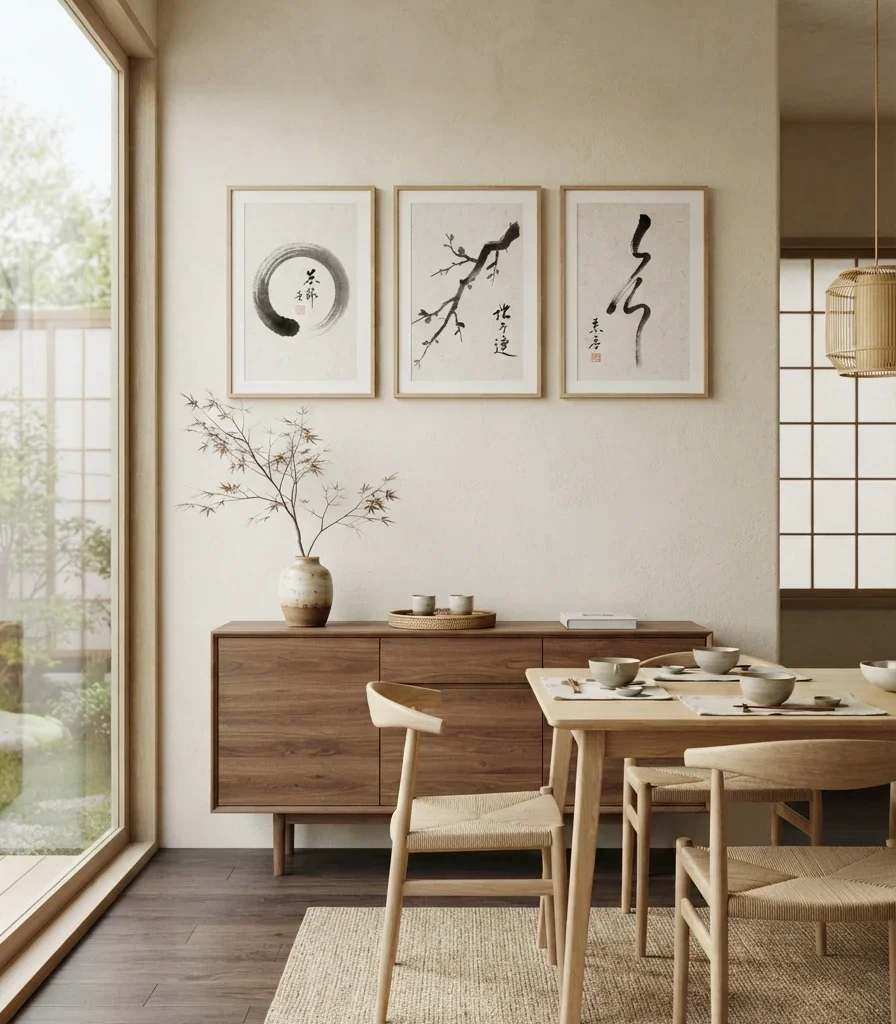
Vibe: Contemplative and balanced, allowing the wall to feel intentionally quiet.
Why it works: Three vertically oriented artworks create rhythm without covering the wall. Japanese-inspired artwork works best when the composition leaves substantial breathing room around each piece.
How to get it: Choose three related prints with a restrained palette and identical frame material. Hang them with consistent spacing of approximately 8–12 cm rather than creating a dense gallery wall.
Shop The Look
| Product | Search phrase |
| Japanese art prints | minimalist Japanese ink art print set 3 |
| Natural frames | thin natural oak picture frames |
| Walnut sideboard | low walnut dining sideboard |
| Ceramic vessel | Japanese matte ceramic vessel |
| Woven tray | natural bamboo serving tray |
19. Bamboo and Rattan Texture Layering
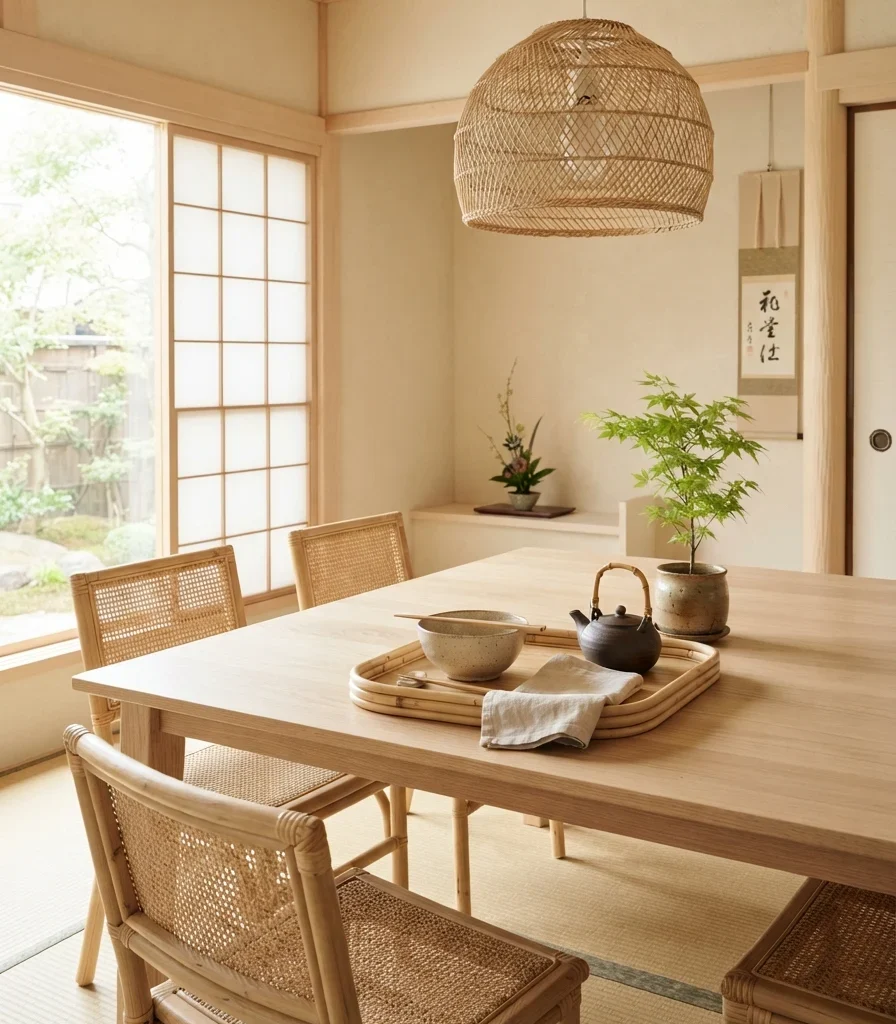
Vibe: Airy and tactile, with woven fibers giving the restrained room a gentle softness.
Why it works: Bamboo and rattan provide texture without relying on pattern. Keeping the woven materials in similar straw tones creates cohesion while the smoother oak table provides necessary textural contrast.
How to get it: Use one dominant woven element, such as the pendant, then repeat bamboo in a smaller accessory rather than matching every piece of furniture.
Shop The Look
| Product | Search phrase |
| Bamboo dining chairs | natural bamboo Japanese dining chair |
| Rattan pendant | woven rattan dining pendant natural |
| Oak table | pale oak dining table |
| Bamboo tray | Japanese bamboo serving tray |
| Ceramic bowl | cream matte ceramic bowl |
20. Small Japanese Dining Room With Wall-Mounted Storage

Vibe: Uncluttered and breathable, proving that restraint can make a small dining area feel larger.
Why it works: Wall-mounted storage keeps the floor visible, increasing perceived floor area. The floating cabinet also creates a horizontal line that organizes the wall without the visual weight of a full-height cupboard.
How to get it: Prioritize storage above or beside the dining table and keep the lower 60–75 cm of wall visually open where possible. Choose furniture with legs rather than solid bases.
💡 Quick Win: Replace a freestanding storage cabinet with two wall-mounted oak shelves and move rarely used dining pieces into closed storage elsewhere.
Shop The Look
| Product | Search phrase |
| Floating cabinet | wall mounted oak dining storage cabinet |
| Compact table | small natural oak dining table 120cm |
| Slim chairs | narrow minimalist dining chairs |
| Wall pendant | small Japanese pendant light |
| Ceramic vase | tiny matte ceramic bud vase |
21. Japanese Dining Room With a Built-In Window Seat
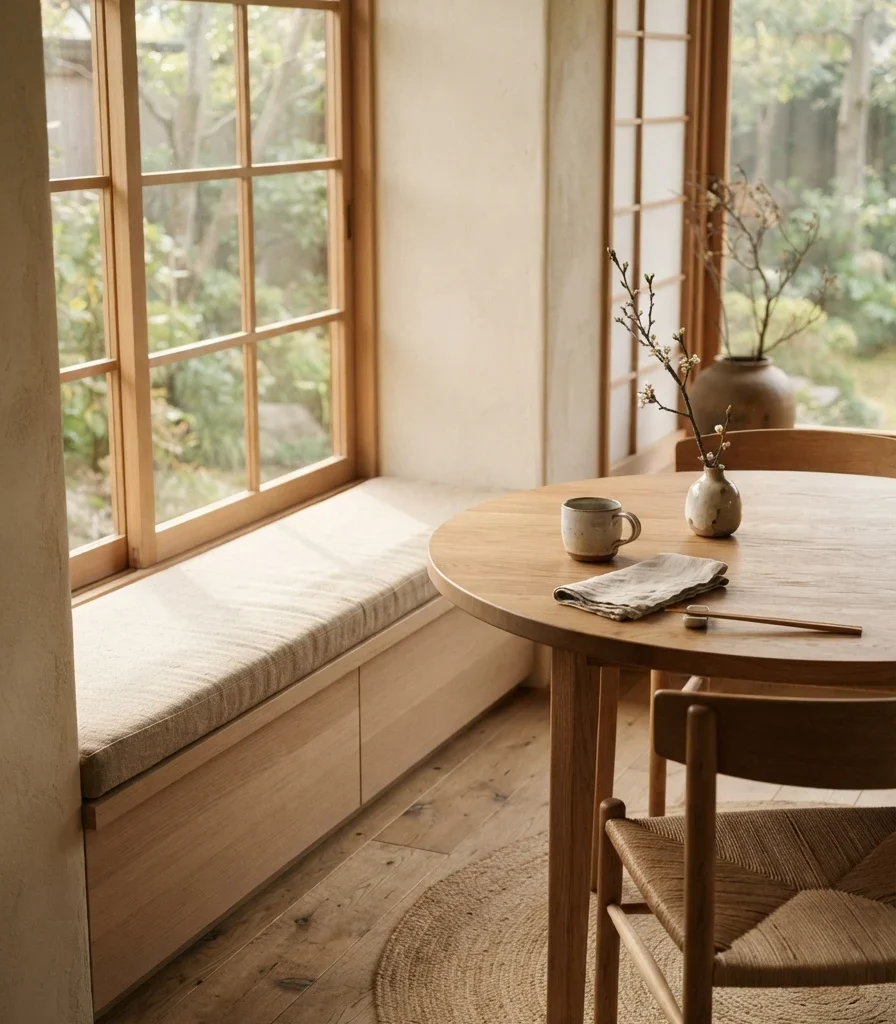
Vibe: Sun-warmed and intimate, making natural light part of the dining experience.
Why it works: The window seat turns otherwise unused perimeter space into functional seating while reinforcing the Japanese appreciation for views and changing daylight. The low horizontal profile also keeps the window visually open.
How to get it: Build the seat so its finished height aligns with the dining chair seat, approximately 45 cm, and use a washable linen cushion. Avoid placing tall furniture directly beside the window.
Shop The Look
| Product | Search phrase |
| Window bench | minimalist natural oak window seat bench |
| Linen cushion | natural linen bench cushion 45cm |
| Round table | compact Japanese round oak dining table |
| Ceramic cup | handmade Japanese ceramic cup |
| Potted branch | minimalist indoor branch plant pot |
22. Indigo Accent Details
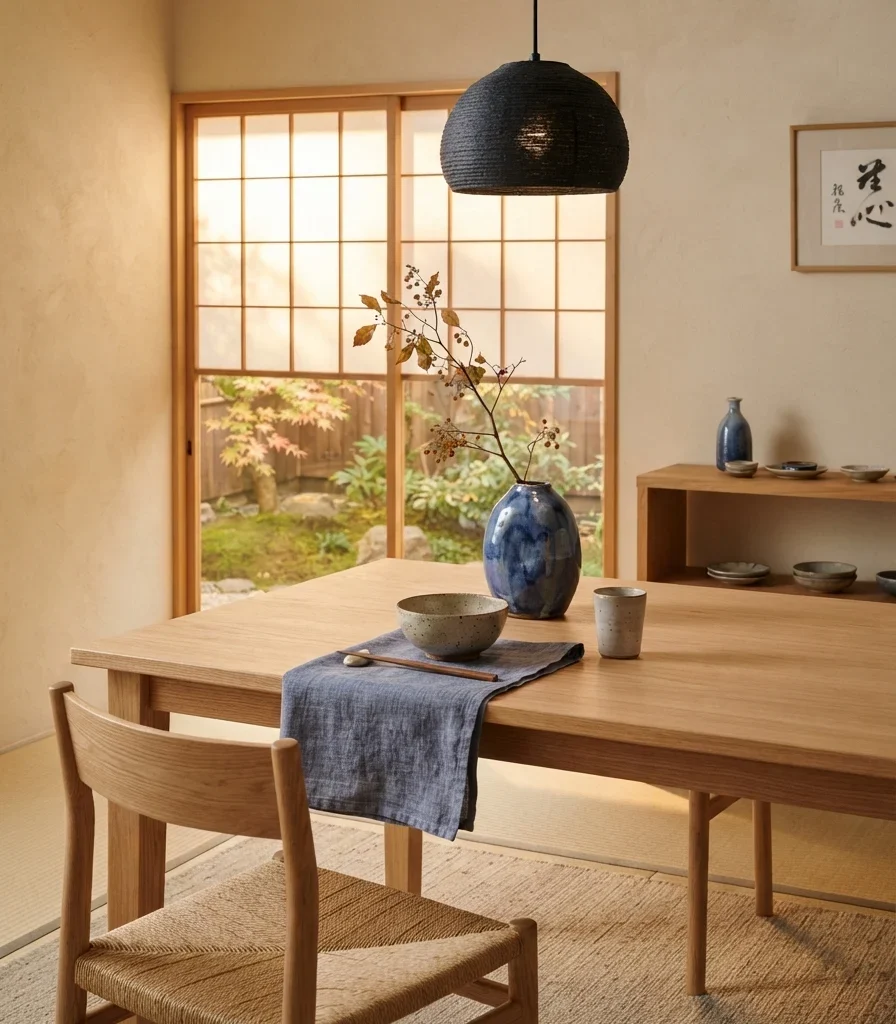
Vibe: Tranquil and slightly cool, with indigo adding depth to an otherwise warm room.
Why it works: A restrained indigo accent references traditional Japanese textile and ceramic traditions without turning the dining room into a themed space. Because the blue is deep and muted, it behaves almost like a neutral.
How to get it: Introduce indigo in only three locations: one textile, one ceramic piece, and one small artwork. Repeat the same tone rather than using several unrelated blues.
💡 Quick Win: Add four indigo linen napkins to a neutral dining table; they can change the room’s visual rhythm without changing any furniture.
Shop The Look
| Product | Search phrase |
| Indigo napkins | Japanese indigo linen napkins set |
| Blue ceramic vase | handmade indigo blue ceramic vase |
| Oak table | natural oak dining table |
| Indigo artwork | minimalist Japanese indigo wall art |
| Stoneware plates | cream stoneware dinner plates |
23. Zen-Inspired Dining Room With Almost No Decor
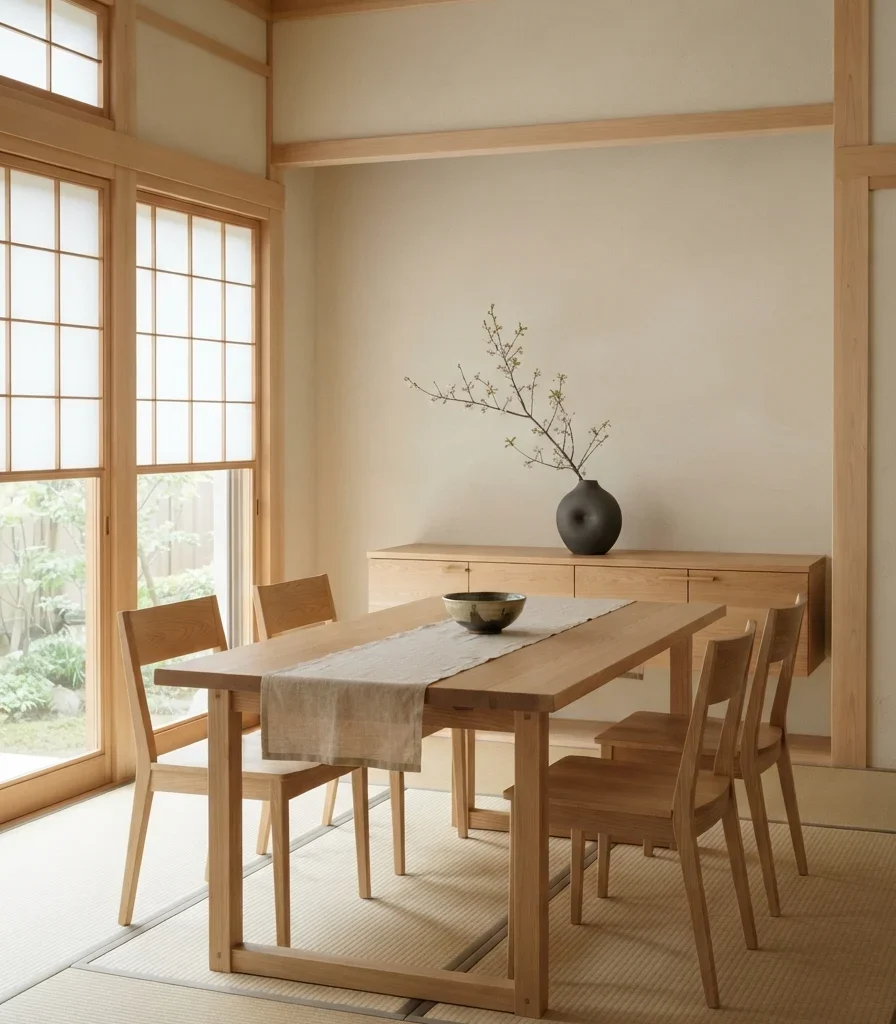
Vibe: Hushed and restorative, letting emptiness become part of the room’s decoration.
Why it works: Negative space is not simply the absence of decor; it is an active compositional element. The few objects that remain gain importance because nothing competes with them, while the open wall and floor allow the timber and light to become the room’s visual features.
How to get it: Remove objects until every remaining piece has a clear function or material purpose. Keep one principal decorative object on the sideboard rather than filling it with symmetrical accessories.
Shop The Look
| Product | Search phrase |
| Minimal oak table | simple Japanese pale oak dining table |
| Wooden chairs | minimalist Japanese dining chair set |
| Low sideboard | simple oak low sideboard dining |
| Single branch vase | minimalist tall ceramic bud vase |
| Linen runner | natural undyed linen table runner |
24. Japanese Dining Room With a Dark Walnut Focal Point
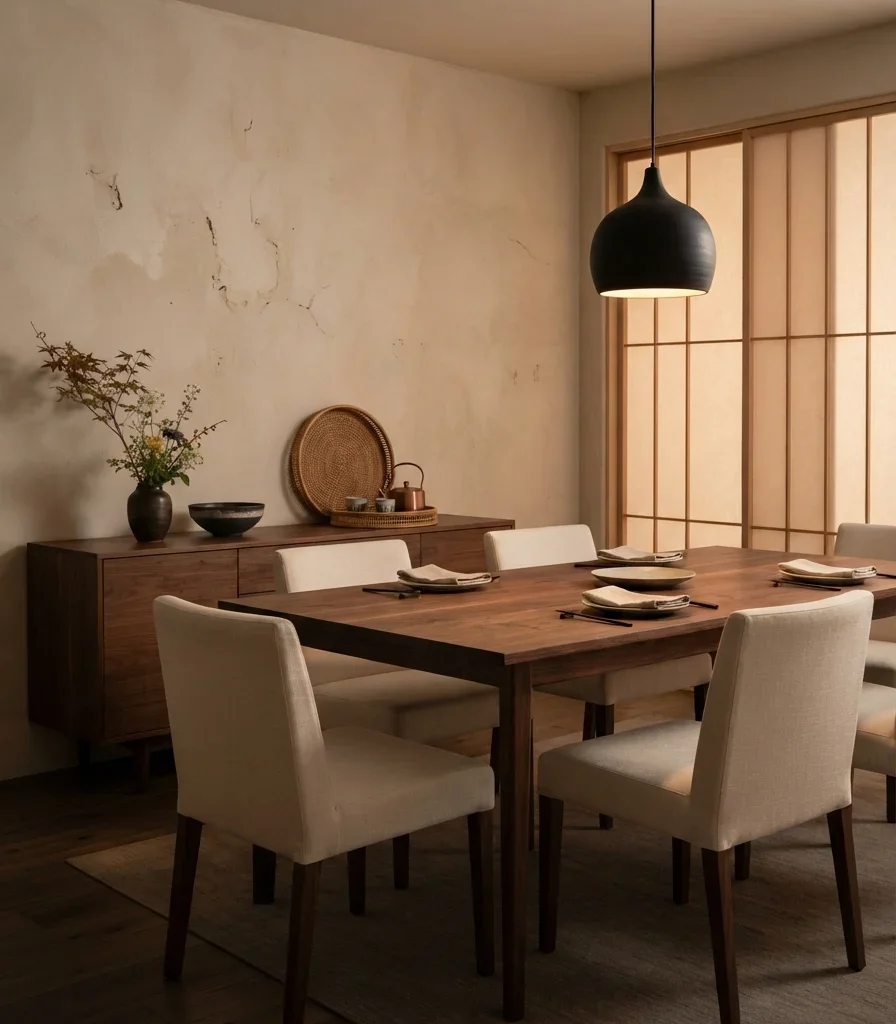
Vibe: Intimate and richly grounded, with walnut bringing evening depth to the restrained palette.
Why it works: Dark walnut can anchor a Japanese dining room without making it heavy when its surrounding elements remain light. The visual weight is concentrated at table height, while ivory walls and linen chairs keep the upper half of the room open.
How to get it: Use walnut as the hero material and avoid introducing a second dark wood species. Balance the table with pale upholstery, warm-white walls, and generous empty wall space.
Shop The Look
| Product | Search phrase |
| Walnut table | dark walnut Japanese dining table |
| Linen chairs | ivory linen wood dining chairs |
| Black pendant | matte black Japanese dining pendant |
| Walnut sideboard | dark walnut low sideboard |
| Woven tray | dark natural bamboo serving tray |
25. Seasonal Japanese Dining Table Styling
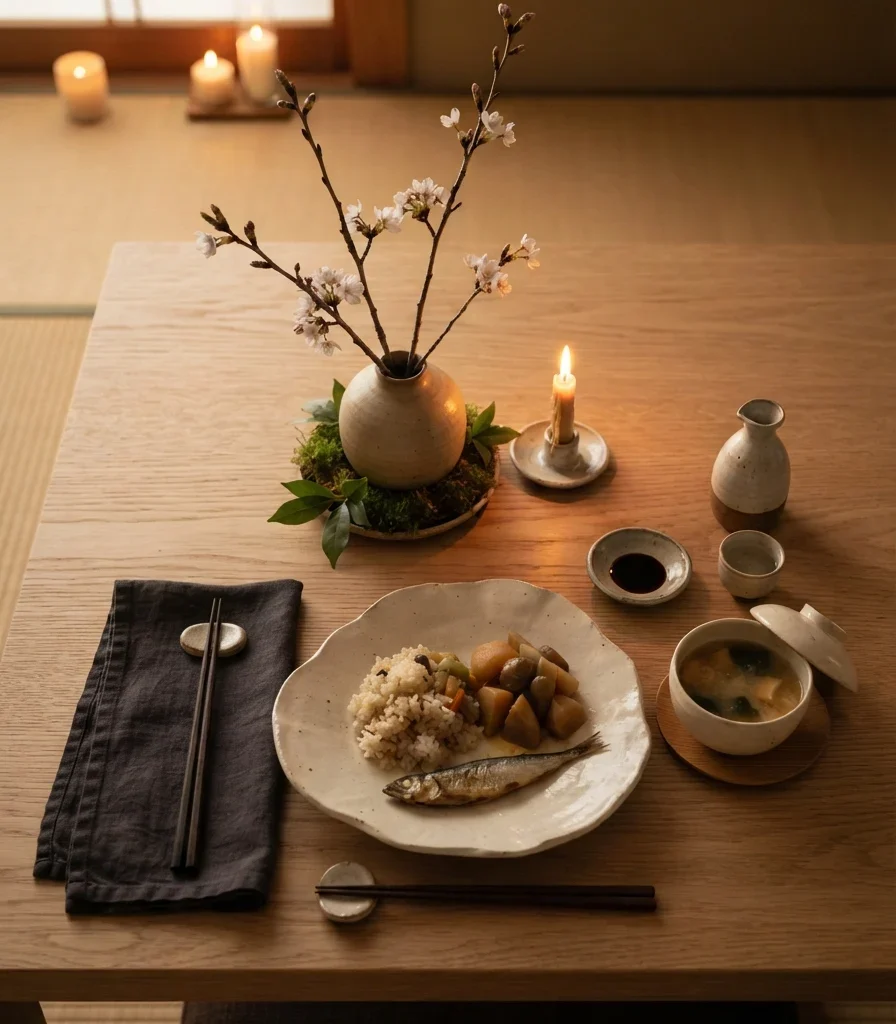
Vibe: Seasonal and intimate, allowing a meal to feel special without turning the table into a display.
Why it works: Japanese table styling benefits from asymmetry, low arrangements, and tactile materials that leave sightlines open across the table. A small number of meaningful pieces gives the setting rhythm while preserving the functional space needed for food and conversation.
How to get it: Keep the centerpiece below approximately 30 cm so diners can see across the table, then change only the botanical element seasonally. Spring can use delicate branches, summer can use green foliage, autumn can introduce dried grasses, and winter can rely on bare branches or evergreen stems.
💡 Quick Win: Put three branches into a low ceramic bowl you already own and remove every other centerpiece item for a cleaner Japanese-inspired arrangement.
Shop The Look
| Product | Search phrase |
| Low ceramic vase | Japanese low ceramic centerpiece vase |
| Cream stoneware | handmade cream stoneware dinner set |
| Linen napkins | natural linen napkins neutral set |
| Wooden chopsticks | Japanese dark wood chopsticks set |
| Ceramic candle holder | Minimalist handmade ceramic candle holder |
How to Start Your Japanese Dining Room Transformation
Begin with one pale natural-oak dining table. Choose a simple rectangular or round design with visible grain, a matte finish, and relatively slender legs; this single piece establishes the room’s material language and gives you a reliable reference point for every later decision.
The most common mistake is mixing too many wood undertones. A yellow-orange oak table beside reddish walnut chairs and gray-brown flooring can make an otherwise restrained room feel visually noisy. Pick one dominant timber and allow secondary wood only when its tone is clearly intentional.
For an inexpensive entry point, start with three small changes: a natural linen runner under $30, a matte cream ceramic vase under $25, and a 2700K dimmable warm-white bulb under $15. Together, they change texture, light, and tabletop styling without requiring new furniture.
A starter transformation can realistically happen over one weekend for roughly $150–$500 if the existing furniture is usable; a fuller dining-room renovation with a new table, seating, lighting, storage, and wall treatment can move into the $1,500–$4,000+ range. Painting and styling can happen quickly, while custom cabinetry, built-ins, flooring, or made-to-order furniture may take several weeks or months.
Frequently Asked Questions About Japanese Dining Room Designs
What is Japanese dining room design and how is it different from Japandi?
Japanese dining room design is rooted more directly in Japanese spatial principles, natural materials, craftsmanship, simplicity, and concepts such as ma and wabi-sabi. Japandi combines Japanese restraint with Scandinavian warmth, often adding boucle, softer upholstery, and Nordic furniture influences. A Japanese room might emphasize handmade ceramics, timber, paper-like lighting, and negative space more strongly. Both styles benefit from restrained palettes and natural materials.
What colors work best in a Japanese dining room?
Warm white, rice-paper cream, pale beige, mushroom taupe, muted olive, charcoal, and natural wood tones are especially versatile. Indigo can work as a broader accent, particularly through ceramics or linen textiles. Avoid extremely bright primary colors if the goal is a restrained Japanese atmosphere. Test warm whites in the actual dining room because north-facing and south-facing light can alter how cream and beige appear.
How much does it cost to create a Japanese dining room?
A budget refresh can cost approximately $150–$500 when you keep the existing table and chairs and focus on lighting, textiles, ceramics, and paint. A mid-range room with a new solid-wood table, four to six chairs, pendant lighting, rug, and storage can reach approximately $1,500–$4,000. Custom timber furniture and built-ins can increase the budget substantially. The biggest cost difference usually comes from furniture construction and real natural materials rather than small accessories.
Can Japanese dining room design work with modern furniture?
Yes, provided the modern furniture has clean proportions and does not overwhelm the room. A simple contemporary oak table can work with Japanese ceramics, linen, paper-style lighting, and restrained artwork. Avoid mixing several competing furniture styles at once. The strongest connection comes from repeating natural materials, quiet colors, and visual simplicity.
What lighting is best for a Japanese dining room?
A 2700K warm-white light source is a reliable starting point for evening dining because it creates a softer atmosphere than cool white lighting. Paper, rice-paper-inspired, linen, bamboo, and other translucent or woven shades are particularly effective because they diffuse light across the room. Position a dining pendant approximately 75–90 cm above the tabletop, adjusting for the fixture’s scale and sightlines. Add dimming where possible so the room can shift from brighter meal preparation to softer evening dining.
Ready to Create Your Dream Japanese Dining Room?
These 25 Japanese dining room designs cover quiet color palettes, honest timber and ceramic materials, layered lighting, furniture proportion, compact layouts, storage, and seasonal table styling. You do not need to transform everything at once; beginning with one table, one light, or one carefully chosen ceramic piece is often the more convincing approach. Today, measure your dining table and replace one cool light bulb with a dimmable 2700K warm-white bulb to immediately change the atmosphere. As the room develops, the combination of natural materials, negative space, and deliberate simplicity can make everyday meals feel calmer, slower, and more connected to the space around you. Save your favorite ideas- especially the pale-oak tables, washi-inspired lighting, handmade ceramics, and beautifully restrained space- so you can return to them when you’re ready to build your own Japanese dining room.
[…] is something wonderfully enveloping about a Victorian dining room: candlelight catches on aged brass, dark wood absorbs the evening glow, patterned wallpaper gives […]
[…] good coastal dining room should feel like sunlight coming through linen curtains on a quiet morning. There is an ease to […]
[…] 25 Japanese Dining Room Designs That Bring Calm, Craft, and Natural Beauty […]