

Art Deco dining rooms combine geometric architecture, luxurious materials, dramatic symmetry, and glamorous lighting with the streamlined confidence of the Jazz Age. These 23 Art Deco dining room design ideas show you how to use jewel tones, walnut, lacquer, brass, velvet, marble, mirrors, geometric wallpaper, sculptural furniture, and compact-space tricks without turning your dining room into a themed 1920s set.
The mood is theatrical but controlled: brass catches warm evening light, velvet absorbs sound, polished walnut glows against black lacquer, and geometric lines make an ordinary meal feel slightly ceremonial. The style has energy, but its geometry keeps that energy disciplined. Contemporary Art Deco rooms work particularly well when historical motifs are selectively mixed with modern furniture rather than reproduced literally.
Here are 23 ideas worth saving and stealing.
Why 23 Art Deco Dining Room Design Ideas Work So Well
Art Deco emerged in France and flourished internationally during the 1920s and 1930s, with the pivotal 1925 Exposition Internationale des Arts Décoratifs et Industriels Modernes in Paris helping define its vocabulary. It combined luxury craftsmanship with machine-age optimism, favoring geometric ornament, streamlined silhouettes, exotic veneers, lacquer, metal, glass, and reflective surfaces rather than copying historical styles.
Core materials include Macassar ebony, walnut, mahogany, black lacquer, marble, mirrored glass, chrome, brass, velvet, and polished stone. Classic colors include emerald green, sapphire blue, deep teal, oxblood, black, ivory, cream, and warm metallic gold; jewel tones were often balanced with neutrals and dark contrast.
Art Deco feels current because modern interiors are again embracing stronger color, statement lighting, vintage pieces, handcrafted materials, and rooms with more personality instead of anonymous neutral furniture sets. Current designers also tend to borrow selected Deco elements- geometric furniture, brass, marble, lacquer, sculptural lighting- rather than recreating an entire period interior.
Small dining rooms can absolutely use Art Deco, but restraint becomes essential. Prioritize one strong geometric feature, such as a chandelier, mirror, wallpaper, or table, then preserve approximately 36 inches of circulation around the main traffic route. Reflective surfaces can visually enlarge the room, but too many glossy surfaces can make a compact space feel visually busy.
Style at a Glance
| Element | Art Deco Direction |
| Philosophy | Geometry + glamour + streamlined luxury |
| Materials | Walnut, lacquer, marble, brass, chrome, velvet |
| Color palette | Emerald, sapphire, black, ivory, oxblood, gold |
1. Emerald Green Walls with Black and Brass Contrast
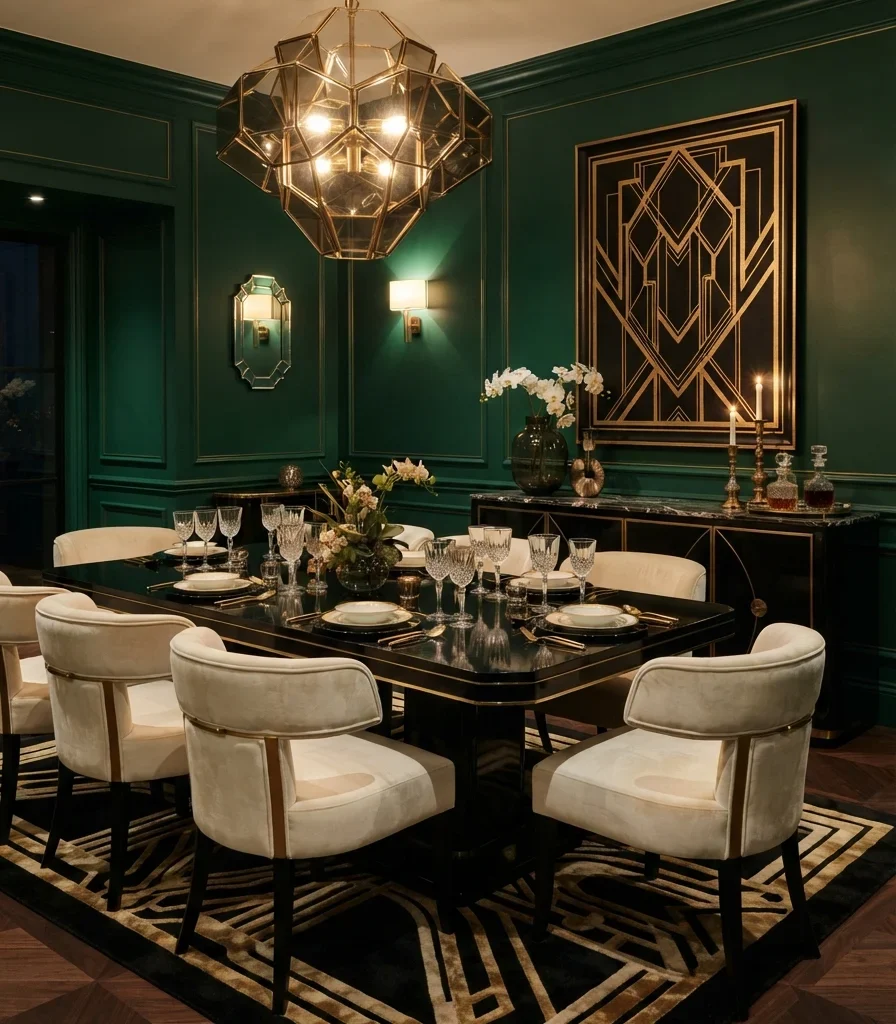
Category: COLOR
Vibe: Opulent.
Why it works: Emerald establishes the high-contrast jewel-tone foundation associated with classic Art Deco interiors, while black creates visual weight and brass introduces reflected warmth. The three materials- paint, lacquer, and metal- also vary surface reflectivity.
How to get it: Paint the walls in a deep emerald around #176B57, then keep the ceiling warm ivory. Repeat black in only two major elements, such as the table and picture frames, so the brass remains the visual bridge.
💡 Quick Win: Replace ordinary dining chair cushions with emerald velvet covers before committing to a full wall-color change.
Shop The Look
| Product | Search phrase |
| Paint | Deep emerald green interior wall paint |
| Chairs | Emerald velvet Art Deco dining chairs |
| Frames | Black geometric picture frame set |
| Vase | Smoked green glass decorative vase |
| Candlesticks | Brass Art Deco taper candle holders |
2. Macassar Ebony-Inspired Feature Cabinet
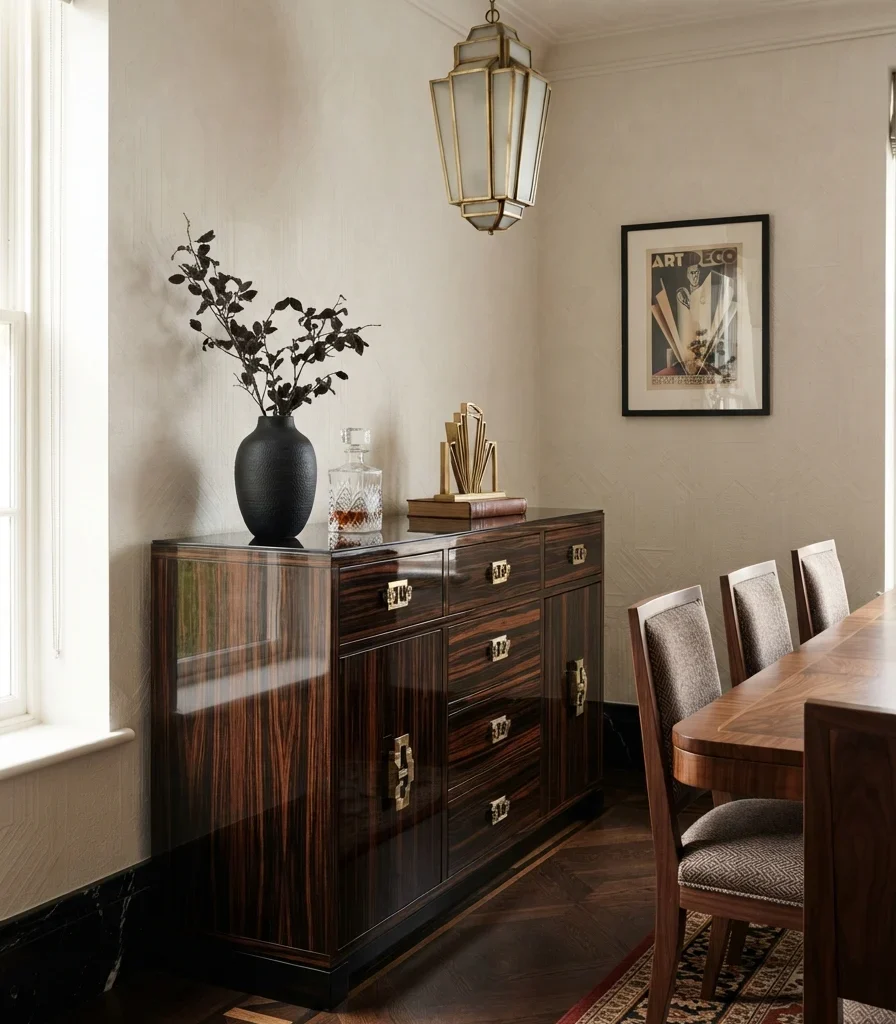
Category: MATERIAL
Vibe: Rich.
Why it works: Exotic wood veneers were an important part of high-end Art Deco furniture, with designers such as Émile-Jacques Ruhlmann using richly figured woods and refined surfaces. The strong grain provides pattern without relying on wallpaper.
How to get it: Use a walnut or Macassar-style veneer sideboard with a satin or high-gloss finish, then choose brushed or aged brass hardware rather than mixing several metal colors. Let the grain remain the dominant decorative element.
Shop The Look
| Product | Search phrase |
| Sideboard | Macassar ebony style Art Deco sideboard |
| Hardware | Brushed brass geometric cabinet pulls |
| Vase | Black ceramic sculptural vase |
| Decanter | Crystal whiskey decanter, geometric |
| Sculpture | Brass geometric Art Deco sculpture |
3. A Geometric Sunburst Chandelier as the Focal Point
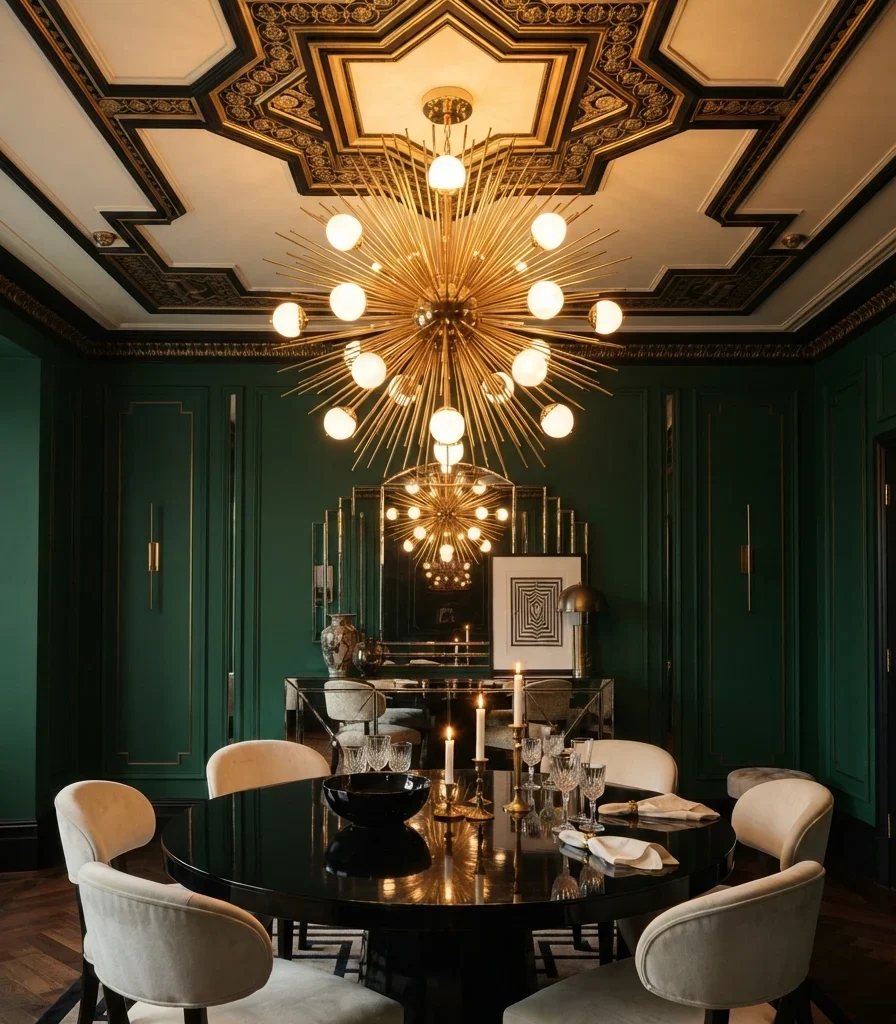
Category: LIGHTING
Vibe: Luminous.
Why it works: Radial lighting introduces geometric repetition and vertical hierarchy simultaneously. Art Deco lighting frequently emphasized stacked, stepped, curved, or radiating forms, making the fixture part of the architecture rather than background illumination.
How to get it: Choose a chandelier whose diameter is approximately ½ to ⅔ of the table width. Hang it around 30–36 inches above the tabletop and use dimmable 2700K bulbs to keep brass and velvet warm at dinner.
Shop The Look
| Product | Search phrase |
| Chandelier | Large brass Art Deco sunburst chandelier |
| Bulbs | 2700K dimmable globe LED bulbs |
| Ceiling detail | Geometric Art Deco ceiling medallion |
| Candles | Black taper candle set |
| Dimmer | LED-compatible brass wall dimmer |
4. Curved Velvet Dining Chairs with Fan Backs
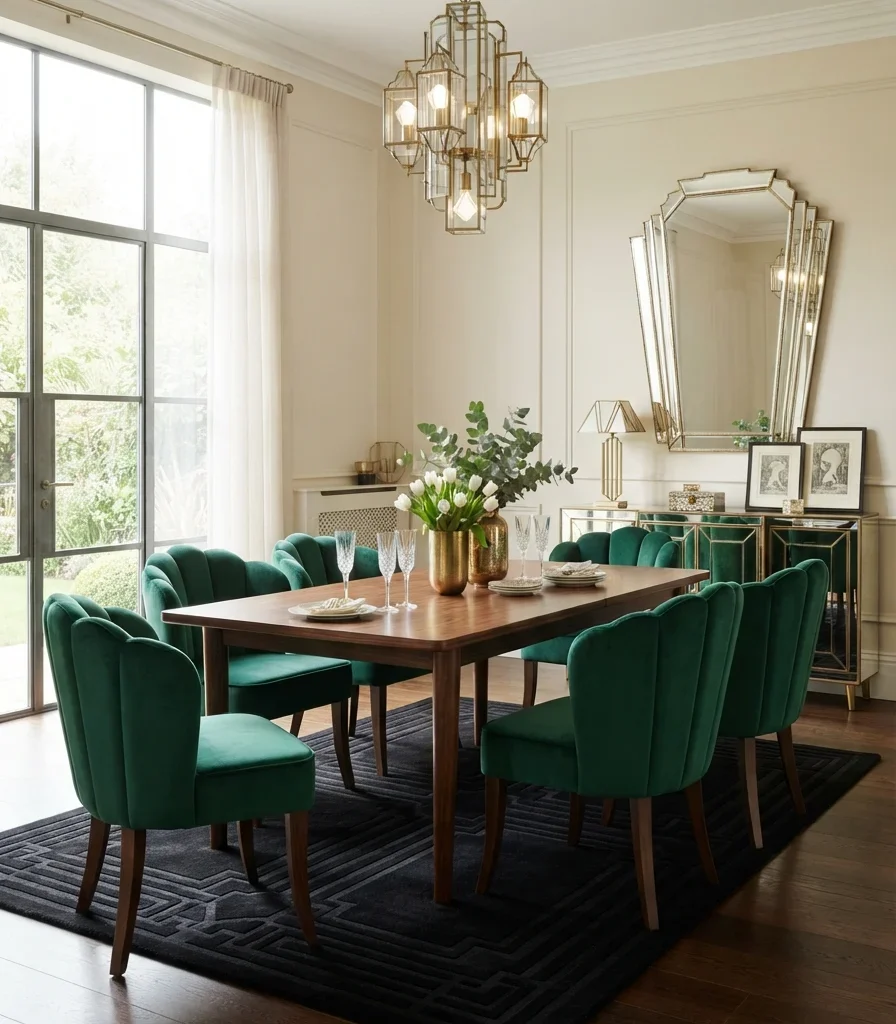
Category: FURNITURE
Vibe: Plush.
Why it works: The fan-back silhouette provides repeated geometry while velvet introduces acoustic softness and tactile contrast against hard lacquer, marble, and metal. Repetition of the chair shape creates a strong rhythmic frame around the table.
How to get it: Select chairs with approximately 19–21 inches of seat width and a back tall enough to create a visible silhouette behind the table. Keep the upholstery uniform rather than mixing multiple chair patterns.
Shop The Look
| Product | Search phrase |
| Chairs | Emerald velvet Art Deco fan back dining chairs |
| Table | Dark walnut rectangular dining table |
| Rug | Black geometric dining room area rug |
| Vase | Antique brass geometric vase |
| Glassware | Crystal coupe glass set |
5. Sunburst Mirror Above a Slim Sideboard
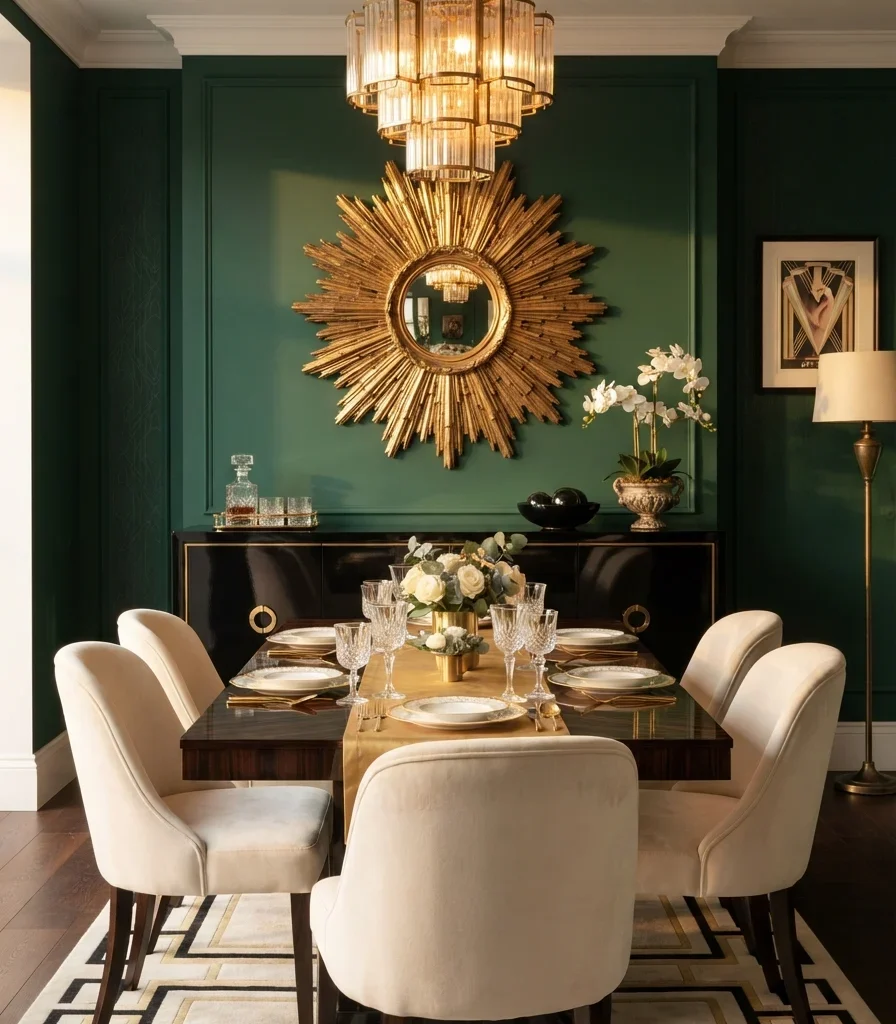
Category: ACCESSORIES
Vibe: Radiant.
Why it works: A sunburst mirror creates radial movement and reflects both light and geometry, making it one of the clearest visual shortcuts to Deco character. The sideboard beneath it gives the composition a horizontal anchor.
How to get it: Choose a mirror approximately 60–75% of the sideboard width and center it on the sideboard rather than the wall. Keep the surface below minimally styled so the radial silhouette remains dominant.
💡 Quick Win: Add a 24–30 inch brass sunburst mirror above an existing sideboard before buying any new dining furniture.
Shop The Look
| Product | Search phrase |
| Mirror | Large gold Art Deco sunburst wall mirror |
| Sideboard | Black lacquer narrow dining sideboard |
| Bowl | Black geometric ceramic centerpiece bowl |
| Decanter | Crystal Art Deco whiskey decanter |
| Orchid | Artificial white orchid arrangement |
6. Small-Space Deco with a Round Pedestal Table
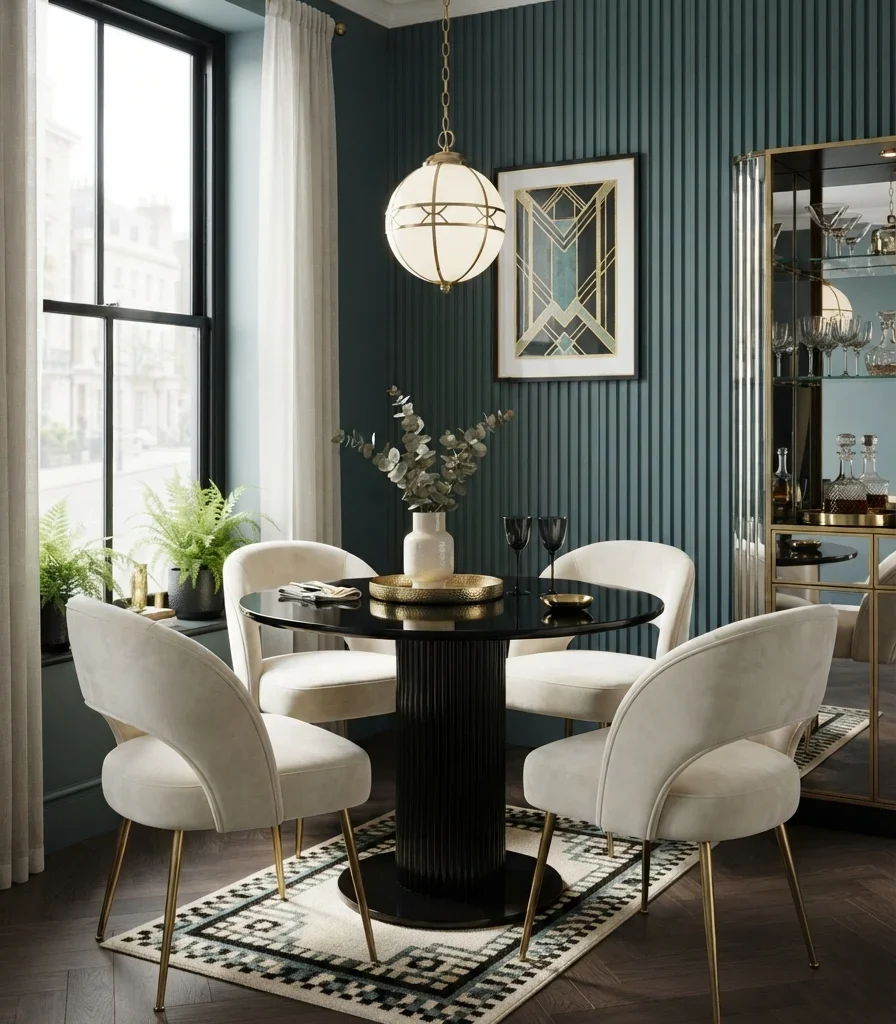
Category: SMALL SPACE
Vibe: Intimate.
Why it works: A pedestal table removes the four corner legs that interrupt circulation, applying negative-space efficiency to a compact footprint. Black lacquer also gives the table visual clarity without requiring a bulky silhouette.
How to get it: Use a 42–48 inch round pedestal table for two to four diners and choose narrow chairs with exposed legs. Keep the surrounding furniture shallow so at least 36 inches of usable circulation remains.
Shop The Look
| Product | Search phrase |
| Table | 42-inch round black lacquer pedestal dining table |
| Chairs | Cream velvet compact dining chairs |
| Pendant | Small brass globe Art Deco pendant |
| Cabinet | Narrow mirrored storage cabinet dining |
| Art | Small geometric Deco wall art |
7. Sapphire Blue with Ivory and Polished Brass
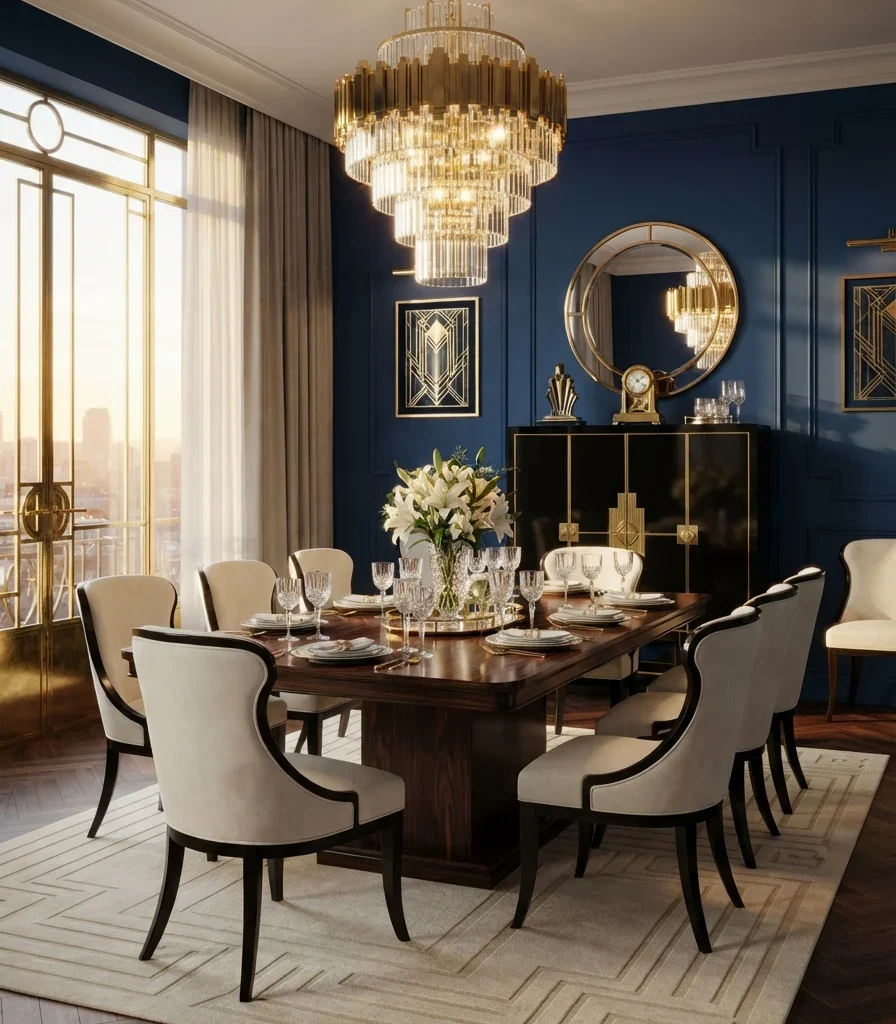
Category: COLOR
Vibe: Saturated.
Why it works: Sapphire provides the jewel-tone depth characteristic of Deco, while ivory prevents the saturated wall from visually shrinking every other element. Brass introduces a warm reflective counterpoint.
How to get it: Try a deep sapphire around #173B63 and test it against both daylight and warm evening lighting. Keep approximately two-thirds of the furniture neutral or dark wood so the wall color remains the main chromatic statement.
Shop The Look
| Product | Search phrase |
| Paint | Deep sapphire blue dining room paint |
| Chairs | Ivory velvet upholstered dining chairs |
| Rug | Cream black geometric Art Deco rug |
| Tray | Polished brass decorative serving tray |
| Vase | Clear crystal geometric vase |
8. Black Lacquer and White Marble Sideboard

Category: MATERIAL
Vibe: Glossy.
Why it works: The combination creates surface contrast: reflective black lacquer, veined marble, and warm metal each catch light differently. Art Deco interiors historically embraced mirrors, colored glass, metal, lacquer, and exotic veneers as expressive surfaces.
How to get it: Pair a black cabinet with a marble-look top at least 1 inch thick visually so the top has enough weight to balance the dark base. Choose restrained brass edging rather than excessive gold decoration.
Shop The Look
| Product | Search phrase |
| Sideboard | Black lacquer white marble Art Deco sideboard |
| Hardware | Brass geometric cabinet handles |
| Sculpture | Gold geometric Art Deco tabletop sculpture |
| Urn | Matte black ceramic urn vase |
| Glassware | Smoked glass tumbler set |
9. Symmetrical Dining Layout with a Central Axis
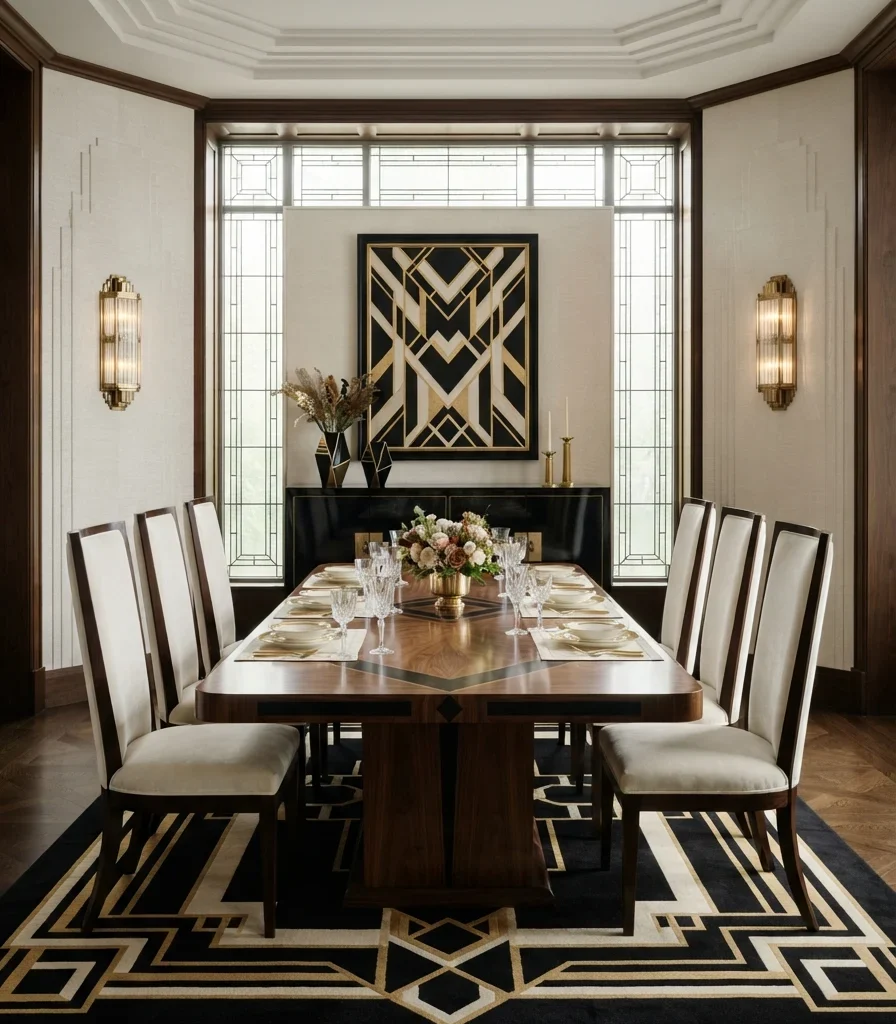
Category: LAYOUT
Vibe: Ordered.
Why it works: Art Deco depends heavily on symmetry and repetition, which create visual certainty even when colors and materials are dramatic. A central axis makes the room feel intentionally composed rather than simply furnished.
How to get it: Mark the room’s centerline with painter’s tape before positioning the table. Align the table, chandelier, rug, sideboard, and primary artwork to that axis wherever the architecture permits.
Shop The Look
| Product | Search phrase |
| Rug | Symmetrical black gold geometric dining rug |
| Sconces | Matching brass geometric wall sconces |
| Table | Long walnut rectangular dining table |
| Artwork | Large symmetrical Art Deco geometric print |
| Candlesticks | Matching brass candleholder pair |
10. Waterfall-Edge Dining Table with Sculptural Base
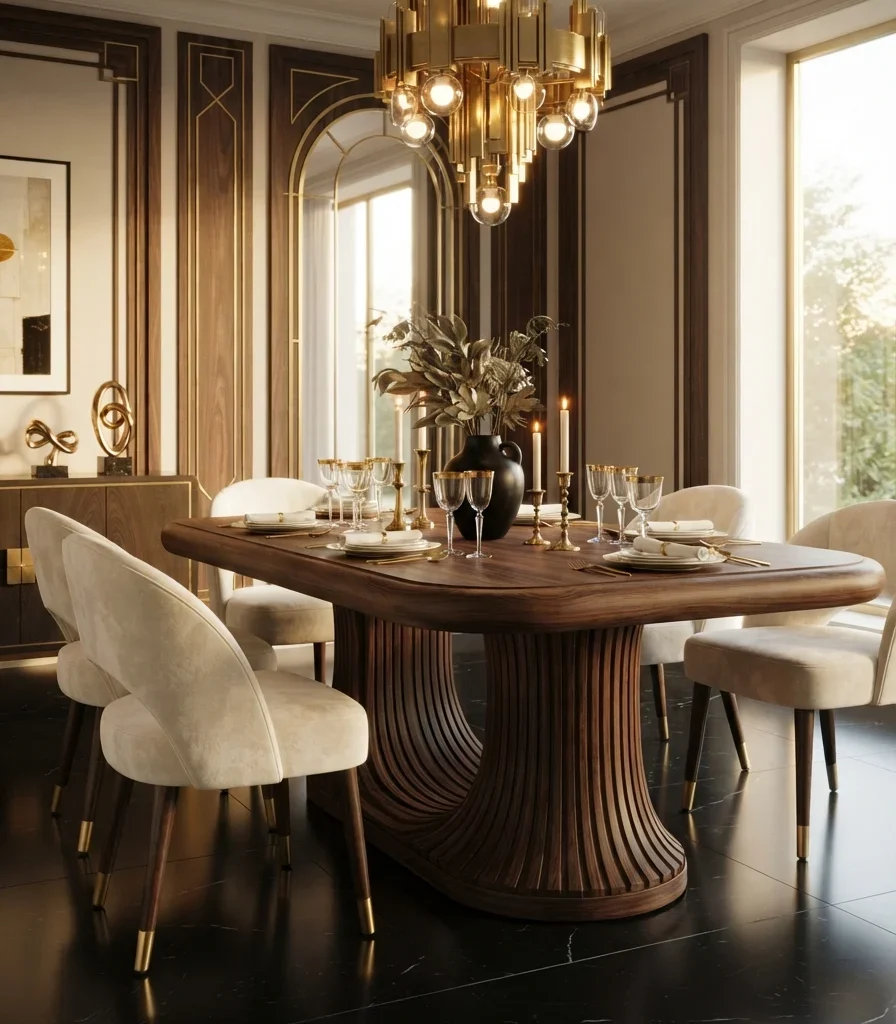
Category: FURNITURE
Vibe: Sculptural.
Why it works: The thick tabletop and curved base create visual mass without ornate carving, translating Deco geometry into a contemporary furniture silhouette. The rounded edge also softens the hard rectangular lines elsewhere.
How to get it: Choose a table with a substantial 1.5–2-inch visual top thickness and one dominant pedestal form. Avoid pairing it with heavily carved chairs; simpler upholstery lets the table remain the sculpture.
Shop The Look
| Product | Search phrase |
| Table | Dark walnut sculptural pedestal dining table |
| Chairs | Ivory curved velvet dining chairs |
| Centerpiece | Black stone geometric bowl |
| Sculpture | Brass abstract Deco sculpture |
| Rug | Low pile neutral geometric dining rug |
11. Frosted Glass Globe Chandelier
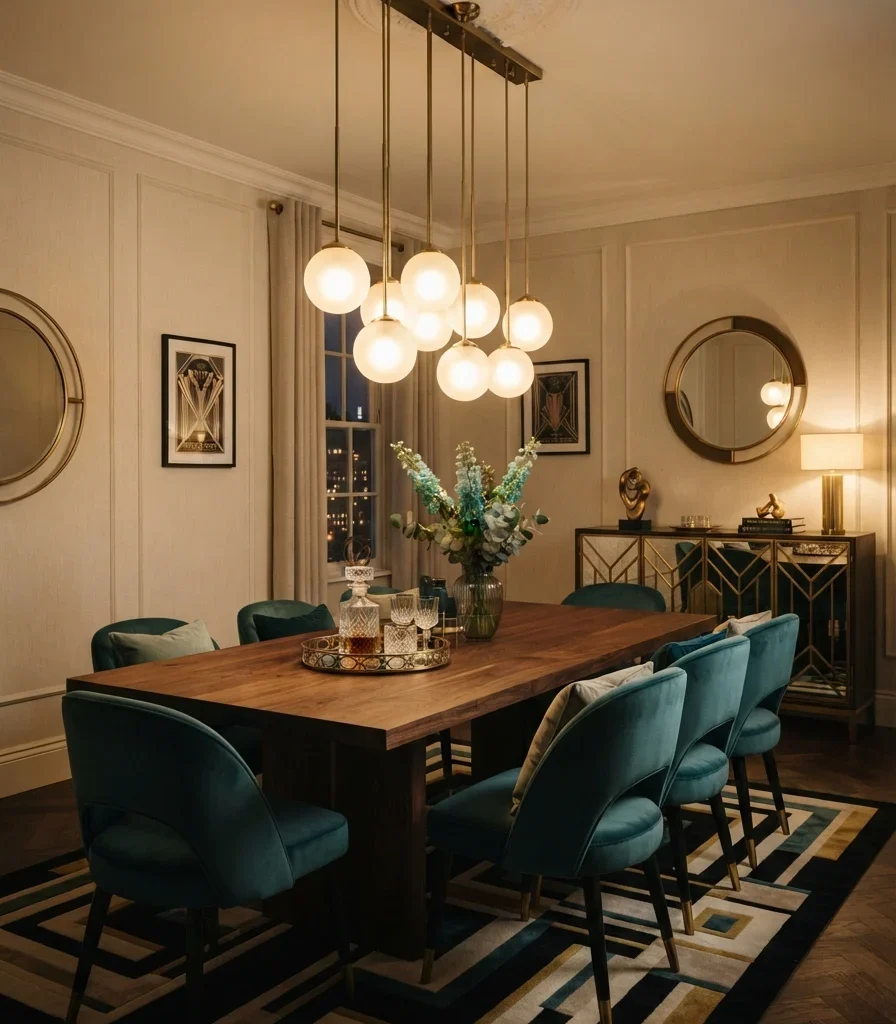
Category: LIGHTING
Vibe: Atmospheric.
Why it works: Repeated glass globes create rhythmic geometry while frosted surfaces diffuse light more gently than exposed bulbs. The result feels Deco without relying on a historically literal chandelier.
How to get it: For a rectangular table, choose a linear fixture approximately half to two-thirds of the table length. Use multiple 2700K bulbs and dim them at night so the glass glows instead of producing harsh points of light.
💡 Quick Win: Replace clear chandelier bulbs with frosted 2700K globe LEDs for an inexpensive Deco-style lighting upgrade.
Shop The Look
| Product | Search phrase |
| Chandelier | Brass linear frosted glass globe chandelier |
| Bulbs | Frosted globe LED bulbs 2700K |
| Dimmer | Dimmable LED wall switch |
| Decanter | Ribbed crystal whiskey decanter |
| Tray | Brass rectangular bar serving tray |
12. Fan Motif in Art and Tabletop Details
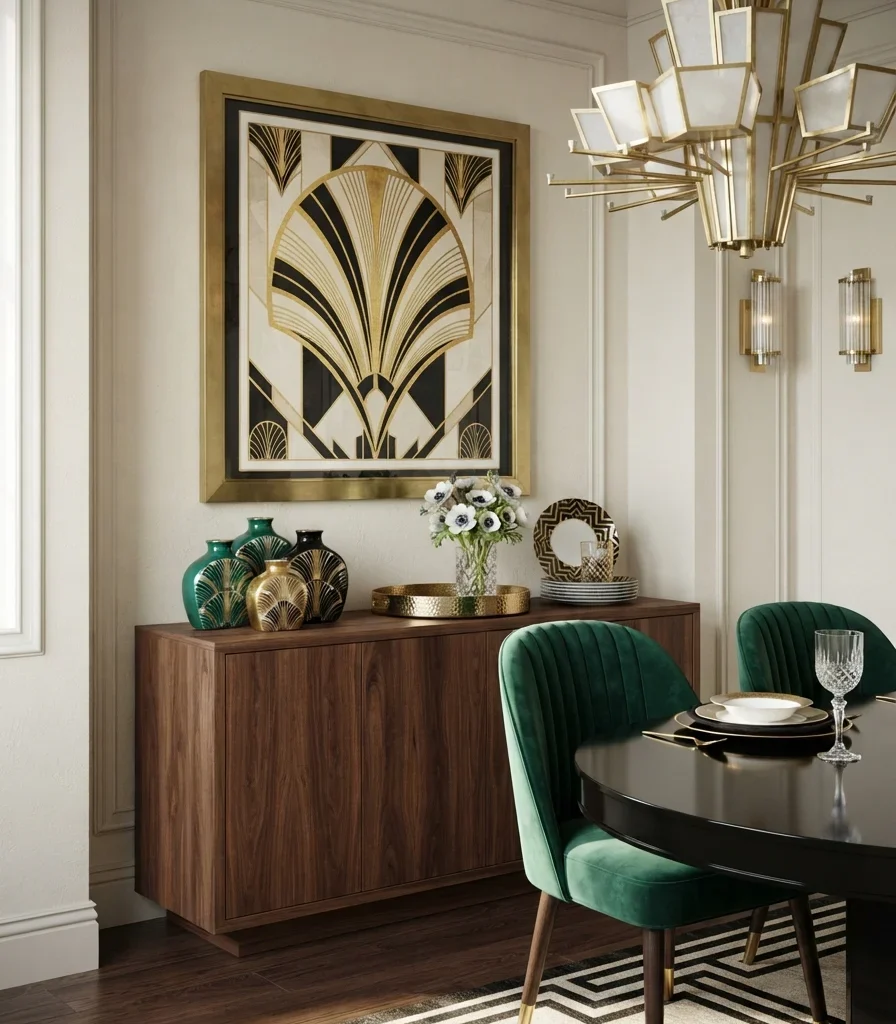
Category: ACCESSORIES
Vibe: Rhythmic.
Why it works: Repeating one motif creates cohesion through controlled repetition. The fan shape is immediately associated with Deco geometry, but using it in only two or three locations keeps the motif sophisticated.
How to get it: Repeat the fan motif in the artwork and one tabletop accessory, then stop. Avoid placing fan shapes on chairs, rug, wallpaper, and curtains simultaneously; repetition works because there is visual space between occurrences.
Shop The Look
| Product | Search phrase |
| Artwork | Gold black Art Deco fan wall print |
| Plates | Geometric fan motif decorative plates |
| Tray | Brass fan pattern decorative tray |
| Vase | Emerald green ribbed glass vase |
| Coasters | Black gold geometric coaster set |
13. Fluted Glass Cabinet Doors for Deco Texture
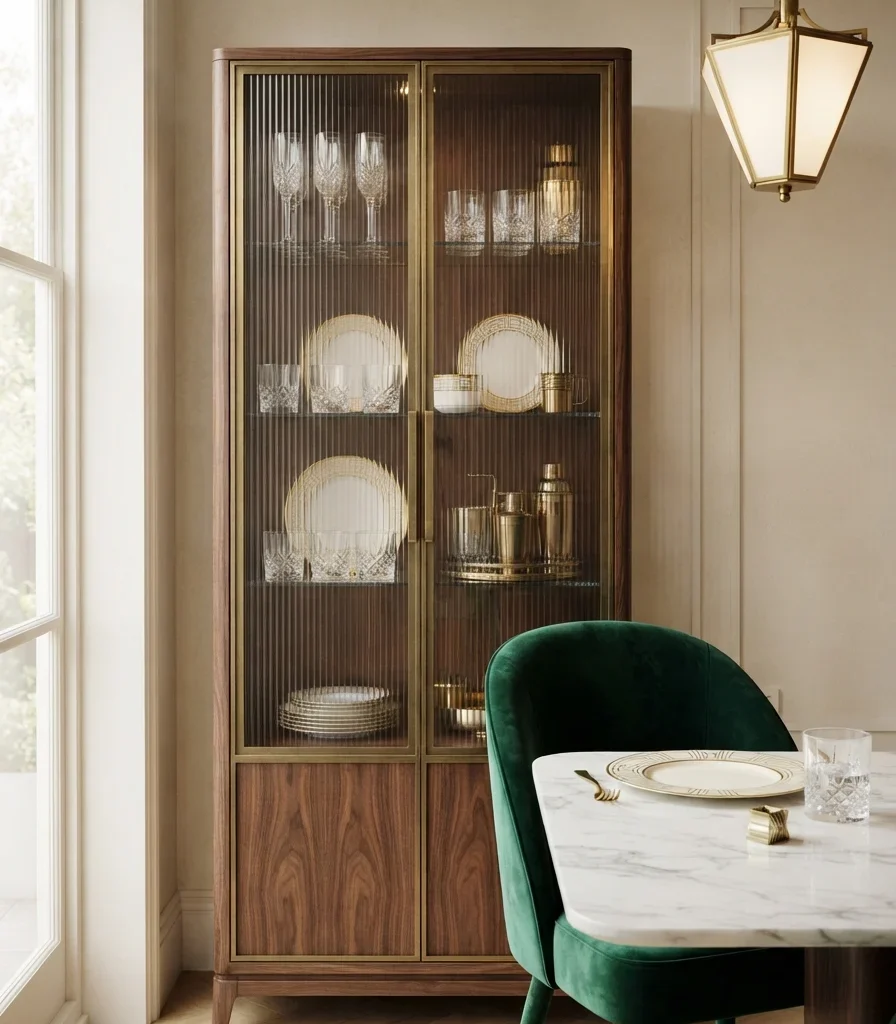
Category: MATERIAL
Vibe: Tactile.
Why it works: Fluted glass introduces vertical texture and controlled transparency, allowing stored glassware to remain visible without creating visual clutter. The combination of ribbed glass, walnut, and brass strongly echoes Deco’s fascination with luxurious surfaces.
How to get it: Use fluted or reeded glass in cabinet doors and keep the interior lighting warm. Arrange glassware by height rather than color so the ribbing remains the main visual texture.
Shop The Look
| Product | Search phrase |
| Cabinet | Walnut fluted glass Art Deco display cabinet |
| Glassware | Crystal coupe glass set |
| Plates | Ivory porcelain dinnerware set |
| Lighting | Warm LED cabinet strip 2700K |
| Hardware | Antique brass cabinet pull set |
14. Oxblood Velvet Against Warm Ivory
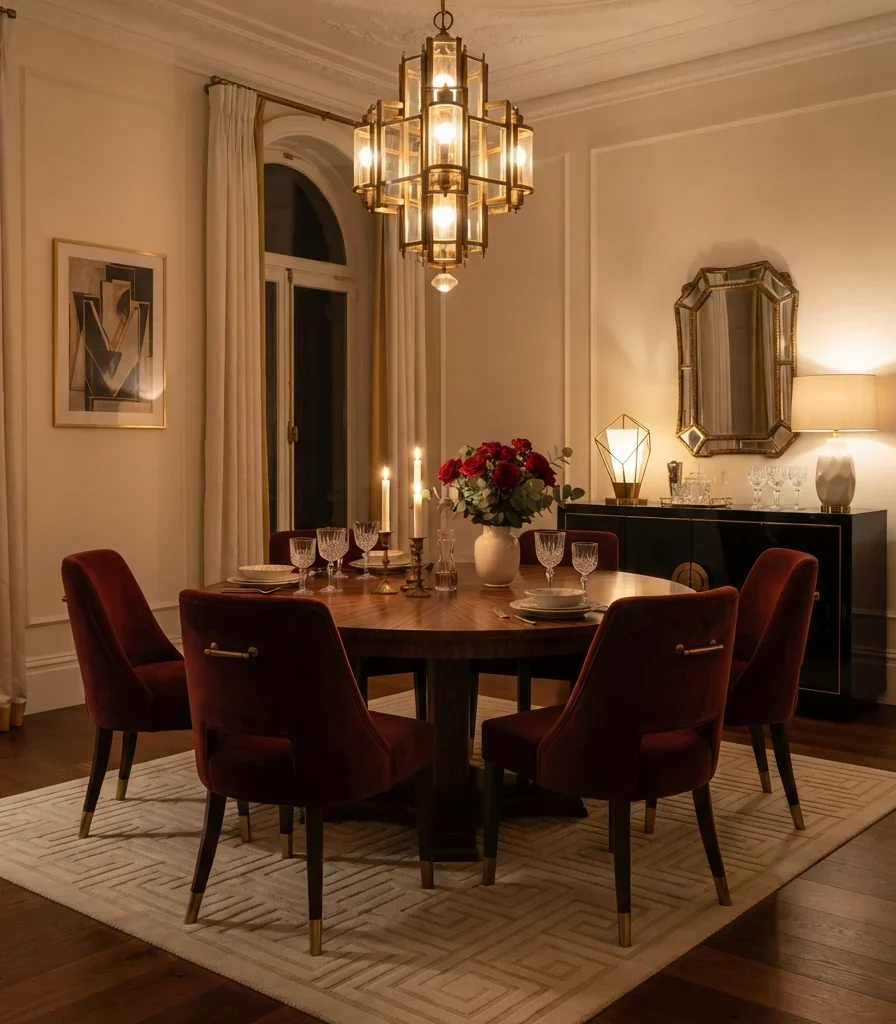
Category: COLOR
Vibe: Velvety.
Why it works: Oxblood provides controlled saturation without the brightness of scarlet. Against warm ivory and walnut, it creates a rich chromatic hierarchy while brass prevents the darker palette from becoming flat.
How to get it: Look for velvet around #641F2B rather than bright burgundy. Repeat the oxblood only in one artwork detail or flower arrangement so the chairs remain the primary color of the event.
Shop The Look
| Product | Search phrase |
| Chairs | Oxblood velvet Art Deco dining chairs |
| Paint | Warm ivory dining room interior paint |
| Rug | Cream geometric Deco area rug |
| Flowers | Faux deep burgundy floral arrangement |
| Glassware | Clear crystal wine glass set |
15. Curved Banquette with a Deco Scalloped Back
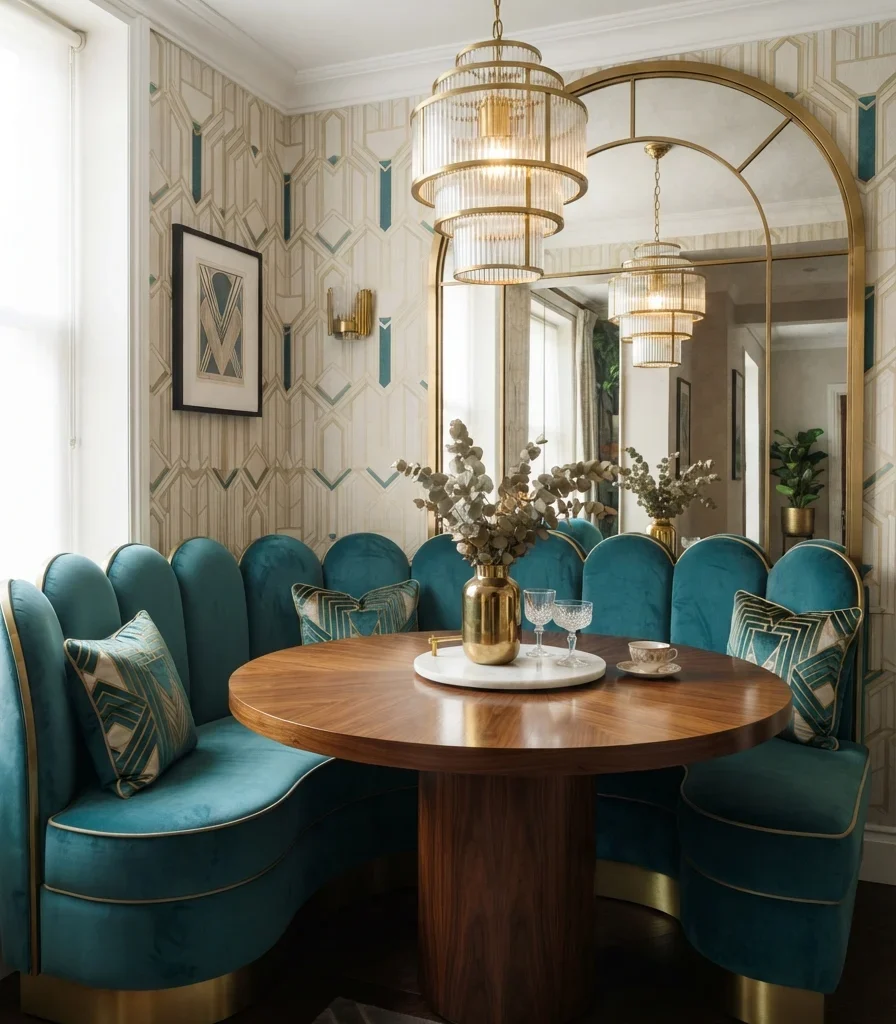
Category: FURNITURE
Vibe: Cocooned.
Why it works: A banquette uses perimeter space efficiently, allowing seating to occupy a wall that might otherwise remain unused. The curved or scalloped back adds recognizable Deco geometry without consuming floor area.
How to get it: Build the bench approximately 18 inches high and 18–20 inches deep, then use a round table with a pedestal base. Keep the upholstery in one solid velvet tone so the silhouette remains the feature.
Shop The Look
| Product | Search phrase |
| Banquette cushion | Teal velvet custom bench cushion |
| Table | Round walnut pedestal dining table |
| Pillow | Scalloped teal velvet lumbar cushion |
| Pendant | Brass dome Art Deco pendant |
| Tray | Round white marble serving tray |
16. Mirrored Wall Panels in a Narrow Dining Room
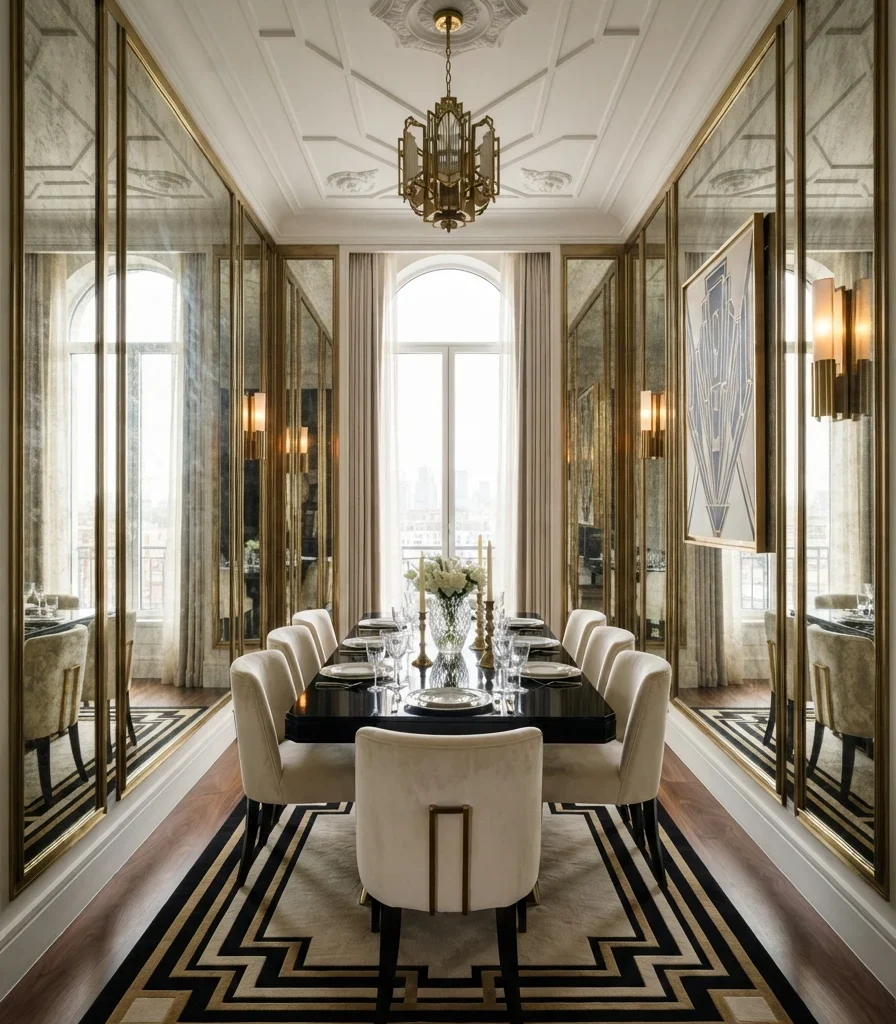
Category: SMALL SPACE
Vibe: Expansive.
Why it works: Large mirrors extend sightlines, which is especially valuable when dining furniture occupies much of the floor. Art Deco already embraces reflective materials, so the space-enhancing trick remains stylistically authentic.
How to get it: Install mirrored panels on the longest wall and divide them with thin brass or dark trim. Position the mirror so it reflects a window, chandelier, or artwork, not a crowded storage area.
💡 Quick Win: Use one oversized antiqued mirror rather than installing a full mirrored wall if a permanent renovation is not practical.
Shop The Look
| Product | Search phrase |
| Mirror | Large antiqued mirror wall panel |
| Trim | Thin brass mirror framing trim |
| Table | Black lacquer narrow dining table |
| Chairs | Cream velvet slim dining chairs |
| Sconces | Brass geometric Deco wall sconces |
17. Sculptural Chrome and Brass Lighting
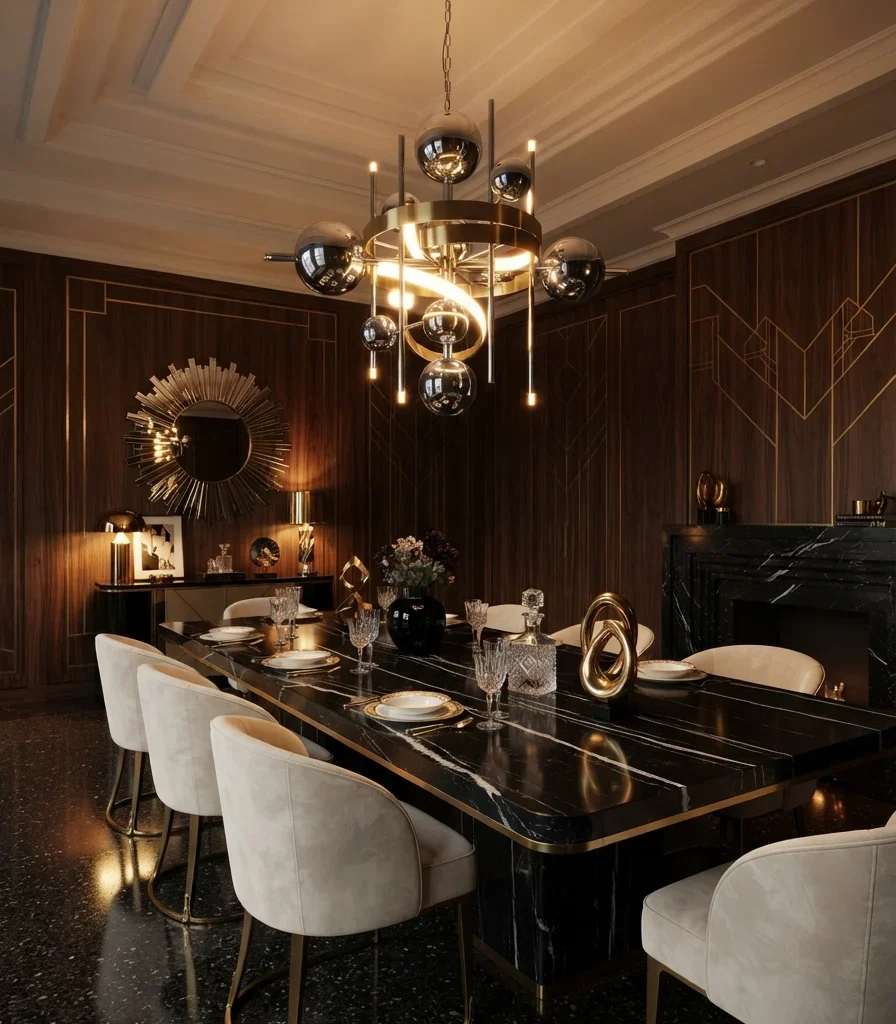
Category: LIGHTING
Vibe: Electric.
Why it works: Chrome and brass create cool-warm reflective contrast, capturing the machine-age character that became increasingly important in later Art Deco. The V&A notes that chrome-plated steel, aluminum, mirror, colored glass, and new plastics became prominent Deco materials in the 1930s.
How to get it: Combine chrome with only one warm metal, preferably brass, and repeat each finish at least twice. This makes mixed metal intentional rather than accidental.
Shop The Look
| Product | Search phrase |
| Chandelier | Chrome brass geometric Art Deco chandelier |
| Bulbs | Warm white dimmable globe LED bulbs |
| Sculpture | Chrome and brass geometric sculpture |
| Decanter | Crystal geometric decanter |
| Mirror | Round chrome-framed Deco mirror |
18. Geometric Marble Inlay Dining Table
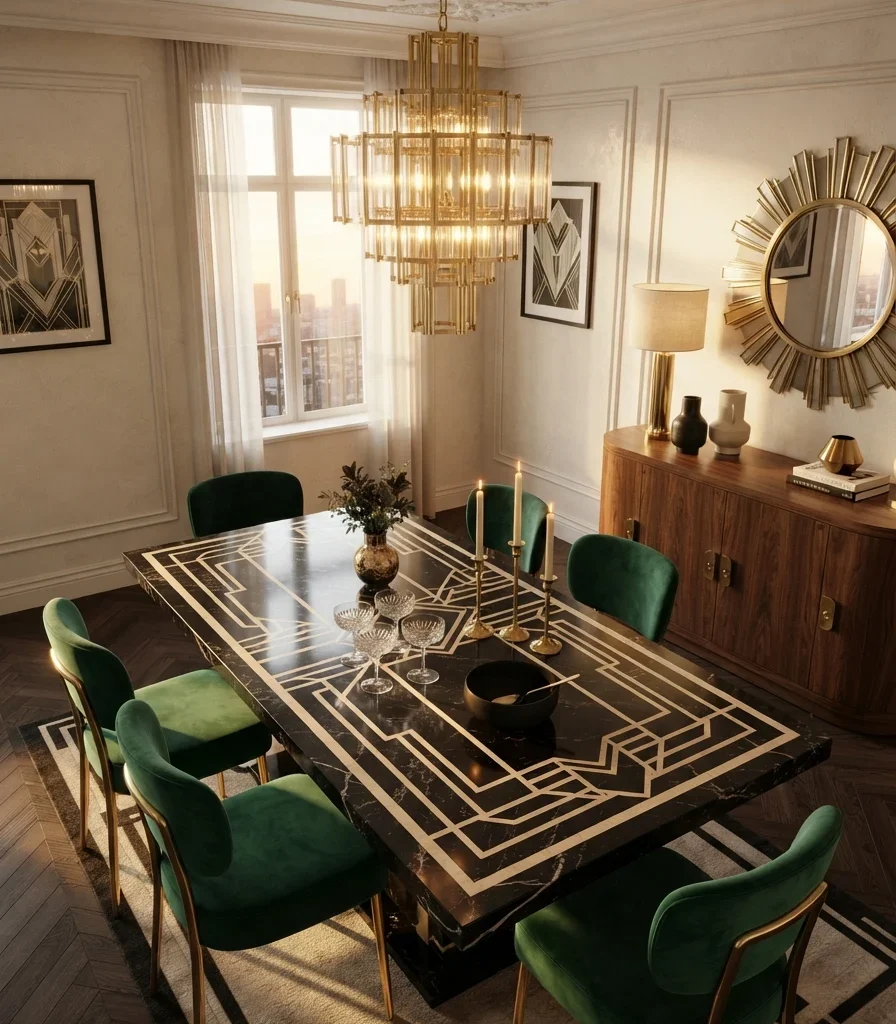
Category: MATERIAL
Vibe: Graphic.
Why it works: The tabletop becomes the room’s pattern through material inlay rather than printed decoration. Historic Deco furniture frequently used exotic veneers and contrasting materials to create geometric surfaces.
How to get it: If a full inlaid table is too expensive, use a black marble-look tabletop with a contrasting ivory border or geometric runner. Keep the floor pattern simple so the table does not compete with another strong geometric plane.
Shop The Look
| Product | Search phrase |
| Table | Black marble geometric Art Deco dining table |
| Runner | Ivory black geometric table runner |
| Chairs | Emerald velvet dining chair set |
| Bowl | Black marble centerpiece bowl |
| Glassware | Crystal coupe glass set Deco style |
19. A Circular Table Centered Under a Round Rug
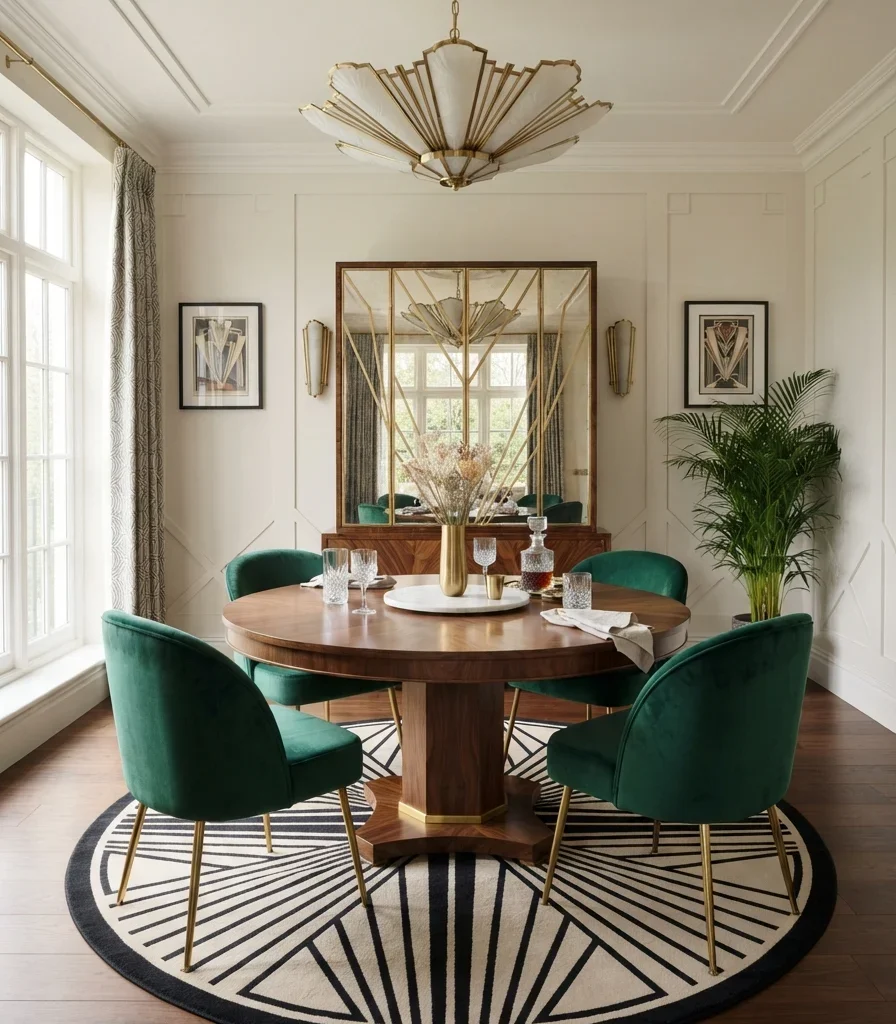
Category: LAYOUT
Vibe: Centered.
Why it works: Concentric circles create visual hierarchy, making the dining table read as the deliberate center of the room. The circular rug also softens a rectangular architectural envelope.
How to get it: Select a rug at least 24 inches wider than the table on every side, allowing chairs to remain on the rug when pulled out. Align the pendant, table pedestal, rug center, and main artwork along one vertical axis.
Shop The Look
| Product | Search phrase |
| Rug | Round black cream geometric Art Deco rug |
| Table | Round walnut pedestal dining table |
| Chairs | Emerald velvet barrel dining chairs |
| Tray | Round brass geometric serving tray |
| Vase | Small round crystal decorative vase |
20. Lacquered Bar Cart as a Dining Room Accent

Category: ACCESSORIES
Vibe: Celebratory.
Why it works: The bar cart connects Art Deco’s hospitality culture and decorative utility with a genuinely functional dining feature. Lacquer, brass, glass, and geometric wheels give it the right material vocabulary without requiring a major renovation.
How to get it: Choose a two-tier cart with a footprint no deeper than 18 inches for a standard dining room. Keep the lower shelf functional and the upper shelf edited to one decanter, four to six glasses, and one tray.
Shop The Look
| Product | Search phrase |
| Bar cart | Black lacquer brass Art Deco bar cart |
| Decanter | Crystal geometric whiskey decanter |
| Glasses | Vintage coupe cocktail glass set |
| Shaker | Brass cocktail shaker geometric |
| Tray | Black lacquer serving tray brass edge |
21. Walnut Chevron Cabinetry for Built-In Deco Drama

Category: FURNITURE
Vibe: Tailored.
Why it works: Chevron veneer creates directional geometry while built-in cabinetry uses the wall plane efficiently. The repeated V-shape gives visual movement without requiring patterned wallpaper.
How to get it: Use a chevron veneer with a matte or satin finish and align every door’s grain direction carefully. Continue the brass hardware finish throughout the cabinet instead of mixing knobs, pulls, and handles.
Shop The Look
| Product | Search phrase |
| Cabinet | Walnut chevron veneer dining cabinet |
| Handles | Brass geometric cabinet pull set |
| Art books | Large Art Deco design coffee table books |
| Vase | Ivory sculptural ceramic vase |
| Glassware | Crystal coupe and wine glass set |
22. Stepped Wall Molding Behind the Dining Table
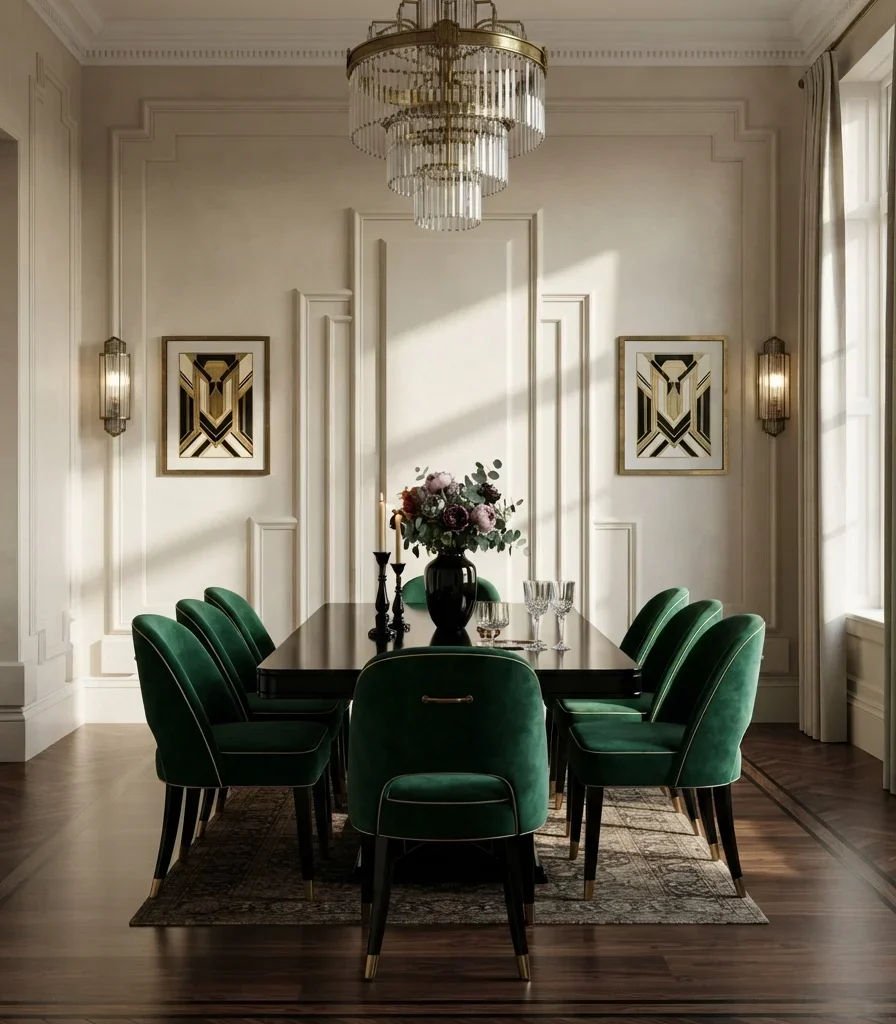
Category: MATERIAL
Vibe: Architectural.
Why it works: Stepped molding adds shadow relief and geometric depth without introducing another material pattern. The machine-inspired stepped form is particularly useful when a room lacks period architectural details.
How to get it: Install 20–30mm MDF strips in a stepped arrangement and paint the entire wall one color. Let natural side light create the shadows; the molding does not need a contrasting paint color to become visible.
💡 Quick Win: Create one 4–6 foot-wide stepped panel behind the sideboard instead of treating the entire dining room.
Shop The Look
| Product | Search phrase |
| MDF strips | 25mm Art Deco geometric wall molding strips |
| Adhesive | Heavy-duty construction adhesive interior |
| Paint | Warm ivory matte interior paint |
| Art | Black gold geometric Deco wall art |
| Sconces | Brass stepped geometric wall sconces |
23. Black, Emerald, Brass, and Ivory: The Full Deco Composition
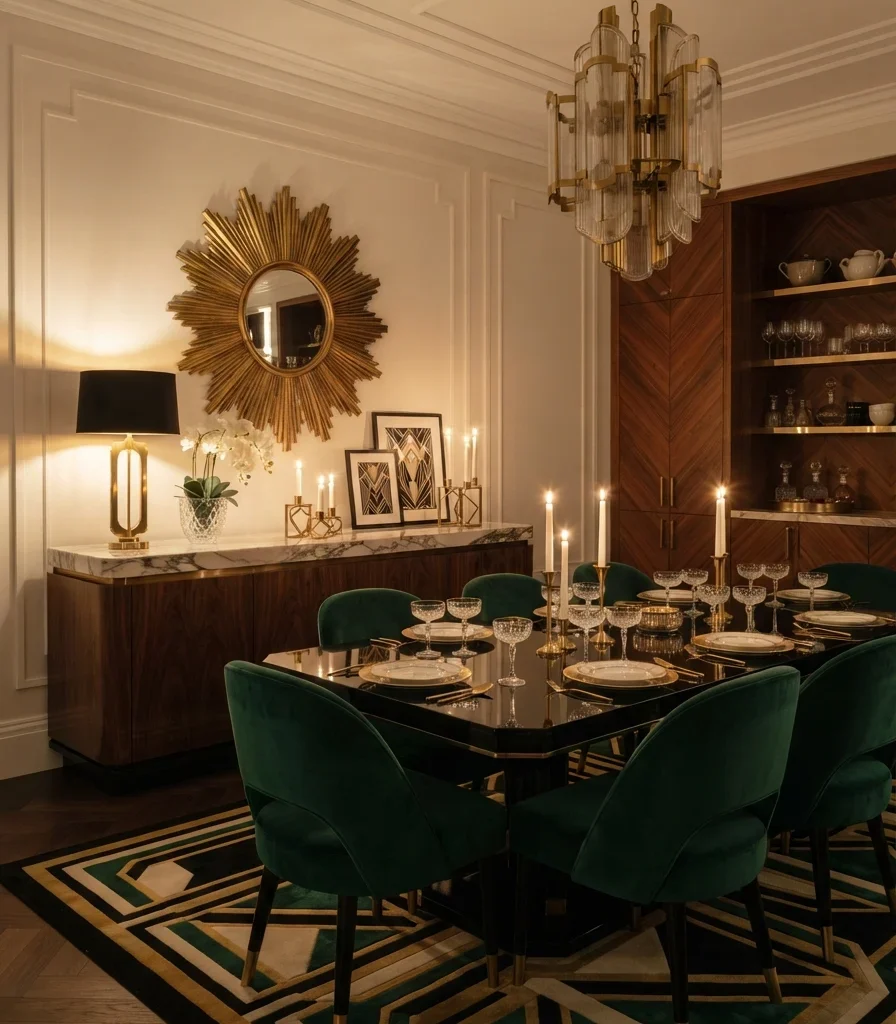
Category: COLOR
Vibe: Cinematic.
Why it works: The full composition succeeds through hierarchy rather than accumulation: ivory supplies the visual breathing room, black anchors the room, emerald supplies saturated color, and brass provides the reflective highlight. This is the modern way to interpret Deco: using several defining elements while keeping the overall composition edited. Contemporary designers frequently recommend borrowing selected Art Deco details instead of recreating an entirely authentic period room.
How to get it: Use the 60–30–10 principle as a loose framework: approximately 60% ivory and natural wood surfaces, 30% black/emerald furniture and major accents, and 10% brass or gold highlights. Repeat each major finish at least twice so nothing looks isolated.
Shop The Look
| Product | Search phrase |
| Table | Black lacquer Art Deco rectangular dining table |
| Chairs | Emerald velvet fan back dining chairs |
| Mirror | Large antique gold sunburst mirror |
| Rug | Black emerald ivory geometric dining rug |
| Chandelier | Brass sculptural Art Deco dining chandelier |
How to Start Your Art Deco Transformation
Make a black-and-walnut dining table your first major purchase. It establishes the dark visual anchor that lets emerald, sapphire, ivory, marble, brass, and velvet relate to one another; starting with accessories first often produces a collection of attractive pieces without a coherent hierarchy.
The most common mistake is using too many shiny finishes at once. Black lacquer, polished chrome, mirrored walls, glossy marble, crystal, and highly polished brass can make a dining room feel like a showroom rather than a home. Keep two or three reflective surfaces and balance them with velvet, matte plaster, natural walnut, or honed stone.
For an inexpensive entry point, start with one brass geometric candleholder under $25, one black ceramic geometric vase under $30, and one small emerald velvet cushion under $40. Those three pieces immediately establish the palette without committing you to permanent changes.
A starter Art Deco refresh can take one weekend and cost roughly $200–$800 using paint, lighting, textiles, and secondhand accessories. A full room with a new dining set, chandelier, rug, wallpaper or molding, cabinetry, and upgraded lighting can realistically reach $2,500–$8,000+. Custom millwork, marble, electrical changes, and flooring are the parts that usually extend the project from a weekend to several weeks or months.
Frequently Asked Questions About Art Deco Dining Room
What is the difference between Art Deco and traditional 1920s dining room design?
Art Deco is specifically associated with streamlined geometry, symmetry, luxury materials, and machine-age influences, while other 1920s interiors could remain rooted in Colonial, Tudor, Neoclassical, or other historical revivals. Art Deco commonly uses lacquer, chrome, geometric ornament, exotic veneers, mirrors, and strong color contrast. The distinction matters because simply using dark wood and antique furniture does not automatically create an Art Deco room.
What colors work best for an Art Deco dining room?
The classic palette includes emerald green, sapphire blue, deep teal, oxblood, black, ivory, cream, and metallic gold or brass. Jewel tones work especially well when balanced against a neutral wall or dark wood foundation. For a modern interpretation, try emerald velvet chairs with warm ivory walls and aged brass rather than using saturated color on every surface.
How much does it cost to create an Art Deco dining room?
A small decorative refresh can start around $200–$800, particularly when paint, lighting, cushions, mirrors, and secondhand accessories do most of the work. A furniture-focused redesign may fall around $1,500–$4,000, while a complete high-end room with custom cabinetry, marble, flooring, wallpaper, and electrical work can exceed $8,000. The largest cost variable is usually custom architectural work rather than decorative accessories.
Can Art Deco dining room style work in a small apartment?
Yes, but the room needs a tighter visual hierarchy. Use a 42–48 inch round pedestal table, narrow upholstered chairs, one large mirror, and one strong pendant instead of several large pieces. Reflective materials can increase perceived depth, but too many glossy surfaces will multiply visual clutter, so combine lacquer or mirror with velvet and matte finishes.
What type of lighting is best for an Art Deco dining room?
A sculptural chandelier is usually the strongest choice because lighting itself becomes part of the geometric composition. Look for brass, chrome, frosted glass, stepped forms, sunburst shapes, or globe clusters, and use 2700K dimmable bulbs for dinner. A fixture positioned approximately 30–36 inches above the tabletop generally provides a strong visual connection without sitting too low.
Ready to Create Your Dream Art Deco Dining Room?
These 23 Art Deco dining room design ideas cover jewel-tone color schemes, walnut and marble materials, geometric lighting, sculptural furniture, mirrors, compact layouts, built-ins, and carefully edited accessories so you can choose the level of Deco that suits your home. Starting with one strong element is not only easier on the budget; it creates the hierarchy that keeps Art Deco from becoming visually overwhelming. Today, measure your dining table and mark a 36-inch circulation zone around it with painter’s tape before buying anything new. Once the room balances geometry with velvet softness, reflective brass with matte surfaces, and dramatic color with visual breathing room, it should feel energized, confident, and ready for long dinners. Save or pin your favorite combination of emerald velvet, black lacquer, walnut, brass, marble, and geometric lighting so you have a clear Deco direction when you shop.
You Might Also Like
- 25 Japanese Dining Room Designs That Bring Calm, Craft, and Natural Beauty
- 21 French Parisian Dining Room Ideas
- 26 Victorian Dining Room Ideas for a Rich, Timeless Dining Space
- 16 Coastal Dining Room Ideas for a Relaxed, Light-Filled Space
- 19 Moroccan Dining Room Designs
- 20 The Timeless Elegance of an English Countryside Dining Room