
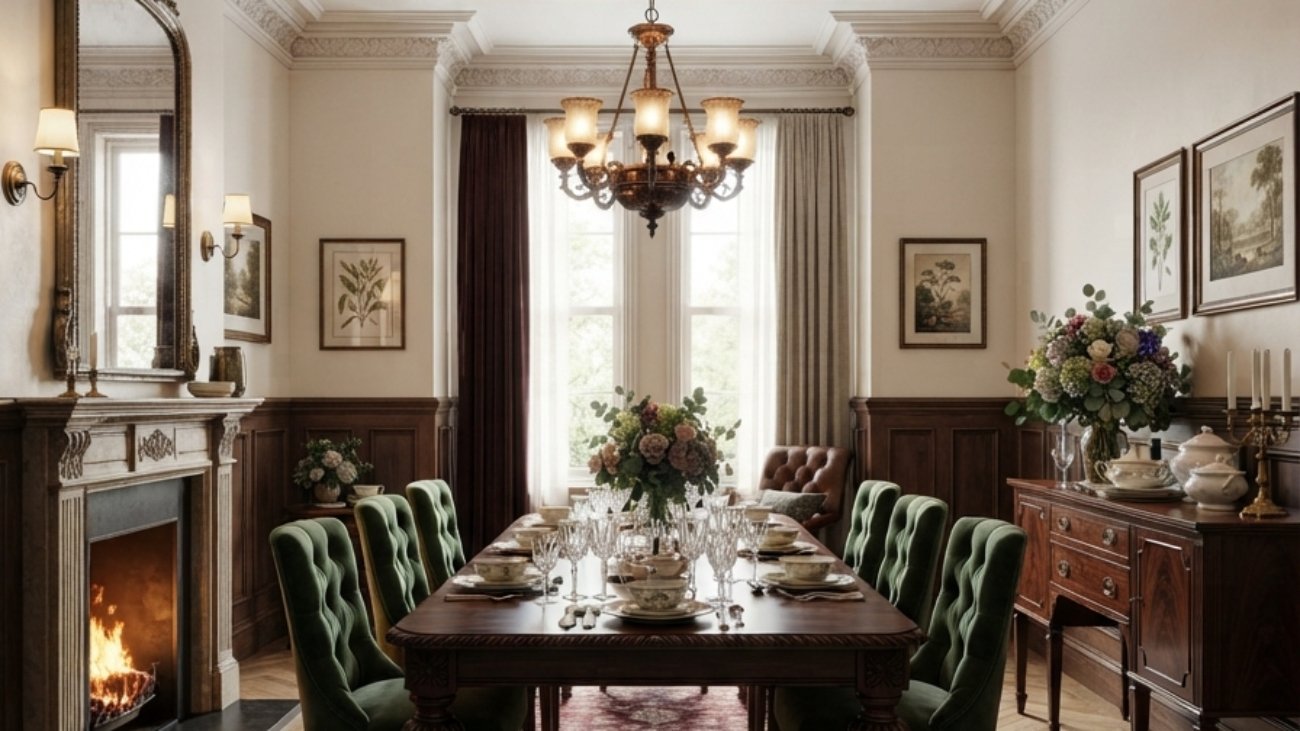
Victorian dining rooms combine nineteenth-century ornament, dark timber, patterned textiles, and layered lighting to create interiors that feel formal, intimate, and richly collected. These 26 Victorian dining room ideas show how to use color, materials, furniture, lighting, accessories, and layout without turning the room into a historical replica.
There is something wonderfully enveloping about a Victorian dining room: candlelight catches on aged brass, dark wood absorbs the evening glow, patterned wallpaper gives the walls depth, and every surface seems to invite a closer look. The style feels ceremonial without needing to be stiff, especially when antique-inspired pieces are balanced with practical modern dining furniture. Deep oxblood, bottle green, tobacco brown, navy, and warm cream create the visual language, while velvet, walnut, mahogany, carved timber, brass, and patterned textiles add tactile richness. Here are 26 ideas worth saving and stealing.
Why Victorian Dining Room Ideas Work So Well
Victorian interiors developed during Queen Victoria’s reign from 1837 to 1901, but “Victorian” is better understood as a broad period style than a single aesthetic. Dining rooms of the era could borrow from Gothic Revival, Renaissance Revival, Rococo Revival, Arts and Crafts, and increasingly industrial manufacturing. What distinguishes a Victorian dining room is this willingness to combine ornament, craftsmanship, pattern, and visual abundance rather than pursuing the restrained minimalism associated with later modernist interiors.
The material palette is naturally substantial. Look for walnut, mahogany, oak, dark-stained pine, turned or carved timber, marble, brass, bronze, velvet, damask, tapestry-inspired fabrics, and heavy linen. Colors tend toward saturated jewel and earth tones: oxblood, forest green, aubergine, navy, tobacco, ochre, antique cream, and charcoal. A useful rule is to pair one dark architectural color with one warm light neutral so the room remains atmospheric rather than visually compressed.
Victorian design also fits today’s renewed interest in rooms that feel personal rather than disposable. The current preference for vintage furniture, secondhand finds, maximalist pattern, craftsmanship, and rooms with stronger individual character makes the period’s layered approach especially adaptable. Instead of reproducing an entire nineteenth-century room, modern decorators can borrow its principles- rich materials, strong silhouettes, decorative lighting, and collected objects- while keeping the dining room practical for everyday life.
Small dining rooms can absolutely use Victorian design, but editing becomes essential. Start with one strong element such as patterned wallpaper, a dark wood table, or a substantial pendant rather than introducing every Victorian reference simultaneously. Keep walking paths around 36 inches where possible, use a table with visually lighter legs, and let mirrors or warm cream wall areas interrupt large expanses of dark color.
Style at a Glance
| Element | Victorian Dining Room |
| Philosophy | Ornament, craftsmanship, historical layering |
| Key Materials | Mahogany, walnut, oak, velvet, brass, marble |
| Key Colors | Oxblood, forest green, navy, tobacco, cream |
| Furniture | Carved wood, turned legs, upholstered seating |
| Lighting | Brass chandeliers, shaded lamps, candle-style sconces |
| Decorative Language | Botanical prints, portraits, ceramics, antique-style objects |
| Best Modern Balance | Pair period references with practical contemporary pieces |
1. Oxblood Walls With Dark Mahogany Furniture

Vibe: The room feels hushed, enveloping diners in warm color and polished timber.
Why it works: The dark-on-dark palette creates visual depth while the mahogany’s reflective grain prevents the room from becoming flat. The principle is tonal contrast rather than high color contrast: oxblood walls sit close enough to the furniture’s brown-red undertone to feel unified, while antique brass introduces controlled luminosity.
How to get it: Use a muted oxblood such as Benjamin Moore New London Burgundy as the wall reference, then choose mahogany furniture with a warm red-brown undertone rather than orange walnut. Keep the ceiling and major trim in a warm ivory so the darker wall treatment has a visual release.
💡 Quick Win: Add a pair of antique-brass candlesticks to an existing dark dining table before changing larger furniture.
Shop The Look
| Product | Search phrase |
| Dining table | Traditional mahogany rectangular dining table carved legs |
| Rug | Persian style burgundy dining room rug 8×10 |
| Lighting | Antique brass candle style chandelier dining room |
| Curtains | Warm ivory linen pinch pleat dining curtains |
| Candlesticks | Vintage brass taper candle holder pair |
2. Forest Green Victorian Dining Room With Botanical Character
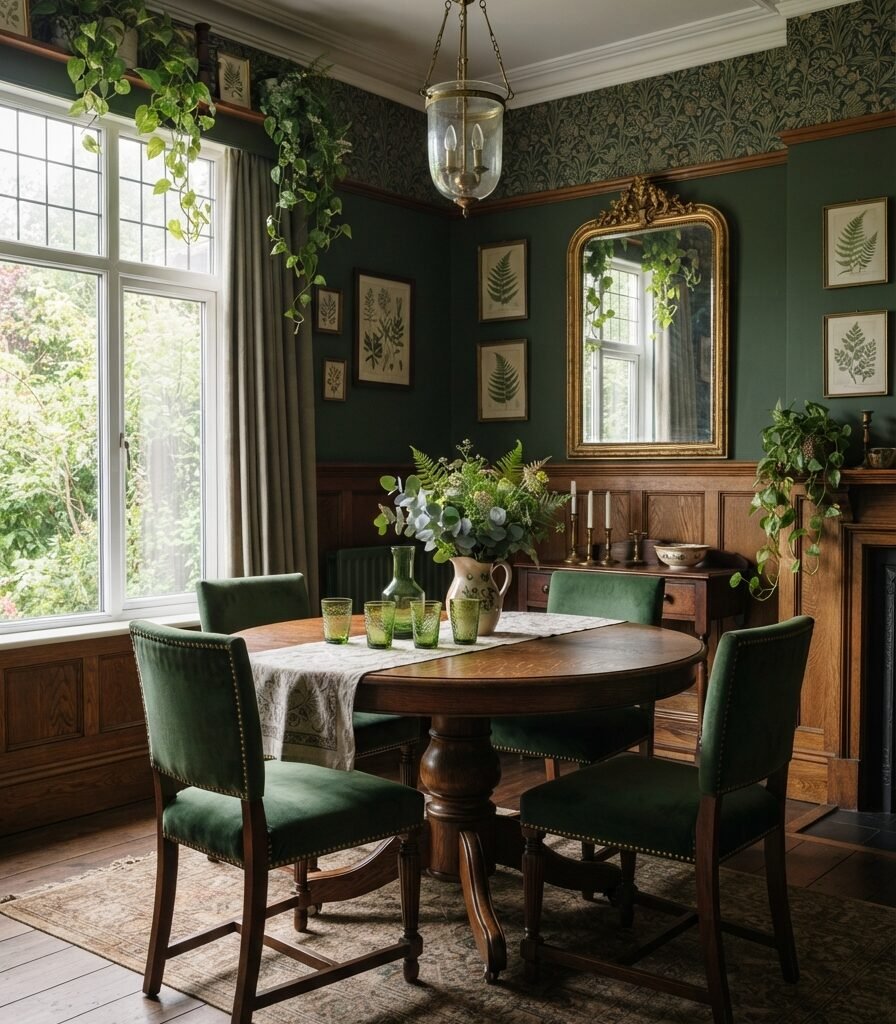
Vibe: The space feels grounded, with botanical green giving the dining room an almost garden-room quality.
Why it works: Victorian interiors frequently embraced botanical references, and deep green creates a natural bridge between foliage, dark timber, and brass. The principle is color continuity: repeating green through wallpaper, upholstery, and glassware makes separate elements read as one composition.
How to get it: Paint the lower wall in a flat forest green and use botanical wallpaper above a chair rail, keeping the pattern smaller than the room’s largest furniture silhouette. Repeat the same green in only two additional places to prevent the palette from becoming overly themed.
💡 Quick Win: Replace ordinary dining napkins with dark green linen napkins and use them with plain cream plates.
Shop The Look
| Product | Search phrase |
| Wallpaper | Dark green Victorian botanical peel and stick wallpaper |
| Chairs | Forest green velvet traditional dining chairs |
| Mirror | Antique brass oval wall mirror vintage |
| Tableware | Cream ceramic dinner plates vintage style |
| Napkins | Forest green linen dinner napkins set |
3. A Carved Walnut Dining Table as the Hero Piece

Vibe: The room feels substantial, with the dining table acting as its architectural center.
Why it works: Victorian furniture often relies on strong visual weight, and a carved walnut table gives the room a clear focal hierarchy. Its dark mass anchors lighter walls while turned legs and carved details prevent the furniture from appearing like a simple rectangular block.
How to get it: Choose a table whose length leaves approximately 36 inches of circulation space around the primary walking routes. Prioritize the leg profile and apron detail over excessive surface carving because those features remain visible even when the table is dressed for dinner.
Shop The Look
| Product | Search phrase |
| Table | Carved walnut Victorian dining table turned legs |
| Chairs | Antique style upholstered dining chair dark wood |
| Rug | Traditional Persian dining rug burgundy navy |
| Tureen | White ceramic Victorian serving tureen |
| Tray | Antique brass rectangular serving tray |
4. Antique Brass Chandelier Over the Dining Table

Vibe: The room feels luminous, with warm light concentrated around the table.
Why it works: A chandelier establishes a visual axis between ceiling and dining surface, while multiple small light sources create softer shadows than a single central bulb. For Victorian character, branching arms and warm brass echo nineteenth-century candle fixtures without requiring actual open flames.
How to get it: Hang the chandelier approximately 30–36 inches above the dining tabletop, adjusting slightly for fixture scale and sightlines. Choose 2200–2700K warm bulbs so brass, wood, and warm wallpaper retain their depth.
💡 Quick Win: Install warm 2200K flame-tip LED bulbs in an existing brass chandelier for an immediate period-inspired change.
Shop The Look
| Product | Search phrase |
| Chandelier | Antique brass six light Victorian dining chandelier |
| Bulbs | 2200K warm flame tip LED chandelier bulbs |
| Medallion | Ornate ceiling medallion vintage plaster style |
| Candlesticks | Brass taper candle holders Victorian pair |
| Table runner | Burgundy damask dining table runner |
5. Damask Wallpaper for a Formal Victorian Backdrop
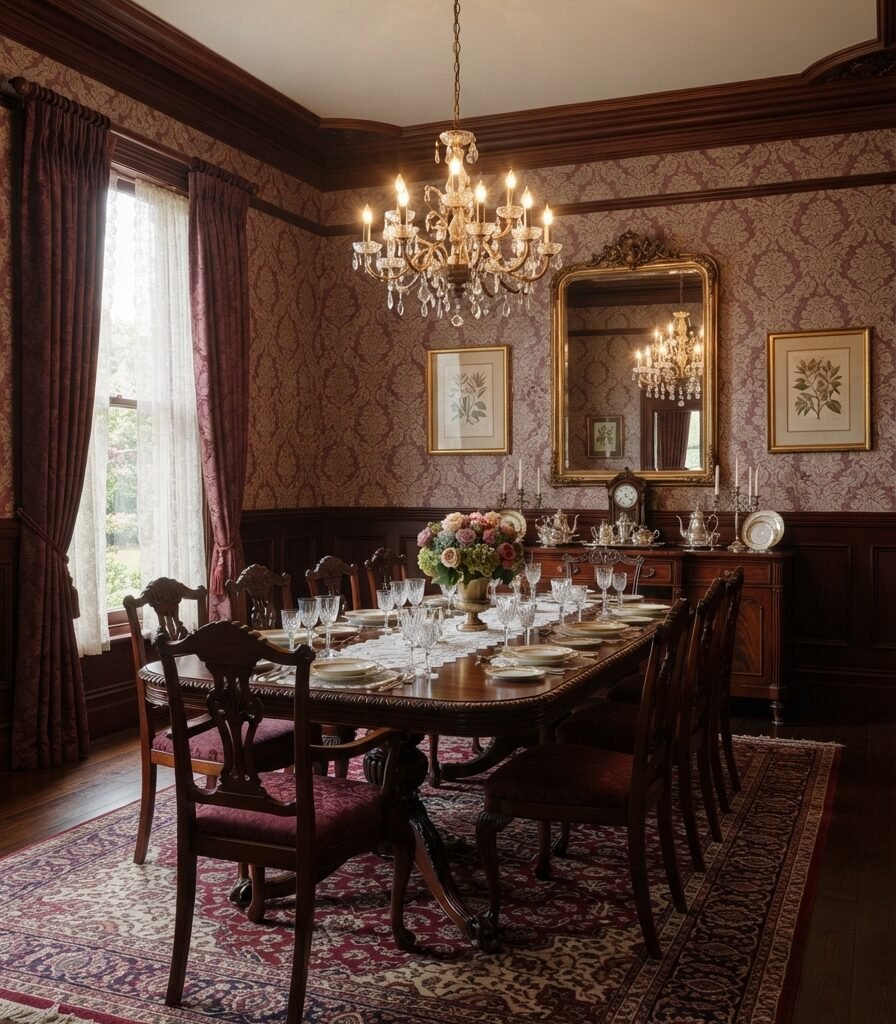
Vibe: The room feels layered, with the walls carrying as much visual personality as the furniture.
Why it works: Wallpaper gives Victorian dining rooms the patterned surface historically associated with richly furnished interiors. Damask also works through repetition: its recurring motif creates rhythm behind irregular furniture and accessories.
How to get it: Use damask wallpaper on the main dining walls but keep crown molding and ceiling in a warm cream. If the pattern is large, reduce the number of wall-hung accessories so the room retains a readable focal hierarchy.
Shop The Look
| Product | Search phrase |
| Wallpaper | Victorian burgundy cream damask wallpaper |
| Mirror | Antique gilt frame rectangular mirror |
| Rug | Traditional wool Persian rug burgundy cream |
| Vase | Vintage porcelain floral vase |
| Runner | Cream damask table runner traditional dining |
6. Velvet Dining Chairs With Turned Wooden Legs
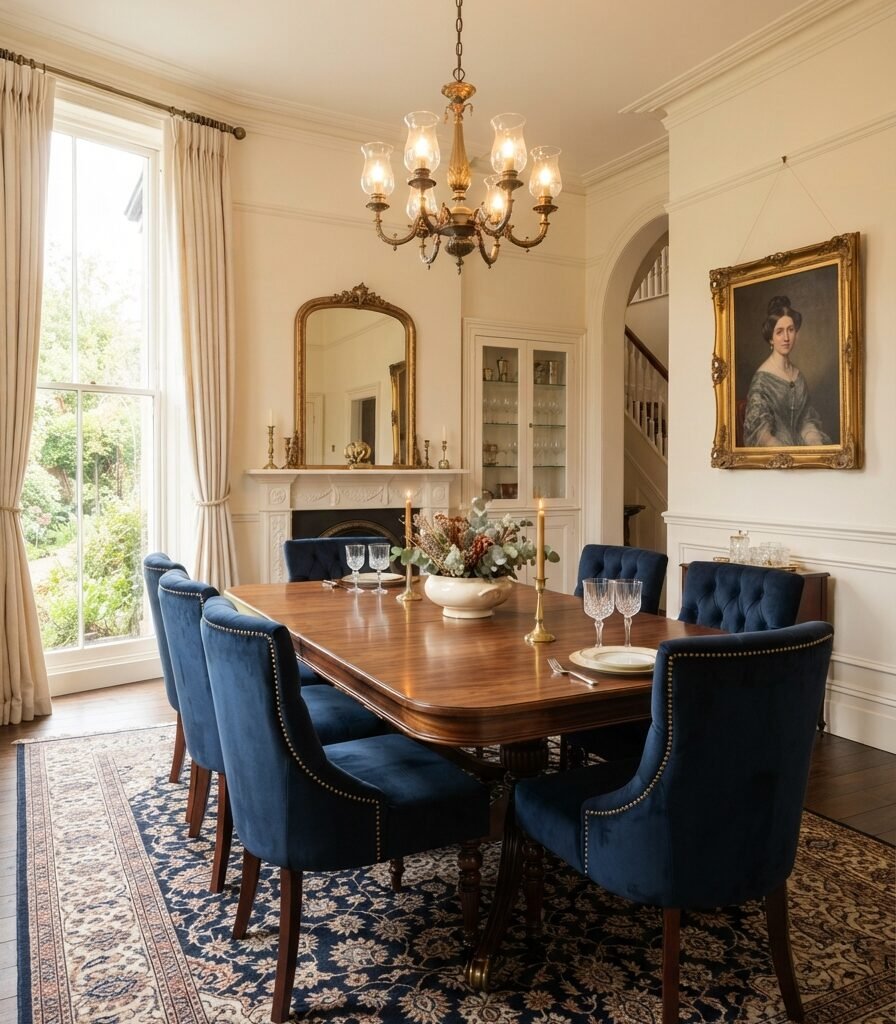
Vibe: The room feels plush, balancing formal timber with tactile upholstery.
Why it works: Velvet absorbs and reflects light differently across its pile, giving dark chairs subtle tonal variation. Turned wooden legs preserve the period reference while the upholstered seat makes long dinners more comfortable than rigid all-wood seating.
How to get it: Select velvet in navy, forest green, or aubergine and avoid overly shiny polyester fabric. Keep the chair silhouette relatively upright so the table remains visually dominant.
💡 Quick Win: Reupholster existing dining seat cushions in a deep velvet instead of replacing the entire chairs.
Shop The Look
| Product | Search phrase |
| Chairs | Navy velvet Victorian dining chairs turned wood legs |
| Fabric | Navy velvet upholstery fabric by yard |
| Table | Dark walnut traditional dining table |
| Rug | Navy burgundy traditional dining room rug |
| Cushions | Velvet seat cushion covers navy dining chair |
7. Victorian Dining Room With a Warm Cream Palette

Vibe: The room feels airy, proving Victorian character does not require dark walls.
Why it works: A light palette shifts attention toward architectural detail such as cornices, picture rails, carved moldings, and furniture profiles. Warm cream is more historically sympathetic than stark optical white because it supports the golden undertones of brass and timber.
How to get it: Use a warm off-white with an LRV around 70–80 for the walls, then introduce darker Victorian elements through furniture rather than paint. Avoid cool gray whites because they can make brass and natural timber look disconnected.
Shop The Look
| Product | Search phrase |
| Paint | Warm antique cream interior wall paint |
| Chairs | Ivory upholstered traditional dining chairs |
| Chandelier | Aged brass Victorian chandelier cream room |
| Artwork | Vintage botanical prints framed set |
| Rug | Sage cream Persian-style dining rug |
8. A Victorian Gallery Wall of Botanical Prints
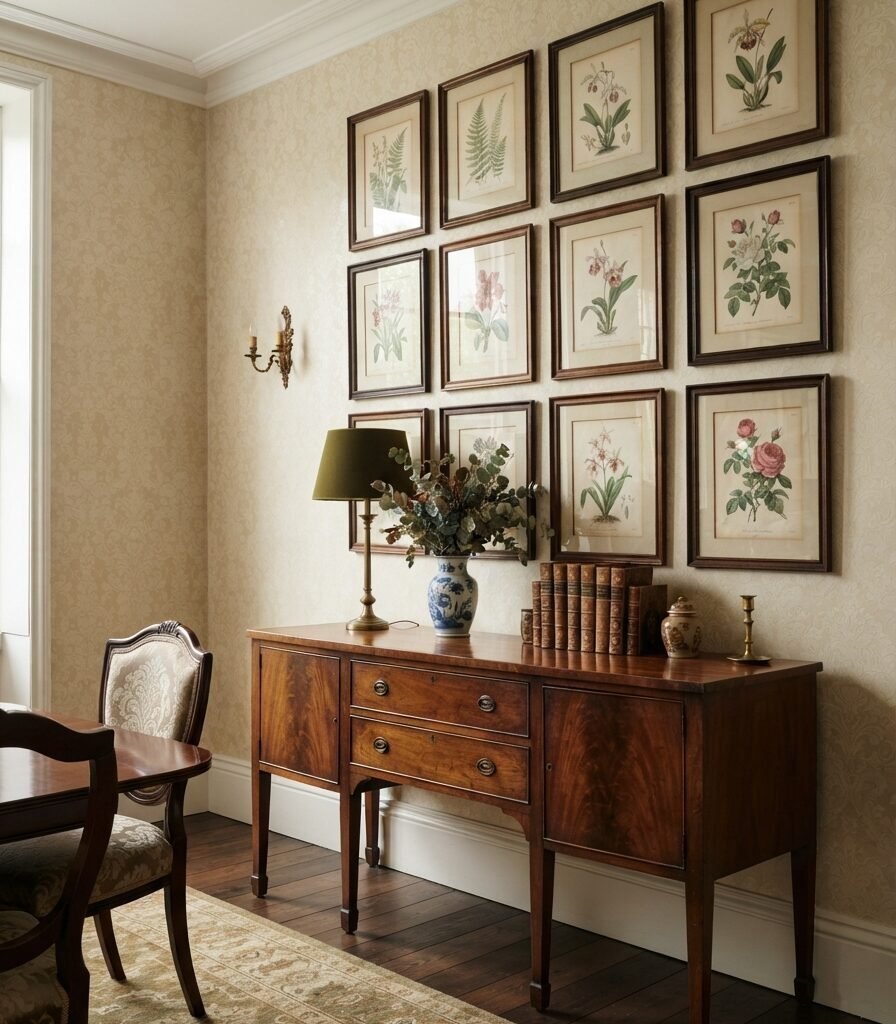
Vibe: The room feels curious, like a private collection accumulated over decades.
Why it works: Repetition turns individual botanical prints into a unified architectural surface, while varied frame widths keep the wall from looking mass-produced. The composition works because the prints share a visual language even when their frames differ.
How to get it: Lay the entire arrangement on the floor first and maintain roughly 2–3 inches between frames. Center the overall composition on the sideboard rather than centering each print individually.
💡 Quick Win: Print public-domain botanical illustrations and place them in thrifted walnut frames for a low-cost gallery wall.
Shop The Look
| Product | Search phrase |
| Prints | Vintage Victorian botanical wall art print set |
| Frames | Antique walnut picture frames assorted sizes |
| Sideboard | Dark wood Victorian style dining sideboard |
| Lamp | Antique brass table lamp traditional |
| Books | Vintage style antique decorative book set |
9. A Marble-Topped Sideboard for Practical Luxury
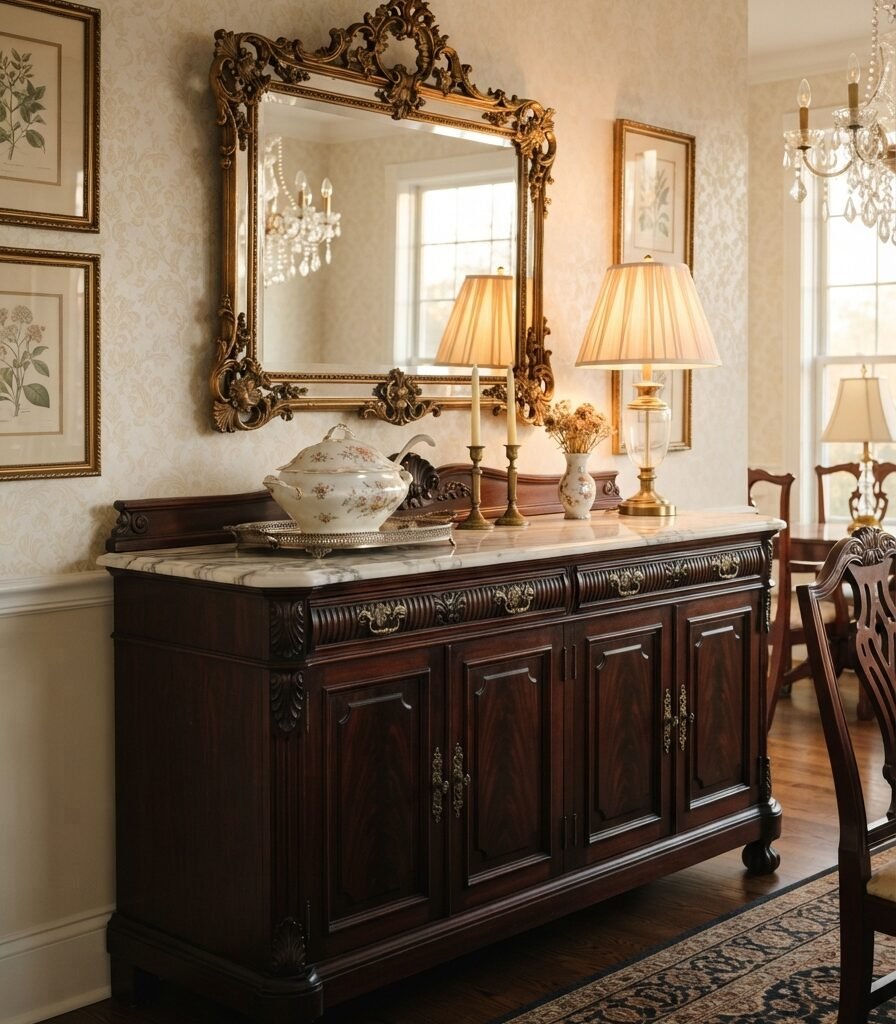
Vibe: The room feels substantial, with the sideboard adding both storage and architectural weight.
Why it works: Marble introduces a cool, reflective surface against dark timber, creating material contrast without requiring another color. The sideboard also gives the room a horizontal anchor beneath a mirror or artwork.
How to get it: Choose white marble with warm gray or taupe veining rather than blue-gray stone. If genuine marble is outside the budget, a quality stone-look surface can reproduce the contrast while keeping the cabinet itself in solid or veneer mahogany.
Shop The Look
| Product | Search phrase |
| Sideboard | Mahogany Victorian sideboard marble top |
| Mirror | Large antique gilt mirror dining room |
| Lamp | Traditional brass table lamp linen shade |
| Tray | Silver tone rectangular serving tray vintage |
| Tureen | White porcelain serving tureen classic |
10. Patterned Runner Over a Dark Wood Table

Vibe: The table feels ceremonial, even before dinner is served.
Why it works: A narrow runner creates a central visual axis without covering the walnut grain that gives a Victorian table its character. The pattern also links table textiles to wallpaper, rugs, or upholstery elsewhere in the room.
How to get it: Select a runner approximately 12–16 inches wide and repeat only one of its accent colors elsewhere on the table. Keep the place settings relatively quiet so the textile remains the dominant pattern.
Shop The Look
| Product | Search phrase |
| Runner | Burgundy sage Victorian damask table runner |
| Plates | Cream vintage style ceramic dinnerware set |
| Glassware | Cut crystal wine glasses traditional |
| Candlesticks | Antique brass taper holder set |
| Napkins | Sage linen dinner napkins embroidered |
11. Dark Wood Paneling With Picture Rails
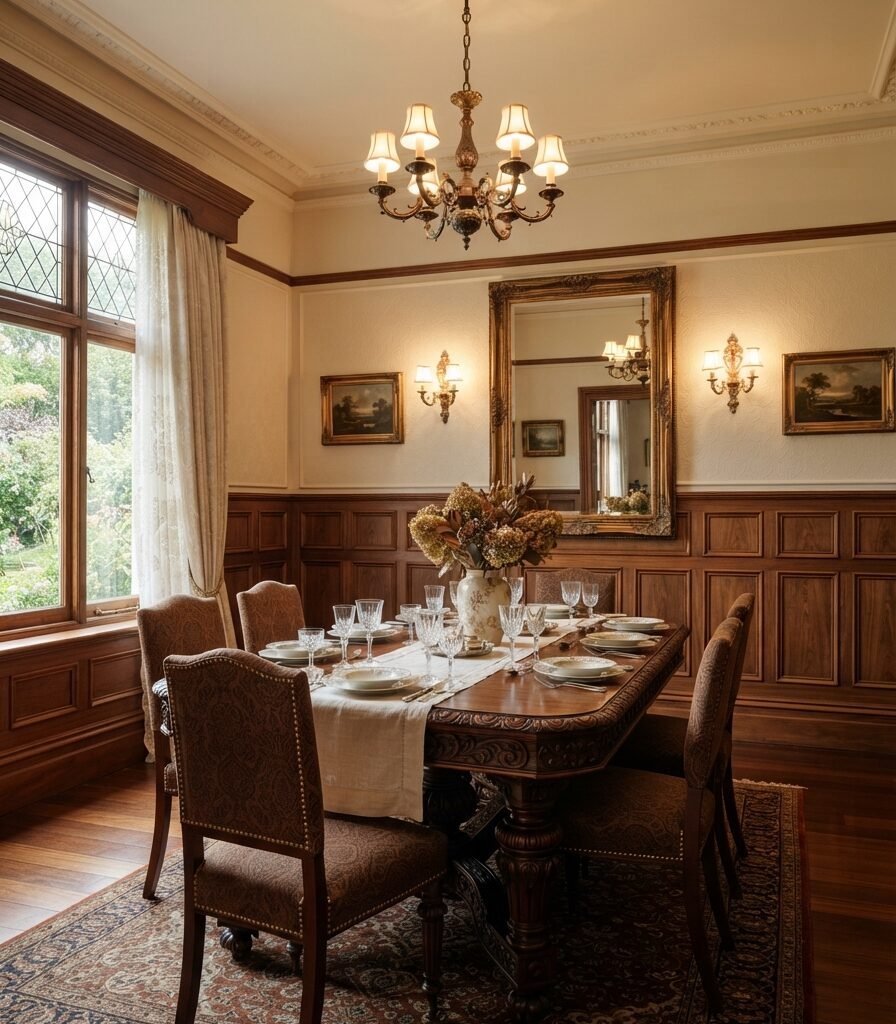
Vibe: The room feels grounded, with the lower walls giving the furniture a strong architectural base.
Why it works: Wainscoting divides the wall vertically, reducing the visual dominance of dark timber while introducing authentic period geometry. The lighter upper wall keeps the ceiling visually elevated.
How to get it: Install panel molding at roughly one-third to one-half wall height and paint the entire lower section a walnut-inspired brown. Use a narrow picture rail above the upper wall zone to display art without filling the wall with holes.
💡 Quick Win: Use removable picture-frame molding painted in dark brown for a renter-friendly approximation of traditional paneling.
Shop The Look
| Product | Search phrase |
| Molding | Victorian picture frame wall molding kit |
| Paint | Deep walnut brown interior wall paint |
| Sconces | Antique brass traditional wall sconces pair |
| Frames | Dark walnut picture frames traditional |
| Vase | Handmade cream ceramic dining vase |
12. An Ornate Gilt Mirror Behind the Sideboard

Vibe: The room feels luminous, with the mirror multiplying the available light.
Why it works: Mirrors are particularly useful in darker Victorian palettes because they interrupt large areas of saturated color and reflect chandelier or window light. A carved gilt frame also reinforces the ornamental language without requiring additional wall pattern.
How to get it: Choose a mirror roughly two-thirds the width of the sideboard and center it above the cabinet. If the room faces north, place it where it can reflect a brighter adjoining window rather than a dark wall.
Shop The Look
| Product | Search phrase |
| Mirror | Large ornate antique gold Victorian mirror |
| Sideboard | Carved walnut traditional dining sideboard |
| Candlesticks | Gilt brass candle holders vintage pair |
| Bowl | Large cream ceramic decorative bowl |
| Branches | Natural dried botanical branches tall |
13. Gothic Revival Dining Room With Arched Details
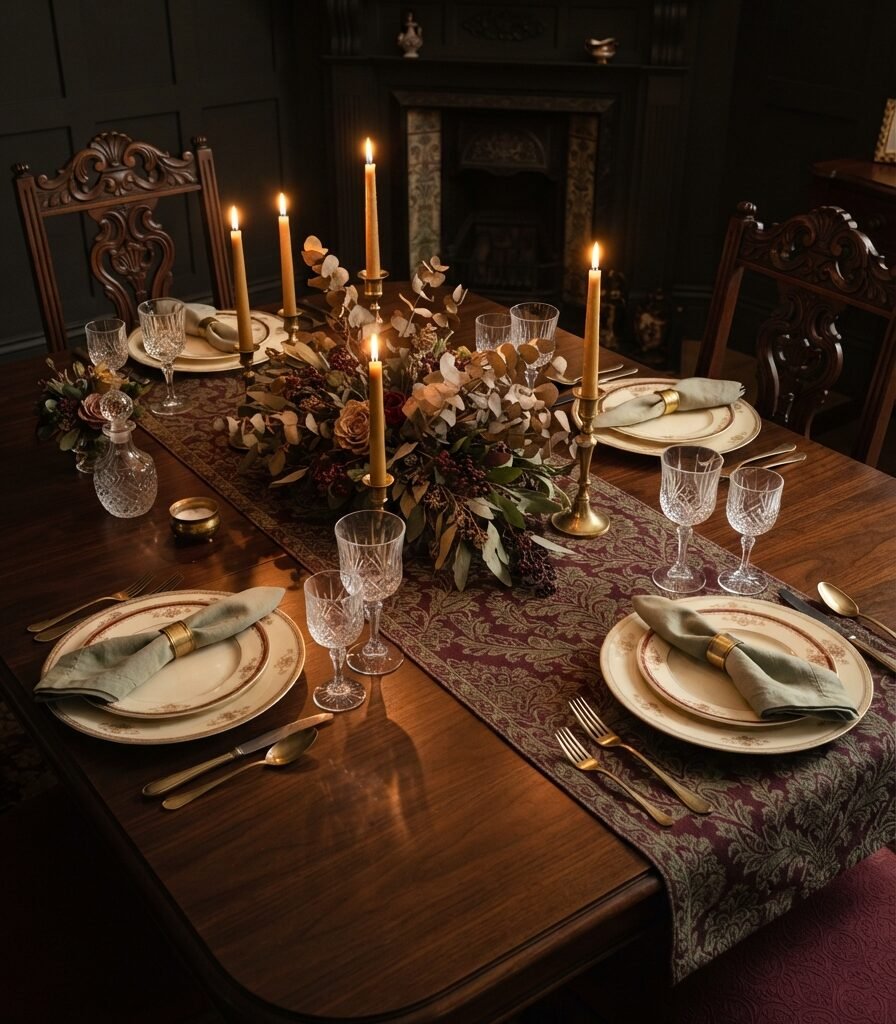
Vibe: The room feels dramatic, with Gothic Revival geometry giving Victorian dining design a stronger edge.
Why it works: Gothic Revival was one of the major nineteenth-century influences on Victorian interiors, particularly in Britain. Pointed arches and vertical forms create upward movement, while dark oak and iron give the room stronger visual weight than softer Victorian palettes.
How to get it: Introduce Gothic geometry through one major feature- an arched mirror, pointed cabinet, or architectural wall panel- rather than combining several motifs. Keep the remaining furniture traditionally Victorian but comparatively restrained.
Shop The Look
| Product | Search phrase |
| Mirror | Gothic arched antique gold wall mirror |
| Table | Dark oak Gothic Victorian dining table |
| Chairs | High back velvet Gothic dining chairs |
| Chandelier | Black iron medieval style dining chandelier |
| Rug | Burgundy Gothic traditional area rug |
14. Antique-Inspired Portrait Gallery
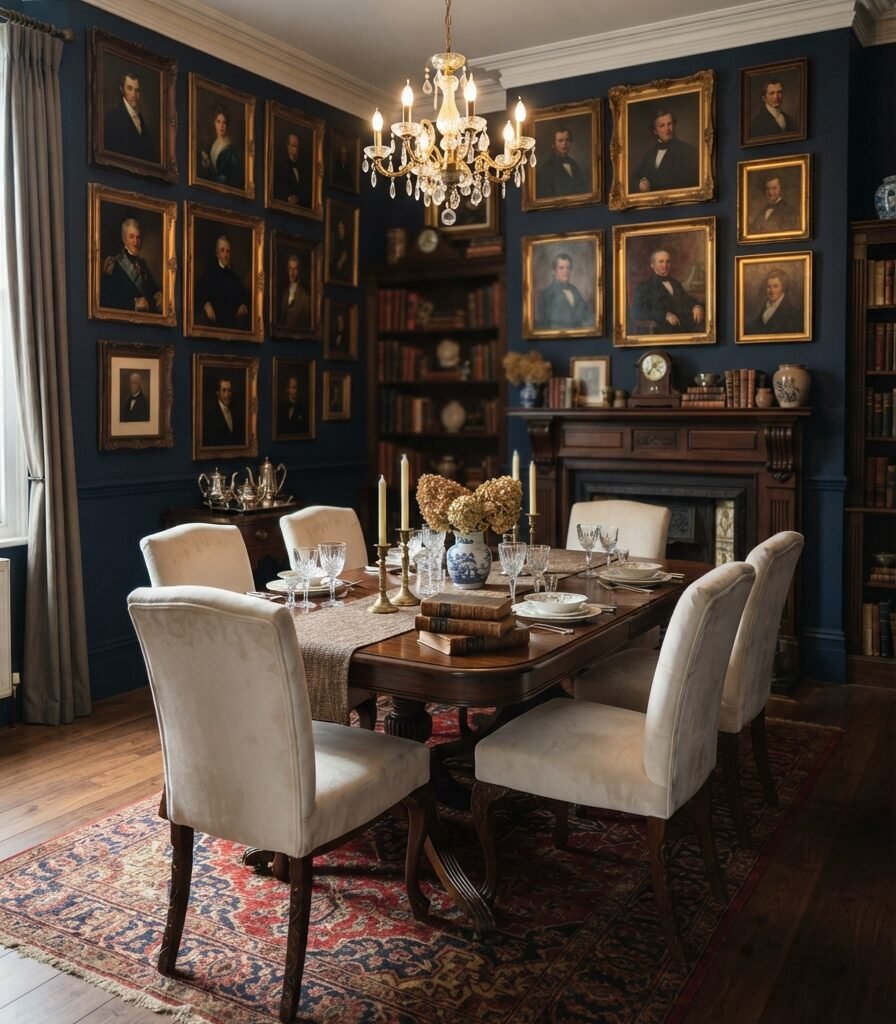
Vibe: The room feels collected, as though its walls have stories beyond the furniture.
Why it works: Portrait galleries add human-scale vertical rhythm and make tall dining walls feel intentional. The varied frame profiles create complexity while the repeated dark timber and gold tones maintain cohesion.
How to get it: Use portraits in several sizes but keep the bottom edges of the lowest frames roughly aligned. Choose frames that share either a dark wood or aged-gold finish so the artwork feels like one collection.
💡 Quick Win: Combine two larger portrait prints with three smaller ones instead of trying to fill an entire wall immediately.
Shop The Look
| Product | Search phrase |
| Artwork | Antique Victorian portrait wall art print set |
| Frames | Ornate dark wood and gold picture frames |
| Chandelier | Navy dining room antique brass chandelier |
| Vase | Dark ceramic Victorian flower vase |
| Rug | Traditional navy Persian style area rug |
15. A Long Narrow Table for Formal Victorian Proportion

Vibe: The room feels ceremonial, with a strong central axis directing attention toward the table.
Why it works: A long rectangular table suits Victorian entertaining because it emphasizes procession and symmetry. Keeping the table relatively narrow improves conversation across the center and prevents oversized furniture from consuming the circulation zone.
How to get it: Maintain approximately 30–36 inches between the table edge and surrounding furniture where circulation is required. Choose chairs with relatively narrow frames if the room is under 12 feet wide.
Shop The Look
| Product | Search phrase |
| Table | Long narrow Victorian walnut dining table |
| Chairs | Carved wood traditional dining chairs set |
| Sconces | Antique brass symmetrical wall sconces |
| Centerpiece | Long ceramic Victorian dining centerpiece bowl |
| Runner | Olive burgundy traditional table runner |
16. Victorian Dining Nook for a Smaller Home
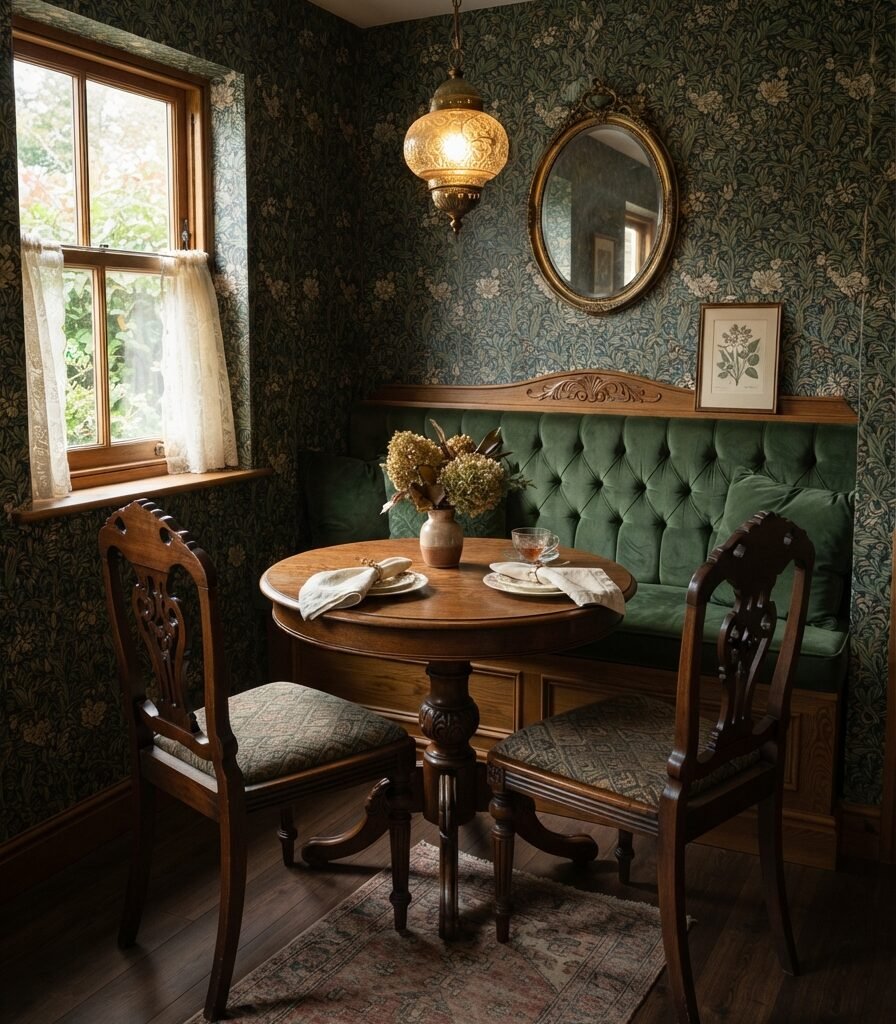
Vibe: The nook feels cozy, proving Victorian richness can work without a formal dining hall.
Why it works: A round table eliminates sharp corners and improves circulation around compact seating. The bench uses otherwise wasted wall depth, while the mirror adds reflected light and makes the enclosure feel less compressed.
How to get it: Choose a round table between 42 and 48 inches for a compact four-person arrangement. Keep the pendant visually small and let the wallpaper provide the majority of the decorative impact.
💡 Quick Win: Add an oval antique-style mirror above an existing dining bench before replacing furniture.
Shop The Look
| Product | Search phrase |
| Table | 42-inch round walnut traditional dining table |
| Bench | Compact forest green velvet dining bench |
| Pendant | Small antique brass Victorian pendant light |
| Mirror | Small ornate oval antique gold mirror |
| Rug | Narrow Persian runner burgundy green |
17. Peacock Blue and Brass Victorian Dining Room
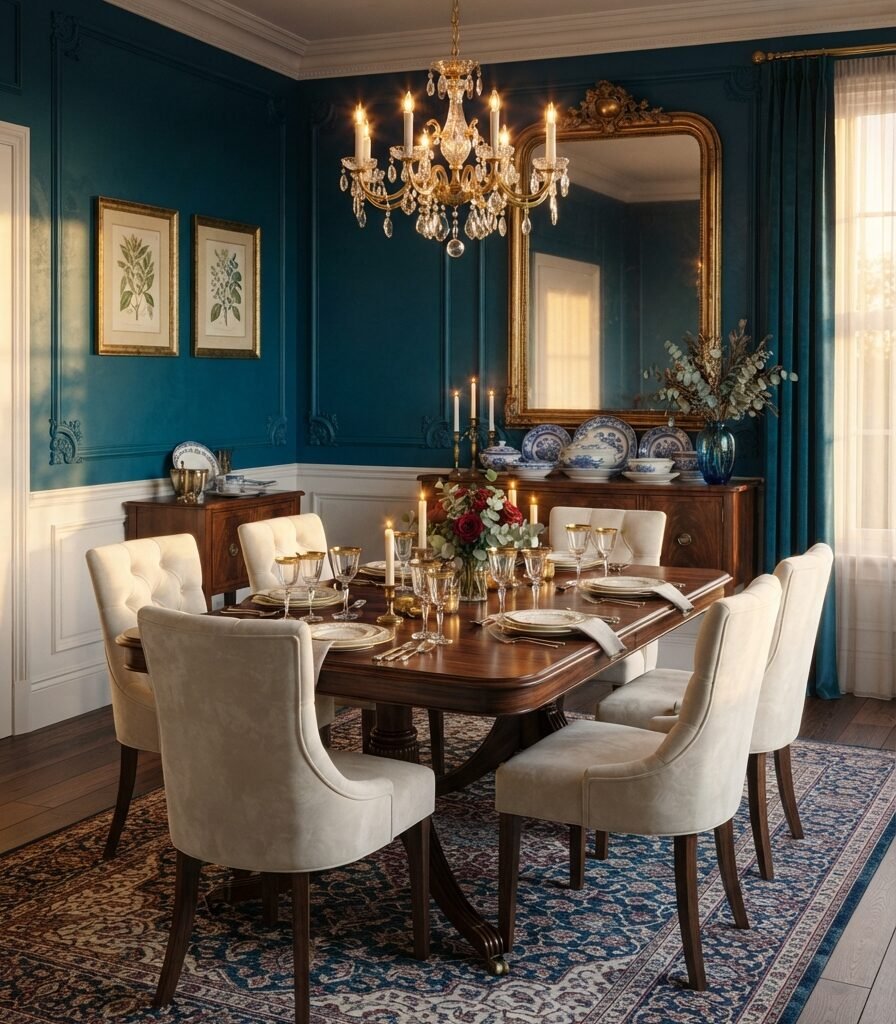
Vibe: The room feels velvety, with saturated blue absorbing light while brass catches it.
Why it works: Peacock blue gives Victorian interiors a cooler jewel-tone alternative to burgundy and green. Warm brass and walnut prevent the blue from feeling contemporary or nautical, maintaining the period atmosphere.
How to get it: Test blue paint on the actual dining wall because north-facing light can make saturated blues appear substantially darker. Repeat the blue in only one textile or glass element after painting.
Shop The Look
| Product | Search phrase |
| Paint | Deep peacock blue interior wall paint |
| Chairs | Cream velvet Victorian dining chairs |
| Rug | Blue burgundy Persian style dining rug |
| Vase | Cobalt blue glass decorative vase |
| Mirror | Antique brass Victorian wall mirror |
18. A Victorian Bar Cabinet for Entertaining
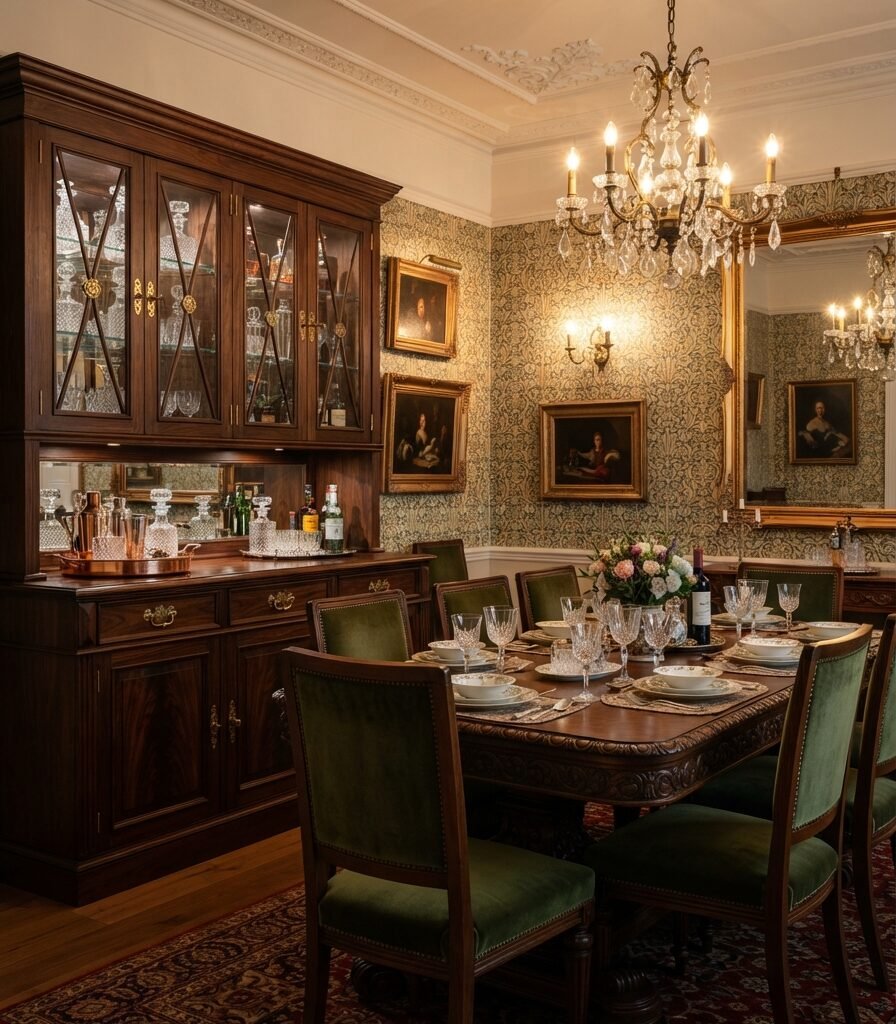
Vibe: The room feels welcoming, with the bar cabinet turning storage into part of the entertaining ritual.
Why it works: Victorian interiors often celebrated specialized furniture, and a bar cabinet recreates that sense of purpose without requiring a historical replica. Glass doors introduce vertical transparency, while brass hardware ties the cabinet to lighting and table accessories.
How to get it: Choose a cabinet no deeper than approximately 18–20 inches for comfortable circulation. Style the visible shelves with a controlled collection of crystal, decanters, and one ceramic object rather than filling every inch.
💡 Quick Win: Convert a narrow glass-front cabinet into a dining display by styling only its top two shelves with matching glassware.
Shop The Look
| Product | Search phrase |
| Cabinet | Dark walnut glass door bar cabinet traditional |
| Decanters | Vintage crystal decanter set dining room |
| Tray | Antique brass cocktail serving tray |
| Glassware | Cut crystal cocktail glass set vintage |
| Art | Victorian still life framed wall art |
19. Stained-Glass Inspired Window Treatment
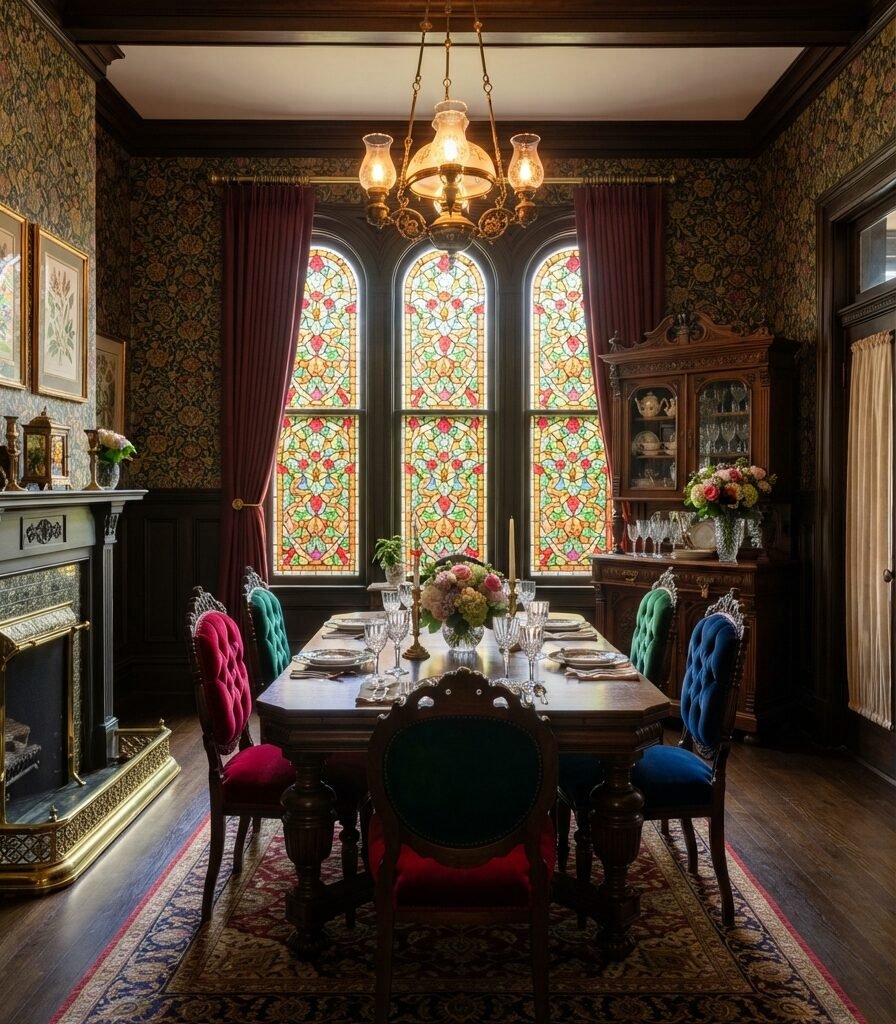
Vibe: The room feels jewel-like, with filtered daylight becoming part of the decoration.
Why it works: Stained glass was strongly associated with Victorian Gothic and Arts and Crafts interiors, and colored light changes throughout the day rather than remaining static. The effect is especially useful when the dining room lacks strong wall space for decoration.
How to get it: Use removable stained-glass film on one window section rather than covering every pane. Keep curtains in one muted tone- burgundy or olive- to frame rather than compete with the colored light.
Shop The Look
| Product | Search phrase |
| Window film | Victorian stained glass removable window film |
| Curtains | Burgundy velvet dining room curtain panels |
| Rod | Antique brass curtain rod traditional |
| Vase | Cut glass vintage style flower vase |
| Artwork | Victorian botanical stained glass print |
20. A Fireplace-Focused Victorian Dining Room
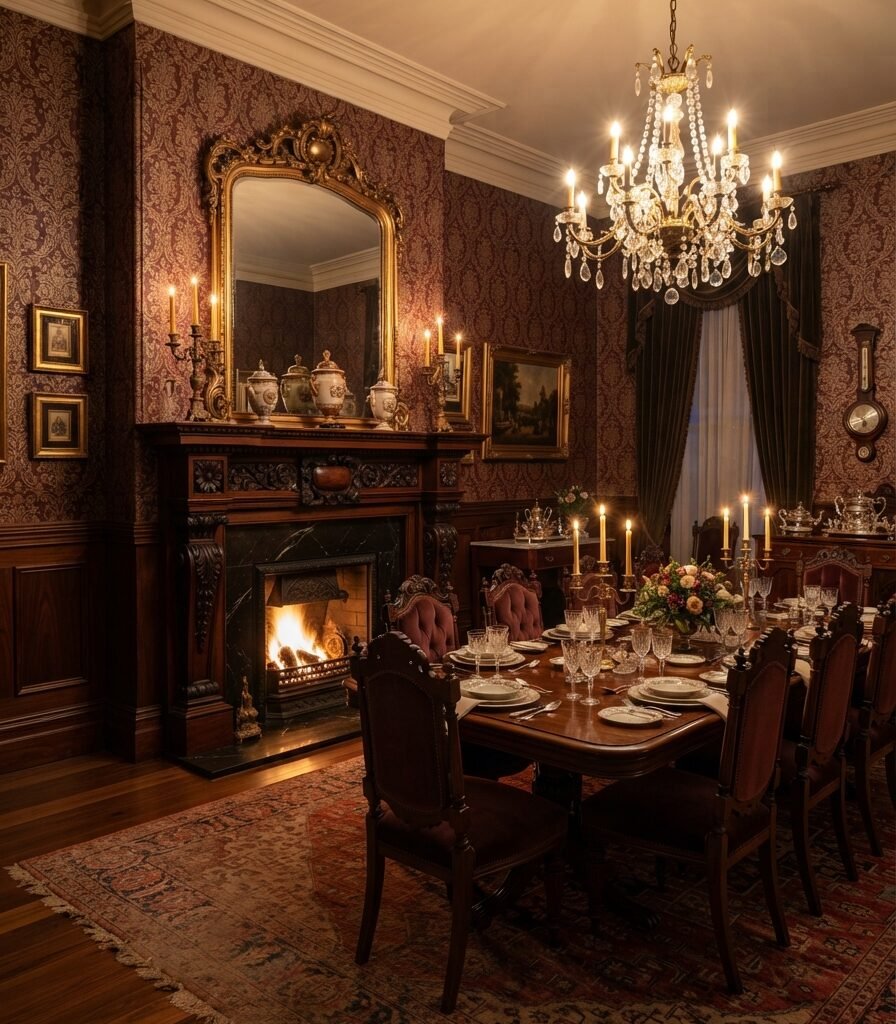
Vibe: The room feels warm, with the fireplace acting as both architectural anchor and social center.
Why it works: Victorian dining rooms often benefited from fireplaces because they provided a strong vertical focal point and practical warmth. A mirror above the mantel extends the room upward while reflecting chandelier light toward the dining table.
How to get it: Keep the mantel styling asymmetrical but visually balanced: one taller ceramic urn on one side and two smaller objects on the other. Leave enough open mantel surface for the carved woodwork to remain visible.
Shop The Look
| Product | Search phrase |
| Mirror | Ornate Victorian fireplace mirror antique gold |
| Candlesticks | Brass mantel candlestick pair vintage |
| Urns | Antique style ceramic decorative urn pair |
| Rug | Large Persian fireplace dining rug burgundy |
| Table | Walnut Victorian dining table carved |
21. Arts and Crafts Victorian Dining Room
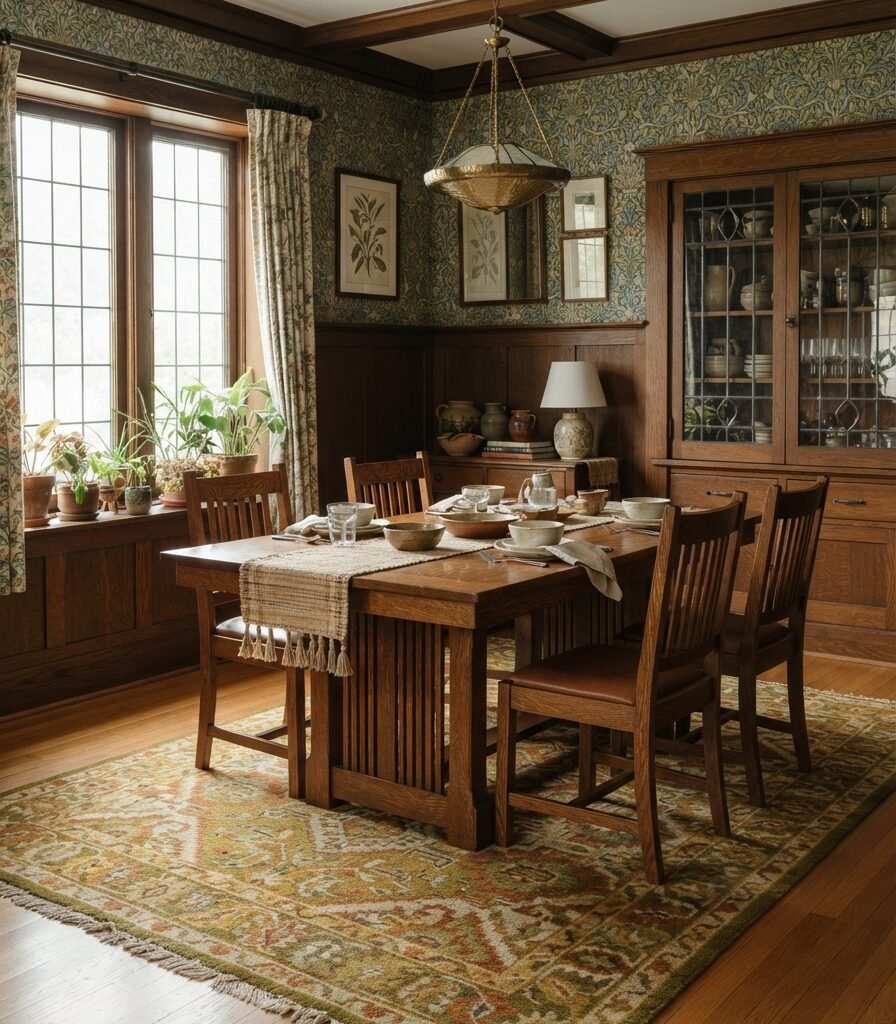
Vibe: The room feels handcrafted, with material honesty replacing excessive ornament.
Why it works: Arts and Crafts developed partly as a response to industrial mass production and emphasized craftsmanship, natural materials, and simplified forms. It sits comfortably within the broader Victorian era while offering a calmer interpretation of period dining design.
How to get it: Choose quarter-sawn oak or oak-look furniture with visible grain and use botanical motifs sparingly. Favor matte ceramic, hammered brass, and woven textiles over glossy manufactured finishes.
💡 Quick Win: Replace one mass-produced centerpiece with a single handmade-looking stoneware vessel in an earthy olive or ochre glaze.
Shop The Look
| Product | Search phrase |
| Table | Quarter sawn oak Arts and Crafts dining table |
| Cabinet | Leaded glass oak display cabinet traditional |
| Ceramics | Handmade stoneware dinnerware olive glaze |
| Pendant | Hammered brass Arts and Crafts pendant |
| Rug | Wool botanical Arts and Crafts area rug |
22. Victorian Dining Room With a Built-In Display Cabinet
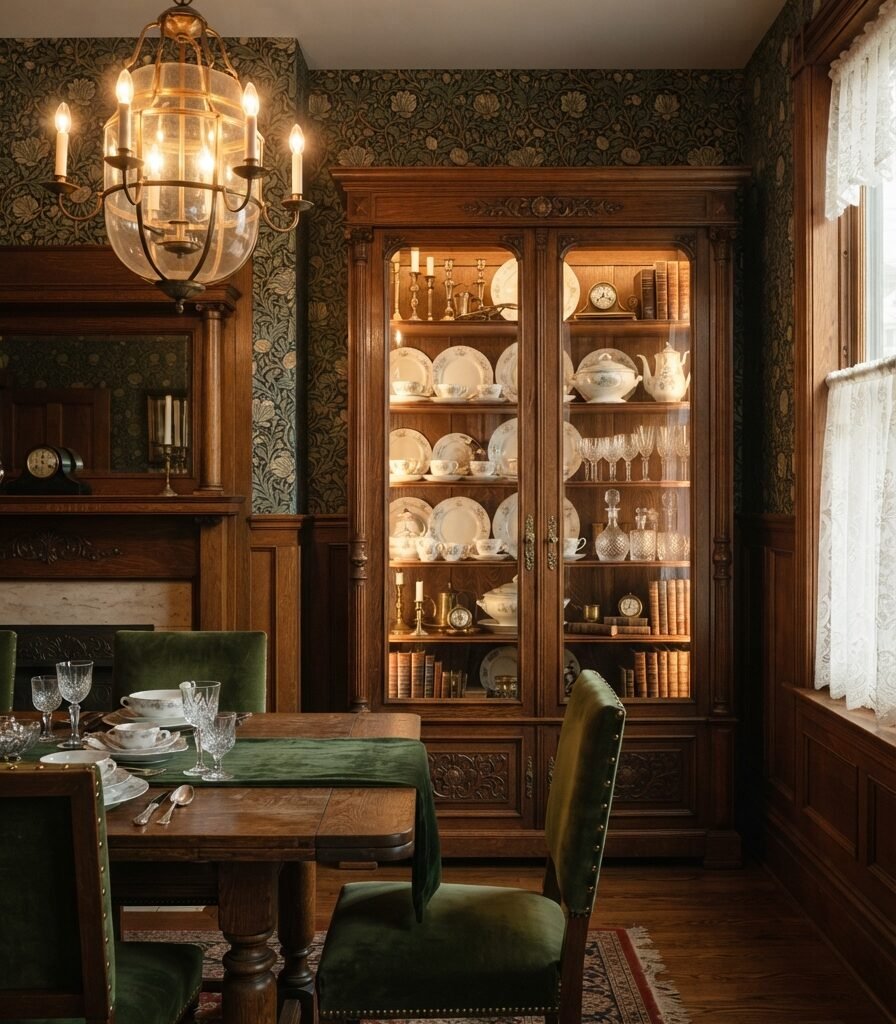
Vibe: The room feels collected, turning everyday dining objects into a visual archive.
Why it works: Display cabinets suit Victorian interiors because they combine storage with visible accumulation. The vertical cabinet also balances the horizontal dining table and creates a stronger sense of room height.
How to get it: Arrange cabinet contents in groups rather than filling every shelf evenly: plates vertically, bowls stacked, glasses grouped, and one taller object per section. Leave roughly 20–30 percent of each shelf visually empty.
Shop The Look
| Product | Search phrase |
| Cabinet | Tall dark oak glass display cabinet dining room |
| Plates | Ivory porcelain vintage dinner plate set |
| Glassware | Clear crystal wine glass traditional set |
| Books | Antique style decorative books neutral |
| Tureen | Ivory ceramic Victorian serving tureen |
23. Layered Persian Rugs for an Old-World Foundation

Vibe: The room feels layered, with pattern accumulating gently from floor to ceiling.
Why it works: Persian-inspired rugs provide the visual density Victorian interiors need, but faded motifs prevent the room from feeling excessively saturated. The design principle is pattern hierarchy: the largest rug establishes the palette while smaller patterns repeat only selected colors.
How to get it: Choose a large rug that extends at least 24 inches beyond the dining chairs when they are pulled back from the table. If layering rugs, keep the lower rug visually quiet and let the smaller patterned rug provide the strongest motif.
Shop The Look
| Product | Search phrase |
| Rug | Faded Persian dining room rug 8×10 burgundy |
| Runner | Vintage Persian runner olive burgundy |
| Table | Dark walnut traditional dining table |
| Chairs | Burgundy velvet dining chairs carved wood |
| Art | Antique botanical wall art framed |
24. Small Victorian Dining Room With a Wall-Mounted Sconce Pair

Vibe: The room feels intimate, using vertical surfaces instead of floor area to create character.
Why it works: Wall sconces free valuable tabletop and floor space while adding the layered illumination Victorian rooms depend on. The round table also improves circulation, and the oval mirror introduces a vertical reflective surface without adding visual bulk.
How to get it: Mount sconces around eye level when seated, generally about 60–66 inches from the floor depending on fixture size. Keep the sideboard under 16–18 inches deep if circulation is tight.
💡 Quick Win: Add plug-in brass sconces with fabric shades if rewiring is not practical.
Shop The Look
| Product | Search phrase |
| Sconces | Antique brass plug-in wall sconces fabric shade |
| Table | 42 inch round walnut dining table traditional |
| Mirror | Small ornate oval vintage brass mirror |
| Sideboard | Narrow Victorian style dining sideboard |
| Wallpaper | Dark floral Victorian removable wallpaper |
25. Modern Victorian Dining Room With Contemporary Restraint

Vibe: The room feels balanced, allowing historical references to breathe beside simpler modern pieces.
Why it works: The key principle is controlled contrast: one ornate object can carry more historical information when the surrounding furniture is visually quiet. A classic mirror or carved table becomes a focal point rather than competing with multiple decorative motifs.
How to get it: Follow the 80/20 rule: make roughly 80 percent of the room timeless and restrained, then reserve 20 percent for unmistakably Victorian elements such as an ornate mirror, antique table, or patterned rug.
Shop The Look
| Product | Search phrase |
| Table | Walnut pedestal dining table traditional modern |
| Chairs | Cream upholstered modern classic dining chairs |
| Mirror | Ornate antique gold Victorian mirror |
| Chandelier | Sculptural aged brass dining chandelier |
| Rug | Muted Persian traditional dining rug |
26. Full Victorian Maximalist Dining Room

Vibe: The room feels theatrical, embracing Victorian abundance without losing a deliberate visual hierarchy.
Why it works: Maximalism works when repetition creates order inside abundance. Here, emerald, burgundy, mahogany, and antique gold recur across walls, textiles, furniture, and accessories, while the large dining table establishes one dominant horizontal axis. The room feels intentionally accumulated rather than randomly crowded.
How to get it: Pick four repeating materials- mahogany, velvet, brass, and porcelain- and make sure each appears in at least three locations. Keep the floor comparatively quiet so the walls, furniture, and lighting can carry the decorative density.
💡 Quick Win: Begin with one ornate mirror, one patterned rug, and a pair of brass candlesticks; build the rest of the room around those three references instead of buying everything simultaneously.
Shop The Look
| Product | Search phrase |
| Table | Large carved mahogany Victorian dining table |
| Chairs | Emerald green velvet Victorian dining chairs |
| Mirror | Oversized ornate antique gilt mirror |
| Chandelier | Large Victorian brass twelve-light chandelier |
| Rug | Emerald burgundy Persian style dining room rug |
How to Start Your Victorian Dining Room Transformation
Start with Benjamin Moore New London Burgundy on the main dining-room wall. This single move establishes the deep, warm color direction that makes walnut, mahogany, brass, cream upholstery, and traditional rugs easier to coordinate; once the wall color is fixed, choose furniture and textiles that repeat its warm undertone rather than fighting it.
The most common mistake is combining too many unrelated “old-fashioned” finishes- orange oak, yellow brass, glossy cherry, cool gray paint, and red-patterned rugs- because each belongs to a different visual temperature. Victorian rooms can be layered, but they still need a controlled palette. Keep timber within one warm family and use antique brass instead of mixing bright chrome with polished gold.
For a low-cost entry point, start with a pair of antique-brass taper holders under $50, a burgundy damask table runner under $50, and one cream ceramic decorative vase under $50. These three pieces can immediately establish period character without committing to major furniture.
A small styling refresh can happen over a weekend, while wallpaper, lighting installation, furniture sourcing, and custom upholstery may take several weeks or months. A starter transformation can realistically land around $300–$1,000, while a full room using quality furniture, wallpaper, lighting, rugs, and upholstery can move into the $2,500–$8,000+ range depending on room size and whether original architectural details require restoration.
Frequently Asked Questions About Victorian Dining Room Ideas
What makes a dining room Victorian instead of traditional?
Victorian design refers primarily to the nineteenth-century period and its many revival movements, including Gothic Revival, Renaissance Revival, Rococo Revival, and Arts and Crafts influences. Traditional dining rooms can borrow from many historical periods without specifically following Victorian design. Look for combinations of dark timber, ornamented furniture, saturated colors, patterned textiles, brass lighting, and collected decorative objects to create a more distinctly Victorian character.
What colors work best for a Victorian dining room?
Deep forest green, oxblood, navy, aubergine, tobacco brown, and warm cream are particularly effective. A useful starting palette is forest green walls with walnut furniture, antique brass, and cream upholstery. If the dining room is small or receives limited daylight, use the darker color on one feature wall and warm cream elsewhere rather than painting every surface saturated.
How much does it cost to create a Victorian dining room?
A modest decorative refresh can cost roughly $300–$1,000 using paint, textiles, lighting accessories, artwork, and secondhand furniture. A more complete room with a dining table, six chairs, chandelier, rug, wallpaper, mirror, and storage furniture can reasonably reach $2,500–$8,000 or more. Vintage and antique sourcing can reduce costs, although restoration and professional reupholstery can add substantially to the budget.
Can Victorian dining room ideas work in a modern home?
Yes, and the combination can be especially effective when historical pieces are edited rather than replicated throughout the room. Pair an ornate gilt mirror or Victorian dining table with simpler contemporary chairs, warm cream walls, and streamlined lighting. The goal is to create contrast between old and new rather than making every item look as though it came from the same period.
Which lighting works best in a Victorian dining room?
A warm brass chandelier is the strongest central fixture because it recreates the branching, candle-based visual language associated with nineteenth-century interiors. Use bulbs around 2200–2700K for a warmer atmosphere and hang the fixture roughly 30–36 inches above the tabletop, adjusting for scale and sightlines. Wall sconces or shaded lamps should then provide secondary light so the room does not depend entirely on the chandelier.
Ready to Create Your Dream Victorian Dining Room?
These 26 Victorian dining room ideas explore everything from oxblood and forest-green color schemes to carved walnut furniture, damask walls, brass lighting, gallery arrangements, compact layouts, and layered traditional rugs. You do not need to transform the entire room at once; starting with one period-inspired element is often the smartest way to build an authentic result gradually. Today, choose one wall and test a warm oxblood or forest-green paint sample beside your existing dining furniture in both daylight and evening light. As the room develops, the combination of craftsmanship, rich materials, and warm illumination should make dining feel more intimate, ceremonial, and connected to the character of the home. Save your favorite ideas now, especially the brass-and-walnut combinations, botanical walls, and old-world lighting details that give Victorian dining rooms their unmistakable character.