

Coastal interior design brings the colors, textures, and relaxed rhythm of the shoreline indoors without turning a room into a collection of nautical decorations. These 16 coastal dining room ideas show how to use natural wood, breezy textiles, sea-inspired colors, layered lighting, and practical layouts to create a dining space that feels fresh without feeling themed.
A good coastal dining room should feel like sunlight coming through linen curtains on a quiet morning. There is an ease to pale oak, weathered finishes, woven fibers, and softly faded blue that makes the room feel connected to nature without becoming overly decorative. The best coastal spaces also leave enough breathing room for the eye, allowing texture and light to do much of the work.
Whether your dining room opens toward a garden, sits inside a compact apartment, or receives very little natural light, coastal design can be adapted to the architecture rather than forced onto it. The goal is not to recreate a beach house; it is to capture the calm, openness, and tactile quality associated with coastal living.
Here are 16 ideas worth saving and stealing.
Why Coastal Dining Room Ideas Work So Well
Coastal design developed from practical seaside living rather than from a single historical design movement. Traditional coastal interiors borrowed from maritime architecture, New England cottages, Mediterranean homes, and later resort design, but contemporary coastal rooms have become more restrained. Unlike nautical decorating, which often relies on anchors, ropes, stripes, and overt maritime symbols, modern coastal design communicates its setting primarily through light, natural materials, relaxed proportions, and colors inspired by sand, water, driftwood, and sky.
The material palette is equally important. Start with pale or medium-toned oak, ash, cane, rattan, woven seagrass, linen, cotton, ceramic, and lightly weathered timber. Useful colors include warm white, oyster, sand, mushroom, pale blue, dusty blue-gray, sea-glass green, and muted navy. The trick is to avoid making every surface the same pale shade; coastal rooms need tonal variation to keep white walls and light furniture from becoming visually flat.
Coastal interiors remain relevant because they support the way many people now want their homes to function: relaxed, uncluttered, comfortable, and connected to natural materials. The emphasis on durable wood, washable linen, woven fibers, and fewer decorative objects also fits the broader move toward less disposable decorating. Instead of chasing a highly specific beach-house look, today’s coastal dining room can feel timeless because its visual language is built around materials and light.
Small dining rooms can absolutely use coastal design, but editing becomes more important as square footage decreases. Prioritize one light-toned dining table, slim-profile seating, a large mirror or reflective surface, and curtains mounted high enough to emphasize ceiling height. Avoid filling a compact room with oversized wicker furniture or too many accessories. Coastal style works best when the room has enough negative space for the natural textures to remain legible.
Style at a Glance
| Element | Core Trait 1 | Core Trait 2 |
| Philosophy | Relaxed, nature-connected | Light and uncluttered |
| Materials | Pale oak, rattan, linen | Seagrass, ceramic, cane |
| Color palette | Warm white, sand, pale blue | Sea-glass green, muted navy |
The strongest coastal dining rooms balance warmth and airiness rather than relying exclusively on blue and white. Think of the palette as a hierarchy: warm white for the largest surfaces, natural wood for visual grounding, a soft water-inspired color for secondary elements, and darker accents used sparingly. This keeps coastal dining room decor sophisticated enough for everyday living while retaining the easy atmosphere that makes the style so appealing.
1. Pale Oak Table with Soft Blue Upholstered Chairs
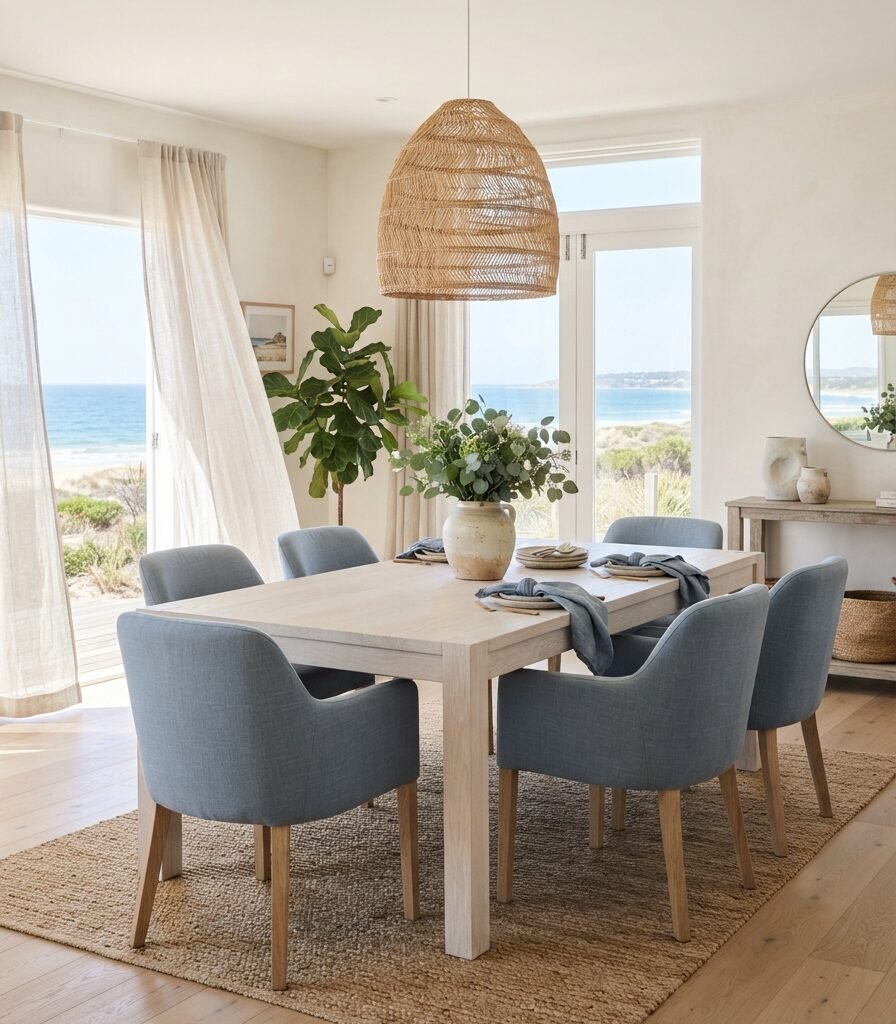
Vibe: The room feels sun-washed, relaxed, and quietly welcoming.
Why it works: The contrast between pale oak and dusty blue creates enough visual definition without introducing a harsh accent color. The natural wood supplies warmth while the upholstered chairs soften the harder table surface, creating useful texture layering. Keeping the table finish matte rather than glossy also prevents reflected light from making the room feel overly formal.
How to get it: Choose a dining table in natural or whitewashed oak with visible grain rather than a heavily painted finish. Pair it with chairs upholstered in muted blue-gray rather than saturated navy, keeping the blue approximately one to two shades darker than the surrounding wall color.
Quick Win: If replacing the chairs is outside the budget, add washable dusty-blue linen seat cushions to existing wooden chairs for an immediate coastal color shift.
Shop The Look
| Product | Search phrase |
| Dining table | Natural pale oak rectangular dining table 72 inch |
| Dining chairs | Dusty blue upholstered dining chairs set of 4 |
| Pendant | Large woven rattan pendant light natural |
| Table centerpiece | Low matte white ceramic vase |
| Table linens | Natural linen napkin set dusty blue |
2. Warm White and Sand-Tone Coastal Dining Room

Vibe: The dining room feels hushed and tactile.
Why it works: Removing strong blue from the palette makes the room feel more sophisticated while still retaining coastal character through natural textures. The principle here is tonal layering: ivory walls, oatmeal textiles, pale wood, and sandy fibers occupy different values of the same warm-neutral family. This prevents an all-neutral room from appearing one-dimensional.
How to get it: Use warm white rather than cool white on the walls, then introduce three distinct sand-colored materials: linen, jute, and natural wood. Avoid matching their tones exactly; slight differences make the room feel collected rather than color-matched.
Shop The Look
| Product | Search phrase |
| Dining table | Light ash wood dining table natural finish |
| Chairs | Natural rush seat dining chairs set of 4 |
| Rug | Natural jute dining room rug 8×10 |
| Curtains | Oatmeal linen curtain panels floor length |
| Ceramics | Handmade ivory stoneware dinnerware set |
3. Rattan Pendant for Coastal Dining Room Ambience

Vibe: The room feels glowing and intimate after sunset.
Why it works: Woven rattan performs double duty: it provides illumination while adding a natural material layer. The open weave allows light to escape through the shade, producing patterned shadows that make the room feel more dimensional. A warm 2700K bulb keeps the coastal palette from becoming cold at night.
How to get it: Hang the bottom of the pendant approximately 75–85 cm above the tabletop and use a dimmable warm-white LED around 2700K. A shade around 60–75 cm wide works well over a six-person rectangular table, provided it does not obstruct sightlines.
Quick Win: Swap an existing cool-white dining bulb for a 2700K dimmable bulb before buying a new fixture; the warmer light can immediately change the atmosphere.
Shop The Look
| Product | Search phrase |
| Pendant | Large natural rattan dining pendant 28 inch |
| Bulb | E26 dimmable LED bulb 2700K warm white |
| Dimmer | LED compatible rotary dimmer switch |
| Ceiling hardware | Natural brass pendant ceiling canopy |
| Table decor | Blue gray ceramic low centerpiece bowl |
4. Natural Linen Table Styling with Sea-Glass Blue
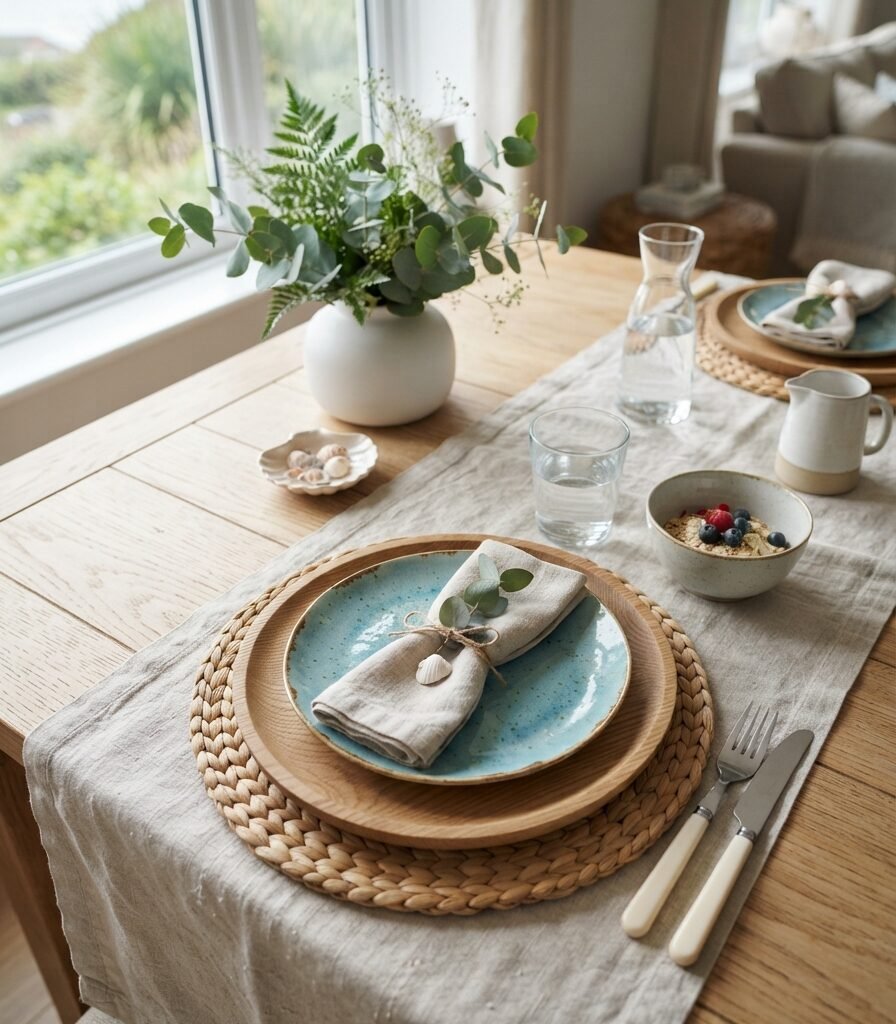
Vibe: The table feels fresh and naturally layered.
Why it works: Linen introduces tactile softness while sea-glass blue supplies the water-inspired color associated with coastal interiors. The important principle is restraint: the blue appears in only a few repeated objects instead of being distributed across every surface. This makes the accent feel intentional rather than themed.
How to get it: Let a natural linen runner extend roughly 15–20 cm beyond each end of the table. Add sea-glass blue through dinnerware rather than paint if you want an easily changeable seasonal accent.
Shop The Look
| Product | Search phrase |
| Runner | Undyed natural linen table runner 180cm |
| Dinnerware | Sea glass blue ceramic dinner plates set |
| Placemats | Natural woven seagrass placemat set |
| Glassware | Clear ribbed glass tumbler set |
| Centerpiece | Low ivory ceramic bowl vase |
5. Weathered Wood Dining Table as the Coastal Focal Point

Vibe: The room feels grounded, as though it has been lived in for years.
Why it works: Weathered wood introduces visual history and prevents a coastal dining room from looking newly assembled. The irregular grain and softened edges contrast with cleaner upholstered seating, creating material tension. The table becomes the visual anchor because its darker tonal weight balances the pale walls.
How to get it: Look for oak with a wire-brushed, limed, or naturally distressed surface rather than artificial gray staining. If refinishing an existing table, use a clear matte hard-wax oil after lightly abrading the surface to preserve the wood grain.
Quick Win: Add a washable natural-linen table runner to an existing wood table and remove glossy accessories; the change emphasizes the table’s natural surface immediately.
Shop The Look
| Product | Search phrase |
| Table | Weathered oak rectangular dining table 72 inch |
| Chairs | White linen slipcovered dining chairs |
| Rug | Handwoven natural wool jute dining rug |
| Pitcher | Distressed white ceramic farmhouse pitcher |
| Basket | Large natural seagrass floor basket |
6. Coastal Blue Accent Wall with Natural Wood
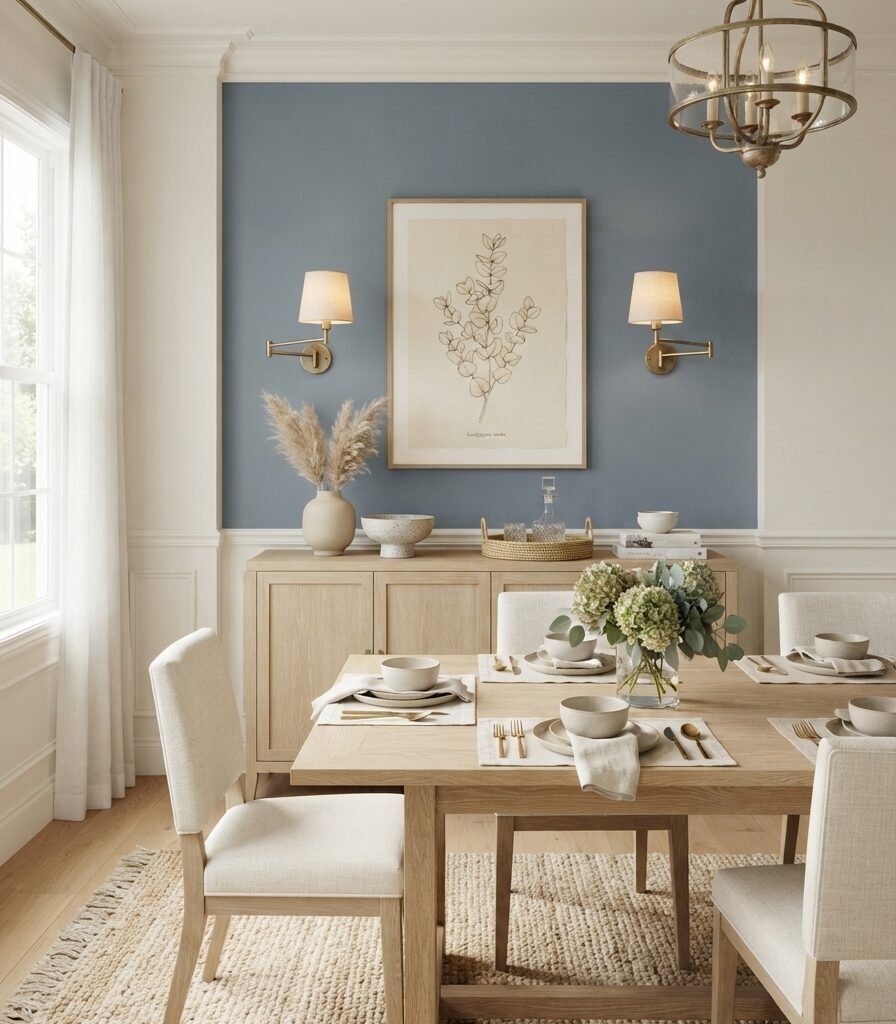
Vibe: The room feels cool yet welcoming.
Why it works: A muted blue-gray accent wall creates depth without the visual heaviness of navy. The design principle is controlled contrast: the darker wall gives the pale furniture something to visually push against while the warm wood prevents the blue from reading icy. A chalky finish is more appropriate than high-gloss paint because it resembles weathered surfaces found in coastal architecture.
How to get it: Test the blue in the room at morning, afternoon, and evening before painting. For north-facing rooms, choose a blue-gray with a slight green or warm undertone rather than an icy blue.
Shop The Look
| Product | Search phrase |
| Paint | Muted blue gray interior wall paint matte |
| Sideboard | Light oak coastal dining sideboard |
| Sconces | Aged brass wall sconces pair dining |
| Art | Coastal botanical wall art blue neutral |
| Tray | Natural woven rectangular serving tray |
7. Small Coastal Dining Nook with Built-In Bench
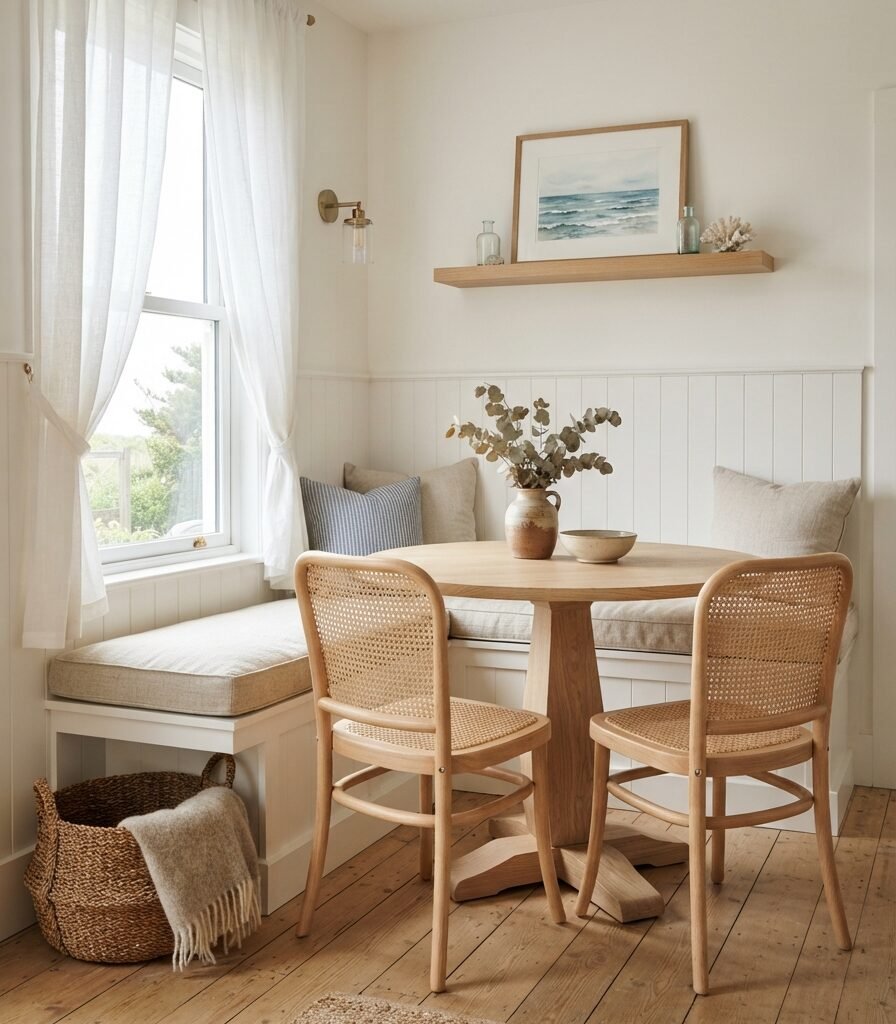
Vibe: The nook feels cozy without feeling cramped.
Why it works: Bench seating uses the perimeter of the room more efficiently than four individual chairs. The round pedestal table also reduces corner collisions and makes circulation easier because there are no table legs interrupting the seating zone. The combination creates a compact coastal dining area with a strong sense of openness.
How to get it: Use a bench seat around 45 cm high and approximately 48–52 cm deep for comfortable adult dining. Choose a pedestal table between 100 and 120 cm wide so chairs can pull back without blocking the primary walkway.
Quick Win: Replace bulky dining chairs with two slim cane-back chairs and add a bench cushion against the wall to recover valuable floor space.
Shop The Look
| Product | Search phrase |
| Table | 42-inch round light oak pedestal dining table |
| Chairs | Natural cane back dining chairs set of 2 |
| Cushion | Natural linen bench cushion 48 inch |
| Shelf | Floating light oak wall shelf 24 inch |
| Basket | Woven seagrass under-bench storage basket |
8. Oversized Coastal Mirror to Multiply Natural Light

Vibe: The room feels luminous and expansive.
Why it works: A mirror becomes particularly useful in coastal dining rooms because it amplifies the style’s defining quality: light. Positioning it opposite or adjacent to a window allows natural illumination to bounce deeper into the room, while the large vertical proportion adds height. The frame should remain visually quiet so the reflected light remains the primary effect.
How to get it: Choose a mirror approximately two-thirds the width of the sideboard below it, leaving visible wall on both sides. Position the bottom edge around 15–20 cm above the furniture rather than leaving a large disconnected gap.
Shop The Look
| Product | Search phrase |
| Mirror | Large arched natural wood wall mirror |
| Sideboard | White oak coastal sideboard 60 inch |
| Lamp | Ceramic table lamp linen shade |
| Bowl | Large woven seagrass decorative bowl |
| Botanicals | Dried eucalyptus stems natural |
9. Coastal Dining Room with Cane-Back Chairs
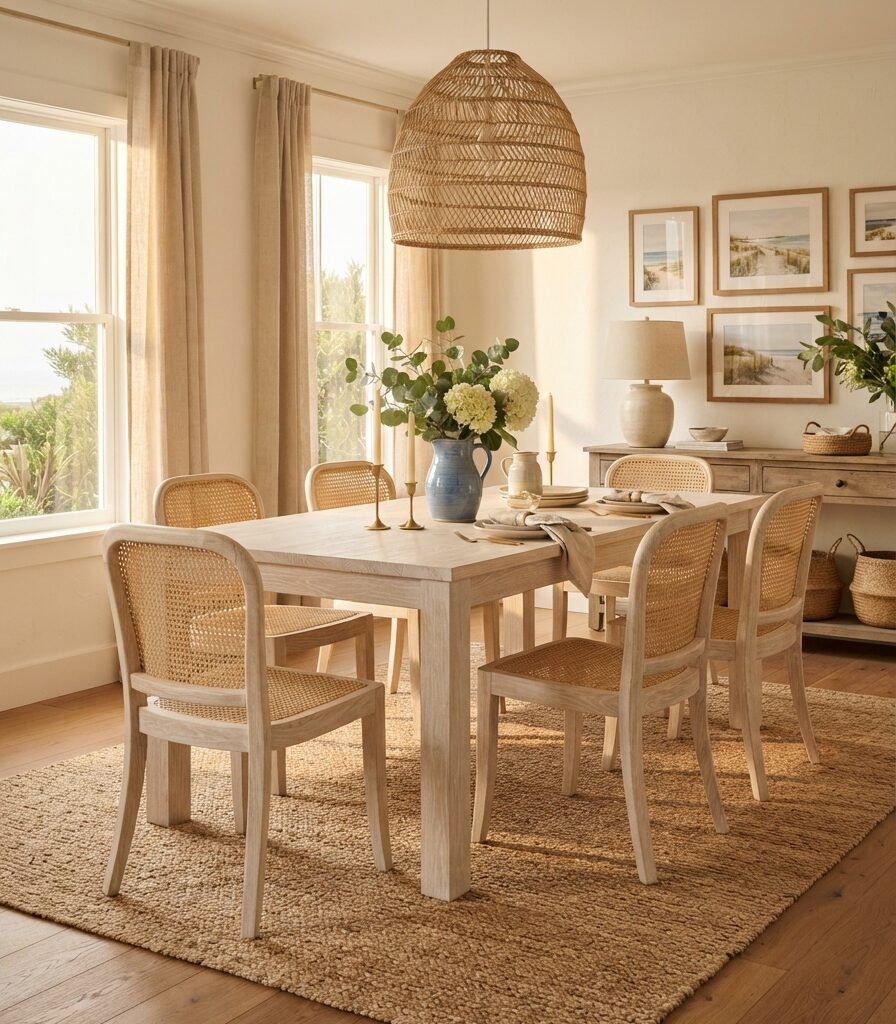
Vibe: The dining room feels textured and easygoing.
Why it works: Cane adds a fine visual pattern without the heaviness of upholstered or solid-wood seating. Its open structure allows wall and floor colors to remain visible through the chair backs, preserving negative space. The combination works particularly well with a substantial table because the lighter chairs visually reduce the furniture’s total weight.
How to get it: Choose cane with a natural honey finish rather than orange-toned lacquer. Keep the upholstery, if present, within cream, flax, or pale oatmeal so the woven backs remain the strongest textural element.
Shop The Look
| Product | Search phrase |
| Chairs | Natural cane back dining chairs set of 6 |
| Table | Whitewashed oak dining table 72 inch |
| Chandelier | Woven natural fiber dining chandelier |
| Rug | Handwoven cream natural fiber dining rug |
| Pitcher | Blue and white ceramic pitcher coastal |
10. Coastal Dining Room with Layered Blue Textiles

Vibe: The space feels breezy and casually collected.
Why it works: Layering multiple blue tones is more sophisticated than using one repeated blue throughout the room. The visual principle is tonal progression: pale blue occupies the largest textile surfaces, dusty blue appears at furniture level, and navy becomes a small grounding accent. This creates depth without overwhelming the warm-white foundation.
How to get it: Keep the strongest blue below eye level when possible, using navy in only one or two small elements. Combine one subtle stripe with solid textiles instead of introducing several competing coastal patterns.
Quick Win: Replace only the dining napkins and runner with dusty blue linen; two coordinated textiles can establish the palette without changing furniture.
Shop The Look
| Product | Search phrase |
| Curtains | White linen sheer curtain panels floor length |
| Runner | Dusty blue striped linen table runner |
| Napkins | Dusty blue linen napkins set of 4 |
| Cushion | Navy blue linen window seat cushion |
| Vase | Blue gray ceramic vase matte |
11. Seagrass Rug to Define an Open-Plan Dining Area

Vibe: The open-plan space feels anchored and organized.
Why it works: A rug visually establishes the dining zone without adding a physical partition. Seagrass also introduces enough texture to distinguish the dining area from a smooth kitchen floor. For dining, the rug must be large enough that chair legs remain supported when chairs are pulled backward.
How to get it: Aim for at least 60 cm of rug beyond each edge of the dining table. For a table around 180 cm long, a rug approximately 300 × 240 cm gives chairs adequate movement space without constantly catching the rug edge.
Shop The Look
| Product | Search phrase |
| Rug | Large woven seagrass dining room rug 8×10 |
| Rug pad | Thin non-slip rug pad hard floor |
| Table | Pale oak rectangular dining table 72 inch |
| Chairs | Cream upholstered dining chairs set of 6 |
| Pendant | Natural woven seagrass pendant dining |
12. Coastal White Dining Room with Subtle Natural Texture

Vibe: The room feels serene rather than stark.
Why it works: A white coastal dining room succeeds through texture, not simply through color. The key principle is surface variation: matte paint, linen, ceramic, oak, and woven fiber all reflect light differently even when their colors are closely related. This gives the room depth while maintaining the clean visual openness associated with coastal interiors.
How to get it: Avoid pure optic white where possible and choose a warm white with a soft cream undertone. Then use at least four textures across the room so the palette does not become visually sterile.
Shop The Look
| Product | Search phrase |
| Table | Natural white oak dining table |
| Chairs | Ivory linen slipcovered dining chairs set |
| Curtains | Warm white linen curtain panels |
| Dinnerware | Matte ivory ceramic dinnerware set |
| Rug | Natural cream woven dining room rug |
13. Coastal Gallery Wall with Botanical and Ocean Artwork
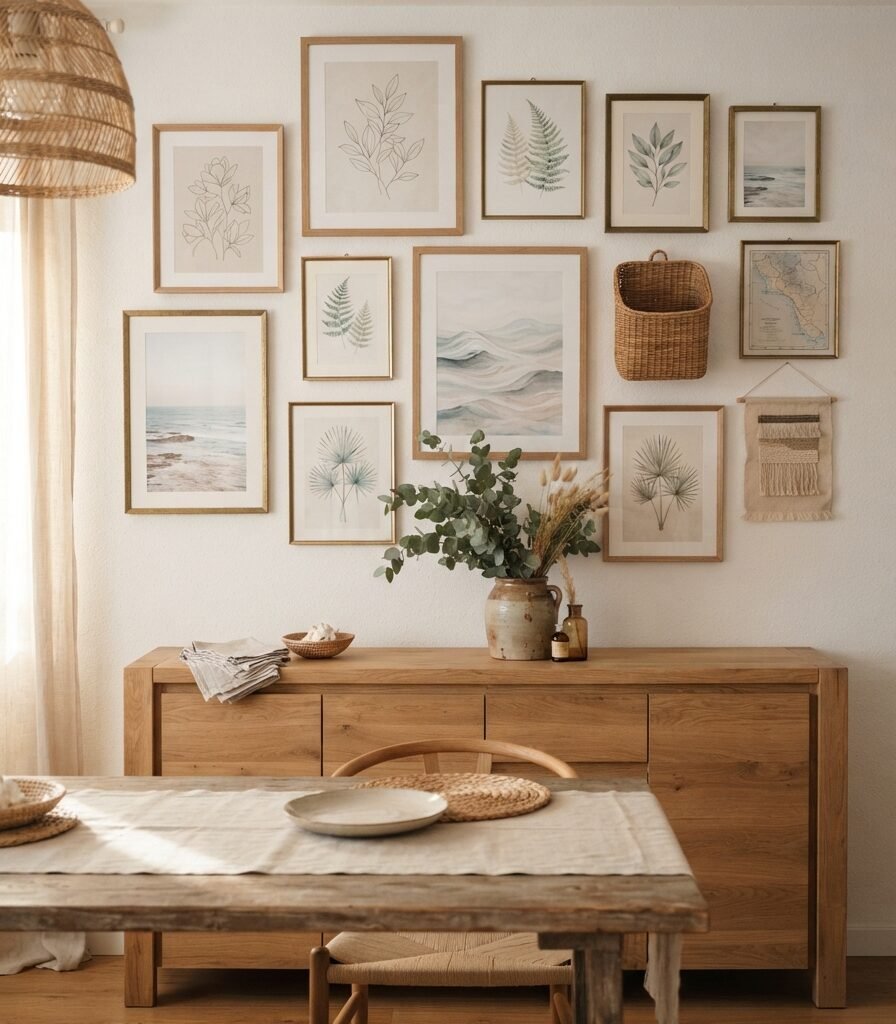
Vibe: The wall feels collected and quietly personal.
Why it works: Coastal artwork works best when it references the environment without literally illustrating a beach in every frame. Mixing botanical studies, abstract water shapes, and restrained landscape photography creates thematic cohesion while varying the visual language. The sideboard provides a horizontal anchor beneath the vertical artwork.
How to get it: Keep the frames within one restrained family- natural oak, thin black, or aged brass- and allow approximately 5–8 cm between smaller frames. Use one larger artwork as the anchor and build outward rather than creating a rigid grid.
Quick Win: Start with three prints in different sizes and lean them on a sideboard before drilling holes; this lets you test the composition at zero installation cost.
Shop The Look
| Product | Search phrase |
| Art | Neutral coastal abstract ocean wall art set |
| Frames | Natural oak picture frames assorted sizes |
| Sideboard | Light wood coastal buffet cabinet |
| Basket | Small woven seagrass wall basket |
| Vase | Matte ivory ceramic vase tall |
14. Coastal Dining Room with a Round Table
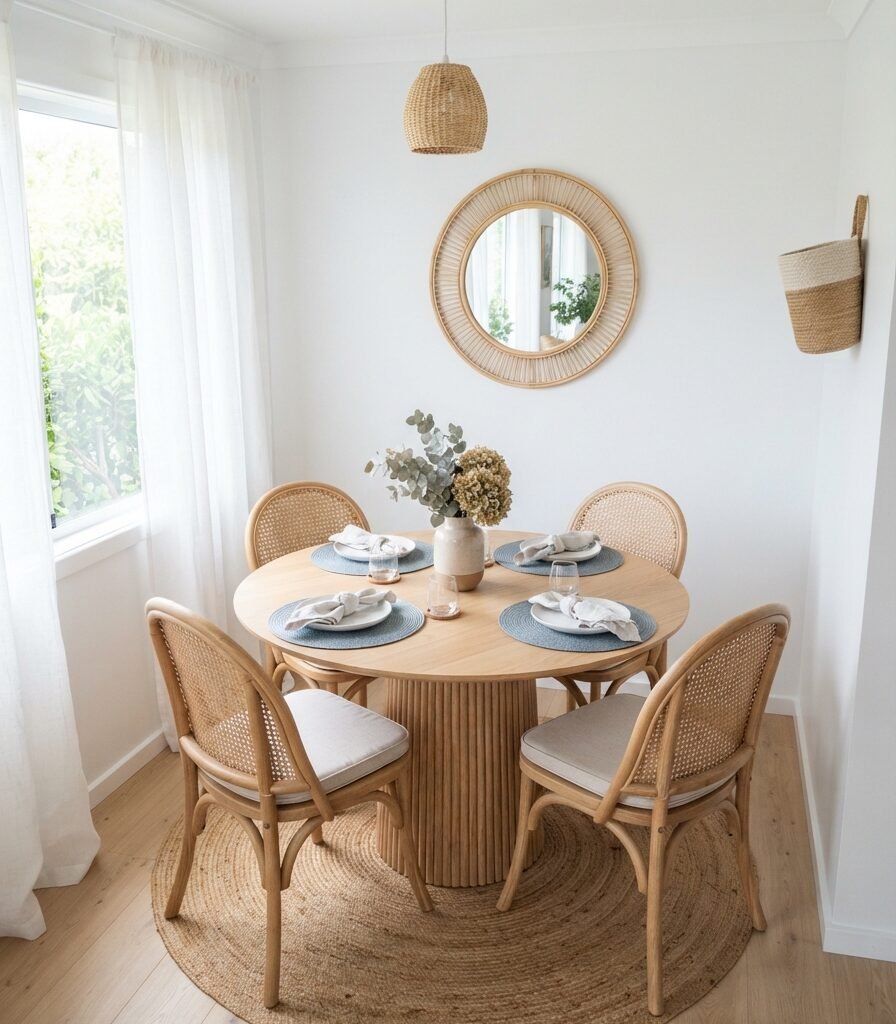
Vibe: The room feels social and fluid.
Why it works: Round tables are particularly effective in compact dining rooms because their continuous edge improves circulation and eliminates sharp corners in the main walking path. A pedestal base further reduces visual and physical obstruction beneath the tabletop. Curved cane chairs reinforce the softer geometry.
How to get it: For four people, choose a round table around 100–120 cm in diameter. Keep at least 90 cm of usable circulation around the main seating zone wherever the architecture permits.
Shop The Look
| Product | Search phrase |
| Table | 42-inch round pale oak pedestal dining table |
| Chairs | Natural cane round back dining chairs set 4 |
| Pendant | Small woven rattan pendant light |
| Mirror | Round natural wood wall mirror 30 inch |
| Placemats | Blue gray woven round placemats set |
15. Coastal Dining Room with Natural Wood and Brass Accents

Vibe: The room feels polished without becoming formal.
Why it works: Aged brass adds warmth and a small amount of reflective contrast to the predominantly matte coastal palette. The important distinction is finish: aged or brushed brass works better than highly polished yellow brass because it has a softer relationship with linen and natural wood. Repeating the metal in two or three locations creates visual continuity.
How to get it: Choose one brass finish and repeat it from the main pendant to smaller details such as candle holders or sideboard pulls. Avoid mixing polished chrome, shiny gold, and brass within the same compact dining room.
Shop The Look
| Product | Search phrase |
| Pendant | Aged brass coastal dining pendant light |
| Table | Natural oak dining table medium tone |
| Chairs | Cream linen upholstered dining chairs |
| Candle holders | Aged brass taper candle holder set |
| Vase | Dusty blue ceramic table vase |
16. Relaxed Coastal Dining Room with a Low Centerpiece
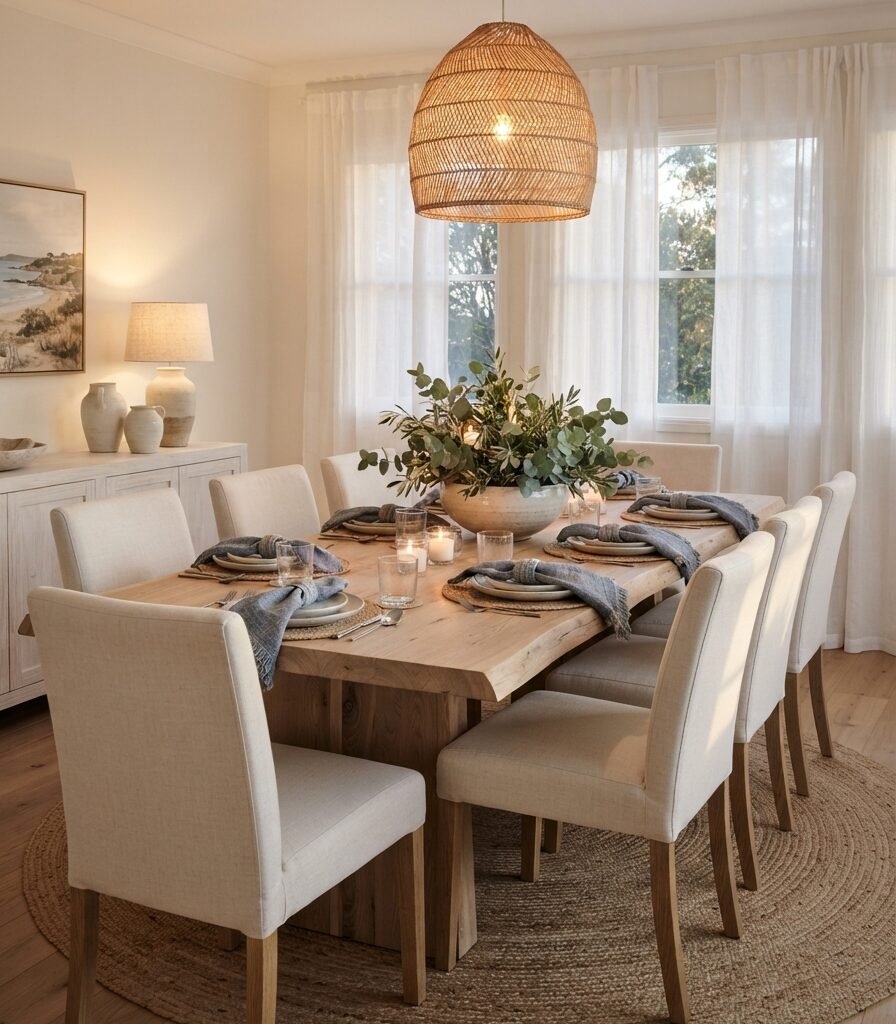
Vibe: The table feels hushed, relaxed, and ready for a long meal.
Why it works: A low centerpiece protects sightlines across the table, which matters more in a dining room than creating maximum decorative height. The wide vessel spreads greenery horizontally and visually echoes the length of the table. Small candleholders introduce a second light level once daylight disappears.
How to get it: Choose a centerpiece vessel no taller than about 20–25 cm so seated guests can comfortably see one another. Arrange branches loosely rather than creating a dense florist-style bouquet; coastal styling benefits from visible negative space.
Quick Win: Use a shallow ceramic serving bowl you already own, add three eucalyptus stems, and place two small battery-operated candles beside it for a five-minute coastal centerpiece.
Shop The Look
| Product | Search phrase |
| Vase | Low wide matte ceramic centerpiece bowl |
| Botanicals | Realistic eucalyptus olive branch stems |
| Candles | Warm white flameless taper candles |
| Runner | Natural flax linen table runner |
| Napkins | Muted blue linen napkins set 4 |
How to Start Your Coastal Dining Room Transformation
The first move should be choosing your dining room’s main wood tone, and pale natural oak is the most flexible starting point for a classic coastal scheme. It establishes warmth beneath white walls while working naturally with rattan, linen, sea-glass blue, and aged brass. Once that anchor is fixed, every later purchase can be judged against it instead of creating a collection of unrelated pale finishes.
The most common mistake is making everything blue and white. That combination can quickly become visually flat or overly themed when there is no warm material underneath it. Correct the problem by treating blue as an accent and allowing natural oak, jute, rattan, linen, and warm white to occupy most of the room.
Three inexpensive entry points can make an immediate difference: a natural linen table runner under $30, a small sea-glass blue ceramic vase under $25, and a woven seagrass tray under $40. These introduce texture and coastal color without requiring new furniture.
A starter coastal dining refresh can realistically take one weekend and roughly $150–$500 if the existing table and chairs remain. A more substantial transformation involving new furniture, lighting, rugs, and window treatments can range from $1,500 to $5,000+, depending heavily on furniture quality and room size. Custom built-ins, flooring, plaster finishes, and architectural changes are projects measured in weeks or months rather than a weekend.
Frequently Asked Questions About Coastal Dining Room Ideas
What is the difference between coastal and nautical dining room style?
Coastal design is primarily about atmosphere, natural materials, light, and relaxed color, while nautical design tends to use recognizable maritime symbols such as anchors, ropes, stripes, and ship-inspired details. A coastal dining room might use pale oak, linen, rattan, and sea-glass blue without displaying any nautical objects. If you want a timeless result, keep overt maritime motifs limited and let materials communicate the theme instead.
What colors work best for a coastal dining room?
Warm white, sand, pale blue, dusty blue-gray, sea-glass green, and muted navy are reliable coastal colors. For a warmer room, combine creamy white with pale oak and sandy beige rather than bright white and icy blue. A useful ratio is roughly 60% warm neutral, 30% natural wood and texture, and 10% blue or green accent.
How much does it cost to decorate a coastal dining room?
A small styling refresh can cost around $150–$500 when the existing furniture is retained, and the focus is on textiles, lighting, artwork, and accessories. Replacing a dining table, chairs, pendant, and rug can move the budget toward $1,500–$5,000 or more. Custom furniture, built-in seating, premium lighting, and architectural work can push the total substantially higher.
Can coastal style work in a dining room that gets little natural light?
Yes, but the color temperature and material choices become especially important. Use warm white walls rather than cool gray-white, pale oak rather than very dark furniture, and layered lighting with 2700K bulbs. A large mirror placed where it can catch available daylight can also increase the perceived brightness of the room.
What type of lighting is best for a coastal dining room?
A woven rattan, seagrass, cane, or linen-textured pendant is one of the most effective choices because it combines ambient lighting with natural material texture. Hang the fixture roughly 75–85 cm above the dining table and use a dimmable bulb around 2700K for warm evening light. If the room is large, supplement the pendant with wall sconces or a sideboard lamp rather than relying on one ceiling fixture.
Ready to Create Your Dream Coastal Dining Room?
These 16 coastal dining room ideas cover everything from pale oak furniture and woven lighting to blue textiles, small-space layouts, natural rugs, mirrors, and relaxed table styling. A coastal transformation is incremental, and beginning with one table, one textile, or one lighting change is often the smartest way to build a cohesive room. Today, replace your existing table runner with natural linen and add one muted blue ceramic vessel to establish the palette immediately. As the materials become warmer and the visual clutter falls away, the room should begin to feel lighter, calmer, and easier to live in- the real philosophy behind coastal design. Save your favorite ideas now, especially the ones featuring pale oak, woven textures, and sea-glass tones, so you can return to them when you’re ready to shape your own coastal dining space.