
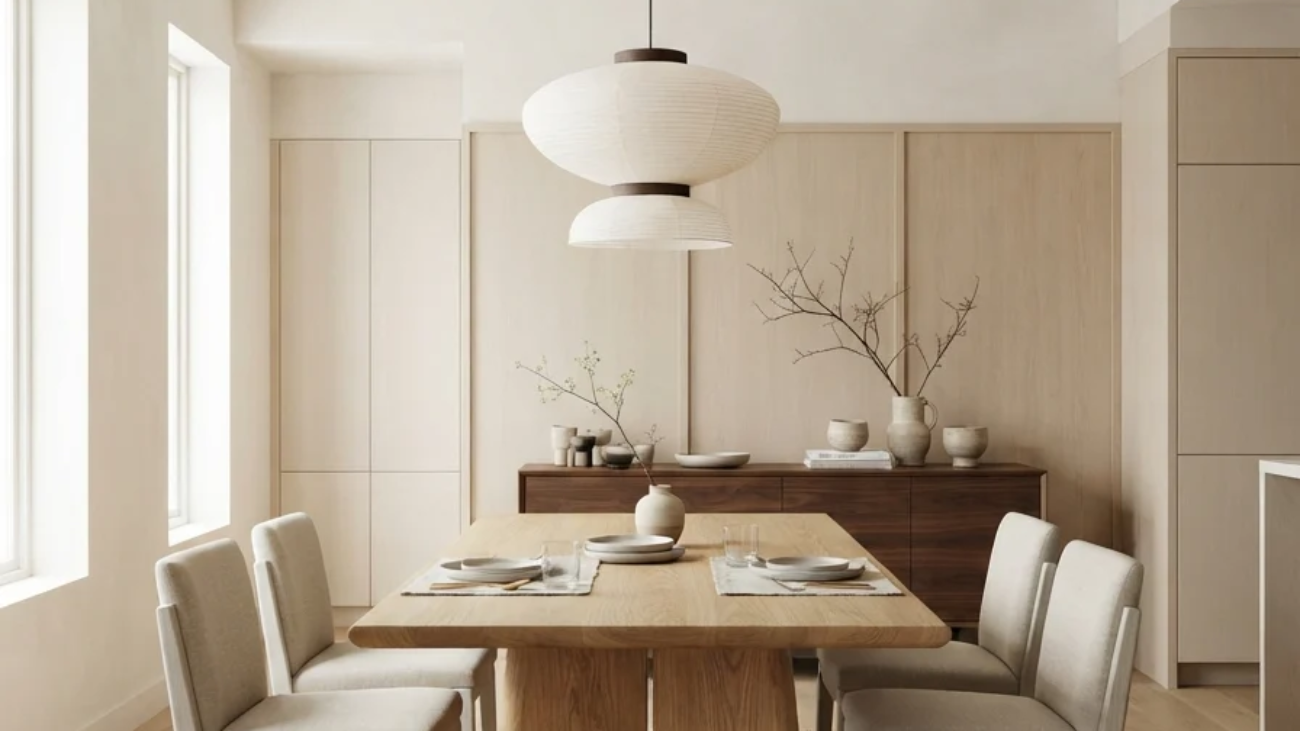
Japandi is an interior style that combines Japanese restraint and wabi-sabi principles with Scandinavian warmth, functional simplicity, and natural materials. These 24 Japandi dining room designs show how to use wood, neutral colors, lighting, furniture proportions, texture, and thoughtful layouts to create a dining space that feels calm without becoming cold.
The best Japandi rooms do not feel empty; they feel edited. Morning light falls across pale oak, linen softens hard surfaces, and a single ceramic vessel can carry more visual weight than an entire shelf of accessories. There is warmth without clutter and simplicity without sterility. The dining table becomes less like a piece of furniture and more like the quiet center of the room. Here are 24 ideas worth saving and stealing.
Why Japandi Dining Room Design Works So Well
Japandi developed from the visual compatibility between Japanese minimalism and Scandinavian functionalism. Japanese interiors contribute restraint, natural imperfection, asymmetry, and wabi-sabi, while Scandinavian design contributes practicality, pale woods, comfortable forms, and an emphasis on everyday living. The result is distinct from stark minimalism because Japandi allows warmth, texture, craftsmanship, and carefully selected imperfections.
Its material palette is tactile rather than decorative: white oak, ash, walnut, bamboo, rattan, linen, wool, handmade ceramics, travertine, and lightly textured plaster. Colors usually stay close to nature: warm white, oatmeal, mushroom taupe, sand, greige, charcoal, muted sage, and soft clay. Black is useful as a small architectural accent rather than the dominant color.
Style at a Glance
| Element | Japandi Dining Room |
| Philosophy | Quiet function, intentional simplicity, wabi-sabi |
| Core Materials | White oak, ash, walnut, linen, wool, rattan, ceramic, stone |
| Color Palette | Warm white, oatmeal, greige, mushroom, charcoal, muted sage |
| Furniture | Low-profile, rounded, functional, visually light |
| Lighting | Soft diffused light, paper, linen, wood, matte finishes |
| Accessories | Few objects, handmade ceramics, branches, natural textiles |
| Signature Detail | Imperfect texture balanced by precise proportions |
1. Pale Oak Table With Warm White Walls
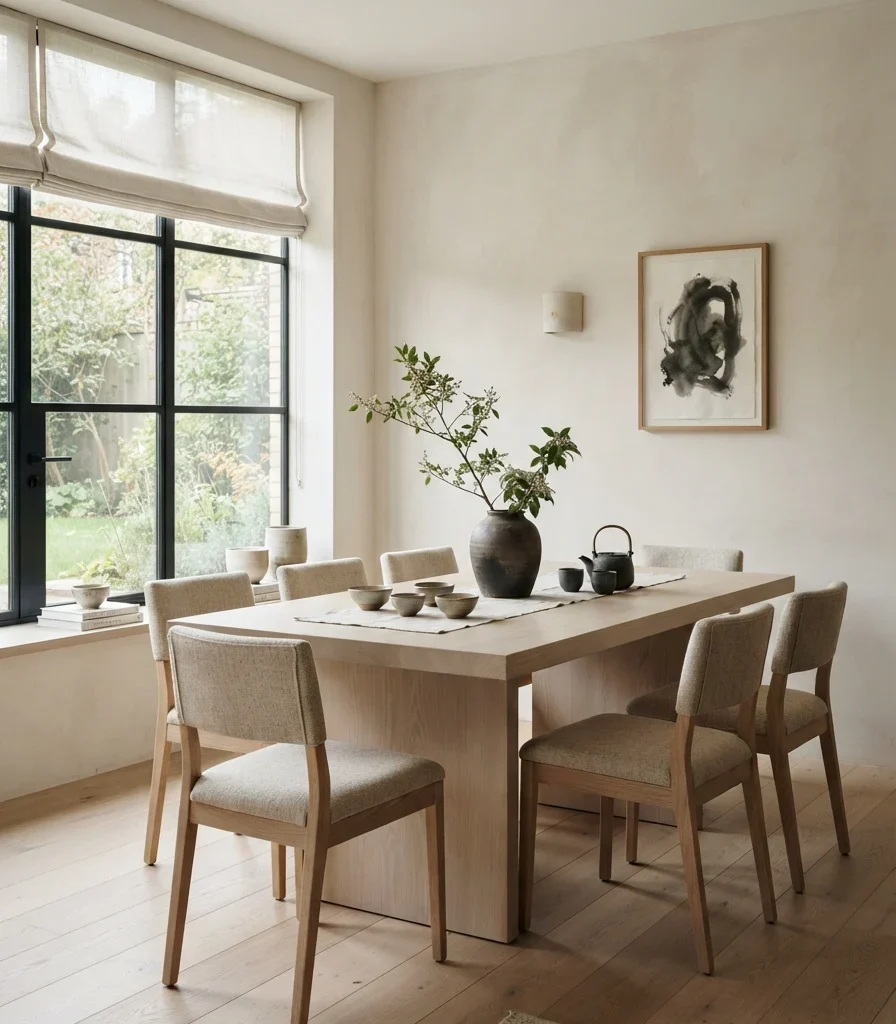
Category: MATERIAL
Vibe: The room feels hushed, warm, and quietly tactile.
Why it works: The Japandi principle here is material hierarchy: the unfinished-looking white oak becomes the dominant texture while warm white walls create negative space around it. Pale wood prevents the dining room from becoming visually heavy, while charcoal details give the soft palette enough contrast to remain defined.
How to get it: Choose a table with a matte or low-sheen oak finish rather than orange-toned varnish. Pair it with warm white walls instead of blue-based white so the wood remains visually connected to the architecture.
Quick Win: Add a handmade-looking off-white stoneware bowl filled with three or four sculptural branches.
Shop The Look
| Product | Purpose |
| Light oak Japandi dining table | Natural foundation |
| Oatmeal linen dining chair covers | Soft texture |
| Handmade off-white stoneware bowl | Organic centerpiece |
| Natural wood branch arrangement | Vertical accent |
| Warm white textured wall art | Quiet wall detail |
2. Round Dining Table for Better Conversation
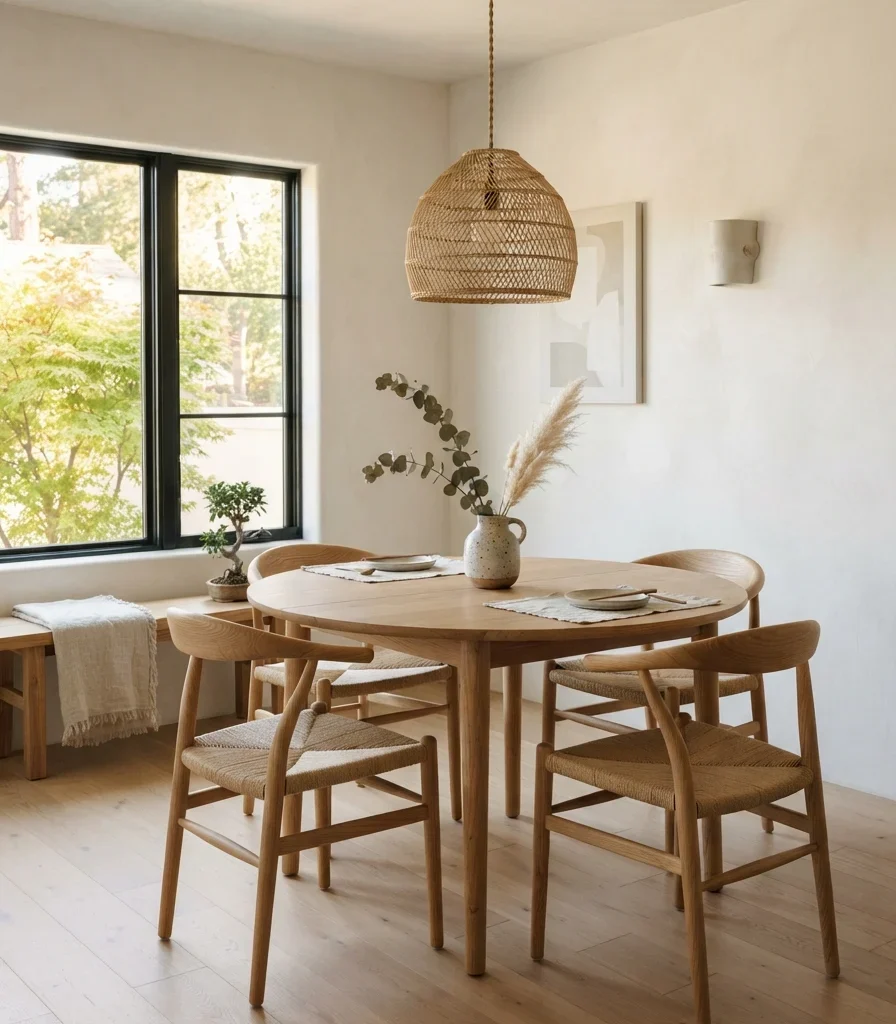
Category: FURNITURE
Vibe: The arrangement feels grounded and naturally social.
Why it works: A round table removes the visual hierarchy of a head position and creates equal sightlines between diners. The circular tabletop also introduces an organic counterpoint to the straight architectural lines common in modern homes.
How to get it: For four people, start around a 90–110 cm diameter table; for six, consider approximately 120–140 cm depending on chair width. Keep the chairs visually slim so the circular silhouette remains dominant.
Shop The Look
| Product | Purpose |
| Round light oak dining table | Central anchor |
| Curved-back wood dining chairs | Organic seating |
| Woven pendant light | Soft overhead texture |
| Round jute dining rug | Defines table zone |
| Minimal ceramic bud vase | Small centerpiece |
3. Japandi Dining Room With Charcoal Contrast

Category: COLOR
Vibe: The space feels balanced, with a gentle graphic edge.
Why it works: Japandi needs contrast, but excessive black can overpower its softness. A controlled charcoal accent- window frames, one pendant, or chair legs- creates visual punctuation without changing the room’s calm character.
How to get it: Use a roughly 80/15/5 palette: warm neutral as the foundation, natural wood as the secondary tone, and charcoal as the smallest accent. Repeat charcoal in at least two places so it looks intentional rather than accidental.
Quick Win: Replace three small decorative objects with one matte charcoal ceramic vase.
Shop The Look
| Product | Purpose |
| Matte charcoal ceramic vase | Dark accent |
| Pale oak dining table | Warm foundation |
| Ivory linen dining chairs | Soft balance |
| Black dome pendant light | Graphic contrast |
| Mushroom linen runner | Tonal bridge |
4. Linen Upholstered Dining Chairs

Category: MATERIAL
Vibe: The room feels soft without losing structure.
Why it works: Upholstery introduces acoustic and tactile softness into a dining room dominated by hard surfaces. Natural linen also keeps the chairs visually quieter than velvet or patterned upholstery, allowing the table to remain the focal point.
How to get it: Choose a tightly woven linen or linen-look fabric in oatmeal rather than bright cream. The slightly darker undertone is more forgiving around a dining table and better complements medium wood.
Shop The Look
| Product | Purpose |
| Oatmeal linen dining chairs | Upholstered seating |
| Walnut dining table | Warm contrast |
| Textured plaster-look wall panel | Background texture |
| Stoneware serving bowl | Centerpiece |
| Natural linen table runner | Textile layer |
5. Paper Lantern Above the Dining Table

Category: LIGHTING
Vibe: The atmosphere feels luminous and gentle.
Why it works: A paper lantern diffuses light instead of producing a hard spotlight, which supports the soft visual transitions central to Japandi. Its rounded silhouette also prevents a rectangular dining table from becoming too linear.
How to get it: Select a pendant large enough to relate to the table; generally, around one-half to two-thirds of the table width is a useful visual starting point. Hang it so the bottom sits roughly 70–80 cm above the tabletop, then adjust for sightlines.
Quick Win: Swap a cool-white bulb for a warm 2700K LED to immediately soften the room.
Shop The Look
| Product | Purpose |
| Large rice paper pendant | Diffused focal light |
| 2700K warm LED bulb | Soft illumination |
| Pale oak dining table | Natural base |
| Linen dining chair set | Texture |
| Ceramic pendant ceiling canopy | Clean finish |
6. Walnut and Cream Japandi Dining Room
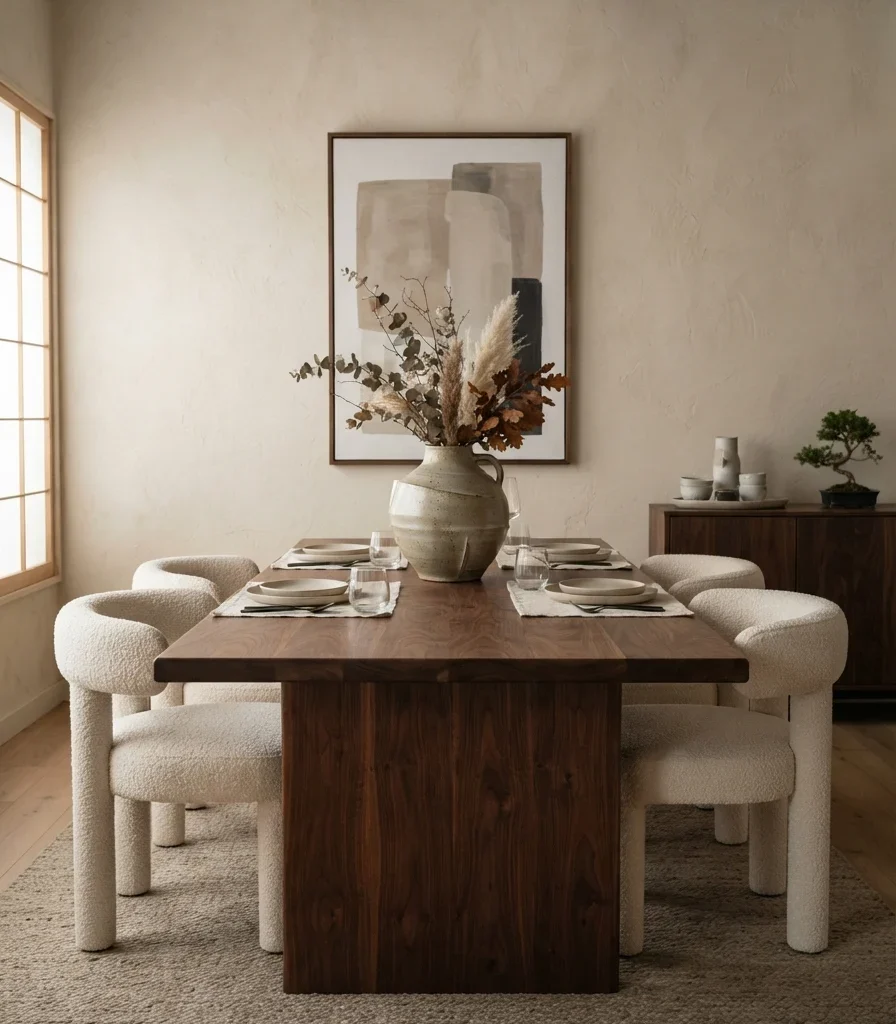
Category: COLOR
Vibe: The dining room feels rich while remaining restrained.
Why it works: Dark walnut provides visual weight against pale walls, creating a high-value tonal contrast without relying on bright colors. Cream upholstery softens the transition between the dark table and light architecture.
How to get it: Repeat walnut at least twice, perhaps in the table and a sideboard, rather than introducing several unrelated wood tones. Keep the walls lighter to preserve the visual breathing room.
Shop The Look
| Product | Purpose |
| Dark walnut dining table | Visual anchor |
| Cream boucle dining chairs | Soft contrast |
| Ivory ceramic vase | Light accessory |
| Walnut serving tray | Wood repetition |
| Beige linen runner | Transitional texture |
7. Sculptural Wood Dining Chairs

Category: FURNITURE
Vibe: The room feels crafted and quietly expressive.
Why it works: Japandi furniture often gains character through silhouette rather than decoration. A curved wooden back provides visual movement while the restrained table and walls keep the chairs from becoming overly sculptural.
How to get it: Look for chairs with exposed wood grain, rounded edges, and a relatively open back. Avoid ornate carving; the form should provide interest without becoming a decorative theme.
Shop The Look
| Product | Purpose |
| Curved ash wood dining chairs | Sculptural seating |
| Natural oak dining table | Simple foundation |
| Stone pedestal bowl | Organic accent |
| Taupe woven rug | Grounding layer |
| Minimal wood serving board | Functional decor |
8. Travertine Dining Table With Oak Chairs

Category: MATERIAL
Vibe: The room feels earthy and architectural.
Why it works: Travertine introduces mineral texture and visual mass while oak prevents the room from feeling too hard. This is a useful Japandi pairing because stone and wood create contrast through material rather than color.
How to get it: Select honed travertine rather than highly polished stone if you want a softer, more authentic surface. Expect natural pores and tonal variation; these are part of the material rather than defects.
Quick Win: Use a small travertine-look pedestal bowl on an existing wooden table.
Shop The Look
| Product | Purpose |
| Honed travertine dining table | Stone centerpiece |
| Pale oak dining chairs | Warm balance |
| Travertine pedestal bowl | Material repetition |
| Beige wool flatweave rug | Soft grounding |
| Handmade clay vase | Organic texture |
9. Built-In Dining Bench for a Calm Wall
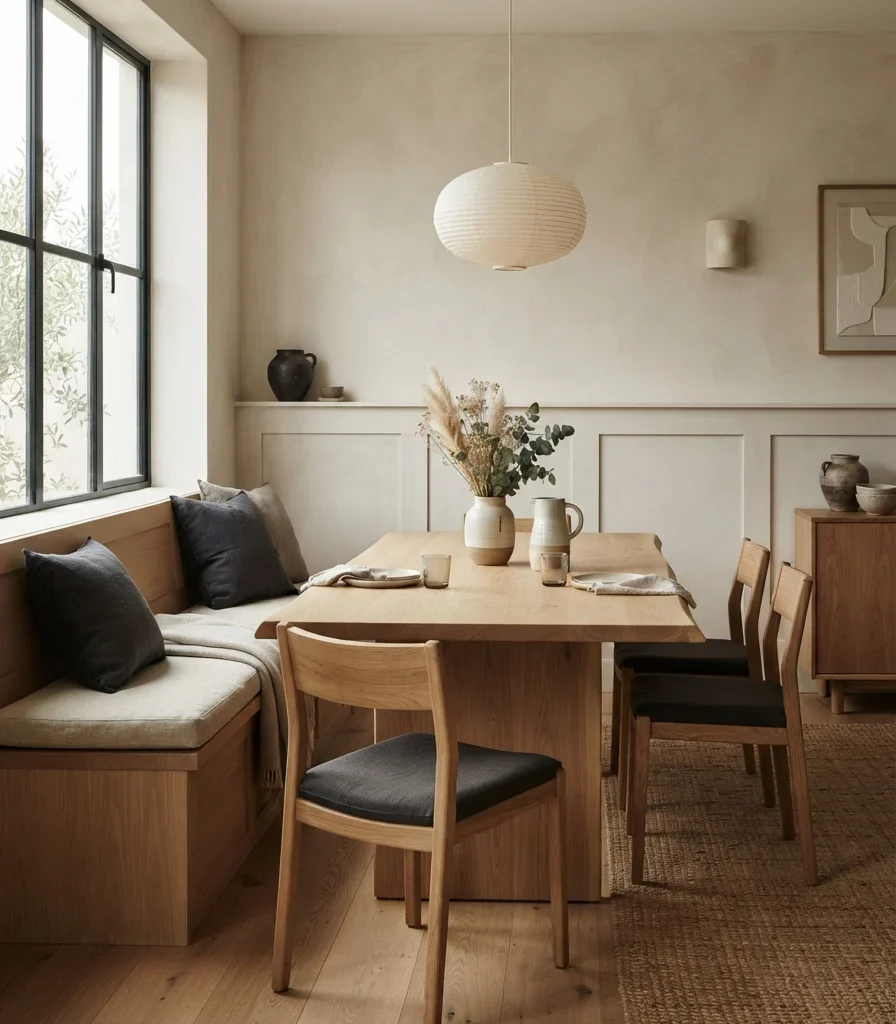
Category: LAYOUT
Vibe: The layout feels settled and efficient.
Why it works: A built-in bench removes the visual clutter created by chair backs along one wall and can make a dining area feel architecturally integrated. It is particularly effective when the room is narrow because the bench uses wall-side space more efficiently.
How to get it: Keep the bench depth around 45–50 cm and use a removable seat cushion so the upholstery remains practical. Allow enough knee clearance beneath the table instead of pushing the tabletop tightly against the bench.
Shop The Look
| Product | Purpose |
| Oak dining bench | Space-efficient seating |
| Oatmeal bench cushion | Comfort layer |
| Slim rectangular dining table | Clear circulation |
| Linen side chairs | Flexible seating |
| Minimal wall sconce | Architectural light |
10. Handmade Ceramic Centerpiece

Category: ACCESSORIES
Vibe: The table feels organic and intentionally imperfect.
Why it works: Wabi-sabi allows irregularity to become part of the composition. A handmade ceramic vessel introduces variation in shape and glaze that mass-produced symmetrical objects often lack.
How to get it: Choose one vessel with an uneven rim or lightly mottled glaze rather than assembling multiple matching pieces. Keep the branches sparse; three to five stems are enough.
Quick Win: Style a single handmade-looking ceramic vase in the exact center of your existing dining table.
Shop The Look
| Product | Purpose |
| Handmade irregular ceramic vase | Centerpiece |
| Dried sculptural branches | Vertical form |
| Sage linen napkins | Muted color |
| Natural oak serving board | Organic base |
| Stoneware candle holder | Secondary texture |
11. Low Sideboard With Negative Space

Category: FURNITURE
Vibe: The room feels spacious despite having substantial furniture.
Why it works: Negative space is doing as much work as the sideboard itself. Instead of filling the entire wall, the low cabinet creates horizontal visual weight while leaving generous breathing room above.
How to get it: Keep the wall above the sideboard mostly empty and place only two or three objects on the surface. The strongest composition is often the one that stops before the wall feels “finished.”
Shop The Look
| Product | Purpose |
| Low walnut sideboard | Storage anchor |
| Ceramic table lamp | Soft glow |
| Sculptural stone vase | Focal object |
| Neutral framed print | Optional wall layer |
| Woven storage basket | Hidden utility |
12. Soft Sage Accent in a Japandi Dining Room
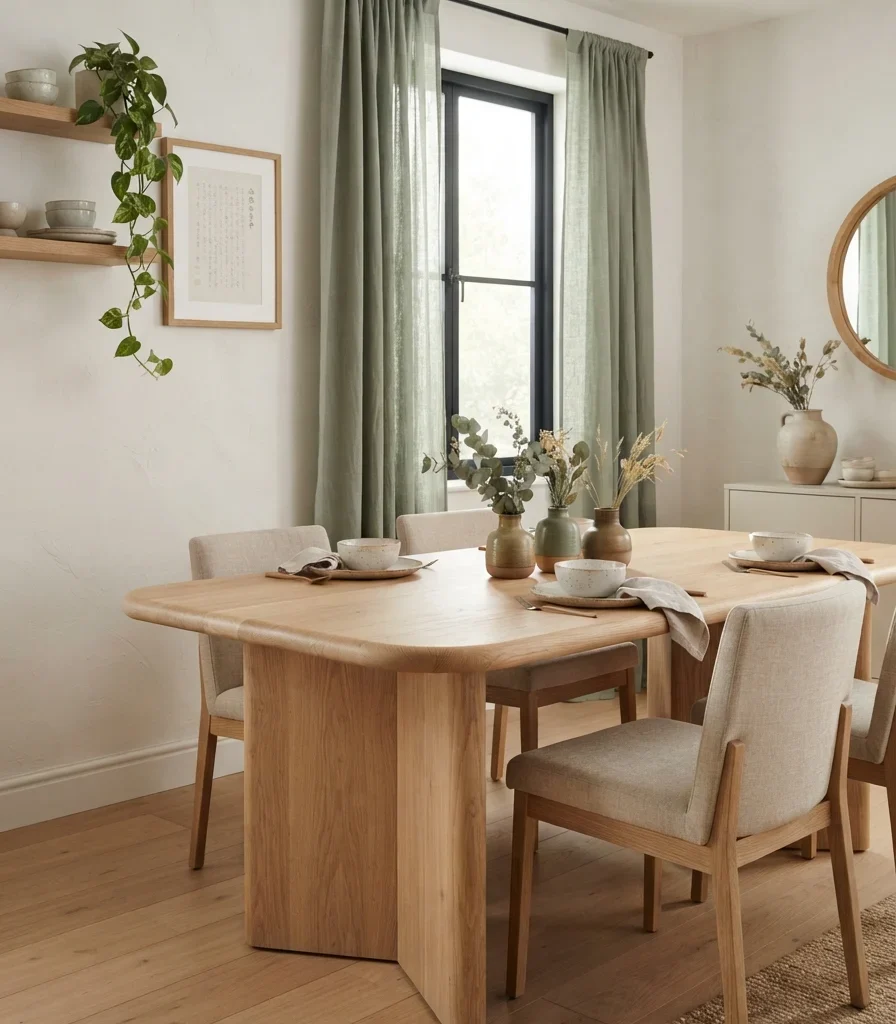
Category: COLOR
Vibe: The room feels fresh without becoming colorful.
Why it works: Muted sage behaves almost like a neutral when paired with warm wood and cream. Its low saturation prevents the dining room from losing Japandi restraint while introducing enough chromatic variation to stop the palette from becoming flat.
How to get it: Use sage on one large textile surface rather than scattering green accessories around the room. Linen curtains are particularly effective because their folds create tonal variation.
Quick Win: Add sage linen napkins or two sage cushion covers before repainting anything.
Shop The Look
| Product | Purpose |
| Muted sage linen curtains | Color layer |
| Pale oak dining table | Natural base |
| Oatmeal upholstered chairs | Neutral seating |
| Sage linen napkin set | Small repetition |
| Mushroom ceramic vase | Tonal bridge |
13. Japandi Dining Room With Arched Mirror
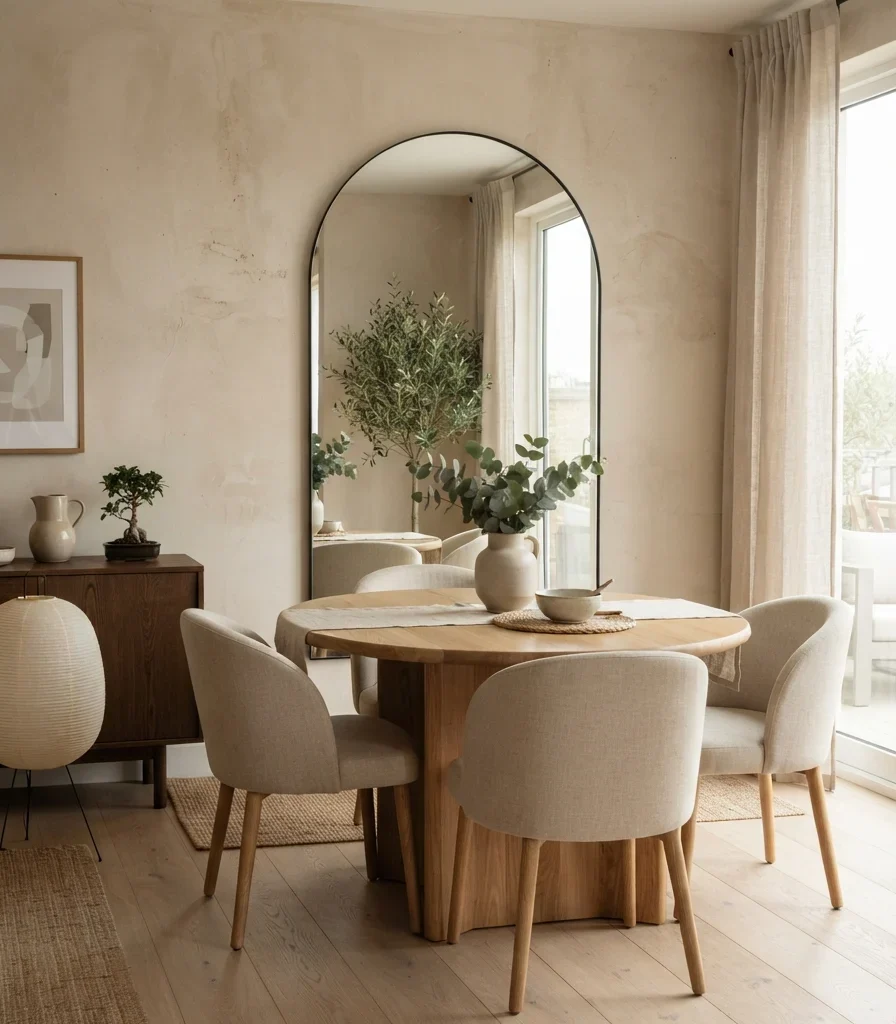
Category: ACCESSORIES
Vibe: The room feels airy and visually expanded.
Why it works: The mirror creates depth through reflection while the arched top introduces a soft geometric shape against the dining furniture. It works best when it reflects a pleasant view rather than clutter or another busy wall.
How to get it: Position the mirror so it catches side-window light rather than directly reflecting a bright window. A thin oak or natural wood frame keeps the piece consistent with Japandi restraint.
Shop The Look
| Product | Purpose |
| Thin oak arched mirror | Spatial focal point |
| Pale oak dining table | Material continuity |
| Linen dining chairs | Soft texture |
| Minimal ceramic vase | Table accent |
| Natural fiber rug | Floor grounding |
14. Black-and-Oak Japandi Contrast
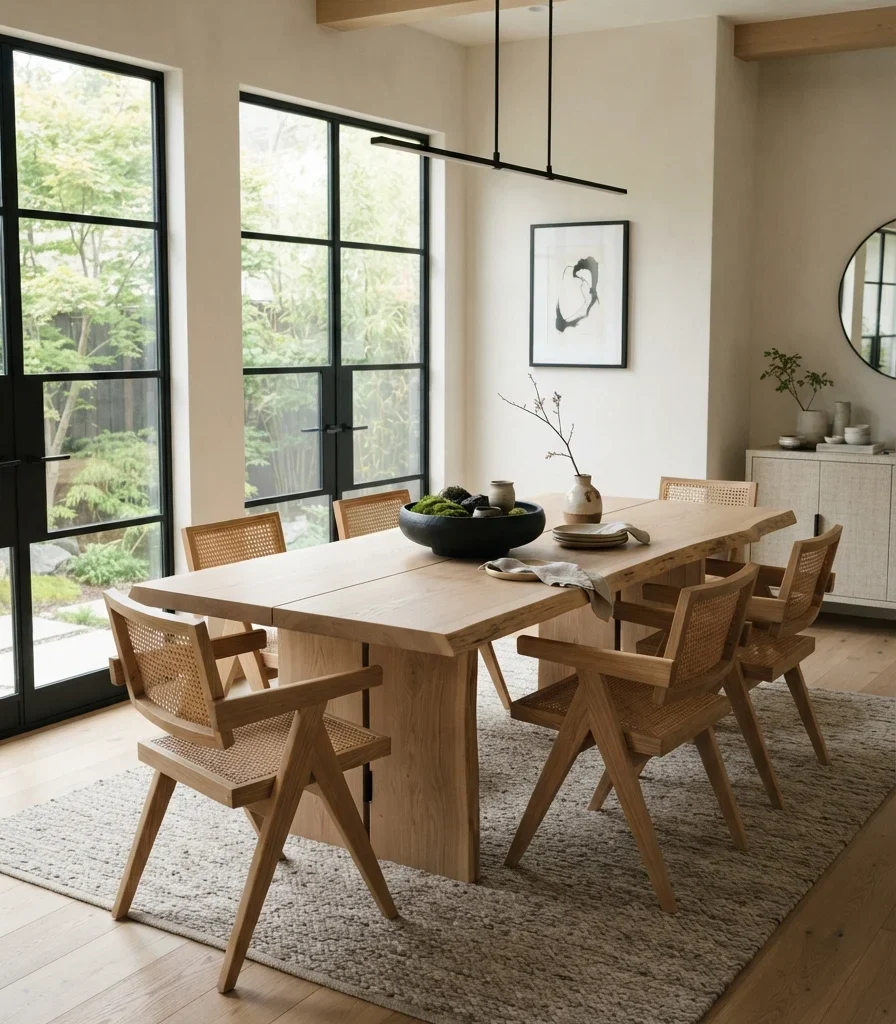
Category: COLOR
Vibe: The room feels crisp but still warm.
Why it works: Matte black adds definition to the pale wood palette and prevents the room from becoming visually washed out. The key is repetition: black should appear in several small architectural or decorative points rather than as one isolated statement.
How to get it: Repeat black in the pendant, window frames, chair legs, or ceramic accessories. Avoid glossy black because reflection introduces a more formal, high-contrast feeling.
Shop The Look
| Product | Purpose |
| Matte black pendant | Strong focal accent |
| Pale oak dining table | Warm contrast |
| Black ceramic vase | Small repetition |
| Natural wood chairs | Soft balance |
| Ivory wool rug | Visual buffer |
15. Wabi-Sabi Plaster Walls

Category: MATERIAL
IMAGE PROMPT: Japandi dining room with softly irregular limewashed plaster walls, low oak dining table, woven chairs, handmade ceramics, warm evening daylight, wide establishing shot, raw mood, tactile plaster and oak grain, chalk white, sand, pale oak, clay, photorealistic, 8K, Pinterest vertical 2:3, no people.
Vibe: The room feels raw and quietly grounded.
How to get it: If true plaster is outside your budget, use a mineral-based limewash or textured paint technique on one feature wall. Test the finish under both daylight and artificial light before committing because undertones can change dramatically.
Quick Win: Apply a removable textured wall panel behind the dining table rather than treating every wall.
Shop The Look
| Product | Purpose |
| Warm white limewash paint | Wall treatment |
| Pale oak dining table | Natural anchor |
| Woven dining chairs | Texture |
| Handmade clay vessel | Wabi-sabi accent |
| Neutral wool rug | Soft foundation |
16. Minimal Dining Table Styling
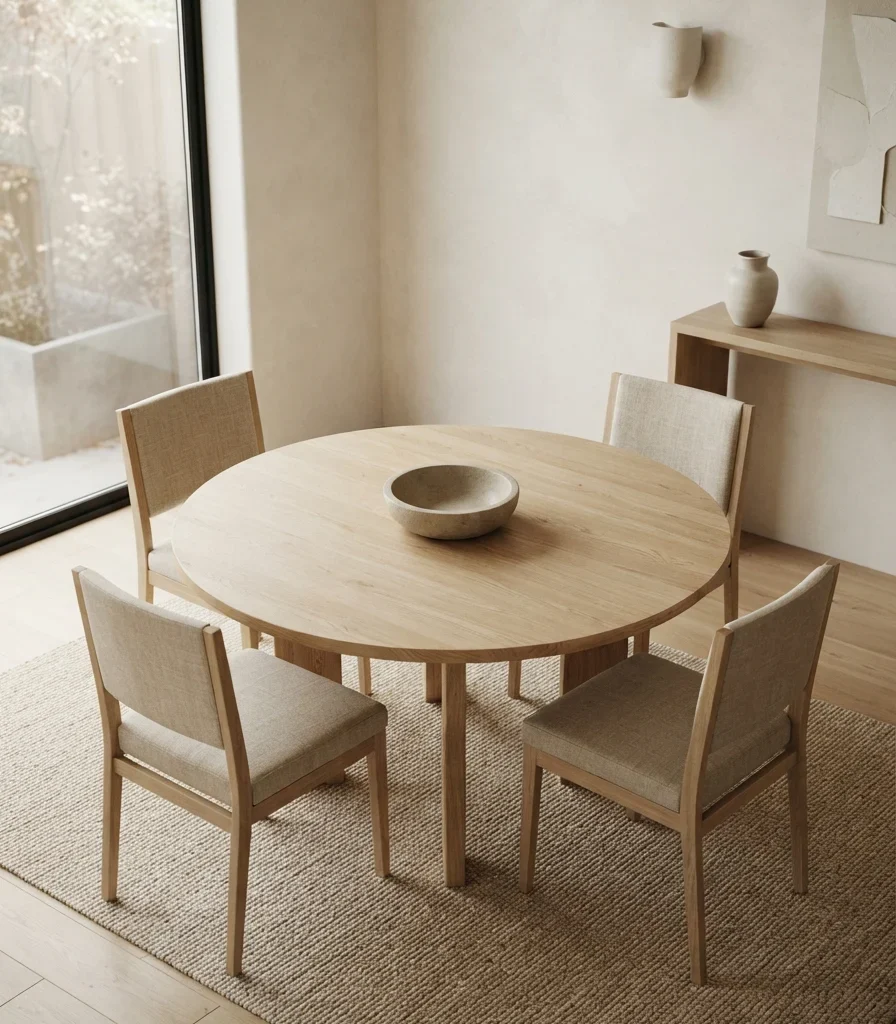
Category: ACCESSORIES
Vibe: The tabletop feels still and deliberate.
Why it works: Japandi relies heavily on visual hierarchy, and a mostly empty table gives the eye one clear destination. The low bowl keeps the center visually available while adding enough material contrast to prevent the room from looking unfinished.
How to get it: Use the “one hero object” rule: one bowl, vessel, branch arrangement, or candle cluster rather than several small accessories. Keep the object below eye level when seated.
Shop The Look
| Product | Purpose |
| Low limestone bowl | Hero centerpiece |
| Pale oak dining table | Clean foundation |
| Linen dining chairs | Soft seating |
| Neutral woven rug | Grounding |
| Handmade ceramic candle | Subtle glow |
17. Japandi Dining Nook With Window Seat
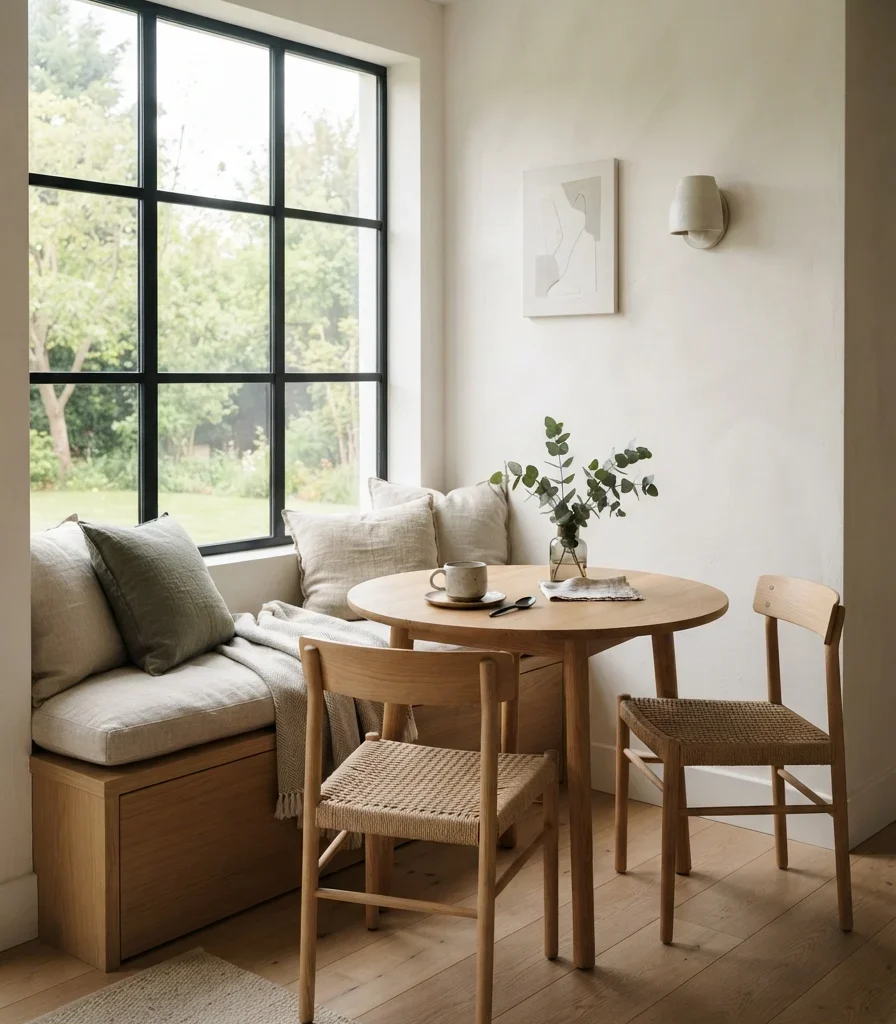
Category: SMALL SPACE
Vibe: The nook feels cozy without feeling cramped.
Why it works: A bench uses the perimeter of a small room more efficiently than four freestanding chairs. The round table further improves circulation because no sharp corners are competing with the walking path.
How to get it: Leave approximately 75–90 cm wherever regular traffic passes and choose a table diameter appropriate to the number of users. Keep the furniture visually light beneath the window.
Quick Win: Replace two dining chairs on one side with a slim bench to immediately open the circulation path.
Shop The Look
| Product | Purpose |
| Compact round oak table | Space-efficient table |
| Slim wooden dining chairs | Lightweight seating |
| Oatmeal bench cushion | Built-in softness |
| Linen Roman shade | Window treatment |
| Small ceramic planter | Natural accent |
18. Layered Neutral Textiles
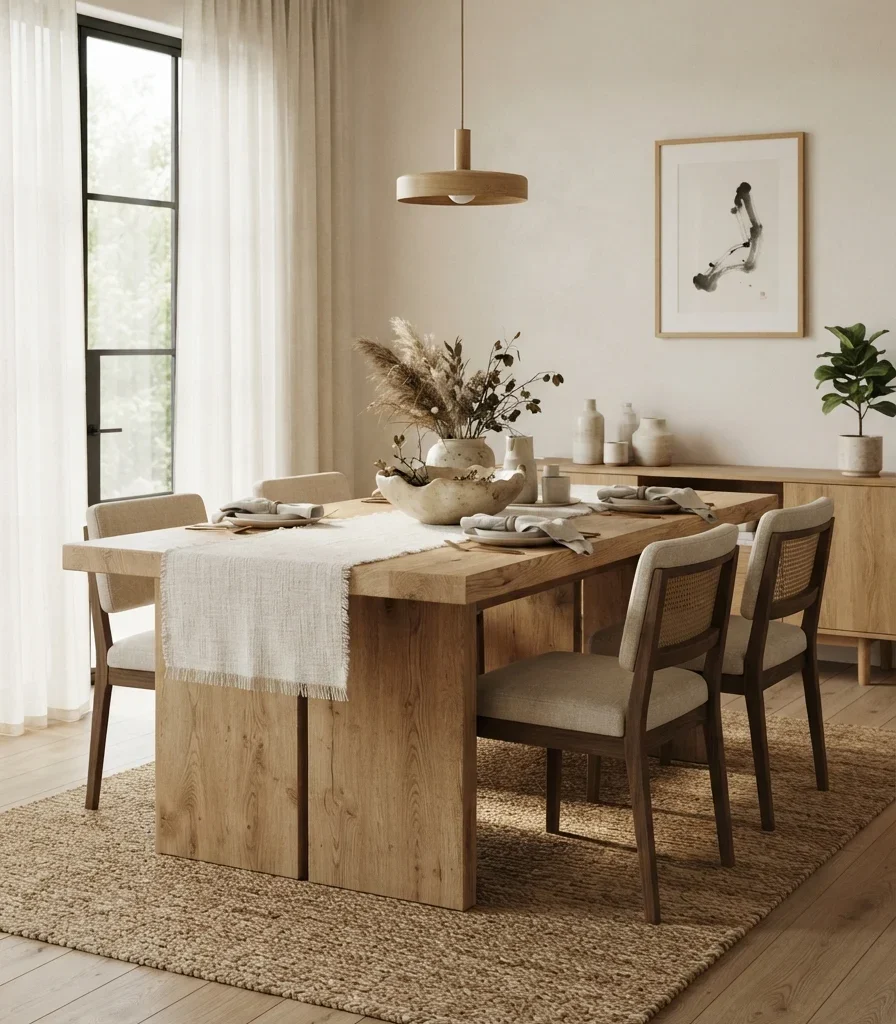
Category: MATERIAL
Vibe: The room feels layered while remaining quiet.
Why it works: Japandi can become flat when every surface is smooth and similarly colored. Texture layering solves that problem without requiring stronger colors: linen, jute, oak, and ceramic create distinct sensory surfaces within one tonal family.
How to get it: Change texture before changing color. Pair one coarse material such as jute with one soft material such as linen and one smooth material such as ceramic.
Shop The Look
| Product | Purpose |
| Natural jute dining rug | Coarse texture |
| Oatmeal linen chairs | Soft texture |
| Ivory linen curtains | Vertical softness |
| Pale oak table | Wood warmth |
| Textured ceramic runner-weight bowl | Smooth contrast |
19. Sculptural Pendant With Organic Curves
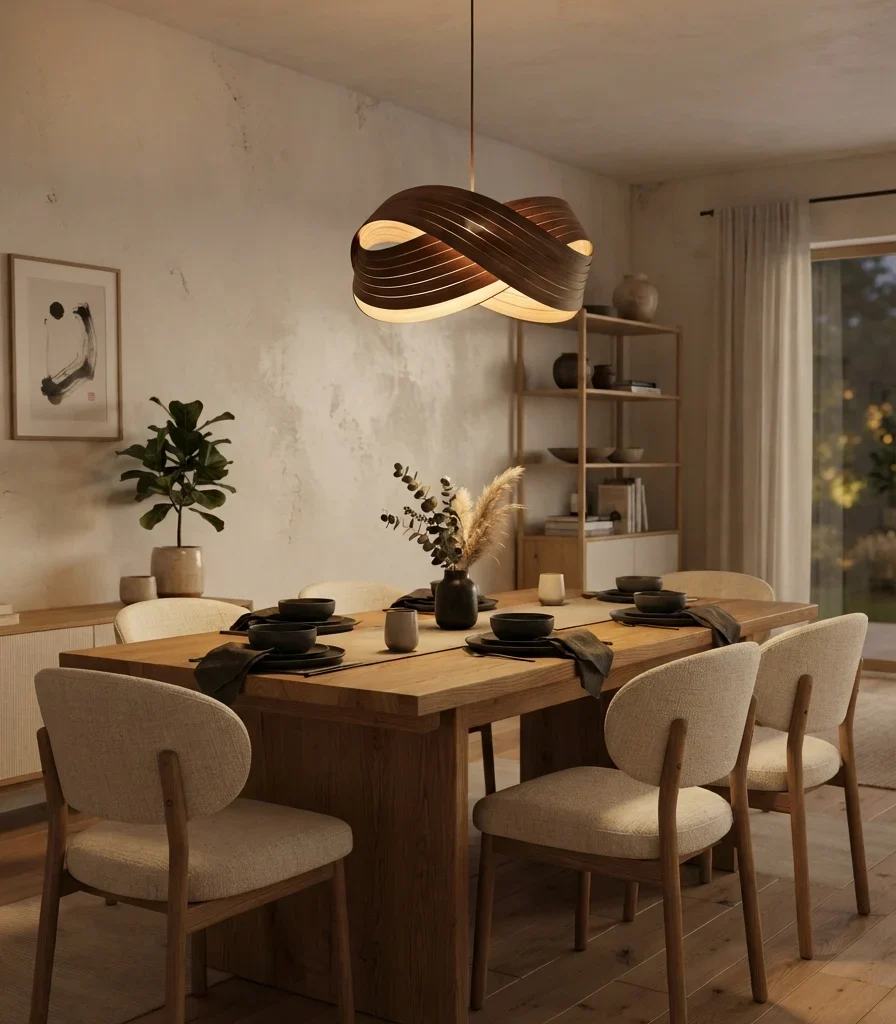
Category: LIGHTING
Vibe: The lighting feels warm and architectural.
Why it works: A sculptural pendant gives Japandi a focal point without requiring decorative clutter. Curved forms soften the strict horizontal line of the dining table and create a stronger sense of visual rhythm overhead.
How to get it: Choose a fixture with an organic silhouette and matte finish. The light source should be diffused or shielded enough to prevent glare across the table surface.
Quick Win: Install a dimmable warm LED bulb in your existing pendant before replacing the fixture.
Shop The Look
| Product | Purpose |
| Curved wood pendant light | Sculptural focal point |
| Dimmable 2700K LED bulbs | Warm atmosphere |
| Oak dining table | Material continuity |
| Cream linen chairs | Soft contrast |
| Matte ceramic centerpiece | Table texture |
20. Japandi Dining Room With Floor-to-Ceiling Curtains
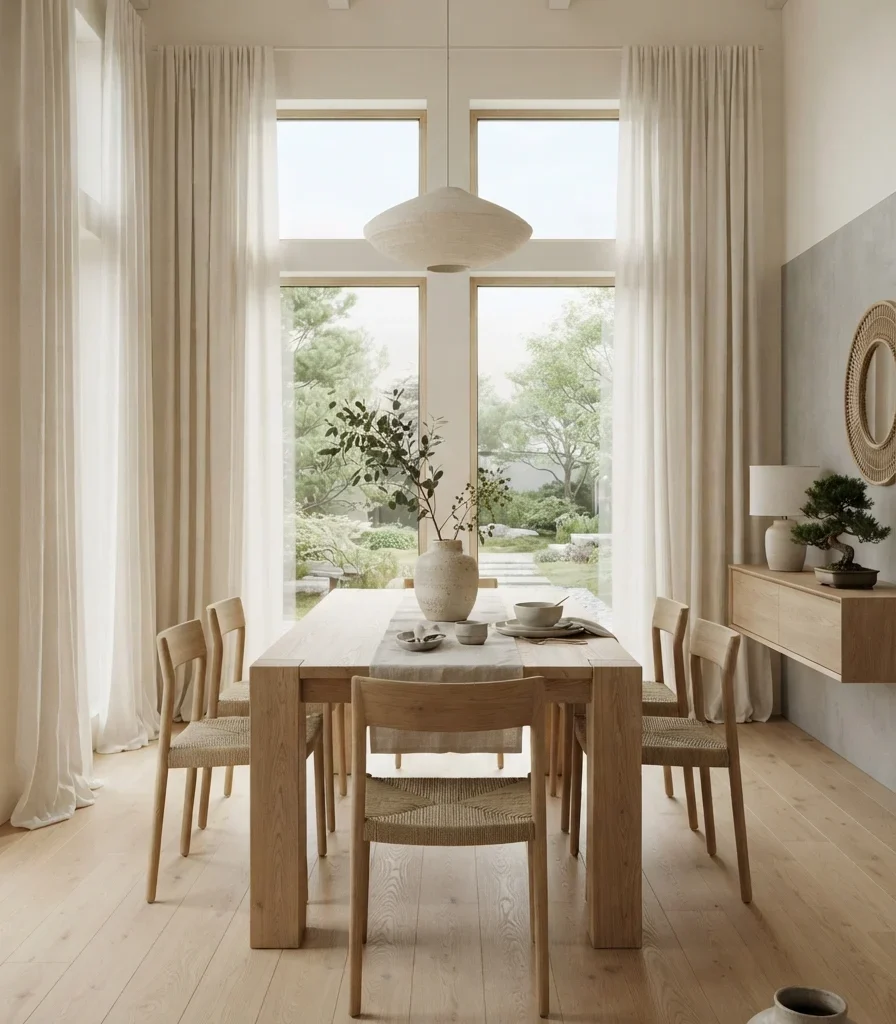
Category: LAYOUT
Vibe: The room feels elevated and open.
Why it works: Curtains that extend from near ceiling level to the floor create a strong vertical line and visually connect the window to the architecture. The continuous fabric also softens hard window edges.
How to get it: Mount the curtain rod or track as close to the ceiling as practical and let the fabric barely kiss or lightly break at the floor. Choose linen with enough opacity to filter daylight without making the room dark.
Shop The Look
| Product | Purpose |
| Ivory linen curtain panels | Vertical softness |
| Ceiling-mount curtain track | Clean installation |
| Pale oak dining table | Natural anchor |
| Oatmeal dining chairs | Tonal seating |
| Stone ceramic vase | Subtle contrast |
21. Compact Japandi Dining Room With Wall-Mounted Storage

Category: SMALL SPACE
Vibe: The room feels ordered and breathable.
Why it works: Floating storage keeps floor space visible, which makes a small room feel less visually compressed. The uninterrupted floor line is particularly useful in compact dining areas where bulky cabinets can make circulation feel crowded.
How to get it: Mount shallow cabinets high enough to preserve comfortable head clearance and choose fronts without busy hardware. Keep everyday dining items inside closed storage so the wall does not become visually noisy.
Quick Win: Replace a freestanding cabinet with a narrow floating shelf and two closed baskets underneath.
Shop The Look
| Product | Purpose |
| Floating oak wall cabinet | Vertical storage |
| Slim oak dining table | Compact footprint |
| Woven storage baskets | Concealed organization |
| Wall-mounted ceramic shelf | Display |
| Minimal black hooks | Practical accent |
22. Japandi Dining Room With Muted Clay Accents

Category: COLOR
Vibe: The room feels sun-warmed and grounded.
Why it works: Muted terracotta or clay introduces warmth without the visual intensity of saturated orange. Because it appears in textiles and ceramics rather than large painted surfaces, the color remains easy to control.
How to get it: Look for dusty clay, burnt sienna, or muted terracotta rather than bright rust. Repeat the tone twice, such as cushions and ceramics, so the accent becomes a deliberate palette element.
Shop The Look
| Product | Purpose |
| Muted terracotta linen cushions | Warm accent |
| Terracotta ceramic vase | Color repetition |
| Pale oak dining table | Neutral foundation |
| Mushroom linen runner | Tonal bridge |
| Ivory ceramic dinnerware | Light balance |
23. Japandi Dining Room With Statement Art

Category: ACCESSORIES
Vibe: The room feels contemplative and collected.
Why it works: One large artwork creates hierarchy more effectively than several small pieces competing for attention. The restrained palette allows the artwork’s composition, paper texture, and scale to provide visual interest.
How to get it: Choose artwork that is roughly two-thirds to three-quarters the width of the furniture beneath it. Leave enough breathing room around the frame rather than pushing it toward adjacent walls or ceiling lines.
Quick Win: Replace a cluster of small prints with one oversized neutral abstract print in a thin natural wood frame.
Shop The Look
| Product | Purpose |
| Oversized neutral abstract print | Main artwork |
| Thin walnut picture frame | Warm framing |
| Low walnut sideboard | Supporting furniture |
| Handmade ceramic vessel | Organic accessory |
| Linen dining chair set | Soft foreground |
24. Full Warm-Neutral Japandi Dining Room
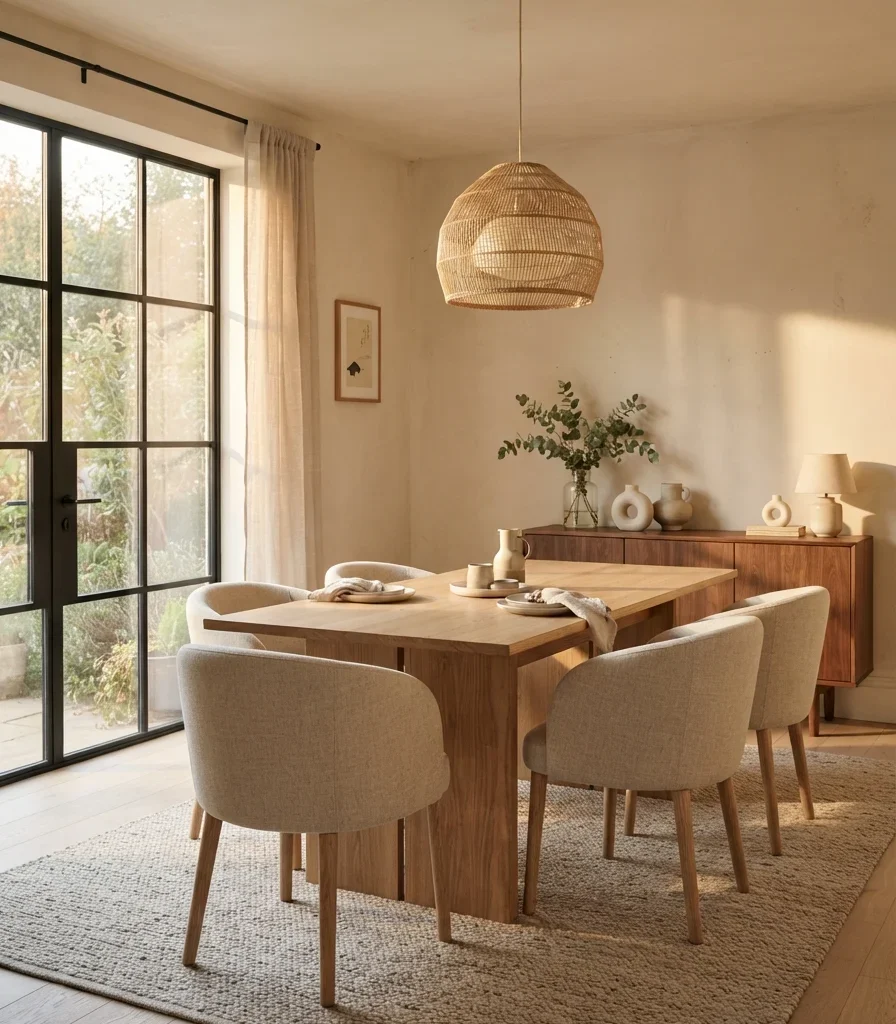
Category: COLOR
Vibe: The finished room feels serene, warm, and deeply settled.
Why it works: The room works because no single element is fighting for dominance. Pale oak carries the main furniture, walnut adds controlled depth, linen softens the seating, ceramics provide irregularity, and warm ivory architecture preserves negative space.
How to get it: Build the room from the largest surfaces downward: establish the wall color first, choose the dining table second, then coordinate seating, lighting, rug, and accessories. Keep every new material accountable to the existing palette rather than introducing another wood or accent color simply because it is attractive on its own.
Shop The Look
| Product | Purpose |
| Pale oak dining table | Main foundation |
| Curved oatmeal dining chairs | Soft seating |
| Woven natural pendant | Overhead focal point |
| Large neutral wool rug | Room grounding |
| Low walnut sideboard | Depth and storage |
How to Start Your Japandi Dining Room Transformation
Start with warm white walls rather than accessories. A soft warm white with an LRV in the high 70s or 80s gives pale oak, walnut, linen, and ceramics a neutral architectural background while avoiding the blue cast that can make Japandi rooms feel sterile. Once the wall tone is established, every subsequent material can be judged against the same foundation.
The most common mistake is mixing too many wood undertones. Honey oak, orange-toned pine, red walnut, and gray-washed oak can make a supposedly calm dining room look assembled rather than designed. Choose one dominant wood family and one secondary wood at most; if the table is pale oak, let walnut appear only in a controlled accent such as a sideboard or frame.
For inexpensive entry points, start with an oatmeal linen-look runner under $25, a matte off-white ceramic vase around $15–$30, and a 2700K warm LED bulb under $10. None requires construction, but each changes texture, color temperature, or composition immediately.
A meaningful Japandi dining-room transformation can happen in a weekend if the furniture already works and you are mainly changing paint, lighting, textiles, and styling. A starter refresh can reasonably fall around $300–$800, while replacing a table, chairs, lighting, rug, storage, and wall treatment can push a full room toward $1,500–$4,000+ depending on furniture quality; custom cabinetry, plasterwork, or premium solid wood can take the project substantially higher.
Frequently Asked Questions About Japandi Dining Room Design
What is Japandi dining room design and how is it different from minimalist style?
Japandi combines Japanese restraint with Scandinavian warmth, whereas minimalism is a broader design philosophy that can use many different aesthetics. A Japandi dining room typically introduces natural oak, linen, handmade ceramics, muted earth tones, and wabi-sabi-inspired irregularity. The goal is not simply to own fewer things; it is to choose fewer things with stronger material and functional value.
What colors work best in a Japandi dining room?
Warm white, oatmeal, mushroom taupe, greige, muted sage, clay, pale oak, and soft charcoal are reliable choices. Avoid building the entire room from cool gray because it can remove the warmth that makes Japandi feel livable. A useful starting palette is approximately warm white 60%, natural wood 30%, and one accent tone 10%.
How much does it cost to create a Japandi dining room?
A small styling refresh can cost under $300 if the existing table and chairs are usable. A more complete starter room often falls around $800–$1,500, while replacing major furniture and adding premium lighting, rugs, storage, and wall treatments can reach $1,500–$4,000 or more. Solid hardwood, custom cabinetry, and professional plaster finishes are the biggest variables.
Can Japandi work with an existing traditional dining table?
Yes, provided the table has a relatively simple silhouette and its wood tone can connect with the rest of the room. A heavy ornate table can be softened with linen chairs, a neutral rug, simple lighting, and restrained ceramics, but extremely carved or glossy furniture may fight the Japandi language. In that situation, changing the chairs and lighting first is often more practical than replacing the table immediately.
Which lighting works best over a Japandi dining table?
A diffused pendant is usually the strongest choice because it creates a soft pool of illumination without producing harsh glare. Rice-paper, linen, frosted glass, and matte wood fixtures all work well. Use a warm 2700K bulb and a dimmer when possible so the same fixture can provide brighter daytime illumination and a softer evening atmosphere.
Ready to Create Your Dream Japandi Dining Room?
These 24 Japandi dining room designs cover pale oak and walnut, muted color palettes, sculptural furniture, paper lighting, compact layouts, natural textiles, handmade ceramics, and carefully controlled negative space. A Japandi transformation does not need to happen all at once; starting with one surface, one material, or one light fixture is often the most intelligent way to build the look. Today, replace your dining-room bulb with a warm 2700K LED and clear every unnecessary object from the table so you can see what the room already has going for it. As the room becomes quieter and more tactile, the space begins to feel less like a collection of decorations and more like a calm setting for everyday meals and conversation. Save your favorite ideas, especially the pale-oak, paper-lantern, wabi-sabi plaster, and compact dining-nook combinations, for the moment you are ready to bring that Japandi calm home.
[…] materials, and a deliberate relationship between space and useful objects. These 25 Japanese dining room designs explore warm wood, low furniture, tactile ceramics, soft lighting, natural color palettes, […]
[…] lighting to create interiors that feel formal, intimate, and richly collected. These 26 Victorian dining room ideas show how to use color, materials, furniture, lighting, accessories, and layout without […]
[…] indoors without turning a room into a collection of nautical decorations. These 16 coastal dining room ideas show how to use natural wood, breezy textiles, sea-inspired colors, layered lighting, and […]