
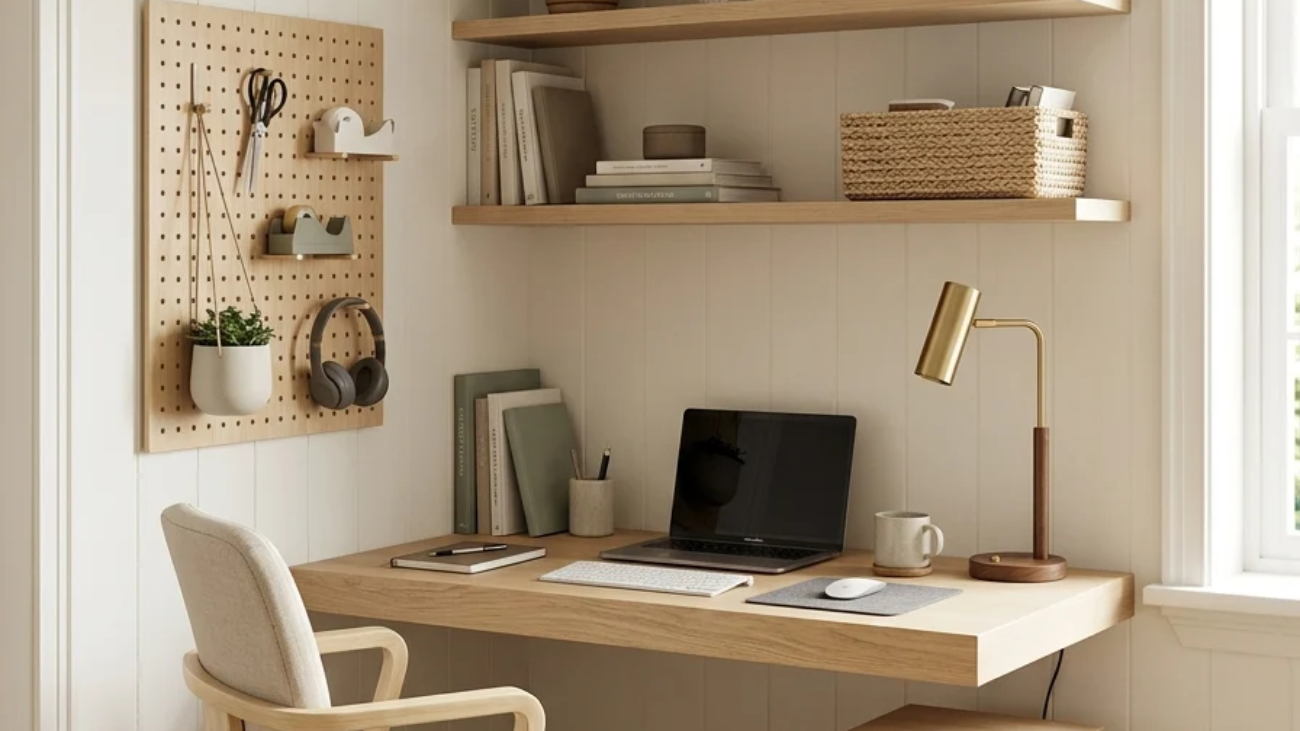
An optimized small home office corner turns an unused nook beside a window, under stairs, or in a bedroom’s dead angle into a real workspace without stealing the room it sits in. This guide walks through 15 ways to optimize a small home office corner, covering color, materials, lighting, and layout tricks sized for a footprint as small as 20 square feet.
Picture a floating desk tucked into the one corner every room seems to waste, a task lamp clipped directly to the shelf edge instead of needing its own surface, and a single deep-toned wall marking “this is where work happens” without a single wall built. The space feels defined rather than crammed, all on purpose, not by accident. It borrows the same efficient confidence found in Japanese micro-apartment design, where every inch has a job.
Here are 15 ideas worth saving and stealing.
Why Optimizing a Small Home Office Corner Works So Well
A small home office corner isn’t a decor style like farmhouse or coastal; it’s a spatial problem-solving approach rooted in Japanese micro-living design and Scandinavian small-footprint planning, both traditions built around making single square feet do double duty. What separates a corner office from a full home office is that it has to coexist inside another room’s identity, not replace it.
The palette stays deliberately narrow: warm white or soft sage for the surrounding walls, with one deeper accent tone warm charcoal or forest green reserved for the corner itself. Materials lean light and space-conscious: unfinished white oak for floating or triangular desks, woven rattan for a chair that tucks fully away, and matte black or brushed brass hardware kept minimal.
This approach is trending because hybrid work pushed millions of people to carve out a workspace inside a living room, bedroom, or hallway rather than a dedicated room, and Pinterest searches for “corner office ideas” and “small desk nook” have climbed steadily as square footage per household has shrunk in most major cities.
A true corner, as small as 20 square feet, can absolutely support this style; it’s arguably the best-case scenario, since a defined boundary already exists on two sides. Prioritize a floating or wall-mounted desk first; what genuinely doesn’t work is a bulky freestanding desk with drawers on both sides, which overwhelms a corner’s limited width almost immediately.
Style at a Glance
| Element | Detail |
| Philosophy | One corner, fully claimed |
| Key Materials | white oak, rattan, matte black, brushed brass |
| Key Colors | warm white, soft sage, warm charcoal |
15 Ways to Optimize a Small Home Office Corner
1. Claim the Awkward Nook Beside a Window
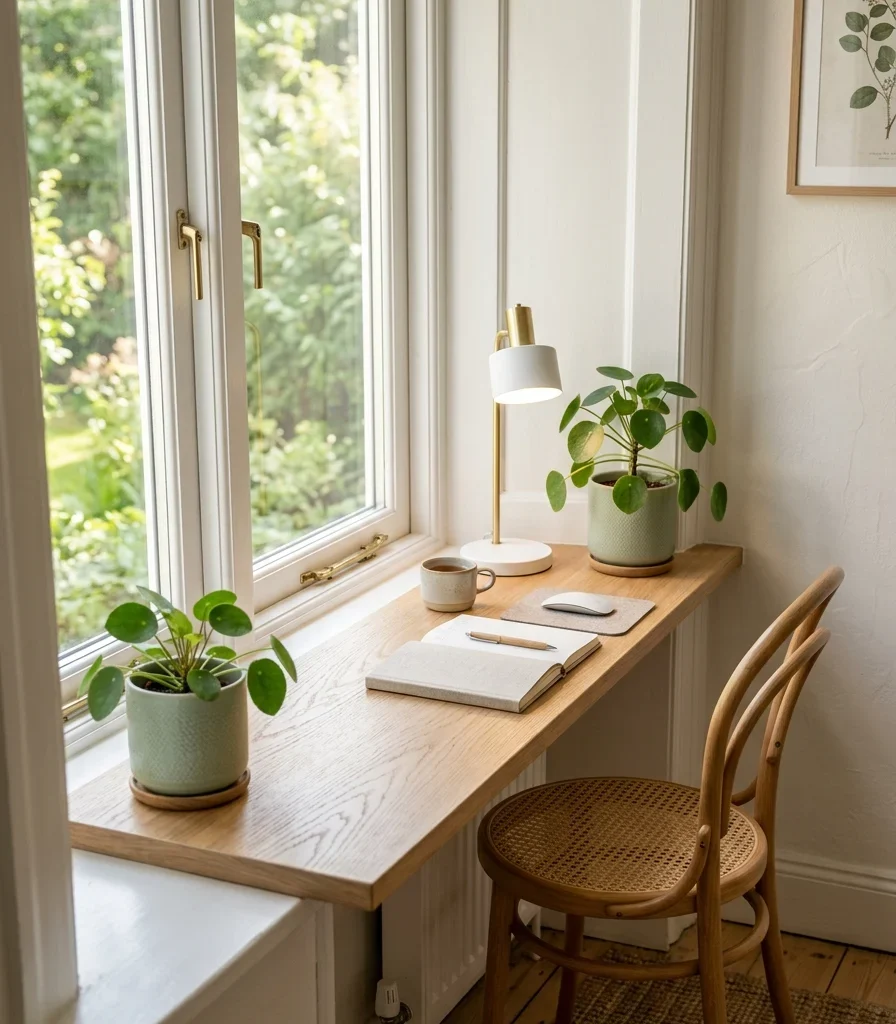
Vibe: Airy. A desk built into the strip beside a window uses daylight that most furniture arrangements waste entirely.
Why it works: This applies negative space logic to a spot most rooms leave empty. The narrow gap beside a window frame is too tight for standard furniture but exactly right for a slim desk, letting the corner claim daylight a wider desk elsewhere in the room couldn’t access as directly.
How to get it: Measure the gap beside your window before shopping, then choose a desk no wider than that measurement minus two inches of clearance, positioning it so the chair doesn’t block window access.
Shop the Look
- Slim white oak desk, narrow width
- Compact articulating desk lamp
- Small potted pothos, ceramic pot
- Under-desk cable tray, small
2. Paint Just the Corner Nook in a Deeper Tone
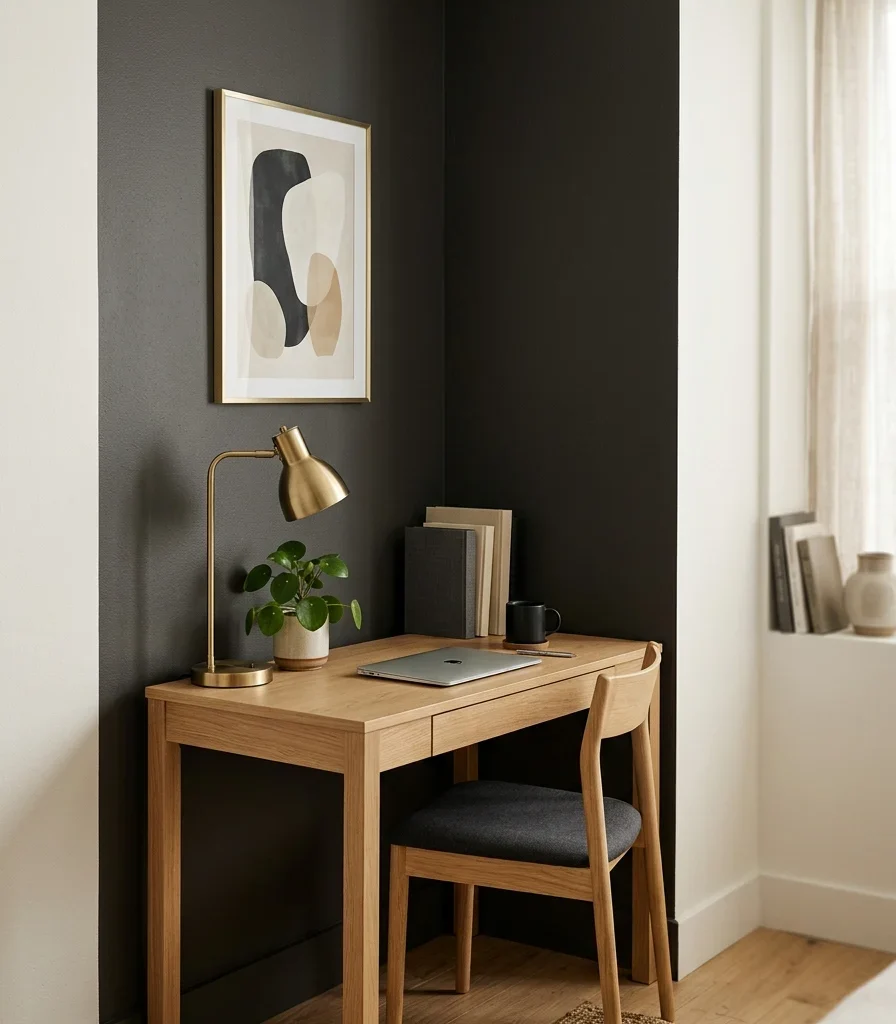
Vibe: Grounded. A single darker corner reads as a defined room within a room, without a single wall built.
Why it works: Color blocking at this scale uses contrast to create a psychological boundary. Painting only the two walls that meet at the corner in a deeper tone, like warm charcoal,l signals “this is the work zone” the moment you glance at it, while the rest of the room stays untouched.
How to get it: Paint just the two walls forming the corner in a warm charcoal such as Benjamin Moore Kendall Charcoal, stopping the color exactly at the room’s next corner so the boundary reads as intentional.
💡 Quick Win: A large framed charcoal-toned canvas leaned in the corner achieves a similar visual break without any paint at all.
Shop the Look
- Benjamin Moore Kendall Charcoal paint sample
- White oak desk, straight leg
- Brushed brass desk lamp, articulating
- Framed neutral print, small
3. Floating Corner Desk in White Oak
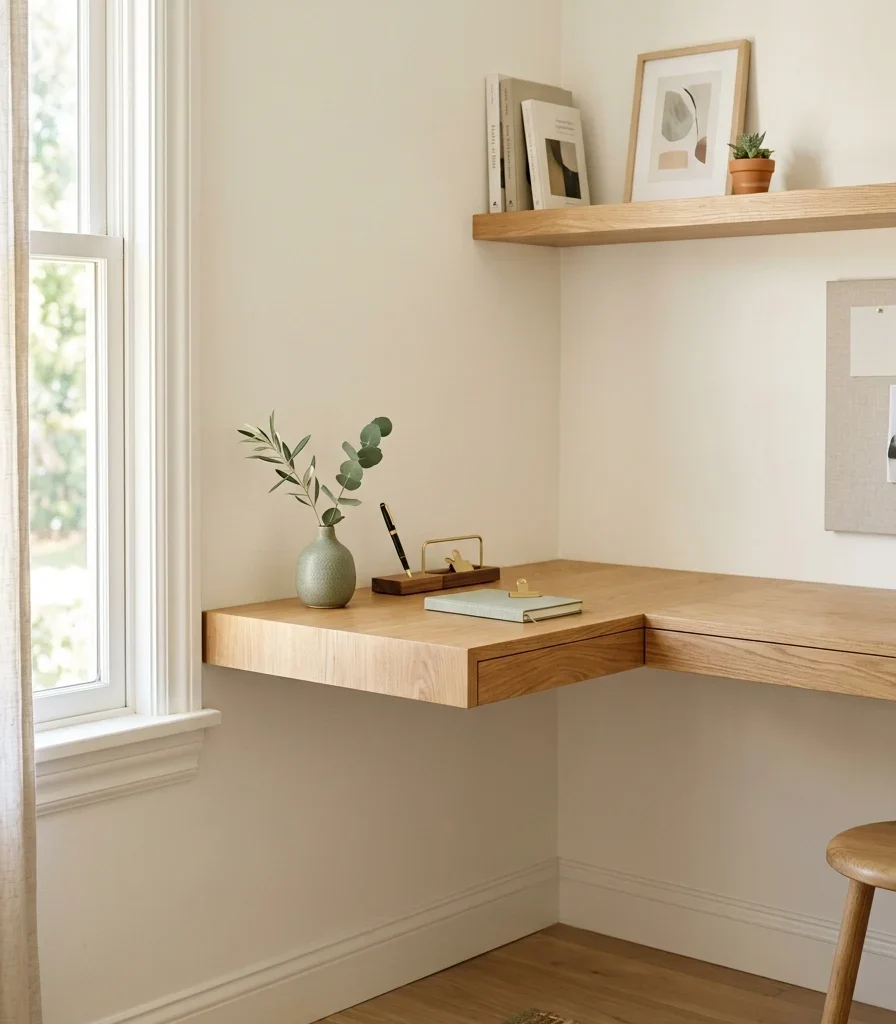
Vibe: Lumino, with no legs breaking up the floor; light travels underneath, and the corner reads as open rather than filled.
Why it works: Material and mounting choice work together here: a floating corner desk in white oak, secured with concealed steel brackets, removes the visual weight a leg-supported desk would add, which matters disproportionately in a corner where every inch of visible floor affects how large the whole room feels.
How to get it: Mount a mitered-corner white oak desk shelf using brackets rated for at least 75 pounds, positioning the surface at a standard desk height of 29 inches from the floor.
Shop the Look
- Floating corner desk shelf, white oak, mitered
- Heavy-duty concealed steel bracket set
- Oak desk organizer tray
- Ceramic bud vase, single-stem
4. Clip-On Task Lamp That Doesn’t Need Its Own Surface
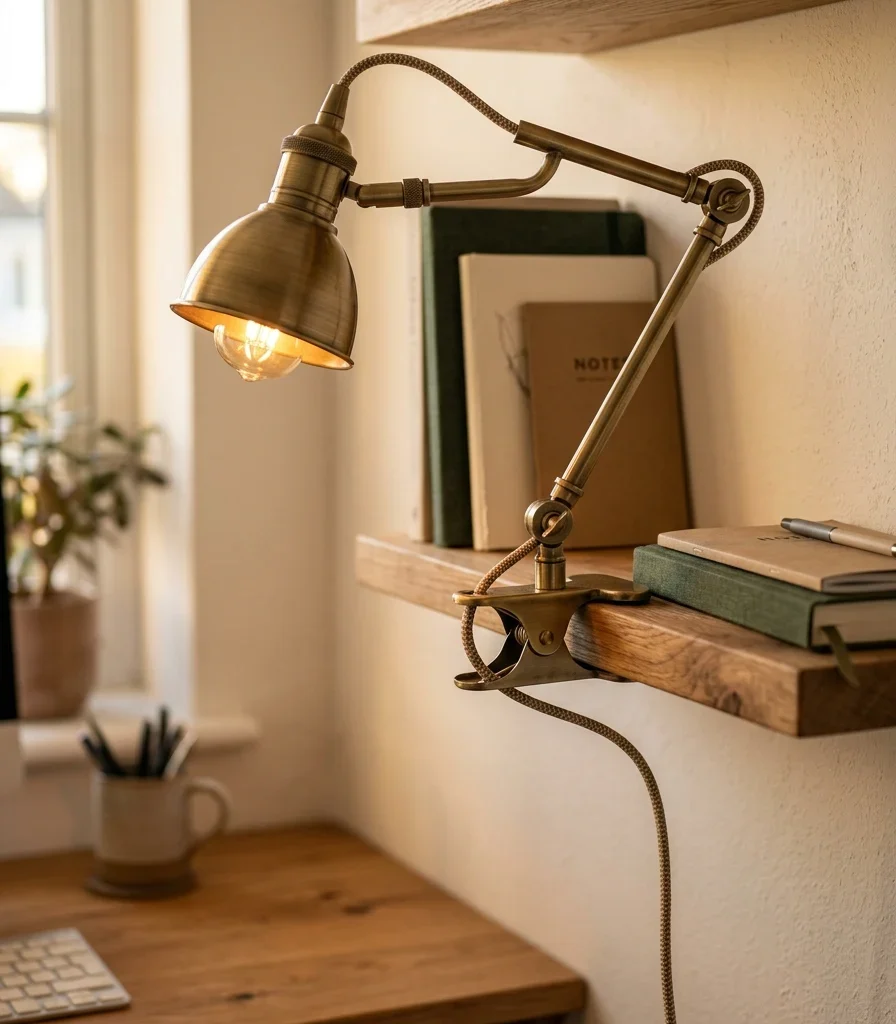
Vibe: Warm. A lamp that clips onto a shelf edge frees up every inch of a tight desk surface for actual work.
Why it works: Furniture and lighting choices in a corner have to account for surface area lost to the fixture itself. A clip-on lamp mounts to a shelf edge or desk lip rather than sitting on the desktop, reclaiming the two or three square inches a base-mounted lamp would otherwise occupy on a genuinely small surface.
How to get it: Choose a brushed brass clip-on task lamp with an articulated arm, clamping it to the edge of a shelf above the desk rather than the desk itself so the full work surface stays clear.
Shop the Look
- Brushed brass clip-on task lamp
- Warm white LED bulb, 2700K
- Small stack of lined notebooks
- Oak floating shelf for lamp mount
5. Corner-Fit Triangular Desk for Odd Angles
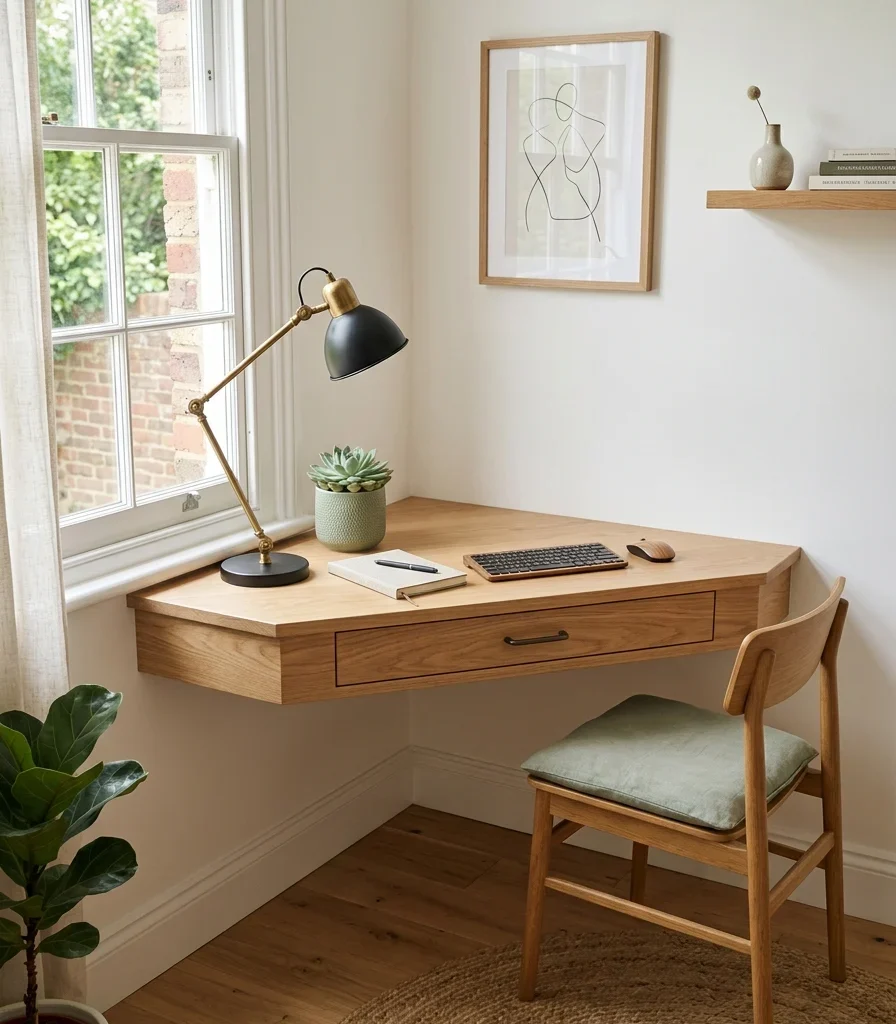
Vibe: Efficient. A desk shaped to match the corner’s actual angle uses every inch a rectangular desk would waste.
Why it works: Furniture profile matters more than furniture size in a corner. A triangular or corner-cut desk follows the room’s existing geometry instead of forcing a straight-edged rectangle into an angled space, which typically gains several extra inches of usable surface compared to a standard desk pushed diagonally into the same spot.
How to get it: Measure the exact angle where your two walls meet before ordering, choosing a triangular desk with a matching corner cut rather than assuming a standard 90-degree fit.
Shop the Look
- Triangular corner desk, white oak, single drawer
- Compact desk lamp, matte black
- Small potted succulent, ceramic pot
- Slim desktop organizer tray
6. Warm White Walls to Keep the Corner Open
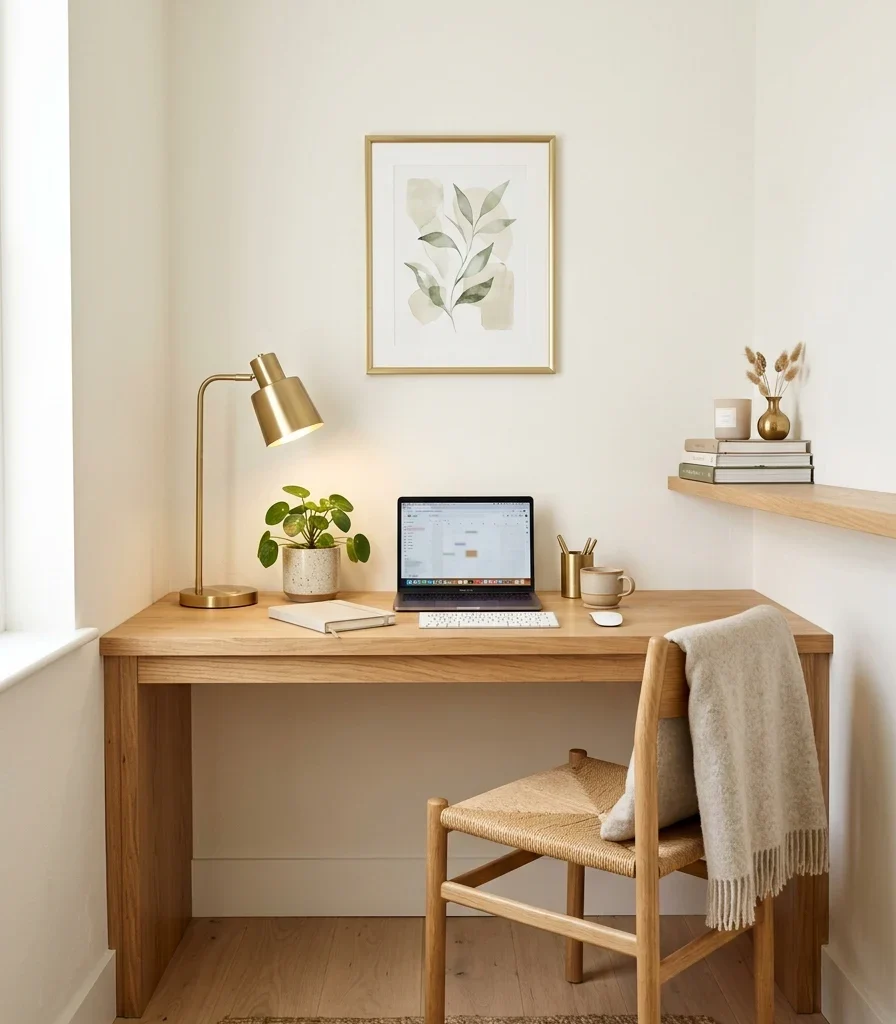
Vibe: Airy when the corner needs to disappear into the room rather than announce itself, warm white does the job.
Why it works: This is the inverse approach to color blocking, and it’s just as valid a choice for corners already small and possibly dim. Keeping the walls in the same warm white as the rest of the room avoids adding any visual weight that a deeper accent tone would introduce.
How to get it: Paint the corner in the same warm white as the surrounding room, such as Benjamin Moore Simply White, letting furniture and lighting, not wall color, define the workspace instead.
Shop the Look
- Benjamin Moore Simply White paint sample
- White oak desk, compact
- Brushed brass desk lamp
- Small potted plant, ceramic pot
7. Vertical Pinboard Strip Instead of a Full Corkboard
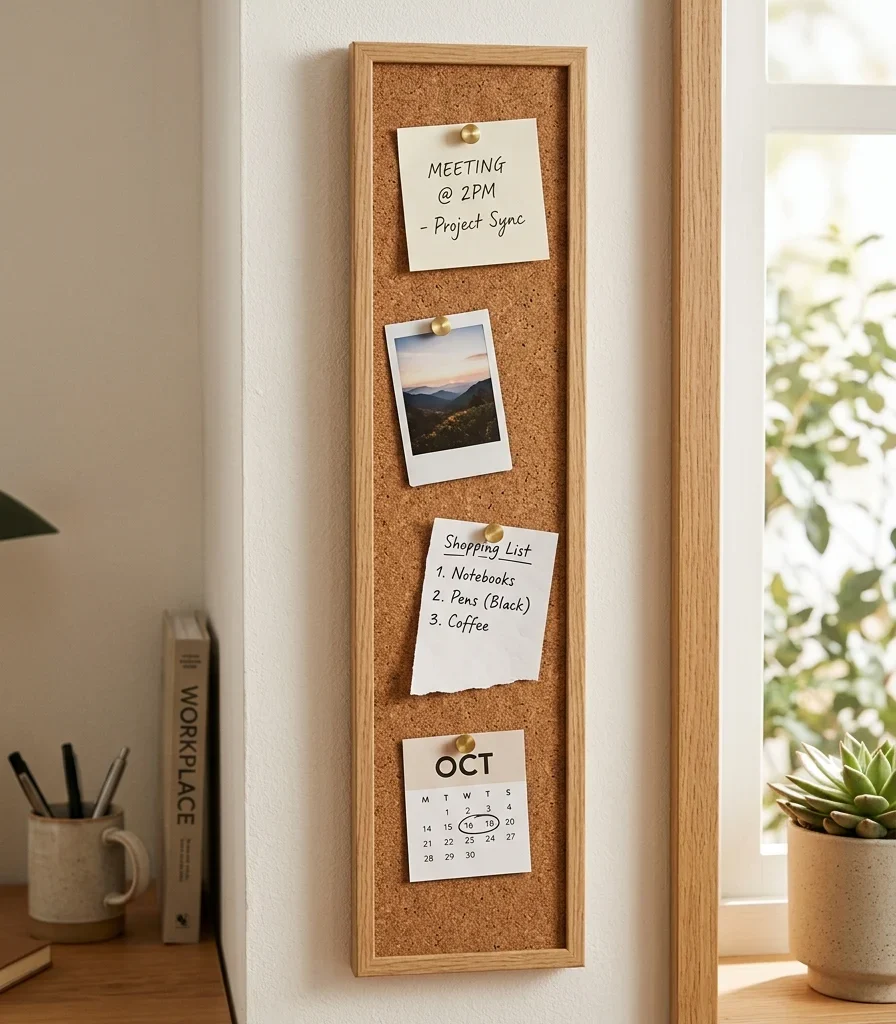
Vibe: Calm. A slim vertical strip holds exactly what a corner setup needs without eating into limited wall width.
Why it works: Scale-matching accessories to the space is a texture and proportion decision often skipped. A full-size corkboard, sized for a larger office, dominates a narrow corner wall, while a vertical strip only 6 inches wide provides the same pinning function at a fraction of the visual footprint.
How to get it: Mount a 6-by-24-inch vertical cork strip in a thin oak frame along the narrow side wall of the corner, keeping pinned items to three or four at most so the strip doesn’t overflow.
Shop the Look
- Vertical cork pinboard strip, oak frame
- Brass push pin set
- Small printed note card set
- Oak wall hook, single
8. Woven Rattan Chair That Tucks Fully Under the Desk
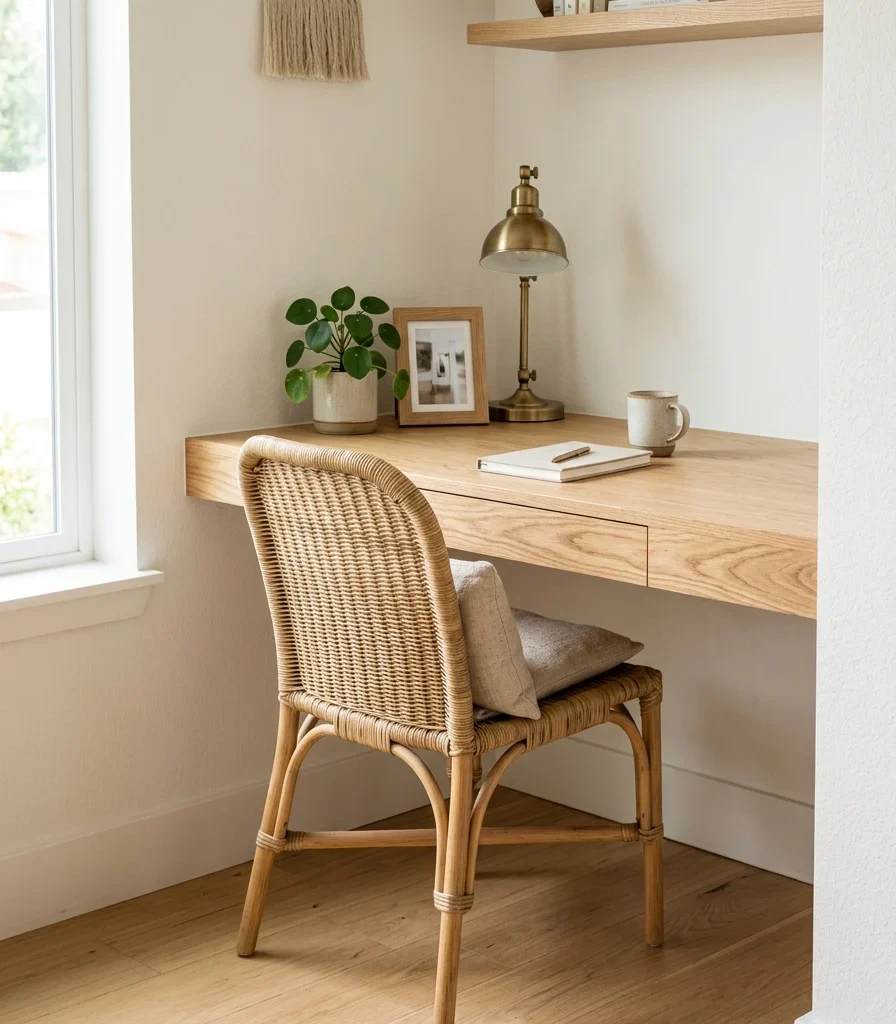
Vibe: Raw. A chair that vanishes fully under the desk means the corner can visually reset the moment work is done.
Why it works: Material and profile choice determine whether a chair adds clutter or disappears. A slim woven rattan chair with a low back and no arms fits entirely within a desk’s leg space, unlike a bulkier upholstered task chair, which typically protrudes and blocks part of the walking path even when pushed in.
How to get it: Measure your desk’s under-surface clearance before choosing a chair, selecting a rattan or cane chair with a seat width narrow enough to slide fully beneath the desktop with no overhang.
Shop the Look
- Woven rattan desk chair, low back, armless
- Small tie-on seat cushion, natural linen
- Slim under-desk footrest, oak finish
- Compact desk lamp, brushed brass
9. Angle the Desk at 45 Degrees to Open Up the Room
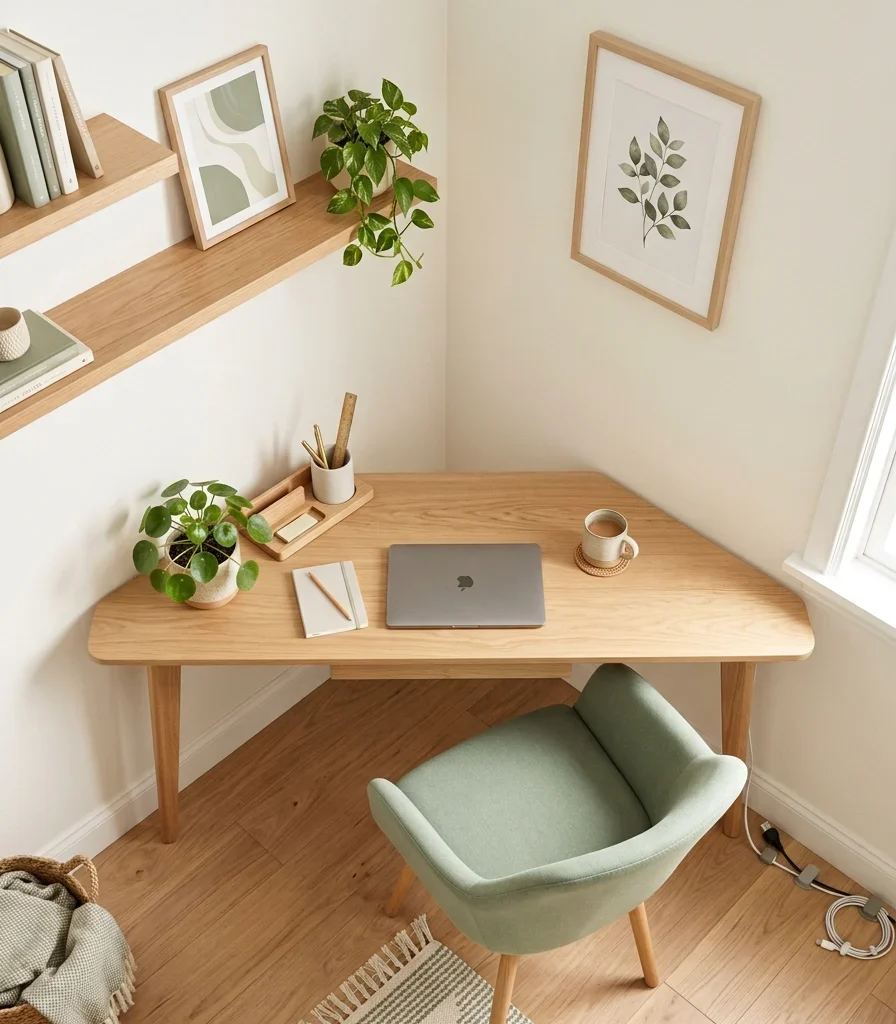
Vibe: Airy. An angled desk creates a small buffer of extra floor space that a flush-against-the-wall placement never offers.
Why it works: This is a layout decision that trades a small amount of usable corner depth for a meaningful gain in perceived openness. Placing the desk diagonally across the corner, rather than flush against one wall, opens a triangular pocket of floor space behind it that breaks up the boxed-in feeling most tight corners create.
How to get it: Position the desk at a 45-degree angle across the corner rather than flush against either wall, leaving the triangular space behind it open or holding only a small plant.
Shop the Look
- Compact white oak desk, straight leg
- Small jute-blend area rug, 3×3
- Small potted plant, ceramic pot
- Slim desk organizer tray
10. Sage Green Curtain to Close Off the Corner When Not in Use
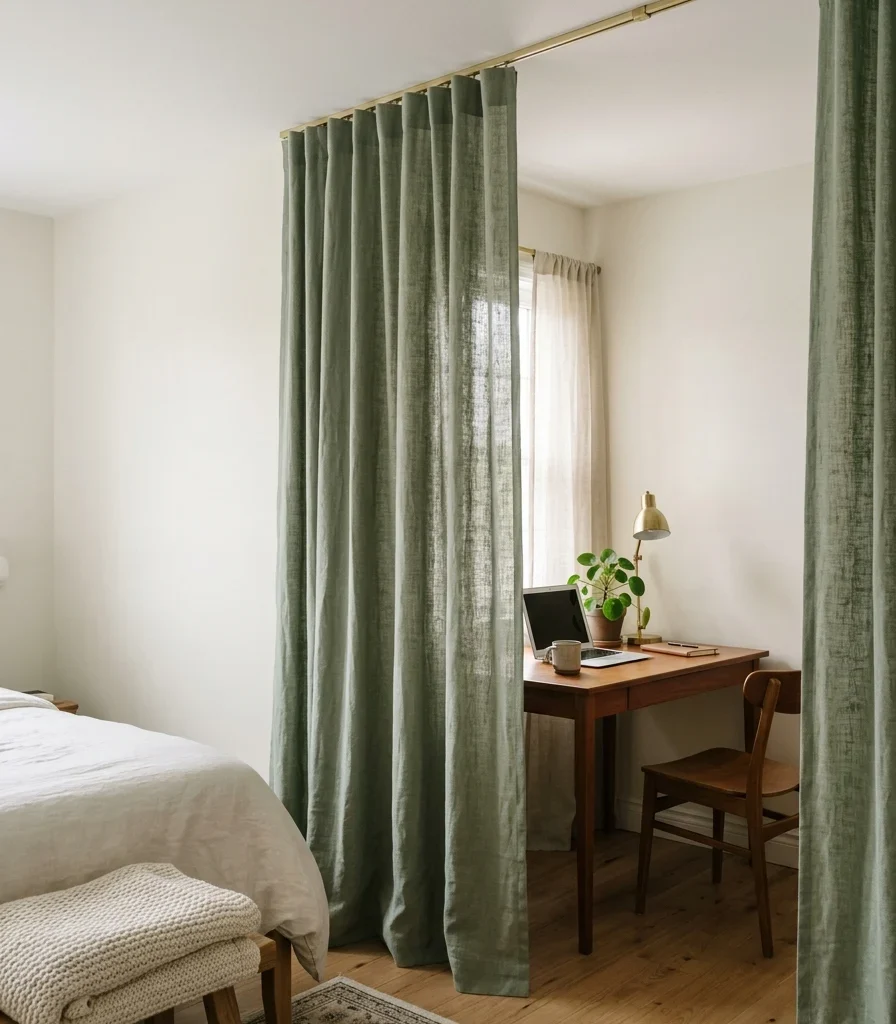
Vibe: Hushed. A curtain that closes at the end of the day lets the corner visually disappear from a bedroom or living space.
Why it works: Color choice here does double duty as a boundary marker. A sage green linen curtain, drawn closed, visually removes the work corner from a shared room entirely, which matters most when the corner sits inside a bedroom or living space that needs to feel fully off-duty in the evening.
How to get it: Mount a ceiling-track curtain rod across the corner’s open side and hang a soft sage linen panel that can be pushed back during work hours and drawn fully closed after.
Shop the Look
- Sage green linen curtain panel, ceiling track
- Brass ceiling-mounted curtain track
- Curtain track pull cord, brass
- Folded cotton throw, warm white
11. Fold-Flat Wall Desk for a Corner That Needs to Disappear
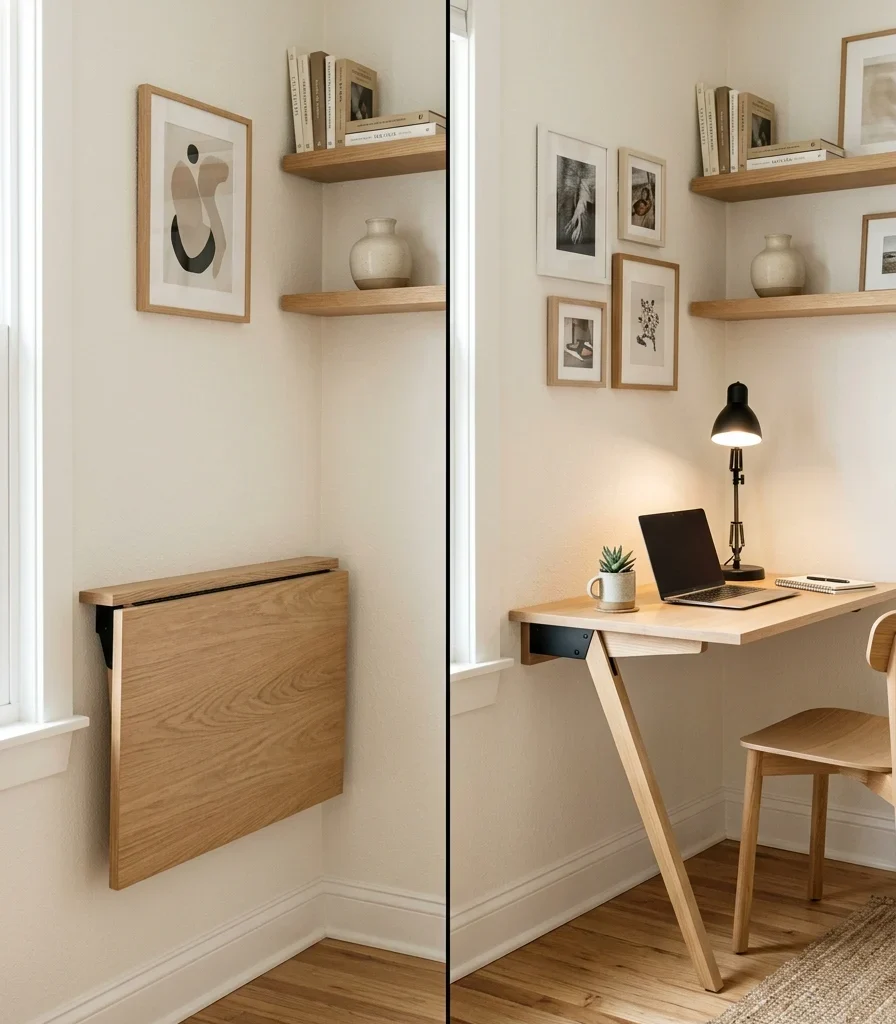
Vibe: Efficient. A desk that folds flush against the wall means the corner can fully return to being part of the room.
Why it works: In corners inside shared living spaces, permanence is often the actual constraint. A fold-flat desk uses the wall as its support structure only when needed, following the same negative-space logic as a Murphy bed, letting the corner serve its original room function the rest of the time.
How to get it: Mount a fold-flat white oak desk with a piano hinge and single folding leg at standard desk height, choosing a matte black hinge finish so the closed panel reads as intentional wall paneling rather than obvious furniture.
Shop the Look
- Fold-flat wall desk, white oak, piano hinge
- Matte black folding leg hardware kit
- Compact articulating desk lamp
- Small wall hook for folded chair storage
12. Slim Bookcase as a Soft Boundary for the Corner Office
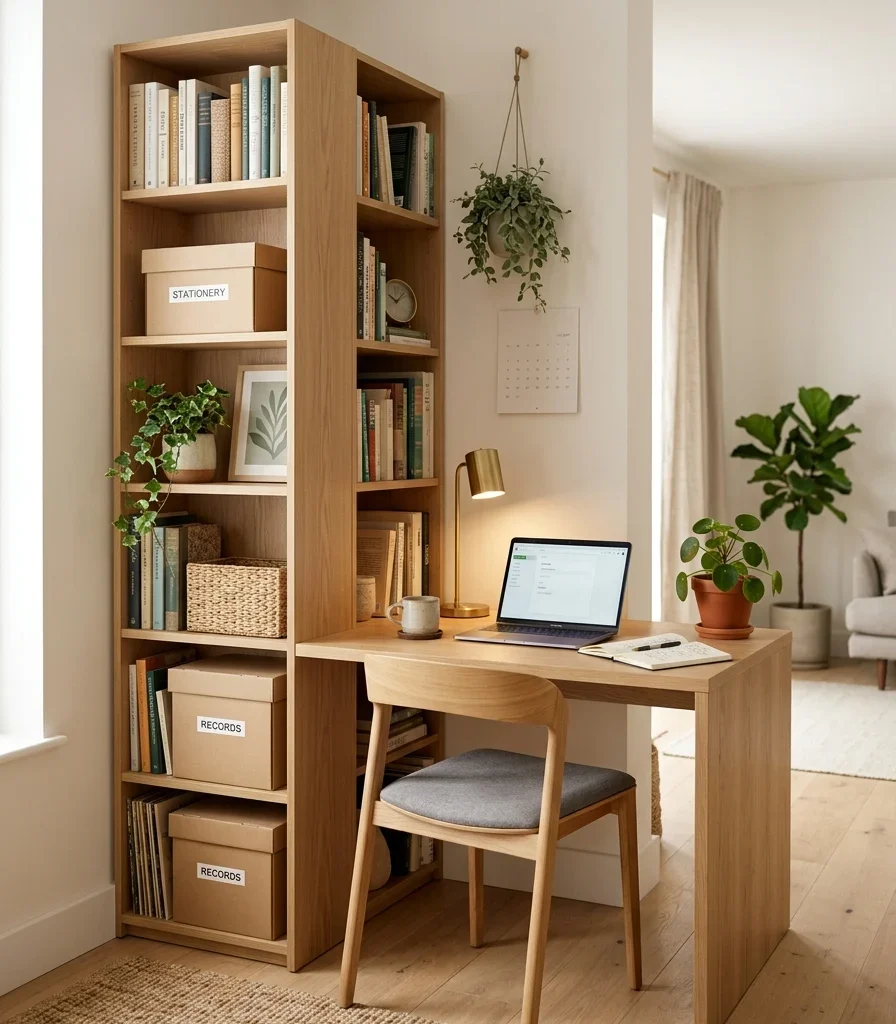
Vibe: Layered. A slim bookcase marks the edge of the work zone without a full wall or curtain closing it off.
Why it works: Furniture arrangement can define a zone through placement alone. Positioning a narrow, open-backed bookcase perpendicular to the desk creates a visual edge to the corner office while keeping sightlines open above shoulder height, avoiding the closed-off feeling a solid divider would create in a shared room.
How to get it: Position a bookcase no deeper than 10 inches perpendicular to the desk, using it to mark where the “office” ends and the rest of the room begins without blocking light or sightlines.
Shop the Look
- Slim open-back bookcase, white oak, 10-inch depth
- Labeled canvas storage box, set of 2
- Small potted plant, ceramic pot
- Bookend set, matte black
13. Under-Shelf Lighting to Brighten a Dim Corner
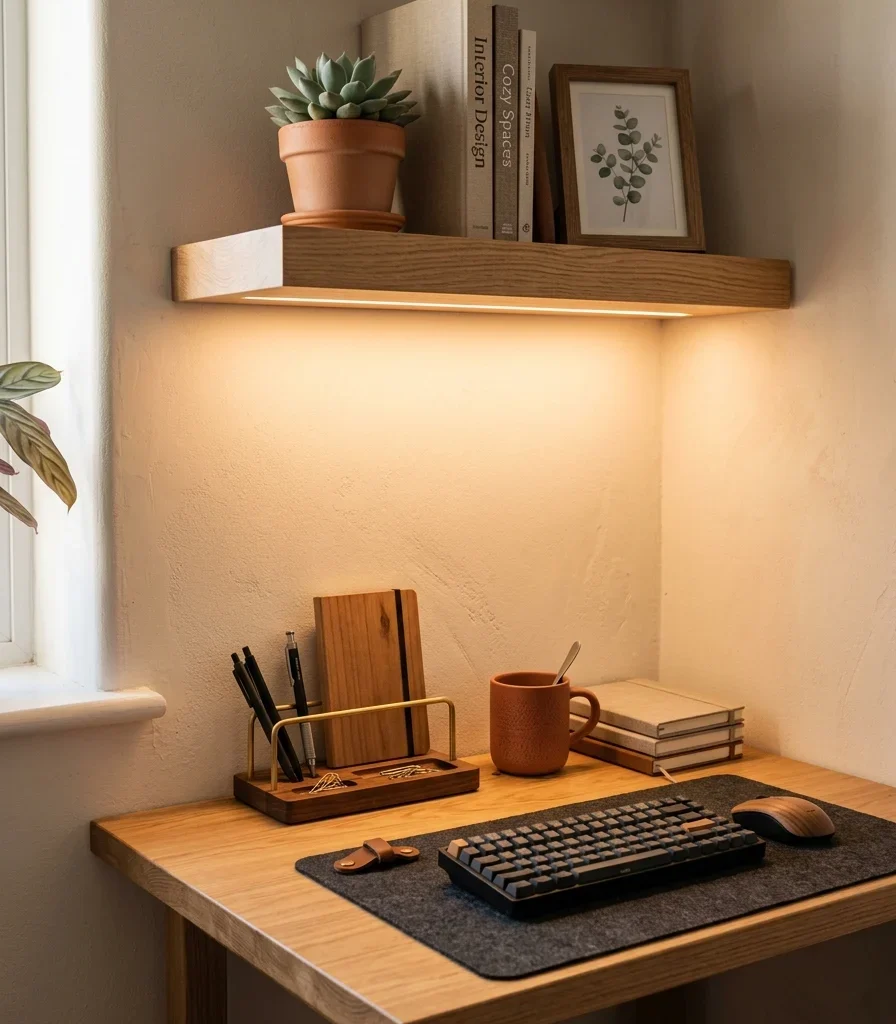
Vibe: Warm corners are often the dimmest part of a room, and light tucked under a shelf fixes that without adding a visible fixture.
Why it works: Light behavior explains why corners read as gloomy even in well-lit rooms; they sit farthest from both windows and overhead fixtures, so a warm 2700K LED strip mounted at the underside of a shelf directly above the desk delivers focused task light exactly where ambient light fails to reach.
How to get it: Run an adhesive warm white LED strip along the front underside edge of a shelf mounted above the corner desk, wiring it to a small switch positioned within easy reach of the chair.
💡 Quick Win: A battery-powered puck light with an adhesive mount skips wiring entirely and repositions easily if the desk moves.
Shop the Look
- Warm white LED strip light, 2700K, adhesive
- Oak floating shelf, small
- Battery-powered LED puck light, set of 2
- Small in-line LED switch
14. A Single Framed Print Sized to the Corner’s Narrow Wall
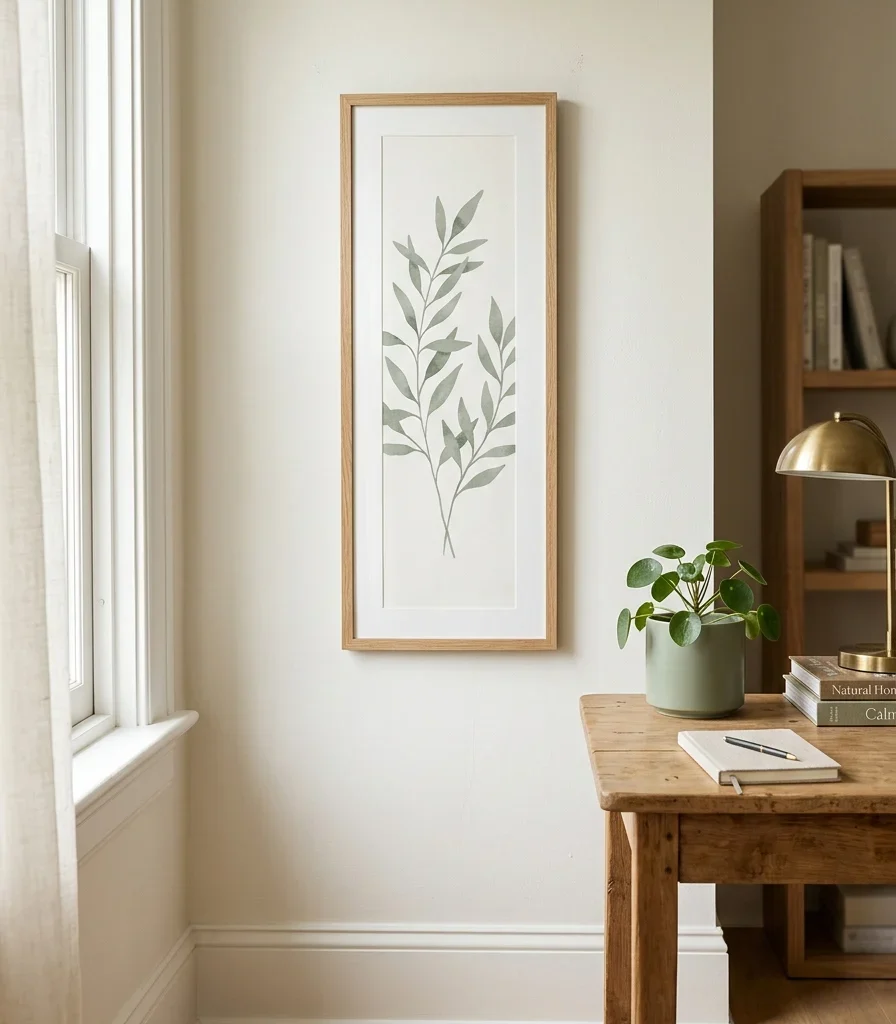
Vibe: Calm. One tall, narrow print fits the actual proportions of a corner’s side wall instead of forcing a standard square frame into an awkward gap.
Why it works: Scale-matched accessories prevent the mismatched look that makes small corners feel like an afterthought. A vertically oriented print, chosen for the exact narrow width of the side wall, uses proportion correctly where a standard square or landscape frame would either overhang or leave excess bare wall on either side.
How to get it: Measure the narrow wall’s width before choosing art, selecting a vertical print no wider than that measurement minus four inches of margin on each side.
Shop the Look
- Vertical botanical print, framed, narrow format
- Slim white oak picture frame
- Picture hanging strip kit
- Small brass wall hook, single
15. Position the Desk to Face Into the Room, Not the Wall
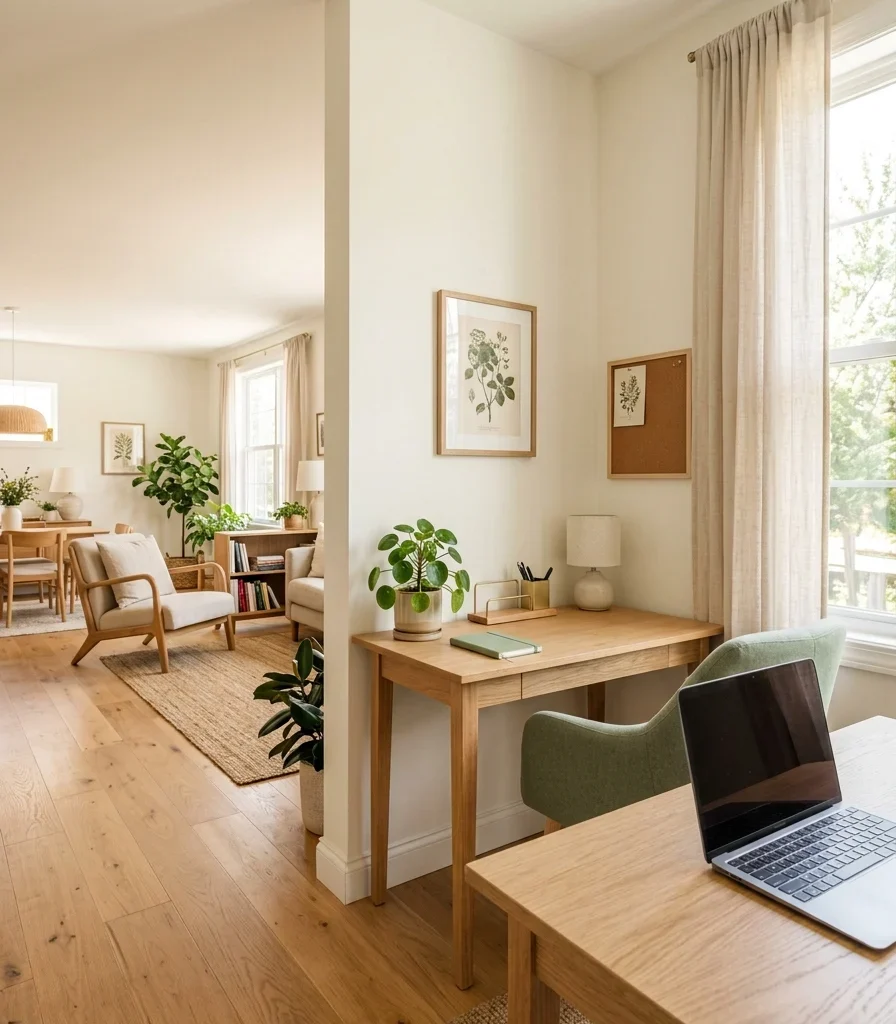
Vibe: Grounded. Facing outward into the room rather than staring at a wall changes how confined the corner actually feels during a workday.
Why it works: This is a layout principle borrowed from open-plan office design, where facing a wall for hours increases the feeling of confinement regardless of room size. Backing the desk into the corner so the chair faces outward gives the eye a full room’s depth to rest on instead of eighteen inches of wall.
How to get it: Push the desk back into the corner so its front edge, not its back, faces the room, positioning the chair to look outward across the space rather than toward the intersecting walls.
Shop the Look
- Compact white oak desk, corner-fit
- Low-profile task chair, neutral upholstery
- Small area rug to anchor the desk, 3×3
- Small potted plant, ceramic pot
How to Start Your Small Home Office Corner Transformation
Start with a floating or wall-mounted desk in white oak, not a freestanding one with legs. This single choice determines how much visible floor space the corner keeps, which shapes every decision after it, from chair size to lighting placement.
The most common mistake is choosing a desk sized for a full room rather than a corner. A standard 48-inch desk with drawers on both sides overwhelms a tight nook almost immediately. The fix is measuring the actual corner width first and choosing a desk at least six inches narrower than that measurement on each side.
Three items under $50 create real impact fast: a brushed brass clip-on task lamp (around $34), a small jute-blend area rug in 3×3 (around $38), and a vertical cork pinboard strip in an oak frame (around $26).
A weekend covers desk setup, lighting, and styling; a fold-flat or floating desk installation takes about a week, including wall mounting. Budget $150–$400 for a starter version, or $800–$2,000 for a full built-in corner solution.
Frequently Asked Questions About Small Home Office Corner Design
What’s the difference between a small home office corner and a full home office?
A full home office occupies its own dedicated room and can support standard-sized furniture without spatial trade-offs. A small home office corner has to fit inside another room’s function a bedroom, living room, or hallway which means every piece, from the desk to the chair, needs to be sized specifically for the corner rather than for general use.
What is the best paint color for a small office corner?
Warm charcoal, such as Benjamin Moore Kendall Charcoal, works well when you want the corner to read as a clearly defined zone within a larger room. Warm white, such as Benjamin Moore Simply White, is the better choice when the corner needs to blend into the room rather than announce itself, especially in already-dim spaces.
How much does it cost to optimize a small home office corner?
A starter setup using a compact desk, lighting, and styling runs $150 to $400. A mid-range version with a floating desk and matched storage typically lands between $500 and $1,000. A full built-in solution with a fold-flat desk and custom shelving can reach $800 to $2,000 depending on installation needs.
Can a small home office corner work inside a bedroom?
Yes, and it’s one of the most common placements. A sage green curtain on a ceiling track or a slim bookcase positioned as a soft divider both let the corner close off visually at night, so the workspace doesn’t compete with the room’s rest function once the day is done.
What is the best desk shape for a small office corner?
A triangular or mitered corner desk is the most searched and most space-efficient choice, since it follows the room’s existing angle rather than forcing a rectangular shape into a diagonal space. Floating corner desks come in a close second for corners where floor space, not surface area, is the primary constraint.
Ready to Optimize Your Small Home Office Corner?
From floating desks to angled layouts and fold-flat wall units, these 15 ways to optimize a small home office corner cover color, materials, lighting, and layout so even 20 square feet can hold a real workday. You don’t need to build out the whole corner this weekend; starting with just the desk or just the lighting is genuinely the right way to begin, not a smaller version of the goal. Measure your corner today and choose a desk at least six inches narrower on each side before you buy anything else. Once it’s set up right, that corner will feel like a real workspace rather than a compromise, calm enough to sit down in and get straight to work. Pin your favorites now, especially the fold-flat and floating desk ideas you can picture claiming your own overlooked corner.