
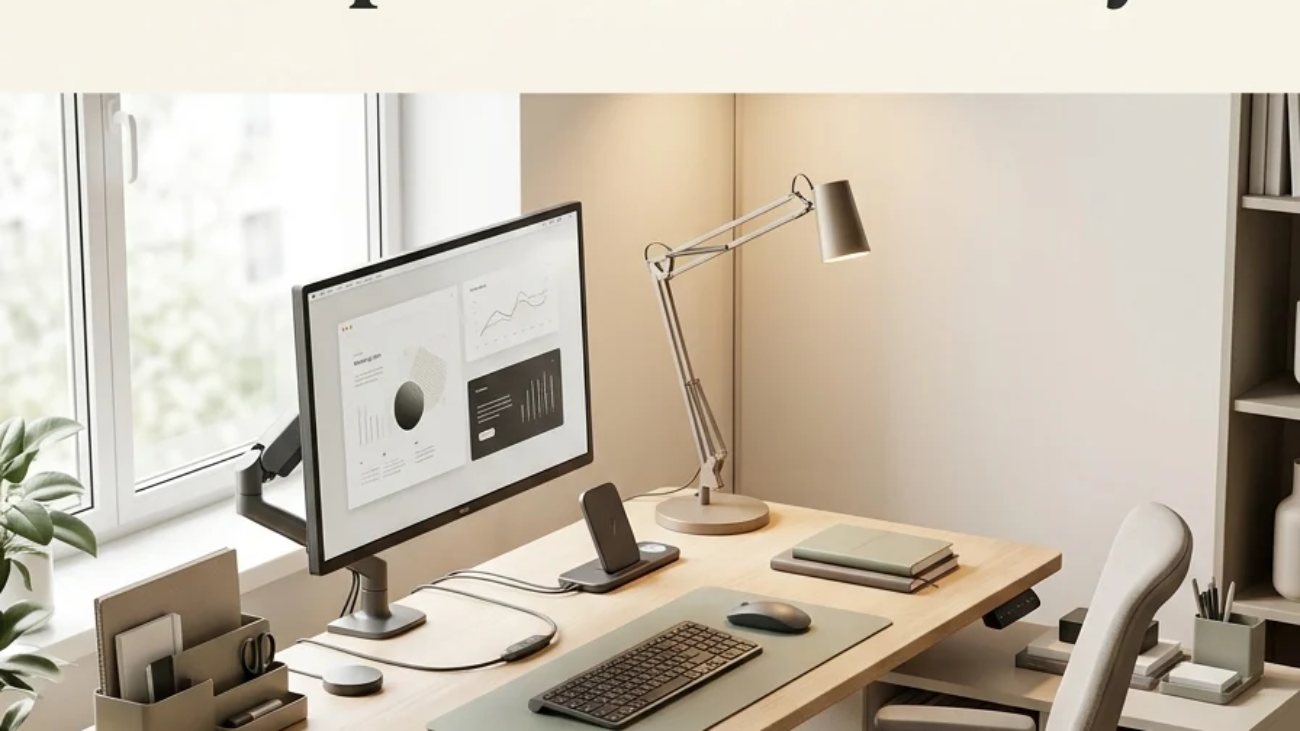
An optimized work-from-home setup for productivity treats the whole room’s environment sound, light, color, and daily transition cues as part of the system, not just the desk and chair most productivity advice stops at. This article gives you 15 genuinely effective ways to optimize your work-from-home setup for productivity, covering material, color, lighting, and layout decisions that address the parts of remote work a monitor arm or a filing system alone can’t fix.
It feels like a room that knows what time it is: light that shifts warmer as the day winds down, a small ritual that marks the moment work actually ends, quiet enough that a video call doesn’t echo back at you. This is a productivity-focused home office at its most complete: attentive to the psychology of remote work, not just its furniture. Every choice earns its place because working from home asks the same room to hold focus, transition, and rest, often with no walk to separate them.
Here are 15 ideas worth saving nd stealing.
Why Optimizing a Work-From-Home Setup for Productivity Works So Well
This approach draws from environmental psychology research on workspace transition rituals; studies on remote work consistently find that people who lack a physical or symbolic boundary between “work” and “home” report more difficulty switching off, a problem an office commute used to solve without anyone designing for it. What distinguishes a genuinely optimized WFH setup from a merely well-organized desk is that it treats acoustic comfort, circadian light exposure, and daily transition cues as functional productivity tools, not decorative afterthoughts.
Core materials favor sound-dampening and grounding textures: wool acoustic panels, cork flooring, and live-edge wood for a tactile, natural counterpoint to screens. Color leans toward sage green and warm terracotta as focus-supporting accents, paired with a clear two-tone wall split that visually separates the work zone from the rest of a shared room.
Style at a Glance
| Element | Core Trait 1 | Core Trait 2 |
| Philosophy | Environment and daily ritual treated as productivity tools | Transition cues matter as much as ergonomics |
| Materials | Wool acoustic panel, cork flooring, live-edge wood | Warm terracotta and sage accents |
| Color Palette | Sage green focus wall | Warm terracotta accent |
15 Ways to Optimize Your Work From Home Setup for Productivity
1. Add an Acoustic Wool Panel to Dampen Video-Call Echo
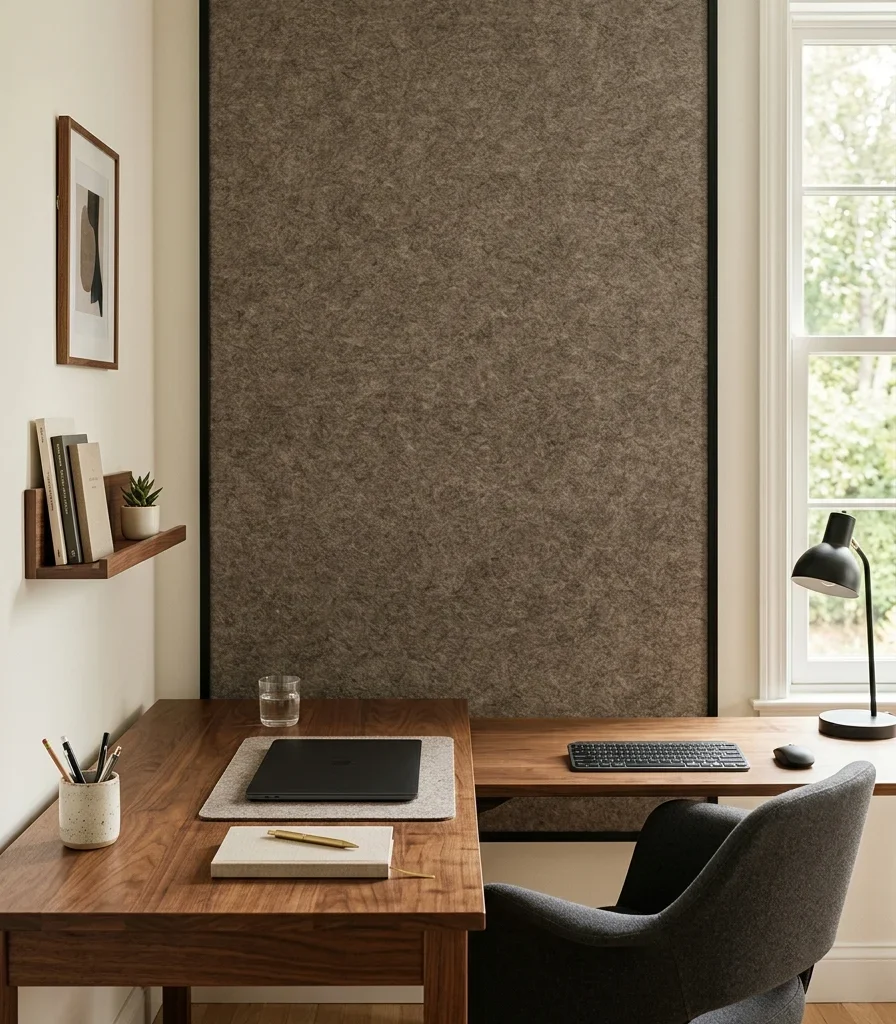
Vibe: Still a room quiet enough that a video call sounds like you’re speaking directly to someone, not into a hallway.
Why it works: Acoustic wool panels apply a material-honesty principle to sound rather than appearance. Hard walls and bare windows reflect voice and echo back into a microphone, which video-call software often amplifies, and dense wool felt absorbs those reflections in a way no decorative object can, directly affecting how professional a remote worker sounds on every call.
How to get it: Mount at least one 24×36-inch wool felt panel on the wall directly behind the desk chair (the surface a camera microphone picks up most directly), choosing a dense, tightly felted wool rather than a decorative fabric-wrapped panel, which absorbs sound less effectively.
💡 Quick Win: A thick woven wall hanging in the same spot absorbs more sound than a flat framed print meaningfully, even without a dedicated acoustic product.
Shop the Look
| Product |
| Wool felt acoustic wall panel |
| Matte black panel mounting frame |
| Small ceramic pen cup |
| Walnut desk accent |
| Acoustic panel adhesive kit |
2. Paint a Sage Green Focus Wall
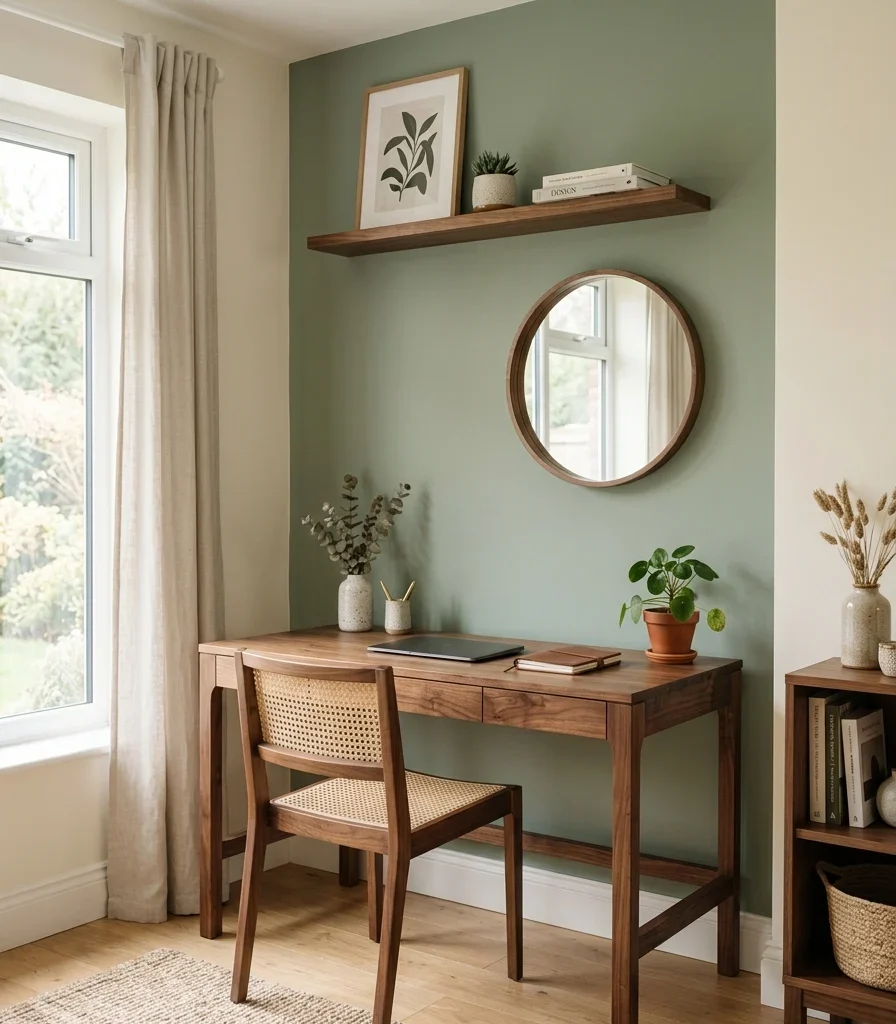
Vibe: Calm, a color chosen specifically because it supports sustained attention rather than stimulating it.
Why it works: Muted greens are consistently associated with lower physiological arousal and sustained attention in color psychology research compared to high-saturation colors like red or orange, which is why sage functions as a genuine focus-supporting choice for a work zone rather than a purely decorative one.
How to get it: Paint only the wall directly behind or beside the desk in a matte sage green, keeping the rest of the room in a lighter neutral so the color reads as a deliberate focus zone rather than a full room commitment that could feel heavy over long hours.
Shop the Look
| Product |
| Sage green matte wall paint |
| Walnut desk accent piece |
| Small ceramic decorative vessel |
| Painter’s tape precision edge |
| Warm white contrast wall paint |
3. Add a Dedicated “Off-Duty” Chair Separate From the Desk Chair
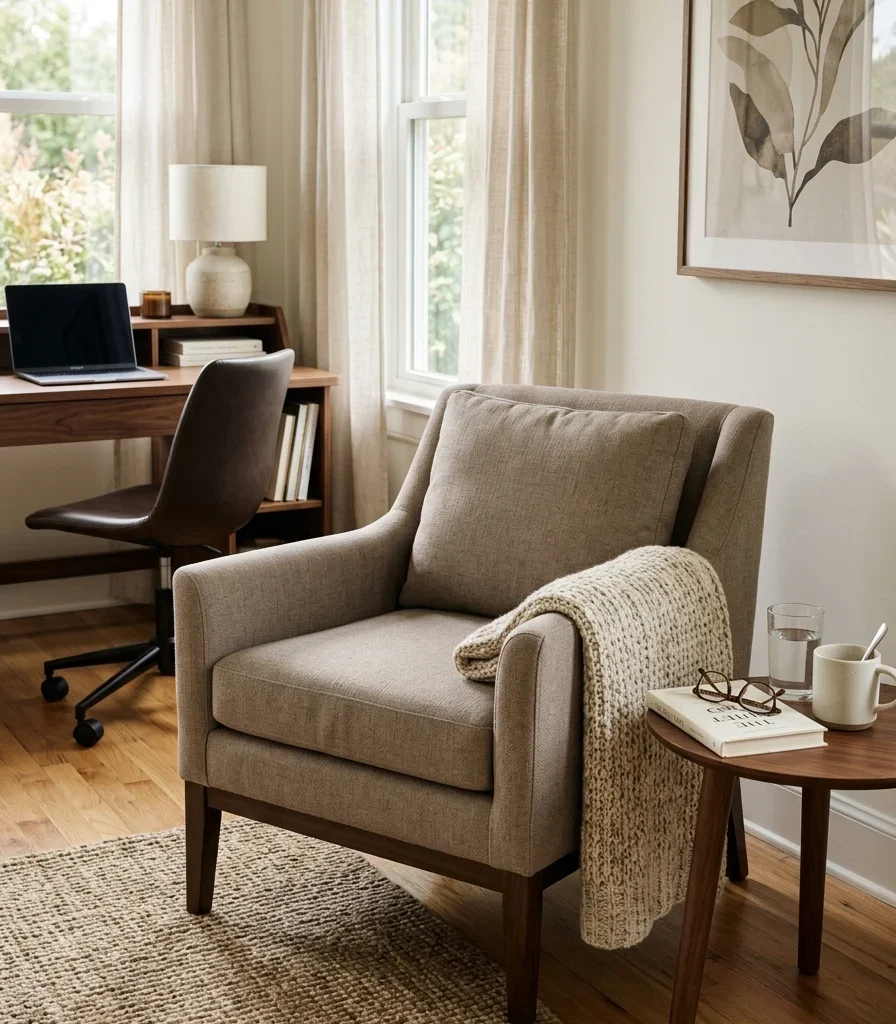
Vibe: Layer a second seat that exists purely to signal the workday has ended, even a few feet from the desk.
Why it works: Having a physically distinct seat for non-work moments applies furniture-arrangement thinking to the transition-ritual problem: sitting in a different chair at the end of the day creates a physical, repeatable cue that the desk chair alone can’t provide, since remaining in the same seat blurs the boundary between working and simply being in the room.
How to get it: Choose a chair with a clearly different profile and fabric from the desk chair a slipper chair in taupe bouclé versus a mesh ergonomic chair, for instance nd treat sitting in it as a deliberate signal that work hours are over.
Shop the Look
| Product |
| Taupe bouclé slipper chair |
| Small walnut side table |
| Folded throw blanket |
| Small ceramic reading lamp |
| Soft wool accent pillow |
4. Use a Daylight-Mimicking Desk Lamp for Natural Circadian Cues
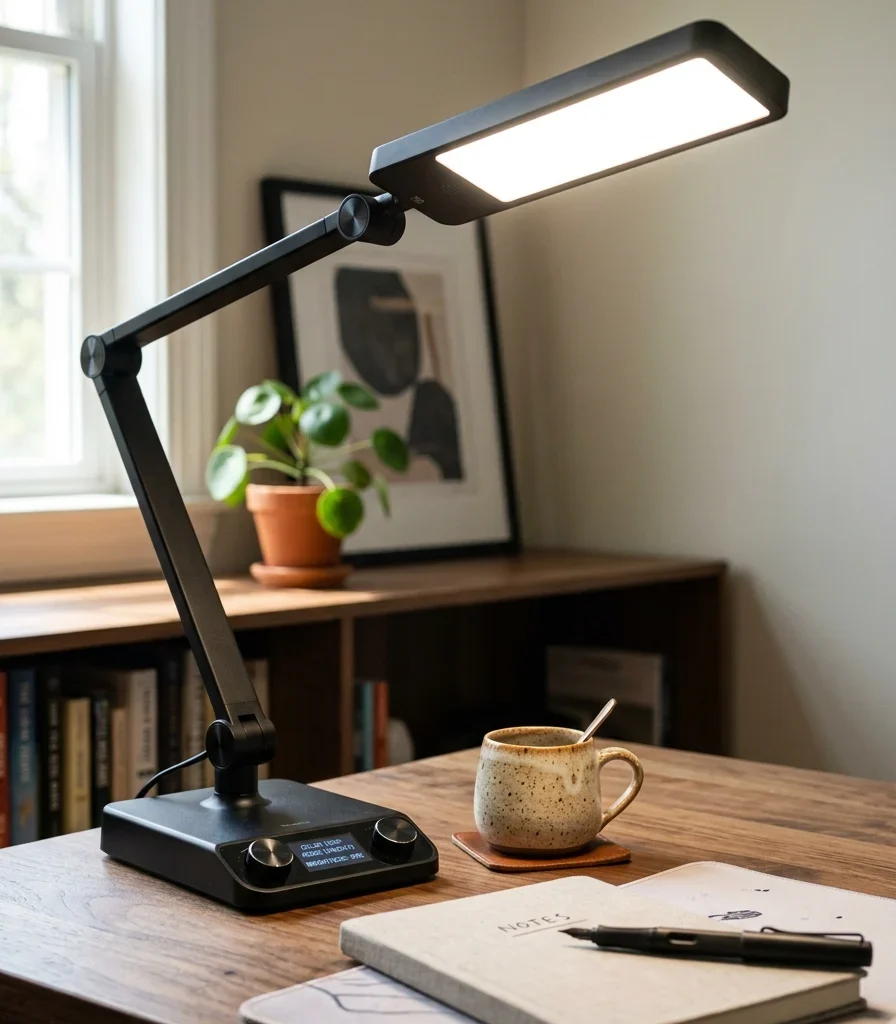
Vibe: Functional: a lamp that shifts its own light to match what the body expects at each hour of the day.
Why it works: Circadian or tunable lighting applies light-behavior research directly to remote-work fatigue. Many home offices lack the natural daylight exposure a traditional commute and office windows once provided, and a lamp that shifts from cooler, brighter light in the morning to warmer tones by late afternoon helps compensate for that lost cue, supporting alertness when it matters and winding down appropriately later.
How to get it: Choose a tunable LED desk lamp with an automatic daily color-temperature schedule (cool 5000K in the morning, warm 2700K by evening) rather than a fixed single-temperature bulb, positioning it where its light reaches the face directly rather than only the desk surface.
Shop the Look
| Product |
| Tunable circadian LED desk lamp |
| Matte black adjustable lamp arm |
| Small ceramic desk mug |
| Daylight lamp scheduling remote |
| Walnut desk lamp base |
5. Lay Cork Flooring for All-Day Standing Comfort
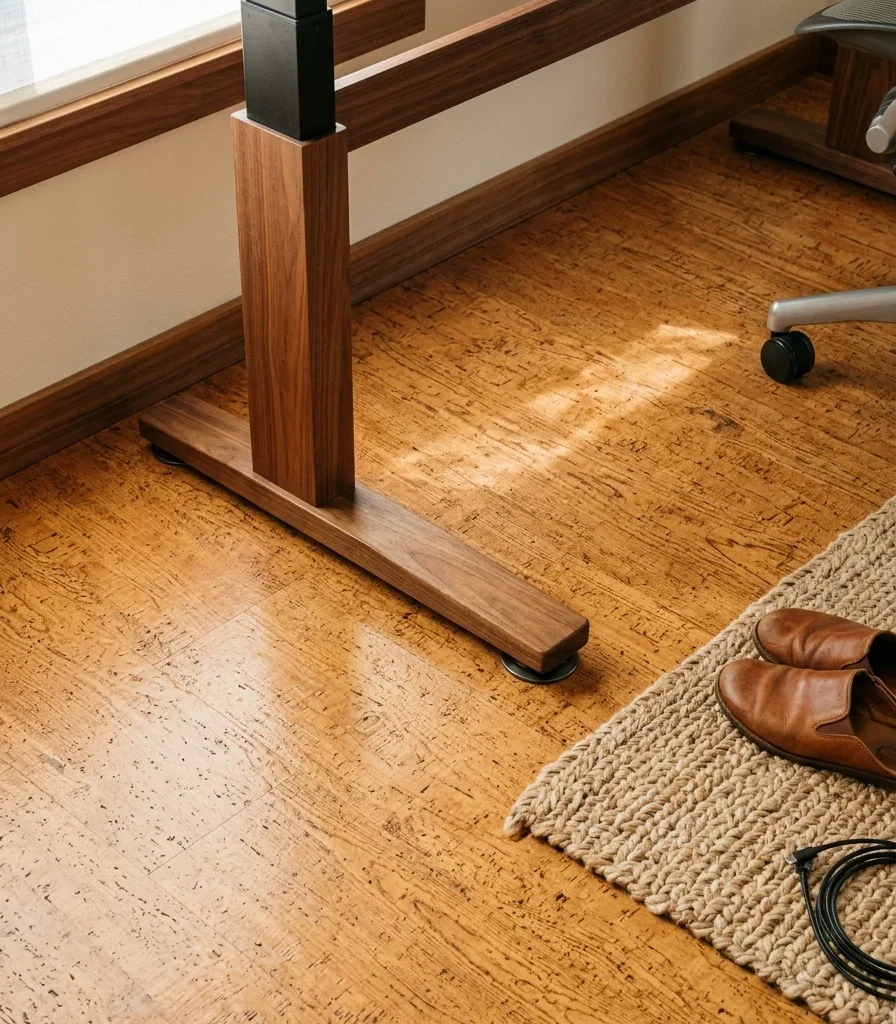
Vibe: Warm, a floor with genuine give underfoot, meaningfully softer than bare hardwood or tile during a long standing session.
Why it works: Cork’s natural cellular structure gives it more cushioning and thermal warmth than hardwood or laminate, a material-honesty principle that matters specifically for anyone using a standing desk converter regularly, since standing on a harder surface for extended periods causes more foot and lower-back fatigue than a naturally resilient material.
How to get it: Install cork flooring or a cork floor mat specifically in the standing-desk zone rather than the whole room, choosing a sealed, finished cork rated for daily foot traffic rather than a decorative unsealed tile.
Shop the Look
| Product |
| Natural cork floor tile sealed |
| Cork standing mat anti-fatigue |
| Walnut standing desk converter |
| Small woven floor mat edge |
| Cork floor sealant maintenance kit |
6. Add a Small Tray as a Closing Ritual Object
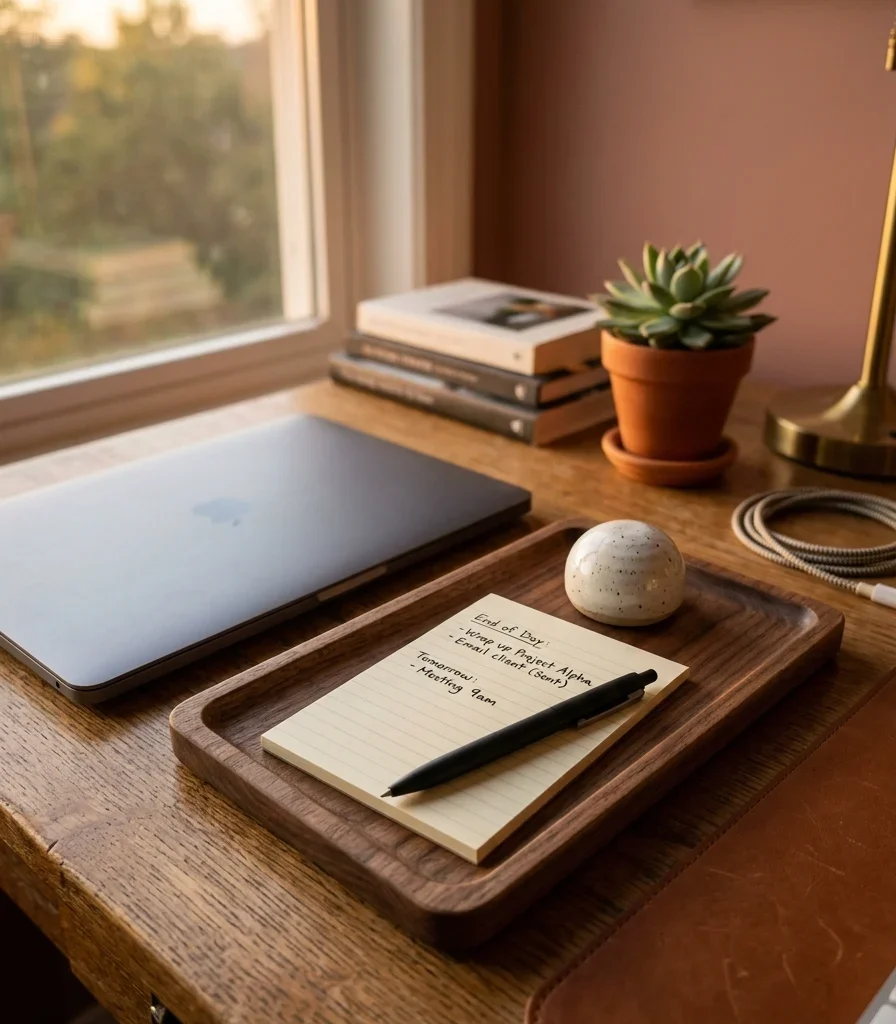
Vibe: Hushed, a small object that turns “closing the laptop” into an actual, repeatable end-of-day ritual.
Why it works: A dedicated closing-ritual tray applies accessory layering to the transition-cue problem directly; placing tomorrow’s notepad and pen on the tray each evening, alongside the closed laptop, creates a consistent physical action that signals the workday’s end, addressing the same boundary-blurring issue the off-duty chair solves from a different angle.
How to get it: Choose a small walnut tray no larger than 10×6 inches, and use it consistently for the same closing sequence each day: laptop closed, notepad placed on the tray, so the ritual becomes automatic rather than occasional.
💡 Quick Win: Any small tray already in the house works for this exercise immediately; the ritual matters more than the object’s cost.
Shop the Look
| Product |
| Small walnut wood tray |
| Leather-bound notepad |
| Small ceramic paperweight |
| Matte black pen set |
| Walnut desk organizer edge |
7. Break Up an All-Grey Home Office With Warm Terracotta
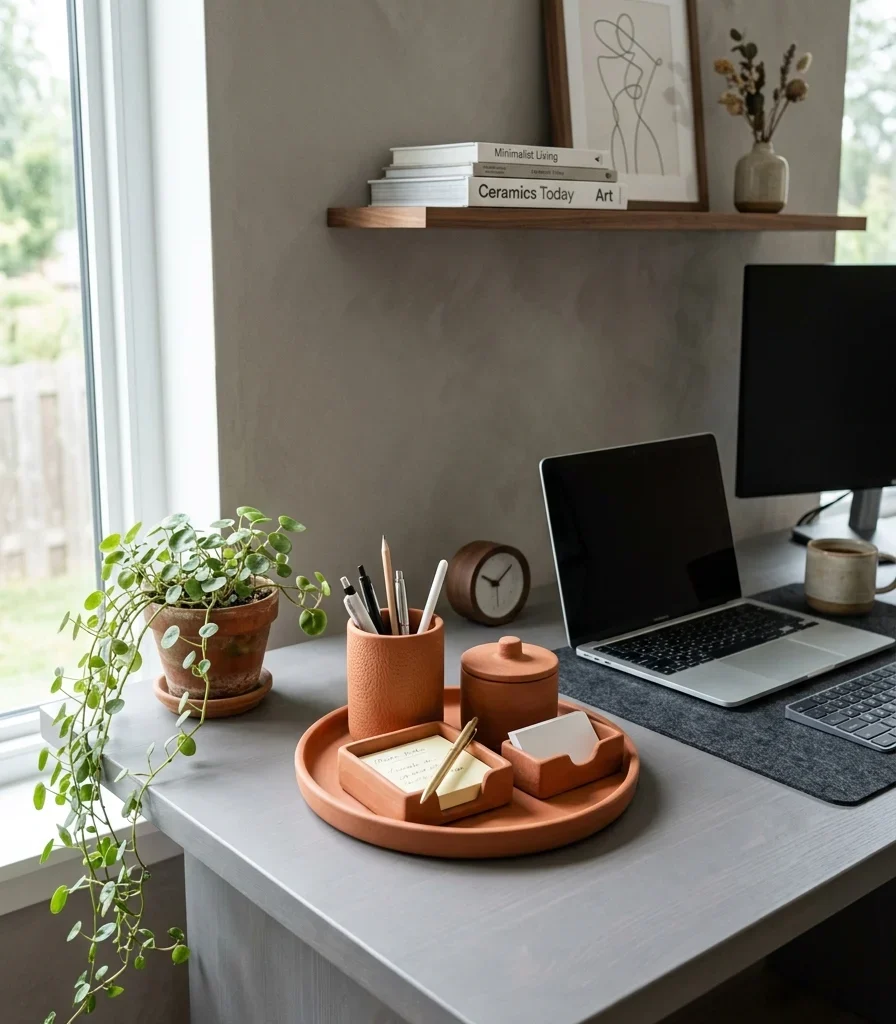
Vibe: Warm, a single earthy accent that keeps an all-grey room from reading as flat or sterile.
Why it works: Many home offices default entirely to grey and white for a “professional” look, but a fully neutral room without any warmth can read as sterile over long working hours. Introducing terracotta through two or three small objects applies tonal layering that adds visual warmth without disrupting the room’s overall calm, neutral base.
How to get it: Limit terracotta to a pen cup, a small planter, and one desk tray, keeping the desk, walls, and larger furniture in their existing grey palette so the terracotta reads as a deliberate accent rather than a competing scheme.
Shop the Look
| Product |
| Terracotta ceramic pen cup |
| Terracotta desk catchall tray |
| Small trailing plant terracotta pot |
| Warm grey desk pad |
| Walnut desk accent trim |
8. Add a Room Divider Screen for a Commute-Like Transition
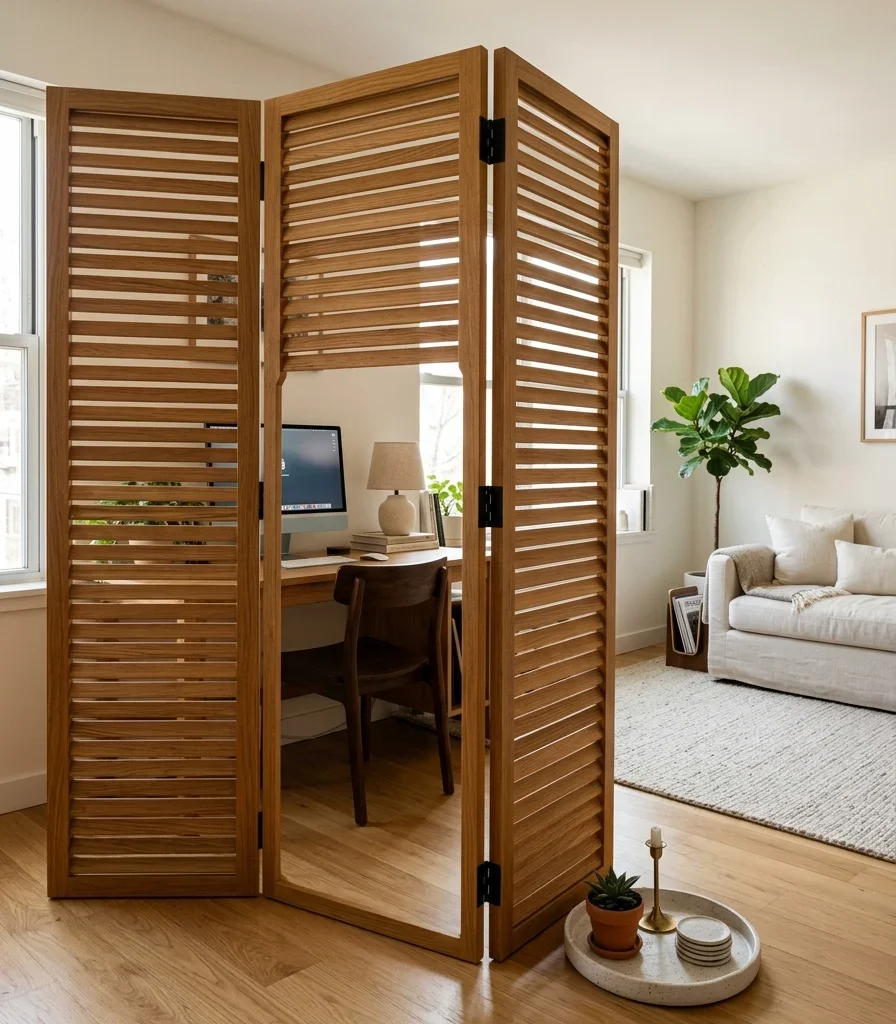
Vibe: Still a folding screen that recreates the physical “leaving work” moment a commute used to provide.
Why it works: A room divider applies furniture-arrangement and transition-ritual thinking together; physically walking through or past the screen at the start and end of the workday recreates the boundary-crossing moment a commute once provided automatically, which research on remote-work transitions identifies as one of the more effective substitutes for a physical commute.
How to get it: Position a folding slatted wood screen between the desk and the room’s main living area, closing it at the end of the workday as a deliberate action rather than leaving it permanently open, so the act of closing it becomes part of the ritual.
Shop the Look
| Product |
| Slatted wood folding room divider |
| Small ceramic tray beside screen |
| Honey wood hinge hardware |
| Matte black screen foot caps |
| Small woven floor mat |
9. Use a Sunrise-Timed Smart Bulb for a Natural Wake-Up Cue
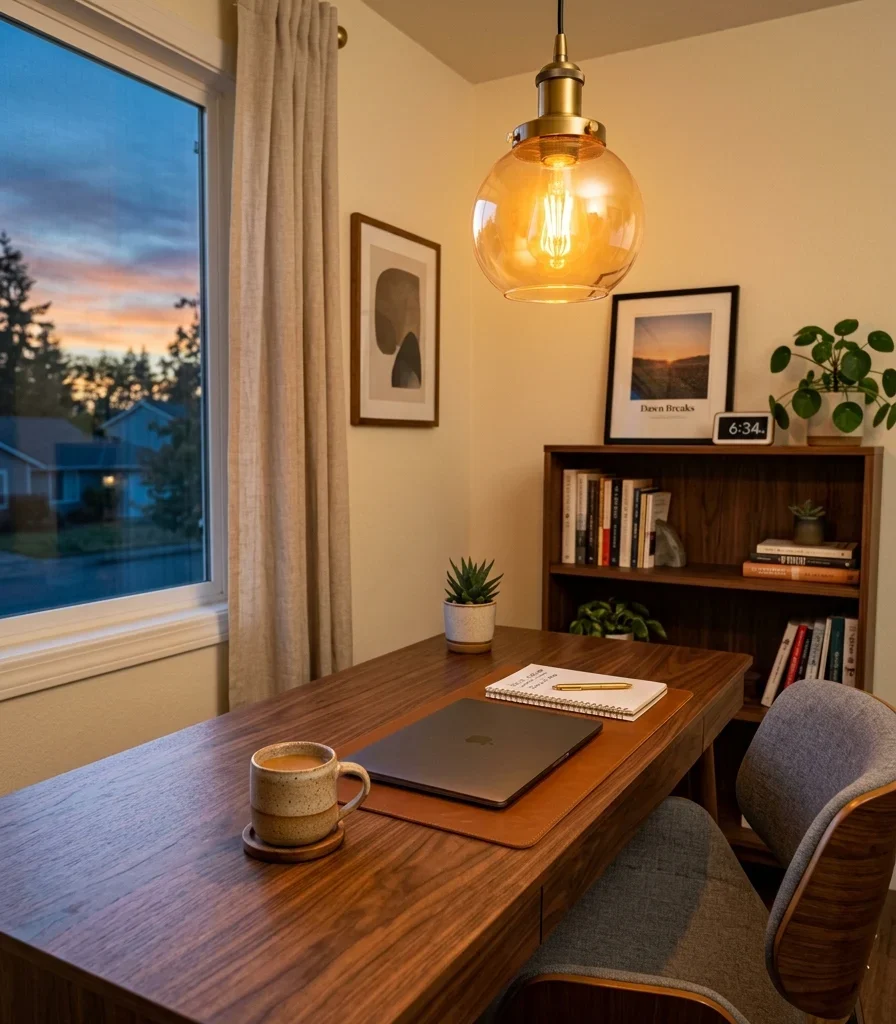
Vibe: Warm light that eases the room awake instead of snapping on at full brightness the moment work starts.
Why it works: A sunrise-simulating smart bulb applies light-layering to the specific transition into the workday, gradually increasing brightness over 20 to 30 minutes before a scheduled start time mimics a natural sunrise, which supports a more gradual cortisol and alertness curve than an abrupt bright light or, worse, starting work in dim ambient light with no wake cue at all.
How to get it: Schedule a smart bulb to begin a gradual warm-to-bright transition 20 minutes before the workday’s actual start time, positioning the bulb in the desk’s main overhead or floor lamp fixture rather than a secondary accent light.
Shop the Look
| Product |
| Sunrise simulation smart bulb |
| Matte black floor lamp fixture |
| Small ceramic desk mug |
| Smart bulb hub compatible |
| Walnut lamp base accent |
10. Add a Live-Edge Wood Shelf for a Grounding Natural Texture
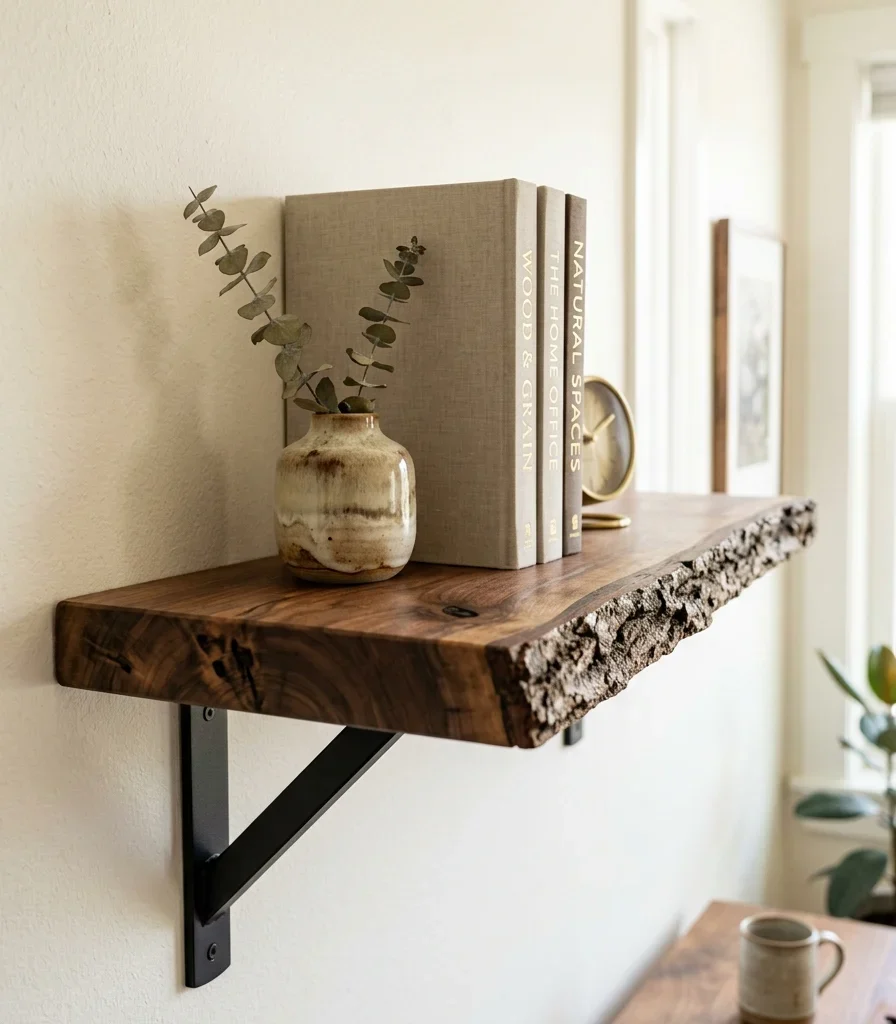
Vibe: Grounded a piece of genuinely unprocessed wood grain in a room otherwise dominated by screens.
Why it works: A live-edge shelf applies biophilic material honesty; its irregular, natural silhouette contrasts directly against the flat, rectangular geometry of monitors and desks, giving the eye a genuinely organic reference point that research on biophilic design associates with reduced stress and improved sustained attention during screen-heavy work.
How to get it: Choose a live-edge walnut or oak shelf with its natural bark edge left intact (not sanded into a uniform curve), mounted at eye level or slightly above so its irregular silhouette is genuinely visible rather than tucked below the sightline.
Shop the Look
| Product |
| Live edge walnut floating shelf |
| Matte black shelf bracket |
| Small ceramic decorative vessel |
| Wood grain sealant finish |
| Small dried branch accent |
11. Split the Wall Two-Tone to Separate Work Zone From the Rest of the Room
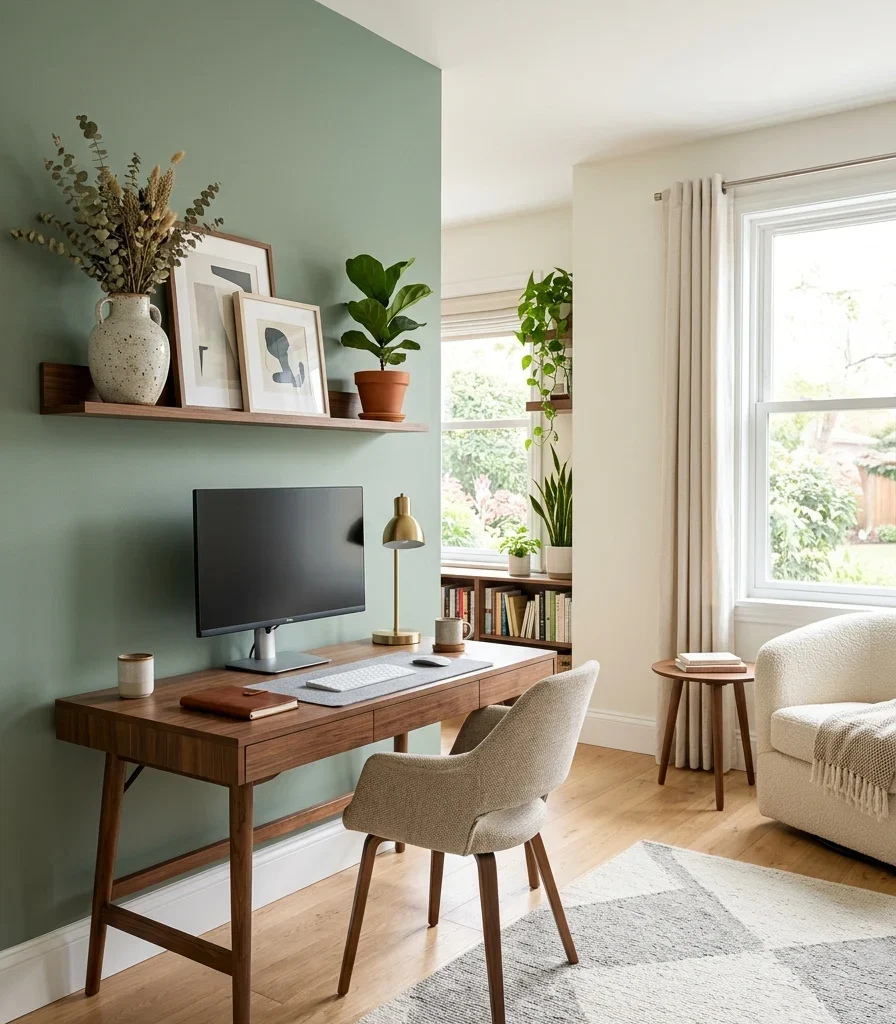
Vibe: Fresh, a visible line that tells the eye exactly where “work” ends and the rest of the room begins.
Why it works: Color blocking is a zoning technique that divides one shared room into two functional areas without a physical partition a distinct wall color behind the desk zone, different from the room’s other walls, gives the brain the same instant “this is a different area” cue used in studio apartments to separate a kitchen from a living space, reinforcing the mental boundary a shared work-and-rest room otherwise lacks.
How to get it: Paint the wall section directly behind and slightly wider than the desk setup in sage green, keeping the rest of the room in warm white, with a crisp painter’s-tape edge rather than a decorative trim strip marking the transition.
Shop the Look
| Product |
| Sage green matte wall paint |
| Warm white contrast wall paint |
| Painter’s tape precision edge |
| Small ceramic countertop vessel |
| Walnut trim accent |
12. Position a Small Plant Trio Within the Camera Frame
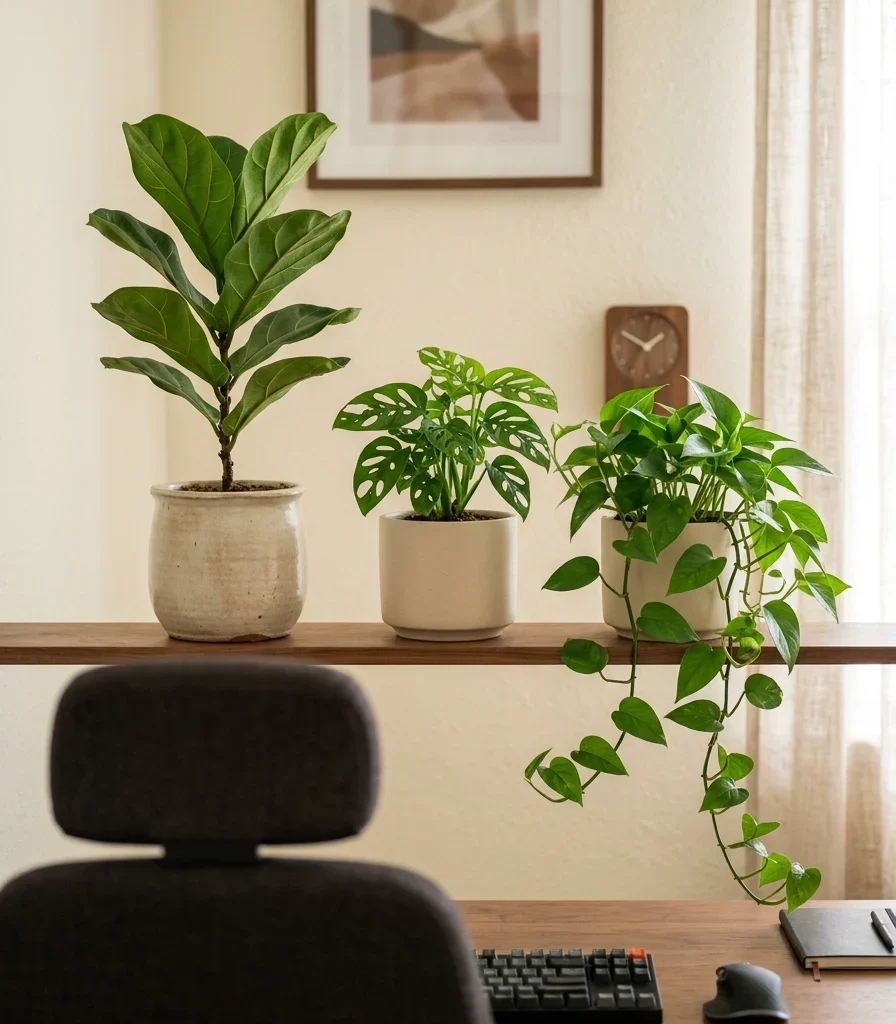
Vibe: Layered greenery placed exactly where a colleague’s screen will actually see it during a call.
Why it works: Positioning plants specifically within the camera’s field of view (rather than anywhere convenient in the room) is an accessory-layering principle unique to remote work. Video calls make a narrow slice of the room the only part colleagues ever see, so styling that specific frame has an outsized effect on the room’s perceived calm and professionalism relative to decorating the rest of the space.
How to get it: Sit in the desk chair with the webcam active, and place three plants at varied heights (a taller floor plant, a mid-height shelf plant, a small desk plant) specifically within that visible frame, adjusting positions while checking the actual camera view rather than guessing from across the room.
Shop the Look
| Product |
| Small potted plant trio set |
| Matte ceramic plant pot varied |
| Trailing vine plant small |
| Walnut plant stand riser |
| Small ceramic watering can |
13. Use a Low Bookshelf as a Soft Room Boundary
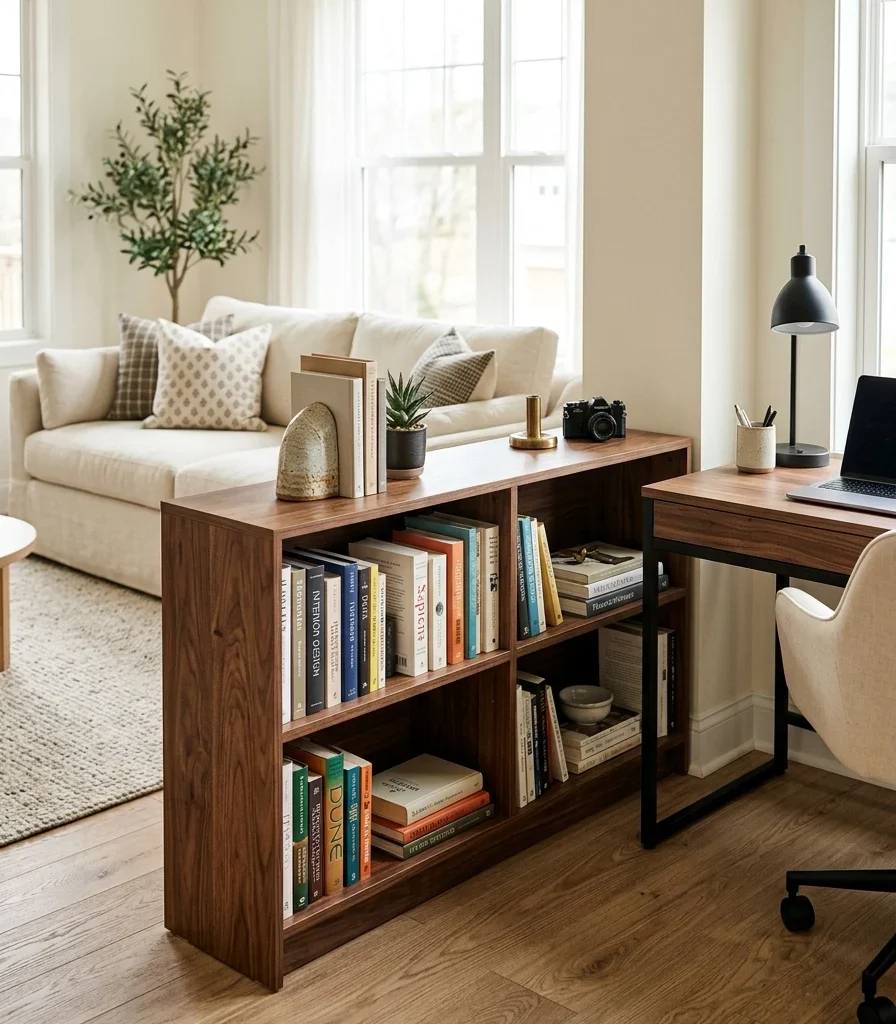
Vibe: Airy, a boundary low enough to keep the room open, but present enough to mark where work begins.
Why it works: A low bookshelf applies furniture-arrangement zoning without the visual heaviness of a full room divider; at roughly 30 inches tall, it defines the work zone’s edge while still allowing sightlines and natural light to pass over it, a middle ground between no boundary at all and a full floor-to-ceiling partition a small shared room can’t spare.
How to get it: Position a low bookshelf no taller than 30–36 inches perpendicular to the desk, using it to mark the boundary of the work zone rather than pushing it flush against a wall, and keep its top surface intentionally styled since it becomes a secondary sightline during calls.
Shop the Look
| Product |
| Low walnut open bookshelf |
| Small ceramic bookend set |
| Stacked hardcover book set |
| Small ceramic decorative vessel |
| Walnut shelf trim accent |
14. Position the Desk to Face the Room’s Entry Point
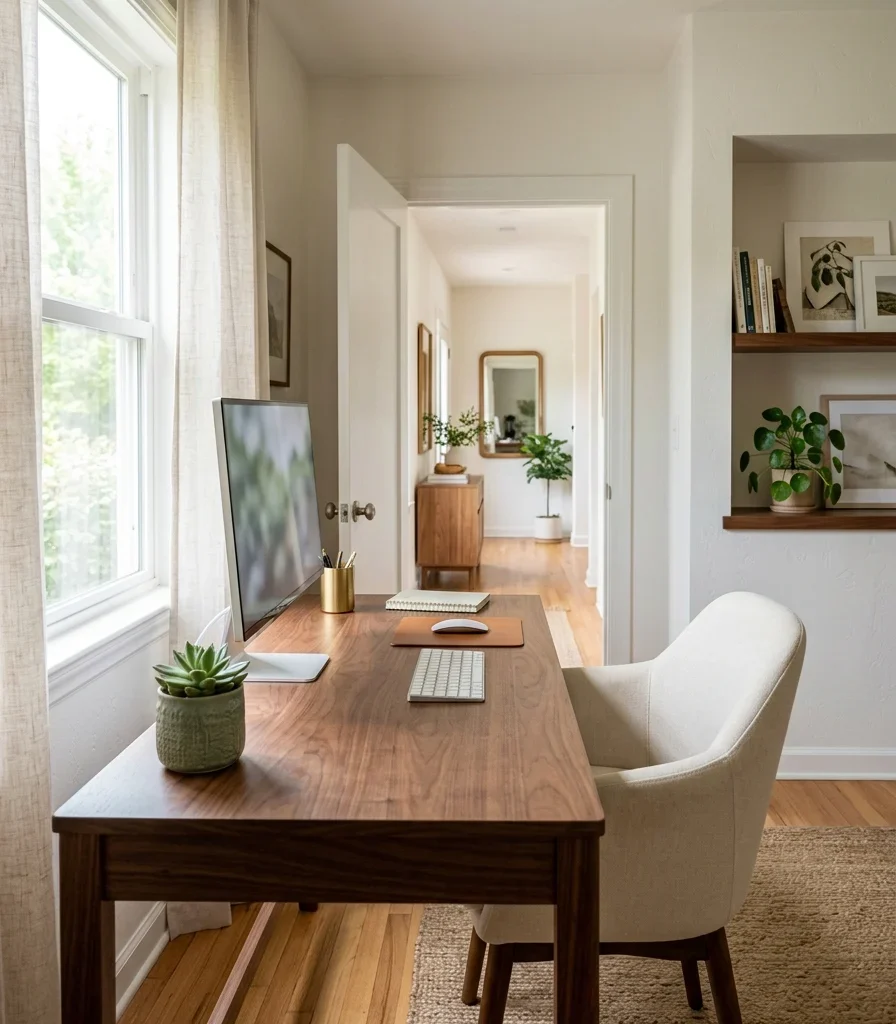
Vibe: Still a desk oriented so nothing catches you off guard mid-focus.
Why it works: Facing the desk toward the room’s entry point is a layout principle borrowed from workplace environmental psychology; sitting with your back to a doorway creates a low-grade, often unconscious vigilance for anyone entering the room, which measurably interrupts sustained focus, while a direct sightline to the entry removes that background alertness entirely.
How to get it: Rotate the desk so the chair faces the doorway directly or at a diagonal angle, allowing a clear view of it, even if this means the desk no longer sits flush against the room’s most obvious wall, since the sightline benefit outweighs the furniture-arrangement convenience of a wall-flush desk.
Shop the Look
| Product |
| Walnut desk with entry sightline |
| Ergonomic chair swivel base |
| Small ceramic desk vessel |
| Sage green accent wall paint |
| Walnut desk organizer |
15. Add a Fold-Flat Desk That Signals the Workday Has Ended
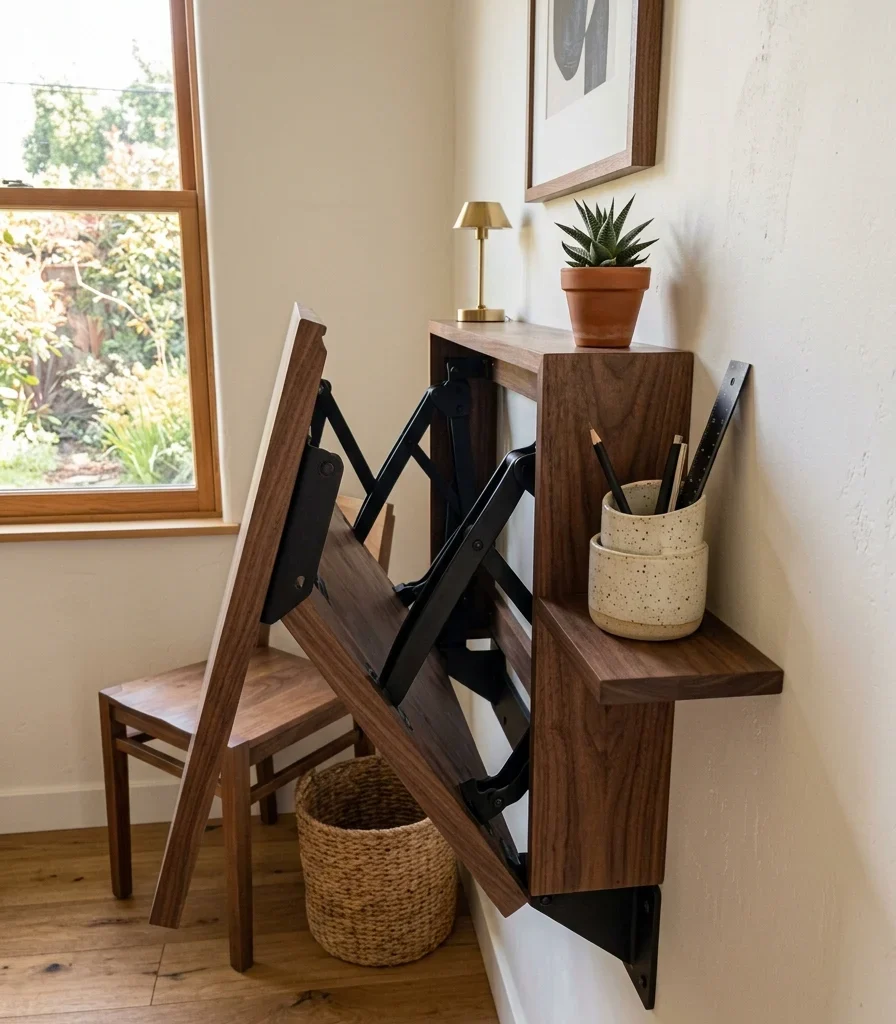
Vibe: Still a desk that physically disappears the moment the workday is over, reclaiming the room for something else entirely.
Why it works: In a genuinely small or multi-use room where the desk sits inside a bedroom or living space, a fold-flat desk is the small-space adaptation that solves the transition-ritual problem architecturally rather than symbolically folding it away at day’s end isn’t just a visual cue like the closing tray, it’s a physical removal of the workspace from the room entirely, which matters most when there’s no separate office to walk away from.
How to get it: Choose a fold-down desk with a hinge rated for daily use and enough storage on an adjacent shelf to fully clear the desktop before folding, making the fold-away action part of the same closing ritual as the tray and off-duty chair covered earlier.
💡 Quick Win: A slim wall-mounted laptop shelf that folds up against the wall achieves a similar effect in an even tighter footprint than a full fold-down desk.
Shop the Look
| Product |
| Fold-down wall-mounted desk |
| Matte black fold hinge hardware |
| Adjacent storage shelf |
| Small ceramic organizer |
| Slim fold-up laptop shelf |
How to Start Optimizing Your Work-From-Home Setup
Your first move is establishing a single closing ritual: the tray, the off-duty chair, or folding the desk away before addressing any material or color change. Since the core problem this whole approach solves is the missing boundary between work and rest, a repeatable daily ritual costs nothing and starts working immediately, while paint and furniture take longer to arrange.
The most common mistake is treating a WFH productivity setup as a checklist of gadgets rather than a genuinely repeated daily habit. Buying a sunrise lamp or an acoustic panel changes nothing if the underlying routine around it stays inconsistent. The fix is committing to the same start-of-day and end-of-day sequence every single day for at least two weeks before evaluating whether it’s working.
Three items under $50 that create immediate impact: a small walnut tray for the closing ritual, a set of three small potted plants for the camera frame, and a wool felt panel remnant for basic sound dampening behind the desk.
A weekend refresh a ritual object, plants, and paint costs $100–350. A full setup including acoustic paneling, circadian lighting, and a room divider typically runs $600–1,800 and can be completed over two to three weekends.
Frequently Asked Questions About Optimizing a Work-From-Home Setup for Productivity
What is the difference between an ergonomic home office setup and a productivity-optimized one?
An ergonomic setup focuses on physical comfort: monitor height, chair support, desk depth. A productivity-optimized work-from-home setup addresses the psychological and environmental factors ergonomics doesn’t cover, including acoustic comfort, circadian lighting, and daily transition rituals that mark the start and end of the workday, which matter especially when work and home share the same physical space.
What color works best for a productivity-focused home office?
Sage green works well as a focus-wall color since muted greens are associated with lower physiological arousal and sustained attention in color psychology research, while warm terracotta works as a smaller accent to prevent an all-grey or all-white office from feeling sterile over long working hours.
How much does it cost to optimize a work-from-home setup for productivity?
A budget refresh using a closing-ritual tray, plants, and basic acoustic treatment costs $100–350. A mid-range upgrade with circadian lighting and a room divider runs $600–1,200, and a full setup including cork flooring and custom acoustic paneling typically costs $1,200–2,500 depending on room size.
Can a shared or multi-use room still support real WFH productivity?
Yes, and it may need these techniques more than a dedicated office does: a two-tone wall split, a low bookshelf boundary, and a fold-flat desk all create the zoning and transition cues a separate office room provides architecturally, compensating for the lack of a physical door to close at day’s end.
What is the single most effective productivity change for a work-from-home setup?
Establishing a consistent closing ritual is the most effective single change, since the lack of a commute or physical transition is the specific problem most WFH productivity research identifies as the hardest to solve, and a repeatable ritual closing a laptop onto a tray, changing seats, or folding away a desk addresses that gap directly and at essentially no cost.
Ready to Optimize Your Work-From-Home Setup for Productivity?
These 15 ideas move across material, color, lighting, layout, and true small-space solutions, rom an acoustic wool panel and a sunrise-timed smart bulb to a fold-flat desk that reclaims the room the moment the workday ends. None of this needs to happen all at once, and starting with a single closing ritual this week is genuinely the smartest place to begin, not a smaller version of the full plan. Today’s specific action: pick one object a tray, a different chair, a screen to close and use it as your exact end-of-workday signal starting tomorrow, repeating it daily before adding anything else from this list. Once the room finally knows the difference between work hours and the rest of the day, sitting down to work will feel less like negotiating with your own space and more like stepping into a room built specifically to hold your attention when it should, and let go of it when it shouldn’t. Save the ideas that fit your actual routine and your room’s real constraints; that closing ritual and sage green focus wall will still be doing their job a year from now.
You Might Also Like
- 16 Ways to Optimize a Home Office Setup in a Small Bedroom
- 15 Small Home Office Ideas for Two That Actually Work
- 15 Ways to Optimize Home Office Storage Space
- 15 Ways to Optimize a Small Home Office Corner
- 15 Efficient Small Business Home Office Ideas
- 15 Smart Small Home Office Guestroom Design Ideas