
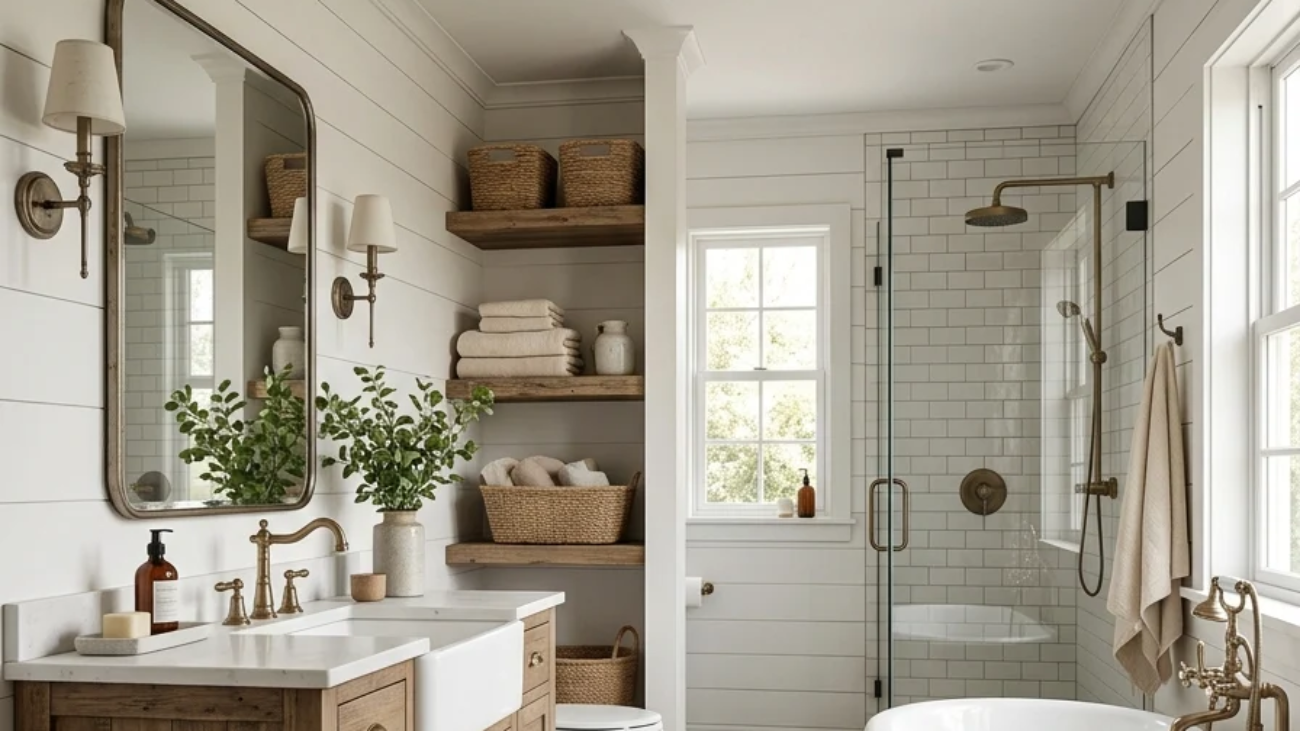
A farmhouse full bathroom is a complete bathroom: tub, shower, toilet, and sink, finished in the practical, warm materials of American farmhouse tradition: shiplap, reclaimed wood, galvanized metal, and matte black hardware, built for everyday function rather than showroom polish. This article gives you 15 genuinely creative farmhouse full bathroom ideas that go beyond the standard shiplap-and-barn-door formula, covering material, color, lighting, and layout decisions for a room that holds real daily use.
It feels like stepping into a room with a past: a repurposed dresser holding a vessel sink instead of a builder-grade vanity, a schoolhouse pendant throwing warm light the way it did over a porch a century ago, the specific comfort of a clawfoot tub that looks like it’s always belonged there. This is farmhouse design at its most inventive: practical, a little unexpected, never a kit-built copy of itself.
Here are 15 ideas worth saving and stealing.
Why Creative Farmhouse Full Bathroom Design Works So Well
Farmhouse design draws directly from the working American farmhouse of the late 1800s and early 1900s a house built for function first, using local, affordable materials like shiplap siding, cast iron fixtures, and repurposed furniture rather than anything manufactured for decoration. What separates a genuinely creative farmhouse bathroom from a generic one is repurposing: instead of buying a new “farmhouse-style” vanity, the creative version finds an actual antique dresser or feed trough and adapts it, which is exactly how the original farmhouse aesthetic came to exist in the first place.
Core materials are white or warm-white shiplap, reclaimed or repurposed wood furniture, galvanized and matte black metal, cast iron for tubs, and honed or matte subway and hexagon tile. Color runs warm white, warm sage, warm charcoal, and terracotta, always paired with black or dark bronze hardware rather than polished chrome, which reads too modern against the style’s rougher textures.
Style at a Glance
| Element | Key Materials | Key Colors |
| Philosophy | Practical, honest materials repurposed and reused rather than manufactured to imitate age | Warmth and function prioritized over polish |
| Materials | Shiplap, reclaimed wood, galvanized metal, cast iron, matte black hardware | |
| Color Palette | Warm white, warm sage, warm charcoal, terracotta |
15 Creative Farmhouse Full Bathroom Ideas
1. Wrap the Tub in a Waterproofed Shiplap Surround
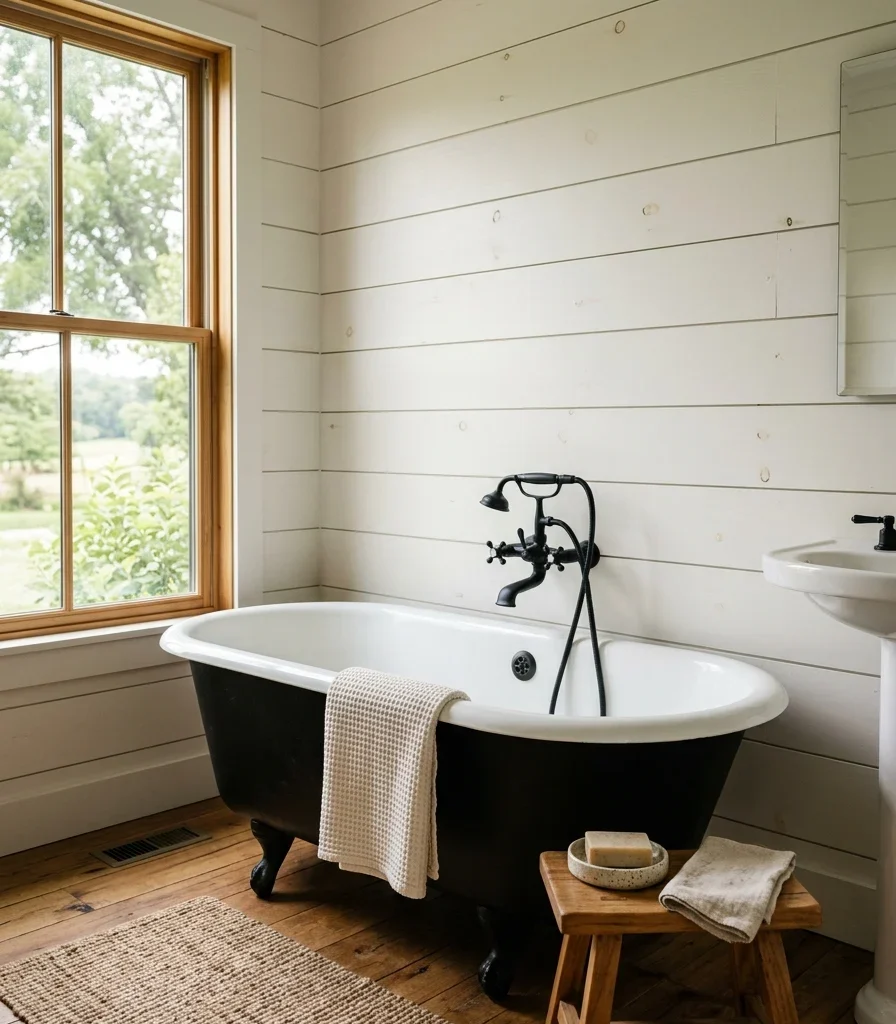
Vibe: Ground a tub surround with genuine architectural texture instead of a flat tiled wall.
Why it works: Shiplap applies texture layering to a wet-zone surface most bathrooms leave completely flat. The horizontal grooves catch light and shadow differently than smooth tile, giving the tub wall visual depth, but only works long-term if properly waterproofed, which is the detail most DIY farmhouse bathrooms skip and later regret.
How to get it: Install shiplap only above the tub’s splash line (roughly 18 inches up from the rim) and seal every groove and seam with a marine-grade waterproof polyurethane rather than standard interior paint, reapplying the sealant annually in the direct splash zone.
💡 Quick Win: PVC shiplap panels designed for wet areas achieve the same look without the sealing maintenance real wood requires.
Shop the Look
| Product |
| Warm white shiplap wall panel |
| Marine-grade polyurethane sealant |
| Matte black tub filler |
| Small ceramic soap dish |
| PVC waterproof shiplap panel |
2. Pair Warm Sage Green With White Shiplap
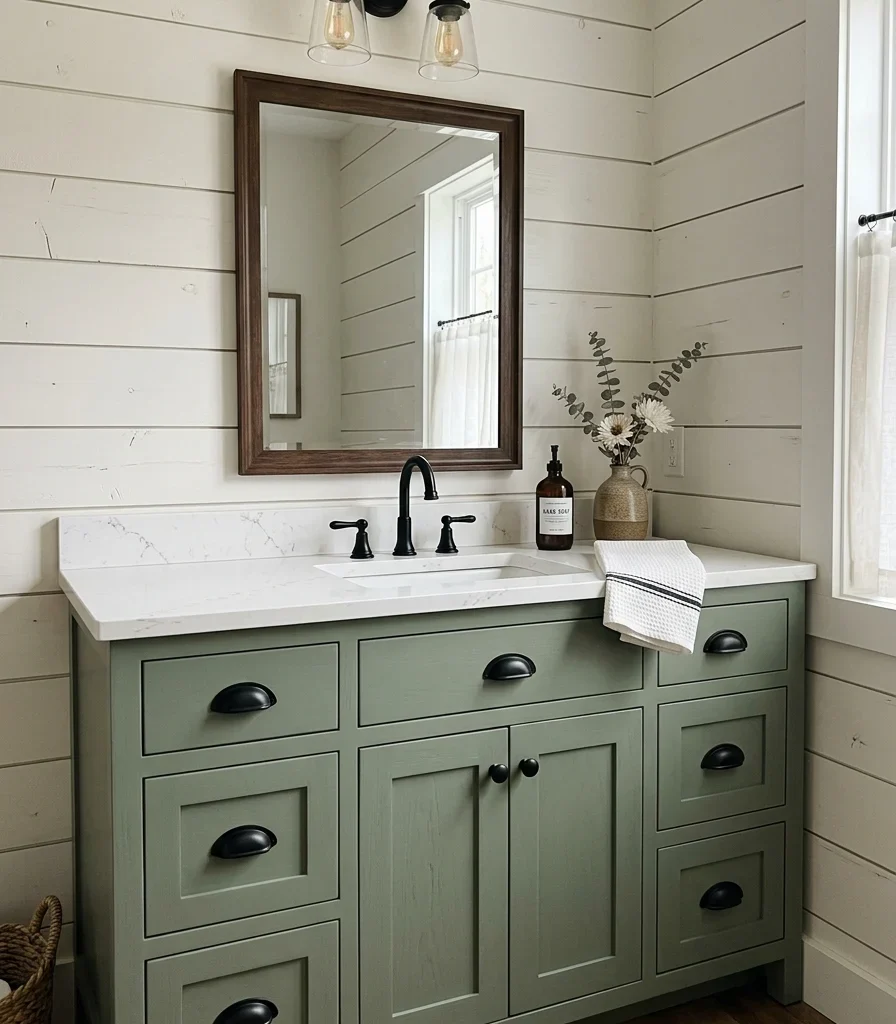
Vibe: Calm a color pairing that feels lived-in and unhurried rather than freshly staged.
Why it works: Color anchoring lets the vanity carry the room’s single accent color while shiplap stays neutral, a contrast principle that keeps a small full bathroom from feeling visually busy. Sage reads as an earthy, farmhouse-appropriate color specifically because it references garden and orchard tones rather than a purely decorative palette.
How to get it: Paint the vanity in a matte or eggshell warm sage (avoid a cool, blue-based sage, which clashes with warm white shiplap), and pair it with matte black cup pulls rather than brass, which reads slightly more formal than the style typically calls for.
Shop the Look
| Product |
| Warm sage cabinet-grade paint |
| Matte black cabinet cup pull |
| Small ceramic bud vase |
| Warm white shiplap panel |
| Honed stone vanity counter |
3. Repurpose a Dresser Into a Vessel Sink Vanity
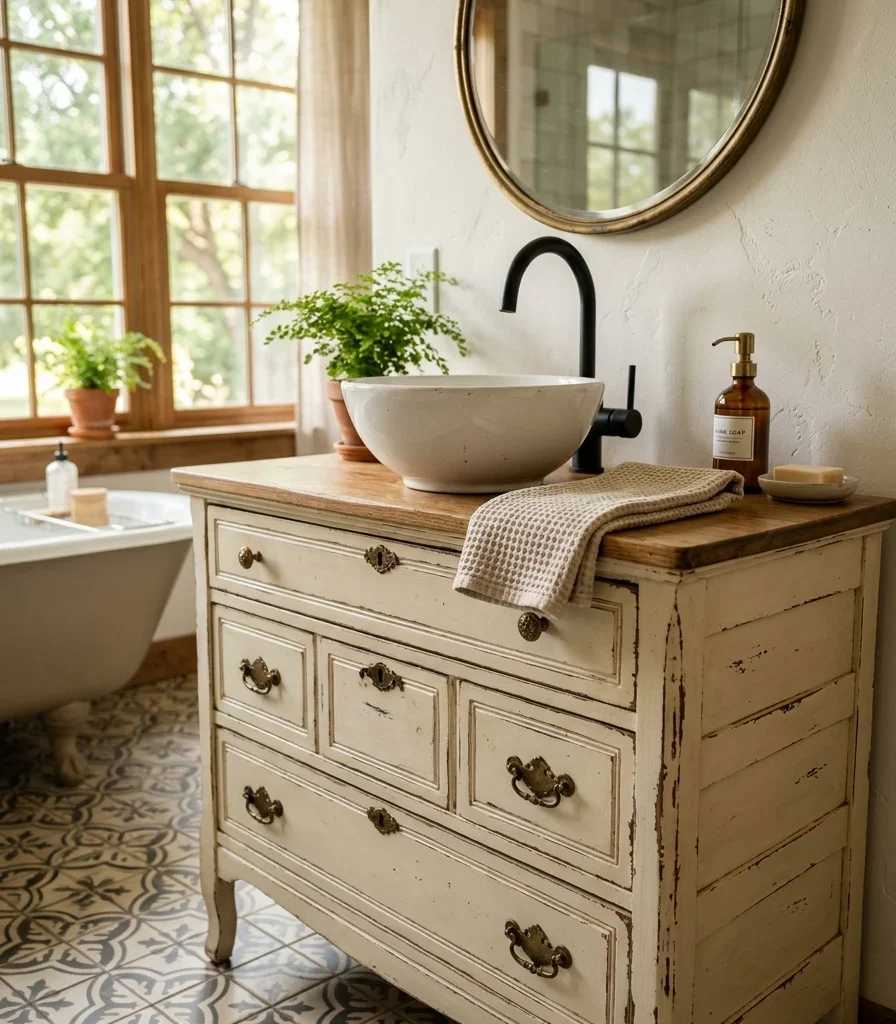
Vibe: Layered a piece of furniture with a genuine former life, now doing double duty as a sink base.
Why it works: Repurposing furniture is the single most authentic expression of farmhouse philosophy, since the original style emerged from families adapting whatever furniture they already owned rather than buying purpose-built bathroom cabinetry; a converted dresser carries visible drawer hardware and proportions no manufactured vanity replicates.
How to get it: Source a solid wood (not veneer) dresser with drawers deep enough to remain functional once the sink and plumbing are cut through the top, seal the wood surface with a waterproof polyurethane around the sink cutout, and keep the original hardware rather than swapping it for new pulls, since the mismatch in age is part of the piece’s authenticity.
Shop the Look
| Product |
| White ceramic vessel sink round |
| Matte black gooseneck faucet |
| Waterproof polyurethane wood sealant |
| Linen folded hand towel |
| Vessel sink mounting ring |
4. Hang a Vintage-Style Schoolhouse Pendant Over the Vanity
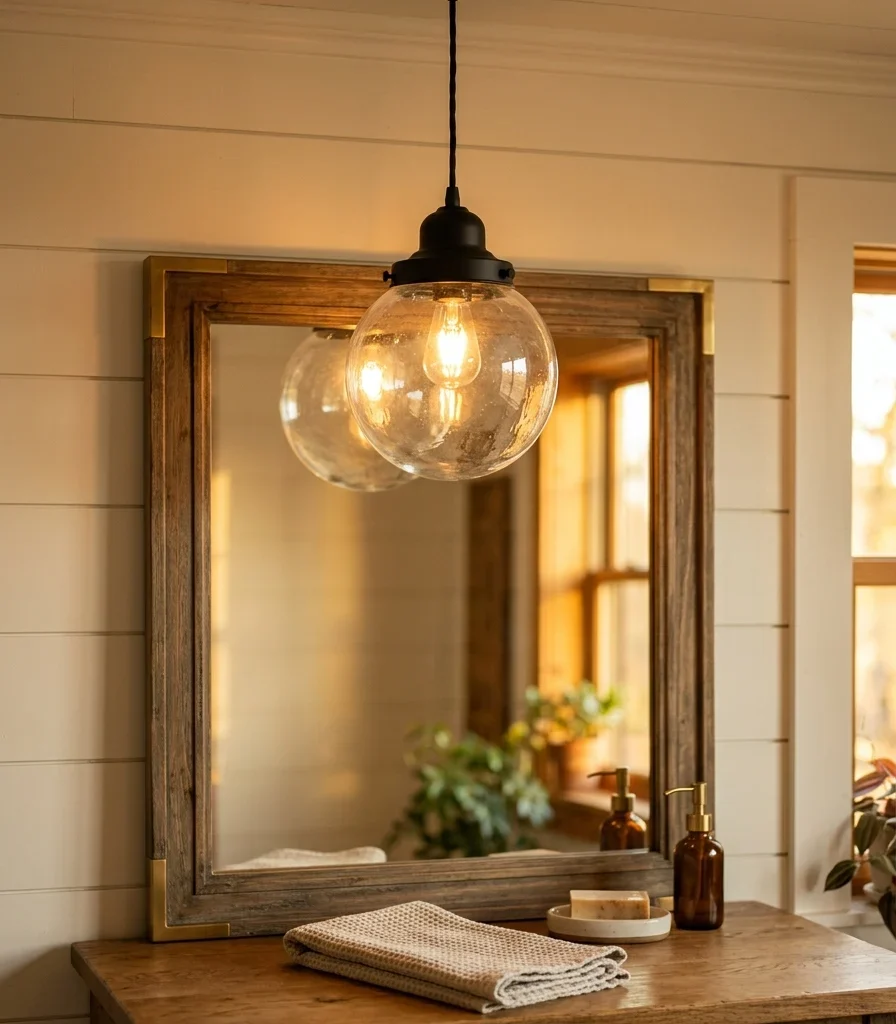
Vibe: Warm a single fixture with genuine period character instead of a standard vanity bar light.
Why it works: A schoolhouse pendant applies light-behavior and historical-detail principles together; its rounded milk-glass globe diffuses light evenly across the vanity area (avoiding the harsh directional glare of exposed vanity bulbs), while its silhouette directly references early 1900s American schoolhouse and farmhouse lighting fixtures, grounding the room’s period authenticity in a way generic modern fixtures can’t.
How to get it: Center the pendant 12–15 inches above the mirror’s top edge on a cord long enough to hang the globe at roughly eye level when standing, and choose a warm 2700K bulb visible through the glass rather than a cool white one, since the exposed glow is part of the fixture’s character.
Shop the Look
| Product |
| Glass schoolhouse pendant light |
| Matte black pendant cap hardware |
| Warm 2700K exposed bulb |
| Adjustable pendant cord kit |
| Folded cotton hand towel |
5. Lay a Black-and-White Hexagon Mosaic Floor
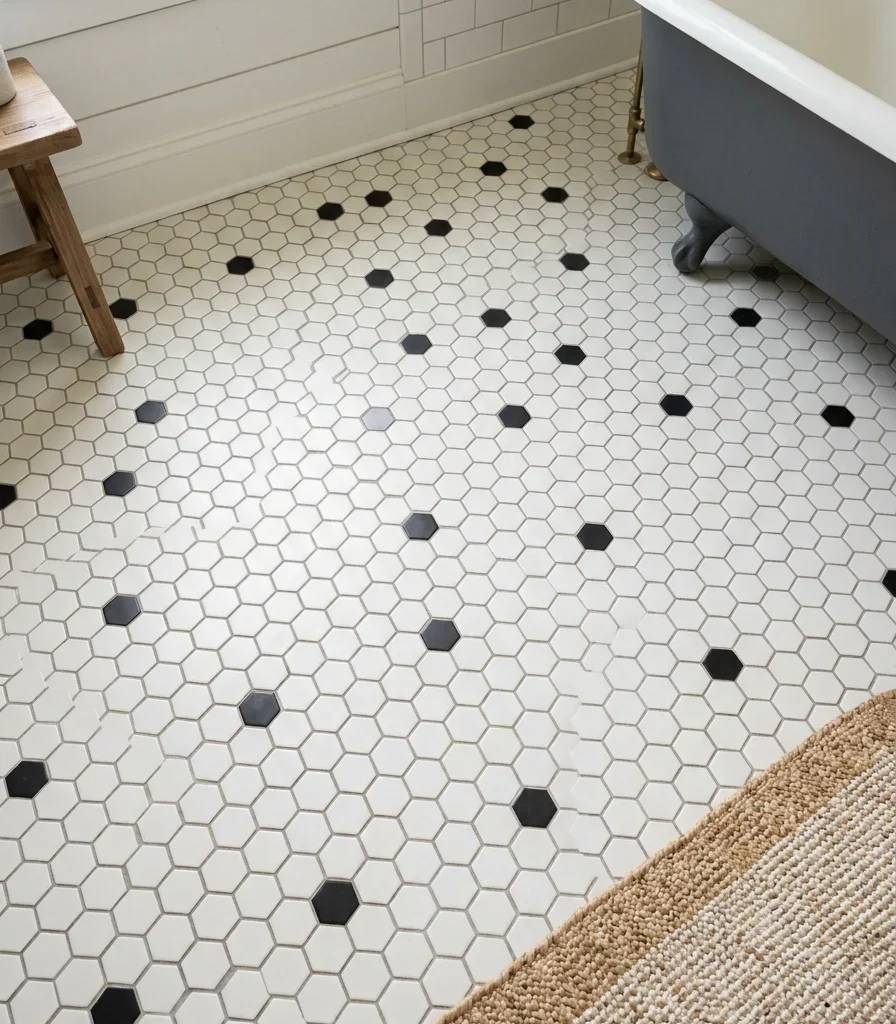
Vibe: Still a floor pattern with genuine period detail that grounds the whole room in its era.
Why it works: Hexagon mosaic is a material and pattern choice directly tied to early American farmhouse and craftsman bathroom flooring; the small-format tile creates a fine, detailed pattern underfoot that contrasts intentionally with the larger, plainer surfaces (shiplap, cabinetry) elsewhere in the room, a texture-layering principle that keeps the floor from disappearing visually.
How to get it: Choose a 1-inch hexagon mosaic sheet in warm white with black hexagons scattered at roughly one in twenty for a classic, understated pattern rather than a dense checkerboard, and use a warm grey grout rather than stark white to soften the high contrast underfoot.
💡 Quick Win: A hexagon-print vinyl floor tile achieves the same visual pattern at a fraction of the installation cost and time.
Shop the Look
| Product |
| Black and white hexagon mosaic sheet |
| Warm grey sanded grout |
| Vinyl hexagon print floor tile |
| Natural jute bath mat |
| Grout sealer penetrating |
6. Store Extras in Galvanized Metal Bins
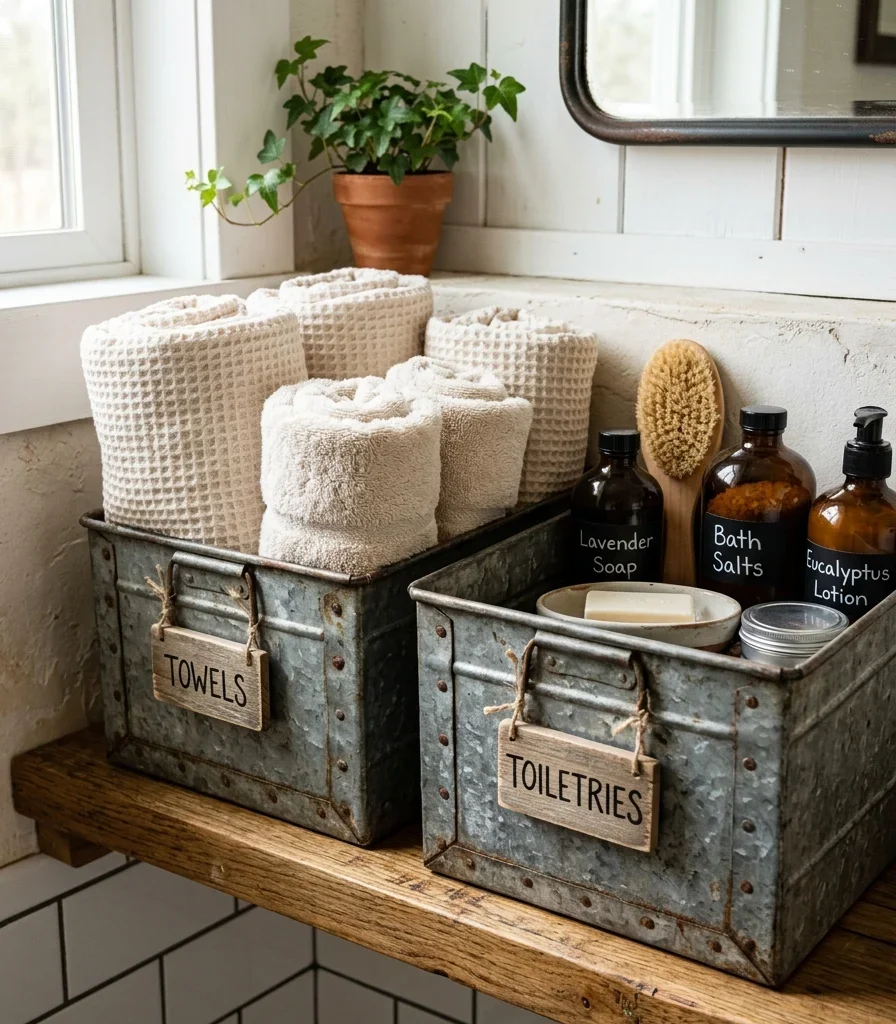
Vibe: Raw storage with genuine industrial-agricultural character instead of soft basket weave.
Why it works: Galvanized metal introduces material contrast against the room’s warmer wood and shiplap surfaces; its cool, slightly rough texture references actual farm equipment storage (feed bins, tool caddies), which keeps the room from leaning entirely soft and cottage-like, adding the more rugged edge that distinguishes farmhouse from a purely cottage or shabby-chic look.
How to get it: Use one larger galvanized bin for rolled towels on an open shelf and a smaller one on the counter for daily toiletries, choosing bins with visible rivets and a slightly matte (not shiny new) finish for authenticity.
Shop the Look
| Product |
| Galvanized metal storage bin large |
| Small galvanized countertop bin |
| Wood engraved label tag |
| Rolled cotton towel set |
| Honey oak floating shelf |
7. Install Warm Charcoal Beadboard Wainscoting
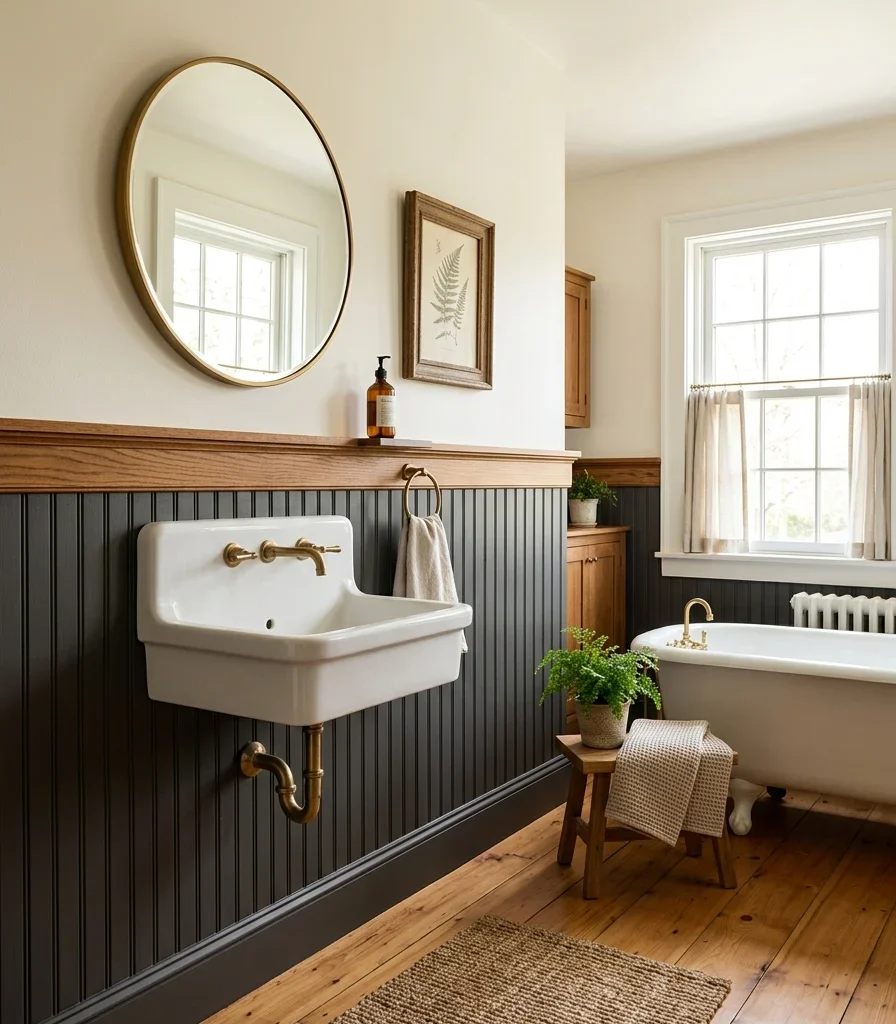
Vibe: Grounded, a darker lower half that anchors the room without requiring a full dark paint commitment.
Why it works: Beadboard in a saturated charcoal rather than the standard white applies a proportion and visual-weight principle, keeping the darker, heavier tone below the chair rail grounds the room visually while the lighter warm white above lifts the eye toward the ceiling, a technique that helps a full bathroom with a lower ceiling feel taller.
How to get it: Install beadboard to a chair rail height of roughly 42 inches, paint it in a matte warm charcoal (avoiding a cool black-based charcoal, which reads more modern-industrial than farmhouse), and keep the trim molding at the top rail in the same warm white as the upper walls for a clean transition line.
Shop the Look
| Product |
| Beadboard wall paneling kit |
| Warm charcoal matte wall paint |
| Wood chair rail trim molding |
| Small framed botanical print |
| Warm white matte wall paint |
8. Pair a Clawfoot Tub With a Vintage-Style Cage Curtain Ring
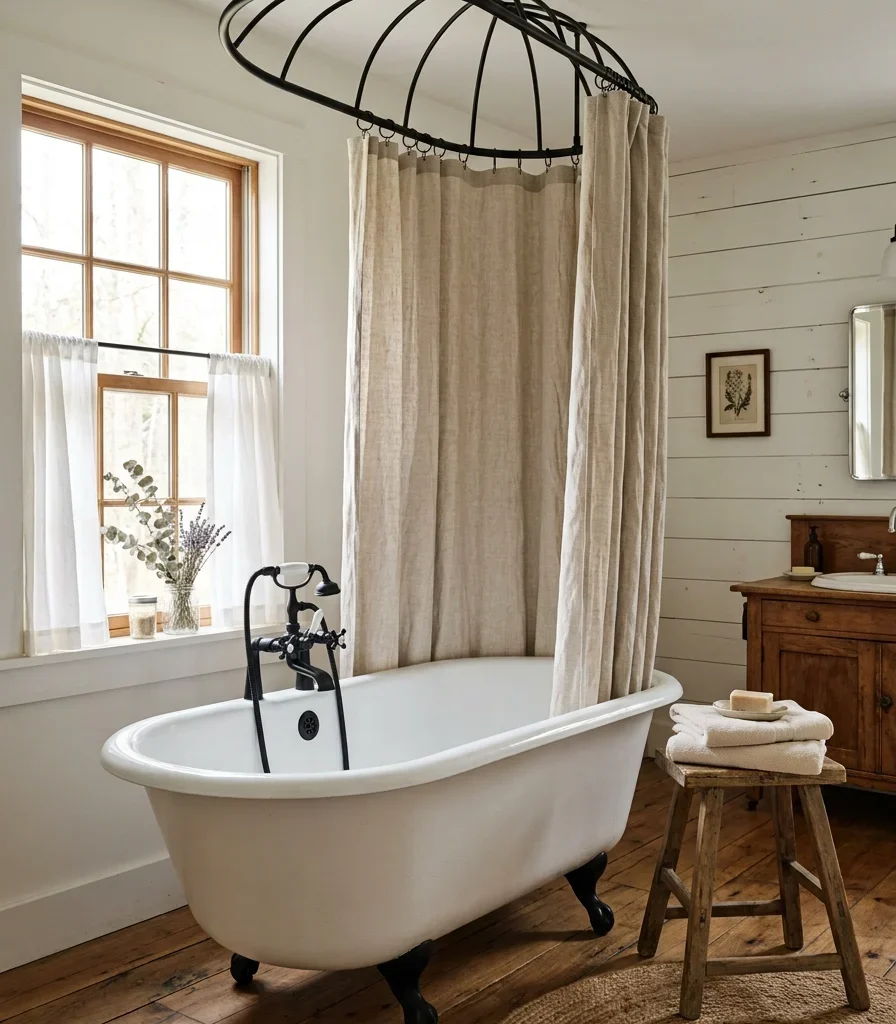
Vibe: Still a tub-and-shower combination that solves a real functional problem without sacrificing the tub’s classic silhouette.
Why it works: A cage-style curtain ring is a furniture-arrangement solution specific to clawfoot tubs, which don’t have a built-in shower surround; the oval cage ring mounts from the ceiling and wall to create an enclosed shower space around the freestanding tub, letting a full bathroom use the tub for actual daily showering rather than as a purely decorative soaking piece.
How to get it: Choose a matte black oval cage ring sized to clear the tub’s full perimeter with at least 4 inches of buffer, and hang a natural linen or cotton curtain (rather than vinyl) both inside for waterproofing and outside for texture, since the double-layer approach is what makes a clawfoot tub genuinely functional as a shower.
Shop the Look
| Product |
| Oval cage shower curtain ring |
| Natural linen shower curtain |
| Waterproof inner shower liner |
| Small wood stool |
| Matte black curtain hooks |
9. Flank the Mirror With Frosted Barn-Style Sconces
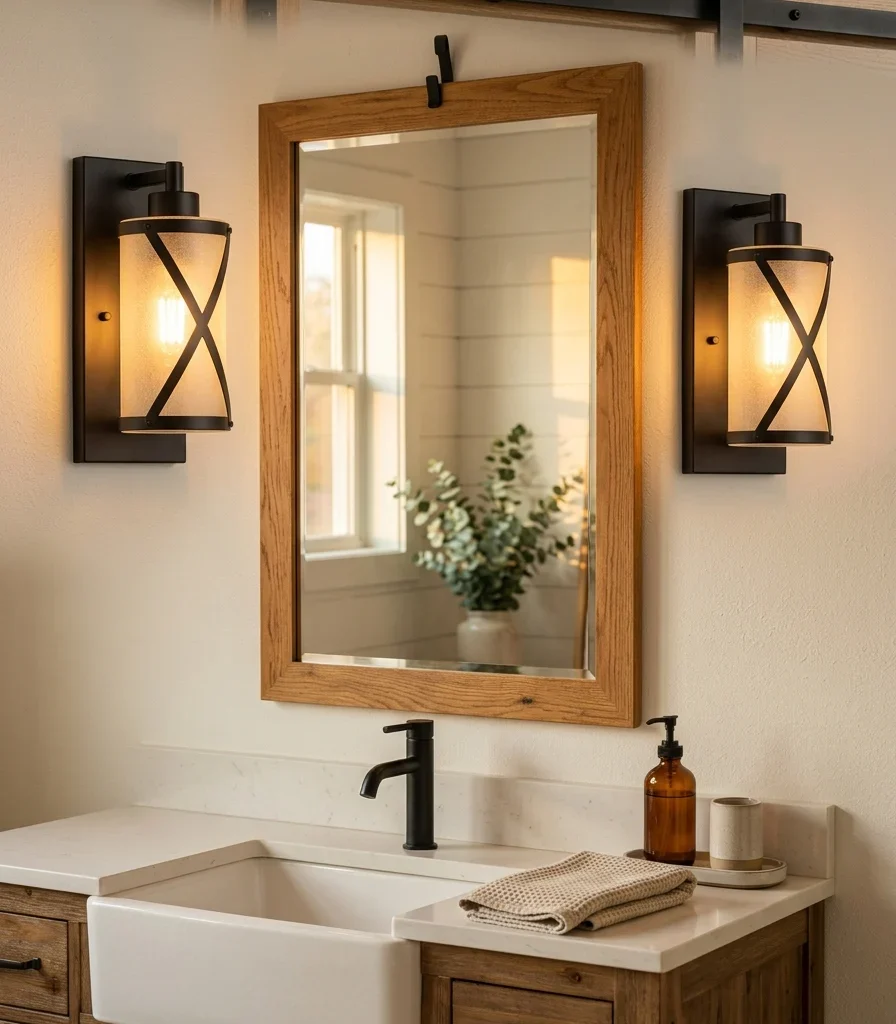
Vibe: Warm light that flatters the face evenly from both sides instead of casting shadows from above.
Why it works: Vertical sconce placement addresses a light-behavior problem common to farmhouse bathrooms with a single overhead fixture; mounting frosted sconces at face height on either side of the mirror lights the face evenly, while the frosted glass diffuses the bulb’s glow rather than exposing a harsh point of light, both improving function and referencing the barn-lantern silhouette central to the style.
How to get it: Mount sconces at 60–65 inches from the floor, spaced 30–36 inches apart on either side of the mirror, and choose frosted (not clear) glass shades specifically, since clear glass exposes the bulb directly and undercuts the soft, diffused light the style depends on.
💡 Quick Win: Plug-in sconce versions with a cord cover kit skip any electrical rewiring and install in under an hour.
Shop the Look
| Product |
| Frosted glass barn-style sconce pair |
| Warm 2700K bulb set |
| Cord cover kit plug-in sconce |
| Matte black mounting hardware |
| Folded waffle weave towel |
10. Add a Reclaimed Wood Ladder Shelf for Towels
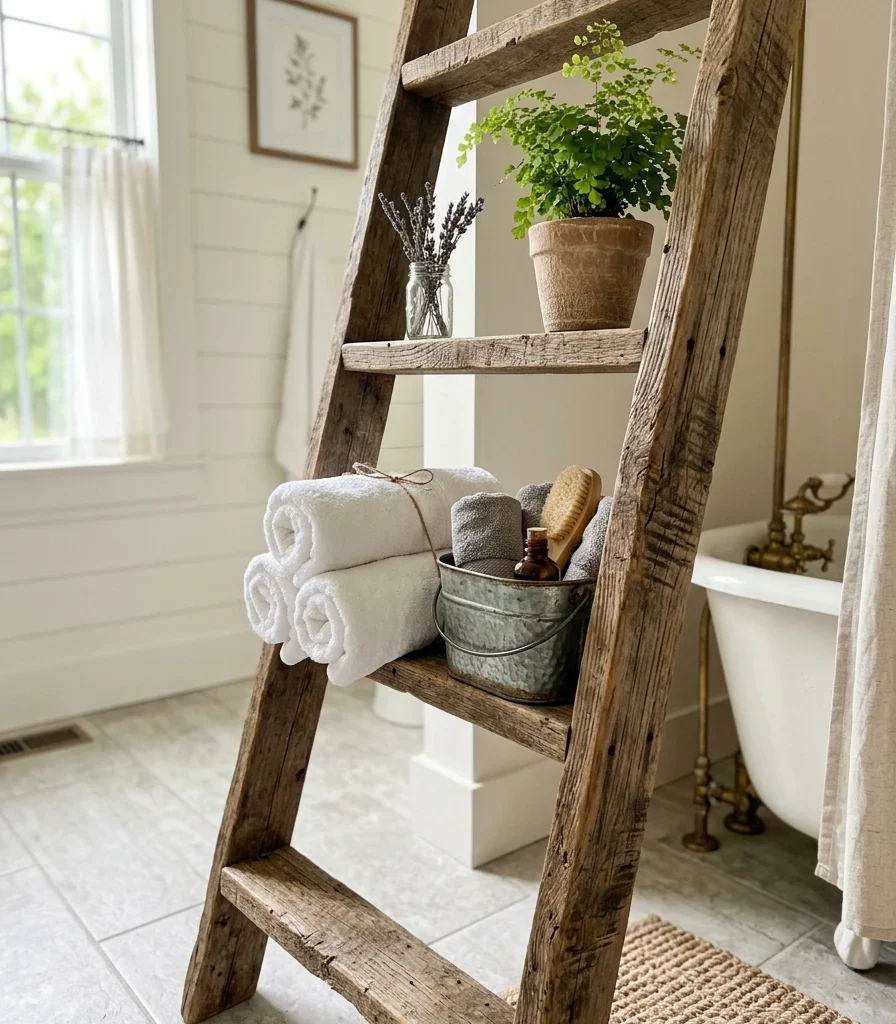
Vibe: Layered storage with genuine material history leaning casually against the wall rather than mounted.
Why it works: A reclaimed wood ladder shelf uses vertical negative space a full bathroom’s fixed fixtures (tub, toilet, sink) can’t spare on the floor, and its weathered, reclaimed material provides the texture contrast against smooth tile and porcelain that keeps the room from feeling too polished for the style.
How to get it: Choose a ladder shelf no wider than 20 inches built from genuinely reclaimed or rough-sawn lumber rather than artificially distressed new wood, and lean it at the manufacturer’s recommended angle against a wall with enough weight-bearing support behind it, since a leaning piece relies on friction rather than mounting hardware.
Shop the Look
| Product |
| Reclaimed wood ladder shelf |
| Small galvanized storage bin |
| Rolled cotton towel stack |
| Small potted fern ceramic pot |
| Wood shelf wall anchor kit |
11. Pair Warm Terracotta Grout With White Subway Tile
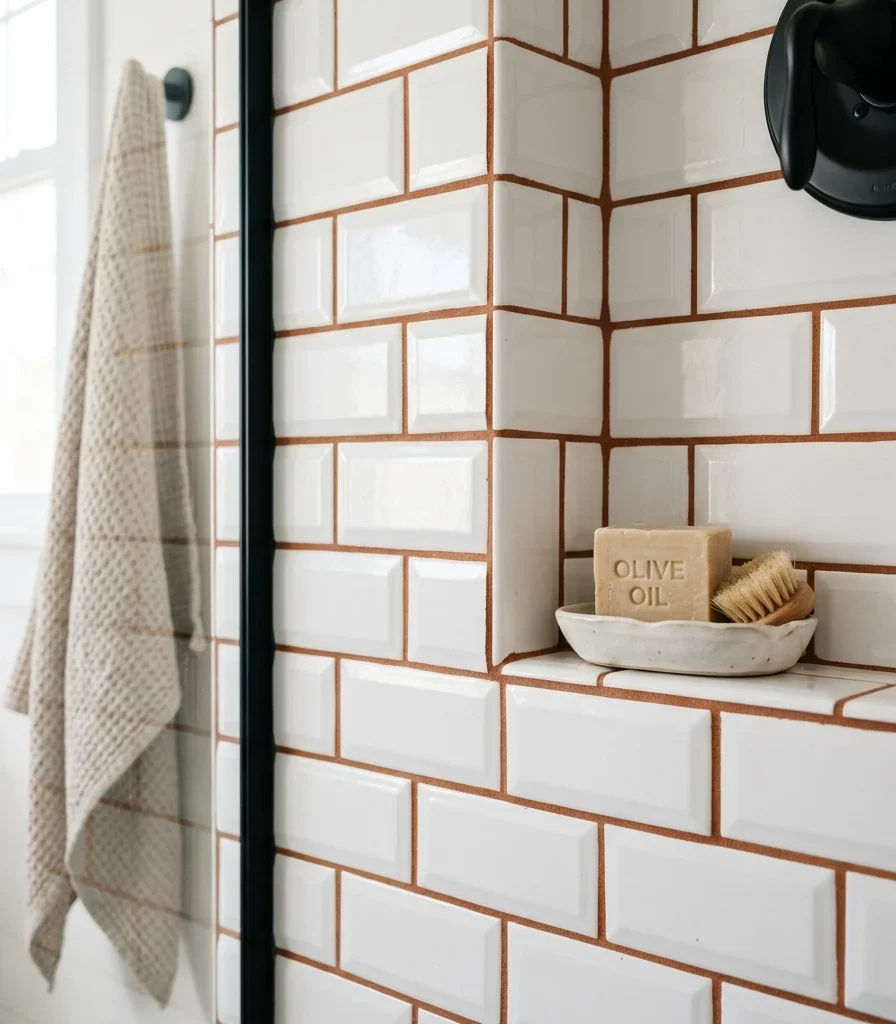
Vibe: Warm a familiar tile pattern given an unexpected, earthy twist through grout color alone.
Why it works: Grout color is an underused contrast tool; swapping the standard white or grey grout for warm terracotta against classic white subway tile creates a visible grid pattern with genuine warmth, a creative reinterpretation of the most common farmhouse tile choice that most homeowners never consider changing.
How to get it: Use a beveled-edge white subway tile (the bevel catches shadow and adds dimension) with a warm terracotta sanded grout mixed slightly lighter than a full clay tone, so the contrast reads as a deliberate warm accent rather than a jarring color clash.
Shop the Look
| Product |
| Beveled white subway tile |
| Warm terracotta sanded grout |
| Grout sealer penetrating |
| Small ceramic soap dish |
| Tile edge trim matte black |
12. Repurpose a Vintage Crate or Scale as Bath Storage
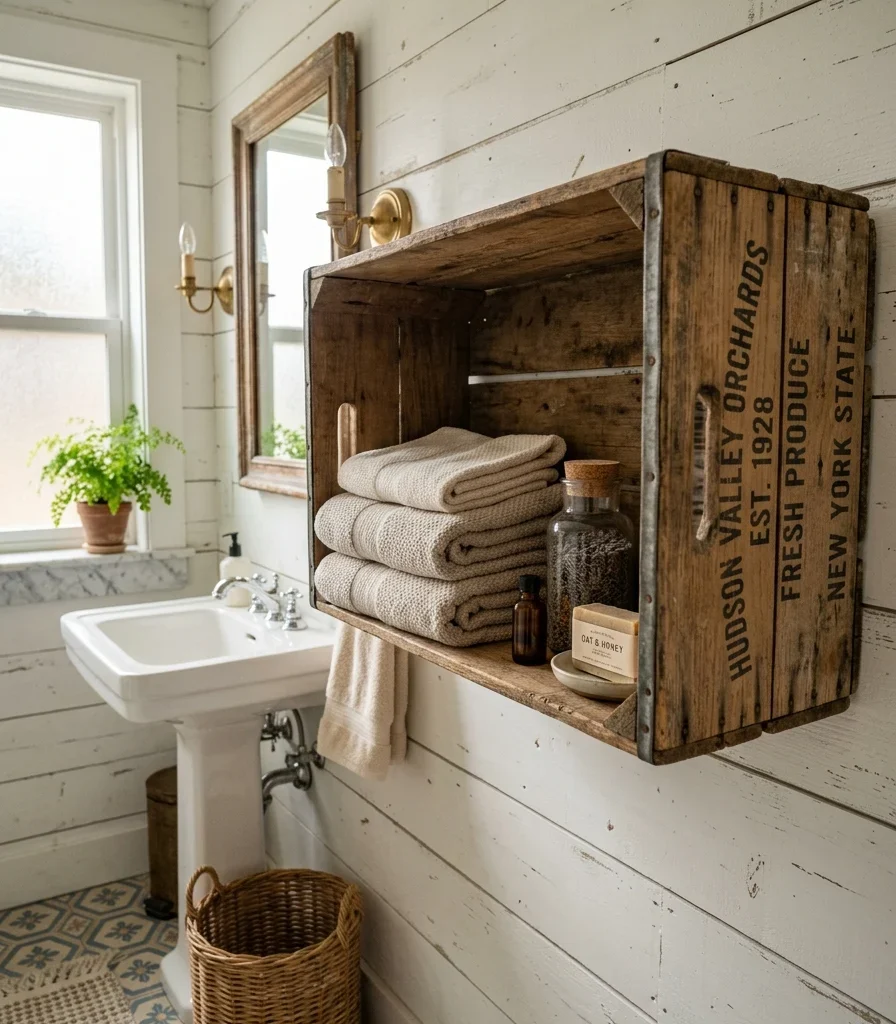
Vibe: Layered storage with a genuine backstory instead of a manufactured farmhouse-style organizer.
Why it works: Repurposing an actual vintage crate or scale reinforces the same authenticity principle as the dresser vanity: an object with visible wear, stenciled lettering, or worn hardware carries a material honesty that new “farmhouse style” storage boxes, however well-made, can’t replicate, because genuine age can’t be manufactured.
How to get it: Mount a vintage wood produce crate horizontally on the wall as an open shelf using L-brackets hidden inside the crate’s frame, or repurpose an old platform scale as a side table beside the tub, keeping any original markings or patina intact rather than refinishing them away.
Shop the Look
| Product |
| Vintage-style wood crate shelf |
| Hidden L-bracket mounting kit |
| Small glass apothecary jar |
| Rolled cotton towel set |
| Vintage-style platform scale table |
13. Add a Sliding Barn Door for the Water Closet Zone
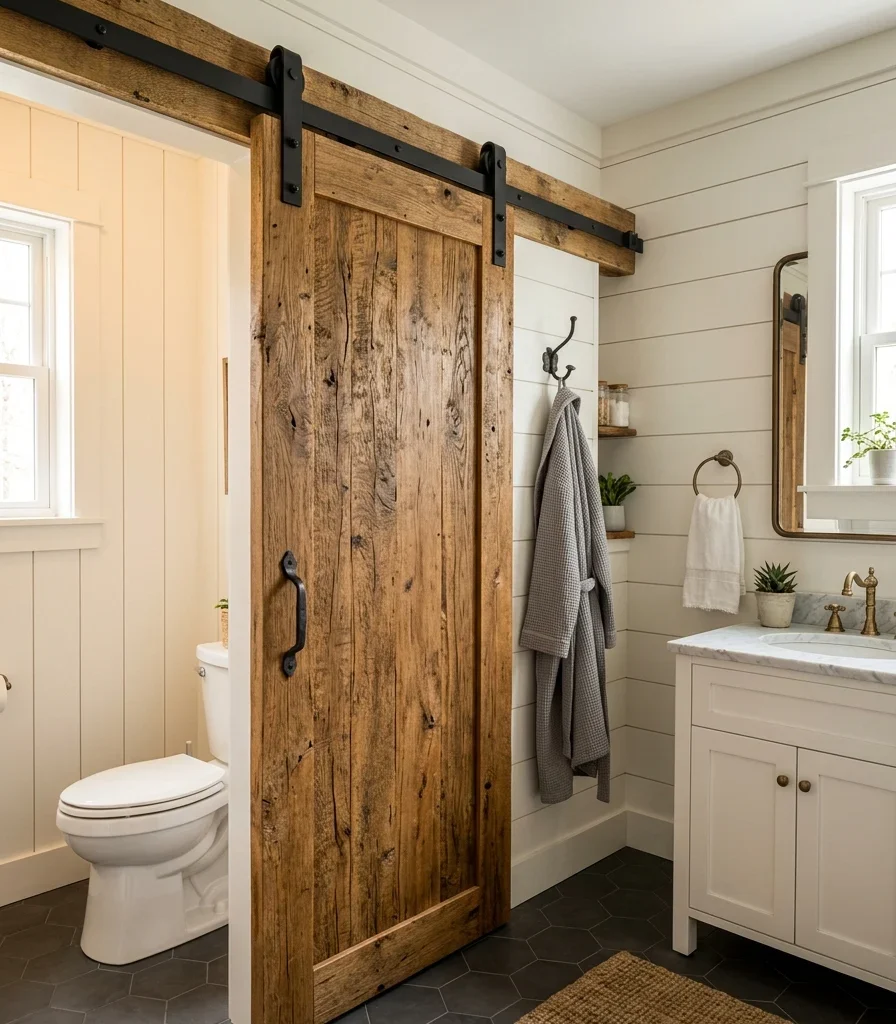
Vibe: Still a private nook carved out of an open full bathroom layout without adding a swinging door.
Why it works: A sliding barn door applies a furniture-arrangement principle specific to full bathrooms with multiple people using the room simultaneously. Separating the toilet into its own small nook behind a sliding door solves a genuine privacy problem in a shared full bathroom without requiring the swing radius a hinged door demands in a tight footprint.
How to get it: Install a reclaimed or rough-sawn wood barn door on an exposed matte black iron track sized to overlap the toilet nook opening by at least 2 inches on each side, and add a simple slide-bolt lock on the inside for genuine privacy function rather than a purely decorative door.
Shop the Look
| Product |
| Reclaimed wood barn door slab |
| Matte black barn door track kit |
| Slide bolt privacy lock |
| Wall mount robe hook |
| Iron door pull handle |
14. Zone the Full Bath With a Half Wall Between Wet and Dry Areas
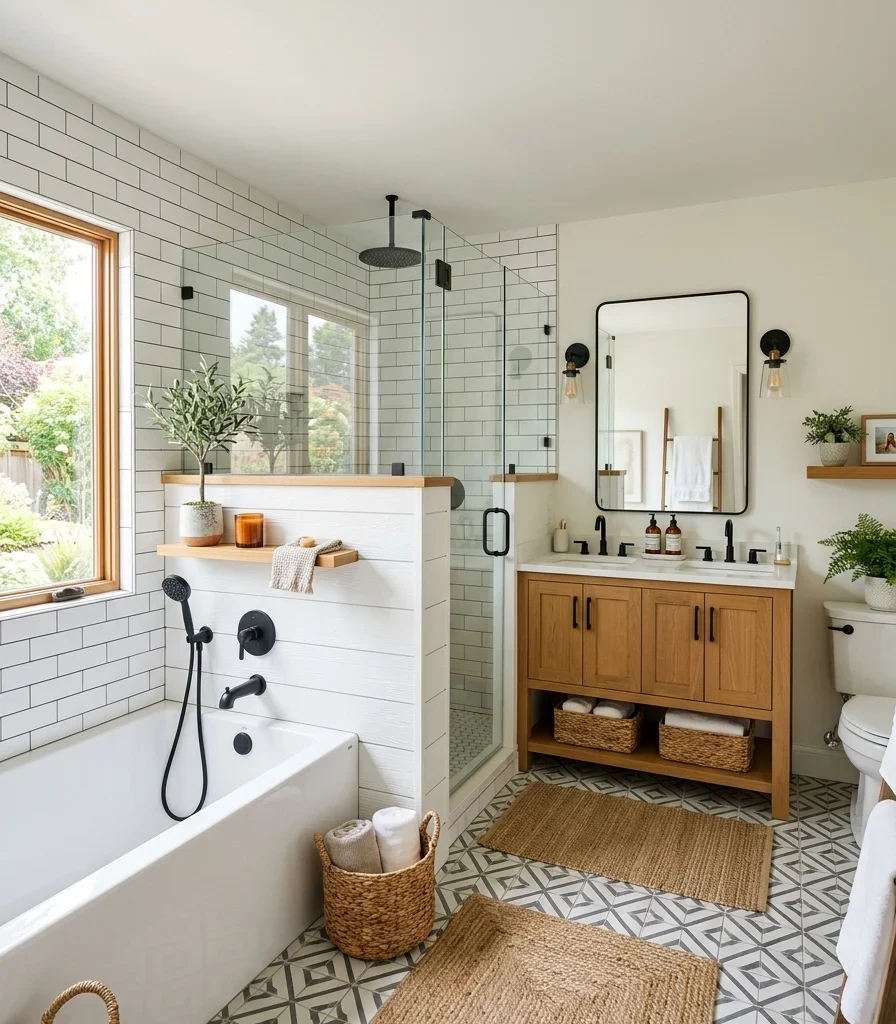
Vibe: Airy, a full bathroom that reads as two distinct zones without ever fully closing off light or sightlines.
Why it works: A half wall applies traffic-flow and zone-definition principles at once; capping the shiplap partition at roughly 42 inches keeps the wet zone visually and functionally separate from the vanity area while letting light and sightlines pass freely above it, which matters specifically in a full bathroom where four separate fixtures compete for a limited footprint.
How to get it: Build the half wall to 42 inches with a flat wood cap wide enough to hold a small shelf or plant, finish it in the same shiplap as the rest of the room for material continuity, and position it perpendicular to the room’s main walking path rather than parallel, so it actively divides the zones rather than simply running alongside them.
Shop the Look
| Product |
| Shiplap half wall paneling kit |
| Wood cap trim for half wall |
| Small wood shelf for wall cap |
| Small potted plant ceramic pot |
| Wall anchor mounting hardware |
15. Choose a Corner Vanity to Maximize a Tight Footprint
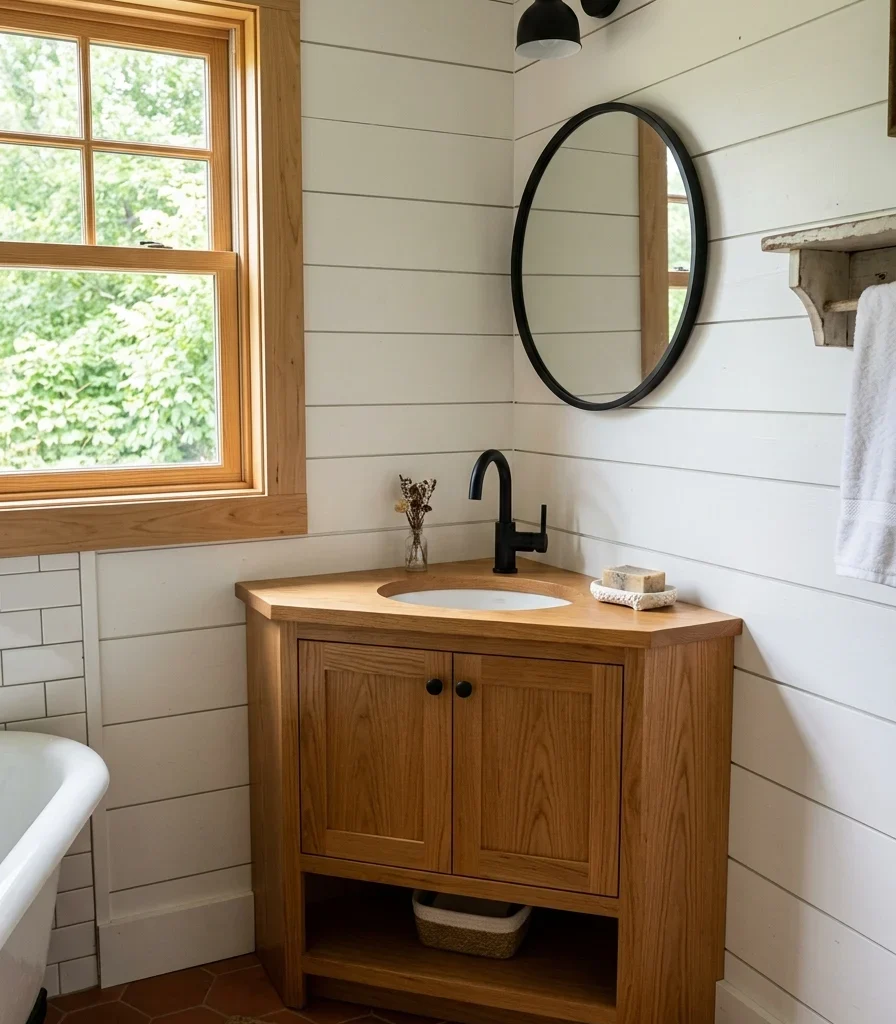
Vibe: Still full set of fixtures fitted into a footprint that seems too small until the corner does its job.
Why it works: In a genuinely tight full bathroom under 40 square feet, corner geometry is the small-space adaptation that reclaims otherwise wasted floor area. A triangular vanity fitted diagonally into the room’s corner leaves the more walkable central floor space free for the tub, shower, and toilet, which a standard flat-front vanity against a straight wall can’t achieve in the same footprint.
How to get it: Choose a corner vanity no wider than 24 inches at its widest point, angled at 45 degrees into the corner, and pair it with a round rather than oval mirror above, since round mirrors clear the angled cabinet’s sightline more comfortably in a tight corner than a wider oval shape would.
💡 Quick Win: A corner pedestal sink under $150 achieves the same space-saving effect for a full bathroom too tight even for a corner cabinet.
Shop the Look
| Product |
| Corner vanity cabinet 24 inch |
| Round mirror matte black frame |
| Corner pedestal sink |
| Matte black faucet single hole |
| Small ceramic soap dish |
How to Start Your Creative Farmhouse Full Bathroom Transformation
Your first move is sourcing the vanity piece, specifically, either a genuine antique dresser to convert or a corner-fit cabinet if the room is tight. Since the vanity sits at eye level and sets the room’s material authenticity, committing to this piece first anchors every wood tone, hardware finish, and paint color decision that follows.
The most common mistake is buying new “farmhouse-style” furniture with faux distressing instead of sourcing genuinely reclaimed or secondhand pieces, which reads as artificial next to real shiplap and cast iron. The fix is prioritizing at least one authentically aged or repurposed piece, like the vanity, a ladder shelf, or a vintage crate, even if everything else in the room is new.
Three items under $50 that create immediate impact: a matte black towel hook set, a small galvanized countertop storage bin, and a single stem of dried wheat in a small ceramic vase.
A weekend refresh of hardware, lighting, and accessories costs $200–500. A full creative farmhouse full bathroom renovation with a repurposed dresser vanity, shiplap, and a clawfoot tub typically runs $6,000–15,000 and takes three to six weeks depending on plumbing changes.
Frequently Asked Questions About Creative Farmhouse Full Bathroom Design
What is the difference between farmhouse and modern farmhouse bathroom design?
Traditional farmhouse bathroom design uses genuinely repurposed furniture, reclaimed wood, and period-accurate fixtures like schoolhouse pendants and cast iron tubs. Modern farmhouse softens those references with cleaner lines, matte black hardware paired with brighter white walls, and new furniture built to resemble antique pieces rather than actual salvaged ones, trading some authenticity for lower maintenance and easier sourcing.
What color works best in a farmhouse full bathroom?
Warm white, warm sage, and warm charcoal all work well as a base, paired with terracotta or black as an accent through grout, hardware, or a single painted piece. Cool grey tends to clash with the style’s warmer wood tones and galvanized metal, which read best against colors with yellow or red undertones rather than blue-based neutrals.
How much does a creative farmhouse full bathroom renovation cost?
A budget refresh using hardware, lighting, and a repurposed storage piece costs $200–700. A mid-range renovation with a converted dresser vanity and new tile runs $4,000–9,000, while a full renovation including a cast iron clawfoot tub and shiplap tub surround typically costs $8,000–15,000 depending on plumbing complexity.
Can a repurposed dresser vanity work in a genuinely small full bathroom?
Yes, but measure the dresser’s width against the room’s clearance requirements first, since building codes typically require at least 21 inches of clear floor space in front of any vanity or toilet. A narrower antique washstand or nightstand, rather than a full-width dresser, often fits a small full bathroom’s footprint more comfortably while still achieving the repurposed-furniture look.
What is the most searched element in farmhouse bathroom design right now?
Shiplap accent walls remain the most searched single element in farmhouse bathroom design, though repurposed vanity furniture and clawfoot tubs follow closely, reflecting a broader shift toward sourcing genuinely secondhand or salvaged pieces rather than buying new furniture manufactured to imitate the reclaimed look.
Ready to Create Your Dream Creative Farmhouse Full Bathroom?
These 15 ideas move across material, color, lighting, layout, and true small-space solutions from a repurposed dresser vanity and a schoolhouse pendant to a half wall that zones a full bathroom’s wet and dry areas without closing off a single sightline. None of this needs to happen all at once, and starting with one genuinely repurposed piece before any tile or paint decision is truly the right way to begin. Today’s specific action: visit one salvage yard, estate sale, or secondhand shop this week and look specifically for a solid wood dresser, crate, or ladder shelf that could anchor the whole room’s material story. Once that one authentic piece is in place, the rest of the bathroom will feel less like a themed renovation and more like a room that’s genuinely collected its character over time. Save the ideas that fit your room’s real footprint and your own sense of what’s worth hunting down secondhand; that converted dresser vanity will still feel just as personal a year from now.
[…] 15 Creative Farmhouse Full Bathroom Ideas […]
[…] 15 Creative Farmhouse Full Bathroom Ideas […]
[…] 15 Creative Farmhouse Full Bathroom Ideas […]
[…] 15 Creative Farmhouse Full Bathroom Ideas […]