

Tile-forward small bathroom design uses pattern, shape, and finish, not floor plan or fixtures, as the room’s primary style statement, treating tile as the single material with the most power to make a tight bathroom feel considered. This article gives you 15 genuinely stylish small bathroom tile ideas covering material, color, lighting, and layout decisions that let tile do the visual work a small room’s limited square footage can’t.
It feels like walking into a room that decided on its personality before anything else was chosen: handmade zellige catching light unevenly across a wall, a herringbone pattern pulling the eye upward, grout drawn in a color bold enough to be a decision rather than an afterthought. This is stylish small bathroom tile design at its most confident: pattern-driven, texturally rich, unwilling to let four walls of blank paint do less than they could. Every tile choice earns its place because in a small room, tile is often the only surface with room to make a real statement.
Here are 15 ideas worth saving and stealing.
Why Stylish Small Bathroom Tile Design Works So Well
Tile-forward bathroom design draws from several converging traditions: the Moroccan zellige craft of hand-cut glazed clay tile, the Victorian-era penny tile and hexagon floors common in early 20th-century American bathrooms, and the Art Deco geometric tile patterns that followed. What unites them as a modern approach is treating tile as the room’s primary design decision rather than a neutral backdrop chosen last, after paint and fixtures are already settled.
Core materials span handmade zellige, glossy subway tile, matte penny-round mosaic, and scalloped fish-scale shapes, most often in warm white, sage green, or terracotta, with grout color used deliberately rather than defaulting to a safe match. Pattern does real work here: herringbone, vertical stacking, and two-tone borders all change how a small room’s proportions read.
This approach is trending because Pinterest search data consistently shows “bathroom tile ideas” among the platform’s most-searched home categories, and as more homeowners renovate smaller, older bathrooms rather than build new ones, tile has become the highest-leverage material choice for changing a room’s entire character without touching the floor plan.
Yes, small bathrooms are arguably where bold tile choices read best, since pattern and texture are visible at close range in a way they aren’t in a larger room. Prioritize one dominant tile decision (the floor or the shower wall) first, and keep the remaining surfaces simpler so the statement tile has room to register.
Style at a Glance
| Element | Core Trait 1 | Core Trait 2 |
| Philosophy | Tile as the room’s primary style decision, not a neutral backdrop | Pattern and grout color used deliberately, not defaulted |
| Materials | Handmade zellige, glossy subway, penny-round mosaic | Scalloped fish-scale, matte terracotta |
| Color Palette | Warm white, sage green | Terracotta accent |
15 Stylish Small Bathroom Tile Ideas
1. Use Handmade Zellige Tile for Genuine Wall Texture
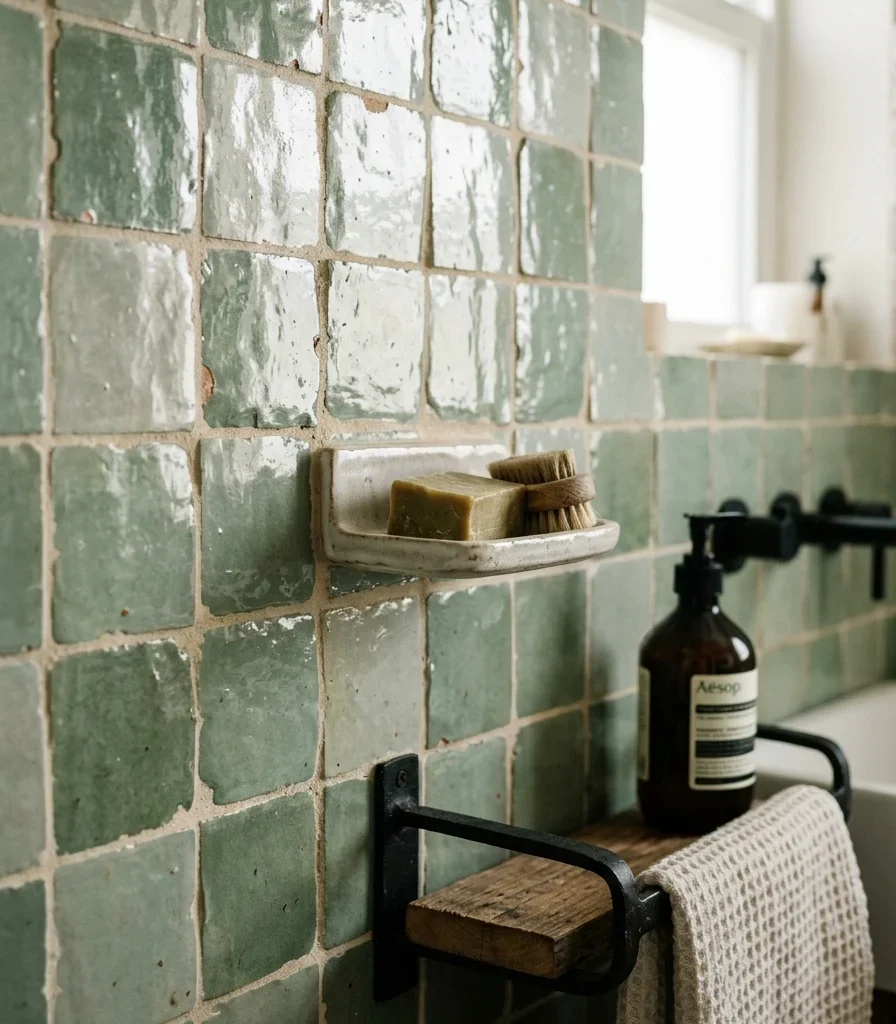
Vibe: Raw a wall with enough handmade irregularity that light catches it differently at every angle.
Why it works: Zellige’s glaze variation is a texture-layering principle unique to handmade tile because no two tiles reflect light identically; a wall of zellige avoids the flat, uniform look manufactured tile produces, giving even a single-color wall genuine visual depth that a machine-pressed tile in the same shade can’t replicate.
How to get it: Install handmade zellige in sage green with a warm white grout mixed slightly darker than pure white to avoid stark contrast lines, and request tiles from a single production batch since dye lots vary noticeably between zellige runs.
💡 Quick Win: A zellige-look ceramic tile approximates the glaze variation at a lower cost and more consistent sizing for easier DIY installation.
Shop the Look
| Product |
| Sage green handmade zellige tile |
| Warm white sanded grout |
| Small ceramic soap dish |
| Zellige look ceramic alternative |
| Natural sea sponge holder |
2. Pair Sage Green Subway Tile With Contrast Grout

Vibe: Fresh a tile-and-grout pairing bold enough to feel like a deliberate design choice rather than a default.
Why it works: Grout color is a contrast tool most homeowners never adjust from the default white or grey; pairing sage green tile with warm charcoal grout creates a visible grid pattern that emphasizes each tile, a texture-layering effect that reads as considerably more current than the same tile installed with a matching, grout-hidden finish.
How to get it: Choose a matte sage subway tile and request a warm charcoal (not jet black) sanded grout, testing a small sample area first since dark grout against a pale tile shows any application inconsistency more visibly than a matched grout would.
Shop the Look
| Product |
| Matte sage green subway tile |
| Warm charcoal sanded grout |
| Grout sealer penetrating |
| Small ceramic soap dispenser |
| Tile edge trim matte black |
3. Build a Tiled Bench Into the Shower
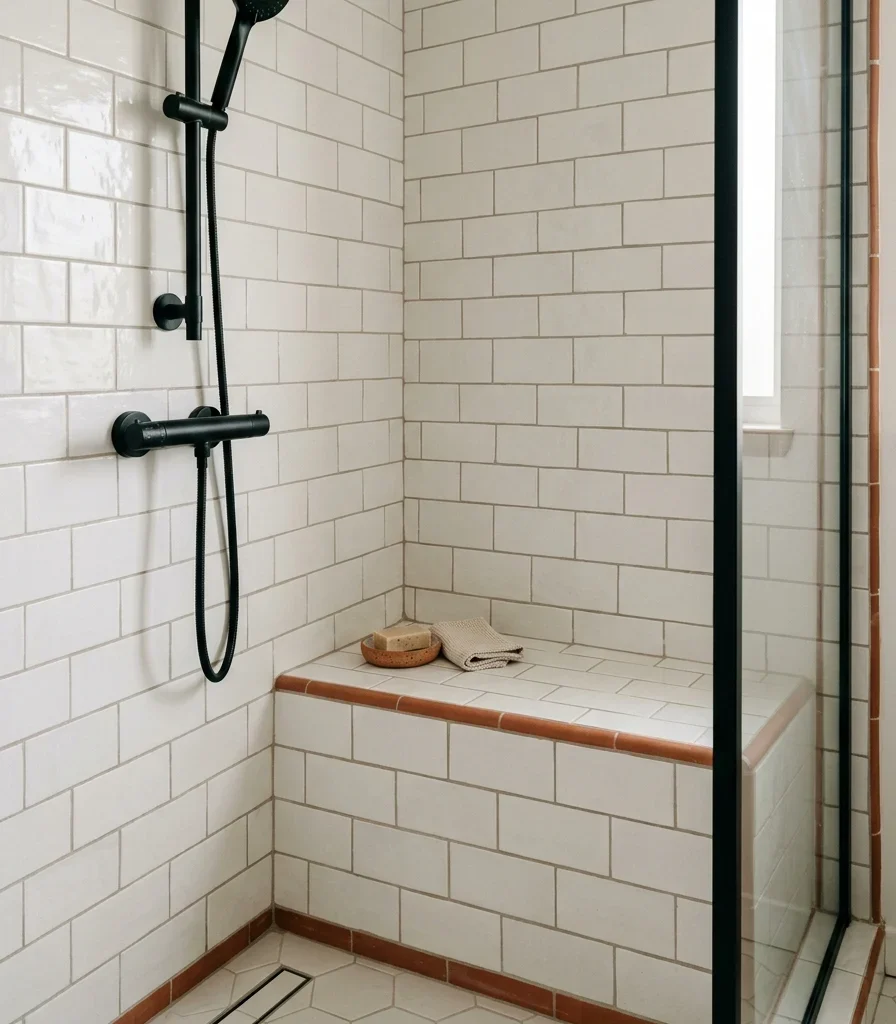
Vibe: Still a seat built entirely from the same tile as the walls, so it reads as architecture rather than furniture.
Why it works: A fully tiled bench uses the underused-corner storage principle common in small-space design, applied here to seating. Because the bench is built from the same tile as the surrounding walls, it adds function without introducing a new material or visual break, which keeps a small shower from feeling like it’s accumulating separate objects.
How to get it: Tile the bench in the same field tile as the walls, adding a single terracotta accent row along its front edge to give the seat definition, and angle the seat surface at 5 degrees for water runoff during use.
Shop the Look
| Product |
| Warm white field tile matching |
| Terracotta accent trim tile |
| Small ceramic soap dish |
| Matte black grab bar |
| Waterproof tile sealant |
4. Choose Glossy Tile to Bounce Light Across a Windowless Bath

Vibe: Luminous a room with no window that still manages to feel bright because of what the tile itself is doing.
Why it works: Glossy tile applies light-behavior principles specifically useful in a windowless bathroom; its reflective surface bounces available artificial light around the room more effectively than a matte finish would, which absorbs more light than it reflects, making genuinely dark, view-less bathrooms feel measurably brighter with the same fixtures.
How to get it: Choose a high-gloss warm white tile for at least two walls in a windowless bathroom, pairing it with a bright ceiling fixture positioned to hit the tile directly rather than only the floor, so the reflected bounce actually reaches eye level.
Shop the Look
| Product |
| High gloss warm white tile |
| Bright LED ceiling fixture |
| Small ceramic decorative vessel |
| Matte black towel bar |
| Glossy tile polish cloth |
5. Add a Scalloped Fish-Scale Tile Accent Wall
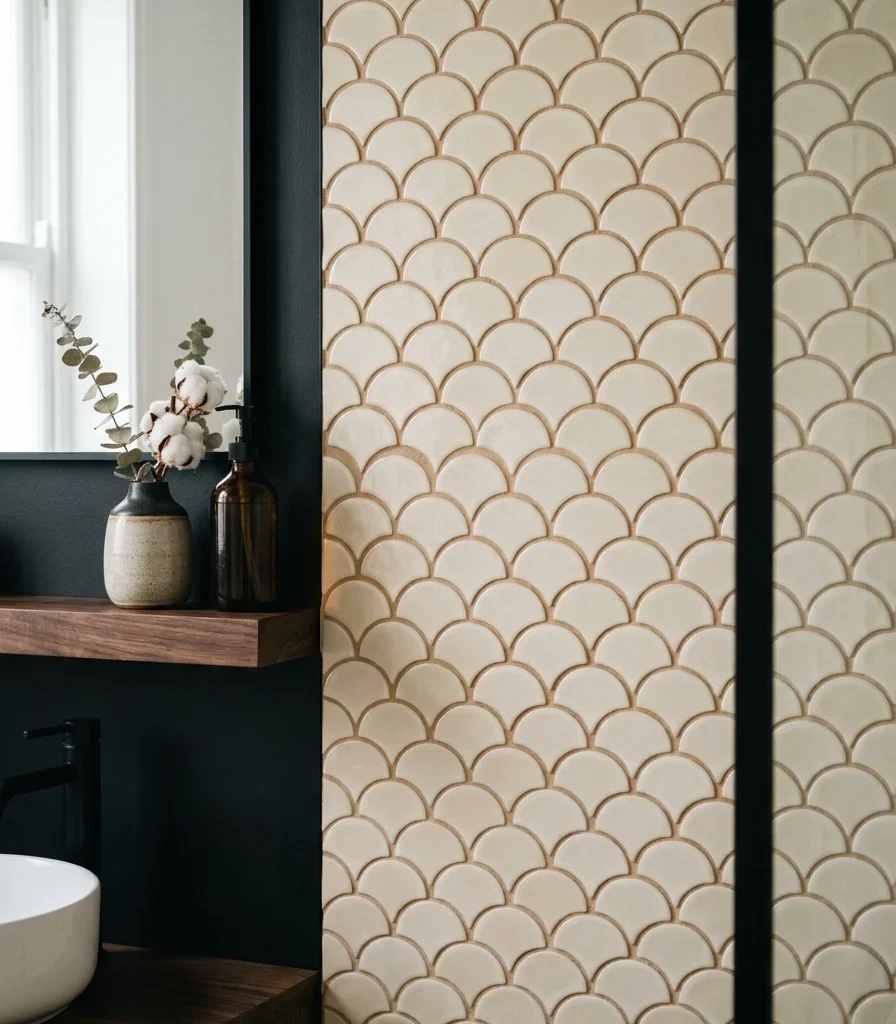
Vibe: Layer a wall with genuine dimensional shape instead of a flat rectangular grid.
Why it works: Scalloped or fish-scale tile applies texture layering through shape rather than glaze or color. The repeating curved silhouette creates a pattern with visible relief, catching shadow along each tile’s rounded edge in a way flat square or rectangular tile physically cannot, adding depth to a small accent wall without any additional color.
How to get it: Reserve scalloped tile for a single accent wall (typically behind the vanity or as a shower backdrop) rather than the entire room, since its strong pattern reads best against simpler surrounding surfaces.
💡 Quick Win: A peel-and-stick scalloped tile decal achieves the shape’s visual pattern for renters without permanent tiling.
Shop the Look
| Product |
| Scalloped fish scale ceramic tile |
| Peel and stick scalloped decal |
| Matte black tile trim edge |
| Small ceramic countertop vessel |
| Grout sealer for curved tile |
6. Build a Tiled Niche Shelf for Display Storage
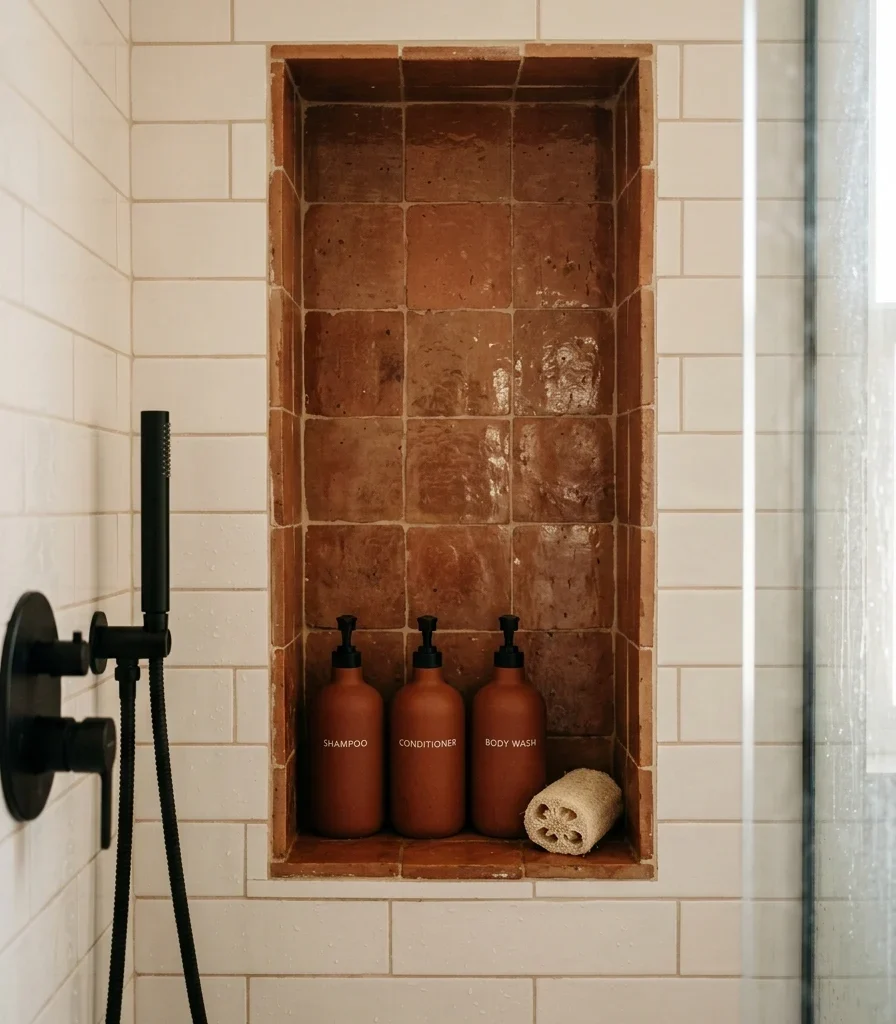
Vibe: Warm, a recessed shelf that becomes a small styled moment instead of just a place to stash shampoo.
Why it works: Tiling the niche’s interior in a contrasting color to the surrounding wall is a color-anchoring principle that turns purely functional storage into a deliberate design feature; the contrast frames whatever sits inside, treating the niche as a miniature display case rather than an afterthought carved into the shower wall.
How to get it: Frame the niche at a depth of at least 4 inches, tiling the interior in terracotta against warm white surrounding walls, and style it with two or three coordinated ceramic bottles rather than mismatched plastic packaging.
Shop the Look
| Product |
| Terracotta niche interior tile |
| Warm white surrounding field tile |
| Ceramic amenity bottle set |
| Matte black niche trim frame |
| Small ceramic soap dish |
7. Lay a Terracotta Tile Floor Against White Walls
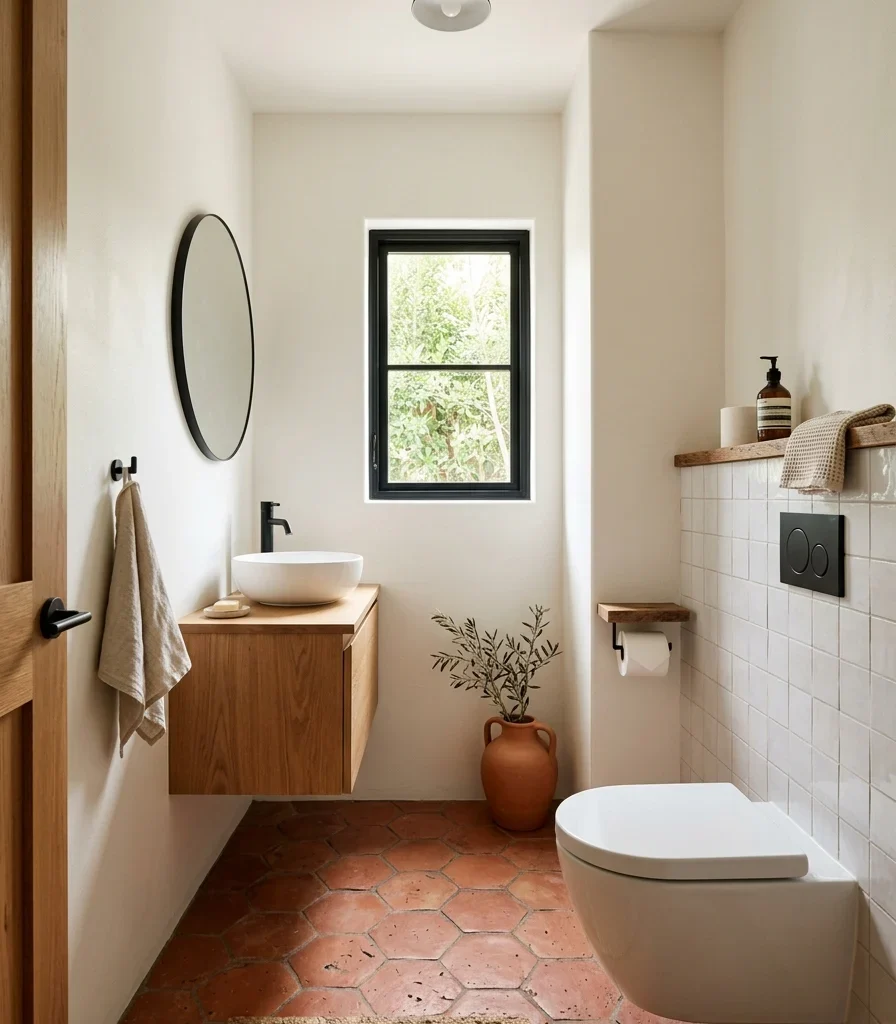
Vibe: Warm, a floor that grounds the room in genuine color while the walls stay light and open.
Why it works: Concentrating bold color on the floor rather than the walls is a proportion principle that lets a small bathroom commit to a saturated tone without darkening the vertical surfaces that most affect how spacious a room feels. The terracotta floor grounds the room visually while white walls keep the ceiling and sightlines feeling open.
How to get it: Choose a matte terracotta floor tile in a hexagon or square format, keeping every wall in warm white tile or paint, and match the grout on the floor closely to the terracotta tone so the floor reads as one warm plane rather than a busy grid.
Shop the Look
| Product |
| Matte terracotta hexagon floor tile |
| Warm white wall tile |
| Terracotta matched grout |
| Small ceramic countertop vessel |
| Matte black floor transition strip |
8. Extend a Tiled Shelf From the Floating Vanity
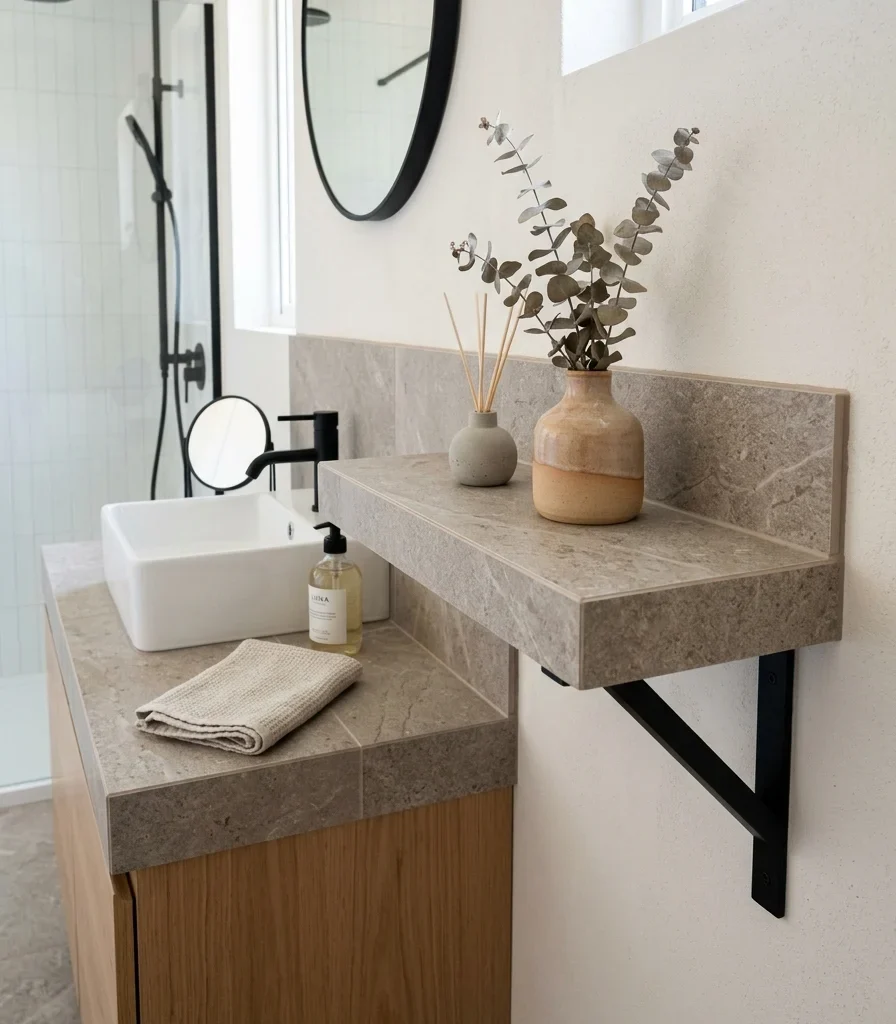
Vibe: Still a shelf that looks like it grew directly out of the vanity counter rather than being added afterward.
Why it works: Extending the same tile from the vanity counter onto an adjacent floating shelf is a material-continuity principle that reads as more architecturally considered than a mismatched wood or glass shelf; the unbroken material line signals the piece was planned as part of the vanity design, not bolted on as an afterthought.
How to get it: Specify the same stone-look porcelain slab for both the vanity counter and a floating shelf mounted at the same height along an adjacent wall, using a concealed bracket rated for the tile’s weight so the shelf appears to float unsupported.
Shop the Look
| Product |
| Stone look porcelain slab tile |
| Concealed floating shelf bracket |
| Matte black shelf trim |
| Small ceramic countertop vessel |
| Tile edge polishing kit |
9. Run Tile Up to a Skylight for a Sunlit Wash
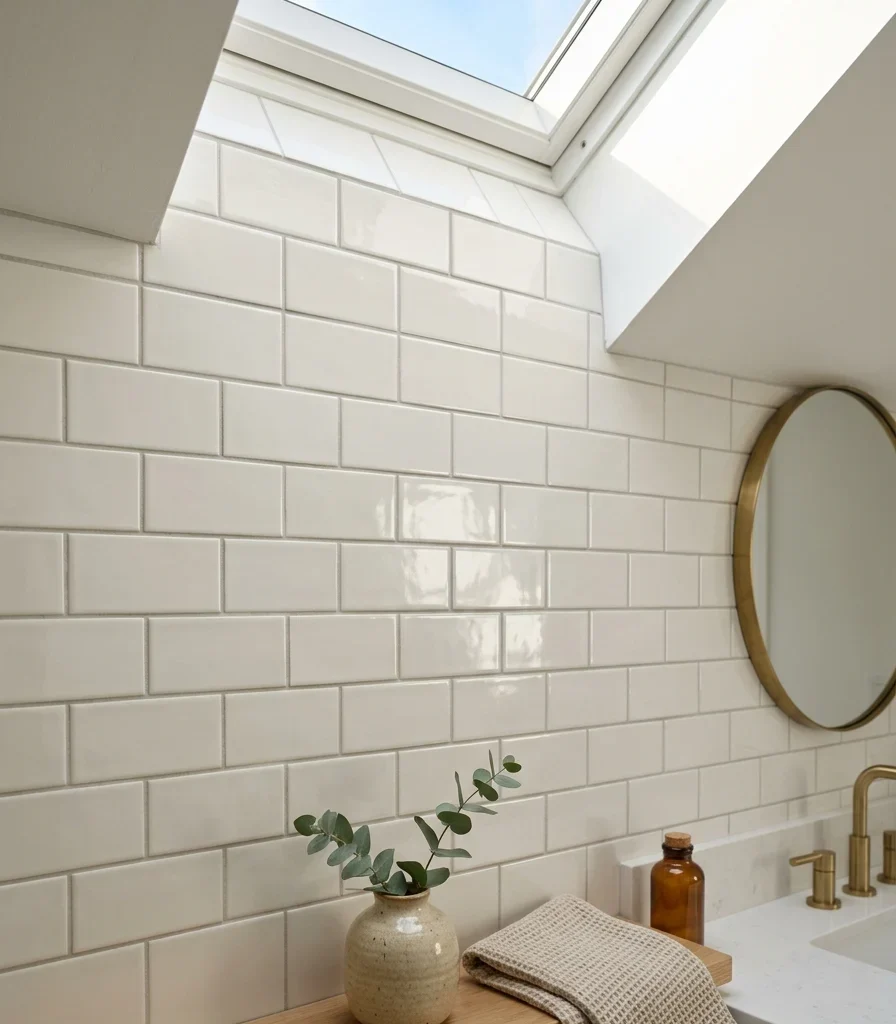
Vibe: Serene tile that catches and carries daylight down the wall the way water carries light underwater.
Why it works: Running glossy tile continuously up to a skylight opening is a light-behavior principle that maximizes how far natural daylight travels down a wall; the tile’s reflective surface bounces the light source’s glow further into the room than a matte wall would, effectively extending the skylight’s reach.
How to get it: If a skylight is feasible, tile the full wall height beneath it in a high-gloss finish, and avoid interrupting the tile run with a chair rail or trim strip, since a continuous surface carries the reflected light more effectively than a broken one.
Shop the Look
| Product |
| High gloss warm white full wall tile |
| Skylight frosted glass panel |
| Small ceramic decorative vessel |
| Matte black towel hook |
| Tile grout sealant |
10. Choose a Penny-Round Mosaic Floor for Texture Underfoot

Vibe: Still a floor with fine, detailed texture that reads as intentional history rather than a plain surface.
Why it works: Penny-round mosaic is a material choice directly tied to early 20th-century American bathroom flooring; its small, circular format creates a naturally slip-resistant texture underfoot through its dense grout-line pattern, while its fine scale intentionally contrasts with larger-format wall tile elsewhere in the room.
How to get it: Install a 1-inch penny-round mosaic sheet in warm white with a warm grey grout rather than stark white, which softens the high grout-line density this small tile format naturally creates.
Shop the Look
| Product |
| Penny round mosaic tile sheet |
| Warm grey sanded grout |
| Natural jute bath mat |
| Grout sealer penetrating |
| Matte black floor drain cover |
11. Split Tile Two-Tone With a Contrast Border Line
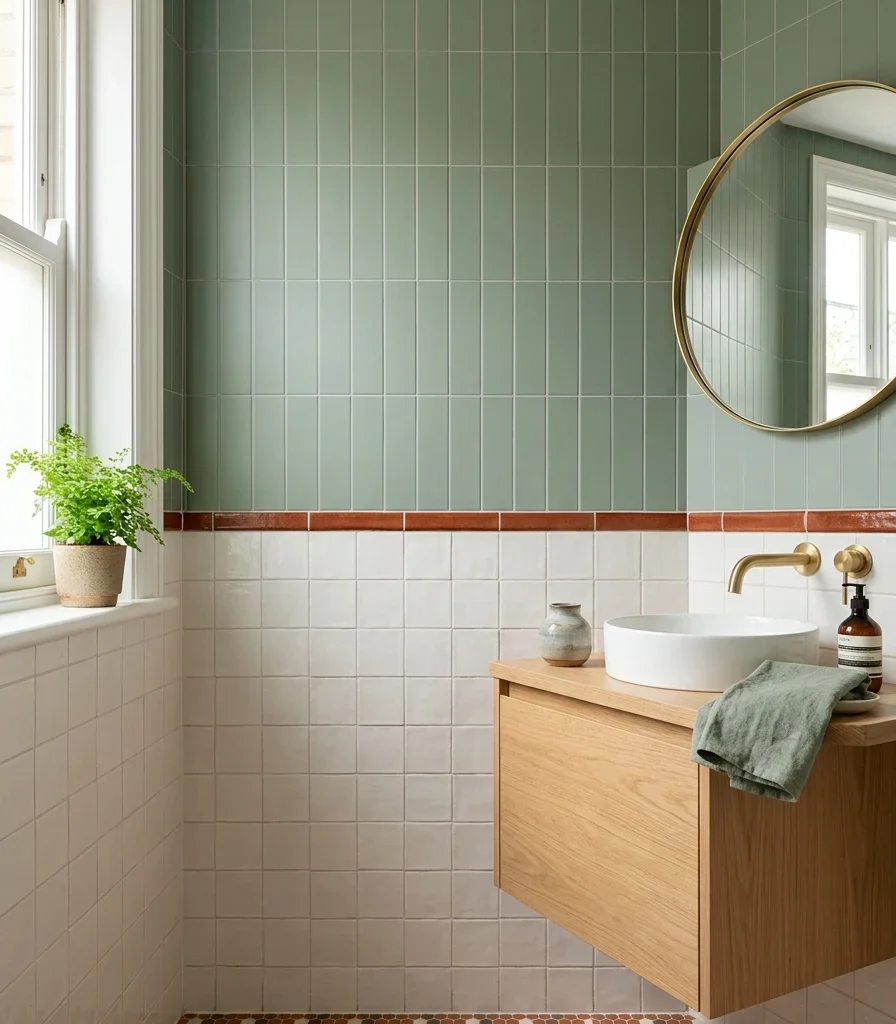
Vibe: Layered two tile tones, separated by a third color that acts as a deliberate seam rather than a simple line.
Why it works: A narrow border tile between two main tones is a proportion principle borrowed from Victorian-era tile design rather than a plain grout line marking the transition; a 1 to 2-inch terracotta border tile gives the two-tone split its own visual moment, adding a third color in careful moderation rather than diluting the room’s overall restraint.
How to get it: Install the border tile at the transition height (typically 42–48 inches), keeping it no wider than 2 inches so it reads as an accent line rather than a third full field of color competing with the two main tones.
Shop the Look
| Product |
| Terracotta narrow border tile |
| Warm white lower field tile |
| Sage green upper field tile |
| Tile edge trim matte black |
| Grout sealer for border tile |
12. Frame Leftover Tile as Wall Art
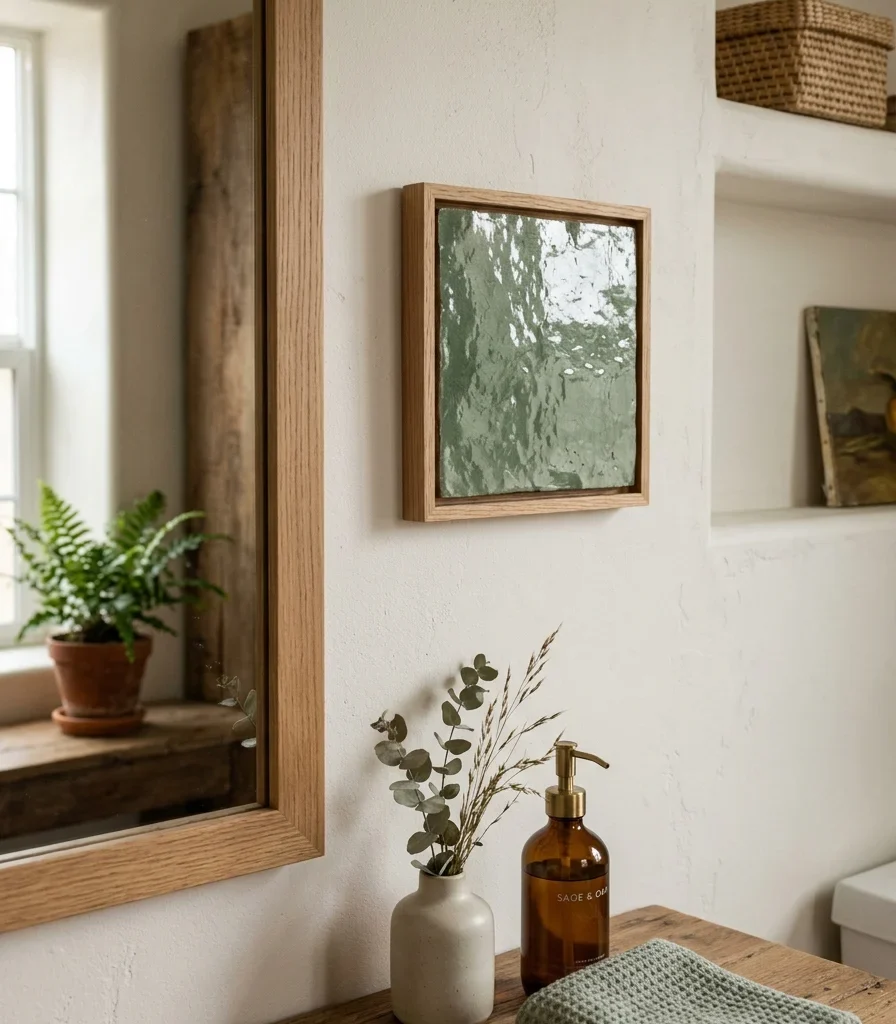
Vibe: Layered, a single leftover tile treated with the same care as a piece of art rather than discarded as scrap.
Why it works: Framing a single extra tile is an accessory-layering principle that ties wall art directly back to the room’s material story rather than introducing an unrelated framed print. One tile from the same batch used elsewhere in the bathroom creates visual continuity between the “functional” tile and the “decorative” wall art, a connection a generic print can’t offer.
How to get it: Save one or two tiles from the original installation order specifically for this purpose, mounting each in a thin oak frame sized closely to the tile itself, and hang it at eye level near the mirror where it reads clearly as intentional art.
Shop the Look
| Product |
| Thin oak picture frame small |
| Extra zellige tile for framing |
| Picture hanging hardware |
| Small ceramic decorative vessel |
| Frame mounting adhesive |
13. Build a Tiled Pedestal Base for a Vessel Sink

Vibe: Warm a sink base built entirely from tile, tying the vanity zone visually back to the rest of the room.
Why it works: A fully tiled pedestal applies material continuity at furniture scale rather than a wood or laminate vanity cabinet introducing a separate material into the room; a tiled base built from the same terracotta used in the shower creates one unbroken material story across the entire small bathroom.
How to get it: Build the pedestal from cement board tiled in the same terracotta as the shower zone, topping it with a simple white ceramic vessel sink and a matte black faucet so the hardware reads consistently against the tiled base.
💡 Quick Win: Wrapping an existing plain pedestal sink base in adhesive tile sheeting achieves a similar effect without full reconstruction.
Shop the Look
| Product |
| Terracotta tile for pedestal base |
| White ceramic vessel sink |
| Matte black vessel faucet |
| Small ceramic soap dish |
| Cement board pedestal substrate |
14. Lay Vertical Herringbone Tile to Add Height
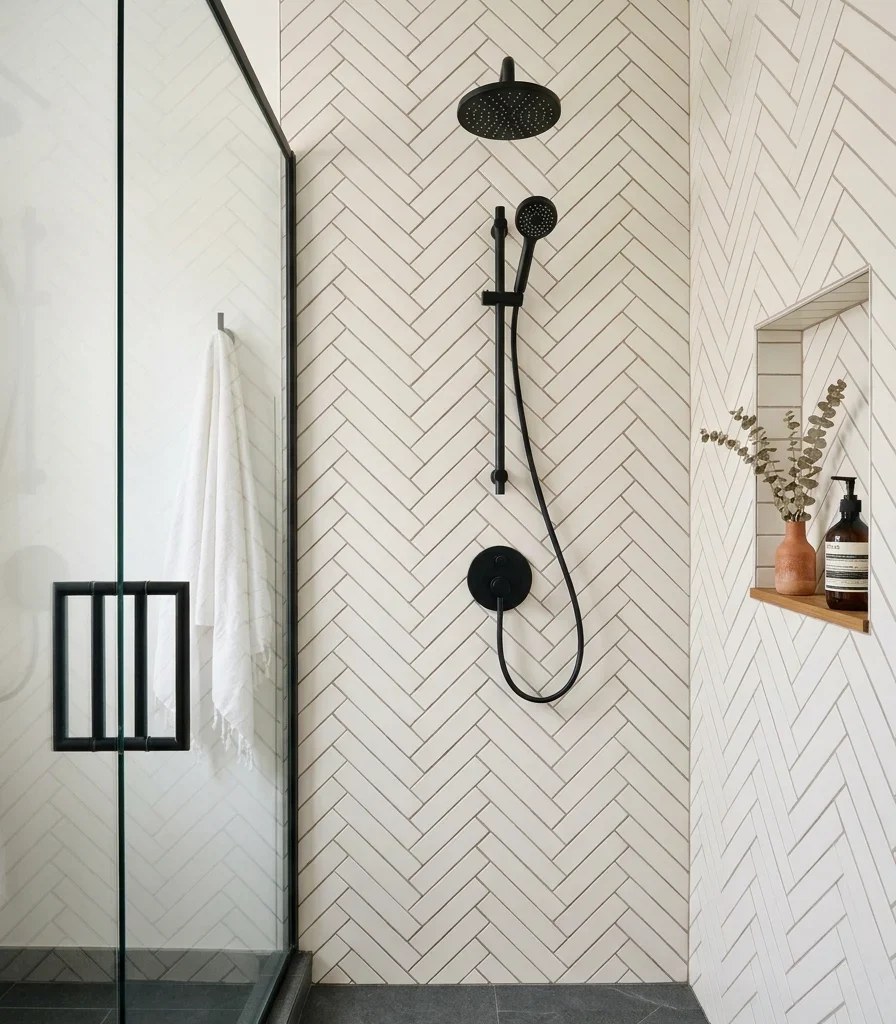
Vibe: Airy, a pattern that pulls the eye upward instead of settling flat across the wall.
Why it works: Orienting herringbone vertically rather than horizontally is a proportion principle that directly counters a low ceiling; the diagonal zigzag pattern reads as continuous upward movement when run vertically, which makes a small bathroom’s ceiling feel higher than the same tile installed in a standard horizontal running-bond pattern.
How to get it: Install rectangular tile in a vertical herringbone pattern from floor to ceiling on the shower’s tallest wall specifically, since the height-adding effect is strongest on the wall with the most vertical run available.
Shop the Look
| Product |
| Rectangular tile for herringbone |
| Warm white matte finish tile |
| Tile spacer kit for herringbone |
| Matte black shower niche trim |
| Grout sealer penetrating |
15. Run Tile Continuously Onto the Ceiling
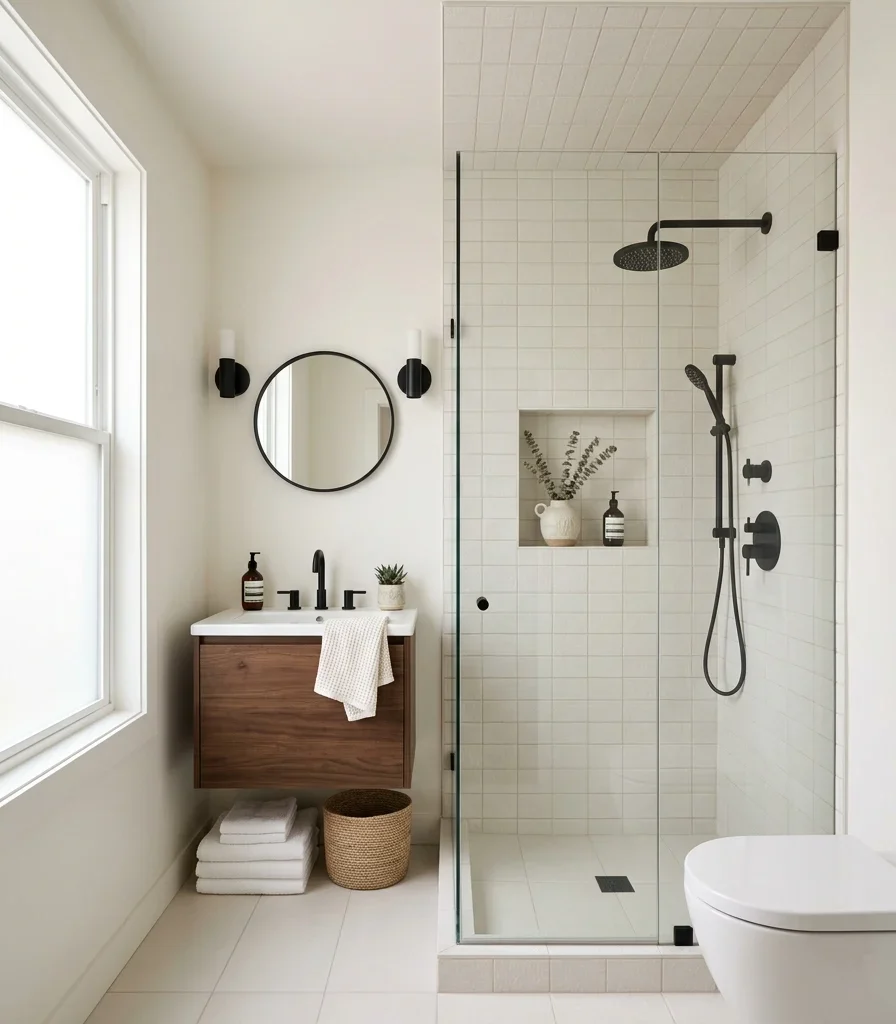
Vibe: Airy, a shower enclosure that removes the one visual boundary the ceiling line most rooms take for granted.
Why it works: In a genuinely small shower enclosure, continuing the wall tile onto the ceiling is the small-space illusion technique that eliminates the horizontal line where wall meets ceiling, the specific boundary that makes a tight enclosure feel most compressed; removing it lets the walls and ceiling read as one continuous wrapped surface.
How to get it: Use the same tile, size, and grout color on the ceiling as the walls with no interrupting trim strip at the transition, and choose a lighter tone specifically for this technique, since a dark tile wrapped onto the ceiling can make a small enclosure feel heavier rather than more expansive.
💡 Quick Win: Even continuing tile just 12 inches onto the ceiling at the shower’s edge (rather than the full enclosure) softens the boundary line noticeably.
Shop the Look
| Product |
| Warm white ceiling-rated tile |
| Waterproof ceiling tile adhesive |
| Matte black shower fixture set |
| Small ceramic countertop vessel |
| Tile grout sealant ceiling rated |
How to Start Your Stylish Small Bathroom Tile Transformation
Your first move is choosing the single dominant tile decision for the shower wall or the floor before any paint or fixture selection. Since tile carries the most visual weight of any material in a small bathroom, committing to that one statement first (a zellige wall, a terracotta floor) sets the reference point every other color and hardware decision gets measured against.
The most common mistake is choosing bold pattern or color for every surface at once- a patterned floor, a colored wall, and a contrast border all in the same small room, which competes rather than complements. The fix is committing to one dominant tile statement and keeping every other surface deliberately simple so that one choice actually reads clearly.
Three items under $50 that create immediate impact: a peel-and-stick scalloped tile decal for a small accent area, a single framed extra tile as wall art, and a warm charcoal grout pen to test a contrast-grout look on existing tile before a full regrout.
A weekend refresh grout color and a framed tile costs $50–200. A full stylish tile renovation with zellige walls and a terracotta floor typically runs $6,000–14,000 and takes two to four weeks depending on tile lead times.
Frequently Asked Questions About Stylish Small Bathroom Tile Design
What is the difference between zellige and standard ceramic tile?
Zellige is hand-cut from glazed clay in Morocco, carrying natural glaze variation and slightly irregular edges that give it visible texture and depth. Standard ceramic tile is machine-pressed for uniform size and consistent color, which is more budget-friendly and easier to install but lacks the handmade variation that gives zellige its distinctive light-catching quality.
What grout color works best for a stylish small bathroom?
Warm charcoal grout against a pale tile creates strong, deliberate contrast that emphasizes each tile’s shape, while a grout matched closely to the tile color lets the surface read as one continuous plane. Both are valid stylish choices depending on whether the goal is pattern emphasis or seamless continuity.
How much does a stylish small bathroom tile renovation cost?
A budget refresh using an accent wall or new grout costs $500–2,000. A mid-range renovation with handmade zellige on one wall and a terracotta floor runs $6,000–10,000, and a full renovation including a herringbone shower and ceiling-continued tile typically costs $10,000–16,000 depending on tile type and labor.
Can bold tile patterns work in a genuinely tiny bathroom?
Yes, and they often work better there than in a larger room. Pattern and texture are visible at close range in a small bathroom in a way a larger space dilutes, so a scalloped accent wall or a vertical herringbone shower reads as a clear, considered statement rather than getting lost across a bigger footprint.
What is the most popular tile choice for small bathrooms right now?
Handmade zellige remains the most searched and most specified tile for small bathrooms, according to Pinterest and design-industry data, followed closely by penny-round mosaic flooring and two-tone tile splits with a contrast border line as ways to add pattern without overwhelming a tight room.
Ready to Create Your Dream Stylish Small Bathroom?
These 15 ideas move across material, color, lighting, layout, and true small-space solutions from handmade zellige and a terracotta pedestal base to tile wrapped onto the ceiling for a shower enclosure that finally loses its tightest edge. None of this needs to happen all at once, and starting with one accent wall or a single framed extra tile is genuinely the smartest place to begin, not a smaller version of the full vision. Today’s specific action: pull tile samples in your two or three favorite finishes and hold them against your bathroom’s actual light at different times of day before ordering anything, since tile reads differently under morning and evening light than it does under a showroom bulb. Once the room’s tile story is settled and installed, stepping into it will feel less like using a plain functional space and more like standing inside a considered, textured room built with genuine intention. Save the ideas that fit your bathroom’s real footprint and your own sense of pattern; handmade zellige and warm charcoal grout will still feel just as considered a year from now.