
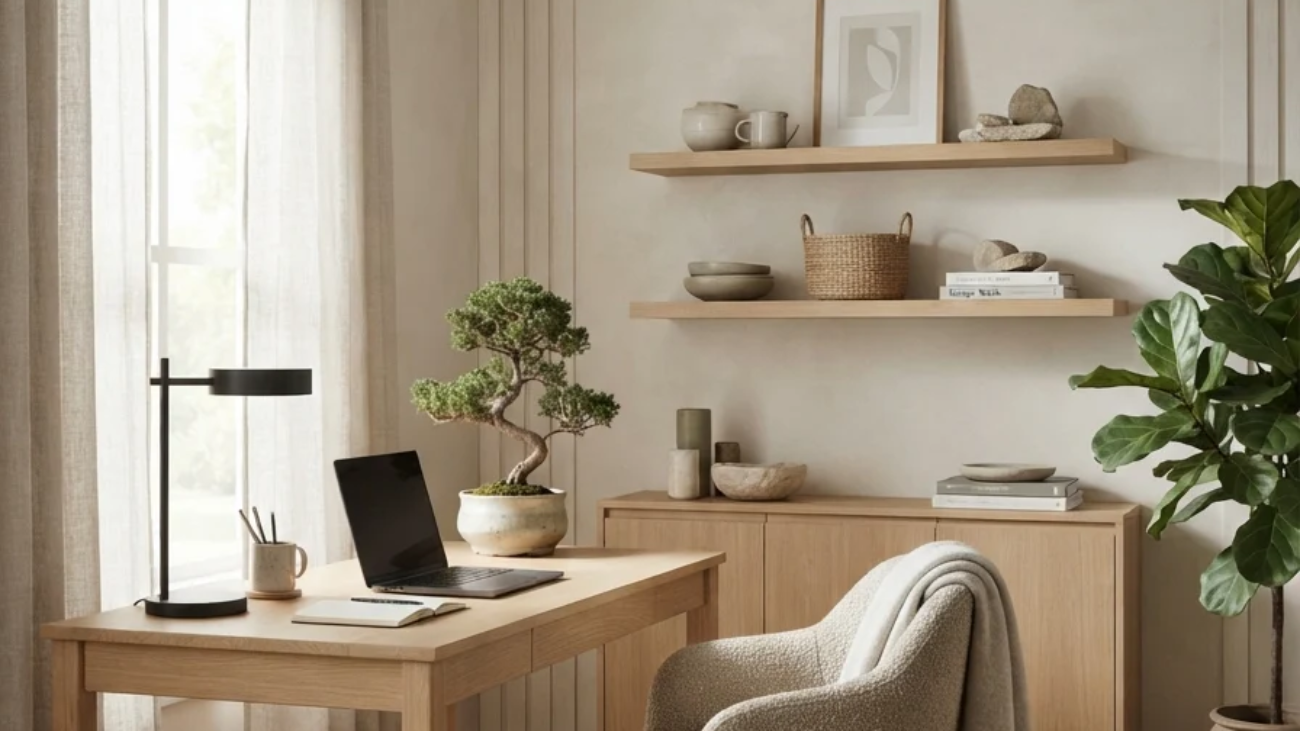
Japandi is a design style that combines Japanese restraint with Scandinavian warmth, creating spaces built around simplicity, natural materials, functional beauty, and visual calm. These 16 Japandi home office ideas show how to turn a workspace into a quieter, more intentional environment using warm wood, soft neutrals, thoughtful lighting, ergonomic furniture, and uncluttered layouts.
Morning light falls softly across pale oak, a linen chair feels warm beneath your hand, and the desk holds only what you genuinely need for the work ahead. A Japandi home office does not demand attention; it gives your attention somewhere peaceful to land. Natural textures, muted colors, and carefully controlled negative space make the room feel grounded without becoming stark. The result is a workspace that supports concentration while still feeling unmistakably part of a home.
Here are 16 ideas worth saving and stealing.
Why Japandi Home Office Design Works So Well
Japandi combines two traditions that approach simplicity from different directions: Japanese design emphasizes restraint, asymmetry, natural imperfection, and the concept of ma, or meaningful space, while Scandinavian interiors contribute warmth, practicality, comfort, and accessible natural materials. The result is less clinical than strict minimalism and less rustic than traditional Nordic decorating. In a Japandi home office, every object should have a reason to exist, but that reason can be functional, tactile, or quietly personal.
The material palette is deliberately honest. Look for unfinished or matte-finished oak, ash, walnut, bamboo, linen, cotton, wool, rattan, handmade ceramic, paper, and blackened or aged metal. Core colors include warm white, oatmeal, mushroom, greige, sand, muted sage, clay, charcoal, and soft black. Rather than using strong contrast everywhere, Japandi relies on tonal shiftscream beside pale oak, mushroom beside walnut, or sage against warm whiteto create depth without visual noise.
Japandi also fits the way many people now use their homes. A home office has to support concentration, video calls, storage, and long working sessions while still belonging to a domestic environment. The style’s emphasis on natural materials, fewer possessions, multifunctional furniture, and low visual stimulation makes it particularly suited to people who want their workspace to feel restorative rather than corporate.
Style at a Glance
| Element | Japandi Home Office |
| Philosophy | Intentional simplicity, function, calm, meaningful negative space |
| Key Materials | Pale oak, ash, walnut, linen, wool, bamboo, ceramic, rattan |
| Key Colors | Warm white, oatmeal, mushroom, greige, muted sage, charcoal |
| Lighting | Soft daylight, 2700–3000K ambient light, focused task lighting |
| Furniture | Low-profile, ergonomic, clean-lined, natural wood |
| Styling Rule | Fewer objects, stronger materials, generous breathing room |
16 Japandi Home Office Ideas
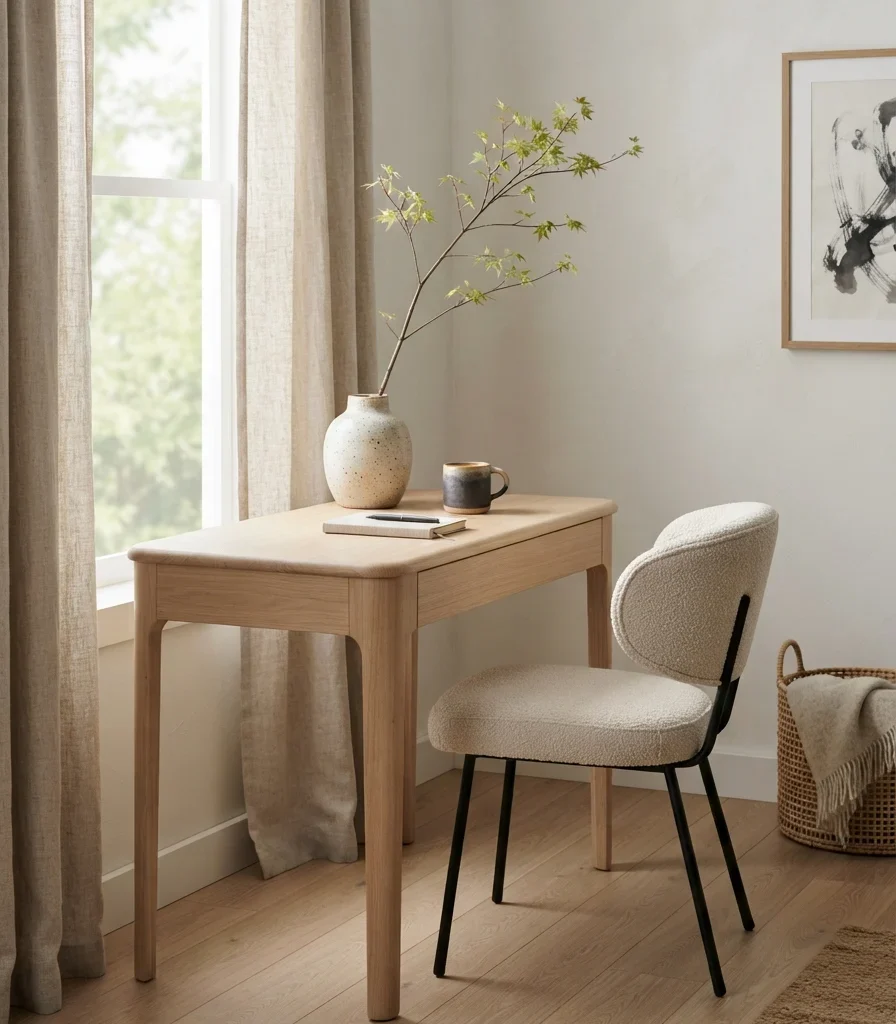
1. Ground the Room With a Pale Oak Desk
Category: Furniture
Vibe: Grounded.
Why it works: The desk is the visual anchor of a home office, and pale oak gives that anchor warmth without creating heavy visual weight. Japandi furniture works through proportion and material honesty: a simple rectangular top, gently rounded corners, and visible wood grain feel intentional without decorative excess. Pairing oak with an upholstered cream chair introduces a controlled texture contrast between hard timber and soft fabric.
How to get it: Choose a desk approximately 120–140 cm wide and 60–70 cm deep, preferably with a matte or low-sheen finish. Keep the surface at standard desk height around 72–75 cm and leave at least 75 cm of clear space behind the chair for comfortable movement.
💡 Quick Win: If replacing the desk is not practical, add a pale oak monitor riser and a matching wooden desk tray to an existing neutral desk.
Shop The Look
| Product | Search-friendly product |
| Desk | Pale oak minimalist writing desk |
| Chair | Cream linen ergonomic office chair |
| Desk accessory | Natural oak monitor riser |
| Storage | Oak desk drawer organizer |
| Decor | Handmade beige ceramic bud vase |
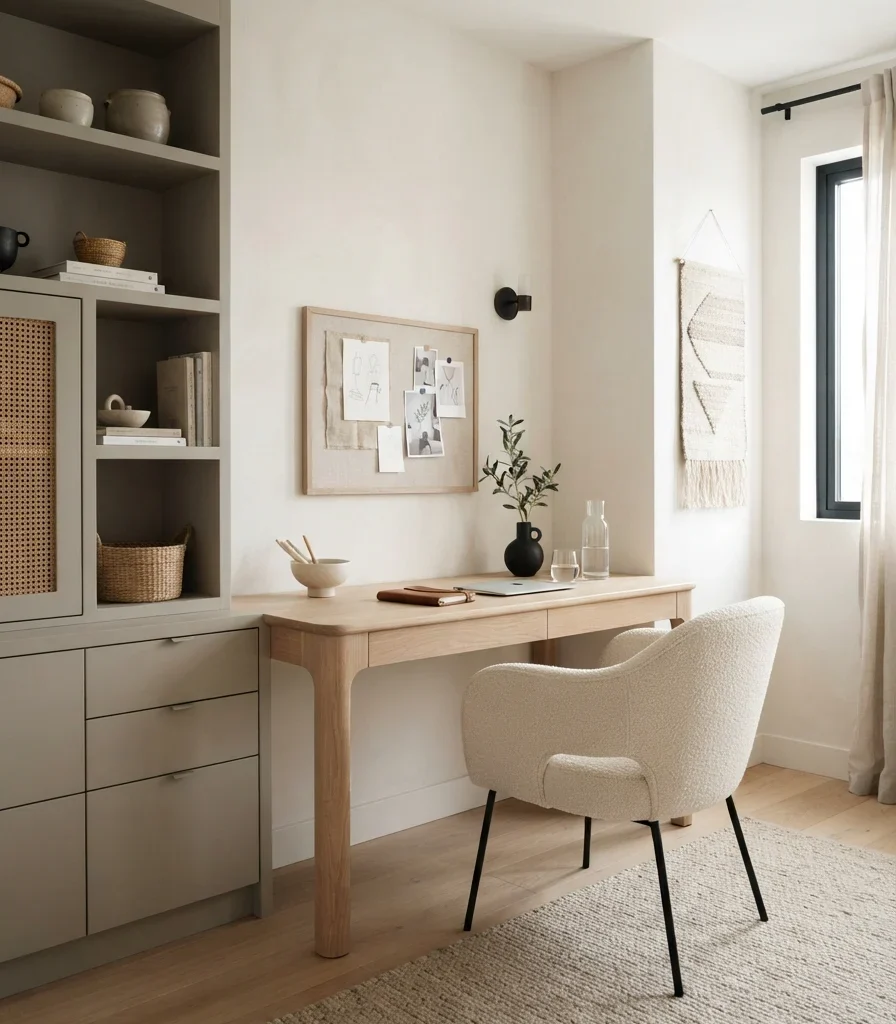
2. Use Warm White and Mushroom for Visual Quiet
Category: Color
Vibe: Hushed.
Why it works: Japandi color schemes rely on tonal layering rather than dramatic contrast. Warm white keeps the office luminous, while mushroom and oatmeal introduce enough depth to prevent the room from reading as plain white minimalism. The principle is low-contrast continuity: adjacent surfaces remain close enough in value that the eye moves gently around the room rather than stopping at hard color boundaries.
How to get it: Paint the main walls a warm white with a slight creamy undertone, then introduce mushroom through one cabinet, rug, or upholstered chair. Avoid blue-grey whites because they can make natural oak appear orange and undermine the warmer Scandinavian-Japanese balance.
Shop The Look
| Product | Search-friendly product |
| Paint accent | Mushroom beige interior wall paint |
| Chair | Oatmeal boucle desk chair |
| Rug | Low pile mushroom neutral office rug |
| Curtains | Warm white linen curtain panels |
| Wall decor | Minimal neutral abstract print |
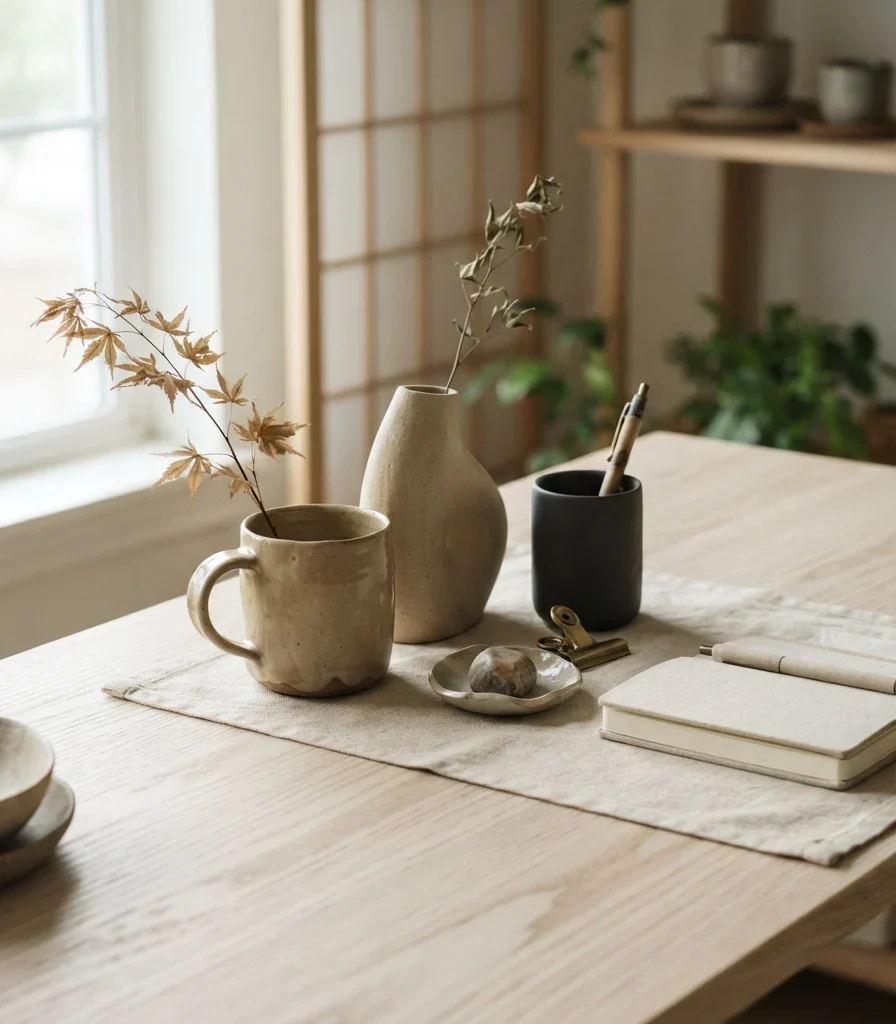
3. Layer Pale Wood With Handmade Ceramic
Category: Material
Vibe: Tactile.
Why it works: Natural wood can become visually flat when every accessory is equally smooth and manufactured. Handmade ceramic solves that problem through irregularity: subtle dents, mineral variation, matte glaze, and uneven edges give the eye something to explore. This is where Japanese wabi-sabi sensibility complements Scandinavian practicalitythe materials remain simple, but their surfaces carry character.
How to get it: Combine one pale wood species with ceramics that have visibly different finishes, such as unglazed stoneware beside a lightly speckled matte glaze. Keep the ceramic palette within ivory, sand, taupe, and charcoal so texture provides the variation rather than competing colors.
💡 Quick Win: Replace three plastic desk containers with one handmade-style ceramic pen cup and a shallow stoneware tray.
Shop The Look
| Product | Search-friendly product |
| Pen holder | Handmade matte ceramic pen cup |
| Tray | Speckled stoneware catchall tray |
| Mug | Japanese-style ceramic coffee mug |
| Vase | Small irregular ivory ceramic vase |
| Paperweight | Natural river stone desk paperweight |
4. Add a Warm Pendant Above the Work Zone

Category: Lighting
Vibe: Luminous.
Why it works: A ceiling fixture positioned directly over the work zone establishes a visual center without requiring decorative clutter. A paper or fabric shade softens the light and produces the diffused glow associated with Japanese interiors, while pale wood keeps the Scandinavian side of the palette present. Layered lighting also prevents the office from depending on one harsh ceiling source.
How to get it: Select a pendant with a diffusing paper, linen, or frosted shade and a warm LED bulb around 2700K–3000K. Hang it so the bottom of the shade remains comfortably above head height while visually aligning with the desk rather than the room’s geometric center.
Shop The Look
| Product | Search-friendly product |
| Pendant | Japanese paper pendant light |
| Bulb | 2700K warm white LED bulb |
| Cord | Natural fabric pendant cord |
| Switch | Warm dimmer compatible light switch |
| Accent light | Small oak table lamp |
5. Style Shelves With Negative Space
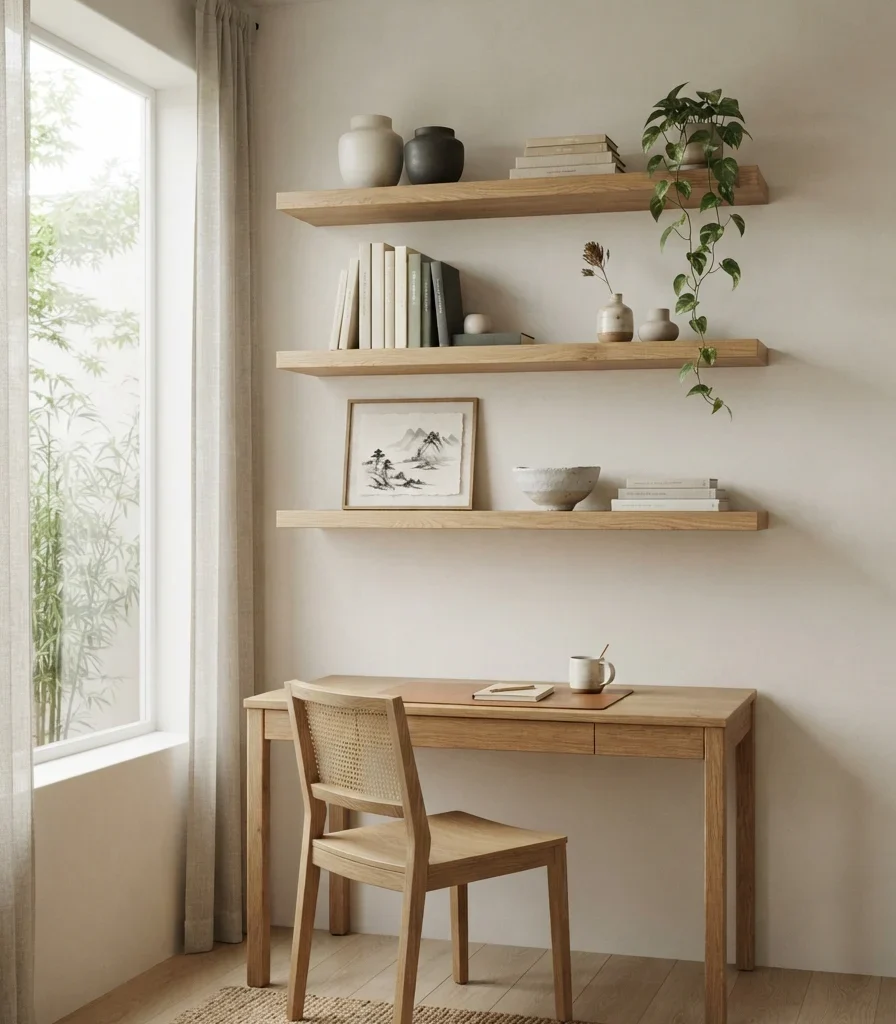
Category: Accessories
Vibe: Airy.
Why it works: Japandi shelving depends on negative space as much as the objects themselves. Leaving roughly 25–30% of each shelf empty prevents books and accessories from becoming a visual wall, while varying horizontal stacks with vertical books creates rhythm. The combination of timber, paper, ceramic, and greenery gives the shelving material diversity without introducing visual chaos.
How to get it: Begin with books, then add only one decorative object to every second or third group. Vary object height while keeping the color palette restrained. Position heavier objects toward the lower shelves and lighter ceramics toward eye level.
💡 Quick Win: Remove one-third of the objects from your existing office shelves and leave the freed space empty for a week before adding anything back.
Shop The Look
| Product | Search-friendly product |
| Shelf | Natural oak floating shelf |
| Vase | Matte sage ceramic bud vase |
| Basket | Woven seagrass storage basket |
| Art | Minimal Japanese botanical print |
| Bookend | Solid wood minimalist bookend |
6. Create a Desk-to-Reading Layout

Category: Layout
Vibe: Balanced.
Why it works: A home office becomes more comfortable when work and reflection have subtly different physical zones. The desk supports active concentration, while a low chair or reading corner provides a place for reviewing documents, thinking, or stepping away from the screen. The principle is functional zoning without visual partitions, allowing the room to remain open.
How to get it: Position the desk in the brightest practical location and place the secondary chair perpendicular to it rather than directly facing the desk. Keep a circulation path of roughly 75–90 cm between the zones so movement never feels squeezed.
Shop The Look
| Product | Search-friendly product |
| Chair | Low-profile oatmeal lounge chair |
| Rug | Neutral wool area rug |
| Table | Small oak round side table |
| Cushion | Natural linen lumbar cushion |
| Lamp | Minimal wood floor reading lamp |
7. Turn a Narrow Wall Into a Complete Office
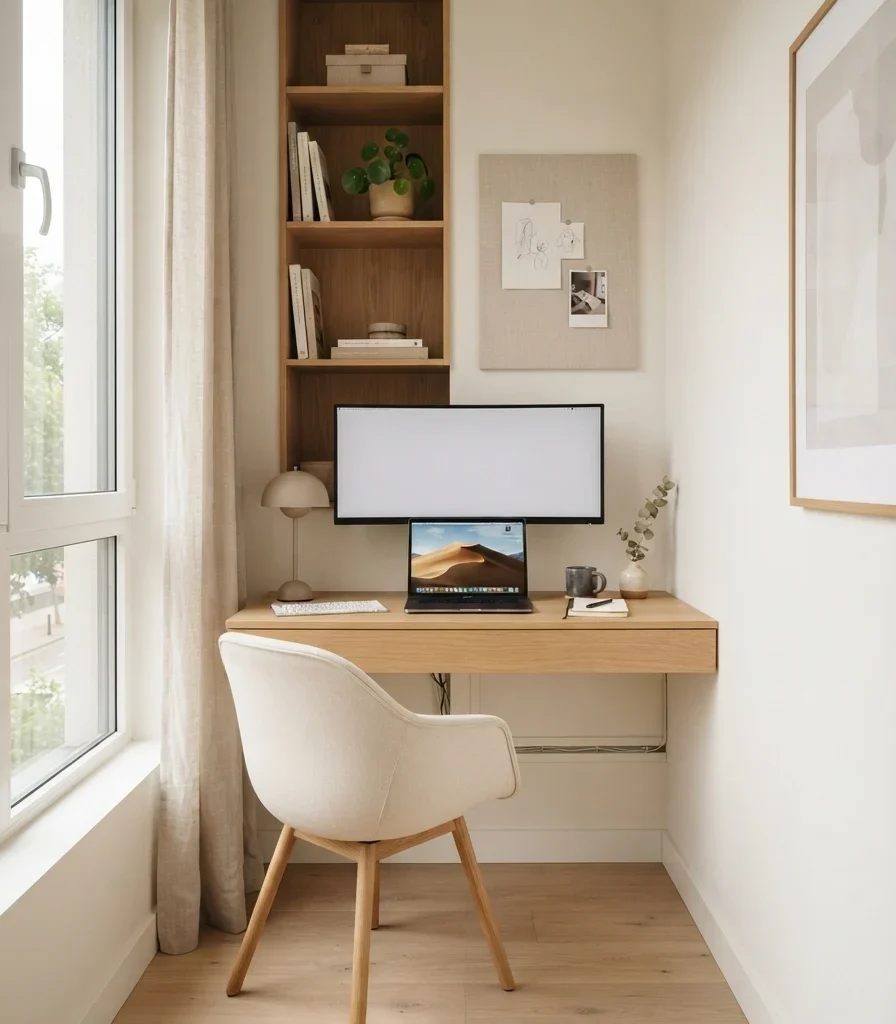
Category: Small Space
Vibe: Efficient.
Why it works: Narrow rooms benefit from vertical thinking rather than compacting everything onto the floor. A floating desk keeps the floor visually open, while shelving above it creates storage without expanding the footprint. The eye sees one continuous vertical composition instead of several unrelated furniture pieces, which makes a small Japandi office feel calmer.
How to get it: Use a floating desktop approximately 55–65 cm deep and install shelving in a vertical stack rather than spreading it horizontally. Conceal cables through a wall-colored raceway or a cable trough mounted underneath the desktop.
💡 Quick Win: If a floating desk is not possible, replace a bulky pedestal desk with a simple 120 cm writing table and a slim rolling drawer unit that can slide underneath.
Shop The Look
| Product | Search-friendly product |
| Desk | Wall mounted oak floating desk |
| Storage | Vertical oak office shelving unit |
| Chair | Compact cream ergonomic chair |
| Cable control | White under-desk cable tray |
| Pinboard | Linen fabric wall pinboard |
8. Choose an Ergonomic Chair That Still Looks Residential
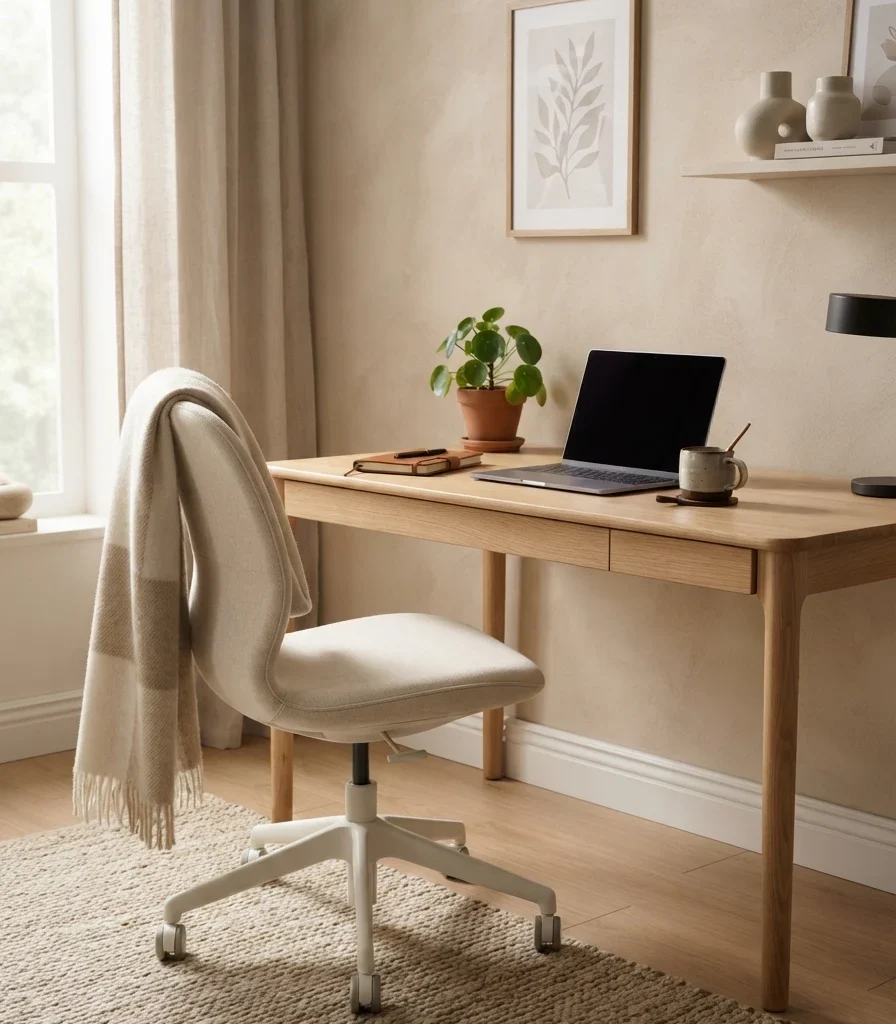
Category: Furniture
Vibe: Supported.
Why it works: Japandi should never require sacrificing comfort for appearance, especially in a room used for several hours each day. The ideal chair combines ergonomic adjustability with a residential material such as linen-look upholstery, warm grey fabric, or soft oatmeal bouclé. The design principle is concealed function: the ergonomic mechanisms should support the body without visually dominating the room.
How to get it: Prioritize adjustable seat height, lumbar support, and armrests before choosing upholstery. Your knees should remain around a 90-degree angle with feet supported, while your shoulders stay relaxed when your hands reach the keyboard.
Shop The Look
| Product | Search-friendly product |
| Chair | Oatmeal ergonomic upholstered office chair |
| Cushion | Natural wool lumbar support cushion |
| Footrest | Light wood ergonomic footrest |
| Mat | Clear office chair floor mat |
| Throw | Soft taupe wool office throw |
9. Introduce Muted Sage as the Natural Accent
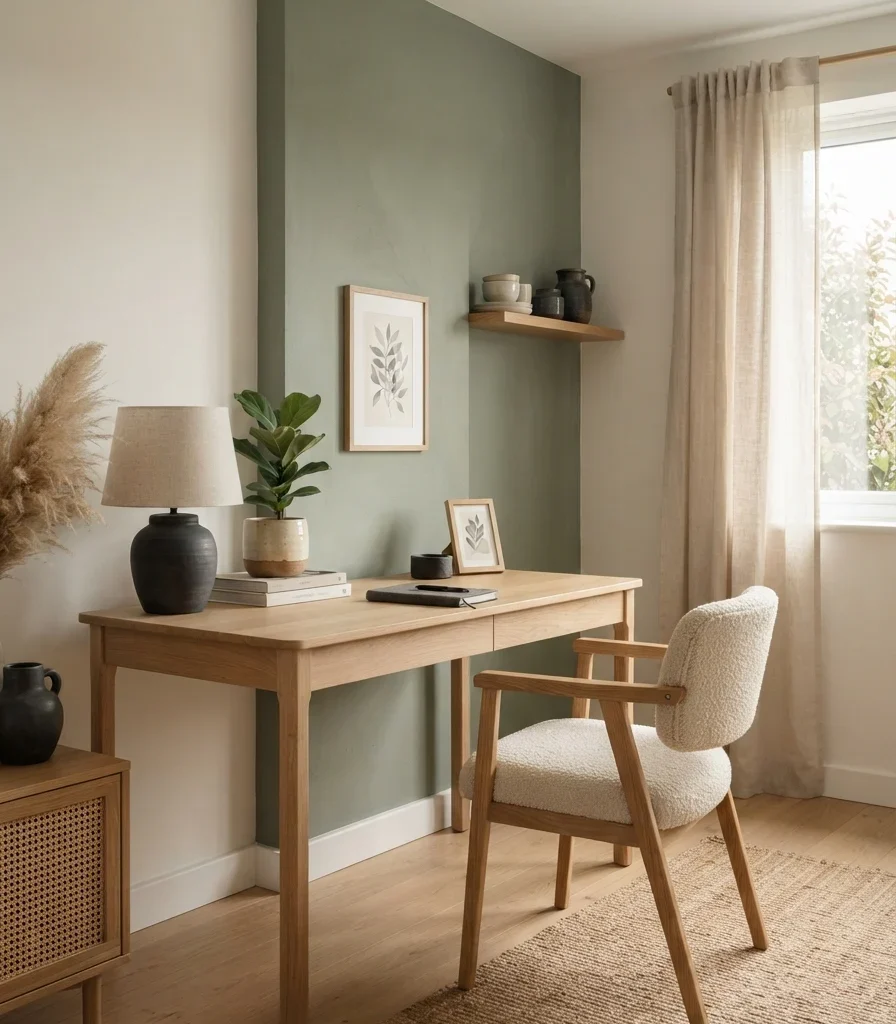
Category: Color
Vibe: Restorative.
Why it works: Muted sage introduces color without breaking Japandi’s restrained visual language. Because sage contains grey rather than bright yellow or blue, it behaves almost like a neutral while adding an unmistakable connection to foliage and natural landscapes. Keeping the accent wall matte also reduces reflected glare behind a monitor.
How to get it: Paint only the wall directly behind the desk in a dusty sage or eucalyptus tone and keep the remaining walls warm white. Echo the sage once or twice through a planter, cushion, or botanical artwork rather than repeating it across every accessory.
💡 Quick Win: Add one sage linen cushion or ceramic planter before committing to paint; live with the color for several days under both daylight and evening lamps.
Shop The Look
| Product | Search-friendly product |
| Accent decor | Muted sage ceramic planter |
| Cushion | Sage green linen lumbar pillow |
| Art | Minimal sage botanical wall print |
| Desk mat | Sage felt desk mat |
| Organizer | Sage fabric file storage box |
10. Use Walnut Only as a Controlled Contrast

Category: Material
Vibe: Anchored.
Why it works: Using only one wood tone can feel too uniform, but introducing several competing species can make a Japandi office look assembled rather than intentional. Walnut works best as a controlled darker accent against pale oak because the contrast establishes visual hierarchy. The deeper brown gives the eye an anchor while the lighter timber keeps the overall room open.
How to get it: Follow a 70/30 wood rule: let approximately 70% of visible timber remain pale oak or ash and use walnut for one substantial element such as a cabinet, shelf, or desk drawer. Repeat the walnut no more than two additional times.
Shop The Look
| Product | Search-friendly product |
| Cabinet | Walnut minimalist filing cabinet |
| Desk accessory | Walnut wooden monitor stand |
| Tray | Dark walnut valet tray |
| Frame | Walnut minimalist picture frame |
| Organizer | Walnut desktop storage box |
11. Put Task Lighting at Eye and Hand Level
Category: Lighting
Vibe: Focused.
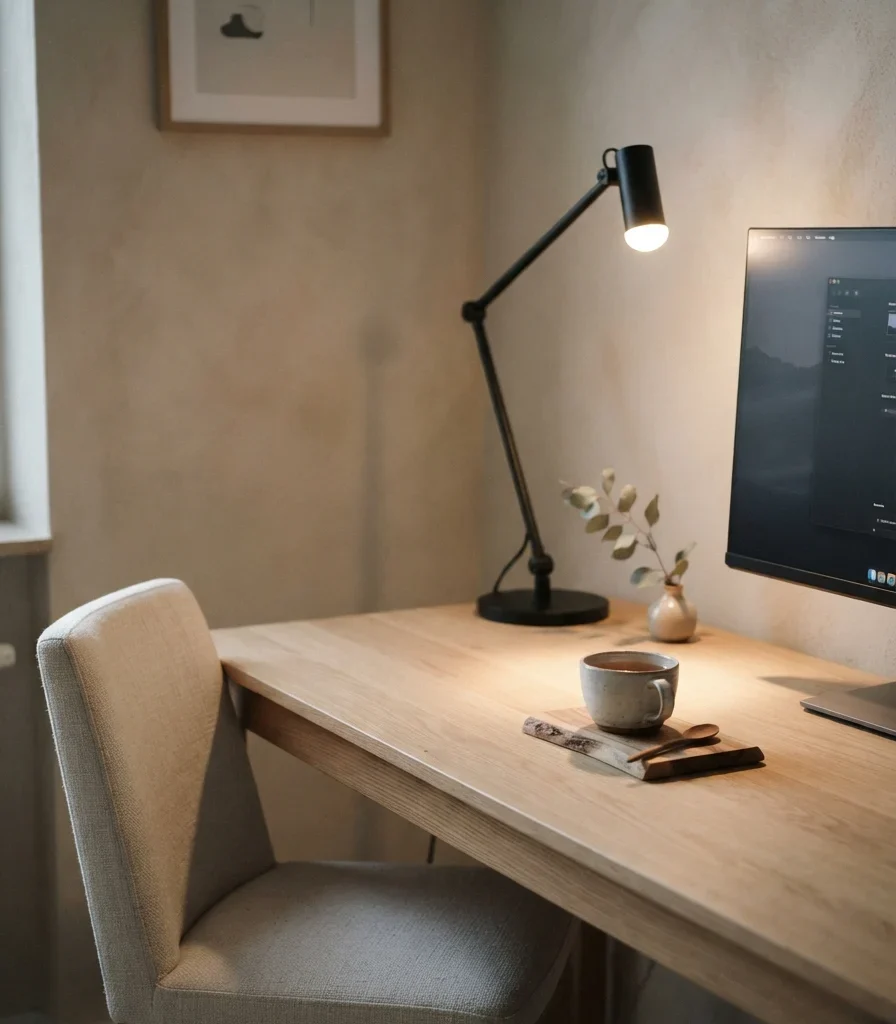
Why it works: Desk lighting should illuminate the work surface without producing glare on a monitor. A directional lamp creates a small pool of focused light, while softer ambient lighting keeps the surrounding room from becoming visually black by comparison. Japandi benefits from this layered light behavior because it creates atmosphere without requiring decorative fixtures everywhere.
How to get it: Position the task lamp to the side opposite your writing hand when possible and angle it toward the desk surface rather than directly at the screen. Choose a dimmable 2700K–3000K LED and use a matte shade to reduce glare.
Shop The Look
| Product | Search-friendly product |
| Lamp | Matte black articulated desk lamp |
| Bulb | Dimmable 3000K LED desk bulb |
| Glare control | Monitor light bar warm white |
| Cable control | Black braided desk cable sleeve |
| Tray | Charcoal felt desk organizer tray |
12. Add Linen and Wool Instead of Extra Decor
Category: Accessories
Vibe: Sun-warmed.
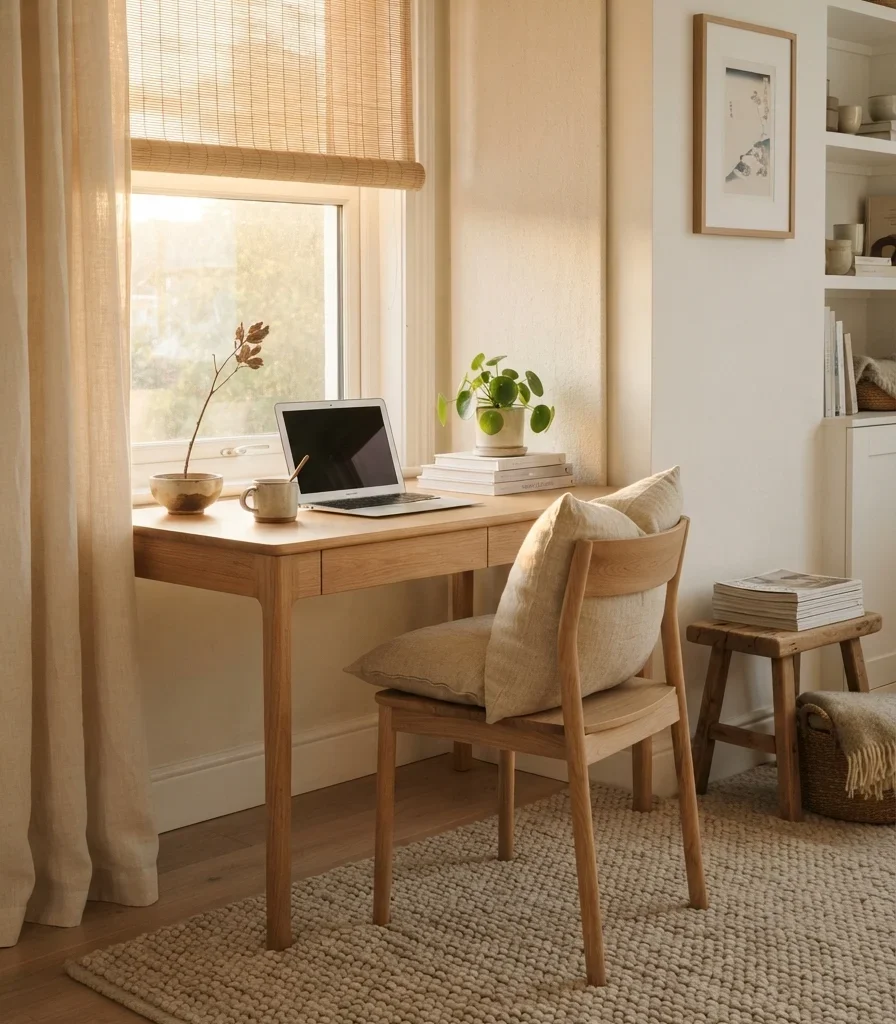
Why it works: When a Japandi office feels too bare, the answer is usually texture rather than more objects. Linen and wool add visual depth because their fibers scatter light differently from timber and ceramic. This is texture layering without clutter: the room gains softness and acoustic comfort while retaining its limited object count.
How to get it: Choose one substantial wool or wool-blend rug and one linen textile, then stop before adding multiple decorative fabrics. Keep both within warm neutrals such as oatmeal, flax, cream, and mushroom so texture, not pattern, creates the visual interest.
💡 Quick Win: Add a 40×60 cm oatmeal linen cushion to an existing office chair or reading chair for an immediate material shift.
Shop The Look
| Product | Search-friendly product |
| Rug | Oatmeal low pile wool rug |
| Cushion | Natural flax linen cushion cover |
| Curtain | Woven linen blend window shade |
| Throw | Cream waffle cotton throw |
| Foot cushion | Wool felt floor cushion |
13. Hide Technology Behind Calm Storage
Category: Furniture
Vibe: Orderly.
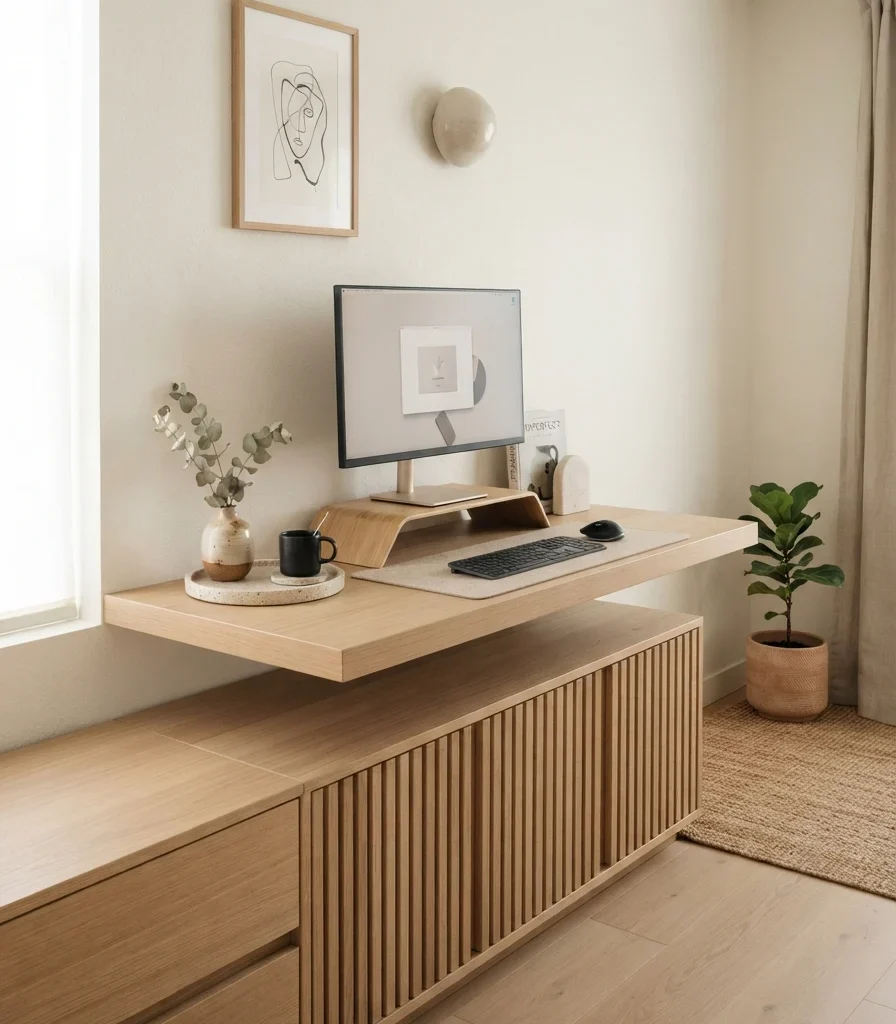
Why it works: Technology creates visual noise because cables, chargers, printers, and peripherals introduce dark lines and irregular shapes into an otherwise calm room. Closed storage restores visual hierarchy by giving those functional objects a defined home behind one continuous material surface. Slatted or fluted oak doors can add subtle shadow without turning the cabinet into a decorative statement.
How to get it: Select a low cabinet with adjustable shelves and at least one rear cable opening. Group printers, chargers, paper, and spare electronics by function, then leave the cabinet’s top at least 50% empty so it remains a visual surface rather than another storage zone.
Shop The Look
| Product | Search-friendly product |
| Cabinet | Natural oak slatted storage cabinet |
| Cable box | Wooden cable management box |
| File storage | Neutral fabric document boxes |
| Drawer tray | Bamboo office drawer organizer |
| Labeling | Minimal kraft file label set |
14. Balance Warm White With Charcoal Accents
Category: Color
Vibe: Grounded.
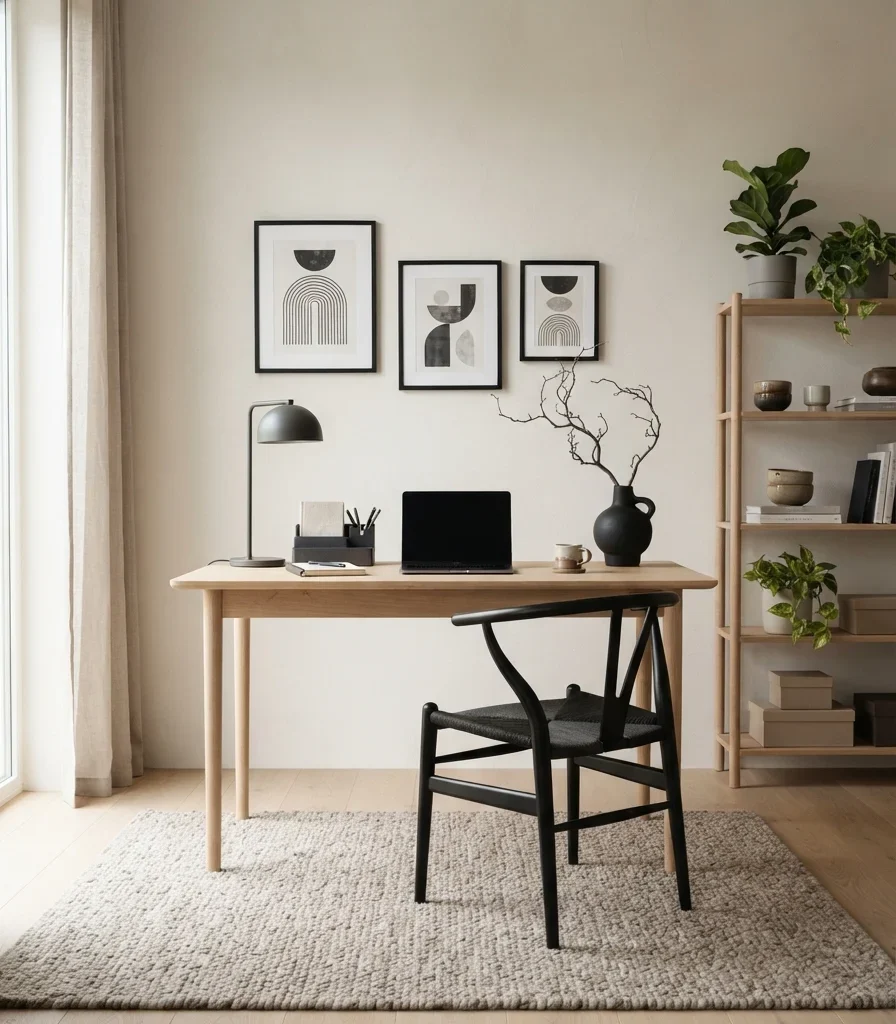
Why it works: A room made entirely from pale neutrals can lose definition, particularly when viewed through a video-call camera. Small amounts of charcoal create visual punctuation and clarify the silhouettes of desks, shelves, lamps, and frames. The contrast works because it is repeated strategically rather than scattered randomly.
How to get it: Keep charcoal to roughly 10% of the visible palette and repeat it in three locations: one lighting element, one frame or hardware detail, and one small desk accessory. Avoid using glossy black, which can feel more contemporary and visually aggressive than matte charcoal.
Shop The Look
| Product | Search-friendly product |
| Frame | Thin charcoal wood picture frame |
| Lamp | Charcoal ceramic table lamp |
| Desk mat | Dark grey wool felt desk mat |
| Vase | Matte charcoal ceramic vase |
| Organizer | Blackened metal file holder |
15. Bring Nature Indoors With One Sculptural Plant

Category: Material
Vibe: Organic.
Why it works: A single substantial plant provides the irregular organic form that a minimalist office needs without adding a collection of small decorative objects. The branching structure contrasts with the straight lines of the desk and shelving, creating a useful balance between geometry and nature. Terracotta also introduces an earthy mineral texture that connects the plant visually to the rest of the material palette.
How to get it: Choose one plant suited to your actual light level rather than choosing by appearance alone. Position it in an indirect-light corner and use a matte terracotta or stone-colored planter approximately one-third to one-half the plant’s total visual height.
💡 Quick Win: For a darker office, use a trailing pothos in a matte stoneware planter rather than forcing a high-light olive tree into unsuitable conditions.
Shop The Look
| Product | Search-friendly product |
| Plant | Indoor olive tree live plant |
| Planter | Large matte terracotta planter |
| Plant stand | Low natural oak plant stand |
| Basket | Woven seagrass plant basket |
| Watering | Minimal brass plant watering can |
16. Finish the Office With a Quiet Wabi-Sabi Wall
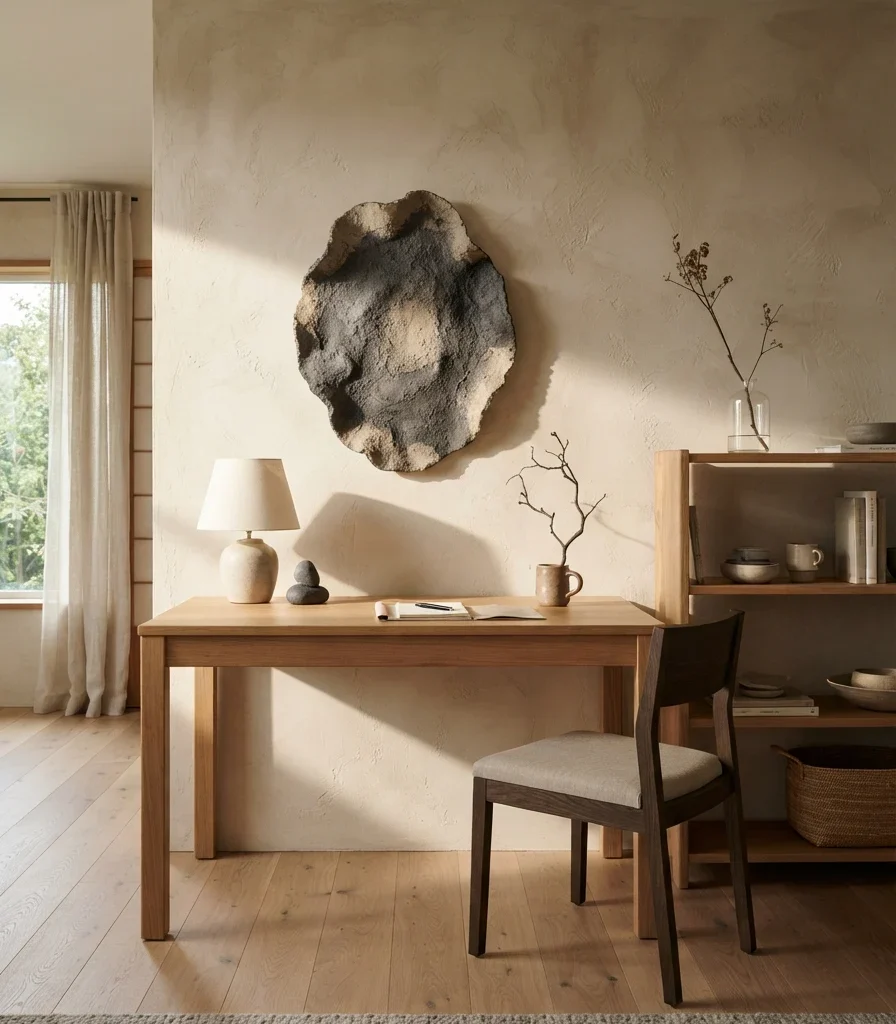
Category: Material
Vibe: Still.
Why it works: Wabi-sabi influence works best when it appears through material character rather than obvious themed decoration. A softly irregular plaster surface, handmade ceramic, or imperfect timber edge introduces variation while maintaining the calm composition. The principle is controlled imperfection: one tactile surface can make an otherwise simple room feel considered without filling the walls with artwork.
How to get it: Create the effect with mineral paint, limewash, or a subtle clay-plaster finish rather than a high-contrast textured wallpaper. Keep the feature wall mostly empty and place one substantial handmade object where its irregular silhouette can become the focal point.
Shop The Look
| Product | Search-friendly product |
| Wall finish | Warm ivory limewash interior paint |
| Wall decor | Handmade neutral ceramic wall sculpture |
| Art | Wabi-sabi minimalist abstract print |
| Sculpture | Natural stone desk sculpture |
| Branch vase | Tall matte clay floor vase |
How to Start Your Japandi Home Office Transformation
The first move is to establish the desk wall in a warm white, such as a soft ivory, rather than starting with accessories. This gives pale oak, linen, ceramic, and muted sage a consistent background and immediately establishes the warm visual temperature Japandi needs. Once the wall tone is correct, every later decision, from the desk finish to the rug and lighting, can be judged against the same calm foundation.
The most common mistake is making Japandi synonymous with an empty white room. Too much white, too little texture, and furniture with identical pale finishes can make an office feel unfinished rather than intentional. Fix it by introducing three contrasting material temperatures: pale timber, tactile textile, and handmade ceramic or stone. The room should feel restrained, not sterile.
For an inexpensive starting point, buy a small handmade-style ceramic pen cup, a natural flax linen cushion cover, and a bamboo or oak cable-management tray. Each can typically be found below $50, and together they address texture, comfort, and visual clutter.
A starter transformation can happen over one weekend for roughly $200–$600 if you already own a suitable desk and chair. A more complete room with a quality desk, ergonomic chair, rug, lighting, storage, and decorative materials may run $1,000–$3,500, while custom cabinetry or built-ins can push the project considerably higher. Painting, styling, and cable management are weekend projects; furniture sourcing and custom storage may take several weeks.
Frequently Asked Questions About Japandi Home Office Design
What is a Japandi home office and how is it different from minimalist design?
A Japandi home office combines Japanese restraint with Scandinavian warmth, while minimalism is a broader design philosophy that can use many different visual languages. Japandi typically feels softer because it relies heavily on pale timber, linen, wool, handmade ceramics, and warm neutral colors. A minimalist office could be monochromatic and highly architectural, whereas Japandi usually introduces visible natural texture and craftsmanship. The distinction is especially noticeable in the treatment of space: Japandi uses negative space intentionally rather than simply removing objects.
Which colors work best for a Japandi home office?
Warm white, oatmeal, mushroom, greige, muted sage, clay, pale oak, and charcoal are particularly effective. For a compact room, warm white walls with pale oak furniture can maximize visual brightness without creating the coldness of stark white. Muted sage is useful as a restrained accent, especially behind a desk. Avoid highly saturated primary colors because they tend to compete with the style’s emphasis on quiet tonal transitions.
How much does a Japandi home office cost?
A simple Japandi workspace can be created for around $200–$600 if you already own the main desk and chair. A complete room with a new natural-wood desk, ergonomic seating, rug, task lighting, storage, and accessories commonly reaches $1,000–$3,500. Custom oak cabinetry or premium solid-wood furniture can raise the budget substantially. The most important investment should go toward pieces you use every day, especially the desk, chair, and lighting.
Can Japandi office furniture work with a computer and multiple monitors?
Yes, but the technology needs to be visually controlled. Use a natural-wood monitor riser or slim monitor arm, route cables through an under-desk tray, and keep chargers inside a closed drawer or cabinet. For two monitors, a 140–160 cm desk generally gives more breathing room than a 120 cm surface. A matte charcoal accessory palette can also visually integrate dark screens without making the technology feel like the room’s main design feature.
What is the most important element in a Japandi home office?
The desk is usually the most important visual and functional element because it determines both the working posture and the room’s material direction. A pale oak or ash desk with a simple profile provides the strongest Japandi foundation, especially when paired with an ergonomic chair in cream, oatmeal, or warm grey. After the desk, lighting is the next major priority because even excellent materials can feel flat under harsh cool-white illumination. If the desk and lighting are right, fewer decorative additions are needed.
Ready to Create Your Dream Japandi Home Office?
These 16 Japandi home office ideas cover more than decoration, moving from warm white and muted sage color layering to pale oak, handmade ceramic, natural textiles, thoughtful lighting, ergonomic furniture, and space-conscious layouts. You do not need to transform everything at once; starting with one material, one wall, or one lighting change is often the most faithful approach to Japandi itself. Today, clear your desk completely and return only the five items you genuinely use, then add one natural material such as an oak tray or ceramic vessel. As the room becomes quieter, you should feel less visually pulled in different directions and more able to settle into focused, comfortable work. Save or pin the ideas that speak to you most, especially the pale oak, muted sage, handmade ceramic, and meaningful negative-space details that give Japandi its calm character.