
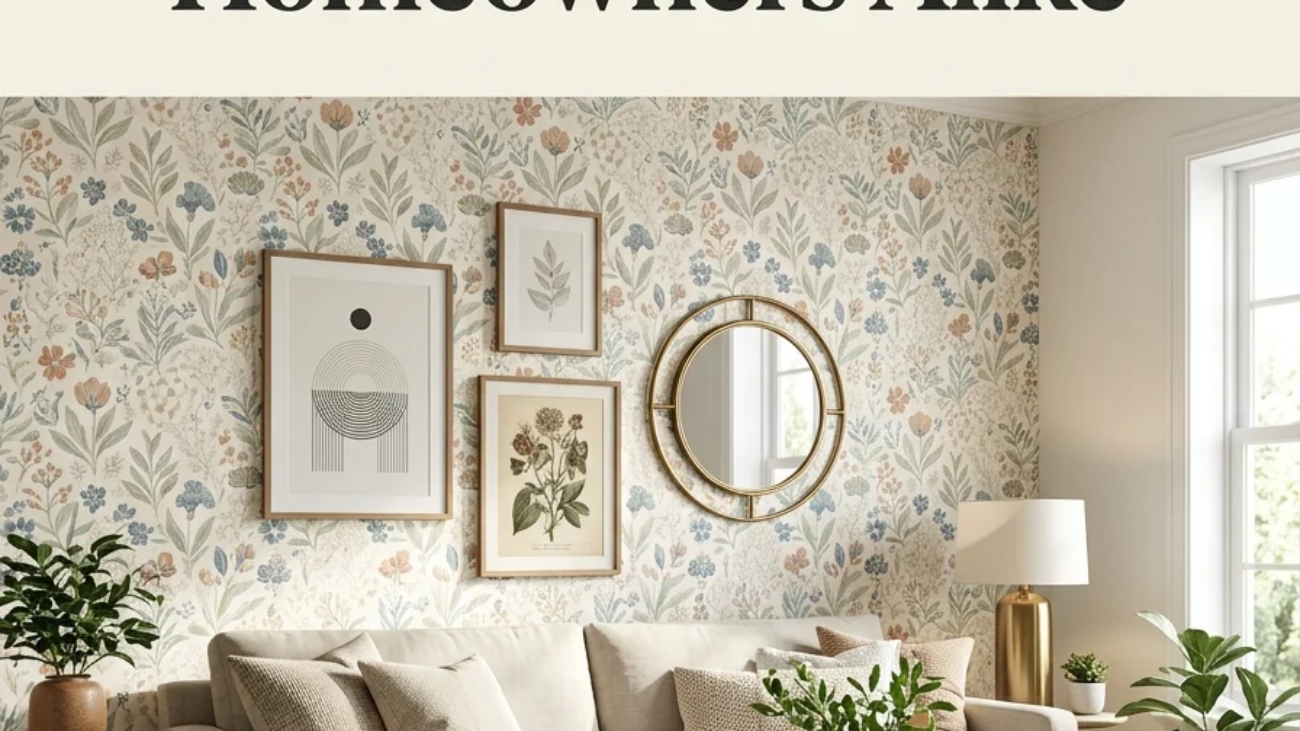
Peel-and-stick wallpaper is a self-adhesive wall covering that applies directly to a clean, painted wall without paste, water, or steam, and removes cleanly when you’re ready for something new. This article gives you 20 real Peel-and-stick wallpaper ideas covering color, material, lighting, furniture, and layout, each one showing exactly where and how this single removable product can transform a space.
The feel is unmistakable: pattern and texture arriving overnight, a wall that finally has personality without a single drop of paste or a weekend lost to steaming off old glue. Peel-and-stick wallpaper turns commitment-phobic decorating into something genuinely low-risk. Here are 20 ideas worth saving and stealing.
Why Peel-and-Stick Wallpaper Works So Well
Peel-and-stick wallpaper evolved from adhesive vinyl film technology, adapted specifically for walls once manufacturers developed a repositionable, low-tack adhesive strong enough to hold the pattern in place for years but gentle enough to release cleanly from painted drywall on removal. This is what separates it from traditional pasted wallpaper, which requires wheat paste or wallpaper adhesive and typically steam or chemical stripping to remove, and from paint, which delivers color but no texture or pattern at all.
The material comes in two main types: thinner vinyl film, best for smooth, low-texture applications, and thicker non-woven fabric-backed versions, which handle slightly uneven walls better and tend to resist bubbling. Popular pattern categories span botanical prints in sage and terracotta tones, geometric prints in bold contrast colors, faux-stone finishes like marble and zellige tile, and textured looks like grasscloth or linen that read as genuinely woven from a normal viewing distance.
Peel-and-stick wallpaper has grown into one of the most searched wall treatments specifically because renting has become the default housing situation for a growing share of households, and this product is one of the only wall treatments that delivers real pattern and color commitment without violating a typical lease’s no-permanent-alteration clause. Removable design content has correspondingly surged across Pinterest and TikTok as more people document full apartment transformations achievable without a landlord’s permission.
Small spaces are arguably the strongest use case for peel-and-stick wallpaper, since a powder room, closet, or small nook can absorb a bold, pattern-dense wallpaper that would feel overwhelming across an entire living room. Prioritize contained, high-impact spaces first. A single small room lets you commit to a genuinely confident pattern choice with far less financial or visual risk than a full room would carry.
Style at a Glance
| Element | Vinyl Film Type | Non-Woven Fabric-Backed Type |
| Philosophy | Thin, best on smooth walls | Slightly thicker, forgives texture |
| Materials | PVC vinyl with adhesive backing | Fabric-blend backing, paper-like feel |
| Color Palette | Sage, terracotta, charcoal, blush | Same broad range, richer texture depth |
20 Peel-and-stick Wallpaper Ideas
1. A Botanical Print Wallpaper in Warm Sage for a Living Room Accent Wall
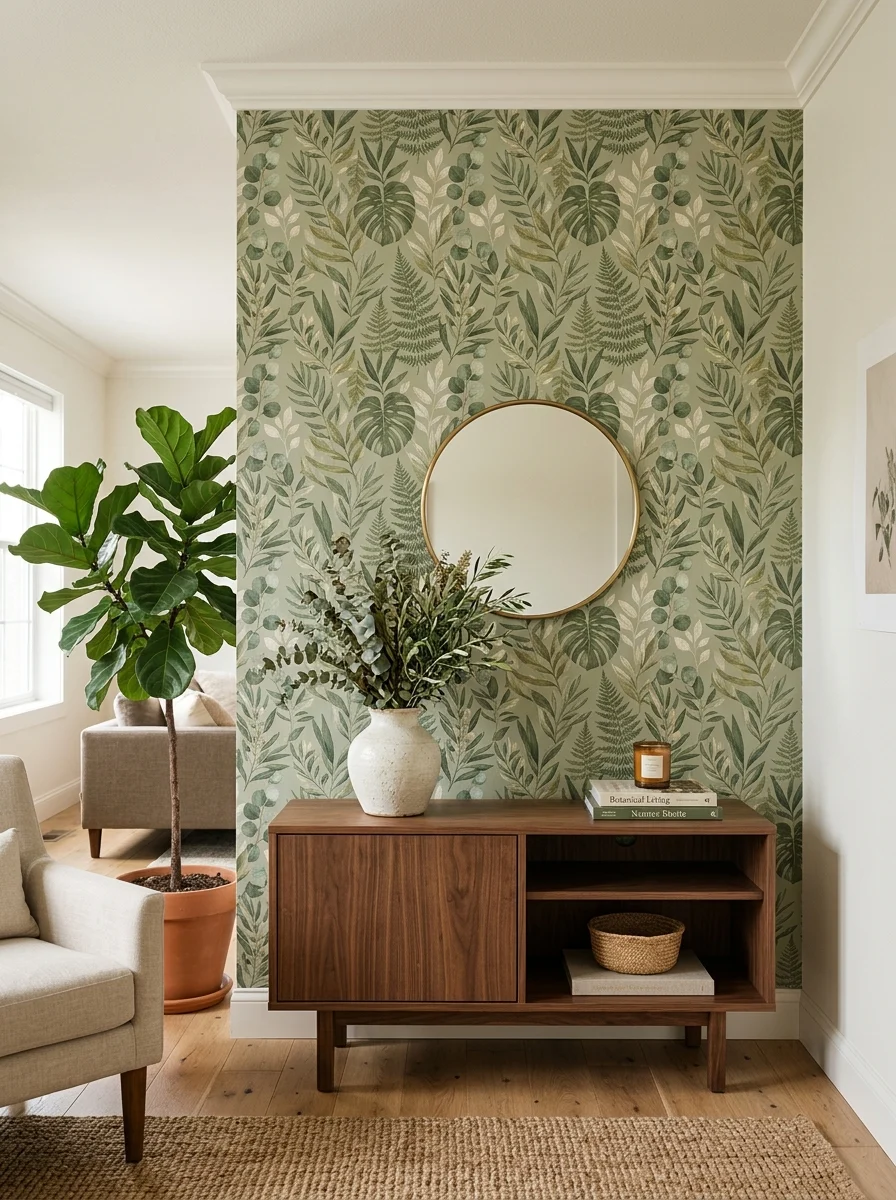
Vibe: The wall feels layered, a botanical pattern doing what plain paint never could.
Why it works: A botanical print wallpaper introduces color and pattern in one single decision, which is why it’s consistently the highest-impact starting point for a first peel-and-stick project. The leaf motif also reads as organic and calming rather than busy, since the repeated natural shapes create rhythm without the visual noise a geometric print can carry. Sage green specifically stays close enough to neutral that it pairs easily with warm wood tones already in most living rooms.
How to get it: Choose a botanical print with a repeat pattern under 24 inches so seams align more forgivingly during installation, and apply starting from a corner using a plastic smoothing tool to push air bubbles outward as you go.
💡 Quick Win: Apply the wallpaper to just the wall behind a media console or bookshelf first, where furniture covers any minor seam imperfections while you build confidence with the technique.
Shop the Look
| Product |
| Botanical print peel-and-stick wallpaper |
| Wallpaper smoothing tool |
| Craft knife for trimming edges |
| Walnut console table |
| Ceramic decorative vase |
2. Faux Grasscloth Texture Wallpaper for Organic Warmth
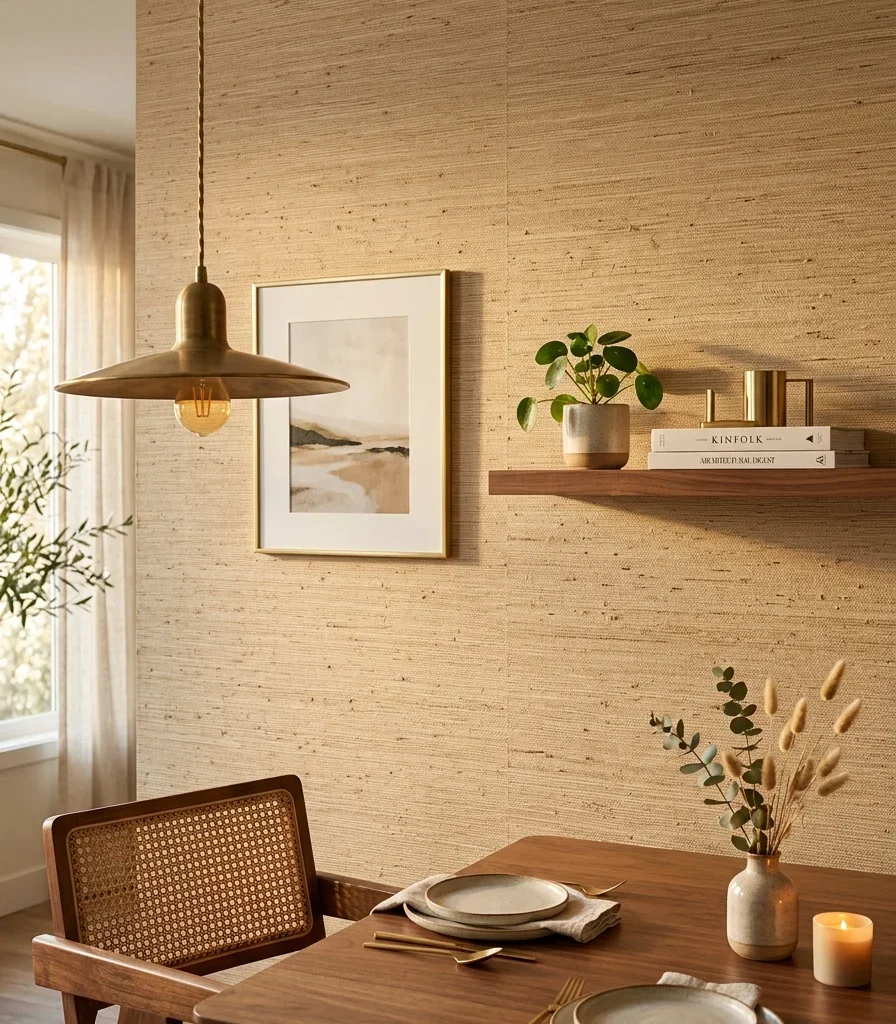
Vibe: The dining room feels tactile, with printed texture reading as genuinely woven.
Why it works: Faux grasscloth wallpaper prints a woven, fibrous texture pattern onto the vinyl or fabric-backed surface, which gives a flat wall the visual depth of real woven grasscloth without the material’s characteristic fragility or the difficulty of removing genuine grasscloth cleanly from drywall. This is a material-mimicry technique, similar in spirit to faux marble, where the printed surface does the visual work an expensive natural material would otherwise carry.
How to get it: Choose a grasscloth print with directional grain and run all panels in the same orientation, since mismatched grain direction between panels is the most common visual error with this specific pattern type.
Shop the Look
| Product |
| Faux grasscloth texture wallpaper |
| Walnut dining table |
| Brass pendant light fixture |
| Wallpaper seam roller |
| Level tool for panel alignment |
3. Metallic Accent Wallpaper to Catch Window Light
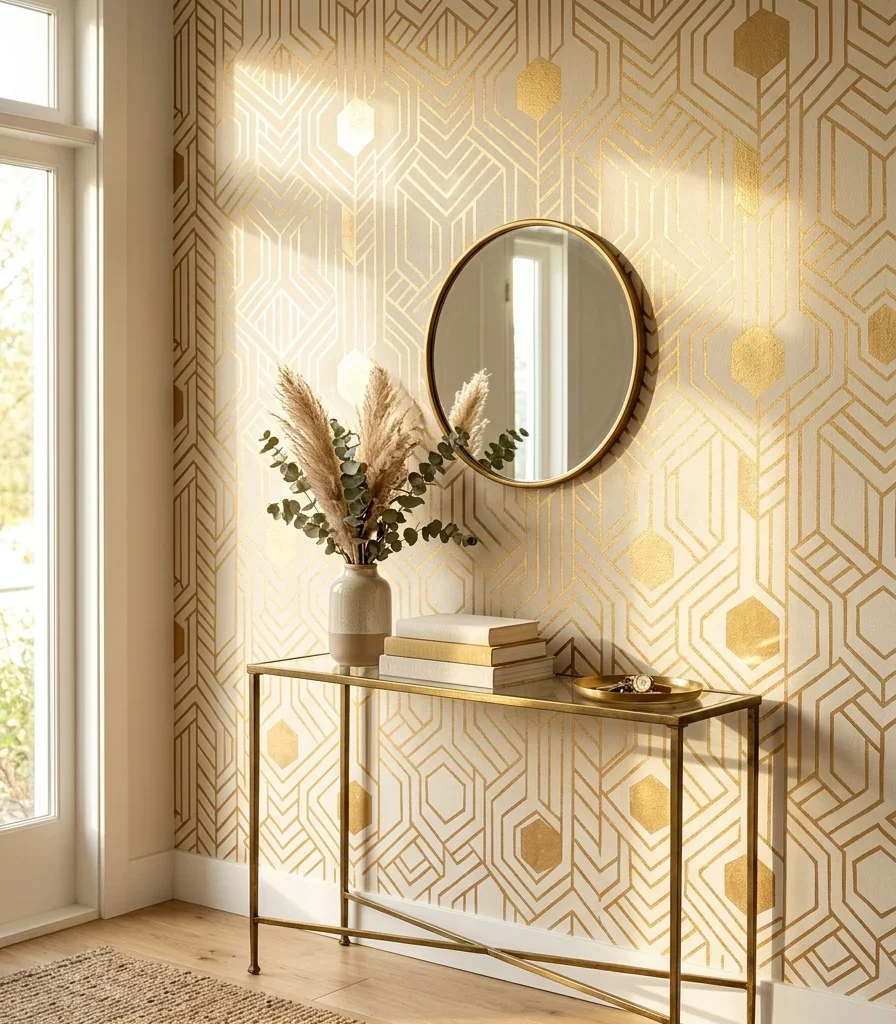
Vibe: The entryway feels luminous, pattern shifting with the light throughout the day.
Why it works: Metallic-finish wallpaper incorporates a reflective foil or ink layer into the print, which means the pattern’s appearance genuinely changes depending on the angle and intensity of nearby light, a light-behavior effect flat matte wallpaper simply can’t produce. This makes metallic wallpaper a particularly strong choice for entryways and hallways that receive direct but brief daily light, since the reflection creates movement in spaces people pass through rather than linger in.
How to get it: Position metallic wallpaper on the wall most directly hit by a window or doorway’s natural light rather than an interior wall, since the reflective effect depends entirely on having a real light source to catch.
Shop the Look
| Product |
| Metallic geometric peel-and-stick wallpaper |
| Brass console table |
| Small round wall mirror |
| Wallpaper smoothing tool |
| Craft knife for trimming |
4. Wallpapering the Back of an Open Bookshelf
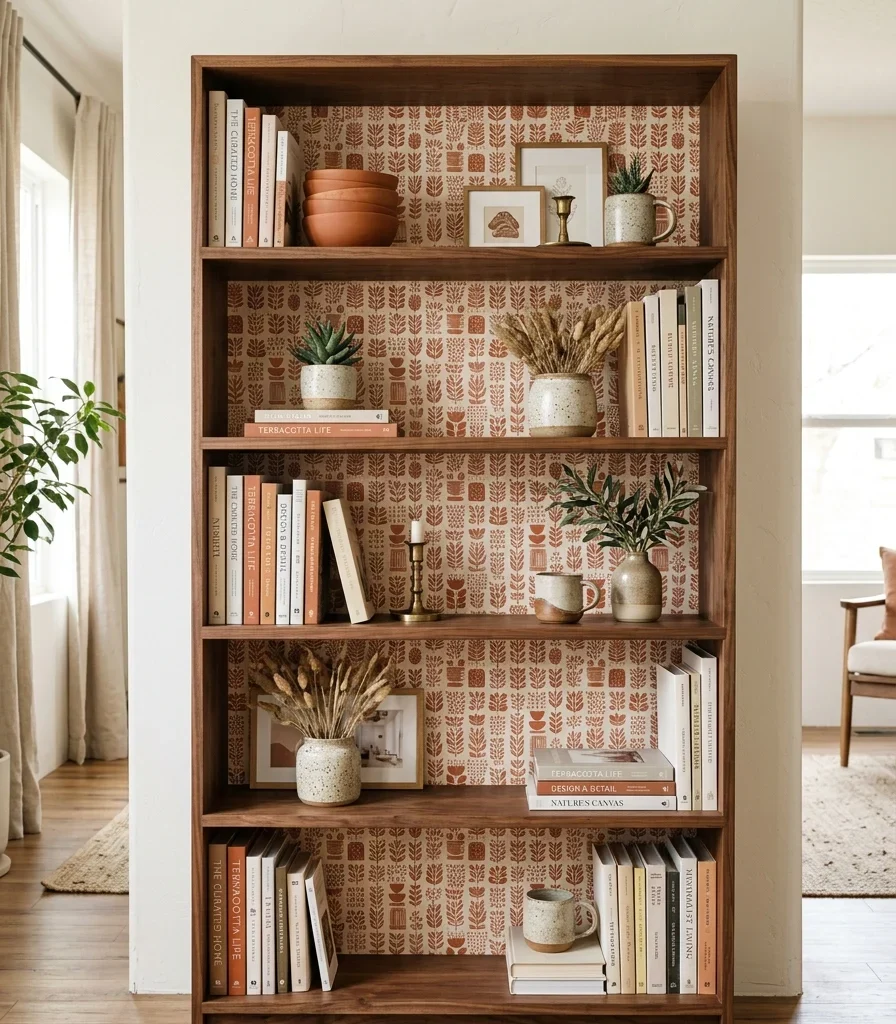
Vibe: The shelf feels curated, pattern peeking through as a considered backdrop.
Why it works: Applying wallpaper only to a bookshelf’s back panel, rather than an entire wall, delivers a contained pattern moment that reads as a deliberate styling choice rather than a full room commitment, since the surrounding shelf frame and displayed objects naturally break up the pattern into smaller, more digestible sections. This furniture-specific application also uses a fraction of a single wallpaper roll, making it one of the most material-efficient ways to try a bold print.
How to get it: Remove shelf contents and measure the back panel precisely before cutting your wallpaper piece, applying it to a clean, dust-free surface, and trimming excess with a sharp craft knife along the panel’s exact edges.
💡 Quick Win: A single wallpaper roll typically covers the back panels of two to three standard bookshelf units, making this an efficient way to use leftover wallpaper from a larger project.
Shop the Look
| Product |
| Small-scale terracotta print wallpaper |
| Open bookshelf unit, wood frame |
| Ceramic bowl set |
| Neutral hardcover book stack |
| Craft knife for precise trimming |
5. Wallpapering a Single Framed Panel Instead of a Full Wall
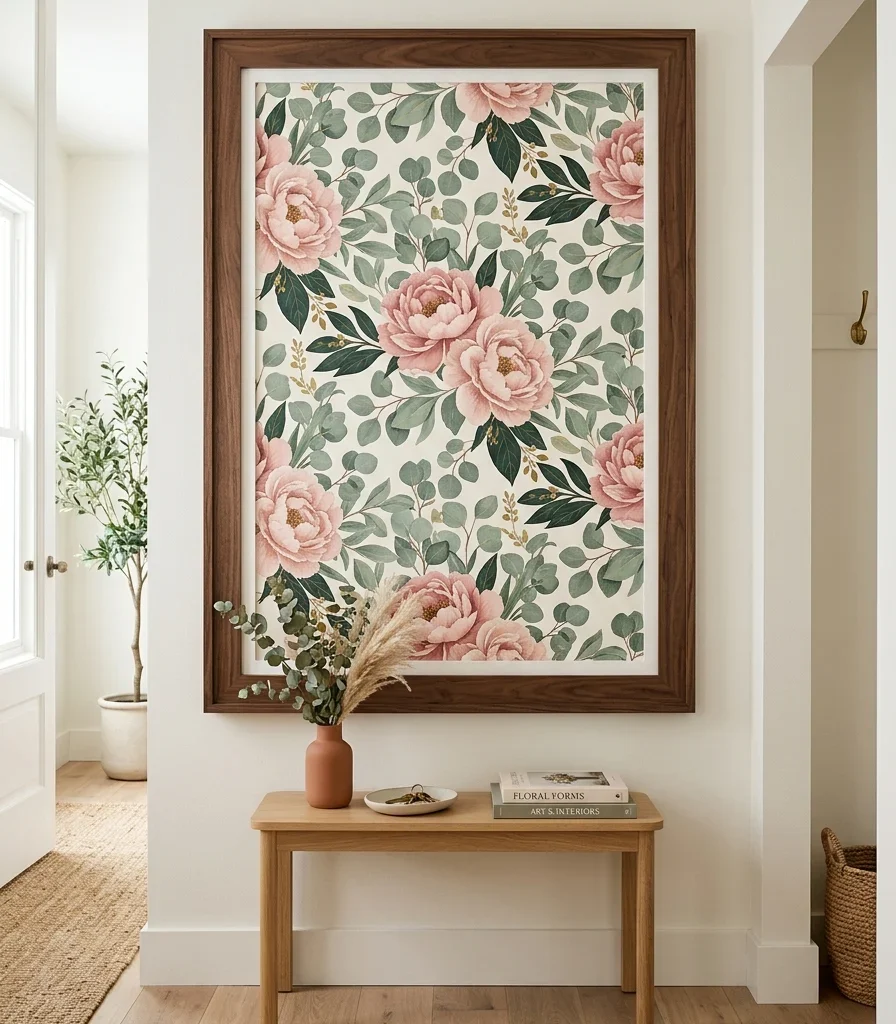
Vibe: The hallway feels artful, one contained panel doing the job a full wall would.
Why it works: Mounting a cut piece of wallpaper onto a large mat board or plywood panel and framing it turns even the boldest, most saturated pattern into functional wall art rather than a permanent wall treatment, which is a technique specifically useful for renters who want maximum pattern impact with zero wall commitment at all. This approach also lets you use a genuinely expensive or striking wallpaper pattern in a small quantity rather than needing enough rolls to cover a full wall.
How to get it: Apply a single wallpaper sheet to a rigid mat board or plywood panel cut to your frame’s exact interior dimensions, smoothing carefully from the center outward before inserting it into the frame.
Shop the Look
| Product |
| Bold floral peel-and-stick wallpaper |
| Large picture frame, statement size |
| Rigid mat board or plywood panel |
| Small console table |
| Command picture hanging strips |
6. A Bold Terracotta Geometric Pattern for a Powder Room
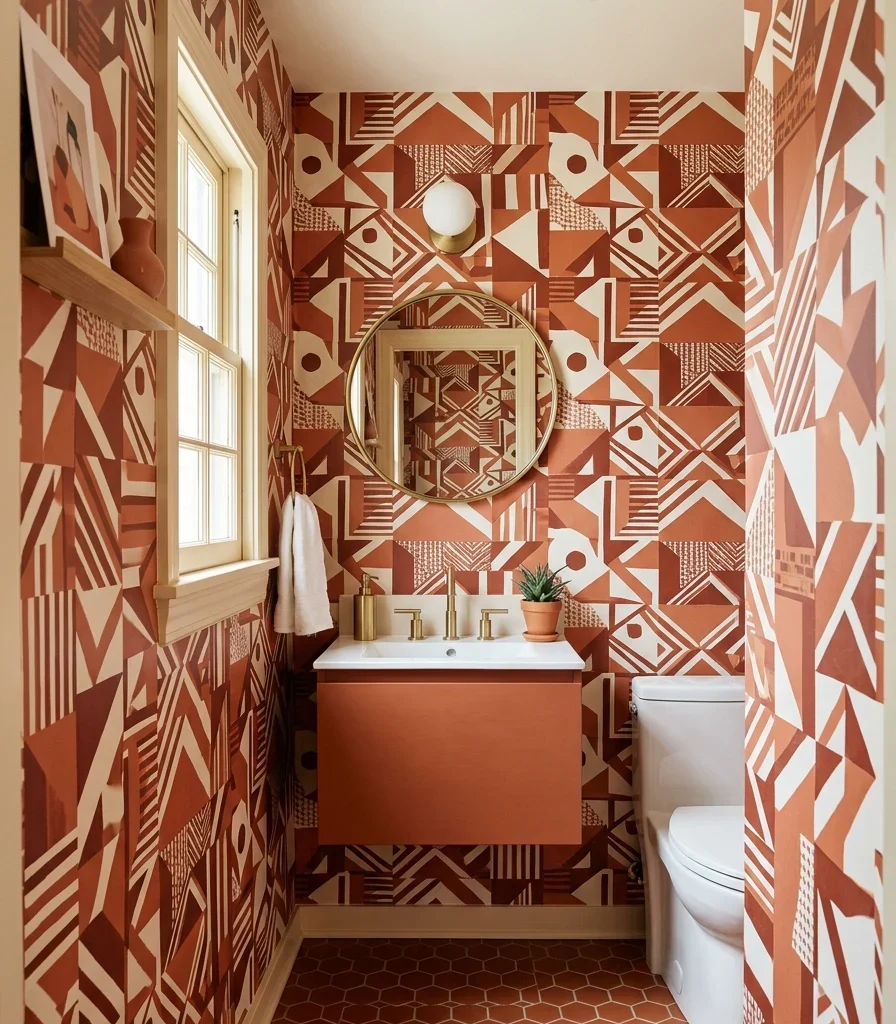
Vibe: The powder room feels confident, bold pattern with nowhere to hide and no reason to.
Why it works: Powder rooms are small enough that a bold, saturated pattern covering every wall reads as intentional and immersive rather than overwhelming, which is precisely why interior designers reach for their most confident wallpaper choices in exactly this room. The contained square footage means the pattern investment stays low even when the visual impact is high. This is the small-room version of the “go bold where it’s contained” principle that governs strong wallpaper choices generally.
How to get it: Measure your powder room’s full wall perimeter carefully before ordering, since most powder rooms need only one to two rolls total, and choose a pattern with a directional element that you center on the room’s main sightline from the doorway.
Shop the Look
| Product |
| Bold terracotta geometric wallpaper |
| Brushed brass bathroom fixture set |
| Small round wall mirror |
| Wallpaper smoothing tool |
| Wallpaper seam roller |
7. Faux Marble Wallpaper for a Convincing Stone Look
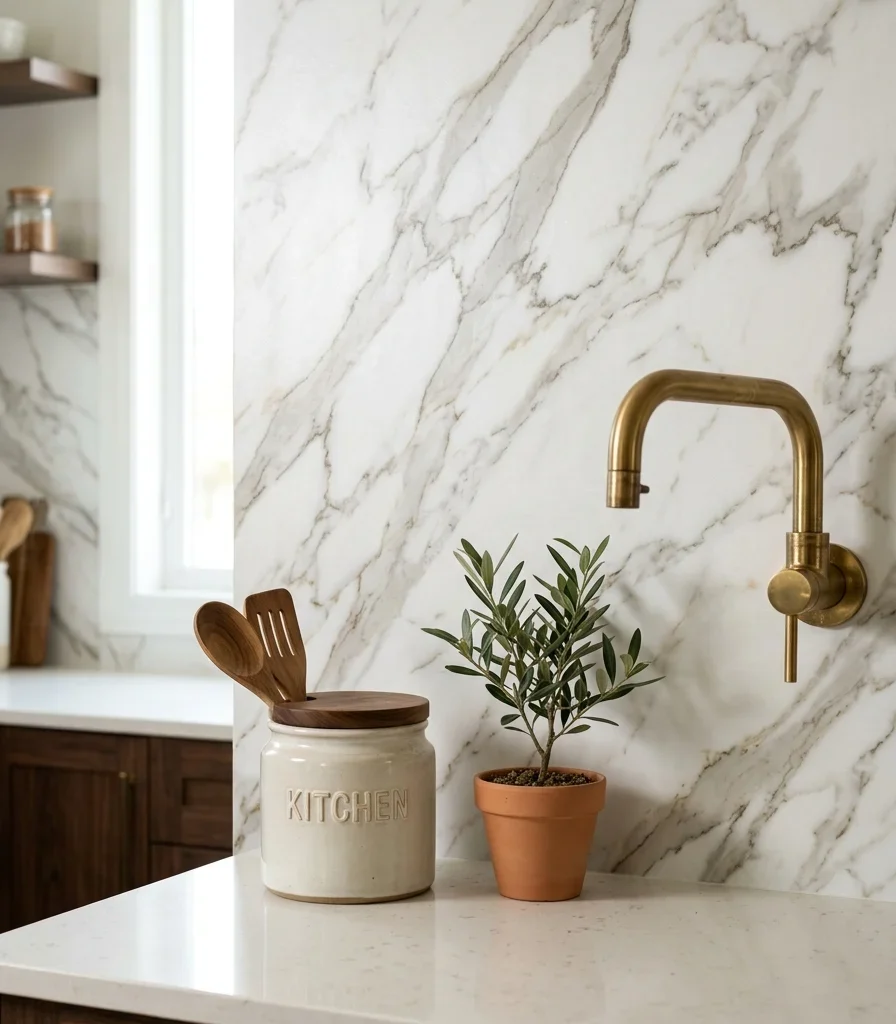
Vibe: The kitchen feels upgraded, printed stone reading as convincingly real from across the room.
Why it works: High-quality faux marble wallpaper prints realistic veining at a scale and resolution that reads convincingly from normal viewing distance, functioning as one of the most effective material-mimicry applications in the entire Peel-and-stick category, since genuine marble is one of the most expensive materials it’s designed to replace. The satin, non-glossy finish most faux marble wallpaper uses is what keeps it from reading as an obvious print up close.
How to get it: Choose a faux marble wallpaper with vertically running veins for backsplash applications, matching the vein direction as closely as possible at each panel seam so the pattern reads as one continuous slab rather than repeated tiles.
Shop the Look
| Product |
| Faux marble peel-and-stick wallpaper |
| Wallpaper smoothing tool |
| Craft knife for trimming |
| Ceramic kitchen canister set |
| Small potted herb plant |
8. Using Wallpaper to Define a Reading Nook Within an Open Room
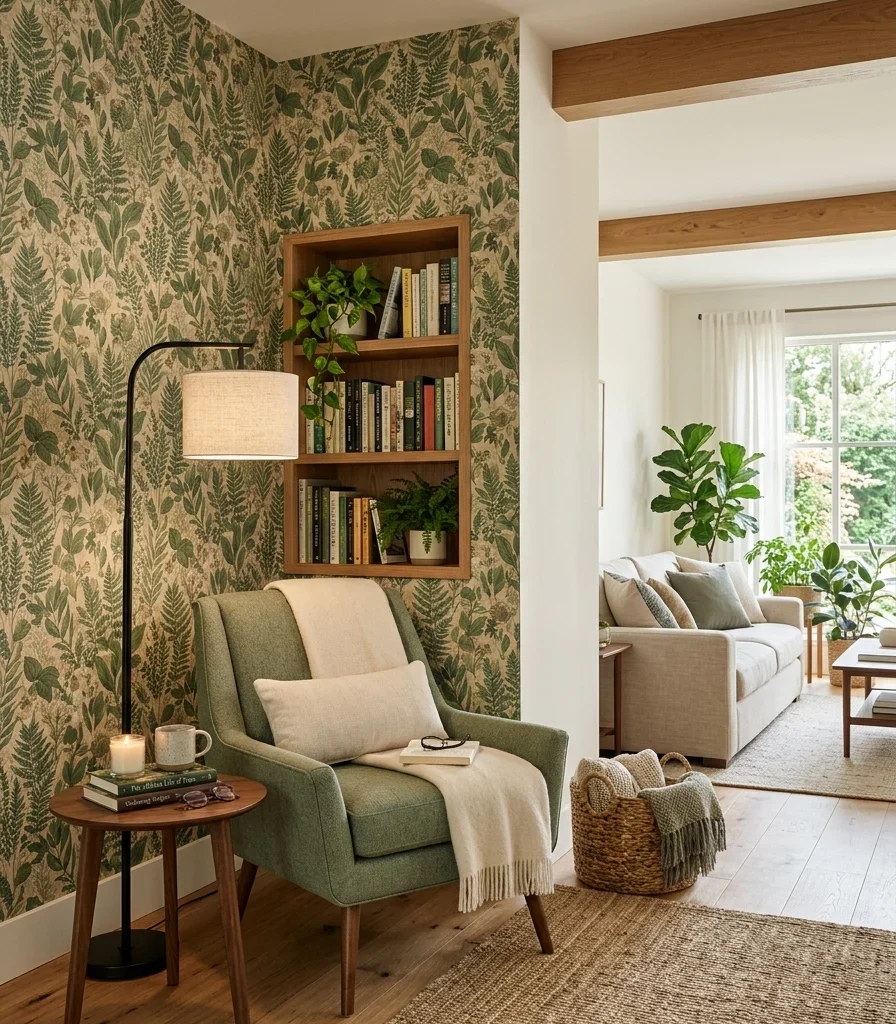
Vibe: The nook feels defined, pattern doing the zoning work walls alone can’t.
Why it works: In an open floor plan, wallpapering just one corner or alcove creates a visual boundary that signals “this is a distinct zone,” the same way a rug or furniture grouping does elsewhere in layout design, but through wall treatment, specifically a technique especially useful in homes where architectural walls don’t naturally divide functions. This soft-zoning application works because the pattern change alone is enough for the eye to register a shift in purpose, without any physical partition required.
How to get it: Choose a corner or alcove with at least two adjoining walls to wallpaper together, since covering just one flat wall segment reads as a partial accent rather than a genuinely defined zone.
Shop the Look
| Product |
| Botanical print peel-and-stick wallpaper |
| Accent reading chair |
| Floor lamp, adjustable arm |
| Small side table |
| Neutral throw blanket |
9. Wallpapering a Ceiling in a Small Powder Room
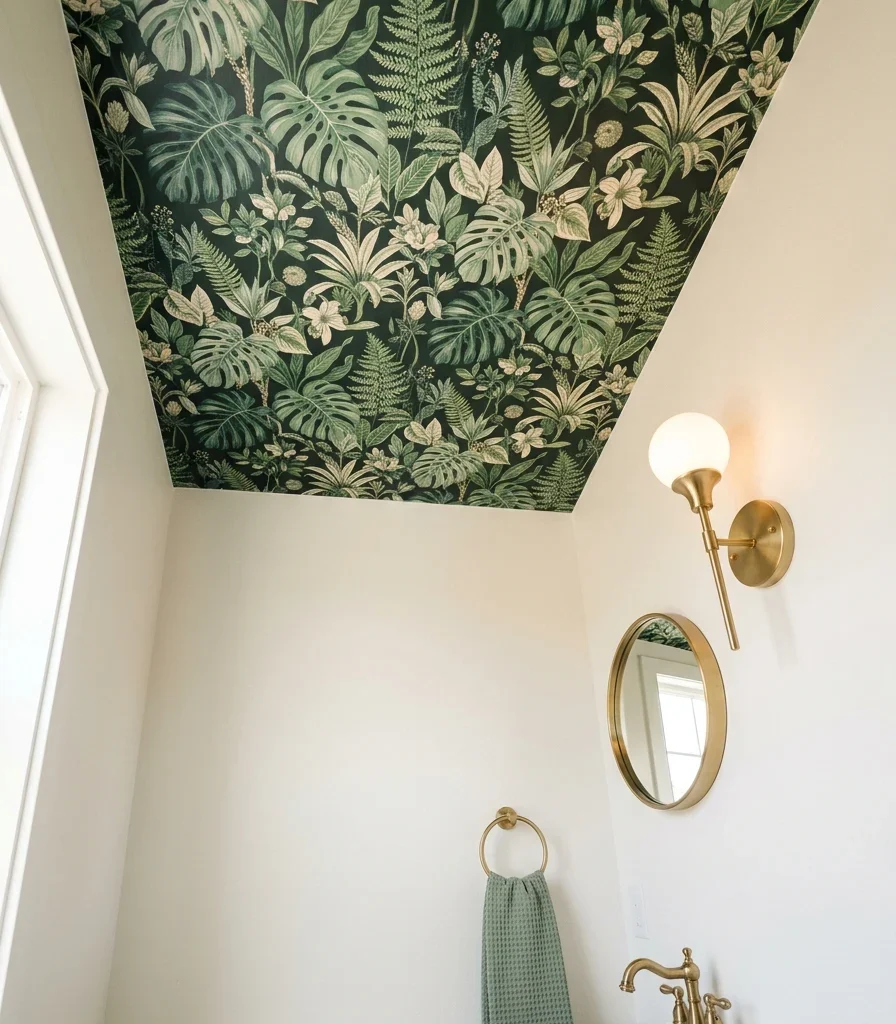
Vibe: The powder room feels playful, pattern arriving from a direction most rooms ignore.
Why it works: A ceiling sometimes called the “fifth wall” in design is almost universally left plain white, which means wallpapering it delivers outsized visual surprise precisely because it’s an underused surface rather than a competitive one; in a small powder room specifically, the contained ceiling area makes this typically the most technically manageable room to attempt an overhead application in. This works particularly well left as the sole patterned surface, with walls staying plain to let the ceiling read as the room’s clear focal point.
How to get it: Apply ceiling wallpaper with a helper if possible, since working overhead alone makes smoothing large panels significantly harder, and start from the center of the ceiling, working outward in both directions for the most even seam alignment.
💡 Quick Win: A powder room ceiling typically needs less than one full roll, making this one of the lowest-material-cost ways to try a dramatic overhead pattern.
Shop the Look
| Product |
| Bold botanical print wallpaper |
| Wallpaper smoothing tool, extended handle |
| Brass wall sconce |
| Small round wall mirror |
| Wallpaper seam roller |
10. Wallpapering a Headboard Wall Behind a Low Platform Bed
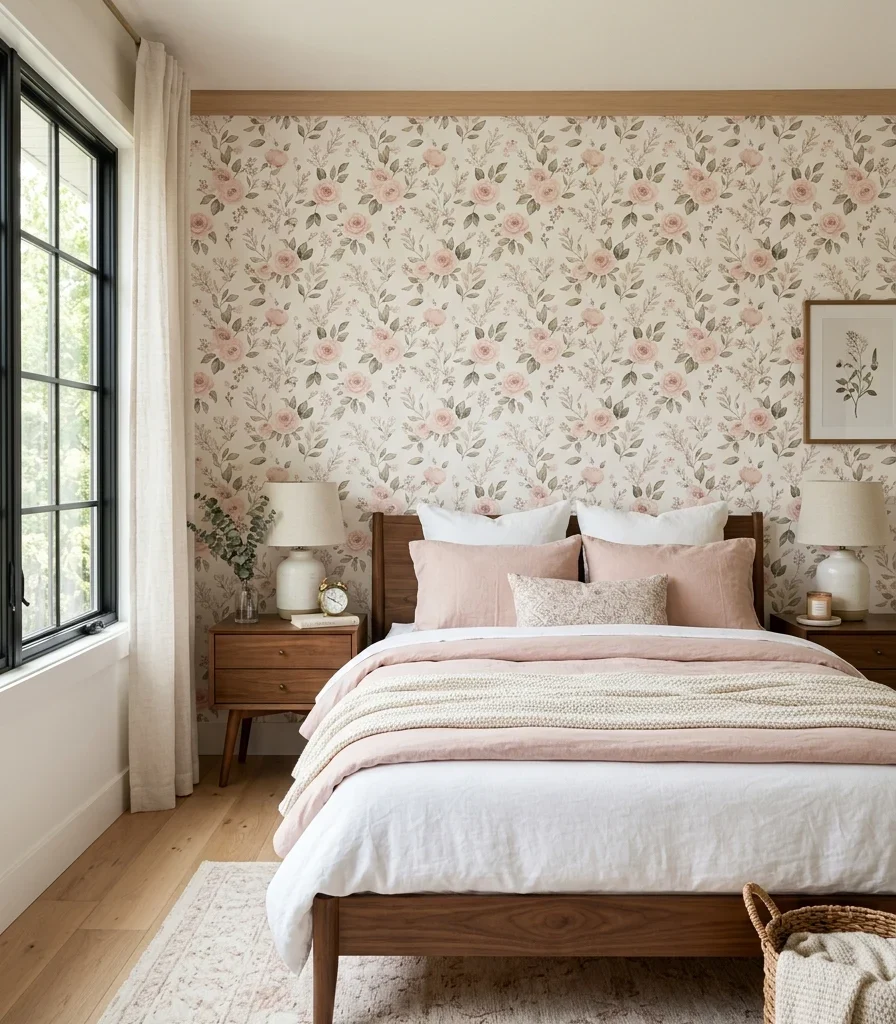
Vibe: The bedroom feels restful, with a pattern standing in for an actual upholstered headboard.
Why it works: Wallpapering just the wall behind a bed functions as a visual headboard substitute, giving the sleeping area a defined focal point without the cost of an actual upholstered headboard piece. Since a low platform bed frame typically has minimal visual presence on its own, the wallpaper does the work of anchoring that end of the room. This is furniture-adjacent styling: the treatment directly supports and completes a specific piece rather than existing as a general room backdrop.
How to get it: Size your wallpaper coverage to extend at least 12–18 inches beyond the bed’s width on each side, so the pattern reads as a considered headboard-shaped zone rather than an arbitrarily wallpapered wall segment.
Shop the Look
| Product |
| Blush floral peel-and-stick wallpaper |
| Low platform bed frame |
| Walnut nightstand pair |
| Ceramic table lamp pair |
| Neutral bedding set |
11. A Dark Wallpaper Behind a Picture-Lit Gallery Wall
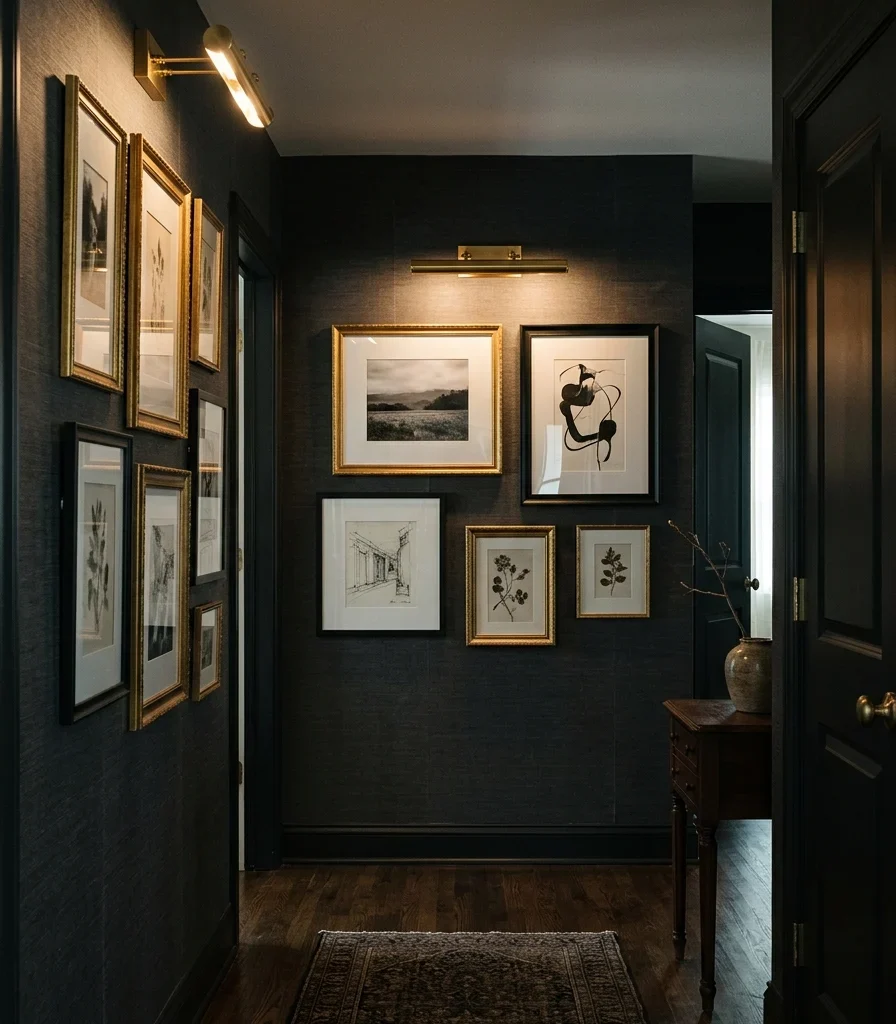
Vibe: The hallway feels gallery-like, with a dark backdrop making every lit frame glow.
Why it works: A deep, dark wallpaper behind framed art functions the way museum gallery walls use dark paint. The contrast between the dark backdrop and the illuminated frame makes the art itself the brightest, most attention-grabbing element in the space, an emphasis technique that a light or white wall backdrop can’t achieve nearly as effectively. This pairing specifically requires picture lighting to work, since a dark wallpaper wall under only ambient light can read as simply dim rather than intentionally dramatic.
How to get it: Choose a wallpaper in the darkest 20% of your intended color range, and add at least one dedicated picture light per major frame, since the contrast between dark wall and lit art is what carries this entire effect.
Shop the Look
| Product |
| Deep charcoal textured wallpaper |
| Brass picture light, plug-in |
| Gilt frame set, varied sizes |
| Black frame set |
| Warm white LED bulb, dimmable |
12. Textured Linen-Look Wallpaper for Subtle Depth
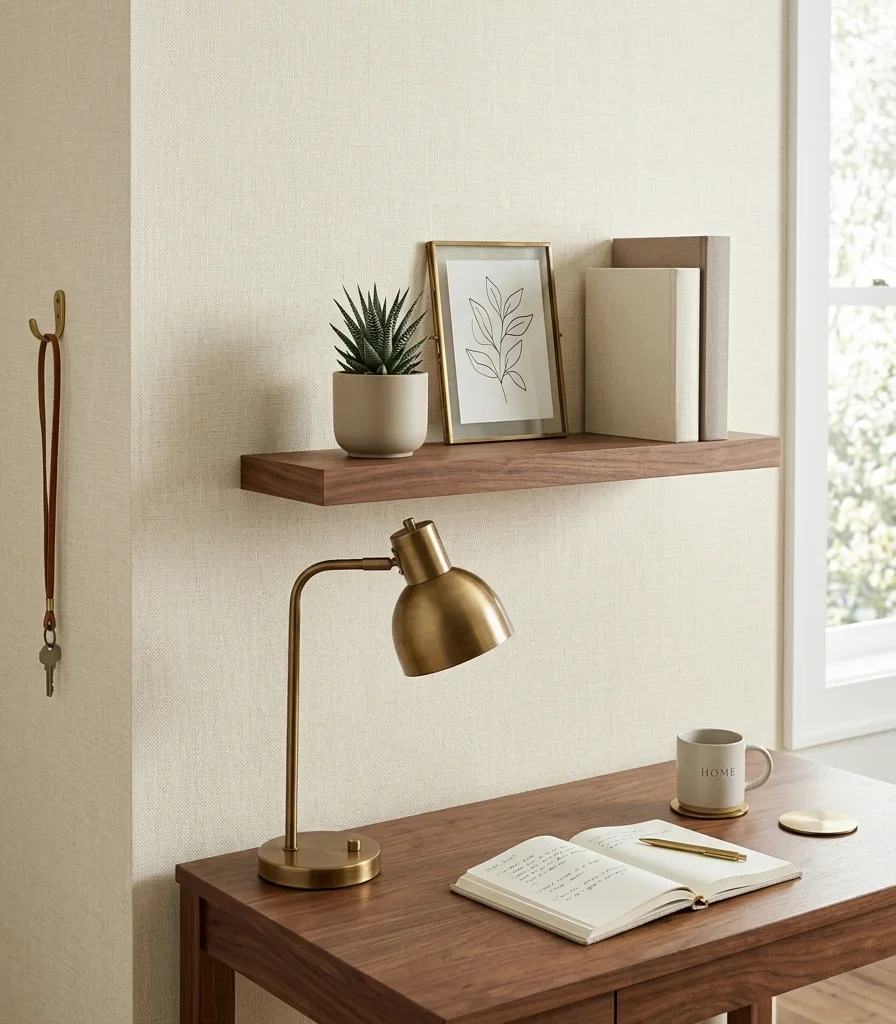
Vibe: The office feels refined, with a texture of quiet work without any bold color.
Why it works: Linen-look wallpaper prints a subtle woven texture rather than a distinct pattern, which delivers depth and visual interest without committing to strong color or shape, a strategy particularly useful in workspaces where a busier pattern might become visually tiring over long periods of daily use. This is the wallpaper equivalent of tonal layering, since the texture reads as variation within one narrow color family rather than genuine contrast.
How to get it: Choose a linen-look wallpaper in a warm cream or oatmeal tone close to your existing wall color for the most subtle transition, since this pattern type is meant to be felt more than seen from across the room.
Shop the Look
| Product |
| Linen-look textured wallpaper, cream |
| Walnut writing desk |
| Small floating shelf |
| Brass desk lamp |
| Desk organizer tray |
13. Wallpapering a Console Table’s Back Panel
Vibe: The console feels unexpected, a pattern showing up somewhere most people never think to look.
Why it works: Applying wallpaper to a piece of furniture’s back panel, a console table, or an open cabinet’s interior, rather than a wall, extends the material into furniture styling, which is a technique that reads as genuinely surprising precisely because pattern in this location is so rarely used. This furniture-specific application uses a small enough wallpaper quantity that it’s an ideal way to sample a bold print you’re not yet ready to commit to on an actual wall.
How to get it: Remove any glass or hardware from the panel before applying wallpaper, and use a smaller cutting mat to trim precisely around any structural cutouts in the console’s back panel.
Shop the Look
| Product |
| Small-scale terracotta print wallpaper |
| Open-back console table |
| Ceramic decorative vase |
| Small decorative tray |
| Craft knife for precise trimming |
14. A Soft Blush Pink Floral for a Nursery Accent Wall
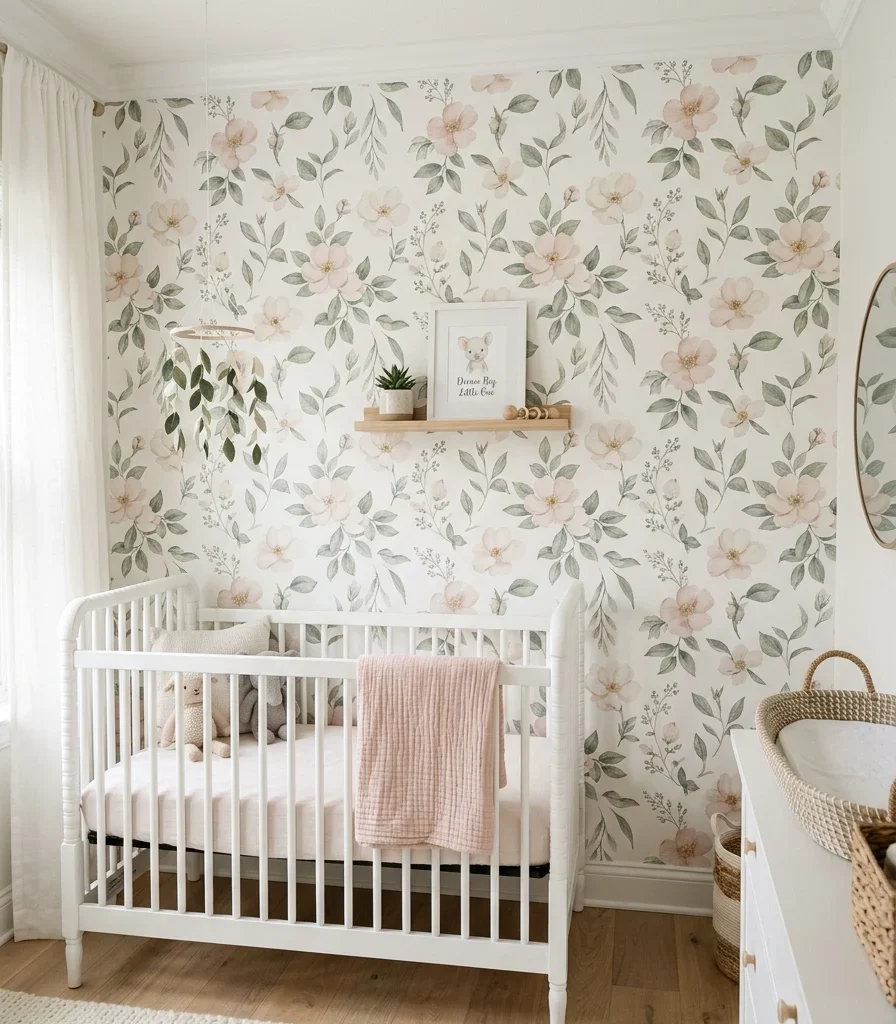
Vibe: The nursery feels gentle, with a muted floral pattern setting a genuinely calm tone.
Why it works: Peel-and-stick wallpaper is specifically well-suited to nurseries because the room’s decor typically needs to change within a few years as a child grows, and the removable format lets that transition happen without repainting or wall repair. Choosing a muted, lower-saturation blush rather than a bright pink keeps the pattern from feeling overly juvenile, extending the wallpaper’s usable lifespan as the room’s purpose eventually shifts.
How to get it: Verify your chosen wallpaper is labeled low-VOC or formaldehyde-free specifically for nursery use, since indoor air quality matters more in a room where an infant spends significant time.
💡 Quick Win: Applying wallpaper to just the wall behind the crib, rather than the full room, achieves the same design impact with a fraction of the material and installation time.
Shop the Look
| Product |
| Blush floral peel-and-stick wallpaper, low-VOC |
| White crib frame |
| Small floating shelf |
| Sage green ceramic decor object |
| Neutral crib bedding set |
15. Wallpapering Inside Glass-Front Cabinet Doors
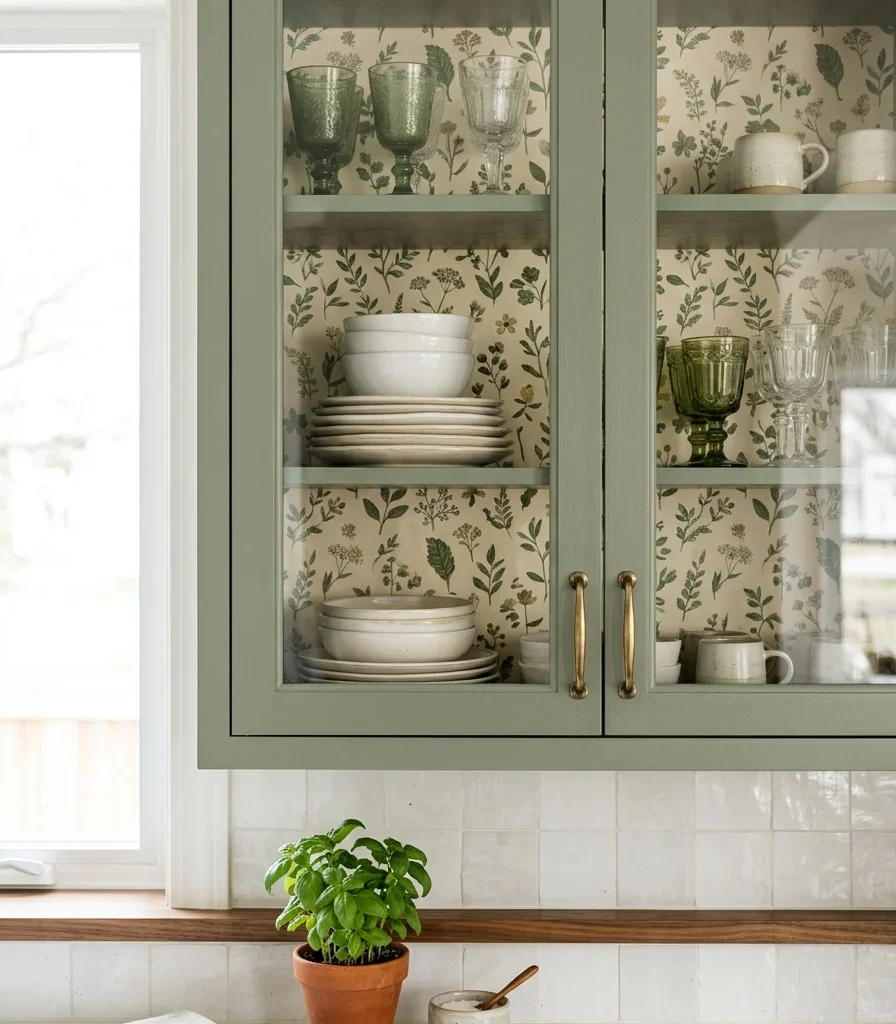
Vibe: The cabinet feels layered, pattern glimpsed through glass rather than displayed outright.
Why it works: Glass-front cabinets typically show plain wood or painted interior panels behind whatever dishware is displayed, which is genuinely underused real estate for pattern wallpapering. Just adding a layer of visual interest that’s only partially visible at any given time, creating the same kind of considered detail as a lined jacket that reveals its pattern only when moved. This is one of the smallest-footprint peel-and-stick applications on this list, often using only a single sheet.
How to get it: Remove cabinet shelves and hardware before measuring and cutting your wallpaper piece to the interior back panel’s exact dimensions, applying it before reinstalling shelving and dishware.
Shop the Look
| Product |
| Small botanical print wallpaper |
| Ceramic dishware set |
| Glassware set, clear |
| Craft knife for precise trimming |
| Wallpaper smoothing tool |
16. Pearlescent Wallpaper for a Candlelit Dining Nook
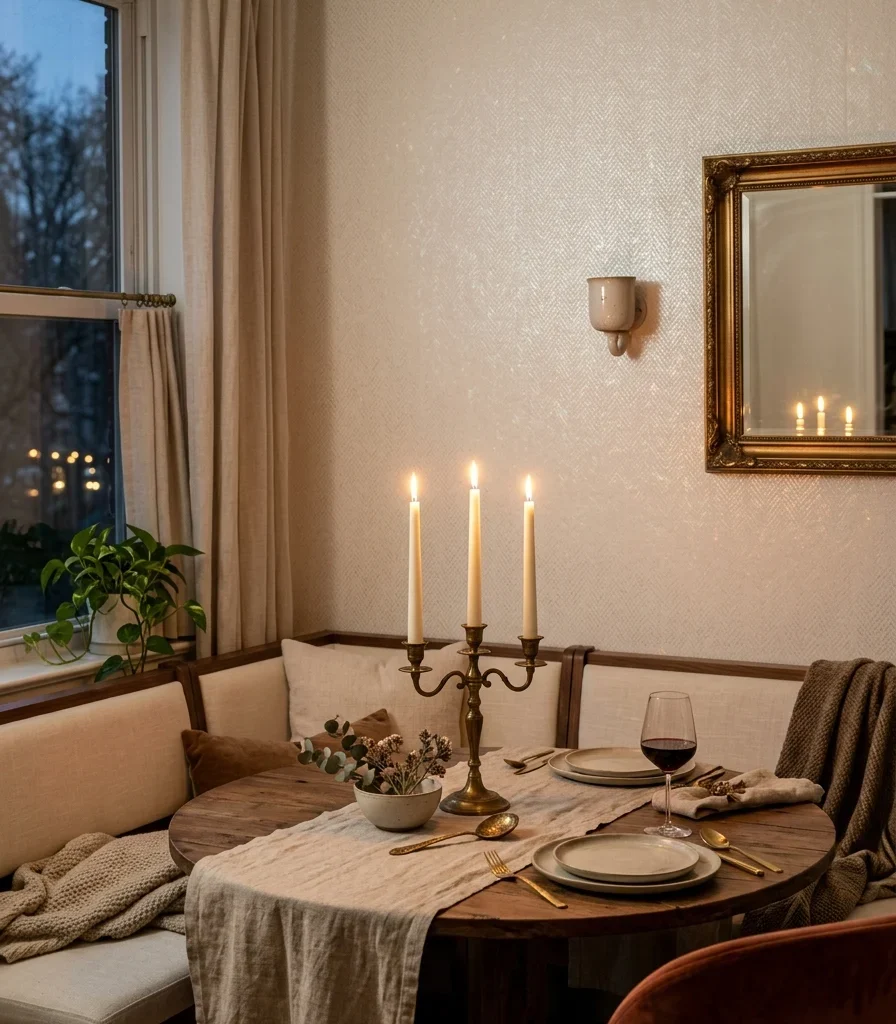
Vibe: The nook feels romantic, shimmer catching every flicker of candlelight.
Why it works: Pearlescent-finish wallpaper incorporates a subtle iridescent coating that shifts tone gently depending on viewing angle and light source, an effect that becomes especially noticeable under moving light like candle flame rather than the constant, even glow of overhead electric light. This makes it a specifically strong choice for small evening dining spaces, where the wallpaper’s shimmer becomes part of the room’s ambiance rather than a static background color.
How to get it: Reserve pearlescent wallpaper for rooms primarily used in evening light, since the shimmer effect is most noticeable under warm, low-level lighting and can read as flatter under bright, even daylight.
Shop the Look
| Product |
| Pearlescent shimmer wallpaper |
| Brass taper candlestick pair |
| Linen table runner, neutral |
| Small dining table |
| Warm white dimmable pendant light |
17. A Deep Charcoal Abstract Print for a Moody Study
Vibe: The study feels grounded, deep tones settling the room into focus.
Why it works: A dark, saturated wallpaper in a study or home office works against the common instinct to keep workspaces bright and neutral, since a moodier backdrop can actually support concentration by reducing visual distraction from an otherwise busy or high-contrast wall. The abstract pattern’s tonal consistency (variations of charcoal and black rather than competing colors) keeps the wall visually calm despite its darkness. This is a specifically deliberate departure from the brighter, more common wallpaper applications elsewhere on this list.
How to get it: Balance a dark abstract wallpaper wall with warm brass lighting and lighter wood furniture in the same room, since an entirely dark room with dark furniture too can tip from moody into genuinely cave-like.
Shop the Look
| Product |
| Charcoal abstract print wallpaper |
| Leather accent armchair |
| Brass adjustable desk lamp |
| Walnut writing desk |
| Warm white dimmable bulb |
18. Wallpapering Only the Upper Half Above a Chair Rail Line
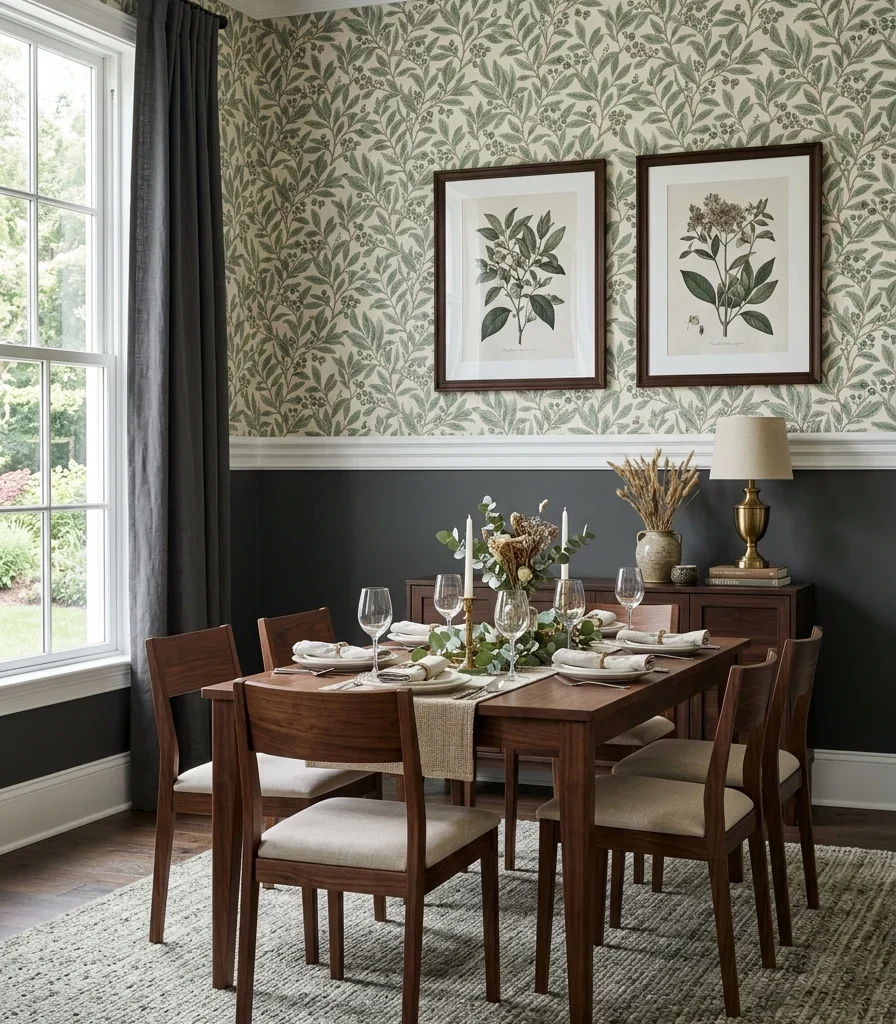
Vibe: The dining room feels formal, pattern and solid colors trading off on the walls evenly.
Why it works: Applying wallpaper only above an existing or painted chair rail line references traditional wainscoting and two-tone wall treatments, using pattern for the upper zone while a solid, more durable painted finish protects the lower half from the scuffs and chair contact that a full wallpaper treatment would show wear from first. This split application also uses roughly half the wallpaper quantity a full wall would require, making a bolder, more expensive pattern choice financially reasonable.
How to get it: Measure and mark your chair rail line at a consistent 32–36 inches from the floor using a laser level, applying wallpaper cleanly to that boundary, and finishing the edge with thin trim molding for a crisp transition.
Shop the Look
| Product |
| Sage green pattern peel-and-stick wallpaper |
| Charcoal interior paint, lower wall |
| Thin trim molding, chair rail height |
| Laser level tool |
| Walnut dining chair set |
19. Faux Zellige Tile Wallpaper for a Kitchen Backsplash
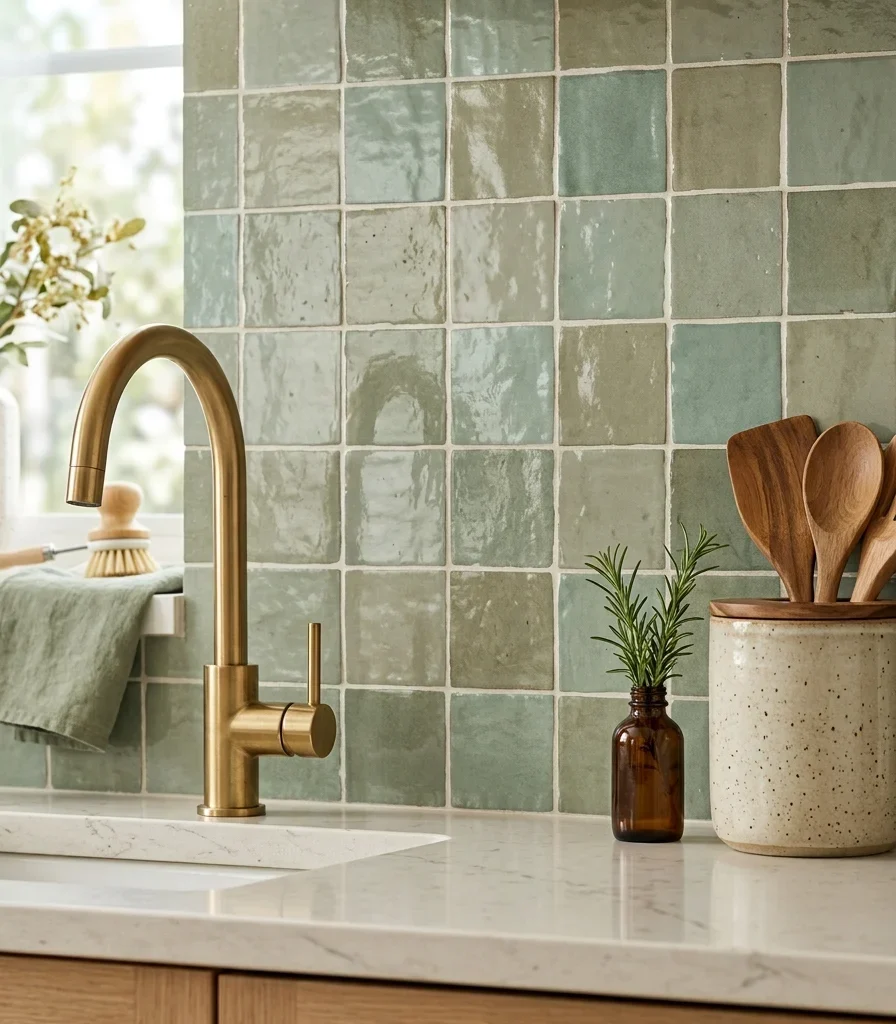
Vibe: The kitchen feels upgraded, with printed tile carrying the same handmade irregularity as the real material.
Why it works: Faux zellige wallpaper prints the deliberate glaze variation and slight color irregularity that makes genuine handmade zellige tile so visually prized, replicating that specific imperfect quality at a fraction of the real tile’s material and installation cost. This is the same material-mimicry principle behind faux marble wallpaper, applied to a material whose entire visual appeal comes from irregularity rather than uniformity, which is why the printed version can read as remarkably convincing.
How to get it: Choose a faux zellige print with visible individual tile variation printed in, rather than a perfectly uniform tile pattern, and apply it behind the stove and sink areas where real tile traditionally goes, protecting the wallpaper surface with a clear protective laminate if it will face direct grease or splash exposure.
Shop the Look
| Product |
| Faux zellige tile Peel-and-stick wallpaper |
| Clear protective laminate sheet |
| Brushed brass kitchen fixture set |
| Ceramic kitchen canister set |
| Wallpaper smoothing tool |
20. Wallpapering Inside a Small Closet for Hidden Color
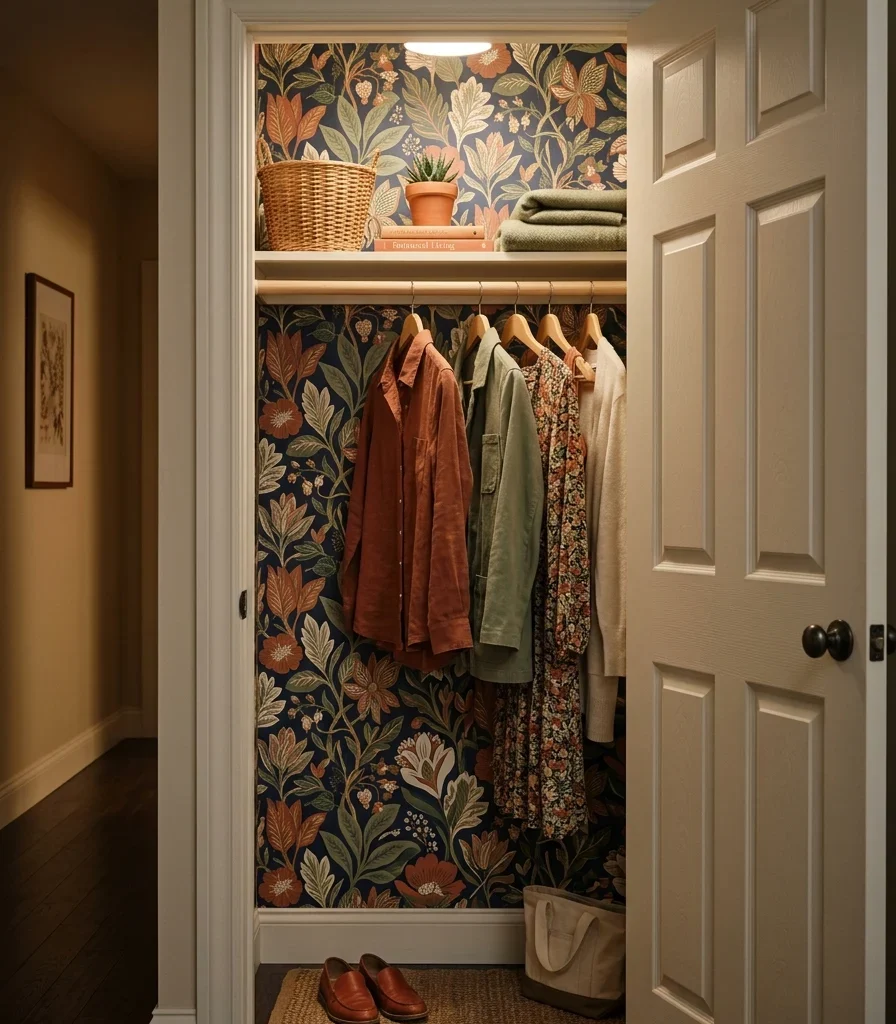
Vibe: The closet feels surprising, a bold pattern hiding just behind a closed door.
Why it works: A closet’s small, enclosed footprint is one of the lowest-risk places to try the boldest pattern in a wallpaper collection, since the treatment stays hidden behind a closed door most of the time and only reveals itself when opened. This is the small-space version of the “go bold where it’s contained” principle applied at its smallest possible scale. It also uses very little material, since most closets need well under a single roll to fully cover.
How to get it: Measure your closet’s interior walls precisely, focusing pattern coverage on the back wall specifically, since side walls are often obscured by hanging clothes and don’t need full coverage to achieve the surprise effect.
💡 Quick Win: A single leftover half-roll from another room’s project is usually more than enough to fully wallpaper one small closet interior.
Shop the Look
| Product |
| Bold botanical print Peel-and-stick wallpaper |
| Small closet shelf, wood |
| Closet rod and bracket set |
| Craft knife for precise trimming |
| Wallpaper smoothing tool |
How to Start Your Peel-and-Stick Wallpaper Project
Your single first move should be a small, contained space, a closet interior, a bookshelf back panel, or a powder room, rather than a full living room wall, because starting small lets you learn the smoothing and seam-alignment technique on a low-stakes surface before committing to a room everyone sees daily.
The most common mistake is applying wallpaper to a freshly painted wall, since paint typically needs a full 30 days to cure before Peel-and-stick adhesive will bond properly, and applying too soon often results in bubbling or premature peeling within weeks. Fix it by waiting out the full cure time on any recently painted surface before starting your wallpaper project, even when the paint feels dry to the touch.
Three specific items under $50 that create immediate impact: a small roll of Peel-and-stick wallpaper sized for a bookshelf back panel or closet interior, a plastic smoothing tool to prevent trapped air bubbles, and a sharp craft knife for clean, precise trim cuts along edges and outlets.
A single small application, a closet, a shelf back, a framed panel typically takes under an hour and costs $15–$40. A full accent wall generally takes one afternoon and runs $40–$100 depending on wall size and pattern choice, while a full room, like a powder room wrapped on all sides, usually takes a full weekend and costs $80–$200 including material overage for pattern matching.
Frequently Asked Questions About Peel-and-Stick Wallpaper
What is the difference between Peel-and-stick wallpaper and traditional wallpaper?
Peel-and-stick wallpaper uses a pre-applied, low-tack adhesive backing that sticks directly to a clean wall without paste or water activation, and removes cleanly without steaming or chemical stripping, while traditional wallpaper requires wheat paste or wallpaper adhesive applied during installation and typically needs steam or a chemical stripping solution to remove later. This is why Peel-and-stick has become the default choice for renters and anyone wanting a fully reversible wall treatment, while traditional wallpaper remains more common in permanent, owned-home installations meant to last many years.
What colors and patterns work best for Peel-and-stick wallpaper?
Botanical prints in sage green and terracotta remain the most consistently popular starting patterns, since their organic, repeated motifs read as calming rather than busy even at full-wall scale. Faux material finishes, such as marble, grasscloth, and zellige tile, are the fastest-growing category, since they deliver the visual richness of expensive natural materials at a fraction of the cost and installation complexity, particularly popular for kitchen backsplashes and bathroom accent walls.
How much does a Peel-and-stick wallpaper project typically cost?
A single small application, like a closet interior or bookshelf back panel, typically costs $15–$40 in material. A full accent wall in an average bedroom or living room generally runs $40–$100, depending on wall size and pattern price point, while wrapping a full small room like a powder room usually costs $80–$200, including extra material for pattern matching at seams, substantially less than professional traditional wallpaper installation, which often runs several hundred dollars per room in labor alone.
Does Peel-and-stick wallpaper work on textured or uneven walls?
It works best on smooth, primed, or painted drywall, and non-woven fabric-backed versions specifically handle mild texture better than thinner vinyl film types, though heavily textured surfaces like popcorn ceilings or deeply textured plaster generally aren’t good candidates regardless of wallpaper type. For textured walls, a thin skim coat of joint compound to smooth the surface first, allowed to fully cure, significantly improves the adhesion and finished appearance.
What is the most searched Peel-and-stick wallpaper application right now?
Kitchen backsplashes using faux tile and marble finishes have seen the fastest search growth, driven largely by renters wanting a real tile look without a landlord’s permission for actual tile installation. Powder room and small bathroom applications remain the most consistently searched category overall, since the contained square footage lets people commit to genuinely bold, high-saturation patterns with comparatively low material cost and risk.
Ready to Try Peel-and-Stick Wallpaper?
These 20 Peel-and-stick wallpaper ideas span color, material, lighting, furniture, and layout from a full powder room wrap and a faux marble backsplash to a single wallpapered bookshelf back and a hidden pattern inside a closet door, so there’s a genuinely low-risk starting point here, whichever room in your home has been waiting for some real personality. You don’t need to wallpaper your whole home at once, and starting with one small, contained surface is not a lesser version of the transformation; it’s the smartest way to learn the technique before trusting it with a wall everyone actually sees. Today’s specific action: measure your smallest closet or your bookshelf’s back panel and order just enough wallpaper for that one contained space, before committing to anything larger. Once that first small application is up and looking exactly the way you pictured it, the rest of the home’s blank walls will finally feel like an opportunity instead of something to work around. Save the patterns that caught your eye today, that faux zellige backsplash, that shimmering dining nook wall, because with Peel-and-stick wallpaper, changing your mind later was never the risk it used to be.
You Might Also Like
- 20 Apartment Decor Ideas for When You Can’t Paint
- Eco Friendly Bamboo Home Decor: 9 Stunning Ways to Style Every Room
- 10 Stylish Shelf Decor Ideas for Every Room
- Modern Home Decor: 15 Ideas Worth Saving and Stealing
- 13 Minimalist Home Decor Ideas for a Calm, Clutter-Free Space
- 12 Small Space Decor Ideas for a Modern Minimalist Home
[…] 20 Peel-and-stick Wallpaper Ideas for Renters and Homeowners Alike […]