
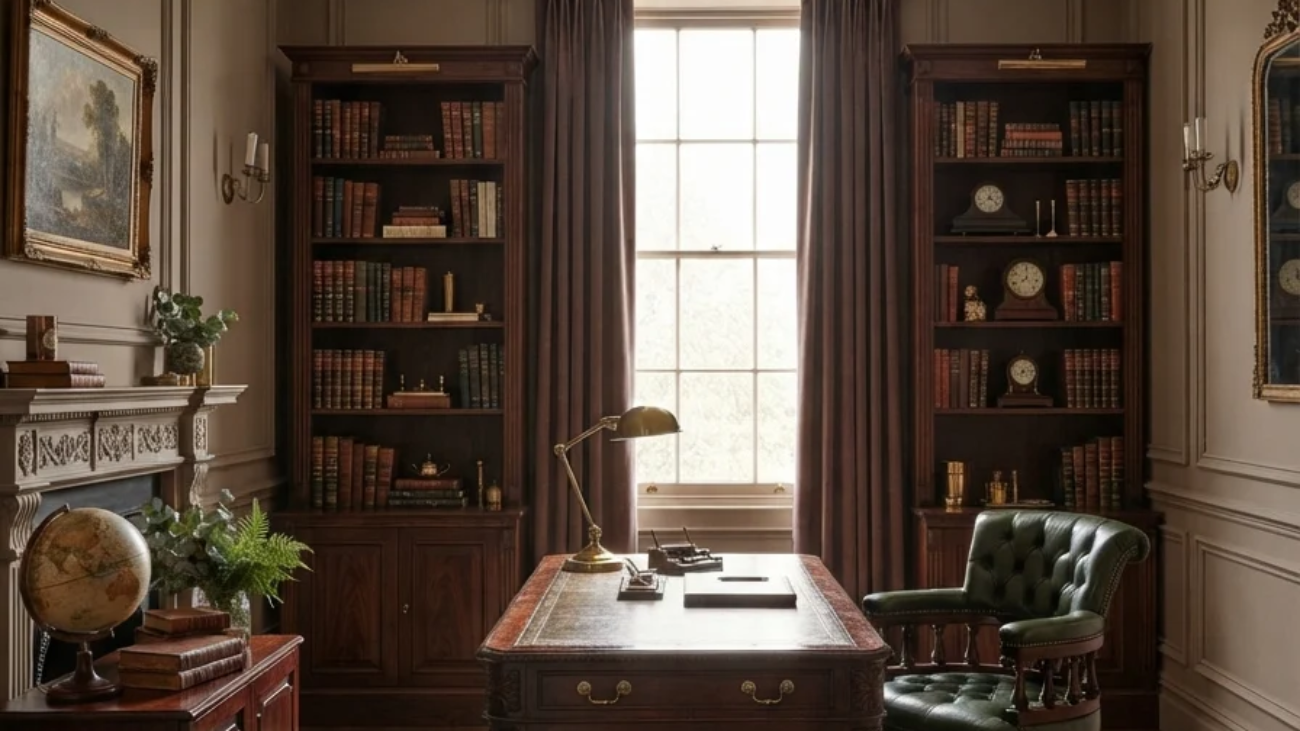
A Victorian style home office combines the richness, craftsmanship, ornament, and layered materials of 19th-century interiors with the practical needs of a modern workspace. These 12 Victorian style home office ideas show how to create that character through deep wall colors, dark wood, patterned wallpaper, antique-inspired furniture, library lighting, textiles, and carefully controlled decorative detail.
The room should feel quietly enveloping rather than visually chaotic: lamplight pools across a mahogany desk, patterned wallpaper gives the walls depth, and the faint sheen of aged brass catches your eye between shelves of books. There is a sense of permanence here, as though the office has been assembled over decades rather than purchased in one afternoon. Yet contemporary ergonomics, clean cable management, and deliberate negative space keep the Victorian influence from becoming a museum recreation. Here are 12 ideas worth saving and stealing.
Why 12 Victorian Style Home Office Ideas Work So Well
Victorian interior design refers broadly to the design culture of Britain during Queen Victoria’s reign from 1837 to 1901, but it was never one completely uniform style. Victorian homes borrowed from Gothic Revival, Renaissance Revival, Italianate, medieval, Asian, and later Aesthetic and Arts & Crafts influences. This eclecticism is important for a home office because it gives you permission to combine a carved writing desk, patterned wallpaper, a Gothic-inspired bookcase, and a restrained contemporary task chair without losing the historical character.
The strongest Victorian palette uses depth rather than flat darkness: oxblood, bottle green, forest green, tobacco brown, muted navy, plum, warm cream, and aged gold. Materials include mahogany, walnut, ebonized wood, leather, velvet, wool, damask, brass, stained glass, ceramic, and richly patterned wallpaper. William Morris and other Victorian designers helped establish the importance of botanical pattern, while Arts & Crafts designers later emphasized visible workmanship and honest materials.
The style feels especially relevant now because contemporary homeowners are spending more time designing rooms around daily rituals rather than treating every room as a neutral resale backdrop. Home offices are particularly suited to this shift: unlike a shared living room, a private workspace can carry a stronger personality. The current HomeDreamStyle approach similarly treats a home office as a functional environment first, with lighting, ergonomics, storage, and visual identity working together rather than decoration being added afterward.
Small rooms can absolutely achieve Victorian character, but restraint becomes more important as square footage decreases. Prioritize one strong wall treatment, one substantial wood piece, and one distinctive light source rather than filling every surface. A compact room can handle bottle-green paint, a narrow walnut desk, a wall-mounted bookcase, and a brass library lamp; it may not comfortably handle a massive executive desk, oversized upholstered chair, floor-to-ceiling bookcases, and multiple freestanding cabinets simultaneously.
Style at a Glance
| Element | Victorian Style Home Office |
| Philosophy | Layered character, craftsmanship, historical influence, and useful ornament |
| Key Materials | Mahogany, walnut, leather, velvet, brass, patterned wallpaper, stained glass |
| Key Colors | Bottle green, oxblood, tobacco brown, muted navy, plum, warm cream |
1. Paint the Office in Deep Bottle Green

Vibe: Grounded. The deep green makes the office feel settled, private, and intellectually serious.
Why it works: Victorian rooms often relied on strong color relationships and rich wall treatments rather than pale neutral backgrounds. Bottle green works particularly well because its cool depth balances the reddish warmth of mahogany and the yellow warmth of aged brass. The principle is color temperature contrast: the wall absorbs visual attention while the wood and metal introduce warmer notes that keep the office from feeling cold.
How to get it: Choose a matte or low-sheen bottle green with enough gray or black in the formula to avoid a good emerald effect. Paint the skirting boards and door trim a darker green-black rather than stark white so the architecture remains continuous.
💡 Quick Win: Buy a sample pot first and test it beside the desk and window. Green can shift dramatically between daylight and warm evening bulbs, so judge it at both times before committing.
Shop The Look
| Product | Search on Amazon |
| Deep bottle green wall paint | Deep bottle green matte interior paint |
| Mahogany writing desk | Traditional mahogany writing desk home office |
| Aged brass desk lamp | Antique brass banker desk lamp |
| Leather-bound vintage books | Decorative vintage leather-bound books |
| Botanical framed wall art | Victorian botanical framed prints set |
2. Build the Desk Around Dark Walnut and Leather
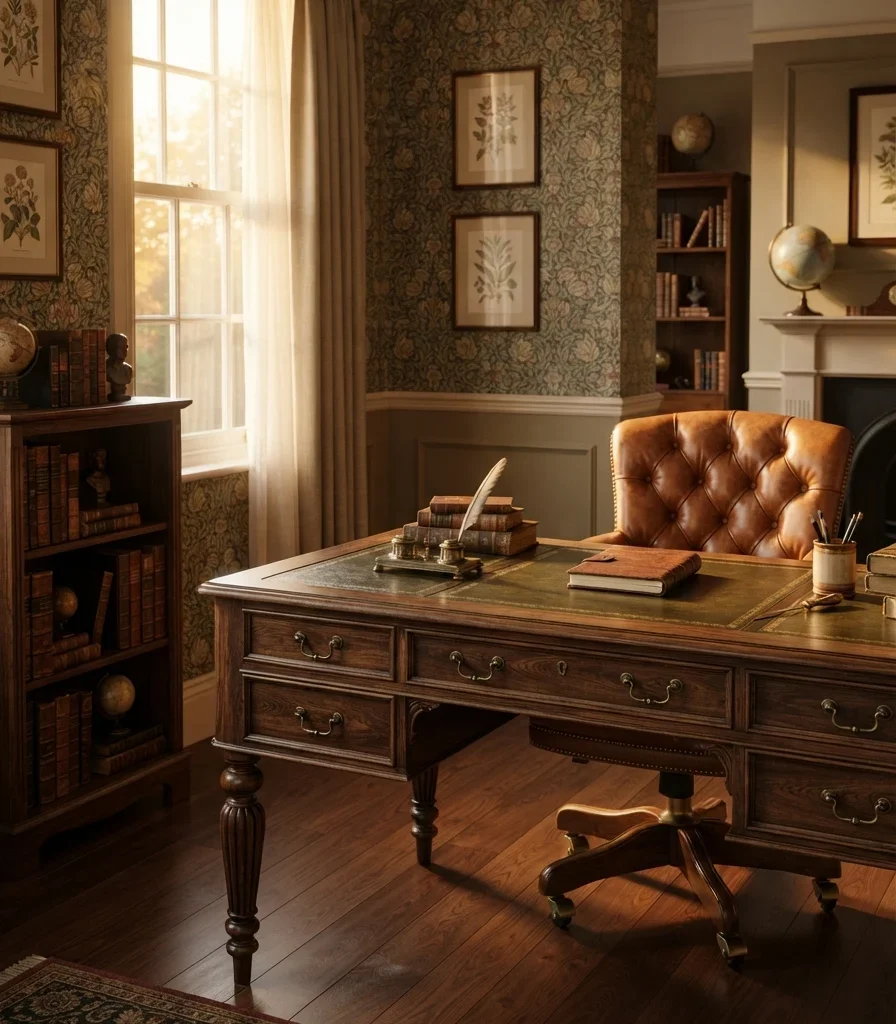
Vibe: The desk invites you to write, read, and work slowly.
Why it works: The combination uses material hierarchy: wood establishes permanence, leather supplies softness, and brass provides small points of reflection. Victorian furniture frequently emphasized substantial craftsmanship and visible construction, while later Arts & Crafts thinking strengthened the idea that materials should be allowed to express their natural qualities. The result feels authentic when the desk has real grain, nd the leather has a matte, slightly worn appearance.
How to get it: Select a desk with a medium-to-dark walnut or mahogany tone and pair it with cognac or oxblood leather rather than bright black. Keep the desktop approximately 72–76cm high and choose a chair whose seat height allows your elbows to rest near a 90-degree working angle.
Shop The Look
| Product | Search on Amazon |
| Dark walnut writing desk | Dark walnut traditional writing desk |
| Cognac leather office chair | Cognac leather traditional office chair |
| Brass letter opener | Antique brass letter opener desk |
| Leather document box | Brown leather document storage box |
| Walnut bookcase | Dark walnut narrow bookcase traditional |
3. Use a Banker’s Lamp as the Office’s Visual Anchor
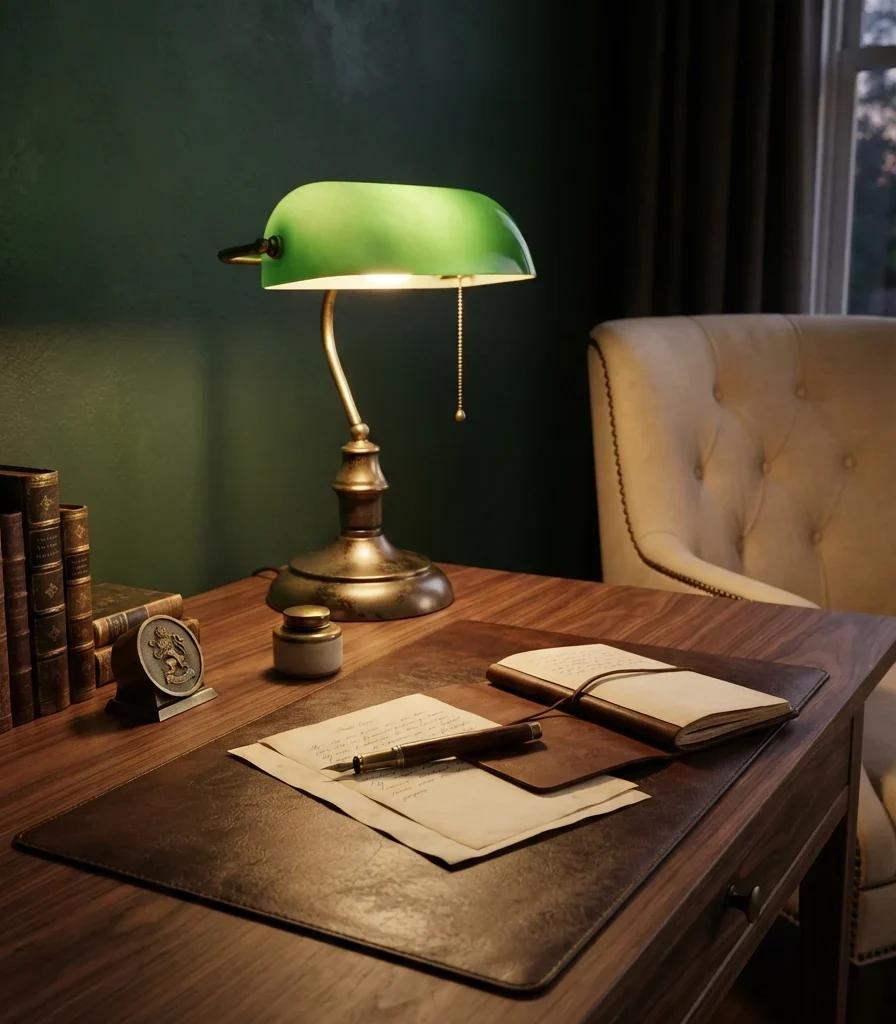
Vibe: Hushed. The concentrated pool of light makes work feel separate from the rest of the house.
Why it works: The principle is light zoning. Instead of illuminating the entire office evenly, a banker-style lamp creates a defined working pool while allowing the surrounding room to remain softer and darker. That layered lighting approach is particularly appropriate for a Victorian-inspired study because historical interiors commonly depended on candles, lamps, sconces, and localized pools of illumination rather than the uniform overhead lighting typical of contemporary rooms.
How to get it: Position the lamp on the opposite side of your dominant writing hand when possible to reduce shadows across paperwork. Use a warm 2700K bulb with a high color-rendering rating and place the lamp roughly 40–50cm above the desktop.
💡 Quick Win: A $25–$50 antique-brass banker’s lamp can establish the Victorian mood faster than almost any small decorative purchase because it changes both the light quality and the visual language of the desk.
Shop The Look
| Product | Search on Amazon |
| Green glass banker lamp | Green glass banker desk lamp antique brass |
| 2700K warm LED bulb | 2700K high CRI warm LED bulb |
| Leather desk blotter | Cognac leather desk mat traditional |
| Brass paperweight | Antique brass decorative paperweight |
| Ceramic ink pot | Vintage style ceramic ink bottle desk |
4. Choose a High-Back Tufted Chair With Contemporary Ergonomics

Vibe: Stately. The chair gives the workspace the presence of a private study.
Why it works: This is a balance of historical silhouette and modern function. Button tufting, a high back, and leather upholstery evoke Victorian club chairs and study furniture, but an office chair still needs adjustable height, appropriate lumbar support, and enough seat depth for extended work. The contrast between an ornate exterior profile and discreet ergonomic engineering keeps the room from becoming theatrical.
How to get it: Look for a high-back chair in cognac or oxblood leather with adjustable height and lumbar support, then keep the visible hardware dark or antique bronze. Avoid ultra-modern chrome casters because the bright metal can visually disconnect the chair from the rest of the room.
Shop The Look
| Product | Search on Amazon |
| Cognac tufted leather office chair | Cognac tufted leather ergonomic office chair |
| Walnut writing desk | Walnut executive writing desk traditional |
| Botanical wallpaper | Victorian botanical wallpaper peel and stick |
| Persian-style runner rug | Traditional Persian style office runner rug |
| Brass floor lamp | Antique brass floor lamp reading office |
5. Frame the Walls With Botanical Prints and Portrait-Style Art
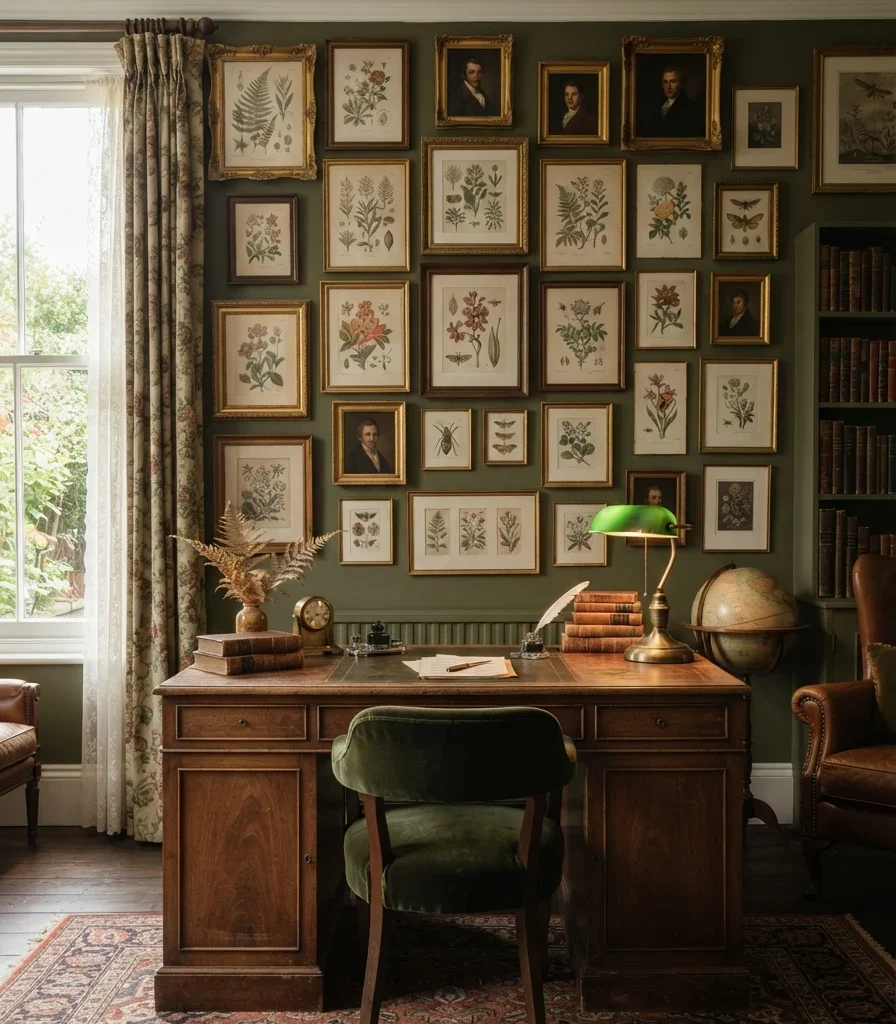
Vibe: Scholarly; the walls feel like a visual record collected over time.
Why it works: Victorian interiors often embraced extensive decoration, but a modern home office benefits from controlled density rather than filling every inch. Botanical prints provide historical resonance while their flat, pale paper surfaces create contrast against saturated walls. Mixing two or three frame sizes also creates hierarchy, allowing the eye to move through the arrangement instead of reading it as repetitive wallpaper.
How to get it: Use mostly antique-brass, walnut, or dark-gold frames and keep approximately 5–8cm between neighboring frames. Start with one large botanical print at eye level, then build outward with smaller pieces rather than creating a perfectly symmetrical grid.
💡 Quick Win: Download public-domain botanical illustrations, print them on warm-white archival paper, and place them in thrifted dark-gold frames. This can create a convincing Victorian wall for considerably less than collecting original antiques.
Shop The Look
| Product | Search on Amazon |
| Victorian botanical prints | Vintage Victorian botanical prints framed |
| Antique gold picture frames | Antique gold ornate picture frames set |
| Walnut picture frame | Dark walnut traditional picture frame |
| Dried fern stems | Dried fern botanical stems decor |
| Brass mantel clock | Vintage brass mantel clock traditional |
6. Create a Library Wall With Floor-to-Ceiling Shelving
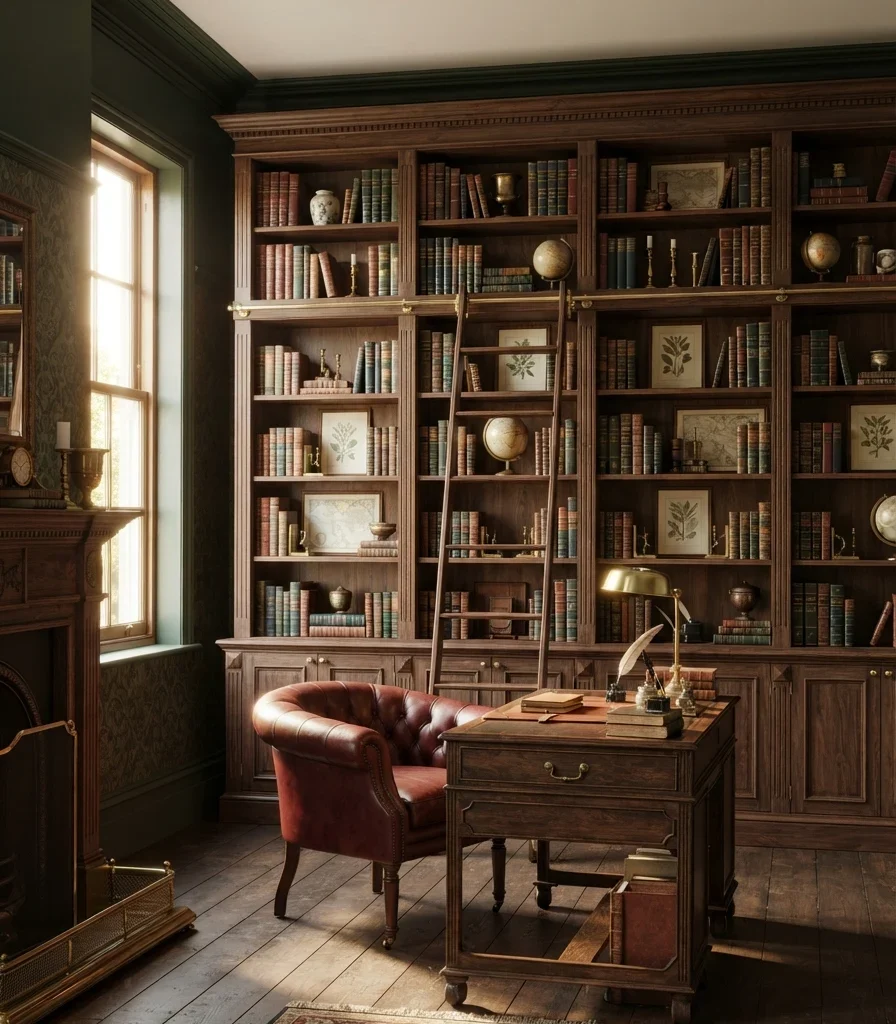
Vibe: Immersive; the room feels wrapped in knowledge and accumulated character.
Why it works: A library wall creates vertical visual weight, which suits Victorian architecture because tall shelving reinforces the room’s height and gives the eye a strong architectural plane. The important distinction is between display and storage: books and meaningful objects can create personality, but closed cabinets or matching boxes should hide modern office clutter.
How to get it: Use shelving approximately 25–30cm deep for books and keep the vertical bays relatively narrow so they feel substantial rather than flimsy. Style roughly 60% of the storage for books and practical items, leaving 40% for framed art, ceramics, and breathing space.
Shop The Look
| Product | Search on Amazon |
| Dark walnut bookcase | Tall dark walnut bookcase traditional |
| Brass library ladder decor | Brass rail library ladder decorative |
| Leather-bound decorative books | Vintage leather bound decorative book set |
| Brass bookends | Antique brass decorative bookends |
| Antique-style desk globe | Vintage world globe brass stand |
7. Use a Small Writing Nook Beside the Window
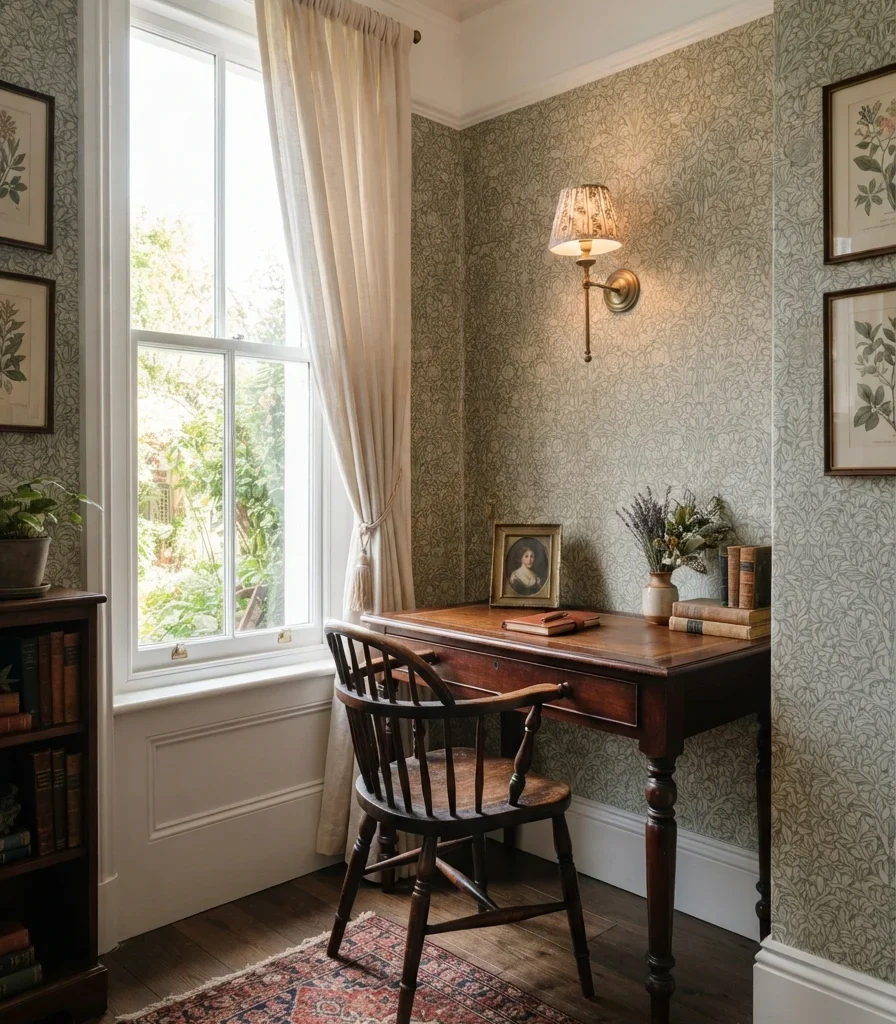
Vibe: Reflective. The compact arrangement makes quiet work feel intentional rather than squeezed in.
Why it works: The layout uses zoning without walls. A window-side desk receives natural light while the wallpaper and rug visually define the work area as its own destination. This approach works particularly well in bedrooms, guest rooms, or living rooms where a complete dedicated office is impossible.
How to get it: Choose a desk no deeper than 50–55cm and place it perpendicular to the window so daylight reaches your work surface from the side. Keep the chair fully within the nook when not in use to preserve the room’s circulation path.
💡 Quick Win: A narrow 90–110cm writing desk, a brass wall lamp, and one framed botanical print can establish a Victorian writing corner for far less than furnishing an entire dedicated office.
Shop The Look
| Product | Search on Amazon |
| Narrow mahogany writing desk | Narrow mahogany writing desk small space |
| Curved wooden office chair | Curved wooden writing chair traditional |
| Brass wall sconce | Antique brass wall sconce Victorian style |
| Persian-style small rug | Traditional Persian style small office rug |
| Linen cafe curtain | Natural linen cafe curtain vintage style |
8. Introduce Oxblood Through Leather and Textiles
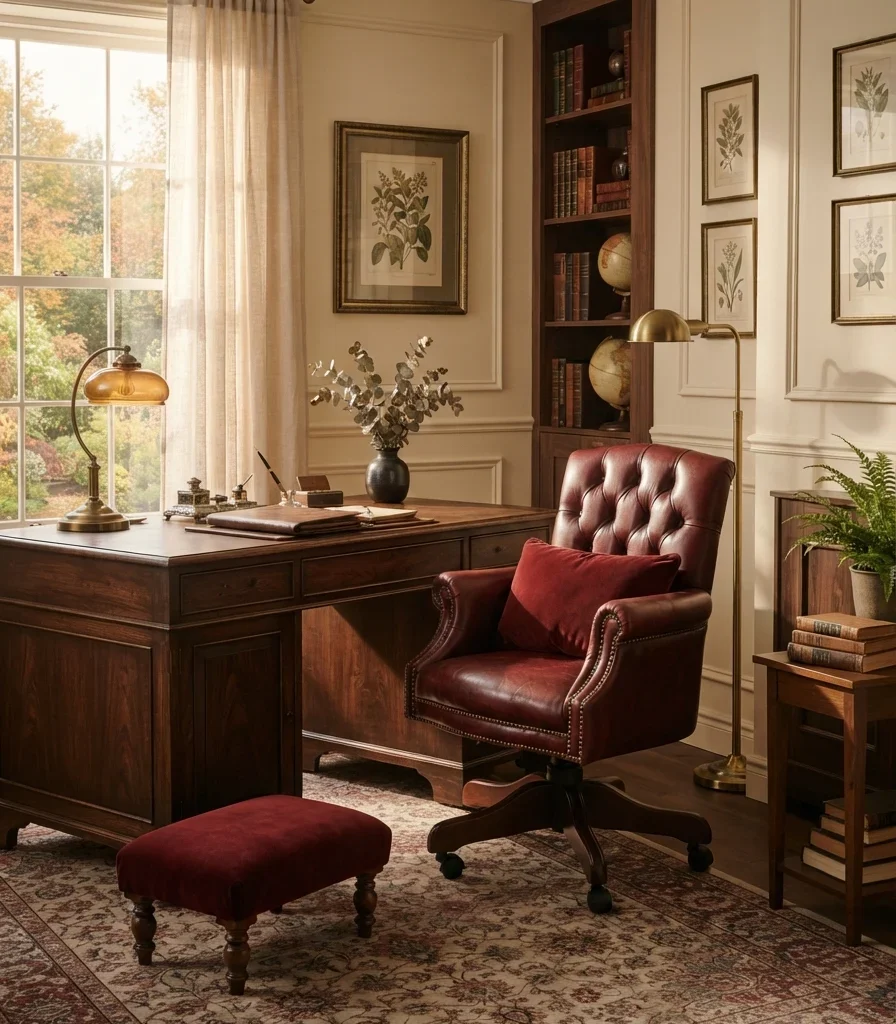
Vibe: Rich red-brown accents add warmth without turning the office theatrical.
Why it works: Oxblood is historically compatible with the deeper red, brown, and jewel-like palettes associated with Victorian interiors. The principle is accent-color repetition: instead of scattering unrelated red objects around the room, repeat one restrained oxblood tone across leather, textile, or artwork so the color appears intentional. Victorian color schemes often relied on a dominant hue supported by smaller subsidiary colors.
How to get it: Choose one oxblood item as the largest accent, preferably a leather chair, then repeat the same family in only two smaller locations, such as a cushion and rug detail. Keep the surrounding walls and furniture quieter so the red-brown tone remains sophisticated.
Shop The Look
| Product | Search on Amazon |
| Oxblood leather office chair | Oxblood burgundy leather office chair |
| Oxblood velvet cushion | Oxblood velvet lumbar pillow |
| Traditional burgundy rug | Burgundy traditional office area rug |
| Walnut leather portfolio | Dark brown leather writing portfolio |
| Brass desk accessories | Antique brass desk accessory set |
9. Add Patterned Wallpaper Behind the Desk
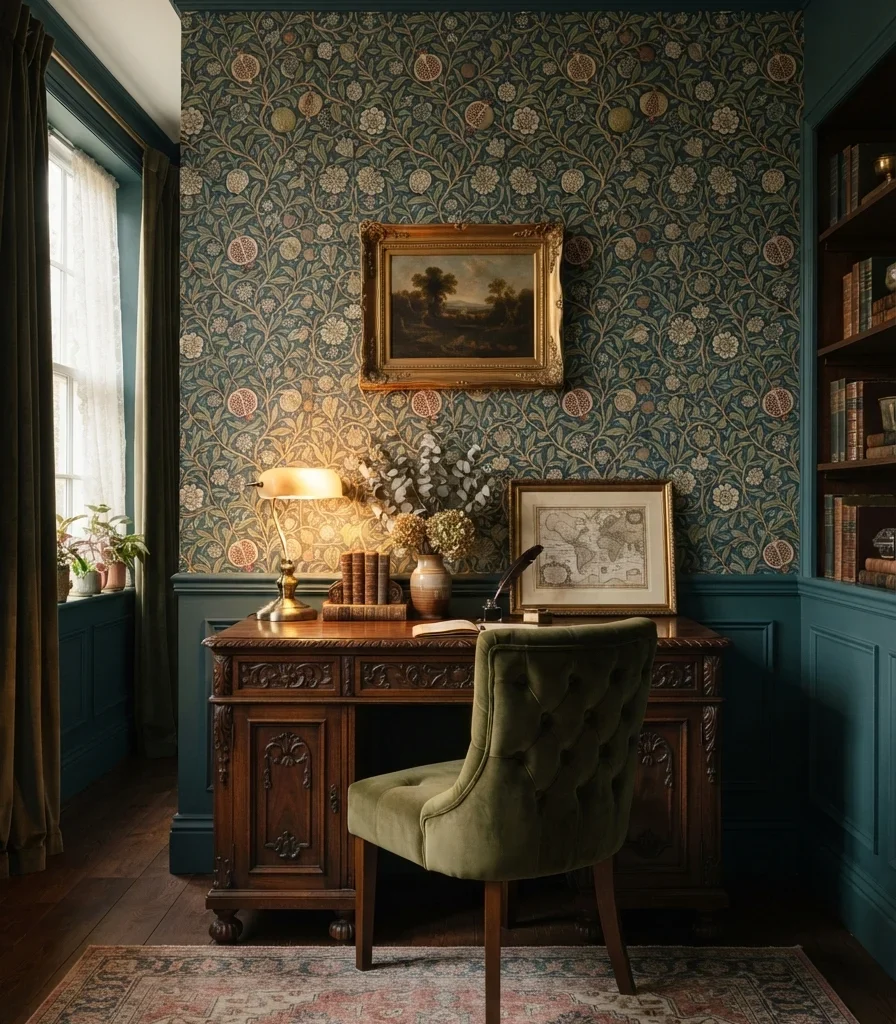
Vibe: Romantic. The patterned wall gives the office the feeling of a private illustrated chamber.
Why it works: Victorian wallpaper frequently used botanical forms and complex repeating patterns, while William Morris became especially influential for stylized natural motifs. The design principle here is pattern as architectural framing: placing wallpaper behind the desk turns the primary workspace into a visual focal point instead of allowing the pattern to compete equally with every wall.
How to get it: Choose a wallpaper with a dark ground and no more than three dominant colors, then keep the desk silhouette simple. For renters, use a quality removable paper on a single wall rather than attempting to wrap the entire room.
💡 Quick Win: Apply removable botanical wallpaper only to the wall directly behind the desk. A single roll or carefully measured accent area can create the visual effect of a fully decorated Victorian study without the cost or commitment of papering every wall.
Shop The Look
| Product | Search on Amazon |
| Victorian botanical wallpaper | Dark Victorian botanical peel and stick wallpaper |
| Walnut writing desk | Walnut writing desk traditional home office |
| Velvet office chair | Deep green velvet desk chair traditional |
| Brass picture frame | Antique brass picture frame ornate |
| Ceramic botanical vase | Dark green ceramic vase vintage style |
10. Hang a Small Chandelier Instead of Using a Ceiling Fixture
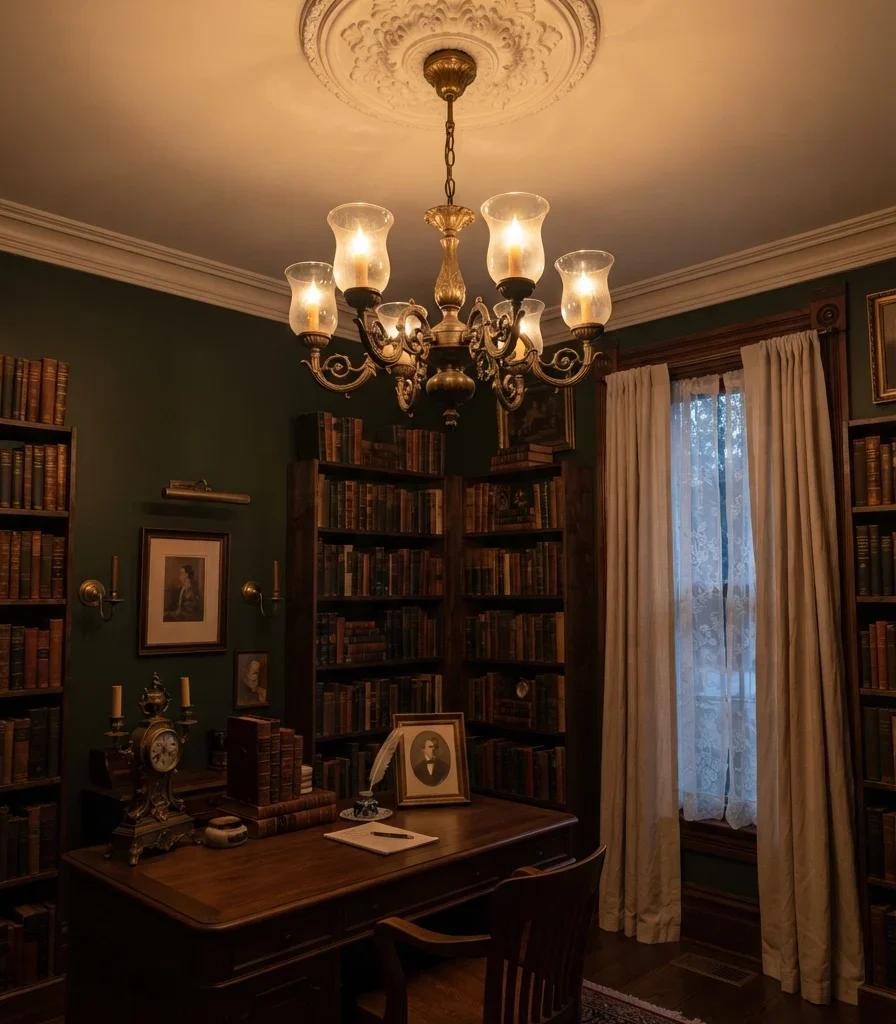
Vibe: Atmospheric; the ceiling contributes to the room’s identity instead of disappearing above it.
Why it works: Victorian interiors often treated lighting as part of decorative composition, using chandeliers, sconces, and candles to create layered atmosphere. A small chandelier also establishes vertical hierarchy, drawing the eye upward and emphasizing ceiling height. The key is scale: a compact office needs a fixture that feels ornamental without visually overwhelming the desk.
How to get it: Choose a chandelier approximately one-third the width of the room and hang it so the lowest point remains comfortably above head height. Use warm 2200–2700K bulbs and a dimmer so the fixture can transition from practical daytime illumination to evening atmosphere.
Shop The Look
| Product | Search on Amazon |
| Small antique brass chandelier | Small antique brass Victorian chandelier |
| Warm dimmable chandelier bulbs | 2200K 2700K dimmable chandelier bulbs |
| Decorative ceiling medallion | Small Victorian ceiling medallion |
| Cream linen curtains | Warm cream linen curtain panels |
| Brass chain curtain tiebacks | Antique brass curtain tiebacks |
11. Choose a Carved Wood Bookcase as the Hero Furniture Piece

Vibe: Historic. One substantial piece makes the room feel as though it has inherited its character.
Why it works: The principle is focal hierarchy. Victorian interiors could accommodate substantial furniture, but a modern room needs one clear hero instead of competing large pieces. A carved bookcase supplies verticality, storage, ornament, and historical reference simultaneously, allowing the desk to remain relatively restrained.
How to get it: Search for a bookcase with one or two strong architectural details arched doors, fluted posts, or a carved cornice rather than combining several ornate pieces. Leave some shelf space deliberately empty so the carving remains visible and the furniture does not become visually buried.
💡 Quick Win: If a full antique bookcase is outside your budget, use a tall dark-wood bookcase and add traditional brass knobs plus a decorative crown molding strip at the top.
Shop The Look
| Product | Search on Amazon |
| Carved walnut bookcase | Carved walnut bookcase Victorian style |
| Brass cabinet knobs | Antique brass cabinet knobs traditional |
| Glass-front bookcase | Glass door dark wood bookcase |
| Decorative antique map | Vintage antique world map framed |
| Ceramic urn vase | Traditional ceramic urn vase dark green |
12. Finish the Desk With a Curated Writing Set

Vibe: Contemplative. The smallest objects make the office feel personal rather than staged.
Why it works: This vignette uses controlled object grouping instead of general clutter. A Victorian-inspired workspace benefits from objects that suggest writing, reading, correspondence, and collecting, but too many small accessories quickly turn the desk into visual noise. Three to five related pieces create a readable composition while preserving usable work surface.
How to get it: Build the desktop around one horizontal object, such as a leather writing pad, one vertical object, such as a small frame, and one reflective object, such as a brass clock. Keep at least half of the working surface completely clear so the office remains functional.
Shop The Look
| Product | Search on Amazon |
| Leather writing pad | Brown leather writing desk pad traditional |
| Antique brass desk clock | Antique brass desk clock vintage |
| Fountain pen set | Classic fountain pen writing set |
| Ceramic ink pot | Vintage ceramic ink pot desk |
| Small porcelain vase | Small porcelain bud vase traditional |
How to Start Your Victorian Style Home Office Transformation
Your one first move should be the wall color: choose a deep bottle green matte paint and test it on the wall behind your desk. That single decision establishes the visual depth of the room and immediately gives walnut, mahogany, brass, leather, and warm cream somewhere to visually register. It also lets you judge every later purchase against a defined palette rather than buying Victorian-looking objects individually.
The most common mistake is overloading the room with unrelated antiques. A carved desk, ornate chair, heavy bookcase, elaborate chandelier, patterned rug, floral wallpaper, and multiple framed collections can make a small office feel crowded instead of historically convincing. Victorian interiors were layered, but the layers still needed relationships in color, texture, and proportion. Choose one hero furniture piece and let the other elements support it.
Three inexpensive entry points are a green-glass banker lamp for roughly $25–$50, an antique-brass picture frame around $15–$25, and a small oxblood velvet cushion around $15–$30. These immediately introduce the period’s characteristic color, metal, and textile language.
A starter transformation can happen over one weekend for around $200–$600 if you already own a suitable desk. A fuller room with wallpaper, quality lighting, a chair, bookcase, rug, and window treatments can realistically reach $1,500–$4,000. Built-in shelving, custom millwork, original antiques, or architectural restoration can take several months and push the budget substantially higher.
Frequently Asked Questions About 12 Victorian Style Home Office Ideas
What makes a home office Victorian style instead of traditional?
A Victorian home office draws specifically from the design vocabulary of the 19th century, including dark woods, richer colors, patterned wallpaper, brass, leather, botanical motifs, and furniture influenced by Gothic Revival and other historical revivals. A generic traditional office may use similar wood furniture but does not necessarily contain those Victorian references. The easiest distinction is the combination of historical pattern, material richness, and layered ornament rather than wood furniture alone.
Which colors are best for a Victorian style home office?
Bottle green, forest green, oxblood, tobacco brown, muted navy, plum, and warm cream are particularly useful. Deep green is an especially flexible starting point because it works with walnut, mahogany, aged brass, and botanical wallpaper. If the office receives little natural light, choose a softened green with gray or brown undertones rather than an extremely saturated emerald.
How much does a Victorian style home office cost?
A budget refresh using paint, a banker lamp, framed prints, and a few desk accessories can cost roughly $150–$500. A more complete room with a quality desk chair, wallpaper, rug, lighting, bookcase, and curtains can reach $1,500–$4,000. Genuine antique furniture, custom cabinetry, original wallpaper, or restoration work can raise the cost considerably.
Can Victorian style work in a modern home office?
Yes, and the combination can actually make the room more functional because contemporary ergonomics can sit behind a historical visual shell. Pair a Victorian-inspired walnut desk with an ergonomic leather chair, modern cable management, and adjustable 2700K lighting. Keep modern technology visually contained through leather boxes, closed drawers, and concealed cable channels rather than trying to make computers look antique.
What type of wallpaper is best for a Victorian home office?
Botanical wallpaper with stylized leaves, vines, pomegranate forms, birds, or muted floral motifs is one of the most natural choices. William Morris’s work is particularly influential in this area, with botanical patterns becoming strongly associated with late-Victorian and Arts & Crafts interiors. For a contemporary office, choose a dark green, blue-green, or muted brown background and use the wallpaper on one focal wall if the room is small.
Ready to Create Your Dream Victorian Style Home Office?
These 12 Victorian-style home office ideas cover deep color, walnut and mahogany, patterned wallpaper, layered lighting, library storage, leather, botanical art, compact layouts, and carefully edited accessories. The transformation does not need to happen all at once; starting with one wall color and one period-inspired light is often the more convincing approach because the room can develop character gradually. Today, test a bottle-green paint sample behind your desk and view it once in daylight and again under a 2700K lamp before buying anything else. When the layers come together, the office should feel scholarly, grounded, tactile, and private a room that makes ordinary work feel more deliberate. Save or pin your favorite combination of green walls, walnut, brass, leather, and botanical pattern so you have a clear Victorian direction to return to as the room evolves.