
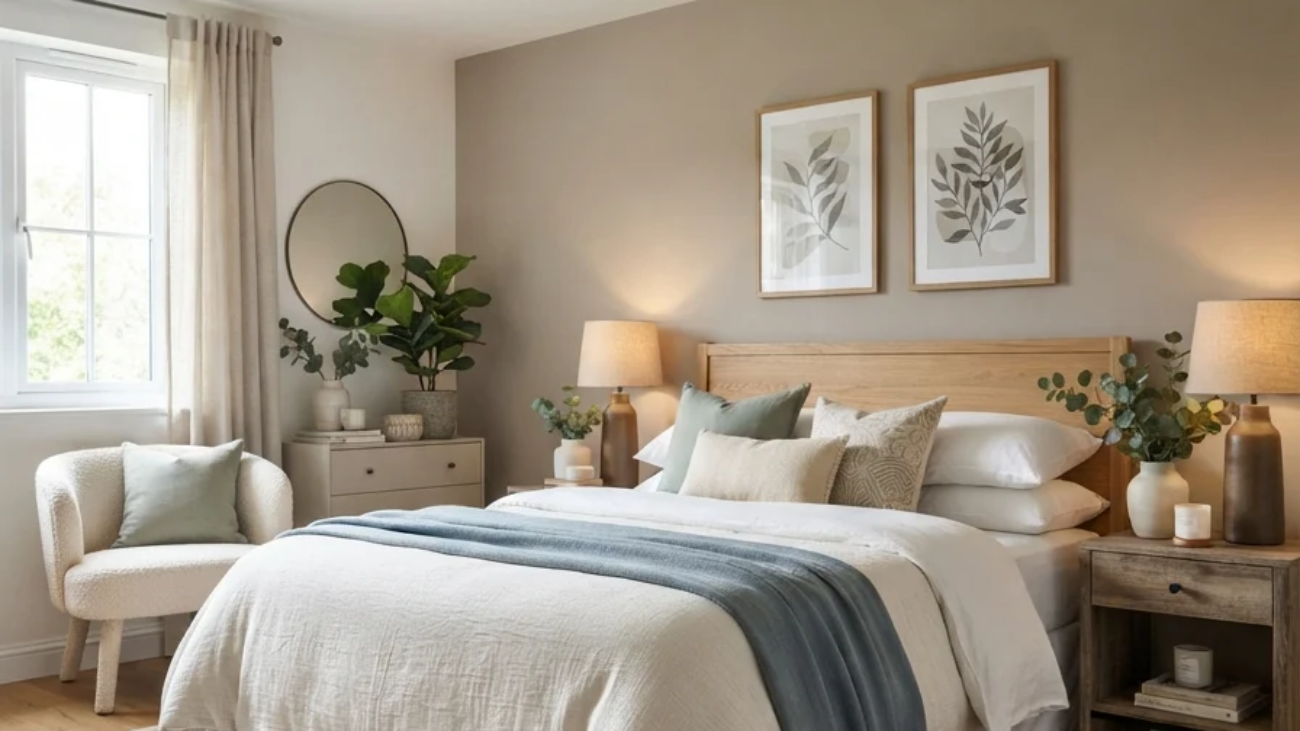
A home bedroom refresh is a focused update that improves a bedroom’s color, lighting, textiles, furniture arrangement, and decorative details without requiring a complete renovation. These 11 home bedroom refresh ideas show you how to make a tired bedroom feel more comfortable, cohesive, functional, and visually finished through manageable changes.
A refreshed bedroom should feel easier to enter at the end of the day: softer light across the walls, clean bedding beneath your hands, a calmer bedside surface, and enough visual breathing room to let your mind slow down. You do not need to replace every piece of furniture to create that feeling. Small changes in proportion, texture, color, and lighting can alter how the entire room is experienced. The best bedroom updates also improve everyday routines, from reaching for a book at night to finding clothes in the morning without fighting through clutter. Think of the process as editing rather than rebuilding. Here are 11 ideas worth saving and stealing.
Why Home Bedroom Refresh Works So Well
A bedroom refresh works because it sits between ordinary decorating and a full renovation. Instead of changing the architecture, you improve the visual hierarchy of the existing room: the bed becomes the anchor, lighting establishes atmosphere, textiles add softness, and secondary furniture supports how the space is actually used. Contemporary bedroom design also borrows from hospitality, Scandinavian interiors, quiet luxury, and residential minimalism, where comfort and restraint matter as much as appearance.
The most effective materials are tactile rather than merely decorative. Washed linen, cotton percale, unfinished or medium-toned oak, walnut veneer, wool, jute, ceramic, aged brass, and matte black metal all introduce useful variation. A practical palette might combine warm ivory with mushroom taupe, dusty sage, muted clay, soft charcoal, or walnut brown. These tones are easier to layer than a collection of unrelated accent colors.
Bedroom refreshes remain especially relevant because people increasingly expect their homes to support rest, work, storage, and personal rituals. The bedroom has become more than a place to sleep, which makes lighting, organization, comfortable seating, charging access, and flexible furniture important design considerations. A good refresh therefore improves both the photograph and the lived experience of the room.
Small bedrooms can absolutely benefit from the same approach, but scale becomes critical. Prioritize one strong focal point, furniture with useful storage, wall-mounted lighting, and textiles that create softness without consuming floor area. Avoid filling every empty corner simply because it is available; negative space is one of the cheapest ways to make a compact bedroom feel more generous.
Style at a Glance
| Element | Home Bedroom Refresh |
| Philosophy | Edit, layer, and improve function |
| Key Materials | Linen, cotton, oak, walnut, wool, ceramic, brass |
| Key Colors | Warm ivory, mushroom taupe, dusty sage, muted clay |
1. Start With a Layered Neutral Bedding Reset
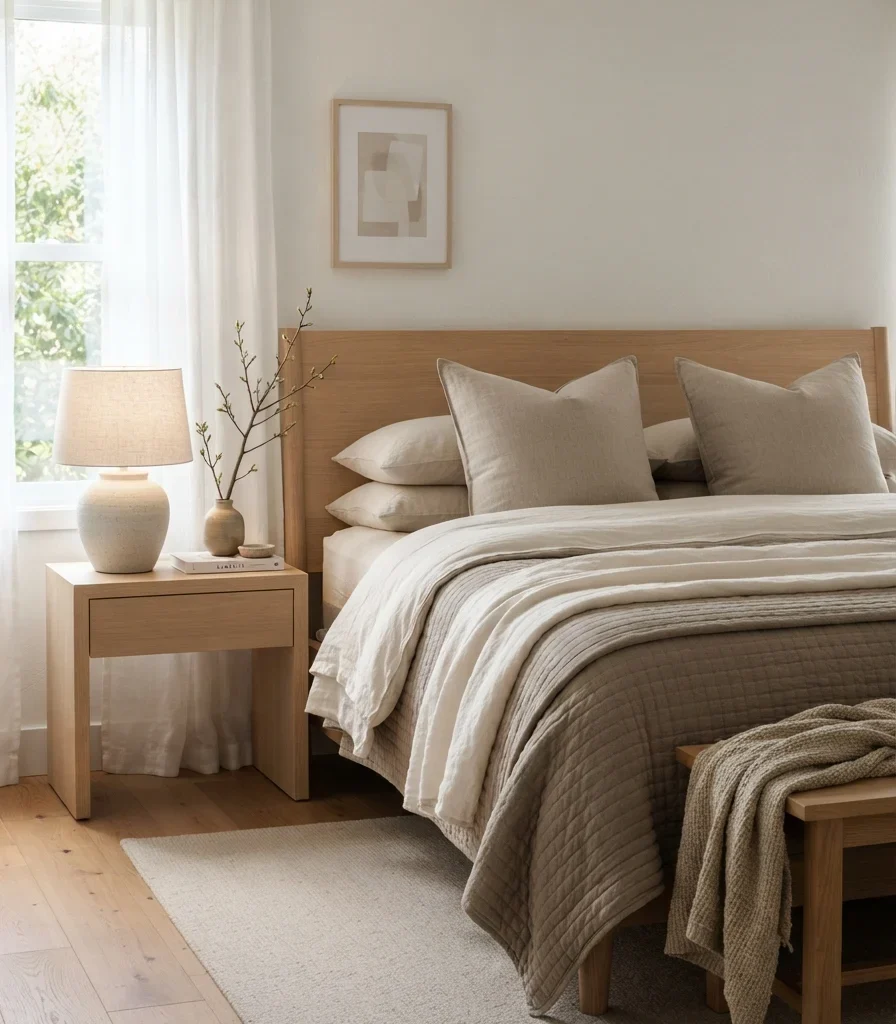
Vibe: Hushed. The bed immediately becomes softer, calmer, and more inviting.
Why it works: Textile hierarchy gives the eye a clear visual order instead of making the bed look like a pile of unrelated cushions and blankets. Combining washed linen, cotton percale, and a lightweight quilt creates contrast through texture while keeping the colors within one tonal family. The neutral layering also makes existing furniture easier to keep, because the bed becomes the refreshed focal point without demanding a new frame or headboard.
How to get it: Begin with one warm ivory duvet cover, add a mushroom or oatmeal quilt folded across the lower third, and finish with two larger pillows behind your regular sleeping pillows. Keep decorative cushions to one or two so the bed remains practical rather than staged.
💡 Quick Win: Replace only the duvet cover and add one textured throw before buying anything else; this can change the room within an afternoon.
Shop The Look
| Product | Search on Amazon |
| Linen duvet cover | Warm ivory washed linen duvet cover queen |
| Quilt | Oatmeal lightweight cotton quilt queen |
| Euro shams | Mushroom taupe euro pillow covers set |
| Throw | Chunky neutral knit throw blanket |
| Pillow covers | Textured boucle lumbar pillow cover |
2. Paint the Headboard Wall a Softer Accent Color
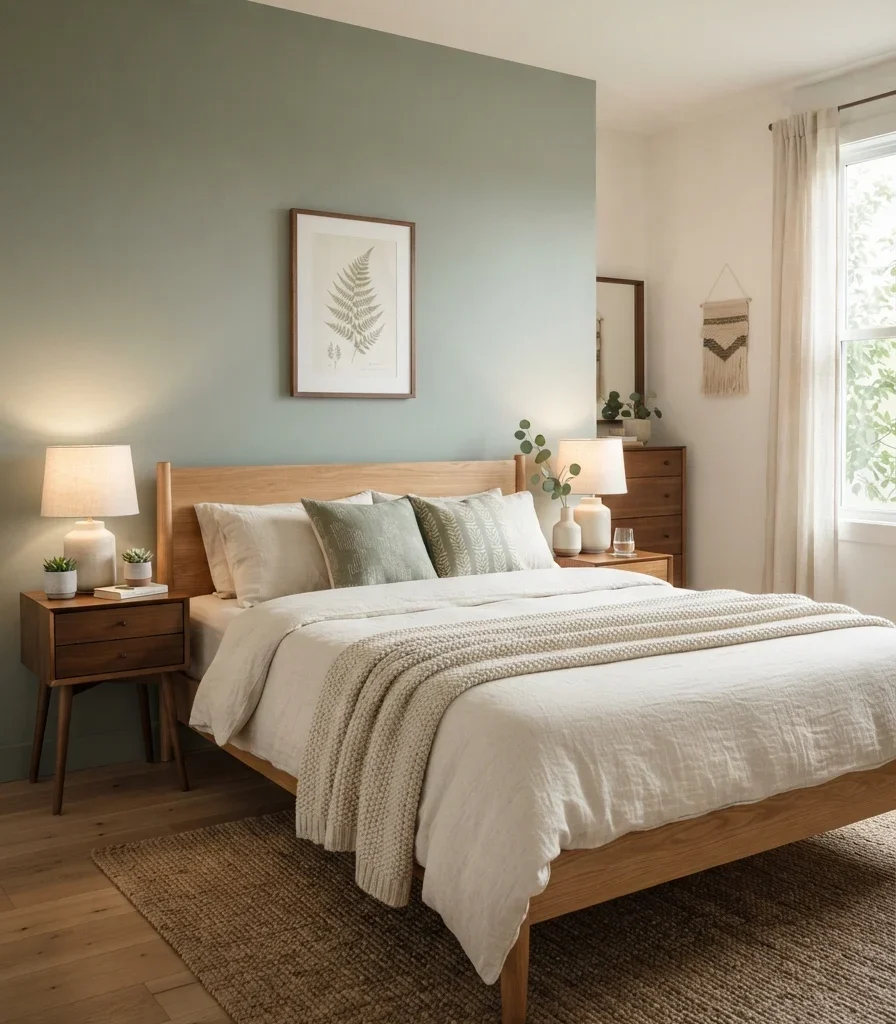
Vibe: Grounded; the room feels visually anchored without becoming dark.
Why it works: A single accent wall creates contrast and establishes a focal plane behind the bed, which is especially useful when the existing headboard is visually plain. Dusty sage, muted clay, mushroom taupe, and soft blue-gray are safer choices than highly saturated colors because they introduce depth without competing with bedding. A matte finish also reduces glare and gives the wall a more substantial appearance.
How to get it: Choose the wall behind the bed and paint it in a muted, low-saturation shade such as dusty sage. Keep the remaining walls warm white or very pale greige so the accent wall reads as intentional rather than making the whole room feel smaller.
Shop The Look
| Product | Search on Amazon |
| Wall paint | Dusty sage green interior matte wall paint |
| Paint roller | 9-inch microfiber smooth wall paint roller |
| Cutting brush | 2 inch angled paint brush |
| Drop cloth | Reusable cotton canvas painting drop cloth |
| Painter’s tape | Low-tack clean-edge painter’s tape |
3. Replace Hard-Edged Curtains With Soft Linen Panels
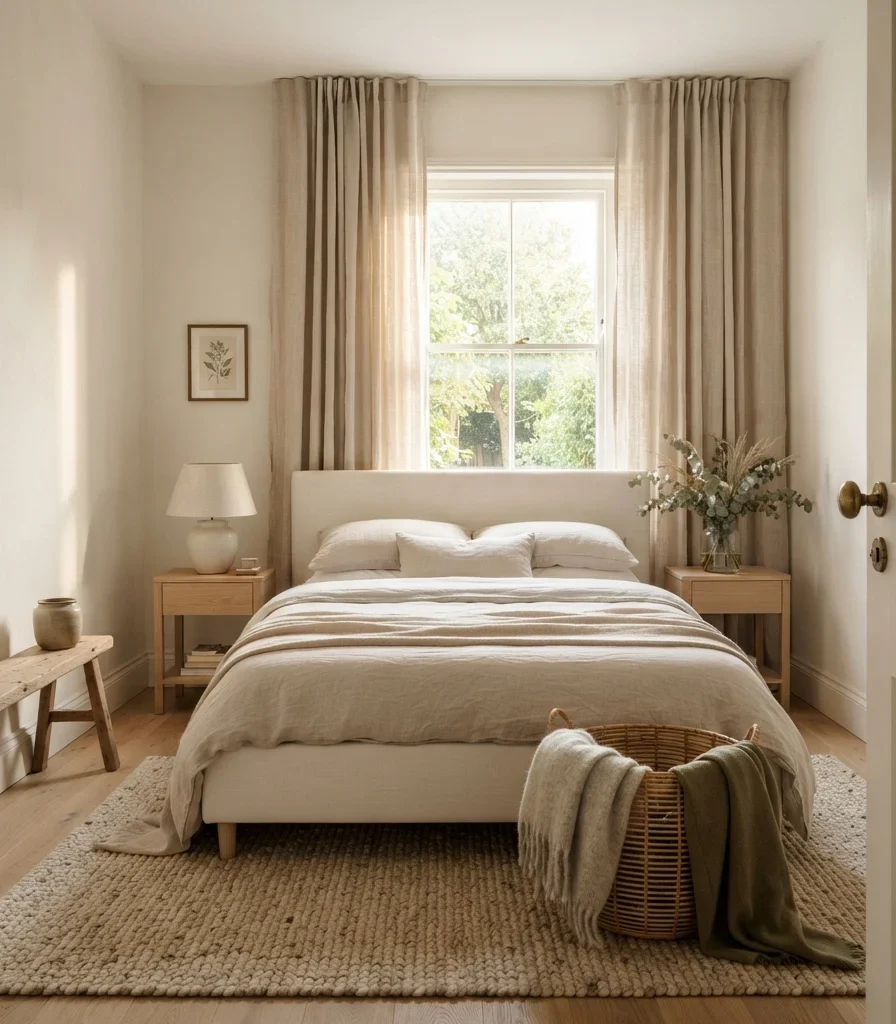
Vibe: Airy daylight becomes softer, and the room feels less visually rigid.
Why it works: Full-height curtains create vertical emphasis, making the window wall feel taller while softening hard architectural edges. Linen is particularly effective because its irregular weave catches daylight without looking glossy or overly formal. The key principle is fullness: skimpy curtain panels expose too much glass and produce a temporary-looking finish, while generous fabric creates controlled folds.
How to get it: Mount the curtain rod or track close to the ceiling and extend it beyond both sides of the window frame. Choose panels with approximately 1.5–2 times the window width in total fabric so they retain fullness even when closed.
💡 Quick Win: If your existing curtains are usable, simply raise the rod closer to the ceiling and add wider panels rather than replacing the entire window treatment.
Shop The Look
| Product | Search on Amazon |
| Curtains | Natural flax linen curtain panels 96 inch |
| Curtain rod | Matte black or antique brass extra long curtain rod |
| Rings | Wooden curtain rings with clips |
| Sheers | Warm white sheer linen-look curtain panels |
| Tiebacks | Natural cotton rope curtain tiebacks |
4. Add Warm Bedside Lighting at the Correct Height
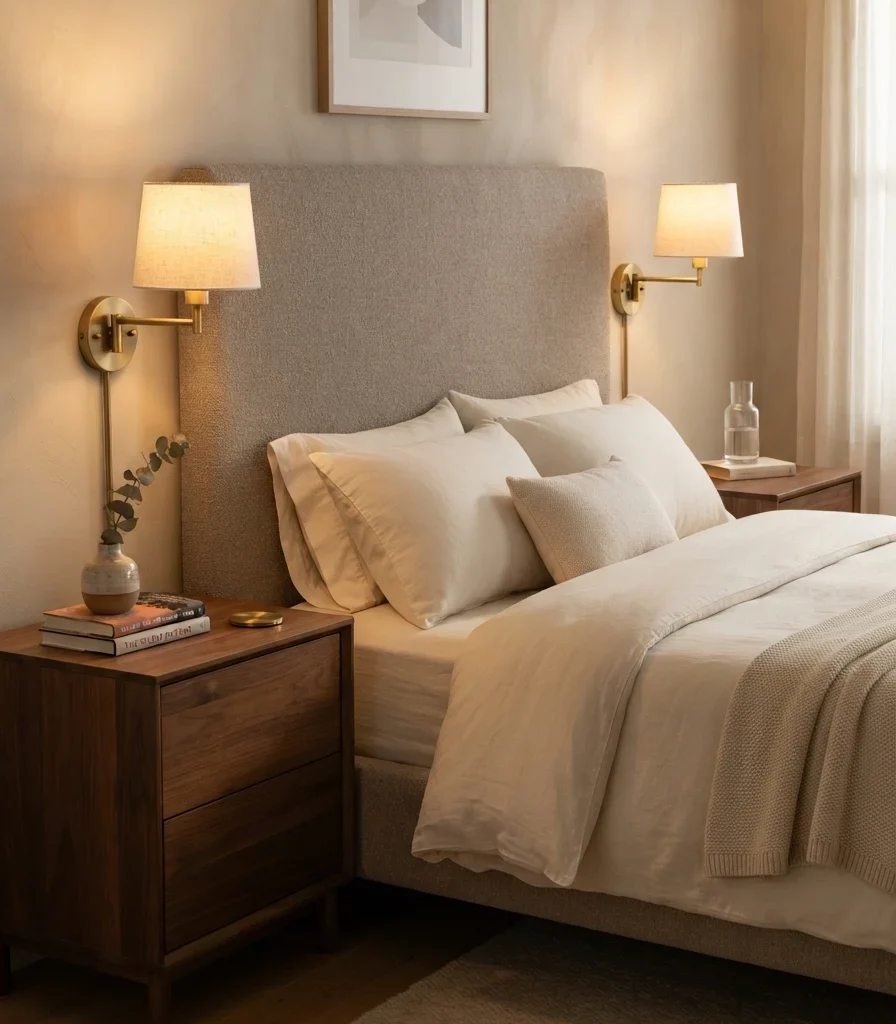
Vibe: Luminous; the room shifts from functional brightness to deliberate evening atmosphere.
Why it works: Layered bedroom lighting works because different sources illuminate different visual planes. A bedside sconce supplies task light for reading while eliminating the footprint of a table lamp, which is valuable when nightstands are narrow. Warm 2700K bulbs create a softer evening environment than cool daylight bulbs, while adjustable arms direct light toward the book rather than directly into the sleeper’s eyes.
How to get it: Mount each sconce so its switch is reachable from bed and position the reading head approximately 45–60 cm above the top of the mattress, adjusting for your seated reading position. Choose dimmable fixtures whenever the wiring and switch arrangement allow it.
Shop The Look
| Product | Search on Amazon |
| Wall sconces | Adjustable arm bedroom wall sconces brushed brass |
| Bulbs | 2700K dimmable warm white LED bulbs |
| Plug-in kit | Plug-in wall sconce cord cover kit |
| Cord cover | Paintable adhesive cable raceway |
| Dimmer | Plug-in lamp dimmer compatible with LED |
5. Introduce One Substantial Wood Piece

Vibe: Anchored. One substantial natural material gives the room visual weight.
Why it works: Bedrooms can look unfinished when every major surface is lightweight, glossy, or visually similar. A solid-looking oak dresser introduces visual weight and natural grain, creating contrast against softer bedding and painted walls. Proportion matters more than quantity: one substantial timber piece usually contributes more character than several small decorative wooden accessories.
How to get it: Select one dresser, chest, or substantial bedside cabinet in oak or walnut and make it the room’s primary furniture investment. Keep its styling deliberately sparse, leaving roughly one-third of the top surface visually empty so the wood remains part of the composition.
💡 Quick Win: If replacing furniture is not practical, add a solid oak tray or wooden bedside stool to introduce natural grain at a much smaller cost.
Shop The Look
| Product | Search on Amazon |
| Dresser | Natural oak 6 drawer bedroom dresser |
| Bedside chest | Oak wood two drawer nightstand |
| Tray | Solid oak rectangular decorative tray |
| Stool | Natural wood bedroom accent stool |
| Drawer organizers | Bamboo adjustable drawer organizer set |
6. Build a Bedside Surface That Actually Works
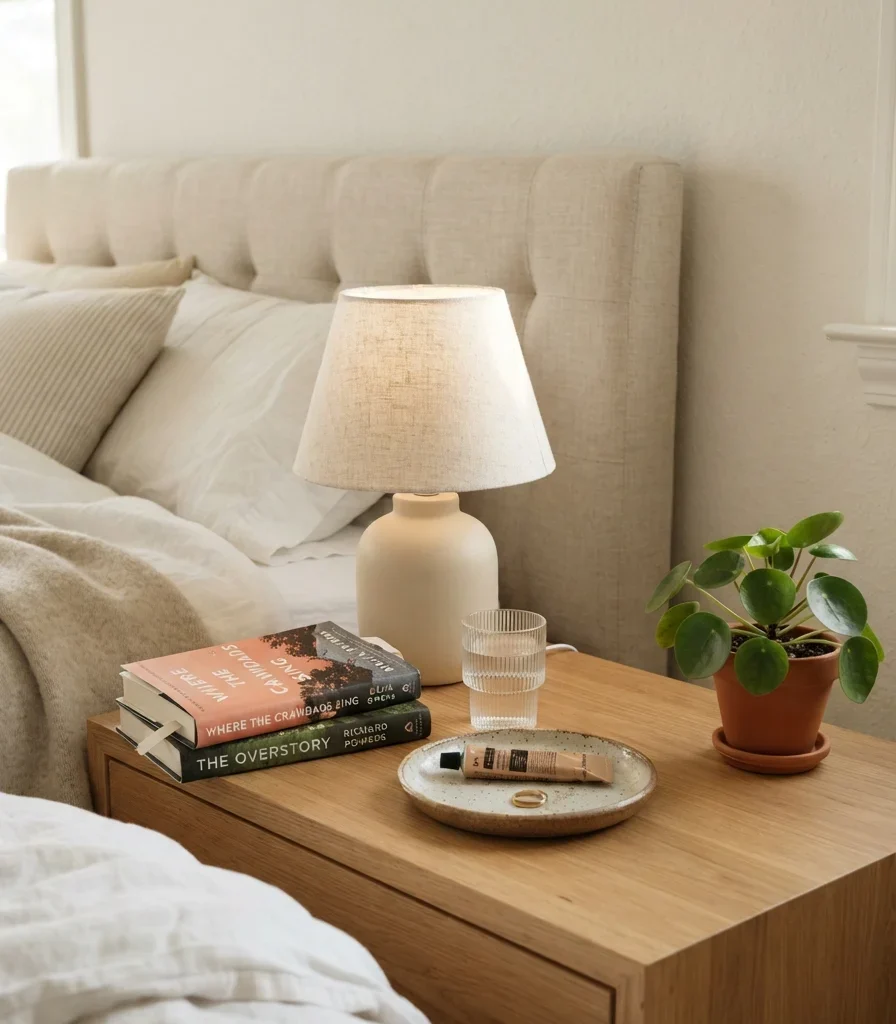
Vibe: Personal. The bedside becomes a small ritual station rather than a dumping ground.
Why it works: A functional bedside arrangement improves visual order because every object has a defined role. The combination of a lamp, tray, book, and one organic element creates asymmetrical balance without filling the entire surface. The shallow tray is particularly useful because it visually groups small objects and prevents chargers, jewelry, and everyday items from spreading across the nightstand.
How to get it: Clear the entire nightstand first, then return only four functional categories: light, reading, personal item, and catchall storage. Use a tray no wider than about two-thirds of the nightstand so there is still deliberate negative space around it.
Shop The Look
| Product | Search on Amazon |
| Table lamp | Small ceramic bedside lamp linen shade |
| Catchall tray | Stoneware oval bedside catchall tray |
| Book stand | Minimal wooden adjustable book stand |
| Plant pot | Small matte ceramic planter sage green |
| Charging station | Compact wooden bedside charging station |
7. Rework the Furniture Layout Around the Bed
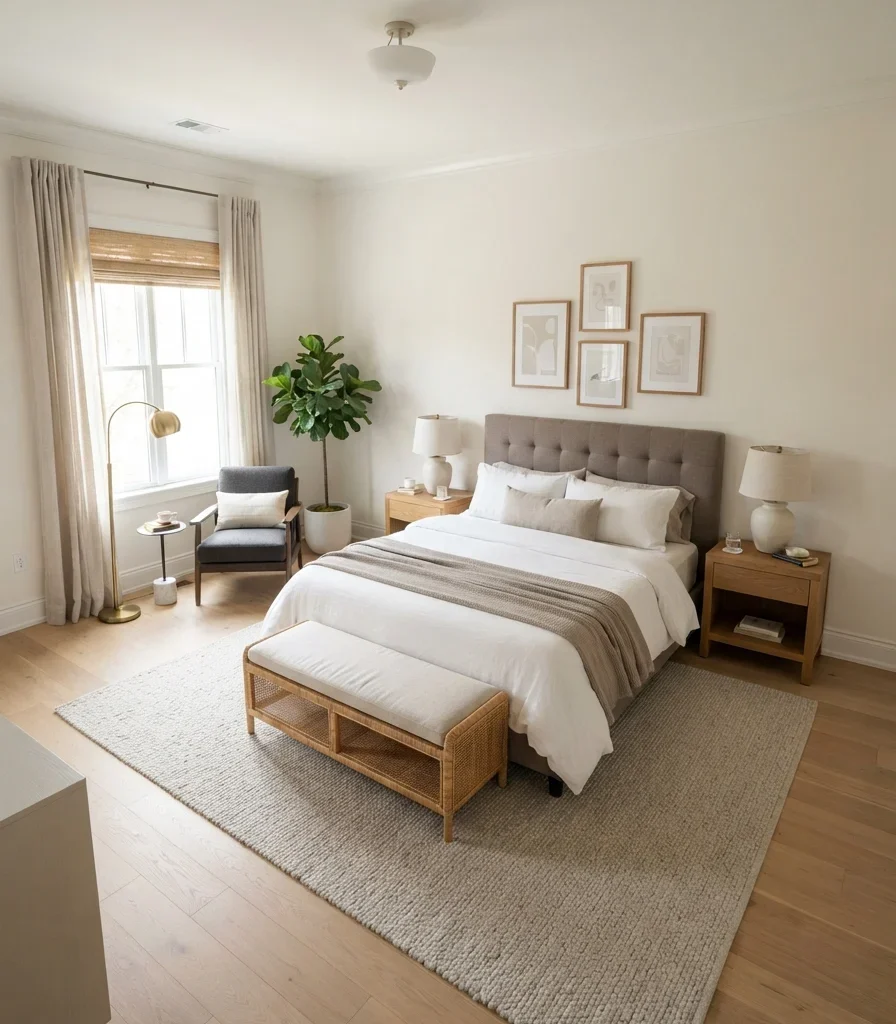
Vibe: Balanced; the bedroom feels calmer because movement through it becomes obvious.
Why it works: Furniture arrangement determines how spacious a bedroom feels even when the square footage does not change. Centering the bed where possible establishes symmetry and gives the sleeping zone visual authority, while clear circulation reduces the feeling of congestion. Ideally, maintain roughly 60–75 cm of comfortable walking space beside the bed where the room allows it.
How to get it: Remove small movable furniture and temporarily center the bed on the strongest wall before returning anything else. Walk through the room from the door to the bed and from the bed to the closet; anything that interrupts those primary paths should be moved or removed.
💡 Quick Win: Before buying furniture, use painter’s tape on the floor to mark the footprint of a proposed bed, dresser, or chair and test the circulation for a full day.
Shop The Look
| Product | Search on Amazon |
| Bed bench | Upholstered bedroom bench 48 inch neutral |
| Area rug | 8×10 low pile neutral bedroom rug |
| Floor lamp | Slim arc floor lamp warm white shade |
| Furniture sliders | Heavy-duty reusable furniture moving sliders |
| Measuring tape | 25-foot retractable measuring tape |
8. Add a Textured Throw at the Foot of the Bed
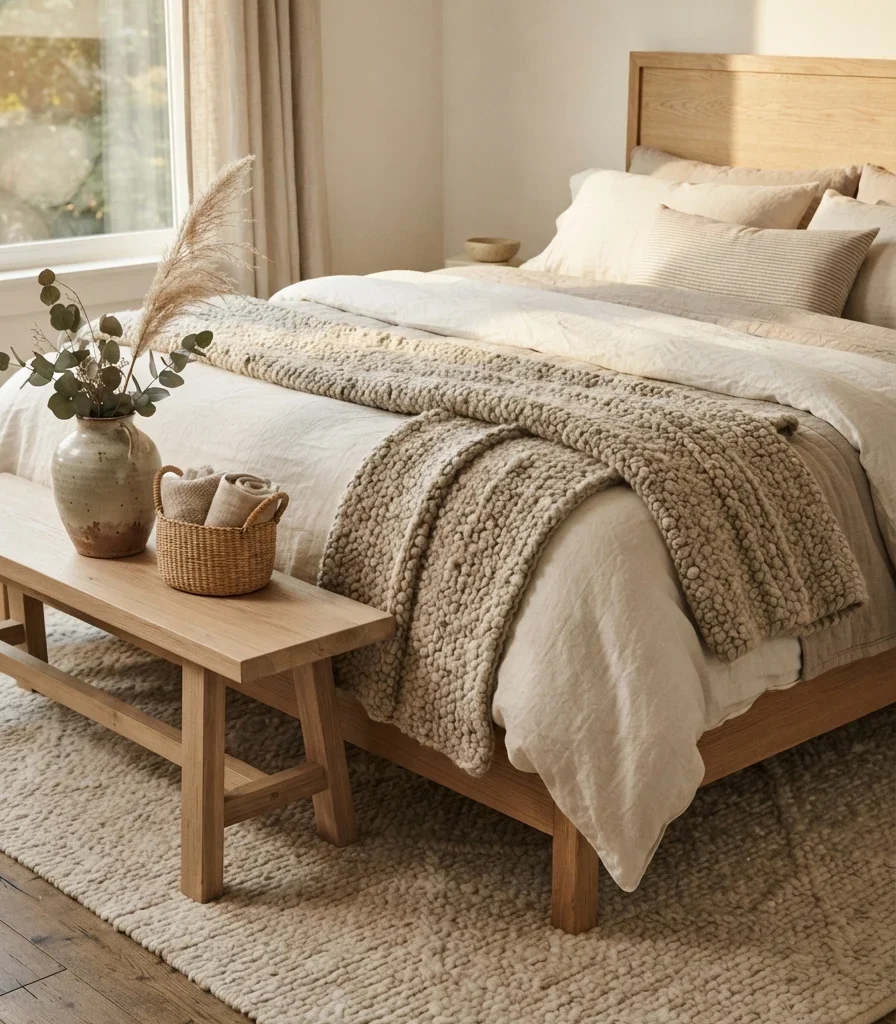
Vibe: Tactile; the room becomes inviting through visible and implied softness.
Why it works: Texture layering adds depth without requiring additional color. A chunky cotton, wool, or boucle throw contrasts with the flatter surface of a duvet and the fine weave of linen, creating a material hierarchy that the eye can read immediately. Placing the throw across the lower third also creates horizontal balance and visually finishes the bed without covering its entire surface.
How to get it: Choose a throw that differs from the duvet in both texture and scale, then place it loosely across the lower quarter to third of the bed rather than folding it into a rigid rectangle. Keep the color within two shades of the bedding for a restrained result.
Shop The Look
| Product | Search on Amazon |
| Throw blanket | Oatmeal chunky cotton knit throw |
| Boucle throw | Cream boucle textured throw blanket |
| Bed scarf | Taupe woven bed runner |
| Bench cushion | Neutral boucle bench cushion |
| Wool rug | Small natural wool bedside rug |
9. Use a Large Mirror to Multiply Daylight
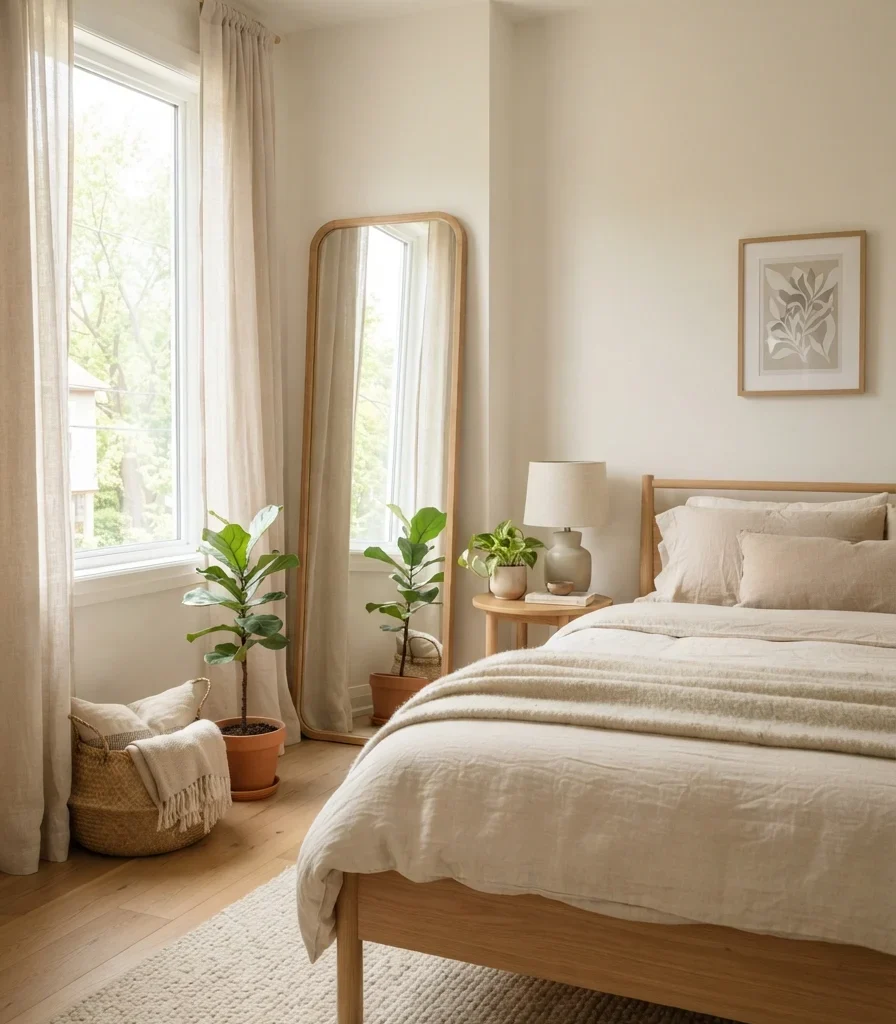
Vibe: Open reflected daylight gives the room more visual breathing room.
Why it works: A mirror can visually extend a bedroom by reflecting existing light and creating another apparent plane. The placement matters more than the mirror itself: positioning it where it catches a window or bright wall is considerably more effective than placing it against a dark corner. A tall vertical shape also emphasizes ceiling height and can make compact rooms feel less compressed.
How to get it: Position a large mirror perpendicular or diagonally opposite the brightest window rather than directly facing the bed. Choose a frame that echoes an existing material, such as pale oak, walnut, or matte black, so the mirror feels integrated rather than randomly introduced.
💡 Quick Win: Move an existing full-length mirror before purchasing a new one and test three positions during daylight; the brightest reflection is usually the strongest placement.
Shop The Look
| Product | Search on Amazon |
| Floor mirror | Full length arched wood frame bedroom mirror |
| Wall mirror | Large rounded rectangle bedroom wall mirror |
| Mirror hooks | Heavy duty D-ring mirror hanging hardware |
| Anti-tip kit | Furniture and mirror anti-tip wall anchor |
| Felt pads | Self-adhesive felt furniture floor protectors |
10. Create a Calm Gallery Above the Dresser
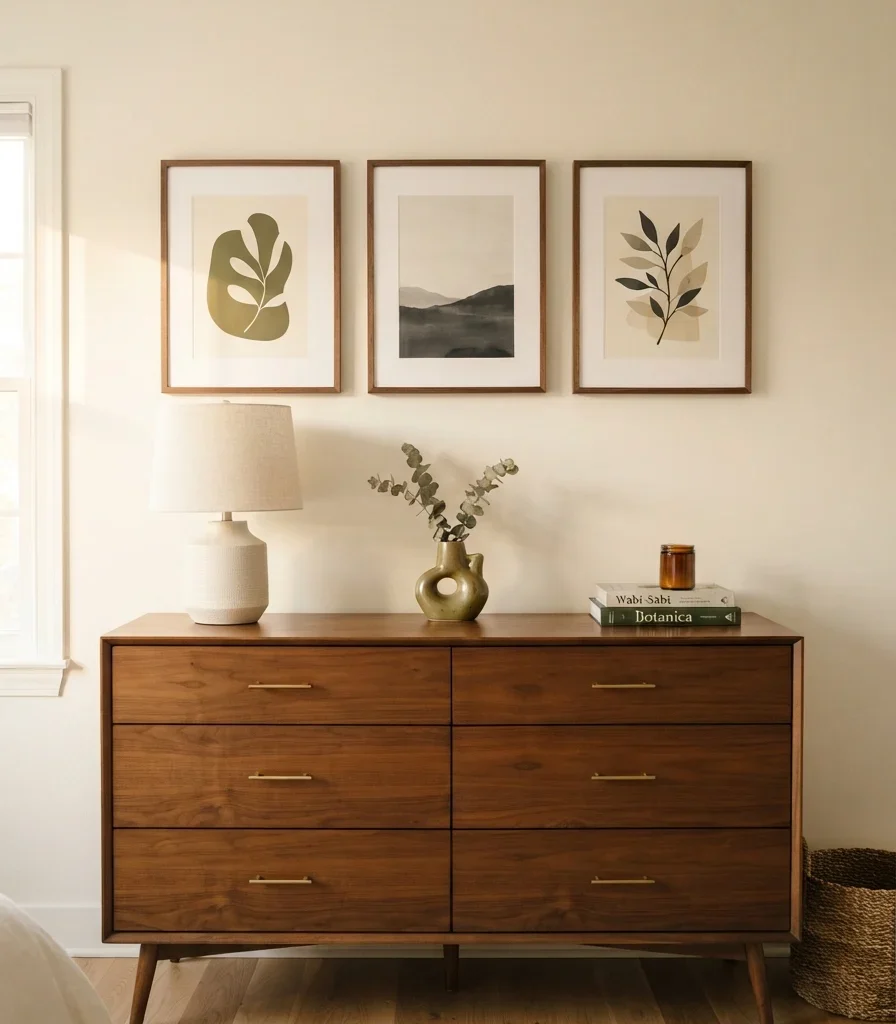
Vibe: Considered; the wall feels intentionally composed rather than merely decorated.
Why it works: A small coordinated gallery gives a bedroom personality while maintaining visual control. Repetition creates cohesion: using the same frame finish or a consistent color family makes three different artworks read as one collection. The arrangement should also relate to the furniture below; a grouping that is too narrow can make a dresser look oversized, while a grouping around two-thirds of the furniture width usually feels more proportionate.
How to get it: Choose three prints that share one visual thread, such as botanical forms or muted landscapes, and arrange them with consistent 5–8 cm spacing. Center the entire grouping over the dresser rather than centering each artwork individually.
Shop The Look
| Product | Search on Amazon |
| Botanical prints | Neutral botanical wall art set of 3 |
| Frames | Walnut wood picture frames 8×10 set |
| Mat boards | Off-white archival picture mat 8×10 |
| Hanging level | Magnetic picture hanging alignment tool |
| Dresser tray | Dark walnut decorative dresser tray |
11. Turn an Awkward Corner Into a Mini Reading Zone
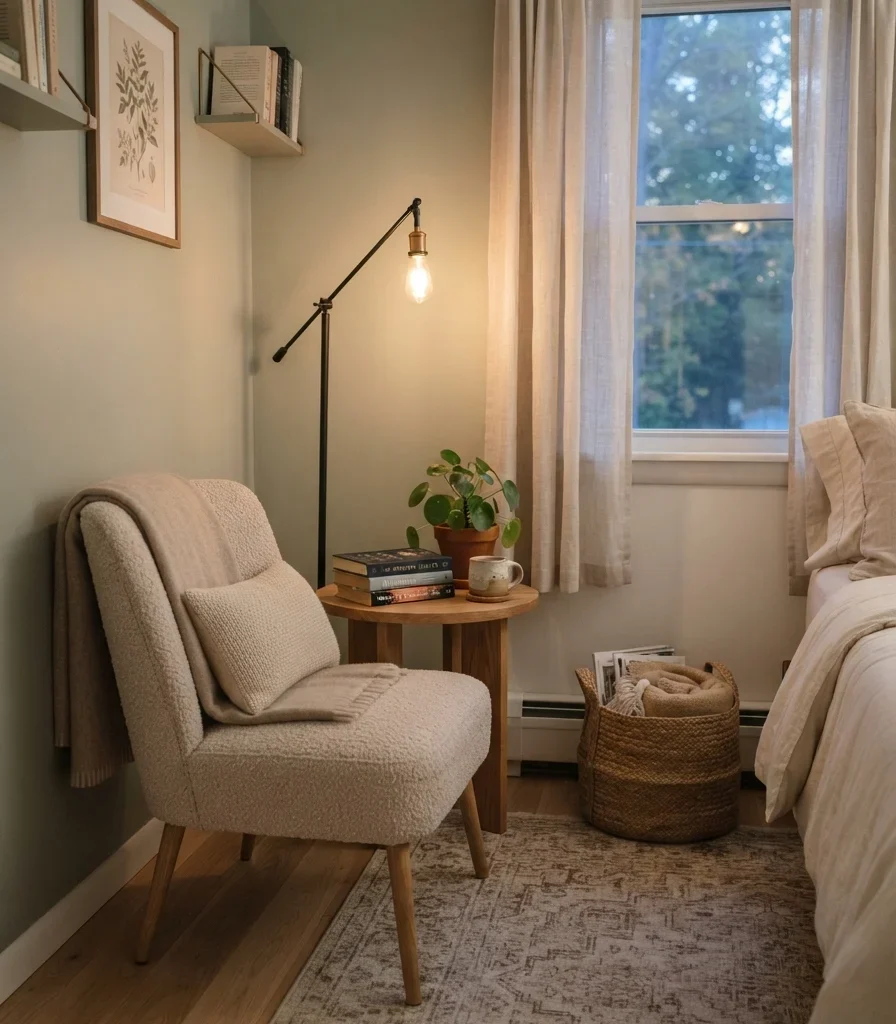
Vibe: Hushed; an unused corner becomes a reason to slow down.
Why it works: Giving an awkward corner a defined purpose makes the whole bedroom feel more intentional. The important principle is scale: a slim chair and small round table provide function without creating a second heavy furniture cluster. A dedicated reading light also prevents the corner from becoming purely decorative; the space earns its footprint through actual use.
How to get it: Choose the smallest chair that still supports your back comfortably, then pair it with a table no wider than about 40–45 cm. Place the lamp slightly behind and to the reading side of the chair so the light falls onto the pages rather than directly into your eyes.
💡 Quick Win: You can create the zone for under $50 initially with a small side table, secondhand chair cushion, warm LED bulb, and one basket for books or blankets.
Shop The Look
| Product | Search on Amazon |
| Accent chair | Compact oatmeal boucle bedroom reading chair |
| Side table | Small round natural oak side table |
| Reading lamp | Adjustable warm light floor reading lamp |
| Book basket | Woven seagrass floor basket for books |
| Throw | Sage green wool blend reading chair throw |
How to Start Your Home Bedroom Refresh
The single best first move is to reset the bed, because it is normally the largest visual object in the room and determines the color and texture direction for everything around it. Start with a warm ivory duvet cover and one muted secondary tone such as mushroom taupe or dusty sage; that foundation makes later decisions about curtains, rugs, art, and accessories much easier.
The most common mistake is changing too many small accessories before fixing scale and visual hierarchy. Ten new decorative objects cannot compensate for a bed that is badly positioned, curtains mounted too low, or lighting that is harsh and overhead-only. Fix the largest visual problems first, then add smaller details.
For an inexpensive entry point, buy three specific pieces: a warm ivory textured pillow cover, a small ceramic bedside lamp, and a woven cotton throw in oatmeal or muted sage, ideally keeping each under $50. Those three changes can introduce softness, warmth, and layered light without committing to new furniture.
A focused weekend can handle bedding, styling, curtains, artwork, and furniture rearrangement, while painting may take one to two days, i ncluding drying time. A starter refresh can realistically fall around $150–$500, while a fuller room update with new lighting, rug, curtains, storage, and one substantial furniture piece may reach $800–$2,500+, depending on room size and product quality.
Frequently Asked Questions About Home Bedroom Refresh
What is a home bedroom refresh and how is it different from redecorating?
A home bedroom refresh is a lighter intervention that improves an existing room without requiring a complete furniture replacement or renovation. It might involve new bedding, lighting, curtains, paint, artwork, and furniture placement while keeping the main bed and storage. Redecorating can be broader and may involve replacing multiple major pieces. A refresh is particularly useful when the room’s structure already works, but its atmosphere feels dated or unfinished.
What colors work best for a bedroom refresh?
Warm ivory, mushroom taupe, dusty sage, muted clay, soft blue-gray, and oatmeal are versatile choices because they create depth without overwhelming a sleeping space. If the room receives limited natural light, avoid using several dark colors simultaneously. A warm ivory base with one accent such as dusty sage is usually easier to balance than introducing three or four competing colors.
How much does a bedroom refresh usually cost?
A small DIY refresh can cost approximately $150–$500 if you concentrate on bedding, lighting, textiles, and artwork. A more comprehensive update with a rug, curtains, new lighting, paint, storage, and one substantial furniture piece can reach $800–$2,500 or more. The largest savings usually come from keeping the existing bed and major storage pieces while changing the surfaces around them.
Can I refresh a small bedroom without making it feel more crowded?
Yes, but every new item should justify its footprint. Use wall-mounted sconces, under-bed storage, tall curtains, a large mirror, and furniture with drawers instead of adding multiple freestanding decorative pieces. Keep at least one visible area of negative space around the bed so the room does not become visually compressed.
What is the most important element to update during a home bedroom refresh?
The bed is usually the strongest starting point because it occupies the most visual area and is the room’s primary functional feature. Start with layered bedding, then evaluate the headboard, bedside lighting, rug, and surrounding furniture. A correctly proportioned bed zone can make the rest of the room look more intentional even before additional accessories are added.
Ready to Create Your Refreshed Bedroom?
These 11 home bedroom refresh ideas cover the pieces that make the biggest difference: bedding, color, natural materials, lighting, layout, mirrors, artwork, and functional corners. A transformation does not need to happen all at once; starting with one high-impact change is often the smartest way to avoid buying pieces that later compete with each other. Today, strip the bed, clear both nightstands, and rebuild the bed with one warm ivory layer and one contrasting textured layer. As the room becomes calmer and more functional, it should feel less like a collection of furniture and more like a place designed specifically for rest and everyday comfort. Save or pin your favorite ideas now, especially the layered bedding, warm lighting, and small reading-corner concepts you can return to when your next bedroom update begins.
You Might Also Like
- 16 Ways to Optimize a Home Office Setup in a Small Bedroom
- 15 Serene Atmosphere Green Bedroom Ideas
- 12 Cozy Green Terracotta Bedroom Ideas Worth Saving
- 10 Black and Green Bedroom Design Ideas Worth Saving
- 10 Ways to Create a Relaxing Green Grey Bedroom
- 12 Green Comforter Bedroom Ideas for Max Comfort