
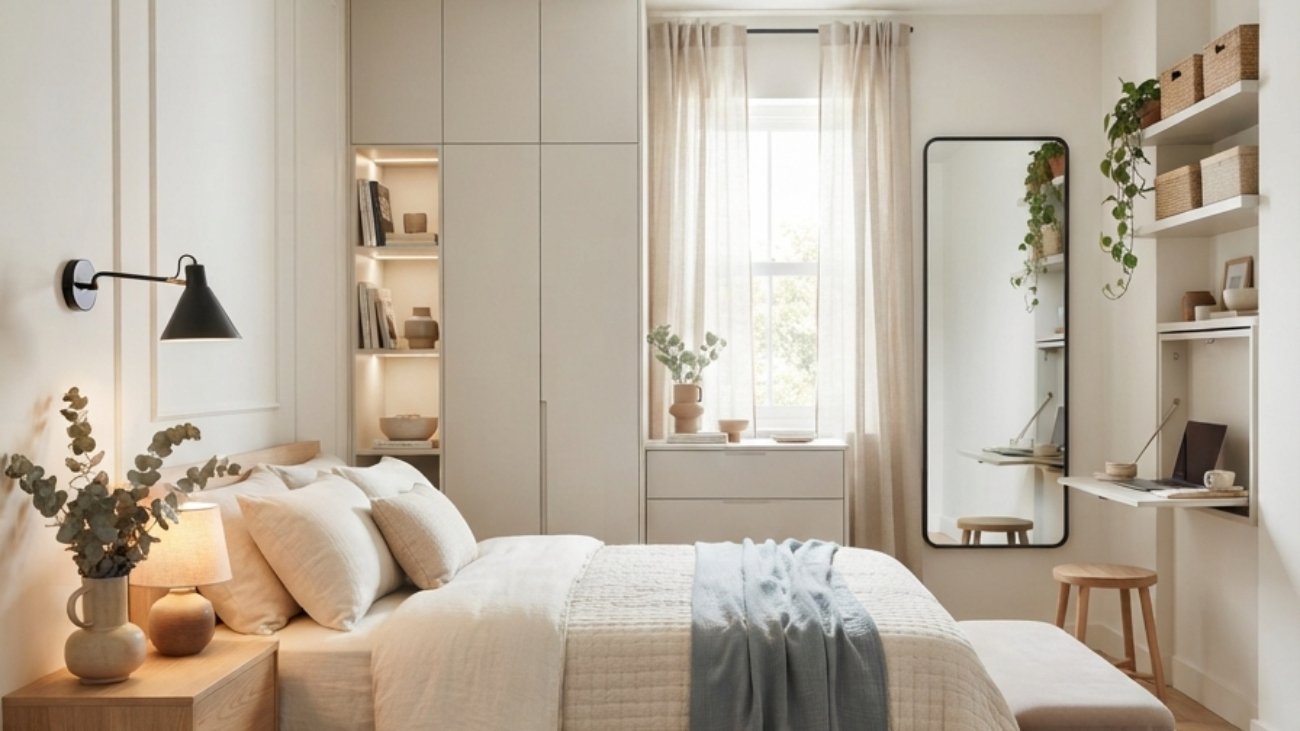
A tiny bedroom design uses scale, vertical space, visual continuity, and multifunctional furniture to make a genuinely small sleeping area feel calmer and more usable. These 18 Tiny Bedroom Design Ideas focus on space-saving layouts, smart storage, light, color, materials, and furniture choices that work without making the room feel overfilled.
The best tiny bedrooms do not feel like storage closets with a bed squeezed inside; they feel edited, intentional, and surprisingly restful. Soft daylight can travel farther when surfaces stay visually quiet, while warm linen, pale timber, and tactile bedding add comfort without demanding extra floor area. The goal is not to pretend a 70-square-foot room is enormous, but to make every inch work harder and look lighter while doing it. Here are 18 ideas worth saving and stealing.
Why Tiny Bedroom Design Ideas Work So Well
Tiny-bedroom design is not a single historical style; it is a modern space-planning approach influenced by functionalism, compact apartment living, Japanese spatial restraint, and Scandinavian ideas about useful, comfortable interiors. Early modernist furniture increasingly treated storage and furniture as tools for rational use of limited domestic space, while postwar Japanese design pushed modular and compact interiors even further.
The material palette works best when visual weight stays controlled: warm white, soft greige, pale oak, natural linen, wool, cane, matte ceramic, brushed brass, and light birch all reflect or distribute light without making the room feel sterile. Rather than using many tiny decorative objects, choose one substantial mirror, one tactile textile layer, or one strong wall treatment and let negative space around it do some of the decorating.
Style at a Glance
| Element | Core Trait 1 | Core Trait 2 |
| Philosophy | Space efficiency | Visual calm |
| Materials | Pale oak, linen, glass | Wool, cane, matte ceramic |
| Color palette | Warm white, greige | Oatmeal, muted sage |
1. Tiny Bedroom Design Ideas: Start with a Warm White and Oatmeal Palette
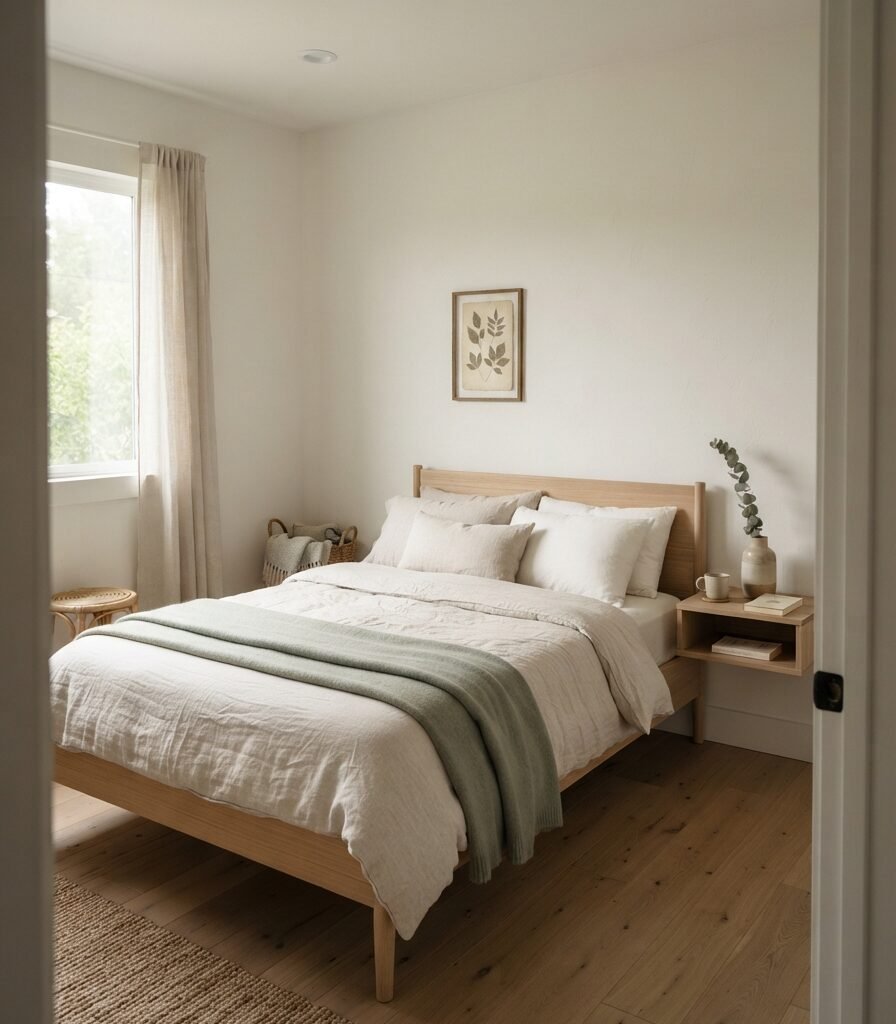
Vibe: Hushed, with the visual quietness of a room that finally has somewhere for the eye to rest.
Why it works: Color continuity reduces visual fragmentation, one of the most useful principles in a tiny bedroom because contrasting walls, trim, furniture, and bedding can make the footprint feel chopped into separate blocks. Warm white walls paired with oatmeal linen and pale oak create tonal layering without introducing strong visual boundaries.
How to get it: Paint the walls and trim within the same warm-white family, then keep the largest textile surfaces within one step of that tone. Let pale oak provide the darker value rather than adding several unrelated wood finishes.
💡 Quick Win: Swap bright-white bedding for an oatmeal duvet cover before changing furniture; the softer contrast immediately makes the room feel more cohesive.
Shop The Look
| Product | Purpose |
| Warm white washable matte interior paint | Tonal wall foundation |
| Oatmeal linen-look duvet cover | Soft visual layering |
| Pale oak platform bed frame | Light furniture anchor |
| Muted sage lumbar pillow | Controlled accent color |
| Small matte ceramic bud vase | Minimal bedside detail |
2. Pale Oak Slat Headboard for Vertical Texture
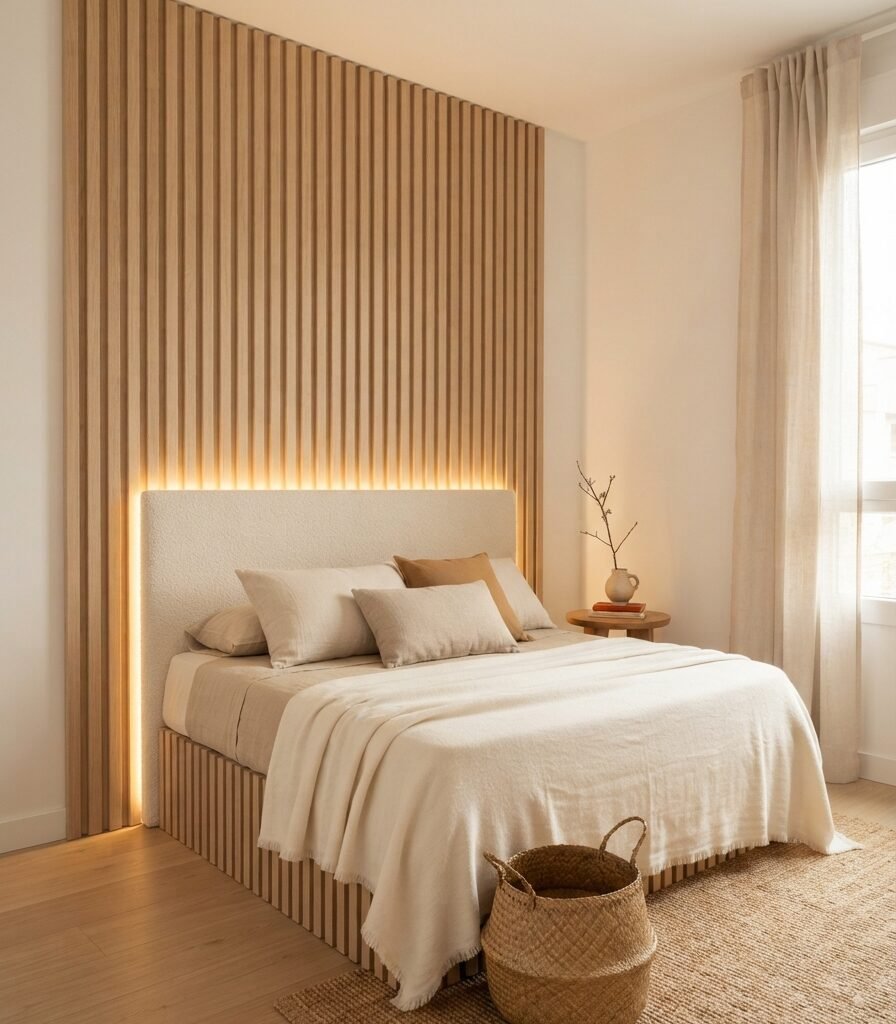
Vibe: Grounded, with texture rising upward instead of spreading across the floor.
Why it works: Vertical repetition draws the eye toward the ceiling while the narrow slats add texture without adding physical depth. Pale oak also introduces warmth without the visual heaviness of dark walnut or painted cabinetry.
How to get it: Use 25–35mm-wide oak battens with consistent gaps of roughly 20–25mm, keeping the total projection shallow. Stop the treatment at the ceiling rather than creating a short headboard panel if ceiling height is one of the room’s strengths.
Shop The Look
| Product | Purpose |
| Natural oak wall slat panels | Vertical feature wall |
| Cream upholstered compact headboard | Soft bed backdrop |
| Warm white LED strip kit | Hidden illumination |
| Natural jute bedside basket | Organic texture |
| Camel linen lumbar pillow | Warm tonal accent |
3. Wall-Mounted Reading Lights Instead of Bedside Lamps
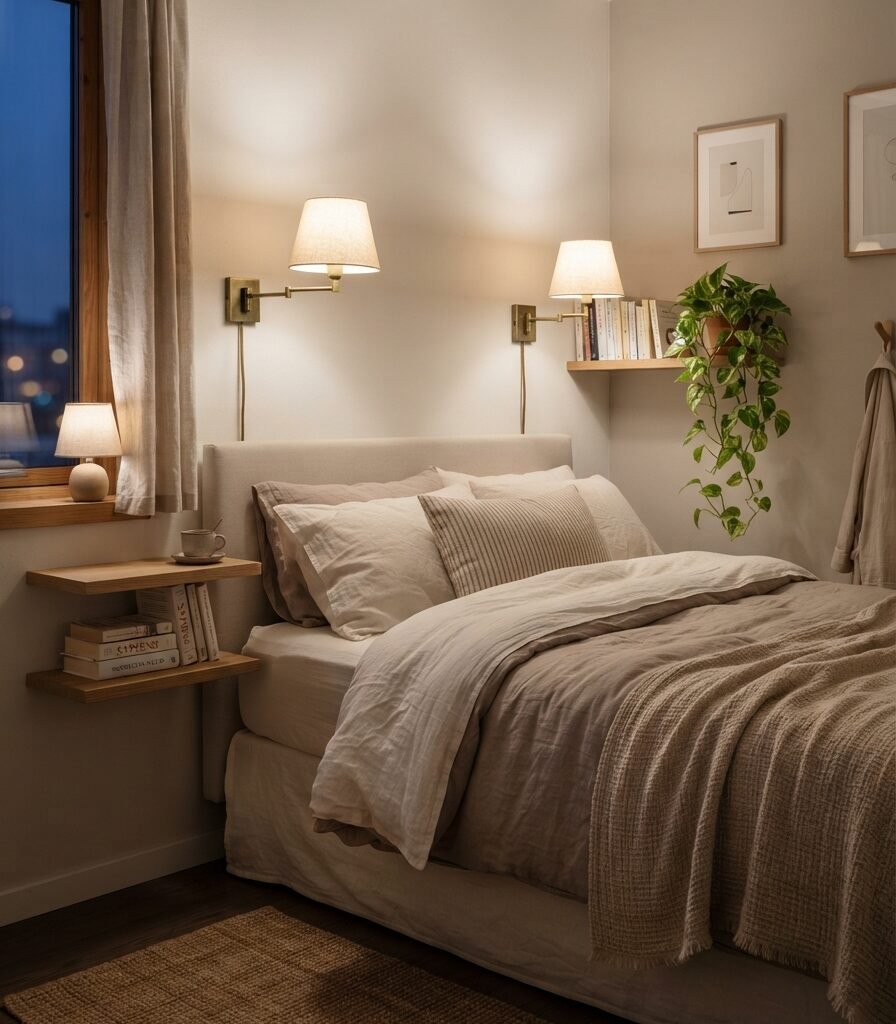
Vibe: Efficient, as though the bedside surfaces suddenly became twice as useful.
Why it works: Removing table lamps recovers precious horizontal surface area while wall-mounted fixtures add vertical interest. The principle is functional compression: lighting moves onto the wall plane instead of consuming floor or tabletop space.
How to get it: Install slim swing-arm sconces approximately 50–60cm above the mattress surface, then pair them with 2700K dimmable bulbs. A floating shelf beneath each fixture can hold only the essentials: a book, a glass, and one small object.
💡 Quick Win: Battery-operated rechargeable sconces can test the placement before you commit to hardwiring.
Shop The Look
| Product | Purpose |
| Aged brass swing-arm wall sconces | Bedside lighting |
| Warm 2700K dimmable LED bulbs | Soft reading light |
| Narrow natural-oak floating shelf | Nightstand replacement |
| Neutral linen pillow pair | Bed styling |
| Small rechargeable wall light | Rental-friendly backup |
4. Slim-Leg Bed with Visible Floor Around It
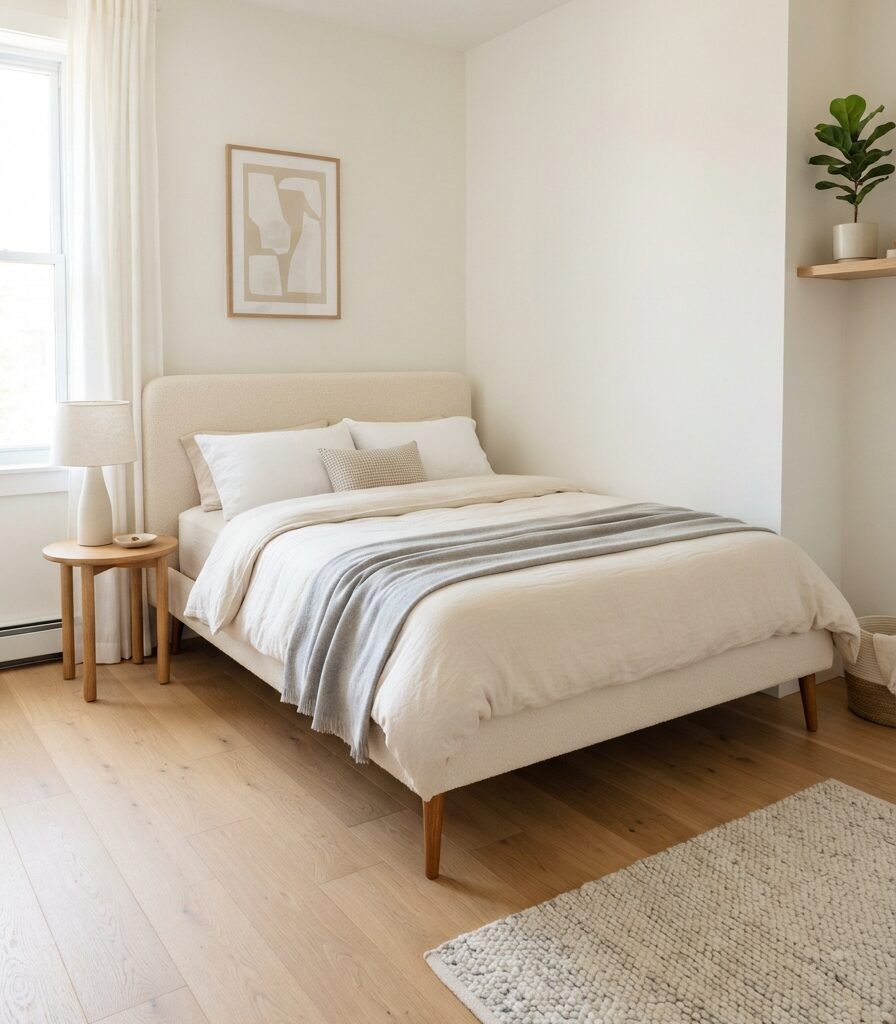
Vibe: Airy, because the floor remains visible beneath and around the furniture.
Why it works: Furniture lifted on slim legs creates visible floor continuity, reducing visual weight compared with a bulky base that meets the floor. This does not add square footage, but it makes the floor plane easier for the eye to read as one uninterrupted surface.
How to get it: Choose a bed frame with approximately 12–18cm of visible clearance and avoid oversized under-bed drawers that visually close the floor line. Use matching pale wood elsewhere so the legs feel integrated rather than decorative.
Shop The Look
| Product | Purpose |
| Slim-leg cream upholstered bed | Lightweight furniture anchor |
| Pale oak furniture riser feet | Increased floor visibility |
| Soft gray low-pile bedroom rug | Grounding layer |
| Linen duvet in natural white | Quiet bedding |
| Slim ceramic bedside lamp | Compact illumination |
5. One Oversized Mirror Instead of Several Small Frames
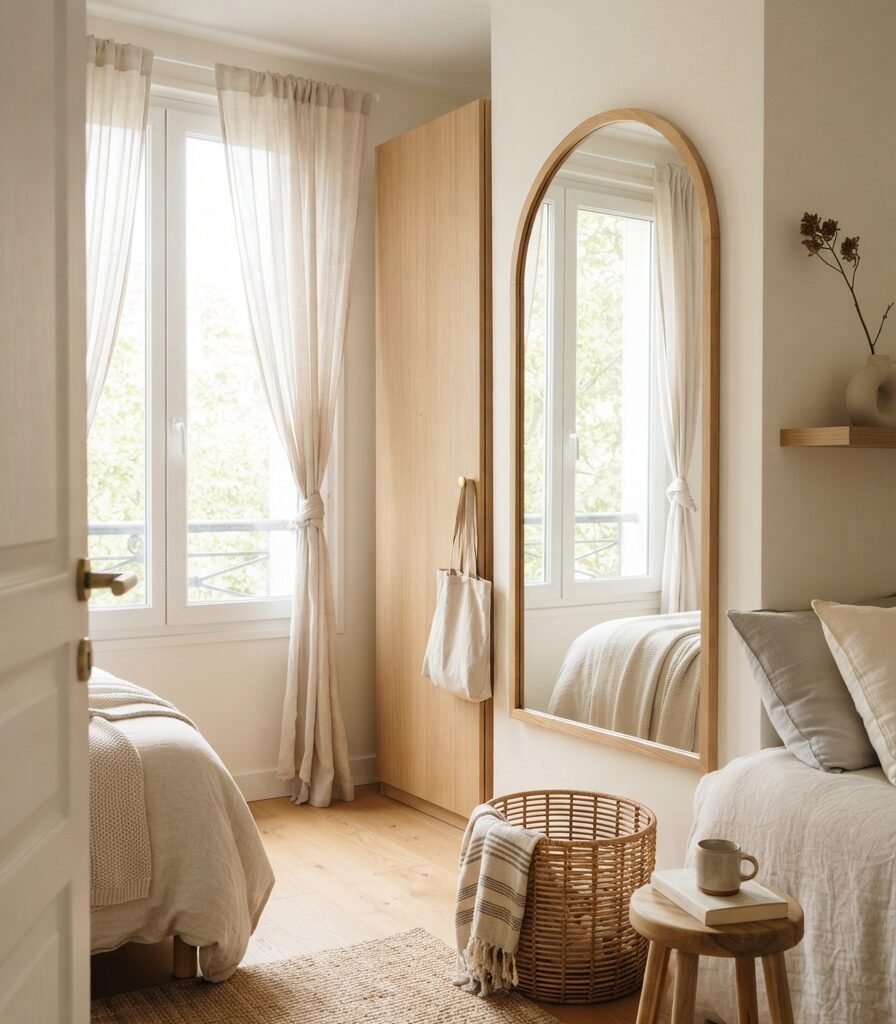
Vibe: Luminous, as if the room borrowed another window.
Why it works: A single large reflective plane extends sightlines more effectively than multiple tiny mirrors separated by wall space. Recent small-bedroom guidance similarly favors large, cohesive reflective elements because scattered small pieces can create visual fragmentation.
How to get it: Choose a mirror at least 150–165cm tall if floor space allows, and place it beside rather than directly opposite the brightest window when possible. Secure a leaning mirror with anti-tip hardware.
💡 Quick Win: Test the mirror position with a cardboard rectangle before buying; it reveals whether the reflection actually adds useful depth.
Shop The Look
| Product | Purpose |
| Tall arched oak-framed mirror | Visual expansion |
| Anti-tip mirror safety kit | Stability |
| Narrow wooden stool | Dressing support |
| Woven seagrass basket | Soft storage |
| Ivory linen-look curtain panels | Light filtering |
6. A Floating Nightstand That Gives the Floor Back
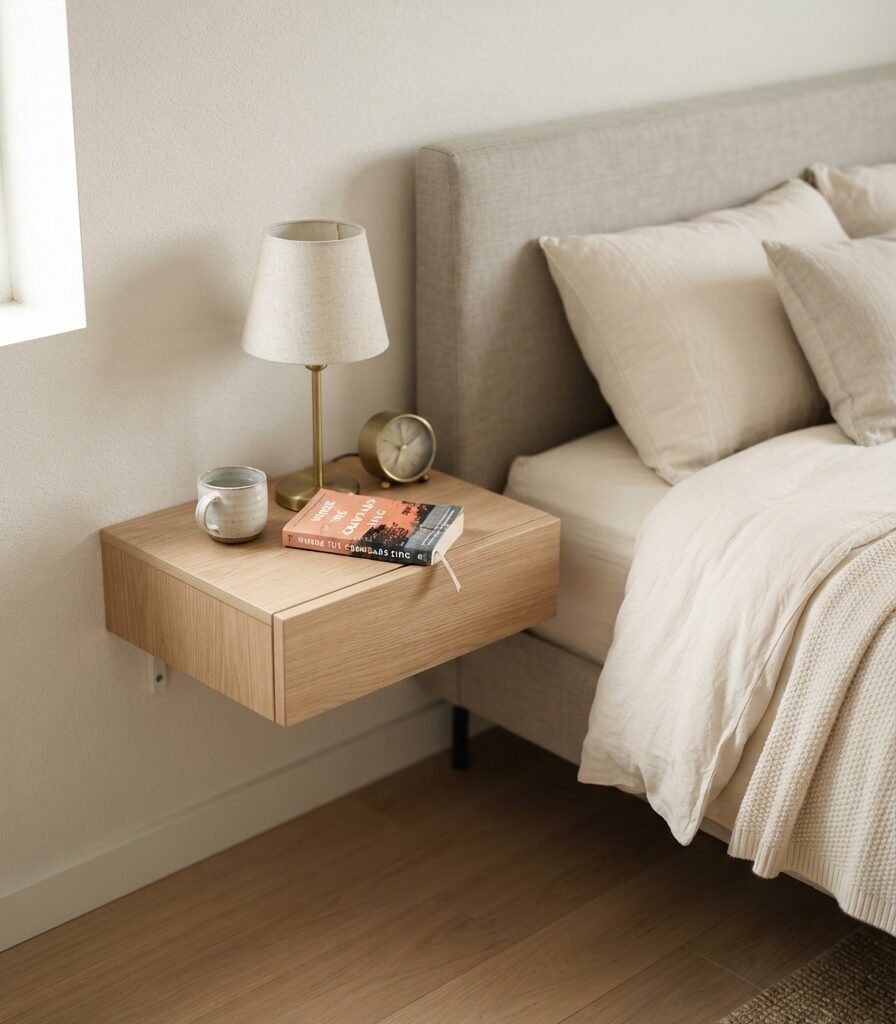
Vibe: Weightless, because nothing bulky interrupts the floor beneath the bed.
Why it works: Floating furniture shifts useful storage onto the wall plane and preserves floor visibility, which is especially valuable beside a bed where a conventional nightstand can create a narrow pinch point. The approach also makes cleaning easier.
How to get it: Install a shelf approximately 18–25cm deep and keep the top visually restrained. One lamp, one book, and one small tray are enough; the empty surface is part of the design.
Shop The Look
| Product | Purpose |
| 24-inch natural-oak floating shelf | Bedside surface |
| Heavy-duty concealed shelf brackets | Wall support |
| Small brass analog alarm clock | Functional accessory |
| Mini ceramic bedside cup | Practical styling |
| Slim rechargeable reading lamp | Surface-free lighting |
7. Tiny Bedroom Design Ideas: Get More Depth with a Tonal Sage Accent Wall
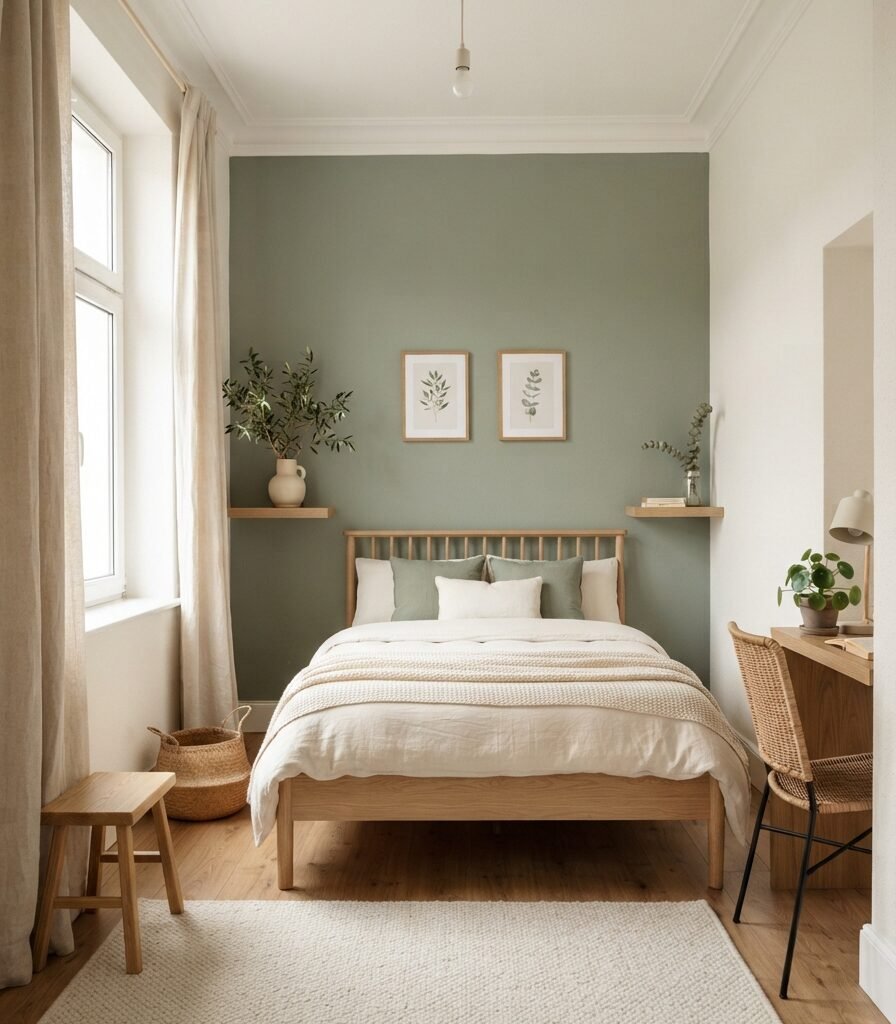
Vibe: Restful, with just enough color to give the room a quiet focal point.
Why it works: A restrained accent wall creates depth without introducing the high contrast that can visually shorten a tiny room. Muted sage has enough saturation to distinguish the bed wall while remaining close in visual intensity to warm neutrals.
How to get it: Try a dusty or gray-green sage rather than a saturated emerald. Paint only the wall behind the bed and keep bedding within ivory, oatmeal, and natural flax so the accent remains architectural rather than decorative noise.
💡 Quick Win: Paint only the headboard rectangle first; if you love the depth it creates, extend the color across the entire wall.
Shop The Look
| Product | Purpose |
| Muted sage matte interior paint | Accent wall |
| Ivory linen duvet cover | Neutral balance |
| Pale oak floating shelf | Warm material repetition |
| Botanical olive branch stems | Organic accent |
| Cream ceramic vase | Soft accessory layer |
8. Under-Bed Storage with Matching Fabric Boxes

Vibe: Tidy, with everyday clutter disappearing into the architecture of the bed.
Why it works: Under-bed storage uses a volume that otherwise sits empty, but matching containers prevent the area from becoming a visual dumping ground. Repetition of fabric texture also keeps the storage visually quieter than mismatched plastic bins.
How to get it: Measure the clear height under the frame before shopping and choose boxes at least 2cm shorter than that opening. Label only the handles so the storage stays visually anonymous.
Shop The Look
| Product | Purpose |
| Oatmeal under-bed storage bins | Hidden clothing storage |
| Pale oak raised platform bed | Storage clearance |
| Cotton rope-handled organizer | Soft organization |
| Cream washable low-pile rug | Floor softness |
| Linen storage label tags | Easy identification |
9. Use a Doorway-to-Bed Sightline for Better Flow
Vibe: Clear, because the eye can travel through the room without hitting furniture immediately.
Why it works: Layout matters more than decoration when the footprint is extremely small. A continuous sightline from doorway to window or bed makes the room easier to read, while furniture pushed to the perimeter reduces interruption in the main circulation path.
How to get it: Stand in the doorway and identify the strongest destination point, then keep that visual axis as open as possible. Avoid placing a tall dresser directly opposite the entrance unless it is built into the wall.
💡 Quick Win: Move one piece of furniture 10–15cm toward a wall and photograph the room before and after; the difference in visual openness can be surprisingly large.
Shop The Look
| Product | Purpose |
| Narrow washable bedroom runner | Defines circulation |
| Slim five-drawer vertical dresser | Perimeter storage |
| Minimal framed line-art print | Vertical focal point |
| Small faux olive tree | Controlled height |
| Furniture moving sliders | Easy layout testing |
10. A Narrow Wardrobe with Full-Height Doors
Vibe: Composed, because the storage reads as architecture instead of furniture clutter.
Why it works: Full-height storage uses vertical volume rather than floor width, and continuous doors reduce the visual noise created by several freestanding storage pieces. Space-saving wardrobe design has a long connection to functionalist thinking about rational organization of domestic interiors.
How to get it: If replacing a wardrobe, prioritize height before width and choose doors with a flat finish. Interior drawers and adjustable shelves matter more than decorative exterior detailing.
Shop The Look
| Product | Purpose |
| Tall narrow wardrobe cabinet | Vertical clothing storage |
| Brushed brass cabinet pulls | Refined hardware |
| Stackable fabric drawer organizers | Interior organization |
| Slim felt hangers | Space-efficient hanging |
| Over-door accessory organizer | Small-item storage |
11. Soft Linen Curtains Hung Above the Window

Vibe: Airy, with the window appearing taller and the ceiling slightly farther away.
Why it works: Long vertical fabric panels extend the eye upward and prevent the window from reading as a small isolated rectangle. Lightweight linen-look fabric also filters daylight without creating the heavy visual block of dark curtains.
How to get it: Mount the curtain rod or track as close to the ceiling as practical and let the panels reach the floor. Choose ivory or flax rather than charcoal if the room receives limited daylight.
Shop The Look
| Product | Purpose |
| Ivory linen-look curtain panels | Soft window treatment |
| Ceiling-mount curtain track | Vertical installation |
| Matte brass curtain clips | Hardware detail |
| Natural flax tieback pair | Practical styling |
| White sheer privacy panel | Daylight diffusion |
12. Tiny Bedroom Design Ideas Can Use a Built-In Headboard Shelf
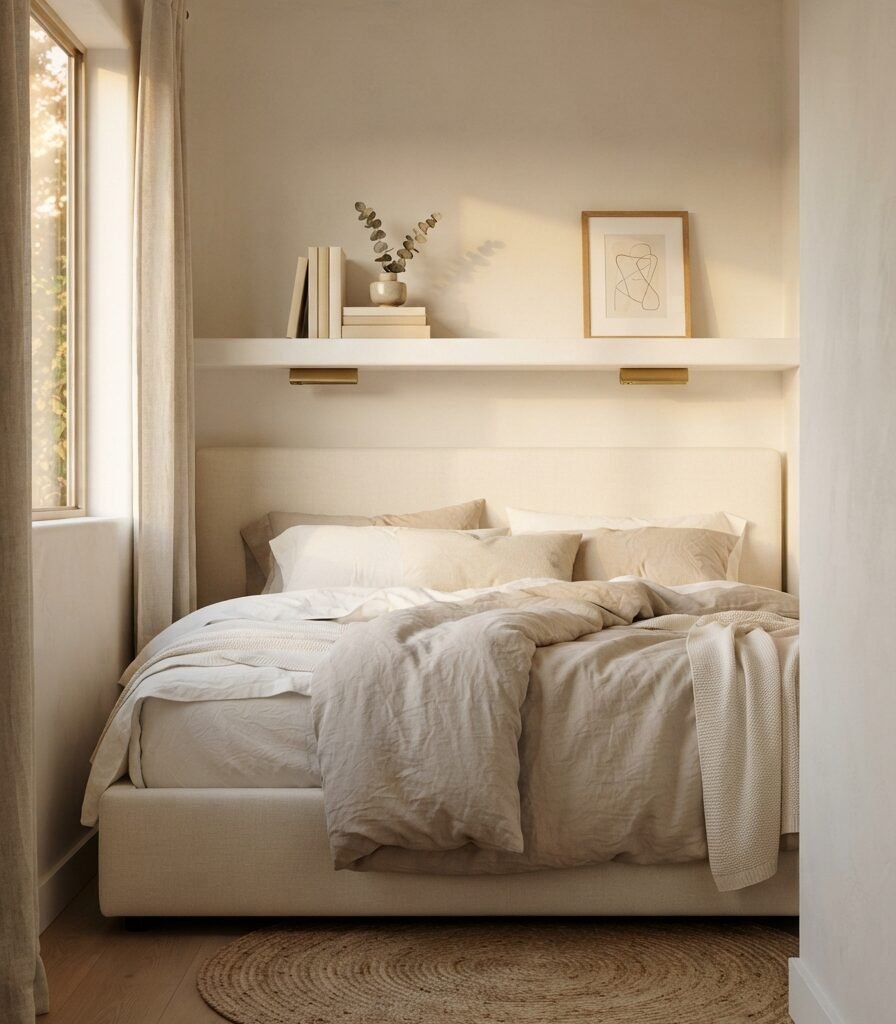
Vibe: Architectural, because the bed wall feels designed rather than furnished piece by piece.
Why it works: A shallow shelf can replace two bedside tables while creating a continuous horizontal line behind the bed. The visual principle is consolidation: several functions occupy one carefully controlled zone instead of competing across the room.
How to get it: Aim for roughly 15–20cm of shelf depth and keep objects concentrated in small groups rather than filling the entire length. Add concealed LED lighting underneath if the wall can accommodate wiring.
💡 Quick Win: Recreate the effect with one long picture ledge behind the bed before committing to custom carpentry.
Shop The Look
| Product | Purpose |
| Long natural-wood picture ledge | Headboard shelf effect |
| Cream upholstered bed frame | Soft anchor |
| Warm white rechargeable puck lights | Shelf illumination |
| Neutral hardcover book stack | Controlled styling |
| Small handmade ceramic vessel | Organic focal point |
13. Cane or Rattan Storage for Lightweight Texture

Vibe: Tactile, with natural texture replacing bulky decoration.
Why it works: Woven cane introduces pattern and shadow without the visual density of dark cabinetry or heavily carved furniture. It also connects storage to the room’s softer textiles, making a practical piece feel intentional.
How to get it: Choose one cane-front storage piece rather than several woven items. Keep the frame in pale oak or natural timber and avoid mixing multiple yellow-toned woods.
Shop The Look
| Product | Purpose |
| Slim rattan-front storage cabinet | Textured storage |
| Natural woven laundry hamper | Clothing containment |
| Pale oak floating shelf | Vertical storage |
| Cream linen cushion | Soft material repetition |
| Woven seagrass tray | Small-item organization |
14. Warm Layered Lighting at Three Heights

Vibe: Layered, because the room has depth even after sunset.
Why it works: Multiple light heights prevent the ceiling fixture from becoming the sole source of illumination. Current small-bedroom lighting guidance emphasizes layered sources, warm 2700K bulbs, and wall-mounted or vertical fixtures to create depth without consuming floor space.
How to get it: Combine one ceiling source, one bedside source, and one low ambient source, preferably with independent switches or dimming. Avoid making all three equally bright; the lower sources should provide the softer glow.
Shop The Look
| Product | Purpose |
| Frosted glass flush-mount ceiling light | General illumination |
| Brass swing-arm wall sconce | Bedside task light |
| Warm white under-bed LED strip | Low ambient glow |
| 2700K dimmable LED bulb set | Consistent warmth |
| Plug-in dimmer switch | Lighting control |
15. A Compact Upholstered Bench at the Foot of the Bed
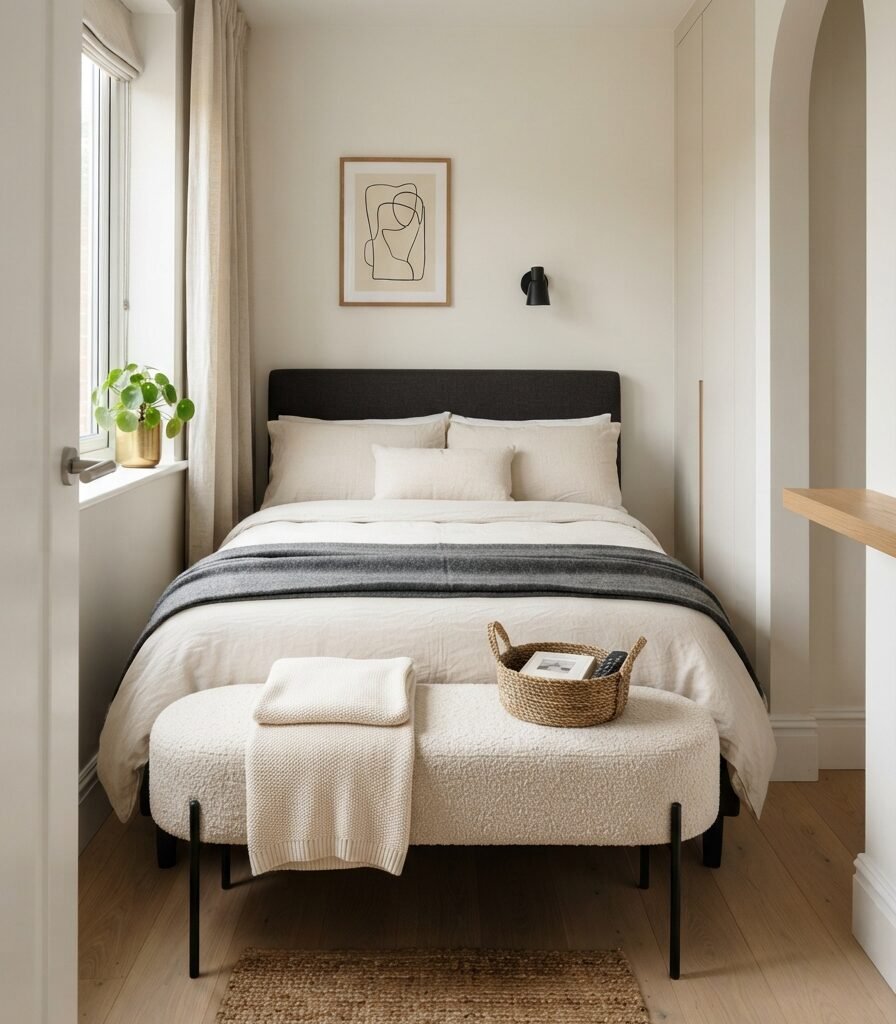
Vibe: Balanced, giving the end of the bed purpose without making it feel crowded.
Why it works: A slim bench provides seating, temporary clothing placement, or a place to fold laundry while remaining much lighter than an upholstered trunk. The principle is multifunctional furniture: one footprint serves several daily tasks.
How to get it: Choose a bench no deeper than about 30–35cm and maintain a comfortable circulation zone around it. Avoid storage benches with bulky solid bases if the room already contains substantial furniture.
💡 Quick Win: Use a narrow upholstered stool instead if a bench would reduce the walkway below a comfortable width.
Shop The Look
| Product | Purpose |
| 90cm oatmeal boucle bench | Compact seating |
| Slim black metal-leg stool | Alternate footprint |
| Folded linen throw blanket | Soft styling |
| Small lidded storage basket | Temporary storage |
| Pale oak bedside furniture | Material continuity |
16. A Full-Width Curtain Wall for a Window That Feels Larger
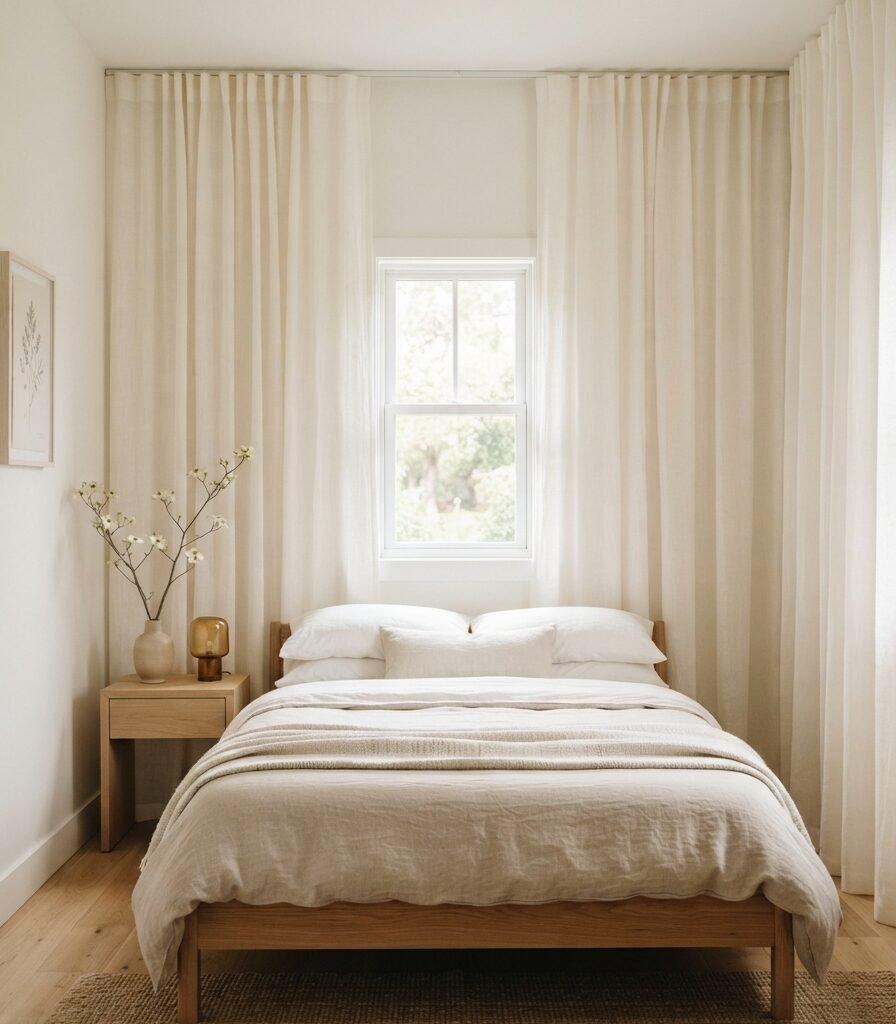
Vibe: Expansive, because the window stops feeling like a small isolated opening.
Why it works: Extending curtains beyond the actual window frame creates a larger textile composition and hides uneven wall edges. The uninterrupted vertical fabric can make a tiny window wall feel calmer and more substantial.
How to get it: Install the track wider than the window and use two full-height panels that stack outside the glass when open. Choose a light linen-look fabric so the enlarged treatment does not become a heavy visual block.
Shop The Look
| Product | Purpose |
| Wall-to-wall ivory curtain panels | Enlarged window effect |
| Extra-wide ceiling curtain track | Full-width installation |
| Linen-look sheer panels | Daylight diffusion |
| Matte white curtain gliders | Clean hardware |
| Pale oak curtain rod cover | Warm finishing detail |
17. Concealed Storage Behind the Bed
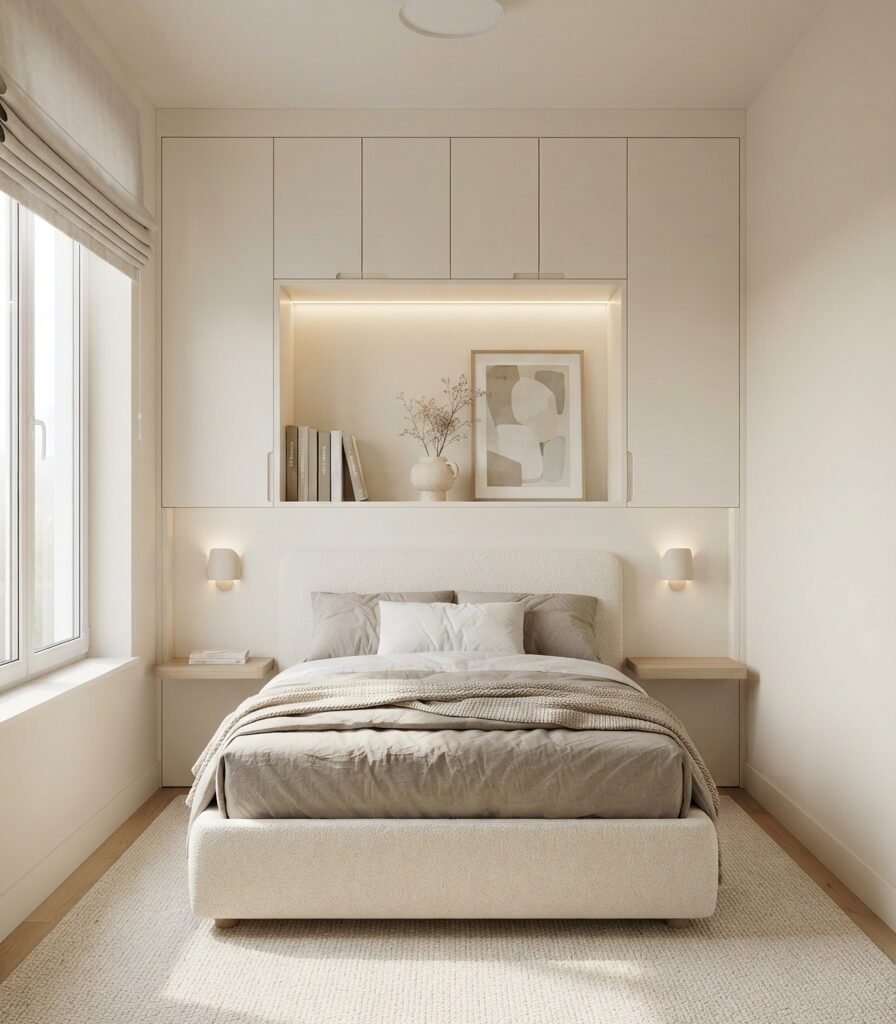
Vibe: Seamless, because storage disappears into the architecture instead of crowding the room.
Why it works: Built-in storage uses the wall’s full height and depth while reducing the number of freestanding objects. The uninterrupted surface also gives a tiny bedroom fewer visual boundaries, which helps preserve a sense of calm.
How to get it: If custom cabinetry is possible, use shallow cupboards around or above the bed and reserve open niches for only a few objects. For a rental, imitate the effect with matching tall cabinets placed tightly together and painted in the wall color.
Shop The Look
| Product | Purpose |
| Tall narrow white storage cabinets | Vertical concealed storage |
| Push-to-open cabinet hardware | Handle-free appearance |
| Adjustable white shelving inserts | Flexible organization |
| Cream upholstered headboard | Soft transition |
| Matte ceramic storage box | Small-item containment |
18. One Large Artwork with a Controlled Material Palette

Vibe: Focused, with one strong visual statement replacing a wall full of small distractions.
Why it works: In compact rooms, one substantial artwork can establish scale more confidently than a cluster of tiny frames. This follows the same visual-discipline principle used in successful small-bedroom wall treatments: concentrate design energy on one wall rather than fragmenting it across the room.
How to get it: Choose artwork roughly two-thirds the width of the bed and frame it in pale timber or another material already present in the room. Leave intentional negative space around it instead of adding filler pieces.
💡 Quick Win: Print one oversized abstract image at a local print shop and use a simple poster-hanger frame instead of commissioning custom framing.
Shop The Look
| Product | Purpose |
| Large neutral abstract wall print | Main focal point |
| Slim pale-oak poster frame | Lightweight framing |
| Minimal wall hanging hardware | Secure installation |
| Oatmeal wool throw blanket | Texture layer |
| Matte charcoal ceramic vase | Controlled contrast |
How to Start Your Tiny Bedroom Transformation
Start with one exact move: clear a 70cm-wide visual path from the bedroom entrance toward the bed or window. This anchors the entire transformation because furniture placement determines whether every later storage, lighting, and decor decision feels spacious or obstructed. Photograph the room from the doorway before moving anything, then remove or relocate the first object that interrupts that sightline.
The most common mistake is buying several pieces labeled “small” without checking their combined footprint. A 35cm nightstand, 40cm dresser, floor lamp, chair, and basket can consume more usable circulation than one properly planned storage wall. Measure every piece,e including door swing and drawer clearance,ce before purchasing, and prioritize multifunctional or wall-mounted furniture.
For under $50, start with a 2700K dimmable LED bulb set, a small adhesive-backed rechargeable puck-light set, and one 60–90cm natural-oak picture ledge. These three changes improve warmth, lighting, and vertical storage without committing you to a renovation.
A cosmetic weekend refresh can realistically cost 50–200, while a more complete furniture and storage update may reach 500–1,500 depending on cabinetry and bed quality. Painting, lighting swaps, floating shelves, and decluttering can happen in one weekend; custom wardrobes, built-ins, electrical work, or made-to-measure furniture may take several weeks.
Frequently Asked Questions About Tiny Bedroom Design Ideas
What makes a bedroom look bigger without removing walls?
The biggest visual gains usually come from reducing fragmentation rather than adding more decoration. Use one continuous wall color, a large mirror, visible floor beneath furniture, and curtains that extend toward the ceiling. In very small rooms, one large artwork or mirror often reads more coherently than several small pieces.
What colors are best for a tiny bedroom?
Warm white, soft greige, oatmeal, pale sage, and muted taupe are reliable choices because they maintain lightness without the starkness of pure white. If you want stronger color, use a single muted accent such as dusty sage on the headboard wall. Avoid using several high-contrast colors on adjacent walls because they visually divide the small footprint.
How much does it cost to redesign a tiny bedroom?
A simple refresh can cost around 50–200 when it focuses on paint, bulbs, textiles, and small storage accessories. A mid-range furniture refresh may fall around 500–1,500, while custom cabinetry or built-in storage can push the project considerably higher. The most economical approach is to solve layout and storage before buying decorative items.
Can a tiny bedroom still have a king-size bed?
It can, but the trade-off is substantial. A king bed is about 193cm wide by 203cm long, so the remaining floor area needs to accommodate door swings, wardrobes, and comfortable circulation. If the room cannot preserve a practical walking route around the bed, a queen or full-size bed may provide a much more usable room even if the larger mattress technically fits.
Which storage idea works best in a very small bedroom?
Full-height vertical storage is usually more effective than adding multiple low cabinets because it uses wall volume without consuming additional floor width. A narrow wardrobe with adjustable shelves, under-bed boxes, and a floating bedside shelf can create several storage zones without requiring a separate dresser. If custom work is possible, shallow built-ins around the bed can consolidate several furniture pieces into one architectural element.
Ready to Create Your Dream Tiny Bedroom?
These 18 Tiny Bedroom Design Ideas cover tonal color, vertical materials, layered lighting, floating furniture, storage, circulation, mirrors, curtains, and carefully controlled accessories rather than relying on decoration alone. You do not need to transform everything at once; starting with one circulation problem or one storage bottleneck is the right way to make a genuinely tiny room better. Today, measure the clearest walking path from your doorway and remove one piece that interrupts it. Once the floor plan becomes easier to navigate and the visual noise drops, the room can feel calmer and more intentional even before you buy anything new. Save and pin your favorites, especially the floating storage, oversized mirror, and warm layered-lighting ideas, so you have a practical reference when you begin.
You Might Also Like
- 11 Home Bedroom Refresh Ideas That Make Your Space Feel New Again
- 10 Black and Green Bedroom Design Ideas Worth Saving
- 16 Modern Cottage Bedroom Ideas That Feel Warm, Clean, and Effortless
- 12 Green Comforter Bedroom Ideas for Max Comfort
- 12 Cozy Green Terracotta Bedroom Ideas Worth Saving
- 16 Ways to Master the Art of a French Country Bedroom