

A family room is a relaxed, everyday living space designed around comfort, conversation, entertainment, and the routines of real life. These 17 Family Room Ideas show how to combine practical furniture, layered lighting, useful storage, natural materials, and personal accents without making the room feel cluttered or overly formal.
The best family rooms feel inviting before you even sit down. Soft upholstery makes the room feel easy, warm wood adds visual grounding, and carefully placed lighting creates pools of glow instead of one harsh ceiling light. There is room for books, blankets, games, television, conversation, and the occasional mess.
You do not need a huge room or a designer-sized budget to create that feeling. The secret is choosing pieces that perform more than one job and giving the room enough negative space to breathe.
Whether your family room is open-plan, compact, traditional, or newly furnished, the goal is the same: comfortable enough for Tuesday night television and considered enough for weekend guests.
Here are 17 ideas worth saving and stealing.
Why 17 Family Room Ideas Work So Well
A successful family room sits between a formal living room and a purely functional media space. Its design is usually less precious than a formal sitting room, but it still benefits from intentional proportion, repeated materials, and a clear focal point. The most successful layouts support multiple activities without making every piece of furniture compete for attention.
Core materials should balance softness with durability. Performance linen-look upholstery, tightly woven cotton, wool-blend rugs, oak or walnut furniture, matte ceramic, woven baskets, and aged or brushed metal create layers that feel tactile without becoming visually noisy. Warm white, mushroom, greige, camel, muted olive, dusty blue, and charcoal are especially adaptable.
Family rooms also reflect how homes are being used now: one room may need to handle movie nights, remote work, reading, children’s activities, entertaining, and everyday storage. That makes flexible furniture and concealed organization more valuable than purely decorative pieces. The room should look intentional even when it is being actively lived in.
Small family rooms can absolutely work. Prioritize a properly scaled sofa, a rug large enough to connect the seating, wall-mounted or narrow storage, and lighting that uses vertical space. The biggest mistake is filling every available corner; leaving some floor and wall area open often makes a compact family room feel larger.
Style at a Glance
| Element | Core Trait 1 | Core Trait 2 |
| Philosophy | Comfort first | Intentional simplicity |
| Materials | Oak, linen, wool | Ceramic, rattan, metal |
| Color palette | Warm white, greige | Olive, camel, charcoal |
1. Ground the Room With a Large Neutral Area Rug
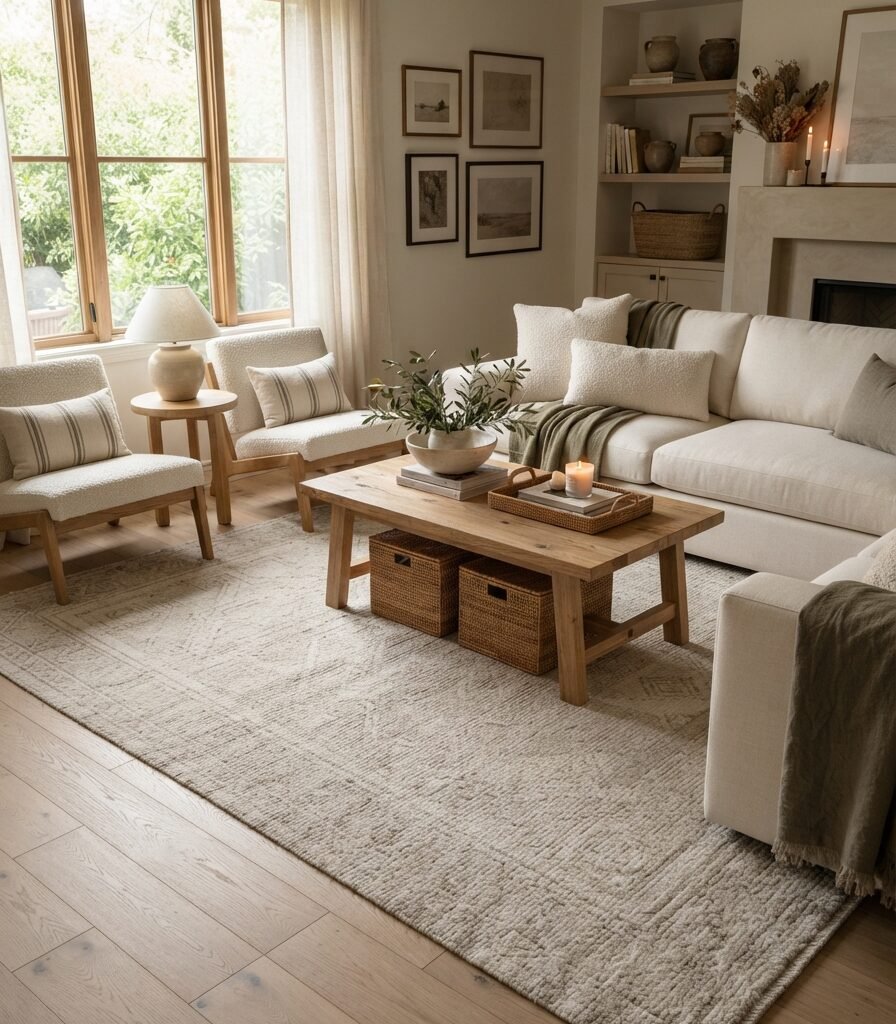
Vibe: The room feels grounded, soft, and immediately settled.
Why it works: A large rug visually connects separate seating pieces and creates a defined conversation zone, which is especially useful in an open-plan home. The contrast between wool texture, smooth oak, and upholstered furniture gives the room depth without requiring strong color.
How to get it: Choose a rug large enough for at least the front legs of the main sofa and chairs to sit on it. For a standard seating arrangement, an 8×10-foot rug is often more useful than a smaller 5×7 because it visually unifies the furniture rather than floating underneath the coffee table.
💡 Quick Win: If your existing rug is too small, layer it over a larger natural-fiber rug to expand the visual footprint without replacing the decorative piece.
Shop The Look
| Product | Purpose |
| Ivory and taupe wool blend 8×10 area rug | Main foundation |
| Cream performance linen sectional sofa | Comfortable seating |
| Natural oak rectangular coffee table | Warm center anchor |
| Woven seagrass storage basket with handles | Flexible storage |
| Neutral textured lumbar pillow covers | Soft layering |
2. Try a Warm White and Camel Color Palette

Vibe: The palette feels sun-warmed and quietly sophisticated.
Why it works: Warm white prevents the room from feeling stark while camel introduces enough depth to define the seating. Walnut acts as the darker visual anchor, giving the light palette a sense of hierarchy instead of allowing everything to blend.
How to get it: Keep approximately 60 percent of the room in warm neutrals, 30 percent in camel or medium wood tones, and 10 percent in a broader accent such as walnut or charcoal. Avoid cool blue-whites because they can make camel upholstery appear orange.
Shop The Look
| Product | Purpose |
| Camel faux leather accent chair | Warm contrast |
| Warm white linen-look curtain panels | Soft backdrop |
| Walnut wood end table | Darker anchor |
| Cream textured area rug | Neutral foundation |
| Matte ivory ceramic table lamp | Soft illumination |
3. Use a Built-In Media Wall for Visual Order
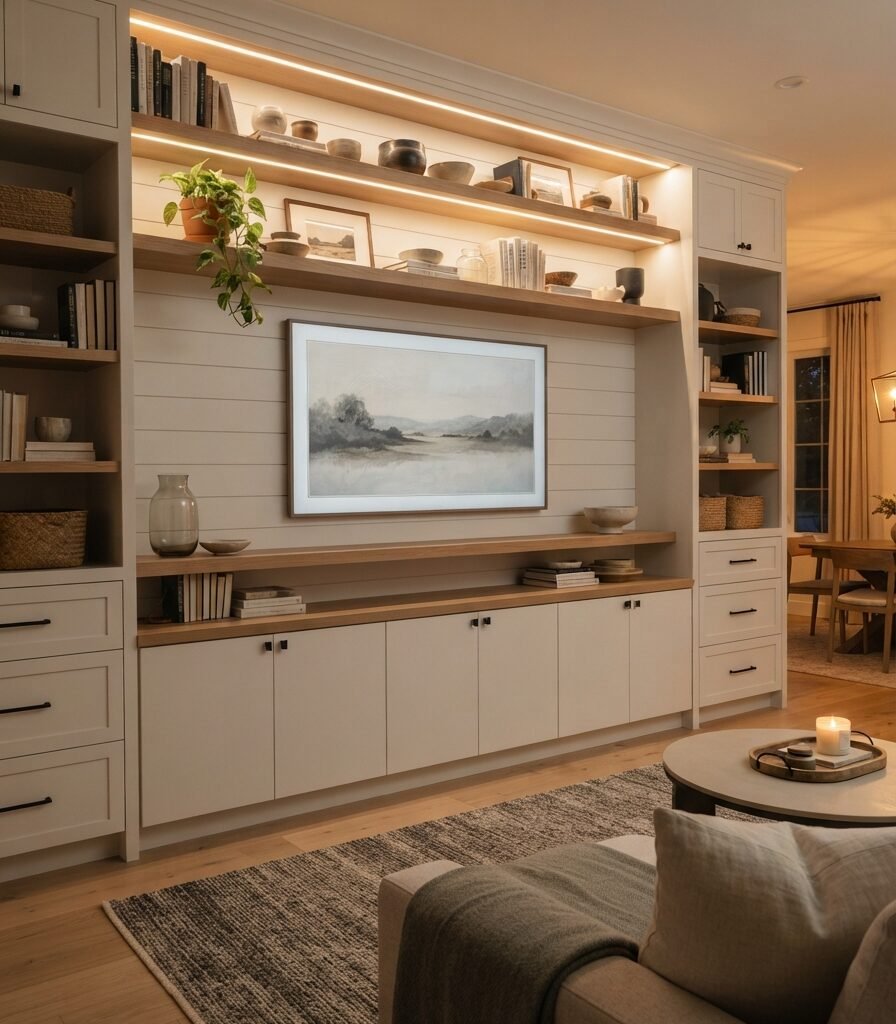
Vibe: The room feels organized without feeling sterile.
Why it works: A built-in media wall gives the largest visual object in the room a deliberate architectural home. Closed cabinetry hides cables, games, remotes, and equipment while open shelving provides controlled opportunities for texture and personality.
How to get it: Use warm-white lower cabinets with natural white-oak shelves rather than matching every surface. Keep roughly two-thirds of the storage closed, and one-third open so everyday clutter remains hidden while the display areas can breathe.
💡 Quick Win: Before commissioning cabinetry, use removable painter’s tape to mark the proposed cabinet and television dimensions directly on the wall.
Shop The Look
| Product | Purpose |
| Modular warm white storage cabinet | Closed media storage |
| White oak floating shelf set | Display shelving |
| Recessed warm LED shelf light strips | Architectural glow |
| Neutral framed landscape art prints | Shelf styling |
| Matte ceramic sculptural vase | Organic accent |
4. Create a Reading Corner Beside the Window

Vibe: The corner feels still and tucked away from the room’s activity.
Why it works: A reading chair creates a secondary destination within a larger family room, giving the space more than one purpose. Positioning it near daylight makes use of existing light while the rounded table and woven basket soften the stronger vertical lines of the window.
How to get it: Choose a chair with a seat depth of roughly 20–23 inches if you want comfortable reading without allowing it to dominate the room. Add a floor lamp behind the shoulder rather than directly in front of the chair to keep the reading surface visually clear.
Shop The Look
| Product | Purpose |
| Oatmeal upholstered reading chair | Reading seat |
| Honey oak round side table | Compact surface |
| Natural jute floor basket | Throw storage |
| Linen pinch-pleat curtain panels | Window softness |
| Adjustable warm-white reading floor lamp | Task lighting |
5. Mix Wood and Woven Materials
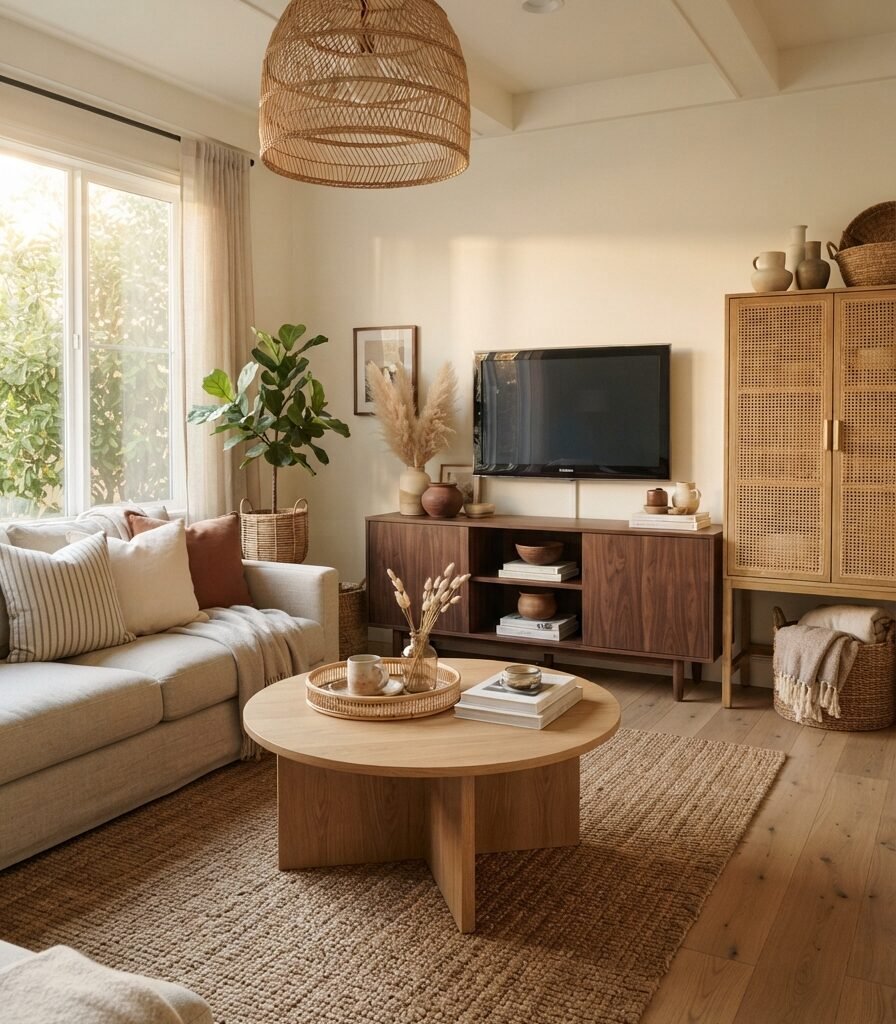
Vibe: The room feels layered without feeling busy.
Why it works: Material variation creates interest even when the color palette remains restrained. Oak, walnut, cane, rattan, and linen each reflect light differently, preventing a neutral family room from becoming visually flat.
How to get it: Limit yourself to two dominant wood tones and one woven material family. If the floor is already dark walnut, introduce lighter oak furniture rather than adding another dark wood species.
💡 Quick Win: Replace one glossy storage box with a natural seagrass basket; the texture change can make a shelf feel significantly warmer in minutes.
Shop The Look
| Product | Purpose |
| Natural cane-front storage cabinet | Textural furniture |
| Light oak rectangular coffee table | Pale wood layer |
| Walnut media console | Dark wood anchor |
| Seagrass lidded storage baskets | Organic organization |
| Natural rattan pendant light | Overhead texture |
6. Add Layered Lighting Instead of One Ceiling Fixture

Vibe: The room feels luminous rather than brightly lit.
Why it works: Layered lighting changes the perceived depth of a room by placing illumination at different heights. A ceiling fixture provides general light, while table and floor lamps create smaller pools of warmth around seating and shelving.
How to get it: Use bulbs around 2700K for evening comfort and place at least one light source near the sofa, one near a secondary seating zone, and one at a lower level such as a console or side table.
Shop The Look
| Product | Purpose |
| Aged brass arc floor lamp with linen shade | Main ambient layer |
| Ceramic table lamp with fabric shade | Side lighting |
| Warm 2700K LED bulb set | Consistent color temperature |
| Brass picture light | Artwork illumination |
| Plug-in dimmer switch for lamps | Adjustable atmosphere |
7. Choose a Deep Sofa for a True Family-Room Feel
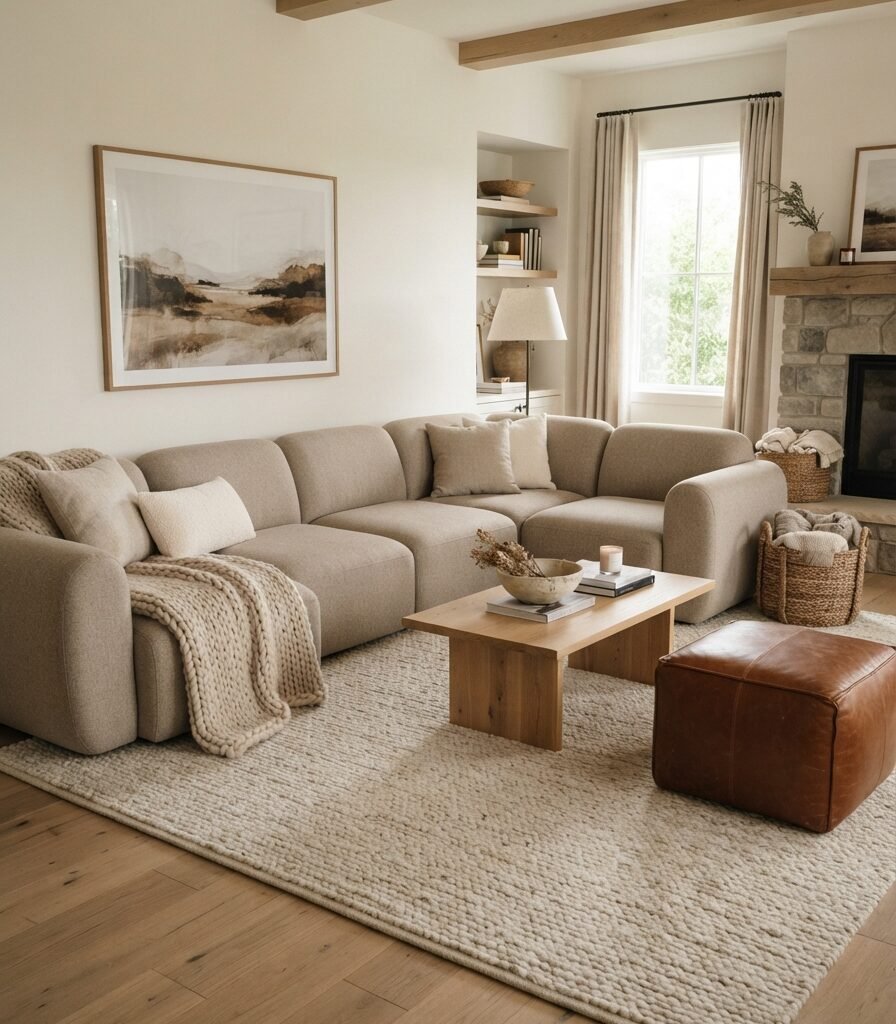
Vibe: The sofa feels grounded and generously comfortable.
Why it works: A family room benefits from furniture that supports long periods of sitting rather than simply looking formal. A deep sofa paired with a lower coffee table creates a relaxed visual proportion, while durable upholstery makes the centerpiece practical for daily use.
How to get it: Look for seat depths around 23–26 inches and medium-firm cushions if the sofa will be used every day. Performance fabric is worth considering when children, pets, or frequent entertaining are part of the room’s routine.
💡 Quick Win: Add two oversized 24-inch pillow inserts to an existing sofa; larger pillows can instantly make a standard-depth sofa feel more generous.
Shop The Look
| Product | Purpose |
| Oatmeal performance-fabric deep sectional | Main seating |
| Cognac leather storage ottoman | Flexible footrest |
| Low-profile oak coffee table | Relaxed proportion |
| 24-inch down-alternative pillow inserts | Fuller cushions |
| Chunky cream knit throw blanket | Cozy texture |
8. Use Built-In Window Seating for Extra Capacity
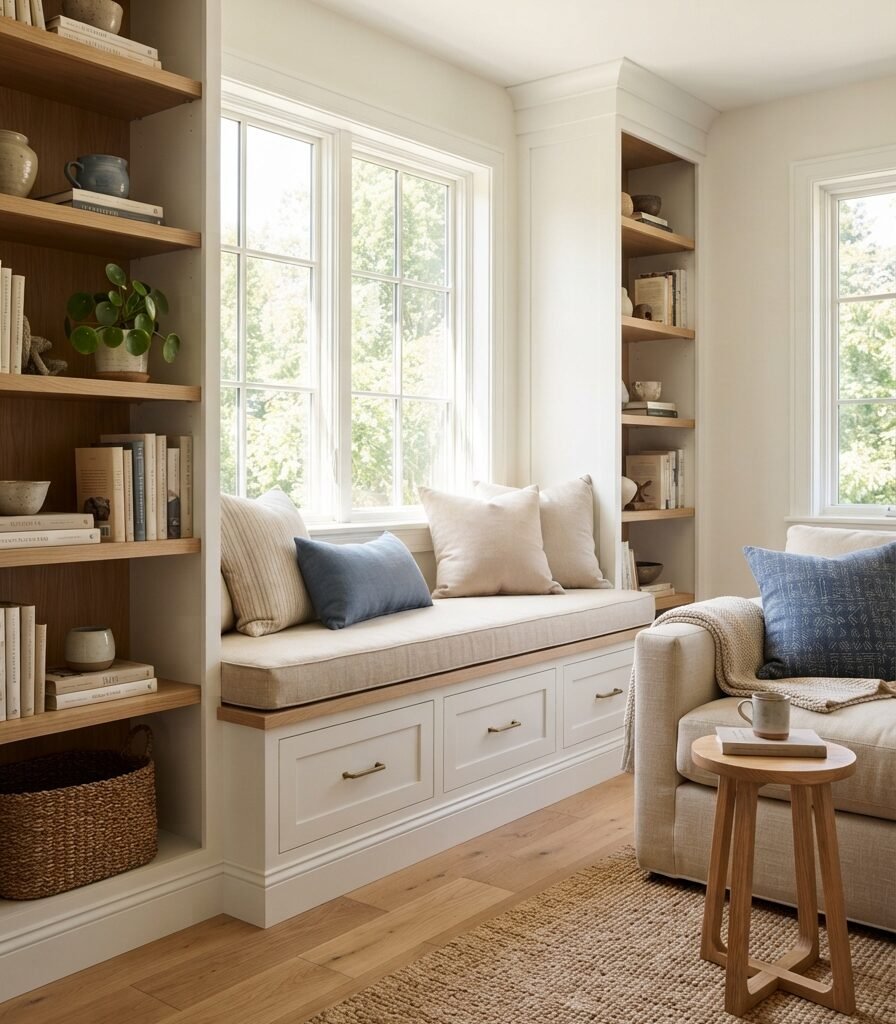
Vibe: The nook feels airy while quietly adding seating.
Why it works: Window seating uses architectural space that might otherwise remain unused. The bench creates seating capacity without adding another freestanding chair, while drawers beneath it provide valuable concealed storage.
How to get it: Build the bench at approximately 18 inches high and give the cushion a depth of at least 20 inches. Use lift-up or drawer storage beneath the seat for blankets, board games, or seasonal accessories.
Shop The Look
| Product | Purpose |
| Custom-fit window bench cushion in performance fabric | Built-in comfort |
| Tailored neutral lumbar pillows | Back support |
| Under-bench woven storage bins | Hidden organization |
| Blue-and-cream striped pillow cover | Pattern accent |
| Slim oak floating shelf | Vertical display |
9. Make a Round Coffee Table the Social Center
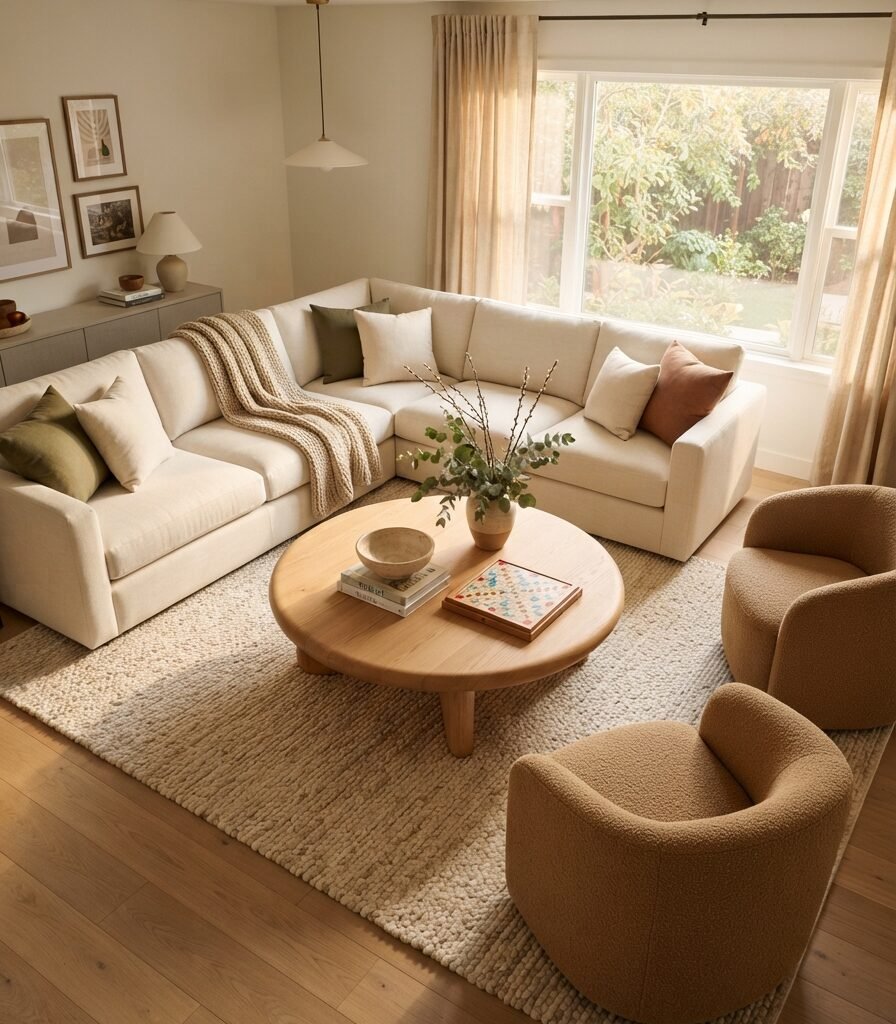
Vibe: The arrangement feels social and easy to move around.
Why it works: A round table removes sharp corners from a busy circulation zone and makes seating feel more conversational. The circular form also breaks up the repeated rectangles created by sofas, rugs, televisions, and cabinetry.
How to get it: Leave roughly 16–18 inches between the coffee table and surrounding seating. Choose a diameter large enough to serve the entire seating group without forcing people to reach across an oversized gap.
💡 Quick Win: If your rectangular coffee table blocks circulation, rotate it 90 degrees before buying anything; sometimes the issue is orientation rather than size.
Shop The Look
| Product | Purpose |
| Round natural oak coffee table 40-inch | Social centerpiece |
| Curved cream accent chair | Shape contrast |
| Low ceramic serving bowl | Table styling |
| Neutral oversized coffee-table book set | Layered display |
| Small olive branch arrangement | Organic height |
10. Create a Dedicated Game and Activity Zone
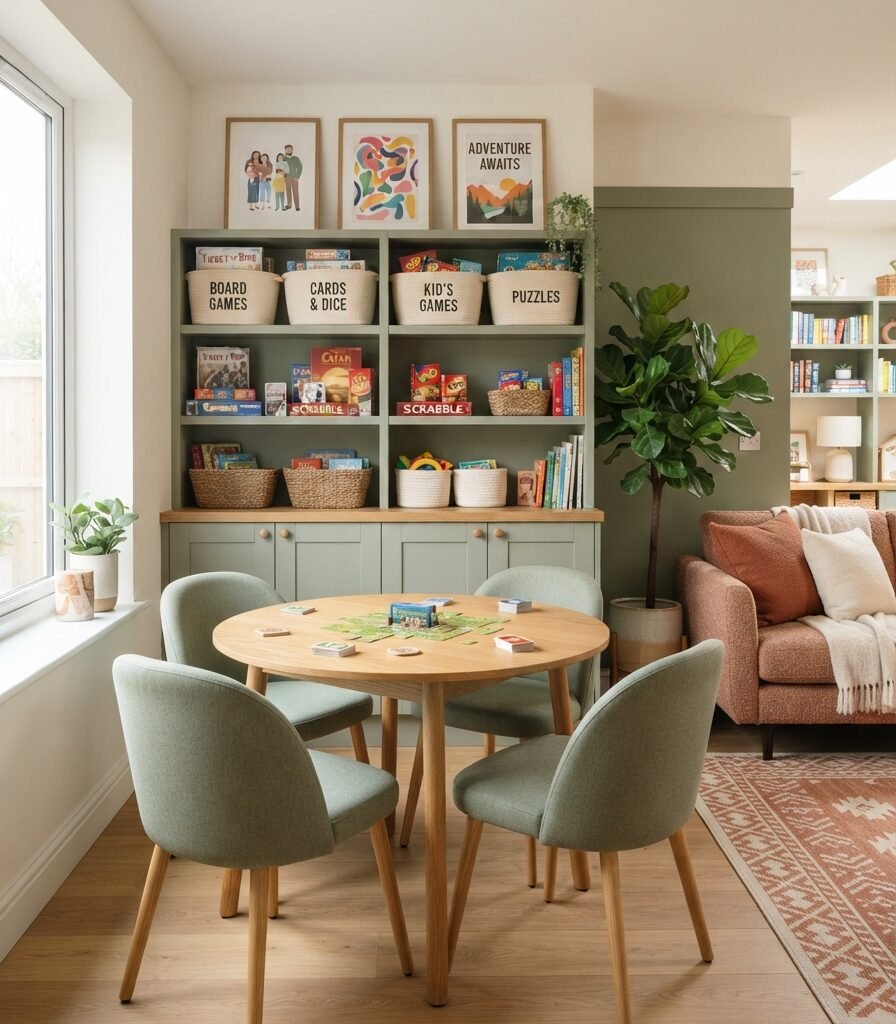
Vibe: The room feels lively but controlled.
Why it works: Zoning prevents children’s activities from taking over the entire family room. A small dedicated table gives games and crafts a home while closed storage keeps supplies visually contained when the activity is finished.
How to get it: Choose a round table about 36–42 inches wide and place storage directly beside it. Use matching baskets or bins so the organization reads as part of the design rather than an afterthought.
Shop The Look
| Product | Purpose |
| 42-inch round oak game table | Activity surface |
| Sage green upholstered dining chairs | Flexible seating |
| Woven cube storage baskets with labels | Game organization |
| Wall-mounted oak display shelves | Vertical storage |
| Terracotta ceramic pencil cup set | Small-item organization |
11. Pair Olive Green With Natural Wood

Vibe: The room feels grounded and slightly hushed.
Why it works: Muted olive behaves almost like a neutral while giving the room more visual depth than beige alone. Its connection to natural foliage makes pale oak and linen feel integrated rather than separately chosen.
How to get it: Test the paint on the actual wall because north-facing and south-facing rooms can change olive’s appearance dramatically. Choose a gray-green olive rather than a yellow-green if the room already has warm oak.
💡 Quick Win: Paint only the wall behind the television or sofa instead of the whole room to test the palette with less commitment.
Shop The Look
| Product | Purpose |
| Muted olive interior wall paint | Accent backdrop |
| Pale oak media console | Natural foundation |
| Cream linen-look sofa throw | Soft contrast |
| Botanical framed print set | Nature-inspired art |
| Handmade ceramic planter in warm white | Organic accessory |
12. Use a Storage Ottoman Instead of a Traditional Coffee Table
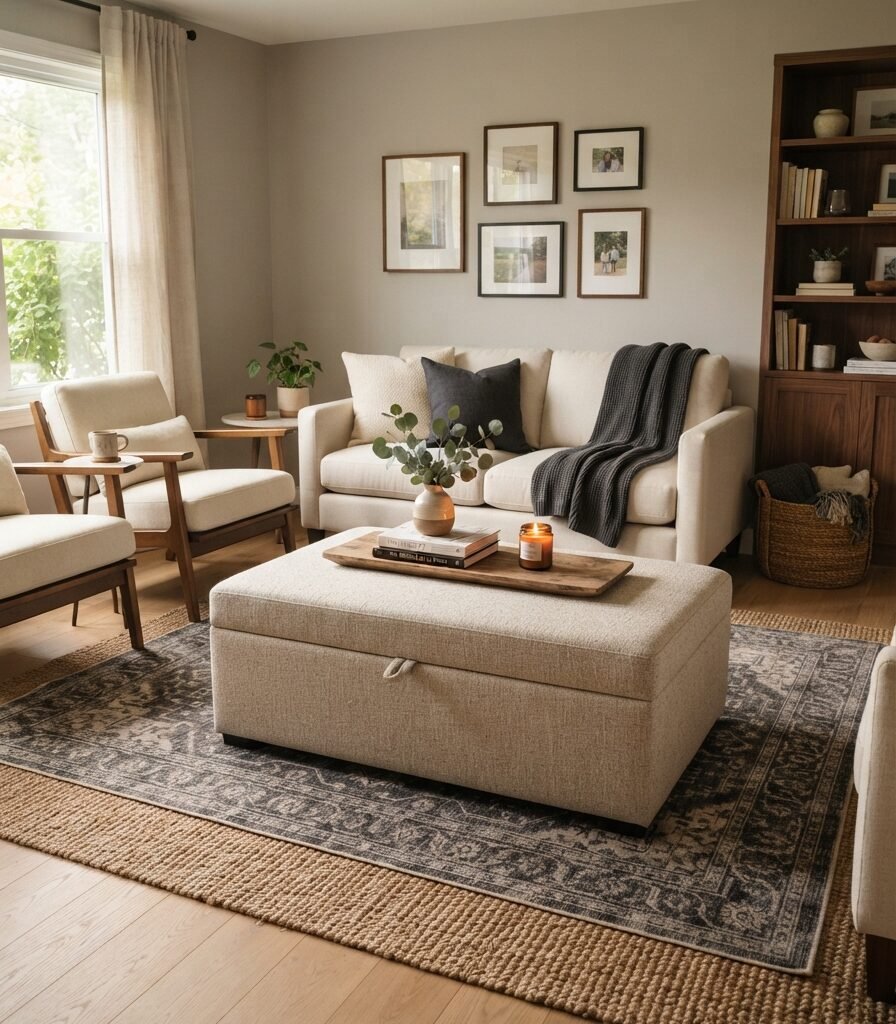
Vibe: The room feels cozy and forgiving.
Why it works: An upholstered ottoman eliminates the hard edge of a traditional table while providing hidden storage and a comfortable place to put feet up. A rigid tray on top restores a stable surface for drinks and decorative objects.
How to get it: Select an ottoman at least two-thirds the length of your sofa and use a tray 1–2 inches smaller than the ottoman’s width on all sides. This creates a visible border that makes the composition feel deliberate.
Shop The Look
| Product | Purpose |
| Oatmeal rectangular storage ottoman | Seating and storage |
| Large natural wood serving tray | Stable surface |
| Cream performance sofa | Main seating |
| Charcoal textured throw pillow | Tonal contrast |
| Woven blanket basket | Extra textile storage |
13. Add a Gallery Wall With Family Personality

Vibe: The wall feels layered with personality rather than staged.
Why it works: A gallery wall gives a family room emotional character while repeating frame material creates cohesion. Mixing sizes creates rhythm, but keeping the palette restrained prevents children’s drawings, photography, and decorative art from competing.
How to get it: Choose the frame finish first, then lay every artwork on the floor before hanging. Keep approximately 2–4 inches between smaller frames and use one large anchor piece to prevent the arrangement from feeling scattered.
💡 Quick Win: Print three favorite photographs in black and white and place them in matching 8×10 oak frames for an inexpensive starter gallery.
Shop The Look
| Product | Purpose |
| Natural oak picture frames 8×10 set | Cohesive framing |
| Large neutral abstract wall print | Gallery anchor |
| Black-and-white family photo printing set | Personal artwork |
| Removable picture hanging strips | Low-damage installation |
| Slim picture light in aged brass | Gallery illumination |
14. Make a Small Family Room Feel Larger With Vertical Storage
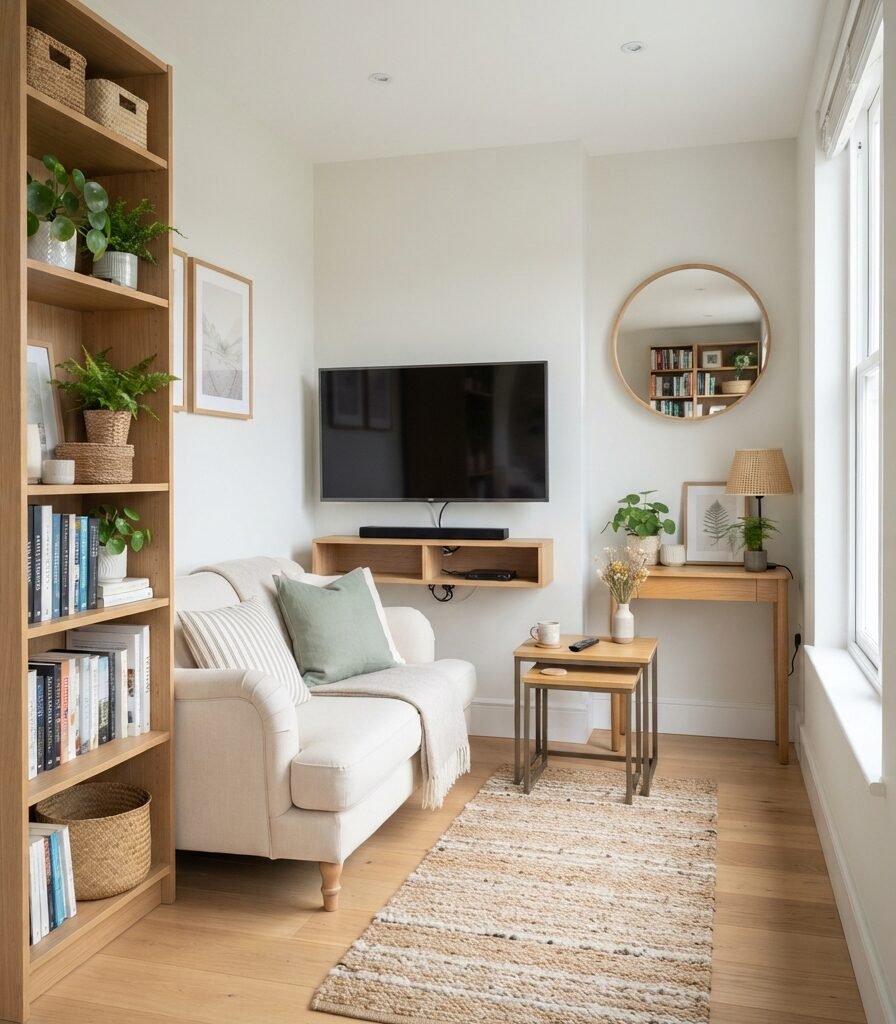
Vibe: The room feels airy despite its compact footprint.
Why it works: Vertical storage moves the eye upward instead of consuming valuable floor area. A wall-mounted television and slim furniture preserve circulation space, while nesting tables provide flexible surfaces without committing to a large coffee table.
How to get it: Keep the deepest furniture pieces against the longest wall and use storage no deeper than approximately 12–14 inches where possible. Paint the shelving close to the wall color if you want it to visually recede.
Shop The Look
| Product | Purpose |
| Slim 12-inch-deep oak bookcase | Vertical storage |
| Compact cream loveseat | Space-conscious seating |
| Nesting oak side tables | Flexible surfaces |
| Neutral narrow runner rug | Floor definition |
| Arched wall mirror with slim frame | Light reflection |
15. Layer Soft Blue for a Calm Family Room

Vibe: The room feels fresh and quietly restorative.
Why it works: Dusty blue adds color without overwhelming the relaxed character of a family room. Repeating the blue at different strengths- curtain, chair, cushion, and artwork- creates tonal continuity rather than a collection of unrelated blue objects.
How to get it: Choose one muted blue with a gray undertone and repeat it at least three times at different visual weights. Avoid highly saturated royal or turquoise blue if you want the room to remain soft.
💡 Quick Win: Start with two dusty-blue pillow covers rather than replacing major furniture; the repeated color will show you whether the palette works in your existing light.
Shop The Look
| Product | Purpose |
| Dusty blue linen-look accent chair | Main color accent |
| Ivory cotton area rug | Light foundation |
| Blue-gray curtain panels | Vertical color repetition |
| Pale oak coffee table | Natural balance |
| Blue-and-ivory striped pillow covers | Pattern layer |
16. Arrange Seating Around Conversation Instead of the Television
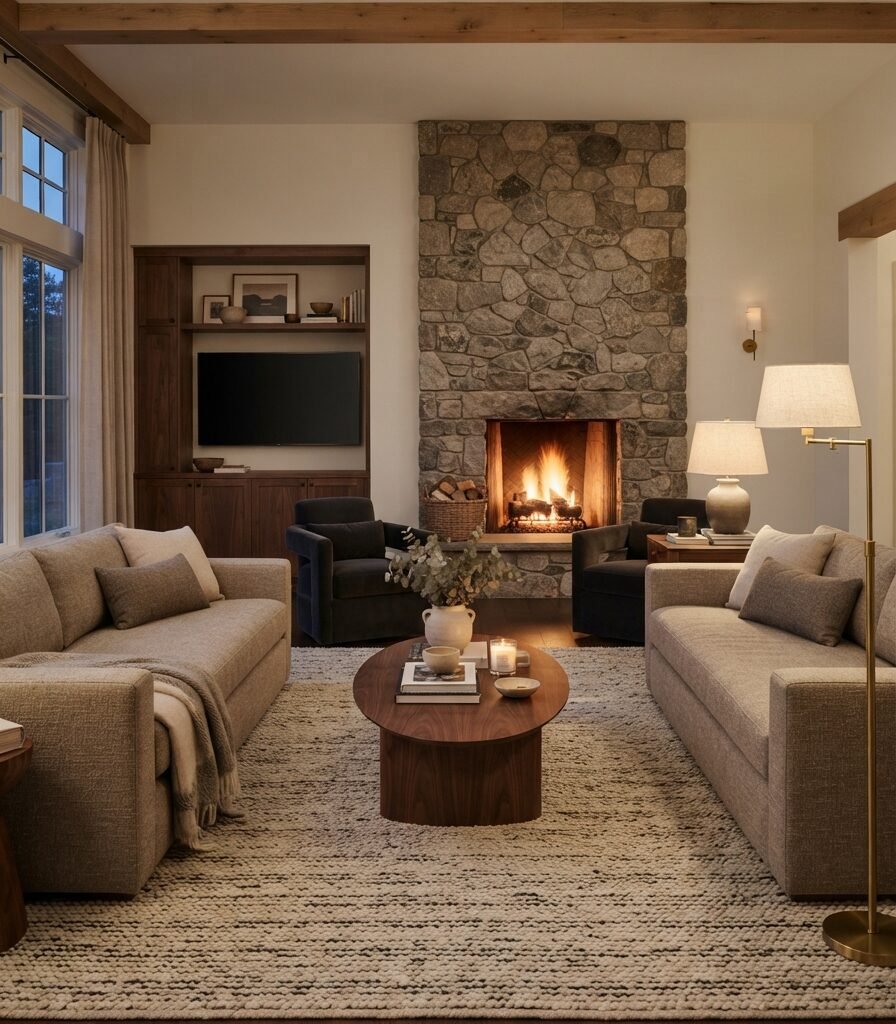
Vibe: The room feels intimate and genuinely social.
Why it works: Orienting furniture toward one another gives conversation visual priority instead of forcing every seat toward a screen. An oval table keeps the central circulation softer while the fireplace provides a second focal point.
How to get it: Aim to keep the primary seating within roughly 8–10 feet of each other for comfortable conversation. If television viewing remains important, use a swiveling chair or secondary viewing angle rather than turning every sofa toward the screen.
Shop The Look
| Product | Purpose |
| Pair of mushroom-colored sofas | Conversation seating |
| Oval walnut coffee table | Central anchor |
| Stone-look electric fireplace console | Secondary focal point |
| Charcoal wool throw | Contrast textile |
| Tall linen-shade floor lamp | Evening illumination |
17. Finish With One Oversized Piece of Art

Vibe: The room feels collected and quietly confident.
Why it works: One oversized artwork can establish scale more effectively than a cluster of small decorations. The large canvas gives the wall a visual anchor, while the low console provides horizontal weight beneath it.
How to get it: For a standard sofa, aim for artwork roughly two-thirds to three-quarters of the sofa’s width. Leave approximately 6–10 inches between the top of the sofa and the bottom of the artwork so the two pieces read as one composition.
💡 Quick Win: Instead of buying expensive original art, choose a large textured canvas print with a restrained abstract palette and place it in a simple natural-oak frame.
Shop The Look
| Product | Purpose |
| Oversized neutral abstract canvas 36×48 | Main focal point |
| Natural oak floating frame | Architectural finish |
| Low walnut console table | Horizontal anchor |
| Large sculptural ceramic vase | Console accent |
| Textured ivory table lamp pair | Balanced lighting |
How to Start Your Family Room Transformation
Start with the area rug. Choose a neutral 8×10-foot rug in ivory, taupe, or warm greige that is large enough to connect the main seating group. This single decision establishes the room’s visual footprint, introduces texture, and gives you a reference point for the sofa, coffee table, curtains, and accent colors.
The most common mistake is choosing furniture before checking scale and circulation. A family room can quickly become crowded when a deep sectional, oversized coffee table, and multiple chairs are all purchased separately. Measure the room first, tape the furniture footprints onto the floor, and preserve comfortable walking paths before ordering anything.
For a budget entry point, start with three small upgrades: a pair of textured pillow covers under $25, a natural woven storage basket under $35, and a warm ceramic table lamp under $50. These pieces can change texture, organization, and lighting without committing you to expensive furniture.
A realistic refresh can happen over one weekend if you already have the major furniture. A starter makeover might cost around 150–500, while a fuller room with a new sofa, rug, lighting, storage, and artwork can easily reach 2,000–6,000 or more. Custom cabinetry, built-ins, and major electrical work can take several weeks or months.
Frequently Asked Questions About 17 Family Room Ideas
What is the difference between a family room and a living room?
A family room is generally designed around relaxed everyday use, while a formal living room may prioritize entertaining and presentation. Family rooms commonly include deeper sofas, television areas, games, storage, and durable fabrics. The distinction is not absolute, but the family room usually tolerates more activity and multifunctional furniture.
What colors make a family room feel warm and inviting?
Warm white, greige, camel, muted olive, dusty blue, mushroom, and natural wood tones are reliable choices. If your room receives cool northern light, warmer colors such as ivory and camel can prevent it from feeling gray. In a sunny room, softer gray-green or dusty blue can balance the stronger natural light.
How much does it cost to decorate a family room?
A modest refresh using existing furniture can cost approximately 150–500 for accessories, lighting, textiles, and artwork. A more substantial furnishing project with a new sofa, rug, coffee table, lamps, and storage can reach 2,000–6,000 or more. Custom built-ins, premium upholstery, and electrical work will increase the total considerably.
Can a family room look elegant and still be kid-friendly?
Yes, provided elegance comes from proportion and material consistency rather than delicate objects. Choose performance upholstery, washable rugs, rounded furniture edges, closed storage, and durable ceramic or wood accessories. A palette of warm white, oak, olive, and camel can look refined while remaining practical for everyday family use.
Which furniture is most important in a family room?
The sofa is usually the most important investment because it determines comfort, scale, and much of the room’s visual character. A deep sofa around 23–26 inches in seat depth can provide relaxed seating, while performance fabric makes sense for high-use households. The second major priority should be a properly sized rug that connects the seating arrangement.
Ready to Create Your Dream Family Room?
These 17 Family Room Ideas cover everything from warm color palettes and natural materials to storage, lighting, seating layouts, small-space solutions, and personal artwork. The transformation does not have to happen all at once; starting with one well-chosen rug, lamp, or storage basket is often the smartest way to establish direction. Today, measure your seating area and mark the ideal rug size on the floor with painter’s tape before buying anything else. When the proportions, textures, and lighting work together, the family room starts to feel relaxed, welcoming, and genuinely easy to live in. Save your favorite ideasespecially the ones involving layered lighting, natural wood, and flexible storageso you have a practical visual plan when you’re ready to make the room yours.