
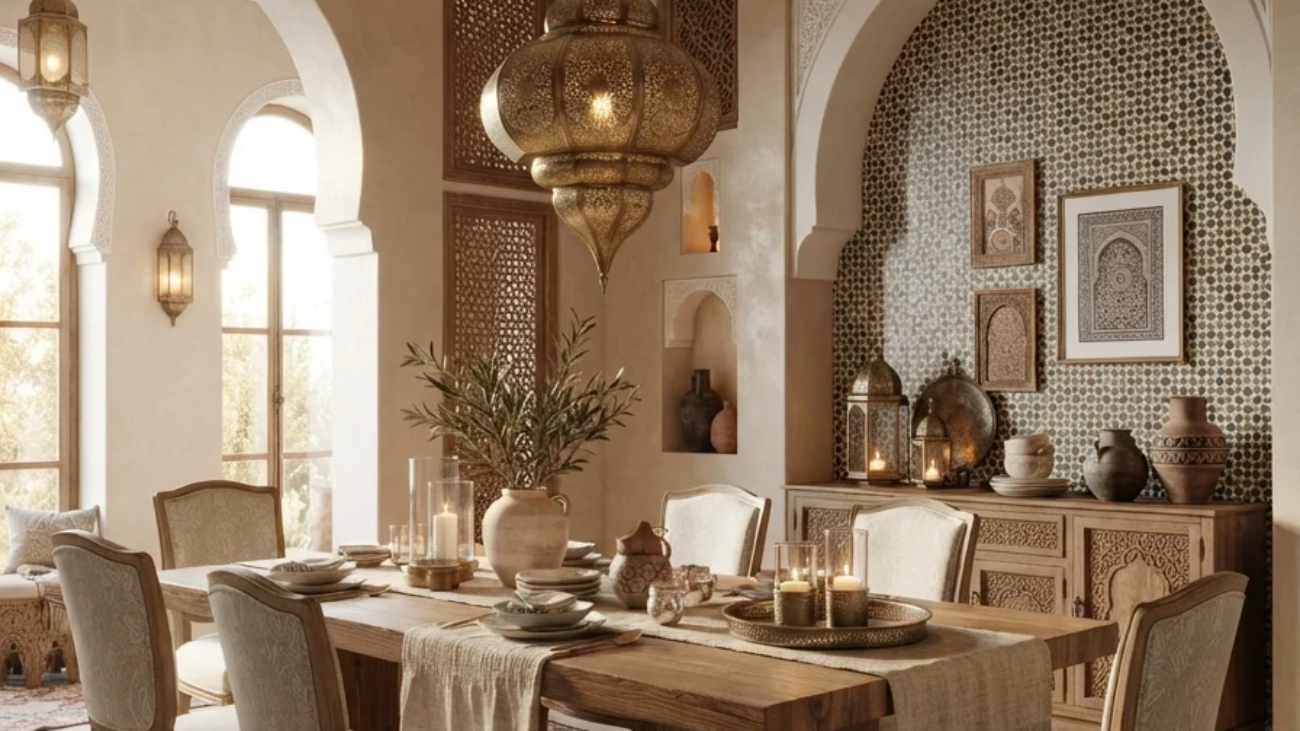
Moroccan dining room design brings the craft, geometry, warmth, and inward-looking character of North African interiors into a space designed for gathering and long meals. These 19 Moroccan dining room designs show how to use zellige, tadelakt-inspired walls, carved wood, brass lanterns, rugs, arches, rich color, and practical furniture layouts without making the room feel like a themed restaurant.
The atmosphere is tactile before it is decorative: candlelight flickers through pierced metal, glazed tiles catch tiny variations of light, wool softens the floor beneath the dining chairs, and warm plaster makes even a simple meal feel slower. A Moroccan room can feel earthy and grounded or saturated and jewel-toned, depending on how much pattern and color you introduce. The most convincing rooms balance ornament with quiet surfaces so the eye has somewhere to rest. Traditional Moroccan interiors draw from Amazigh craft, Arab-Islamic geometry, Andalusian influences, Mediterranean light, and regional materials rather than one single decorating formula.
Here are 19 ideas worth saving and stealing.
Why 19 Moroccan Dining Room Designs Work So Well
Moroccan interior design is a craft-led visual language shaped by North African architecture, Amazigh traditions, Arab-Islamic geometry, Andalusian influences, and the inward-facing architecture of the riad. Rather than treating decoration as something applied after construction, the style often makes walls, floors, screens, ceilings, and lighting part of the visual experience. Zellige, carved plaster, arches, cedar, textiles, and pierced metal create an environment where surface and architecture work together.
Its material palette is unusually specific. Think warm bone plaster, terracotta, saffron, olive, indigo, deep teal, cedar brown, aged brass, hammered copper, hand-cut zellige, tadelakt, wool, leather, clay, and carved wood. Tadelakt is a polished lime-plaster finish with a soft, slightly undulating surface, while zellige is recognized for hand-cut variation and reflective glazed surfaces.
Style at a Glance
| Element | Moroccan Dining Room Direction |
| Philosophy | Craft, hospitality, geometry, sensory warmth |
| Materials | Zellige, tadelakt, cedar, wool, brass, copper, clay |
| Color palette | Bone, terracotta, saffron, olive, indigo, teal |
1. Warm Tadelakt-Inspired Walls with a Simple Cedar Table

Category: COLOR
Vibe: Grounded.
Why it works: The principle here is tonal continuity: keeping walls, furniture, and textiles within closely related earth tones lets craftsmanship become the visual interest. Tadelakt-inspired plaster supplies mineral variation while cedar adds warmth and grain without introducing another dominant color.
How to get it: Use a warm mineral paint such as a sand or bone tone with a matte finish, then pair it with unfinished or lightly oiled cedar. Avoid cool gray-beige paint because its blue undertone can make the warm wood and terracotta accents look disconnected.
💡 Quick Win: Paint only the dining-room focal wall first and introduce a $20–$40 terracotta vessel to test the palette before committing to larger changes.
Shop The Look
| Product | Search phrase |
| Wall finish | Warm bone matte mineral interior paint |
| Table | Solid cedar farmhouse dining table |
| Vase | Handmade terracotta floor vase |
| Rug | Natural cream Moroccan wool rug |
| Napkins | Terracotta linen napkin set |
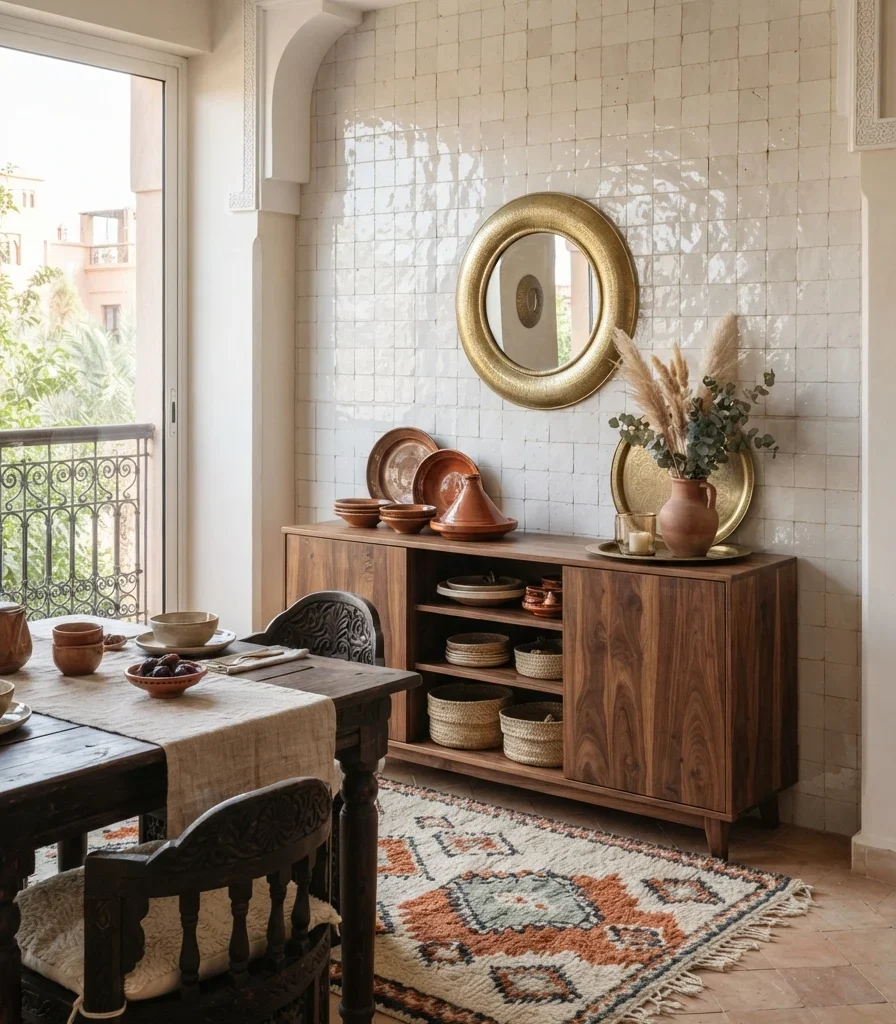
2. Hand-Cut Zellige Backsplash Behind the Sideboard
Category: MATERIAL
Vibe: Artisanal.
Why it works: Zellige introduces surface variation that printed ceramic tile cannot reproduce as convincingly. Slightly irregular pieces reflect light at different angles, so the wall changes subtly throughout the day rather than behaving like a flat patterned backdrop.
How to get it: Use zellige only behind the sideboard or on one architectural plane rather than covering every wall. Keep the grout visually quiet and let the naturally uneven tile edges provide the pattern.
Shop The Look
| Product | Search phrase |
| Tile | Ivory handmade zellige-look wall tile |
| Sideboard | Low walnut wood dining sideboard |
| Mirror | Round antique brass wall mirror |
| Tray | Hammered brass Moroccan serving tray |
| Vase | Handmade white ceramic bud vase |
3. Hang a Pierced Brass Lantern Over the Table

Category: LIGHTING
Vibe: Luminous.
Why it works: Moroccan lanterns are not merely fixtures; their pierced surfaces create shadow patterns as decoration. The moving geometry across plaster walls adds another layer of visual texture while warm light prevents the dining room from feeling like a brightly illuminated utility space.
How to get it: Hang the lowest point of the pendant approximately 30–36 inches above the tabletop and put it on a dimmer. Choose an aged-brass or brass-and-glass fixture rather than shiny yellow gold for a more believable finish.
Shop The Look
| Product | Search phrase |
| Pendant | Large pierced brass Moroccan lantern pendant |
| Bulb | 2700K dimmable amber LED filament bulb |
| Dimmer | LED compatible wall dimmer switch |
| Candles | Ivory pillar candle set |
| Chain | Adjustable antique brass pendant chain |
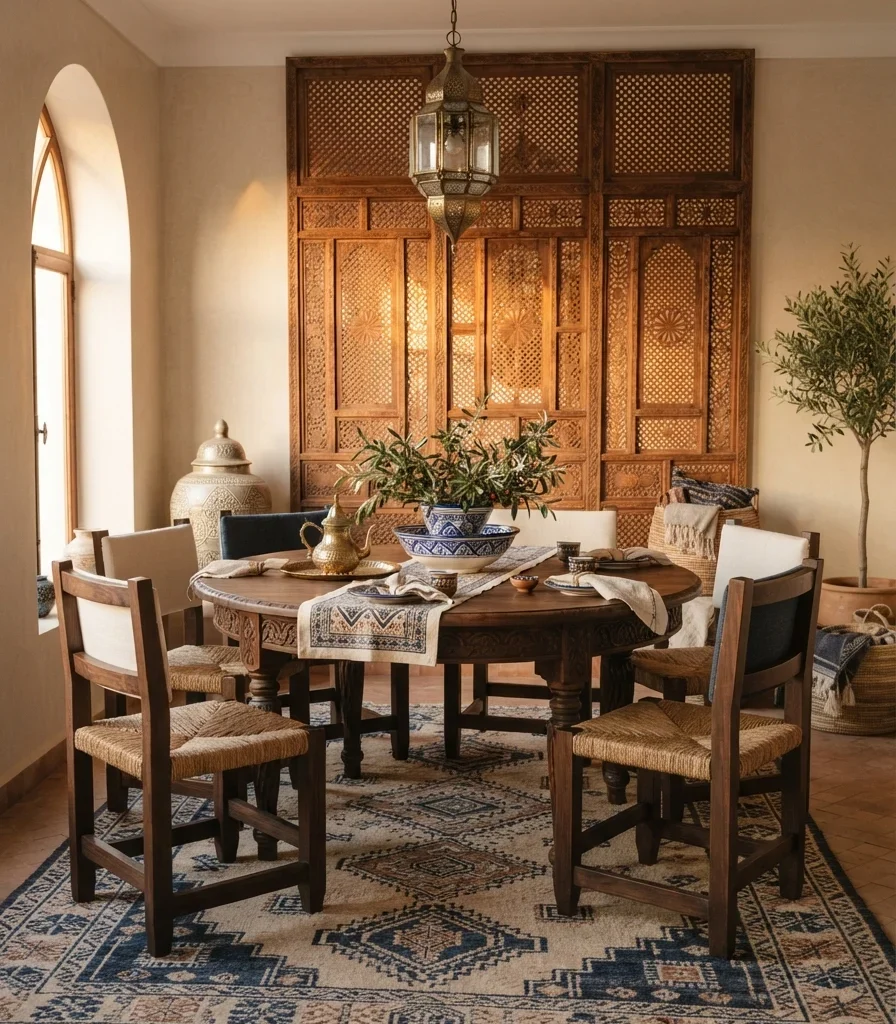
4. Use a Low Walnut Table with Carved Legs
Category: FURNITURE
Vibe: Substantial.
Why it works: The table becomes the room’s visual anchor when its legs carry enough craft detail to stand against patterned surfaces. Walnut gives the eye a dark horizontal foundation while carved details connect the furniture to Moroccan woodworking traditions.
How to get it: Look for a table with turned or subtly carved legs rather than ornate carving across every surface. Keep the tabletop relatively quiet so the craftsmanship reads as detail instead of visual noise.
Shop The Look
| Product | Search phrase |
| Table | Dark walnut carved-leg dining table |
| Chairs | Cream woven upholstered dining chairs |
| Rug | Indigo terracotta Moroccan wool rug |
| Bowl | Hand-painted Moroccan ceramic serving bowl |
| Screen | Carved wood room divider Moroccan style |
5. Layer a Beni Ourain-Inspired Rug Under the Table

Category: ACCESSORIES
Vibe: Tactile.
Why it works: A wool rug softens hard dining surfaces while creating a clear visual zone beneath the table. A restrained geometric pattern references Moroccan textile traditions without competing with zellige, carved wood, or lantern shadows.
How to get it: Choose a rug at least 24 inches wider than the table on every side so chairs remain on the rug when pulled back. In a 6-seat room, a 9×12-foot rug is usually more practical than a small 5×7-foot option.
💡 Quick Win: If a genuine handwoven rug is outside your budget, start with a low-pile ivory-and-black geometric wool-blend rug and upgrade later.
Shop The Look
| Product | Search phrase |
| Rug | Ivory black Moroccan wool area rug 9×12 |
| Pad | Thick non-slip rug pad 9×12 |
| Placemats | Natural woven Moroccan placemat set |
| Pitcher | Handmade cream ceramic water pitcher |
| Basket | Flat woven wool storage basket |
6. Frame the Dining Area with a Horseshoe Arch

Category: LAYOUT
Vibe: Architectural.
Why it works: An arch creates spatial hierarchy without needing a separate room or partition. Horseshoe and related Moorish arch forms are recognizable elements of Moroccan architectural vocabulary, so even a simple opening can give a dining area stronger cultural identity.
How to get it: If structural construction is unrealistic, create the effect with a removable arched wall molding, painted arch, or freestanding arched screen. Keep the arch slightly wider than the table so the furniture does not visually crowd its opening.
Shop The Look
| Product | Search phrase |
| Arch panel | Decorative Moroccan horseshoe arch wall panel |
| Screen | Freestanding carved wood Moroccan screen |
| Paint | Warm ivory arch accent wall paint |
| Niche decor | Small indigo ceramic vase |
| Table runner | Natural linen table runner |
7. Turn a Small Dining Room into a Moroccan Jewel Box

Category: SMALL SPACE
Vibe: Intimate.
Why it works: A round table eliminates sharp corner conflicts and lets circulation move around the seating more naturally. A wall bench also reduces chair pull-back requirements on one side, making the Moroccan layering possible without sacrificing usable floor area.
How to get it: Choose a round pedestal table rather than four-legged furniture and build the room around a single focal material. In very tight spaces, one zellige wall and one lantern will read more convincingly than multiple competing patterns.
Shop The Look
| Product | Search phrase |
| Table | Round walnut pedestal dining table 48 inch |
| Bench | Cream upholstered dining bench narrow |
| Chairs | Slim natural wood dining chairs set |
| Rug | Small Moroccan geometric wool rug |
| Lantern | Compact brass Moroccan hanging lantern |
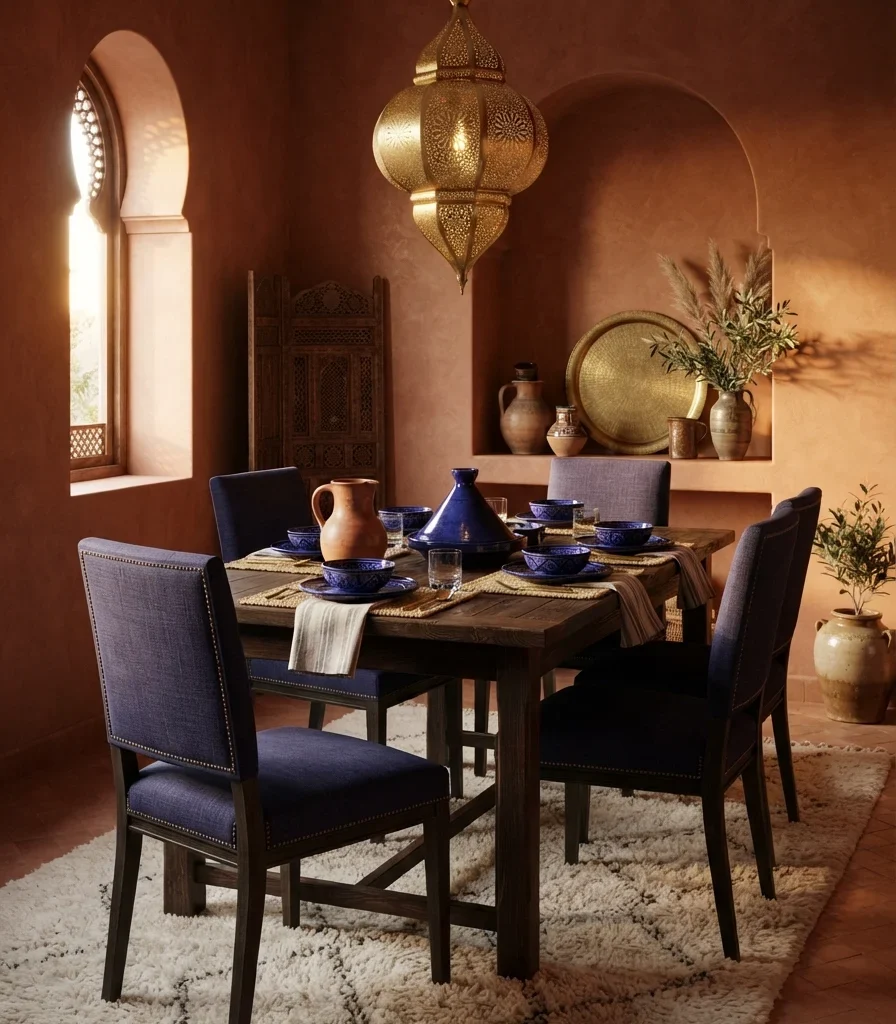
8. Pair Terracotta with Deep Indigo
Category: COLOR
Vibe: Saturated.
Why it works: Terracotta and indigo create warm-cool contrast, giving the room depth without requiring a dozen colors. The warm mineral wall visually advances while deep indigo furniture recedes, creating a useful balance between intimacy and visual weight.
How to get it: Let terracotta occupy the largest surface and reserve indigo for approximately 10–15% of the room through chairs, ceramics, or textiles. Use warm ivory between them so the colors do not compete directly.
Shop The Look
| Product | Search phrase |
| Paint | Terracotta clay matte interior paint |
| Chairs | Deep indigo upholstered dining chairs |
| Rug | Ivory Moroccan wool rug geometric |
| Ceramics | Cobalt blue Moroccan dinnerware set |
| Vase | Terracotta ceramic table vase |
9. Use Cedar Slats as a Modern Moroccan Feature
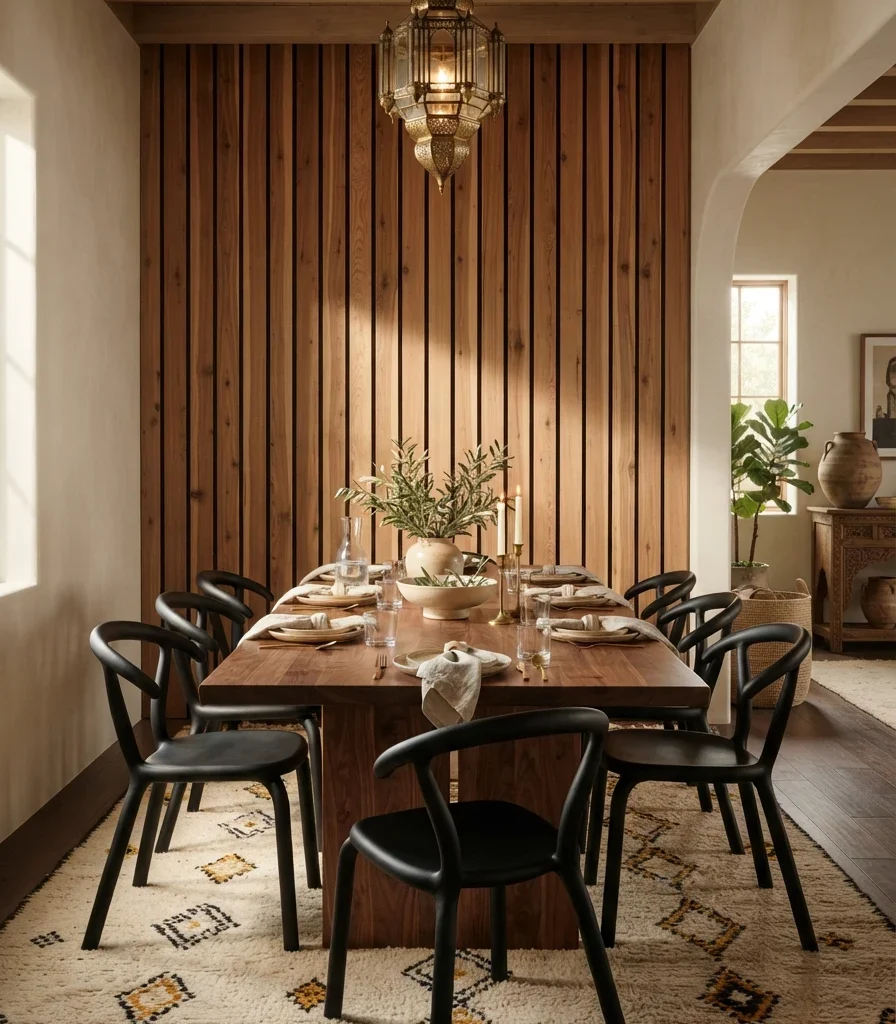
Category: MATERIAL
Vibe: Textured.
Why it works: Vertical cedar creates rhythmic repetition and references Moroccan woodcraft without reproducing an entire traditional carved wall. The repeated shadow lines give the surface depth, especially when warm light strikes it from one side.
How to get it: Use 40–60mm-wide timber slats with approximately 15–20mm shadow gaps for a restrained contemporary interpretation. Keep the surrounding walls matte and plain so the cedar remains the dominant material feature.
💡 Quick Win: For a rental-friendly version, use a removable wood-slat acoustic panel on only the central 120–180cm section behind the table.
Shop The Look
| Product | Search phrase |
| Slat panel | Natural cedar acoustic wood slat wall panel |
| Table | Modern solid cedar dining table |
| Chairs | Matte black wood dining chairs |
| Bowl | Handmade cream stoneware serving bowl |
| Candles | Brass Moroccan candleholder pair |
10. Install a Round Brass Mirror Above the Sideboard
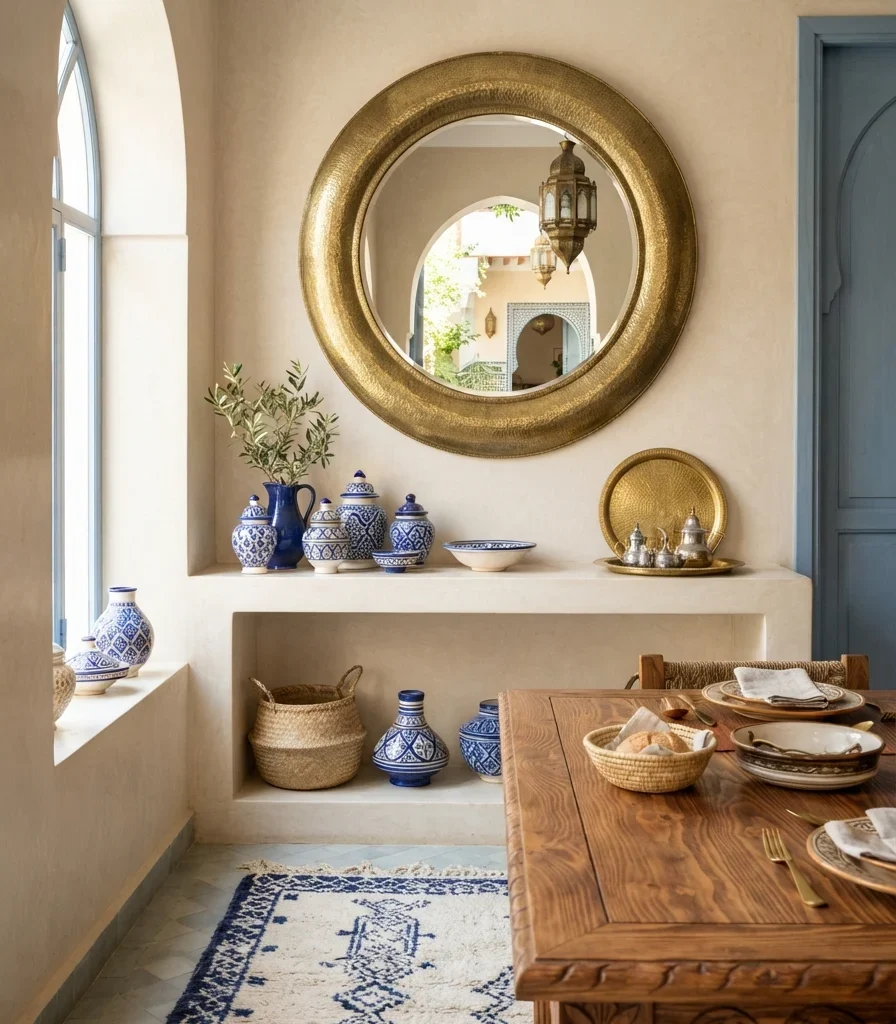
Category: LIGHTING
Vibe: Luminous.
Why it works: The mirror combines light behavior and material texture in one object. Its reflective surface bounces daylight while the hammered brass frame introduces irregular highlights that complement zellige and handmade ceramics.
How to get it: Position the mirror so it reflects a window, lantern, or attractive architectural surface rather than a blank wall. Choose a diameter around two-thirds the width of the sideboard to create proportional balance.
Shop The Look
| Product | Search phrase |
| Mirror | Round hammered brass Moroccan wall mirror |
| Sideboard | Low cream plaster-look dining sideboard |
| Vase | Indigo Moroccan ceramic vase |
| Tray | Round hammered brass serving tray |
| Basket | Natural palm leaf storage basket |
11. Use a Long Banquette for Riad-Inspired Seating
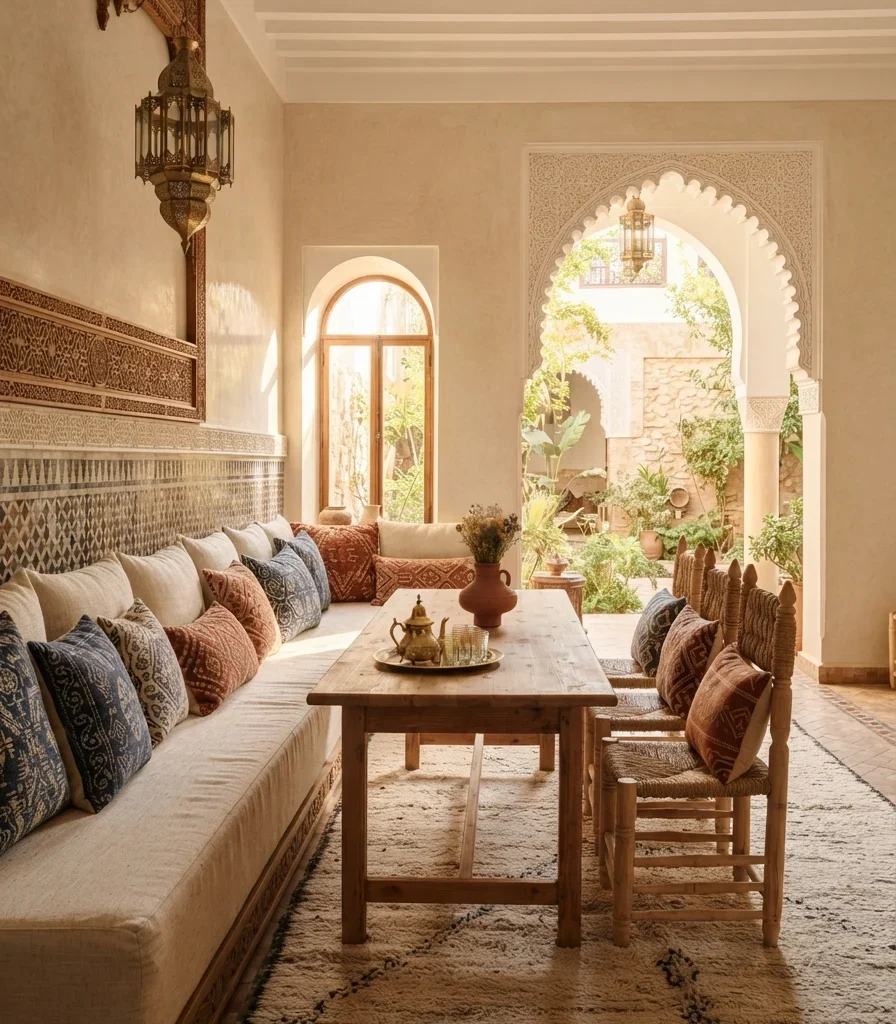
Category: FURNITURE
Vibe: Communal.
Why it works: Banquette seating changes the dining room’s social geometry, allowing people to sit closer together while reducing the clearance needed for individual chairs along one wall. It also creates a broad textile surface where Moroccan cushions and wool can carry pattern.
How to get it: Make the seat approximately 45–48cm high and 45–55cm deep for normal dining posture. Use a durable linen-blend upholstery in cream or sand, then add removable indigo or terracotta cushions for pattern.
Shop The Look
| Product | Search phrase |
| Bench | Built-in style cream dining banquette |
| Cushions | Indigo Moroccan kilim lumbar cushions |
| Table | Low rectangular cedar dining table |
| Throw | Terracotta woven Moroccan blanket |
| Tea set | Hammered brass Moroccan tea serving set |
12. Display Moroccan Ceramics on a Low Sideboard
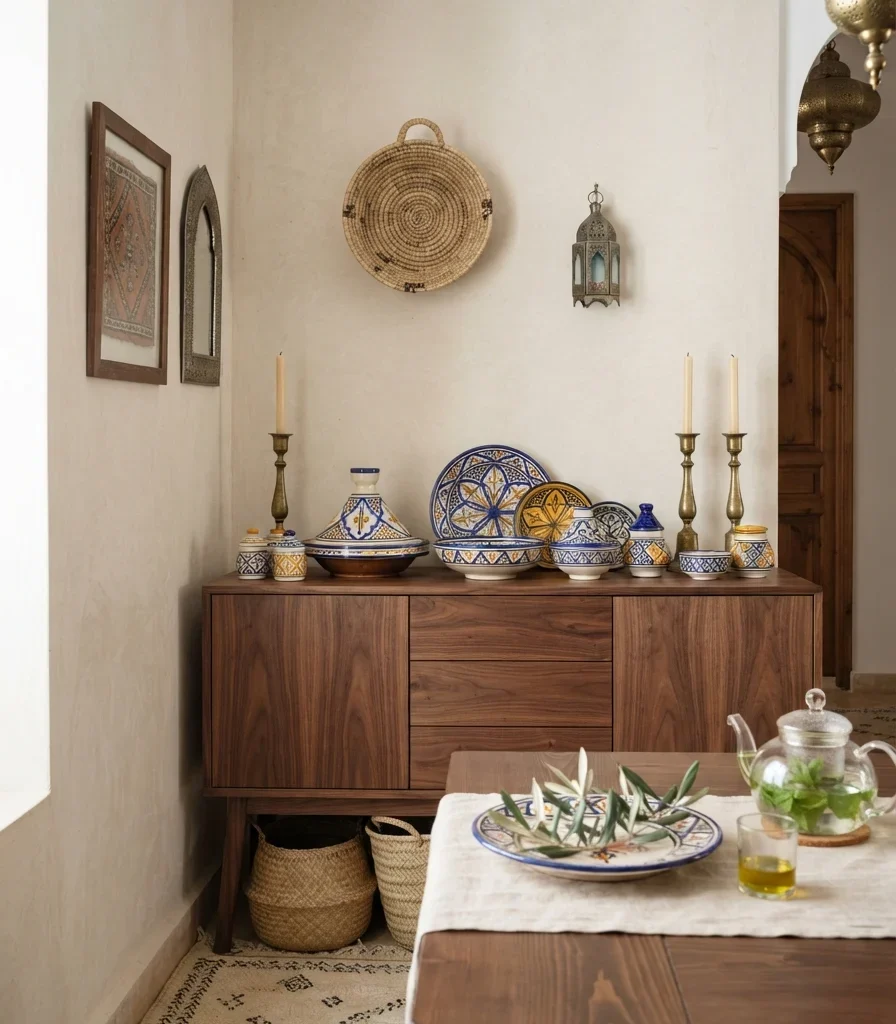
Category: ACCESSORIES
Vibe: Collected.
Why it works: Functional ceramics provide authentic visual storytelling because they belong naturally in a dining environment. Grouping them on a sideboard gives the room pattern and color while keeping the dining table available for actual meals.
How to get it: Arrange ceramics in three height levels: one tall vessel, two medium forms, and several low bowls. Leave roughly one-third of the sideboard visually open so the display does not become a continuous wall of objects.
💡 Quick Win: Start with three handmade-looking ceramic pieces in cobalt, cream, and saffron instead of purchasing an entire matching collection.
Shop The Look
| Product | Search phrase |
| Vase | Hand-painted cobalt Moroccan ceramic vase |
| Bowl | Saffron yellow Moroccan serving bowl |
| Tagine | Decorative Moroccan ceramic tagine |
| Candlesticks | Aged brass taper candlestick pair |
| Sideboard | Walnut low-profile dining sideboard |
13. Create a Moroccan Dining Nook Around a Round Table
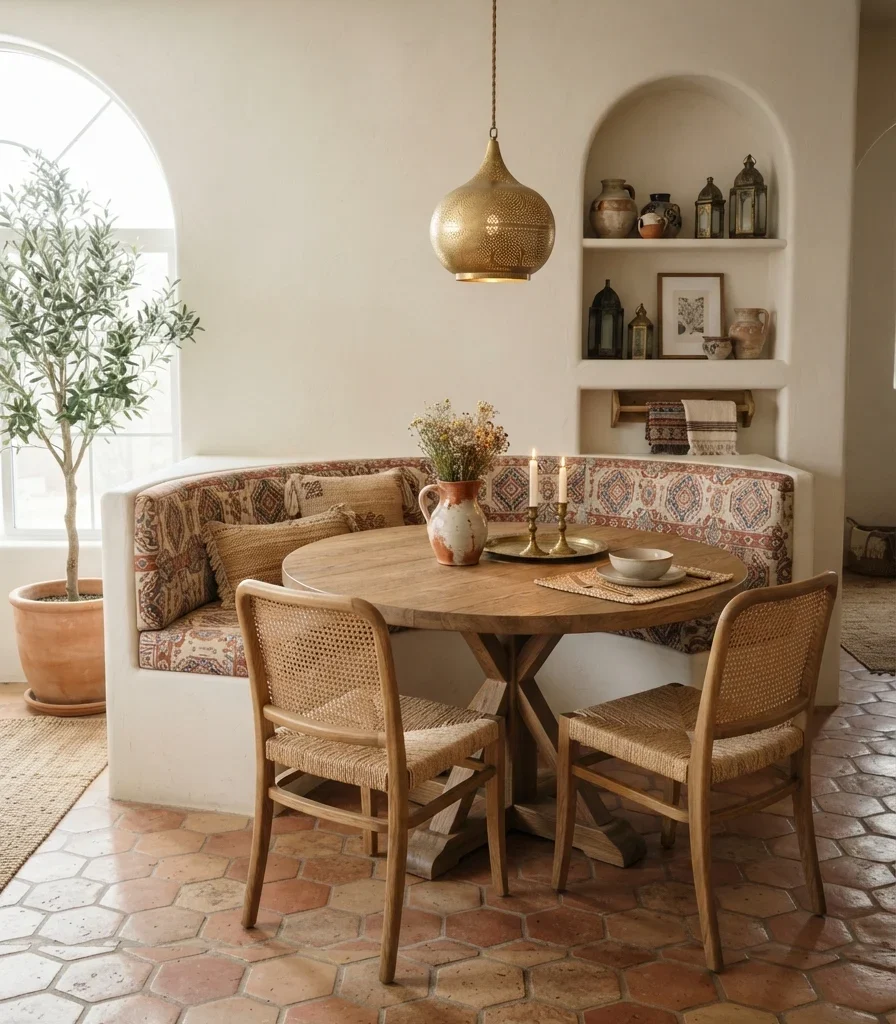
Category: LAYOUT
Vibe: Welcoming.
Why it works: Circular furniture creates continuous circulation and removes the corner collisions associated with rectangular tables. A banquette can tuck completely against one wall, making the dining zone feel more integrated with the architecture.
How to get it: Use a 48-inch round table for four people when space is limited and place the banquette on the least-used wall. Keep the center of the pendant aligned with the table rather than the room’s ceiling geometry.
Shop The Look
| Product | Search phrase |
| Table | 48-inch round natural oak pedestal table |
| Bench | Curved cream upholstered dining bench |
| Chairs | Natural cane dining chair pair |
| Pendant | Small brass Moroccan globe lantern |
| Cushion | Terracotta woven bench cushion |
14. Paint the Ceiling Saffron and Keep Walls Bone
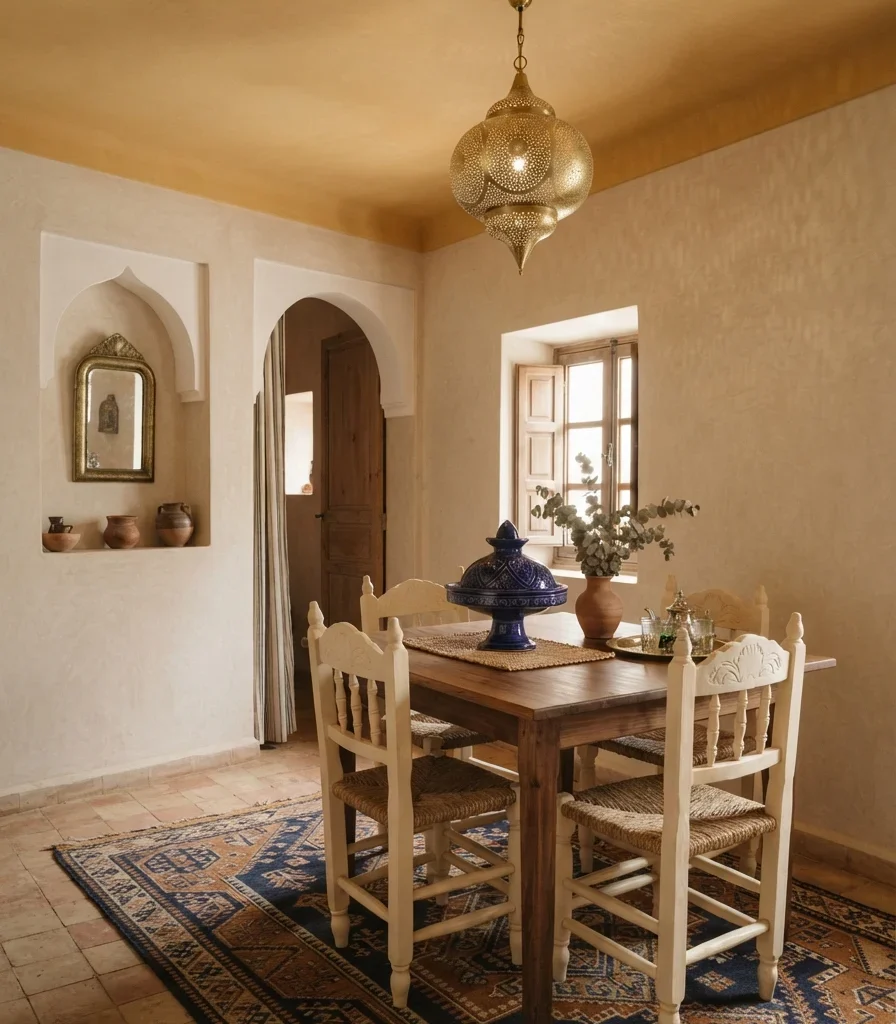
Category: SMALL SPACE
Vibe: Elevated.
Why it works: A colored ceiling creates vertical interest without consuming wall space. In a small room, saffron overhead can feel enveloping while bone walls maintain enough reflectivity to prevent the room from becoming visually compressed.
How to get it: Select a muted saffron rather than a bright primary yellow and use the same matte sheen as the walls. Keep furniture dark and simple so the ceiling reads as an intentional architectural plane.
Shop The Look
| Product | Search phrase |
| Paint | Muted saffron yellow matte ceiling paint |
| Table | Dark walnut compact dining table |
| Chairs | Cream upholstered slim dining chairs |
| Rug | Small ivory geometric Moroccan rug |
| Centerpiece | Indigo ceramic decorative bowl |
15. Combine Emerald Zellige with Natural Wood

Category: COLOR
Vibe: Jewel-toned.
Why it works: Emerald zellige supplies saturated color while pale natural wood prevents the composition from becoming heavy. The contrast between reflective tile and porous wood creates material opposition, giving the room depth from both color and texture. Moroccan interiors commonly use expressive greens alongside mineral neutrals and warm woods.
How to get it: Restrict emerald to one wall or backsplash and repeat only tiny amounts elsewhere. Choose an oak table with a matte oil finish rather than glossy lacquer so the tile remains the most reflective surface.
Shop The Look
| Product | Search phrase |
| Tile | Emerald green handmade zellige-look tile |
| Table | Natural oak rectangular dining table |
| Chairs | Cream linen upholstered dining chairs |
| Pendant | Brushed brass Moroccan lantern pendant |
| Pitcher | Terracotta handmade ceramic pitcher |
16. Add a Carved Wood Screen Behind the Table
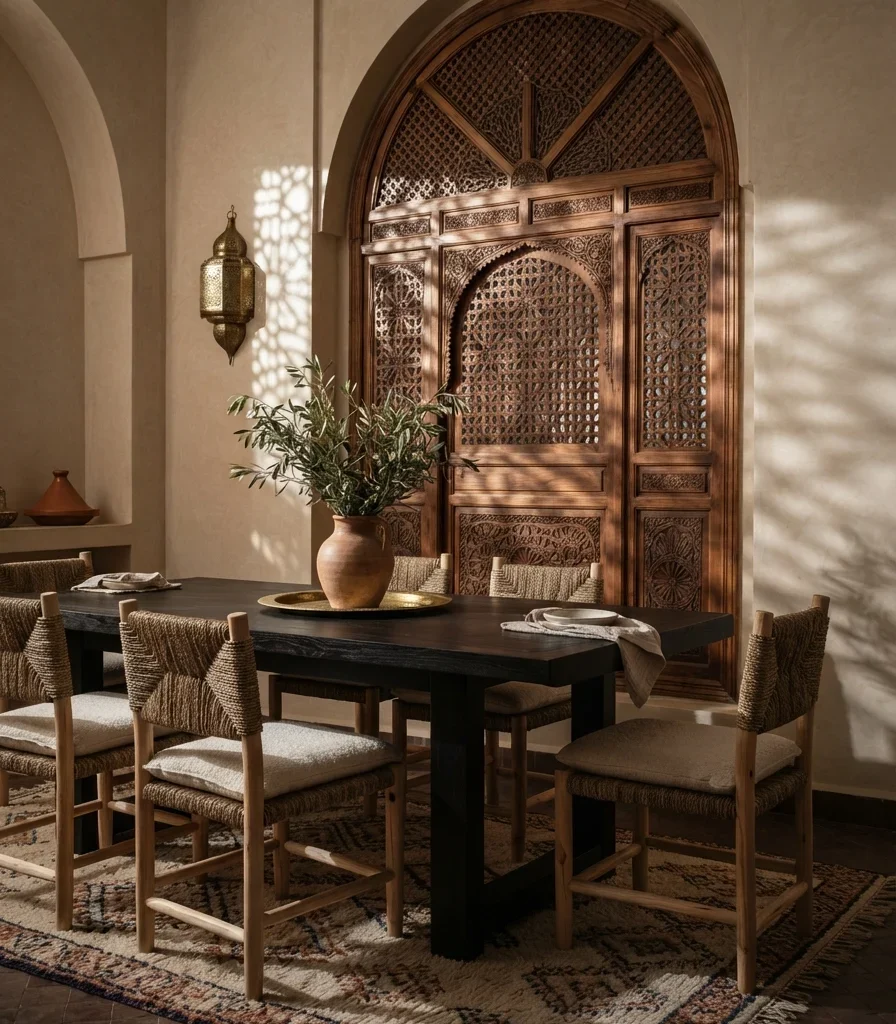
Category: MATERIAL
Vibe: Shadowed.
Why it works: A carved screen introduces light-and-shadow texture without adding another solid visual block. Its perforations allow the wall behind it to remain visible, creating depth while referencing the patterned screens found in Moroccan architectural traditions.
How to get it: Use one screen approximately 70–90% as wide as the dining table rather than filling the entire wall. If authentic cedar carving is expensive, use a laser-cut wood panel finished in natural cedar or walnut.
Shop The Look
| Product | Search phrase |
| Screen | Carved cedar Moroccan room divider panel |
| Table | Dark wood rectangular dining table |
| Chairs | Natural woven dining chairs |
| Lantern | Pierced copper Moroccan pendant |
| Rug | Neutral Moroccan wool geometric rug |
17. Use a Brass-and-Glass Dining Chandelier for a Contemporary Moroccan Look
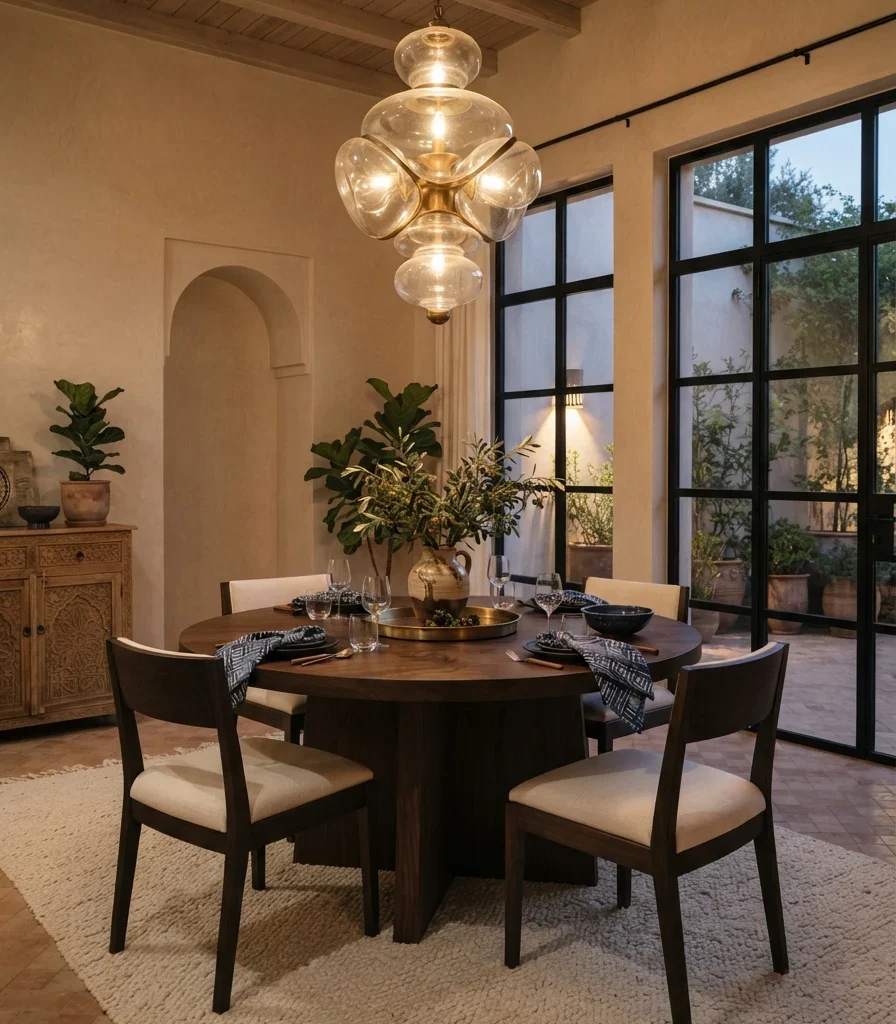
Category: LIGHTING
Vibe: Sophisticated.
Why it works: Contemporary Moroccan design does not require a traditional lantern in every room. A sculptural brass fixture keeps the warm metal and shadow logic of Moroccan interiors while allowing the furniture to remain cleaner and more modern.
How to get it: Select a chandelier whose width is approximately half to two-thirds of the dining table width. Use warm 2700K bulbs and a dimmer so the fixture can move between practical dining light and atmospheric evening light.
💡 Quick Win: Swap only the dining-room fixture and keep your existing furniture; changing the overhead focal point can make the entire room read differently.
Shop The Look
| Product | Search phrase |
| Chandelier | Modern aged brass glass dining chandelier |
| Bulbs | 2700K dimmable clear globe LED bulbs |
| Dimmer | Brass finish LED dimmer switch |
| Table | Round walnut pedestal dining table |
| Vase | Minimal indigo ceramic table vase |
18. Style the Table with a Moroccan Tea-Service Centerpiece

Category: ACCESSORIES
Vibe: Hospitable.
Why it works: Moroccan dining is strongly connected to hospitality and shared ritual, so functional serving pieces make more sense than purely decorative objects. Brass tea equipment also provides a warm reflective surface that responds beautifully to candlelight.
How to get it: Keep the centerpiece below approximately 30cm high so diners can maintain eye contact across the table. Group the tea tray with one low ceramic bowl and two candleholders rather than scattering individual objects across the entire tabletop.
Shop The Look
| Product | Search phrase |
| Tray | Hammered brass Moroccan tea serving tray |
| Teapot | Moroccan brass teapot traditional style |
| Glasses | Hand-painted Moroccan tea glass set |
| Runner | Natural ivory linen table runner |
| Candles | Terracotta candleholder set |
19. Create a Modern Moroccan Dining Room with Bone, Walnut, and Indigo

Category: COLOR
Vibe: Serene.
Why it works: This approach uses controlled ornament rather than maximal layering. Bone walls provide visual rest, walnut supplies weight, and indigo provides a single saturated note, allowing Moroccan craft details to register without overwhelming a contemporary dining room.
How to get it: Follow a restrained 60/30/10 composition: approximately 60% bone and cream, 30% walnut and natural materials, and 10% indigo, brass, or terracotta accents. Choose one authentic-looking craft feature such as zellige or carved wood and let it carry the cultural identity.
Shop The Look
| Product | Search phrase |
| Table | Modern dark walnut dining table |
| Chairs | Cream linen upholstered dining chairs |
| Artwork | Indigo geometric Moroccan wall art |
| Pendant | Aged brass Moroccan dining pendant |
| Rug | Natural ivory wool Moroccan rug |
How to Start Your Moroccan Dining Room Transformation
Make the dining-room walls warm bone or sand your first move. This creates the neutral architectural foundation that allows cedar, brass, terracotta, indigo, and zellige to layer naturally instead of competing from the beginning. A warm mineral-looking matte paint is also far less expensive and less permanent than beginning with tile or plaster.
The most common mistake is using too many Moroccan motifs at the same time. A lantern, geometric rug, patterned cushions, zellige wall, carved screen, colorful ceramics, and ornate furniture can quickly turn a dining room into a theme set. Keep one major patterned surface and two supporting craft elements, then allow plain plaster, wood, or linen to provide visual rest.
For an under-$50 entry point, start with one hammered-brass serving tray, a small terracotta vase, and two indigo linen napkins. These three pieces introduce the material and color language without changing your furniture.
A starter transformation can take one weekend and cost roughly $100–$500, depending on paint, textiles, lighting, and secondhand finds. A fuller dining-room redesign with zellige, custom banquette seating, a substantial rug, chandelier, and furniture can reach $1,500–$5,000+. Tile, plaster, built-ins, and custom woodworking are the elements most likely to extend the project into several weeks or months.
Frequently Asked Questions About 19 Moroccan Dining Room Designs
What makes a dining room Moroccan instead of bohemian?
Moroccan design is more strongly connected to North African architecture and craft traditions, including zellige, tadelakt, carved wood, geometric screens, brass or copper metalwork, and riad-inspired arches. Bohemian interiors can borrow Moroccan elements but usually have a broader mix of global textiles and styles. A Moroccan dining room can therefore be richly layered while still following a much more specific material vocabulary.
What colors work best in a Moroccan dining room?
Warm bone, sand, terracotta, saffron, olive, indigo, deep teal, and cedar brown are reliable Moroccan colors. For a quieter contemporary room, use bone as the dominant color and add approximately 10% indigo or terracotta. More traditional or jewel-toned rooms can introduce emerald, cobalt, saffron, or deep red through zellige and ceramics. Moroccan palettes commonly balance expressive colors against mineral neutrals rather than using every saturated shade at once.
How much does a Moroccan dining room cost?
A simple Moroccan refresh can cost around $100–$500 using paint, textiles, ceramics, and a small brass light. A mid-range redesign with a new rug, table, chairs, pendant, and substantial accessories can fall around $1,000–$3,000. Authentic handmade zellige, tadelakt, carved cedar, and custom furniture can increase the budget considerably because these are labor-intensive materials rather than inexpensive printed finishes.
Can Moroccan dining room design work in a modern home?
Yes. Modern Moroccan interiors often simplify the number of colors and decorative objects while retaining one or two strong craft elements. A contemporary room can combine bone plaster walls, a clean walnut table, cream upholstery, one brass pendant, and a small zellige feature rather than recreating a historic riad literally. This edited approach preserves the material character without making the architecture feel artificially traditional.
What lighting is best for a Moroccan dining room?
A pierced brass or copper pendant is one of the most recognizable choices because its perforations project patterned shadows onto nearby walls. Hang it approximately 30–36 inches above the dining table and use a dimmable 2700K bulb for warm evening light. Add candles or a secondary low-level lamp if the room feels too dependent on one central fixture. The important point is that Moroccan lighting should create both illumination and shadow; the shadow pattern is part of the design.
Ready to Create Your Dream Moroccan Dining Room? Start with These 19 Moroccan Dining Room Designs
These 19 Moroccan dining room designs explore warm color, zellige and cedar materials, patterned lighting, practical seating, round-table layouts, small-space solutions, and edited accessories rather than relying on decorative clichés. You do not need to renovate the entire room at once; one warm wall, one brass lantern, or one handmade ceramic can establish the direction before larger decisions follow. Today, replace one cool dining-room bulb with a dimmable 2700K warm-white bulb and see how your existing wood and ceramics change under the new light. The finished room should feel hospitable, tactile, and slightly sheltered- the kind of space that makes an ordinary meal feel worth lingering over. Save or pin your favorite combination of bone plaster, cedar, brass, zellige, and indigo, so you have a clear Moroccan palette to return to when you begin shopping.
You Might Also Like
- 20 The Timeless Elegance of an English Countryside Dining Room
- 12 Minimalist Dining Room Ideas for a Room That Says Enough
- 20 Budget Home Decor Ideas That Actually Look Expensive
- 12 Small Space Decor Ideas for a Modern Minimalist Home
- 13 Minimalist Home Decor Ideas for a Calm, Clutter-Free Space
- 20 Home Styling Ideas That Make a Room Feel Finished
[…] 19 Moroccan Dining Room Designs […]