
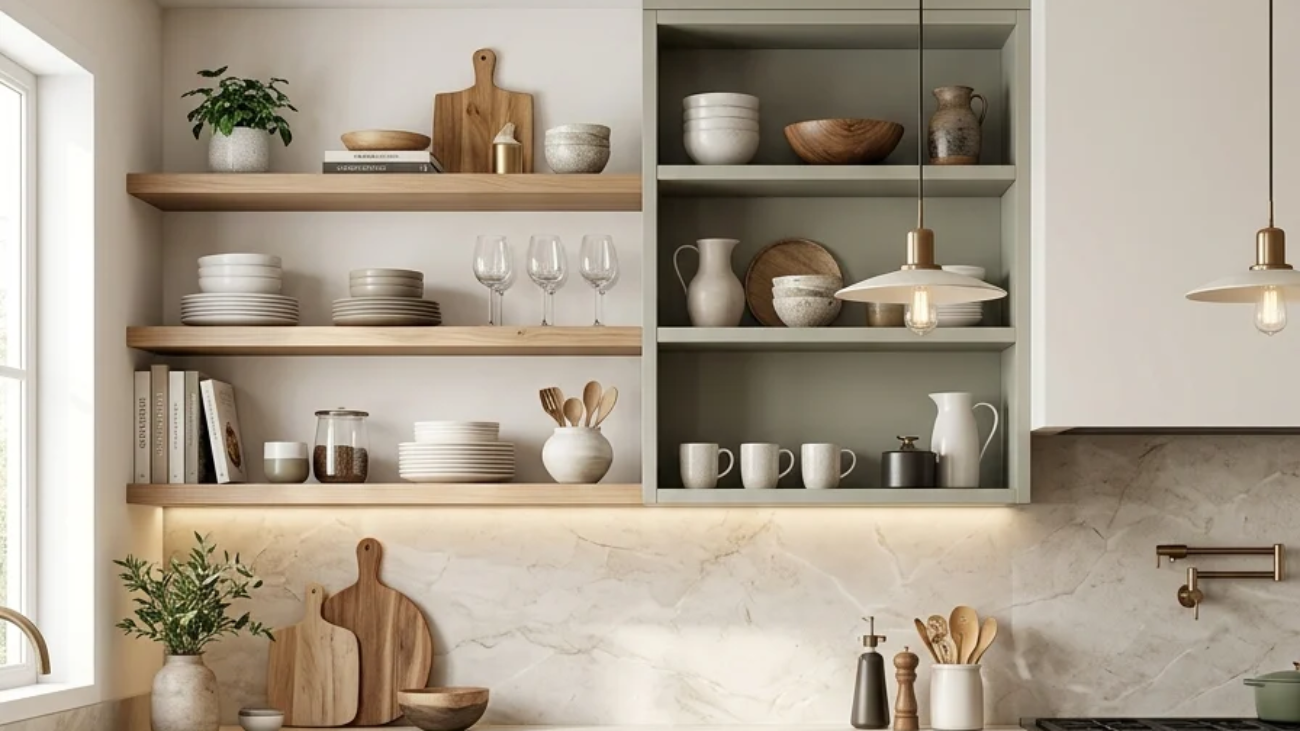
Open shelving in the kitchen replaces some or all upper cabinets with exposed shelves, trading concealed storage for visible display, better light, and a lighter overall feel in the room. This article gives you 15 genuine benefits of open shelving in the kitchen, covering material, color, lighting, and layout advantages that explain why homeowners keep choosing exposed shelves over closed cabinet doors, even knowing the trade-offs involved.
It feels like a kitchen that breathes a little easier: daylight traveling further across the room without a bank of cabinets blocking it, everyday ceramics finally doing double duty as decor. This corner used to sit empty, now holding genuine storage. This is open shelving at its most convincing: practical benefits dressed up as good design, not the other way around. Every advantage earns its place because open shelving asks something real in return: genuine organization, which is exactly what makes its benefits worth understanding before committing.
Here are 15 ideas worth saving and stealing.
Why Open Shelving in the Kitchen Works So Well
Open shelving traces to two converging influences: he practical pantry and larder shelving common in working kitchens before built-in cabinetry became standard in the mid-20th century, and the more recent minimalist and Scandinavian design movements that favor visible, functional objects over concealed storage. What makes open shelving distinct from simply removing cabinet doors is that it requires a genuinely different relationship with kitchen organization, since everything on it is visible daily rather than hidden behind a door.
Core materials that suit open shelving include warm oak or walnut boards, matte black or brass brackets, and ceramics chosen specifically for their glaze and shape since they’re on permanent display. Color benefits come from the flexibility to introduce trend colors through swappable dishware rather than a full cabinet repaint, and from the visual lightness pale wood or painted shelves bring compared to a solid wall of cabinet doors.
Style at a Glance
| Element | Core Trait 1 | Core Trait 2 |
| Philosophy | Visible, functional storage over concealed cabinetry | Genuine organizational commitment required for the look to work |
| Materials | Warm oak or walnut shelving, matte black or brass brackets | Ceramics chosen for display, not just storage |
| Color Palette | Flexible, swappable through dishware rather than fixed cabinetry | Pale wood or painted shelves read lighter than solid cabinet doors |
15 Benefits of Open Shelving in the Kitchen
1. Open Oak Shelves Make the Kitchen Feel Larger
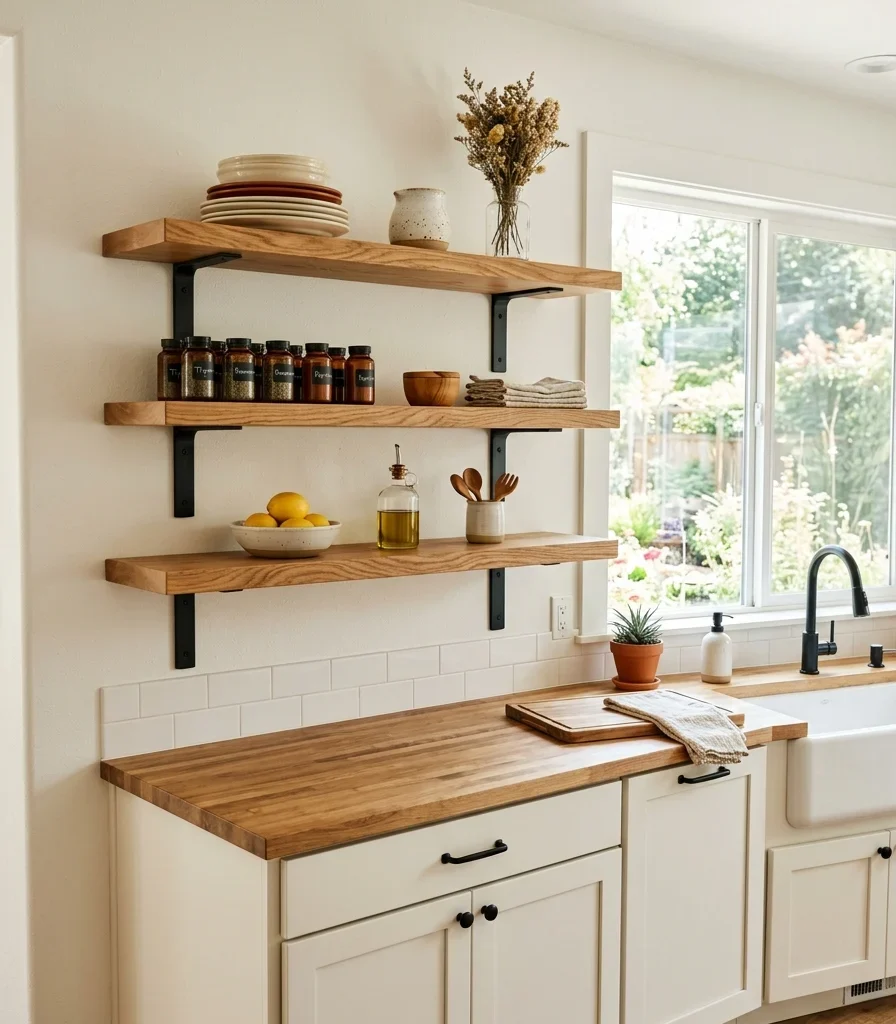
Vibe: An airy kitchen wall that reads as open even while holding genuine daily storage.
Why it works: Removing a solid bank of upper cabinets in favor of open shelving is a negative-space principle that measurably changes how large a kitchen feels. A wall of closed cabinet doors reads as a heavy, opaque block, while open shelving lets the eye travel past the shelf edges to the wall behind, which is the single biggest visual benefit open shelving offers over standard upper cabinetry.
How to get it: Replace at least one full run of upper cabinets with two or three floating oak shelves on concealed brackets, keeping the wall paint behind them light so the visible wall space reinforces the openness rather than competing with a dark backdrop.
💡 Quick Win: Removing just the cabinet doors from an existing upper cabinet run (leaving the boxes as open shelving) tests the benefit without any new construction.
Shop the Look
| Product |
| Floating oak shelf set |
| Concealed shelf bracket rated |
| Small ceramic decorative vessel |
| Warm white wall paint |
| Matte black shelf trim |
2. A Painted Backsplash Behind Shelves Becomes a Design Statement
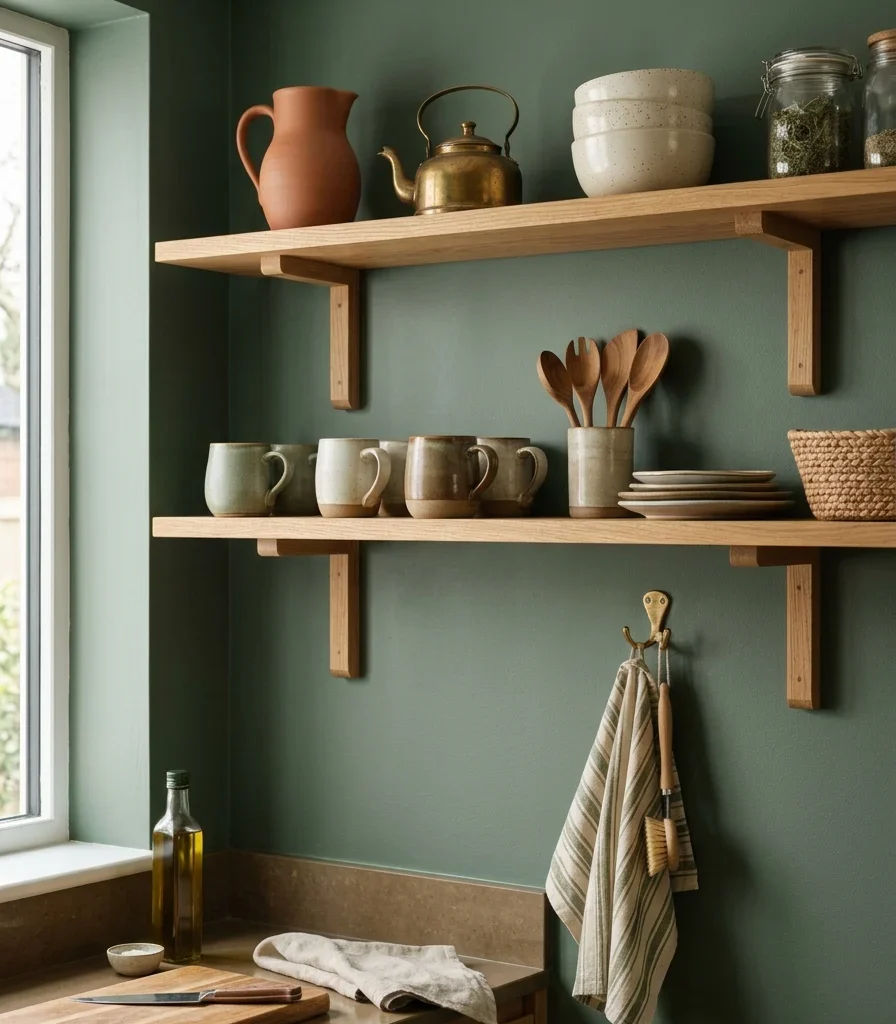
Vibe: Grounded a wall that becomes genuinely visible design real estate once it’s not hidden behind cabinet doors.
Why it works: Open shelving reveals wall space that closed cabinets would otherwise cover entirely, which is a color-anchoring benefit unique to the format. A painted backsplash color behind open shelves gets seen constantly and does real design work, whereas the same wall behind solid cabinets would be permanently hidden and essentially wasted as a color opportunity.
How to get it: Paint the wall section directly behind the shelving in a deliberate accent color like deep sage, choosing a matte finish so ceramics displayed in front read clearly against a non-reflective backdrop.
Shop the Look
| Product |
| Deep sage green matte paint |
| Warm oak floating shelf |
| Small brass wall hook |
| Painter’s tape precision edge |
| Small ceramic display vessel |
3. Removing Upper Cabinets Frees the Room’s Sightlines
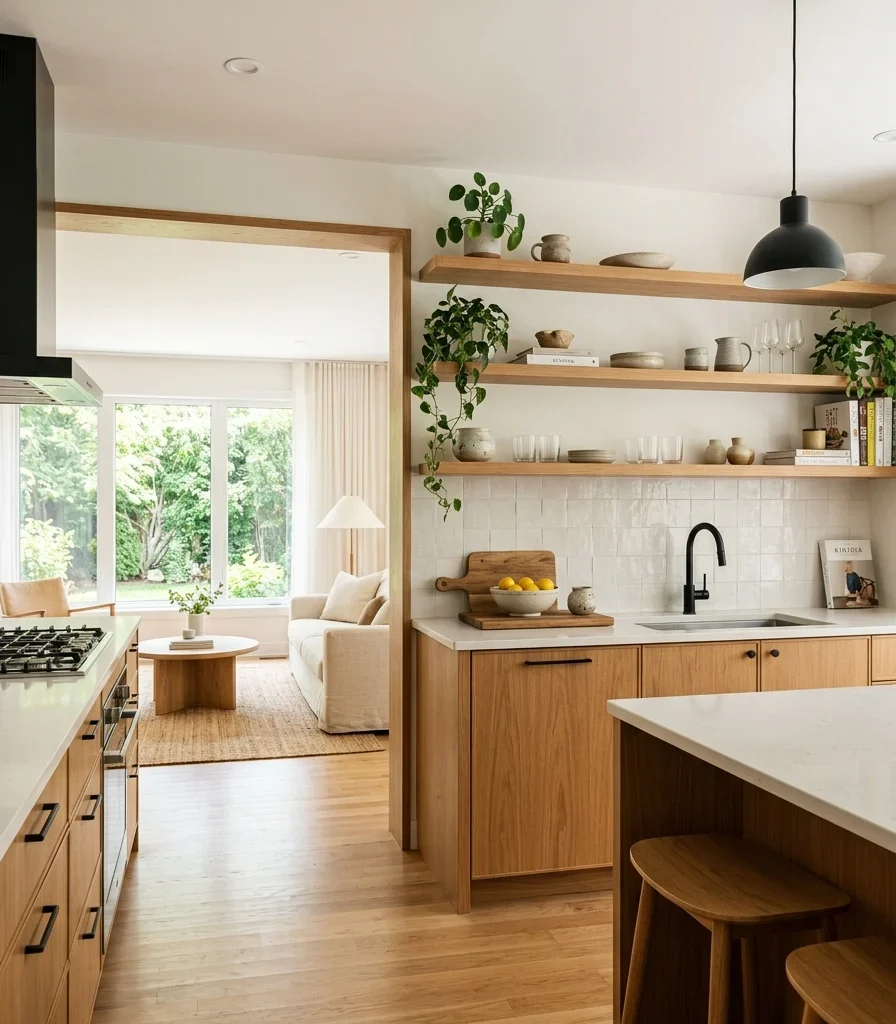
Vibe: Airy, a kitchen that visually extends into the next room instead of stopping at a wall of cabinet fronts.
Why it works: In an open-concept home specifically, replacing upper cabinets with shelving is a negative-space benefit that matters at the scale of the whole floor plan. Solid cabinetry creates a visual stopping point between the kitchen and adjacent living space, while open shelving lets sightlines continue past it, borrowing visual square footage from the connected room.
How to get it: Prioritize removing upper cabinets specifically on the wall facing an adjacent open living space (rather than an interior wall), since that’s where the sightline benefit registers most directly for anyone in either room.
Shop the Look
| Product |
| Warm oak open shelf set |
| Matte black bracket hardware |
| Small ceramic decorative vessel |
| Warm white wall paint |
| Small trailing plant accent |
4. Under-Shelf Lighting Turns Storage Into Ambient Light
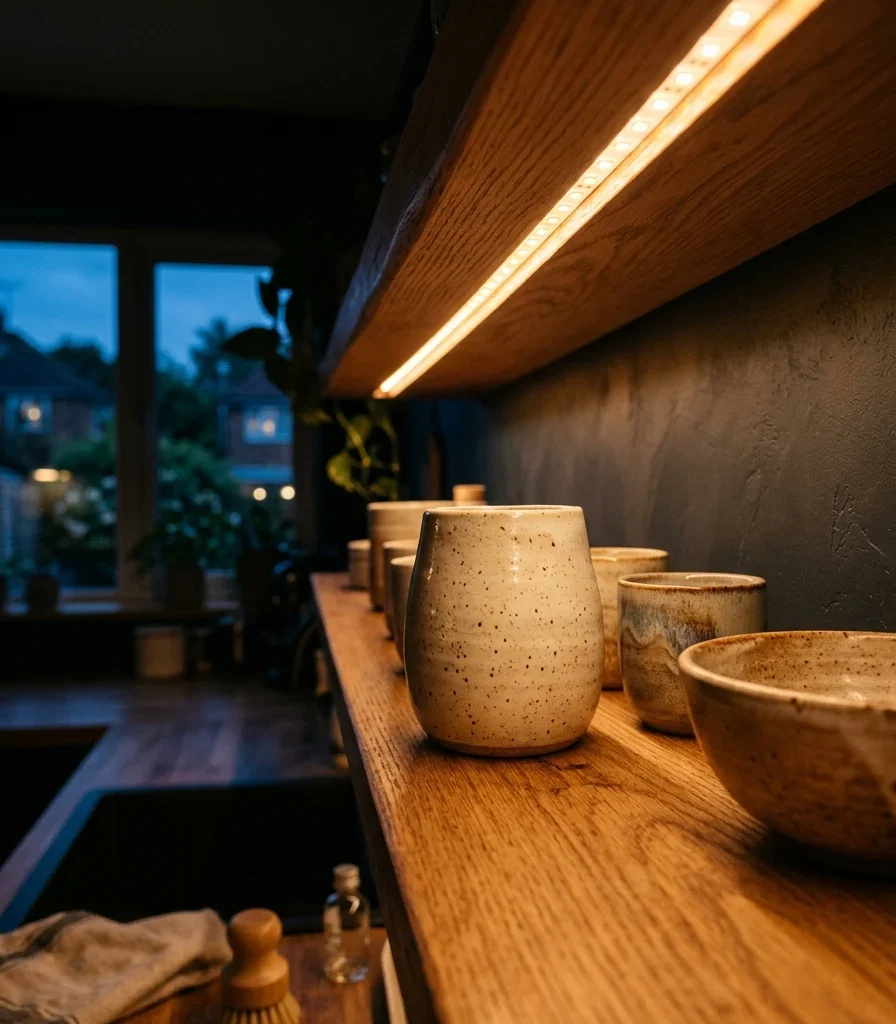
Vibe: Warm storage that doubles as the kitchen’s evening ambient light source.
Why it works: Because open shelving has no door to block light, it’s the one storage format that can genuinely incorporate under-shelf lighting as a functional design layer. This benefit is structurally unavailable to closed cabinetry, where any interior light would be invisible until the door opens, making open shelving uniquely suited to this specific light-layering technique.
How to get it: Install a warm 2700K LED strip along the underside of each shelf, wired to its own dimmer separate from the kitchen’s main task lighting, so the shelves can glow softly during evening hours independent of overhead brightness.
Shop the Look
| Product |
| Warm 2700K LED shelf strip |
| Open oak floating shelf |
| In-line dimmer switch |
| Small ceramic display vessel |
| Adhesive LED mounting clips |
5. Open Shelving Lets You Rotate Ceramics Seasonally
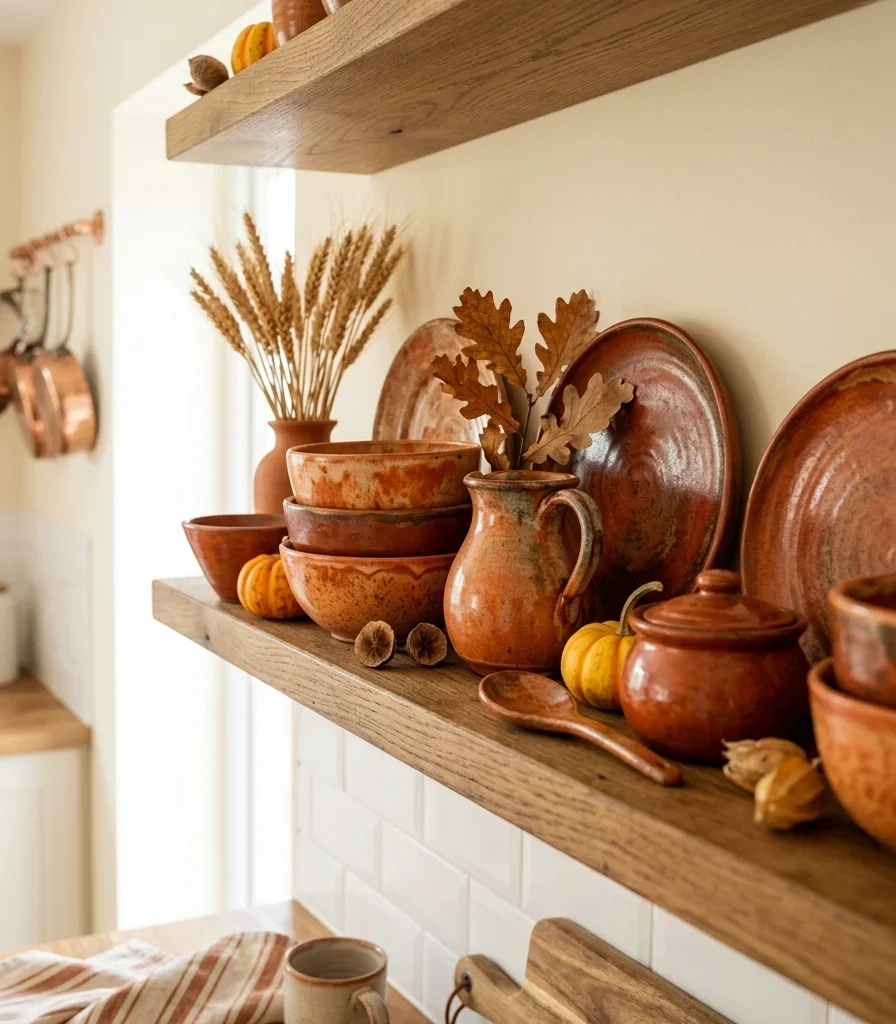
Vibe: Layered a kitchen that can shift its whole color mood with a simple dishware swap.
Why it works: Because the ceramics on open shelving are visible rather than hidden, swapping them seasonally is a genuine color-flexibility benefit closed cabinetry doesn’t offer. Changing a kitchen’s color story through cabinet paint requires real commitment, while rotating displayed dishware from warm terracotta in fall to cooler tones in summer costs nothing structurally and takes an afternoon.
How to get it: Keep one set of everyday ceramics in daily rotation and a second seasonal set stored elsewhere, swapping the displayed set roughly twice a year to keep the open shelving’s color story feeling current without repainting anything.
Shop the Look
| Product |
| Warm terracotta ceramic set |
| Warm cream ceramic seasonal set |
| Small dried wheat stem |
| Open oak shelf |
| Small ceramic seasonal bowl |
6. Displaying Cookbooks Turns a Practical Collection Into Decor
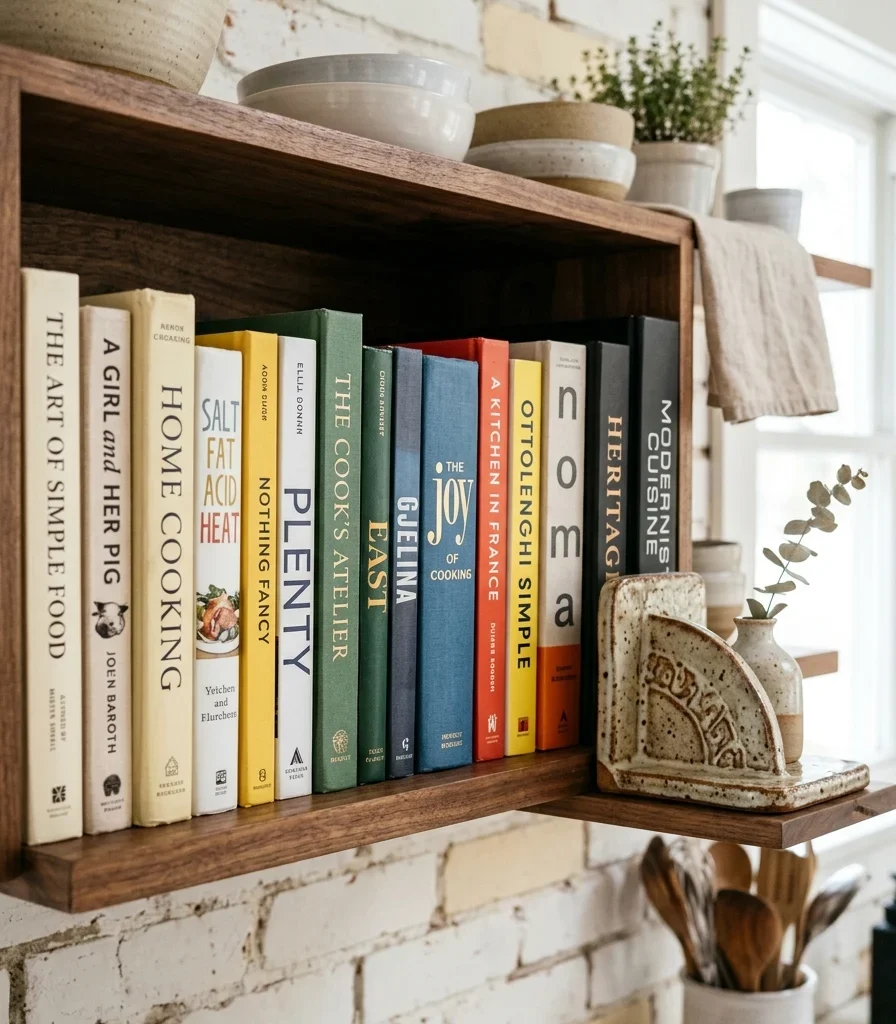
Vibe: Layered, a working collection that does genuine decorative duty instead of hiding in a drawer.
Why it works: Open shelving gives a practical, frequently used collection like cookbooks a visible home that doubles as styling; this is an accessory-layering benefit specific to open storage, since a closed cabinet would store the same books just as functionally but without any of the visual return an open shelf provides simply by existing in the room’s sightline.
How to get it: Group cookbooks loosely by spine color rather than alphabetically for a more visually composed display, bookending the row with a ceramic or wood bookend to keep the stack upright and intentional-looking.
Shop the Look
| Product |
| Ceramic bookend pair |
| Walnut open shelf |
| Small dried stem accent |
| Cookbook stand riser |
| Small ceramic vessel |
7. Open Shelves Introduce Trend Color Without Full Commitment
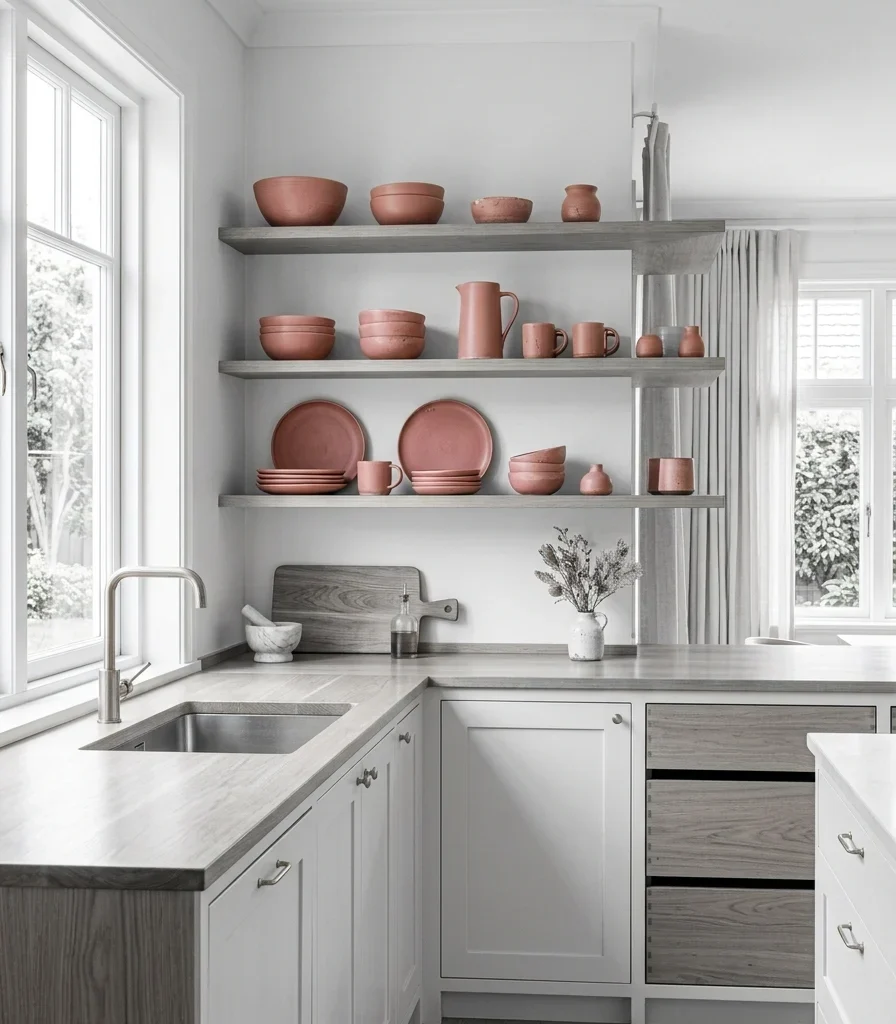
Vibe: Fresh a color trend tested through dishware instead of a wall that’s harder to undo.
Why it works: Because open shelving displays whatever’s placed on it, it functions as a low-risk way to test a trending color dusty rose, sage, or any other current hue through easily replaceable ceramics rather than a full cabinet repaint, a genuine cost and commitment benefit for anyone hesitant to commit a whole kitchen to a color that might feel dated in a few years.
How to get it: Keep the kitchen’s cabinetry and walls in a stable neutral, introducing any trend color exclusively through the displayed ceramics on open shelving, so the color experiment stays contained and reversible.
Shop the Look
| Product |
| Dusty rose ceramic vessel set |
| Warm white cabinet paint |
| Open oak shelf |
| Small ceramic bowl matching |
| Neutral countertop accent |
8. Corner Open Shelving Claims Dead Kitchen Corner Space
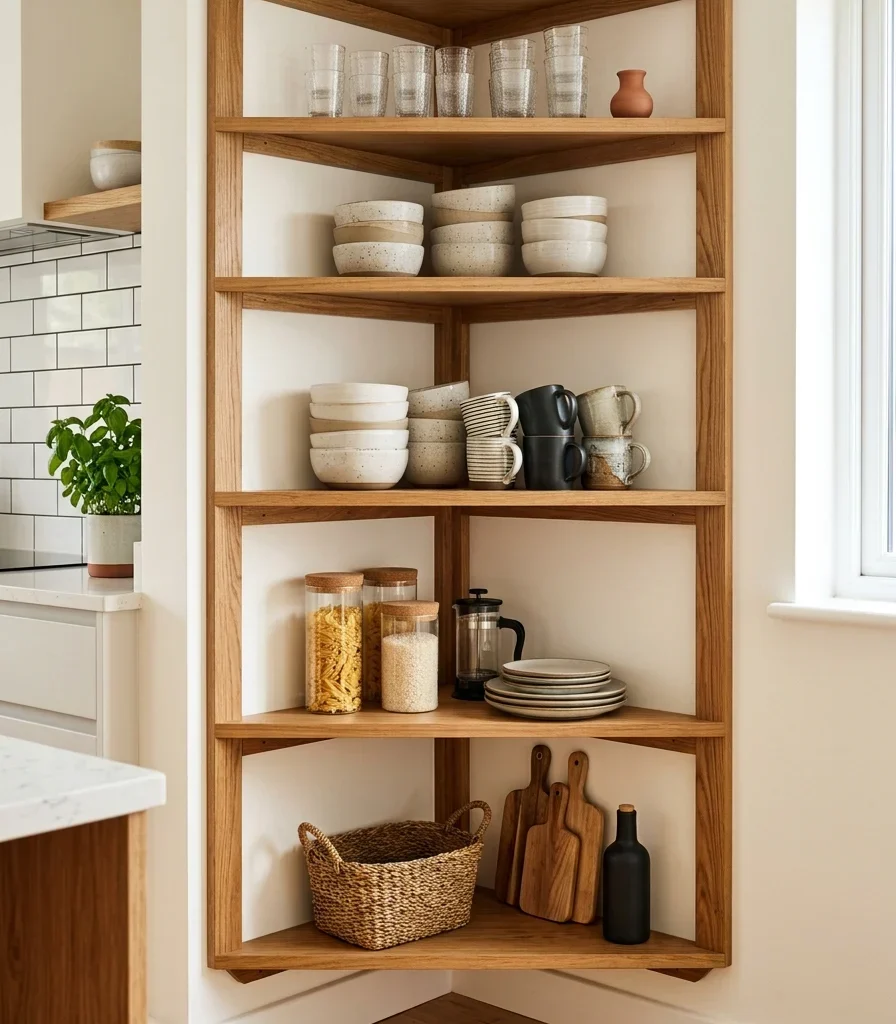
Vibe: Tidy storage claiming the one spot a standard cabinet run almost always leaves empty.
Why it works: Corner geometry is consistently the most underused space in kitchen design, since standard cabinetry is built for flat walls; open shelving specifically shaped for a corner is a furniture benefit closed cabinets struggle to match at the same cost, since custom corner cabinets are notoriously expensive relative to a simple triangular open shelf unit.
How to get it: Measure the corner’s actual angle before ordering (most are a true 90 degrees, but older homes vary), choosing a unit with at least two shelves so the corner’s full height gets used rather than just its base footprint.
Shop the Look
| Product |
| Triangular corner open shelf unit |
| Small ceramic vessel set |
| Matte black corner bracket |
| Glassware set for display |
| Small ceramic catchall dish |
9. Daylight Reaches Deeper Into the Room Without Upper Cabinets
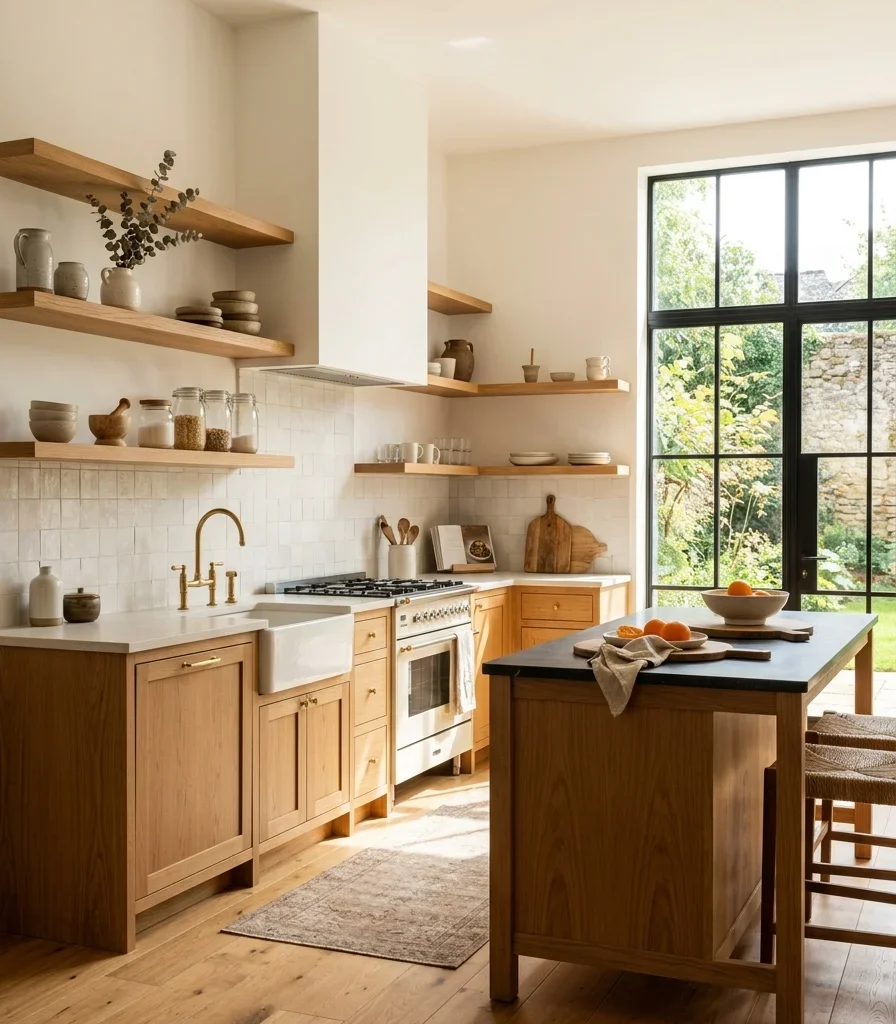
Vibe: Luminous, a kitchen where the window’s light actually reaches the far end of the room.
Why it works: Upper cabinets, particularly on a wall perpendicular to a window, can physically block a meaningful portion of a kitchen’s available daylight from reaching deeper into the room; removing them for open shelving is a light-behavior benefit that lets that same daylight travel further, since shelving occupies far less physical volume than a solid cabinet box.
How to get it: Prioritize converting the cabinet run closest to or perpendicular to the kitchen’s main window first, since that’s where the daylight-blocking effect of solid cabinetry is most pronounced.
Shop the Look
| Product |
| Warm oak open shelf near window |
| Small ceramic decorative vessel |
| Matte black shelf bracket |
| Sheer window curtain |
| Small trailing plant accent |
10. Mixed Materials on Open Shelves Add Texture Cabinets Can’t
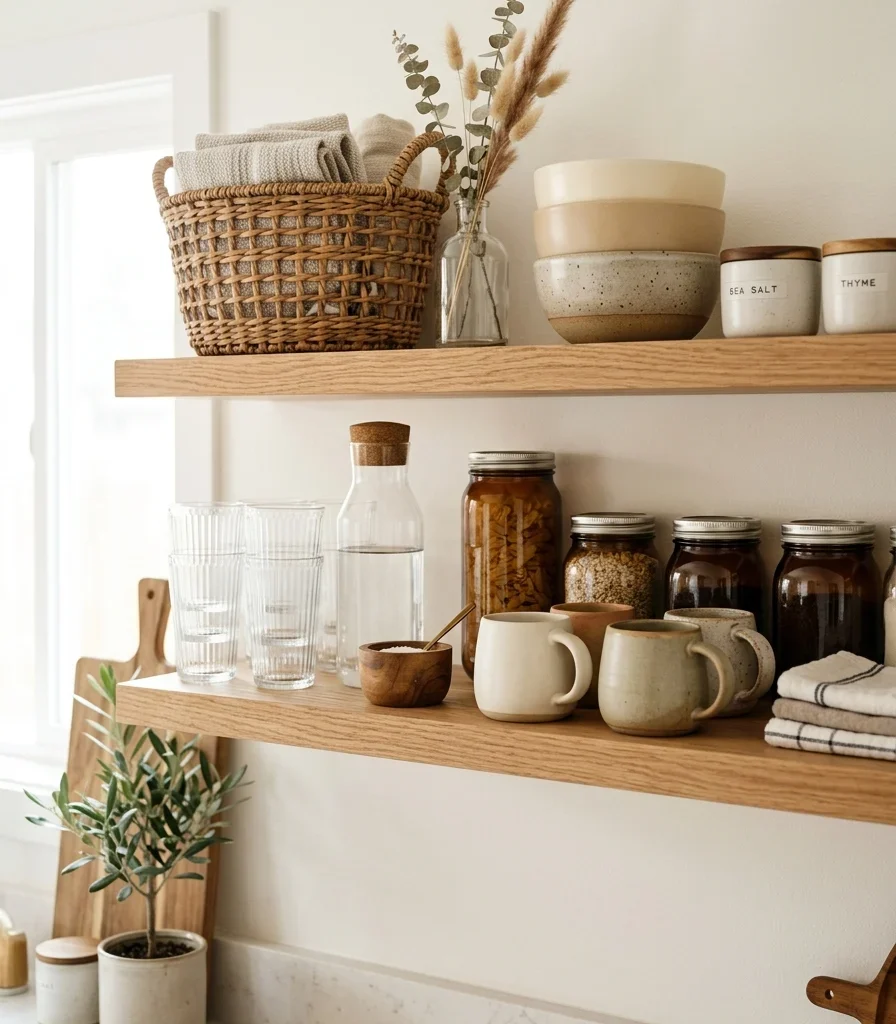
Vibe: Layer a shelf with genuine textural range instead of one flat material repeated endlessly.
Why it works: A closed cabinet door is one uniform material and finish across its whole surface, but open shelving is a material-layering benefit specifically because every object placed on it introduces its own texture; ceramic, glass, and woven basket together create visual richness a single cabinet material could never achieve regardless of how nice that one material is.
How to get it: Style each shelf with at least two different materials (a ceramic vessel plus a woven basket, for instance) rather than an all-matching set, keeping the overall color palette cohesive even as the materials vary.
Shop the Look
| Product |
| Matte ceramic vessel set |
| Small glass storage jar |
| Woven seagrass basket small |
| Small dried stem accent |
| Open oak shelf |
11. A Two-Tone Kitchen Reads Lighter With Open Shelves on Top
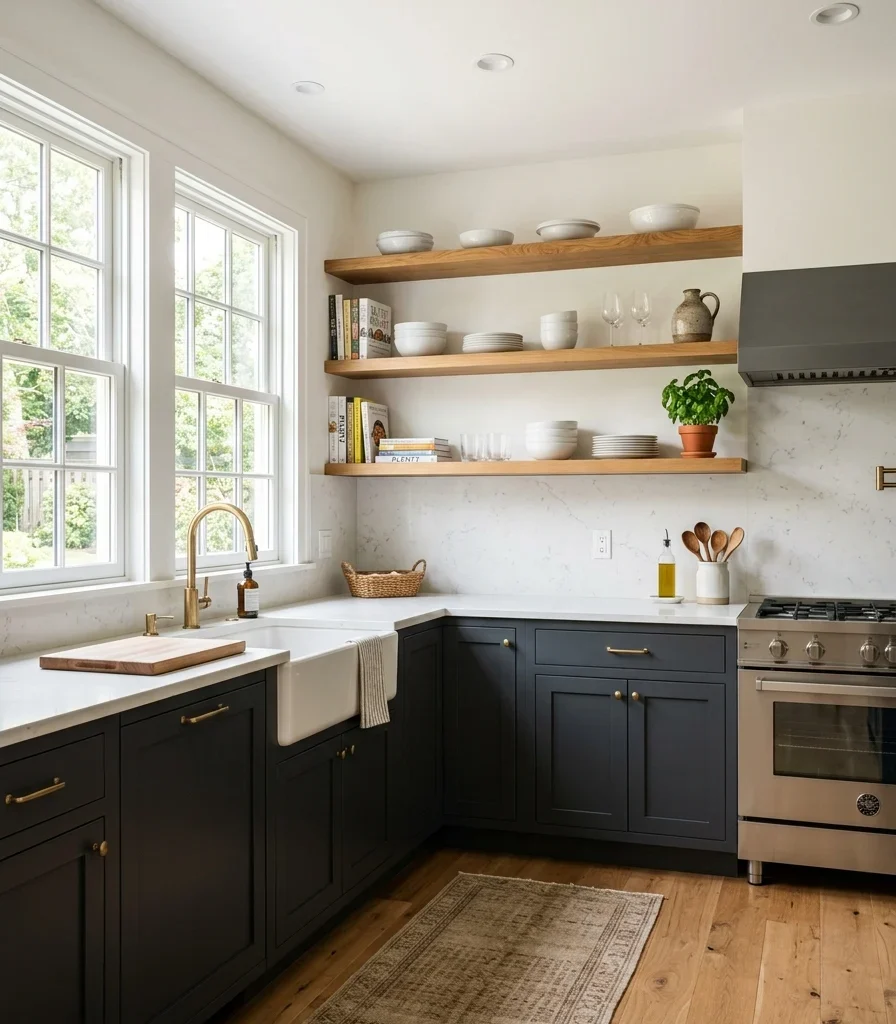
Vibe: A fresh kitchen with a dark, grounded base and an open, light-filled top instead of feeling boxed in on both levels.
Why it works: Pairing dark lower cabinets with open shelving above (rather than matching dark upper cabinets) is a proportion benefit that keeps a bold two-tone kitchen from feeling heavy overhead; the visual weight of a saturated lower cabinet color stays grounded at floor level, while open shelving above keeps the upper half of the room reading light regardless of how dark the base cabinets go.
How to get it: Keep lower cabinets in the saturated color of choice, replacing upper cabinets entirely with warm oak open shelving rather than painting them the same dark tone, letting the contrast between solid and open do the proportion work.
Shop the Look
| Product |
| Deep charcoal cabinet paint |
| Warm oak open shelf set |
| Matte black shelf bracket |
| Small ceramic decorative vessel |
| Warm white ceiling paint |
12. Everyday Items Get Curated Instead of Hidden
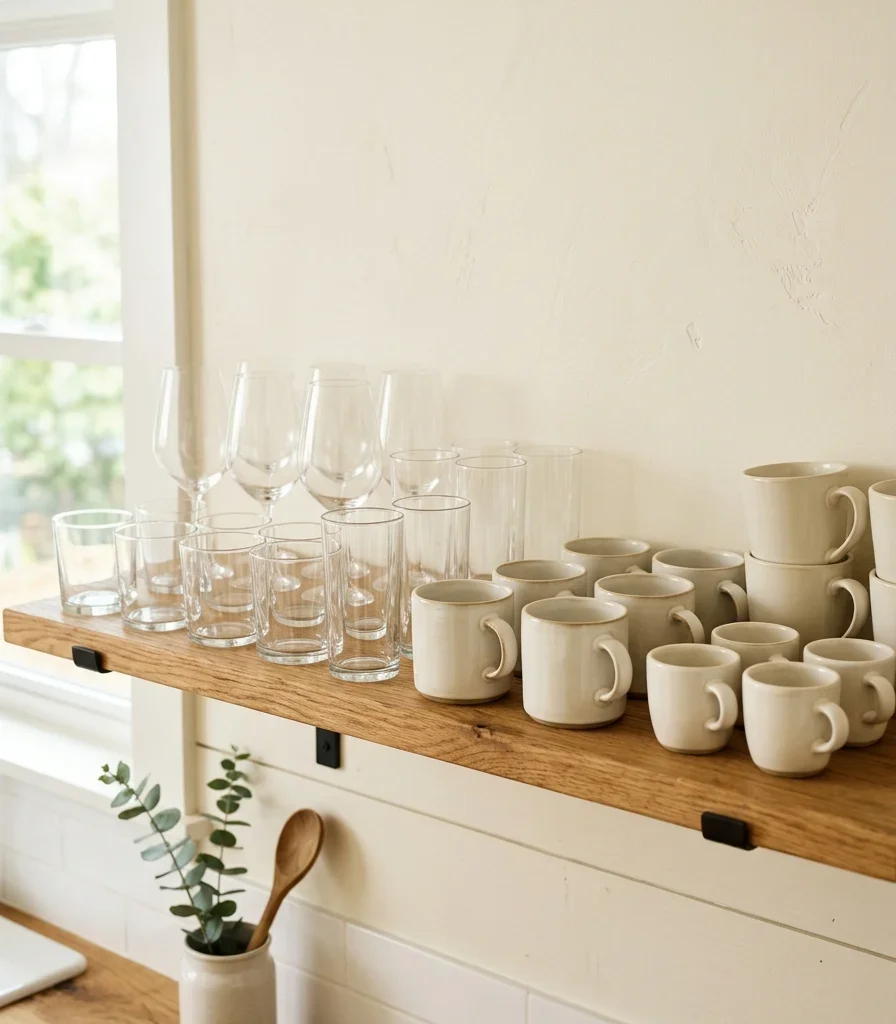
Vibe: Tidy mugs and glasses arranged with the same care usually reserved for decorative objects.
Why it works: Open shelving creates an organizational benefit through visibility itself because everyday items are seen constantly rather than hidden behind a door; there’s a natural incentive to keep them genuinely organized and matched, which often results in better daily kitchen tidiness than closed cabinets, where mismatched mugs can pile up unseen indefinitely.
How to get it: Replace mismatched everyday glassware and mugs with a coordinated set in one or two finishes, arranging by height and type on the shelf so the display stays legible and intentional rather than simply stacked.
Shop the Look
| Product |
| Coordinated ceramic mug set |
| Glassware set matching |
| Open oak shelf |
| Small ceramic organizing tray |
| Matte black shelf bracket |
13. Open Shelves Cost Less Than Upper Cabinets to Install
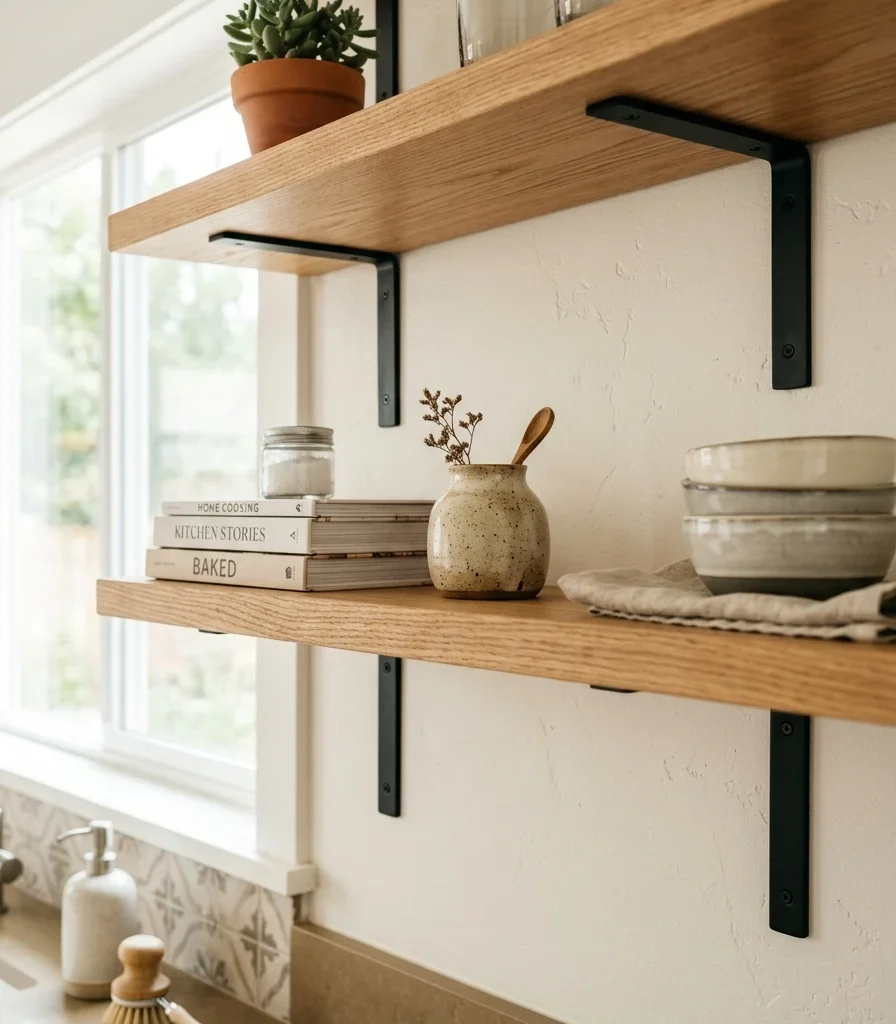
Vibe: Still storage that requires a fraction of the material and labor a full cabinet box does.
Why it works: A material and furniture-arrangement benefit of open shelving is straightforward cost: a solid wood board and a pair of brackets require far less material, hardware, and installation labor than a fully boxed, doored, and hinged upper cabinet, which is why open shelving remains one of the most accessible kitchen upgrades for a limited renovation budget.
How to get it: Choose solid wood boards (not a full manufactured shelving system) mounted on simple concealed brackets, which most homeowners with basic tools can install in an afternoon without hiring a cabinet installer.
💡 Quick Win: A single 36-inch oak shelf with brackets typically costs a fraction of even one small upper cabinet box, making it the lowest-cost entry point on this list.
Shop the Look
| Product |
| Solid oak shelf board |
| Concealed bracket set |
| Small ceramic decorative vessel |
| Wall anchor mounting kit |
| Wood sealant finish |
14. Open Shelving Keeps Sightlines Open in a Galley Kitchen
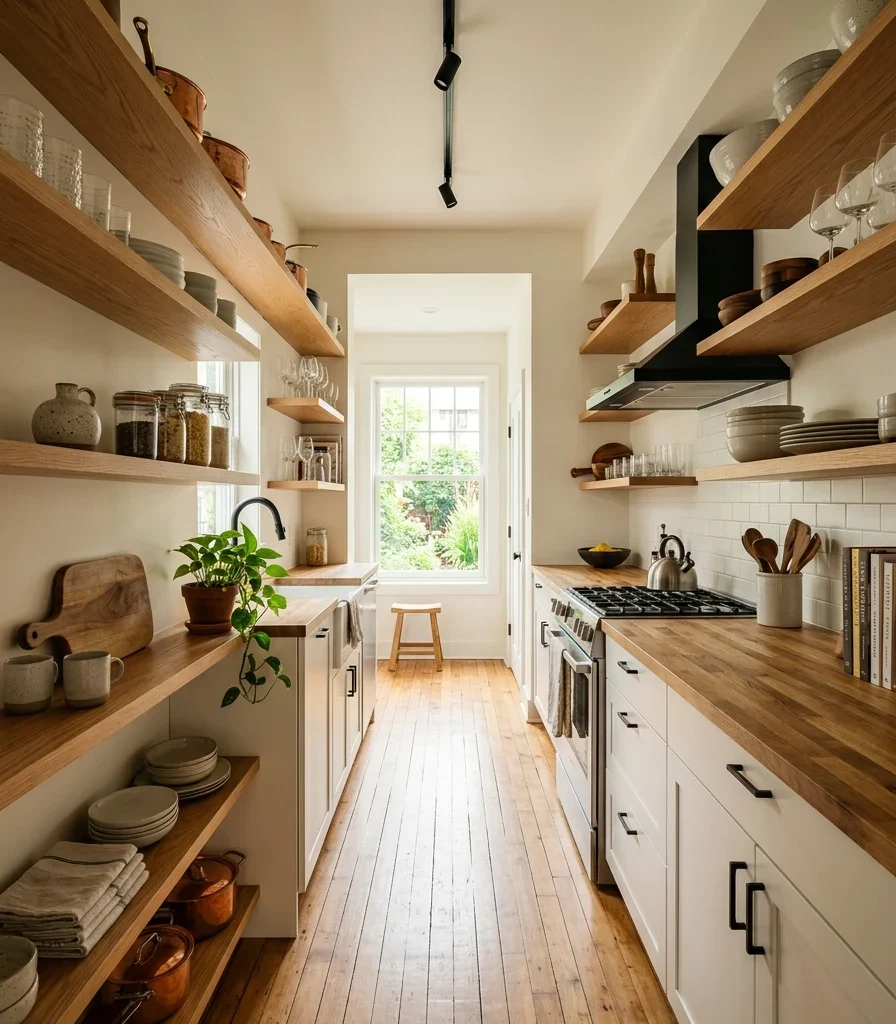
Vibe: Airy, a narrow room that avoids the tunnel-like feeling two walls of upper cabinets can create.
Why it works: In a galley kitchen specifically, upper cabinets on both walls can create a compressed, tunnel-like traffic-flow effect, since the eye has nowhere to travel but straight down the narrow corridor; open shelving on one or both walls is a layout benefit that keeps sightlines traveling past the shelves to the walls behind, softening the narrow room’s proportions.
How to get it: Convert at least one wall of a galley kitchen’s upper cabinets to open shelving, prioritizing the wall opposite the room’s main light source so daylight bounces off the visible wall behind the shelves.
Shop the Look
| Product |
| Warm oak open shelf for galley |
| Matte black bracket set |
| Small ceramic vessel |
| Warm white wall paint |
| Small woven basket accent |
15. A Single Open Shelf Adds Storage Without Bulk in a Tiny Kitchen
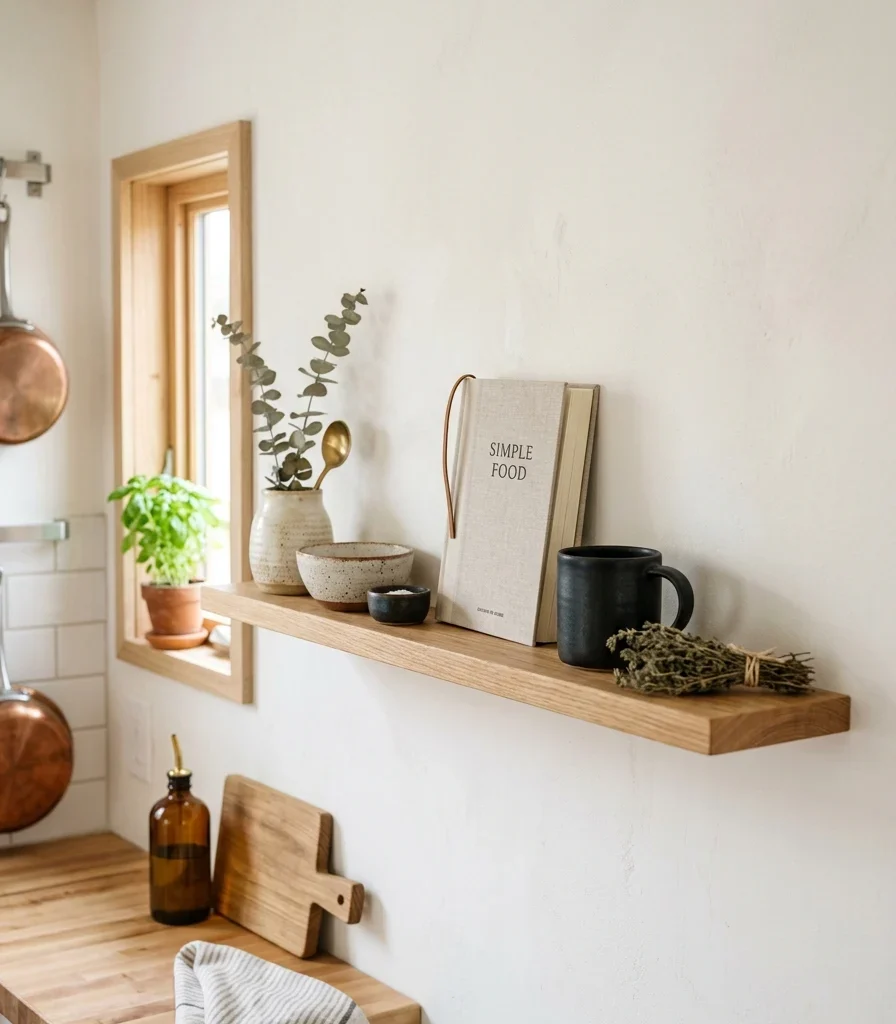
Vibe: Still one shelf doing meaningful storage work without adding a single ounce of visual weight to a tiny room.
Why it works: In a genuinely small kitchen, even one additional upper cabinet can feel like too much visual mass for the room to absorb; a single open shelf is the small-space adaptation that adds real storage capacity while keeping the wall’s visual footprint minimal, since an open board reads as far less bulky than even a small cabinet box in the same spot.
How to get it: Choose one shelf no deeper than 8 inches, styling it with no more than three or four items so it stays genuinely light in a small kitchen where every additional object registers more heavily than it would in a larger room.
💡 Quick Win: A single 24-inch shelf above the sink adds a functional soap-and-dish-brush spot without requiring any cabinet at all.
Shop the Look
| Product |
| Slim narrow oak shelf 24-inch |
| Small ceramic soap dispenser |
| Matte black shelf bracket |
| Small ceramic vessel |
| Small dish brush holder |
How to Start Adding Open Shelving to Your Kitchen
Your first move is testing the concept on a single cabinet before removing any others; specifically, take the doors off one existing upper cabinet and live with it open for two weeks. This single, reversible test tells you honestly whether you’ll actually keep the shelf organized before committing to a full wall of exposed storage.
The most common mistake is converting an entire kitchen’s upper cabinets to open shelving all at once without this test period, then discovering the daily maintenance of keeping everything visibly tidy isn’t sustainable for the household’s actual habits. The fix is starting with one shelf, evaluating honestly after a few weeks, and expanding only if the format genuinely works for how the kitchen gets used.
Three items under $50 that create immediate impact: a set of coordinated ceramic mugs to replace mismatched ones, a small woven basket for loose items, and a ceramic bookend pair if displaying cookbooks.
A weekend project removing doors from one cabinet or installing a single shelf costs $50–200. A full open shelving conversion across multiple cabinet runs typically runs $500–2,000 depending on shelf material and whether under-shelf lighting is included, and can usually be completed in a single weekend.
Frequently Asked Questions About Open Shelving Benefits in the Kitchen
What is the difference between open shelving and removing cabinet doors?
Open shelving typically refers to purpose-built shelves (a board on brackets) designed from the start to be seen, often shallower and more minimal than a cabinet box. Removing doors from an existing cabinet achieves a similar open effect using the original cabinet box, which is deeper and often has visible hinge holes, making it a good low-cost test but not identical to purpose-built shelving.
What color works best for open kitchen shelving?
Warm oak or walnut works well as a neutral base that lets displayed ceramics carry the room’s color story, while the wall behind the shelves is where a bolder color choice, like deep sage or warm terracotta, gets the most visual return, since that wall is only visible because the shelving is open.
How much does open shelving cost compared to upper cabinets?
Open shelving typically costs $50–300 per section including brackets, compared to $150–600 or more per section for a comparable upper cabinet box with doors and hinges. A full kitchen’s worth of open shelving generally runs $500–2,000, meaningfully less than the equivalent run of built-in upper cabinetry.
Can open shelving work in a kitchen with a lot of daily cooking mess?
Yes, but it requires realistic placement, keeping open shelving away from the direct splash zone of the stove and sink, and reserving it for items that don’t need frequent washing between uses, which helps the display stay genuinely clean without demanding constant wiping the way shelving directly above a busy cooktop would.
What is the most common concern people have about open shelving?
Dust and visible clutter are the most commonly cited concerns about open shelving, according to design-industry and homeowner survey data, which is why the honest recommendation is testing the format on a single cabinet first, since the format’s real success depends more on a household’s actual tidiness habits than on any specific styling choice.
Ready to Add Open Shelving to Your Kitchen?
These 15 benefits move across material, color, lighting, layout, and true small-space advantages, from daylight reaching further into the room to a single narrow shelf that adds storage without a single ounce of visual bulk. None of this needs to happen all at once, and testing the concept on one cabinet before converting the whole kitchen is genuinely the smartest way to begin, not a smaller version of the full commitment. Today’s specific action: remove the doors from just one upper cabinet this week and use it exactly as-is for the next two weeks, since that honest trial will tell you more about whether open shelving suits your kitchen than any amount of browsing inspiration photos. Once you know the format genuinely fits how your household actually cooks and cleans, expanding it will feel like a confirmed decision instead of a gamble. Save the ideas that fit your kitchen’s real light, layout, and your own honest tidiness habits, so that daylight reaching the far wall and that one curated shelf will still be earning their keep a year from now.
You Might Also Like
- 15 Ways to Decorate an Open Plan Kitchen Dining Space
- 15 Ways to Maximize Space in an Open Plan Kitchen Room
- 10 Open Kitchen Partition Ideas Worth Saving
- 14 Coastal Kitchen Decor Ideas for a Breezy, Sunlit Space
- 15 Luxurious Classic Kitchen Design Ideas With Real Architectural Detail
- 15 Ways to Create a Modern Luxury Kitchen Ceiling Design
[…] 15 Open Shelving in the Kitchen | Kitchen Storage Ideas […]
[…] 15 Open Shelving in the Kitchen | Kitchen Storage Ideas […]
[…] 15 Open Shelving in the Kitchen | Kitchen Storage Ideas […]