
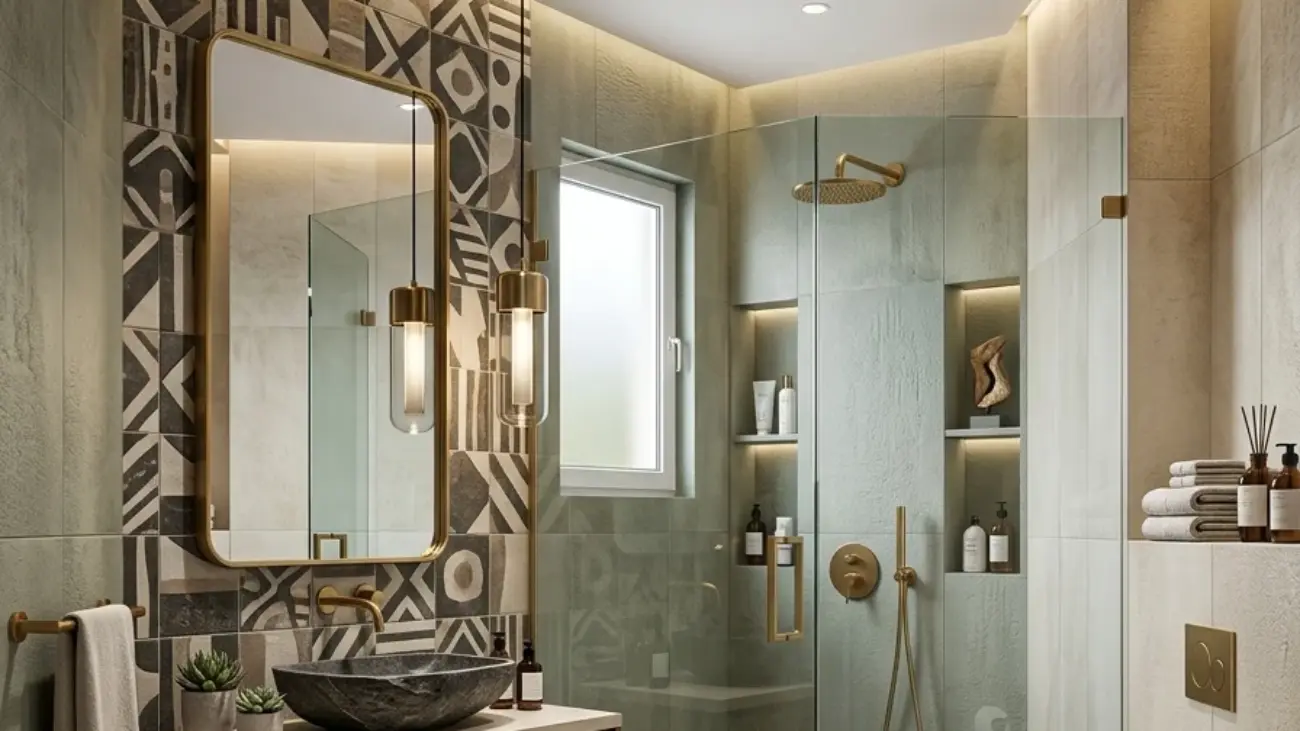
Creative small bathroom design means solving a compact footprint with unexpected, rule-breaking choices instead of defaulting to the safe, all-white minimal playbook most small bathrooms fall back on. This article gives you 15 real creative small full bathroom ideas covering color, material, lighting, furniture, and layout, each one a genuinely unexpected move that still respects the practical limits of a small room.
The feel is unmistakable: a mirror that’s deliberately too big, a color choice that ignores the usual “keep it light” advice, a dresser standing in where a builder-grade vanity was supposed to go. Creative doesn’t mean chaotic it means trusting one bold idea enough to let it actually work in a room this size. Here are 15 ideas worth saving and stealing.
Why Creative Small Full Bathroom Ideas Work So Well
Creative small bathroom design isn’t tied to one historical movement the way farmhouse or Art Deco are; it’s a design attitude that emerged directly as a reaction against the builder-beige, safe-neutral small bathrooms that dominated residential construction through the 2010s, when “make it feel bigger” was treated as the only acceptable small-space brief. The eclectic maximalism movement in interior design, which champions bold color and pattern over cautious restraint, gave this approach its clearest current expression, arguing that a small room can carry more personality precisely because there’s less of it to commit to.
The materials and techniques that define this approach include fully saturated color used counterintuitively rather than avoided, patterned cement or encaustic-look tile paired with plain walls, intentionally mismatched metal finishes, and repurposed furniture: a vintage dresser, an old console standing in for a standard vanity. Textile swaps matter too: a curtain instead of a glass shower door, a runner rug instead of a bath mat, both choices that borrow from other rooms rather than following bathroom convention.
Search interest in bold, unconventional small bathrooms has grown alongside a broader “dopamine decor” trend and visible fatigue with a decade of minimalist, neutral-dominated interiors flooding Pinterest and Instagram feeds. Powder room and small bathroom searches specifically show rising interest in “moody,” “colorful,” and “maximalist” modifiers, reflecting a real shift in what people are now searching for instead of “small bathroom ideas to make it look bigger.”
Style at a Glance
| Element | Bold & Saturated Moves | Unexpected Material Swaps |
| Philosophy | Full commitment to one strong color or scale choice | Borrowing materials from outside typical bathroom convention |
| Materials | Saturated paint, patterned tile, mixed metals | Repurposed furniture, curtains, rugs, oversized mirrors |
| Color Palette | Deep jewel tones, warm terracotta, moody charcoal | Determined by whatever the swapped material introduces |
15 Creative Small Full Bathroom Ideas
1. A Fully Color-Drenched Small Bathroom in One Bold Hue

Vibe: The bathroom feels enveloping, one saturated color removing every visual seam in the room.
Why it works: Color-drenching a small bathroom painting walls, trim, and ceiling in one continuous hue works against the conventional small-space instinct to keep things light, and it succeeds precisely because removing the contrast between wall and trim eliminates the visual edges that would otherwise make a small room’s actual boundaries more apparent. Without white trim breaking up the walls, the room reads as one continuous volume rather than a small box with visible seams.
How to get it: Choose a single warm, mid-saturation color in a matte or flat finish for walls and ceiling, using a slightly higher sheen like eggshell on the trim so the surfaces stay unified in color but distinguishable by texture.
💡 Quick Win: Test color-drenching first with a large poster-board swatch taped across a full wall corner, including where the ceiling meets it, before committing to paint.
Shop the Look
| Product |
| Deep terracotta matte interior paint |
| Terracotta eggshell trim paint, matching |
| White ceramic pedestal sink |
| Brushed brass faucet |
| Small brass wall hook set |
2. A Patterned Cement Tile Floor Under Plain White Walls
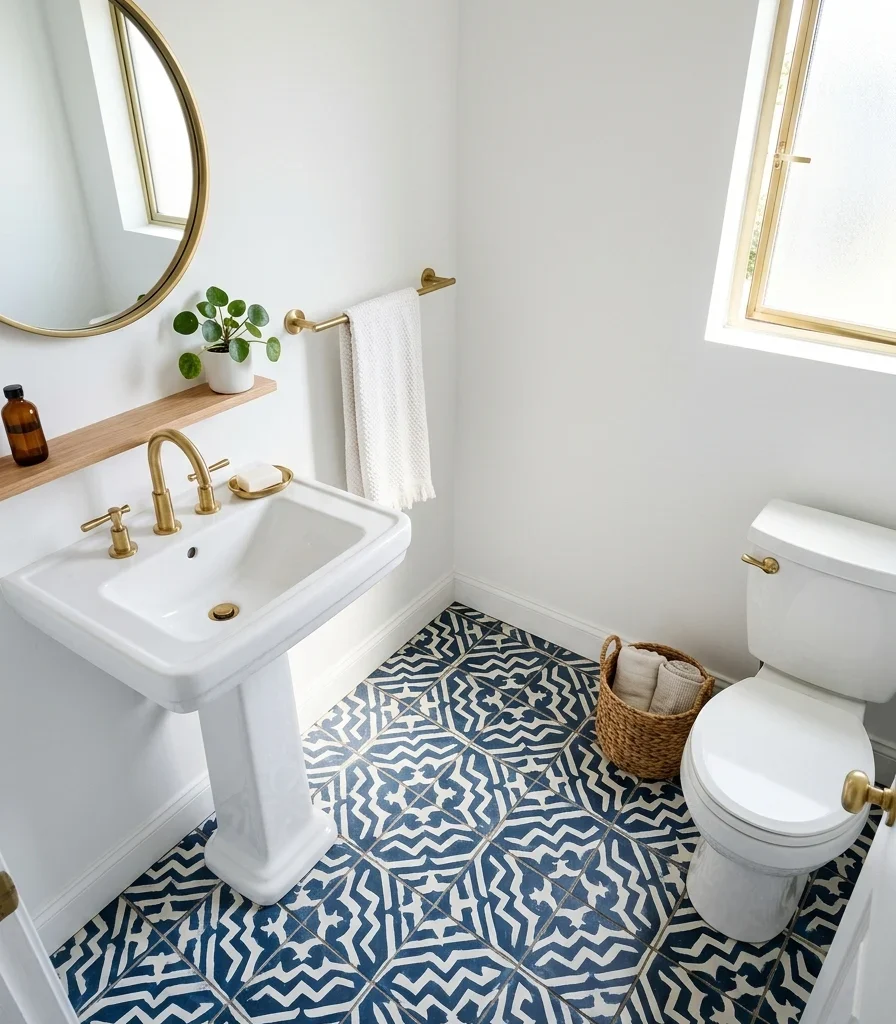
Vibe: The floor feels graphic, one bold pattern doing all the room’s visual talking.
Why it works: Concentrating pattern exclusively at floor level, while keeping every wall plain white, lets a genuinely bold and busy tile choice register clearly without competing against itself. This is a restraint-through-contrast principle, where the floor’s visual intensity depends entirely on having nothing else in the room pulling equal attention. A small bathroom’s contained floor area also means a dramatic pattern here carries much lower material cost than the same pattern would across a larger room.
How to get it: Choose a patterned cement or encaustic-look tile in a two-color scheme, and resist adding any additional pattern or bold color elsewhere in the room, letting the floor remain the singular loud element against an otherwise quiet backdrop.
Shop the Look
| Product |
| Patterned cement-look floor tile |
| Tile grout, matching neutral tone |
| White pedestal sink |
| Brushed brass faucet |
| Anti-slip tile sealant |
3. A Statement Light Fixture Scaled Up, Not Down
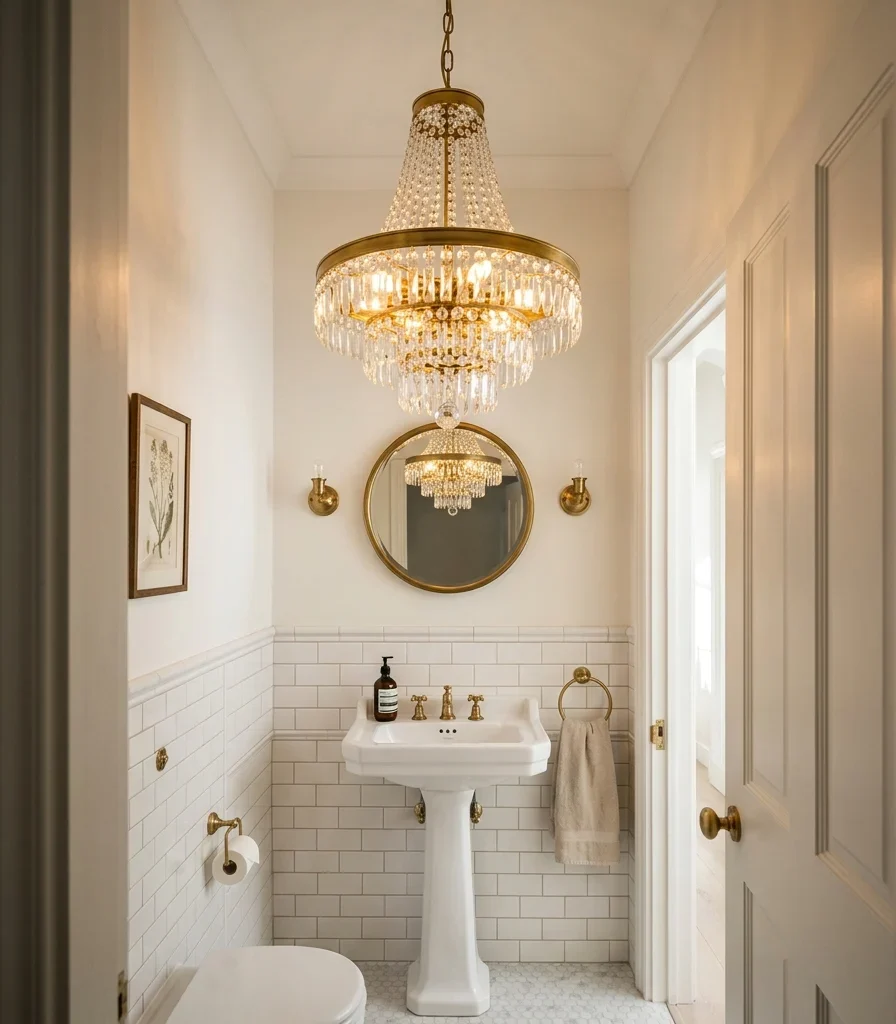
Vibe: The powder room feels dramatic, one fixture claiming more presence than the “safe” choice would allow.
Why it works: Conventional small-space advice pushes toward scaled-down, unobtrusive fixtures, but an intentionally oversized pendant or chandelier in a small bathroom creates the same emphasis effect a bold color choice does; the fixture becomes an unmissable focal point precisely because its scale defies the room’s actual size. This works specifically in powder rooms and small full bathrooms where the fixture doesn’t need to clear a shower or bathtub’s functional zone.
How to get it: Choose a fixture roughly one and a half times the scale a standard small-room lighting guide would recommend, and hang it centered in the room rather than tucked to one side, letting its full presence read clearly from the doorway.
Shop the Look
| Product |
| Oversized brass and crystal pendant light |
| Dimmer switch for pendant |
| Warm dimmable bulb set |
| White pedestal sink |
| Small brass wall hook |
4. A Vintage Dresser Repurposed as a Vanity

Vibe: The vanity feels unexpected, furniture from another room finding new purpose here.
Why it works: A vintage dresser repurposed as a vanity carries genuine furniture character real drawer joinery, aged hardware, a silhouette that has nothing to do with standard bathroom cabinetry that no purpose-built vanity can replicate, since it was never designed to be one. This is the same collected, furniture-forward luxury principle used in high-end kitchens, applied at small-bathroom scale and cost, since a secondhand dresser typically costs a fraction of a comparable custom vanity.
How to get it: Have a plumber assess the dresser’s top thickness before cutting for a drop-in sink, and seal any exposed wood surfaces with a moisture-resistant finish given the humidity a bathroom regularly experiences.
Shop the Look
| Product |
| Vintage-style wood dresser, vanity-height |
| Drop-in ceramic sink |
| Brushed brass faucet |
| Moisture-resistant wood sealant |
| White ceramic soap dish |
5. A Gallery Wall Inside a Tiny Powder Room

Vibe: The powder room feels layered, art covering nearly every inch on purpose.
Why it works: Conventional wisdom says small rooms need visual breathing room, but a densely hung gallery wall inverts that logic entirely. In a genuinely tiny powder room, filling the walls floor to ceiling with framed art removes any single focal point competition and instead makes the room itself feel like being inside a curated collection rather than a small, underdecorated box. This is the salon-style hanging tradition applied specifically where conventional small-space advice would say to leave walls bare.
How to get it: Lay the full arrangement out on the floor first using painter’s tape as a placement guide, and don’t stop at eye level; continue frames up toward the ceiling and down near the baseboard for genuine floor-to-ceiling density.
Shop the Look
| Product |
| Mixed gilt frame set, varied sizes |
| Matte black frame set |
| Art print bundle, varied subjects |
| Painter’s tape for layout planning |
| Command picture hanging strips |
6. Painting a Recessed Niche a Contrasting Color
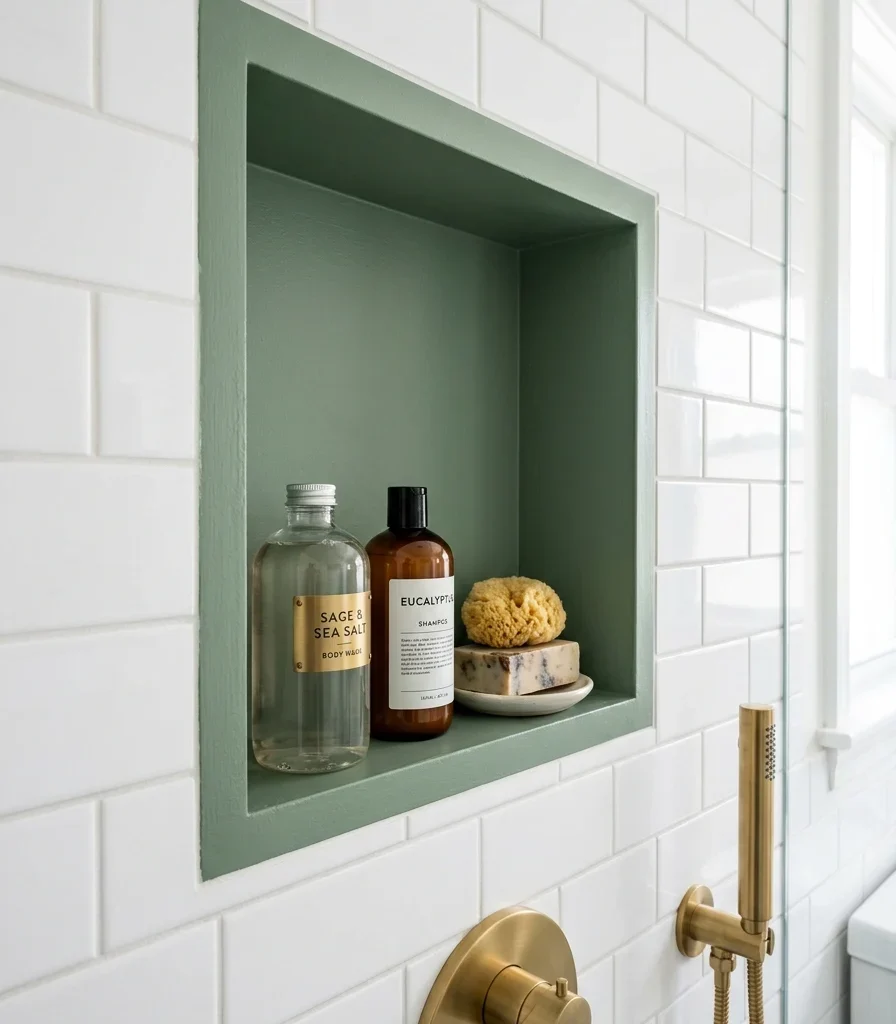
Vibe: The niche feels precise, one small painted surprise tucked into an otherwise plain wall.
Why it works: A recessed shower or storage niche is typically finished in the same material as the surrounding wall, making it functionally invisible until something’s placed inside it. Painting or tiling just the niche’s interior in a contrasting color turns this overlooked architectural feature into a deliberate small moment of color, delivering real visual interest using a genuinely tiny surface area. This is the small-bathroom equivalent of an accent wall, scaled down to the smallest possible footprint that still reads clearly.
How to get it: Use a moisture-resistant paint or small-format tile specifically rated for wet areas within the niche, and keep the contrast color confined strictly to the niche’s interior walls, letting the surrounding tile stay unchanged for maximum contrast.
Shop the Look
| Product |
| Sage green moisture-resistant paint |
| Small-format contrast tile, niche-sized |
| Tile grout, white |
| Brass niche shelf trim |
| Bath product organizer set |
7. Mixing Two Unexpected Metal Finishes on Purpose
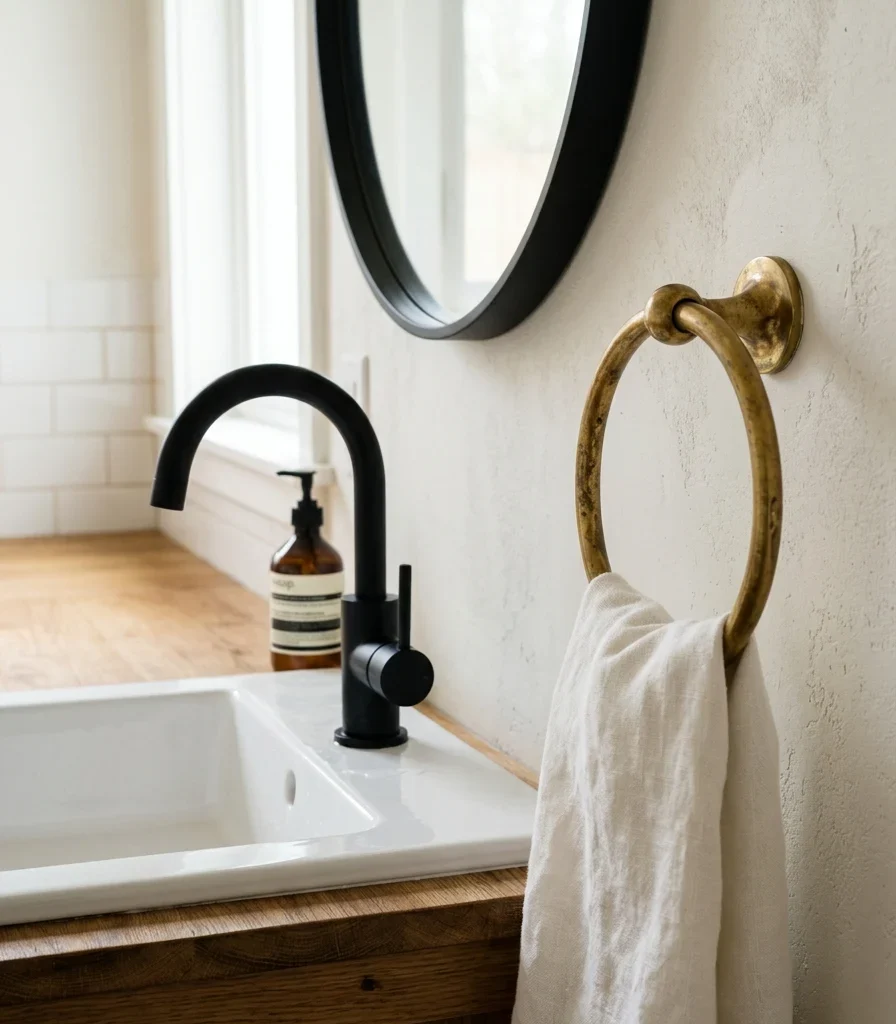
Vibe: The sink feels considered, two metals doing a deliberate, unexpected duet.
Why it works: Mixed metals used to be treated as an outright design mistake to avoid, but pairing two genuinely different finishes matte black and unlacquered brass, for instance with clear intention, keeping one dominant and one secondary, delivers more visual depth than a single-metal room, especially in a small bathroom where fixture finishes sit in close enough proximity to actually register as a considered pairing rather than a mismatch.
How to get it: Choose one metal for roughly 70% of the room’s hardware, typically the faucet and drain, and reserve the second metal for towel bars and hooks specifically, keeping the split consistent rather than randomly distributed.
Shop the Look
| Product |
| Matte black bathroom faucet |
| Unlacquered brass towel bar |
| Unlacquered brass hook set |
| White ceramic sink |
| Matte black drain hardware |
8. Turning a Windowsill Into a Display Ledge
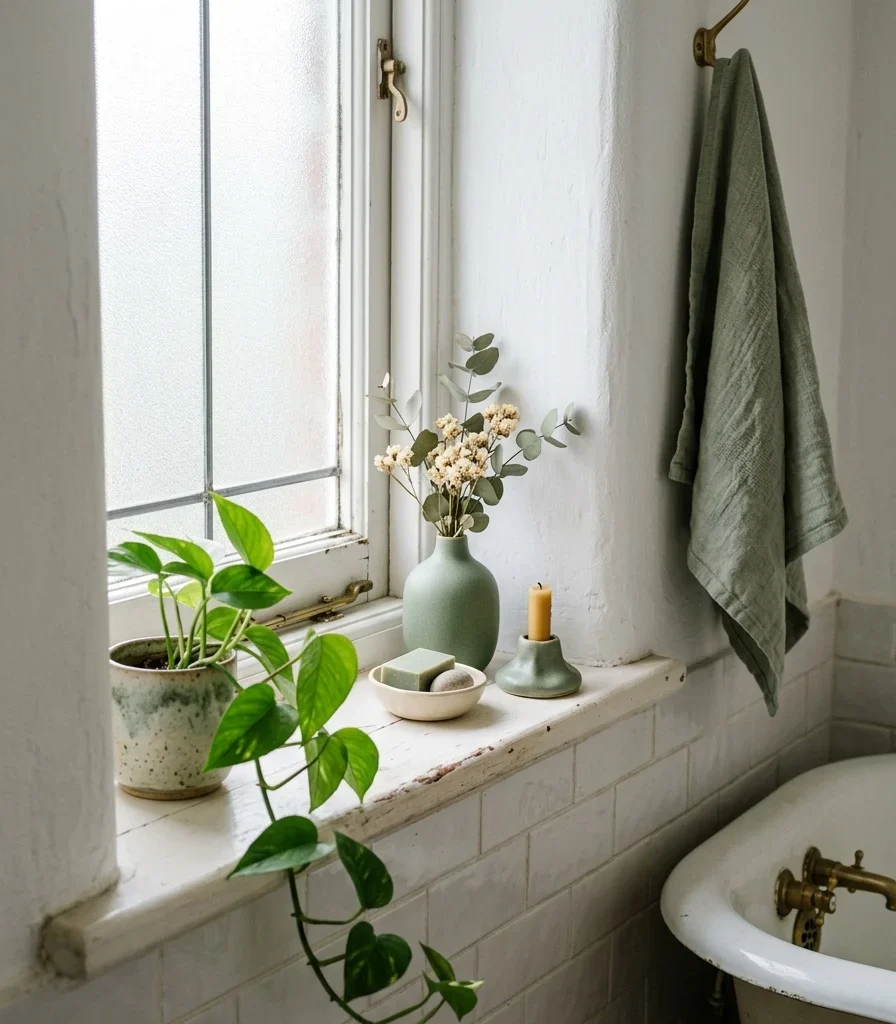
Vibe: The window feels curated, a normally overlooked ledge treated as real display space.
Why it works: A windowsill in a small bathroom is almost universally left bare or cluttered with random bottles; when treating it as an intentional display ledge the same way a mantel or console gets styled elsewhere in a home, it claims genuinely free surface area that a small room can’t spare to waste. This is a layout-level reframing: recognizing an existing architectural feature as usable space rather than dead space, without adding any new furniture or storage at all.
How to get it: Style the sill with two or three objects at varied heights following the same asymmetric-grouping principle used on shelves elsewhere, keeping the total footprint shallow enough not to block window function or cleaning access.
Shop the Look
| Product |
| Small ceramic vase, windowsill-sized |
| Trailing plant, bathroom-tolerant |
| Small ceramic dish |
| Sage green ceramic accent piece |
| Small brass candle holder |
9. Uplighting a Niche Shelf for a Gallery Effect
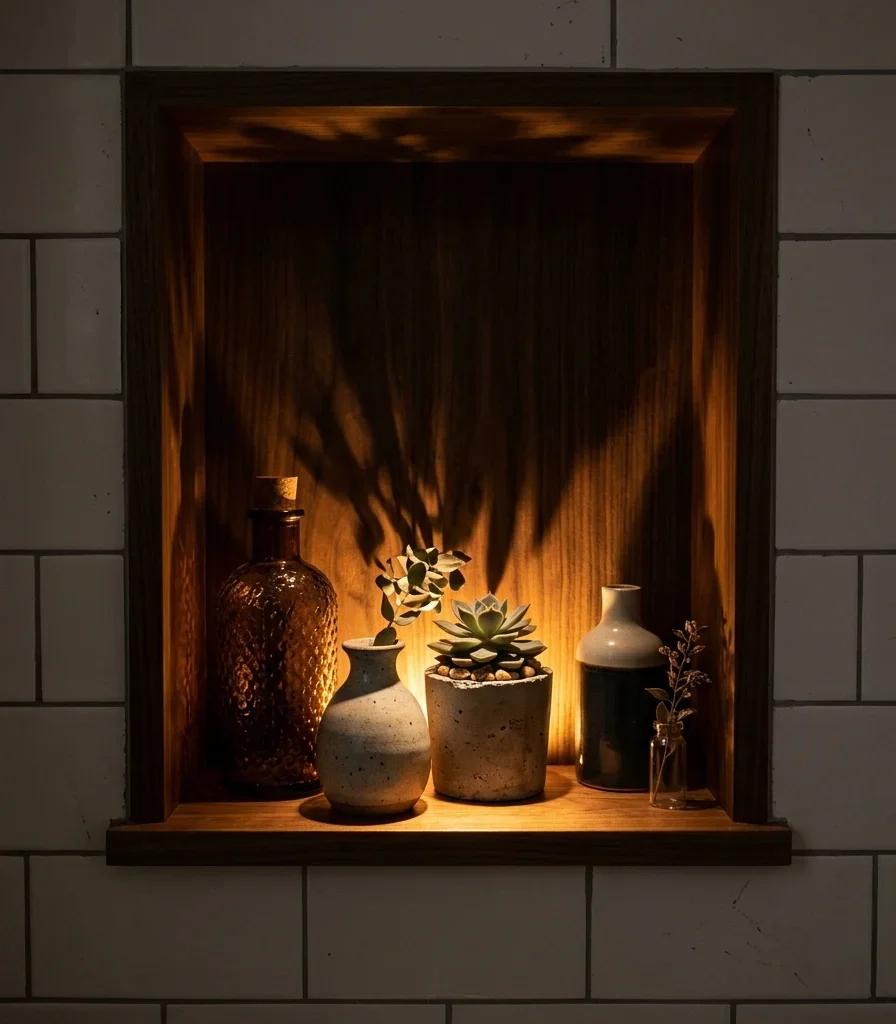
Vibe: The niche feels gallery-like, small hidden light doing dramatic, unexpected work.
Why it works: Uplighting a recessed niche from below, rather than lighting it with standard even ambient light, casts shadow upward across whatever’s displayed inside it, creating the same dramatic effect museum lighting uses for small sculptural objects a genuinely unconventional lighting choice for a functional bathroom storage spot, treating everyday bath products the way a gallery would treat a display piece.
How to get it: Install a small battery-powered or hardwired puck light at the niche’s base, angled to cast light upward across the displayed contents rather than straight out, and choose warm-toned bulbs to keep the dramatic effect from reading as harsh.
Shop the Look
| Product |
| Small battery-powered puck light |
| Warm white LED bulb, directional |
| Ceramic bath product bottles |
| Small potted plant, niche-sized |
| Adhesive mounting strips for light |
10. Floating the Vanity to Reveal More Floor
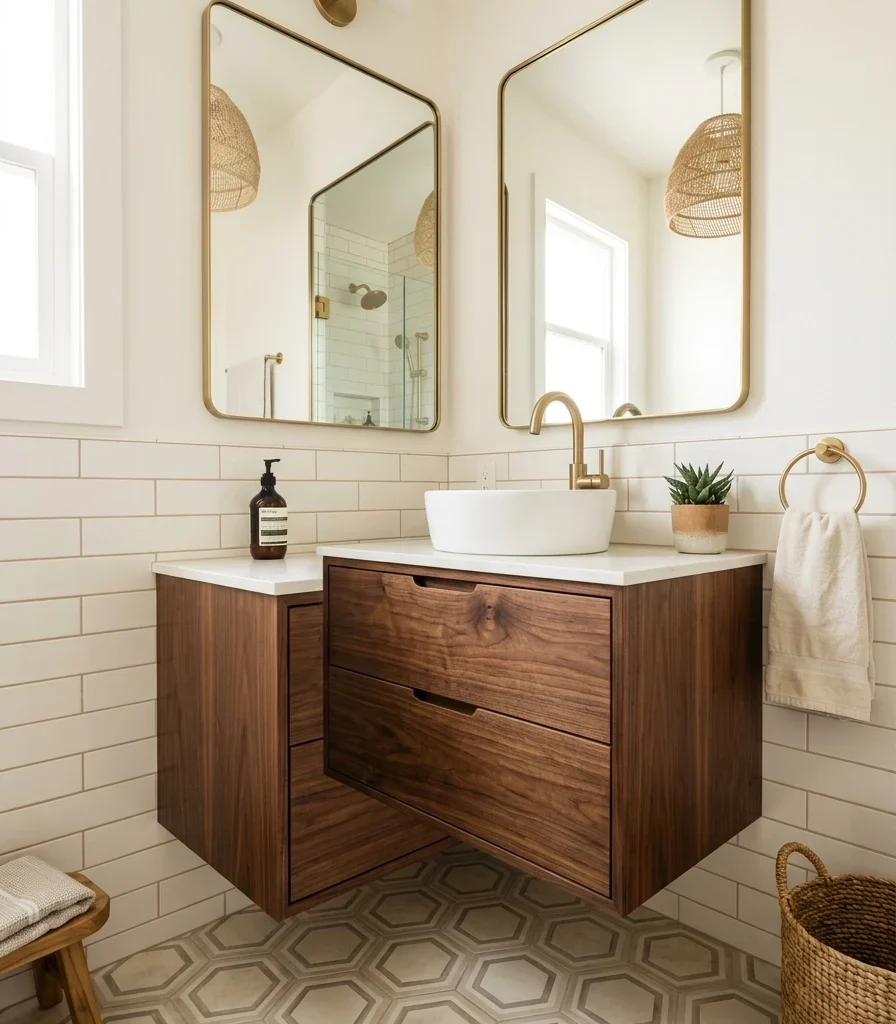
Vibe: The bathroom feels open, with the visible floor doing more for spaciousness than a bigger vanity ever could.
Why it works: A wall-mounted floating vanity leaves the floor beneath it fully visible, which is the same optical principle behind exposed sofa legs; sightlines passing under and around a piece of furniture make a room read as more spacious than the same furniture sitting flush to the floor would, regardless of the vanity’s actual storage capacity. In a small bathroom specifically, this visible floor strip can make a meaningful difference in how open the whole room feels.
How to get it: Mount the vanity into wall studs at a height that leaves at least 8–10 inches of visible floor beneath it, and continue the same floor tile or material underneath rather than stopping it at the vanity’s edge, since continuous flooring amplifies the spaciousness effect.
Shop the Look
| Product |
| Wall-mounted floating vanity |
| Hidden mounting bracket kit |
| Brushed brass faucet |
| Stud finder tool |
| Continuous floor tile, matching |
11. A Curtain Instead of a Glass Shower Door

Vibe: The shower feels soft, fabric doing what a hard glass panel never could.
Why it works: Glass shower doors have become the default small-bathroom choice specifically because they’re assumed to make a room feel more open, but a well-chosen fabric curtain introduces genuine textile softness into a room otherwise dominated entirely by hard, reflective surfaces tile, glass, porcelain which can actually read as more inviting despite technically “closing off” the shower visually. This is a deliberate departure from the standard small-bathroom playbook, prioritizing textural variety over maximum visual openness.
How to get it: Choose a mid-weight cotton or linen curtain rather than vinyl, hung from a curved rod for slightly more interior shower space, and pair it with a curtain liner specifically for water containment.
Shop the Look
| Product |
| Patterned linen shower curtain |
| Curved brass curtain rod |
| Clear vinyl curtain liner |
| Brass curtain rings |
| White ceramic tile, shower interior |
12. A Sculptural Faucet Treated as the Room’s Art Piece
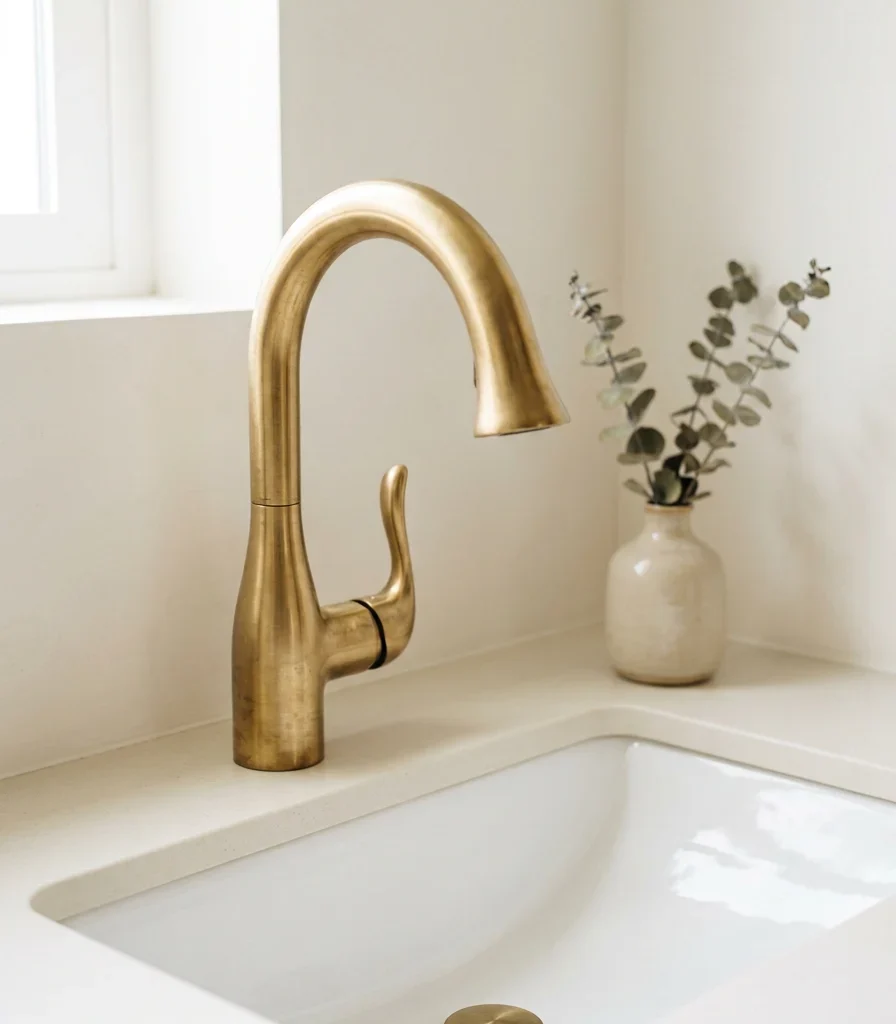
Vibe: The sink feels sculptural, one fixture treated with the seriousness of a real art object.
Why it works: A faucet is typically the most overlooked fixture in a bathroom, chosen last and purely for function, but a genuinely sculptural, curved-form faucet can function as the room’s actual focal point when everything else sink, walls, floor stays deliberately plain and unadorned around it. This is emphasis achieved through a fixture most small-bathroom plans treat as an afterthought, redirecting the room’s visual hierarchy entirely.
How to get it: Choose a faucet with a genuinely sculptural, curved silhouette rather than a standard straight-spout design, and keep the surrounding sink and counter completely undecorated so the faucet has zero visual competition.
Shop the Look
| Product |
| Sculptural curved brass faucet |
| Minimal white ceramic sink |
| Small ceramic soap dish, plain |
| Brass drain hardware, matching |
| White hand towel, plain |
13. An Unexpected Dark Color for a Windowless Bathroom

Vibe: The bathroom feels cocoon-like, darkness working with the room rather than against it.
Why it works: Windowless bathrooms are almost always advised to stay light and bright to compensate for the lack of natural daylight, but a genuinely dark, saturated color can work in the opposite direction just as effectively, since a windowless room has no daylight to lose in the first place; there’s nothing a dark color is competing against. Layered warm artificial lighting becomes essential to this approach, since the room’s entire mood depends on artificial light doing what daylight would in a windowed space.
How to get it: Commit fully to a deep, saturated color across every wall rather than trying to balance dark and light zones, and compensate specifically with multiple warm light sources sconces, an overhead fixture, and, if possible, a small accent light rather than relying on a single central bulb.
Shop the Look
| Product |
| Deep charcoal matte interior paint |
| Brass wall sconce pair |
| Warm white dimmable bulb set |
| White ceramic sink |
| Brass towel bar |
14. A Runner Rug Instead of a Standard Bath Mat
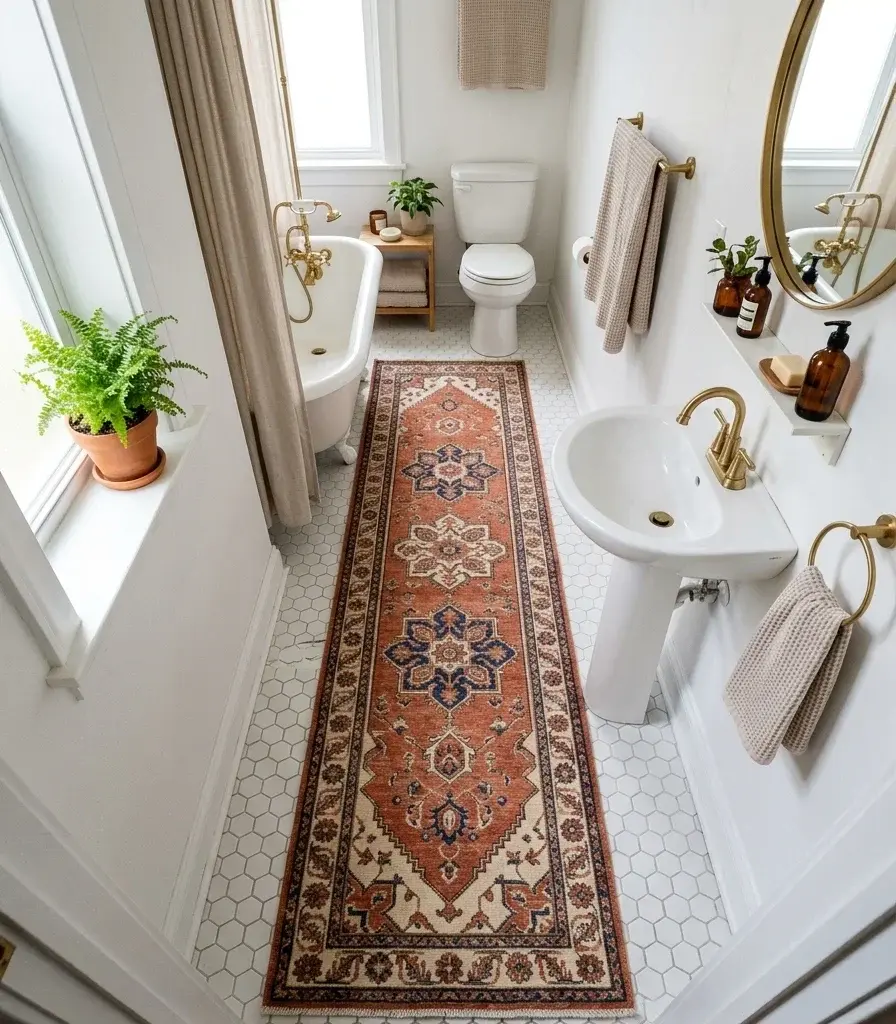
Vibe: The floor feels layered, one long rug doing more than a small mat ever could.
Why it works: A standard small bath mat covers only the immediate area in front of the sink or tub, while a full-length runner extends across the entire floor’s usable length, borrowing directly from hallway and kitchen runner conventions rather than typical bathroom textile choices. This delivers considerably more pattern and color impact per square foot of floor than a small contained mat, while still serving the same slip-safety function.
How to get it: Choose a runner with a low pile and a non-slip backing specifically rated for bathroom moisture, sizing it to run the floor’s longest usable stretch rather than confining it to just the sink or tub area.
💡 Quick Win: A runner rug typically costs less per square foot than a designer bath mat of comparable pattern quality, making this a genuinely efficient upgrade.
Shop the Look
| Product |
| Patterned runner rug, bathroom-safe |
| Non-slip rug backing |
| White pedestal sink |
| Brushed brass faucet |
| White hand towel set |
15. An Oversized Mirror Deliberately Too Big for the Room
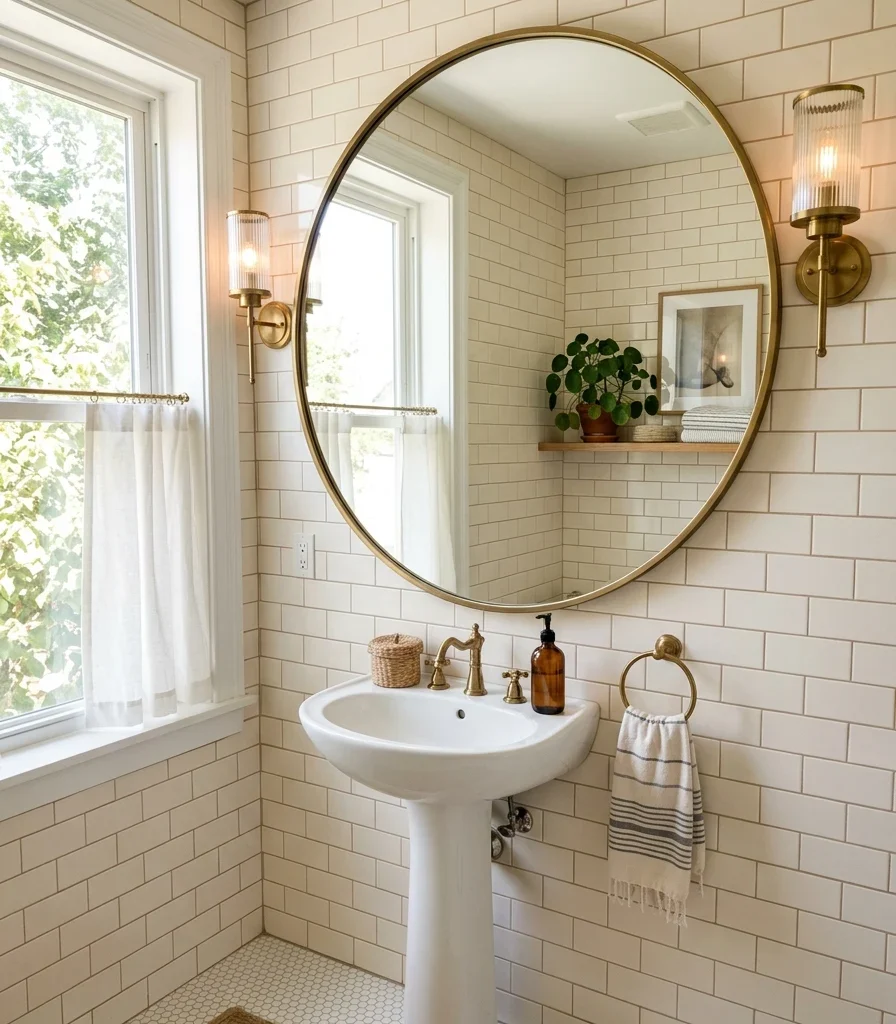
Vibe: The bathroom feels expansive, one oversized mirror doing double duty as light and drama.
Why it works: Standard advice suggests sizing a mirror to match the sink or vanity beneath it, but choosing one deliberately larger, extending well beyond the sink’s edges on both sides, maximizes the same light-reflecting benefit a right-sized mirror provides while adding genuine visual drama a proportionally “correct” mirror wouldn’t. This is the small-space illusion technique of reflected light taken to its most confident extreme, prioritizing impact over conventional proportion rules.
How to get it: Choose a mirror at least 1.5 times the width of your sink or vanity, positioning it centered above the fixture even though its edges will extend past the counter on both sides, and confirm wall space allows the oversized scale without crowding adjacent fixtures.
Shop the Look
| Product |
| Oversized round wall mirror, brass frame |
| Brass wall sconce pair |
| White pedestal sink |
| Brushed brass faucet |
| Small brass shelf beneath mirror |
How to Start Your Creative Small Bathroom Transformation
Your first move should be choosing one genuinely bold idea from this list a color-drenched wall, an oversized mirror, a repurposed vintage vanity and committing to it fully before adding any other unexpected element, since creative small-bathroom design depends on confident execution of one idea rather than several competing ones diluting each other.
The most common mistake is layering too many bold choices into the same small room at once a patterned floor, a saturated wall color, and mixed metals all together tips from confident into visually chaotic. Fix it by choosing your single strongest idea, executing it fully, and keeping every other element in the room deliberately quiet and neutral around it.
Three specific items under $50 that create immediate impact: a patterned runner rug sized for your bathroom’s full floor length, a set of unlacquered brass hooks to introduce a second metal finish, and a small ceramic vase to style an unused windowsill as genuine display space.
A single bold-idea refresh of a color-drenched wall or a new statement mirror typically takes one weekend and costs $100–$400. A fuller creative transformation including a repurposed vanity or patterned tile floor generally runs $2,000–$6,000 and takes two to four weeks, while a complete renovation incorporating several of these ideas realistically spans six to ten weeks and $10,000–$25,000 depending on the extent of plumbing and structural work involved.
Frequently Asked Questions About Creative Small Bathrooms
What is the difference between creative and minimalist small bathroom design?
Minimalist small bathroom design follows the conventional advice to keep colors light, surfaces plain, and decoration sparse in order to make a compact room feel larger, while creative small bathroom design deliberately breaks from that playbook using saturated color, oversized fixtures, or unexpected furniture to give the room genuine personality instead. Both approaches can succeed in the same square footage; the difference is philosophy, with creative design trusting that a small room can carry bold choices confidently rather than needing to visually disappear.
What colors work best for a creative small bathroom?
Deep, saturated colors like terracotta, charcoal, and jewel-toned greens tend to work more effectively in creative small bathroom design than the conventional pale neutrals typically recommended for small spaces, precisely because a contained room can absorb genuine color intensity without feeling overwhelming the way a larger room might. Color-drenching, using the same saturated hue across walls, trim, and ceiling, is the most common technique for making a bold color choice read as intentional rather than accidental.
How much does a creative small bathroom transformation typically cost?
A single bold-idea refresh, like a color-drenched wall or an oversized statement mirror, typically costs $100–$400 and takes a weekend. A fuller creative transformation incorporating a repurposed vanity or patterned tile flooring generally runs $2,000–$6,000, while a complete renovation combining several creative elements bold color, custom furniture conversion, and new fixtures usually falls between $10,000 and $25,000 depending on the extent of plumbing work required.
Does creative small bathroom design work in a rental apartment?
Yes, with some adjustment, textile-based ideas like a patterned runner rug, a fabric shower curtain, and windowsill styling require no permanent changes and work fully within typical lease restrictions. Bolder structural moves like color-drenching or a repurposed vanity generally need landlord approval, though a large statement mirror or an oversized light fixture can deliver similar visual drama without any wall alteration at all.
What is the most searched creative small bathroom trend right now?
Color-drenched powder rooms and small bathrooms consistently rank among the fastest-growing search terms in the category, reflecting the broader shift away from all-white minimalism toward bolder, more personality-driven small spaces. Mixed metal fixtures and oversized statement mirrors are also seeing significant search growth, as more people specifically look for ways to break from standard small-bathroom proportion advice rather than follow it.
Ready to Create Your Dream Creative Small Bathroom?
These 15 creative small full bathroom ideas span color, material, lighting, furniture, and layout, from a fully color-drenched wall and a repurposed vintage dresser to an oversized mirror that ignores standard proportion rules entirely, so there’s a genuinely bold starting point here, whatever your small bathroom currently looks like. You don’t need every idea at once, and committing fully to just one confident choice is not a smaller version of the transformation; it’s exactly what separates creative design from visual chaos in a room this size. Today’s specific action: pick the single boldest idea from this list that actually excites you, and plan to execute it completely rather than diluting it with three smaller changes at once. Once that one confident choice is in place, the small bathroom will finally feel like a room someone actually decided something about, rather than one that simply avoided every decision it could. Save the ideas that felt the most unexpected to you today that color-drenched wall, that sculptural faucet, because in creative small bathroom design, the choice that feels slightly too bold at first is usually the one that ends up being exactly right.