
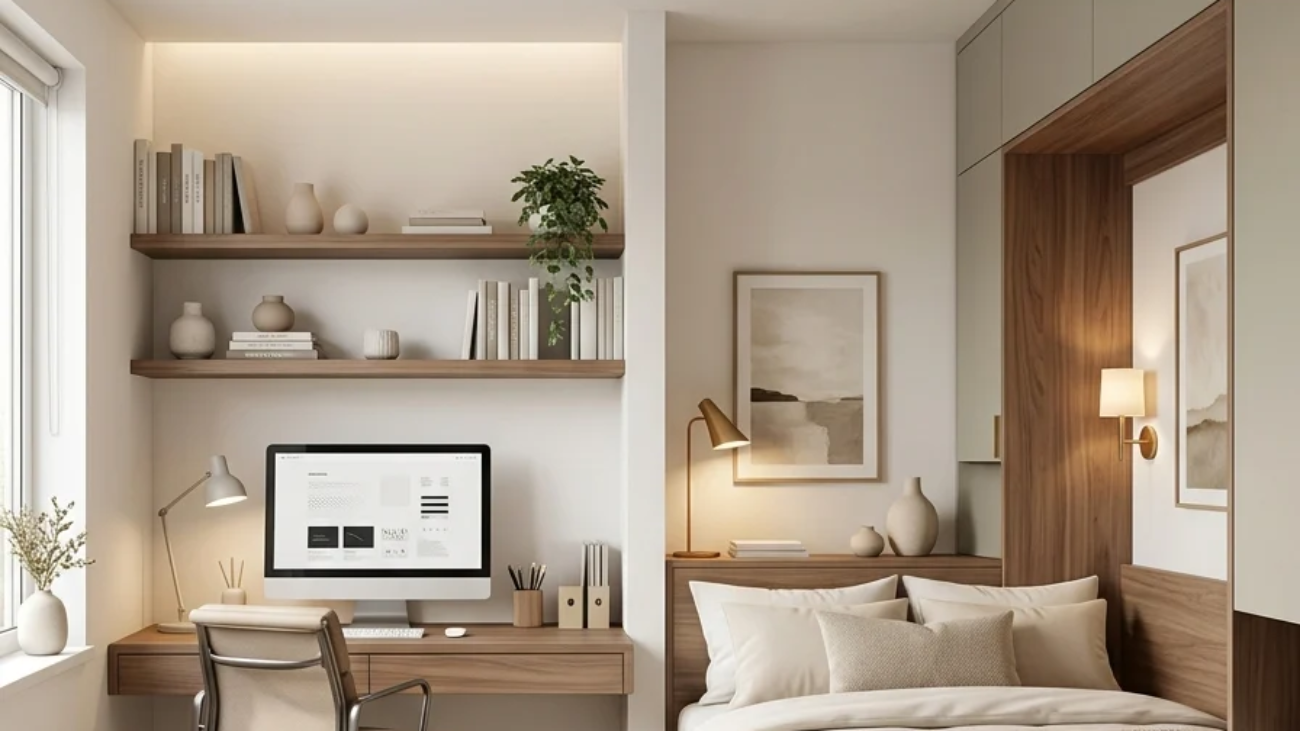
A smart small home office guestroom is one room engineered to work as a real office by day and a real bedroom by night, without either function feeling like an afterthought. This guide walks through 15 smart small home office guestroom design ideas, covering layout, color, materials, and furniture that switch roles as fast as your schedule does.
Picture a desk that catches morning light for focused work, and a daybed just steps away that folds out the moment a guest texts they’re five minutes out. The room feels efficient rather than cramped nothing wasted, nothing doubled up by accident. It borrows the calm restraint of Scandinavian small-space planning, where every piece earns its keep twice over.
Here are 15 ideas worth saving nd stealing.
Why Smart Small Home Office Guestroom Design Works So Well
A home office guestroom isn’t a decor movement like farmhouse or coastal; it’s a functional design category built around dual occupancy of time rather than space. It draws from Japanese multi-purpose room planning and from the compact hospitality design used in boutique hotel suites, where a desk, storage, and sleeping surface share a footprint under 120 square feet without visually colliding.
The palette leans warm greige, soft sage, and warm charcoal, kept consistent across both functions so the room doesn’t read as “office” in one corner and “bedroom” in another. Materials do double duty: unfinished white oak for desks and daybed frames, linen for curtains and bedding, brushed brass for hardware, and woven rattan for storage that hides guest linens in plain sight.
This dual-purpose approach is trending because hybrid work made a dedicated office non-negotiable for millions of households that don’t have a spare room to spare. Pinterest searches for “office guest room combo” and “murphy bed office” have climbed steadily since remote work became permanent rather than temporary.
Small rooms handle this better than large ones; honestly, a huge room tempts you to keep the desk and bed fully separate, which defeats the purpose. Prioritize one piece of convertible furniture first, whether that’s a daybed or a fold-down desk; what doesn’t work is trying to fit two full-size, single-purpose pieces into one small room.
Style at a Glance
| Element | Detail |
| Philosophy | One room, two full functions |
| Key Materials | white oak, linen, brushed brass, rattan |
| Key Colors | warm greige, soft sage, warm charcoal |
15 Smart Small Home Office Guestroom Design Ideas
1. Murphy Bed Desk Combo That Folds Away in Seconds
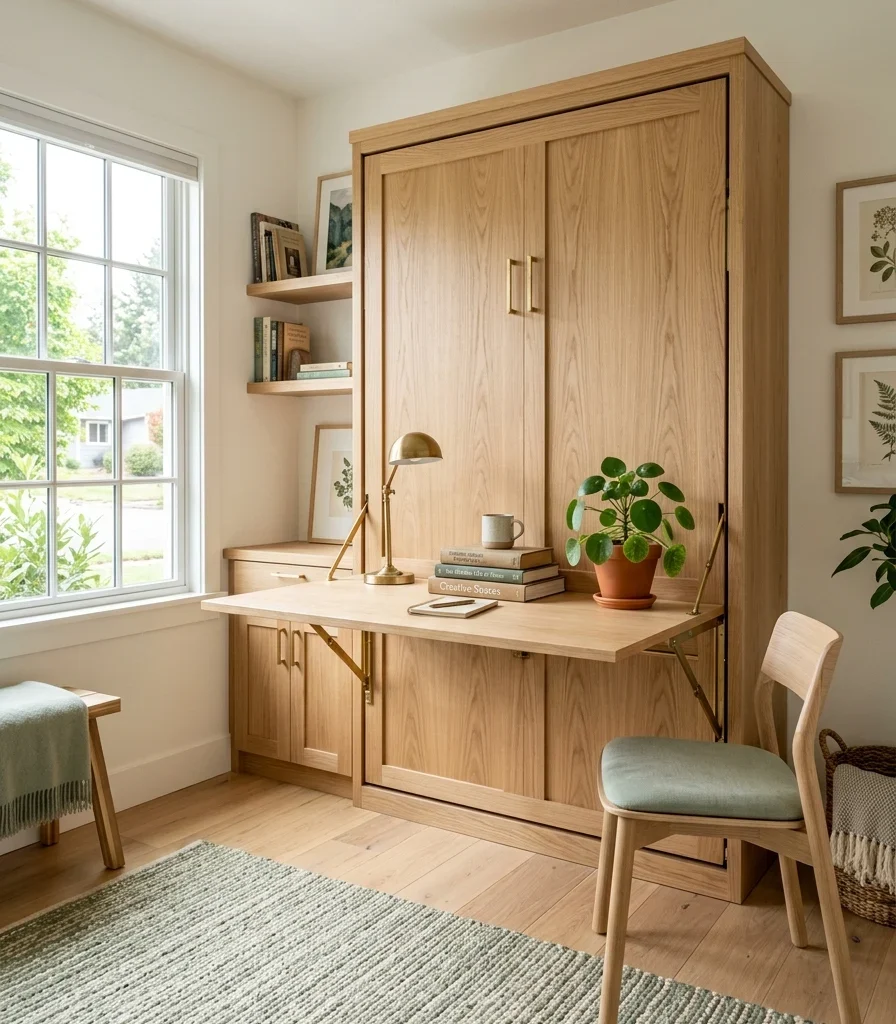
Vibe: Airy. With the bed tucked away, the room reads as a full office with zero visual trace of a bedroom underneath.
Why it works: This solves negative space at its root. A standard bed occupies floor space permanently, whether it’s in use or not, while aMurphyy combo unit only claims that footprint when a guest actually needs it, freeing the rest of the room for full-time desk use.
How to get it: Choose a white oak Murphy bed unit with a built-in desk that folds down when the bed is stowed, mounting it against the room’s longest wall so the fold-out swing has full clearance.
Shop the Look
- White oak Murphy bed with integrated desk
- Brass folding hardware kit, wall-mount
- Slim articulating desk lamp, matte black
- Small potted snake plant, ceramic pot
2. Warm Greige Walls That Read Office by Day, Calm by Night
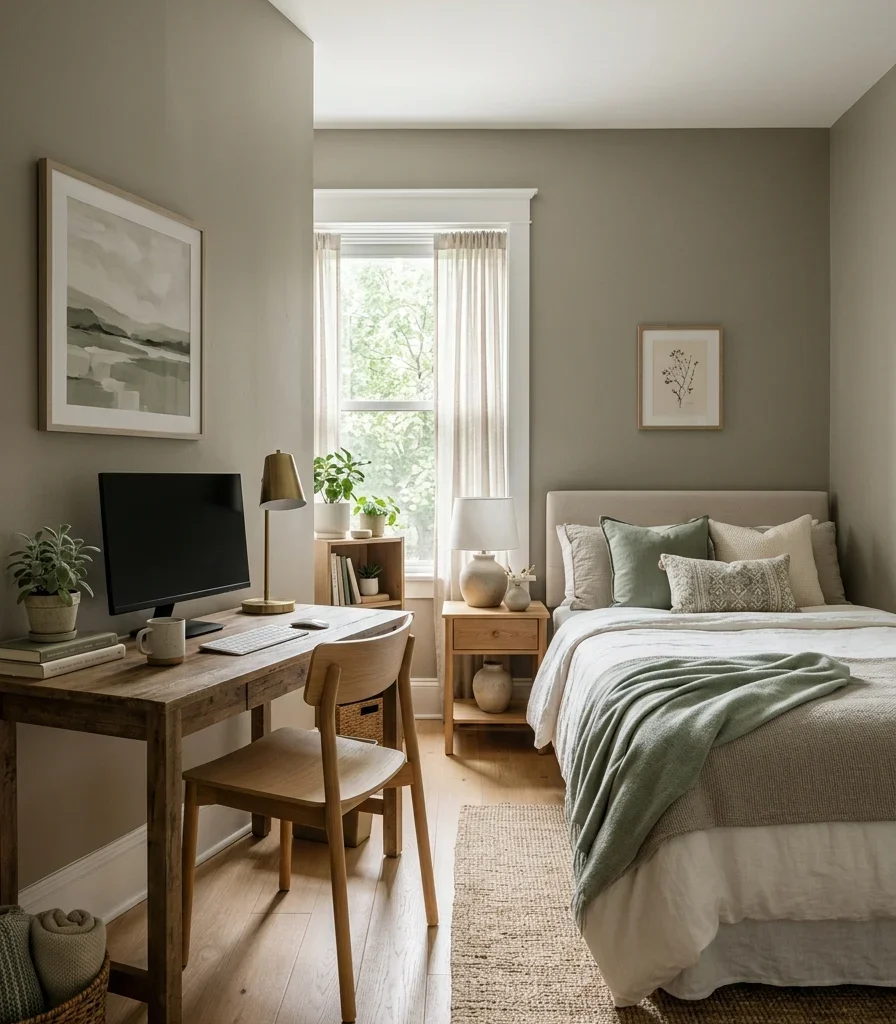
Vibe: Serene. One wall color across the whole room keeps the eye from registering “two rooms in one.”
Why it works: Color continuity is the single fastest way to visually unify a dual-purpose space. A warm greige like Sherwin-Williams Agreeable Gray reads as neutral enough to support both a productive desk mood and a restful sleeping mood without repainting or accent walls to separate them.
How to get it: Paint the entire room in one warm greige tone, then let furniture and textiles, not additional wall colors, signal which zone is which.
💡 Quick Win: Test the greige on a large poster board first and view it under both daytime and evening lamp light before committing to the full room.
Shop the Look
- Sherwin-Williams Agreeable Gray paint sample
- Framed neutral abstract print, small
- Folded waffle-weave throw blanket, sage
- White trim paint, satin finish
3. Unfinished White Oak Daybed With Trundle Storage
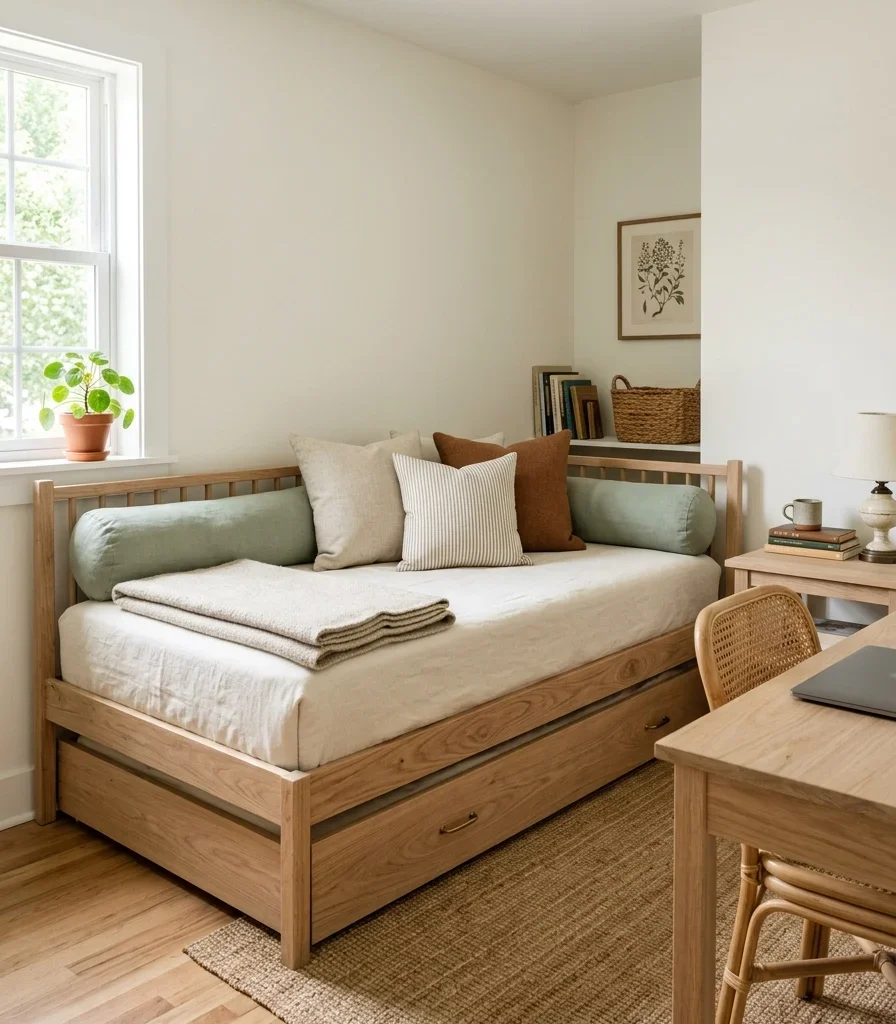
Vibe: Grounded. A low daybed frame keeps the room’s sightlines open even with a full sleeping surface in it.
Why it works: Material choice matters here as much as furniture form. Unfinished white oak keeps the daybed visually light compared to a dark upholstered frame, and the trundle drawer beneath uses vertical layering to store guest linens without adding a separate dresser to the room.
How to get it: Choose a daybed frame in unfinished white oak with a built-in trundle drawer rated for a twin mattress, and dress the daytime side with three linen bolster pillows so it reads as seating, not a bed, during work hours.
Shop the Look
- Unfinished white oak daybed frame with trundle
- Linen bolster pillow, set of 3
- Folded wool throw blanket, natural
- Twin trundle mattress, low-profile
4. Dimmable Pendant That Shifts From Task Light to Ambient Glow
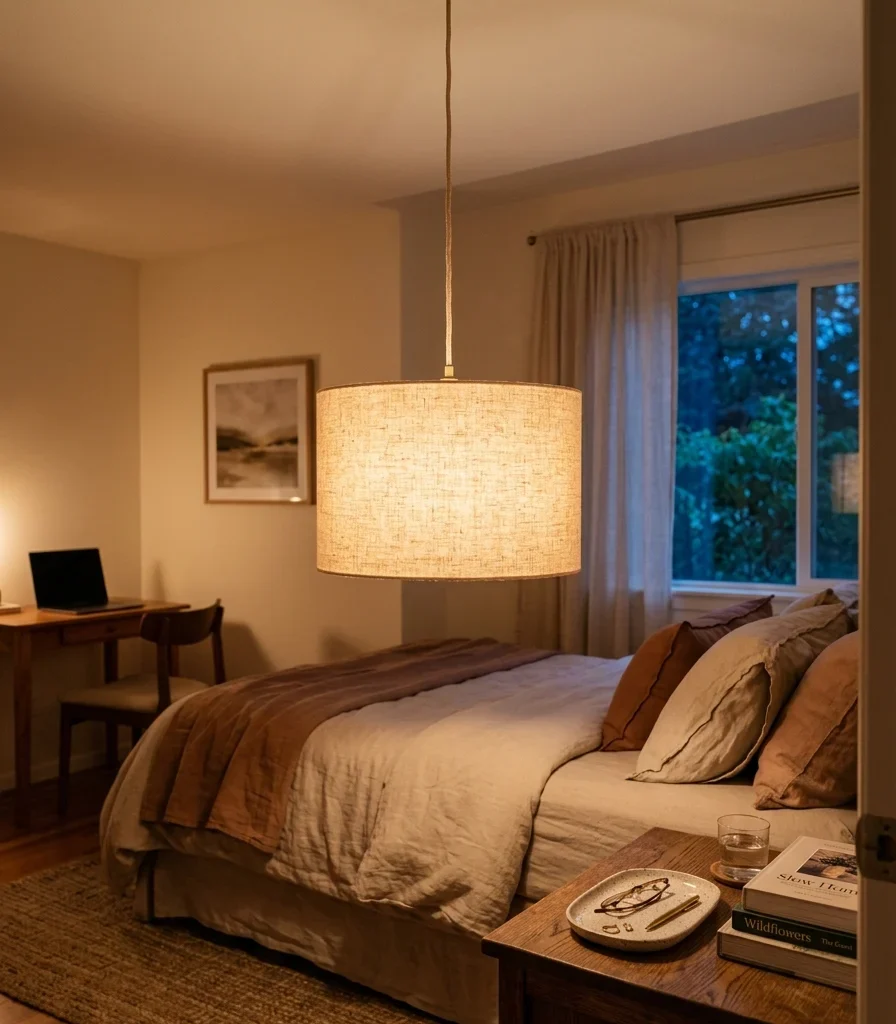
Vibe: Warm the same fixture that lights a spreadsheet at noon softens into bedtime glow by evening.
Why it works: Light behavior changes a room’s entire mood without moving a single piece of furniture. A dimmable pendant on a warm 2700K bulb reads as a bright, functional task light at full power and shifts to a restful glow at 20 percent, letting one fixture serve two completely different needs.
How to get it: Install one linen drum pendant with a brass canopy on a dimmer switch, centered over the room rather than directly above the desk, so its light reaches both the work zone and the sleeping zone evenly.
Shop the Look
- Linen drum pendant light, brass canopy
- In-wall dimmer switch, standard
- Warm white LED bulb, 2700K
- Small ceramic bedside tray
5. Daybed With Bolster Pillows Doubling as Desk-Side Seating
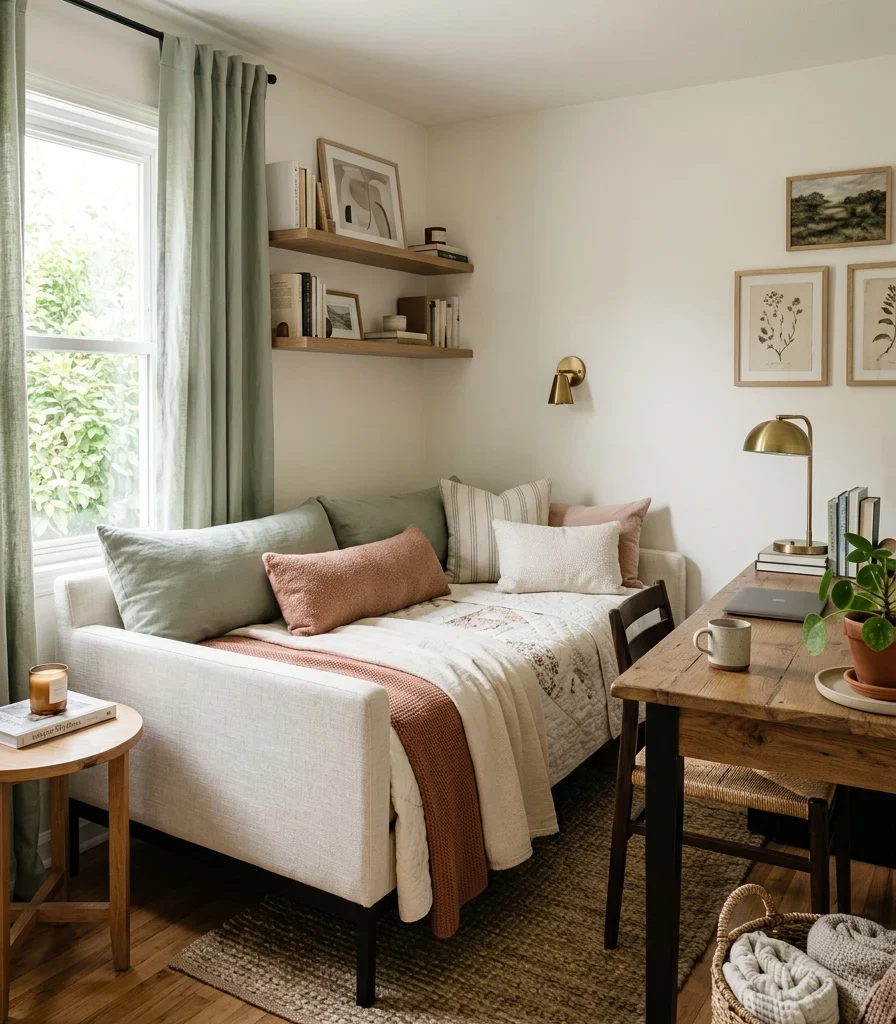
Vibe: Layered: a daybed positioned near the desk becomes a second seat for calls or reading, not just overnight furniture.
Why it works: Furniture arrangement here follows proximity logic; placing the daybed perpendicular to the desk rather than against a far wall keeps both pieces functionally connected during the day, so the “guest” furniture earns daily use instead of sitting idle until visitors arrive.
How to get it: Position a linen-upholstered daybed at a right angle to the desk, close enough that its edge doubles as an overflow surface or seat during work hours, and dress it with two bolster pillows in contrasting tones.
💡 Quick Win: A slim side table between the desk and daybed instantly makes the daybed feel like a designed seating nook rather than leftover bed space.
Shop the Look
- Linen-upholstered daybed, matte black legs
- Bolster pillow, sage green, set of 2
- Bolster pillow, terracotta blush, set of 2
- Slim round side table, oak finish
6. Charcoal Accent Wall Behind the Desk for Focus
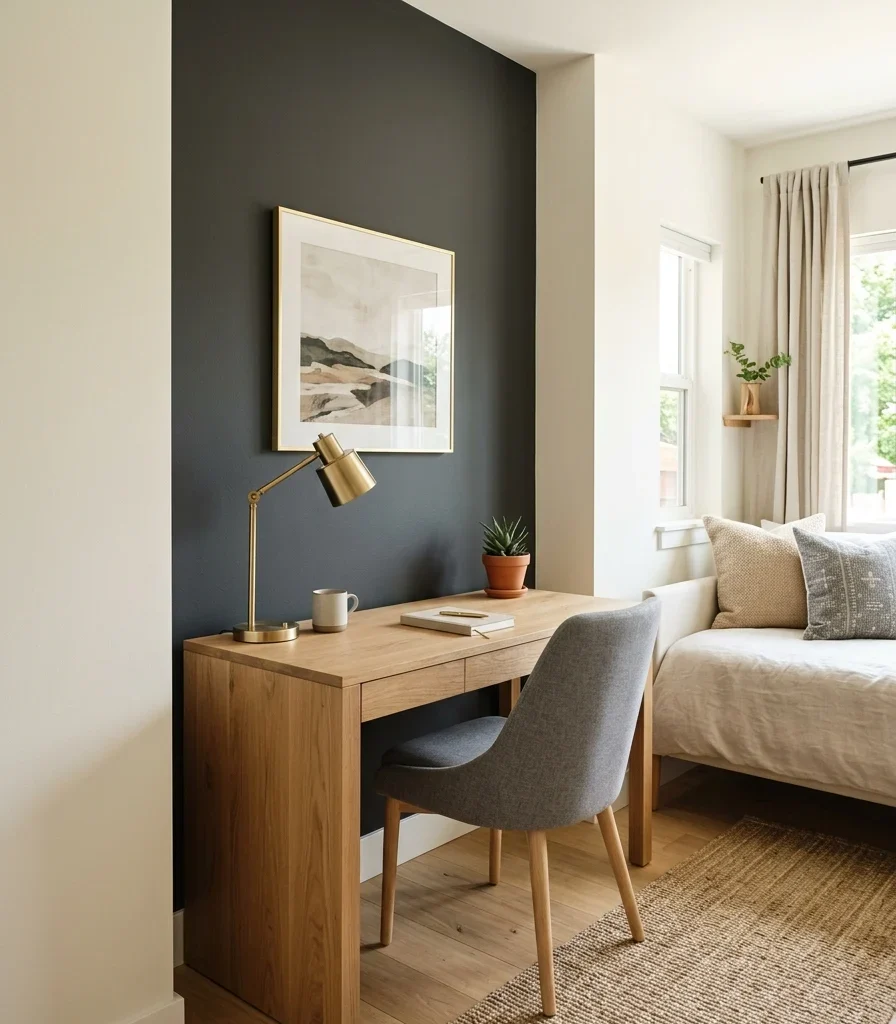
Vibe: Grounded. A single dark wall behind the desk creates a defined “work mode” without a full room repaint.
Why it works: Contrast theory explains the psychological shift here. A charcoal wall directly behind the desk gives the eye a fixed point of focus during video calls and deep work, while the surrounding warm white walls keep the rest of the small room from feeling closed in.
How to get it: Paint only the wall directly behind the desk in a warm charcoal such as Benjamin Moore Kendall Charcoal, stopping the color exactly at the room’s corner, so it reads as a defined zone rather than a mistake.
Shop the Look
- Benjamin Moore Kendall Charcoal paint sample
- White oak desk, straight leg
- Brushed brass desk lamp, articulating arm
- Framed neutral print, small
7. Woven Baskets That Hide Guest Linens in Plain Sight
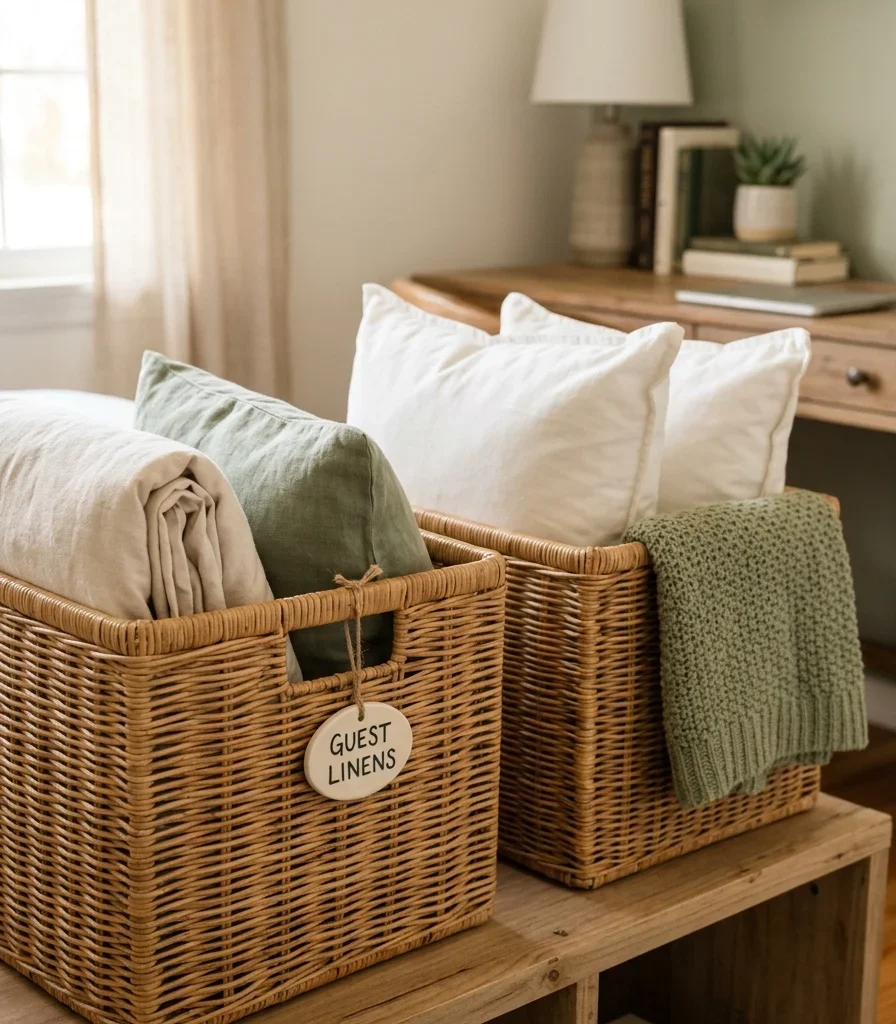
Vibe: War askets full of guest linens look like styled decor rather than storage waiting to be unpacked.
Why it works: Repetition and texture layering both apply here; two or three matching rattan baskets on one shelf read as an intentional display, disguising the practical function of holding sheets and towels that only come out a few nights a month.
How to get it: Line two large woven rattan baskets with lids on an open shelf, using one exclusively for guest bedding and the other for spare pillows, so setup for a visitor takes under two minutes.
Shop the Look
- Woven rattan storage basket with lid, large, set of 2
- Folded linen sheet set, warm white
- Ceramic basket label tag, set of 2
- Open wall shelf, white oak, 36-inch
8. Linen Curtain Room Divider for Instant Privacy
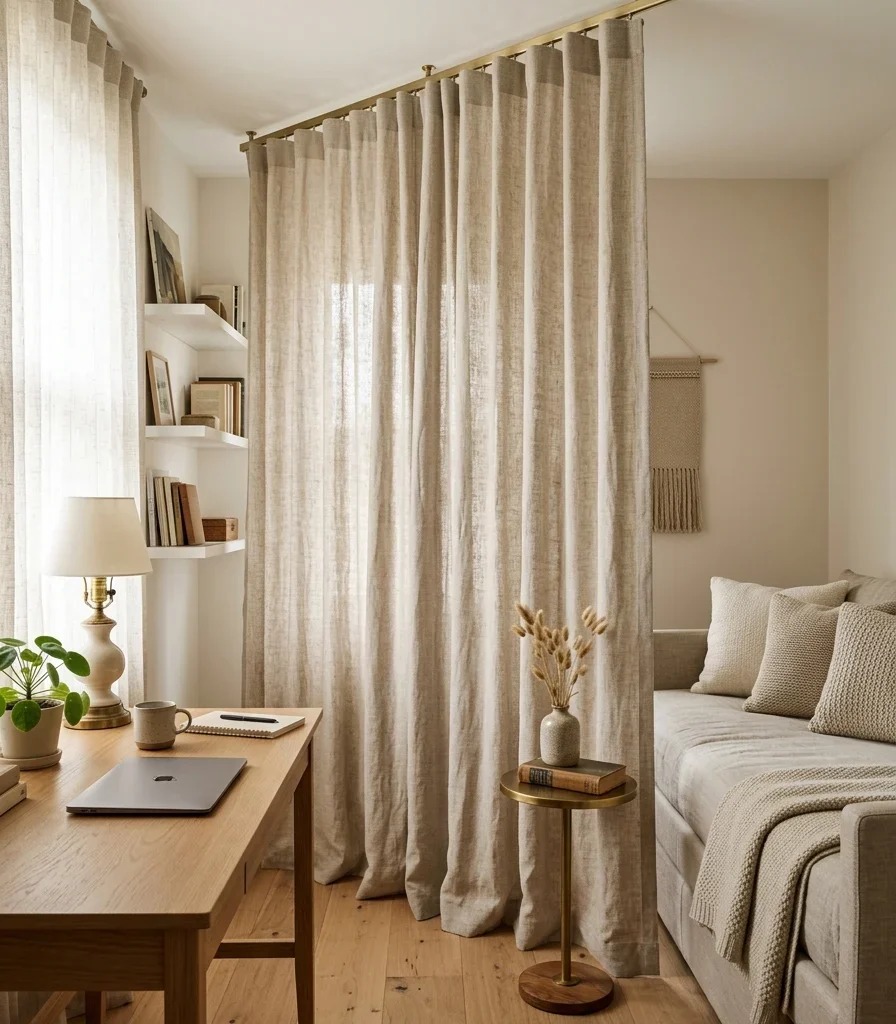
Vibe: Hushed. A drawn linen curtain gives an overnight guest real privacy without a single permanent wall.
Why it works: Linen at this weight uses texture layering and light diffusion together heavy enough to block sightlines when drawn, but soft enough that daylight still filters through, avoiding the closed-off feeling a solid partition would create in a small footprint.
How to get it: Mount a ceiling-track curtain rod across the room’s midpoint and hang heavyweight linen panels that can be pushed fully open during work hours and drawn closed only when a guest is staying over.
💡 Quick Win: Use a tension rod version if you’re renting and can’t mount a permanent ceiling track.
Shop the Look
- Heavyweight linen curtain panel, floor-length, set of 2
- Ceiling-mounted curtain track, brass finish
- Slim side table, oak finish
- Folded cotton throw, warm white
9. L-Shaped Zoning: Desk on one wall, Bed on the Other
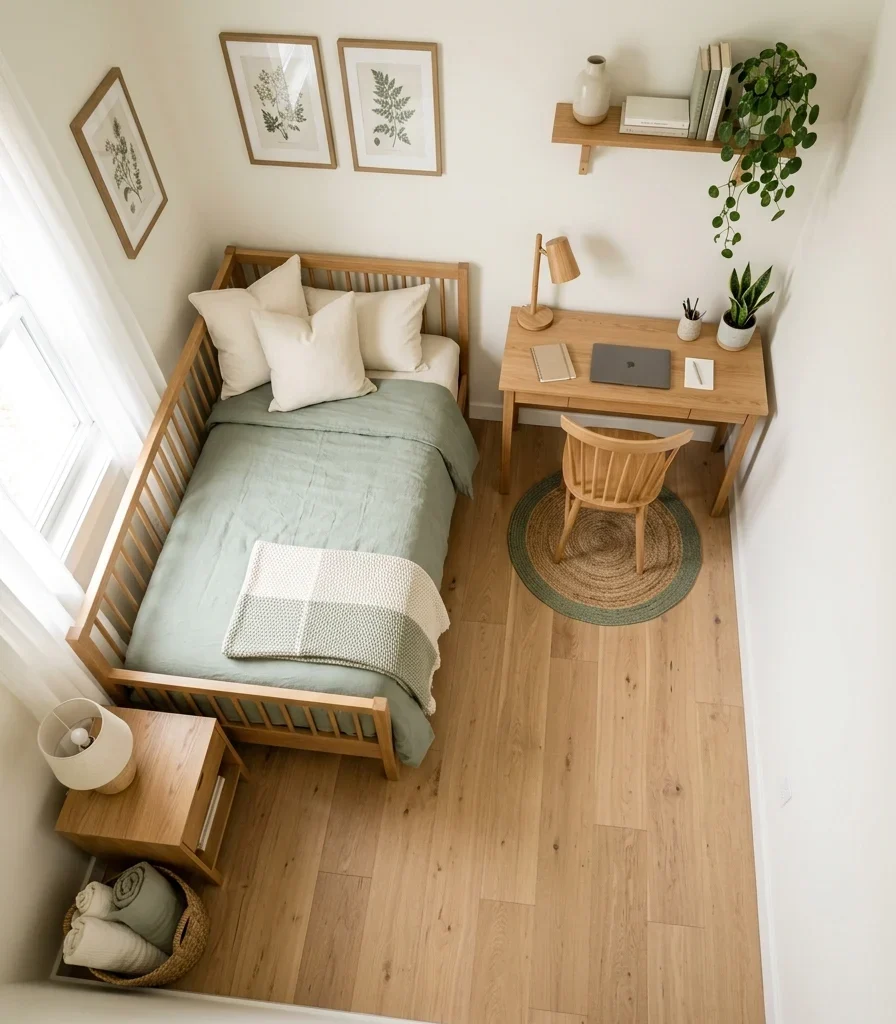
Vibe: Air. Ann L-shaped zoning plan keeps a clear walking path down the room’s center at all times.
Why it works: This is a pure layout decision, not a decor one. Placing the desk and daybed on perpendicular walls rather than opposite ones uses the room’s corner as a shared anchor point, which preserves more open floor space than a straight parallel arrangement would in a room under 100 square feet.
How to get it: Position the desk along the room’s window wall and the daybed along the adjacent wall, leaving at least 30 inches of clear walking space between the two zones at all times.
Shop the Look
- Small area rug, 3×5, jute blend
- White oak desk, compact
- Linen daybed, low profile
- Wall-mounted coat hook, brass, set of 2
10. Sage Green Bedding That Signals “Guest Mode” at a Glance
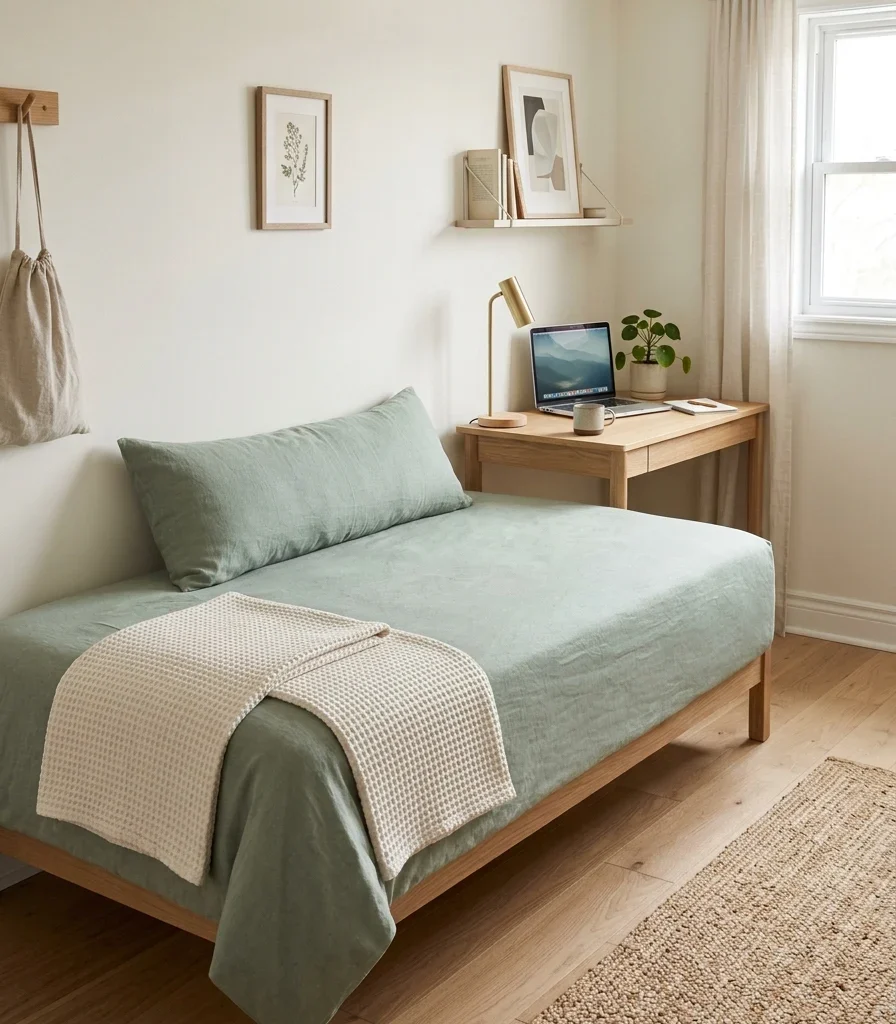
Vibe: Calm sage bedding against a neutral desk zone quietly marks “this side is for sleeping” without a sign.
Why it works: Color coding a specific zone is a wayfinding trick borrowed from hospitality design. A consistent sage tone on bedding only, never on desk textiles, gives the room an intuitive visual split that guests understand instantly without needing an explanation.
How to get it: Dress the daybed exclusively in soft sage green linen bedding, keeping every desk-side textile chair cushion, rug, curtains in warm white or oak tones so the color itself becomes the zone marker.
Shop the Look
- Sage green linen duvet cover, twin size
- Linen fitted sheet, sage green
- Waffle-weave cotton throw, warm white
- Linen bolster pillow, sage green
11. Bedside Sconces That Double as Desk Task Lighting
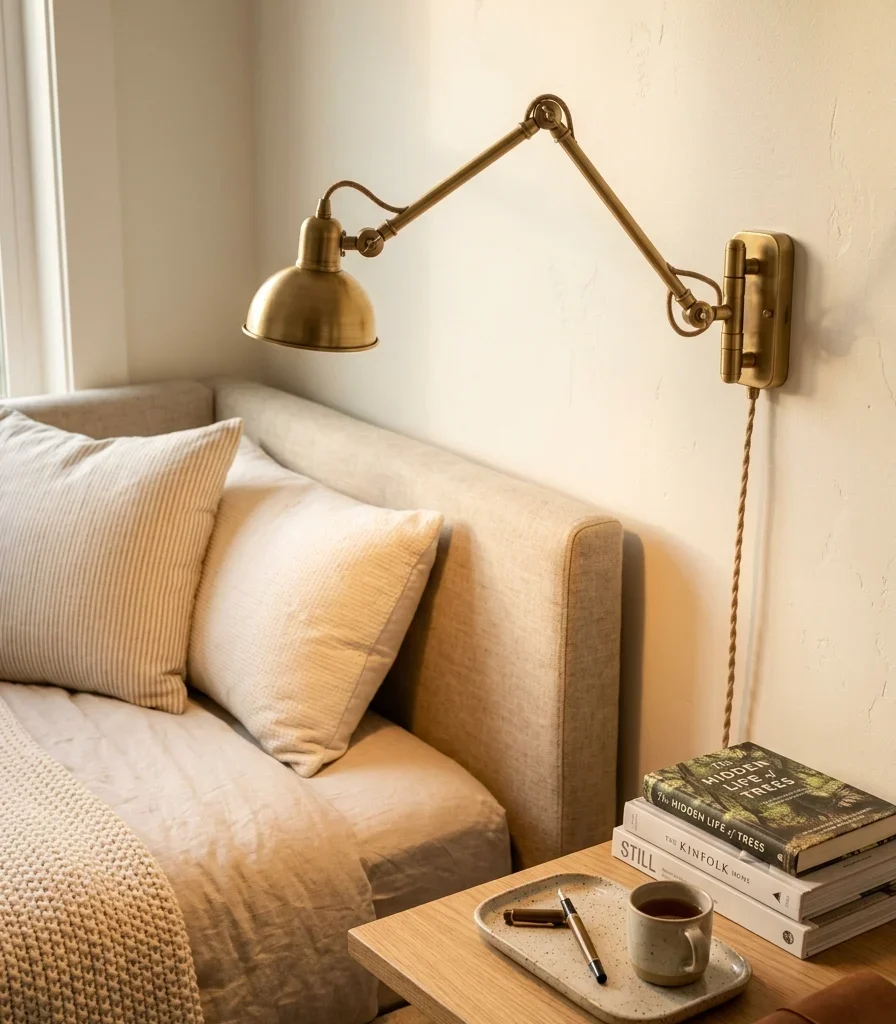
Vibe: Warm. One adjustable sconce quietly does the job of two separate lamps.
Why it works: Task lighting placement is a light behavior principle worth planning around in dual-purpose rooms. Mounting a swing-arm sconce where its reach overlaps both the daybed and a nearby desk corner eliminates the need for a second lamp, saving both cost and counter space.
How to get it: Mount one brushed brass swing-arm sconce on the wall between the daybed and desk, positioned so its arm can extend toward either surface depending on which is in use.
💡 Quick Win: A plug-in sconce with a swing arm skips electrical work and can be repositioned if you rearrange the room later.
Shop the Look
- Brushed brass swing-arm wall sconce, plug-in
- Warm white LED bulb, 2700K
- Small ceramic bedside tray
- Fabric-wrapped extension cord, neutral
12. Fold-Down Wall Desk Above a Built-In Daybed
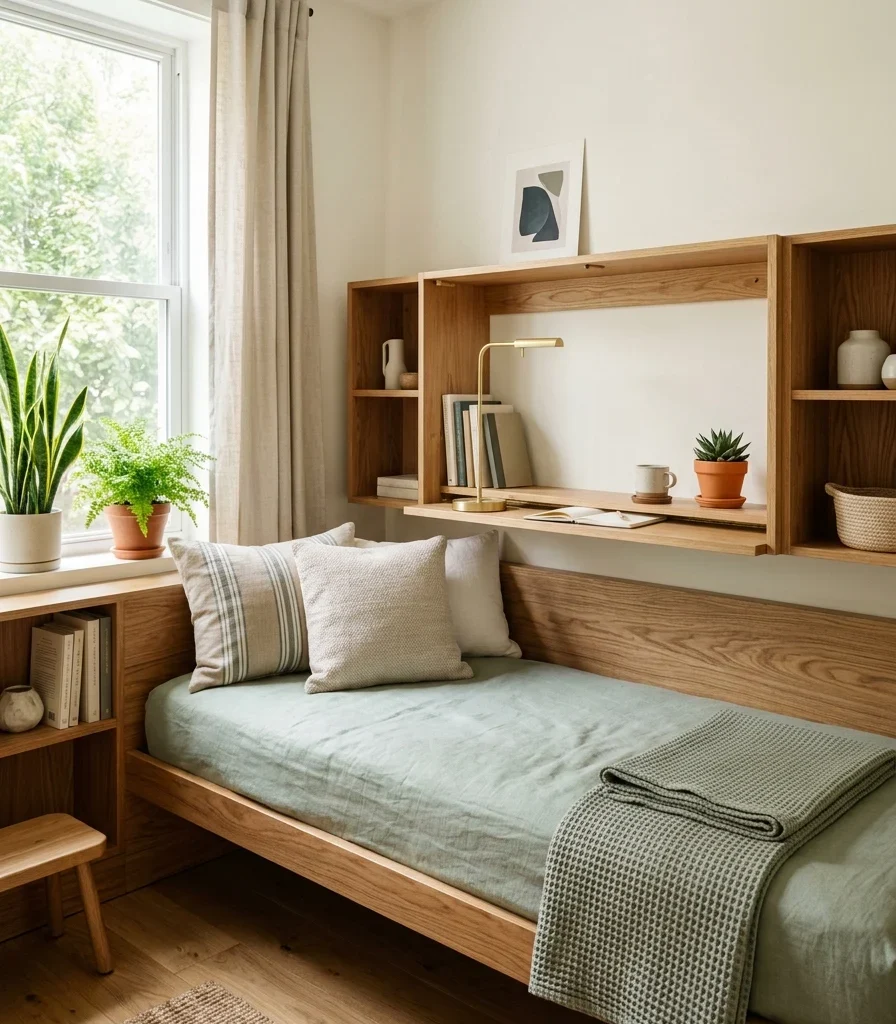
Vibe: Efficient tacking function vertically means the desk simply doesn’t exist as furniture when it’s folded flat.
Why it works: This uses proportion and negative space at their most extreme. Mounting the desk on the wall directly above the daybed claims a surface that would otherwise sit empty above a low sleeping platform, a move only possible because the daybed’s low profile leaves headroom a standard bed frame wouldn’t.
How to get it: Mount a fold-down white oak desk on the wall 34 inches above a built-in daybed platform, using a piano hinge and single folding leg so the desk closes flush when the guest bed is in use.
Shop the Look
- Fold-down wall desk, white oak, piano hinge
- Built-in daybed platform frame, low profile
- Compact articulating desk lamp
- Folded wool throw, foot-of-bed size
13. Rattan Nightstand That Moonlights as a Printer Stand
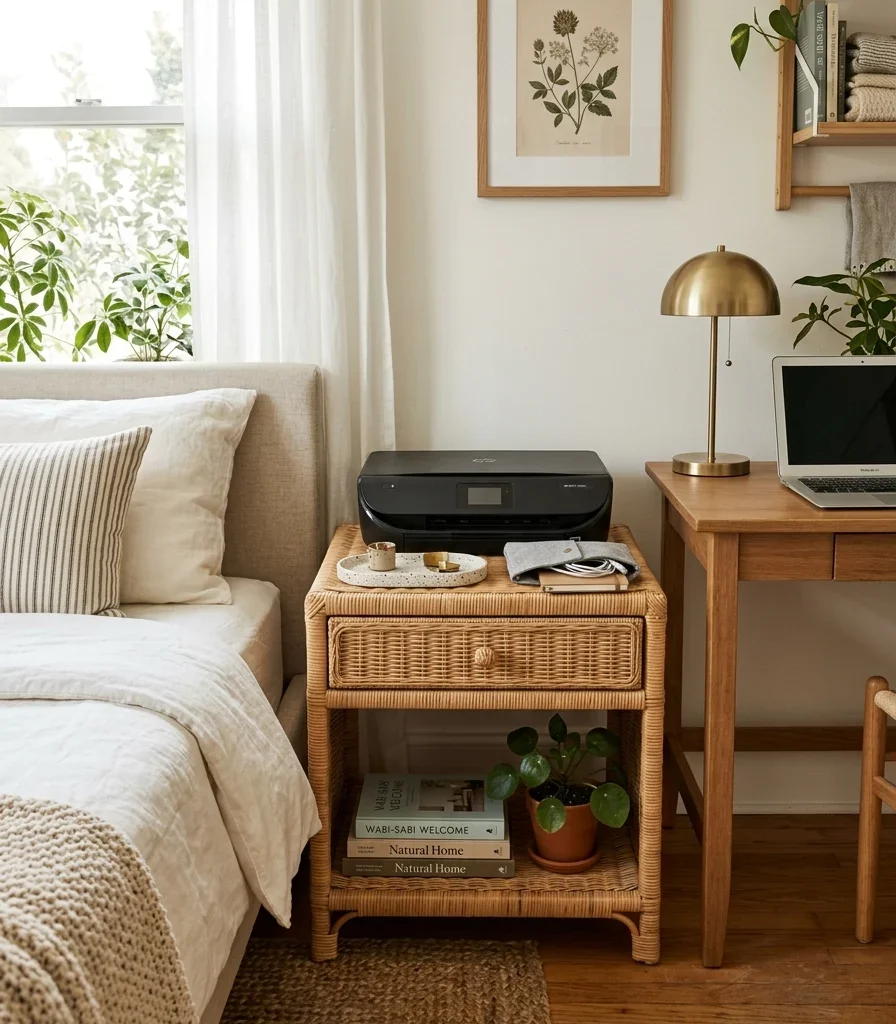
Vibe: Grounded. A single rattan piece serving two functions keeps the room from accumulating furniture it doesn’t need.
Why it works: Material consistency and dual function work together here. A rattan nightstand placed at the seam between the daybed and desk zones holds a lamp and book at night, then holds a printer or supplies during work hours, avoiding a second dedicated office cart entirely.
How to get it: Position one rattan nightstand with an open lower shelf exactly at the junction between the daybed and desk, using the top surface for a lamp at night and a compact printer during the day.
Shop the Look
- Woven rattan nightstand, open shelf
- Compact wireless printer, white finish
- Small ceramic catch-all tray
- Fabric cable management sleeve
14. A Folding Luggage Rack That Becomes an Extra Shelf
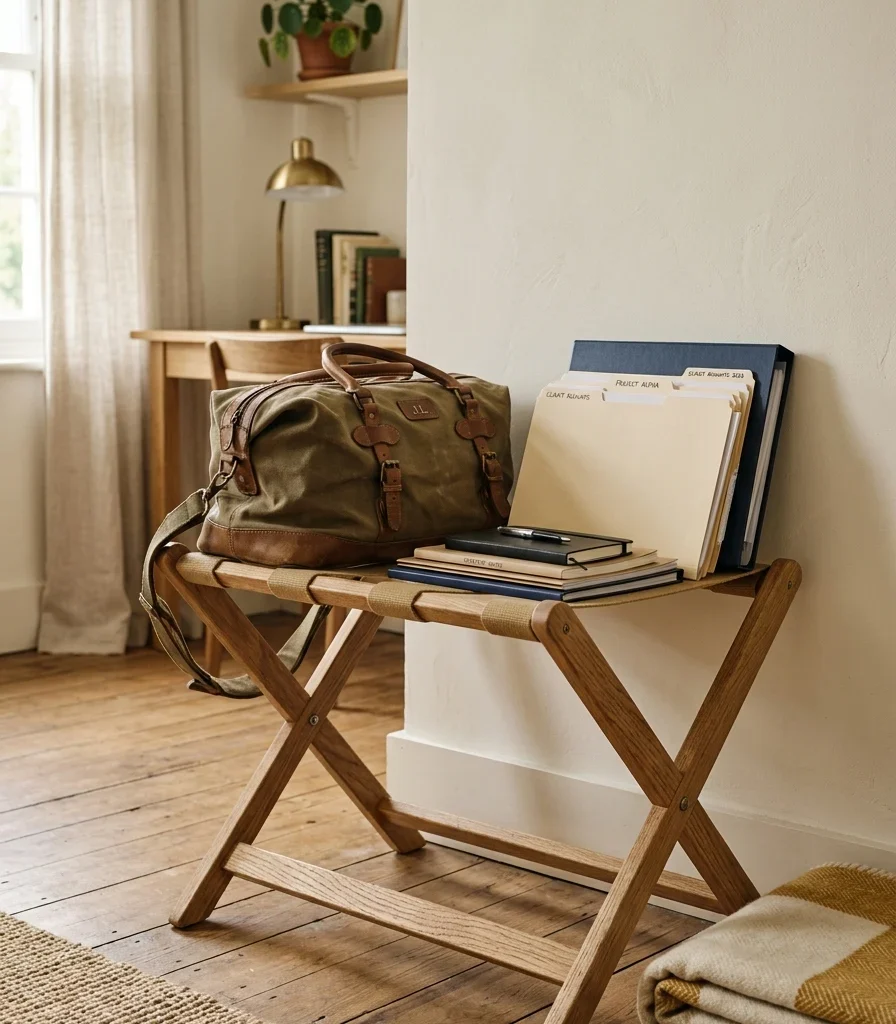
Vibe: Layered. A piece built for guests earns its daily keep as file storage the rest of the month.
Why it works: Dual-purpose accessories extend the same logic as dual-purpose furniture down to the smallest scale. A folding luggage rack’s flat canvas surface holds a suitcase for one night and a stack of document trays for the other twenty-nine, using an object most rooms only bring out for guests.
How to get it: Keep one folding canvas luggage rack tucked against the wall near the closet, using its surface for document trays or a printer paper ream when no guest is staying, then clearing it in seconds before arrival.
💡 Quick Win: Choose a rack with a wood frame that matches your desk finish so it reads as furniture, not a hotel amenity, when not folded away.
Shop the Look
- Folding canvas luggage rack, oak frame
- Stackable document tray, set of 2
- Small folded throw blanket, tan
- Wall hook for folded rack storage
15. Floating Furniture Arrangement to Keep Both Functions Open
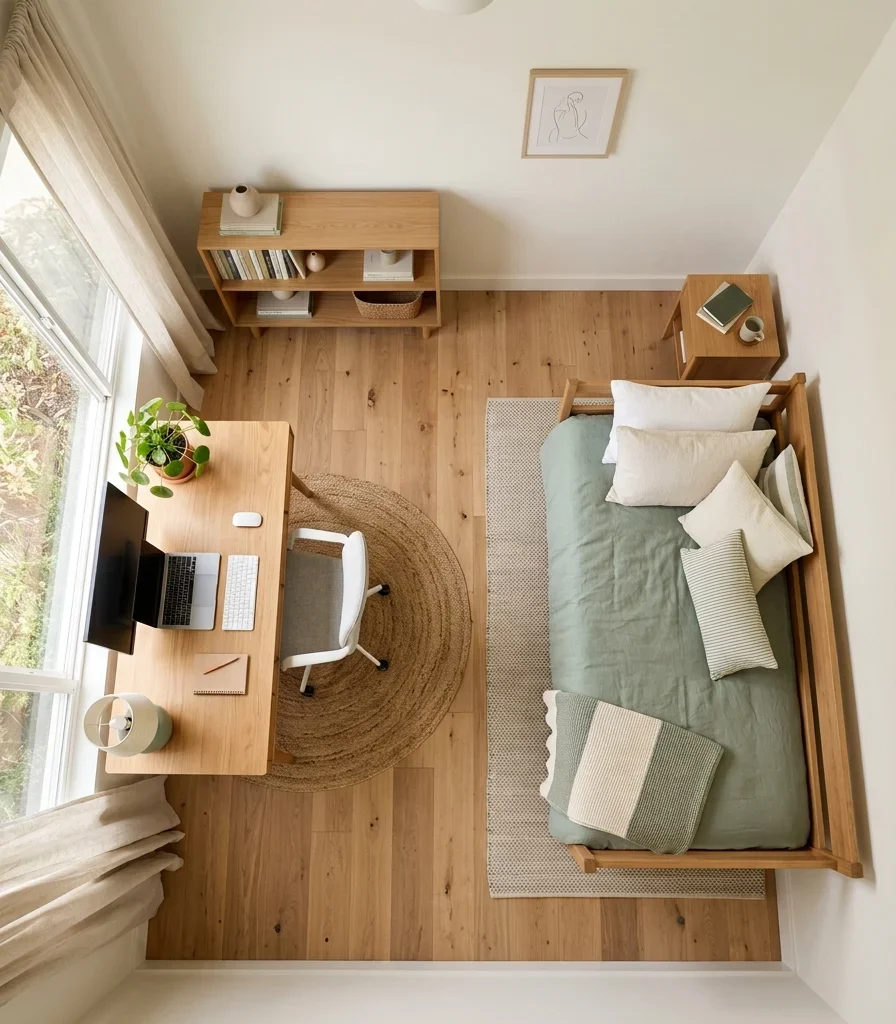
Vibe: Airy, pulling furniture even a few inches off the walls makes a small dual-purpose room read larger than it is.
Why it works: This is a traffic-flow layout principle counterintuitive to most small-space advice. Pushing every piece flush against the wall actually flattens a room visually, while floating the desk and daybed slightly forward creates depth and a defined path, which matters more when two functions need to coexist without collision.
How to get it: Pull both the desk and daybed roughly six inches away from their walls, anchor each zone with its own small rug, and keep the center path between them at least 30 inches wide.
Shop the Look
- Small jute-blend area rug, 3×5, set of 2
- White oak desk, compact
- Linen daybed, low profile
- Slim floor lamp, brushed brass
How to Start Your Smart Small Home Office Guestroom Transformation
Start with the daybed specifically; choose a low-profile frame in unfinished white oak before anything else, since its height and footprint determine where the desk, lighting, and storage can go. Everything else in the room is built to work around this one piece, not the other way around.
The most common mistake is buying a full-size guest bed instead of a daybed or Murphy unit. A standard bed frame claims permanent floor space that a home office simply can’t spare, and it visually dominates the room even when made up neatly. The fix is choosing a daybed or fold-away frame from the start, not retrofitting one in later.
Three items under $50 create real impact fast: a woven rattan basket with a lid for guest linens (around $32), a plug-in brass swing-arm sconce (around $38), and a folded waffle-weave throw in sage green (around $24).
A weekend covers furniture rearranging, bedding, and lighting swaps; a Murphy bed or built-in daybed installation takes three to six weeks with a contractor. Budget $400–$900 for a starter version, or $2,500–$6,000 for a full built-in transformation.
Frequently Asked Questions About Smart Small Home Office Guestroom Design
What’s the difference between a home office guestroom and a regular guest room?
A regular guest room is built around occasional overnight use and can afford to sit mostly empty between visits. A smart small home office guestroom has to function as a full-time workspace first, with guest capability layered on through convertible furniture like daybeds, Murphy beds, or fold-down desks, so the room earns its keep every single day, not just a few nights a year.
What is the best paint color for a small home office guestroom?
Warm greige, such as Sherwin-Williams Agreeable Gray, works best because it supports both a focused work mood and a restful sleep mood without needing separate accent walls. A single warm charcoal wall, like Benjamin Moore Kendall Charcoal, behind just the desk can add definition without darkening the whole room.
How much does a small home office guestroom cost to set up?
A starter version using a daybed, rearranged furniture, and new lighting runs $400 to $900. A mid-range setup with a fold-down desk and rattan storage typically lands between $1,200 and $2,500. A full built-in transformation with a Murphy bed system or custom millwork can reach $2,500 to $6,000 depending on the unit chosen.
Can a home office guestroom work in a room without a closet?
Yes, with adjustments. Woven baskets and a folding luggage rack replace closet storage for guest linens and bags, and a linen curtain divider can section off a dressing or privacy zone without any structural work. The one real limit is hanging storage; plan on a slim wall-mounted rod or freestanding rack if closet space is fully absent.
What is the best furniture piece for a small home office guestroom?
A low-profile daybed with trundle storage is consistently the most searched and most versatile choice, since it functions as daytime seating, overnight sleeping space, and hidden linen storage in one frame. Murphy bed desk combos come in second for rooms under 80 square feet where even a daybed’s footprint is too much to spare full-time.
Ready to Create Your Dream Smart Small Home Office Guestroom?
From Murphy bed desk combos to sage-toned bedding zones and floating furniture layouts, these 15 smart small home office guestroom ideas cover color, materials, and layout so the room works equally hard for you and for whoever’s staying over. You don’t need every piece in place at once; starting with just the daybed or just the lighting swap is genuinely the right way to begin, not a compromise. Measure your room today and decide between a daybed and a Murphy bed combo before buying anything else, since that single choice shapes every decision after it. Once it’s set up right, the room will feel efficient rather than crowded a space that quietly does two jobs without either one feeling like a leftover. Pin your favorites now, especially the fold-down and dual-purpose pieces you can picture solving your own square footage.
[…] either function feeling like an afterthought bolted onto the other. This article gives you 15 smart small home office guestroom ideas covering convertible furniture, storage, color, and layout tricks so one compact room can […]