
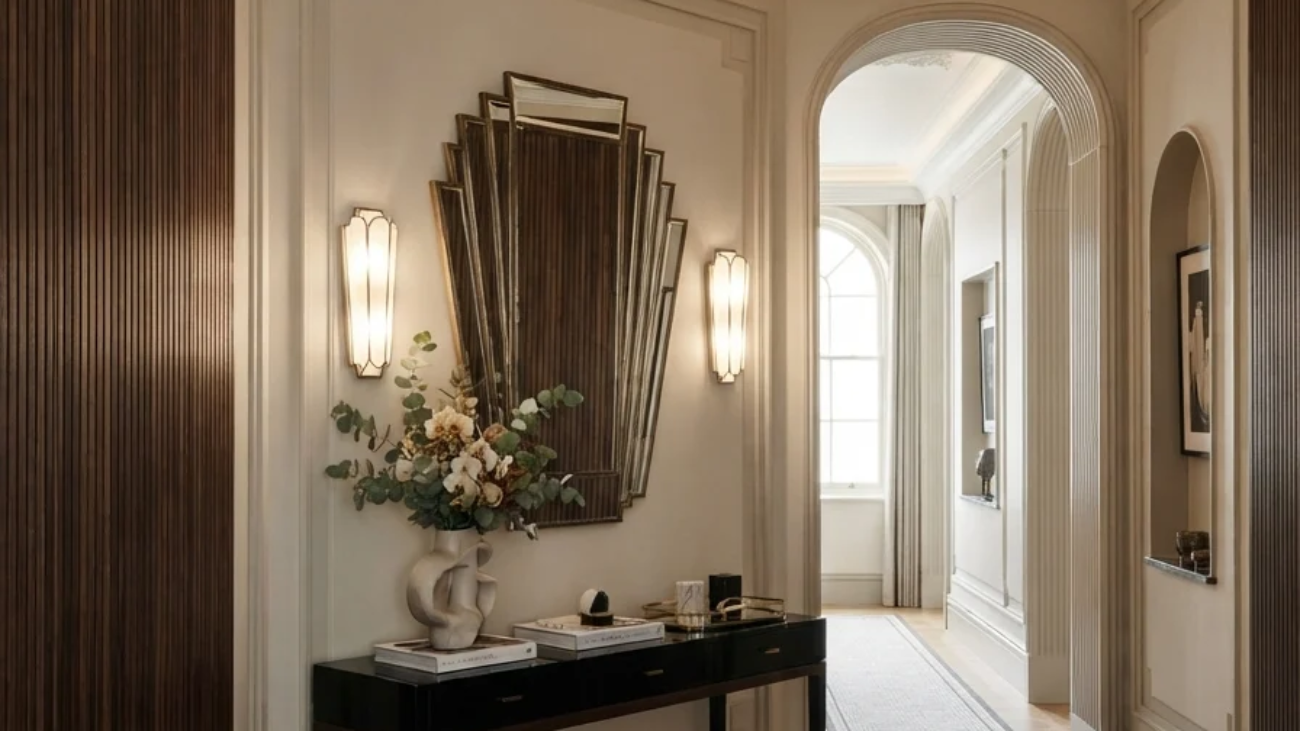
Art Deco hallway design is a glamorous early-20th-century style defined by geometric forms, symmetry, rich materials, metallic accents, and a controlled sense of luxury. These 22 Art Deco hallway design ideas show how to translate that visual language into entryways and corridors through color, lighting, mirrors, flooring, furniture, wall treatments, and small-space tricks.
The best Art Deco hallways feel polished without becoming theatrical. Light catches aged brass, dark wood gains depth against creamy walls, and geometric patterns create movement even when the corridor itself is narrow. Velvet introduces softness, while marble, lacquer, glass, and metal give the architecture a crisp edge. The result feels intentional from the moment someone crosses the threshold.
Art Deco works particularly well in hallways because these transitional spaces benefit from strong visual punctuation. You do not need a large room or an enormous furniture budget; one architectural wall treatment, a properly scaled mirror, or a dramatic light can establish the vocabulary.
Here are 22 ideas worth saving nd stealing.
Why Art Deco Hallway Design Works So Well
Art Deco emerged internationally during the 1920s and 1930s, with the 1925 Paris Exposition Internationale des Arts Décoratifs et Industriels Modernes giving the movement its defining public moment. Its vocabulary combined streamlined modern geometry with influences from Cubism, historic decorative arts, machinery, and motifs drawn from ancient cultures. Unlike softer Art Nouveau forms, Art Deco favors symmetry, stepped profiles, sunbursts, chevrons, strong verticals, and deliberate ornament.
The material palette is equally distinctive. Think walnut or dark-stained oak, black lacquer, honed or polished marble, smoked glass, mirror, velvet, satin, chrome, and aged brass. Classic colors include ivory, cream, black, charcoal, emerald green, petrol blue, oxblood, and deep plum. The key is contrast: a dark tone should have a lighter architectural partner rather than becoming a uniformly dark corridor.
Style at a Glance
| Element | Core Trait 1 | Core Trait 2 |
| Philosophy | Geometric glamour | Controlled ornament |
| Materials | Walnut, marble, velvet, glass | Brass, chrome, lacquer |
| Color palette | Ivory, black, emerald | Navy, oxblood, champagne |
1. Emerald Green Walls with Aged Brass
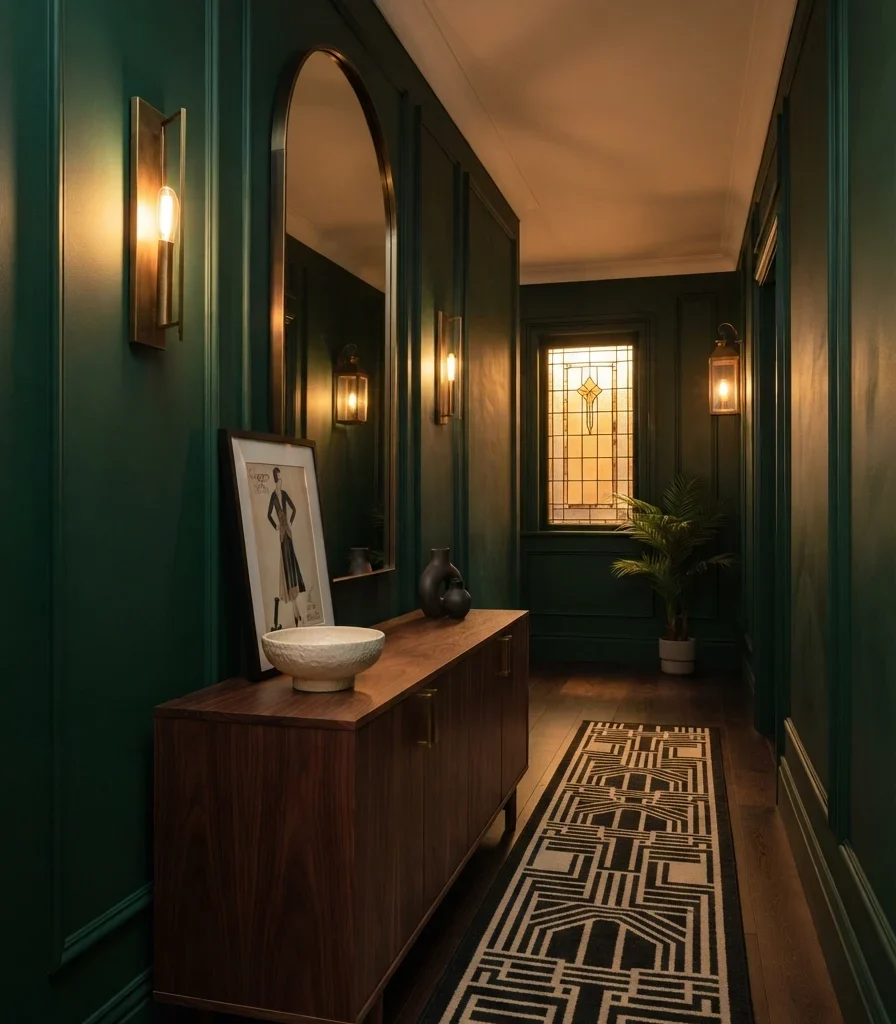
Vibe: The hallway feels lush, enveloping, and quietly theatrical.
Why it works: The high-value contrast between emerald and aged brass immediately establishes Art Deco’s jewel-box character. Walnut adds visual weight at floor level while the brass introduces reflective highlights, preventing the dark wall color from absorbing all available light.
How to get it: Use a deep emerald such as Benjamin Moore Essex Green as inspiration rather than automatically choosing the darkest green available. Balance it with an ivory runner and warm 2700K lighting so the corridor reads rich rather than cold.
Quick Win: Replace ordinary switch plates or cabinet pulls with antique-brass versions before repainting; repeated metal details can establish the style surprisingly quickly.
Shop The Look
| Product |
| Deep emerald green satin interior wall paint |
| Aged brass half-moon wall sconce pair |
| Dark walnut narrow hallway console |
| Ivory black geometric runner rug |
| Antique brass decorative bowl |
2. Black-and-Ivory Checkerboard Floor
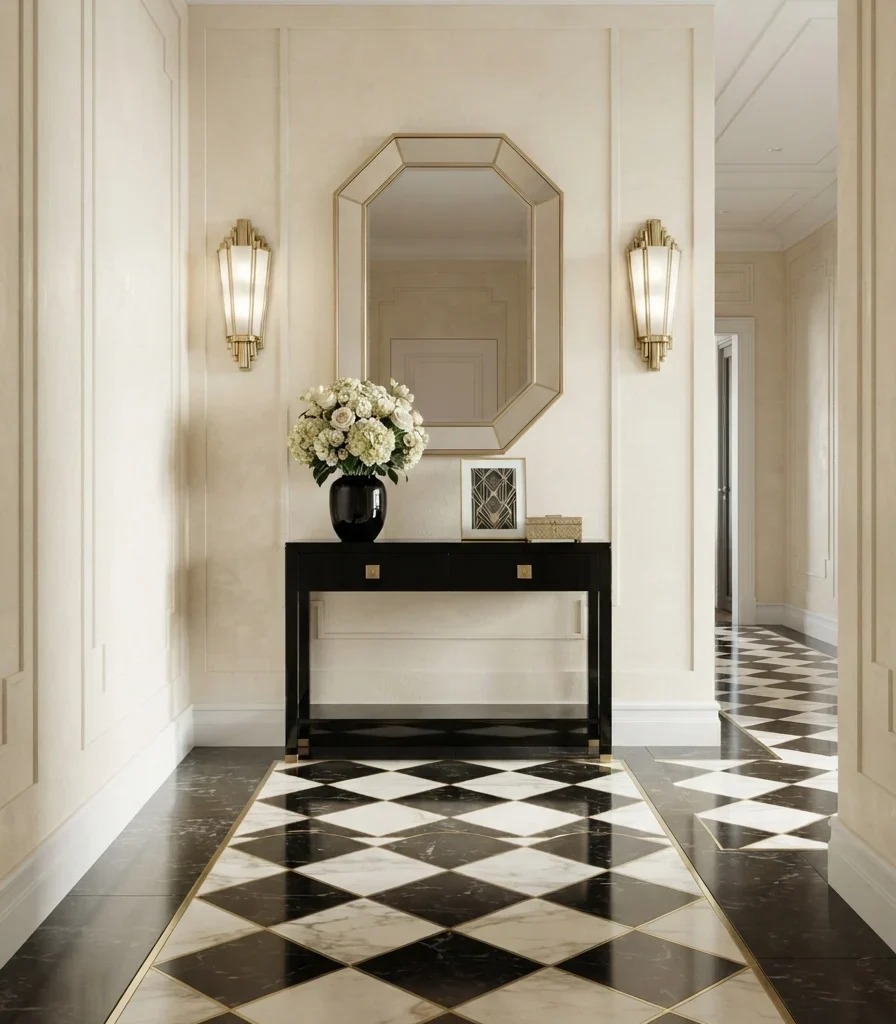
Vibe: The floor feels graphic, crisp, and architectural.
Why it works: Checkerboard flooring creates the repeated geometry that Art Deco needs without requiring patterned wallpaper. The floor becomes the horizontal foundation while simple cream walls provide negative space above it.
How to get it: Use 12-inch square tiles or porcelain alternatives rather than tiny checks in a narrow corridor; larger squares generally make a compact hallway feel less visually fragmented.
Quick Win: If replacing flooring is impractical, use a removable black-and-ivory checkerboard runner with a low pile and keep the surrounding floor visible.
Shop The Look
| Product |
| Black ivory checkerboard porcelain floor tile |
| Black and cream geometric hallway runner |
| Brass framed rectangular wall mirror |
| Black lacquer narrow console table |
| Ivory ceramic geometric vase |
3. A Sunburst Mirror as the Hallway Focal Point

Vibe: The entry feels radiant, with the mirror acting like jewelry for the wall.
Why it works: Sunburst geometry is one of the clearest decorative references to Art Deco, while the circular center interrupts the hallway’s straight sightline. The radial frame also catches and redistributes light.
How to get it: Choose a mirror at least two-thirds the width of the console beneath it. Keep the console accessories low so the radial frame remains the dominant silhouette.
Shop The Look
| Product |
| Antique brass sunburst wall mirror 36 inch |
| Slim walnut console table drawer |
| White marble rectangular catchall tray |
| Crystal-style glass bud vase |
| Faux white orchid arrangement tabletop |
4. Fluted Wall Paneling for Vertical Rhythm
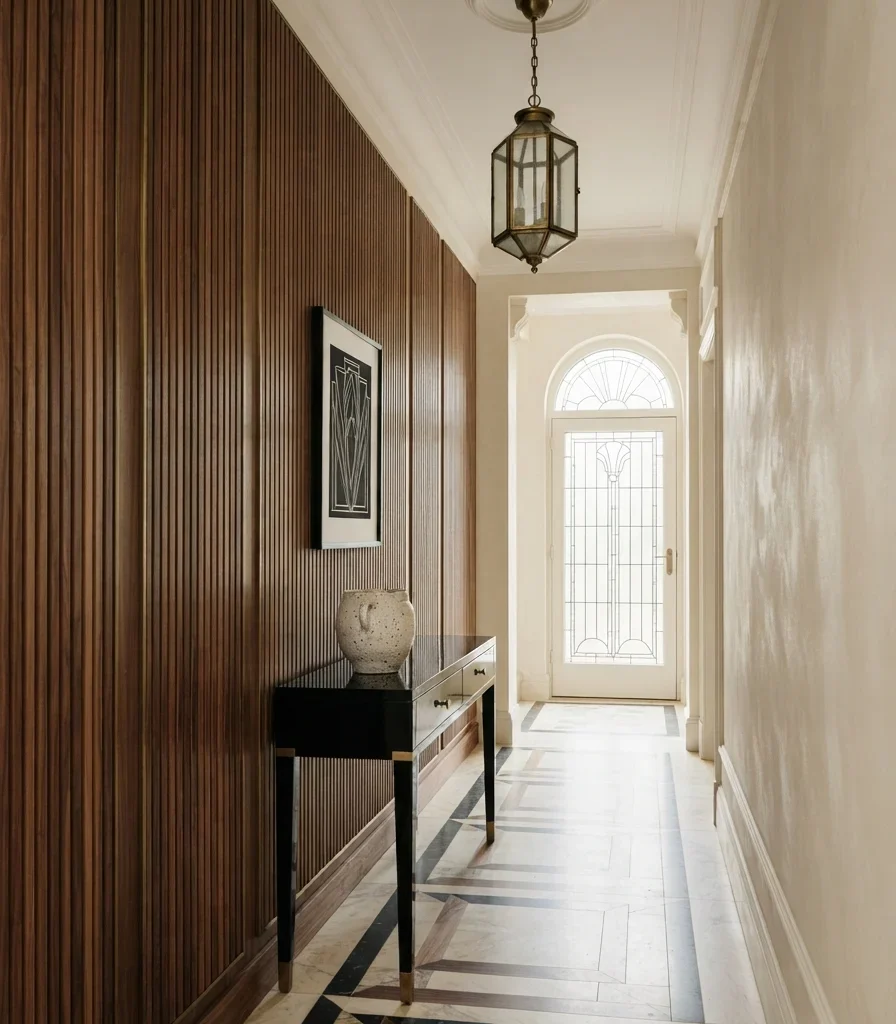
Vibe: The corridor feels ordered, with every vertical line adding height.
Why it works: Fluting creates shadow rhythm and gives a flat wall architectural depth. The repeated narrow grooves echo the linear geometry of Art Deco while making a low-ceilinged hallway appear taller.
How to get it: Install fluted MDF or wood-look panels on one focal wall instead of every wall. Keep the grooves vertical and use a darker stain if the hallway receives generous natural light.
Quick Win: Apply peel-and-stick fluted-effect wall panels to the lower half of one wall and finish the top with warm ivory paint.
Shop The Look
| Product |
| Walnut fluted decorative wall panel |
| Black narrow lacquer console table |
| Aged brass linear pendant light |
| Matte black sculptural ceramic vase |
| Ivory geometric framed wall art |
5. Curved Velvet Bench at the Entrance
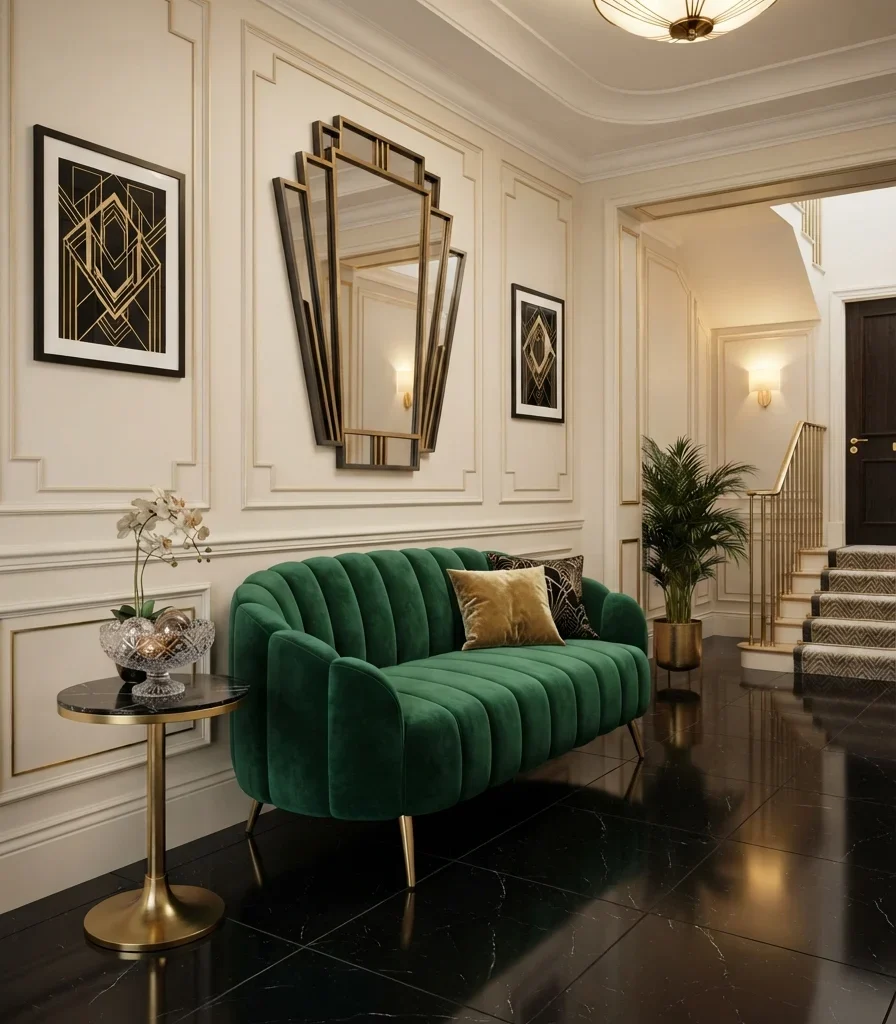
Vibe: The entrance feels plush, tactile, and welcoming.
Why it works: Curved seating softens the hard geometry while velvet introduces the tactile richness associated with historic Art Deco interiors. The bench also gives the hallway a functional landing point without needing a bulky chair.
How to get it: Leave at least 36 inches of clear walking space in front of the bench. Choose channel tufting or a scalloped back instead of casual linen upholstery for a stronger Deco silhouette.
Shop The Look
| Product |
| Emerald green curved velvet entry bench |
| Round antique brass pedestal accent table |
| Black marble look floor tile |
| Geometric black gold wall art |
| Crystal glass decorative bowl |
6. Geometric Wallpaper in a Narrow Corridor
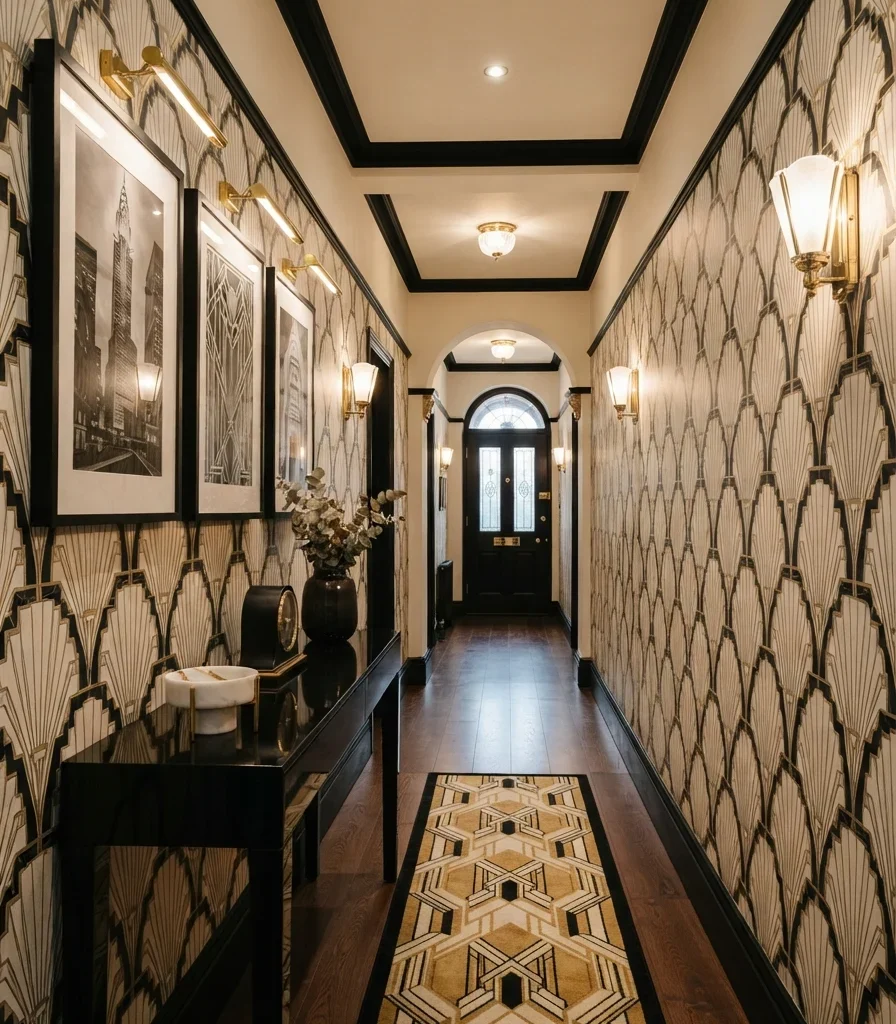
Vibe: The hallway feels layered, with pattern creating movement from one end to the other.
Why it works: A repeating geometric wallpaper turns a transitional corridor into a deliberate design destination. The restrained palette keeps the pattern architectural instead of playful.
How to get it: Select wallpaper with a medium-scale motif; patterns that are too small can look busy from close range, while very large motifs may lose their rhythm in a narrow passage.
Quick Win: Wallpaper only the longest uninterrupted wall and paint the remaining walls warm ivory.
Shop The Look
| Product |
| Cream black Art Deco geometric peel stick wallpaper |
| Slim black console table brass handles |
| Antique brass picture light plug-in |
| Black ivory framed geometric prints |
| Small white marble decorative box |
7. Smoked Glass Pendant Lighting
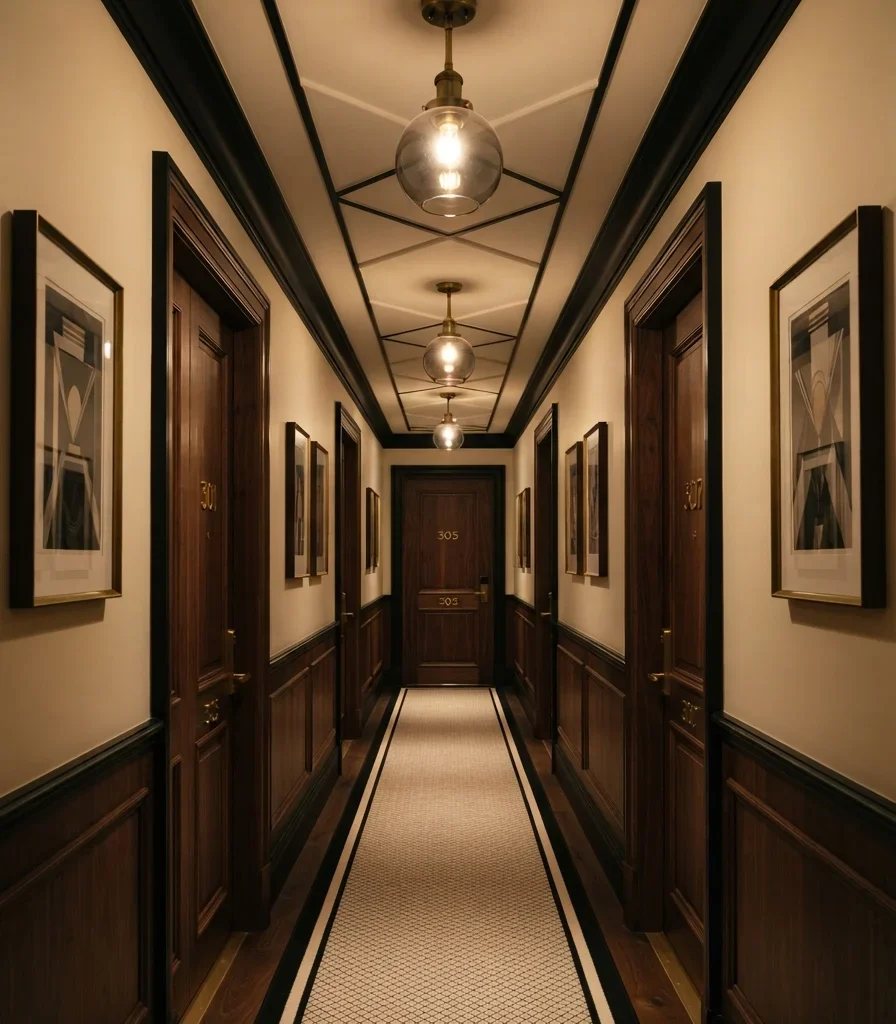
Vibe: The corridor feels hushed, with pools of light creating a slow visual rhythm.
Why it works: Repetition is central to the composition: three matching pendants distribute attention along the hallway instead of concentrating it at one end. Smoked glass softens the bulbs while brass fittings add a warm metallic note.
How to get it: Space the pendants according to the corridor length rather than centering one fixture. Use dimmable 2700K bulbs and keep the fixtures high enough to preserve comfortable head clearance.
Shop The Look
| Product |
| Smoked glass globe pendant light brass |
| Warm white dimmable E27 LED 2700K bulbs |
| Black ceiling canopy pendant fitting |
| Brass electrical cord grip |
| Slim cream hallway runner |
8. Black Lacquer Console with Brass Hardware

Vibe: The console feels sleek, reflective, and deliberately formal.
Why it works: Glossy black creates the visual drama Art Deco needs, while brass prevents the composition from becoming severe. The console’s horizontal line also counterbalances the vertical hallway walls.
How to get it: Look for a console no deeper than 12–14 inches in a circulation corridor. Choose curved corners or stepped legs to make the furniture profile more period-appropriate.
Shop The Look
| Product |
| Black lacquer narrow console brass handles |
| Brass table lamp black shade pair |
| Round antique gold wall mirror |
| Black ceramic decorative vase |
| Ivory faux hydrangea arrangement |
9. Marble-and-Brass Hallway Moment
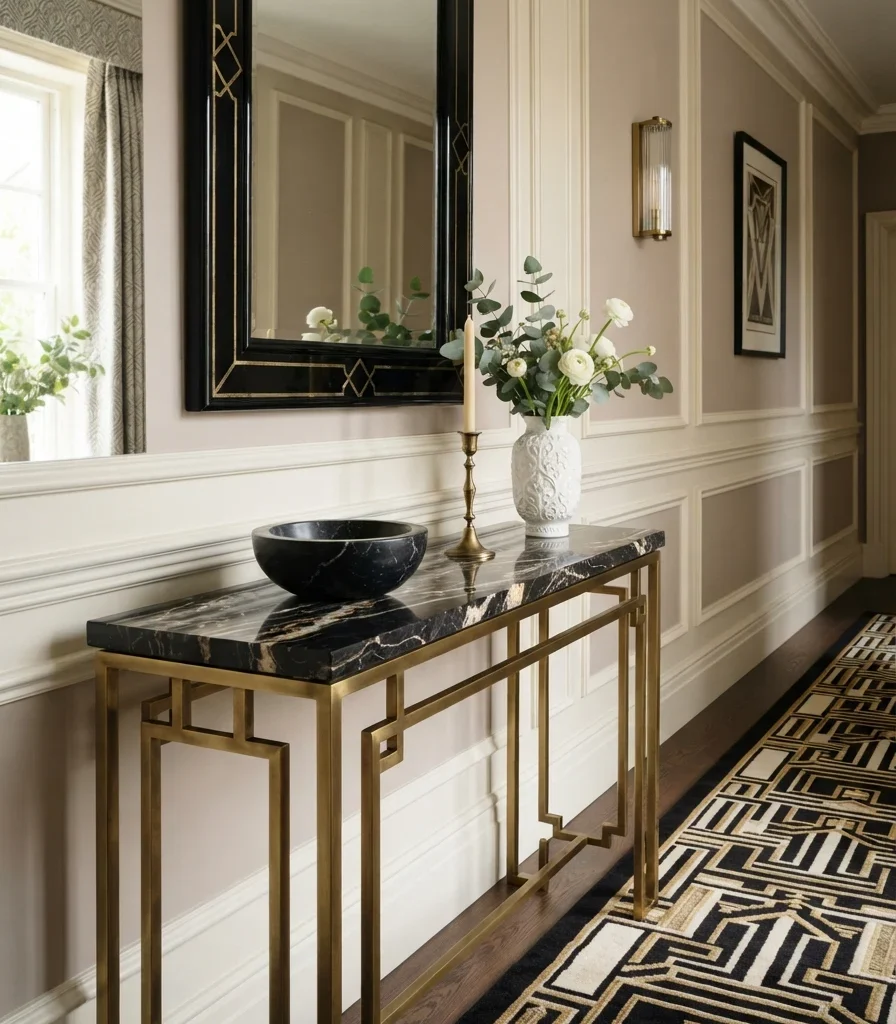
Vibe: The space feels grounded, with stone providing quiet visual weight.
Why it works: Marble introduces natural veining that breaks up the precision of geometric forms. Brass adds warmth, while the pale wall keeps the dark stone from making the hallway visually heavy.
How to get it: Use a slim marble console or marble-look top rather than covering the entire corridor in stone. A 10–14-inch-deep surface is enough for styling while preserving circulation.
Quick Win: Use a removable marble-look contact surface on an existing console to mimic the stone-and-metal combination.
Shop The Look
| Product |
| Black white marble look narrow console table |
| Antique brass console legs |
| Black metal framed rectangular mirror |
| White marble decorative bowl |
| Brass taper candle holder pair |
10. Symmetrical Sconces and Mirror
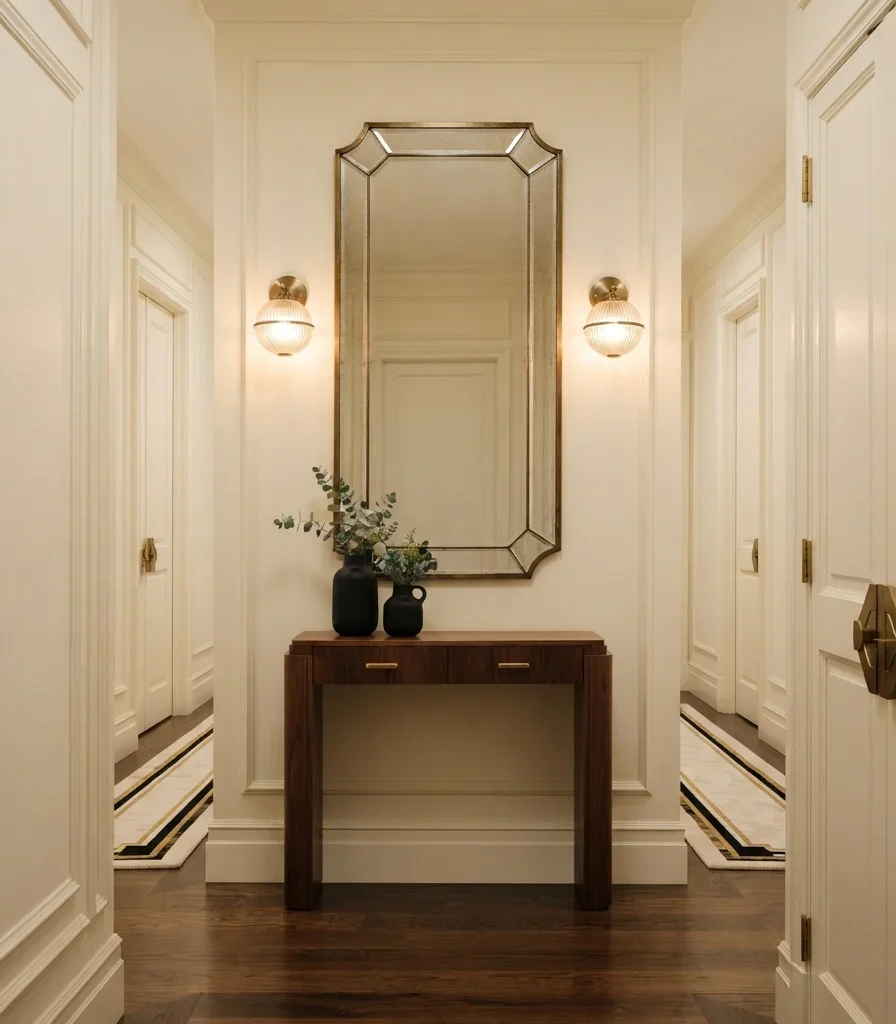
Vibe: The hallway feels balanced, calm, and architecturally intentional.
Why it works: Symmetry is one of the easiest ways to make a hallway read as Art Deco rather than merely glamorous. Matching sconces create bilateral balance while the mirror becomes the central axis.
How to get it: Center the mirror first, then install sconces at equal distances from its vertical edges. Keep the console directly underneath so all three elements share one compositional centerline.
Shop The Look
| Product |
| Tall beveled rectangular wall mirror |
| Aged brass globe wall sconce pair |
| Walnut narrow entry console |
| Matching ivory ceramic vase pair |
| Black and cream geometric runner |
11. Oxblood and Champagne Gold Accent Wall
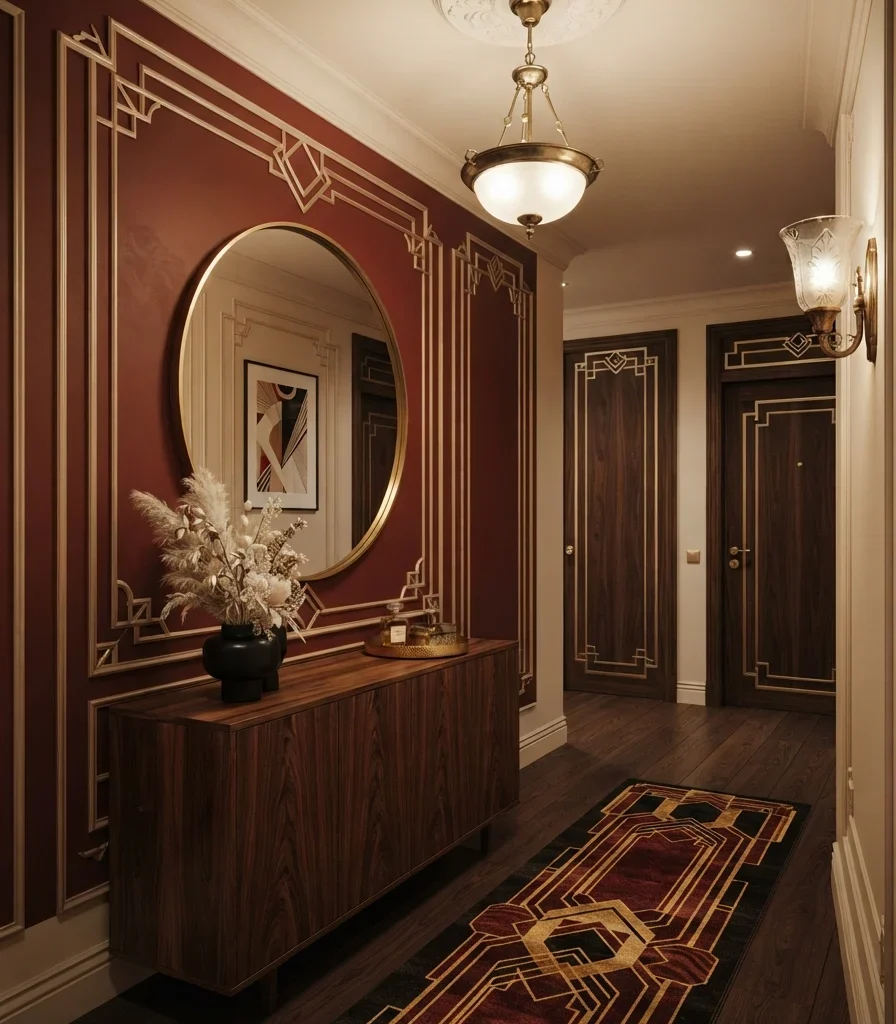
Vibe: The corridor feels romantic, deep, and jewel-like.
Why it works: Oxblood gives Art Deco its characteristic saturated color without relying on emerald or navy. Champagne gold softens the contrast compared with bright yellow brass and creates a more muted, residential finish.
How to get it: Paint one focal wall rather than the whole hallway, especially in a corridor with limited natural light. Repeat the champagne tone in only two additional places so the accent remains intentional.
Shop The Look
| Product |
| Oxblood burgundy interior wall paint satin |
| Champagne gold geometric wall molding |
| Walnut floating console shelf |
| Round champagne gold mirror |
| Black ceramic vase with narrow neck |
12. Fluted Glass Door with Brass Frame
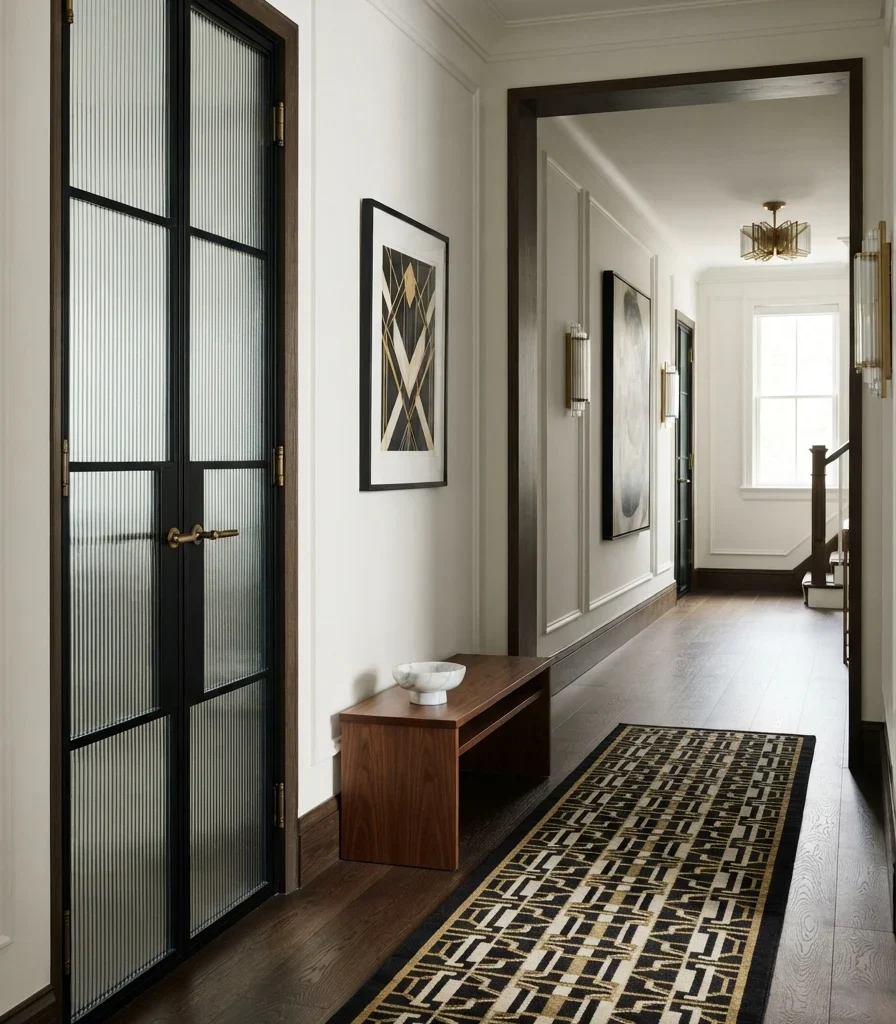
Vibe: The hallway feels airy, private without feeling closed.
Why it works: Reeded glass references the textured glazing frequently associated with decorative interiors while allowing light to travel between rooms. The slim black frame adds geometry, and the brass hardware provides warmth.
How to get it: Use fluted glass for a door separating the hallway from a home office, kitchen, or living room. If replacing the door is not possible, apply removable reeded privacy film to existing glass.
Quick Win: Install reeded-glass window film and replace the door handle with an aged-brass lever for a fast Deco update.
Shop The Look
| Product |
| Reeded fluted privacy window film |
| Aged brass interior door lever handle |
| Black framed interior glass door hardware |
| Dark oak peel and stick floor planks |
| Ivory geometric hallway runner |
13. Navy Blue with Polished Nickel

Vibe: The hallway feels cool, polished, and quietly dramatic.
Why it works: Navy gives the Art Deco palette a sophisticated alternative to emerald and black. Polished nickel reflects more neutral light than yellow brass, making this combination useful in homes with cooler flooring or existing silver hardware.
How to get it: Match the metal to existing door handles and light fixtures rather than mixing silver and brass randomly. Use warm ivory textiles to stop the navy from feeling too stark.
Shop The Look
| Product |
| Deep navy interior wall paint satin |
| Polished nickel globe wall sconce |
| Black curved hallway console table |
| Round silver framed mirror |
| Ivory navy geometric runner rug |
14. Geometric Gallery Wall with Deco Prints

Vibe: The wall feels layered, like a compact private gallery.
Why it works: Repetition turns separate prints into one visual composition. Matching frames create cohesion while varying the geometric motifs keeps the arrangement from looking mass-produced.
How to get it: Lay the frames on the floor first and maintain approximately 2–3 inches between pieces. Use two-thirds of the wall width above the console rather than filling every available inch.
Shop The Look
| Product |
| Black gold Art Deco geometric print set |
| Thin black picture frames 8×10 set |
| Brass picture light plug-in |
| Walnut narrow console shelf |
| Black ceramic bud vase |
15. Curved Archway with Brass Trim
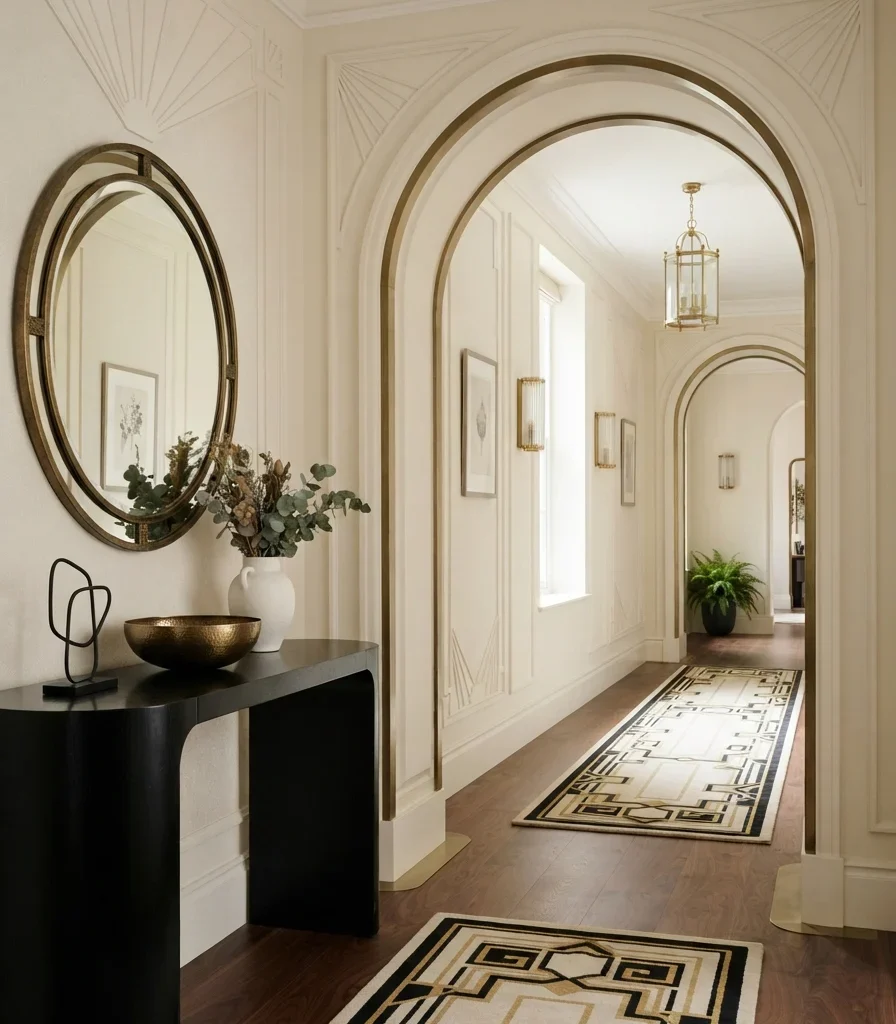
Vibe: The architecture feels sculptural, with the doorway becoming the decoration.
Why it works: Art Deco is not limited to furniture and accessories; architectural openings can carry its geometry. The curved arch softens the movement while brass edging emphasizes the silhouette.
How to get it: If the existing opening is square, use flexible decorative molding to create a shallow visual arch rather than rebuilding the structure. Paint the arch interior one shade darker for additional depth.
Quick Win: Apply removable metallic trim around an existing doorway and paint the inner reveal a deeper neutral.
Shop The Look
| Product |
| Flexible antique brass wall trim molding |
| Warm ivory interior wall paint |
| Dark walnut peel-and-stick floor planks |
| Black narrow arch console table |
| Round brass framed mirror |
16. Black-and-Gold Ceiling Detail
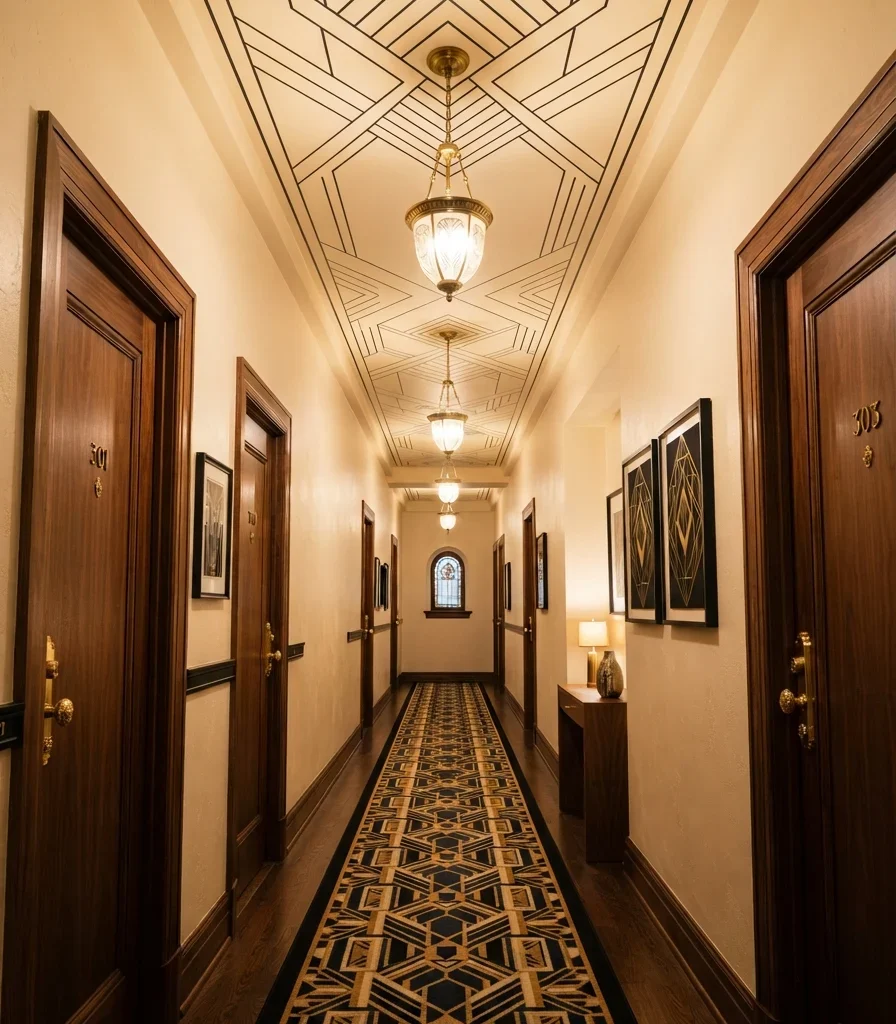
Vibe: The ceiling feels unexpected, turning an overlooked plane into a design feature.
Why it works: A patterned ceiling adds Art Deco geometry without consuming wall space. This is especially useful in hallways where floor and wall surfaces already need to remain clear for movement.
How to get it: Keep the ceiling base warm ivory and introduce thin black lines in symmetrical rectangles or stepped forms. Avoid filling the entire surface with dense pattern.
Shop The Look
| Product |
| Black geometric ceiling stencil Art Deco |
| Warm ivory ceiling paint matte |
| Brass semi flush ceiling light |
| Black and brass picture frames |
| Walnut door hardware set |
17. Deco Runner with Fan Motif
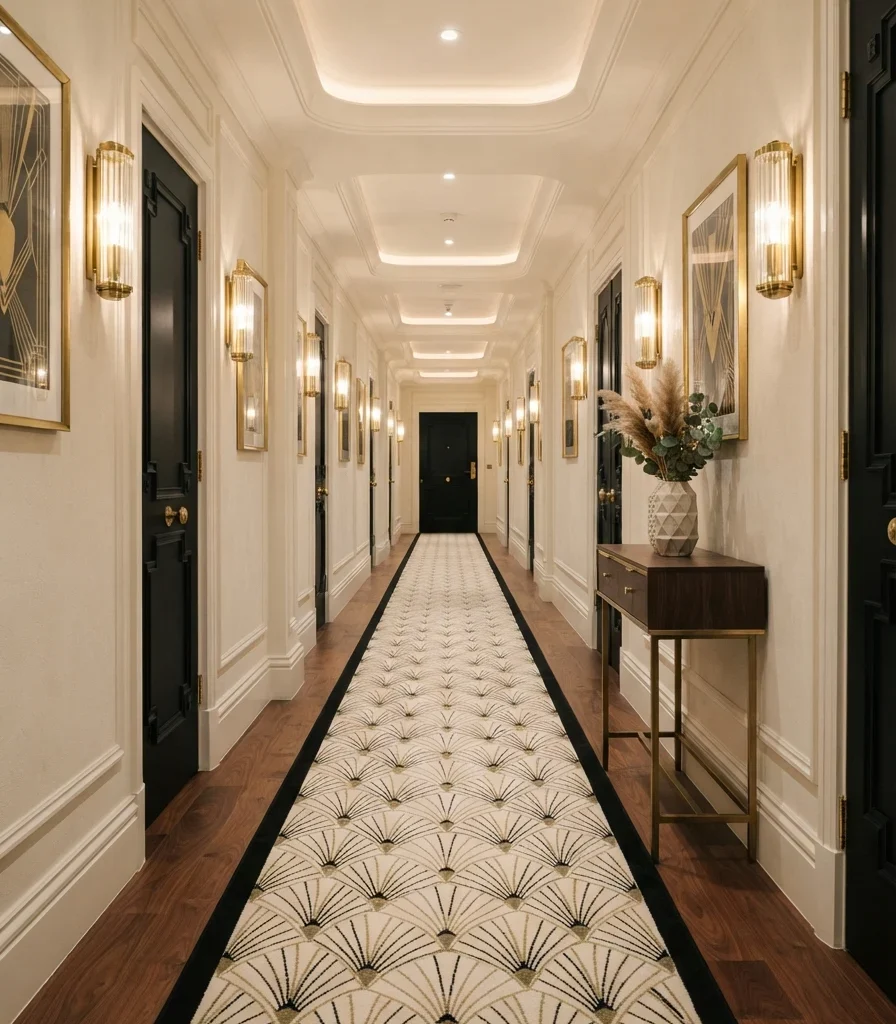
Vibe: The floor feels rhythmic, drawing the eye naturally toward the destination.
Why it works: A runner is an efficient way to introduce a strong Deco motif without committing to wallpaper or architectural work. The repeated fan pattern creates movement along the hallway’s natural axis.
How to get it: Choose a runner that leaves visible floor borders on both sides; roughly 4–6 inches of exposed flooring helps the pattern feel framed rather than wall-to-wall.
Quick Win: Add a washable fan-pattern runner before changing anything else; it gives you a test of the palette and motif.
Shop The Look
| Product |
| Cream black Art Deco fan pattern runner |
| Non-slip hallway rug pad |
| Aged brass cylinder wall sconces |
| Black narrow entry console |
| Gold black geometric ceramic vase |
18. Small Deco Hallway with a Floating Console
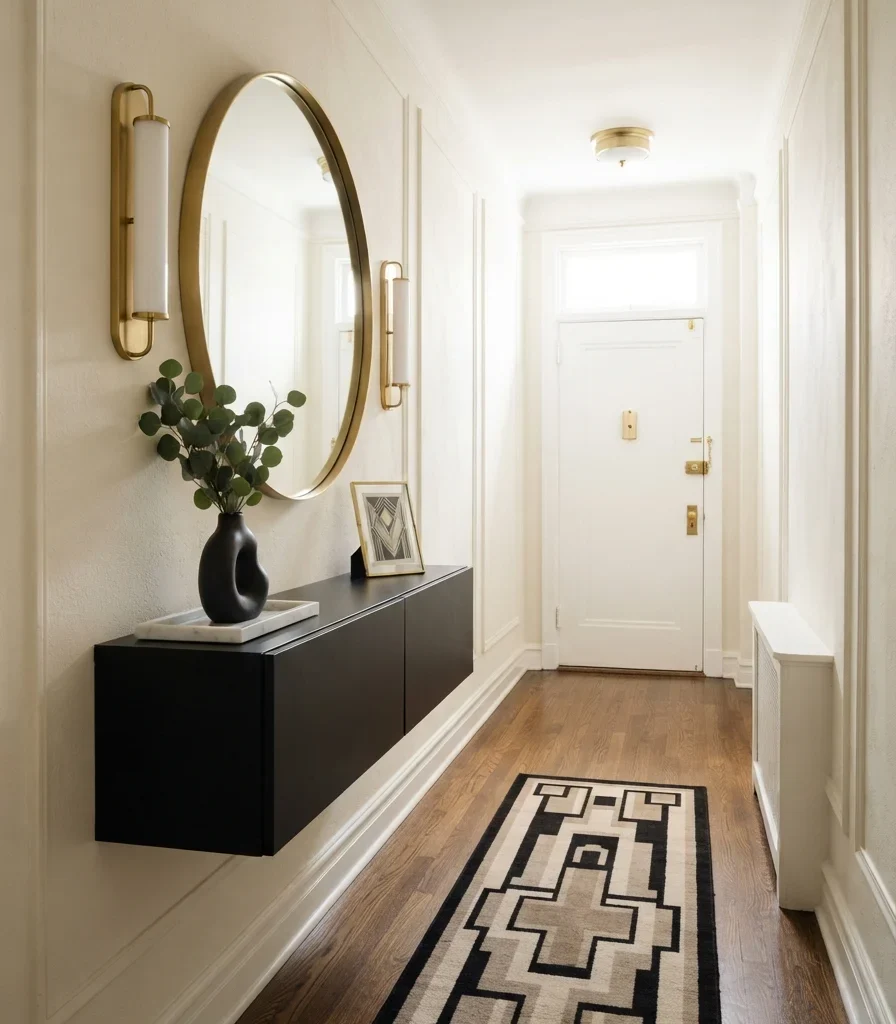
Vibe: The small corridor feels airy, despite its strong contrast.
Why it works: Floating furniture preserves visible floor area, creating the perception of greater width. The oversized mirror adds reflection while the restrained console prevents the hallway from becoming obstructed.
How to get it: For very narrow corridors, choose a floating shelf or console no deeper than 8–10 inches. Put everyday keys and mail in one concealed drawer rather than filling the surface with accessories.
Shop The Look
| Product |
| Black floating hallway console shelf |
| Oversized round antique brass mirror |
| Slim brass wall sconce plug-in |
| Taupe black geometric runner |
| Small white marble catchall tray |
19. Art Deco Hallway with a Round Mirror Trio

Vibe: The composition feels ordered, with circles interrupting the corridor’s straight lines.
Why it works: Repetition creates rhythm while the circular forms provide contrast against rectangular architecture. Three mirrors also multiply light without requiring one extremely large piece.
How to get it: Keep the mirror diameters identical and align their centers precisely. Leave consistent gaps between frames so the installation reads as one composition rather than three unrelated decorations.
Shop The Look
| Product |
| Round antique brass mirror set three |
| Long black narrow console table |
| Small ivory ceramic vase set |
| Brass rectangular decorative tray |
| Dark walnut hallway runner |
20. Black Marble-Effect Walls with Gold Geometry
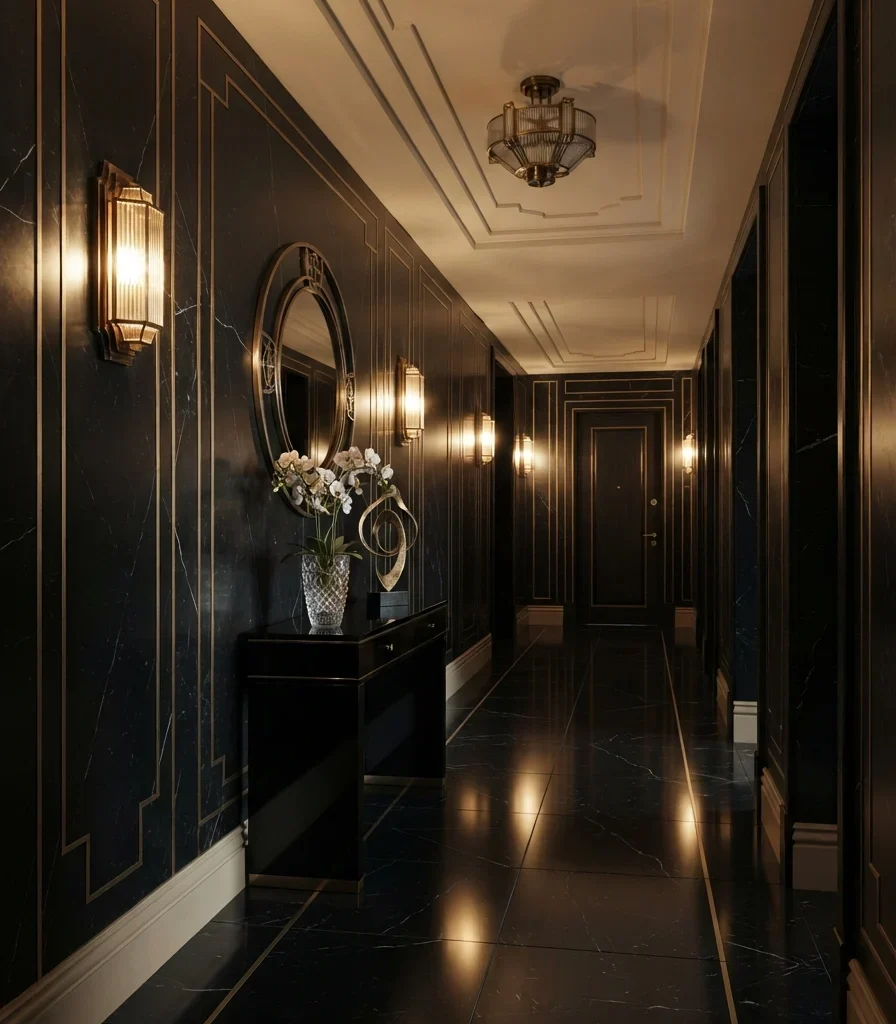
Vibe: The corridor feels dramatic, like a boutique hotel passage.
Why it works: Black marble-look surfaces create strong visual depth, while thin gold lines provide the geometric precision associated with Deco. The cream ceiling gives the eye a light resting plane.
How to get it: Use the marble effect on one focal wall instead of every surface. Choose slabs or panels with restrained veining; excessive white movement can compete with the geometric trim.
Quick Win: Use peel-and-stick black marble wall panels on the console wall and add one thin brass trim rectangle.
Shop The Look
| Product |
| Black marble white vein peel-and-stick wall panel |
| Antique gold geometric wall trim |
| Brass cylinder wall sconce pair |
| Black lacquer narrow console |
| Clear crystal decorative vase |
21. Art Deco Gallery Hallway with Dark Wood Doors

Vibe: The corridor feels grounded, with dark timber giving the architecture permanence.
Why it works: Repeating dark doors create visual rhythm and make the hallway architecture part of the Deco composition. Brass hardware breaks up the dark timber, while emerald in the runner supplies a controlled jewel-tone accent.
How to get it: Stain or paint the doors as one continuous family rather than mixing several wood tones. Repeat the same brass finish on handles, hinges, and at least one light fixture.
Shop The Look
| Product |
| Dark walnut interior door stain |
| Aged brass lever door handle set |
| Emerald ivory geometric hallway runner |
| Black gold Art Deco framed prints |
| Slim walnut wall-mounted console |
22. Soft Ivory Art Deco Hallway for a Modern Home
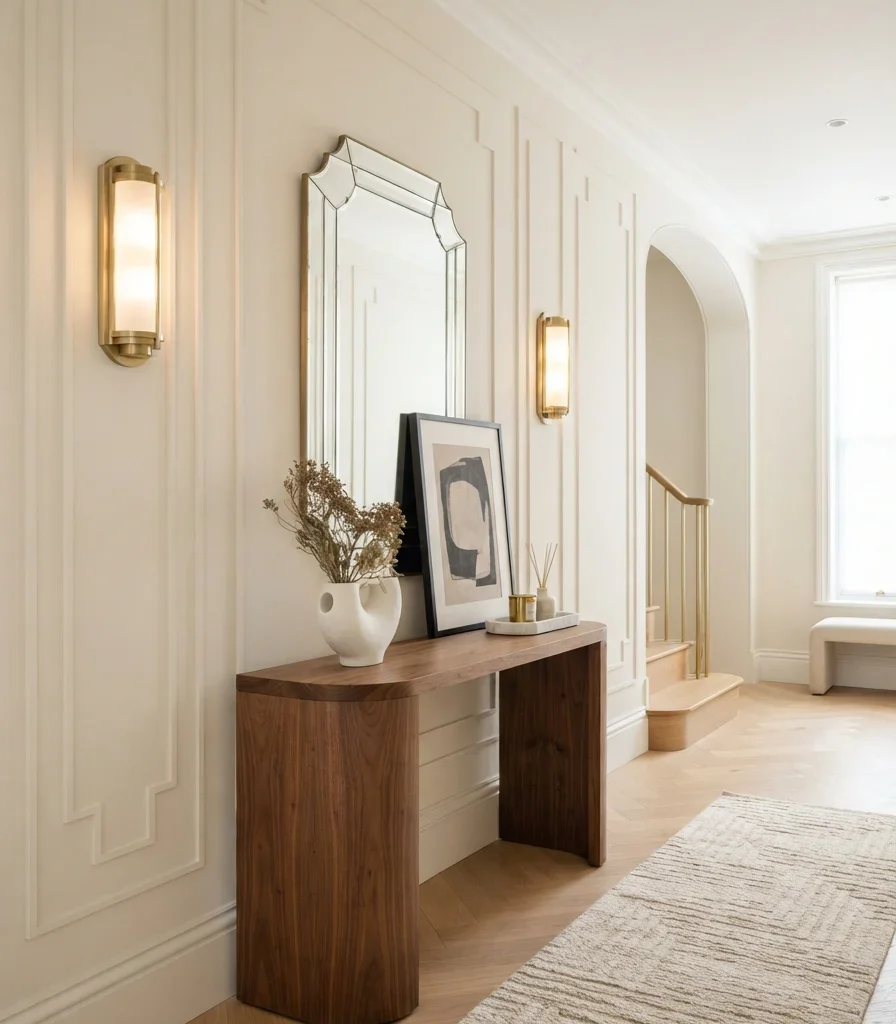
Vibe: The hallway feels luminous, elegant without becoming formal.
Why it works: This is the most adaptable version of Art Deco because the geometry is quiet rather than high contrast. Warm ivory walls preserve brightness, while champagne brass, walnut, and curved profiles supply the period vocabulary without overwhelming a contemporary home.
How to get it: Use tone-on-tone molding in an ivory shade only slightly darker than the wall, then introduce Deco through the furniture and lighting. This approach works particularly well when the rest of the house is modern, and you want continuity rather than a themed corridor.
Quick Win: Add a large beveled mirror and one champagne-brass sconce before committing to architectural changes; these two elements establish reflection, geometry, and metallic warmth immediately.
Shop The Look
| Product |
| Warm ivory interior wall paint eggshell |
| Champagne brass curved wall sconce |
| Curved walnut entryway console |
| Large beveled rectangular mirror |
| Neutral cream geometric hallway runner |
How to Start Your Art Deco Hallway Transformation
Start with one large beveled mirror in an aged-brass frame on the hallway’s main focal wall. It establishes the three qualities that make Art Deco work so well in transitional spaces: geometry, reflection, and metallic warmth before you spend money on larger architectural changes.
The most common mistake is combining too many unrelated Deco motifs at once: chevrons, sunbursts, fans, checkerboard tile, heavy gold, and multiple jewel tones can quickly become visually noisy. Choose one dominant geometric language, such as fan shapes, and repeat it subtly through the runner, artwork, or hardware.
For inexpensive entry points, start with an antique-brass decorative tray under $30, a black-and-ivory geometric runner under $50, and a small Art Deco-inspired framed print under $25. Together they can change the composition without replacing the console or flooring.
A starter hallway can be refreshed over one weekend for roughly $100–$400, depending on whether you already own a mirror or console. A more complete transformation involving wallpaper, lighting, flooring, paint, and furniture can reasonably move into the $700–$2,500+ range, while structural changes such as new doors or built-in paneling take longer and may require professional installation.
Frequently Asked Questions About Art Deco Hallway Design
What makes a hallway Art Deco instead of simply glamorous?
Art Deco is defined by more than expensive-looking finishes. Its recognizable language comes from geometry, symmetry, stepped forms, repeated motifs, contrasting materials, and carefully controlled ornament. A hallway with a brass mirror alone is not necessarily Art Deco, but a brass-framed geometric mirror paired with symmetrical sconces, dark wood, and strong linear proportions clearly moves in that direction.
What colors work best for an Art Deco hallway?
Classic Art Deco hallway colors include emerald green, deep navy, black, ivory, cream, oxblood, charcoal, and muted metallics. For a small hallway, warm ivory with black and champagne brass is one of the easiest combinations because it maintains brightness while introducing contrast. If the corridor has plenty of natural light, emerald or navy can create a richer jewel-box effect.
How much does it cost to create an Art Deco hallway?
A simple decorative update can cost around $100–$400 using paint, a runner, a mirror, artwork, and replacement hardware. A mid-range makeover with a new console, sconces, wallpaper, and upgraded accessories may cost $500–$1,500. Custom paneling, stone flooring, electrical work, or bespoke furniture can push the project substantially higher.
Can Art Deco hallway design work in a modern house?
Yes, and it often works best when only a few defining elements are introduced. Keep the existing modern architecture and add Deco through a beveled mirror, curved walnut console, aged-brass lighting, or geometric runner. Avoid trying to reproduce an entire 1920s interior if the rest of the house is contemporary; selective repetition will create a more cohesive result.
Which lighting works best in an Art Deco hallway?
Wall sconces are particularly effective because hallways are naturally linear and sconces can create repeated points of illumination without consuming floor space. Look for globe, stepped, fan, or fluted designs in aged brass, champagne brass, black, or polished nickel. Use warm bulbs around 2700K and choose dimmable fixtures where possible so the hallway can shift from bright daytime circulation to a softer evening atmosphere.
Ready to Create Your Dream Art Deco Hallway Design?
These 22 Art Deco hallway design ideas explore jewel-tone color, marble, walnut, velvet, geometric flooring, mirrors, sconces, wallpaper, architectural molding, furniture placement, and compact-space solutions. You do not need to transform everything at once; starting with one strong element is often the smartest way to build a coherent room. Today, measure your hallway’s longest wall and choose a mirror or console that fits within the available circulation space. Once the geometry, reflection, and warm metallic details begin working together, the hallway can feel more polished and intentional every time you pass through it. Save or pin the ideas that speak to you most, especially the combinations of aged brass, dark walnut, jewel tones, and Deco geometry that can give even a quiet corridor its own character.