
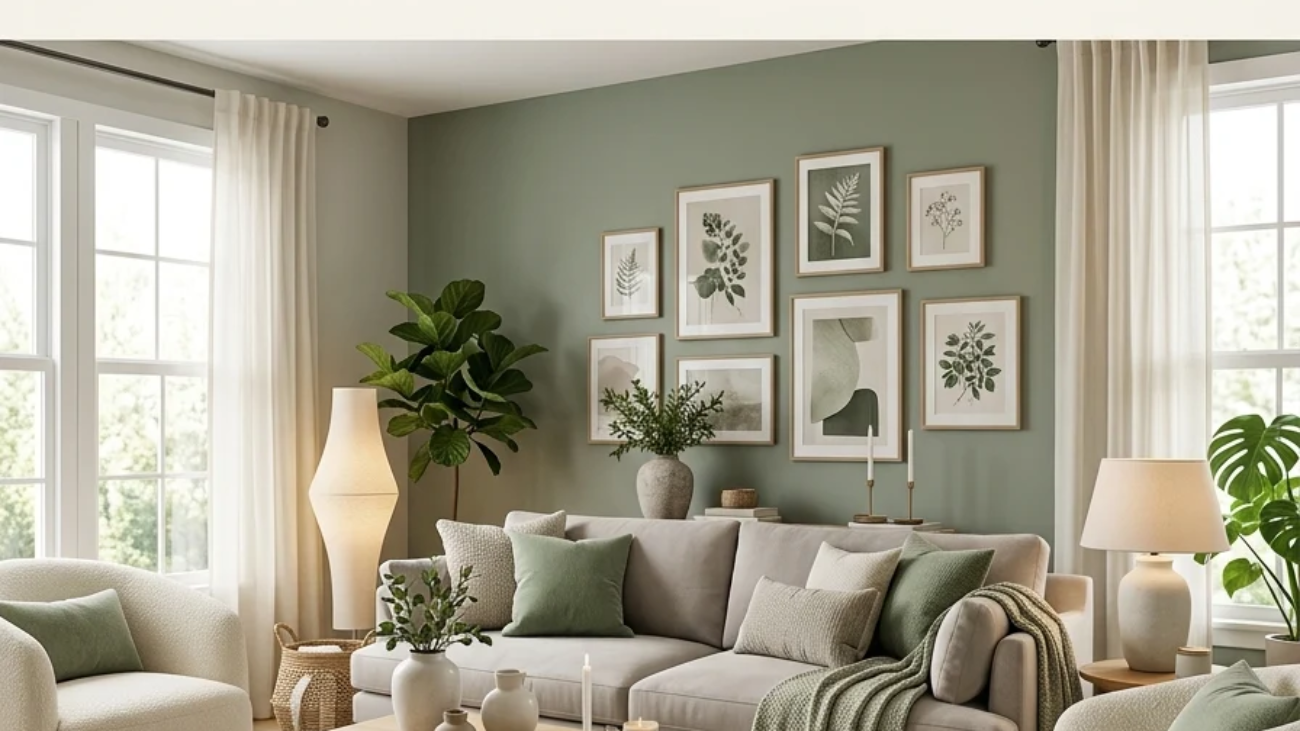
A cozy sage green gray living room pairs muted botanical green with warm, layered gray tones to build a space that feels calm without feeling cold. This article gives you 12 cozy sage green gray living room ideas: color, materials, lighting, furniture, layout, and small-space fixes, each with a shoppable “Steal the Look” list.
Picture a room where the gray never reads as flat or corporate because sage green is warming it from every corner: a throw here, a painted trim there, a ceramic vase catching the afternoon light. The textures do most of the emotional work: boucle that begs to be sat in, oak that still shows its grain, wool that holds warmth after the sun moves off it. Nothing shouts. Everything settles. Here are 12 ideas worth saving and stealing.
Why a Cozy Sage Green Gray Living Room Works So Well
A sage green gray living room is a color-palette-driven style drawing from biophilic design: muted, botanical greens that calm the way real plants do, layered against the warm-neutral minimalism of Scandinavian and modern farmhouse interiors. What separates it from a plain “neutral living room” is the intentional two-tone anchor: sage brings life, gray brings grounding.
Its materials are specific: boucle upholstery, white oak or ash furniture, unglazed stoneware, brushed nickel or matte black hardware, and wool or jute rugs. The colors worth naming are sage, moss, and eucalyptus green against warm gray, greige, and soft charcoal never a cool, blue-based gray, which fights the warmth the green is trying to introduce.
This pairing is trending because it answers two search behaviors at once. Pinterest shows sustained interest in “sage green living room” and “warm gray living room” independently, and combining them meets the post-pandemic pull toward rooms that feel restorative rather than showroom-perfect.
Small living rooms can do this, but should lead with gray as the dominant wall tone and let sage arrive through furniture and textiles; two saturated colors competing for wall space in a tight room reads busy rather than calm.
| Element | Green Influence | Gray Influence |
| Philosophy | Biophilic calm, botanical warmth | Grounded warm-neutral minimalism |
| Materials | Linen, boucle, rattan, unglazed ceramic | Travertine, white oak, wool, brushed nickel |
| Color Palette | Sage, moss, eucalyptus | Warm gray, greige, soft charcoal |
1. Sage Green Accent Wall Paired With Warm Gray Trim
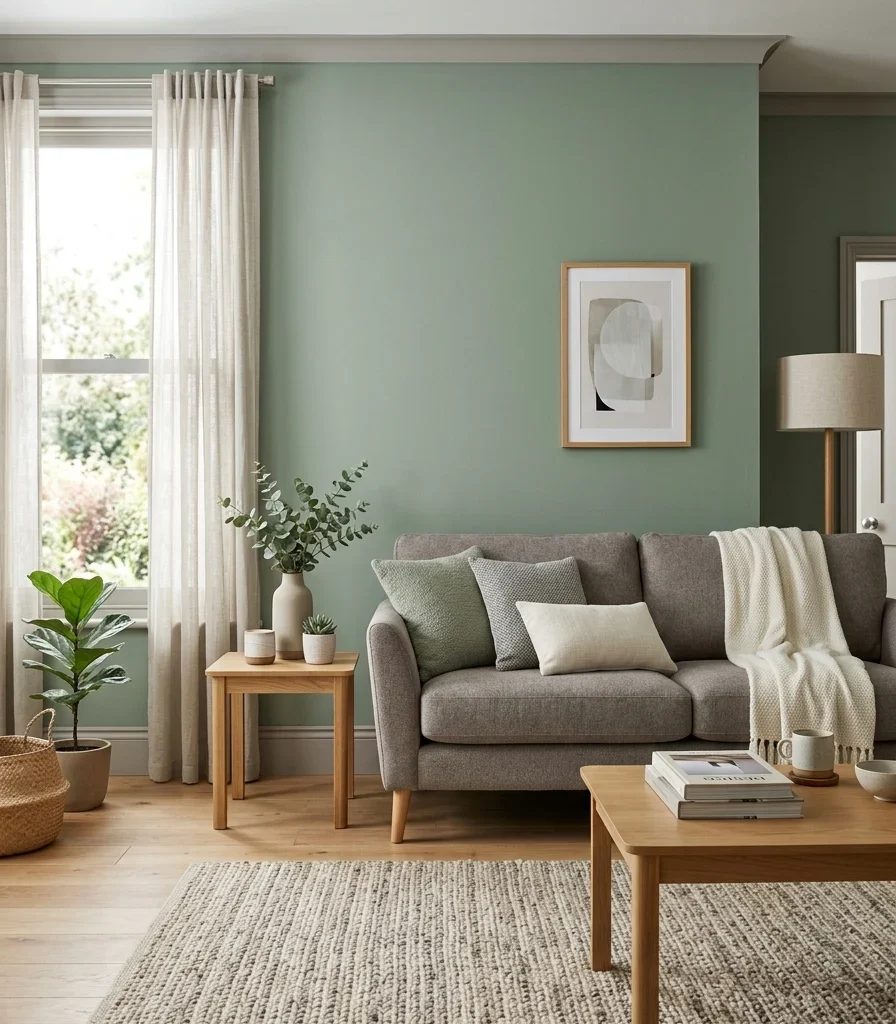
Vibe: Serene the wall color that makes the whole room exhale.
Why it works: Sage advances visually less aggressively than a saturated green, so a single accent wall reads calm, not dominant. Pairing it with warm gray trim rather than stark white keeps the contrast soft; lower values create harmony, wider gaps create tension.
How to get it: Paint one wall in a chalky matte sage such as Farrow & Ball “Card Room Green” or Sherwin-Williams “Clary Sage,” and trim in a warm gray like Benjamin Moore “Revere Pewter” rather than bright white.
💡 Quick Win: No time to paint? A large sage green boucle throw draped over the sofa back gives the same color anchor in an afternoon.
Shop The Look
| Product |
| Sage green matte paint sample pot |
| Warm gray trim paint sample |
| Ceramic vase sage green glaze |
| Woven cotton throw blanket ivory |
| Small potted eucalyptus plant faux |
2. Boucle and White Oak Furniture Pairing
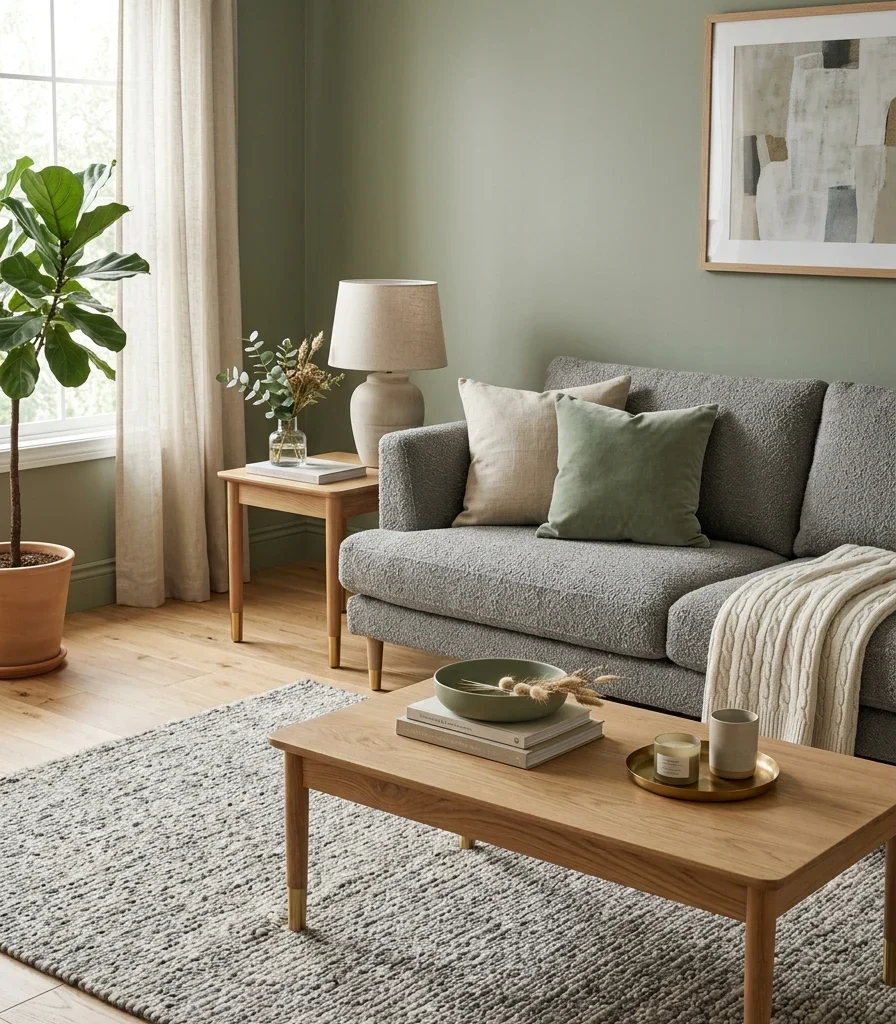
Vibe: Textural room you want to run your hand across before you sit down.
Why it works: Texture layering pairs a soft, nubby fabric with a hard, grained material, so the eye has contrast without extra color. Boucle’s dimensional weave catches light differently than flat upholstery, so it photographs warmer than it measures on a chip.
How to get it: Choose a gray boucle sofa and pair it with white oak side and coffee tables rather than walnut or espresso; the lighter wood keeps the palette from tipping too dark, and its visible grain adds the material honesty this style depends on.
Shop The Look
| Product |
| Gray boucle upholstered sofa |
| White oak coffee table round |
| White oak side table small |
| Sage green ceramic bowl decorative |
| Linen lumbar cushion cover ivory |
3. Warm Amber Floor and Table Lamps
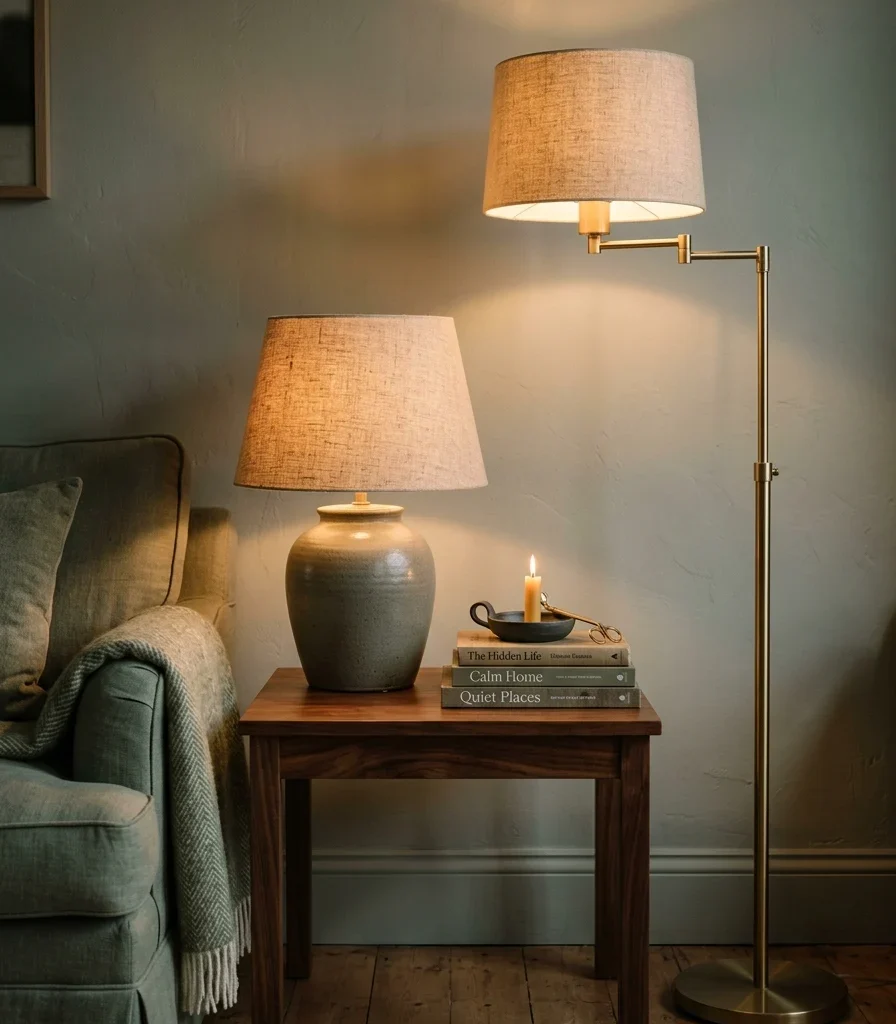
Vibe: Hushed light that makes evenings in this room feel unhurried.
Why it works: Warm 2700K bulbs shift a gray room away from clinical and toward cocooning, since cool-toned gray under cool-white light reads flat and office-like. Two layered light pools soften the shadows a single overhead fixture leaves behind.
How to get it: Add a brushed brass floor lamp with a linen shade beside the sofa and a ceramic table lamp on the console, both fitted with 2700K bulbs and, if possible, dimmable.
💡 Quick Win: Swapping existing bulbs to 2700K “warm white” costs under $12 for a pair and instantly warms up a cool gray room.
Shop The Look
| Product |
| Brushed brass floor lamp linen shade |
| Ceramic table lamp warm sage glaze |
| Warm white 2700K LED bulb set |
| Small ceramic catch-all dish |
| Linen lamp shade replacement ivory |
4. Tonal Gray Layering From Charcoal to Greige
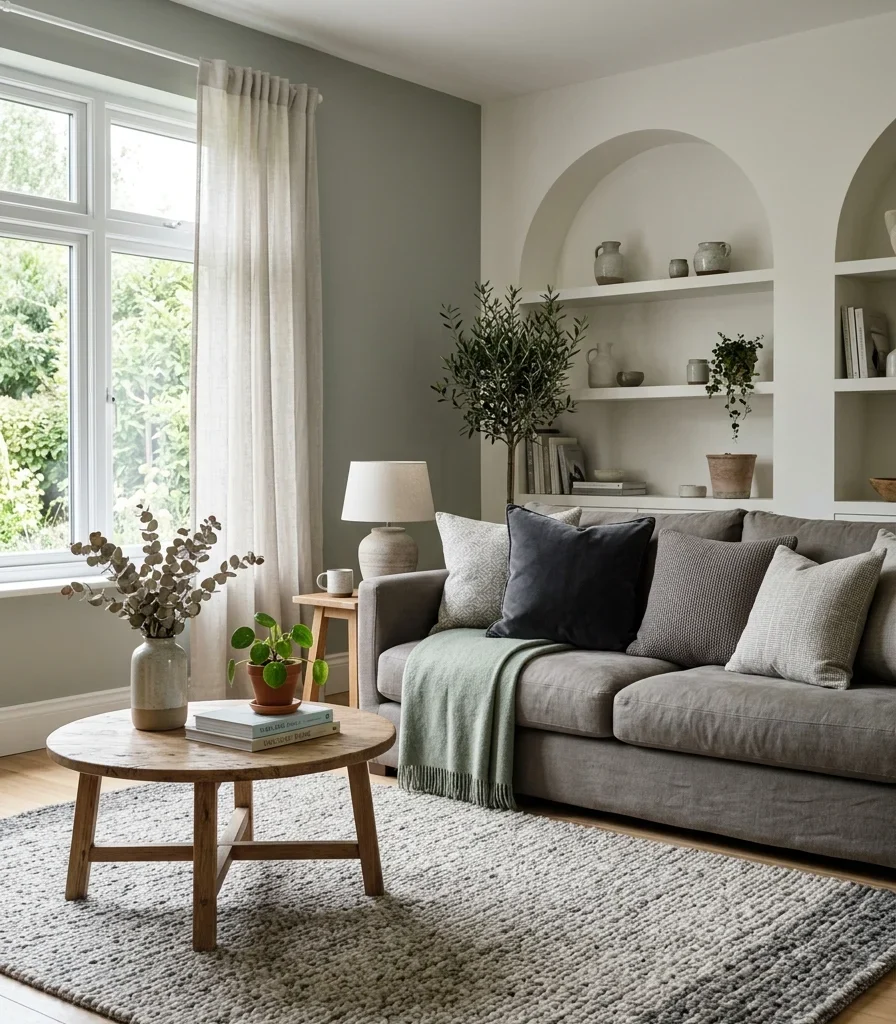
Vibe: Layered gray shows up at three depths instead of one flat tone.
Why it works: Tonal layering within one color family creates depth that a single flat gray can’t achieve. A light greige wall, a mid-gray sofa, and one charcoal cushion give the eye a gradient to travel across, the same principle behind tonal green layering elsewhere in this palette.
How to get it: Paint walls in a light greige like Sherwin-Williams “Agreeable Gray,” choose a mid-toned gray linen sofa, and add one charcoal velvet cushion as the deepest note; resist adding a fourth gray shade, which flattens the gradient instead of extending it.
Shop The Look
| Product |
| Light greige wall paint sample |
| Mid-gray linen sofa slipcover |
| Charcoal velvet throw pillow cover |
| Wool area rug warm gray |
| Sage green throw blanket folded |
5. Curved Sage Green Sofa as Anchor
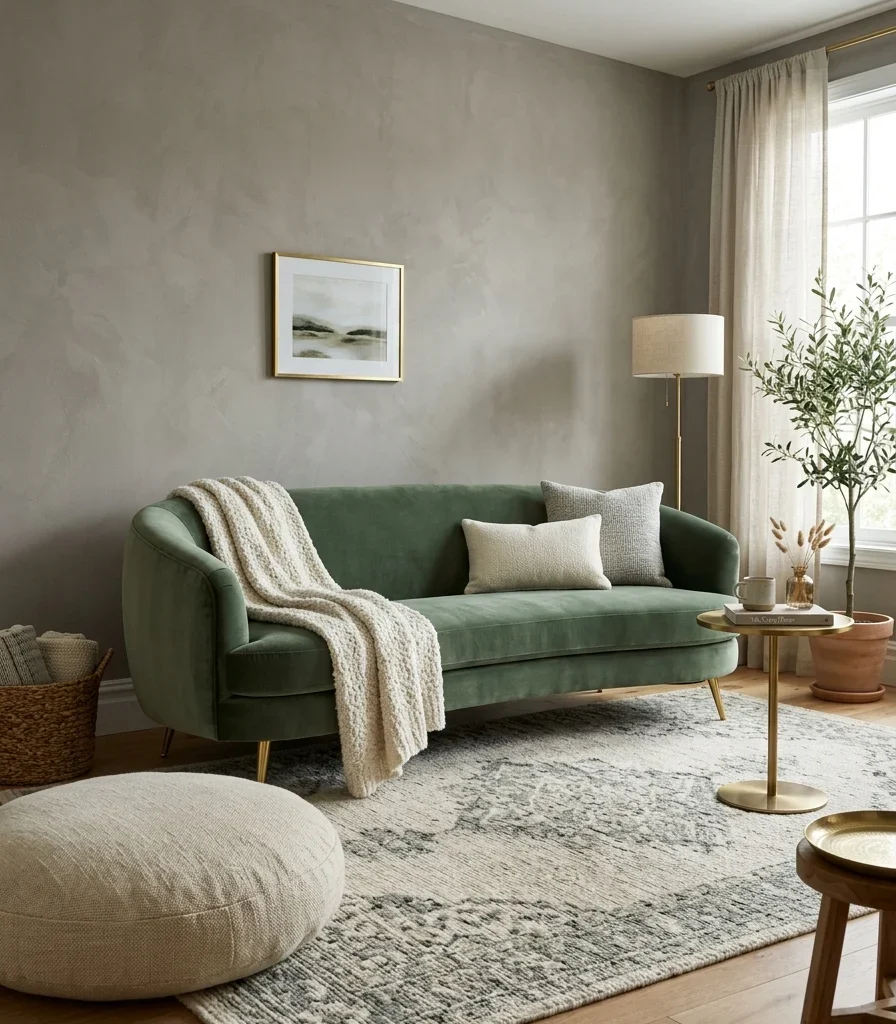
Vibe: Grounded, a sofa shape that softens every hard line in the room around it.
Why it works: A curved sofa reduces the visual weight a boxy silhouette carries at the same footprint; rounded forms read as lighter to the eye. Choosing sage for the sofa rather than the wall puts the boldest hue on the most-used piece of furniture, where it earns its presence daily.
How to get it: Source a curved sofa in sage green velvet or performance fabric rather than the more common cream or gray, and keep the wall behind it in warm gray so the sofa remains the room’s clear color statement.
💡 Quick Win: Not ready for a new sofa? A sage green velvet bench at the foot of an existing sofa introduces the same anchor color at a fraction of the cost.
Shop The Look
| Product |
| Curved sage green velvet sofa |
| Sage green upholstered bench small |
| Brass sofa leg caps set |
| Oversized floor cushion ivory |
| Wool throw blanket warm gray |
6. Travertine or Textured Stone Coffee Table
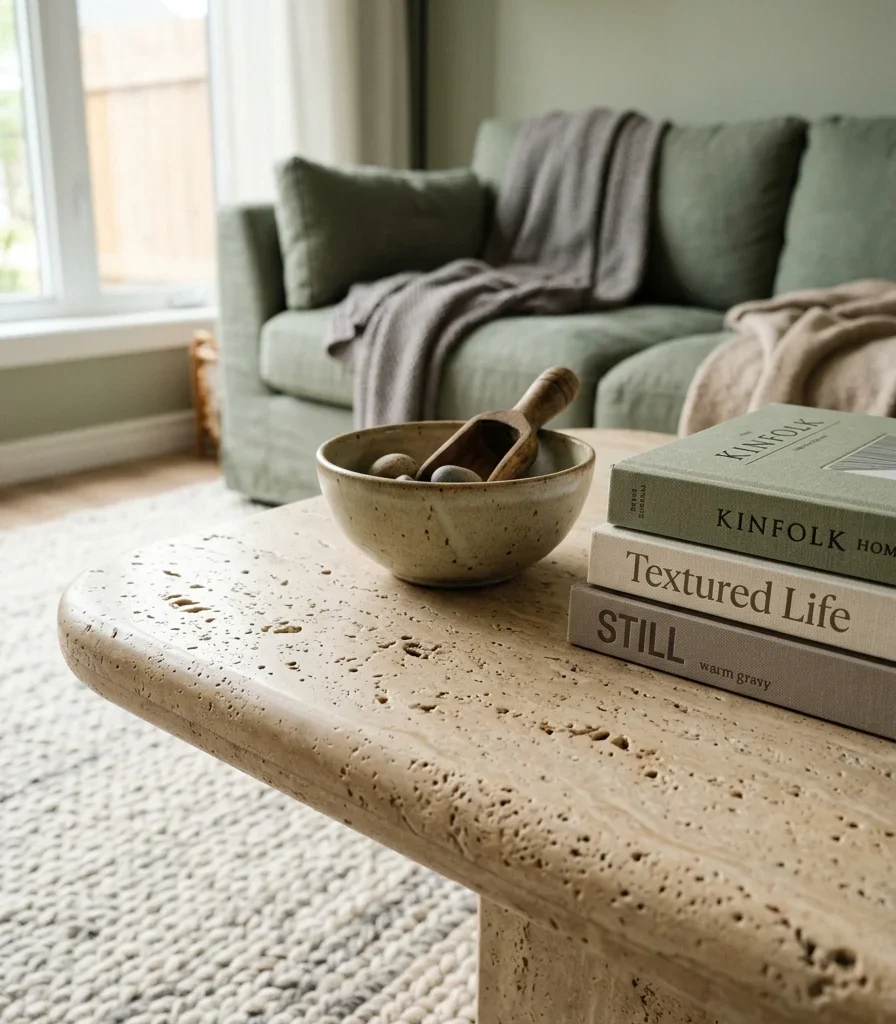
Vibe: Tactile a surface with more visual interest than any accessory placed on it.
Why it works: Honed travertine’s natural pitting provides material authenticity that glass or laminate can’t replicate; light catches its uneven surface differently at every angle. A rounded profile also softens the room the way the curved sofa does.
How to get it: Choose a round or oval travertine coffee table in a honed (matte) rather than polished finish. Polished stone throws hard reflections that compete with the room’s soft lighting scheme.
Shop The Look
| Product |
| Honed travertine coffee table round |
| Ceramic decorative bowl sage green |
| Small hardback book stack neutral |
| Travertine stone coaster set |
| Natural stone sealer for maintenance |
7. Textured Throw Pillows and Botanical Greenery
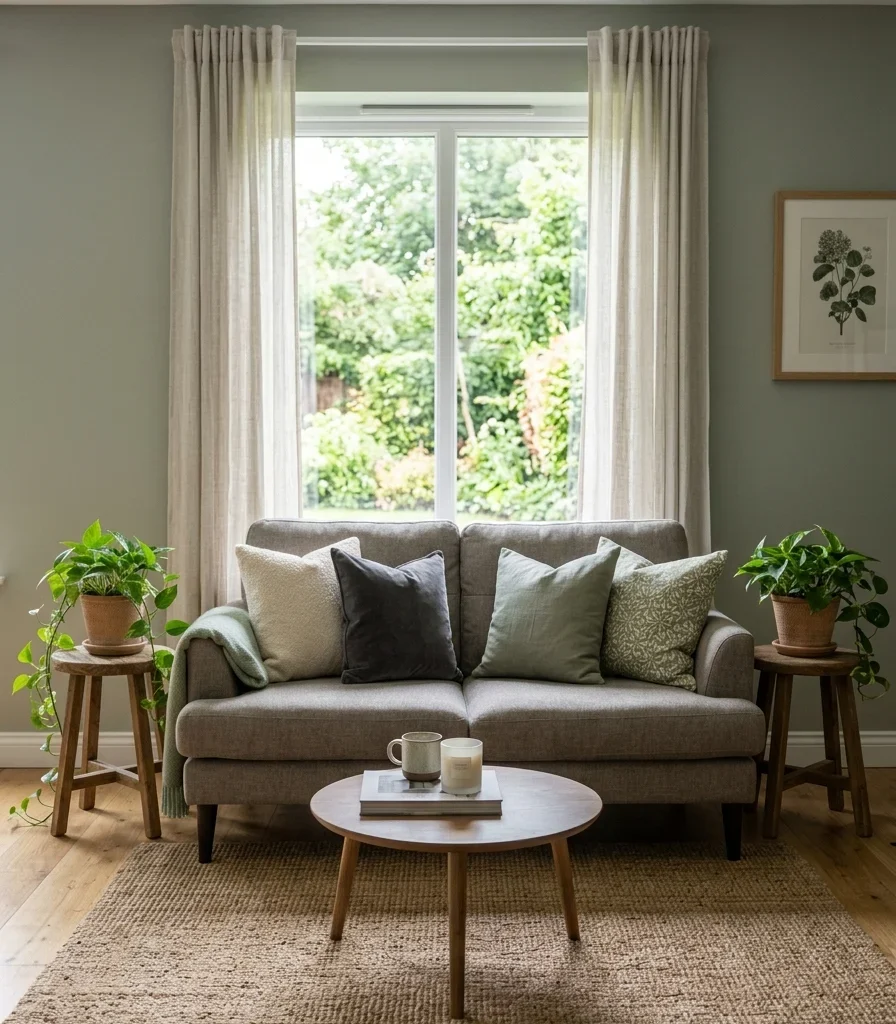
Vibe: Lush, the small living touch that keeps the room from feeling too composed.
Why it works: Mixing pillow textures boucle, linen, velvet within one narrow color range adds richness without a new hue, the same texture-layering principle used on the sofa and coffee table. A trailing plant grounds the painted sage tones in something alive.
How to get it: Style the sofa with five pillows in three different textures, all within the sage-to-charcoal range, and place one trailing pothos or philodendron in a terracotta or ceramic planter within view of the seating area.
💡 Quick Win: A single faux trailing plant on a plant stand beside the sofa delivers the same visual softness with zero watering required.
Shop The Look
| Product |
| Boucle throw pillow cover sage |
| Linen throw pillow cover charcoal |
| Velvet lumbar pillow cover warm gray |
| Trailing pothos plant faux or live |
| Ceramic planter pot sage glaze |
8. Defining a Conversation Zone With Rugs
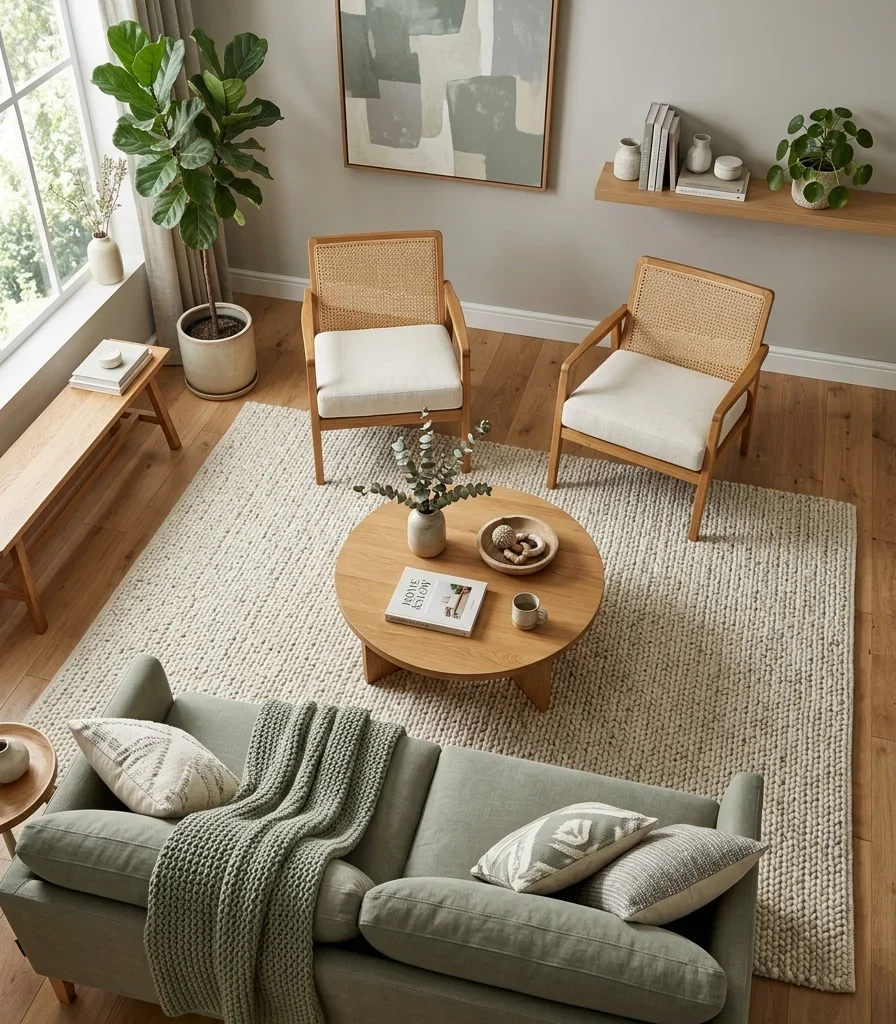
Vibe: Consider a room that reads as arranged rather than furniture placed at random.
Why it works: A properly sized rug applies zone definition; when every seating piece rests at least its front legs on the rug, the eye reads the grouping as one connected conversation area rather than scattered furniture.
How to get it: Size the rug so the sofa and both accent chairs can rest at least their front legs on it. For a standard living room, this usually means an 8×10 rug minimum, not the smaller 5×7 that leaves furniture floating off the edges.
Shop The Look
| Product |
| Wool area rug 8×10 warm gray |
| Non-slip rug pad underlay |
| Round coffee table centered oak |
| Sage green accent chair pair |
| Rug corner grippers set |
9. Layered Picture Lights and Dimmable Sconces
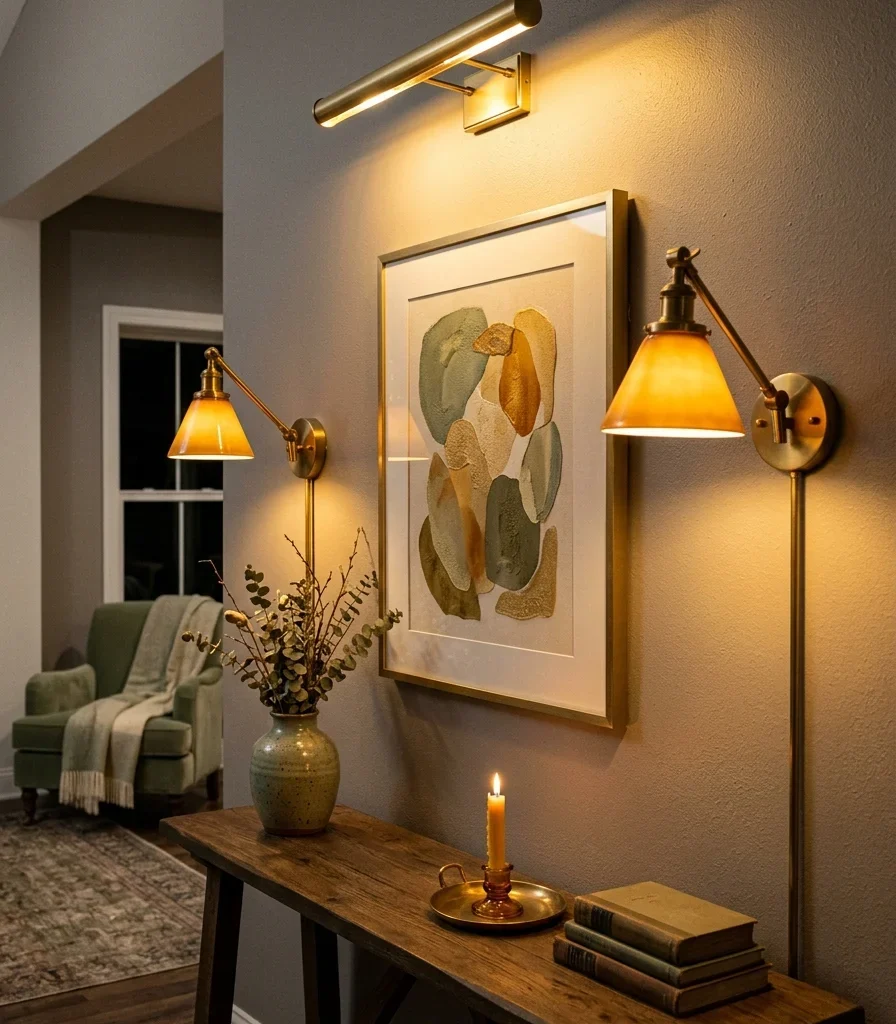
Vibe: Glowing light sources placed high enough to wash the walls instead of just the floor.
Why it works: Wall-mounted picture lights and sconces add light at eye level and above; illuminating vertical surfaces makes a room feel larger than relying on table and floor lamps alone, which only light the lower third of a space.
How to get it: Install a brass picture light above the room’s largest artwork and add one pair of dimmable sconces flanking a console or media unit, all on 2700K bulbs.
💡 Quick Win: A plug-in wall sconce with a hardwired look installs with no electrician needed, just a nearby outlet and a cord cover.
Shop The Look
| Product |
| Brass picture light for artwork |
| Dimmable wall sconce pair brass |
| Plug-in wall sconce with cord cover |
| Warm white 2700K LED bulb set |
| Console table narrow oak |
10. Mixed Accent Chairs for Visual Balance
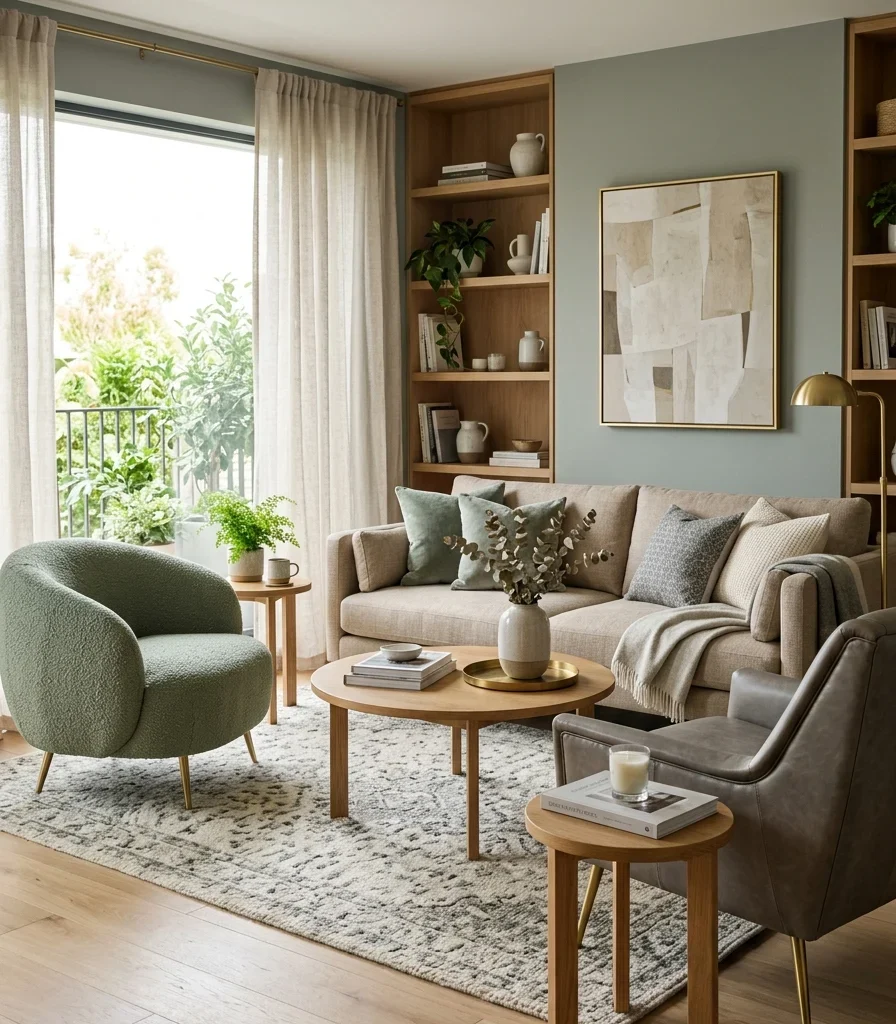
Vibe: Balanced seating group that feels curated rather than matched from a single showroom set.
Why it works: Pairing two different accent chairs in the two anchor colors, rather than a matching pair, balances visual weight. Each chair carries equal presence through matched scale and leg finish, even though the fabrics differ, so the room avoids feeling like a showroom set.
How to get it: Choose one sage boucle chair and one warm gray leather or performance-fabric chair, matched only in leg finish and general scale, and place them at a slight angle facing the sofa rather than in strict mirror symmetry.
Shop The Look
| Product |
| Sage green boucle accent chair |
| Warm gray leather accent chair |
| Brass tapered chair legs set |
| Small round side table oak pair |
| Ceramic coaster set for side tables |
11. Gallery Wall in Sage and Charcoal Tones
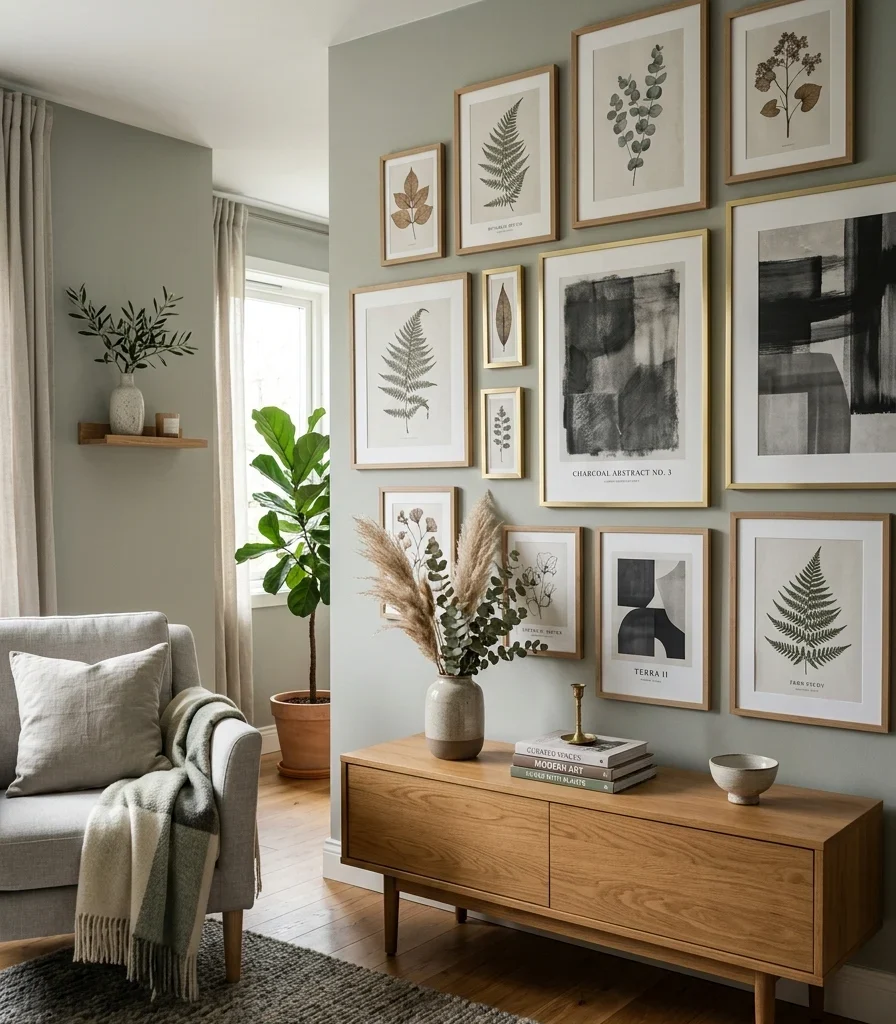
Vibe: Curated wall that signals this palette was chosen with intention.
Why it works: Mixing botanical prints with abstract charcoal canvases keeps the gallery tied to both anchor colors instead of drifting into unrelated hues, and varying frame widths between oak and brass adds the material mix this style relies on.
How to get it: Lay the arrangement out on the floor first using painter’s tape as a guide, mixing two botanical prints with two or three abstract pieces in sage and charcoal tones, spaced 5–8cm apart.
💡 Quick Win: Three botanical prints in identical oak frames, evenly spaced in a single row, create an instant gallery moment without any complex layout planning.
Shop The Look
| Product |
| Botanical print framed art set |
| Abstract charcoal canvas art set |
| Oak picture frame set assorted |
| Small floating wood shelf |
| Ceramic vase for shelf styling |
12. Vertical Layering for Compact Living Rooms
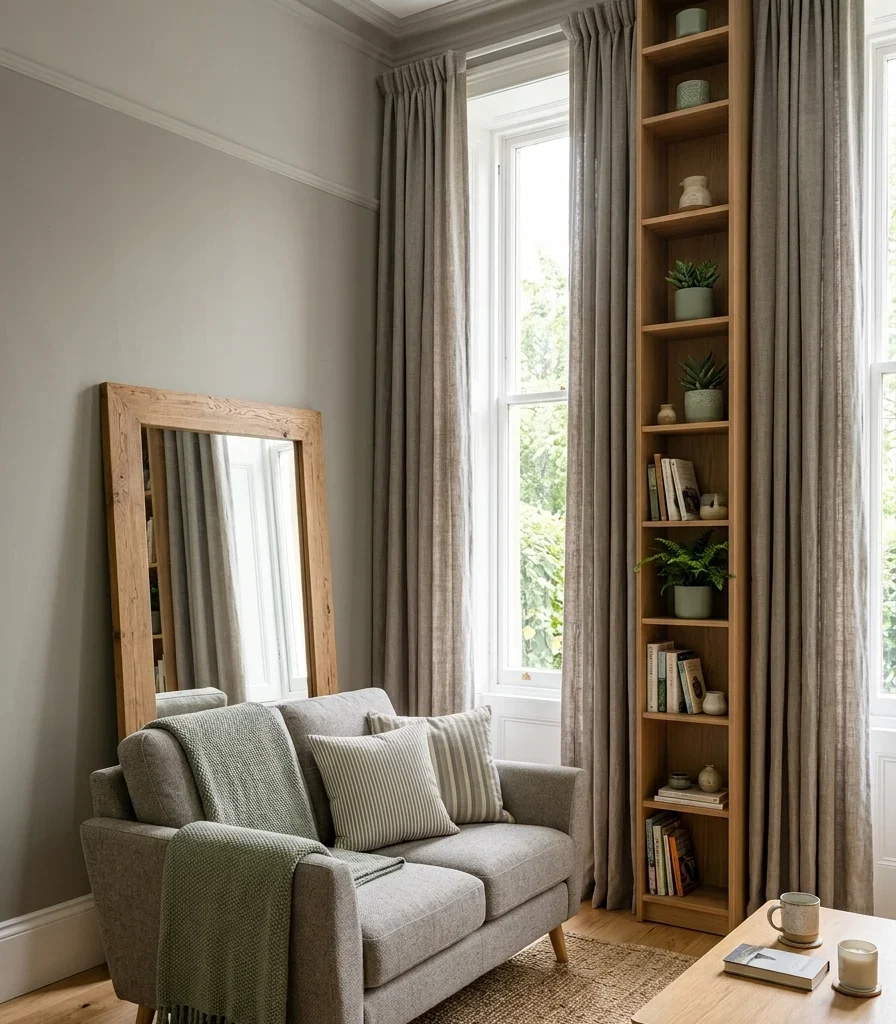
Vibe: Airy; prove this palette can live in a small room without feeling closed in.
Why it works: Vertical layering tall, narrow furniture and ceiling-height curtains draws the eye upward, making a compact room feel taller than its footprint. Keeping sage confined to small objects while gray carries the large surfaces prevents the palette from crowding a tight floor plan.
How to get it: Mount curtain rods at ceiling height in warm gray linen, add one tall narrow bookshelf in white oak, and reserve sage green for small accessories only: a planter, a stack of books, a single throw.
Shop The Look
| Product |
| Ceiling-height curtain rod extendable |
| Warm gray linen curtain panel pair |
| Tall narrow bookshelf white oak |
| Small sage green ceramic planter set |
| Leaning full-length mirror slim frame |
How to Start Your Sage Green Gray Living Room Transformation
Start with the sofa. Before choosing a wall color, a rug, or any accessories, decide whether your sofa will be gray or sage. This single decision determines every other color choice in the room, since everything else is selected to support whichever anchor color the largest piece of furniture carries.
The most common mistake beginners make is choosing a cool, blue-based gray instead of a warm gray, which fights against sage green rather than supporting it. The two undertones clash, and the room reads sterile instead of cozy. The fix is checking the paint’s undertone in natural daylight before buying; warm grays like “Agreeable Gray” or “Revere Pewter” lean beige, not blue.
Three items under $50 that make an immediate impact: a sage green ceramic vase ($20–$30) on the coffee table; a warm gray wool throw ($25–$40) draped over the sofa arm; and a warm white 2700K bulb set ($10–$14) replacing cool-white bulbs in existing lamps.
Realistic expectations: A starter version- new pillows, a throw, and a plant takes an afternoon and costs $100–$250. A full room transformation with new furniture, paint, and lighting runs $2,000–$6,000 and typically unfolds over six to ten weeks.
Frequently Asked Questions About Cozy Sage Green Gray Living Room Ideas
What is a sage green gray living room, and how is it different from a plain neutral living room?
A cozy sage green gray living room deliberately pairs two anchor colors: muted botanical sage and warm gray, rather than pulling from a broad neutral palette of beiges, tans, and whites. A plain neutral living room skips color almost entirely, while this style uses sage as a controlled, intentional accent that keeps the gray from feeling flat or corporate.
What shade of gray pairs best with sage green in a living room?
Warm grays with a beige or greige undertone, such as Benjamin Moore “Revere Pewter” or Sherwin-Williams “Agreeable Gray,” pair best because their warmth complements sage’s soft, grayed-green tone. Cool, blue-based grays clash with sage and should be avoided, since the two undertones pull the room in opposite temperature directions.
How much does it cost to decorate a living room in this style?
A budget-conscious refresh using pillows, a throw, and a few ceramic accents costs roughly $100–$250 and can be done in an afternoon. A fuller transformation with a new sofa, rug, and lighting typically runs $2,000–$6,000, depending on whether furniture is new or sourced secondhand.
Does this palette work with existing furniture, like a brown leather sofa or dark wood floors?
Yes, a brown leather sofa can stay in the room as long as new textiles and wall color lean into the sage-and-gray story, since leather’s warmth actually complements sage well. Dark wood floors ground the palette nicely too; just keep coffee and side tables in a lighter oak to avoid an all-dark furniture footprint.
What’s the single most important element for making this style feel cozy rather than cold?
Warm lighting is the deciding factor: 2700K bulbs and layered light sources (a floor lamp, a table lamp, and at least one wall-mounted fixture) keep the gray from reading sterile. Cool white or single-overhead lighting is the fastest way to make an otherwise well-styled sage and gray room feel like a waiting room instead of a living room.
Ready to Create Your Dream Sage Green Gray Living Room?
These 12 ideas cover the full range of what this palette can do, from the color-anchoring power of a sage accent wall, to the material richness of boucle and travertine, to small-space tricks that make a compact room feel just as layered as a large one. Building a room like this happens one throw pillow, one lamp, one wall at a time;n o rule says the whole space needs to change at once. If you’re starting today, pick one sage green accessory and set it against your current gray or neutral sofa to see how the pairing actually feels in your light. Once the textures are layered and the light is warm, this is the kind of living room that makes coming home feel like an actual exhale. Save the ideas that match your room’s light and size and start building your sage-and-gray moodboard tonight.
You Might Also Like
- 15 Modern Farmhouse Living Room Ideas
- 15 Smart Ways to Get More Function From an Open Living Room
- 12 Cozy Green Terracotta Bedroom Ideas Worth Saving
- 10 Black and Green Bedroom Design Ideas Worth Saving
- Modern Home Decor: 15 Ideas Worth Saving and Stealing
- 10 Open Kitchen Partition Ideas Worth Saving
[…] 12 Cozy Sage Green Gray Living Room Ideas Worth Saving […]