
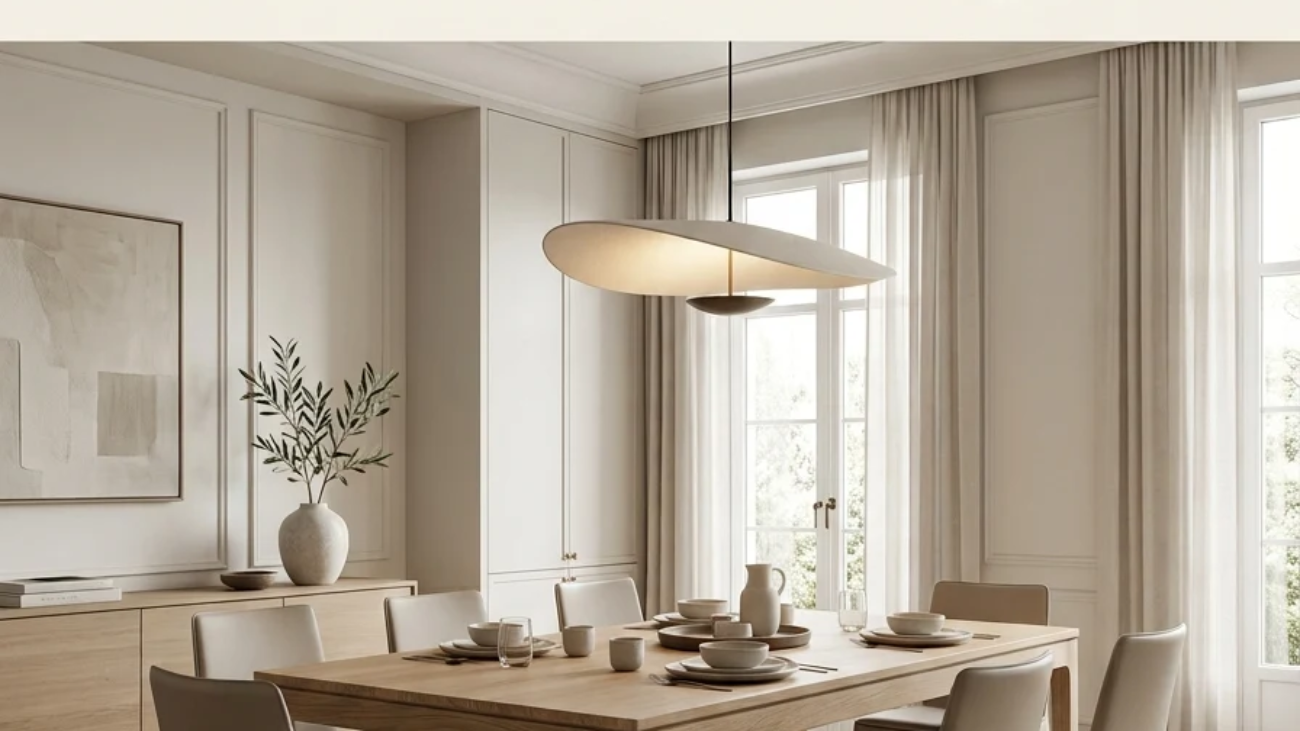
Minimalist dining room design strips a space down to only what serves the act of eating together, letting form, proportion, and material quality carry the room instead of decoration. This guide gives you 12 minimalist dining room ideas covering color, materials, lighting, and layout so you can build a room that feels complete rather than empty.
Picture a table lit by a single sculptural fixture, walls holding nothing but one considered object, and a silence in the room that isn’t absence but restraint. It’s a look built on confidence: every piece earns its place, every surface has room to breathe. Minimalist dining rooms feel finished the moment there’s nothing left to remove. Here are 12 ideas worth saving and stealing.
Why Minimalist Dining Room Ideas Work So Well
What is it? Minimalist dining room design draws from Bauhaus functionalism and Scandinavian modernism, both rooted in the belief that form should follow function and that unnecessary ornament weakens rather than enriches a space. It differs from Japandi, which adds warmth through natural wood grain and imperfection, by staying more austere and geometrically precise.
Materials and colors. Expect warm white, greige, and warm charcoal against solid oak, honed stone, matte black steel, and unbleached linen. A minimalist dining room might use only three materials total : ood, stone, and metal, repeated with total consistency rather than varied for interest.
Why it’s trending now. As homes fill with more possessions than ever, Pinterest data shows rising searches for “minimalist dining room” and “quiet luxury dining” reflecting a cultural pushback toward fewer, better-made pieces. The shift toward hosting smaller, more intentional gatherings post-pandemic has also made the dining room a space people want to feel calm in, not cluttered.
Can small spaces achieve this? Yes, minimalist design was arguably built for small rooms. Prioritize one round table with a pedestal base and a single light fixture; a small dining room with restraint reads as intentional, while a small room stuffed with mismatched pieces reads as cramped.
Style at a Glance
| Element | Core Trait 1 | Core Trait 2 |
| Philosophy | Form follows function | Quality over quantity |
| Materials | Solid oak, honed stone, matte black steel | Unbleached linen, blown glass, powder-coated metal |
| Color palette | Warm white, greige | Warm charcoal, soft black |
12 Minimalist Dining Room Ideas
1. Solid Oak Dining Table with Exposed Joinery
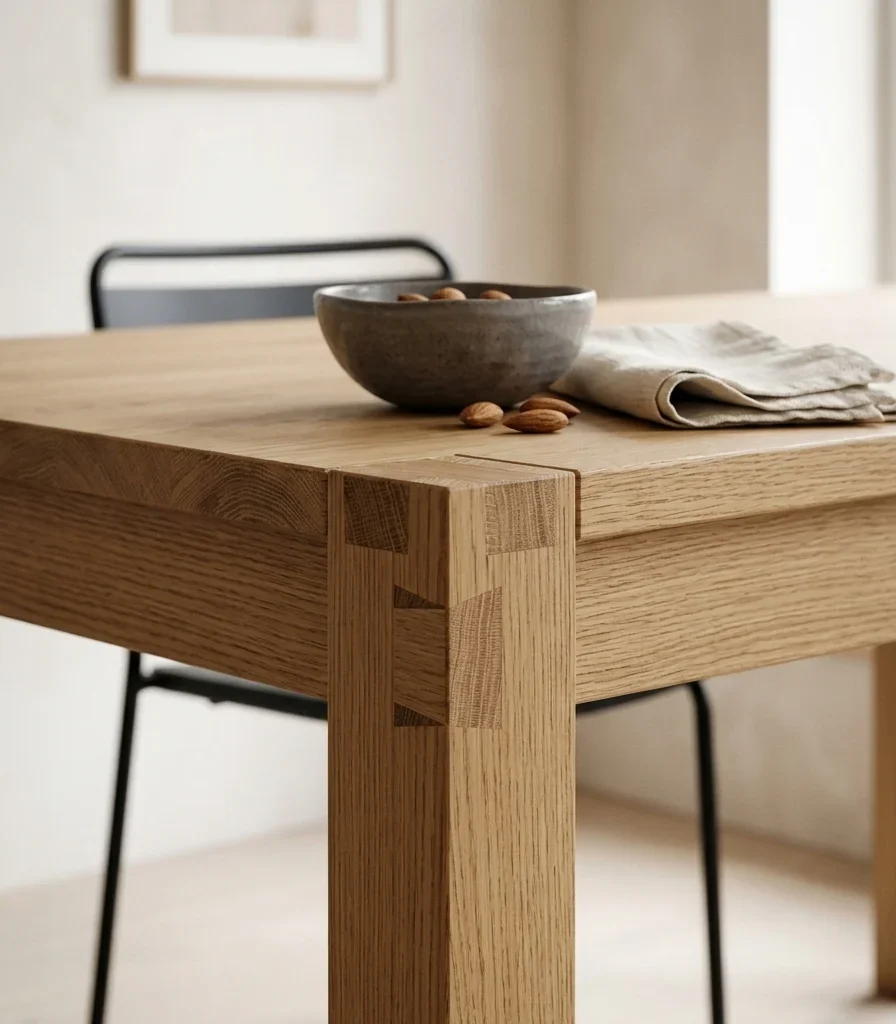
Vibe: Grounded the table anchors the room through craft, not size.
Why it works: Exposed joinery makes the table’s construction visible rather than hidden, a design principle that treats structural honesty as decoration itself, so the piece needs no additional ornament to feel finished.
How to get it: Choose a solid oak table with visible mortise-and-tenon leg joints and a matte oil finish rather than a high-gloss lacquer, which would compete with the wood grain instead of showing it.
💡 Quick Win: An oiled oak table runner in the same wood tone can visually extend the table’s material story without buying new furniture.
Shop the Look
| Product |
| Solid oak dining table exposed joinery |
| Matte oil wood finish |
| Ceramic serving bowl minimal |
| Linen napkin set undyed |
| Wood table runner oak |
2. Warm White Walls with a Single Charcoal Accent
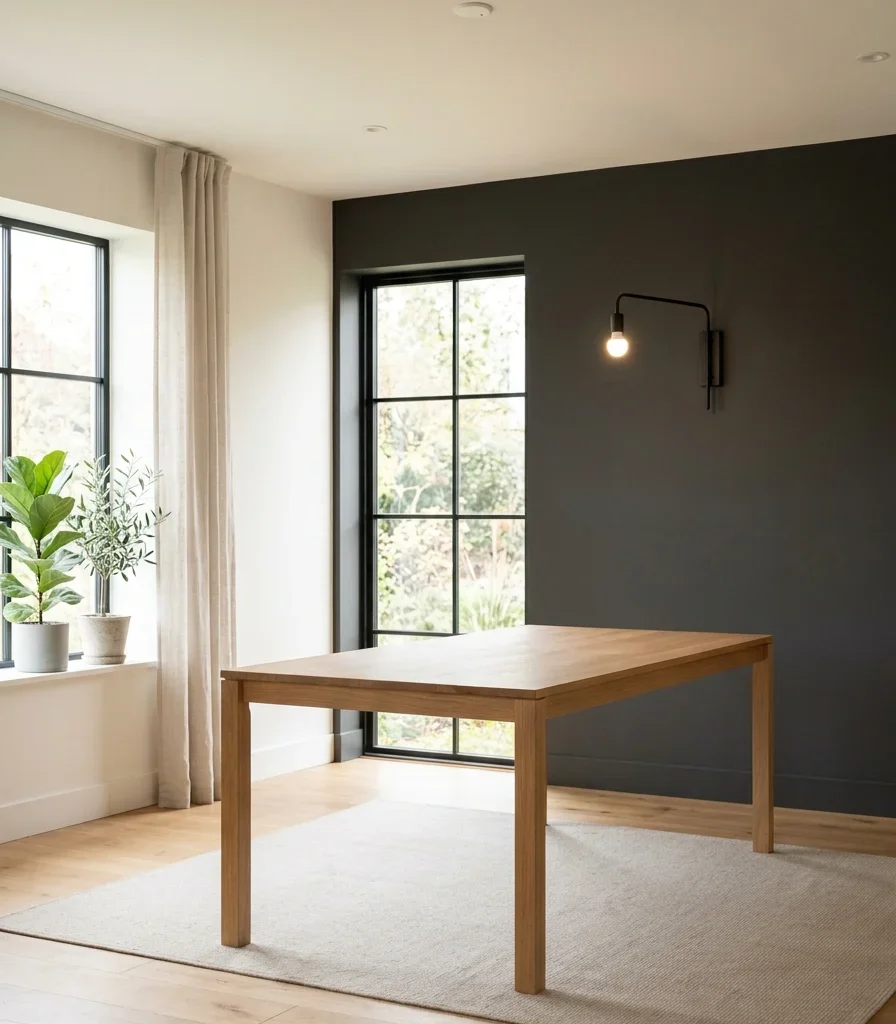
Vibe: Still, the contrast reads as calm, not dramatic.
Why it works: Limiting the darker tone to one wall creates value contrast that gives the room depth without introducing a second decorative element, keeping the palette to exactly two colors plus wood.
How to get it: Paint three walls in warm white and the wall behind the table in warm charcoal, choosing a matte finish on both so light doesn’t bounce unevenly between them.
Shop the Look
| Product |
| Warm white matte wall paint |
| Warm charcoal matte wall paint |
| Brass wall sconce minimal |
| Oak dining chair set |
| Ceramic centerpiece bowl |
3. Sculptural Pendant as the Room’s Only Light Source
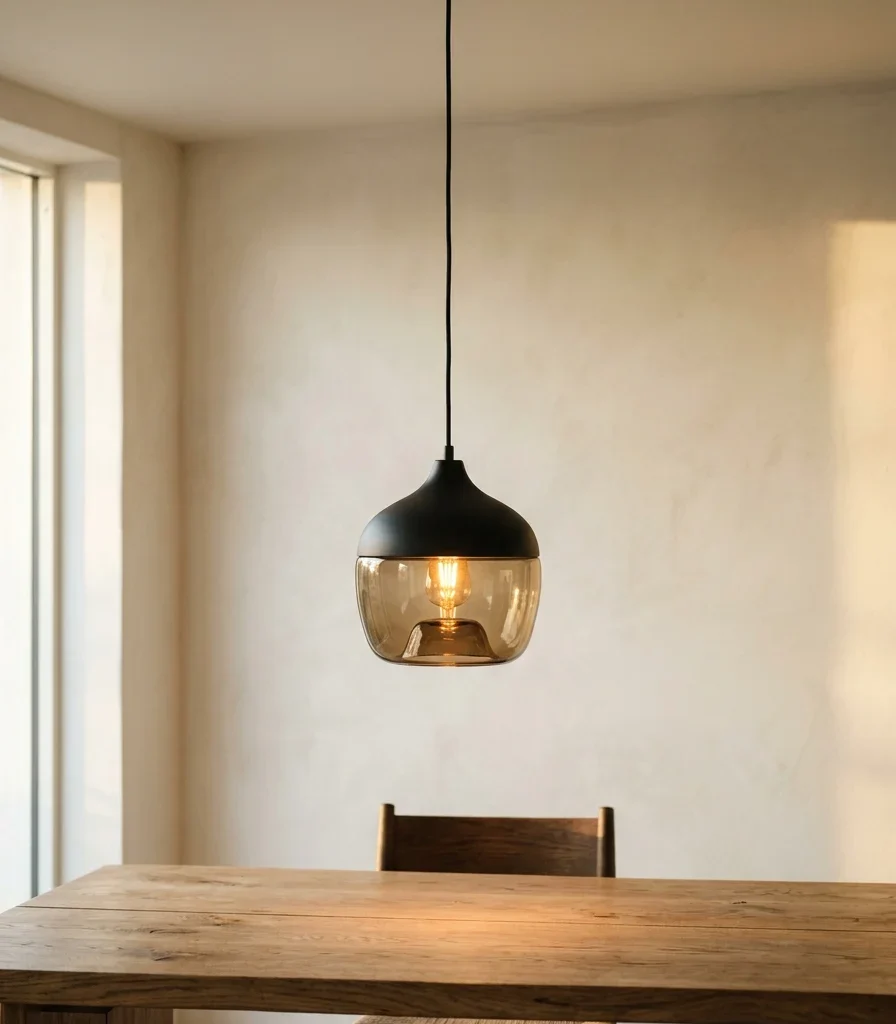
Vibe: Warm one fixture doing the work of an entire lighting plan.
Why it works: Relying on a single, sculptural pendant rather than layered ambient and accent lighting forces the fixture itself to become the room’s visual centerpiece, using negative space in the lighting plan the same way the room uses it in furniture.
How to get it: Hang the pendant 30 to 34 inches above the tabletop, centered exactly over the table’s midpoint rather than the room’s, and choose a matte black or hand-blown glass form with no visible hardware beyond the cord.
Shop the Look
| Product |
| Sculptural pendant light matte black |
| Blown glass pendant shade |
| Ceiling canopy plate black |
| Dimmer switch single-pole |
| Warm LED bulb 2700K |
4. Matching Set of Six Chairs, No More
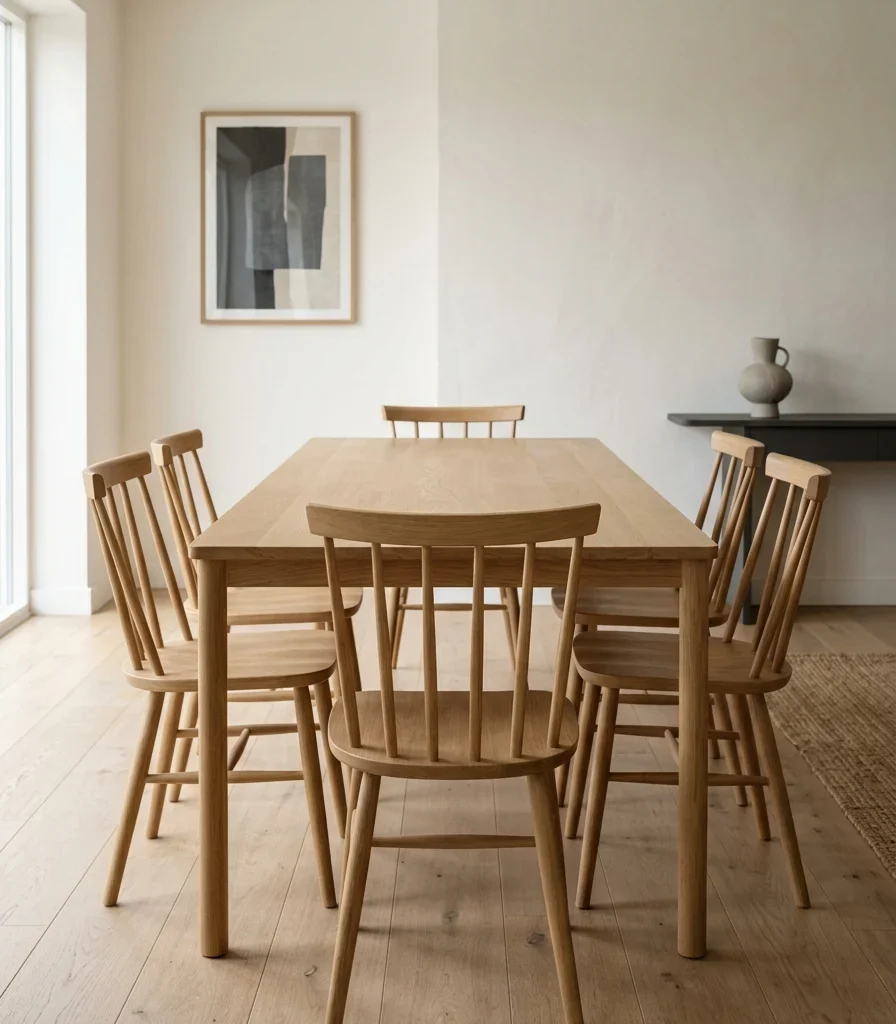
Vibe: Layered repetition creates rhythm instead of monotony.
Why it works: Six identical chairs repeat one silhouette around the table, using visual rhythm rather than variety to create interest, which is the opposite approach from eclectic dining rooms that mix chair styles deliberately.
How to get it: Choose one chair design in solid oak or matte black steel and commit to it for every seat at the table, resisting the urge to add a single “statement” head chair that would break the repetition.
💡 Quick Win: If budget only allows for four matching chairs now, leave the remaining seats empty rather than filling them with mismatched pieces.
Shop the Look
| Product |
| Oak dining chair set of six |
| Matte black steel dining chair |
| Chair leg felt pads |
| Linen seat cushion set |
| Wood care oil finish |
5. One Ceramic Vase, No Centerpiece Clutter
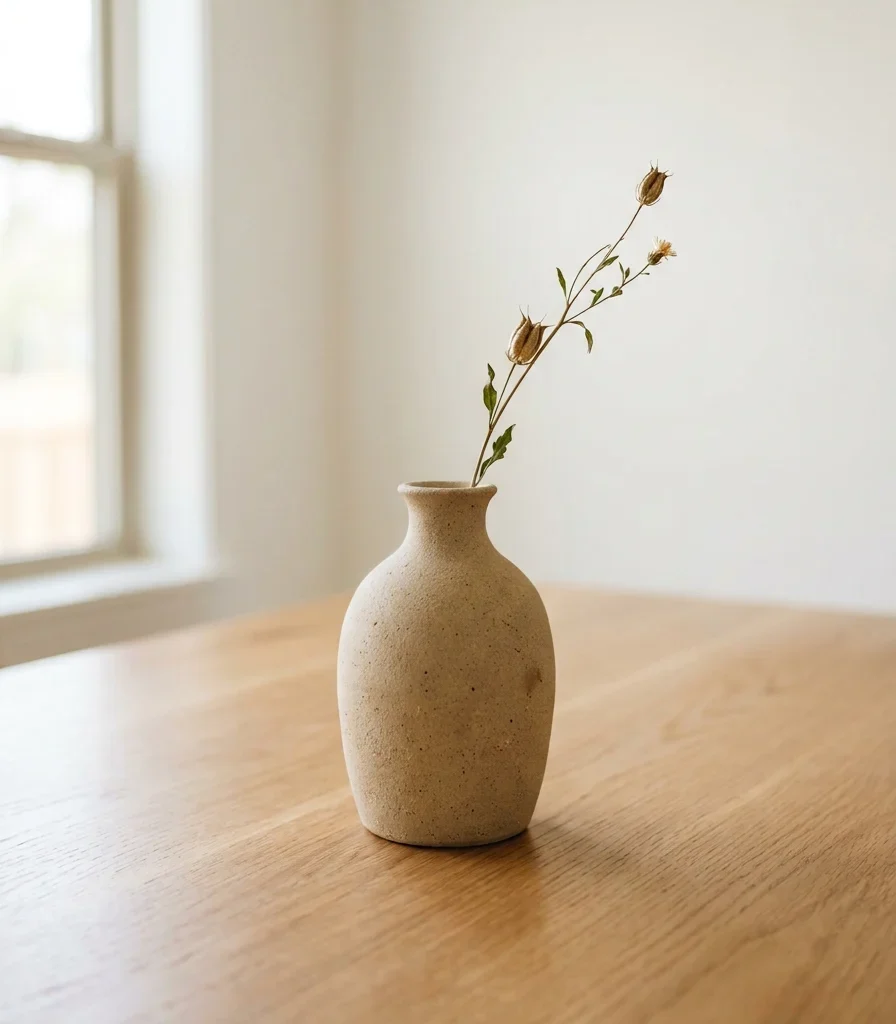
Vibe: Quiet one object holds the entire table’s attention.
Why it works: A single vase with a single stem uses negative space as the primary design tool, letting the empty tabletop around it read as intentional rather than unfinished,-the core discipline that separates minimalism from simply “not decorated yet.”
How to get it: Choose one matte, unglazed ceramic vase in a neutral tone and place a single stem or branch, resisting the instinct to add a runner, candles, or additional objects around it.
Shop the Look
| Product |
| Matte ceramic vase unglazed |
| Single stem dried branch |
| Linen table runner oat |
| Ceramic pillar candle holder |
| Wood trivet minimal |
6. Honed Stone Tabletop
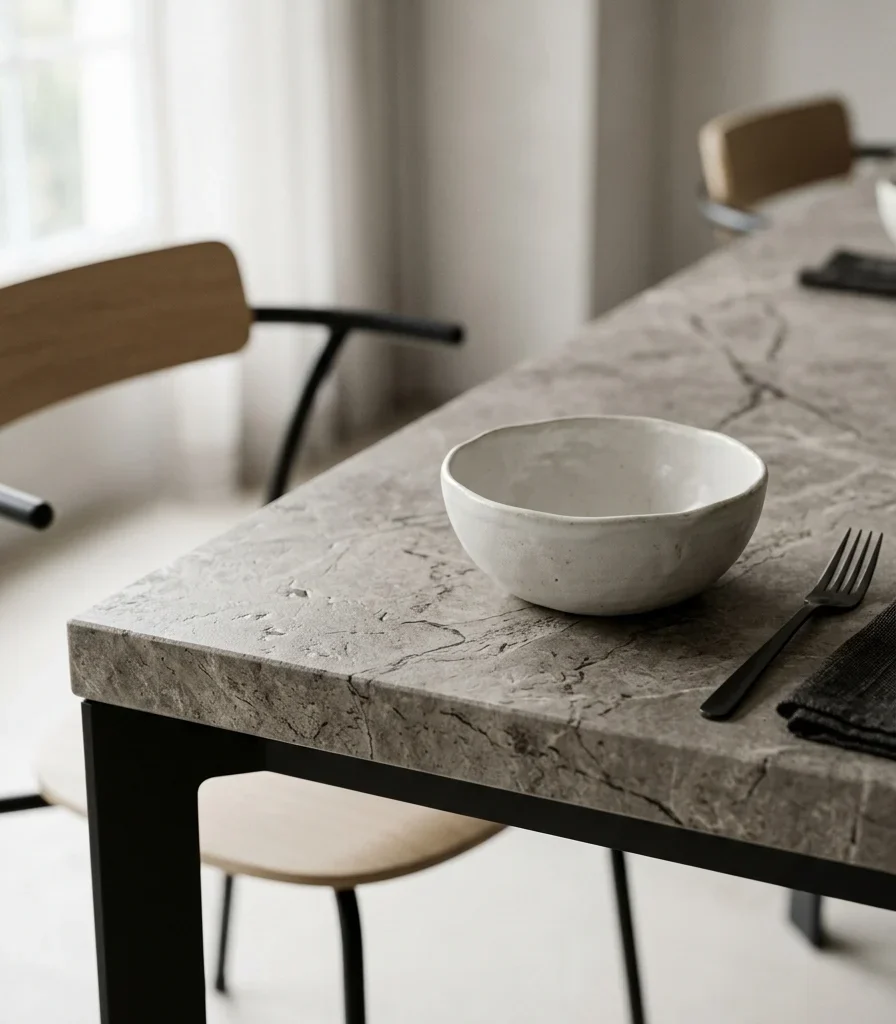
Vibe: Luminous the stone catches light without shining.
Why it works: A honed rather than polished finish keeps the stone’s natural veining visible while eliminating glare, so the tabletop reads as a material feature rather than a reflective surface competing with the room’s lighting.
How to get it: Choose a honed marble or limestone tabletop on a matte black steel base, keeping the base as thin as possible so the stone’s visual weight isn’t doubled by a bulky frame.
Shop the Look
| Product |
| Honed stone dining table |
| Matte black steel table base |
| Ceramic serving bowl matte |
| Stone coaster set |
| Linen placemat set |
7. Monochrome Greige Palette Top to Bottom
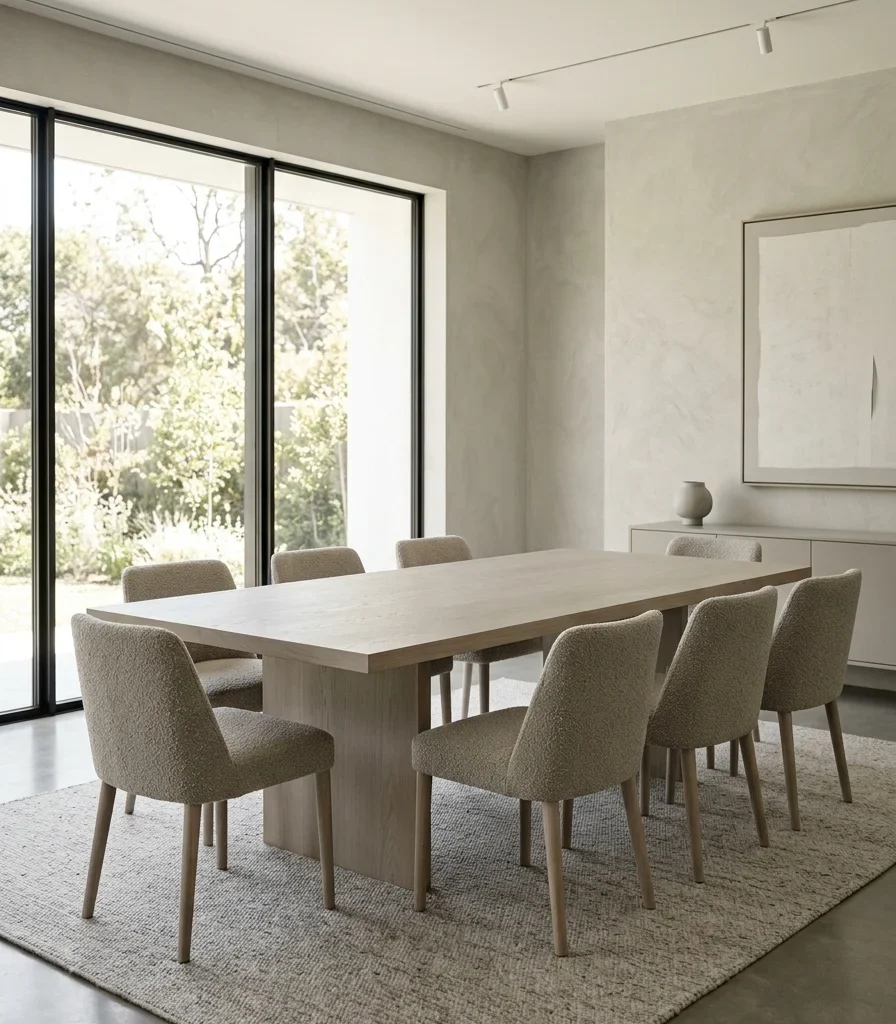
Vibe: Serene the eye has nowhere jarring to land.
Why it works: Keeping walls, flooring, and upholstery within one tonal family removes color contrast as a source of visual noise entirely, relying instead on subtle texture differences between matte paint, woven upholstery, and wood grain to create depth.
How to get it: Choose a single greige as the base tone and select flooring, wall paint, and chair upholstery all within two shades of that color, letting material texture rather than color do the work of variety.
💡 Quick Win: Test the monochrome approach first with seat cushions in the same greige as the walls before recovering an entire chair set.
Shop the Look
| Product |
| Greige matte wall paint |
| Greige linen chair upholstery fabric |
| Wool area rug greige |
| Ceramic object neutral tone |
| Taupe linen table runner |
8. Open Sightline Between Dining and Kitchen
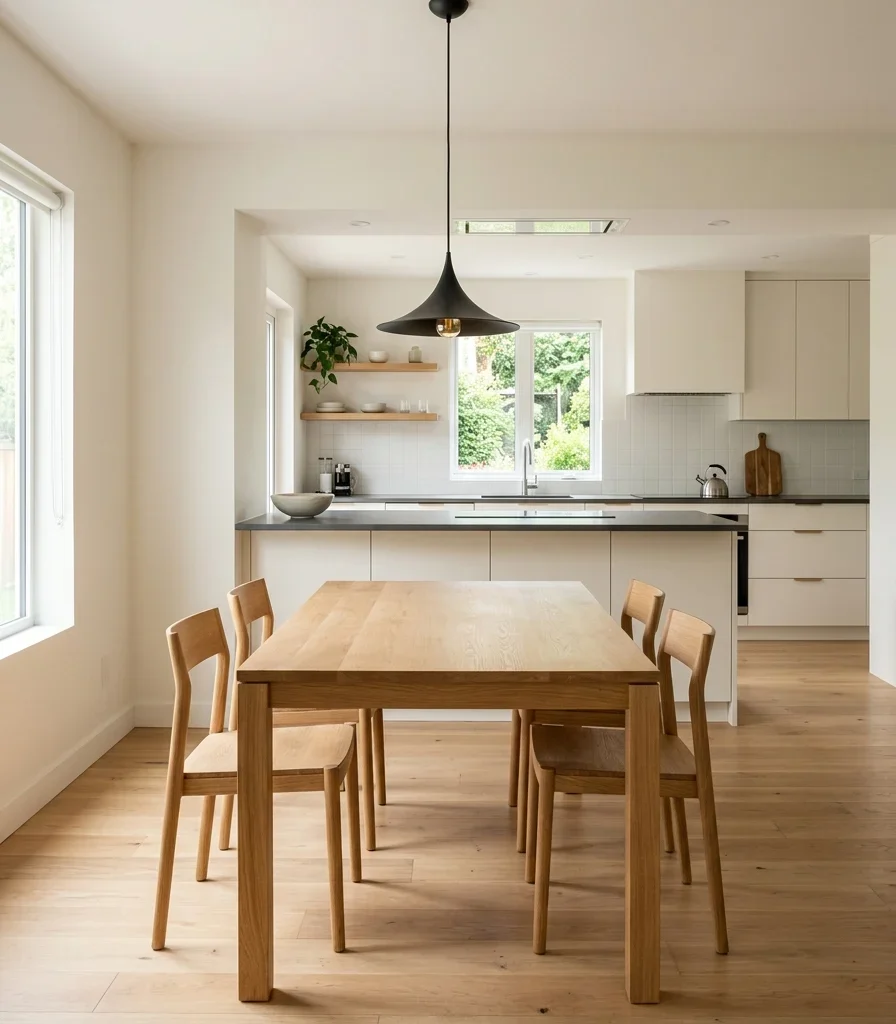
Vibe: Airy the dining room feels larger by sharing its view.
Why it works: Keeping the sightline between the dining and kitchen zones clear of tall furniture or partitions lets both spaces borrow visual volume from each other, a layout principle that makes each room register as more spacious than its actual footprint.
How to get it: Position the dining table so no chair back or sideboard sits directly in the sightline from the kitchen, and choose furniture no taller than counter height along that line of sight.
Shop the Look
| Product |
| Low profile sideboard oak |
| Counter-height bar stool |
| Sculptural pendant light |
| Oak dining chair set |
| Ceramic serving platter |
9. Bench Seating on One Side for Visual Lightness
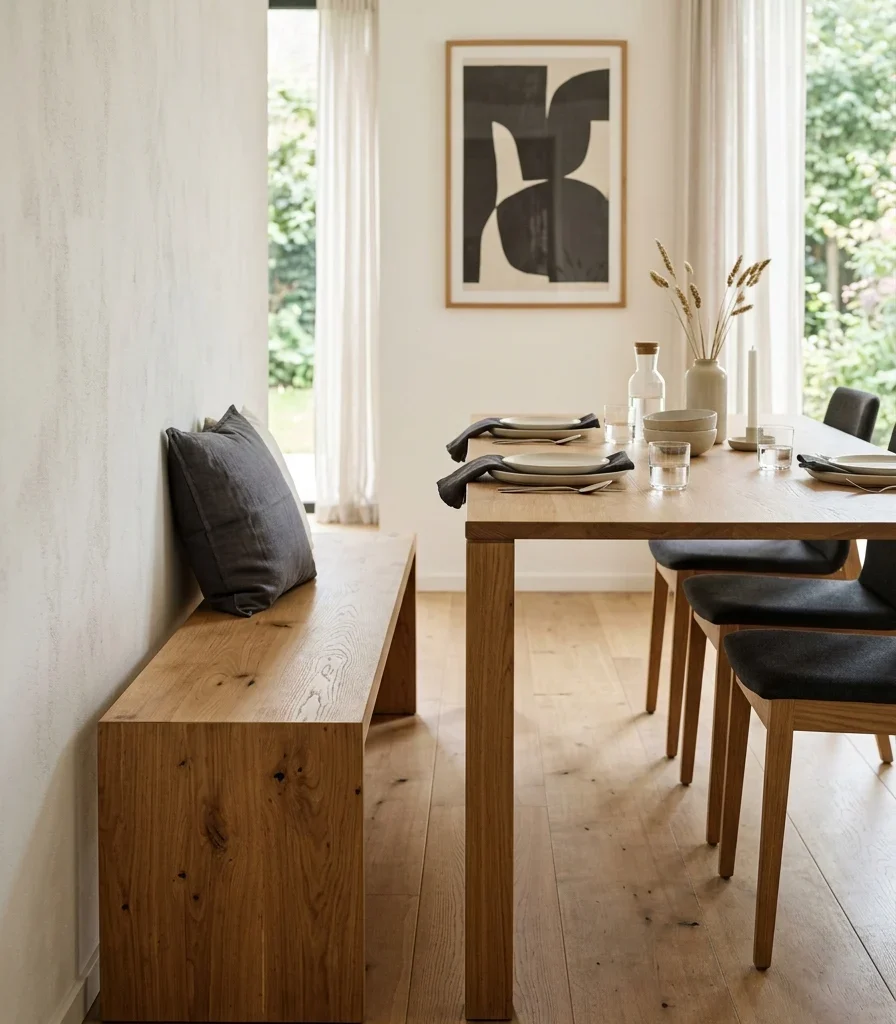
Vibe: Layered; one side of the table reads lighter than the other on purpose.
Why it works: A backless bench takes up less visual mass than four individual chairs would on the same side, using asymmetry deliberately to keep the room from feeling overcrowded with repeated chair silhouettes.
How to get it: Pair a single solid oak bench along the wall-facing side of the table with individual chairs on the open side, matching the bench’s wood tone exactly to the table rather than the chairs.
Shop the Look
| Product |
| Solid oak dining bench |
| Linen bench cushion |
| Oak dining chair pair |
| Wood care oil finish |
| Ceramic centerpiece bowl |
10. Dimmable Linear Chandelier Over a Long Table
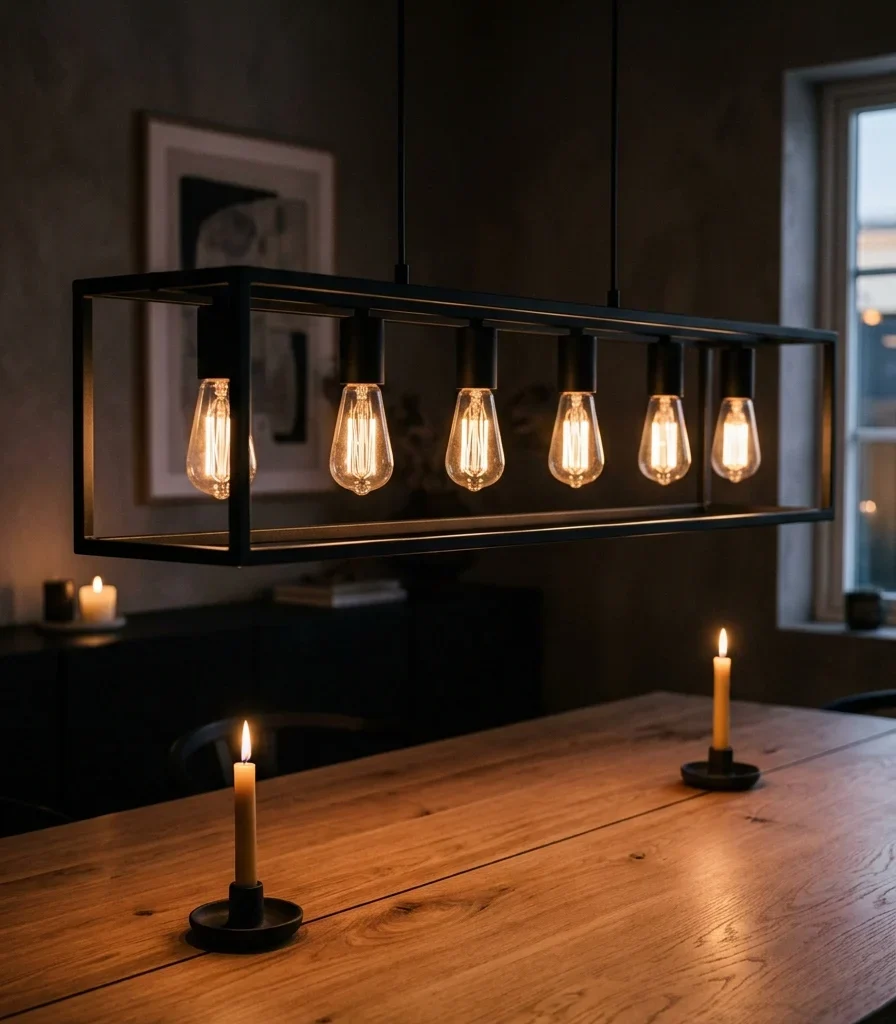
Vibe: Intimate the long table finally has light stretched to match its length.
Why it works: A linear fixture matches the light source’s shape to the table’s proportion, avoiding the single dark ends that a round pendant leaves on a long rectangular table, which is a proportion-matching principle specific to elongated rooms.
How to get it: Choose a linear chandelier sized to roughly two-thirds the table’s length, wired to a dimmer so it can shift from bright daytime use to a low, warm evening glow.
💡 Quick Win: If a linear fixture isn’t in budget yet, two matching pendants spaced evenly over a long table create a similar stretched-light effect.
Shop the Look
| Product |
| Linear chandelier matte black |
| Dimmer switch single-pole |
| Warm LED bulb 2700K |
| Ceiling mount plate black |
| Long dining table oak |
11. A Single Piece of Wall Art, Nothing Else
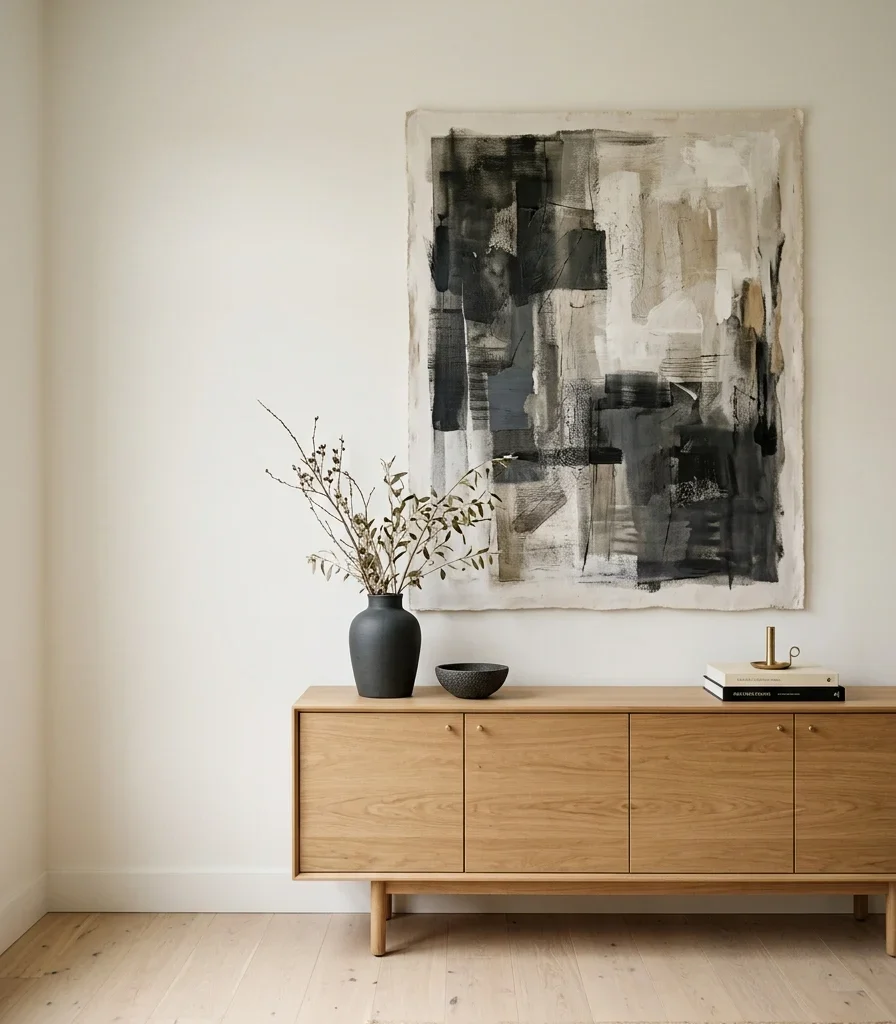
Vibe: Quiet the wall holds one idea instead of a gallery of them.
Why it works: A single large-scale piece uses proportion rather than quantity to fill a wall, letting negative space around the frame do the same visual work that multiple smaller pieces would need a full gallery arrangement to achieve.
How to get it: Choose one abstract or tonal canvas sized to roughly two-thirds the width of the furniture beneath it, hung with its center at 60 inches, and resist adding a second piece nearby.
Shop the Look
| Product |
| Abstract canvas art large scale |
| Low profile sideboard oak |
| Picture hanging hardware heavy duty |
| Ceramic object for sideboard |
| Linen table runner neutral |
12. Round Table with a Pedestal Base to Save Corners
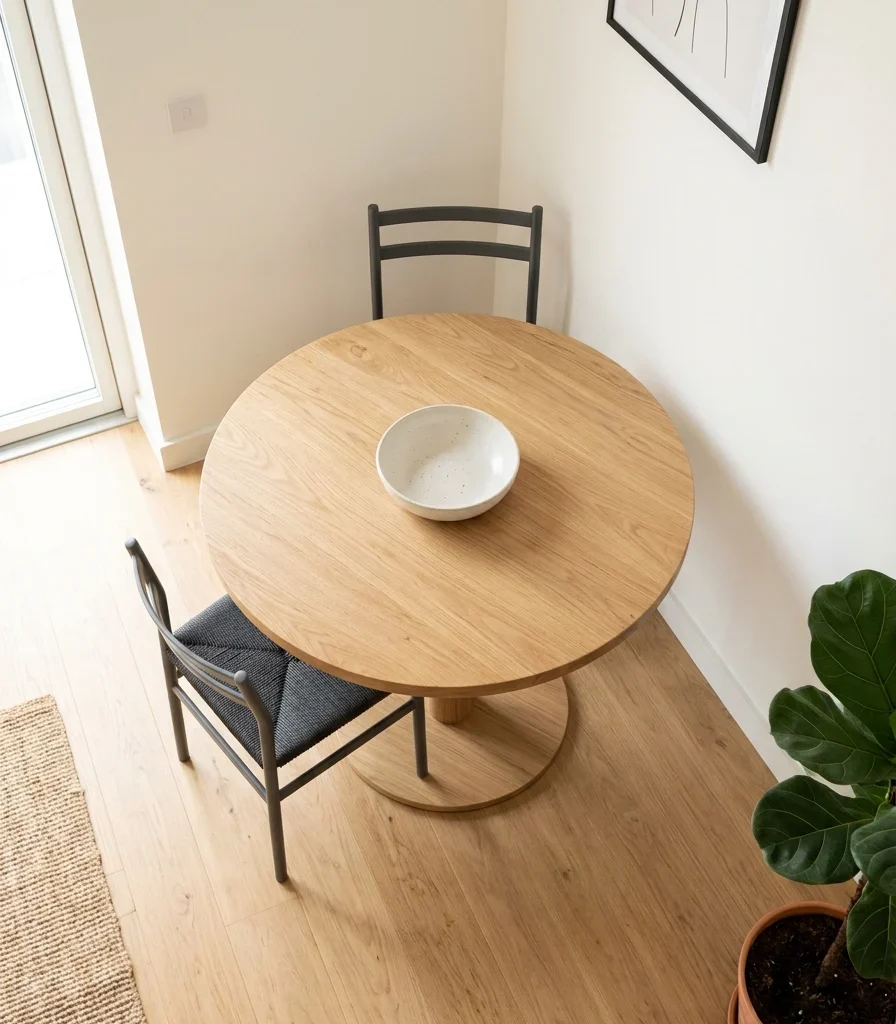
Vibe: Airy a small room stops feeling like it’s negotiating with furniture.
Why it works: A pedestal base eliminates the four table legs a small room’s traffic path would otherwise have to navigate around, an illusion technique that frees floor space and lets chairs tuck fully underneath without leg interference.
How to get it: Choose a round table on a single central pedestal, sized so the table’s diameter leaves at least 36 inches of clearance to the nearest wall on every side.
Shop the Look
| Product |
| Round oak dining table pedestal base |
| Oak dining chair pair slim profile |
| Small ceramic centerpiece bowl |
| Compact pendant light |
| Wool rug round small |
How to Start Your Minimalist Dining Room Transformation
Your first move should be the table, not the wall color. A solid oak or honed stone table is the single piece every other decision in the room gets measured against, and choosing it first prevents the common trap of decorating around furniture that doesn’t actually anchor the space.
The most common mistake is over-decorating the tabletop with a runner, candles, and a centerpiece all at once, which crowds the exact surface minimalism is meant to keep clear. Fix it by choosing one object only a vase or a bowl and removing everything else before deciding the table needs more.
Three items under $50 that create real impact fast: a matte unglazed ceramic vase with a single dried branch (around $24), a set of linen napkins in undyed natural fabric (around $22), and chair leg felt pads to keep the room visually quiet and scratch-free (around $8).
A weekend refresh paint, lighting swap, and clearing clutter costs $150–$350. A full room transformation with a new table, chairs, and lighting runs $2,500–$8,000 and typically takes three to six weeks depending on furniture lead times.
Frequently Asked Questions About Minimalist Dining Room Ideas
What is the difference between minimalist and Scandinavian dining room design?
Minimalist dining rooms prioritize the fewest possible elements and strict material discipline, while Scandinavian design allows more texture and warmth through wool, sheepskin, and pale wood tones. Scandinavian rooms often include layered textiles that a strict minimalist room would remove entirely. Both share light color palettes, but minimalism is defined more by restraint in quantity than by any specific material.
What colors work best in a minimalist dining room?
Warm white and greige as base tones, with a single warm charcoal accent wall or piece of furniture, is the most reliable minimalist palette. Avoid introducing more than one accent color, since minimalism depends on tonal restraint rather than variety. A charcoal dining chair set against warm white walls is one of the most searched minimalist color pairings.
How much does it cost to decorate a minimalist dining room?
A budget refresh with paint, a vase, and lighting adjustments runs $150–$400. A mid-range update adding new chairs and a pendant light lands between $1,000–$3,000. A full room transformation with a new table, matching chair set, and a sculptural light fixture typically costs $3,000–$10,000 depending on material choices like solid stone versus laminate.
Does minimalist style work in a small dining room?
Yes, and small rooms often benefit most from it. Prioritize a round pedestal table over a rectangular one to free corner space, choose a single compact light fixture, and limit seating to exactly what fits without crowding the walkway. Avoid a large sideboard or bench in addition to chairs, which can quickly overwhelm a room under 100 square feet.
What kind of lighting is best for a minimalist dining room?
A single sculptural pendant or linear chandelier in matte black steel, sized to match the table’s shape and hung 30 to 34 inches above the surface, is the most reliable minimalist dining room lighting choice. This avoids the layered ambient and accent lighting that busier styles rely on. Wiring the fixture to a dimmer lets one light source cover both bright daytime use and a low evening glow.
Ready to Create Your Dream Minimalist Dining Room?
These 12 ideas cover color, material, lighting, and layout, so there’s a genuine entry point whether you’re starting with an empty room or editing down one that already feels crowded. Starting small is not a lesser version of this style; removing one object from the table tonight is a legitimate first step, not a placeholder for a full renovation later. Today, clear your dining table down to a single object and notice how the room reads with that much open surface. Once the room comes together, sitting down to eat should feel less like using a room and more like the deliberate pause this style was designed to create. Save the ideas that matched your table, your light, and the one object you’re not ready to remove, and start there.
[…] 12 Minimalist Dining Room Ideas for a Room That Says Enough […]